The Future Brand Manifesto … How to build brands that shape markets, inspire people and unlock new growth in a world of AI and intelligent agents … and become more human, more intelligent, and more valuable
October 13, 2026
The future of brands is being rewritten. And with it, the future of marketing.
AI is transforming how people discover, evaluate and buy products. Technologies are converging to create extraordinary new possibilities. Industry boundaries are dissolving, new competitors are emerging from unexpected directions, and intelligent agents are beginning to act on behalf of customers. These changes are not simply disrupting how businesses communicate. They are redefining how markets work, where competitive advantage comes from and how companies create value.
Yet perhaps the biggest challenge for marketing is not technological. It is strategic. Marketing has become increasingly sophisticated at driving today’s sales, while becoming less influential in shaping tomorrow’s business.
Over the past two decades, digital technologies have transformed the profession. Social media, search engine optimisation, programmatic advertising, performance marketing, dynamic pricing and customer analytics have created unprecedented opportunities to reach, target and convert customers. These capabilities have delivered enormous value, but they have also created a temptation to focus disproportionately on what can be measured immediately: clicks, impressions, conversion rates, acquisition costs and short-term returns on advertising expenditure.
The result is a paradox. At a time when markets are being fundamentally reinvented, marketing risks becoming more tactical, transactional and myopic. Instead of shaping customer aspirations, it optimises responses to existing demand. Instead of creating new markets, it competes for attention within established ones. Instead of driving innovation and profitable growth, it increasingly becomes a support function for sales. The danger is not digital marketing itself, but allowing digital tools and short-term metrics to define the ambition of marketing.
Marketing should be one of the most strategic capabilities of any business. It should help leaders understand how the world is changing, anticipate where customer value is shifting, identify opportunities beyond existing categories, shape new propositions and build the brands and ecosystems that accelerate profitable growth. Its role should extend from understanding markets to making markets, from communicating innovation to driving it, and from supporting commercial performance to shaping the strategic progress of the business.
Marketing should not simply help the business sell what it makes. It should help the business imagine and create what it could become.
This is the opportunity behind the Future Brand Manifesto: to rediscover the strategic role of brands and marketing in a world of intelligent technologies, changing customer aspirations and unprecedented opportunities for business reinvention. At its heart is a powerful combination: using AI to make brands more intelligent, while drawing on humanity to make them more meaningful. The greatest potential comes when the two work together.
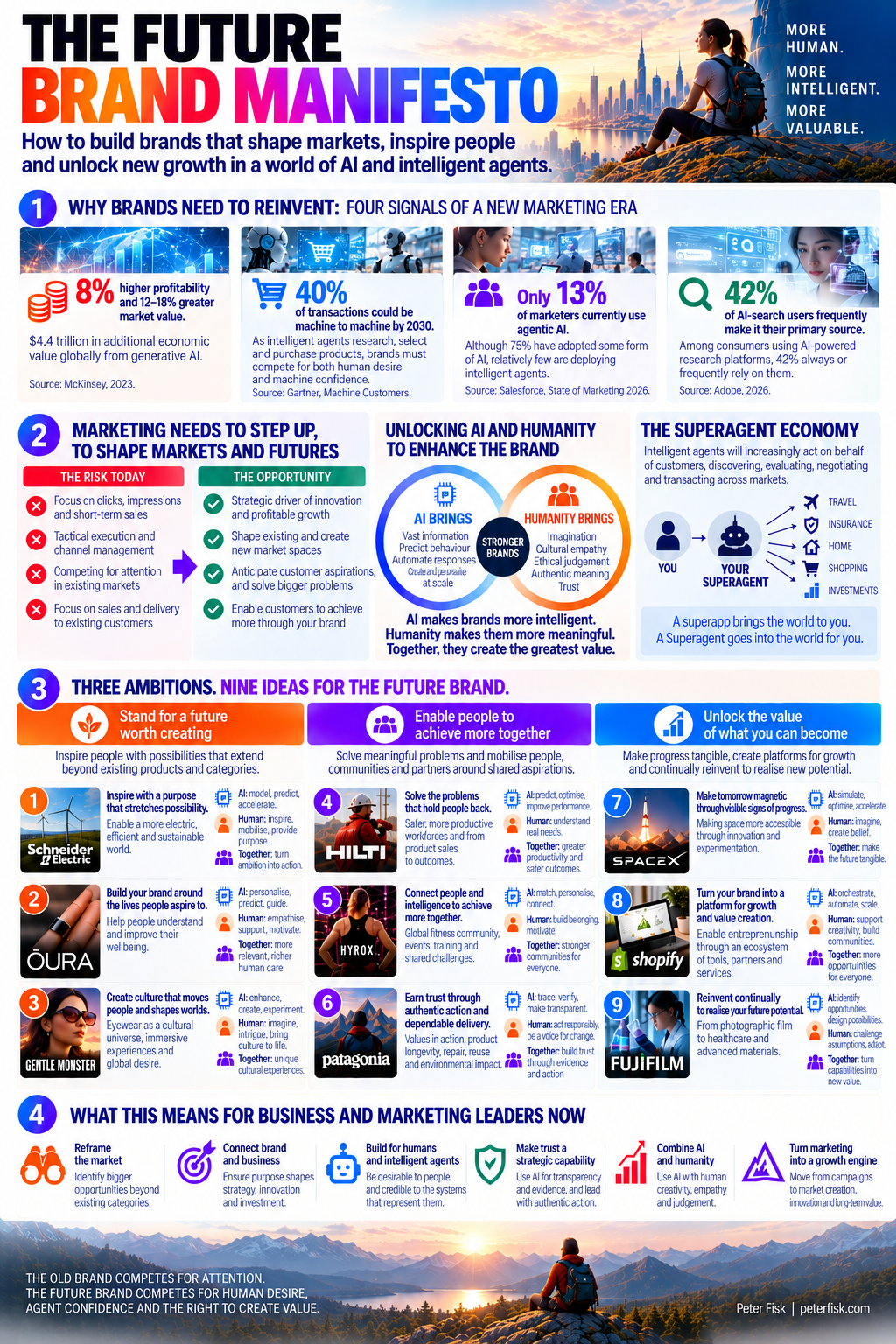
Why brands must reinvent
The transformation of marketing is accelerating. AI is creating extraordinary economic opportunities, intelligent agents are beginning to reshape commerce, and customers are changing how they discover, evaluate and engage with brands. Yet while the adoption of AI is widespread, its potential to reinvent marketing and customer relationships remains largely untapped.
- $4.4 trillion additional economic value globally. For individual businesses that go beyond automation to reinvent customer engagement, propositions and growth models, this could be 8–12% higher operating profits and 12–18% greater market value.
- 40% of transactions could be machine to machine by 2030. Gartner reports that CEOs anticipate machine customers accounting for a significant share of future revenues. As intelligent agents increasingly research, select and purchase products, brands will need to compete for both human desire and machine confidence. Source: Gartner, Machine Customers.
- Only 13% of marketers currently use agentic AI. Although 75% of marketing organisations have adopted some form of AI, relatively few are deploying intelligent agents. The opportunity is to move beyond automated content and campaigns towards responsive, personalised and increasingly autonomous customer engagement. Source: Salesforce, State of Marketing 2026.
- 42% of AI-search users frequently make it their primary research source. Among consumers already using AI-powered research platforms, 42% always or frequently rely on them as their primary source for advice, shopping and troubleshooting. Customer discovery is moving beyond conventional search engines towards conversational intelligence.
Together, these 4 signals reveal a fundamental shift in the economics, mechanisms and expectations of marketing. AI is creating new value, intelligent agents are emerging as commercial participants, customers are discovering brands in new ways, and AI-influenced purchasing is becoming increasingly significant. Yet most marketers remain focused on using AI to improve existing activities rather than reinventing how brands engage customers and create value.
The great disruption: From competing in markets to creating them
The greatest impact of AI is not simply that it makes existing processes faster and cheaper. It changes what businesses can do, how markets operate and where value can be created. AI is dramatically reducing the cost of intelligence, while the convergence of AI with biotechnology, robotics, energy systems and connected devices is enabling solutions that transcend traditional industry boundaries.
Healthcare is converging with data, prevention and everyday wellbeing. Automotive businesses are converging with software, energy and mobility services. Financial services are converging with commerce, travel and intelligent personal assistance. Customers do not organise their lives around industry classifications. They want to live better, work smarter, connect more easily and achieve more. This creates opportunities for businesses willing to redefine the markets in which they compete.
Three companies illustrate the shift:
- Xiaomi has expanded from smartphones into an interconnected ecosystem of personal devices, smart homes and electric vehicles, creating value through connected experiences.
- Schneider Electric has moved beyond individual electrical products towards enabling electrification, automation, energy efficiency and sustainability.
- Fujifilm has applied capabilities developed in photographic film to new opportunities in healthcare, advanced materials and other technologies.
Each illustrates the opportunity to move beyond existing product categories and create broader spaces for growth. For brands, this means that the greatest opportunities may no longer lie in winning market share, but in reframing what the market could become.
The challenge is not to use AI to do more marketing. It is to use AI and humanity together to make marketing more strategic, more meaningful and more valuable. This means moving beyond campaigns and conversion towards understanding emerging customer aspirations, creating distinctive experiences, building trusted relationships, shaping new markets and driving innovation and profitable growth.
AI can analyse vast amounts of information, identify patterns, predict behaviour, generate possibilities and orchestrate increasingly complex interactions. Humanity brings imagination, empathy, cultural understanding, ethical judgement, creativity and the ability to create meaning. These are not opposing forces. Their combination can enable businesses to understand people more deeply, imagine more ambitious futures and deliver experiences that are simultaneously more intelligent and more human.
The opportunity is therefore much bigger than making marketing more efficient. It is to rethink how brands create relevance, difference and trust, and how they can become engines of innovation, market creation and profitable growth.
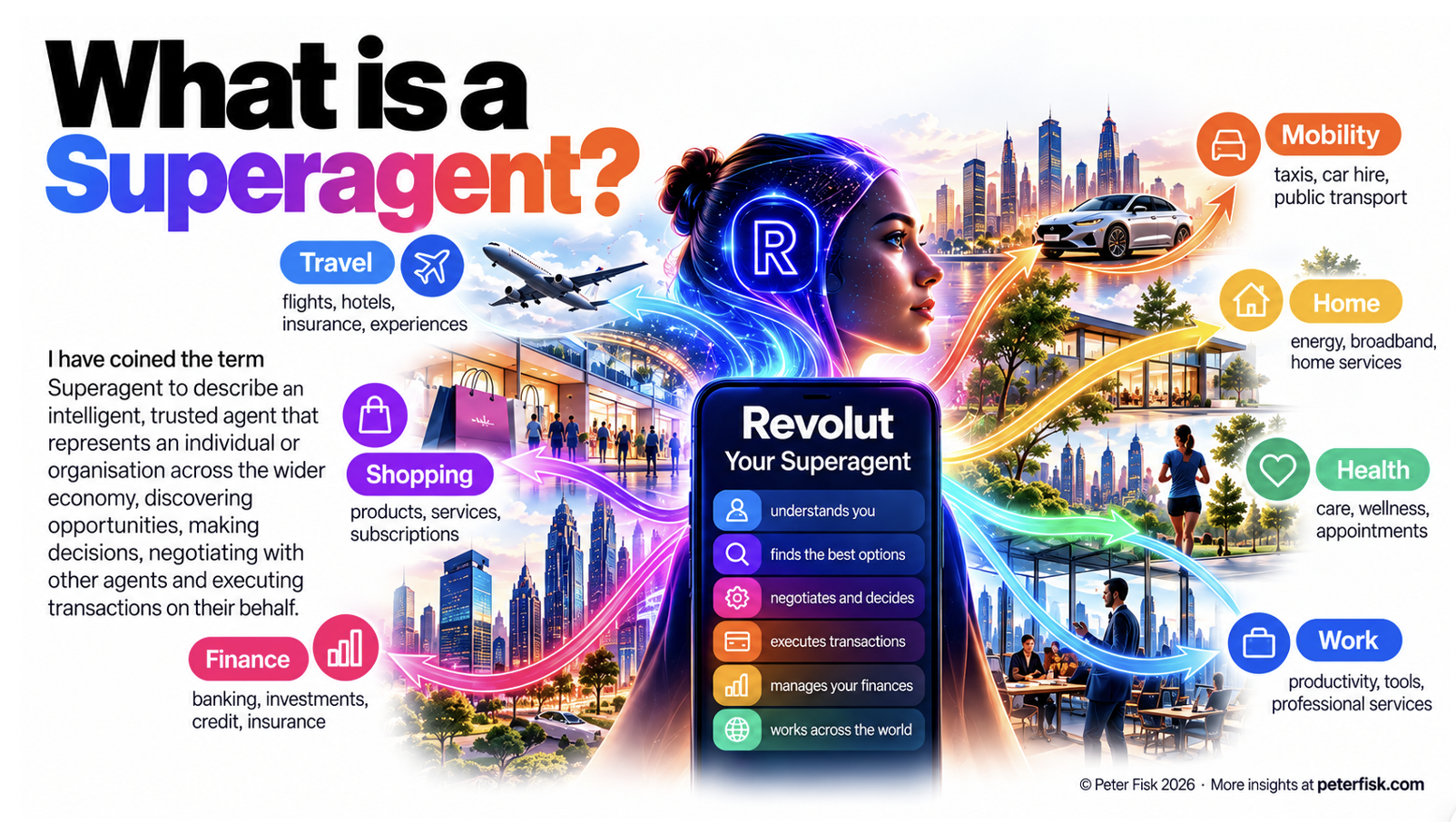
Revolut and the possibility of the Superagent Economy
Consider Revolut. Founded in 2015 to make foreign currency exchange simpler and cheaper, it has evolved into a broad financial platform spanning payments, savings, investments and other services. Its founder, Nik Storonsky, has articulated ambitions to build a global technology company, with AI playing an important role in its future.
But what if Revolut were to evolve beyond banking and even beyond the superapp model into what I call a “superagent”?
A Superagent is an intelligent, trusted representative of an individual or organisation that operates across markets, discovering opportunities, evaluating alternatives, negotiating with other agents and executing authorised transactions to achieve the best outcomes for its principal. Whereas a superapp aggregates services within an ecosystem, a Superagent acts across ecosystems on the customer’s behalf.
A superapp brings the world to you. A Superagent goes into the world for you.
Imagine asking your financial Superagent to organise a holiday, compare insurance, optimise household spending or find the best way to finance a major purchase. Rather than directing you towards different websites and applications, it could research alternatives, evaluate trade-offs, negotiate with providers and complete approved transactions.
Revolut has not announced that it intends to become a Superagent in this expansive sense. It is a strategic possibility arising from the convergence of its customer relationships, financial capabilities, AI ambitions and transaction infrastructure.
The opportunity extends far beyond financial services. General-purpose AI companies, technology platforms and specialist businesses could develop intelligent representatives for individuals and organisations. As agents representing customers interact with agents representing suppliers, a new form of commerce could emerge: A-to-A Commerce, agent-to-agent commerce.
This creates three profound changes for brands:
- From customer attention to customer representation. Brands will increasingly need to influence both the people who want products and the agents helping them choose.
- From persuasive claims to demonstrable value. Performance, reliability, availability, sustainability and trust may need to be expressed through credible, machine-readable evidence.
- From controlling customer journeys to participating in intelligent ecosystems. Discovery, comparison and transactions may increasingly happen outside a brand’s own website, store or app.
Brands will therefore need to win twice: creating human desire through emotion, aspiration, identity and meaning, while earning agent confidence through demonstrable performance, trusted information and relevance to customer objectives.
This does not mean brands become less important. Intelligent agents may compare prices and specifications, but people will still care about craftsmanship, cultural identity, belonging, sustainability and the emotional significance of their choices. Indeed, as functional differences become easier to compare, distinctive meaning and trusted relationships could become more valuable.
The future brand must be compelling enough for people to desire it, and credible enough for their intelligent agents to choose it.
Rediscovering what brands are really for
Amid these extraordinary changes, the enduring principles of brand strategy remain remarkably relevant. A brand is not a logo, campaign or corporate statement. It exists through the perceptions, experiences, aspirations and relationships of customers. The strongest brands begin with a deep understanding of what people value, the problems they face and the futures they want to create.
Four principles remain fundamental:
- Brands are about customers, not businesses. Their starting point should be people’s aspirations, needs and frustrations, rather than the products or capabilities a company already possesses.
- Brands create difference and relevance. Difference makes a brand distinctive; relevance makes that difference meaningful. Sustainable advantage comes from creating value customers genuinely care about.
- Brands earn trust through what they do. Credibility is built through the relationship between promises and delivery, increasingly supported by transparency, evidence and responsible use of intelligence.
- Brands should be platforms for innovation and accelerated growth. A strong brand creates permission to enter new markets, develop new propositions, connect partners and realise opportunities beyond the existing business.
These principles have always mattered, but they must now be applied in a world of intelligent markets, converging technologies and increasingly empowered customers. The challenge is not to abandon traditional brand thinking, but to extend it from managing today’s business to creating tomorrow’s.
AI and humanity each have a distinctive role in this reinvention. AI can reveal previously invisible customer needs, identify emerging opportunities, personalise propositions and connect complex ecosystems. Human capabilities create the imagination to challenge existing assumptions, the empathy to understand what truly matters, the creativity to build distinctive experiences and the judgement to make responsible choices. Used together, they can make brands simultaneously more relevant, more distinctive and more capable of delivering meaningful value.
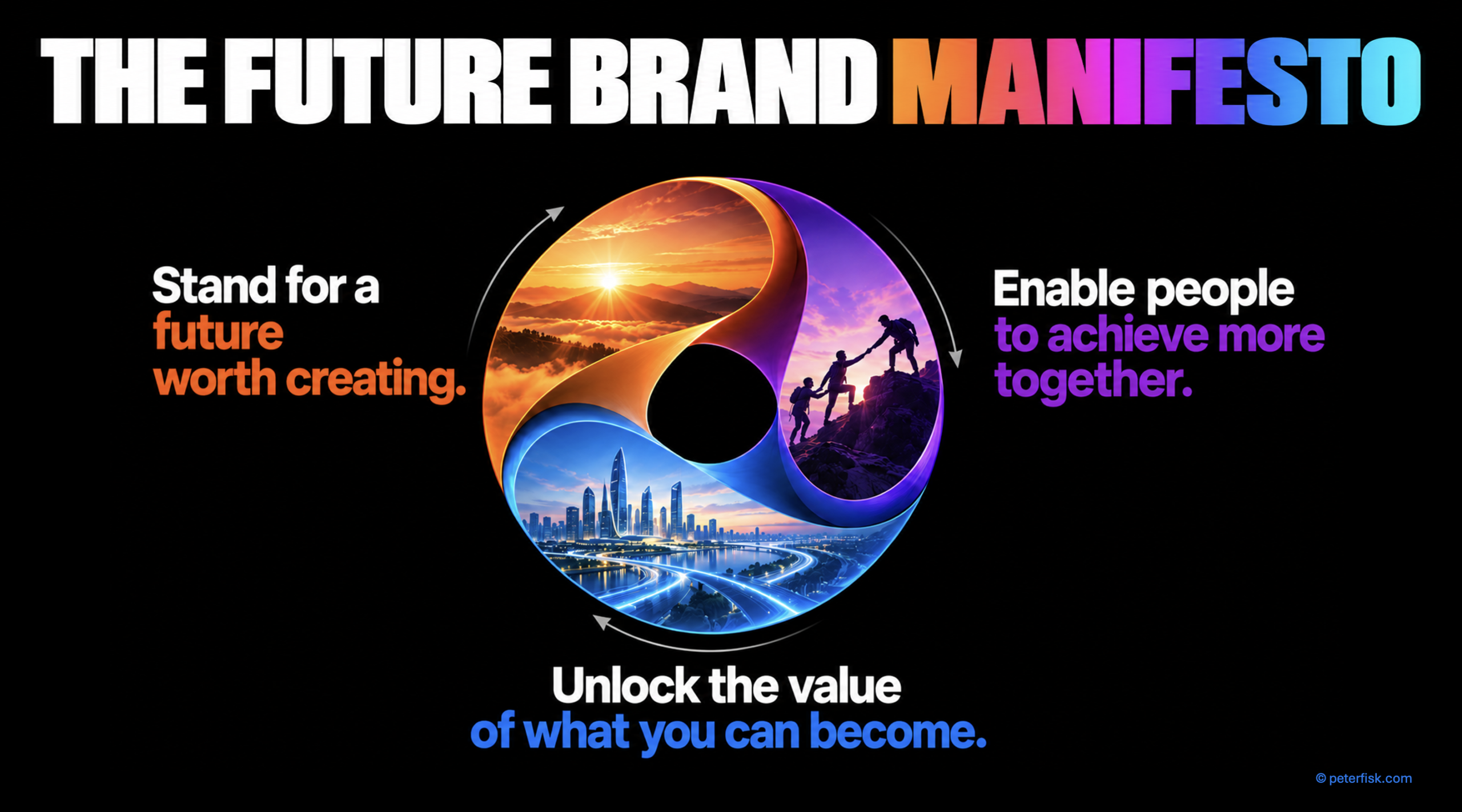
The Future Brand Manifesto
The Future Brand Manifesto is organised around three connected ambitions: stand for a future worth creating; enable people to achieve more together; and unlock the value of what you can become. Together, they provide nine ideas for building brands that are more meaningful, more intelligent and more valuable.
Each idea represents a shift in brand thinking, illustrated by a contemporary company. Each can also be enhanced through AI and humanity, with the greatest opportunities emerging when intelligent capabilities amplify human imagination, relationships and creativity.
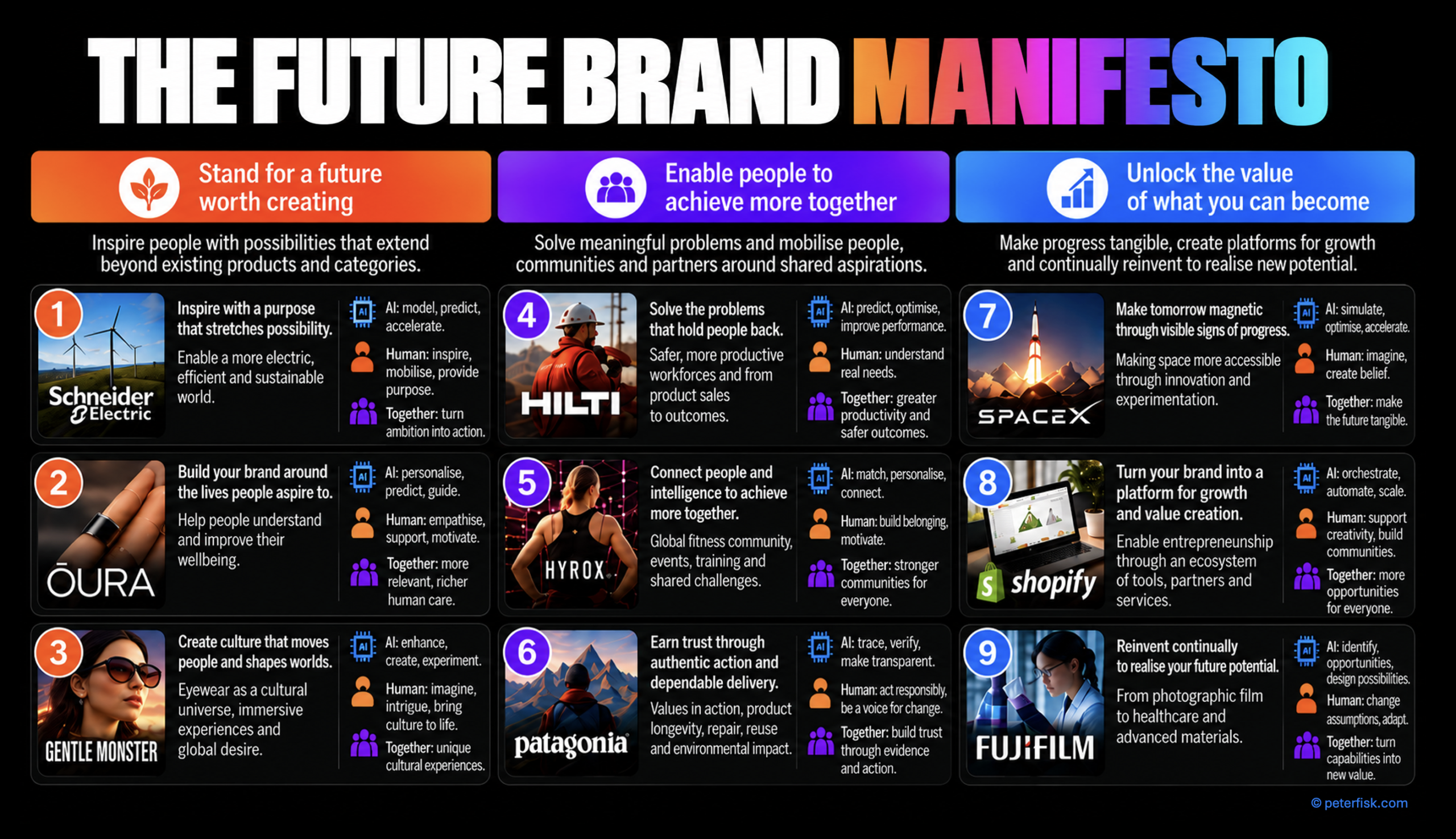
AMBITION ONE: STAND FOR A FUTURE WORTH CREATING
1. Inspire people with a purpose that stretches possibility
The shift: From communicating what you do to inspiring what could be.
Traditional brands often define their purpose around their products, category or corporate capabilities. Future brands start with a bigger possibility, imagining a better future for customers and society and demonstrating how their business can help create it. Purpose becomes more than a statement of values; it becomes a source of strategic ambition, innovation and growth.
Example: Schneider Electric
Schneider Electric illustrates how a broader purpose can transform a company’s strategic relevance. Rather than defining itself simply through electrical equipment, it connects its technologies and capabilities around the bigger challenges of electrification, energy efficiency, automation and sustainability.
- Bigger ambition: Enabling a more electric, efficient and sustainable world.
- Brand innovation: Connecting hardware, software, automation and services around customer outcomes.
- Growth opportunity: Expanding relevance across buildings, industries, infrastructure and energy systems.
- Enhanced by AI: Using intelligent modelling, simulation and predictive analytics to identify opportunities for greater efficiency and sustainability, making ambitious futures more achievable.
- Enhanced by humanity: Inspiring people with a compelling vision of progress, creating shared purpose and mobilising customers, employees and partners around a future worth building.
AI makes ambitious possibilities more achievable, while human imagination and purpose make them worth pursuing. The brand becomes a catalyst for meaningful progress rather than simply a statement of corporate intent.
2. Build your brand around the lives people aspire to
The shift: From targeting customer segments to enabling human aspirations.
Traditional marketing frequently starts with segmentation, categorising customers by demographics, lifestyles or purchasing behaviour. Future brands need to understand something deeper: what people are trying to achieve, how they want to feel and the lives they aspire to create. AI can make this understanding more contextual and personalised, but the objective remains fundamentally human.
Example: Oura
Oura has built its brand around people’s aspirations to understand and improve their wellbeing. Its smart ring is the starting point for an ongoing relationship that connects physiological insights with more informed everyday decisions.
- Bigger ambition: Helping people understand and improve their health and wellbeing.
- Brand innovation: Combining wearable technology, continuous data and AI-enabled personal insights.
- Growth opportunity: Evolving from a device into an intelligent wellbeing relationship, with recurring services and broader relevance.
- Enhanced by AI: Understanding individual patterns, predicting emerging needs and delivering more personalised, timely guidance.
- Enhanced by humanity: Understanding people’s emotional aspirations, motivations and everyday challenges, and creating supportive experiences that respect individual circumstances.
AI makes the brand more personally relevant, while human empathy ensures that relevance feels supportive rather than intrusive. The opportunity is to move from understanding what customers do towards helping them become who they want to be.
3. Create culture that moves people and shapes worlds
The shift: From creating campaigns to creating cultural participation.
Traditional brands seek attention through advertising, sponsorship and communication. Future brands can go further by creating distinctive cultural worlds that people want to experience, participate in and share. These worlds combine ideas, aesthetics, communities and identities, making brands meaningful beyond their functional products.
Example: Gentle Monster
Gentle Monster has transformed eyewear into a platform for artistic expression and cultural experimentation. Its immersive retail spaces, imaginative installations and collaborations blur the boundaries between fashion, art, design and entertainment.
- Bigger ambition: Making eyewear part of a distinctive cultural universe.
- Brand innovation: Turning stores, collaborations and product launches into immersive experiences.
- Growth opportunity: Building global desire, cultural influence and differentiation beyond product functionality.
- Enhanced by AI: Creating adaptive experiences, experimenting with new forms of digital art and enabling more immersive, responsive interactions.
- Enhanced by humanity: Drawing on artistic originality, cultural insight, storytelling and creative collaboration to build distinctive worlds people want to experience.
AI expands the possibilities for creative expression, while human imagination gives those experiences originality and meaning. The strongest cultural brands will use technology to amplify creativity rather than replace it.
AMBITION TWO: ENABLE PEOPLE TO ACHIEVE MORE TOGETHER
4. Solve the problems that hold people back
The shift: From selling products to removing barriers to progress.
Customers rarely want products for their own sake. They want to achieve something, overcome difficulties or make progress towards a particular outcome. Future brands identify the deeper problems that prevent customers from succeeding, then combine products, services, intelligence and partnerships to remove those barriers.
Example: Hilti
Hilti’s construction customers do not simply need drilling equipment. They need safer worksites, greater productivity, less downtime and more predictable project performance. Hilti addresses these challenges through professional tools, fleet management, software and integrated services.
- Bigger ambition: Helping construction professionals work more productively and safely.
- Brand innovation: Combining equipment, digital services and lifecycle support.
- Growth opportunity: Moving from individual product sales towards broader customer relationships and recurring services.
- Enhanced by AI: Predicting equipment failures, identifying workflow inefficiencies and optimising project resources and performance.
- Enhanced by humanity: Understanding the practical realities of construction sites, collaborating closely with customers and designing solutions around real human frustrations and needs.
AI identifies opportunities for improvement, while human understanding ensures that solutions address the problems that truly matter. The brand shifts from selling equipment to enabling better outcomes.
5. Connect people and intelligence to achieve more together
The shift: From building audiences to mobilising communities and ecosystems.
Traditional marketing often measures success through reach, engagement and loyalty. Future brands should ask a more ambitious question: what can people achieve together because this brand exists? Brands can become catalysts for collaboration and collective progress, connecting customers, communities, partners and intelligent technologies around shared aspirations.
Example: Hyrox
Hyrox has created a global fitness community around a distinctive combination of running and functional fitness. Its success is not simply about organising competitions, but connecting athletes, gyms, coaches, partners and supporters through shared challenges.
- Bigger ambition: Making fitness a shared experience of personal achievement.
- Brand innovation: Combining a repeatable global competition format with community, training and participation.
- Growth opportunity: Expanding through events, partnerships, training ecosystems and international communities.
- Enhanced by AI: Connecting people with relevant communities, personalising training and identifying opportunities for collaboration and shared progress.
- Enhanced by humanity: Building belonging, motivation, mutual encouragement and the emotional energy of shared experiences.
AI makes connections smarter and more relevant, while human relationships make them meaningful. The brand becomes a platform for collective achievement rather than simply an audience to monetise.
6. Earn trust through authentic action and dependable delivery
The shift: From making promises to proving them consistently.
Trust has always been central to strong brands, but in an age of synthetic content, automated recommendations, personal data and delegated decisions, it becomes a more demanding capability. Customers increasingly expect businesses to demonstrate authenticity, transparency, responsibility and dependable performance.
Example: Patagonia
Patagonia has connected its environmental values with business decisions, product design and customer relationships. Its emphasis on durability, repair, product longevity and environmental activism demonstrates how purpose can influence what a business actually does.
- Bigger ambition: Connecting business success with environmental responsibility.
- Brand innovation: Making repair, durability and responsible consumption part of the proposition.
- Growth opportunity: Building distinctive loyalty and long-term relevance through values supported by action.
- Enhanced by AI: Making performance, provenance, environmental impact and supply-chain information more transparent, traceable and verifiable.
- Enhanced by humanity: Demonstrating integrity, making responsible choices and building genuine relationships through consistent behaviour.
AI can provide evidence that supports trust, while human values and accountability make that trust meaningful. In an agentic economy, brands must be trusted both by people and by the intelligent systems acting on their behalf.
AMBITION THREE: UNLOCK THE VALUE OF WHAT YOU CAN BECOME
7. Make tomorrow magnetic through visible signs of progress
The shift: From promising a future to demonstrating that it is becoming real.
An ambitious future can inspire people, but belief grows when progress becomes visible. Future brands make their ambitions tangible through innovations, experiments, prototypes, milestones and achievements. Progress creates momentum, attracting customers, employees, investors and partners who want to participate in the journey.
Example: SpaceX
SpaceX has built much of its brand around an extraordinary ambition to make space more accessible and enable humanity to extend its presence beyond Earth. Its rocket launches, reusable booster landings and continuing technological experimentation make that ambition tangible.
- Bigger ambition: Making space more accessible and enabling a future beyond Earth.
- Brand innovation: Turning technological development and visible experimentation into powerful evidence of progress.
- Growth opportunity: Creating new capabilities and commercial possibilities in launch services, satellite communications and space infrastructure.
- Enhanced by AI: Accelerating experimentation, simulation and design, while making complex future possibilities easier to visualise and understand.
- Enhanced by humanity: Creating inspiring narratives, celebrating breakthroughs and inviting people to participate emotionally in the journey.
AI accelerates the creation of tomorrow, while human imagination makes tomorrow magnetic. The brand becomes a visible journey of progress that people want to follow and support.
8. Turn your brand into a platform for growth and value creation
The shift: From owning a proposition to enabling an ecosystem of opportunities.
Traditional brands often grow by expanding product ranges or entering adjacent categories. Future brands can become platforms that enable other businesses and individuals to innovate, connect and grow. Their value expands as customers, developers, suppliers and partners succeed through shared capabilities and infrastructure.
Example: Shopify
Shopify illustrates how a brand can become an enabling platform for other businesses. Its proposition extends beyond software to helping merchants establish, operate and grow their businesses through a wider ecosystem of commerce tools, payments, applications and partners.
- Bigger ambition: Making commerce more accessible and enabling entrepreneurship.
- Brand innovation: Connecting merchants with the infrastructure, services and partners needed to grow.
- Growth opportunity: Expanding through ecosystem participation, commerce services and AI-enabled shopping and transactions.
- Enhanced by AI: Orchestrating intelligent commerce, matching customers with merchants, enabling automated services and reducing friction across transactions.
- Enhanced by humanity: Supporting entrepreneurial creativity, building partnerships and creating communities of businesses that learn and grow together.
AI makes ecosystems more connected and efficient, while human entrepreneurship creates the ideas, relationships and innovations that make them valuable. The brand becomes a platform through which others create growth.
9. Reinvent continually to realise your future potential
The shift: From defending today’s success to creating tomorrow’s business.
The greatest danger for successful brands is becoming trapped by the capabilities, categories and assumptions that originally made them successful. Markets change, technologies evolve and customer expectations move. Future brands must therefore embrace continuous reinvention, exploring new possibilities and applying existing strengths in unexpected markets.
Example: Fujifilm
As digital photography undermined the traditional photographic-film market, Fujifilm applied its capabilities in chemistry, imaging, materials and precision technologies to new opportunities, including cosmetics, healthcare and advanced materials.
- Bigger ambition: Creating new value from the company’s scientific and technological capabilities.
- Brand innovation: Reframing its identity beyond photographic film and redeploying capabilities across industries.
- Growth opportunity: Building new businesses in healthcare, advanced materials and other technology-intensive markets.
- Enhanced by AI: Identifying emerging opportunities, modelling alternative futures, accelerating discovery and exploring new applications of existing capabilities.
- Enhanced by humanity: Challenging established assumptions, imagining different futures and demonstrating the courage and leadership needed to transform the business.
AI expands the possibilities for reinvention, while human imagination and leadership turn possibilities into strategic choices and meaningful change. The brand represents not only what the business is today, but what it has the potential to become.
What this means for business and marketing leaders
The Future Brand Manifesto is not simply a new approach to brand communication. It demands a different relationship between strategy, innovation, marketing and leadership. The central opportunity is to restore marketing’s role as a strategic driver of the business, connecting customer understanding with future possibilities, innovation and profitable growth.
For business and marketing leaders, six priorities stand out:
- Reframe the market. Move beyond competing for share in established categories. Understand where customer value is shifting, which boundaries are dissolving and which bigger problems the business could solve. Use AI-enabled foresight and human imagination together to identify opportunities before they become conventional markets.
- Connect brand ambition with business reinvention. Ensure that purpose and positioning influence strategic choices, innovation priorities, investment and partnerships. The brand should help define what the business aspires to become, not simply communicate what it already does.
- Build brands for humans and intelligent agents. Combine emotional meaning, distinctive experiences and cultural relevance with trusted data, demonstrable performance and agent-ready capabilities. Future brands must be desirable to people and credible to the systems increasingly representing them.
- Make trust a strategic capability. Invest in responsible AI, transparent information, dependable delivery and verifiable evidence. As customers delegate more decisions to intelligent systems, trust becomes essential to earning permission to act on their behalf.
- Combine AI and humanity deliberately. Use AI to understand, predict, personalise, experiment and orchestrate, while developing human capabilities in empathy, creativity, cultural understanding, ethical judgement and leadership. The greatest opportunities come from combining these strengths rather than treating them as alternatives.
- Turn marketing into a growth engine. Expand its remit from campaigns, channels and conversion towards market creation, proposition innovation, ecosystem development and profitable growth. Measure success not only through immediate sales performance, but through customer value, innovation contribution, market development and long-term business value.
For CMOs, this represents an opportunity to become genuine market makers, connecting customer understanding, strategic foresight, brand building, innovation and commercial growth. It requires a broader mindset, stronger commercial capabilities and the confidence to contribute directly to the strategic direction of the business. AI can augment these capabilities, but it cannot replace the imagination, judgement and leadership required to make ambitious strategic choices.
For CEOs, the brand can become a strategic expression of what the organisation aspires to become, aligning investment, culture, innovation and leadership around a shared future. For boards, brand value should be understood not only through current reputation, customer preference and financial performance, but also through the organisation’s capacity to create new markets and realise future potential.
This also demands a different balance between short-term performance and long-term possibility. Digital marketing, pricing optimisation and customer acquisition remain essential, but they should serve a larger strategic ambition. The challenge is to perform successfully today while creating the foundations for tomorrow.
The future brand: More human, more intelligent, more valuable
The emergence of AI and the Superagent Economy does not mean brands become less important. It changes what makes them important. In a world where information becomes abundant, meaning becomes more valuable. Where products become easier to compare, distinctive experiences and trusted relationships become more important. Where intelligent agents increasingly influence transactions, brands must demonstrate their value through credible evidence. And where technologies converge and industries blur, brands can become powerful platforms for imagining and creating new markets.
The future of brands therefore cannot be reduced to AI-driven personalisation, automated content or more efficient marketing. Those are useful capabilities, but they are not the destination. The bigger opportunity is to rethink the role of brands in people’s lives and in the creation of economic value, combining the analytical power of AI with the imagination, empathy and creativity of humanity.
The Future Brand Manifesto brings together nine ideas within three connected ambitions: stand for a future worth creating; enable people to achieve more together; and unlock the value of what you can become. Together, they challenge leaders to build brands around human aspirations rather than product categories, create cultural meaning rather than simply capture attention, solve bigger problems rather than sell more things, mobilise communities and ecosystems rather than simply manage audiences, prove trust rather than merely claim it, and make brands platforms for innovation, growth and continual reinvention.
Ultimately, the challenge is not simply to build a better brand for today’s business. It is to build a brand capable of helping create tomorrow’s business. That requires marketing to move from tactical execution towards strategic leadership, from responding to existing demand towards shaping new possibilities, and from supporting sales towards driving innovation and profitable growth.
The old brand competed for attention. The future brand competes for human desire, agent confidence and the right to create value.
In a world of intelligent markets, the strongest brands will not merely respond to the future. They will inspire people to imagine it, enable them to shape it, and unlock the value of what they can become.
More from the blog