M[A]RKETING at the Global Marketing Summit 2026
October 14, 2026 at Mandarin Oriental, Istanbul
Marketing is approaching a more profound transformation than the shift from analogue to digital. AI is not simply giving marketers better tools. It is changing the nature of markets, customers, competition and value creation itself.
The first wave of digital marketing made marketing searchable, measurable and targetable. Social media made it participative and continuous. Mobile made it immediate and contextual. AI now adds something fundamentally different: intelligence. Marketing systems can increasingly sense what is happening, interpret what it means, anticipate what might happen next, generate possible responses, choose between them and act, often in real time.
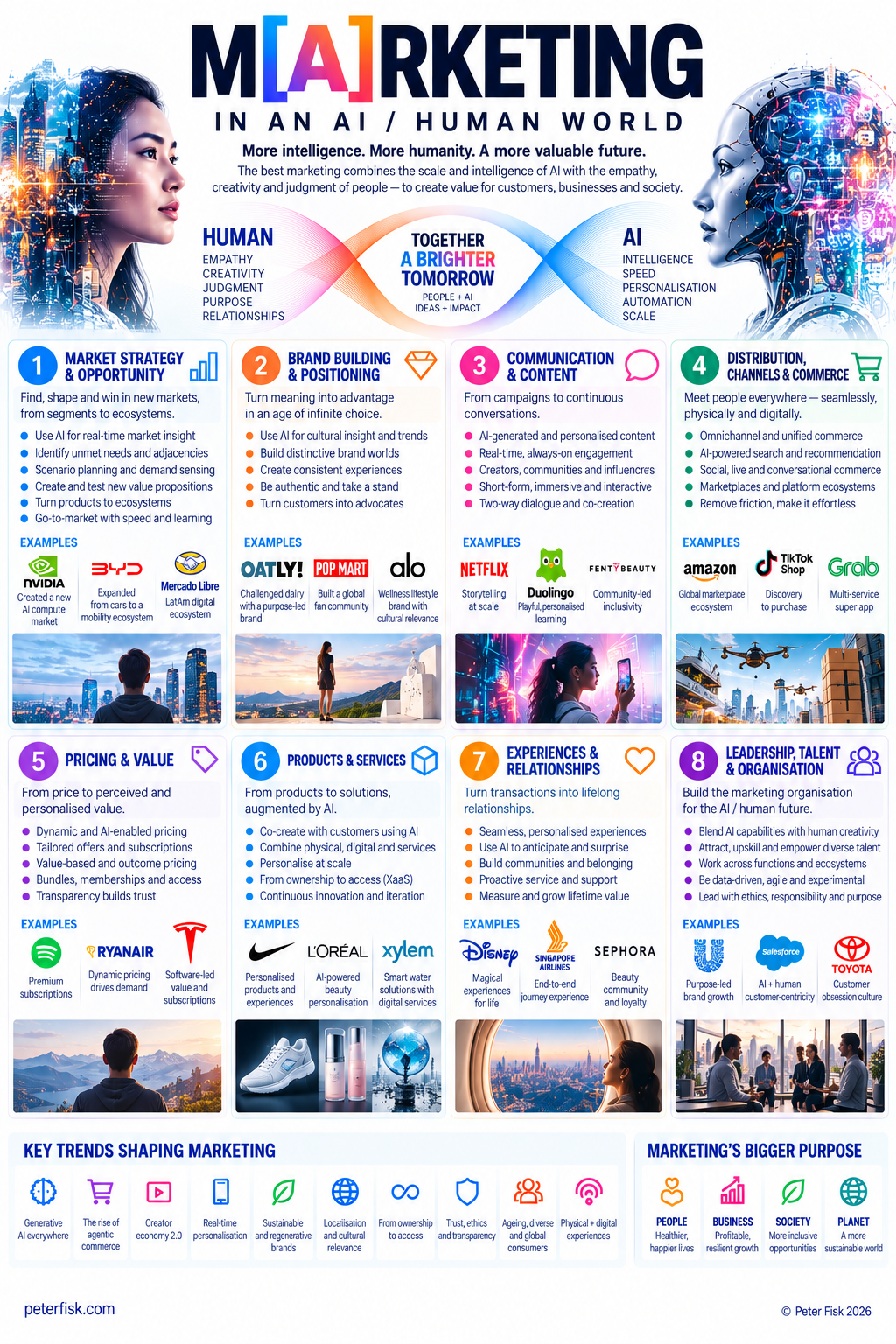
Asia offers some of the clearest signals of where this is heading. Nearly three-quarters of Asia-Pacific consumers already use AI to discover, compare or learn about products, according to Deloitte, while 29% of consumer businesses in the region are adopting agentic AI, a figure Deloitte expects to reach 76% within two years. In China, Alibaba is integrating AI agents directly into Taobao and Tmall, while Meituan is moving from recommendations towards agents capable of understanding intent and executing transactions.
These are not simply better digital channels. They point towards a different model of marketing.
The conventional question is how AI can improve today’s activities: generate an advertisement in seconds, automate an email campaign, optimise media spend or deploy a chatbot. These applications matter, but they represent the least imaginative interpretation of what is happening. They use tomorrow’s technology to improve yesterday’s marketing.
The more interesting question is: what does marketing become when intelligence is everywhere?
When every customer can have an intelligent agent. When every product can become adaptive. When every interaction can be personalised. When markets can be sensed continuously rather than researched periodically. When millions of propositions can be generated and tested almost instantly. When brands communicate not just with people but with their algorithms. And when machines increasingly search, evaluate, recommend, negotiate and buy from other machines.
Marketing is shifting from a largely human-directed function into an intelligent, anticipatory and adaptive system for creating value.
From responsive to anticipatory
Most marketing has historically been reactive. Customers search, brands advertise. Customers complain, companies intervene. Sales decline, marketers launch promotions. Research identifies an emerging trend, and companies eventually develop propositions around it.
AI enables marketers to reverse the sequence.
Instead of waiting for demand, companies can increasingly detect the conditions from which demand will emerge. Search behaviour, transactions, location, weather, social conversations, cultural signals and product usage can reveal changing intentions before customers articulate them themselves.
Meituan demonstrates how far this logic can go. Its recommendation systems already incorporate behavioural, product, temporal, spatial and contextual information to match customers with relevant merchants and products. Its Xiaomei agent goes further: rather than simply recommending lunch, for example, it can interpret a user’s request, remember preferences and execute the order.
Elsewhere, Spotify has made anticipation central to discovery by learning tastes and continually proposing what someone might enjoy next. Netflix uses behavioural intelligence to turn an enormous catalogue into an individually relevant experience. Grab brings transport, food, financial services and other everyday activities together, creating the potential to understand needs across contexts rather than isolated transactions.
Marketing therefore moves from response to anticipation. The competitive question becomes not “How quickly can we react to customers?” but “How early can we recognise what they will value next?”
From personalisation to personal
For two decades, marketers have talked about personalisation. Much of it has been superficial: inserting someone’s name into an email, retargeting a product they already viewed or recommending something because similar customers bought it.
AI makes possible something much deeper: marketing that is genuinely personal.
L’Oréal is moving beauty from generic product selection towards technology-enabled diagnosis, recommendation and personalisation. Nike connects physical products with apps, communities, activity and individual experiences. Nubank in Latin America demonstrates a similar principle in financial services: using a digital relationship to simplify and personalise an industry historically built around standardised products and institutional processes.
The unit of marketing therefore moves progressively from mass market to segment, segment to individual, and ultimately from individual to individual-in-this-moment.
That last shift is crucial. People are not static profiles. The same person has different priorities on Monday morning and Saturday evening, travelling for business and holidaying with their family, buying for themselves and choosing a gift.
Tomorrow’s intelligent marketer will respond to this fluidity. The objective is no longer simply to know who somebody is. It is to understand what matters to them now — and what is likely to matter next.
From campaigns to cultural responsiveness
Traditional marketing operates in episodes. Research. Plan. Brief. Create. Approve. Launch. Measure. Repeat.
Markets no longer move at that speed.
Culture changes by the hour. Creators ignite conversations overnight. Competitors change prices instantly. A meme can circle the world before a conventional marketing team has scheduled its morning meeting.
Brands such as Duolingo demonstrate the power of behaving more like cultural participants than conventional advertisers. Pop Mart has built global momentum around characters, collectability, scarcity, social sharing and fandom. Zara built its original advantage around compressing the distance between what consumers were wearing and what appeared in stores; AI offers the potential to compress that feedback loop dramatically further.
The implication is not that every brand should chase every trend. When response becomes almost effortless, judgement becomes more valuable.
The capability that matters is therefore not real-time marketing but real-time judgement: sensing what is happening, deciding whether it matters to your customers and brand, and responding while the moment is still alive.
From customer journeys to connected lives
Marketing has spent years mapping customer journeys. The problem is that customers do not experience themselves as journeys through a company’s funnel.
They live lives.
In Asia, super-app models have demonstrated what happens when businesses organise around those lives rather than around product categories. WeChat integrates messaging, content, commerce and services. Grab connects mobility, food, payments and financial services. Meituan connects restaurants, travel, entertainment, retail and local services.
The significance is not simply convenience. Connected ecosystems can understand customers across needs, contexts and moments.
The Western model has historically been more fragmented, but it is moving in the same direction. Amazon spans shopping, entertainment, devices and services. Disney connects stories, streaming, merchandise, parks and experiences. Apple combines devices, software, payments, health, entertainment and services into an increasingly continuous relationship.
Marketing therefore moves beyond omnichannel towards continuous relationship. The most advanced experience may eventually be one in which customers barely notice channels at all.
From search to agentic discovery
This leads to an even bigger discontinuity.
For 25 years, marketers have competed to influence what people see when they search. Increasingly, people may stop searching themselves.
They will ask.
“Find me the best running shoes for my training and gait.”
“Organise a four-day break somewhere warm next month within £1,500.”
“Replace my electricity supplier with the best sustainable tariff.”
“Reorder the things we’re running out of.”
An AI agent can interpret the objective, research alternatives, evaluate reviews, compare specifications, check availability, negotiate conditions and execute the transaction.
Alibaba provides one of the clearest glimpses of this future. Its Qwen Shopping Assistant supports customers across idea generation, product discovery, purchasing, order management and after-sales service. On the merchant side, Wukong applies agentic AI to operational workflows. Alibaba.com has also introduced Accio, an AI-enabled B2B procurement engine, and Accio Work, designed to handle activities across the operating lifecycle of smaller businesses.
The distinction is profound. Search helps humans decide. Agency delegates parts of the decision.
From human customers to machine customers
This creates an entirely new audience for marketing: machines.
Until now, marketers have primarily designed propositions to be attractive to people. Increasingly they will also need to make those propositions understandable and preferable to algorithms acting for people.
A human might prefer one hotel because the photographs create desire. Their travel agent might also evaluate cancellation terms, walking distance, historical price movements, review authenticity, room specifications and hundreds of other variables.
Both matter.
Brands will therefore need two simultaneous forms of attractiveness: emotional desirability for humans and informational superiority for machines.
The implications stretch far beyond consumer shopping. Industrial machines will increasingly identify when components need replacing and procure them. Vehicles can select charging locations. Buildings can optimise energy purchasing. Corporate procurement agents can compare suppliers and initiate negotiations.
Machine-to-machine markets become a significant new frontier for marketing.
This changes what “brand visibility” means. The future equivalent of shelf position or search ranking may be whether an agent considers your proposition trustworthy enough to include in its decision set.
Marketing therefore evolves from SEO towards AIO — artificial-intelligence optimisation — and ultimately agent optimisation.
From automation to agency
There is an equally significant transformation inside the marketing organisation.
Automation executes predefined tasks. Agency pursues goals.
AI agents can increasingly monitor markets, analyse competitors, identify customer changes, generate propositions, create content, conduct experiments, allocate spending, analyse outcomes and recommend what happens next.
Alibaba’s Tmall is already moving in this direction. It has described agentic capabilities that give merchants AI support across store analytics, advertising, customer service and post-sale processes; its AI customer-service technology has been piloted across 200,000 merchants, with Alibaba reporting a 30% improvement in conversion.
Shopify is similarly positioning AI closer to the operating core of commerce, while new consumer agents are increasingly integrating with merchant platforms and payment systems.
The marketer’s role consequently moves upwards. When machines can increasingly execute, humans need to become better at direction.
What opportunity are we pursuing? Which customers matter? What future do we believe in? What should the brand stand for? What should we optimise? What should never be optimised? What should machines decide — and what should humans always decide?
From optimisation to imagination
Here lies perhaps the greatest danger of AI marketing.
It could make companies exceptionally good at optimising yesterday.
Algorithms learn from existing customers, previous behaviours and historical successes. This makes them extraordinarily powerful at exploitation — and potentially conservative at exploration.
The most valuable marketing capability therefore becomes market imagination.
Look at NVIDIA. Its remarkable trajectory did not come simply from marketing GPUs more effectively to existing customers; it helped imagine accelerated computing as infrastructure for an AI economy. BYD has expanded its competitive frame beyond conventional cars into batteries, electric mobility and energy technologies. Mercado Libreevolved beyond ecommerce into payments, credit, logistics and advertising across Latin America.
Likewise, Reliance Jio did not simply compete for Indian telecom customers. It helped reshape the economics of digital participation around connectivity and a much broader ecosystem of services. Xiaomi has stretched from smartphones into a connected ecosystem spanning devices, homes and now mobility.
These businesses illustrate a critical distinction. Great marketing does not merely win market share.
It helps redefine the market itself.
From products to continuously evolving propositions
AI also destroys the assumption that a proposition is finished when it launches.
Products can learn. Services can adapt. Experiences can reconfigure themselves. Pricing can change. Interfaces can evolve. Recommendations can improve.
Oura turns a physical ring into an evolving health relationship built around continuously interpreted data. L’Oréal can combine beauty products with diagnostics, virtual experiences and personalisation. John Deere increasingly combines machinery with software, precision agriculture and data-driven decision support.
The proposition therefore becomes dynamic.
Instead of make → market → sell, the emerging loop becomes sense → imagine → create → learn → adapt.
Marketing moves upstream into innovation and downstream into usage. It stops being the function that explains what the company has made and becomes part of the system determining what the company should make next.
From consistent brands to living brands
AI challenges another long-established marketing doctrine: consistency.
Brands traditionally sought to look and sound the same everywhere. Intelligent brands can instead be coherent without being identical.
They can speak differently in Seoul, São Paulo, Mumbai and Manchester while retaining a recognisable worldview. They can adapt to different communities. They can respond to cultural moments. They can hold millions of individual conversations while remaining unmistakably themselves.
Asian brands provide particularly interesting examples. Pop Mart has turned intellectual property into participative global fandom. Gentle Monster treats retail almost as surrealist cultural theatre. Xiaomi has built community into product development and ecosystem expansion. Japanese brands such as Uniqlo demonstrate how a distinctive philosophy can travel globally while adapting locally.
The brand becomes less like a fixed identity and more like a living world.
And here AI creates another paradox. When everybody can generate competent imagery, copy and video instantly, competence loses value.
Distinctiveness becomes scarce.
From marketing department to market operating system
Bring these changes together and marketing begins to look fundamentally different.
It senses emerging behaviours like Meituan. It anticipates preferences like Spotify. It personalises propositions like L’Oréal. It creates connected ecosystems like Grab. It moves with culture like Duolingo. It builds worlds like Pop Mart and Disney. It uses intelligent agents like Alibaba. It continuously innovates around customer problems rather than simply promoting products.
Marketing stops being primarily a communications department.
It becomes the company’s market operating system.
It senses what is changing. Interprets why it matters. Anticipates what people will need. Imagines possibilities. Creates propositions. Connects ecosystems. Orchestrates agents. Builds communities. Shapes demand. Learns continuously. And feeds that intelligence back into strategy and innovation.
That requires a different kind of CMO. The future marketing leader needs enough technological literacy to understand machines without trying to become the organisation’s chief technologist. Their distinctive contribution is to connect data with culture, intelligence with imagination, today with tomorrow.
The human premium
And this reveals the great paradox of M[A]RKETING.
The more intelligent marketing becomes, the more valuable humanity becomes.
When intelligence is scarce, intelligence creates advantage. When intelligence becomes ubiquitous, different qualities become scarce: empathy, curiosity, imagination, taste, courage, judgement, meaning and trust.
AI can identify what millions of people are doing. Humans still need to ask why it matters.
AI can generate ten thousand propositions. Humans need to recognise the one worth pursuing.
AI can personalise a billion interactions. Humans need to decide what kind of relationship a brand deserves to have with people.
AI can optimise relentlessly towards an objective. Humans need to decide whether it is the right objective.
The future is therefore not AI marketing.
It is M[A]RKETING — artificial intelligence embedded inside a much larger human discipline.
Marketing becomes anticipatory rather than reactive. Personal rather than merely personalised. Connected rather than channelled. Continuous rather than campaign-based. Topical rather than pre-programmed. Responsive rather than bureaucratic. Agentic rather than automated. Machine-readable as well as emotionally resonant. Faster in execution but further-sighted in ambition. More experimental, more innovative and ultimately more imaginative.
From Alibaba and Meituan in China to Grab in Southeast Asia; from Jio in India and Uniqlo in Japan to Mercado Libre and Nubank in Latin America; from Spotify and L’Oréal in Europe to NVIDIA, Disney and Netflix in the United States, the signals are already visible. The next marketing model will not emerge from one geography or one industry. It is being assembled simultaneously around the world.
The winners will not simply be the companies with the most AI. Intelligence itself will increasingly be available to everyone.
Advantage will come from what organisations do with that intelligence — how quickly they learn, how boldly they imagine, how intelligently they anticipate and how meaningfully they connect.
That is the real promise of M[A]RKETING.
Not artificial marketing.
Amplified marketing.
More anticipatory. More personal. More connected. More responsive. More agentic. More imaginative.
And, ultimately, more human.