The Business of U2 … from The Joshua Tree to Zoo TV, live at the Sphere or the Carnaval de Luz … 50 years of unforgettable music, innovative experiences, intellectual ownership and relentless reinvention
September 28, 2026
I remember the rebellious scream of Sunday Bloody Sunday, a song that seemed to demand you pay attention to the world beyond yourself. Then came the ache of With or Without You, the searching atmosphere of The Unforgettable Fire, and the inspired calm of One.
Different sounds, different moments, yet an unmistakable thread running through them. One world, one life, and the difficult work of finding a way forward together.
That thread helps explain why U2 matter to me. It also helps explain why their business is so interesting.
50 years after Larry Mullen Jr. invited fellow pupils to form a band in Dublin, Bono, the Edge, Adam Clayton and Mullen remain together. They have announced Carnaval De Luz, their first studio album of new material in nine years, for release in November 2026.
Their success did not come from a single formula. U2 built a business that could hold together through changes in music, media, technology and audience expectations.
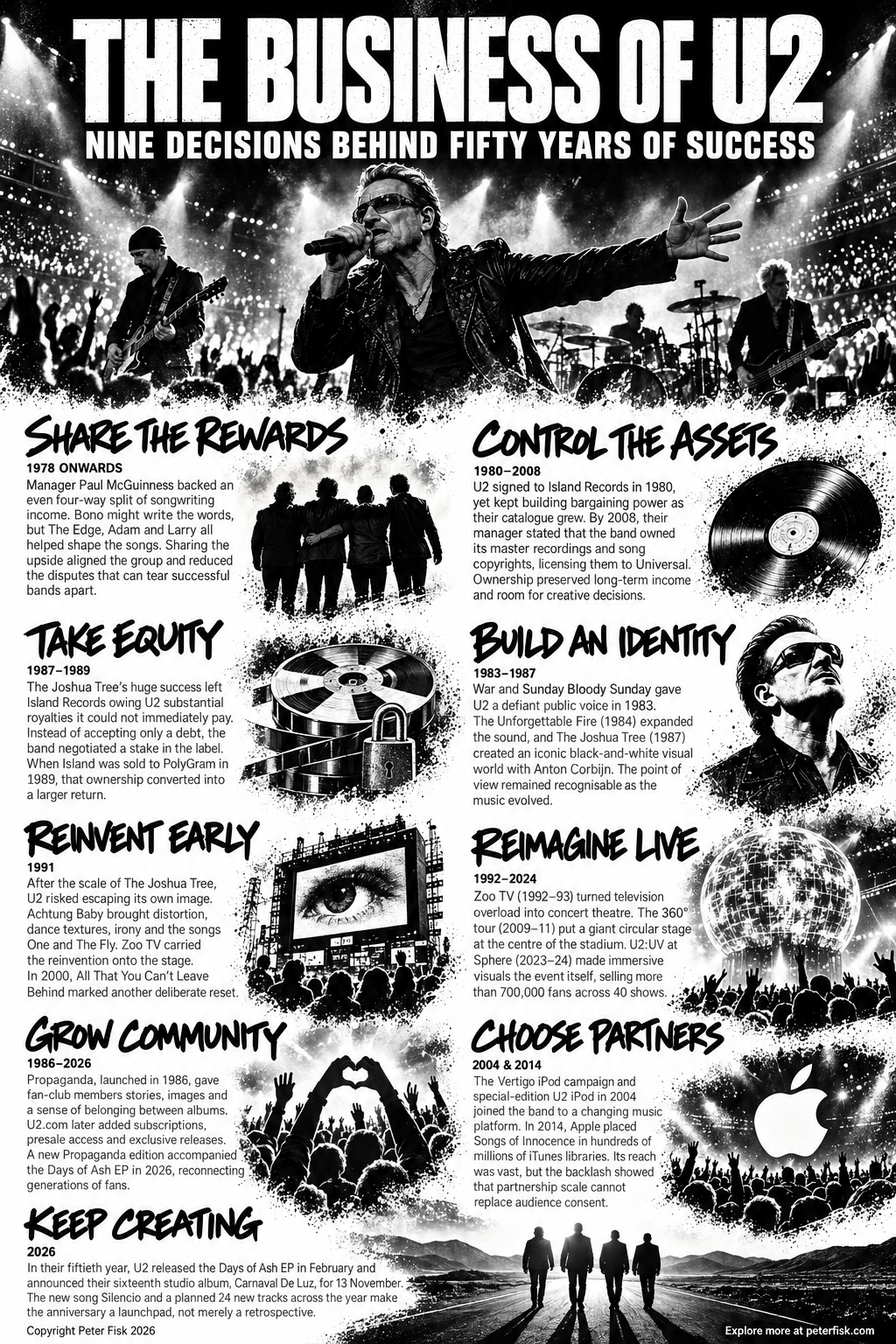
9 commercial decisions stand out:
- Share the rewards. An equal division of songwriting proceeds among the four musicians helped protect the partnership at the centre of the enterprise.
- Control the assets. Stronger rights agreements gave the band a greater stake in the enduring value of its songs and recordings.
- Take equity when the opportunity warrants it. A stake in Island Records turned unpaid royalties into a share of the label’s future value.
- Build a recognisable identity. U2 developed a distinctive combination of sound, imagery, emotional scale and engagement with the wider world.
- Reinvent before familiarity becomes a constraint. Achtung Baby changed what audiences thought a U2 record and concert could be.
- Make live performance an invention of its own. From Zoo TV to 360° and Sphere, each major production gave people a fresh reason to see the band.
- Invest in the relationship between releases. Fan publications, memberships, archives and exclusive experiences helped turn a worldwide audience into a lasting community.
- Use partners to reach new possibilities. Deals with Apple and live entertainment businesses expanded distribution and ambition, while also exposing the risks of getting too close to a powerful partner’s agenda.
- Keep creating new work. A valuable catalogue supports the business; new music keeps its future open.
Together, these decisions reveal a strategy that other businesses can learn from. U2 protected the value of what they made, built a bond with the people who cared about it, and repeatedly found a new form for that bond. The choices were rarely risk free. Some were controversial. That makes their fifty-year story more useful than a tidy account of uninterrupted triumph.
Build the partnership before the fortune
A band is an organisation built under unusual pressure. Four people may begin as friends, but success makes every contribution visible and every difference consequential. Who wrote the defining line? Who created the sound everyone recognises? Whose face sells the ticket? Questions of credit and income have ended many musical partnerships.
U2 addressed part of that problem early. Manager Paul McGuinness encouraged the musicians to divide songwriting proceeds equally among the four of them. He later explained that unequal earnings had created divisions in other bands. The arrangement recognised something that a conventional songwriting credit can struggle to capture – the value of a group’s collective judgement and chemistry.
Bono may write a lyric, but it becomes a U2 song through the choices of the Edge, Clayton and Mullen. A guitar part can leave space for a voice. A bass line can supply momentum without demanding attention. A drum pattern can turn an idea into a call to action. Just as valuable is the trust required to challenge a weak idea or follow one member into unfamiliar territory.
The attached video summarises this as a “five-way split” including McGuinness. That is too neat a description of the band’s arrangements. McGuinness had a substantial management share, while the equal songwriting division applied to the four musicians. The more significant point is the design principle: U2 gave every member a durable stake in the value they created together.
That decision did not remove conflict. During the making of Achtung Baby, different ideas about the band’s direction brought them close to breaking apart. But a shared economic foundation gave them one less reason to do so. In any enterprise built on a small group of exceptional people, the way rewards are divided can either strengthen the collaboration or quietly undermine it.
Own more of what you create
Commercial success and financial control are different things. Artists can sell millions of records while others own the recordings, collect publishing income and decide how the catalogue is used. McGuinness understood that U2’s songs were accumulating value long after each release campaign ended.
As the band’s negotiating power grew, it secured much stronger control over its publishing and recordings. Then came an unusual decision during negotiations with Island Records. When the label could not meet its royalty obligations in the mid-1980s, U2 took a stake estimated at around 10 per cent in the company. The stake became valuable when Island was subsequently sold. Some retellings attribute the unpaid royalties to The Joshua Tree; contemporary accounts place the negotiations before that album’s 1987 release, in the period following The Unforgettable Fire.
It was a risky choice. Royalties owed were a known claim; equity depended on what happened to the label. Yet the band and its manager could see that Island’s future was connected to the artists on its roster. Rather than view the negotiation solely as a dispute over past payment, they sought participation in future value.
Rights ownership has an equally important long-term effect. Songs can be performed, licensed, reissued and presented in new formats. Albums can become the basis of anniversary tours or immersive shows decades later. Control gives creators more freedom to decide when and how to do those things.
For U2, the catalogue is a living asset. The Joshua Tree could be revisited as a concert experience thirty years after its release. Achtung Baby could become the centre of a Las Vegas residency. Those possibilities depend first on making music people continue to value, and then on having sufficient control to build something new from it.
Make the brand mean something
U2’s brand was never simply a logo or a visual style. It emerged from the experience of listening to the band: urgency, space, conviction, vulnerability and a persistent interest in what binds people together.
That song, Sunday Bloody Sunday made that identity unmistakable early on. Its martial drums and forceful performance could easily have been mistaken for a call to take sides. The song instead asked listeners to confront the human cost of violence. The band chose to bring a fraught subject into popular music, accepting the risk that its meaning would be contested.
The Unforgettable Fire then opened up a different U2. Working with Brian Eno and Daniel Lanois, the band embraced atmosphere, texture and suggestion. That creative turn helped make possible the expansive sound of The Joshua Tree. “With or Without You” reached a vast audience through its emotional restraint; it builds through repetition and tension rather than rushing to demonstrate its power.
The lesson for brand builders is that distinctiveness need not mean sameness. Listeners could recognise U2 across these records because the band’s emotional ambition remained clear even as its sound changed. The brand was a set of creative commitments, broad enough to permit discovery.
Success, however, made those commitments vulnerable to becoming a formula. After The Joshua Tree and Rattle and Hum, the earnest, widescreen U2 image was both a great commercial asset and a potential limitation. The band faced a choice familiar to successful businesses: keep giving customers more of what had worked, or risk changing how that promise was delivered.
Break the formula while it still works
U2’s answer was Achtung Baby. They went to Berlin, struggled with their direction, and emerged with music influenced by electronic and industrial sounds. Bono adopted stage characters. The imagery became darker and more playful. Rather than offer another version of the band that had conquered the 1980s, U2 gave the 1990s a different proposition.
My favourite song, One shows the intelligence of that reinvention. Born during a period of tension within the group, it carried emotional clarity into an album full of sonic change. To me, its calm has never suggested that unity is easy. It suggests the opposite: that people can remain connected while acknowledging difference and difficulty. That is why it feels so large while sounding so intimate.
The business result was a remarkable widening of possibility. Existing fans had to reconsider what U2 could do. New listeners encountered a band engaging with the sounds and anxieties of its time. Reinvention extended the life of the enterprise because it prevented its greatest earlier success from defining all future expectations.
The same logic appeared in later turns, though with varying results. All That You Can’t Leave Behind restored a more direct sound without recreating The Joshua Tree. Songs of Innocence looked back to the members’ Dublin beginnings. The 2017 Joshua Tree tour brought an old album into a changed political climate. Each move asked how familiar material might speak to the present.
That question is more demanding than either abandoning the past or repeating it. It requires knowing which parts of an identity are essential and which are habits acquired through success.
Sell an event, not simply a seat
Live performance became a second arena for U2’s reinvention. Many artists tour an album with a set of songs and a stage design. U2 increasingly treated each major tour as a distinct creative and commercial proposition.
Zoo TV carried Achtung Baby’s fascination with media and identity into the stadium. Screens, characters and interruptions became part of the argument of the show. PopMart enlarged the spectacle and showed how ambition can also outpace audience expectations. The 360° Tour put the band beneath a vast structure in the middle of the stadium, changing sightlines and the relationship between musicians and crowd.
These productions demanded enormous investment. Equipment had to be designed, transported and assembled; crews had to make the experience work repeatedly across cities. Ambition created financial exposure as well as differentiation. U2 treated that challenge as a capability to build over time.
A live show has a particular business advantage in an era when recorded music is widely accessible: people cannot download the experience of being there together. They pay for the event, the anticipation and the memory. A strong catalogue makes the decision to attend easier, but a new production gives people who have already seen the band a reason to return.
U2 understood that the concert itself could be renewed. The songs were the foundation, yet the staging changed what those songs meant in the moment. That is how a band turns repeated demand into something more substantial than nostalgia.
Keep the community alive between moments
Hits attract an audience. Enduring relationships require attention when there is no hit, album or tour to promote.
U2 have maintained a direct connection through their website, membership programme, special releases and Propaganda, their long-running fan publication. The current subscriber offer includes a print edition of Propaganda and a CD tied to the band’s 2026 material. Following Sphere, subscribers could hear audio of the final performance and watch an extended interview. The band’s site also invited fans to add their memories of individual shows.
Such activity can generate revenue, but its deeper commercial role is to sustain attachment. A fan who saw U2 in the 1980s may bring a son or daughter to a later show. Another may travel across borders for a particular performance. People collect records and editions because they mark chapters in their own lives as well as the band’s.
This is why “fan base” understates the asset. A fan base can be counted; a community carries stories. U2’s music has been a soundtrack to personal relationships, political awakenings, grief, hope and celebration. The business benefits from that depth of feeling, but it cannot manufacture it through a subscription scheme alone. The scheme works when it gives an existing connection somewhere to live.
Let partners expand the idea, while protecting trust
U2’s relationship with Apple illustrates both the possibilities and the dangers of a high-profile partnership. In the iPod era, the connection between “Vertigo”, Apple’s advertising and paid digital music felt timely. The band saw a technology company helping listeners acquire music through a new legal channel. Apple gained an association with one of the world’s biggest bands.
A decade later, the logic of reach went too far. In 2014, Songs of Innocence appeared in hundreds of millions of iTunes accounts through a deal paid for by Apple. Some recipients welcomed a new U2 album; many had never asked for it. What was framed as a gift was experienced by others as an intrusion.
It was a useful correction to a familiar marketing assumption. Distribution is the ability to reach people. Permission is their willingness to receive you. The first can be bought or negotiated with a platform. The second has to be earned.
Trust also matters when commercial conduct meets public purpose. Bono’s campaigning on poverty and health has made him an influential voice far beyond music. It has also led people to judge U2’s financial choices against that public stance. The band’s 2006 move of part of its business to the Netherlands, after Ireland capped the artists’ tax exemption, drew criticism. Bono defended the decision and said U2 paid substantial taxes. The disagreement illustrates how a visible mission raises expectations about the choices behind it.
Neither episode erases the band’s achievements. Both show that commercial ingenuity carries reputational consequences. The bigger the platform, the more carefully a business must consider the experience and expectations of people on the other side of the deal.
Give the past a new venue
The Las Vegas Sphere residency brought U2’s capabilities together in an unusual form. U2:UV Achtung Baby Live at Sphere ran for forty shows between September 2023 and March 2024. Rather than presenting a generic greatest-hits residency, the band built the experience around Achtung Baby and the visual possibilities of a venue created for immersive entertainment. Sphere Entertainment reported the run as sold out.
The choice altered the economics of an ambitious show. A production designed for one venue can make full use of its architecture without being dismantled and moved after every performance. Audiences travel to the experience. The venue becomes part of what they are buying.
It was also an elegant artistic decision. Achtung Baby had once marked U2’s break from its established image; Zoo TVexplored how media reshape perception. More than thirty years later, the album proved fertile ground for a new encounter with technology, spectacle and human presence. The band used an old work to ask a current question: what happens to a concert when images can surround us completely, and where should our attention go within that world?
There was a significant qualification. Larry Mullen Jr. was recovering from surgery, so Bram van den Berg played drums at Sphere. The four original members had remained a band, but all four were not performing in that residency. Recognising that distinction makes the achievement easier to understand clearly.
Leave room for the next song
The announcement of Carnaval De Luz makes U2’s fiftieth anniversary a statement of intent as well as a celebration. Scheduled for November, the twelve-song album follows two new EPs released earlier in 2026. It will be offered digitally and in several physical editions, serving different ways people discover, hear and collect music.
Its reception remains an open question. That is precisely why making it matters. A band with U2’s catalogue could build a substantial business around what it has already created. New work exposes the members to fresh judgement. It also gives listeners a chance to form a relationship with U2 that begins in the present.
Fifty years of U2 show how an enterprise can gain strength from what it has built without becoming captive to it. The band shared value internally, fought for control of its work, invested in experiences that others could not easily copy and maintained a direct bond with its audience. At decisive moments, it changed course while keeping its underlying voice.
Yet the deepest explanation for U2’s endurance may lie beyond any contract, stage structure or release plan. It is in the distance between the defiant urgency of “Sunday Bloody Sunday” and the quiet resolve of “One”. Both songs ask what people owe one another. The band has found different ways to carry that question through different decades.
That is why U2 remain more than a successful catalogue. For those of us who have lived with the songs, they are an evolving conversation about how to be in the world: one world, one life, together.
More from the blog