Future Marketing … from building brands, driving innovation and accelerating growth … marketers got lost in their tactical execution … now its time for them to step up, as market makers
September 18, 2026
Marketing has never possessed more intelligence, reach or productive power. AI can generate campaigns, predict behaviour, personalise offers, optimise media and converse with millions of customers. Yet these capabilities are spreading so quickly that they cannot remain a durable source of advantage. When every competitor can create more content, test more variations and target more precisely, efficiency becomes the cost of entry. It does not explain why anyone should choose you.
- Market Makers: Reinventing marketing in a world of AI
- Future Brand Manifesto: Giving business the potential to be much more
- Global Marketing Summit 2026: Opening Keynote by Peter Fisk
The greater risk is that marketing becomes exceptionally efficient at a diminished task: promoting what the business has already decided to make. In many companies, the consequential choices are made elsewhere. Which markets should we create? Which problems are worth solving? What could customers achieve that is difficult today? How should the company evolve as culture, technology and expectations change? Marketing arrives later, with a sales target and a communications brief.
That is a profound waste of the function closest to the market. Marketing should be a strategic growth driver: sensing shifts before they become obvious, seeing possibility across category boundaries, engaging customers in their needs and aspirations, and mobilising the enterprise to create value around them. Its remit should extend from building demand to building the market; from managing a brand to increasing the company’s capacity to grow.
The context makes that shift urgent. Categories are blurring. Discovery increasingly happens through creators, communities and algorithms. Commerce is becoming embedded in everyday life. Customers want relevance without surveillance, personalisation without manipulation and convenience without surrendering control. Brands will not stand out by adding noise. They will stand out by becoming more consequential to people’s progress.
7 shifts define that larger ambition. Each changes what marketing is for, how marketers work and what chief marketing officers should be accountable for.
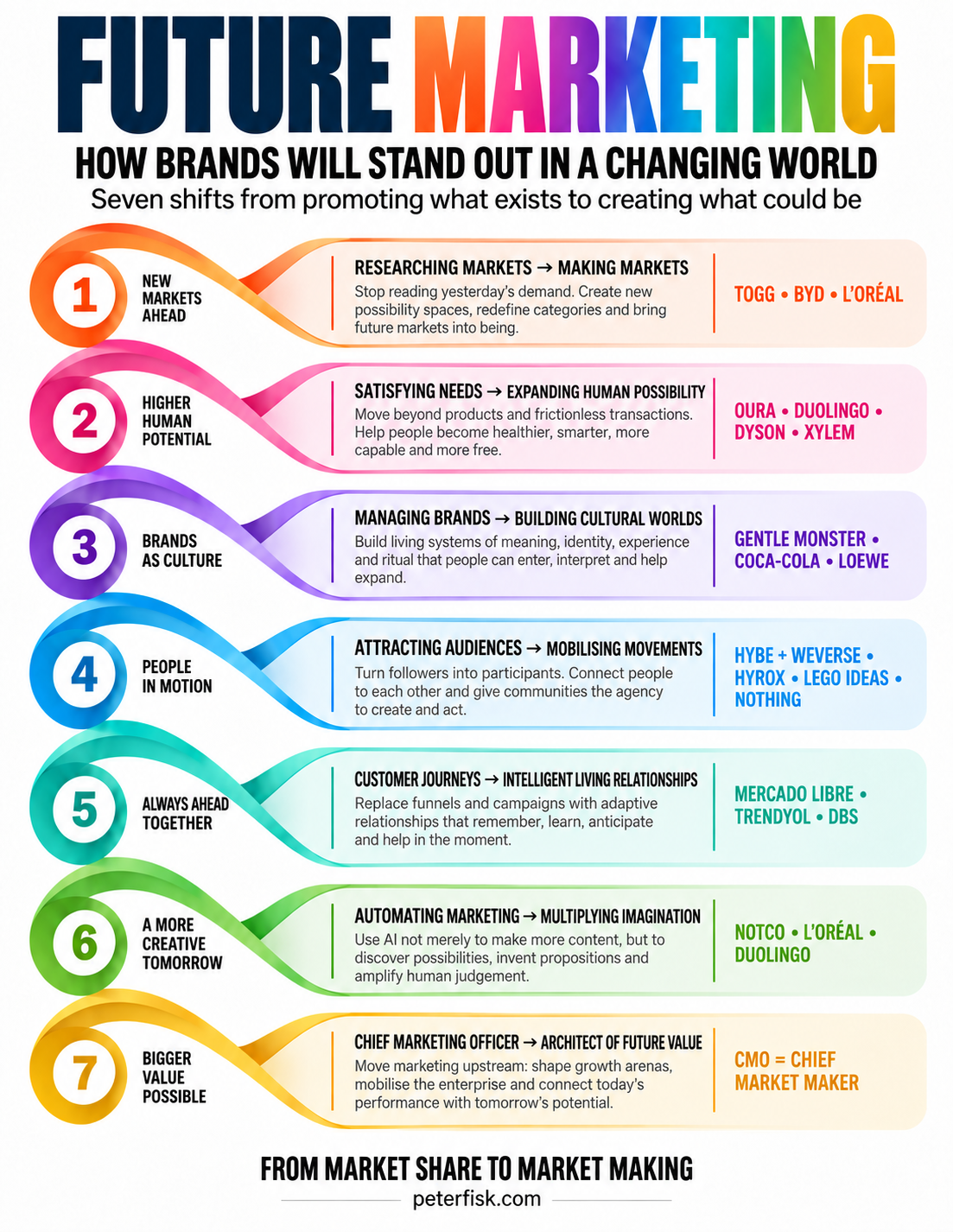
Shift 1: New markets ahead
From researching markets to making markets
Traditional marketing starts with a market that already exists and studies its segments, competitors, behaviours and shares. Future marketing starts with a possibility that does not yet have a category, a convention or a settled pool of demand. Its job is to make that possibility real. The marketer moves from observer to instigator, combining changes in technology, culture, regulation and human aspiration into a new arena of value.
Why this shift matters?
Research is indispensable, but historical data can only describe choices that people were previously offered. It cannot reveal demand for a radically different future. In periods of discontinuity, excessive reliance on existing-category evidence causes companies to perfect yesterday’s game. Market makers identify tensions, imagine a more valuable system and build the partnerships, language, behaviours and confidence that allow demand to form around it.
What are the consequences?
- Frame growth around possibility spaces rather than fixed category shares. Combine weak signals, ethnography, scenario work and AI-assisted exploration to decide which future arena the company can credibly shape.
- Write the market thesis before the communications plan. Define the unmet progress, the new ecosystem and the capabilities required, then make the investment case with finance, product and operations.
- Measure category creation as well as brand performance. Track adoption of new behaviours, ecosystem participation, new-revenue mix and the company’s right to lead the emerging market.
How do the best marketers work?
- BYD combined batteries, electronics, software and manufacturing to help turn electric mobility into a different competitive system, then expanded across price tiers and geographies.
- L’Oreal‘s beauty technology agenda joins science, diagnostics, data and digital services. It expands the market from products people apply to personalised systems that help them understand and manage beauty.
- Togg frames the T10X as a connected smart device and links it to the Trumore platform and charging infrastructure. The proposition is a Turkish mobility ecosystem, not simply another electric car.
Shift 2: Higher human potential
From satisfying needs to expanding human possibility
Needs describe a gap in the present. Aspirations describe a desired future. Customers rarely wake up wanting a feature, a campaign or a frictionless funnel. They want to become healthier, more capable, more confident, more connected or more free. The stronger unit of marketing is therefore not the product or transaction, but the progress a person seeks to make.
Why this shift matters?
Features travel quickly and interfaces are copied. A brand built around a consequential human ambition can keep changing its products while preserving a coherent reason to exist. It also enlarges innovation. Instead of asking how to sell more of an existing offer, teams ask what prevents people from achieving their aspiration and assemble the products, services, intelligence and partners that remove those barriers.
What are the consequences?
- Replace static need states with progress maps. Understand the outcome people seek, the emotional and practical barriers they face, and the moments when help has the greatest value.
- Design propositions as systems of progress, not bundles of features. Marketing should shape the product, service, content, community and behaviour change required to deliver the promise.
- Measure customer advancement alongside satisfaction. Useful indicators include capability gained, milestones reached, adherence, confidence and the customer’s willingness to deepen the relationship.
How do the best marketers do it?
- Oura turns physiological signals into guidance about sleep, stress, readiness and recovery. The ring is an instrument within a continuing relationship that helps people make better daily choices.
- Duolingo converts the intimidating ambition of learning a language into a playful daily practice. Adaptive lessons, streaks and social competition are a motivation system as much as a curriculum.
- Dyson begins with frustrations people have learned to tolerate, then uses engineering to redefine the experience. Its visible technology makes the solution itself the proof and the marketing.
- Xylem frames pumps, sensors and treatment technologies around the larger human possibility of water security. Its solutions help cities and organisations see, manage and protect a resource on which every community depends.
Shift 3: Brands as culture
Managing brands to building cultural worlds
Brand management was designed for an age of controlled messages and stable categories. Its central discipline was consistency: repeat a recognisable promise, identity and tone. Consistency still builds memory, but a static identity is too small for a participative and fast-moving culture. The most magnetic brands now operate as cultural worlds that people can enter, interpret and help expand.
Why this shift matters?
A cultural world is not decoration around a product. It is a distinctive system of meaning, aesthetics, rituals, stories, spaces and behaviours. It gives a brand enough coherence to remain recognisable and enough openness to evolve. That combination matters because functional advantage is increasingly temporary. Meaning gives innovation direction, earns attention without constantly buying it and grants the brand permission to move into new experiences and business models.
What are the consequences?
- Codify the brand’s worldview, not only its visual identity. Define what it notices, values, celebrates and refuses, then express that logic through products, people, spaces and partnerships.
- Build cultural participation into the operating model. Create rituals, symbols, formats and experiences that customers and creators can use rather than messages they can only receive.
- Protect dynamic coherence. The CMO should distinguish the enduring codes that build memory from the expressions that must keep changing with culture.
How do the best marketers do it?
- Gentle Monster makes eyewear retail a form of surreal cultural theatre. Its stores and installations attract people into the brand’s imagination before a purchase is considered.
- Coca-Cola keeps a remarkably stable product culturally alive through music, food, sport, packaging and rituals of sharing. Personalised bottles work because people carry the brand through their own relationships.
- Loewe treats heritage as material for contemporary experimentation. Craft, fashion, art and unexpected collaborations create a recognisable world with room to surprise.
Shift 4: People in motion
From attracting audiences to mobilising movements
An audience watches. A community participates. A movement changes something. Mass marketing was built around people to reach, persuade and convert, and much digital marketing repeats that broadcast logic with finer targeting. Future brands create a shared ambition and give people agency to advance it together. Customers connect with one another, contributing identity, knowledge, creativity, advocacy and action.
Why this shift matters
Attention is rented and increasingly expensive. Participation compounds. A strong community creates learning, belonging, advocacy and new routes to growth; it can also make the proposition more valuable for every member. Influence then becomes distributed across credible specialists, creators and participants. The brand gains momentum because people have a reason to carry it, not because the company has paid for another impression.
What are the consequences?
- Define a cause, challenge or shared pursuit that is larger than consumption but specific enough to act upon. Participation needs a direction, not a vague purpose statement.
- Design roles and assets for the network. Give members stages, tools, status, data, creative freedom and ways to help one another; reward useful contribution rather than passive reach.
- Manage influence as a relationship. Work with credible people whose expertise or identity fits the community, and accept that shared agency requires less message control.
How do the best marketers do it?
- HYBE‘s Weverse connects artists, content, conversation, commerce and fan participation. It converts episodic releases into a persistent social and commercial relationship.
- Hyrox created a repeatable global race combining running and functional exercise. Athletes, gyms and coaches train towards a shared standard, turning fitness participation into a worldwide category.
- Lego Ideas enables enthusiasts to submit and support designs that may become commercial sets. The community does not merely amplify the brand; it expands what the company can imagine and make.
- Nothing has treated its community as a source of feedback, advocacy and product participation. Its transparent design language gives members a recognisable identity to gather around.
Shift 5: Always ahead together
From customer journeys to intelligent living relationships
The customer journey was a useful map for a simpler age. It assumes that people move through a sequence the company can identify and optimise. Real relationships are continuous and contextual. They unfold through recommendations, search, product interfaces, service interactions, employees, communities and AI assistants. The brand is experienced as a living presence rather than a sequence of campaigns.
Why this shift matters?
Data and AI can help a relationship remember, learn and adapt. The strategic opportunity is not to pursue customers everywhere or automate every contact. It is to recognise when help is valuable, carry context across interactions and know when to disappear. Companies that do this well reduce friction, increase relevance and create an accumulation of trust that makes the next interaction easier than the last.
What are the consequences?
- Replace funnel ownership with relationship orchestration. Marketing must connect product, service, commerce, data, partners and customer operations around one experience logic.
- Build a permission architecture. Customers should understand what data is used, what value they receive and how they can control the relationship; relevance without agency will erode trust.
- Optimise lifetime progress, not isolated conversion. Track retention, share of relationship, successful outcomes, cost to serve, trust and the strength of cross-ecosystem participation.
How do the best marketers do it?
- Mercado Libre connects marketplace, payments, credit, logistics and advertising to remove linked barriers in Latin America’s digital economy. Each service makes the wider relationship more useful.
- Trendyol connects consumers, merchants, logistics, creators and cross-border access. It grows by increasing the capability of the network, including the ability of Turkish businesses to reach new markets.
- DBS has worked to embed banking into the moments and ecosystems where people and businesses are already trying to achieve something, making financial services part of progress rather than a separate destination.
Shift 6: A more creative tomorrow
From automating marketing to multiplying imagination
The future of marketing is not AI on its own. It is amplified humanity. Automation can lower cost and accelerate execution, but competitors have access to similar models and tools. The larger opportunity is to multiply what marketers and customers can imagine, test and achieve. AI contributes pattern recognition, simulation, speed and scale. People contribute empathy, curiosity, judgement, taste, responsibility and cultural sensitivity.
Why this shift matters?
Used narrowly, generative AI will flood markets with competent and interchangeable content. It will optimise established patterns and pull brands towards the average. Used ambitiously, it can expand the search space: reveal weak signals, model possible markets, generate hypotheses, prototype propositions and personalise useful experiences. As production becomes abundant, original questions and discriminating judgement become more valuable.
What are the consequences?
- Deploy AI across the growth system, not only the content factory. Prioritise market sensing, proposition invention, experience prototyping and customer decision support where intelligence changes value, not merely volume.
- Redesign teams around human and machine strengths. Marketers need stronger problem framing, experimentation, data fluency, editorial judgement and accountability for what automated systems produce.
- Make trust a product requirement. Establish clear rules for consent, provenance, bias, synthetic media, human escalation and the use of customer data before scaling personalisation.
How do the best marketers do it?
- NotCo‘s Giuseppe AI explores unexpected ingredient relationships; scientists test feasibility, chefs shape taste and consumers validate the result. Technology broadens imagination while people make the consequential judgements.
- L’Oreal combines AI-enabled diagnostics and virtual tools with scientific expertise and beauty advisers, using technology to make expertise more accessible and personal.
- Duolingo uses AI to adapt practice and create conversational learning scenarios, while its educators, product designers and distinctive brand voice shape motivation and trust.
Shift 7 Bigger value possible
From chief marketing officer to architect of future value
The final shift changes the purpose of the CMO. The inherited role manages brand, communications, media and demand generation. The future role connects outside-in possibility with inside-out capability. It identifies valuable markets, frames the customer progress the business will enable and aligns innovation, experience, partnerships and commercial investment around that choice. The CMO becomes an architect of future value.
Why this shift matters?
The sources of growth no longer fit neatly inside functions. A new market may require product innovation, data, service design, operations, finance, acquisitions and ecosystem partners. Marketing cannot own all of those capabilities, but it can provide the market logic that connects them. Without that integrating role, companies fragment customer value across departments and optimise near-term activity while future relevance weakens.
What are the consequences?
- Move the CMO’s centre of gravity upstream. Allocate time and talent to portfolio choices, innovation and business design while retaining excellence in demand creation and brand stewardship.
- Create a shared growth system with finance, product, technology and operations. Link market hypotheses to staged investment, leading evidence and clear decisions to scale, adapt or stop.
- Accept enterprise-level accountability. Report how marketing changes growth, margin, pricing power, customer economics and future options, not only reach, attribution and campaign return.
How do the best marketers do it?
- P&G institutionalised brand building as a general-management discipline. Consumer insight, product performance, innovation and commercial execution are connected rather than treated as a communications sequence.
- Mastercard’s shift from a payment-card identity towards a wider payments and experiences platform shows how a durable brand idea can support category expansion and partnerships.
- Nike has repeatedly linked athlete insight, product innovation, cultural storytelling, membership and direct relationships. Its strongest periods show marketing operating as an enterprise growth system rather than an advertising department.
A mandate for marketing leaders
AI will make marketing easier to produce and harder to distinguish. That paradox raises the value of what remains scarce: an original view of the market, a precise understanding of human aspiration, the courage to create a new category, the taste to build a distinctive world and the trust required to sustain a relationship.
The CMO’s task is larger than modernising the marketing department. It is to help the enterprise see further and act earlier. That means choosing future markets, organising around customer progress, turning brands into cultural and economic platforms, mobilising communities, designing intelligent relationships, multiplying human imagination with AI and proving how these choices change enterprise value.
The brands that stand out will not simply communicate the future more vividly. They will give customers, communities and companies a credible way to enter it.
- McKinsey’s State of Marketing 2026 Report
- Kantar’s Marketing Trends 2026
- Deloitte’s CMO Survey 2026
- McKinsey’s Campaigns to Continuous Growth
- WARC’s Marketer’s Toolkit 2026
More from the blog