Reinventing Consulting
October 19, 2026 at Tokyo, Japan (2 days)
How AI, platforms and new competitors are dismantling the traditional consulting model — and creating a new industry built around outcomes
For decades, the consulting model was remarkably predictable. A client had a difficult strategic problem. A partner arrived with a team of smart, relatively junior consultants. They spent three months interviewing executives, gathering data, benchmarking competitors and building models. Eventually they returned with the answer.
Today, much of that three-month analytical phase can potentially be done in 30 minutes with AI — often by the client themselves.
That doesn’t mean the resulting answer will be right. It does mean that information, research and analysis are becoming dramatically cheaper. And that challenges an industry whose economics have traditionally depended on selling expensive human intelligence by the hour.
One glimpse of what comes next can be found at Palantir. It doesn’t describe itself as a consultancy, yet its model looks remarkably like a reinvention of consulting. Clients bring a real problem and their data; Palantir brings its AI platform and small teams of forward-deployed engineers. Instead of analysing for months and recommending what should happen, they build working solutions alongside the client. Its AIP Bootcamps have been designed to move from a business problem to a working use case in five days or less.
The principle is simple: don’t spend months analysing what could work. Start building, learn quickly and create an outcome.
It turns several assumptions of traditional consulting upside down. Small expert teams replace large pyramids. Technology and people work together rather than sequentially. Diagnosis and implementation converge. Proprietary platforms capture and reuse knowledge. Client relationships become continuous rather than project-based. Most importantly, value comes from what changes in the client’s business, rather than how many consultant-hours were required to change it.
Traditional consulting firms are starting to adopt similar approaches. Deloitte has developed Palantir-trained Forward Deployed Engineers, while IBM Consulting is developing multidisciplinary forward-deployed teams combining engineers, architects and domain experts. IBM explicitly argues that AI is shifting professional services away from labour-based scaling and utilisation towards measurable business outcomes.
This is much bigger than adopting AI. Consulting is reaching the end of one S-curve and beginning another.
Management consulting has always prospered from disruption. Now it is being disrupted itself.
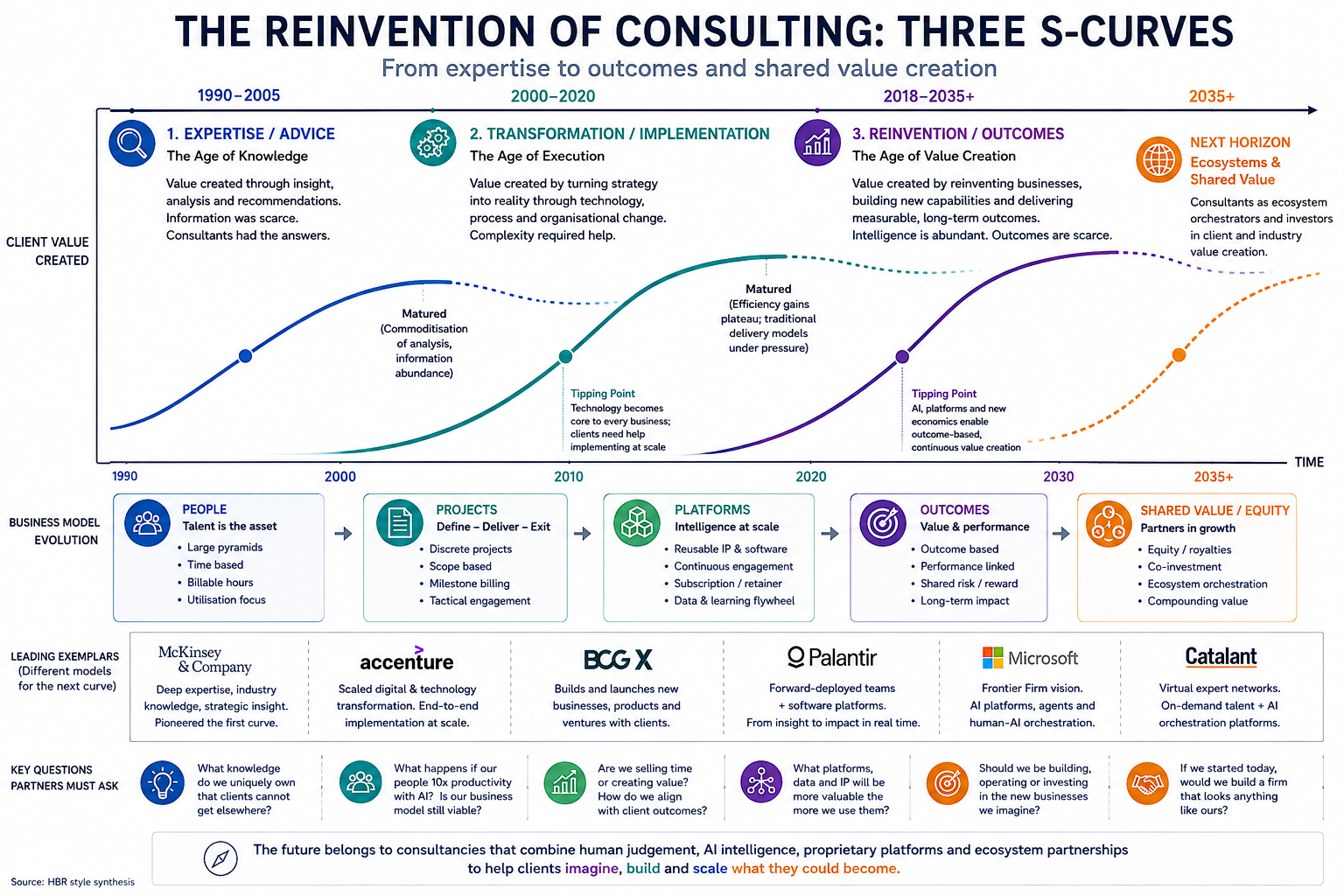
The reinvention of consulting
The evolution of consulting can be understood as a succession of S-curves. Each emerged because clients faced problems they could not easily solve themselves. Each developed distinctive capabilities and economics. And each eventually reached a point where the assumptions that created its success began to constrain what came next.
The first curve was built around expertise. McKinsey, BCG and Bain became extraordinarily successful because knowledge was scarce and difficult to assemble. Consultants had access to information, analytical techniques, industry experience and highly educated talent that most companies could not reproduce internally. They converted this knowledge into frameworks and recommendations. The fundamental product was advice, and the dominant economic model was selling access to talented people.
The second curve emerged as strategy collided with technology. Companies no longer simply needed to know what to do; they needed help making it happen. Accenture, Deloitte, Capgemini, IBM, NTT DATA, TCS and others built enormous businesses around enterprise systems, digital transformation, cloud, data, cybersecurity and managed services. Strategy firms moved in the other direction. McKinsey expanded into implementation and technology, BCG created BCG X, and Bain built increasingly substantial digital capabilities.
The fundamental product shifted from expertise to transformation.
Technology became crucial in three ways. It disrupted clients’ industries, creating the need for consultants. It enabled the solutions consultants recommended. And, increasingly, it transformed how consultants themselves worked.
AI now accelerates all three simultaneously. That is why the third S-curve could be much more disruptive than the second.
The fundamental product is shifting from transformation to outcomes and long-term value creation.
When intelligence becomes abundant
The traditional consulting model contains a structural contradiction. Clients supposedly pay for intellectual insight, but much of the industry’s economic model has depended on intellectual labour.
Research takes hours. Analysis takes hours. Benchmarking takes hours. Building models takes hours. Preparing presentations takes hours. More hours require more people, creating the familiar consulting pyramid in which relatively few expensive partners sit above increasingly large numbers of managers, consultants and analysts.
AI breaks the relationship between hours and output.
McKinsey’s own Lilli platform demonstrates the potential. What began as a knowledge-search tool has evolved into a generative AI platform used for analysis, planning and creative problem-solving. McKinsey describes its ambition as rewiring how the firm operates rather than simply adding another productivity tool.
This is happening across the industry. The immediate response is to celebrate productivity: ten consultants can accomplish what previously required twenty. But commercially that raises an uncomfortable question. If consulting continues charging principally for time, becoming dramatically more productive can mean billing dramatically less.
The issue is therefore not how to insert AI into the old consulting model. It is how to reinvent the model around a world in which intelligence is increasingly abundant.
The scarce capabilities move elsewhere. Asking a better question becomes more valuable than researching an answer. Judgement matters more than information. Imagination matters more than analysis. Trust matters more than presentation. Mobilising people around difficult choices becomes more important than documenting those choices.
AI doesn’t eliminate the consultant. It changes what a consultant needs to be.
From time and materials to outcomes
This leads to the most important economic shift in consulting: from selling inputs to creating outcomes.
The traditional conversation begins with resources. How many consultants? For how many weeks? At what day rate? The future conversation begins somewhere else. What are we trying to achieve? How much economic value could it create? How quickly can we create it? How should that value be shared?
IBM Consulting has articulated the problem unusually clearly. For decades, it argues, labour was the scaling factor for services: more humans produced more output, so everything from time-and-materials pricing to utilisation was calibrated around people. AI changes the scaling factor. IBM consequently argues that transformation needs to move towards multidisciplinary teams orchestrating AI and measured against business outcomes rather than utilisation.
This changes what consulting companies optimise. Instead of utilisation rates, the important metric might become value created per consultant. Instead of revenue per partner, it could be client value created over ten years. Instead of project margin, it might be the recurring economic value of a platform or intellectual asset.
A consultancy helping a manufacturer unlock £500 million of productivity should increasingly be rewarded according to the value created, not the number of consultants who occupied meeting rooms along the way.
The implications go further. Consultants could take equity in businesses they create. They could receive royalties from new products. They could co-invest in transformations. They could license intellectual property. They could share savings or incremental revenues. They could build assets with one client and scale them across an industry.
Consulting starts looking less like professional services and more like a combination of advisory, technology, entrepreneurship and investment.
The disruptors may not call themselves consultants
This is where the most interesting reinvention is occurring. The firms challenging consulting are not necessarily trying to build better consulting firms. They are eliminating parts of consulting altogether.
Microsoft’s idea of the Frontier Firm offers one glimpse of the destination. Microsoft describes organisations progressing from using AI as an assistant, through delegating complete tasks, towards humans orchestrating teams of autonomous agents. The resulting organisation is built around human-agent collaboration and outcomes rather than traditional hierarchical divisions of labour.
Apply that logic to a consultancy. Why maintain hundreds of analysts to gather information if specialised agents can continuously monitor every competitor, technology, market and customer? A future consulting team might consist of one senior strategist, one industry specialist, one technologist and a network of hundreds of AI agents.
The pyramid becomes a platform.
Palantir points towards another model. Its forward-deployed engineers work inside client organisations, combining technology, problem-solving and implementation. Instead of spending months analysing the problem before recommending a solution, small teams build against the client’s real data and operational environment. The model collapses the separation between adviser and implementer, and between diagnosis and action.
It has become influential enough that OpenAI, Anthropic, Databricks and others are now embedding engineers with customers, while conventional consultancies are adopting similar approaches. IBM describes forward-deployed units as multidisciplinary combinations of engineers, architects and domain experts capable of creating measurable results far faster than conventional programmes.
That suggests a radically different consulting principle: don’t present the answer; build it.
The rise of the virtual consulting firm
At the other extreme from Microsoft and Palantir sits an equally important disruption: consulting without the firm.
Companies such as Eden McCallum, Business Talent Group and Catalant have spent years unbundling expertise from traditional consulting organisations. Instead of maintaining large permanent pyramids, they connect clients with independent consultants, executives and specialists assembled around specific problems.
AI makes this model much more powerful.
Imagine a client problem requiring expertise in Chinese electric vehicles, battery chemistry, European regulation, consumer behaviour and mobility ecosystems. A traditional consultancy might search internally for people with approximately the right experience. A platform can potentially identify the best independent experts anywhere in the world, assemble them temporarily, surround them with AI research and analytical capabilities, and dissolve the team when the outcome has been delivered.
The competitive advantage becomes less about owning talent and more about orchestrating talent.
This has profound implications for the industry’s economics. The traditional consultancy needs offices, recruitment programmes, training systems, benches of underutilised consultants and enormous organisational infrastructure. A virtual consultancy can assemble capabilities on demand.
AI becomes the connective tissue that makes the network scalable.
Five models of the future
The emerging industry is therefore unlikely to converge around one winning model. At least five very different architectures are appearing.
Accenture represents the reinvention-at-scale model. Its challenge is to integrate strategy, technology, operations, data and AI around continuous business reinvention. Its enormous advantage is the ability to move from an executive conversation into implementation and operation. Its vulnerability is equally obvious: AI challenges the labour-intensive economics on which much of the global services industry was built.
BCG X represents the build-the-future model. Rather than restricting strategy consultants to recommendations, BCG has assembled designers, engineers, technologists, entrepreneurs and venture builders capable of creating new products, platforms and businesses. The distinction matters. A strategy firm traditionally tells a client where future growth lies; the emerging model helps create the growth business itself.
Palantir represents the product-plus-embedded-expertise model. Its consultants are effectively engineers, its methodology is partly encoded into software, and client problems continuously inform the development of the platform. Rather than separating software, consulting and implementation, the model blends them.
Microsoft represents the intelligence-platform model. Its Frontier Firm concept points towards organisations in which AI agents perform substantial amounts of knowledge work and humans increasingly direct, orchestrate and judge. Microsoft argues that leading companies are creating intelligence platforms combining their own data, workflows, applications, knowledge and expertise so that organisational intelligence compounds over time. For consulting, that could ultimately be more disruptive than merely automating PowerPoint.
Virtual expert networks represent the orchestration model. Firms such as Eden McCallum, BTG and Catalant challenge the assumption that expertise needs to sit inside a permanent firm at all. Add AI agents, global specialist communities and sophisticated collaboration platforms and it becomes possible to imagine a consultancy with relatively few employees but access to extraordinary amounts of capability.
Each model attacks a different assumption of conventional consulting. Accenture challenges the boundary between consulting and operations. BCG X challenges the boundary between advising and building. Palantir challenges the separation of people and software. Microsoft challenges the assumption that knowledge work requires humans. Virtual networks challenge the assumption that the consultancy needs to employ its consultants.
Put them together and something much more radical starts to emerge.
From projects to platforms
The traditional consulting project also looks increasingly anomalous in a world of continuous change.
A strategy is developed, presented and implemented. Three years later another strategy project begins. Yet markets, competitors, technologies and customer expectations evolve continuously.
Why shouldn’t strategy do the same?
Imagine a strategic intelligence platform permanently connected to the organisation’s internal data and the external world. AI agents continuously monitor technologies, start-ups, competitors, regulations, geopolitics and changing customer behaviour. They identify weak signals, simulate scenarios and surface opportunities. Human advisers interpret what matters, challenge assumptions and help leaders make choices.
The annual strategy project becomes an always-on strategy system.
The same principle can apply to innovation, procurement, supply chains, organisational design, marketing and productivity. Consulting IP that once existed as frameworks in PowerPoint becomes algorithms, applications and agents embedded in the client’s organisation.
That changes the economics again. Knowledge becomes a recurring service rather than a one-off project. Fees become subscriptions, licences, retainers and outcome payments. Intellectual capital becomes a scalable asset.
The consulting company starts behaving like a software platform.
From transformation to reinvention
Yet technology alone will not define the winners.
Much of the consulting industry has spent the last two decades helping organisations transform. But transformation generally starts with the existing company. How can we digitise it, automate it, simplify it or make it more efficient?
Reinvention begins with a different question: what could this company become?
Could an automotive manufacturer become an orchestrator of mobility? Could an insurer become a platform for preventing risk? Could a healthcare company make its business maintaining health rather than treating illness? Could a bank become an intelligent financial companion? Could a manufacturer move from selling equipment towards guaranteeing outcomes?
These questions require more than analysis. They require imagination, experimentation and entrepreneurial judgement.
This may become one of the paradoxes of AI. As machines become exponentially better at analytical intelligence, the most valuable consultants become more human. They see possibilities others don’t. They connect ideas across industries. They challenge executive assumptions. They understand people and politics. They inspire confidence in uncertain choices. And they help organisations move before all the evidence exists.
Consulting therefore moves from knowing more to seeing further.
The disappearing pyramid
The organisational consequences could be profound.
For generations, consulting firms have recruited armies of highly talented graduates partly because junior consulting work was the apprenticeship through which future partners learned the profession. But if AI eliminates much of the work at the bottom of the pyramid, what happens to the pyramid itself?
The emerging structure could look much more like a network: relatively small numbers of senior advisers and industry experts, augmented by technologists, designers and entrepreneurs; connected to external specialists and ecosystem partners; and amplified by large numbers of AI agents.
Indeed, professional firms are already reconsidering what juniors need to learn. As analytical tasks become automated, firms are placing greater emphasis on judgement, storytelling, empathy, leadership and client interaction.
The future consultant may therefore reach meaningful client problems much earlier. Instead of spending their first years gathering information and formatting slides, young consultants will need to learn how to frame problems, interrogate AI-generated analysis, work with executives and exercise judgement.
That may ultimately create better consultants.
But probably fewer of them.
The key questions every consulting partner should ask
For the leaders of consulting firms, the danger is treating AI as another technology investment. Giving everyone Copilot and announcing an AI practice does not constitute reinvention.
The first question is more fundamental: if intelligence becomes abundant, where will clients still perceive scarcity?The answers might include judgement, imagination, proprietary data, specialist expertise, trusted relationships, execution capability and the courage to make difficult choices.
Partners should then ask what they are actually selling. Is it expertise, people’s time, transformation capability, technology, intellectual property or outcomes? If a client can obtain 80 per cent of today’s analytical output internally, what constitutes the remaining 20 per cent — and why should it command a premium?
They should ask what happens if their people become ten times more productive. Would that make the firm ten times more profitable, allow it to charge one tenth as much, or destroy the logic of the current business model?
They should examine what the firm should own. Proprietary datasets? AI agents? Decision engines? Platforms? Equity in ventures? Ecosystem relationships? A methodology that lives only in people’s heads and presentation decks becomes increasingly difficult to defend.
They should rethink talent. If you could access the world’s best expert for a problem rather than the best expert currently available inside your firm, why wouldn’t you? And if AI can perform much of the analytical work, should the firm’s next thousand recruits be generalist graduates or entrepreneurs, technologists, designers, scientists and deeply experienced industry operators?
Most importantly, they should ask a question that incumbents in every disrupted industry eventually confront:
If we created this consulting firm from scratch today, knowing what AI will make possible over the next five years, would we design anything resembling the firm we currently lead?
For most partnerships, the answer is uncomfortable.
Jumping to the next curve
The first consulting S-curve monetised expertise. The second monetised transformation. The third will increasingly monetise outcomes and long-term value creation.
The firms that dominate it may look very different from today’s consultancies. Some will resemble technology platforms. Some will look like venture studios. Others will become orchestrators of global talent networks. Some will embed tiny multidisciplinary teams inside clients and build solutions in real time. Others will combine proprietary AI, data and human judgement into continuous strategic intelligence systems.
The most ambitious will probably combine all of these.
That is the deeper meaning of AI for consulting. It is tempting to focus on whether AI can replace analysts, write presentations or reduce project teams. Those things matter, but they are merely efficiency improvements within the existing curve.
The real opportunity is to jump curves.
From analysis to imagination. From recommendations to building. From projects to platforms. From permanent pyramids to intelligent networks. From armies of people to small teams with extraordinary leverage. From time and materials to outcomes. From client transactions to long-term shared value creation.
And ultimately, from helping companies improve what they already are to helping them imagine and create what they could become.
That is not the end of consulting.
It could be the beginning of something much more valuable.