The Progress Company … why the future of business is not profit or purpose … but creating more value by making more progress
May 2, 2026

For decades, debates about the role of business have been framed as a series of choices. Should companies maximise shareholder returns or serve stakeholders? Should they pursue growth or sustainability? Profit or purpose? Should they be commercial enterprises or social enterprises? Should leaders prioritise performance today or invest in a better tomorrow?
These are increasingly the wrong questions.
The more interesting companies are learning to do both. They are commercially ambitious while pursuing meaningful progress. They generate profits while taking a longer view of value. They use technology while expanding human potential. They grow while reducing, or even reversing, their demands on finite resources. And they increasingly combine organisational models once regarded as incompatible: corporations and foundations, commercial ventures and social businesses, private capital and impact investment.
I call these organisations “Progress Companies”.
A Progress Company starts from a simple premise: business exists to create value. This, of course, has always been the case. Value creation is what investors seek, and defined economically as the sum of future cashflows, and based on view on what the organisation will do in the years ahead, and how likely this is.
Profit is an essential part of that equation, but it is neither the only form of value nor the only beneficiary. Value can be created for customers through better outcomes, for employees through opportunity and growth, for partners through stronger ecosystems, for communities through jobs and capabilities, for society through solving important problems, and for the planet by restoring rather than merely consuming natural capital.
This is not an argument for making business less commercial. It is an argument for making commercialism more useful.
The remarkable power of business comes from its ability to mobilise capital, talent, technology and ideas; to coordinate millions of people; to innovate faster than many institutions; and to scale solutions across borders. The challenge is to direct more of that capability towards the problems and possibilities that matter.
That is what makes the Progress Company potentially important.
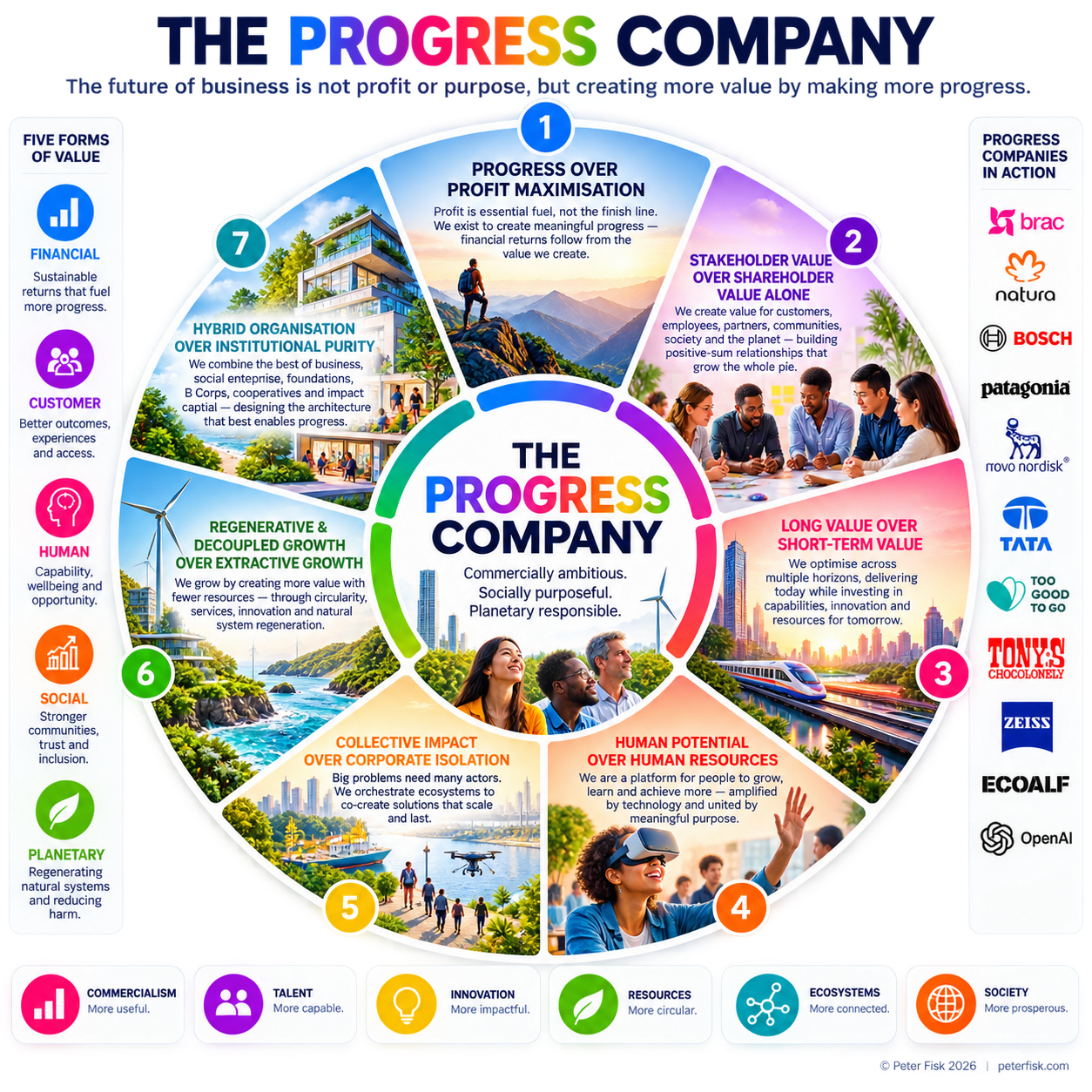
Beyond the profit-purpose divide
There is no shortage of attempts to rethink capitalism. Corporate social responsibility encouraged companies to recognise their wider responsibilities. Social enterprise demonstrated that business methods could address social problems. Muhammad Yunus’s concept of social business pushed the idea further by putting a social objective at the centre of an enterprise. B Corps introduced external standards of social and environmental performance and accountability. Impact investing sought both measurable impact and financial return. ESG brought environmental, social and governance considerations into capital allocation. Benefit corporations and public benefit corporations embedded broader objectives into corporate structures.
Alongside these have emerged cooperatives, mutuals, foundation-owned companies, steward-ownership models, mission-locked businesses, NGOs with commercial subsidiaries and conventional companies with foundations of their own.
Each model has typically been presented as an alternative to something else. The Progress Company sees them differently: as complementary components in an expanding toolkit for enterprise design.
The future company does not have to decide whether it is commercial or social in some absolute sense. Different activities can use different models. A company might have a highly profitable core business, a corporate venture arm investing in future technologies, a foundation supporting scientific research, partnerships with NGOs addressing systemic problems and circular ventures creating new revenues from previously wasted resources.
The organising question is not Which ideological model are we? It is What combination of models will enable us to create the most enduring value and progress?
Example: BRAC, when commercial and social become inseparable
One of the clearest demonstrations comes from Bangladesh rather than Silicon Valley. Founded in 1972, BRAC has developed an extraordinary combination of development programmes, microfinance, education, healthcare and commercial social enterprises.
BRAC’s significance lies partly in its refusal to accept the traditional boundary between charity and commerce. Its enterprises have operated in areas such as agriculture, food, retail and crafts, creating employment and economic activity while helping finance and advance its wider social mission. Markets become part of the mechanism through which development happens rather than something separate from it.
This points towards a fundamental principle of the Progress Company: social impact does not have to begin where commercial activity ends. The commercial activity itself can generate the impact.
Example: Natura, from consuming nature to creating with it
Brazil’s Natura demonstrates a different version of the same idea. The beauty company has built long-term relationships with Amazonian communities and biodiversity into its sourcing and innovation model, and in 2014 became the first publicly traded company to achieve B Corp certification.
Natura is interesting because it pushes the conversation beyond sustainability towards regeneration. Sustainability largely emerged from an industrial model in which businesses sought to reduce the damage associated with producing and consuming more. Regeneration poses a more demanding question: could the natural and social systems on which a company depends become stronger because the business participates in them?
That is a profound shift. Nature stops being simply a resource to extract more efficiently and becomes part of a living system in which the company participates. Communities become partners in value creation rather than stakeholders to compensate.
The commercial challenge is therefore not to stop growing. It is to discover better ways to grow.
Growth without endlessly making more stuff
This is one of the most important ideas behind the Progress Company. We frequently confuse economic growth with material growth.
For much of the industrial age they were closely connected. To double revenues, a company typically needed to make and sell something approaching twice as much. That required more factories, materials, energy and transportation. The consequences of growth therefore expanded with the business.
That relationship is increasingly open to reinvention.
Too Good To Go creates a marketplace around food that has already been produced. Restaurants and retailers recover value that would otherwise disappear, consumers gain access to affordable food, the platform generates revenue and less food is wasted. The company can therefore become more valuable partly by reducing waste elsewhere in the system.
Spain’s Ecoalf similarly explores how fashion can create desirable products from recycled materials rather than depending exclusively on virgin resources. Circularity, repair, resale, access, services and recycling open possibilities for creating economic value from resources already circulating through the economy.
Digital products, platforms and AI extend the principle further. Growth can increasingly come from intelligence, knowledge, personalisation, services, experiences, intellectual property and outcomes rather than simply greater material throughput.
This is “decoupled growth”: increasing value faster than resource consumption.
The objective is not degrowth. It is better growth.
Profit without the blinkers of short-termism
The same distinction needs to be made about profit. Profit is not the problem. Indeed, a Progress Company needs strong economics precisely because sustained profitability provides the independence and resources to invest, experiment and pursue ambitious ideas.
The problem arises when profit becomes confused with value itself, and particularly when long-term value is sacrificed to maximise short-term financial performance.
Denmark’s Novo Nordisk offers an alternative architecture. The Novo Nordisk Foundation maintains control of the pharmaceutical company through Novo Holdings, creating a structure that combines a globally competitive commercial organisation with long-term ownership and large-scale investment in scientific and societal progress. The commercial engine and the wider mission are distinct, but mutually reinforcing.
Germany offers an even older example. Bosch is one of the world’s largest technology and engineering companies, yet around 94% of Robert Bosch GmbH’s share capital is held by the charitable Robert Bosch Stiftung. Voting rights and economic ownership are structured in ways intended to protect the company’s entrepreneurial independence and long-term orientation while dividends help finance the Foundation’s wider work.
ZEISS operates through another foundation-owned structure. The Carl Zeiss Foundation is the sole shareholder of Carl Zeiss AG and SCHOTT AG. The model protects long-term independence while connecting successful science-based businesses with the advancement of research and education.
These structures challenge the assumption that being commercially aggressive requires being financially short-term.
They demonstrate what might be called patient ambition: competing hard, innovating boldly and expecting attractive economic performance while retaining the freedom to invest across decades rather than quarters.
Ownership itself can be reinvented
Patagonia provides a more recent experiment. Founder Yvon Chouinard and his family transferred the company’s voting stock to the Patagonia Purpose Trust and the non-voting stock to the Holdfast Collective. Patagonia remains a commercial, for-profit company, but its governance and economic ownership are designed to protect its mission and channel money not reinvested in the business towards fighting the environmental crisis.
The intriguing part of Patagonia is not simply its environmental commitment. Thousands of companies claim ambitious purposes. Patagonia sought to encode its purpose into the architecture of ownership itself.
Dutch chocolate company Tony’s Chocolonely tackles the same problem differently. Its mission is to end exploitation in cocoa, and its governance includes a mission-lock structure intended to protect that purpose as ownership changes. The business simultaneously seeks to demonstrate that commercially successful chocolate can be produced through a different value chain.
Both examples point towards an underexplored frontier of innovation: corporate architecture.
For decades we have innovated products, services, technologies and business models. The Progress Company asks leaders to apply similar imagination to ownership, governance, capital, incentives and the distribution of value.
Example: Tata, creating value across generations
India’s Tata Group shows how powerful such structures can become over generations. Around two-thirds of the equity of Tata Sons, the group’s principal holding company, is held by philanthropic trusts. At the same time, Tata companies compete commercially across technology, automobiles, steel, consumer goods, hotels, energy, aviation and numerous other industries.
The important point is that Tata is not partly a business and partly philanthropy in the conventional sense. Its unusual ownership means that commercial success and societal contribution can feed each other. Wealth generated through globally competitive businesses helps fund education, healthcare, livelihoods and other societal activities, while Tata’s long-term orientation has helped create institutions, capabilities and infrastructure important to India’s development.
This is capitalism, but with a different architecture of value.
Example: OpenAI and the emerging hybrid
Perhaps the most contemporary experiment is OpenAI. Founded as a non-profit in 2015, it subsequently created a commercial subsidiary to access the enormous amounts of capital and talent required to develop frontier AI. Following its 2025 restructuring, the OpenAI Foundation controls OpenAI Group PBC, a public benefit corporation, while also holding a substantial economic interest in it.
OpenAI’s structure has generated considerable debate, and its ultimate effectiveness as a governance model remains to be demonstrated. But that is precisely why it is interesting. It is attempting to address a genuine twenty-first-century organisational problem: what happens when pursuing a societal mission requires tens or hundreds of billions of dollars of commercial capital?
The old organisational categories struggle with this question. A conventional non-profit cannot easily raise such capital. A conventional corporation may struggle to protect a mission when enormous financial interests accumulate around it.
The hybrid organisation attempts to combine the two.
That experimentation is likely to spread. Climate technology, healthcare, advanced science, education, infrastructure and AI all involve problems whose solution may require combinations of government, philanthropy, patient capital, venture investment and commercial scale.
The Progress Company is a both/and organisation
This brings us to the defining mindset of the Progress Company.
For much of the twentieth century, management was built around choices. Strategy itself became synonymous with trade-offs: deciding what to do and what not to do. Those choices remain important. But some of the most important challenges facing business today require leaders to reconcile apparent contradictions rather than choosing one side.
A Progress Company is therefore not about profit or purpose, but both. It is not commercial or social, but both. It seeks growth and regeneration, shareholder returns and wider societal value, human potential and technological leverage, performance today and progress tomorrow.
The word both matters. This is not about balancing competing objectives into mediocrity. It is about redesigning systems so that previously competing outcomes increasingly reinforce each other.
Too Good To Go does not have to choose between reducing food waste and generating revenues because reducing waste generates the revenues. Natura does not need to separate community relationships entirely from competitive advantage because those relationships can contribute to differentiated products and resilient supply chains. Novo Nordisk’s commercial success creates resources that ultimately strengthen its foundation ecosystem. Patagonia’s profitability creates greater resources for environmental action.
The genuinely radical shift, therefore, isn’t making capitalism less commercial. It is making commercialism more useful— directing its extraordinary capacity for capital, innovation, talent, competition and scale towards solving problems that matter.
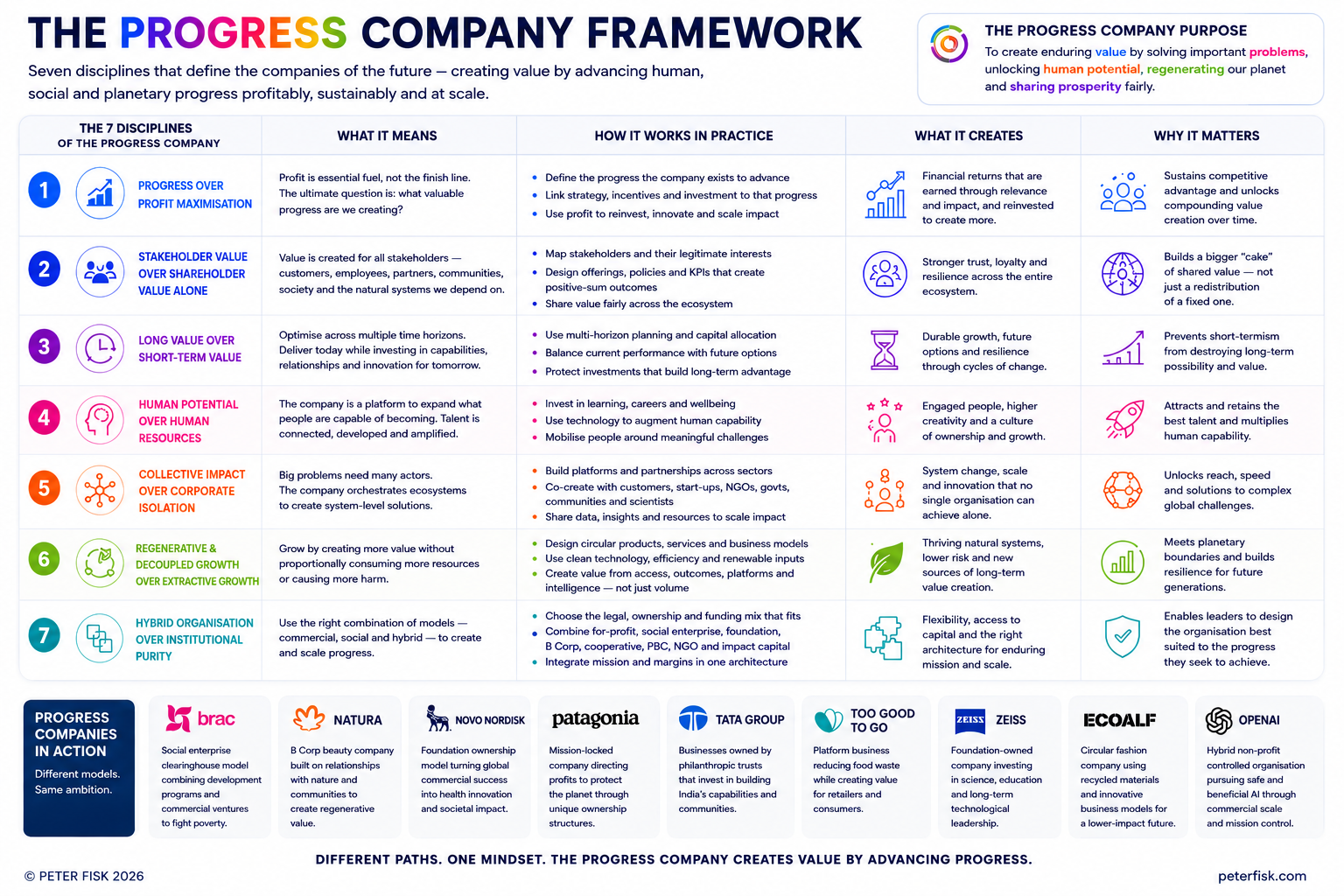
Seven disciplines of the Progress Company
Seven disciplines bring this emerging model together.
1. Progress over profit maximisation. A Progress Company remains financially ambitious, but profit is fuel rather than the finish line. Leaders begin with the progress the organisation is uniquely capable of advancing and connect commercial success directly to delivering it. The better it solves worthwhile problems, the more relevant and valuable it should become.
2. Stakeholder value over shareholder value alone. Shareholders remain legitimate beneficiaries of enterprise, but they are not the only ones. Customers, employees, partners, communities, society and natural systems participate in creating value and can share in its benefits. The objective is not simply to redistribute a fixed amount of value more generously, but to design positive-sum relationships that create more value overall.
3. Long value over short-term value. Progress Companies operate across multiple horizons simultaneously. They deliver the performance necessary to maintain credibility today while investing in innovation, capabilities, relationships, brands, technologies and future markets whose value may emerge over years. They recognise that maximising this quarter’s profit can sometimes minimise the company’s future value.
4. Human potential over human resources. The company becomes a platform through which people can become more capable. Learning, networks, autonomy, technology and meaningful work expand what individuals can accomplish. AI makes this particularly important: the opportunity is not simply to replace human work but to combine human judgement, imagination and relationships with machine intelligence to multiply capability.
5. Collective impact over corporate isolation. The biggest opportunities increasingly sit inside complex systems. Health, climate, mobility, food, education and financial inclusion cannot be transformed by individual companies acting alone. Progress Companies therefore become ecosystem orchestrators, bringing together customers, suppliers, scientists, start-ups, governments, NGOs, communities and sometimes competitors around opportunities no single participant could realise independently.
6. Regenerative and decoupled growth over extractive growth. Growth becomes less dependent on consuming more virgin resources and selling more physical units. Circular models, services, platforms, access, intelligence, outcomes and regenerative systems enable companies to create greater economic value with proportionately fewer resources — and, at their most ambitious, to restore some of the systems upon which they depend.
7. Hybrid organisation over institutional purity. There is no single organisational form for a Progress Company. Commercial corporations, social businesses, B Corps, benefit corporations, cooperatives, foundations, NGOs, steward-owned businesses and impact investors provide different mechanisms for different purposes. The Progress Company combines the ones that best enable its mission rather than forcing every activity into a single corporate template.
These seven disciplines are connected. Together they shift the company from an organisation primarily designed to optimise today’s financial machine towards a platform capable of creating multiple forms of value over time.
From human resources to human possibility
One dimension deserves particular emphasis because it is often overlooked in debates about corporate responsibility. Companies do not merely produce products. They shape people.
For millions of us, organisations are where we spend much of our waking lives, build relationships, acquire knowledge, encounter new ideas, develop confidence and discover what we are capable of doing. A company can diminish that potential through bureaucracy and control, or multiply it through opportunity, autonomy, learning and connection.
The Progress Company therefore regards itself as a human potential platform.
This becomes more important, not less, as AI develops. If leaders see AI principally as a labour-reduction technology, the result may be highly efficient organisations that have systematically removed much of the human capability through which future innovation happens. The more interesting possibility is augmented enterprise: using machines to increase the reach, intelligence, creativity and effectiveness of people.
Again, the answer is not people or technology. It is both.
From company to progress ecosystem
The same logic extends beyond organisational boundaries. Many of the challenges with the greatest potential for value creation are systemic.
Improving health is not simply a pharmaceutical problem. It involves diagnostics, nutrition, prevention, hospitals, pharmacies, insurers, data, technology, governments and individual behaviour. Decarbonising mobility involves energy, infrastructure, vehicles, software, finance, regulation and urban planning. Transforming food involves farmers, biotechnology, retailers, logistics, consumers, waste systems and natural ecosystems.
The Progress Company therefore asks not merely, What can we do? but What could we make possible by bringing others together?
That changes the nature of competitive advantage. The company becomes less defined by the assets it owns and more by the possibilities it can orchestrate.
From purpose statements to progress measures
Purpose was an important step forward because it challenged the idea that companies existed solely to maximise financial returns. But purpose has also become remarkably easy to claim.
Progress is harder.
Purpose describes an intention. Progress describes a consequence.
The Progress Company therefore needs to make its aspirations tangible. What is becoming measurably better because the organisation exists? Are customers healthier, safer or more capable? Are employees developing faster? Are communities becoming more prosperous? Is less virgin material required for every pound of value created? Are ecosystems being restored? Is the organisation building capabilities that make future progress more likely?
Financial measures remain essential. The mistake would be replacing shareholder primacy with an amorphous collection of worthy but unaccountable ambitions.
Instead, Progress Companies need a broader value architecture: financial value, customer value, human value, societal value and planetary value, understood not as five unrelated scorecards but as an interconnected system.
The strategic question becomes how progress in one can multiply value in the others.
The Progress Flywheel
This suggests a very different growth mechanism from the traditional corporate machine.
A Progress Company identifies an important problem that remains inadequately solved. Solving it creates meaningful value for customers and society. That relevance attracts customers, talent, partners and capital. Their participation increases the organisation’s capabilities and reach. Stronger capabilities enable greater innovation. Innovation creates better solutions, which generate financial returns. Those returns are reinvested into the people, technologies, ecosystems and ideas capable of making still greater progress.
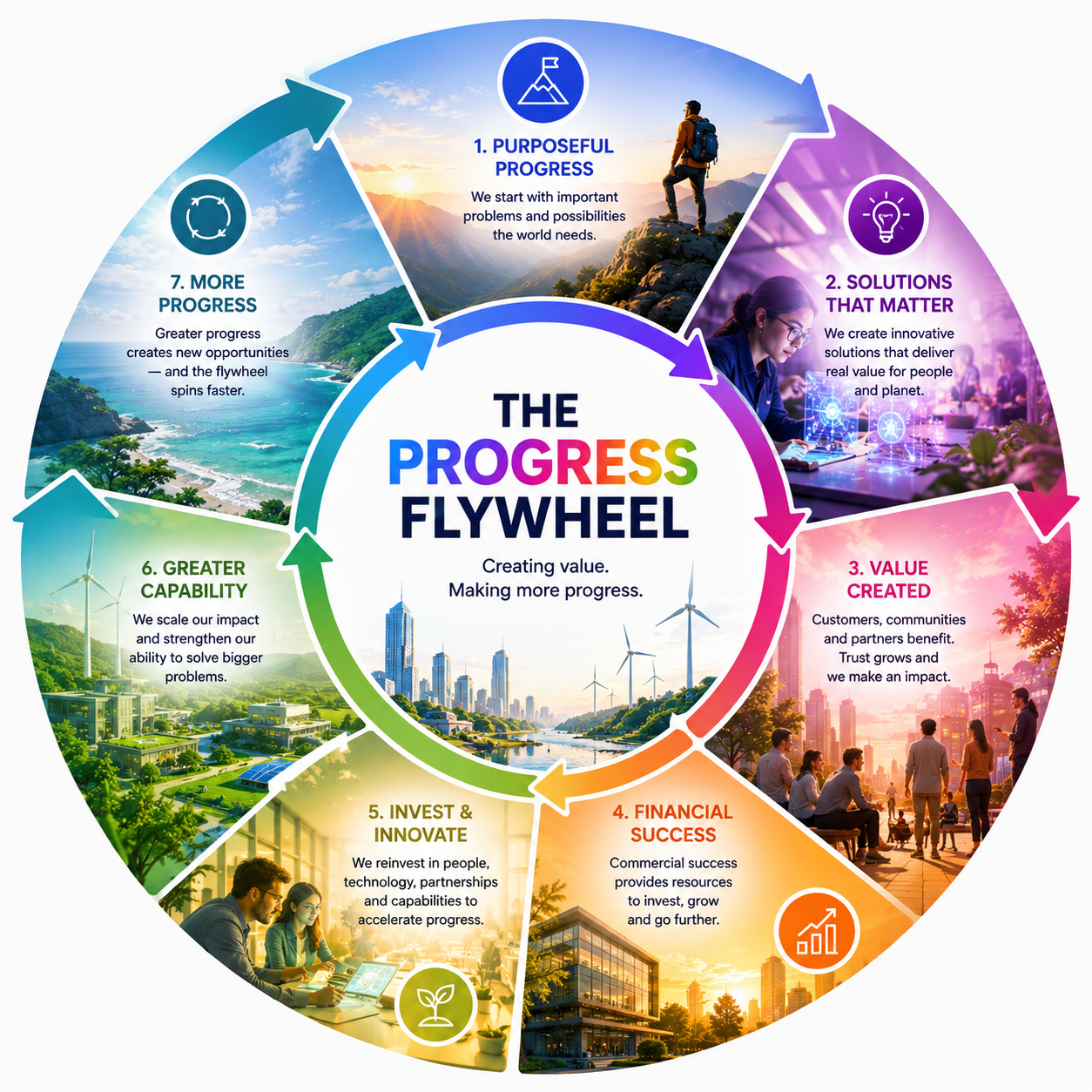
This is the Progress Flywheel.
Its power comes from alignment. Rather than making money in one place and attempting to repair the consequences somewhere else, the organisation increasingly makes money because of the progress it creates.
The closer those two become, the stronger the model.
From extracting value to multiplying value
The industrial corporation became extraordinarily effective at extraction. It extracted raw materials from nature, labour from employees, spending from customers and returns from assets. That model generated unprecedented prosperity, innovation and improvements in living standards, but it also produced consequences that are becoming increasingly difficult to ignore.
The next evolution of enterprise can be built around multiplication.
Does working with the company make suppliers stronger? Do employees leave each year more capable than they entered it? Does technology multiply human potential? Do products enable customers to accomplish more? Do ecosystems become healthier? Do communities acquire capabilities and opportunities? Does every unit of resource generate progressively more value? Does today’s success create more options for tomorrow?
These are not questions at the margins of strategy.
They increasingly define where future value will come from.
The company as an engine of progress
BRAC, Natura, Bosch, Novo Nordisk, Patagonia, Tata, Too Good To Go, ZEISS, Ecoalf, Tony’s Chocolonely and OpenAI are radically different organisations. Some are publicly traded, some privately held, some foundation-controlled, some mission-locked, some social enterprises and some hybrids. They operate in Bangladesh and Brazil, Germany and Denmark, India and the United States; in healthcare, chocolate, fashion, food, AI, engineering and consumer products.
None is a perfect Progress Company. Nor should they be romanticised. Each has tensions, compromises and contradictions.
That is what makes them useful.
Together they demonstrate that there is no need to choose one alternative model for the future of business. The more interesting possibility is to combine the strongest ideas from many of them.
Not profit or purpose. Not commercial or social. Not growth or regeneration. Not shareholders or society. Not people or technology. Not performance today or progress tomorrow.
Both.
The Progress Company is therefore not a softer form of capitalism. It should be a more ambitious one. It embraces the discipline of markets, the creativity of entrepreneurship, the energy of competition, the scalability of technology and the power of capital, but applies them to creating outcomes that matter.
That may ultimately be the biggest opportunity facing business.
The question is no longer simply how much value can we extract from the world? Instead it is how much progress can we make possible, and how much more valuable can we become by doing it?
More from the blog