Market Makers … Reinventing Marketing: from selling what you make, to shaping what comes next … the 10 strategic shifts for CMOs and marketing team
August 16, 2026

Marketing has spent much of the last decade becoming better at marketing.
More data. More channels. More content. More precise targeting. More automation. More sophisticated attribution. And now, exponentially more artificial intelligence.
Yet the biggest opportunity for marketing is not to do more marketing. It is to become something more important.
The world’s most innovative marketers are moving upstream. They are helping their organisations understand how the world is changing, anticipate what customers might value next, imagine new propositions, shape distinctive brands, create new experiences and even redefine the markets in which their companies compete.
They are becoming “market makers”.
This represents a fundamental change in the strategic purpose of the CMO:
Understand how the world is changing. Imagine what customers could value next. Shape the markets, brands, innovations and experiences that turn those possibilities into future growth.
The timing matters. Deloitte’s 2026 CMO Survey finds a 32% increase in revenue growth being regarded as a core marketing responsibility. Yet pressure from the C-suite is also pushing 47% of CMOs back towards established strategies and short-term wins. Deloitte’s conclusion is not that marketers should abandon the core, but that they need to combine it with disciplined experimentation and innovation.
- McKinsey’s State of Marketing 2026 Report
- Kantar’s Marketing Trends 2026
- Deloitte’s CMO Survey 2026
- McKinsey’s Campaigns to Continuous Growth
- WARC’s Marketer’s Toolkit 2026
At the same time, AI is transforming how customers discover, evaluate and buy. McKinsey finds that while 90% of CMOs are experimenting with AI, fewer than 10% have scaled it or captured value across marketing workflows. Only 28% of surveyed organisations are fundamentally rewiring teams and workflows around the technology.
The danger is obvious. Marketing could use the most transformational technology of our generation simply to make yesterday’s marketing faster. The opportunity is much bigger.
The rise of the market maker
For much of the twentieth century, the basic logic of marketing was straightforward. Companies made products. Marketing identified customers, positioned those products, communicated their benefits and stimulated demand. That model has been steadily unravelling.
Customers now discover brands through creators, communities, algorithms and AI agents. Categories converge. Products become services. Services become platforms. Competitors emerge from unexpected places. Social conversations shape reputation in hours. Culture travels across borders in seconds.
Kantar’s 2026 Marketing Trends report suggests that 24% of AI users already use AI-powered shopping assistants, while 74% of AI-assistant users regularly seek AI-driven recommendations. Brands increasingly need to be understood not only by people but by the algorithms acting on their behalf.
Yet technology doesn’t diminish the importance of brands. It potentially increases it. Kantar’s 2026 BrandZ ranking values the world’s 100 most valuable brands at $13.1 trillion, up 22% in a year. Its central conclusion is strikingly traditional: the winners continue to be brands that are meaningfully different.
When technology makes competent execution available to everybody, distinctiveness becomes more valuable. That is why the future of marketing requires ten shifts.
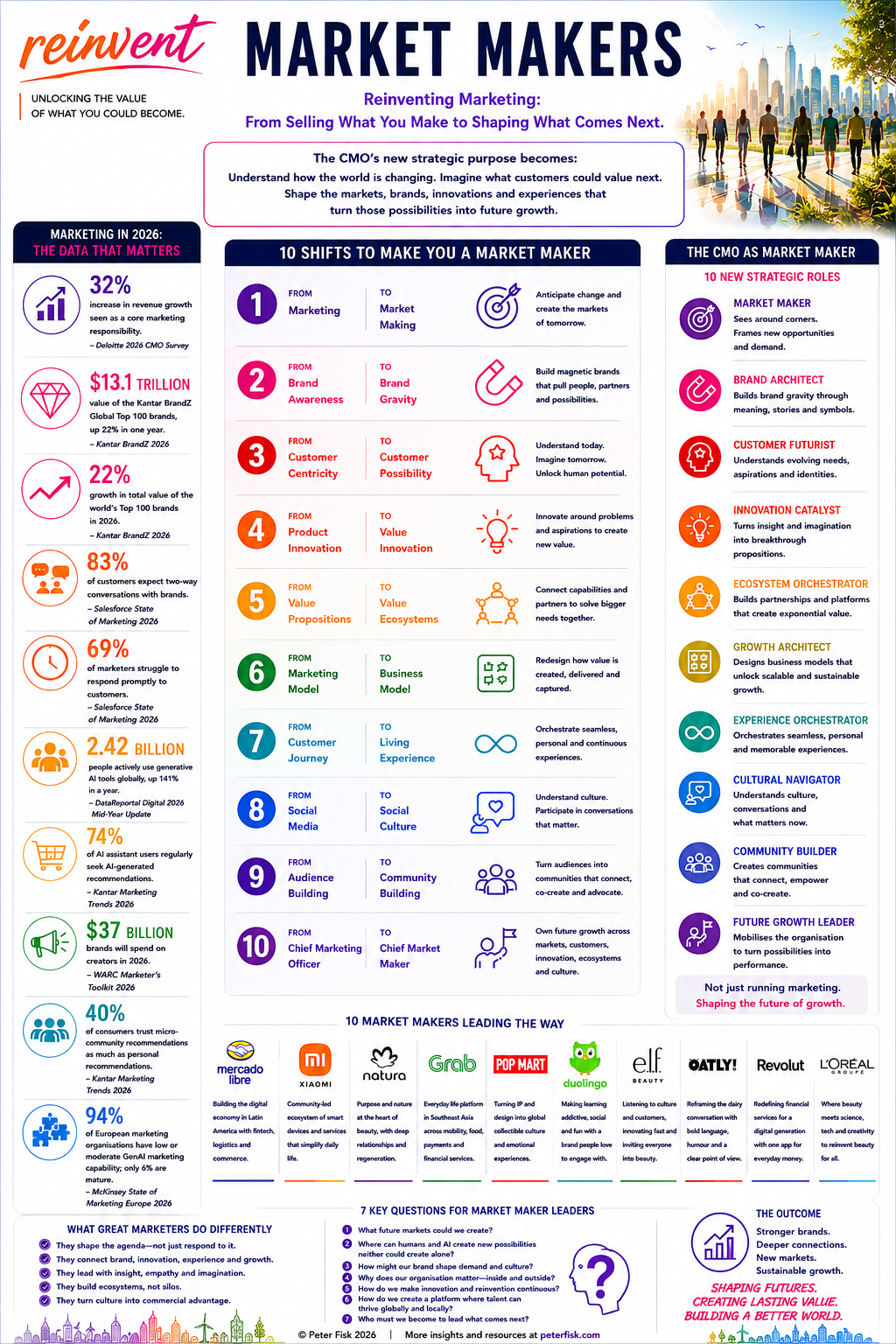
Here are the 10 shifts in more detail, with examples from some of the most innovative strategic marketing companies around the world which I currently observe, and what they mean for the changing role of marketing leaders:
1. From marketing to market making
Most marketers begin with an existing market: How big is it? Who are the segments? What is our share? How do we position ourselves against competitors?
Market makers start somewhere else: What could this market become?
They look around corners. They explore behavioural change, emerging technologies, unmet aspirations and shifting economics. Rather than accepting conventional category boundaries, they redraw them.
Consider Mercado Libre. It would be inadequate to describe it simply as Latin America’s ecommerce brand. By connecting commerce with payments, credit, logistics and advertising, it has helped build much of the infrastructure through which Latin America’s digital economy operates. Kantar’s global BrandZ research highlights Mercado Libre as Latin America’s representative among the world’s most valuable brands.
The strategic marketer therefore becomes a Market Maker — framing opportunities and creating demand rather than merely fighting for existing demand.
2. From brand awareness to brand gravity
For years, marketers have obsessed over awareness, reach and salience. Those still matter, but they are not enough.
The more interesting question is: why should people be drawn towards us?
Brand gravity is the accumulation of meaning, emotion, identity, trust and distinctiveness that makes customers actively choose a brand, recommend it and give it permission to do more.
China’s Xiaomi demonstrates the principle. What began around smartphones grew through fan participation into a much broader ecosystem of connected devices, wearables, smart homes and electric vehicles. The brand does not merely label products; it gives coherence to an expanding world.
AI makes this more important. Kantar warns that brands which fail to differentiate risk disappearing into a “sea of sameness” as AI increasingly mediates choice.
The CMO becomes the Brand Architect, creating meaning strong enough to attract both people and algorithms.
3. From customer centricity to customer possibility
Customer centricity was an important correction to product-centric business. But it can also become surprisingly conservative.
Ask customers what they want and they inevitably answer from the world they already know.
Market makers combine insight with imagination.
Brazil’s Natura demonstrates what becomes possible when a company looks beyond conventional category needs. Beauty becomes connected to wellbeing, biodiversity, relationships, communities and regeneration. The proposition expands because the understanding of the customer’s world expands.
The new question is not merely What does this customer need today? but What could become valuable to this person tomorrow?
The CMO becomes a Customer Futurist.
4. From product innovation to value innovation
Innovation is too important to be left solely to R&D.
Marketing frequently enters the innovation process far too late: somebody develops a product and marketers are asked to find the proposition, audience and launch campaign.
Reverse the sequence.
Start with changing lives, emerging tensions and new possibilities. Then bring together customer insight, technology, design, brand and commercial imagination.
e.l.f. Beauty has become an unusually powerful example. Its advantage is not simply affordable cosmetics or clever TikTok campaigns. It listens closely to cultural signals and customer conversations, moves rapidly and connects innovation with participation. Its latest collaborations continue to blur conventional boundaries between skincare, cosmetics, culture and entertainment.
The marketer becomes an Innovation Catalyst — turning insight and imagination into new value.
5. From value propositions to value ecosystems
Many customer needs are bigger than any single product.
That means the next competitive advantage increasingly comes from connecting capabilities rather than owning all of them.
Grab began with mobility in Southeast Asia, but the underlying customer opportunity was much larger: making everyday urban life easier. Transport could connect with food, deliveries, payments and financial services.
The strategic leap is from asking What else can we sell? to asking What larger problem can we solve?
Platforms, partners and ecosystems then become part of marketing strategy because they enable the brand to deliver a richer promise.
The CMO becomes an Ecosystem Orchestrator.
6. From marketing model to business model
A genuinely innovative proposition frequently requires a different way to create, deliver and capture value.
Marketing therefore needs to engage with subscriptions, memberships, marketplaces, platforms, freemium models, access rather than ownership, outcome-based pricing and ecosystem economics.
Consider Revolut. Its significance lies not simply in digitally marketing banking services. It has repeatedly expanded what a financial relationship can encompass — foreign exchange, payments, savings, investing, travel benefits, subscriptions and more. By August 2026, it had reached around 75 million customers across 40 countries.
Proposition and business model evolve together.
The CMO becomes a Growth Architect, asking simultaneously: What value should we create? How should we deliver it? How should we capture it?
7. From customer journey to living experience
The funnel increasingly looks like an artefact from another age.
Today’s customer might discover a product on TikTok, ask an AI agent about it, read a Reddit discussion, visit a physical store, buy through a marketplace and join a community — in no predictable sequence.
McKinsey argues that this behavioural transformation is pushing marketing beyond the campaign model towards continuous growth, built around five capabilities: insights, creativity, personalisation, agentic commerce and orchestration.
Duolingo illustrates what this feels like in practice. Learning, notifications, its irreverent owl personality, social content and cultural moments merge into one continuous experience. Marketing is not something attached to the product. The product itself is media, conversation and brand theatre.
The CMO becomes an Experience Orchestrator.
8. From social media to social culture
Too many brands interpreted social media as another broadcasting channel.
Create content. Accumulate followers. Generate engagement.
But social is not fundamentally about media. It is about culture.
The most effective brands understand conversations, humour, rituals, identities, creators and movements — and know when to participate rather than interrupt.
Pop Mart is a fascinating example from China. Its characters are not simply products. Through collectability, scarcity, physical retail, social sharing and fandom, properties such as Labubu have become cultural phenomena.
This is market making through meaning.
Kantar finds that a net 61% of marketers intend to increase creator investment in 2026, yet only 27% of creator content currently connects strongly to the brand. The implication is that brands need fewer disconnected influencer transactions and more coherent cultural platforms.
The CMO becomes a Cultural Navigator.
9. From audience building to community building
An audience watches you.
A community connects through you.
That distinction changes marketing profoundly.
Communities generate belonging, identity, advocacy, learning and co-creation. They turn customers from targets into participants.
Kantar reports that almost 40% of consumers trust micro-community recommendations as much as personal recommendations. In China, brands using knowledge-sharing micro-community platforms achieved 25% higher marketing ROI in Kantar’s database.
Oatly provides a different expression of the same principle. It did not build its brand merely around the functional characteristics of oat milk. Its provocative language, packaging and cultural stance helped consumers participate in a larger conversation about food, sustainability and established category conventions.
Community turns brand meaning into social energy.
The CMO becomes a Community Builder.
10. From Chief Marketing Officer to Chief Market Maker
These nine shifts ultimately converge in the tenth.
The CMO’s role itself needs reinventing.
Deloitte’s 2026 UK research explicitly observes that the role continues to broaden, while its US survey shows revenue growth becoming increasingly central to marketing’s responsibilities.
But broadening the CMO role should not mean simply adding more activities. It means moving upstream. The future CMO sits at the intersection of strategy, customers, brand, innovation, experience, technology, culture and growth.
France’s L’Oréal provides perhaps the clearest large-company example. Beauty Tech connects science and product innovation with AI, personalisation, digital services, creators and experience. Marketing is not simply the voice at the end of the innovation process; customer understanding and brand imagination help drive the innovation agenda itself.
The title CMO may remain. The mindset changes. The CMO becomes the Chief Market Maker.
AI is the multiplier, not the strategy
There is one deliberate omission from these ten shifts: AI. That is because AI should not be another box on the marketing organisation chart. It runs through everything.
AI can amplify foresight and customer insight. It can accelerate innovation. It can personalise experiences. It can dynamically generate and evaluate creative work. It can help orchestrate ecosystems and continuously experiment with propositions. But it cannot substitute for imagination.
McKinsey’s finding that 90% of CMOs are experimenting with AI but fewer than 10% have scaled it is revealing. The challenge is no longer access to technology. It is organisational reinvention.
Deloitte reaches a complementary conclusion: its 2026 survey finds marketers are roughly six times more likely to identify having the right talent than the right technology as the most important driver of revenue growth.
AI therefore becomes the intelligent multiplier. Humanity remains the differentiator.
From market takers to market makers
The most interesting marketers around the world are already demonstrating pieces of this new model.
Mercado Libre builds markets. Xiaomi builds ecosystems. Natura connects brand with purpose and regeneration. Grab expands customer needs into platforms. Pop Mart creates cultural phenomena. Duolingo turns experience into entertainment. e.l.f. Beauty converts cultural listening into rapid innovation. Oatly reframes categories. Revolut reinvents propositions and business models. L’Oréal connects customer insight, science, technology and creativity.
They are very different companies, from very different parts of the world. What connects them is a refusal to regard marketing simply as the function that promotes what the company already makes. That is the essential reinvention.
For decades, marketing has fought to earn its place at the top table by demonstrating the ROI of marketing expenditure. That remains necessary, but it is no longer sufficient. The bigger opportunity is to demonstrate the return on imagination.
To see markets before they are obvious. To understand customers beyond what they can articulate. To build brands that create meaning and gravity. To connect innovation with human possibility. To turn audiences into communities and social media into culture. To design ecosystems and business models capable of delivering propositions that did not previously exist.
And ultimately, to create future growth rather than simply compete for today’s.
The question for every CMO is therefore changing. Not simply “How can we market what our business makes?” but “What could our business become; and what new value, markets and possibilities could we create?“
The future belongs not to the organisations that become better at marketing the world as it is. It belongs to the market makers who shape what comes next.
Appendix: Interesting stats from recent reports
Marketing is becoming more technological, but its strategic advantage is becoming more human: imagination, meaning, innovation, culture, trust and the ability to shape markets before others see them.
- McKinsey’s State of Marketing 2026 Report
- Kantar’s Marketing Trends 2026
- Deloitte’s CMO Survey 2026
- McKinsey’s Campaigns to Continuous Growth
- WARC’s Marketer’s Toolkit 2026
From Marketing to Market Making
1. 32% increase in revenue growth being seen as a core marketing responsibility. That is a strong signal that CMOs are being pulled upstream into growth, not just communications.
2. 47% of CMOs are returning to established strategies and short-term wins because of increased C-suite pressure.The tension is important: marketing is being asked to drive growth while simultaneously being pushed towards safer execution.
3. Nearly 6× as many marketers cite “the right talent” rather than “the right technology” as the most important driver of revenue growth. Strategic judgement becomes more valuable as technology becomes ubiquitous.
From Brand Awareness to Brand Gravity
4. Branding is the #1 marketing priority for European marketing leaders in 2026. McKinsey finds that distinctiveness, value perception and creativity have moved back to the top of the CMO agenda.
5. The Kantar BrandZ Global Top 100 are worth $13.1 trillion — up 22% in one year. That is one of the strongest figures for demonstrating the continuing economic power of brands.
6. 72% of European CMOs plan to increase marketing budgets relative to sales in 2026. Marketing investment is not disappearing, but demands for demonstrable value are increasing.
From Customer Centricity to Customer Possibility
7. 83% of marketers say customers increasingly expect two-way conversations with brands. The customer no longer wants merely to receive marketing; they expect interaction.
8. Yet 69% of marketers struggle to respond promptly to customers. There is a huge gap between customer expectations and organisational capability.
9. 78% say they need more personalised content than they can currently produce. Personalisation is moving from a campaign technique towards an operating capability.
From Product Innovation to Value Innovation
10. Only 28% of organisations in McKinsey’s recent work are fundamentally rewiring teams and workflows around AI. The bigger opportunity is organisational and proposition innovation, not merely deploying tools.
11. 34% of organisations in Deloitte’s 2026 State of AI research are using AI to deeply transform products, services or business models. Another 30% are redesigning important processes; 37% remain largely at surface-level adoption.
12. 74% of organisations hope AI will drive future revenue growth, but only 20% say it is doing so already. There remains an enormous value-creation gap between AI aspiration and realised commercial innovation.
From Value Propositions to Value Ecosystems
13. More than 6.12 billion people were online by April 2026. Over 80% of adults aged 16+ globally now use the internet, creating the infrastructure for ecosystem-based propositions at unprecedented scale.
14. Global social-media user identities have reached 5.79 billion — equivalent to 69.9% of the world population.Market ecosystems increasingly span communities, platforms, commerce and content rather than individual channels.
15. Social-media user identities grew by 294 million between April 2024 and April 2026. Despite repeated predictions of “social decline”, participation continues to expand dramatically.
From Marketing Model to Business Model
16. Markets increasingly involve customer + brand + platform + agent. 24% of AI users already use an AI-powered shopping assistant. Commerce is starting to include a completely new participant: the customer’s agent.
17. 74% of people using AI assistants regularly seek AI-generated recommendations. Product visibility increasingly means being selected by machines as well as remembered by people.
18. 2.42 billion people now actively use generative-AI tools — around 29.2% of the global population. Active use grew by roughly 141% in a year, adding more than 1.4 billion users.
From Customer Journey to Living Experience
19. 75% of marketers are already using some form of AI. AI is becoming infrastructure rather than an experimental marketing channel.
20. Only 13% of marketers currently use AI agents — but high-performing marketers are 1.9× more likely to do so than underperformers. That suggests agentic marketing may be becoming an early performance differentiator.
21. Marketing teams satisfied with their unified customer data are 42% more likely to respond regularly to customers. They are also 60% more likely to deploy AI agents. Experience increasingly depends on data architecture behind the scenes.
From Social Media to Social Culture
22. Brands are projected to spend $37 billion on creators in 2026. Creator marketing is no longer marginal media activity.
23. Creator-economy investment is growing at 26% year-on-year — around four times faster than overall advertising expenditure. Attention and cultural influence are clearly migrating.
24. 74% of brands increased creator-marketing budgets in 2025 — yet only 27% of creator content is strongly connected to the brand. This is a fascinating stat: participation without strong brand meaning creates activity rather than cultural capital.
From Audience Building to Community Building
25. Kantar reports that almost 40% of consumers trust micro-community recommendations as much as recommendations from people they know. Small communities can carry disproportionate influence.
26. Brands using knowledge-sharing micro-community platforms in Kantar’s China database achieved around 25% higher marketing ROI. Community can therefore be a commercial growth model rather than simply an engagement tactic.
27. 36% of consumers say they are prepared to take on short-term debt to spend on things they enjoy. Kantar calls this “treatonomics”: changing life milestones and economic uncertainty are reshaping what people value and why they participate in categories and cultures.
From CMO to Chief Market Maker
28. 94% of European marketing organisations still have only low or moderate GenAI marketing capability. Just 6% regard themselves as mature. This shows how much organisational reinvention remains ahead.
29. Those mature GenAI marketers report average efficiency gains of 22%, with expectations of 28% within two years. Crucially, McKinsey says many are reinvesting those gains in growth rather than simply taking out cost.
30. 50% of CMOs identify GenAI-enabled marketing as one of their three fastest-growing investment areas — yet it ranks only 17th out of 20 strategic priorities for 2026. That contradiction neatly captures where marketing currently stands: enormous technological investment, but uncertainty about how profoundly it should change strategy.
More on marketing
- What’s new in marketing?
- McKinsey’s State of Marketing 2026 Report
- Kantar’s Marketing Trends 2026
- Deloitte’s CMO Survey 2026
- McKinsey’s Campaigns to Continuous Growth
- WARC’s Marketer’s Toolkit 2026
Peter Fisk has over 30 years of marketing experience, from his first job as a brand manager in the airline industry, through many roles in developing marketing strategies for the likes of Asahi and Coca Cola, P&G and Unilever, Barclays and Santander. In 2002 he became the CEO of the Chartered Institute of Marketing, with over 60,000 global members, member of the World Marketing Council, a fellow of the Marketing Society, and judge of the annual Marketing Excellence Awards. His bestselling book “Marketing Genius” has been translated into 35 languages, and explores “the left and right brain of marketing thinking, how to be the Einstein and Picasso of brands, combining intelligence and imagination”.
- Book: “Marketing Genius: The left and right-brain of marketing” by Peter Fisk
- Book: “Brand Innovation” by Peter Fisk
- Book: “Gamechangers: Innovative strategies for brands and business” by Peter Fisk
More from the blog