The Future Brand Manifesto … from identity to possibility, why the world’s most powerful brands will shape cultures, communities and markets … and give businesses the potential to be much more
August 15, 2026
Brands were built for a world of relative stability. That world has gone.
For much of the last century, brand building was largely an exercise in consistency. Companies created products, attached distinctive identities to them, positioned them against competitors and then invested relentlessly in awareness, familiarity and preference. Categories were reasonably stable, competitors were relatively predictable and media channels were sufficiently concentrated for companies to exert considerable control over the stories people heard.
The world in which brands now operate is almost the opposite.
We are living through simultaneous technological, economic, social and cultural disruption. Artificial intelligence is accelerating innovation and commoditising knowledge. Industry boundaries are dissolving as technologies and business models converge. Economic gravity is shifting towards Asia and other emerging regions. Generations increasingly coexist with very different attitudes, expectations and behaviours. Climate change is altering priorities. Creators and communities increasingly shape culture. Consumers move continuously between physical, digital and increasingly intelligent environments.
Products are becoming easier to create, competitors easier to launch and advantages harder to sustain. AI will amplify this dramatically. When almost any business can generate competent products, designs, content and customer experiences, competence itself becomes commoditised.
Yet whilst everything accelerates, human needs remain remarkably persistent. People still seek meaning, identity, belonging, aspiration and trust. Indeed, the more confusing and synthetic the world becomes, the more valuable these things become.
This creates one of the great paradoxes of modern business: the faster everything changes, the more valuable meaning becomes.
That is why brand matters more, not less.
The old brand primarily identified the business and differentiated its products. The future brand has a much larger role. It creates a system of meaning around which products, people, communities, partners and possibilities can gather. It connects the company to culture and gives customers ways to express who they are and who they want to become. It provides continuity whilst products, technologies and organisations continuously change.
Most importantly, it gives businesses permission to reinvent.
If your brand is defined by what you make, changing what you make becomes dangerous. But if your brand is anchored in a larger human aspiration, every new product, experience and business model can become another expression of that ambition. Brand moves from protecting consistency to enabling coherent change.
This is why the future of branding is much bigger than marketing. Brand sits increasingly at the intersection of strategy, innovation, culture, community and enterprise value.
The question for leaders is therefore no longer simply how do we build a stronger brand? It is how can our brand shape the future we want to create – for customers, for our market and for our business?
That requires new brand thinking, new brand building, and a new manifesto to guide it.
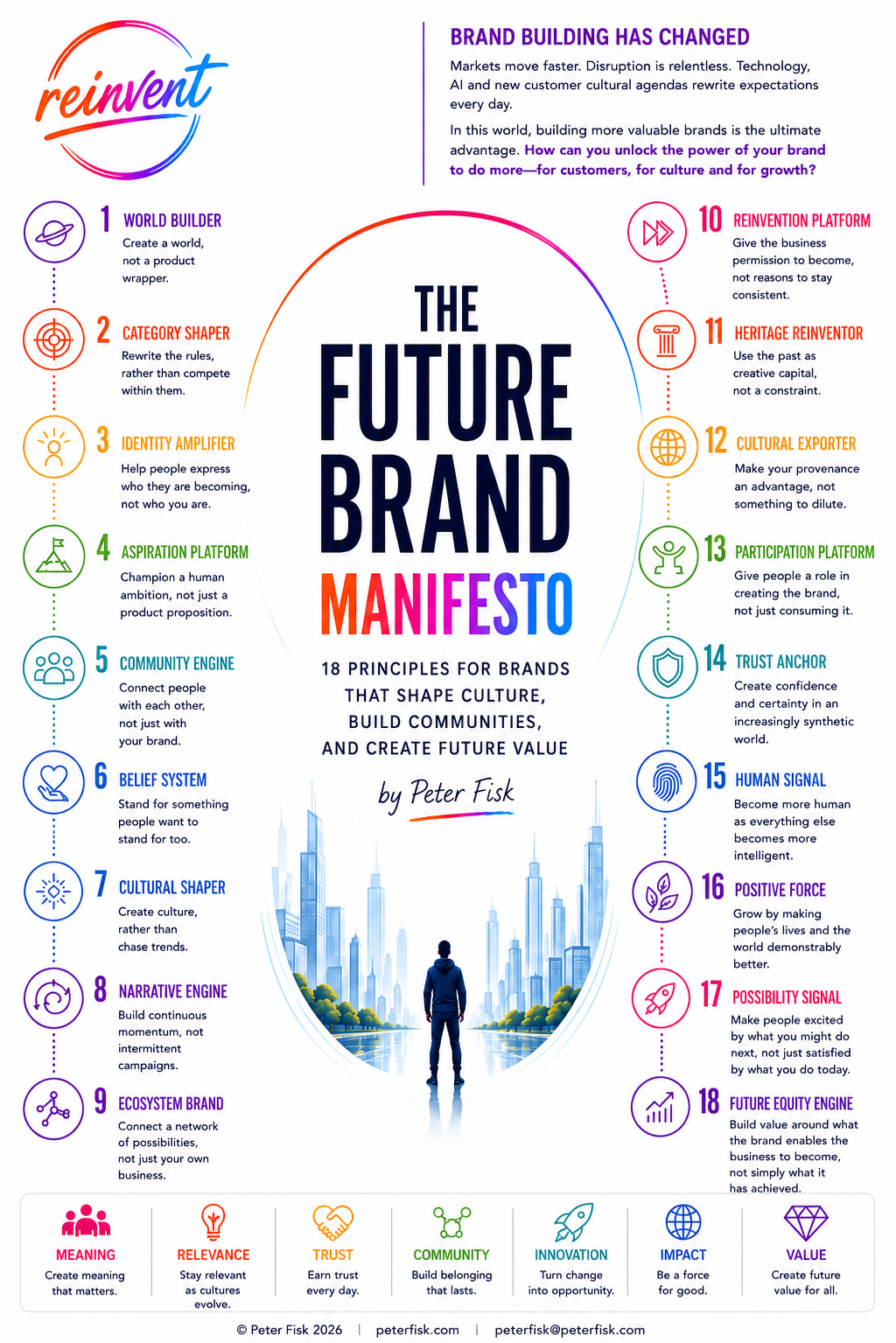
The Future Brand Manifesto
1. Be a World Builder, not a product wrapper.
Great brands will create worlds people want to enter. Pop Mart, LEGO and Disney demonstrate the potential: characters, experiences, products, stories, communities and places reinforce a larger imagined universe. The individual product becomes an entry point rather than the destination. This radically expands both emotional engagement and commercial possibility because the brand can continually create new expressions of the same world. The question therefore moves beyond what do we sell? towards something much more expansive: what world could we create that people actively want to become part of?
Examples:
- Pop Mart, China … Turns characters such as Labubu into expandable worlds of collectibles, scarcity, stores, experiences and fandom.
- Lego, Denmark … Has expanded creative play from bricks into games, films, education, entertainment, communities and destinations.
- Gentle Monster, South Korea … Turns eyewear retail into surreal cultural theatre, making the physical brand experience part gallery, part fantasy world.
Tools:
- World Map … Map the characters, rituals, experiences, places, content and communities that could populate your brand’s world.
- Entry Doors … Identify five different ways people could enter that world beyond buying your core product.
- World Bible … Codify the underlying beliefs, codes and rules so the world can continuously expand without losing coherence.
2. Be a Category Shaper, not a category competitor.
Average brands compete within established rules; exceptional brands change them. Airbnb reframed accommodation around belonging, Oura reframed wearables around understanding your body, and Liquid Death transformed water through entertainment culture. Category Shapers redefine what customers expect, what competitors must respond to and ultimately what constitutes value. Instead of obsessing about taking another percentage point of market share within existing boundaries, future brands will seek mindset share, changing how people understand what a category could become.
Examples:
- Oura, Finland … Reframes wearables from activity tracking towards understanding sleep, recovery, readiness and personal health.
- Liquid Death, USA … Took commodity water and reframed it through entertainment, irreverence and heavy-metal culture.
- Airbnb, USA … Shifted accommodation from rooms and hotels towards the broader human idea of belonging anywhere.
Tools:
- Category Kill … Write down the five assumptions everybody in your category takes for granted, then systematically challenge each one.
- Value Flip … Identify what customers currently compromise on and make that the centre of a new proposition, eliminating the compromise, they can have both.
- Mindset Map … Define how customers think about your category today versus how you want them to think about it tomorrow.
3. Be an Identity Amplifier, not an identity imposer.
Traditional branding asks what the brand should stand for. Future branding asks what choosing the brand allows somebody else to stand for. People increasingly use brands to communicate who they are, what they value and who they aspire to become. On, Patagonia, Apple and many luxury brands derive significant power from this identity effect. The strategic question therefore changes from what does our brand say about us? to what does choosing our brand enable people to say about themselves? The customer’s identity becomes more important than the company’s identity.
Examples:
- On, Switzerland … Combines performance, design and contemporary lifestyle into an identity customers actively wear beyond sport.
- Patagonia, USA … Makes environmental conviction part of what choosing the brand communicates about the customer.
- Farm Rio, Brazil … Allows consumers to participate in an exuberant, optimistic and unmistakably Brazilian expression of identity.
Tools:
- Identity Mirror … Complete the sentence: “People choose us because it says that I am…”
- Becoming Persona … Define customers not by who they are today but by who they aspire to become.
- Social Signal Test … Ask what choosing, wearing, sharing or recommending your brand communicates to somebody else.
4. Be an Aspiration Platform, not just a sales proposition.
Products solve problems; great brands mobilise aspirations. Nike is ultimately bigger than sportswear because human possibility is bigger than sportswear. LEGO is bigger than bricks because creativity is bigger than bricks. An Aspiration Platform identifies a human ambition sufficiently meaningful and expansive to survive multiple generations of products, technologies and business models. This allows innovation without losing coherence. Products become changing manifestations of an enduring aspiration, giving the company permission to keep exploring new ways to help people achieve more.
Examples:
- Nike, USA … Owns human potential through sport rather than defining itself through shoes and apparel.
- Duolingo, USA … Connects learning with expanding people’s worlds rather than simply teaching vocabulary; its own brand narrative explicitly frames learning around possibility.
- Oura, Finland … Is evolving from measuring health towards helping people understand and improve themselves.
Tools:
- Aspiration Ladder … Move from product → benefit → emotional outcome → human aspiration to discover your larger territory.
- 10-Year Stretch … Ask whether your aspiration could accommodate products you have not imagined yet.
- Human Progress Statement … Complete: “We exist to help people become more…”
5. Be a Community Engine, not an audience builder.
Audiences receive; communities participate. Future brands will create connections between customers rather than simply connections between customer and company. Strava, Gymshark and LEGO demonstrate how shared rituals, events, challenges, creation and achievement deepen engagement. This fundamentally changes the economics of marketing because customers create value for each other. Advocacy becomes distribution, participation creates retention and membership strengthens identity. The network becomes part of the brand and the community becomes part of the proposition.
Examples:
- Strava, USA … Turns individual exercise into shared achievement, comparison, encouragement and belonging.
- Gymshark, UK … Grew fitness apparel alongside a highly participative global fitness community.
- Lego, Denmark … Enables enthusiasts to build, exchange, collaborate and contribute ideas rather than remaining passive customers.
Tools:
- Community Canvas … Define the shared aspiration, identity, rituals, language and behaviours that could bind members together.
- Member-to-Member Value Map … Identify what customers can uniquely give each other without your intervention.
- Ritual Designer … Create recurring challenges, events, celebrations or behaviours that transform purchasing into belonging.
6. Be a Belief System, not a messaging system.
The most powerful brands increasingly organise around beliefs people genuinely share. Patagonia’s environmental conviction is powerful because it influences products, operations and actions rather than simply communications. In an age of institutional distrust and synthetic content, authenticity will increasingly come from alignment between what an organisation believes, what it does and what people experience. Messaging becomes evidence rather than invention. Belief becomes the deepest source of consistency, providing an organising principle that can endure even as the company’s activities continuously change.
Examples:
- Patagonia, USA … Makes environmental activism an organising conviction influencing its business, not merely its communications.
- Tony’s Chocolonely, Netherlands … Builds its identity around changing exploitation within the chocolate supply chain.
- Dove, UK … Has sustained a long-running challenge to narrow conventions of beauty through its Real Beauty platform.
Tools:
- Belief Statement … Complete: “We believe the world would be better if…” rather than “Our purpose is…”
- Belief–Behaviour Audit … Test every major business decision against what the brand claims to believe.
- Proof Points … Identify three costly actions you would willingly take that demonstrate the belief is real.
7. Be a Cultural Shaper, not a cultural follower.
Most brands chase culture after it happens. Great brands participate in creating it. Nike has shaped conversations around sport and human possibility; Apple influenced how society imagined creativity and technology; Duolingo behaves increasingly like an entertainment personality as well as an education business. Cultural Shapers understand emerging attitudes early and find ways to amplify them. Instead of constantly asking what is trending?, future brands will ask what cultural shift do we believe in, and how could we help accelerate it?
Examples:
- Nike, USA … Has repeatedly inserted sport into larger cultural conversations around identity, achievement and society.
- Duolingo, USA … Has turned Duo into a cultural character and uses social response itself as creative input; its social-first approach has become widely imitated.
- Skims, USA … Helped reshape cultural conversations around shapewear, body diversity and contemporary underwear.
Tools:
- Culture Radar … Track emerging behaviours, language, creators and tensions rather than conventional category trends.
- Culture Bet … Choose one emerging cultural shift the brand wants to actively accelerate.
- Edge Communities … Spend time with small groups whose behaviours today could become mainstream tomorrow.
8. Be a Narrative Engine, not a storyteller.
The perfectly controlled brand story belongs to the old broadcast media age. Brands now exist through millions of interconnected narratives created by companies, employees, customers, creators, critics, communities and increasingly AI. Future brands therefore need “narrative momentum”: a continuous stream of innovations, experiences, collaborations, conversations and cultural moments that keeps the central idea moving. The brand becomes episodic rather than campaign-based. Its meaning remains recognisable, but its expression continuously evolves, through its audiences, not its agencies. Great brands will become less like finished novels and more like compelling series people want to keep following.
Examples:
- Duolingo, USA … Treats its mascot almost as an evolving entertainment character rather than a static corporate identity.
- Jacquemus, France … Continually creates visually surprising cultural moments that make the brand inherently shareable.
- Red Bull, Austria … Sustains an endless narrative of extreme performance, sport, adventure and spectacle rather than relying on conventional product advertising.
Tools:
- Narrative Arc … Define where the brand story has come from, where it is now and what exciting chapter comes next. 52-
- Week Story Engine … Replace isolated campaigns with a continuous rhythm of moments, experiments and provocations.
- Conversation Loop … Listen → respond → remix → amplify, allowing audiences to influence how the narrative evolves.
9. Be an Ecosystem Brand, not a corporate badge.
The boundaries of businesses are dissolving. Mercado Libre, Xiaomi and other ecosystem businesses demonstrate how trusted identities can connect commerce, technologies, services, partners and experiences. Future brands will increasingly belong to networks rather than individual organisations. Their power will come from orchestrating complementary capabilities and creating value that no participant could generate alone. Brand therefore becomes connective tissue across an ecosystem — a shared promise capable of holding together a continually expanding constellation of partners, propositions and experiences.
Examples:
- Mercado Libre, Argentina … Connects commerce, payments, logistics, credit and advertising around participation in Latin America’s digital economy.
- Xiaomi, China … Is expanding from smartphones towards an integrated smart-living ecosystem spanning devices, homes and mobility; its latest Mijia expansion reinforces this direction.
- Apple, USA … Creates cumulative value as devices, software, services, payments, entertainment and health work together.
Tools:
- Ecosystem Map … Map every player who could contribute to or benefit from delivering your aspiration.
- 1+1=11 Test … Identify partnerships capable of creating propositions neither organisation could build independently.
- Orchestration Canvas … Define what the brand uniquely contributes to holding the ecosystem together: trust, standards, access, data or experience.
10. Be a Reinvention Platform, not a monument to consistency.
Traditional brand management prized consistency. Future brands require something more sophisticated: dynamic coherence. Their underlying meaning remains clear whilst their expressions continuously evolve. Apple can move across computers, music, phones, watches, payments, entertainment and health because its meaning is bigger than any one category. A powerful brand should enable rather than constrain innovation. The crucial test becomes not simply whether customers understand what you do today, but how much more your business can become tomorrow because people trust what your brand means.
Examples:
- Apple, USA … Has stretched across computing, music, phones, watches, payments, entertainment and health whilst retaining recognisable meaning.
- Xiaomi, China … Has moved from smartphones into connected living and electric mobility without abandoning its technology identity.
- Virgin, UK … Historically demonstrated how a sufficiently strong worldview could stretch across radically different categories.
Tools:
- Permission Map … Ask customers which adjacent worlds they would credibly follow your brand into.
- Brand Stretch Matrix … Plot opportunities by attractiveness versus brand permission.
- Dynamic Coherence Test … Separate what must remain constant in your brand from everything you should be willing to reinvent.
11. Be a Heritage Reinventor, not a heritage curator.
History should be creative capital rather than a museum. Loewe demonstrates how heritage, craftsmanship and provenance can provide foundations for experimentation rather than excuses for nostalgia. Future heritage brands will continually reinterpret their distinctive codes for new generations, technologies and cultures. They will identify what is genuinely timeless whilst being fearless about changing everything else. The principle is simple but demanding: respect the DNA; reinvent the expression. Heritage becomes valuable not because it preserves the past, but because it creates credibility from which to imagine the future.
Examples:
- Loewe, Spain … Uses 180 years of craft as a foundation for contemporary imagination and experimentation rather than nostalgia.
- Burberry, UK … Continually reinterprets Britishness, outerwear and its archive for new generations.
- Ferrari, Italy … Extends racing heritage into contemporary luxury whilst fiercely retaining distinctive codes of performance and exclusivity.
Tools:
- DNA/Expression Split … Identify timeless elements of the brand versus expressions that should continually change.
- Archive Mining … Search historical products, stories and codes for ideas capable of radical contemporary reinterpretation.
- Future Heritage Lab … Ask what you could create today that people will regard as an iconic part of your heritage in 20 years.
12. Be a Cultural Exporter, not a Western imitator.
The geography of brands is changing alongside the geography of economic and cultural power. BYD, Pop Mart, Mercado Libre and a new generation of Chinese, Indian, Korean, African and Latin American brands increasingly originate ideas rather than adapting themselves to Western conventions. Tomorrow’s global brands will make cultural specificity an advantage rather than something to dilute. Farm Rio’s Brazilian exuberance or Gentle Monster’s distinctly Korean imagination demonstrate how local cultural confidence can generate global fascination. The next globalisation of brands will be multipolar rather than homogenised.
Examples:
- Pop Mart, China … Demonstrates China’s growing ability to originate globally desirable consumer culture rather than simply manufacture it.
- Farm Rio, Brazil … Amplifies rather than dilutes Brazilian colour, energy and optimism for international audiences.
- Gentle Monster, South Korea … Exports a distinctive Korean sensibility of experimental retail, fashion and contemporary culture.
Tools:
- Cultural DNA Map … Identify the ideas, aesthetics, rituals and attitudes uniquely rooted in your origins.
- Untranslatable Advantage … Find what is distinctive precisely because competitors elsewhere cannot authentically reproduce it.
- Global/Local Dial … Decide deliberately what remains culturally specific and what should adapt in each market.
13. Be a Participation Platform, not a finished product.
Customers increasingly expect agency. They customise, create, review, remix, influence, collaborate and sometimes become producers themselves. Future brands will therefore be deliberately incomplete, leaving space for people to shape their meaning and experiences. LEGO provides the building blocks but customers provide imagination; gaming worlds provide environments but participants create cultures within them. The strategic question changes from what can customers buy from us? towards what can people create, achieve and become with us? Participation turns consumption into agency.
Examples:
- Lego, Denmark … Turns customers into creators and even sources new concepts through fan participation.
- Roblox, USA … Provides infrastructure through which users create much of the content and culture themselves.
- Canva, Australia … Enables millions of people to become creators rather than simply consumers of professional design.
Tools:
- Participation Ladder … Move customers from consume → respond → share → contribute → create → lead.
- Open Brand Challenge … Give communities a genuine problem, product or experience to shape.
- Creator Toolkit … Provide templates, assets, APIs or physical components that make creating with your brand easier.
14. Be a Trust Anchor in a synthetic world.
AI will make competent content, imagery, recommendations, experiences and increasingly products abundant. Abundance will increase the value of provenance. People will need ways to distinguish what is authentic, credible and worthy of attention. Powerful brands can become trust compression mechanisms: allowing people to make increasingly complex decisions quickly because accumulated experience, reputation and social proof reduce uncertainty. Trust becomes particularly valuable when customers cannot easily evaluate the underlying technology or provenance themselves. In an age of synthetic abundance, trusted meaning becomes scarce.
Examples:
- Costco, USA … Builds trust through a remarkably consistent promise around value, quality and membership economics.
- Toyota, Japan … Decades of perceived reliability reduce uncertainty around a complex, high-value purchase.
- Nubank, Brazil … Built a distinctive relationship around simplifying and humanising an industry historically associated with complexity and frustration.
Tools:
- Trust Ledger … Track every interaction that deposits into or withdraws from customer trust.
- Transparency Test … Identify information you currently make unnecessarily difficult for customers to discover or understand.
- Trust Moments Map … Find the points of maximum customer uncertainty and redesign them around reassurance and proof.
15. Be a Human Signal in an intelligent world.
As machines become more capable, humanity becomes more differentiating. Taste, judgement, humour, empathy, imperfection, craft, imagination and emotion acquire new value precisely because efficiency becomes ubiquitous. The strongest future brands will use AI extensively behind the scenes whilst feeling unmistakably human in the world. Technology should increase the ability to understand and serve people rather than sterilise the relationship. Intelligence will power the system; humanity will give it meaning. The most technologically sophisticated brand may therefore need to become the most emotionally intelligent too.
Examples:
- Duolingo, USA … Uses humour, character and imperfection to make digital education emotionally distinctive.
- Loewe, Spain … Elevates human craft and imagination precisely as mass production becomes increasingly sophisticated.
- Airbnb, USA … Built much of its proposition around human hosts, neighbourhoods and personal experiences rather than standardised accommodation.
Tools:
- Human Advantage Audit … Identify where judgement, empathy, humour, imagination or craft create more value than automation.
- AI/Human Split … Decide explicitly what technology should optimise and what humans should make distinctive.
- Imperfection Test … Find where excessive optimisation is stripping personality, surprise or warmth from the experience.
16. Be a Positive Force, not merely a responsible business.
Reducing harm will increasingly become the minimum expectation rather than a distinctive ambition. Future brands will seek to make people’s lives, communities and environments demonstrably better through their success. Sustainability therefore moves beyond compliance, mitigation and worthy corporate messaging towards regeneration and positive impact. The opportunity is to connect societal progress with innovation and growth rather than treating responsibility as a constraint upon them. The ambition shifts from becoming less bad to becoming more useful to the world, turning positive impact into a source of innovation, differentiation and value.
Examples:
- Patagonia, USA … Connects commercial success with environmental action and advocacy.
- Too Good To Go, Denmark … Builds its proposition directly around reducing food waste whilst creating economic value for consumers and businesses.
- M-Pesa, Kenya … Became economic infrastructure by dramatically expanding people’s ability to participate in financial activity.
Tools:
- Net-Positive Canvas … Map how growth could increase positive social or environmental impact rather than merely reduce harm.
- Impact Innovation Sprint … Turn a significant societal challenge into a source of new propositions and business models.
- Shared Value Scorecard … Measure customer, commercial, societal and environmental value together rather than separately.
17. Be a Possibility Signal, not simply a quality signal.
Historically, brands reduced risk by reassuring customers about what they would receive. Future brands will also generate excitement about what might come next. The greatest brands create anticipation because people expect them to keep surprising, innovating and leading. Brand trust therefore becomes prospective as well as retrospective: I trust you because of what you have done, but I value you because of what I believe you might do next. The brand becomes a signal of future possibility, connecting reputation with expectation and today’s credibility with tomorrow’s potential.
Examples:
- SpaceX, USA … Creates extraordinary anticipation around the next technological frontier rather than simply today’s offering.
- BYD, China … Increasingly signals the pace and ambition of the next generation of mobility and Chinese technological innovation.
- Nothing, UK … Uses distinctive design, founder visibility and continual product evolution to make a young technology brand feel like an unfolding experiment.
Tools:
- Next Expectation Test … Ask customers what they expect — and hope — your brand will do next.
- Possibility Pipeline … Maintain a visible portfolio of near, next and future innovations associated with the brand.
- Future Signal Calendar … Deliberately reveal experiments, prototypes, partnerships and ideas that demonstrate forward momentum.
18. Be a Future Equity Engine, not a marketing asset.
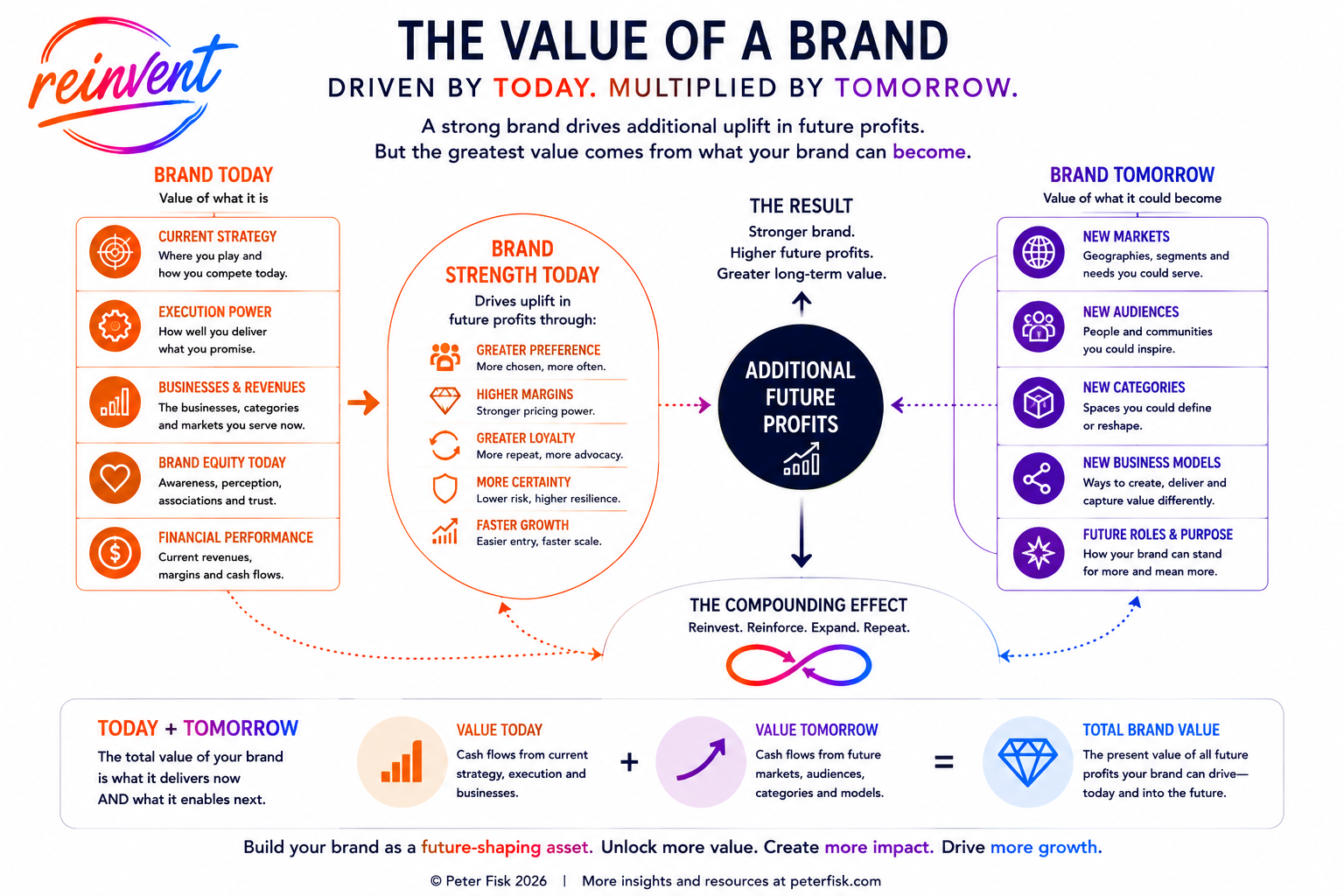
Ultimately, brand matters because it changes economics. Powerful brands generate greater demand, reduce acquisition costs, increase retention, support premium pricing, improve margins, attract talent and partners, accelerate innovation adoption and provide permission to enter new markets. Their greatest contribution may be strategic optionality: increasing the number of credible futures available to the organisation. Brand should therefore be understood as Future Equity, accumulated belief in the organisation’s capacity to remain relevant, innovate and create value beyond its current products and markets.
Examples:
- Apple, USA … Its accumulated trust creates demand and permission across an unusually broad range of future propositions.
- Nvidia, USA … Has evolved from a component brand towards a symbol of the infrastructure and possibility of the AI economy.
- Mercado Libre, Argentina … Its brand increasingly provides credibility for expansion across commerce, finance, logistics and other future services.
Tools:
- Future Equity Score … Measure brand strength across pricing power, trust, stretch, innovation credibility, community and future relevance.
- Option Value Map … Identify which future markets and business models become more achievable because of the brand.
- Brand-to-Value Bridge … Explicitly connect brand investment to revenue growth, margin premium, retention, lower risk and future enterprise value.
So what is really different?
Taken individually, many of these shifts might appear to be developments in marketing. Taken together, they represent something much bigger: a fundamental change in what a brand is for.
The old model was essentially linear: the company created the brand. Marketing communicated it. Consumers received it. Products delivered it. Consistency protected it.
The emerging model is dynamic: the brand is no longer simply transmitted from company to consumer. It is continuously created through interactions between the organisation, its customers, employees, creators, partners and communities. Meaning circulates. Communities amplify it. Culture reshapes it. Innovation renews it. And the resulting trust gives the organisation permission to keep evolving.
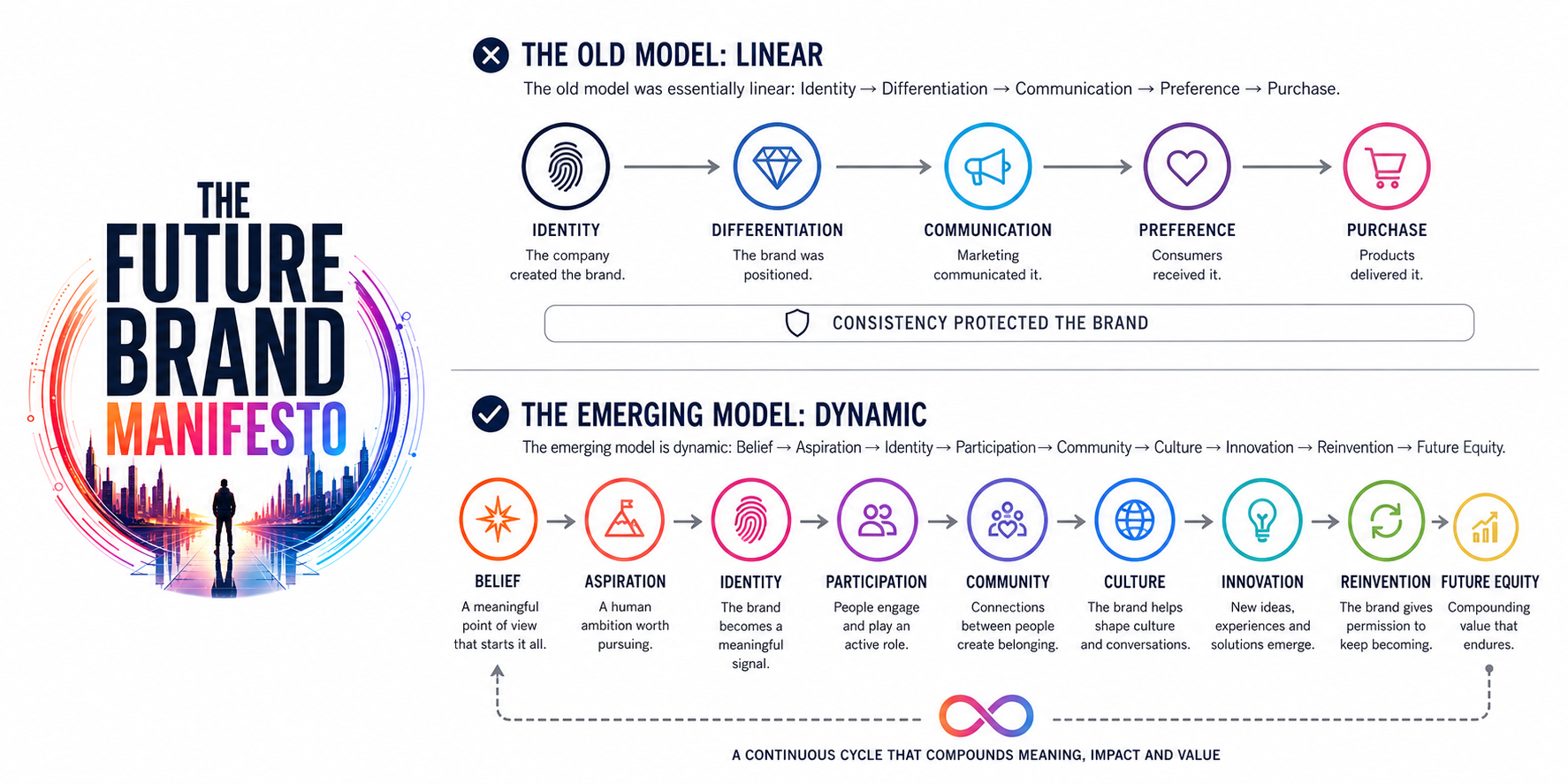
This is perhaps the biggest shift of all: brand moves from representing value to creating possibilities for value.
A strong traditional brand made today’s products easier to sell. A great future brand makes tomorrow’s products, services, markets and business models more credible before they even exist.
That changes the economics. Brand becomes a source not merely of differentiation but of optionality. It allows businesses to move faster because customers trust them, stretch further because their meaning transcends existing categories, and innovate more boldly because people are interested in where they are going rather than attached only to where they have been.
Brand therefore moves from marketing asset to strategic asset; from communications platform to innovation platform; from category position to cultural position; from customer preference to community participation; from brand equity accumulated from the past to Future Equity embedded in what the organisation could become.
What business leaders need to do now
The first implication is organisational. Brand is too important to leave to marketing. The CEO and leadership team need to own the central belief, aspiration and future role of the brand because these choices determine where the organisation can credibly go. Marketing remains critical, but brand increasingly connects strategy, innovation, customer experience, culture, talent, partnerships, sustainability and capital allocation.
Second, leaders should define brands around human aspirations rather than existing categories. Ask what people ultimately seek to achieve, express or become through you. That territory needs to be sufficiently distinctive to matter today but expansive enough to support tomorrow’s innovation.
Third, shift investment from campaigns towards brand systems. Products, experiences, stores, communities, content, collaborations, creators, employees and partners should all become interconnected expressions of the same underlying belief. Stop thinking episodically about communication and start creating continuous narrative momentum.
Fourth, give people a role. Ask not merely what customers can buy but what they can join, contribute, create, share and achieve. The strongest communities create value independently of the company and turn customers into participants in the brand’s evolution.
Fifth, use the brand deliberately as a reinvention platform. Every major innovation should ask two questions simultaneously: does this strengthen what our brand means, and does our brand give us permission to do it? Over time, this creates an expanding frontier of credible possibilities.
Finally, change how brand success is measured. Awareness, consideration and preference still matter, but leaders should also measure pricing power, customer lifetime value, advocacy, community participation, innovation adoption, cultural influence, category stretch and the ability of the brand to support future growth.
The ultimate question is no longer simply: How valuable is our brand today?
Instead it is: How much more valuable can our business become because of our brand tomorrow?
That is the real promise of the Future Brand.
In a world where products become obsolete, technologies converge, categories dissolve and organisations continuously reinvent, brand can become the enduring source of meaning that holds everything together whilst simultaneously pulling the organisation forwards.
Products create transactions. Experiences create memories. Communities create belonging. Beliefs create movements. Brands create possibilities. And possibilities create future value.
© Peter Fisk 2026
Read more from Peter Fisk … Market Makers: Reinventing Marketing
More from the blog