Revolut: The World’s First Superagent? … Forget superapps, think superagents … a new generation of business models for an AI world … the emergence of A2A Commerce, and the Superagent Economy
October 10, 2026

What if the future of banking isn’t a bank? What if the future of shopping isn’t a shop? And what if the future of digital platforms isn’t a platform at all?
This week, Revolut founder and CEO Nik Storonsky outlined an ambition far bigger than becoming the world’s leading digital bank. He wants to build a global technology company from Europe, capable of competing with the likes of Google, Meta and OpenAI.
For a business founded in 2015 to simplify foreign currency exchange, that is an extraordinary ambition.
Revolut has already evolved into a broad financial platform spanning payments, savings, investments, insurance, travel and business services. Valued at approximately $115 billion based on recent transactions, it has become one of Europe’s most valuable private companies.
But perhaps the most intriguing part of Storonsky’s vision is AI.
Revolut is developing proprietary AI models, drawing on the extraordinary intelligence embedded in its financial ecosystem. With tens of millions of transactions every day, it has a potentially powerful understanding of how people spend, save, travel and participate in the economy.
Combined with its payment infrastructure, customer relationships and growing AI capabilities, this creates the foundations for something much bigger.
I call it the “superagent” …
The word superagent has been mentioned before, from Jerry Maguire, the fictional sports superagent played by Tom Cruise, through to increasingly sophisticated AI systems. But I propose a more expansive strategic definition, one that I believe captures the next major evolution of digital and AI business.
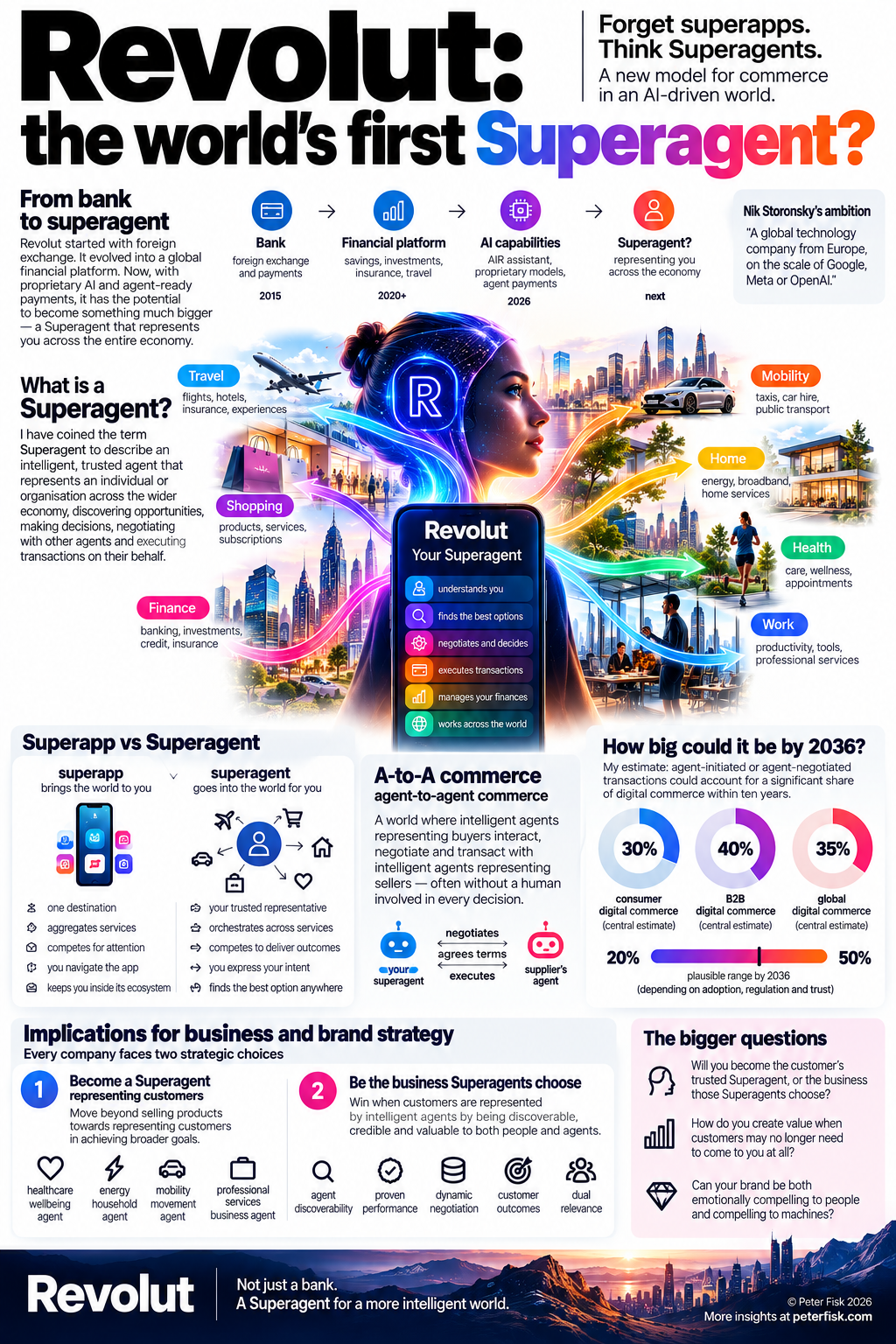
Definition: A superagent is an intelligent, trusted representative of an individual or organisation that operates across markets, discovering opportunities, evaluating alternatives, negotiating with other agents and executing authorised transactions to achieve the best outcomes for its principal.
This is more than an AI assistant. More than a collection of AI tools. And more than an intelligent interface.
It is a new model of customer representation.
I see three interconnected concepts defining this emerging opportunity:
- The “Superagent”: the trusted intelligent representative of the customer.
- A-to-A Business Models: the agent-to-agent interactions through which intelligent representatives of buyers and sellers discover, negotiate and transact.
- The Superagent Economy: an emerging market structure in which intelligent representation, delegated decision-making and autonomous commercial interaction become major sources of competitive advantage.
Together, these ideas describe a fundamental shift in the architecture of commerce.
Revolut hasn’t specifically announced that it intends to become a superagent in this sense. That is my interpretation of the opportunity its strategy opens up. But it could become one of the first companies with the capabilities to make such a model commercially significant.
And it could transform how businesses compete.
Forget superapps. Think Superagents.
For the past decade, one of the great ambitions of digital business has been to build a superapp.
China’s WeChat demonstrated the model, bringing messaging, payments, shopping and everyday services into one integrated environment. Grab and Gojek developed similar propositions in Southeast Asia. Revolut itself has steadily expanded its range of financial and lifestyle services.
The strategic logic was simple: bring more of the customer’s life into one destination. More services meant more engagement, more data, more transactions and stronger customer relationships. The competitive battle was about aggregation.
Who could bring the most valuable services into one place?
But AI opens up an almost opposite model.
What if customers no longer need to visit a marketplace, browse a website or navigate an app? What if their personal agent can go anywhere, discover anything, compare alternatives, negotiate terms and complete transactions?
Instead of bringing the world to the customer, the agent goes into the world on the customer’s behalf. That is the fundamental distinction behind my concept of the Superagent.
A superapp brings the world to you. A Superagent goes into the world for you.
- A superapp is a destination. A Superagent is a representative.
- A superapp aggregates supply. A Superagent orchestrates demand.
- A superapp competes for attention. A Superagent competes to deliver outcomes.
- A superapp wants customers to spend more time inside its ecosystem. A Superagent should help them achieve more while spending less time navigating technology.
The most radical difference is economic.
Superapps typically create value by bringing customers into an ecosystem of services. A genuinely customer-first Superagent should be free to find the best solution anywhere, including from competitors.
This changes the fundamental logic of platform competition. The prize is no longer simply to own the destination. It is to earn the right to represent the customer.
Revolut: From digital bank to intelligent economic life
Revolut’s evolution illustrates how a Superagent might emerge.
- Its first innovation was to make foreign exchange easier, faster and cheaper.
- Its second was to build a broader financial platform, connecting payments, savings, investments and other services.
- Its third could be to transform that financial relationship into an intelligent, agent-driven proposition.
The foundations are beginning to emerge.
Revolut has introduced AIR, its AI-powered financial assistant, enabling customers to interact conversationally with financial information and services. It has also announced work on agent-compatible payments, enabling AI systems to initiate authorised transactions using Revolut’s infrastructure.
Now Storonsky has outlined ambitions to develop proprietary AI models, rather than simply relying on external providers.
These developments suggest three potential layers of future advantage.
- The intelligence layer. Understanding customers’ financial circumstances, preferences and behaviours, with appropriate permissions and safeguards, to anticipate needs and optimise decisions.
- The representation layer. Acting on customers’ behalf across financial services, shopping, travel and other economic activities.
- The transaction layer. Providing the trusted infrastructure through which agents authenticate, authorise, pay, exchange currencies and manage financial risk.
Together, these could enable Revolut to move from managing money to managing economic outcomes.
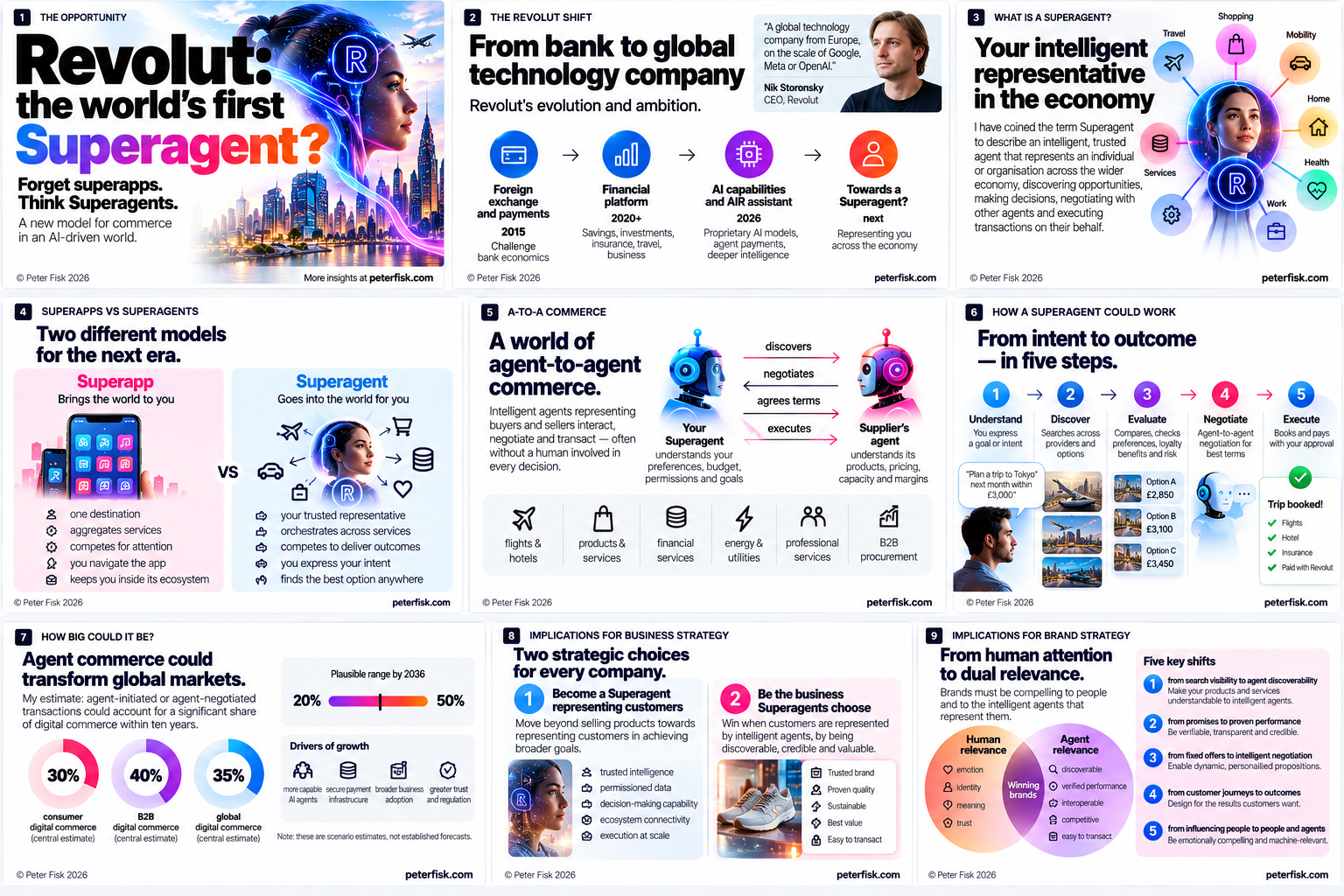
Imagine telling your Revolut Superagent “I’m travelling to Tokyo next month. Find the best flights and hotel, use my loyalty benefits, minimise currency costs, arrange insurance and keep the trip within £3,000.”
The agent could search across airlines, hotels, insurers and other providers.
It could evaluate the options against your preferences, negotiate where possible, request approval for significant commitments and complete the booking.
Or imagine asking “Review my household spending, find better energy and insurance deals, optimise my savings and cancel subscriptions I no longer use.”
Instead of opening multiple applications and comparing providers yourself, you delegate the task.
The crucial insight is that Revolut would not need to own those businesses. Its role would be to represent the customer across them. That is a much bigger opportunity than building another superapp.
A2A commerce: When agents become the buyers and sellers
The Superagent is part of an even larger transformation that I describe as “A-to-A commerce”, agent-to-agent commerce.
Traditional commerce connected people and businesses.
E-commerce digitised those relationships.
Platform commerce brought buyers and sellers together through marketplaces.
Agentic commerce introduces AI into discovery, recommendations and purchasing.
A2A commerce goes further … It describes markets in which intelligent agents representing buyers interact, negotiate and transact with intelligent agents representing sellers.
Imagine your personal Superagent negotiating with an airline’s commercial agent. Your agent understands your preferences, schedule, budget, loyalty status and willingness to pay. The airline’s agent understands capacity, pricing, demand, margins and operating constraints.
The agents exchange information, evaluate alternatives and agree terms within the permissions and limits established by their principals. The transaction can then be authenticated, authorised and completed. The customer receives the outcome.
The same principle could transform almost every industry.
- A manufacturer’s procurement agent could negotiate with suppliers’ agents.
- A household energy agent could continuously optimise electricity sourcing.
- A logistics agent could purchase transport capacity dynamically.
- A company’s treasury agent could optimise liquidity across financial institutions.
- A healthcare agent could coordinate appointments, treatments and administrative services, subject to appropriate clinical oversight.
This is different from conventional machine-to-machine transactions, which have existed for decades.
Automated systems typically execute predefined instructions.
Intelligent agents can interpret objectives, evaluate changing circumstances, consider alternatives and make bounded decisions.
The difference is not simply automation. It is delegated intelligence.
And when intelligent agents begin interacting with other intelligent agents, the architecture of commerce changes.
Markets become increasingly continuous, responsive, personalised and potentially autonomous.
The Superagent Economy: A new architecture of markets
The third concept brings the first two together.
I call it the Superagent Economy.
This is an emerging economic system in which intelligent agents increasingly represent the interests of individuals and organisations, interacting with other agents to discover, negotiate and execute transactions across markets.
It has three defining characteristics.
- Representation replaces navigation. Rather than customers searching through competing platforms, trusted agents explore markets on their behalf.
- Intelligence replaces friction. Agents can continuously evaluate options, compare performance and negotiate terms, reducing the time and effort involved in making decisions.
- Outcomes replace engagement. The most valuable companies may be those that consistently deliver superior results, rather than those that capture the greatest amount of customer attention.
The Superagent Economy could reshape the economics of marketplaces, platforms and intermediaries.
Today’s platforms often derive power from aggregating suppliers and controlling access to customers. Tomorrow’s Superagents could derive power from aggregating customer intent and directing demand towards the most relevant suppliers.
That is a profound shift in market power: From controlling supply to representing demand.
It also raises new questions about competition, trust, data ownership and economic value.
If a Superagent can negotiate with any supplier, what becomes of traditional distribution? If agents can compare thousands of offers in seconds, how will businesses sustain differentiation? And if a trusted agent makes many routine purchasing decisions, who really owns the customer relationship?
These questions are not simply technological. They are strategic.
How much commerce could become A-to-A by 2036?
The opportunity is enormous, although precise forecasts remain uncertain.
McKinsey has estimated that AI agents could orchestrate $3–5 trillion of global consumer commerce by 2030. Payment networks, including Visa and Mastercard, are developing infrastructure to support agent authentication, customer permissions and secure transactions.
Technology companies are building agents capable of searching, comparing and purchasing. Retailers and marketplaces are experimenting with ways to make their products accessible to these systems.
But what proportion of commerce might agents actually control within ten years? My central scenario is that by 2036, approximately 35% of global digital commerce transaction value could be agent-initiated or agent-negotiated.
I would frame the possible range as 20–50%, depending on adoption, regulation, interoperability and trust.
For consumer digital commerce, my central estimate is around 30%. For business-to-business digital commerce, where purchasing is frequently repetitive, data-rich and rules-based, I would estimate closer to 40%.
These are my scenario estimates, not established market forecasts. They describe transactions in which an intelligent agent exercises meaningful discretion, rather than payments that are merely automated.
The transition will not be uniform.
Routine purchasing, travel, subscriptions, procurement, logistics and financial optimisation could move relatively quickly. Highly personal, emotionally significant, complex or regulated decisions may retain more direct human involvement. Fraud, cybersecurity, liability, data protection and consumer trust will also constrain adoption.
But even if agents influence only a third of digital transactions, the strategic implications will be profound.
The next generation of commerce may be less about people browsing products and more about intelligent agents negotiating outcomes.
Who will become the Superagents?
The most interesting question is not simply which companies have the most sophisticated AI. It is which companies can become trusted representatives of customers across markets.
There are already several contenders.
- Google: The universal Superagent. Google has the potential to combine search, Gemini, Maps, shopping, travel and payments into a broad personal agent. Its Universal Commerce Protocol is an important step towards connecting customer intentions with merchants and transactions. Google could move from helping people find things to helping them achieve outcomes.
- OpenAI: The general-purpose Superagent. ChatGPT is evolving from a conversational assistant towards a platform for research, planning, tools and actions. Its opportunity is to become an intelligent representative across many aspects of personal and professional life, coordinating specialist services rather than owning them.
- Amazon: The shopping Superagent. Amazon’s Rufus assistant and Buy for Me initiative point towards a future where Amazon helps customers discover and purchase products beyond its own marketplace. The strategic tension is whether a company built around selling products can become a genuinely independent purchasing representative.
- Revolut: The economic Superagent. Revolut could combine personal financial intelligence, payments, identity and AI to optimise customers’ economic lives. Unlike a traditional retailer or search platform, it already has a close relationship with money and transactions.
- Apple: The personal-life Superagent. Apple’s devices, identity capabilities, payments and personal computing ecosystem provide a potential foundation for a privacy-focused representative operating across everyday activities.
- Microsoft: The enterprise Superagent. Copilot and its enterprise AI infrastructure could increasingly represent employees and organisations in research, workflows, procurement and business decisions.
- Perplexity: The discovery Superagent. Its research and shopping capabilities suggest an alternative model built around finding and evaluating options across the open web, rather than drawing customers into a proprietary marketplace.
- Walmart: The retailer with super agents. Walmart already uses the term super agents for AI systems serving customers, employees and partners. Its Sparky assistant demonstrates how retailers can orchestrate multiple capabilities through AI. However, this is not yet the same as an independent Superagent representing customers across the wider economy.
- Klarna: The shopping and financial Superagent. Klarna’s position at the intersection of retail discovery, payments and consumer finance could enable it to optimise purchasing decisions, affordability and payment choices across merchants.
These businesses approach the opportunity from very different starting points. Some own customer attention. Others understand purchasing behaviour. Others manage payments, identity or business workflows.
The future winners will combine intelligence, trust, permissions and execution.
The Superagent is not simply the company that knows the most about you. It is the company you trust to act most effectively for you.
Beyond technology: Superagents in every industry
The Superagent Economy will not be limited to technology companies.
Some of the most valuable opportunities may emerge from established businesses that reinvent themselves around representing customers rather than selling individual products.
- Booking.com: The travel Superagent. Booking.com could evolve from a platform for accommodation and travel services into an intelligent travel representative, coordinating flights, hotels, ground transport, experiences and disruption management across providers. Its Connected Trip strategy and agentic AI developments provide a foundation.
- Uber, Bolt and Grab: The mobility Superagents. These companies could move beyond providing rides towards optimising complete journeys across competing mobility services. A true mobility Superagent would recommend the best combination of transport modes, even when some journeys are fulfilled by other providers.
- Octopus Energy: The household energy Superagent. Octopus could move beyond selling electricity to representing households across the energy economy. Its Kraken technology, smart tariffs and flexibility capabilities create opportunities to optimise energy purchasing, consumption, generation, storage and electric-vehicle charging.
- Ping An: The health and financial Superagent. Ping An’s combination of insurance, healthcare services and digital ecosystems offers a potential foundation for intelligent representation across prevention, treatment, protection and financial wellbeing.
- Nubank, Monzo and Kaspi.kz: The personal-finance Superagents. These companies could extend from digital banking into broader financial representation, continuously optimising savings, borrowing, insurance, spending and access to third-party services.
- SAP and Coupa: The procurement Superagents. Enterprise software companies could move from enabling purchasing processes to representing organisations in supplier discovery, evaluation, negotiation and ongoing performance management.
- Schneider Electric: The industrial energy Superagent. Schneider’s software, energy-management and automation capabilities could evolve towards representing industrial customers across energy suppliers, assets and infrastructure.
- Accenture, Deloitte and Harvey: The professional-services Superagents. These businesses could develop intelligent representatives that continuously diagnose challenges, assemble expertise, coordinate specialist agents and orchestrate solutions.
These are potential strategic directions, not claims that each company already offers a complete Superagent.
But they illustrate a much broader opportunity.
The Superagent could become the next great business-model innovation across finance, healthcare, travel, mobility, energy and professional services.
The common strategic shift is from providing a product or service to representing a customer’s wider interests.
Three strategic positions in the Superagent Economy
The emerging economy can be understood through three distinct competitive positions.
1. Representing demand: Customer Superagents
These are the trusted representatives of individuals and organisations. Examples could include Google, OpenAI, Revolut, Apple, Booking.com and specialised industry agents.
Their role is to understand intentions, evaluate alternatives, negotiate and execute authorised decisions. Their competitive advantage comes from trust, intelligence, customer understanding and the ability to deliver superior outcomes.
2. Enabling transactions: Agentic commerce infrastructure
These companies provide the systems through which agents interact securely. Visa, Mastercard and PayPal are developing agent-compatible payment capabilities. Shopify and other commerce platforms are helping merchants become accessible to AI-driven purchasing.
The wider infrastructure will need identity, authentication, permissions, interoperability, payment execution, fraud prevention and dispute resolution. These businesses may not own the primary customer relationship, but they could become essential to the functioning of the Superagent Economy.
3. Representing supply: Business and brand agents
Every airline, retailer, manufacturer, hotel, insurer and service provider could develop agents representing its own commercial interests. These supplier agents would present propositions, answer questions, negotiate terms, manage availability and fulfil transactions.
Their task is to make their business the most attractive choice for customer Superagents. This creates a new market architecture.
Customer Superagents represent demand. Supplier agents represent supply. Infrastructure providers enable trusted transactions between them.
Some companies will attempt to operate in more than one layer.
- Revolut, for example, could represent customers while providing the financial infrastructure through which other agents transact.
- Amazon could represent shoppers while also representing merchants selling through its marketplace.
- Google could influence discovery while enabling the underlying commerce protocols.
These combinations create powerful opportunities, but also significant questions about conflicts of interest, transparency and market power.
The paradox of the Superagent
There is a fascinating contradiction at the heart of this new model.
Traditional platforms often benefit from keeping customers inside their own ecosystems. A customer-first Superagent should be willing to send them anywhere.
If Revolut earns commissions from certain merchants, will its agent still recommend a competitor offering better value? If Amazon’s agent can buy from competing retailers, will it consistently prioritise the customer’s interests over Amazon’s own commercial interests? If Google influences both discovery and transactions, how will the independence of its recommendations be demonstrated?
These questions will become central to trust.
The strongest Superagents may need transparent incentives, clear customer permissions and measurable accountability.
Their economic models could also be different. Rather than relying entirely on advertising, referral commissions or transaction fees, they might charge subscriptions, outcome-based fees or a share of verified savings.
Imagine a household Superagent that saves a customer £2,000 annually by optimising insurance, utilities, subscriptions and financial services. The customer might happily pay £200 for that outcome. Or an enterprise procurement Superagent that reduces costs while improving resilience and sustainability. Its value would be measured by the results achieved, not the time spent using an application.
The most successful Superagents may be rewarded for creating customer value, rather than capturing customer attention.
That would be a remarkable reversal of the economics of the digital-platform era.
Two strategic choices for every business
The rise of Superagents and A-to-A Commerce creates two distinct strategic opportunities.
The first is to become a Superagent representing customers.
This opportunity is not limited to banks or technology companies.
- A healthcare provider could become a personal wellbeing Superagent.
- An energy company could become a household resource Superagent.
- A mobility company could become a movement Superagent.
- A professional-services firm could become a business transformation Superagent.
The opportunity is to move beyond selling products towards representing customers in achieving broader goals.
But doing so requires capabilities in trusted intelligence, permissioned data, decision-making, ecosystem connectivity and execution. And it demands a willingness to recommend solutions beyond the company’s own products.
The second opportunity is to become the business that Superagents choose.
For most companies, this will be the more immediate challenge.
If intelligent agents increasingly make or influence purchasing decisions, traditional approaches to marketing, distribution and brand building will need to evolve.
Businesses must become discoverable, understandable, trustworthy and attractive not only to people, but also to their agents. That creates a new competitive landscape.
The reinvention of business and brand strategy
I see five fundamental shifts.
1. From search visibility to agent discoverability.
Companies have spent decades optimising websites for search engines and advertising platforms.
Now they will need to ensure that intelligent agents can discover, understand and evaluate their offerings. Structured product information, reliable APIs, transparent pricing, real-time availability and verifiable credentials will become increasingly important.
The challenge is not simply to appear in search results. It is to become a preferred option within an agent’s decision-making process.
2. From brand promises to proven performance.
Agents can increasingly compare what businesses actually deliver.
Quality, reliability, service levels, sustainability, warranties and customer satisfaction may become more transparent. Claims without evidence could become less effective.
The brands that win will be those whose differentiation can be both emotionally understood and objectively demonstrated.
3. From fixed offers to intelligent negotiation.
Businesses may increasingly negotiate directly with customer agents.
Rather than offering one price and proposition to everyone, companies could create personalised combinations of products, service, convenience, flexibility and value.
Commercial strategy becomes more dynamic. Pricing, distribution and customer experience may need to operate in real time.
4. From customer journeys to customer outcomes.
Traditional marketing is built around awareness, consideration, purchase and loyalty.
But agents could compress or bypass much of that journey. Customers may never visit a website, browse a catalogue or compare offers personally. They simply specify what they want to achieve.
The winning businesses will be those that deliver the best outcomes against those intentions.
5. From influencing people to influencing people and their agents.
This is perhaps the most important change.
Brands have traditionally competed for human attention, emotion and preference. Those things will remain essential. But increasingly, brands will also need to earn the confidence of intelligent agents that evaluate alternatives on behalf of customers.
I call this the challenge of dual relevance.
- Human relevance means being distinctive, desirable, meaningful and trusted.
- Agent relevance means being discoverable, credible, interoperable, competitive and demonstrably valuable.
A luxury brand cannot reduce its proposition to the lowest price. Its customer’s agent must understand craftsmanship, exclusivity, provenance and emotional significance. A sustainable product must make its environmental credentials verifiable, not merely claim them. A premium service must demonstrate why its superior experience justifies its cost.
The strongest brands will succeed with both people and machines.
Brand strategy becomes more human and more intelligent at the same time.
Business Beyond: The rise of the Superagent Economy
Revolut’s announcement this week is significant because it illustrates how ambitious businesses can rethink the boundaries of their industries.
Revolut began by challenging foreign exchange. It evolved into a digital financial platform. It is now developing proprietary AI and agent-compatible payment infrastructure. Its next reinvention could be much bigger.
Not simply a bank with more products. Not another superapp with more services. But potentially a Superagent — an intelligent representative that acts across the wider economy on behalf of its customers.
That is the strategic model I propose, rather than a product Revolut has formally announced.
And it is part of a much bigger transformation.
- The Superagent represents the customer.
- A-to-A Commerce connects intelligent representatives across markets.
- The Superagent Economy reshapes how value is discovered, negotiated and created.
If A-to-A Commerce accounts for even one-third of digital transaction value by 2036, the implications will extend far beyond banking.
Markets will increasingly be shaped by intelligent agents representing buyers and sellers. Customer relationships will be redefined. Brand discovery, preference and loyalty will evolve. New intermediaries will emerge, while established platforms could lose their privileged positions.
And every business will face two important questions.
- Could we become the trusted Superagent representing our customers?
- Or how do we become the brand, product or service that those Superagents consistently choose?
The strategic question is no longer simply how to attract customers into your world: It is how to create value in a world where customers may no longer need to come to you at all.
Welcome to the Superagent Economy.
© Peter Fisk 2026
Email me now at peterfisk@peterfisk.com for keynotes and workshops:
More from the blog