What does it mean to be human in a digital world? … when AI can create almost anything and connect almost anyone, the next challenge for brands is to build experiences that people can trust, shape and share
September 27, 2026

A photo appears in your social feed. It is beautiful, persuasive and possibly synthetic.
A voice message sounds like someone you know.
A review describes a product in convincing detail, although no person may have used it.
Meanwhile, you are encouraged to document your own life: what you achieved, where you travelled, what you think and how you look. You can reach thousands of people, yet still wish for a conversation in which you need impress no one.
These experiences point to a change in what people need from technology. For much of the digital age, the winning formula was to make things faster, easier, more personalised and more connected. Those qualities still matter. But a world abundant in content, convenience and connection creates new scarcities: confidence in what is real, room to be yourself, meaningful relationships, shared experiences and control over your own decisions.
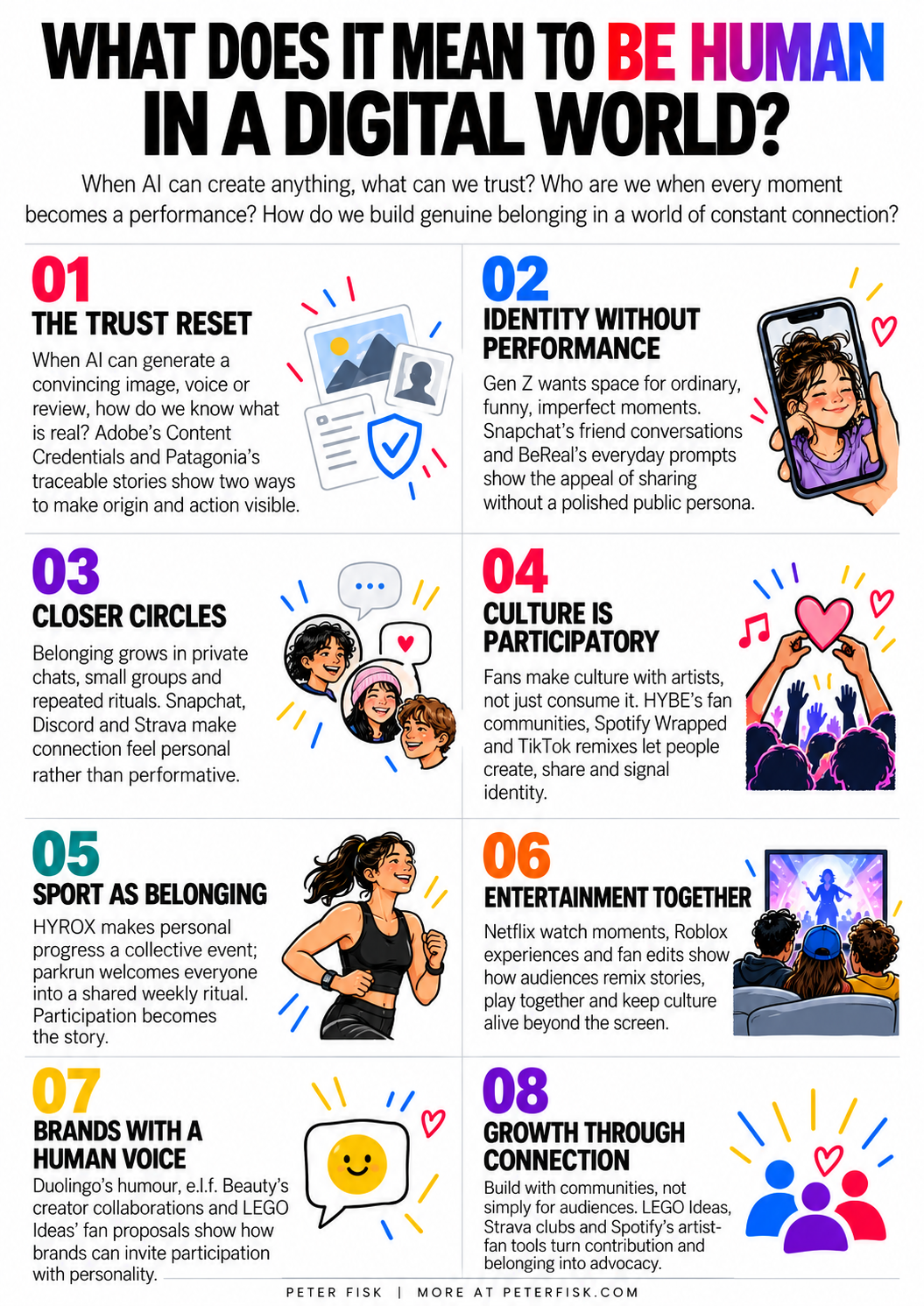
Here are 10 important shifts which I see emerging:
- The trust reset asks organisations to make origins and actions visible.
- Identity without performance gives people room to be ordinary and unfinished.
- Closer circles prize relationships over reach.
- Participatory culture lets audiences help shape what they love.
- Sport as belonging makes personal progress a shared experience.
- Entertainment together turns stories into occasions for connection.
- Brands with a human voice express character through behaviour.
- Growth through connection creates value with communities.
- Staying in control with AI strengthens human judgement.
- The value of presence asks whether technology enriches life beyond the screen.
These are shifts in behaviour, and therefore in business opportunity.
The question for leaders is becoming more demanding: What are people more able to feel, do and become because your organisation exists?
1. The trust reset: Make the origins visible
Trust used to depend heavily on familiar signals. A professional image seemed credible. A confident voice sounded authoritative. A long list of favourable reviews suggested that a product was dependable. AI can now reproduce many of those signals at scale. People need better ways to establish where something came from, what changed along the way and who stands behind it.
- Now: Adobe and Patagonia. Adobe’s work with Content Credentials helps attach information about the origin and editing history of digital media. Patagonia publishes information about its suppliers and the making of its products. One addresses the provenance of content; the other addresses the provenance of goods. Both move beyond the claim “you can trust us” towards giving people something to examine. Explore more at contentcredentials.org
Neither approach offers a magic stamp of truth. A genuine photograph can be used to tell a false story, and supply chain disclosure does not mean every practice is perfect. What matters is the willingness to expose evidence, limitations and responsibility. Trust grows when a company makes scrutiny possible.
- Next: Nikon and a new standard for proof. Nikon already offers Content Credentials capabilities for certain cameras, allowing provenance information to begin at capture. Imagine that approach extending through an entire news or commercial workflow: a photograph carries a record of its capture, a publication explains its edits, and a brand clearly labels generated material. The next trust advantage may come from making such checks simple enough for ordinary people to use, while also protecting the privacy of those pictured. Explore more at C2PA Content Credentials …
The principle applies equally to an AI generated financial explanation, a healthcare recommendation or a sustainability claim. The more consequential the claim, the more readily its basis should be inspected.
2. Identity without performance: Give people room to be themselves
Social media has given people remarkable ways to express who they are. It has also taught them to manage that expression. A meal can become content. A hobby can become a personal brand. A tentative idea can feel risky to share because an audience may treat it as a permanent declaration.
The emerging desire is for places where people can be inconsistent, playful, imperfect and occasionally uninteresting. This is a question of identity: whether digital environments allow us to develop through experimentation, rather than reward us only for presenting a polished self.
- Now: Snapchat and BeReal. Snapchat’s private exchanges between friends offer a different social experience from broadcasting a carefully prepared post. BeReal built its proposition around an everyday prompt and a less curated moment. Neither removes the wish to look good in front of others. Their appeal lies in shifting the expectation from perform for an audience towards share something of your day.
- Next: L’Oréal and beauty beyond the ideal image. Imagine a beauty experience that treats experimentation as the point, rather than steering every customer towards a flawless, public result. L’Oréal could use its digital tools to help someone privately explore different looks, learn techniques from people with similar needs and save ideas without being asked to post them. The strategic question is whether personalisation helps people discover their preferences or quietly imposes a new standard they feel obliged to meet.
The same question belongs in education and work. Can a student ask an elementary question without embarrassment? Can an employee change their mind without appearing weak? Organisations that make room for people to develop may earn a deeper form of loyalty than those that merely help them look accomplished.
3. Closer circles: Design relationships, not just reach
Digital platforms are very good at expanding a network. Yet the number of people who might see a post says little about whether anyone will notice an absence, offer useful help or share a meaningful experience. Belonging is usually built through repetition: the same people showing up, recognising one another and developing small rituals over time.
- Now: Discord and Strava. Discord gives groups spaces organised around games, creators and shared interests. Strava clubs give runners and cyclists a way to recognise one another’s efforts, arrange activities and maintain a connection between outings. Their value comes from what members do together; a community becomes more useful when people have reasons to return and contribute.
- Next: a different ambition for WhatsApp. WhatsApp already hosts countless family groups, neighbourhood networks and informal communities around the world. Imagine tools designed more deliberately for the health of those smaller groups: simple ways to coordinate a regular gathering, welcome a newcomer, share responsibilities or preserve useful knowledge without turning every conversation into another noisy feed. The measure of success would be whether a group becomes better at caring for and organising itself.
For brands, this requires restraint. Many say they want a community when they mean they want an audience that can be contacted more often. A useful test is whether members gain something from one another even when the brand has nothing to announce.
4. Participatory culture: Let the audience shape the story
A fan’s relationship with culture rarely ends at consumption. People discuss an album, reinterpret a scene, make a dance their own, translate a lyric or create something inspired by a character. Digital tools make those responses visible and shareable. The audience can become part of the energy that keeps a work alive.
- Now: HYBE and Spotify. HYBE’s Weverse brings fan communities, artist communication, content and commerce into one environment. Spotify Wrapped turns listening history into a personal story that listeners can share and discuss. In both cases, people express something about themselves through their relationship with culture, extending the experience beyond the original release. hybecorp.com
- Next: HYBE’s opportunity to recognise fan creation. Imagine a future Weverse experience in which artists can invite fans in different countries to help interpret a theme, contribute to a digital exhibition or build parts of an event together. AI could assist with language and creation, making cross border collaboration easier. But the distinctive opportunity would lie in clear credit, consent and appropriate rewards for what fans contribute.
That balance matters across the creative industries. Businesses want the passion of participation, but people need to know whether they are collaborators or simply a source of unpaid material. The strongest cultural ecosystems will give audiences creative freedom while respecting the value they generate.
5. Sport as belonging: Turn private effort into shared progress
Sport has always joined personal challenge with collective emotion. Digital fitness often separates them: a person trains alone, records the result and compares a score. A more powerful model uses data and structure to bring people into a shared endeavour.
- Now: HYROX. Its repeatable race format gives participants a challenge they can understand and prepare for. The event matters, but so do the weeks of training, the people who train together and the recognition of finishing. HYROX describes its movement through community, fitness and competition, bringing everyday participants into an experience with a wider identity. hyrox.com
- Next: WHOOP and the team around the individual. WHOOP already combines personal health insights with coaching and community features. Imagine its data helping a group train for a shared goal while recognising different needs: one person recovering from injury, another learning to pace themselves, a third finding the confidence to start. The technology could help a coach or group organiser see when encouragement is more useful than pressure. Unlock Human Performance & Healthspan
The opportunity is to make progress social without making every person’s body a public scoreboard. Privacy, welcome and different definitions of success will determine whether participation grows.
6. Entertainment together: Make stories occasions for connection
On demand entertainment gives us extraordinary freedom to watch, listen and play whenever we choose. It can also make experiences that once generated a shared cultural moment feel solitary. People are finding ways to bring one another back into the story: listening at the same time, playing within the same world or continuing a conversation after the credits.
- Now: Spotify Jam and Roblox. Spotify Jam allows friends to add songs to a shared queue and listen together. Roblox experiences give players worlds they can inhabit and explore with others. One is a social layer around music; the other places social interaction inside the experience itself. Both demonstrate that access to content and connection through content are distinct forms of value. Spotify
- Next: Netflix and the story that travels. Imagine a series designed with several ways to participate after watching: a small group can discuss an episode without spoilers, explore a setting or character’s perspective, or join a local event inspired by the programme. Some viewers would want none of that. The design challenge is to offer richer participation without making a simple evening’s viewing feel incomplete.
Entertainment’s future may be less about keeping everyone inside one platform for longer and more about creating stories that people carry into friendships, play and the wider world.
7. Brands with a human voice: Show character through action
AI can give every business a constant stream of polished words and images. As that becomes easy, a recognisable voice will depend less on content volume and more on point of view, judgement and behaviour. Humour may help; consistency matters more. People notice whether a brand sounds and acts like itself when something goes wrong.
- Now: Duolingo and e.l.f. Beauty. Duolingo’s expressive owl gives its communications a distinct character, while e.l.f. Beauty has worked with creators to become part of conversations rather than simply place advertising alongside them. These brands understand the value of being recognisable in culture. Duolingo’s own brand guidance describes its mascot as social, communicative and emotional. design.duolingo.com
- Next: Duolingo and the limits of the joke. Imagine Duo appearing in a learner’s experience with a better sense of context: playful when encouragement helps, quieter when someone is struggling and absent when a joke would interrupt learning. AI could make the interaction more adaptive. Human judgement would still be needed to decide what the character should never say or do.
A human voice does not require a brand to pretend it is a friend. It requires a clear sense of character and responsibility. The best test may be a difficult customer interaction: can the company explain a decision honestly, acknowledge a mistake and offer useful help in the same voice it uses when seeking attention?
8. Growth through connection: Build a market with its members
Many businesses still imagine growth as a funnel through which individuals pass: discover, consider, buy and buy again. Yet some of the strongest experiences improve when people contribute to them. A member brings an idea, supports someone else, organises an activity or creates a useful adaptation. That contribution gives others a reason to join.
- Now: LEGO Ideas. LEGO fans can submit concepts, support other proposals and take part in challenges. Ideas that achieve the required support have a chance of being considered for production. The programme gives enthusiasts a meaningful role in finding possibilities that might otherwise remain outside the company. www.lego.com
- Next: LEGO as a broader creative ecosystem. Imagine a more connected path between a child’s invention, a local building group, a digital collaboration and a physical product or exhibition. AI could help participants test structures or visualise alternatives, while the community helps decide what deserves attention. LEGO’s opportunity would be to make contribution more accessible across ages and countries, while maintaining clear rules about credit and ownership.
For any organisation, the growth question becomes: What can people create with us, and what value can they create for one another? An answer might produce advocacy, but that should follow a worthwhile experience. Members will quickly sense when “community” is simply a request to market the company for free.
9. Staying in control with AI: Make people better decision makers
AI can relieve people of repetitive work and give them access to useful knowledge. It can also produce an answer so fluent that they stop examining it. As systems move from suggesting actions to carrying them out, the human need to understand, question and choose becomes more pressing.
- Now: Khan Academy’s Khanmigo. Its tutoring approach uses hints, questions and explanations to guide a learner, with the stated aim of developing understanding and independent thinking. That is a valuable design choice. Completing a task for someone and helping them become able to complete it are different outcomes. Khan Academy Help Center
- Next: DBS and the bank as a decision partner. Imagine an AI banking assistant that helps a customer evaluate a major decision, such as starting a business or financing a home. It could show several paths, explain assumptions, expose uncertainty and make the consequences of each choice easier to understand. Before taking an important action, it would ask for clear approval. A human adviser would be available when the situation calls for one.
The aspiration is that customers leave with stronger judgement. The same standard applies to employees using AI for hiring, clinicians reviewing recommendations and executives testing a strategy. If a system becomes more capable while the people using it become less able to challenge it, something valuable has been lost.
10. The value of presence: Help people live beyond the screen
Many digital businesses measure success by how often people open an app and how long they stay. Those measures can reward useful engagement, but they can also reward interruption. Presence means being able to give your full attention to a person, place or task, without feeling pulled towards the next notification. Increasingly, people may value products that help them decide when technology is useful and when to set it aside.
- Now: Forest and Unplugged. Forest turns time away from distracting apps into a visible achievement: users grow a virtual tree while they focus, and can choose to focus alongside friends. Unplugged takes the idea into the physical world. Its UK cabins include a phone lockbox and offline activities, making an uninterrupted stay part of the experience people are buying. Both businesses create value by helping customers reclaim time for something else. forestapp.cc
- Next: The Light Phone and a new measure of digital value. The Light Phone offers a deliberately limited set of tools, including calls, messages, directions and music. Imagine that principle spreading to mainstream devices and services: a phone that makes essential functions available, then becomes quiet during a meal with friends; a travel app that gets you to a place, then encourages you to explore it; a learning service that helps you prepare, then leaves you free to practise. The commercial challenge is substantial. A business would need to judge success by what customers achieve in their lives, even when that means spending less time in its product. The Light Phone
The question for leaders is simple: After someone uses your technology, are they more able to pay attention to what matters to them?
The next measure of digital progress
These ten themes share a tension. Technology can make something possible without making it valuable. AI can generate content, but people still need to know what to trust. A platform can connect millions, but belonging depends on relationships. A recommendation can save time, but a person still needs the ability to choose. An app can hold attention, but the fullest experiences may happen when attention moves elsewhere.
The most forward looking businesses will treat those human needs as the starting point for innovation. They will make evidence easier to inspect, give people room to be themselves, create reasons to contribute and help them exercise better judgement. They will ask whether their communities are stronger, their customers more capable and their experiences more meaningful because of what they have built.
The defining question of the digital world is no longer simply What can the technology do? It is What does the technology help us become?
More from the blog