“Frontiership” is the superpower of a new generation of business leaders … exploring possibility, redefining boundaries, orchestrating ecosystems and transforming every market
September 2, 2026

Leadership has reached its frontier.
Leadership was largely designed for a world in which the future could be extrapolated from the past. Leaders analysed established markets, set targets, allocated resources and drove execution. Their authority came from experience: knowing more answers than the people around them and converting that knowledge into plans.
That model is no longer sufficient. Artificial intelligence is redistributing intelligence and agency. Industry boundaries are dissolving. Geopolitical fragmentation is reshaping supply, capital and technology. Climate pressure is changing the economics of almost every sector. Customers are moving faster than organisational structures, while new competitors can emerge from anywhere. The central leadership challenge is no longer simply to improve the business that exists. It is to imagine and create the business that could exist next.
This demands a different genre of leadership: “Frontiership”
Frontiership is the capability to lead at the edge of what is known—to explore emerging possibilities, make consequential choices without complete evidence, mobilise people beyond conventional boundaries and convert potential into performance. It is how Future Makers see further and act faster. It combines imagination with judgement, courage with experimentation, and long-term possibility with short-term credibility.
The frontier is not a destination on a strategic map. It is a constantly moving boundary between what is understood and what might become possible. Frontiership therefore describes neither a job title nor a heroic personality. It is an organisational capability that leaders must create around them.
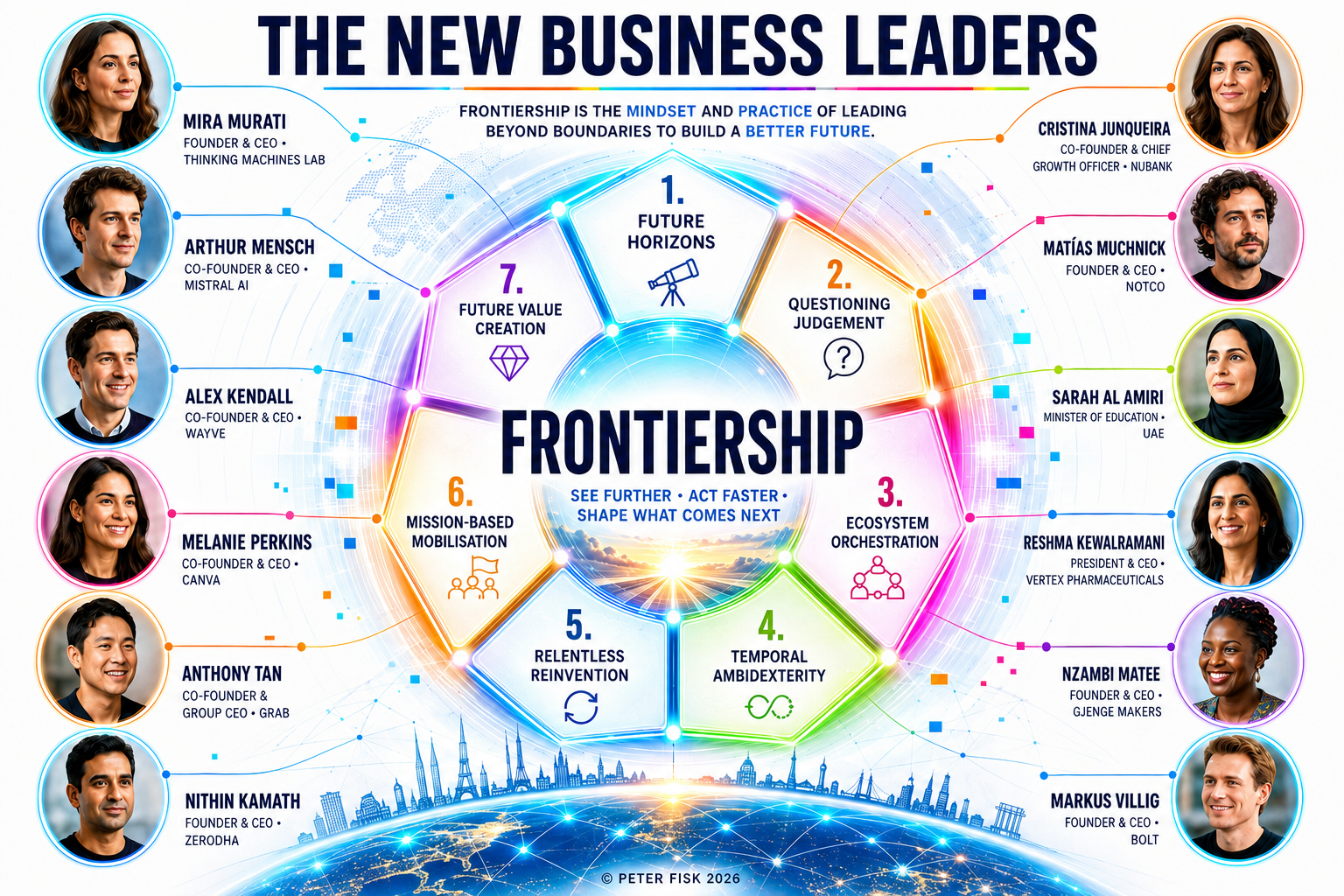
From leadership to “frontiership”
Traditional management seeks control. Frontiership develops capacity. Traditional strategy asks how to win in an existing market. Frontiership asks where value is migrating, which new arenas are forming and what the organisation could become. Traditional leaders are rewarded for answers; frontier leaders are distinguished by the quality of their questions. They do not pretend to possess all the facts. They create the conditions through which better evidence, choices and possibilities can emerge.
This is not an argument for abandoning operational excellence. The future is not financed by imagination alone. Existing businesses must continue to satisfy customers, generate cash and earn trust. But performance without reinvention eventually becomes decline. Frontiership connects the two: exploiting the strengths of today while building the options, capabilities and business models of tomorrow.
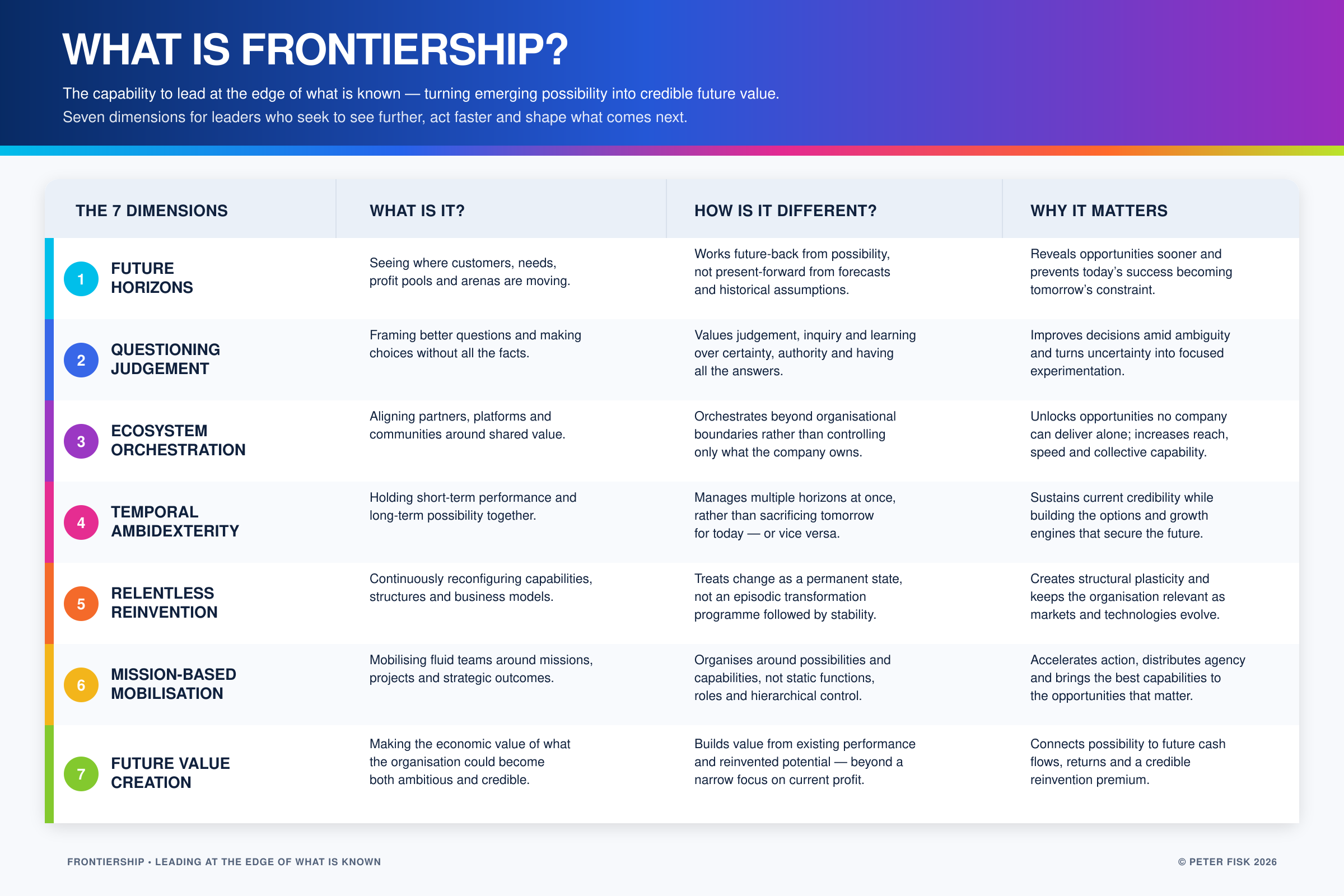
Its practice can be understood through seven connected dimensions.
Dimension 1. Future Horizons
See where value is moving before the market becomes obvious.
Frontier leaders look beyond forecasts towards structural shifts in customers, needs, technologies, profit pools and market arenas. They work future-back rather than present-forward. Instead of asking how much larger today’s business can become, they ask which problems will matter, which boundaries will disappear and where the organisation has a credible right to play. Strategic imagination is disciplined possibility: multiple plausible futures translated into choices, options and experiments.
Dimension 2. Questioning Judgement
Lead with better questions when complete answers do not exist.
In uncertain conditions, more data does not automatically produce a better decision. Leaders must distinguish signal from noise, reversible choices from irreversible commitments and productive uncertainty from avoidable risk. Their premium lies in judgement. They frame questions that expose assumptions: What must be true? What are we not seeing? Which evidence would change our minds? Where can we learn cheaply? Agentic AI may supply more answers, but it makes human judgement—about purpose, trade-offs and consequences—more valuable, not less.
Dimension 3. Ecosystem Orchestration
Create value with others, not only through what you own.
The most significant opportunities increasingly exceed the capabilities of any single company. Frontiership replaces the vertically controlled organisation with an ecosystem of partners, platforms, communities, suppliers, institutions and even competitors. The leader’s role is to align different interests around a shared opportunity, design how value is created and captured, and establish the trust, standards and interfaces that allow the system to work. Influence becomes as important as authority; access can matter more than ownership.
Dimension 4. Temporal Ambidexterity
Hold today and tomorrow in the same decision.
Leaders are routinely trapped between quarterly pressure and distant aspiration. Frontiership rejects that false choice. It manages multiple time horizons simultaneously: strengthening the core, scaling emerging growth and creating options for more radical reinvention. The test is not whether a leader can talk about the long term, but whether capital, talent and attention visibly move towards it while present commitments are still delivered. Short-term performance creates permission to explore; future potential prevents performance from becoming a trap.
Dimension 5. Relentless Reinvention
Treat the organisation as permanently unfinished.
Transformation can no longer be a periodic programme followed by a return to normal. Constant change is normal. Frontier organisations develop structural plasticity: the ability to reconfigure teams, capabilities, technologies and business models repeatedly without losing coherence. They dismantle obsolete assumptions before crisis makes the decision for them. Reinvention becomes a continuous rhythm of sensing, experimenting, scaling and letting go—not an occasional intervention imposed from the top.
Dimension 6. Mission-Based Mobilisation
Organise around possibilities and projects, not static roles.
Job descriptions and functional silos were built for repeatable work. Emerging opportunities cut across both. Frontiership mobilises fluid teams around missions, customer problems and strategic outcomes. People contribute through their capabilities rather than defend their positions. Leaders set intent, boundaries and measures of progress, then distribute agency to those closest to the work. This demands courage as a collective capability: psychological safety to challenge, permission to experiment and accountability for learning as well as delivery.
Dimension 7. Future Value Creation
Build the value of what the company can become.
Profit describes an accounting outcome; value reflects the future cash flows and returns that investors believe a company can generate. Those flows may come from the existing business or from credible possibilities for reinvention. Frontiership makes that potential tangible. Leaders explain where value is migrating, what the company could become, how new propositions and business models will create value, why the company can win, which options already provide evidence, how resources are shifting and when potential should convert into revenue, margin and cash. The reinvention premium is the additional value earned when the market believes this possibility is both ambitious and credible.
Future Makers in action
A new generation of Future Makers is emerging across the world. They are not united by age, celebrity or sector, but by methods that belong to the next era of business.
Mira Murati is attempting to build a new kind of AI institution through Thinking Machines Lab—one based on adaptable intelligence and greater human agency. Arthur Mensch is using Mistral AI to pursue both frontier performance and a strategically independent European approach to artificial intelligence. Alex Kendall’s Wayve challenged the dominant assumptions of autonomous driving through embodied, end-to-end learning. Each is expeditionary: advancing into a field where neither the technology nor the winning organisational model is settled.
Melanie Perkins transformed design from specialist software into an accessible, collaborative platform through Canva. Anthony Tan developed Grab from a taxi-booking service into a Southeast Asian ecosystem spanning mobility, delivery and financial services. Markus Villig built Bolt through rapid local adaptation across diverse markets. Their Frontiership lies in orchestration: enabling customers, creators, partners and providers to achieve more together than the company could deliver alone.
Nithin Kamath challenged the cost, complexity and conventions of Indian investing through Zerodha, combining democratisation with unusual financial discipline. Cristina Junqueira helped build Nubank by questioning assumptions that traditional banks treated as immutable, redesigning financial services around accessibility and customer experience. Their institutions show that reinvention is often less about inventing a new technology than overturning the logic of an established system.
Matías Muchnick uses artificial intelligence not merely to market food differently but to redesign how food products are created through NotCo. Reshma Kewalramani’s leadership at Vertex demonstrates another form of scientific Frontiership: sustaining conviction through long development cycles while connecting research possibilities to medicines, patient outcomes and commercial value. Both combine exploration with the discipline required to turn scientific potential into performance.
Nzambi Matee converts plastic waste into construction materials through Gjenge Makers, reframing an environmental liability as a productive resource. Sarah Al Amiri helped lead the Emirates Mars Mission, using an audacious national project to develop scientific talent, international partnerships and confidence in what a young space ecosystem could achieve. They remind us that Frontiership is not confined to corporations. It can reshape material systems, public institutions and a nation’s sense of possibility.
None of these leaders should be treated as a flawless hero or a finished case study. Frontier ventures can disappoint; bold narratives can outrun evidence; founders can fail to create institutions that endure beyond them. That is precisely why the concept matters. Frontiership is not the celebration of ambition. It is the capacity to make ambition progressively more credible through choices, coalitions, experiments, resource commitments and results.
Building “frontiership” into the organisation
The danger is to turn Frontiership into another leadership competency delegated to a few charismatic individuals. Future-making must become a distributed organisational system. Boards and executive teams can begin with seven practical moves.
- Extend the horizon. Create regular space to explore structural shifts and alternative futures beyond the planning cycle.
- Upgrade the questions. Judge strategic conversations by the assumptions they expose and the options they generate, not the volume of answers presented.
- Map the ecosystem. Identify whose capabilities, access and trust are required to unlock opportunities the company cannot pursue alone.
- Fund all horizons. Separate resources for the core, emerging growth and future options, with different expectations and measures for each.
- Make reinvention continuous. Replace episodic transformation programmes with a permanent portfolio of experiments, ventures and business-model shifts.
- Mobilise around missions. Create cross-boundary teams with clear outcomes, decision rights and time-limited mandates rather than adding more committees.
- Narrate future value. Connect strategic possibilities to capabilities, resource movements, milestones and eventual economic returns.
The leadership advantage of the next era
For much of the last century, leadership advantage came from scale, information and control. In the next era it will come from the ability to navigate possibility. As machines become more capable of analysis, prediction and execution, the distinctively human contribution shifts towards imagination, judgement, meaning, courage and coalition-building.
Frontiership brings these capabilities together. It asks leaders to stand at the moving edge between performance and potential: grounded enough to deliver, imaginative enough to see what others cannot yet see, and courageous enough to begin before every fact is available.
The best leaders will still run strong organisations. But they will do something more consequential. They will help people see a future worth creating, assemble the capabilities to pursue it and build credible bridges from possibility to value. They will not simply prepare their organisations for the future. They will shape it.
Mira Murati … Building the next frontier of AI
Albanian-born Mira Murati emerged as one of the defining technology leaders of her generation through her role as CTO of OpenAI, where she helped lead the development and deployment of ChatGPT, DALL-E and GPT-4. She left OpenAI in 2024 and founded Thinking Machines Lab, assembling an extraordinary group of AI researchers around a different proposition: make advanced AI more understandable, customisable and useful to people. The company has attracted billions of dollars of investment and become one of the most closely watched challengers in frontier AI.
Murati represents scientific frontiership: operating where technological possibility, commercial opportunity and societal consequence collide. Her leadership is significant because she combines technical understanding with product intuition and a willingness to leave an established winner to create something new. She embodies the Future Maker principle that leadership increasingly means asking what should exist next, rather than simply improving what exists today.
Arthur Mensch … Creating a European AI champion
French engineer Arthur Mensch co-founded Mistral AI in 2023 with Guillaume Lample and Timothée Lacroix, after working at Google DeepMind. Their ambition was audacious: build a European frontier-AI company capable of competing with much larger American technology groups while championing greater openness, customisation and user control. Mistral rapidly developed powerful language models and products including Le Chat, growing from start-up to a significant force in the global AI race.
Mensch exemplifies challenger frontiership. Rather than accepting that frontier AI would inevitably be controlled by a handful of US hyperscalers, he challenged the structure of the emerging industry itself. His approach combines deep technical credibility with speed, openness and geopolitical awareness. The wider leadership lesson is important: Future Makers do not merely compete within existing market structures. They recognise moments when technologies are destabilising those structures and move quickly enough to reshape who has power, where capabilities reside and what alternatives become possible.
Alex Kendall … Teaching machines to navigate the physical world
New Zealand-born Alex Kendall co-founded London-based Wayve in 2017 after completing pioneering AI research at Cambridge. Rather than following the conventional autonomous-driving model of detailed maps, rules and highly engineered systems, Kendall pursued an AI-first approach in which vehicles learn to understand and navigate the world through experience. Wayve describes this broader ambition as “embodied AI”: intelligence capable of operating in the physical world.
That contrarian technological bet has attracted major backing and partnerships, with Wayve valued at around $8.6 billion in 2026. Kendall demonstrates expeditionary frontiership: choosing a destination before the route to it is obvious. Rather than optimising accepted autonomous-driving architectures, he questioned their underlying assumptions. His leadership illustrates why future-making increasingly depends upon conviction without certainty — combining a long-term technological thesis with experimentation, learning and adaptability. The objective is bigger than autonomous cars: bringing machine intelligence into the physical economy.
Melanie Perkins … Democratising creativity
Australian entrepreneur Melanie Perkins began with a deceptively simple observation: professional design software was unnecessarily difficult. After creating online school-yearbook business Fusion Books, she co-founded Canva in 2013 with Cliff Obrecht and Cameron Adams. Her ambition was not simply to create easier design software but to democratise visual communication — enabling almost anyone to create professional-looking content. Canva has subsequently grown to hundreds of millions of monthly users and a private-market valuation exceeding $40 billion.
Perkins represents possibility frontiership. Her distinctive skill is seeing enormous opportunity hidden inside everyday frustration and then maintaining conviction while others underestimate it. Investors initially questioned whether a globally significant software company could emerge from Australia. She persisted. More significantly, Canva has continued expanding its definition of the market — from simple design tool towards a broader visual communication and AI-enabled workplace platform. Her leadership demonstrates that Future Makers expand markets by giving ordinary people capabilities previously reserved for experts.
Anthony Tan … Orchestrating Southeast Asia’s digital ecosystem
Anthony Tan co-founded Grab in 2012 after developing the idea for a safer, more reliable taxi-booking service while at Harvard Business School. Rather than simply copying Uber, Tan built Grab around the distinctive realities of Southeast Asia — fragmented markets, different languages, payment systems, regulations and consumer behaviours. Grab subsequently expanded from mobility into food delivery, payments, financial services and other everyday services.
Tan exemplifies ecosystem frontiership. His achievement is not one breakthrough technology but an ability to connect customers, drivers, merchants, financial institutions, governments and partners into an increasingly valuable platform. This requires a different conception of leadership: the organisation cannot control everything it needs to succeed. Instead, leaders orchestrate capabilities across organisational boundaries. Tan’s emphasis on hyperlocalisation and partnerships demonstrates another Future Maker characteristic: think expansively but adapt intensely. His story shows how tomorrow’s biggest businesses can emerge by connecting previously fragmented activities into entirely new economic ecosystems.
Nithin Kamath … Reinventing finance through radical simplicity
Nithin Kamath spent years trading Indian markets before recognising a structural contradiction: customers were increasingly online, while traditional brokers retained expensive branch networks, intermediaries and complex charging structures. In 2010 he founded Zerodha with a radically simpler model — technology-led, online, transparent and dramatically lower cost. The bootstrapped company went on to transform Indian retail broking.
Kamath represents frugal frontiership — demonstrating that reinvention does not always require more technology, capital or complexity. Sometimes the breakthrough comes from systematically removing what customers no longer need. Zerodha’s decision to bootstrap also gave its founders unusual freedom to prioritise resilience and customer value rather than pursuing growth at any price. Kamath challenges the Silicon Valley assumption that disruption necessarily requires huge amounts of venture capital. His Future Maker lesson is powerful: question the economics as well as the experience of an industry. Radical simplicity can simultaneously reduce costs, democratise access and create a fundamentally stronger business model.
Cristina Junqueira … Challenging Latin America’s banking establishment
Brazilian engineer Cristina Junqueira spent years in consulting and traditional banking before concluding that Brazil’s highly concentrated financial system was delivering expensive and frustrating experiences for consumers. In 2013 she joined David Vélez and Edward Wible to co-found Nubank. Their proposition combined digital technology with radical customer centricity: eliminate unnecessary fees, bureaucracy and complexity rather than merely digitising traditional banking.
Nu has subsequently grown beyond 127 million customers across Brazil, Mexico and Colombia, while Junqueira has taken responsibility for developing its emerging US business. She exemplifies institutional frontiership: challenging deeply embedded assumptions about how an industry should work. Her story demonstrates that disruption often starts with indignation — refusing to accept experiences everyone else regards as inevitable. Crucially, Nubank did not simply create a better banking app; it redesigned the relationship between institution and customer. Future Makers like Junqueira turn customer frustration into a mandate for systemic reinvention.
Matías Muchnick … Using AI to reinvent food
Chilean entrepreneur Matías Muchnick co-founded NotCo with Karim Pichara and Pablo Zamora around an unusual question: rather than trying to make plant-based ingredients imitate individual animal products through conventional food science, could artificial intelligence discover entirely new combinations of plants capable of recreating their taste, texture and functionality? The result was Giuseppe, NotCo’s AI platform, and products spanning milk, burgers, mayonnaise and other categories.
Muchnick exemplifies combinatorial frontiership — creating breakthroughs by connecting disciplines and capabilities that traditionally operated separately. NotCo sits at the intersection of AI, biotechnology, consumer brands, food science and sustainability. His leadership therefore matters beyond plant-based food. It demonstrates how industry boundaries themselves are becoming innovation opportunities. Future Makers increasingly ask not “how can we improve our industry?” but “what becomes possible when we combine our industry with something completely different?” Muchnick’s frontier is ultimately not alternative food; it is using intelligence to redesign how food itself is created.
Sarah Al Amiri … Turning national ambition into capability
Sarah Al Amiri represents a different kind of Future Maker: someone using frontier projects to accelerate the capabilities of an entire country. A computer engineer by training, she became science lead and deputy project manager of the UAE’s Emirates Mars Mission, helping deliver the Hope probe that successfully entered Martian orbit in 2021. She subsequently became chair of the UAE Space Agency while taking senior government responsibilities spanning advanced technology, education and science.
Al Amiri exemplifies mission-driven frontiership. The Mars mission was important not simply because the UAE reached Mars, but because an apparently impossible objective created urgency around building scientific knowledge, engineering capability, talent and national confidence. Her leadership demonstrates the power of using ambitious missions as organisational accelerators. Instead of extrapolating cautiously from today’s capabilities, Future Makers define a destination that requires entirely new capabilities to emerge. Al Amiri’s approach therefore captures an important principle of frontiership: ambition is not the reward for capability; sometimes ambition is how capability gets created.
Reshma Kewalramani … Turning scientific possibility into human impact
Physician-scientist Reshma Kewalramani became CEO of Vertex Pharmaceuticals in 2020 after joining the biotechnology company in 2017 and serving as its chief medical officer. Trained in internal medicine and nephrology, she brings a clinician’s understanding of patients together with the strategic perspective required to lead a major biotechnology company. Under her leadership Vertex has extended its leadership in cystic fibrosis while pushing into gene editing, cell therapy, pain and other disease areas.
Most symbolically, Vertex and CRISPR Therapeutics developed Casgevy, the first CRISPR-based gene-editing therapy approved for conditions including sickle-cell disease. Kewalramani represents translational frontiership — turning extraordinary scientific breakthroughs into scalable human outcomes. Her leadership bridges different timescales: today’s successful medicines fund tomorrow’s uncertain science. That combination of performance and possibility is central to Future Maker leadership. The challenge is not simply inventing the future, but building an organisation capable of carrying breakthrough ideas from laboratory possibility to real-world impact.
Nzambi Matee … Turning waste into infrastructure
Kenyan materials engineer Nzambi Matee founded Gjenge Makers around a brilliantly inverted question. Instead of asking how Kenya could dispose of its growing plastic waste, she asked whether that waste could become something valuable. Gjenge collects discarded plastics and combines them with sand to manufacture paving blocks, tiles and other construction products — simultaneously addressing waste, affordable building materials and employment.
Matee exemplifies regenerative frontiership: seeing apparently negative externalities as potential inputs into new value systems. Her background in materials science and applied physics enabled her to move beyond campaigning against plastic pollution towards engineering an economically useful alternative. The significance of Gjenge is therefore larger than recycling. It represents a shift from linear economics — extract, manufacture, consume, discard — towards systems where waste becomes feedstock for new industries. Matee demonstrates a defining Future Maker mindset: do not merely solve the problem presented to you; reframe it until the problem itself becomes an opportunity.
Markus Villig … Building Europe’s mobility challenger
Estonian entrepreneur Markus Villig founded what became Bolt in Tallinn in 2013 when he was just 19. Starting with roughly €5,000 from his family, he built the first version of the ride-hailing software himself and personally recruited the company’s first drivers. Bolt subsequently expanded beyond ride-hailing into scooters, e-bikes, car sharing and food delivery, operating across more than 50 countries.
Villig represents resourceful frontiership. His story challenges the assumption that category-defining technology businesses must originate in Silicon Valley or begin with enormous pools of venture capital. Bolt instead expanded from a tiny home market by moving quickly, remaining cost-conscious and adapting to underserved markets that larger competitors sometimes overlooked. His broader ambition has evolved from competing with Uber towards rethinking urban mobility itself. That evolution is characteristic of Future Makers: they begin by solving a specific problem but progressively expand the arena in which they believe they can make a difference — from a product, to a platform, to reshaping an entire system.
More from the blog