Thinking beyond AI … when intelligence becomes abundant, the new source of value is human judgement, imagination and the ability to reinvent … How can business leaders think beyond AI?
August 3, 2026

In 2023, as many established automotive companies were still debating the speed and scale of the EV transition, BYD emerged as one of the world’s most disruptive forces in mobility. Its rise was not simply because it produced competitive electric cars. It was much more about leadership. Wang Chuanfu, founder and chairman of BYD, had spent decades imagining a very different future for transportation.
Most automotive leaders looked at electrification as a technology transition: how to replace an internal combustion engine with an electric motor while preserving the existing industry model of manufacturing, dealerships and ownership. BYD saw something broader: it saw the convergence of batteries, energy systems, software, manufacturing and mobility. It invested in battery technology, supply chains and vertical integration long before the market had fully validated the opportunity.
It did not simply ask, “How do we make better electric vehicles?” It asked, “What would mobility look like if we rebuilt the entire system around electrification?” … which is the difference between information and intelligence, between analysis and leadership.
Thinking beyond AI: what leaders can do
Today, an AI system could analyse the automotive industry in seconds. It could map consumer trends, compare competitors, identify emerging technologies, assess regulatory shifts and recommend strategic options. It could probably produce a more comprehensive market assessment in minutes than a traditional consulting team could have produced after months of research.
But AI did not create BYD’s ambition. It did not decide that batteries would become the strategic foundation of mobility. It did not create the conviction to invest ahead of certainty. It did not make the difficult choices required to transform a company and an industry.
AI can analyse possibilities, but leadership creates possibilities.
This is the paradox of the AI era. Artificial intelligence is giving leaders access to an extraordinary abundance of knowledge. It can answer questions faster than ever before, synthesise vast amounts of information and generate strategic recommendations at unprecedented speed.
The more intelligence becomes available, the more valuable human leadership becomes.
Because the future will not be won by those who simply know more.
Almost every organisation will soon have access to powerful AI capabilities. The differentiator will be what leaders do with that intelligence. The advantage will move from knowledge acquisition to judgement, from analysis to choice, from prediction to imagination and from strategy creation to execution.
The critical leadership challenge is therefore not simply how to use AI. It is how to think beyond AI.
Thinking beyond AI means recognising that while machines can expand our intelligence, they cannot replace the uniquely human capabilities that create transformation: curiosity, imagination, courage, judgement and the ability to mobilise people around a different future.
The companies that thrive will be those that combine artificial intelligence with human ambition.
They will use AI not merely to optimise what they already do, but to imagine what they could become.
The new source of value: what a company can become
For much of business history, strategy was about improving the business a company already had. Leaders focused on efficiency, scale, market share and operational excellence. They looked at existing competitors and sought to outperform them.
But in a world of accelerating change, value increasingly comes from a different question: What could this company become?
The most valuable companies are often those that have convinced the world they can continually reinvent themselves. Their value is not only based on current performance but on confidence in their future potential.
This is the logic of what I call the “reinvention premium”.
A company earns a reinvention premium when investors, customers and employees believe it has the ability to continually create new sources of relevance, growth and value.
AI will amplify this dynamic because every organisation will have greater ability to explore opportunities, analyse markets and identify potential disruptions.
Reinvention is not a technology challenge. It is a leadership challenge.
AI can tell a company where opportunities may exist. It cannot decide which opportunities matter. It can generate hundreds of possible strategies. It cannot determine which future is worth pursuing.
That requires leaders who can think beyond the obvious.
How business leaders think beyond AI
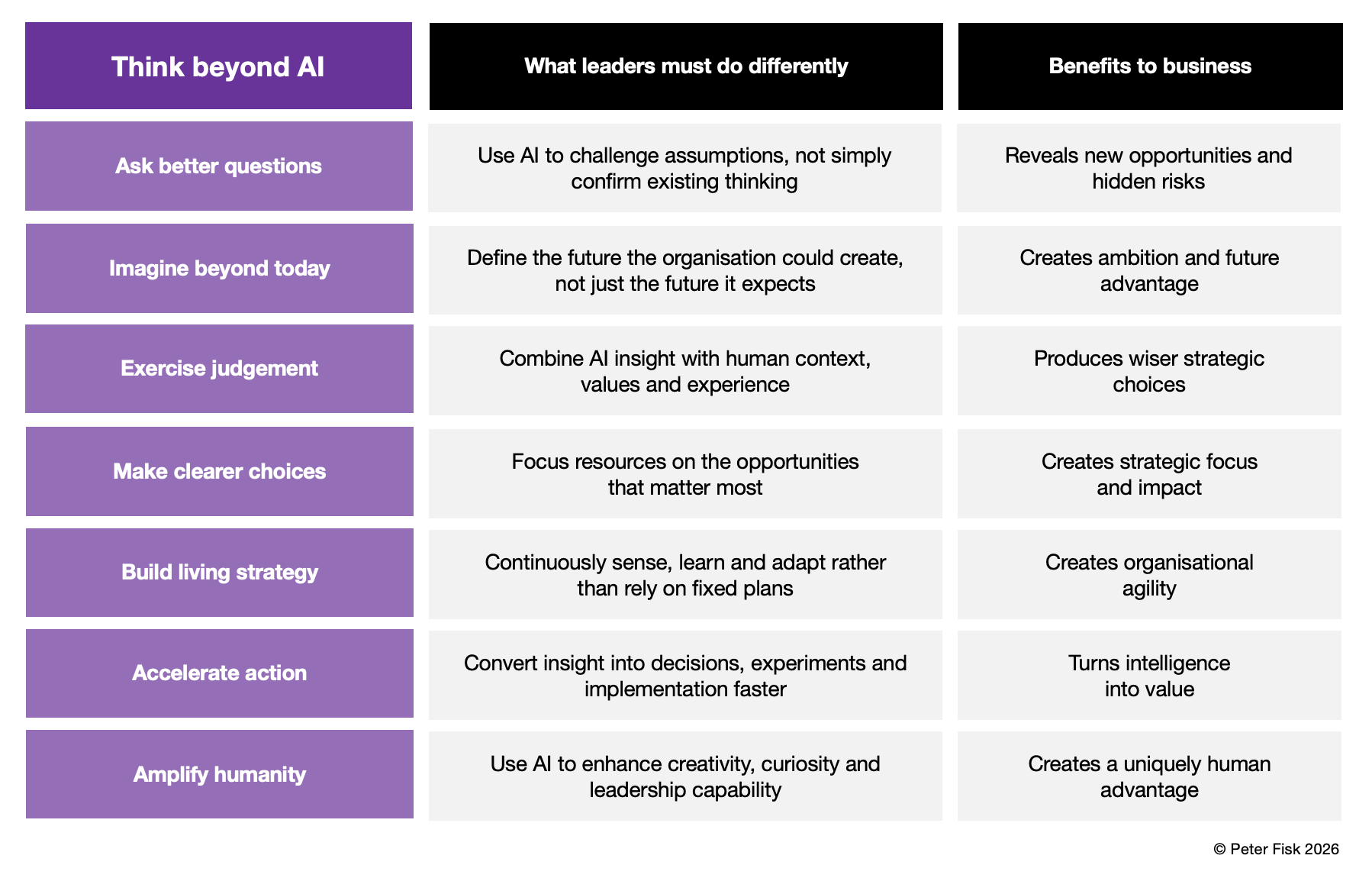
Beyond answers: asking better questions
The first capability of leaders in the AI era is not finding better answers. It is asking better questions.
Most organisations use AI in the same way they have traditionally used information: to solve existing problems faster. They ask how to increase efficiency, reduce costs, improve products or compete more effectively.
These are useful questions. But they are rarely transformational questions.
The greatest reinvention opportunities begin when leaders challenge the assumptions behind their business.
- Instead of asking, “How do we sell more products?” they ask, “What customer problem are we really solving?”
- Instead of asking, “How do we beat competitors?” they ask, “What if the boundaries of our industry disappeared?”
- Instead of asking, “How do we protect our current business?” they ask, “What could make our current business irrelevant?”
Melanie Perkins, co-founder and CEO of Canva, provides a powerful example of this kind of thinking. The conventional software industry assumed that professional design required professional expertise. Powerful creative tools were built for designers, agencies and specialists.
Perkins asked a different question: why should design capability belong only to experts?
Canva’s ambition was not simply to create another design application. It was to democratise creativity by making design accessible to everyone. The company reframed the market around a broader human need: helping people communicate ideas visually.
Now artificial intelligence is accelerating Canva’s mission, helping millions of users create content more easily. But the strategic insight came before the technology.
The lesson is simple: AI expands the range of answers available. Great leaders expand the range of questions being asked.
Beyond prediction: imagining futures that do not yet exist
AI is becoming increasingly powerful at identifying patterns and predicting likely outcomes. But many of the greatest business opportunities do not emerge from predicting the future. They emerge from creating it.
The challenge for leaders is moving from forecasting what is likely to happen towards imagining what could happen.
Peter Wennink, former CEO of ASML, understood this principle. ASML’s leadership in semiconductor manufacturing technology was not created through short-term market responses. It was built through decades of investment in extreme ultraviolet lithography, a technology so complex that success required collaboration across an entire ecosystem of suppliers, researchers and customers.
ASML’s leaders had to believe in a future computing landscape before that future was fully visible. The company’s advantage was not simply superior technology. It was long-term imagination translated into capability building.
The same principle explains BYD’s rise. It was not just following the electric vehicle market. It was building the capabilities required for a future mobility ecosystem.
AI can help leaders explore possible futures more extensively than ever before. But leaders must still decide which future deserves commitment. Prediction helps organisations prepare for change. Imagination helps them create it.
Beyond intelligence: exercising judgement
As AI becomes more sophisticated, leaders face a new challenge: too many plausible answers.
A leadership team can ask AI to analyse a market and receive multiple strategic options. It can model different scenarios and calculate potential outcomes.
But strategy has never been about finding the mathematically perfect answer. It is about making choices under uncertainty. This is where judgement becomes the defining leadership capability.
Bernard Arnault’s leadership of LVMH illustrates this clearly. Luxury is not an industry where success comes simply from analysing consumer behaviour. The value of luxury brands comes from culture, emotion, symbolism and human aspiration.
Arnault’s achievement was not simply acquiring famous brands. It was understanding how to preserve their heritage while continually renewing their relevance.
LVMH has maintained the exclusivity and craftsmanship that define luxury while embracing new generations, digital experiences, global markets and changing cultural expectations.
AI can identify consumer patterns. It cannot determine why a brand becomes meaningful. It cannot understand the emotional connection between history, identity and aspiration. That requires cultural judgement.
The future leader will not be the person who knows everything. It will be the person who knows what matters.
Beyond competition: creating ecosystems
Traditional strategy encourages companies to define themselves by their industry. Banks compete with banks. Retailers compete with retailers. Energy companies compete with energy companies. But many of the most valuable businesses today have escaped these boundaries by creating ecosystems.
Mukesh Ambani’s transformation of Reliance demonstrates this principle. Originally built around energy and petrochemicals, Reliance expanded into telecommunications, digital platforms, retail and consumer services.
The creation of Jio was not simply a telecommunications strategy. It was an ecosystem strategy. The ambition was to create the infrastructure for India’s digital economy, connecting consumers, businesses, entertainment, payments and services.
The strategic question changed from: “How can we compete better in our existing market?” to “What role can we play in shaping the future system around our customers?”
AI can reveal connections between industries and identify emerging opportunities. But leaders must have the ambition to move beyond the boundaries that defined their past success. The biggest opportunities are often found not inside industries, but between them.
Beyond possibilities: making difficult choices
One of the greatest challenges of the AI era will be abundance. Companies will have more ideas, more opportunities and more possible strategies than ever before.
The danger is that intelligence creates complexity rather than clarity. Leadership is ultimately about choice.
Jørgen Vig Knudstorp’s transformation of Lego illustrates this. When he became CEO, Lego was struggling because it had expanded into too many directions. The company had creativity, imagination and innovation, but it lacked strategic focus. The answer was not generating more ideas. It was deciding what mattered most.
Lego returned to the core power of the brick and the creativity it enables. From that stronger foundation, it expanded into successful new areas including digital experiences, entertainment partnerships and global communities.
Reinvention does not mean changing everything. It means choosing what must change and what must remain. AI will create unlimited possibilities. Great leaders will create clarity.
Beyond products: building platforms and solving bigger problems
Another defining characteristic of reinvention leaders is their ability to move beyond products towards platforms.
Marcos Galperin built Mercado Libre as an online marketplace, but the company’s ambition expanded far beyond e-commerce. It developed payments, logistics, credit and advertising capabilities because leaders recognised that customers did not simply need a place to buy and sell products. They needed the infrastructure to participate in a digital economy. The company became valuable because it solved a broader system problem.
This is the essence of platform thinking. AI can help companies identify customer needs more deeply and understand ecosystems more clearly. But leaders must still make the strategic leap from selling products to solving bigger problems.
Beyond technology: building organisations capable of renewal
The final challenge is turning intelligence into action.
Many companies will have access to similar AI tools. Their difference will come from their ability to adapt, decide and execute.
Jane Fraser’s leadership at Citi illustrates this challenge. Transforming a highly complex global financial institution requires more than technology investment. It requires simplifying structures, improving accountability and creating an organisation capable of responding faster.
The lesson applies across industries. The future advantage will not belong to organisations that simply know more. It will belong to organisations that learn faster.
Natarajan Chandrasekaran’s leadership of Tata reflects the same principle. The challenge for a company with more than a century of history is not simply growth. It is renewal: embracing digital technology, electric mobility, advanced manufacturing and new energy while preserving the purpose and values that created the institution. Long-term success requires the ability to reinvent without losing identity.
The ultimate advantage remains human
AI will transform every industry. It will change how companies analyse, innovate and compete. But the biggest mistake leaders can make is seeing AI only as a productivity tool. Its deeper significance is strategic.
AI gives leaders more intelligence than any previous generation has possessed. But intelligence alone does not create value. Value is created when leaders decide what matters, imagine what is possible and mobilise people to create something new.
The future will not belong to those who simply ask AI better questions. It will belong to those who use AI to become better thinkers. Because when machines can provide more answers than ever before, the defining human advantage will be knowing which questions are worth asking, which choices are worth making and which futures are worth creating.
That is what it means to think beyond AI.
More from the blog