The New Lexicon of Business … the 9 important language shifts that fundamentally change how leaders think, act and create value … time to rethink markets, strategies, advantage, leadership, and success
August 17, 2026

The world of business has changed. But the language of business hasn’t.
Competitive advantage. Core competencies. Strategic planning. Economies of scale. Performance management. Change management. These ideas shaped generations of leaders, and still shape how companies think, invest and act.
They were built for a more predictable world: clearer industries, familiar competitors, slower technologies and strategies that could extrapolate from the past. Scale won. Change was episodic. Strategy was planned, then executed.
That world has gone. AI is accelerating innovation, industries are converging, customer expectations are fragmenting and geopolitics is redrawing markets. New competitors and business models can emerge at extraordinary speed. Advantage is more transient; possibility is more abundant.
The language of business is stuck in the past. And that matters, because the words we use shape the way we think, the choices we make and ultimately the value we create:
- Encourage leaders to become future-ready and they prepare for what they think is coming … ask them to become future-shaping and they consider what future they want to create, and set about doing it.
- Define a company by its industry sector and leaders look at established markets and competitors … define its possibility space and they start with customers, bigger problems and more powerful outcomes.
- Tell your teams to strengthen competitive advantage and they look sideways at peers … ask them to create strategic advantage and they look forwards towards broader possibilities.
- Ask managers to improve business performance and they optimise today’s numbers … but ask them to create value and they must think about what the organisation could become.
Words shape questions. Questions shape choices. Choices shape investment. Investment shapes capabilities. Capabilities create possibilities. And, compounded over time, those possibilities determine the future value of the business.
The new lexicon therefore begins with a fundamental shift in perspective.
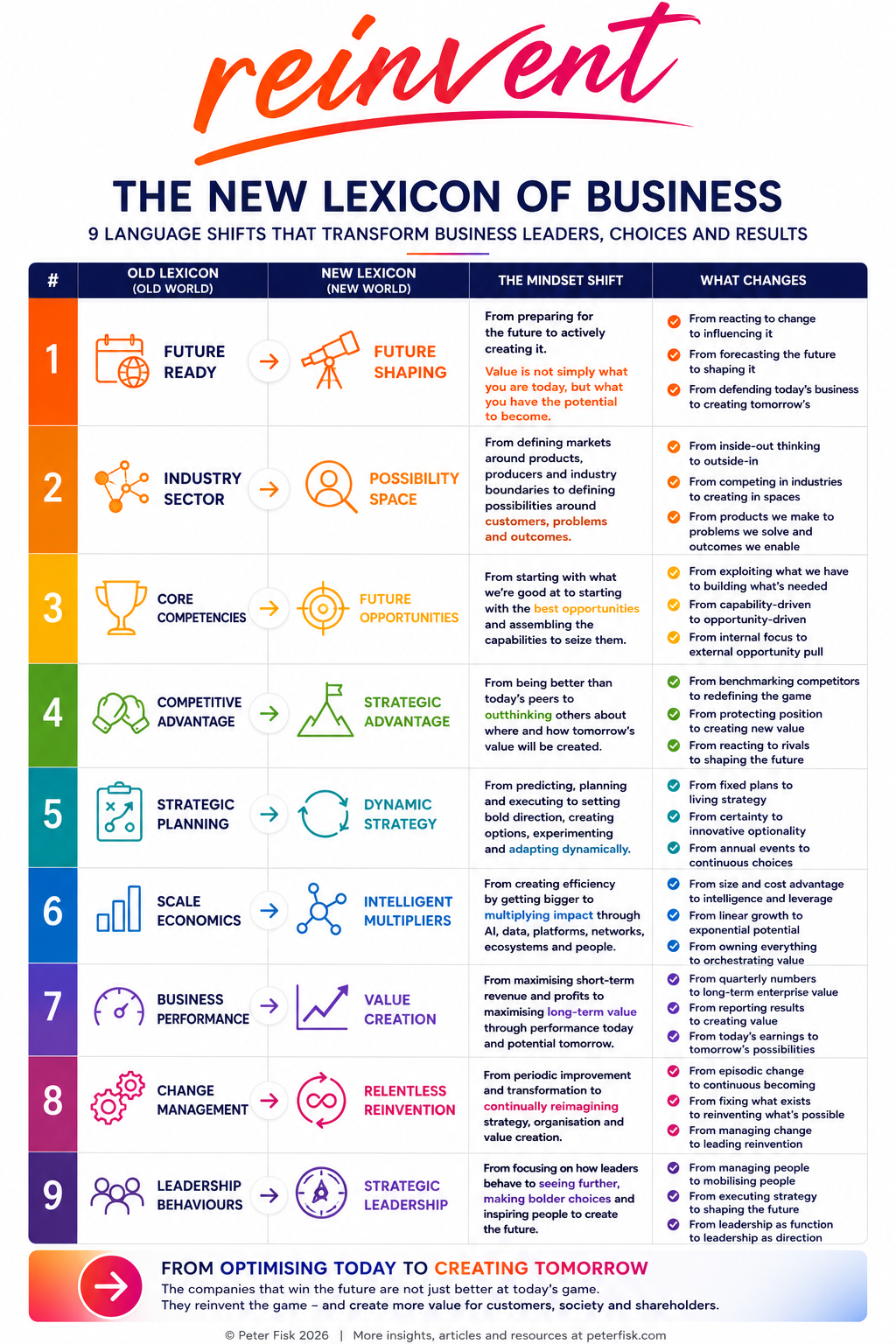
1. From Future Ready to Future Shaping
Being future-ready sounds progressive. But hidden within the phrase is a surprisingly passive assumption: that the future is something that happens to us. We forecast what might change, prepare the organisation and try to become sufficiently agile to respond.
Future shaping starts somewhere different. It asks leaders not simply to anticipate the future but to participate in creating it. The question changes from What is going to happen and how should we prepare? to What future could we create, and what role could we play in making it happen?
SpaceX did not simply prepare for the future of the aerospace industry. It sought to change the economics of access to space through reusable rockets. BYD did not wait for the global automotive industry to transition towards electric vehicles; it built capabilities across batteries, electronics, manufacturing and mobility that helped accelerate that transition. Nvidia’s Jensen Huang spent years advocating accelerated computing before generative AI transformed demand for it.
This reflects a deeper idea about value. Value is not simply what a company is today; it is also what people believe it has the potential to become. Current revenues, profits, assets and market positions matter enormously, but they tell only part of the story. Investors value future growth, future margins, future markets, future business models and, increasingly, an organisation’s demonstrated capacity to reinvent itself.
That changes the purpose of foresight. The objective is no longer to predict the future more accurately than everyone else. It is to understand emerging possibilities early enough to influence them.
The language shift is from readiness to agency. Future-ready organisations ask how they can respond to tomorrow. Future-shaping organisations ask how they can create it.
2. From Industry Sector to Possibility Space
Companies have traditionally defined themselves through industries. Automotive. Banking. Pharmaceuticals. Retail. Energy. Telecommunications. These classifications are convenient, but they can also become strategic cages.
Industries tend to be defined around products and producers: what companies make, how they make it and which other companies make something similar. A possibility space is defined differently. It starts with customers, problems and desired outcomes.
A car manufacturer can define itself as competing in the automotive industry, or it can explore the possibility space of mobility: how people and goods move safely, conveniently and sustainably. A pharmaceutical company can define itself around medicines, or around helping people live healthier for longer. A bank can define itself through financial products, or around financial wellbeing and economic progress. An energy company can think about producing and distributing electricity, or about enabling resilient, affordable, low-carbon economies.
The distinction matters because customers rarely think in industries. They have problems to solve, ambitions to achieve and outcomes they want. Technologies do not respect industry classifications either. AI, biotechnology, robotics, energy storage and digital platforms increasingly connect previously separate sectors, creating opportunities in the spaces between them.
Apple’s evolution illustrates this logic. It can be classified as a technology company, but its activities increasingly intersect communications, entertainment, financial services, health and intelligence. Ping An similarly expanded beyond conventional insurance into an interconnected ecosystem spanning financial services, healthcare and technology.
The language shift is therefore from boundaries to possibilities. Industry thinking asks, What business are we in?Possibility thinking asks, Who are we seeking to serve, what are they trying to achieve, and what new outcomes could we enable?
3. From Core Competencies to Future Opportunities
Core competencies became one of the most influential ideas in modern management: understand what makes your organisation distinctively good, invest in those capabilities and use them as platforms for growth. The logic remains useful, but it contains a potential trap. The capabilities that created yesterday’s success are not necessarily those that will create tomorrow’s.
Companies become emotionally, structurally and financially attached to what made them great. Kodak possessed extraordinary expertise in photographic film. Nokia developed formidable capabilities in mobile handsets. Traditional automotive companies invested for generations in combustion-engine technologies. Competencies create strength, but they also create strategic gravity, pulling companies towards opportunities that fit what they already know.
Future-oriented strategy reverses the sequence. Instead of beginning with What are we good at and where else can we apply it?, leaders ask Where are the most attractive future opportunities and what would we need to become capable of doing to seize them?
This is more than semantics. One approach starts inside the organisation and looks outward. The other starts with the future and works backwards.
And companies increasingly do not need to own every capability required. Some can be built internally, others acquired, and many accessed through partners and ecosystems. Apple orchestrates an extraordinary network of manufacturing, technology and developer capabilities. Businesses can access cloud infrastructure rather than building data centres, AI models rather than developing everything themselves, and specialist expertise through partners rather than permanent ownership.
The strategic question therefore becomes less What can we do with what we have? and more What opportunity is worth pursuing, and how can we assemble what is required to win?
The language shift is from competencies to opportunities — from allowing the past to define the future to allowing the future to determine what capabilities come next.
4. From Competitive Advantage to Strategic Advantage
Competitive advantage has been one of the defining concepts of strategy. Understand your market, identify an attractive position, differentiate yourself from competitors and develop capabilities they struggle to replicate. But the concept contains an increasingly problematic assumption: that today’s competitive arena is the most important one.
In fast-changing markets, being slightly better than today’s peers may matter far less than understanding where tomorrow’s value will come from. Strategic advantage starts with a broader question: not simply How can we outperform our competitors?, but How can we outthink others about where and how the future will be created?
Nvidia illustrates the difference. Had Jensen Huang defined the company’s challenge primarily as outperforming other graphics-chip manufacturers, Nvidia might have remained an exceptional semiconductor company. Instead, it progressively reframed the opportunity from graphics to accelerated computing, then AI infrastructure and increasingly towards a much broader computing platform.
Amazon followed a similarly expansive trajectory. Defining itself against booksellers would have produced one strategy; thinking about the future of commerce created another. That led from books to ecommerce, marketplaces and logistics. Understanding the potential of its underlying technology infrastructure opened another possibility altogether: cloud computing. Advertising, entertainment and AI created further opportunities.
Competitive advantage asks how to win the current game. Strategic advantage asks what the most valuable game could be and how the company might help create it.
This becomes particularly important when viewed through the lens of capital. Companies might compete with industry peers for customers, but they compete across sectors for investment. An investor allocating £1 billion can choose between a retailer, technology company, healthcare platform or energy business. The ultimate competition is therefore increasingly between organisations’ potential to create future value.
The language shift is from peers to possibilities, and the mindset shift is from outperforming today’s competitors to outthinking tomorrow’s opportunities.
5. From Strategic Planning to Dynamic Strategy
Traditional strategic planning was designed for a world in which the future could be forecast with reasonable confidence. Companies analysed markets, projected growth, chose initiatives and translated them into three- or five-year plans. Financial planning followed, allocating budgets against agreed priorities. Once approved, success largely meant executing the plan.
The further leaders look into the future today, however, the less useful detailed prediction becomes. Technologies change, competitors emerge unexpectedly, customer behaviours evolve and new business models alter industry economics. A detailed five-year plan can create an illusion of certainty precisely when organisations most need flexibility.
Dynamic strategy does not mean abandoning long-term ambition. Quite the opposite. Greater uncertainty requires stronger direction, but direction should not be confused with prescription.
A dynamic strategy combines bold strategic intent with innovative optionality. Rather than committing everything to one predetermined future, organisations create portfolios of opportunities. Some exploit today’s business. Others extend it into adjacent customers, propositions and markets. Others explore disruptive possibilities capable of becoming entirely new growth engines.
Amazon’s development of AWS is a classic example. Alphabet has pursued options across autonomous vehicles, AI, healthcare and quantum technologies. Mercado Libre progressively built interconnected growth engines across commerce, payments, logistics, credit and advertising.
Not every option should succeed. Optionality creates value because it allows organisations to experiment, learn and adapt before making disproportionate commitments. Leaders can then dynamically move people, capital and attention towards opportunities as evidence strengthens.
Traditional planning follows a sequence of predict, plan, execute. Dynamic strategy works through imagine, experiment, learn, choose, scale and adapt.
The language shift is from plans to choices. Strategy stops being something organisations periodically produce and starts becoming something leaders continuously do.
6. From Scale Economics to Intelligent Multipliers
For much of the industrial era, scale was one of the most reliable sources of superior economics. Larger factories reduced unit costs, mass marketing spread expenditure across more customers, distribution created barriers to entry and purchasing power increased with size. More volume meant lower cost, which enabled more volume.
Scale still matters. But the mechanisms through which businesses achieve disproportionate economics are changing.
Today’s most powerful businesses increasingly benefit from intelligent multipliers: technologies, relationships and capabilities that enable value to grow significantly faster than the resources required to create it.
AI multiplies human capability. Data multiplies intelligence. Software multiplies distribution at near-zero marginal cost. Platforms multiply participation. Networks multiply connections. Ecosystems multiply capabilities without requiring ownership. Brands multiply willingness to pay. Communities multiply advocacy and engagement.
Nvidia does not create its value solely through producing more chips. Its CUDA software ecosystem, developer relationships and expanding AI platform reinforce the economic value of its hardware. Apple’s value comes not simply from the volume of devices it sells but from the mutually reinforcing effects of hardware, software, services, developers, customers and brand. Mercado Libre’s commerce, payments, logistics, credit and advertising businesses strengthen each other as the ecosystem grows.
This represents an important evolution in the economics of growth. Traditional scale primarily multiplied volume while reducing cost. Intelligent multipliers can increase reach, capability, learning, engagement and value without resources increasing proportionately.
The language shift is therefore from scale to multiplication. The strategic question is no longer simply How can we become bigger? but What mechanisms can make everything we do more valuable?
7. From Business Performance to Value Creation
Perhaps the most consequential language shift concerns the ultimate measure of success. Management systems remain dominated by business performance: revenue, profit, margin, market share, productivity and quarterly growth. These metrics matter enormously. A company that cannot perform today will eventually lose the ability to invest in tomorrow.
But business performance is not the ultimate commercial outcome. Value creation is.
For a public company, market capitalisation provides an observable expression of that value. For a private company, enterprise value can be estimated through expected future cash flows, comparable businesses and future economics. Either way, value is inherently forward-looking. It reflects not simply what the business earns today but what investors believe it could earn tomorrow.
The shift is therefore more profound than replacing one financial metric with another. It changes the time horizon of management. Business performance tends to emphasise short-term revenue and profits. Value creation incorporates those results but also asks whether the organisation is increasing its future growth potential, strengthening its strategic position, creating new options and demonstrating an ability to reinvent.
Consider two businesses each generating £1 billion of annual profit today. The first concentrates primarily on optimisation and grows profit by 3% annually. After ten years, annual profit reaches approximately £1.34 billion. The second combines strong current performance with successful reinvention and compounds profit at 10%, reaching around £2.59 billion.
Now consider valuation. If investors value the slower-growth business at 12 times earnings, its indicative value would be around £16 billion. If the higher-growth company commands a 20-times multiple because investors believe it still possesses significant future potential, its indicative value approaches £52 billion.
These figures are illustrative, not valuation forecasts, but they expose a powerful mechanism. Reinvention can potentially produce a double multiplier: greater future earnings and a higher valuation of those earnings because investors believe further growth remains possible.
This returns us to the principle introduced at the beginning: value is what you can become. Performance tells us how successful the business is today. Value reflects both today’s performance and tomorrow’s potential.
The language shift is therefore from short-term results to long-term value creation. The question moves from Did we hit the numbers? to Did we make the business more valuable?
8. From Change Management to Relentless Reinvention
Change management emerged from a world in which change was largely treated as an event. Organisations operated normally until something required adjustment. Leaders launched a change programme, redesigned processes or structures, helped people adapt and eventually established a new steady state.
That model becomes increasingly problematic when there is no meaningful steady state.
Technology continues to advance. AI capabilities improve. Competitors emerge. Customer expectations move. Regulations evolve. Business models mutate. Change is no longer an interruption to normal business; increasingly, change is normal business.
Transformation represents an important step beyond traditional change management because it recognises that organisations sometimes require holistic and significant change over multiple years. But even transformation can imply a journey with a destination. Reinvention goes further. It assumes organisations will repeatedly need to reimagine their strategies, capabilities, organisations and underlying logic of value creation.
Microsoft under Satya Nadella demonstrates the distinction. Its resurgence was not one change programme. It involved successive shifts in culture, strategy and business model, moving from a Windows-centric software company towards cloud computing, subscriptions, platforms and now AI. Netflix moved from DVD rental to streaming, then from distribution to content creation, and subsequently towards advertising, gaming and live experiences. Each reinvention created capabilities and possibilities that enabled another.
The distinction is simple but important. Change improves what exists. Transformation significantly changes what exists. Reinvention reimagines what could exist.
And then does it again.
The language shift is from managing change to continual becoming. The ultimate organisational capability may be the ability to repeatedly become something more relevant and more valuable.
9. From Leadership Behaviours to Strategic Leadership
Leadership development has increasingly concentrated on behaviour. Executives learn how to communicate, coach, motivate, collaborate, listen, delegate, give feedback and manage conflict. These capabilities matter, and the shift towards more human leadership is welcome. But something fundamental has been lost.
We have become increasingly sophisticated at teaching leaders how to lead, while paying considerably less attention to where they should lead.
The defining responsibility of leadership is ultimately strategic. Leaders need to interpret a changing world, see possibilities others have not yet recognised, challenge assumptions created by previous success, make difficult choices with incomplete information, move resources from yesterday’s priorities towards tomorrow’s opportunities and inspire people to create something that does not yet exist.
Jensen Huang’s significance at Nvidia cannot primarily be explained through conventional leadership behaviours. It lies in his capacity to understand technological trajectories and make strategic commitments years before their potential becomes obvious. Satya Nadella’s cultural transformation of Microsoft mattered enormously, but culture enabled a much larger strategic reinvention. Mary Barra’s challenge at General Motors is not simply to motivate people effectively; it is to navigate profound technological, competitive and business-model shifts in mobility.
Strategic leadership reconnects the human and strategic dimensions of leadership. It combines foresight with judgement, ambition with choices, courage with adaptability, and strategic direction with the capacity to mobilise people.
Leadership behaviours ask, How do I get the best from people? Strategic leadership asks, How do I enable people to create the best possible future?
Great leaders need to do both. But ultimately, leadership is not simply about how leaders behave. It is about where they lead.
The New Language of Business
Taken together, these nine shifts describe more than a change in terminology. They represent a different operating system for business.
There is a clear progression. Shape the future. Explore possibility spaces. Find the best opportunities. Create strategic advantage. Develop dynamic strategies. Activate intelligent multipliers. Create long-term value. Reinvent relentlessly. Lead strategically.
And the financial consequences can become enormous because small differences in value creation compound over time. Consider two businesses worth £10 billion today. If one compounds enterprise value at 5% annually for a decade, it reaches approximately £16.3 billion. If another combines strong performance with greater strategic imagination and compounds at 12%, it reaches approximately £31.1 billion. After 20 years, those same illustrative rates produce approximately £26.5 billion versus £96.5 billion.
The point is not that adopting a new vocabulary somehow produces a 12% growth rate. It doesn’t. The causality is subtler and more important.
Language changes attention. Attention changes questions. Questions change choices. Choices change investment. Investment changes capabilities. Capabilities create possibilities. Possibilities create growth. And credible future growth creates value.
This is why the new lexicon is more than semantics.
The traditional management system was primarily designed to optimise the business you already have. It encouraged leaders to prepare for the future, define their industry, exploit competencies, beat competitors, execute plans, pursue scale, maximise performance, manage change and motivate people.
The emerging challenge is to create the business you could become.
That requires leaders to simultaneously perform and transform, exploit and explore, deliver and discover. They need sufficient conviction to make bold choices and sufficient curiosity to change them as they learn. They need to create value today while continually expanding the possibilities for tomorrow.
Ultimately, the greatest source of long-term value is rarely what an organisation already is.
It is what it still has the potential to become.
For generations, strategy has essentially asked: How can we make this business more successful?
The defining question for the age of reinvention is more ambitious:
What could this business become, and how much more valuable could that future be?
More from the blog