The Empty Chair … What’s missing from your leadership team? … Most boards and executive teams are built for stability, rather than change … Which new mindsets and skills do your team need?
August 25, 2026

You come back from summer refreshed. Your leadership team comes back unchanged … But something is missing … maybe a possibility, or perspective, or even a person.
September has a particular energy. The inbox fills again, airports get crowded, calendars suddenly become impossible and leadership teams reconvene after a few weeks scattered across beaches, mountains, cities and homes. There is often a renewed sense of purpose. People have had time to think, perhaps to read something provocative, visit somewhere different, talk to different people, or simply gain enough distance from work to see it differently. For a brief moment, before the machinery starts moving again, there is an opportunity to look at the business with fresh eyes.
And then something strange happens. We sit back down in exactly the same chairs.
The same people return to the same leadership meetings, carrying broadly the same responsibilities, looking at broadly the same dashboards and asking broadly the same questions. How are revenues tracking? What has happened to margins? Where are we against budget? What is happening with customers, people and operations? The first meeting after summer might feel refreshed, but the architecture of the conversation has barely changed. Within days, we are back inside the assumptions, routines and priorities that shaped the organisation before we went away.
So before normality completely takes over again, there is a more interesting question for every CEO and leadership team to ask: what is missing from this room?
Not who is absent today, or which position remains unfilled on the organisation chart. The more important question is what capability, perspective, ambition or possibility nobody around the table adequately represents. What are we not seeing because nobody is looking for it? What are we not discussing because it belongs to nobody? What could become important remarkably quickly, yet remains peripheral to today’s agenda?
That is the Empty Chair. And it may represent some of the most significant unrealised value in your business.
Leadership teams are designed for the business they already have
Look around most executive tables and you can reconstruct the organisation from the people sitting there. Finance has a chair. Operations has a chair. Marketing and sales have chairs. HR has a chair. Technology increasingly has a chair. Depending on the business, there will be chairs for regions, products, supply chains, legal affairs and other important functions.
There is nothing wrong with any of these roles. The problem is more fundamental. Most leadership teams are essentially organisational maps of where value came from in the past, rather than possibility maps of where value could come from in the future.
The structure of the team reflects the structure of the existing business, and because organisational structures shape conversations, investment and attention, the existing business becomes remarkably good at reproducing itself. Finance naturally asks how to improve returns. Operations asks how to improve efficiency. Sales asks how to increase conversion. Marketing asks how to strengthen demand. HR asks how to attract and develop talent. These are all important questions, but they largely start with the organisation as it currently exists.
The questions that could determine the organisation’s future are different. What business should we be in five years from now? Which markets that barely exist today could become significant tomorrow? Who is the customer we do not yet serve? How could AI fundamentally change the economics of what we do, rather than simply make existing processes more efficient? Which partners could multiply our capabilities? What would happen if the boundaries between our industry and another disappeared? Which assumptions on which our current strategy depends are becoming obsolete?
These are not necessarily questions that fit naturally within anybody’s existing job description. And that is precisely the problem. What belongs to everyone often belongs to nobody; what lies beyond today’s business often lies beyond today’s organisation chart.
The Empty Chair gives those questions somewhere to sit.
The biggest constraint might not be resources
Leadership teams typically assume that their greatest constraint is resources: more investment, more people, more technology or more time. Increasingly, however, the bigger constraint is often imagination. Companies become prisoners of what they already know. Their existing capabilities become their boundaries, their industry definitions become their worldview, their competitors determine their benchmarks, and their current customers define their innovation agenda.
Success can make this worse. The better you become at today’s business, the more evidence you accumulate that today’s business is the right business to be in. Strong performance reinforces the existing paradigm, encourages further investment in proven capabilities and makes alternatives look unnecessarily risky. This creates what I call the Possibility Paradox: the stronger your performance within today’s paradigm, the harder it can become to imagine a fundamentally different one.
That is why reinvention rarely begins with an answer. It usually begins with somebody asking a question the existing organisation was not designed to ask. The Empty Chair gives that question legitimacy. Imagine physically leaving one chair empty at your next executive meeting and asking: who or what needs to sit here for us to see what we currently cannot see?
For one company, the chair might belong to AI — not someone discussing how to deploy another productivity tool, but someone asking how abundant intelligence could transform the fundamental economics, customer proposition and operating model of the business. For another, it might belong to the future customer, representing needs and behaviours that today’s market research barely captures. For another, it could belong to ecosystems, asking what becomes possible when the company stops thinking only about the assets it owns and starts combining its capabilities with those of others.
The chair might represent the next generation, an entrepreneur, a scientist, a future investor, an emerging market, the planet, or even a competitor that does not yet exist. The specific title matters less than the purpose: to bring into the room the perspective that today’s organisation is structurally least able to see.
Seven Empty Chairs
The most interesting Empty Chairs are therefore rarely traditional functions. They represent dimensions of future value creation that established organisational structures struggle to accommodate.
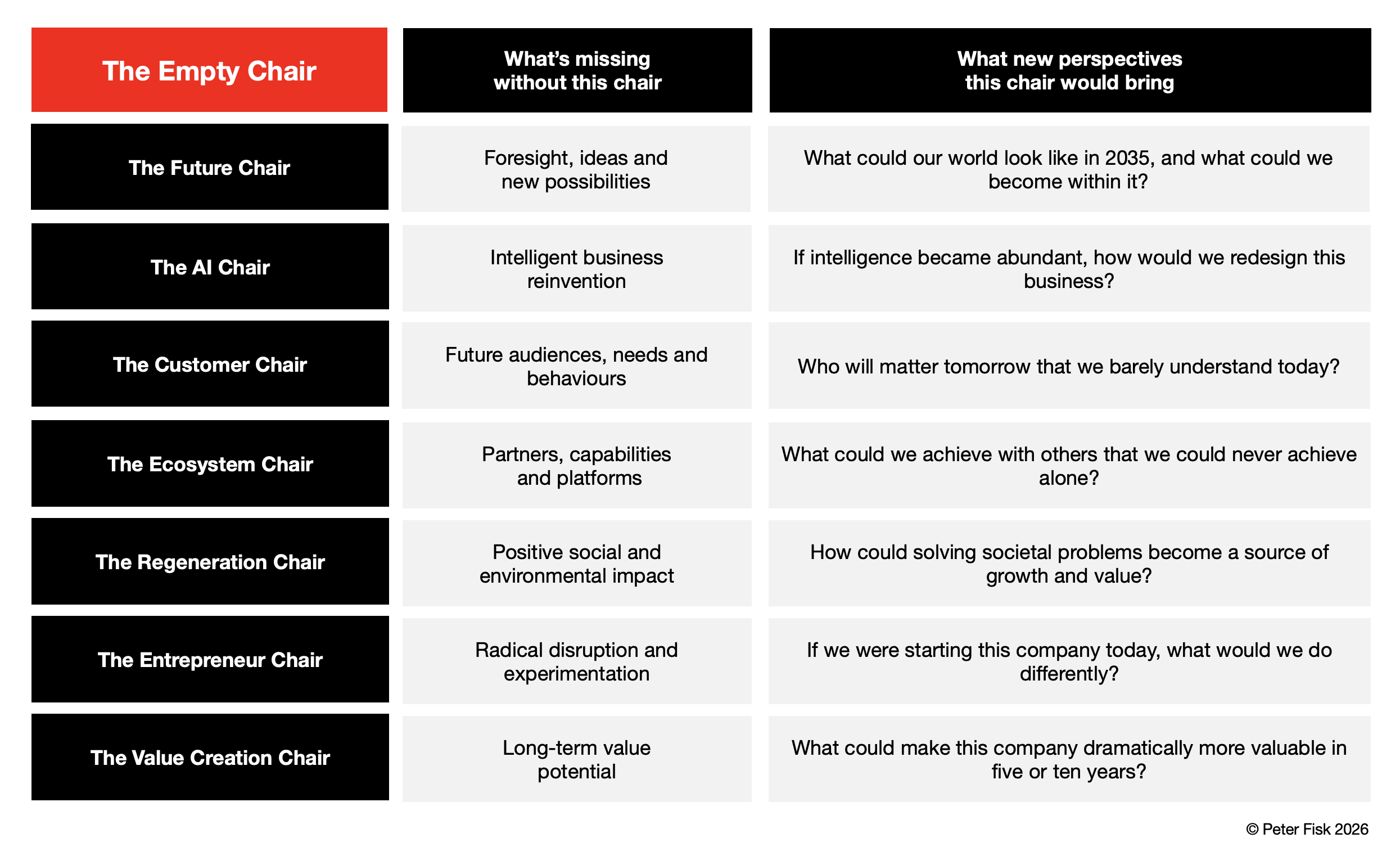
This does not mean hiring seven new executives. That would be to interpret the idea too literally. Sometimes the Empty Chair will require a permanent new capability, and the emergence of roles around AI, ecosystems, transformation and foresight reflects the growing inadequacy of traditional functional structures. But often the solution can be more fluid.
A leadership team could invite an entrepreneur into its meetings every quarter, create a future council drawn from younger employees, bring customers directly into strategy discussions rather than merely presenting research about them, or ask a different executive at each meeting to occupy the Empty Chair and challenge the team’s dominant assumptions. Scientists, technologists, artists, investors, activists and leaders from completely different industries can all provide perspectives that would never emerge naturally from within the existing executive structure.
The Empty Chair is therefore not primarily an organisational device. It is a mechanism for cognitive diversity. You cannot create a fundamentally different future using exactly the same assumptions that created your present.
When experience becomes a constraint
We naturally value experience in leadership, and rightly so. Experience brings judgement, pattern recognition and confidence. Yet experience contains an interesting contradiction: it teaches us how the world worked. That is immensely valuable when tomorrow resembles yesterday, but it becomes more problematic when the conditions that produced our experience are themselves changing.
The accelerating convergence of AI, biotechnology, climate transition, demographic change, new geopolitical structures and shifting consumer expectations means that leaders increasingly face situations for which nobody has meaningful direct experience. In such environments, experience can quietly become orthodoxy. “We tried that before”, “our customers wouldn’t want that”, “that isn’t how our industry works”, “we don’t have the capabilities” and “the economics don’t make sense” can sound like informed judgement, but they can also become defences of an existing paradigm.
Perhaps those statements are correct. But perhaps they describe the world that created our experience rather than the world now emerging. The Empty Chair challenges the tyranny of accumulated certainty. Its purpose is not to disrespect experience, but to stop experience becoming a boundary around possibility.
From organisation chart to possibility map
This suggests a different way to think about leadership teams. Most companies build their executive teams around accountability: who owns finance, people, operations, technology, customers and markets? But the leadership team of the future also needs to be designed around possibility. Who owns the future? Who owns reinvention? Who owns ecosystems? Who owns emerging technologies and new business models? Who owns the value we have not created yet?
That last question is particularly important because most businesses remain obsessed with performance: quarterly revenue, annual margin, market share, productivity and earnings. Yet markets ultimately value something bigger. A company is worth not simply what it produces today, but what investors believe it can produce tomorrow. Its value incorporates expectations about future growth, innovation, adaptability and the opportunities it might be able to capture.
This is the distinction at the heart of reinvention. Performance is the value you extract from what you already are; potential is the value embedded in what you could become. Leadership therefore has two jobs simultaneously: exploiting today’s business brilliantly while exploring tomorrow’s possibilities relentlessly.
Most executive teams are structurally overweight towards the first. Their meetings, metrics, incentives, budgets and organisational responsibilities overwhelmingly focus on improving what already exists. The Empty Chair represents the second. It deliberately introduces potential into a conversation dominated by performance.
The future lives between the boxes
There is another reason the Empty Chair matters. Many of the biggest emerging opportunities no longer fit neatly inside organisational functions. An AI-enabled proposition might simultaneously involve technology, strategy, customer experience, talent, operations and new business models. A regenerative business could connect innovation, supply chains, finance, sustainability and customers. A platform strategy might require competitors to become collaborators, customers to become creators and products to become gateways into wider ecosystems.
Who owns these opportunities? Often everybody, which can quickly mean nobody.
Organisations are remarkably effective at managing things that fit neatly inside boxes. They are much less effective at pursuing possibilities that cut horizontally across them. Yet increasingly, the future lives between the boxes.
This is what I call the Nexus Effect: disproportionate value increasingly emerges from connecting things that were previously separate — technologies, capabilities, industries, partners, customers and ideas. An executive team organised around yesterday’s vertical functions can therefore miss tomorrow’s horizontal opportunities.
The Empty Chair sits at that intersection. Instead of asking only how each part of the organisation can perform better, it asks what becomes possible when we connect the parts differently. That is a much more powerful starting point for reinvention.
The Empty Chair should keep moving
There is no reason why the Empty Chair should remain the same. Indeed, it probably shouldn’t. Perhaps this quarter it represents AI because the organisation urgently needs to understand how intelligent technologies could reshape its business model. Next quarter it might represent India, China, Africa or another geography because the centre of gravity in its market is shifting. Then it might represent a radically younger customer, an entrepreneur attacking the industry from outside, or an investor looking at the company from the perspective of 2035.
The chair changes because the world changes. That is precisely the point. Traditional organisation charts create permanence; the Empty Chair creates movement. It reminds the leadership team that relevance is temporary and that today’s winning formula almost inevitably contains the seeds of tomorrow’s constraint.
Indeed, asking “Who should occupy our Empty Chair now?” could become one of the most valuable quarterly questions a leadership team asks. It forces executives to scan beyond their current agenda and identify the perspective whose absence has become most dangerous — or whose presence could create the greatest new possibility.
From the performance gap to the Reinvention Gap
Leadership teams spend enormous amounts of time examining performance gaps. Why are sales 4% below plan? Why has margin fallen 70 basis points? Why is one region underperforming? Why has employee engagement declined? These questions matter because performance matters.
But there is another gap that rarely appears on executive dashboards: the Reinvention Gap. It is the distance between the value your organisation is creating today and the value it could create if it fully exploited the possibilities emerging around it.
That gap is harder to measure, but potentially far larger. Imagine a company worth £10 billion today. Management might spend months fighting for another £100 million of operating profit, yet a fundamentally different business model, ecosystem, technology platform or market position could potentially create billions in additional enterprise value. Operational improvement remains important, but it needs to be put into perspective. The greatest value creation opportunity may not come from doing today’s business 5% better; it may come from imagining a substantially more valuable business.
That is why I increasingly believe that value is what you can become. The Empty Chair represents everything preventing you from seeing it.
A different first meeting back
So perhaps the first leadership meeting after summer should begin differently. Rather than immediately opening the dashboard, forecast or strategy presentation, put an empty chair at the table and spend the first hour asking what belongs there.
Ask what perspective the team is missing, what uncomfortable voice has been excluded, what capability will matter enormously in three years but barely exists inside the organisation today, and what opportunity lies beyond the boundaries of the current industry. Ask which customers you are not listening to, which technologies you are treating merely as productivity tools when they could reinvent the business, and which partners could enable something you could never create alone. Above all, identify the assumptions everyone around the table shares, because those are precisely the assumptions nobody is likely to challenge.
Then ask the most important question: if we were building the leadership team for the company we want to become, rather than the company we already are, who would be sitting around this table?
That question changes the conversation because leadership is not simply about managing the organisation you inherited. It is about creating the organisation that needs to exist next.
The leadership team as a Becoming Engine
The best leadership teams are not simply management committees. They are Becoming Engines. Their purpose is to connect present performance with future potential, continuously moving between what the organisation is and what it could become. They protect the economic engine of today whilst simultaneously creating the possibilities that might eventually transform or replace it.
This demands a different rhythm of leadership: perform and explore, exploit and imagine, deliver and experiment, optimise and reinvent. These are not sequential phases. They need to happen simultaneously, because by the time today’s performance begins to fail, it is usually too late to start imagining tomorrow.
The Empty Chair keeps that tension alive. It creates space for perspectives that do not fit the existing structure, for people who challenge established assumptions, for opportunities that cannot yet be justified by today’s spreadsheet, and for possibilities whose economic value may only become visible once the organisation starts exploring them.
Most importantly, it prevents the leadership team becoming satisfied with the company’s current identity. It reminds everyone around the table that the organisation they lead today is not the destination. It is simply the latest version of something that must keep becoming.
So as everyone returns from summer and the familiar rhythm of business starts again, resist the temptation to immediately fill every space in the diary and every chair around the table. Leave one empty. Look at it and ask: what is missing from this room that could change what our business becomes?
Somewhere inside the answer may be your next market, your next capability, your next business model, your next source of growth — and perhaps billions in unrealised value.
The Empty Chair is not really empty at all.
It is occupied by your future.
More from the blog