Beyond Ownership … Exor, the Agnelli family’s portfolio of investments from Fiat to Ferrari, Economist to Louboutin, Philips to Juventus … How holding companies act as ecosystems redefining corporate power
June 9, 2026

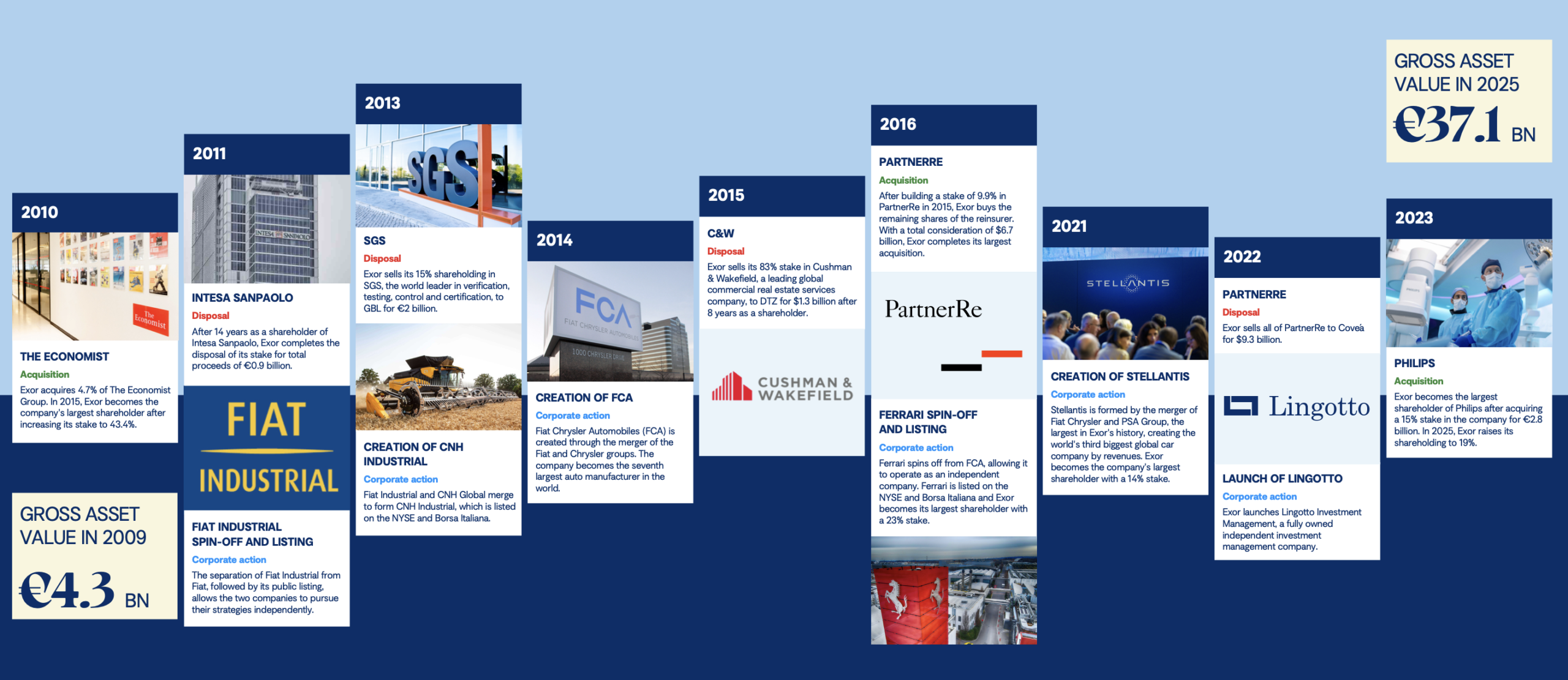
Exor … from Fiat’s industrial roots to a platform for influence
On the surface, Exor looks like a classic European holding company with deep industrial roots. Its history is inseparable from Fiat, founded in 1899 by Giovanni Agnelli in Turin. For much of the twentieth century, the Agnelli family’s influence was anchored in manufacturing scale, automotive engineering, and national industrial identity.
But over the past two decades, Exor has quietly undergone a profound transformation. It has moved away from being a controlling industrial shareholder toward becoming something more fluid and contemporary: a long-term investment platform designed to allocate capital, shape strategy, and connect businesses without necessarily controlling them.
Today, Exor’s portfolio includes globally significant companies such as Ferrari and Stellantis (including Fiat and Jeep), Iveco trucks to Philips healthcare, fashion brands like Christian Louboutin and Shang Xia, and even the Economist . Yet what is striking is not just the diversity of assets, but the deliberate absence of tight operational integration between them.
Exor does not behave like a traditional conglomerate. It does not attempt to impose a unified operating model or extract centralised synergies. Ferrari is not structurally integrated with Philips. The Economist is not managed alongside Stellantis. Instead, each company operates independently, with its own governance, leadership, and strategy.
The central question, therefore, is how Exor creates value at all.
The answer lies in a subtle but powerful shift. Exor operates less as an owner and more as a system of influence. It creates value through time horizon alignment, capital discipline, reputation, and carefully cultivated relationships between companies that would otherwise have little reason to interact.
Inside the Exor system … how influence replaces integration
The Exor model works because it is deliberately selective about where connection matters and where it does not. It does not try to force integration across incompatible business models. Instead, it allows collaboration to emerge where intellectual or strategic spillovers are possible.
Within this ecosystem, value creation happens through four reinforcing mechanisms.
First, there is a shared investment philosophy. Across the portfolio, companies are encouraged to think in decades rather than quarters. This long-term orientation shapes decisions on innovation, capital allocation, and resilience. It is not imposed through operational control, but reinforced through governance expectations and repeated interaction.
Second, there is relational proximity. Leaders of portfolio companies interact through formal and informal channels, building familiarity and trust over time. These interactions rarely produce direct joint ventures, but they often lead to shared insights on strategy, risk, and transformation.
Third, there is reputational coherence. The Agnelli name still carries significant weight in global business. This reputation acts as a soft governance mechanism: companies benefit from being associated with a credible, long-term oriented investment steward, which in turn reinforces alignment.
Fourth, there is cognitive cross-pollination. Ideas travel between sectors not because systems are integrated, but because leaders are exposed to one another’s thinking.
However, Exor is also disciplined about where collaboration does not work.
Where collaboration works well in Exor-style ecosystems
These are areas where ideas and frameworks travel easily:
- Leadership philosophy and governance models
- Capital allocation discipline and long-term investment thinking
- Sustainability frameworks and ESG approaches
- Brand strategy and reputation building
- Innovation mindset and experimentation culture
- Executive networking and talent development
Where collaboration tends to fail or add limited value
These domains resist ecosystem integration because they are too context-specific:
- Core sales execution and go-to-market systems
- Operational IT and legacy infrastructure
- Supply chain and logistics design
- Product engineering and technical architecture
- Customer data systems and regulatory environments
This distinction is critical. Exor does not succeed by forcing integration—it succeeds by understanding where integration is structurally valuable and where autonomy is essential.
Exor is not an isolated case. It is part of a broader shift in global capitalism, where holding companies, sovereign investors, and brand platforms are increasingly moving away from control-based structures toward influence-based systems.
This shift can be understood as the emergence of ecosystem capitalism—a model in which value is created not just by what a firm owns, but by what it enables across a network of semi-independent actors.
Several organisations illustrate different versions of this model, each with a distinct coordination mechanism.
Singapore’s Temasek Holdings, for example, represents a more structured version of ecosystem capitalism. Rather than relying on brand or heritage, Temasek acts as a convenor of intelligence. It brings leaders from across its portfolio together to share insights on AI, sustainability, digital transformation, and macroeconomic trends.
The emphasis is not on forcing collaboration, but on accelerating learning.
Tata … culture as the hidden architecture of collaboration
The Tata Group represents one of the most powerful examples of cultural rather than ownership-based coherence.
Unlike Exor, Tata is not primarily a financial platform. It is a deeply embedded institutional ecosystem, historically shaped by the Tata family and now governed through complex trust structures. Its influence does not rely on tight operational integration or centralised ownership control.
Instead, it is held together by what is often called the “Tata Way”—a shared philosophy emphasising integrity, nation-building, long-term value creation, and social responsibility.
This creates a different form of ecosystem logic. Tata companies such as Tata Consultancy Services, Tata Motors, Tata Steel, and Tata Consumer Products operate independently in very different industries. Yet they remain connected through shared values, leadership pipelines, and institutional memory.
Where collaboration works well in Tata
Tata’s ecosystem strength is most visible in areas where culture and scale matter:
- Brand trust and reputation (especially in domestic and emerging markets)
- Leadership development and succession systems
- Sustainability and social impact initiatives
- Digital transformation frameworks and capability building
- Selective procurement and shared sourcing advantages
- Crisis response and institutional coordination
Where collaboration is limited
But like all ecosystem models, Tata also has clear boundaries:
- Business model design (each company operates in structurally different industries)
- Customer-facing sales and distribution systems
- Product innovation pipelines and R&D
- Data systems and technology architectures
Tata demonstrates an important truth: cultural unity does not require operational integration. In fact, attempting to over-integrate would likely destroy the autonomy that makes each business competitive in its own market.
Virgin … brand as a coordination system without ownership depth
A very different model is found in Virgin Group.
Here, the coordination mechanism is not ownership or culture, but brand. Virgin has historically expanded across aviation, telecoms, financial services, hospitality, and space exploration through partnerships, licensing agreements, and joint ventures rather than majority control.
The Virgin brand acts as a permission system. It signals a set of expectations—customer obsession, disruption, simplicity, and challenger behaviour—that allow independently owned businesses to align around a shared identity.
Where collaboration works in Virgin-style ecosystems
- Brand positioning and customer experience design
- Marketing narrative and identity creation
- Entrepreneurial culture and innovation mindset
- Customer service philosophy and tone of voice
- Strategic storytelling and market entry framing
Where it does not work well
- Operational integration across businesses
- Shared IT systems or infrastructure
- Supply chain coordination
- Financial systems alignment
Virgin shows that identity can sometimes substitute for integration—but only in specific domains where meaning matters more than machinery.
The pattern … what actually works in collaboration ecosystems
Across the above companies, a consistent pattern emerges. Collaboration is highly valuable, but only in specific domains where knowledge can be transferred without operational integration.
High-value collaboration domains
- Leadership philosophy and governance
- Strategic thinking and capital allocation
- Brand and reputation systems
- Sustainability and ESG frameworks
- Talent development and executive networks
- Innovation mindset and experimentation approaches
- Macroeconomic and geopolitical insight
Low-value or high-friction collaboration domains
- Core operations and supply chains
- Product engineering and technical design
- Customer-facing sales execution
- Data systems and analytics infrastructure
- Regulatory and compliance environments
The boundary between these two categories is the most important strategic insight in ecosystem capitalism. The strongest holding companies are not those that maximise integration, but those that are precise about where integration creates value and where it destroys it.
From ownership to orchestration
What Exor and its peers reveal is a fundamental shift in the nature of corporate power. The most sophisticated holding companies are no longer defined by what they own, but by what they orchestrate.
They succeed not by centralising control, but by designing environments in which independent companies choose to collaborate. Influence replaces authority. Trust replaces hierarchy. Networks replace structure.
In this emerging model, the role of the holding company is no longer to act as an operator of assets, but as an architect of ecosystems—carefully shaping the conditions under which value can emerge across boundaries that ownership alone can no longer define.
More from the blog