How to thrive in 2026, and beyond … a manifesto for business leaders … 12 resolutions, and a 100 day plan … Resolve to prioritise your people and purpose, ecosystems and experimentation, clarity and courage
January 1, 2026

Happy new year!
- Download the new Global Business Trends Report 2026.
- Download Trend Kaleidoscope 2026 curating all the trend reports.
- What I Learnt in 2025 from Campari to Cartier, Mexico to Japan.
If you’re a business leader reading this at the start of a new year, you are probably feeling two things at once: the tired refrain of “we must do more with less” and the electric promise that something genuinely different is arriving.
The paradox of our age is that constraint and possibility co-exist more intensely than ever. For leaders in 2026 the task is not simply to endure the level of uncertainty — it is to make a decisive, humane, strategic response: to shape a clear manifesto of what you will stop, start and double down on in the months ahead.
Below is my practical, optimistic and slightly provocative playbook of new year resolutions for leaders who want to thrive — not just survive — in 2026 and the years beyond.
It draws on my recent work on the rapidly changing world of business, markets and organisations – from “Megatrends 2035” to “26 trends for 2026” – and the ideas of AI-enabled leadership, the reinvention playbook, the search for new growth, and what I call the courageous leap of leaders.
Of course you’ll find lots more big ideas, bite-sized actions, and deep dives into leaders and companies getting it right — brought together through inspiring keynotes, practical workshops and leadership support at peterfisk.com.
The context … why 2026 demands a manifesto
We are not moving into a “new normal” so much as a world of ongoing re-definition. The engines of change — generative AI, new supply-chain architectures, climate pressures, demographic shifts, geopolitical competition and rapidly changing customer expectations — are accelerating. For leaders this means two simultaneous realities:
-
Technology is embedding itself everywhere. AI and machine learning are already present across core business functions: product, customer service, operations, HR and strategy. A large and growing share of organisations now report AI use in at least one function; but the jump from experimentation to scaled, enduring value is still work in progress. The use of AI is widespread, even if transformation at scale is rarer.
-
Innovation is not optional. The companies that lead their markets are not merely faster at iteration; they re-write the rules of how value is created. Lists of the world’s most innovative companies show that leadership in 2025-26 comes from combining technological depth with business model creativity. If you do not invest in purposeful innovation now, competitors will.
These two realities give us a simple leadership rule for 2026: be more human in your intent and more machine-smart in your execution.
A manifesto: 12 resolutions every leader should make for 2026
Below are twelve concrete, behavioural resolutions — a manifesto you can adapt for your organisation. Each comes with a short practical action and an example of how a leader might live it.
1. Resolve to make clarity your advantage
Why: In complexity, clarity is a compass. Without it, you are lost in change, and energy leaks into peripheral debates.
Action: Publish a single-page strategic charter by end of Q1 that states your “where to play” and “how to win” for 2026, and cascade it into three measurable outcomes per team. Big choices give direction, while retaining agility.
Leader example: A CEO announces three public outcomes (customer retention %, NPS and net new revenue from a new product) and links all Q1 OKRs to these metrics. The result: faster decision-making and 20% improvement in time-to-market.
- Dynamic Strategy by Peter Fisk
2. Resolve to be AI-practical, not AI-religious
Why: AI is an operational lever — powerful, but only when tied to human judgements.
Action: Create a “value-first AI” map: list five business problems where AI could reduce cost, increase revenue or unlock strategic insight; pilot two, measure ROI in 90 days.
Leader example: A retail COO uses AI to cut supply-chain waste and reduce stockouts. Early pilots show a 6–8% inventory efficiency gain — a clear financial justification for scale. (Remember: many organisations use AI; only some have it at scale).
- Reinventing Business with AI by Peter Fisk
3. Resolve to reinvent your leadership cadence
Why: Speed without rhythm leads to exhaustion; rhythm without flexibility creates irrelevance.
Action: Move to a tri-modal cadence — a weekly tactical check, a monthly strategic review, and a quarterly re-vision day dedicated to trends and bets.
Leader example: An executive team swaps a bimonthly board update for a quarterly “future day” where external experts and customers brief the team; the board begins to fund two experimental bets every quarter.
- Strategic Jazz by Peter Fisk
4. Resolve to invest in human capital as a product
Why: Talent mobility and skill obsolescence mean roles — and careers — are becoming products you must design.
Action: Create “skill pathways” for key roles (AI literacy, ecosystem partnerships, experience design), and allocate 3–5% of payroll to micro-learning and rotation programmes.
Leader example: A services firm offers rotations that pair consultants with data scientists for six-week sprints. Retention and cross-selling increase.
- The Future Ready Organisation by Peter Fisk
5. Resolve to put purpose in your business model, not on your press release
Why: Sustainability and social licence are now business imperatives, not marketing decorations.
Action: Translate one purpose objective into revenue terms (e.g. circular design reduces raw material spend by X) and report it publicly alongside financial KPIs.
Leader example: A food manufacturer redesigns packaging for recyclability, reducing material cost and unlocking new retailer listings.
- Turning Purpose into Profit by Peter Fisk
6. Resolve to redesign customer value as a continuous journey
Why: Customers prize flexibility, speed and human care; lifetime value comes from repeated delight.
Action: Map customer journeys end-to-end, identify three “moments of truth” and apply design experiments to each.
Leader example: A bank eliminates a 10-step mortgage process and replaces it with a two-hour “approval lane” supported by AI triage and human underwriters.
- Hello, I am your Customer! by Peter Fisk
7. Resolve to become an ecosystem strategist
Why: Products increasingly live in networks of partners; the ability to orchestrate ecosystems creates defensibility.
Action: Identify two partner categories (tech, distribution) and design a partner playbook that aligns incentives for customer outcomes.
Leader example: A SaaS vendor launches a marketplace for integrations, turning the product into a platform and adding new recurring revenue streams.
- Ecosystems Inc by Peter Fisk
8. Resolve to experiment with new business models
Why: Incremental change won’t survive structural shifts; new models create optionality.
Action: Dedicate a seed fund (1–2% of revenue) to test subscription services, “as-a-service” transformations, or outcome-based pricing.
Leader example: A manufacturing firm pilots “machines-as-a-service” and discovers a 25% uplift in lifetime customer value.
- Next Generation Business Models by Peter Fisk
9. Resolve to remove friction from the organisation
Why: Bureaucracy is expensive and slows adaptation.
Action: Run a “friction audit” — a two-week process to map approvals, handoffs and decision delays; eliminate or automate the top three.
Leader example: A company automates compliance checks with an AI agent, cutting approval times by half.
- What’s new and next in leadership by Peter Fisk
10. Resolve to make ethical design a board conversation
Why: Ethics and regulation will be strategic issues for AI, data use and customer trust.
Action: Add an ethical risk score to all major initiatives and brief the board quarterly on ethical and regulatory posture.
Leader example: A firm establishes an ethics committee that signs off on generative-AI use cases; this reduces reputational incidents and eases regulator discussions.
11. Resolve to reimagine performance for hybrid futures
Why: Output, not occupancy, must define performance in distributed organisations.
Action: Replace time-based KPIs with outcome-based objectives; tie a portion of variable pay to cross-functional outcomes.
Leader example: An insurer shifts underwriting KPIs from “cases processed” to “loss ratio improvements” and improves underwriting quality.
12. Resolve to take the courageous leap
Why: Many leaders will iterate; a few will leap. A courageous leap is a deliberate decision to commit resources to a future that is not yet visible.
Action: Identify one transformative bet (new market, new capability) and create a six-month launch plan with committed funding and a rapid measurement cadence.
Leader example: A European retailer commits to a full experiential overhaul of its flagship stores, integrating digital and physical experiences; footfall and conversion rates rise materially.
- The Courageous Leap by Peter Fisk
How to convert resolutions into a practical operating plan
Resolutions become meaningful when translated into the language of budgets, people and timelines. Use this simple three-part framework to operationalise your manifesto:
-
Signal (what you will be measured on) — Choose three organisation-level KPIs for 2026 (e.g. X% revenue from new offerings, Y% reduction in customer churn, Z% of decisions powered by AI).
-
Structure (who is responsible) — Assign an owner and a cross-functional delivery squad for each KPI; give them a light governance process and a fixed runway.
-
Speed (how you learn) — Adopt a 90-day sprint model with weekly learning check-ins and a hard stop for either scale or kill.
Two practical tools to adopt immediately:
-
A Strategy One-Pager for the whole company.
-
A Value-First AI Roadmap that links each pilot to a tangible business metric.
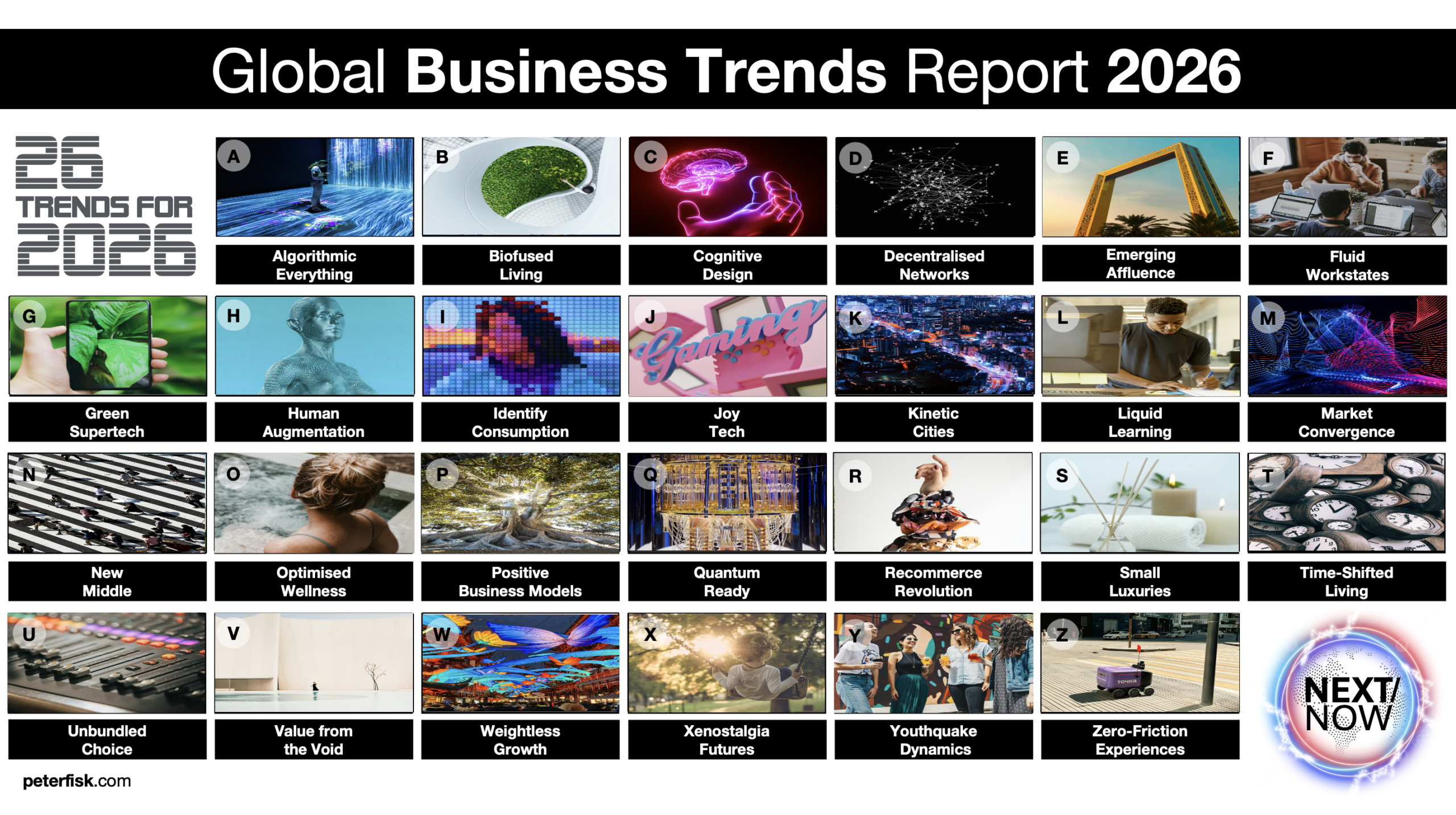
- Download the new Global Business Trends Report 2026.
The numbers that matter, and what they mean
Data helps ground ambition in reality. Here are a few load-bearing statistics you should know as you plan for 2026:
-
AI usage is widespread but scaling remains work in progress. Recent industry surveys report that a very high share of organisations now use AI in at least one function, with many firms experimenting with AI agents and generative tools — but only a minority have scaled AI to capture full enterprise value. This dichotomy means leaders must focus on measurable pilots with the intent to scale.
-
Investment and hype outpace enterprise scaling. Private investment into AI ventures remains immense, and chip-makers and cloud providers are doubling down; yet some surveys note that only a modest proportion of companies have AI implemented at scale, underscoring the need for clear ROI and governance.
-
Innovation leaders are diverse and sector-spanning. Independent rankings of the most innovative companies show that leading firms combine deep technical capability with new business models and ecosystems — from Waymo in mobility to healthcare and consumer champions across many industries. If you want to learn how to lead in 2026, study the ways these firms combine focus with ecosystem play.
These are not theoretical points. They inform the choices in your manifesto: prioritise clear use cases for AI, insist on measurable pilots, and treat innovation as a repeatable operating competency.
Leaders to learn from, and what they will do in 2026
For leaders seeking practical illustration, it helps to look at people who are translating strategy into results today. Below are short, contemporary profiles of leaders — male and female, global in scope — and the kinds of moves they are likely to double down on in 2026.
Satya Nadella … the builder of platforms and productivity
Satya Nadella has steered Microsoft from a legacy software vendor to a platform leader where cloud and AI are central. Nadella’s consistent emphasis has been on empowering people and organisations through platforms that combine cloud scale with productivity tools. He frames AI as a productivity multiplier and stresses the need for responsible, measured adoption. In 2026, expect leaders like Nadella to press on with integrating AI across productivity stacks while investing heavily in security, customers and ecosystem partnerships.
Lesson: Invest in platform thinking: make your product the core of an ecosystem rather than a standalone point solution.
- Satya Nadella, More than a Growth Mindset by Peter Fisk
Jensen Huang … the energy behind AI infrastructure
Jensen Huang at Nvidia has made accelerated computing the backbone of the AI era. His public messages treat AI as infrastructure — as fundamental as electricity — and that framing has shaped investment and partnerships in 2024–25. In 2026, leaders attuned to Huang’s thinking will treat compute strategy and partnerships as strategic assets and will design products that anticipate rising compute needs.
Lesson: View technology infrastructure as strategic capital. Secure partnerships and invest early in capabilities that future use cases will demand.
- Jensen Hunag, the World’s First $5 Trillion CEO by Peter Fisk
Jane Fraser … the architect of disciplined global banking
Jane Fraser has reshaped Citigroup by confronting complexity head-on. As the first woman to lead a major U.S. bank, she has driven a multi-year simplification agenda — exiting non-core markets, tightening strategic focus, and reorganising Citi around a smaller number of global businesses where it can genuinely win. Fraser combines strategic toughness with cultural renewal, modernising risk, technology and talent while reinforcing client trust. In 2026, expect Fraser to double down on operational excellence, AI-enabled risk and compliance, and scalable wealth and institutional services that play to Citi’s global strengths.
Lesson: Simplification is a growth strategy. Focus your organisation on where it can lead — and execute relentlessly.
- Jane Fraser: Leadership Recoded by Peter Fisk
Debra Crew … the operator bringing discipline to iconic brands
Debra Crew brought deep operational rigour to Diageo, applying decades of experience from PepsiCo, Mars and consumer multinationals to one of the world’s most powerful brand portfolios. Her leadership emphasised execution, productivity and commercial performance at a time when global consumer companies faced inflation, shifting demand and supply-chain volatility. Crew’s tenure underscored how brand power alone is not enough without disciplined delivery. In 2026, leaders shaped by this approach will focus on portfolio optimisation, premiumisation with restraint, and data-driven route-to-market strategies that protect margins while sustaining brand equity.
Lesson: Even the strongest brands need operational discipline; execution is the multiplier of strategy.
Tan Su Shan … the scaler of digital banking and AI at work
Tan Su Shan represents the next generation of Asian banking leadership — pragmatic, technology-fluent and commercially focused. Having played a central role in DBS’s decade-long transformation into one of the world’s most digital banks, she now leads with a clear mandate: scale what works. DBS has embedded AI deeply across credit, risk, operations and customer engagement, delivering measurable financial impact rather than isolated experiments. In 2026, Tan will push further into AI-driven productivity, ecosystem partnerships and sustainable finance, reinforcing DBS’s reputation as a technology company with a banking licence.
Lesson: Digital transformation only matters when it delivers real economic value — scale proven use cases fast.
- DBS: The World’s Most innovative Bank by Peter Fisk
Elliott Hill … the restorer of sport, culture and brand energy
Elliott Hill returned to Nike with one defining advantage: deep institutional memory combined with a clear-eyed view of what had drifted. Having grown up inside Nike over decades, he understands that the brand’s power lies at the intersection of sport, performance and culture. His early moves signal a reset — refocusing on athletes, product innovation and emotional connection, while simplifying organisational layers and strengthening partnerships. In 2026, expect Hill to prioritise fewer, better innovations, sharper storytelling, and a more balanced approach between direct-to-consumer and wholesale channels.
Lesson: When brands lose momentum, return to first principles — purpose, product and the people you exist for.
- Nike’s reinvention under Elliott Hill by Peter Fisk
Practical tools and rituals to embed the manifesto
Words without rituals slip away. Here are workshop formats and leadership rituals that embed change:
1. The 90-Day Value Sprint (two days to scope, eight weeks to pilot, two weeks to measure)
-
Kick-off with a cross-functional team and clear success metrics.
-
Use rapid MVE (minimum viable experiment) thinking: small, measurable, reversible.
-
Demo results to the leadership board and decide scale/stop.
2. The Future Day (quarterly)
-
Invite external provocateurs and customer panels.
-
Top three activities: scenario mapping, competitor micro-briefs, the bold bet review.
-
Use the day to shift course or amplify investment.
3. Ethical Risk Table (monthly)
-
A short, structured review of any AI, data or reputational risks arising from live projects.
-
Create a simple red/amber/green score and assign fixes.
4. The Talent Swap (micro-rotation)
-
Six-week rotations pairing business leaders with technologists.
-
Builds empathy and cross-functional capability.
These rituals transform manifesto words into managerial muscle.
The reinvention playbook … time to put it into practice
“Reinvention” can sound like marketing candy. In practice, reinvention is an engineered process. Here is a condensed playbook you can use:
-
Diagnosis — Map where your business sits on S-curves: which products are maturing, which are emerging.
-
Signal — Articulate a bold, measurable future state (three outcomes).
-
Scaffold — Build a dual-structure: core business teams and a small, empowered reinvention unit with separate funding and freedom.
-
Experiment — Run a portfolio of fast experiments that test assumptions (price, model, distribution).
-
Scale — Double down on what works and kill quickly what doesn’t.
-
Institutionalise — Bake new capabilities into the core: new partnerships, skills, and leadership metrics.
This is not an academic exercise; it is how companies move from incrementalism to structural change.
Measuring progress … what good looks like in 12 months
Choose a small set of leading indicators — the things you measure daily or weekly — in addition to lagging financial KPIs. Examples:
-
Percentage of revenue from new products or channels (target: 20%+ in 12 months for ambitious reinvention).
-
Number of AI pilots with validated ROI (target: 4 pilots with positive ROI).
-
Employee skill readiness score for priority skills (target: 70% of target cohort certified).
-
Partner ecosystem NPS (target: improvement of 10 points).
Tie incentives to a mix of short-term delivery and medium-term capability building.
What the courageous leap looks like
Imagine a mid-sized European manufacturer with a strong brand but slowing growth. The CEO commits to a courageous leap: transform from selling components to delivering “performance as a service” (outcomes, not parts). Steps taken:
-
A one-page strategy signed by the board.
-
A seed fund of 1% revenue for experiments.
-
A cross-functional team to pilot a subscription plan for a key client segment.
-
Two AI pilots to predict downtime and optimise maintenance.
-
Quarterly customer co-creation sessions.
Within 12 months the company has a marketable subscription, two paying pilot customers and a measurable reduction in churn among top clients. This is not hypergrowth; it is structural reinvention that creates optionality and scales as the market accepts the model.
Your leadership checklist for the first 100 days of 2026
-
Publish your one-page strategic charter.
-
Run a friction audit and remove the top three blockers.
-
Launch two AI pilots tied to clear financial metrics.
-
Create a talent pathway for two critical skills.
-
Convene the first Future Day and publish three public outcomes.
-
Set up an ethics oversight process for AI and data.
Do these six things and you will have moved from aspiration to disciplined action.
How I can help … keynotes, workshops and strategic facilitation
If you want inspiration, structure and hands-on execution support, that’s precisely what I offer through keynotes, strategy work and workshops — practical sessions that convert trends into tangible business options. Here’s how I work with leaders and teams:
-
Inspiring keynote: A vivid, evidence-rich talk that frames the question (megatrends, 26 trends for 2026), mobilises the team and sets the agenda for change. The goal is to accelerate alignment and create urgency with a clear call to action.
-
Practical strategy workshops: Tailored, interactive sessions that produce a one-page strategy, a 90-day implementation plan and a risk-calibrated portfolio of experiments. These workshops are designed for leadership teams and the top 50–100 change agents in your organisation.
-
Leadership advisory: Ongoing support to accelerate the “reinvention playbook” — from designing new business models and ecosystem strategies to building AI literacy and ethical governance.
-
Custom masterclasses: Deep dives on topics such as “AI for commercial impact”, “Designing new business models” and “Leading through disruption”.
If you want to explore how we can work together, you can find practical resources, case studies and booking details at peterfisk.com. My work blends inspirational framing with practical, measurable plans that leaders can deploy immediately.
Final thought … be a leader who chooses the future
Leaders in 2026 will be judged not by how closely they cling to the past but by how intelligently they choose future possibilities. Choosing the future means three things:
-
You must be a steward of both present value and future value. Balance today’s cash flows with capacity to pivot.
-
You must design experiments as organisational routines. Reinvention is not a project; it is a muscle.
-
You must lead with human purpose and machine speed. Technology amplifies what leaders already care about; it does not replace that compass.
In the words of one modern CEO: “AI is the defining technology of our generation.” Use that claim as a challenge. Let it sharpen your purpose and your practice. Bookend your year with a manifesto and an outcomes sheet, and hold your leadership team to it.
If you would like, I can help you draft a bespoke one-page manifesto for your organisation, a 90-day sprint plan for two value-first AI pilots, or a tailored keynote to align your executive team around the resolutions above. Visit peterfisk.com to see examples and get in touch — or, if you prefer, tell me here which three resolutions you want to start with and I’ll draft a ready-to-use one-page strategy and sprint plan for you.
Happy new year!
More from the blog