Business futurist. Innovative strategist. Leadership advisor. Bestselling author. Inspiring speaker.
End of excuses, time to step up
There are long periods in business history when leadership is largely about stewardship — protecting assets, optimising performance, and extending what already works. And then there are moments when leadership becomes something far more demanding: the deliberate act of redesigning the future while the present is still in motion.
We are entering one of those moments.
As 2026 approaches, leaders face a rare and uncomfortable paradox. The opportunity to reinvent business has never been greater. AI and data, new platforms and ecosystems, and converging technologies are unlocking possibilities that would have seemed implausible only a few years ago. At the same time, the conditions for success have never been tougher.
Capital is expensive. Geopolitics are unstable. Regulation is tightening. Climate pressure is intensifying. Trust in institutions, brands, and leaders, is fragile. The margin for strategic error has vanished.
The early 2020s were defined by what might be called the great experimentation. Organisations everywhere launched pilots, innovation labs, digital initiatives, sustainability programmes, and transformation roadmaps. Some created real value. Many created activity without traction.
2026 marks a turning point. This is the year when experimentation gives way to accountability — when ambition must translate into performance, when narratives must be backed by results, and when leaders are judged on their ability to deliver today and shape tomorrow.
Having worked with CEOs and leadership teams across industries and in every part of the world – from Italian food to Mexican retail, Moroccan fertiliser to Swiss cement, Japanese insurance and German sportswear – one truth is increasingly clear: the leaders pulling ahead are not those with the most technology, but those redefining what leadership itself means.
From hype to hard choices
The hype phase of generative AI is over. That does not diminish its importance — it sharpens it.
Boards and investors are no longer impressed by pilots or demonstrations. They want proof: productivity gains, margin improvement, faster cycle times, and more resilient business models. The question has shifted from “What could this technology do?” to “What value is it creating — and at what cost?”
At the same time, leaders are navigating a world shaped by structural volatility rather than episodic shocks. Global efficiency is being replaced by regional resilience. Consumer markets are splitting into premium and value extremes. Sustainability is shifting from optional ESG to mandatory compliance and competitive advantage.
Uncertainty and complexity has become a poor excuse for inaction. In this environment, leadership is no longer about managing trade-offs at the margins. It is about making decisive choices early — and standing behind them.
Foresight: sensing what others miss
The first defining capability of leadership in 2026 is foresight.
Foresight is not prediction. It is the disciplined ability to sense what is emerging, imagine multiple futures, understand where value is shifting, and act before change becomes obvious.
I recently worked with the CEO of Europe’s largest construction and infrastructure company — a sector often viewed as conservative and cyclical. Investors were pressuring the business on margins, capital intensity, and environmental exposure. The instinctive response would have been defensive cost-cutting.
Instead, the leadership team reframed the company’s future around the megatrends reshaping construction itself: decarbonisation, urban resilience, digital twins, modular building, and climate adaptation. Sustainability moved from being treated as a regulatory cost to becoming the platform for innovation, differentiation, and long-term growth.
This shift reshaped investment priorities, partnerships, and capabilities — and gave investors a credible logic for why the company would win over the next decade, not just survive the next cycle.
That is foresight in action: turning intimidating uncertainty into strategic advantage.
Courage: choosing before certainty
Foresight without courage achieves very little.
Every meaningful transformation involves risk — to short-term performance, to reputation, and often to personal standing. Yet many leaders still default to incrementalism, hoping to delay hard decisions until conditions improve.
They rarely do.
The leaders accelerating ahead in 2026 are those willing to exit businesses that no longer have a future, cannibalise existing revenue before competitors do, reallocate capital away from legacy assets, and say no to initiatives that create motion but not value.
In the Middle East, I worked with the CEO of one of the region’s largest food companies. The business had scale, trusted brands, and deep distribution — yet much of its value was trapped in underleveraged intangible assets.
Rather than simply expanding capacity or pushing price, the leadership team reimagined how the company could unlock its brands, data, and capabilities through new business formats: direct-to-consumer platforms, health-led propositions, premium sub-brands, and ecosystem partnerships. This required challenging deeply held assumptions about what business they were really in.
That courage created friction — and momentum.
Business reinvention: redefining what you are
Beyond foresight and courage lies the real work of leadership today: business reinvention.
Reinvention is not about transformation programmes or digital upgrades. It is about rethinking the fundamentals of the enterprise:
Why does this business exist now?
How does it define itself — and how must that definition evolve?
Where is real value created, and where is it being eroded?
How will value be captured in a world shaped by AI, regulation, and new expectations?
The most effective leaders are reinventing their businesses across three dimensions.
Strategy. Moving beyond defending positions to designing future portfolios of value, often across industry boundaries.
Business models. Shifting from linear models to platforms, services, subscriptions, and ecosystems — from selling products to delivering outcomes.
Innovation everywhere. Embedding innovation across operations, supply chains, pricing, partnerships, talent models, and customer experience — not just in labs.
In Asia, I worked with the CEO of one of the region’s largest insurance companies facing slowing growth and rising claims volatility. Incremental product innovation was no longer enough. The opportunity lay in reconfiguring the business around prediction rather than reaction.
By harnessing AI and advanced analytics, the company began shifting toward prevention-based services — anticipating health risks, climate exposure, and customer needs before they materialised. This was not a technology upgrade. It was a reinvention of what insurance meant.
Reinvention demands a different way of thinking — and a different way of working.
Many organisations are constrained not by a lack of ideas, but by the gravitational pull of past success. Leaders must cultivate curiosity beyond their comfort zone — learning from adjacent sectors, emerging markets, and unconventional competitors.
Equally, strategy itself must change. In a volatile world, strategy cannot be an annual ritual. It must become a dynamic, agile process — continuously sensing change, testing options, reallocating resources, and learning in real time. This means shorter planning cycles, scenario-based decisions, clear strategic intent paired with empowered execution, and constant feedback loops.
The role of leadership shifts from setting a fixed destination to orchestrating continuous movement.
Reconnecting with customers
One of the most underestimated leadership challenges today is the changing nature of the customer relationship.
Trust is eroding — in institutions, technology, media, and brands — while customer expectations continue to rise. People now expect relevance, personalisation, transparency, speed, empathy, and value, often simultaneously. At the same time, customers are fragmenting into sharply divergent groups with very different priorities and definitions of value.
Gen Z consumers seek authenticity, participation, and values alignment. They are sceptical of polished brand claims, fluent in digital culture, and motivated by experience, community, and meaning as much as price. At the other end of the spectrum, aging populations prioritise reassurance, wellbeing, simplicity, and trust, often preferring human interaction over frictionless automation. Between these poles sits a broad middle: value-conscious, volatility-weary customers exhausted by years of economic uncertainty.
For leaders, the challenge is not simply better segmentation or more personalisation. It is how to engage customers with divergent agendas without fragmenting the business beyond coherence.
Leading organisations are responding by moving beyond transactional engagement toward relationship-based models. They are redefining their role — from seller to partner, from provider to coach, from brand to platform or community. This shift is particularly visible in the rise of wellness-led propositions, where businesses move upstream from solving problems to helping customers prevent them. Wellness is no longer a lifestyle trend; it is becoming a strategic lens across food, insurance, retail, finance, and technology.
At the same time, gamification is emerging as a powerful engagement tool — not as superficial entertainment, but as a way to motivate behaviour, sustain participation, and make progress visible. Combined with this is a growing human premium. In a world saturated with AI-generated content, trust increasingly depends on transparency, ethics, and visible human judgement.
In a low-trust, high-expectation world, engaging customers is no longer a marketing task. It is a leadership responsibility — and a critical source of long-term value creation.
Talent and the human premium
Technology may be advancing exponentially, but leadership remains profoundly human.
In fact, the more synthetic the world becomes, the more valuable authentic human leadership is.
Organisations in 2026 face a series of intertwined talent challenges:
An entry-level gap as AI automates junior work
Rising expectations around purpose, flexibility and meaning
Increasing competition for scarce digital and creative skills, and new models of work
The most effective leaders are responding by consciously designing environments where people can learn, grow and contribute — not just execute tasks.
They are also recognising what I call the human premium: the ability to create trust, judgement, empathy and creativity in a world saturated with algorithms.
This applies not only internally, but also to customers. As AI-generated content and virtual interactions proliferate, brands that can guarantee genuine human connection will command disproportionate loyalty and pricing power.
This challenge can’t be addressed in isolation. We need to engage talent, build new capabilities and mindsets, in the context of this new complexity, and exciting opportunities.
Inspiring investors in an age of scepticism
One of the most underestimated leadership challenges in 2026 is communication — not marketing, but strategic credibility.
Investors are more sceptical than ever. They have heard the promises. They have seen the pilot projects. Now they want evidence that leaders can convert ambition into returns.
The leaders who are winning investor confidence do three things exceptionally well:
They articulate a clear theory of value creation, explaining how trends translate into profit
They show disciplined capital allocation, demonstrating tough choices, not just bold ideas
They measure what matters, linking strategy to concrete performance indicators
Crucially, they also tell a story about the future that is grounded, not grandiose. In uncertain times, credibility beats charisma.
Most leaders are still unable or afraid to articulate a clear value creation logic. They find comfort in short term results, turnover and EBITDA, which keeps their organisations afloat. But they lack confidence to express options in terms of long-term enterprise value. While this requires a combination of intuition and analysis, it is the only way to make hard choices which combine short- and long-term thinking. And it is the language of investors.
Transformation as a superpower
Too many organisations still treat transformation as a project — something with a beginning, a middle and an end.
The leaders thriving in 2026 see it differently. For them, transformation is a core capability — a muscle that gets stronger with use. Transformation is much more than change, and demands skills far beyond change management. Transformation is a strategic journey of reinvention, a pivot, a new value logic, a new operating logic. It will connect many changes along the way, and these need to aligned and navigated coherently.
This means:
Building organisations that can reconfigure quickly
Embedding continuous learning
Rewarding adaptability, not just efficiency
Viewing disruption as fuel, not threat
The most successful transformations never stop. The best organisations continually reinvent themselves, creating the next generation of “s-curves” of change. Think of Netflix, constantly reinventing itself from DVDs by mail to online streaming, to content creation to gamification. Think of DSM, transforming itself from coal mining to chemicals, to life science and nutrition. Think of Fujifilm, from camera film to medical imaging, cosmetics to new drugs.
One CEO described it to me succinctly: “Our ability to change faster than our environment is now our only sustainable advantage.”
A leadership manifesto for accelerating change
In a world defined by accelerating AI, geopolitical volatility, climate pressure, and continuous business reinvention, business leaders must move from guardians of continuity to architects of transformation.
They must sense change early, act courageously, mobilise others, and continuously reinvent themselves and their organisations. These are not soft traits or abstract mindsets — they demand new leadership capabilities and decisive action.
Here are my ten priorities for business leaders — a manifesto for a year of accelerating change:
1. Having vision and foresight to embrace the future … the ability to continuously sense what’s emerging, imagine multiple futures, and turn uncertainty into strategic advantage today.
Megatrends 2035: 6 dramatic forces shaping the future of every market
2. Being courageous, to leap into the unknown … the confidence to make bold, values-led decisions early, without waiting for perfect evidence and analysis, and daring to leap beyond the incremental.
3. Embracing change and complexity, positively … leading with clarity and confidence amid ambiguity, where nothing will ever be certain, balancing paradoxes rather than trying to simplify them away.
Dynamic Strategy: combining bold direction with empowered agility
4. Encouraging curiosity beyond normal … asking better questions, exploring beyond the obvious, looking to adjacent sectors for inspiration, to learn and act faster than competitors and disruptors.
5. Thinking innovatively beyond products … reimagining value through new business models, customer experiences, partner ecosystems, and ways of working, rather than just through new offerings.
6. Embracing AI as a performance accelerator … embracing AI across the business, not just for productivity but for reinvention, combining human judgment and machine intelligence to improve decisions, transform processes and business models.
7. Orchestrating transformation, not managing change … designing and leading continuous, interconnected transformation that creates the future while keeping today’s business performing.
8. Mobilising purpose into performance … turning purpose into a practical engine for more impact, not just sustainability, making it core to strategy, engagement, innovation, and long-term value creation.
9. Building personal agility and reinvention … the capacity to unlearn and adapt, to feel comfortable with being uncomfortable, to disrupt and redefine yourself as fast as the world and the business are changing.
10. Developing the next generation of leaders, faster ... accelerating leadership capability by empowering diverse talent early and distributing leadership across the organisation, and embracing their talents now, not just in the future.
Leadership in this world matters more than ever. Not to manage the status quo, but to create the future. Too many business leaders pose uncertainty, complexity and relentless change, as excuses not to make the hard decisions, the strategic leaps. But now is the time for leaders to step up, with creativity and courage. To create a better future, and start making it happen.
In calmer decades, strategy was often an exercise in linear extrapolation. Markets moved incrementally, competitors were familiar, and five-year plans felt solid enough to anchor capital allocation and investor confidence. Forecasts extended trend lines. Risk was something to hedge.
That world has gone.
Today’s leaders navigate a landscape defined by technological acceleration, climate disruption, demographic shifts, geopolitical fragmentation and the rapid emergence of entirely new business models. AI alone is redrawing the contours of work, creativity and value creation. In such a context, traditional forecasting is not merely insufficient; it can be dangerously misleading.
Foresight not forecasts
Strategic foresight offers a different discipline. It does not attempt to predict a single future. It prepares organisations for multiple plausible futures — and, more importantly, equips them to shape those futures to their advantage.
This is not an abstract exercise in speculation. It is a practical capability that touches every part of the enterprise: strategy, innovation, capital allocation, leadership, culture and investor relations. It is the difference between reacting to change and orchestrating it.
It is therefore an essential capability for all business leaders. More than a report, a inspiring keynote, or specialist team, strategic foresight is core to leadership in a fast-changing world.
Over the last year I have worked with companies in sector from fashion to food, finance and pharma, telecoms and tech, and every one of them now prioritise foresight as a priority. And use it strategically and proactively not just to inform strategy and innovation, but to reinvent how they approach such challenges, and work more dynamically across the business – to be more agile, to refocus priorities and reduce risks, and be future ready.
Strategic foresight matters for three fundamental reasons.
First, uncertainty is structural, not cyclical. The forces reshaping industries are not short-term disruptions but deep, systemic shifts. The energy transition, the digitisation of everything, urbanisation, ageing populations, bio-engineering, platform economics — these are megatrends that interact in complex, non-linear ways.
Second, advantage increasingly accrues to those who move early. The window between sensing change and market reconfiguration is shrinking. Companies that identify weak signals and commit boldly can redefine categories before incumbents even recognise the threat.
Third, capital markets are recalibrating expectations. Investors no longer reward efficiency alone; they reward credible future narratives. Companies must articulate not just how they will perform next quarter, but how they will remain relevant in a radically different decade.
Foresight is therefore both defensive and offensive. It builds resilience — protecting against surprise — and it unlocks growth by identifying new spaces to explore.
A robust foresight process begins with megatrends: large-scale, long-term forces that shape the context in which businesses operate.
Consider the global shift towards decarbonisation. Energy systems are being reconfigured from centralised fossil fuel generation to distributed renewables, storage and smart grids. Companies such as Siemens Energy are not simply manufacturing turbines; they are reimagining the architecture of energy systems. Meanwhile, utilities like Iberdrola are investing aggressively in renewables and grid modernisation, redefining what it means to be an energy provider.
Megatrends are not predictions. They are contextual forces. The strategic task is to interpret how these forces might interact. Urbanisation plus digital connectivity plus climate risk leads to the re-engineering of cities. Ageing populations plus AI diagnostics plus genomics transforms pharmaceuticals and preventative healthcare. Platform economics plus creator tools plus immersive media reshapes entertainment.
In my own work with companies across energy, entertainment, finance, pharmaceuticals, technology and telecoms, we begin by mapping these interacting forces. The goal is not to list trends but to surface tensions: where regulation collides with innovation; where social expectations outpace infrastructure; where technology enables behaviour that institutions are not yet ready for.
The next step is scenario planning — not as an academic exercise, but as a leadership dialogue.
Scenario planning was popularised in the corporate world by Royal Dutch Shell, which used it to anticipate oil shocks and geopolitical volatility. The core principle remains powerful: instead of asking “What will happen?”, leaders ask “What could plausibly happen — and how would we respond?”
In practice, we construct a small number of divergent but credible future worlds. For example:
A hyper-regulated energy future where carbon pricing accelerates rapidly.
A fragmented geopolitical environment with regional supply chains.
A digitally immersive consumer world in which entertainment, commerce and community converge.
A biotech breakthrough era where personalised medicine becomes mainstream.
These scenarios are not forecasts. They are test environments. Strategies are stress-tested against each world. Where are we robust? Where are we exposed? Where could we lead?
This process often reveals uncomfortable truths. Core assumptions — about customer behaviour, cost structures, or regulatory stability — prove fragile. Yet it also surfaces latent strengths: capabilities that become disproportionately valuable under certain futures.
For a global telecoms client exploring the future of work, scenario planning reframed their role. Rather than merely providing connectivity, they saw an opportunity to become orchestrators of distributed work ecosystems — integrating secure networks, collaboration platforms and smart city infrastructure.
Scenarios widen the aperture of thinking. They move leadership conversations from incremental improvement to structural reinvention.
Building options, strategy as portfolio
Foresight without action is theatre. The discipline becomes strategic only when it informs capital allocation and innovation choices.
In volatile environments, strategy must resemble a portfolio of options rather than a single linear plan. Some initiatives exploit existing advantages; others explore new domains. Some are low-risk extensions; others are calculated leaps.
Technology companies exemplify this duality. Amazon built its dominance by relentlessly exploiting operational excellence in e-commerce while simultaneously exploring cloud computing, entertainment and logistics. Alphabetinstitutionalised exploration through its “Other Bets”, acknowledging that not all investments would succeed, but some would redefine markets.
For established incumbents, this portfolio logic requires cultural shift. Leaders must legitimise experimentation. They must accept that some initiatives are options — small investments that preserve the right to scale later.
In pharmaceuticals, for example, scenario work around personalised medicine has led companies to invest in data partnerships, AI-enabled drug discovery and gene therapies. Not all of these bets will mature. But failing to participate risks strategic irrelevance.
Dynamic strategy therefore combines direction with agility. It sets a clear long-term ambition — a north star anchored in purpose — while enabling rapid reconfiguration of how that ambition is pursued.
Shaping futures, passive to proactive
The most powerful application of foresight goes beyond adaptation. It seeks to shape the environment itself.
Companies influence regulation, standards, ecosystems and consumer expectations. By articulating compelling visions, they mobilise partners and investors.
Tesla did not wait for a mature electric vehicle market. It accelerated consumer demand, forced incumbents to respond, and catalysed charging infrastructure. Netflix reshaped entertainment consumption, not merely by predicting streaming’s rise, but by investing ahead of demand and redefining content distribution.
In cities, we see similar shaping dynamics. Energy providers, mobility platforms, telecoms operators and property developers collaborate to create smart urban ecosystems. Leaders who engage in foresight are better positioned to influence these emerging standards and partnerships.
Shaping the future requires conviction. It demands leaders who are comfortable articulating bold visions — and aligning organisations around them.
In my work on purpose and vision, we emphasise that foresight without purpose becomes reactive. Purpose clarifies why a company exists beyond profit. Vision translates that purpose into a compelling future state. Strategy then becomes the bridge between today’s capabilities and tomorrow’s ambition.
Key approaches to strategic foresight
Strategic foresight typically integrates five core approaches:
Environmental Scanning Continuous monitoring of technological, social, economic and political signals. This is not a one-off exercise but an embedded capability.
Megatrend Mapping Identifying long-term forces and analysing how they intersect. This often involves cross-functional workshops to surface diverse perspectives.
Scenario Planning Developing plausible future worlds to stress-test assumptions and strategies by exploring the key drivers, considering intersections, and evaluating alternative futures.
Future Back Strategy Starting from a desired future position and working backwards to identify milestones and capability gaps, sometimes to make leaps forwards, to challenge incrementalism, and accelerate progress.
Option Portfolio Design Allocating resources across “exploit and explore” initiatives, balancing resilience and growth, and building a dynamic portfolio of ideas, projects, and businesses to succeed today and tomorrow.
Together, these approaches create a “dynamic strategy” process — one that evolves as contexts shift.
Implications across the enterprise
Strategic foresight is not confined to the strategy team. Its implications permeate the business. Fundamentally it is about making better decisions today. These are most profound when they are tied to capital allocation, and the deliver of effective value-creating performance short and longer term:
Innovation becomes more purposeful. Rather than chasing incremental improvements, teams explore spaces aligned with future scenarios. In food and agriculture, foresight around sustainability and urban density has driven experimentation in vertical farming and alternative proteins.
Leadership evolves. Leaders must be comfortable with ambiguity. They facilitate dialogue across silos, encouraging diverse perspectives. They shift from control to orchestration.
Culture becomes adaptive. Employees are encouraged to question assumptions. Learning loops are accelerated. Failure, when intelligent and bounded, is accepted as part of exploration.
Investor Relations gains a narrative dimension. Investors seek clarity on long-term positioning. Companies that articulate credible future pathways — grounded in foresight — command strategic premium. The conversation shifts from quarterly volatility to structural opportunity.
Talent and Organisation adapt. Skills in data analytics, systems thinking and design become critical. Structures become more modular, enabling rapid reconfiguration.
Risk Management broadens. Rather than focusing solely on downside mitigation, risk teams collaborate with strategists to identify opportunity in uncertainty.
Combining direction with agility
A common misconception is that agility means constant pivoting. In reality, effective agility requires clarity of direction.
Purpose anchors the enterprise. Vision articulates the future it seeks to create. Foresight expands the range of plausible contexts. Dynamic strategy then aligns resources flexibly within that frame.
This combination — direction with agility — enables companies to leap forward when conditions align. It allows them to exploit current strengths while exploring adjacent possibilities.
In financial services, foresight around digital identity and decentralised finance has prompted banks to experiment with embedded finance and platform partnerships. In entertainment, immersive technologies and AI-generated content are redefining how stories are created and monetised. In telecoms, 5G and edge computing open pathways to smart industry and connected cities.
These are not incremental evolutions. They are structural leaps.
Ultimately, strategic foresight is a mindset as much as a methodology. It invites leaders to replace the illusion of certainty with disciplined curiosity.
The future of business will not be shaped by those who forecast most accurately, but by those who imagine most boldly and execute most decisively.
In exploring the future of cities, how we eat, how we work, and how industries converge, I have seen one consistent pattern: the organisations that thrive are those that treat the future not as a threat, but as a canvas.
They scan widely. They question deeply. They experiment intelligently. They communicate compellingly. They align investors, employees and partners around shared ambition.
Strategic foresight does not eliminate uncertainty. It transforms it from a source of anxiety into a source of advantage.
In an age of exponential change, that may be the most important capability any leader can cultivate.
We all need “more female” attributes to seize the opportunities of today’s rapidly changing business world.
Making sense of relentless change and complexity requires us to rise above the data points and short-term priorities, to see a bigger picture – to make sense of a new emerging world. That requires intuition more than logic (intuition is more forwards looking, whilst logic tends to look back).
To add value beyond machines and AI, we need to unlock our humanity, our creativity. That requires us to be more empathetic, to make new connections. Ideas, design, relationships are most valued in today’s business world.
And to solve the big problems of our world, we need to be more thoughtful – to find more responsible, caring and creative, intuitive and inspiring solutions.
You could say “the future is female”
It’s not just about getting to a level playing field in diversity and inclusion, which matters … but even more, its about taking those attributes, those qualities, which are typically “more female” and to embrace them … both for men and women.
We could go into a biological and neurological discussion at this point, but I think the point is clear. Women therefore can have an advantage, whilst for men it might require some unlearning.
The future is not like the future used to be. Being a leader of the future, is not achieved by following the traits of the past success. It’s time to look forwards, together, with a positive mindset, to embrace the opportunities of an incredible new world.
So here are 10 incredible female business leaders, stepping up to disrupt and reinvent our world and our lives:
Kathy Hannun was at Google X when she became obsessed with geothermal energy for home heating and cooling. It drastically cuts the eco footprint compared with diesel or propane-powered furnaces — but a system typically cost $80,000 or more to install in a private house. Hannun cofounded Dandelion in 2017 to bring down the expense. Already, the company’s innovative equipment means that homeowners can either pay $18,500 up front and recoup the costs over about five years or put no money down and pay $135 a month, less than most diesel heating bills. So far Dandelion has raised $23.5 million and is growing 20 percent month over month; its waitlist is in the thousands. “My goal is to make this the mainstream option,” says Hannun. “And advance the way society heats and cools indoor spaces.”
Cristina Junqueira was working at a traditional bank in Brazil, and in 2013 she scored the largest bonus of her career. She quit immediately. Junqueira realized she wanted to change people’s lives, not just make money. Within months, she helped launch Nubank, a Brazilian fintech company that aims to make banking accessible to everyone via tools like low-interest credit cards, high-interest savings accounts, and an app-based credit system. In the early days, it was all hands on deck for Nubank’s tiny team. “You would call our customer service line and it would ring on my cellphone,” Junqueira says. But today, she’s having the impact she hoped for: Her company is valued at $10 billion, recently announced plans to move into Mexico and Argentina, and is exploring new products like personal loans, investment products, and accounts for small and medium-size businesses.
Payal Kadakia, Founder and executive chairman of ClassPass
Back in 2010, Payal Kadakia gave herself two weeks to come up with a viable business idea — time enough, she thought, to know whether she was cut out to be an entrepreneur. It worked. That experiment evolved into ClassPass, the subscription-based service that now helps users in 2,500-plus cities in more than 20 countries discover and book exercise classes. This year, Kadakia expanded into corporate wellness with a service that gives employees access to classes with 22,000 studio partners; clients include Google, Facebook, and Morgan Stanley. But the company, which has raised $255 million, is approaching the milestone of 100 million class reservations, a figure that keeps the founder motivated. “Our ultimate success metric is when someone goes to class,” Kadakia says.
Sometimes a founding story is so good, you just want to bottle it. And these sisters did. Andrea McBride was 12 and living with her foster mom in New Zealand when the phone rang. “Hey, Andrea; it’s your dad,” a man said. He told her he had terminal stomach cancer and she had a big sister named Robin (left) on the opposite side of the world. Andrea set out to find her. It took a few years, but she did. Andrea was 16 and Robin was 25 when the two first met, in New York’s LaGuardia airport. “When I got off the plane,” says Robin, who’d been brought up by her mom in California, “she was standing at the end of the jetway. I thought I was seeing my own reflection.” In 2005, the sisters ended up in California concocting a plan to squeeze into the very male, very white, very old-school wine industry. First they became importers, then distributors, and in 2009 they produced their first vintage. Many followed, including a Black Girl Magic collection, from New Zealand and California. Today the McBride Sisters Wine Collection sells 80,000 cases a year, landing it in the top 3 percent of wineries by size. But the sisters want to see more women there. On March 8, International Women’s Day, they debuted She Can — a New Zealand sauvignon blanc and a California rosé in cans — along with a fund to advance the careers of women in the wine industry. “It’s better than when we started,” says Robin. Andrea finishes the sentence: “But there’s still a lot more work to be done.”
Minted, which transformed over 11 years from selling stationery to being a massive marketplace for indie artists, inked a big deal this summer: Samsung and Method will now license work from Minted’s community, giving newfound exposure to independent designers. “We’re a source for companies that understand the value of one-of-a-kind design but may not have the scale or merchandising bandwidth to develop it internally,” says founder and CEO Mariam Naficy. And Minted doesn’t just have scale; it has crowd buy-in. Back when the company focused solely on greeting cards and wedding invitations, Naficy devised a crowdsourcing model for up-voting the art potential shoppers liked best. Fast-forward to today, and that means big brands can tap into a decade of data on design that inspires both fandom and sales—Naficy even says that by now, Minted can predict which designs will ultimately become best-sellers.
Neha Narkhede, Cofounder and chief product officer of Confluent
Next time you swipe a credit card or call a Lyft, thank Neha Narkhede, who is building what she calls a “central nervous system” for companies’ data. It started while she was working as an engineer at LinkedIn, where she helped create Apache Kafka, an open-source software system that processes the deluge of data flowing through the platform — clicks, messages, and news-feed updates — and makes it available to users in real time. “We said, ‘This is not just a LinkedIn problem; this is part of a broader trend that’s happening in the world where businesses are going to become more digital,’ ” Narkhede says. So she and two colleagues left to start Confluent, a software system that turbocharges Apache Kafka’s capabilities for startups, financial institutions, and Fortune 500 companies. Confluent enables its customers to process trillions of event streams every day, integrating data across apps and platforms and making all that information available centrally to analyze in real time. The service has quickly become an integral tool for businesses looking to leverage their digital footprint, and it shows in Confluent’s growth: The company recently raised $125 million in Series D funding, catapulting it to unicorn status with a $2.5 billion valuation. Next year, Confluent will focus on international business while increasing its 800-person workforce. “The market is as big as what the relational database market will be,” Narkhede says. “That’s on the order of tens of billions of dollars—that’s what we’re looking at in terms of total market potential.”
Canva, the Australia-based graphic design platform, was created in 2013 to help anyone, anywhere — with any level of design knowledge — create and publish beautiful, professional materials. Six years later, CEO Melanie Perkins and her cofounders have made strides. Canva has raised more than $140 million, is valued at $2.5 billion, and has 15 million active monthly users around the globe. “We’re now in 100 languages, and a goal for the year ahead is to bring access to every single market,” Perkins says. “We’ve done less than 1 percent of what we think is possible — we’ve got .56 percent of the world’s population on the platform, but we want to empower the entire world.”
As she designed her first jewelry collection out of her home in 2002, Kendra Scott never dreamed it would become a $1 billion brand. But today, her eponymous company has a unicorn valuation, 100 stores, and shows no signs of slowing down — though Scott’s main focus is about more than baubles. Of the Austin-based brand’s 2,000 employees, more than 90 percent are women, many of whom are mothers. Nursing rooms are commonplace at HQ and distribution centers, Kendra Scott Kids provides a children’s playroom, and once a year Camp Kendra invites in employees’ kids for a day of activities, in which office employees become camp counselors. “If we can support our staff, these women, at this very special time in their lives, we’ll have an employee who is incredibly loyal to our brand,” says Scott. “We believe in their future.” In September, that support expanded beyond the walls of Scott’s company, when she announced the Kendra Scott Women’s Entrepreneurial Leadership Program in partnership with the University of Texas. The programming will feature speaker series and courses on everything from building a business to advocating for equal pay and will be available to University of Texas students. “We want women to be able to access this information,” Scott says.
A biological engineer who can synthesize bacteria to smell like bananas, Reshma Shetty never intended to be an entrepreneur. But as a graduate student at MIT, she became passionate about designing biology-based products the way an architect designs a house. To make her vision a reality, in 2008 she cofounded Ginkgo Bioworks. Eleven years later, Shetty and her 250-person team are known for cutting-edge biotech and valued at $1.4 billion. Ginkgo’s work has spanned various industries, from healthcare to agriculture, with products like synthetic probiotics that reduce gastrointestinal problems in soldiers and (in progress with Synlogic) medicines that program the body’s cells to treat complex diseases. Earlier this year, Ginkgo spun out a separate company called Motif Ingredients to engineer sustainable alternative proteins that taste like the real thing. “Although we’re going after these radically different markets,” says Shetty, “the common thread is biology.”
Drybar founder Alli Webb has a new company, Squeeze, that aims to do for massages what she did for blowouts: Make the experience easy and affordable. The chain launched in March; customers book appointments via an app and can select from a menu of treatments and preferences, from pressure type to areas to avoid. But unlike Drybar (which has 130 locations and 4,000 employees), Squeeze will scale as a franchise, and Webb’s team is creating a two-year blueprint for its future partners, detailing how to greet customers and market locally. “We love the idea of enabling other people to become entrepreneurs themselves,” Webb says.
What are the successful traits?
Fortune Magazine recently asked a range of female leaders about the personality trait they credit for helping launching them into their leadership positions of today:
Ginni Rometty, Chairman, President, and CEO, IBM … “Be curious. A constant thirst to learn has served me well my entire career, especially in the tech industry. We’ve always hired for curiosity at IBM. We receive 7,000 job applications a day, and our managers and HR teams are geared to look for people who are curious and committed to constantly advancing what they know.”
Gail Boudreaux, President and CEO, Anthem … “My strong focus on leadership has been a large part of my success to date. I believe the ability to build and inspire teams is critical and that individuals and organizations can accomplish extraordinary results when they leverage the power of their collective strength working together.”
Julie Sweet, CEO, Accenture … “Openness: starting with my decision to learn Chinese and live in Taiwan and China in 1987 and 1988, before it was commonplace. I have often pursued paths that were not well-trodden. It has helped me become a continuous learner and to understand that it is often from unexpected sources and places that you learn the most.”
Judith McKenna, President and CEO, Walmart International … “It must be somewhere between curiosity and always focusing on people. Both are really important, and I really believe that if we always keep our associates, our people, at the heart of everything we do, and build out strong teams, then we’ll continue to make our business successful.”
Amy Hood, EVP and CFO, Microsoft … “I’m pretty gritty. I can work through most things and come out on the other side feeling like I’ve learned a good lesson and I’ll get better.”
Leanne Caret, President and CEO, Defense, Space & Security, and EVP, Boeing … “I love being authentic and letting people see the real me. That hopefully creates an environment where we are all in it together.”
Jennifer Taubert, EVP, Worldwide Chairman, Pharmaceuticals, Johnson & Johnson … “I think two qualities have been critical in my career: optimism and perseverance. Optimism because I believe in stretching and redefining the boundaries of what’s possible. Perseverance because, with determination, you can overcome any obstacle to do the right thing for patients. ”
Michele Buck, President and CEO, Hershey … “Being a great listener has long been one of my hallmark leadership qualities. I find immense value in seeking diverse perspectives when I’m making an important business decision. I want to hear from people who are deep in the organization, closest to the work, as well as those outside the decision domain who may see things a bit differently. As a leader, it’s important to set direction and impart your knowledge to others; but, you have to balance that with listening to the expertise and point of views of those around you. Intentional listening, and the learning associated with that, has undoubtedly been key to my success. One of the most important lessons I’ve learned is to weigh the perspectives of those around me with my north star. Then, I listen to my gut, which to me isn’t just natural instinct, it’s been built through years of experience, successes, failures, and everything in between.”
Mary Dillon, CEO, Ulta Beauty … “Curiosity and empathy. I told my children as they were growing up to always ask other people about themselves, to be curious to learn about others and to respect their journey. At Ulta Beauty, this is the way we do business. We have a deep curiosity about our guests and their needs, and we treat associates with the respect they deserve. We believe these values are helping us win customer loyalty.”
Marillyn Hewson, Chairman, President, and CEO, Lockheed Martin … “A focus on effective communication—and it all starts with the ability to really listen. Listening to your customers leads to a customer-focused vision. And listening to those you lead creates a climate of understanding and trust. By focusing on consistent and effective communication, leaders can also more quickly identify those times when it is critical to step forward and reach out directly to customers, shareholders, or employees. Simply put, effective communication is the engine for effective leadership and effective decision making at every level.”
We live in a time of incredible change. Dramatic, pervasive, and relentless. More change in the next 10 years than the last 250 years. The challenges are numerous, the opportunities are greater. Incredible technologies transforming our lives and work, expectant consumers and disruptive competitors, power shifts economically and culturally, climate crisis and social distrust. The 2020s will be a decade of transformation.
The 2020s will be a decade of transformation. It will be a decade of shifting power. Whilst we used to think of power as hard and hierarchical, new power is soft and social. I call it “Meta Power” because it goes beyond our traditional sources of power, and boundaries of control. In particular it goes beyond nations, beyond the power nodes and codes of the past.
Megatrends and Metapower
Meta power is not about having the largest army, it is about having the best story. It harnesses the new structures of our society, and is achieved through inspiration and influence. It comes from the voice of people who are loved and respected. It is the emotion stirred through culture and sport. It is the actions that positively contribute to a better society, healthier and happier. It is less tangible and less structural, more human and collaborative. It is a pull not a push, a carrot not a stick.
Thunberg is more respected than Trump, U2 has more influence than the UN, Messi is more followed than Macron. Leaders realise that social media is more effective than press releases, nations realise that culture is more potent than politics, media realise that people love stories of real people beyond celebrity. The best brands win through word of mouth rather than advertising, music and movies are promoted through immersive experiences.
Think of the power of social media in driving the Arab Spring, which no nation was able to influence or contain. Think about reality television which immerse people in trivial yet everyday lives. Think about the most memorable Olympic stories: Jesse Owens as he underminded Hitler in Berlin, Eric “the Eel” Moussambani who have never swum in a pool before Sydney, or Sarah Attar, who ran in London in a headscarf, and inspired the liberation of women in Saudi Arabia.
We are only starting to appreciate the seismic nature of change in our world, technologically and socially, and how it is changing the very concepts of power.
We are all familiar with how the smartphone has transformed the way we live, how we shop and connect, how we work and learn, how we vote and identify ourselves. The rising economies of Asia, its new brands and new middle class, transform business, but also the power behind movies, fashion, and sports. Jurassic Park to Harvey Nichols, Volvo Cars to Weetabix. We might be concerned about Huawei, we should probably be more concerned about TikTok, and its disruptive impact on our children. Indeed, artificial intelligence will be the most powerful transformative force of all, with its applications from genetic recoding to self-learning machines.
Take a look at three megatrends shaping our decade ahead, and the consequences for power, be it for nations, and also for entities that exist beyond or across nations:
Cities and tribes are the new the power nodes
Rapid urbanisation is redefining our world, the nature of markets and nations. 1.5 million more people live in cities every week. By 2025, Asia will be home to 33 of the world’s 49 megacities, of over 10 million people. In fact China expects to have 200 cities with a population of over one million people by 2025. To tackle overcrowding in Beijing, China is building a new city – Xiongan New Area – from scratch 100km southwest of the capital. Delhi will replace Tokyo as the world’s largest city, whilst all 10 of the world’s fastest growing cities will be in India, with the port of Surat growing fastest of all.
Economic growth is driving the rise of a new global middle class, 3.2 billion people today, growing across Asia to 5.3 billion by 2030, the world’s fastest growing market. At the same time, people have migrated across the world. Nations are increasingly heterogeneous, multi-cultural and diverse. Over 350 million people live in a different country from their birth, a number that will triple in 10 years. Diasporas and tribes, driven by culture or religion, a love of hip hop or running will spread across the world, dispersed but connected.
“Meta power” lies in the new communities of cities, and the global tribes of the future.
Social issues are the new power drivers
Environmental threats are intensifying, challenging our desire for industrialisation and progress, demanding a new balance between short- and long-term impacts. As individuals and brands embrace more resource-efficient behaviours, from bike-sharing to material recycling, social and environmental issues have become critical drivers of decision making. 66% of consumers, including 73% of millennials, say they will pay more for environmentally-friendly products.
Last year Formula 1 pledged to become carbon-neutral by 2030, and to make all grand prix sustainable by 2025. For a sport that produces 225,000 tonnes of CO2 each session, and transports 10 teams to 21 races around the globe, this is a huge commitment, and demonstrates the shift in society’s priorities. In a world under threat, people seek positive solutions, authenticity and hope, more human and sustainable solutions. Economic inequality is at an all-time high, whilst trust in all types of institutions is at an all-time low.
“Meta power” lies in stories of humanity, and improved lives and social progress.
Technology platforms are the new power brokers
Connective technology means that by 2020 there will be 7 times as many connected devices as people on the planet. The power of networks, formal and informal, grows exponentially, as we can see from the rise of new platform-based companies – Alibaba to Amazon, Airbnb to Netflix. They thrive as exchanges, fuelled by immense amounts of data. 90% of all data on the planet was created in the last 2 years. Intelligence accelerates growth, through personal relevance and precision influence. These businesses realise that they don’t need to be big to be powerful, instead they are smart and collaborative. Maybe this is a model for the future of nation power.
AI accelerates the data trend, from driverless cars to smart homes, personalised medicines to brain-linked controls. 90% of stock market trading is now done by algorithm. Look too at the addictive power of participation through technology – 2.2 billion people now participate in eSports, more than any other social activity, whilst games like Fortnite drive youth culture and aspiration.
“Meta power” lies in the hyper-connectedness and intelligence achieved through technologies, augmenting and fusing with the real world.
Welcome to a new power generation
“Hard power” succeeded in a world of borders and controls. It is aggressive and coercive, imposed through physical size and strength. “Soft power” is more effective in a world of connections and cooperation. It is more engaging and influential, independent of physicality. Meta power goes further, it harness the new structures and dynamics of a changing world.
We have reached a tipping point. The notion of power has changed, and its effectiveness.
Nations are wasting huge amounts of public money on traditional forms of hard power such as military interventions and economic sanctions, increasingly ineffective in today’s world. Instead they should refocus investments into activities that have a positive influence on other nations, communities and individuals.
Soft power activities, such as more cultural and sporting investment, more humanitarian and environmental support, deliver a better return on their investments, enabling nations to influence their stakeholders and build positive national reputations with enlightened influence.
Meta power goes beyond nations, but can be embraced by them.
In a world of blurred boundaries and multicultural tribes, power lies in the new stories of society – the sports teams we love, the influencers we follow, the movies we watch, the people who reflect our aspirations. This new power transcends nationalism, it embraces globalism, but in relevant ways. It gives individual people the freedom to choose how they are influenced.
Perhaps the most potent source of power in today’s world is change itself. Embrace the changing world, its new structures and codes, and become more powerful. Neglect it, and your power will rapidly diminish.
Change is power, because it is the story of the future, which any one of us can write, and shape to our advantage.
The Global Soft Power Index 2020 is the world’s most comprehensive soft power study, developed by Brand Finance, surveying opinions of over 50,000 people in more than 85 countries.
It specifically explores the ranking of nations, built on a new model of six power drivers. It seeks to understand the relative standing of countries by publics around the world, how effectively they build this new power, and what they can do to better more effective.
The Global Soft Power Summit 2020 will explore what does foreign policy success look like? Is soft power at the heart of diplomacy? Are we witnessing a shift in global soft and hard power dynamics? What are the key drivers of soft power? Is hard power making a resurgence?
Peter Fisk, global thought leader on strategy and innovation, explores the changing nature of power. He will look forwards to the future, making sense of the megatrends driving society and business, to understand where is power heading, and how can it be built and deployed for the future.
Other speakers include:
Ban Ki-Moon, 8th Secretary-General, United Nations
Sebastian Coe, President, World Athletics
Sir Ciarán Devane, CEO, British Council
Dr Yu Jie, Asia-Pacific Programme, Chatham House
David Haigh, CEO, Brand Finance
Mishal Husain. International Broadcaster
There are two summits, in London and Oxford. Free tickets by email softpower@brandfinance.com … Details below:
The future of food is about authenticity, wellness and relevance – traceability of supply chains, natural and organic ingredients, convenient and well designed packaging, and fantastic, inspiring taste
The UN estimates that by 2050 global food production will have to increase by close to 70% if we want to feed the world. This poses a real conundrum: How do we feed all those people healthy diets, in ways that don’t harm the planet?
In some cases, innovators in this space are doing what was once science fiction. The outcome of these new technologies has profound implications for the human diet, the changing climate, and the global economy.
Here are some most recent examples:
DNA Sushi … London-based conveyor belt sushi restaurant YO! Sushi collaborated with DNAfit to help diners choose dishes based on their DNA.
Smart food … Nestlé XiaoAI, an AI family nutrition assistant, is a smart speaker equipped with nutrition and health knowledge answering questions on custom recipes, music, and nutrition
Upcycled Beer … Kellogg’s teamed up with UK brewery Seven Brothers to convert its rejected Corn Flakes, Rice Krispies, and Coco Pops breakfast cereals into beer.
Mood Tea … Marley Mellow Mood Peach Raspberry Relaxation Tea from the US features mood-enhancing botanicals, which are said to calm the soul and ease the mind.
Genetic Dining … Vita Mojo was the first foodservice chain to give customers nutritional guidance based on their genetics, providing a great conversation as well as healthy eating
Sea Farms … Floating Farm is a dairy farm in Rotterdam, Netherlands, that showcases how food production can become less vulnerable to climate change
Indoor Farms … Bowery Parsley is grown in indoor automated vertical farms in New York City, NY promoting itself as “grown locally (in the city!) with no pesticides”
Edible Fashion … Modern Meadow in New Jersey grows animal-free leather in their labs, indeed recent fashion shows have been full of aubergine and mushroom-based fabrics.
Better Bling … New York City- based Couple is the first company to exclusively sell lab-grown diamond rings as an ethical alternative to real diamonds, and a lot cheaper too!
Splash out on dinner at Heston Blumenthal’s Fat Duck restaurant, and you might find an iPod accompanies your seafood risotto. Sounds of the sea enhance the perceived freshness and flavours, and can also affect our sense of sweetness and saltiness.
Caterpillars, already popular in Africa, contain 28mg of protein per 100g, more than minced beef, and add 35mg of iron too. If you’re in search of a calcium boost, try grasshoppers.
Rising food prices, the growing population and environmental concerns make food one of the big debates for governments, and interest areas for investors. Meat production takes up huge amounts of land, consume water, diverts crops from humans, and adds to carbon emissions.
Insects, perhaps rebranding as micro-protein, could become a staple of our diets – low cost, requiring little space or water. With 1500 edible species, we could soon be tucking into nutrititous crickets and grasshoppers, ground into burgers. Wasps are a delicacy in Japan.
If you still want meat, your next steak could be sourced from a test-tube. Strips of muscle tissue using stem cells taken from cows, a little like calamari to look at, are grown in a lab, and then shaped to expectation, similar to existing meat substitutes such as Quorn. Of course you could just become vegetarian, and still get a balanced diet.
Another source of improved eating, is sensory-engineering. Scientists have shown that look and smell affect how we taste. Condiment Junkie, a sonic-branding company is exploring how certain frequencies can compensate for sugar in foods, thereby improving health, as well as enhancing the whole cooking and eating experience.
However the most significant source of future food is likely to come from algae. 145 species of green, red, and brown seaweed is already eaten in huge quantities across Asia, often as a delicacy. Ground into other foods, its strong flavour can dramatically reduce the amount of salt used, for example in bread or prepared meals. Algae farming, for food as well as energy, could become the world’s largest crop industry by 2030.
However it is not just the food content that could radically change. It is also about embracing technology to deliver more personalised service and added value experiences. A great example comes from Singularity Sushi, which uses DNA analysis to ultra-personalise food, and 3D printing to produce objects of incredible beauty.
Here are 20 case studies of companies who are shaking up the world of food and drink in profound and enlightened ways, riding the consumer trends, embracing digital technologies, with incredible new experiences and profitable new business models:
% Arabica – Asian minimalism, African coffee roastery, and Arabic meeting place
Zespri – Redefining the Chinese gooseberry as the Kiwi fruit
In the past few years, food waste has been a particular sustainable action point for consumers and companies. Companies are finding new ways to reuse food waste. The Kellogg Company worked with UK- based Seven Bro7hers Brewery in 2019 to create beer made from non-standard cereal pieces. Meadow Mushrooms in New Zealand has created a container that is made from the organic waste from its mushroom stalks.
In France, Danone committed to solely using ingredients from regenerative agriculture by 2025. Unilever has a Sustainable Living Plan with three wide-reaching corporate social responsibility goals. Danone, Nestlė, Firmenich, International Flavors & Fragrances, and Sodexo are among more than 80 companies that are part of the We Mean Business climate change coalition. Ecommerce giant Amazon has founded its own Climate Pledge that commits to meeting the goals of the Paris Agreement by 2040.
In the next 10 years, consumers will be able to use easily accessible and affordable customised biological tests, data collection, and analysis to learn what makes their bodies one of a kind. The results will help consumers better understand how to address every aspect of their health, including brain and emotional health. While respecting consumer privacy, food, drink, and foodservice companies will have opportunities to develop personalised recipes, custom diet plans, and individualised products.
Consumers are learning more about the natural connections in their bodies as more research discovers how the systems in our bodies work together. In particular, improved understanding of the research into the microbiome has taught more consumers about the importance of maintaining a healthy gut/brain axis, or the connection that links the brain, digestive system, and emotions.
The definition of leadership is shifting from what you could call the Steve Jobs model, the recognition of a singular individual who is founder and CEO, to a definition that has almost nothing to do with your title or place in a hierarchy.
“We start with a fundamental premise: that leadership is an action,” says Jeff Klein from Wharton. “Leadership can be contributed by any member of a team or an organization. It’s that set of actions that will align, excite, or propel a group toward a common goal. It’s not the sole responsibility nor the sole right of those in positions that carry authority.”
In other words, you’re a leader if you’re good at spurring successful collaborations. Simple as that. To explain the difference between old-school leadership and new-school leadership, Klein borrows a metaphor from the Harvard Business Review article “Understanding ‘New Power'” by Jeremy Heimans and Henry Timms.
As the authors describe it, old power is like a currency. Held by few. Jealously guarded. Closed, inaccessible, and leader-driven. By contrast, new power is like a current. Made by many. Open, participatory, and peer-driven. Like water or electricity, it’s most forceful when it surges. The goal with new power is not to hoard it but to channel it.
“Leadership, if you really think about it, has nothing to do with titles and org charts and everything to do with the ability to influence people,” adds Harry Kraemer Jr., clinical professor of strategy at Northwestern University’s Kellogg School of Management and former CEO of Baxter International, a $12 billion global health care company. Kraemer believes that a leader with an understanding of new power will have an edge when it comes to retaining young talent. “The younger generation of employees have the desire and need to feel part of something–and to know what they’re doing is worthwhile,” he says. “They won’t stick around if they don’t think the right things are happening.”
Where does all of that leave you, if you’re a leader with old power but you want to helm an organization that embraces new power? Klein suggests you alter your thinking about hiring, talent assessment, and leadership development. Instead of focusing so much on an employee’s individual talents, evaluate the way your employees collaborate with others–especially across departments and hierarchical strata. Also, consider which employees always seem to be a part of successful teams and projects. Who are the teammates everyone else wants to work with? Those are your organisation’s leaders, regardless of what their titles are.
Here are 7 of the most popular books on leadership, presented in comic-strip animations:
The 21 Irrefutable Laws Of Leadership
What would happen if a top expert with more than thirty years of leadership experience was willing to distill everything he had learned about leadership into a handful of life-changing principles just for you? It would change your life! John Maxwell has done exactly that in “21 Irrefutable Laws of Leadership”. He has combined insights learned from his thirty-plus years of leadership successes and occasional mistakes with observations from the worlds of business, politics, sports, religion, and military conflict.
Mindset
World-renowned Stanford University psychologist Carol Dweck, in decades of research on achievement and success, has discovered a truly groundbreaking idea-the power of our mindset.
Dweck explains why it’s not just our abilities and talent that bring us success-but whether we approach them with a fixed or growth mindset. She makes clear why praising intelligence and ability doesn’t foster self-esteem and lead to accomplishment, but may actually jeopardize success.
With the right mindset, we can motivate our kids and help them to raise their grades, as well as reach our own goals-personal and professional. Dweck reveals what all great parents, teachers, CEOs, and athletes already know: how a simple idea about the brain can create a love of learning and a resilience that is the basis of great accomplishment in every area.
The 15 Invaluable Laws of Growth
Are there tried and true principles that are always certain to help a person grow? John Maxwell says the answer is yes. He has been passionate about personal development for over fifty years, and for the first time, he teaches everything he has gleaned about what it takes to reach our potential.
The Law of Intentionality: You don’t just grow “accidentally”, you must be intentional and deliberate about it.
The Law of Awareness: You cannot improve if you don’t know yourself: where you stand and where you need to work the most.
The Law of the Mirror: To effectively work on yourself, you must first believe you are worth the effort. That means getting rid of limiting self beliefs and developing a high self esteem.
The Law of Reflection: Do take and schedule time to reflect on yourself, your lessons learned and your next steps.
The Law of Consistency: What will really make you grow in the long run is consistency.
The Law of Environment: The people and the environment around you are major contributors (or detractors) of your growth. Make sure the people and the environment around you are not pulling you down but helping you up.
The Law of Design: You must look at self growth seriously. Look at it as a mission and design your plans to make it happen.
The Law of Pain: No pain, no gain. Maxwell says that it’s good management of bad experiences that leads to the biggest growth. Or as Ray Dalio said: pain + reflection = growth.
The Law of the Ladder: Everything you built rests on the foundations of your character, who you are. If you go very high without a solid personal character, you’re on shakier and shakier foundations.
The Law of the Rubber Band: If you’re not stretching yourself, you aren’t growing. Look for change, look for the next growth opportunities.
The Law of the Trade Offs: To achieve your full potential you must be willing to sacrifice something.
The Law of Curiosity: Growth is fuelled by questions and curiosity. To keep growing, you need to be thirsty about knowing more and more.
The Law of Modelling: Find a mentor and look for a coach who has already been where you are going.
The Law of Expansion: Don’t think there’s ever a limit to your growth and expansion. It doesn’t matter what you’ve done or achieved, you can always do more.
The Law of Contribution: The greatest joy in life is in contribution. As you grow yourself, help others to grow as well.
The Effective Executive
The measure of the executive, Peter Drucker reminds us, is the ability to ‘get the right things done’. Usually this involves doing what other people have overlooked, as well as avoiding what is unproductive.
He identifies five talents as essential to effectiveness, and these can be learned; in fact, they must be learned just as scales must be mastered by every piano student regardless of his natural gifts. Intelligence, imagination and knowledge may all be wasted in an executive job without the acquired habits of mind that convert these into results.
One of the talents is the management of time. Another is choosing what to contribute to the particular organization. A third is knowing where and how to apply your strength to best effect. Fourth is setting up the right priorities. And all of them must be knitted together by effective decision-making.
Strengths based Leadership
“StrengthsFinder 2.0” has become a landmark study of great leaders, teams, and the reasons why people follow.
Nearly a decade ago, Gallup unveiled the results of a landmark 30-year research project that ignited a global conversation on the topic of strengths. More than 3 million people have since taken Gallup’s StrengthsFinder assessment, which forms the core of several books on this topic, including the number 1 international bestseller “StrengthsFinder 2.0.”
In recent years, while continuing to learn more about strengths, Gallup scientists have also been poring over decades of data on the topic of leadership. They surveyed a million work teams, conducted more than 50,000 in-depth interviews with leaders, and even interviewed 20,000 followers around the world to ask exactly why they followed the most important leader in their life.
In “Strengths Based Leadership”, bestselling author Tom Rath and renowned leadership consultant Barry Conchie reveal the results of this research.
10 Leadership Contracts
Joe Currier’s book is a practical guide to help ambitious, upwardly mobile individuals to build credible leadership. While the “contracts” are grounded in traditional strategic initiatives to advance one’s career and elevate the business “bottom-line”, the principles also offer valuable suggestions to establish other partner-relationships, including spousal and parental opportunities.
“The 10 Leadership Contracts” are not rigid, legally-binding agreements. They are concrete action-steps to produce passionate partnerships grounded in trust, respect, and excellence. The 5th Contract may exemplify the healthy tension embedded in “power teams”: “My partners are my competition AND my responsibility”.
Start with Why
Here’s a favourite to finish, and to get started.
Why are some people and organisations more inventive, pioneering and successful than others? And why are they able to repeat their success again and again? In business, it doesn’t matter what you do, it matters WHY you do it.
Start with Why analyses leaders like Martin Luther King Jr and Steve Jobs and discovers that they all think in the same way – they all started with why. Simon Sinek explains the framework needed for businesses to move past knowing what they do to how they do it, and then to ask the more important question-WHY?
Why do we do what we do? Why do we exist? Learning to ask these questions can unlock the secret to inspirational business. Sinek explains what it truly takes to lead and inspire and how anyone can learn how to do it.
If there is one concept that has dominated leadership thinking in recent times, then it is probably the “Growth Mindset” as articulated by Stanford psychologist, Carol Dweck, building on her research on mindsets and their effects on achievement and success.
Over the last year, as I have been working closely with Microsoft, for example, I’ve realised that the Growth Mindset is probably the most important idea that has helped Satya Nadella to define a new culture, a new freedom, and a new vision for his organisation. And to triple its market capitalisation over the initial five years of his leadership, regaining the mantle of world’s most valuable company.
Mindsets of course are soft and conceptual. Dweck has been particularly successful at making this more meaningful through her “what it is/isn’t” diagram, and applying her ideas primarily to children’s education, and then secondly to the minds of business leaders.
The hardest part is to turn a concept of the mind, into a practice of reality … part of the everyday working of an organisation, understanding the implications for processes, behaviours, decision making and performance metrics. and then implementing them not as a fashion, but as a meaningful approach that challenges and changes, enhances and extends, the direction of the business.
Other similar concepts have added, or sometimes confused, the picture.
Neuroscience advances offer a rigour to understanding our brains and behaviours, whilst mindfulness has added a more cult-like aura, converged the yoga studio with the workspace. Its value can be huge, being more aware of yourself and your surroundings, and “seizing the nowness” as opposed to the tendency of many corporate workers to otherwise drift in an isolated, internal vacuum.
More of that later, first let’s consider “mindset” …
Fixed and Growth Mindsets
“The view you adopt for yourself profoundly affects the way you lead your life. It can determine whether you become the person you want to be and whether you accomplish the things you value.” says Dweck.
In her book Mindsetshe proposes that two fundamental mindsets dominate our thoughts and consequently our actions: the growth and the fixed mindsets. The growth mindset is based on the belief that your basic qualities are malleable and able to be cultivated through effort. The fixed mindset is based on the belief that your abilities are permanent.
Dweck further analyzes these mindsets and their effects on various domains such as sports, business, relationships, ability, and parenting. She concludes that the growth mindset leads to higher achievement whereas the fixed mindset often leads to early plateaus and lower levels of success.
The Fixed Mindset
Through Dweck’s research, the fixed mindset hampers success and must be avoided in domains where one seeks to find achievement. If we believe that our abilities such as creativity and intelligence cannot be changed, any successes become confirmations of our ingrained skill set and an affirmation of our worthiness. This leads us to avoid failure at all costs in fear of exposing our true selves.
Let’s use a fixed mindset to interpret intelligence. In this system of thought, we believe our intelligence is static, leading us to want to appear intrinsically smart. This can result in: avoiding challenges, giving up easily when faced with obstacles, not giving 100% effort, ignoring criticism, and feeling threatened by the success of others.
If we see life through a fixed mindset:
We become trapped in a black-and-white world of success and failure.
We take easier classes in school to maintain our identity as a “straight-A” student.
We fear effort because it means we’re not good enough.
We become kings of remedial jobs.
We surround ourselves with yes-men.
We avoid social interactions.
We blame others and dodge confrontation.
We reject change.
We embrace ideologies without questioning them.
We believe in an idealized “true love” where our partner is instantaneously and perfectly compatible.
We avoid responsibility.
We play it safe.
The Growth Mindset
Believing that our qualities can be cultivated leads to different fundamental thoughts and actions. This mindset changes the implication of failure from unworthy to opportunity. Failure becomes a minor setback and a chance to learn. This growth-oriented worldview places deep meaning in effort, learning, and reaching one’s potential.
Using a growth mindset, let’s approach intelligence again. Unlike the fixed mindset, we believe intelligence can be developed, leading us to want to learn. A desire for learning often results in: embracing challenges, working through obstacles, valuing effort, learning from criticism, and finding inspiration in the success of others.
If we have a growth mindset:
We live in a world of potentials, where focused learning and effort will lead to a “good” life.
We embrace challenges.
We value effort’s role in achievement.
We listen to opposing viewpoints.
We aren’t afraid to let go of false presuppositions.
We face our fears.
We compromise when necessary.
We take responsibility.
We embrace change.
Of course, this is an abstract concept that needs thoughtful implementation, to shape the attitudes and behaviours, choices and metrics, that will deliver it in reality. Here are some useful links:
When we see mindsets as a dichotomy, we misjudge the subtlety and complexity of Dweck’s work. We may also misunderstand what we must do to change our Mindsets. Students can’t instantly “have” a Growth Mindset. We can’t expect our teaching strategies to suddenly result in students taking on challenges, embracing effort and learning from their mistakes.
Rather, our goal is to help students become increasingly growth oriented. It is more realistic and helpful to expect that as students become more growth oriented, they will persist a bit longer. They will take on a bit more of a challenge, put in a little more effort, and respond more positively to mistakes. Their progress towards a Growth Mindset is gradual.
Furthermore, if we view Mindsets as a dichotomy, we run the significant risk of adopting a one-size-fits-all approach. Students at different stages along the continuum have different worldviews – therefore, they require different teaching strategies. A student with a Fixed Mindset will respond and act differently to a student with a Low Growth Mindset, so we must adapt our teaching methods accordingly.
In other words, a Growth Mindset is not a declaration, it’s a journey – one that involves small, progressive shifts in thinking, rather than huge leaps. Most people aren’t Fixed or Growth, but somewhere in between.
As Dweck says, “Nobody has a Growth Mindset in everything all the time. Everyone is a mixture of Fixed and Growth Mindsets. You could have a predominant Growth Mindset in an area but there can still be things that trigger you into a Fixed Mindset trait.”
The right mindset for business leaders
What matters most, in a business context, is understanding how does all this translate to the mindset of a business leader, and ultimately to everyone within an organisation culture. What are the implications for leadership development, for the role and behaviours of leaders in organisation, and the ability of organisations to focus, develop and succeed in today’s world of market complexity and relentless change.
In my forthcoming book “Extraordinary: How to step up to lead the future of business” I take on this challenge, defining the new mindset for business leaders.
It builds on all of the above, but also with some added insight from the rapidly evolving field of business applied neuroscience. In particular it looks at what it takes for a business leaders to make sense of their complex environment to compete today, but even more importantly, to succeed tomorrow.
Too much leadership thinking has focused on “today” … the ability to deliver operationally, to engage employees and customers in the present, the organisational status quo. Yet in today’s business environment, the dynamics of constant change – driving both challenge and opportunity – is the major dynamic which leaders need to manage.
In particular they become more focused on where they are going, rather than where they are. That requires sense making, to find the best opportunities for future growth, and to dispense with incrementalism, and instead make more dramatic, disruptive choices. This drives a much greater focus on future, rather than just growth – revolutionary beyond evolutionary.
Time to embrace a “future mindset” … Unlock your Einstein dreams and Picasso passion … Embrace your Mandela courage and Ghandi spirit. Be more curious, be more intuitive, be more human. Ask more questions. Don’t be afraid to have audacious ideas, to challenge the old models of success, and turn future ambitions into practical profitable reality.
We lease cars. We rent designer dresses. When the lease is up, we return it and get another.
Could a similar leasing model work for furniture? IKEA, the world’s largest furniture retailer, is launching a subscription model where people can lease everything from office chairs to kitchen cabinets. Imagine you’re ready to redecorate your office or update your kitchen. Instead of going through the rigmarole (and expense) of buying all new and getting rid of the old, you just return everything and pick out something else. It’s the same as leasing a car or a piece of designer clothing. Once returned, it gets cleaned up, refurbished, and goes back into rotation for someone else to rent.
IKEA will pilot the program in Switzerland starting as soon as this month. There’s no word yet how much subscriptions will cost or exactly which Ikea products will be eligible. If the subscription model goes well, Ikea may launch the program globally. The company will start by leasing office furniture like desks and chairs to businesses. Kitchen cabinets are also a possibility. Because of the way Ikea’s cabinets are designed, all you’d have to do is swap out the doors for a completely different look.
“Instead of throwing those away, we refurbish them a little and we could sell them, prolonging the lifecycle of the products,” Torbjorn Loof, chief executive of Inter IKEA, told The Financial Times.
Time to innovate your business model
“The failure of any business reflects at root the failure to innovate, failure to recognise change, and the inability to respond to change adequately or appropriately” says Langdon Morris in his great new book Business Model Warfare.
“Business model innovation is perhaps the most important form of innovation, because it’s available to any company of any size, anywhere in the world. All it takes is insight, and the willingness to listen well and try something new.”
Here’s a short extract:
Today, as we see that yet another massive wave of new technology is about to crash across the global marketplace — what with artificial intelligence, blockchains, machine learning, self-driving cars, robots, quantum computing, etc., etc., all arriving immanently, — we must therefore anticipate that every existing business model of every existing business is thoroughly and utterly subject to disruption. This is a stark warning about the need to innovate.
Wouldn’t it be so incredibly helpful if there were a formula to explain all this, to simplify it and make it useful in practice? And indeed there is, a simple, three element framework:
Outside: The company provides experiences to customers through the delivery of products and services. The current quality of those experiences is today’s reality; making them transformatively better is the vision.
Inside: The factors inside the organization make this delivery possible. These can be many and varied, including the product or service itself, the supply chain, the operations, and technology. These are the means.
The Bridge: And then the way that a company communicates this value proposition to customers through marketing and branding, which are the messages and means through which the company communicates. This is the story.
This formula for business model innovation immediately gives us three essential questions to ask about our own business model, and how to improve it:
What’s the best possible experience that our customer can have? (Vision)
How can we organize ourselves to deliver that? (Means)
What’s the best brand identity to represent it? (Story)
We also observe that the most successful business model innovators tend to focus obsessively on oneparticular aspect of their business means, and develop it innovatively and far beyond what’s been done before. That is, they push it to the edge, the absolute limit of possibility, and in so doing create an entirely new capability that they then leverage to define or enable an exceptionally better value proposition for their customers. (See the illustration at right.)
Let’s look again at some of the companies we’ve already been discussing to see how this applies: where did they push it?
Amazon: The company’s determination to leverage its core technology into every aspect of the customer relationship.
Apple: Obsession with the user interface design created an ease of use that is the basis for nearly everything else that Apple has accomplished.
Google: Obsession with creating user traffic on its platforms has driven two decades of growth.
Southwest Airlines: Obsession with reducing operating costs enabled an entirely new business model and created three decades of exceptional growth and success.
Walmart: Obsession with supply chain optimization is the foundation of its global retailing empire.
The word “obsession” shows up in each one for good reason, and in fact in each of these examples it’s a dual obsession. On the inside, it’s the obsession to optimize some aspect of operations; on the outside, it’s the obsession to optimize the customer’s experience.
Getting there may not be easy, though. Southwest Airlines had to endure a near-death experience during its startup stage before a core element of its eventually-successful business model became clear; it took Google years to figure out how to make money; Amazon and Uber are still losing money; and Apple was moribund as late as 1997, and it was only in about 2005 that its many decades of persistence began to pay off.
How does this work in practice? Business model innovators often begin with these questions simultaneously at the forefront of their thoughts:
The first is simply, What would make the customer’s experience better? Answering this question well requires a detailed understanding of the tacit dimensions of the user experience.
The second is, How can we achieve that? This is the means.
The third question then focuses the compelling story, the critical importance of branding.
Yes, the table is of course a simplification (and possibly an over-simplification), but isn’t it interesting anyway? Do you agree with all the labels I’ve chosen? Perhaps not. But it does convey some important ideas that you need to think about with respect to your own business model:
Can you articulate what your business model is about clearly and concisely?
Does it tell a story that matters to your customers?
Can you deliver on the promise?
Notice that nowhere on the chart is the story or the experience actually the technology itself. Thus, it becomes clear that the importance of new technologies is that they’re the means through which new and better experiences are delivered, but they should rarely be the focus.
Mediocre marketers sell technology. But people buy the hole, not the drill, so skilled marketers sell the hole.
That is, the best business model innovators figure out how to deploy new technologies in order to create better experiences for their customers, while the non-innovators push technology without considering what it means for their business model, or how their business model should be designed to create optimal experiences.
If you look at the up-and-down history of retailers like Best Buy, this is one of the key lessons. They originally designed their stores as temples for people to come and worship technology, which immediately got them commoditized, and soon squeezed by Amazon and Walmart. To turn the business around they had to make it experiential and thus interesting, which they did by turning the stores into brand bazaars, collections of interesting shops in one big box. To complete the turnaround they’re now developing the new brand identity, an essential element of all business models.
Randy Komisar wrote one of my favourite books, The Monk and The Riddle.
In 2003, having just taken on the role of CEO of a mid size organisation, I wanted to give my 350 managers some food for thought. Yes we could do new strategies and organisation change, but firstly I wanted them to think bigger, about the future, and what we could be, and they themselves could be. I gave each of them a copy of the book.
“Passion and drive are not the same at all. Passion pulls you toward something you cannot resist. Drive pushes you toward something you feel compelled or obligated to do. If you know nothing about yourself, you can’t tell the difference. Once you gain a modicum of self-knowledge, you can express your passion…..It’s not about jumping through someone else’s hoops. That’s drive.”
Komisar is a Silicon Valley technology legend and now a partner at Kleiner Perkins Caufield & Byers. He thinks you should not look for your one passion.
“Passion pulls you. It’s the sense of connection you feel when the work you do expresses who you are. Only passion will get you through the tough times.”
That search will paralyze you. Instead think of a portfolio of passions and use those passions to guide you. You don’t have to choose just one. He also suggests that you don’t try to define your end-goal, or your horizon, but rather define your values, or your north-south-east-west as he calls it. This lowers the pressure on you to get it right. It allows you to move into action now. You don’t have to have a clear vision of the future you want, but just have to know that you want to go north or south.
While Plan A may begin the backbone on which an entrepreneurial idea is hinged, succinct data gathering and constant market evaluation more often lead to profit with the next idea in line. The tech sector breeds innovation
“In theory, the risk of business failure can be reduced to a number, the probability of failure multiplied by the cost of failure. Sure, this turns out to be a subjective analysis, but in the process your own attitudes toward financial risk and reward are revealed.
By contrast, personal risk usually defies quantification. It’s a matter of values and priorities, an expression of who you are. “Playing it safe” may simply mean you do not weigh heavily the compromises inherent in the status quo. The financial rewards of the moment may fully compensate you for the loss of time and fulfillment. Or maybe you just don’t think about it. On the other hand, if time and satisfaction are precious, truly priceless, you will find the cost of business failure, so long as it does not put in peril the well-being of you or your family, pales in comparison with the personal risks of no trying to live the life you want today.
Considering personal risk forces us to define personal success. We may well discover that the business failure we avoid and the business success we strive for do not lead us to personal success at all. Most of us have inherited notions of “success” from someone else or have arrived at these notions by facing a seemingly endless line of hurdles extending from grade school through college and into our careers. We constantly judge ourselves against criteria that others have set and rank ourselves against others in their game. Personal goals, on the other hand, leave us on our own, without this habit of useless measurement and comparison.
Only the Whole Life Plan leads to personal success. It has the greatest chance of providing satisfaction and contentment that one can take to the grave, tomorrow. In the Deferred Life Plan there will always be another prize to covet, another distraction, a new hunger to sate. You will forever come up short.”
I’ve been looking forward to Sophie Devonshire’s new book for quite some time. When it came, it was brilliant. I read it at speed, maybe inspired by the title.
Actually it’s around two years ago that I sat down with Sophie in Carluccio’s Richmond to talk about her vision for the book. I downloaded all my thoughts, ideas, experiences. She listened politely. And then off she went to interview some of today’s great business leaders, and from those insights she has shaped a fresh and engaging proposition for business leaders.
Sophie is a super engaging business leader herself. Her obsession with speed and acceleration in business is infectious. She recently became CEO of The Caffeine Partnership, working alongside my friend Andy Milligan, and together they lead this unique business consultancy which works with leaders to find more purpose and pace. You can also join her Superfast community for more, and read the ‘Pacesetter Profiles’ online at superfastthebook.com or follow @s_devonshire on Twitter.
Leading with speed
The back cover captures the book’s core idea: “In today’s fast-paced world, leaders need to move at speed. The rate of innovation and change in organisations and the challenges of impatient investors or shareholders mean leadership decisions must be quick, smart and deliver real impact.
Superfast provides cutting edge inspiration and a host of exciting ideas about how to accelerate performance in an agile and thoughtful way, shedding new light on leading in a world which is fluid and uncertain. You’ll learn the practical solutions to leadership questions which the most savvy global leaders employ, and map your own shortcut to personal and professional success.
Leadership is not just about moving fast, however. Superfast will show you how to use your time in the smartest, most efficient way possible – slowing down when necessary to get decisions right and accelerating elsewhere to unlock growth.”
Here are some of the key messages:
The need for speed in business. Pace can drive performance. Leaders need to move at speed.
Today’s business environment is changing fast, so leaders need to better balance agility with resilience. Purpose and pace are required.
Leaders need to use time as smartly to achieve the most impact as efficiently as possible.
But it’s important to be responsible as well as responsive. Sometimes you need to slow down to get things right.
The pace race: repeated pace setting is an essential leadership practice.
Time is finite but energy isn’t, so manage your energy, not just your time.
Purpose drives pace: a true mission creates accelerating power and a great filter for ideas. Define it. Love it. Live it.
Structure for speed: create fast frameworks. Delete levels and empower frontline staff.
Editing is expediting: superfast means less. Aim for minimalism, reduce decisions for others, make it easy and create constraints.
Human understanding: know your audience, your team, and yourself.
Truth matters: candour and honesty help resolve conflict.
Hire smart, fire fast: take the time to find the right people and then get them in fast. Hire people who can decide, then delegate. Say hello to the best and goodbye to the worst. When you know, let them go.
Coincidentally I’m with Matt Brittin, Google’s boss in Europe, in Denmark this week. I’m interviewing him about his ideas on leadership at the Thinkers50 European Business Forum. He said “Leading at speed is essential in a world of accelerating change, complexity and uncertainty. When the one thing you’re sure of is that things will change, the way we lead people has to change too.”


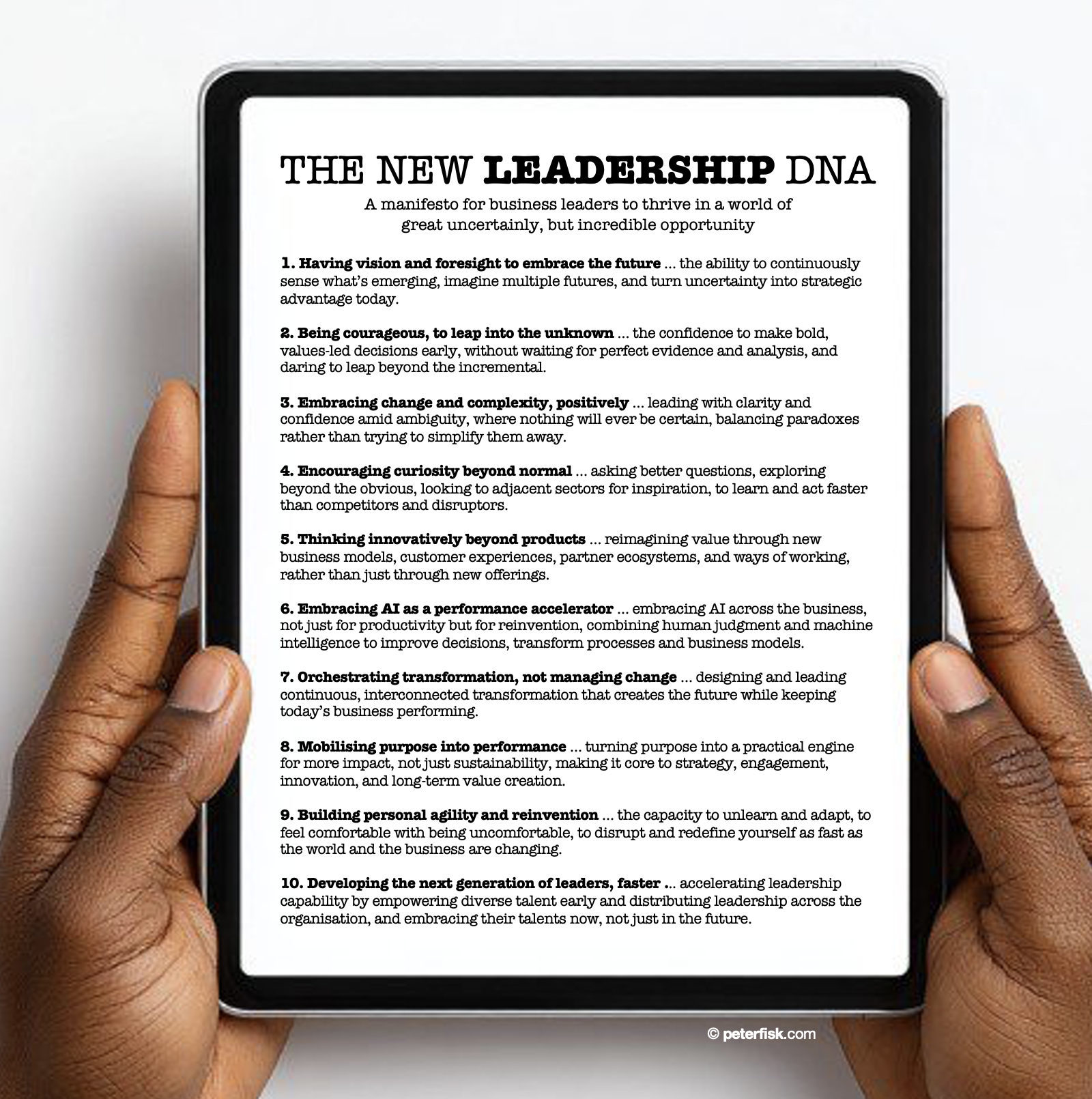


 Outside: The company provides experiences to customers through the delivery of products and services. The current quality of those experiences is today’s reality; making them transformatively better is the vision.
 Let’s look again at some of the companies we’ve already been discussing to see how this applies: where did they push it?