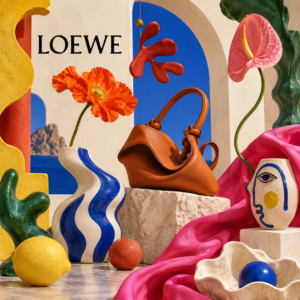
Loewe
180 years of Spanish craft
Founded in 1846 in Madrid as a small leather workshop, Loewe is the second-oldest luxury fashion house in the world. Nearly two centuries it continues evolving a heritage of innovative craft, bold creativity and leather excellence. In fact, it has become one of the most talked about fashion brands - weird, joyful, different.
Loewe has become one of the most talked about fashion brands. Weird, playful, different. But remarkably few people understand how it got here.
It was not always on the front row at Fashion Week. It did not have viral bags, surreal campaigns or Beyoncé wearing its designs. A decade ago, many people outside Spain could not pronounce its name “lo-eh-vay” let alone explain what made it distinctive.
Today, Loewe is one of fashion’s most influential luxury houses. Its Puzzle, Flamenco and Squeeze bags have become contemporary icons. Its campaigns are strange enough to stop people scrolling. Its clothes combine intellectual rigour with cartoonish audacity. A leather coat can look as though it has been folded from paper; a dress can resemble a car; a handbag can take the form of a tomato.
Loewe has topped the Lyst Index of fashion’s hottest brands, generated waiting lists for unlikely products and become a fixture of popular culture without descending into mass-market ubiquity. Estimated sales grew from about €230 million in 2014 to more than €1 billion a decade later. In 2024, Loewe’s principal Spanish company reported sales growth of 9 per cent despite the wider luxury slowdown.
This was not a conventional brand revival. Loewe did not simply rediscover an old logo, recruit some celebrities and raise its prices. It reimagined what a heritage luxury business could become.
The architect of that transformation was Jonathan Anderson, the Northern Irish designer who joined Loewe in 2013. Anderson has now left for Dior. His successors, Jack McCollough and Lazaro Hernandez, founders of Proenza Schouler, have begun writing the next chapter.
The central question is no longer whether Anderson successfully reinvented Loewe. He did. The question is whether the organisation he created can continue evolving or reinventing without him, and how. Because when a brand is built around one extraordinary vision, what happens when that vision walks away?
A great history nobody remembered
Loewe began not in Paris or Milan, but in Madrid in 1846, when a group of Spanish leather artisans established a workshop in the city centre. The name came later, through Enrique Loewe Roessberg, a German craftsman who joined the enterprise and gave it an identity capable of travelling beyond Spain.
The house became an official supplier to the Spanish royal family and built its reputation on exceptional leatherwork. Its bags, cases and accessories embodied discreet European luxury: beautifully made, conservative and expensive. LVMH acquired Loewe in 1996, adding it to a portfolio that included Louis Vuitton, Givenchy and Céline.
But history is not the same as relevance.
By the early 2010s, Loewe possessed many of luxury’s most desirable ingredients: provenance, craftsmanship, archives, artisanship and a powerful parent company. What it lacked was cultural energy. It was respected but rarely desired, known but seldom discussed. Its heritage explained where it had come from, but not why anyone should care about where it was going.
This is a common trap for established brands. They mistake longevity for distinctiveness. They polish their history when they should be using it as raw material for invention.
Loewe did not need a better retrospective. It needed a more compelling future.
The unlikely choice: weird, off-beat, reinventing
Jonathan Anderson did not appear to be the obvious custodian of a traditional Spanish leather house.
Born in Northern Ireland, he had initially wanted to become an actor. He studied menswear at the London College of Fashion and launched JW Anderson in 2008. His early work challenged conventions around gender and identity. He became known for collections that were clever, experimental and sometimes deliberately uncomfortable.
He was young, provocative and not Spanish. Loewe was old, restrained and deeply rooted in Madrid. The apparent mismatch was precisely the opportunity.
When Anderson arrived in 2013, he did not treat the house as a museum to be preserved. Nor did he erase its past and impose an unrelated fashion concept. He approached Loewe more like a curator entering a neglected collection: finding overlooked objects, rearranging their relationships and allowing people to see them differently.
His real achievement was not designing a succession of memorable collections. It was reframing the brand around a powerful contradiction: Loewe would be ancient and experimental, artisanal and provocative, intellectual and playful.
That tension became its engine.
Heritage became a platform, not a prison
Most heritage brands use their past defensively. They repeat established codes because those codes feel safe. Familiarity gradually becomes predictability, and predictability erodes desire.
Anderson used history more aggressively. He went back to Loewe’s fundamental capability—making extraordinary things from leather—but separated that capability from the conservative aesthetic that had accumulated around it.
The result was the Puzzle bag, introduced in 2015. Its geometric construction allowed the bag to fold almost flat. It looked recognisably luxurious but unlike a traditional status bag. Its identity came from its structure rather than a prominent logo.
The Puzzle became commercially successful because it resolved a strategic contradiction. It was distinctive enough to be noticed but functional enough to be used. It demonstrated craft without looking historic. It belonged unmistakably to Loewe while remaining open to new colours, sizes and interpretations.
Other products followed, including the Hammock, Gate, Flamenco and later the Squeeze. Each extended the brand’s vocabulary without merely repeating one formula.
The principle reached beyond handbags. Anderson asked what Loewe’s heritage permitted the brand to do, not what it required the brand to repeat.
That distinction matters. Heritage should provide authority to experiment. It should make radical ideas more credible, rather than make change less likely.
Craft became cultural capital
Anderson also elevated craft from a production story into a cultural proposition.
Luxury brands frequently talk about artisanship, usually through images of hands stitching leather in softly lit workshops. Loewe went further. It presented craft as a living form of creative intelligence: a way of thinking through materials, imagination and human skill.
The Loewe Foundation Craft Prize, launched in 2016, became central to this strategy. It celebrates makers working in ceramics, textiles, wood, metal, glass and other materials. These are not supporting acts for fashion. They are presented as significant contemporary artists.
Inside Casa Loewe stores, fashion sits alongside furniture, sculpture and art. The space feels less like a boutique and more like the home of an unusually adventurous collector. According to LVMH, Loewe now operates around 150 stores worldwide, using the Casa Loewe concept to bring fashion, art, design and craft into one environment.
This produced three strategic advantages.
First, it gave Loewe legitimacy beyond seasonal fashion. The house could participate in conversations about creativity, design and culture rather than relying entirely on its latest runway collection.
Second, craft justified value. At a time when many luxury products appeared to be distinguished mainly by logos and price increases, Loewe showed the complexity, experimentation and human ingenuity behind its objects.
Third, it made the brand more durable. Fashion changes rapidly; serious creative practice accumulates meaning over time.
The Craft Prize was not simply corporate sponsorship. It helped define what Loewe stood for. The house did not merely sell crafted objects. It championed craft as a progressive force.
Weirdness became a business strategy
Loewe’s most visible transformation came from its willingness to become strange.
Anderson created shoes decorated with cracked eggs, dresses shaped like cars, pixelated clothing that appeared to have escaped from a video game and heels incorporating balloons, soap bars and roses. The house produced a bag resembling an heirloom tomato after Anderson encountered a particularly convincing tomato online.
These objects generated attention because they were surprising. But their strategic value went beyond virality.
Luxury depends on disproportionate desire. A product does not need to be universally liked; it needs to be intensely wanted by a sufficiently valuable audience. Playing safe may broaden theoretical appeal, but it often eliminates the emotional charge that makes luxury distinctive.
Loewe learnt to make polarisation productive.
Its most eccentric runway objects created a halo around more accessible bags, shoes, perfumes and accessories. The spectacular item travelled across social media; the commercially scalable product converted attention into revenue. Weirdness attracted people into the world. Craft and quality persuaded them to stay.
This was controlled provocation, not randomness. Even Loewe’s strangest products were grounded in material excellence, artistic references or an obsessive exploration of construction. The absurdity was executed seriously.
The lesson is important for any premium brand: memorability comes from the unexpected, but credibility comes from coherence. Loewe could be weird because its weirdness expressed a consistent worldview.
Culture replaced conventional marketing
Anderson understood that modern luxury brands do not simply advertise within culture. They create cultural material.
Loewe collaborated with Studio Ghibli on collections inspired by Spirited Away, Howl’s Moving Castle and My Neighbour Totoro. It worked with ceramicists, sculptors, filmmakers, actors and photographers. Its campaigns frequently replaced predictable glamour with awkwardness, intimacy or deadpan humour.
Celebrity relationships also felt selective rather than merely transactional. Rihanna wore Loewe during her 2023 Super Bowl performance. Beyoncé chose the house for custom looks on her Renaissance tour. Ambassadors and collaborators included Taylor Russell, Josh O’Connor, Greta Lee, Aubrey Plaza and Jamie Dornan—figures associated with interesting creative choices as much as conventional fame.
Loewe became good at going to where culture was forming. It connected fashion with film, art, animation, music, internet humour and craft. Instead of asking how to make a campaign reach more people, it asked how to make something people would want to discuss.
This distinction transformed marketing from communication into participation.
Many luxury brands have enormous visibility but weak cultural meaning. Loewe achieved the reverse first: it built a distinctive cultural position, then allowed visibility to follow.
The organisation behind the auteur
It is tempting to explain Loewe’s success entirely through Anderson’s genius. That would be both understandable and incomplete.
A creative director can articulate a vision, but cannot alone build supply chains, expand retail, protect quality, allocate investment or translate experimental runway ideas into profitable product families. Loewe’s reinvention also depended on LVMH’s patient capital and operational capabilities, experienced management, skilled artisans and a commercial organisation able to scale desirability without destroying it.
Pascale Lepoivre, Loewe’s chief executive from 2016, played a crucial role in converting creative momentum into international growth. Under her leadership, Loewe expanded its retail footprint, strengthened accessories, developed its presence in Asia and turned Anderson’s artistic direction into a more coherent business system.
This is what separates reinvention from a temporary creative moment. Imagination has to become organisational capability.
At Loewe, several activities reinforced each other:
- Remarkable shows generated cultural relevance.
- Cultural relevance increased demand for accessories.
- Successful accessories funded more experimentation.
- Craft strengthened authenticity and pricing power.
- Stores made the brand’s cultural world tangible.
- Collaborations attracted new audiences without diluting the core.
Together, these created a self-reinforcing value engine. The brand did not grow from one product, one celebrity or one campaign. It grew because creativity, culture, craft and commerce were designed to amplify one another.
The founder’s dilemma, without the founder
Then came the risk embedded in the strategy.
Over 11 years, Anderson’s taste became Loewe’s taste. His curiosity shaped its collaborations. His humour defined its communications. His fascination with objects, art and making determined what the brand considered interesting.
The closer Loewe came to his worldview, the more distinctive it became. But the same coherence created dependency.
This is the creative-director version of the founder’s dilemma: the person who makes the organisation exceptional can also make succession exceptionally difficult.
Anderson left Loewe in 2025 and became sole creative director of Dior, overseeing women’s, men’s and haute couture collections. Loewe appointed Jack McCollough and Lazaro Hernandez, the American designers who founded Proenza Schouler, as co-creative directors.
Their selection was thoughtful. Like Anderson, they are interested in material innovation, art and craft. They understand desirable accessories: Proenza Schouler’s PS1 bag became one of the defining handbags of its era. And appointing a duo rather than another singular celebrity may subtly redistribute creative authority.
Their debut for Loewe’s Spring/Summer 2026 collection received a largely positive response. It retained the house’s fascination with material transformation but introduced a cleaner, sportier and more pragmatic energy. Leather was moulded, painted and manipulated; familiar clothing acquired unexpected volume; the eccentricity remained, but it felt less theatrical and more street-facing.
It was recognisably Loewe, but not an Anderson impersonation.
That is a promising beginning. It is not yet proof of a successful succession.
What must Loewe preserve?
The wrong response would be to preserve Anderson’s aesthetic.
Specific visual signatures decay quickly when separated from the person who created them. Repeating surreal shapes, exaggerated proportions and eccentric objects would gradually turn invention into mannerism. Loewe would become a tribute act to its own recent past.
The house should instead preserve the deeper operating principles behind the transformation.
First, it must continue treating craft as a source of innovation. Craft cannot become a sentimental story about tradition; it must remain a method for discovering new forms, materials and possibilities.
Second, Loewe must protect its permission to surprise. Every collection does not need a viral vegetable, but the brand should continue taking enough creative risk to make people look twice.
Third, it must maintain cultural curiosity. Anderson made Loewe feel connected to artists, filmmakers, designers and subcultures because he appeared genuinely interested in them. Cultural relevance cannot be reduced to celebrity casting or collaboration calendars.
Fourth, the commercial organisation must allow the designers time. Creative transitions are often undermined by pressure for immediate novelty and instant sales. Loewe’s next identity will require exploration, not simply quarterly optimisation.
Finally, the brand must become larger than any creative director without becoming less creative. The Craft Prize, artisan network, archives, Casa Loewe stores and relationships across the arts can provide institutional continuity. These assets turn an individual vision into a platform others can extend.
From genius to system
The central challenge facing Loewe is not replacing Jonathan Anderson. He cannot be replaced, and attempting to reproduce him would diminish both his achievement and his successors.
The challenge is to move from a genius-led transformation to a creativity-led institution.
That means distinguishing between the outcomes Anderson produced and the conditions that allowed him to produce them. The outcomes included Puzzle bags, surreal silhouettes and memorable campaigns. The conditions included freedom, curiosity, deep craft, intelligent management, cultural openness and tolerance for ideas that initially looked commercially irrational.
Those conditions can survive.
Indeed, Loewe’s next era could become an even more significant strategic achievement than its first. Many brands can be revived by an exceptional individual. Far fewer can convert that individual’s energy into an enduring organisational capability.
McCollough and Hernandez therefore need to do something more difficult than honour the past or announce a rupture. They must understand Loewe’s essential contradiction and make it their own. The house must remain rooted but restless, serious about making but irreverent about fashion, Spanish in identity but global in imagination.
If they play too safely, Loewe will lose the creative tension that made it matter. If they chase Anderson’s eccentricity too directly, the brand will feel derivative. Their opportunity lies between imitation and rejection: preserving the courage while changing the expression.
The next reinvention
Loewe’s rise offers a broader lesson for established companies.
Reinvention does not require abandoning heritage. It requires deciding which parts of that heritage are capabilities and which are constraints. Leather craftsmanship was a capability. Conservatism was a constraint. Spanish identity was a source of richness. Low visibility was not evidence of exclusivity. History created authority, but experimentation created relevance.
Anderson understood that the most powerful luxury brands do not merely make better products. They construct worlds people want to enter. Loewe’s world combined exceptional objects, artistic curiosity, humour, humanity and a willingness to look odd.
That world now has new authors.
The early signs suggest that Loewe will not retreat into safety. But its future will depend on whether the house can keep challenging itself after the challenger-in-chief has gone.
The ultimate test of Jonathan Anderson’s legacy will not be whether Loewe misses him. It inevitably will. Nor will it be whether his successors can create another Puzzle bag or viral tomato.
It will be whether he left behind something more valuable than a recognisable aesthetic: an organisation with the confidence to remain unfinished.
Loewe became a phenomenon because it stopped protecting what it had been and started exploring what it could become. Its next leaders must now do the same.
The vision has walked away.
The courage must remain.