Future Junkies by Peter Fisk
The future starts now
Why the future belongs to those who obsessively craft it
We live in a world of relentless acceleration. Every day brings fresh disruption, new breakthroughs, and rising uncertainty. Technologies evolve exponentially. Markets shift in moments. Social and environmental challenges grow more complex and urgent. In this high-velocity world, the old playbooks no longer work. Yesterday’s logic breaks under tomorrow’s pressure.
Enter the Future Junkie: a new breed of business leader obsessed with what comes next. Future Junkies aren’t content to merely adapt to change; they crave it. They are restless, curious, and deeply committed to crafting better futures. They are not defined by their industry, geography, or age, but by their mindset. They see opportunity in challenge, imagination in ambiguity, and purpose in uncertainty.
This book explores the ideas, strategies, and leadership practices of Future Junkies across the world. It’s a guide for anyone who wants to stop reacting to change and start shaping it. You’ll meet bold entrepreneurs, visionary CEOs, and pioneering innovators—people like Elon Musk, Satya Nadella, Melanie Perkins, Lei Jun, and Jessica Jackley—who are rewriting the rules of business. And you’ll explore tools and frameworks to help you build your own futurecrafting discipline.
Future Junkies are not reckless optimists. They are rigorous visionaries. They don’t just dream—they build. They transform ideas into experiments, and experiments into progress. They challenge convention, embrace ambiguity, and mobilise communities. And they never stop asking: what’s next?
This is not just a book about trends. It’s about transformation. It’s about designing businesses, cultures, and strategies for the future—on purpose. Because in an age of uncertainty, the greatest risk is to do nothing.
Welcome to the age of the Future Junkie.

Part I: The Future Junkie Mindset
Chapter 1: Always What’s Next
Why traditional business thinking isn’t enough in a world of disruption. The psychology of a Future Junkie: curiosity, restlessness, impatience for progress.
Future Junkies see the world differently.
While most leaders focus on optimising the present, they are already building what comes after. This mindset—what we might call strategic impatience—fuels their actions. The horizon is not a distant place; it is a current project.
Why do they think this way? Because they know that stability is an illusion. The businesses that dominated the last century—built on scale, control, and efficiency—are being displaced by those driven by ideas, ecosystems, and adaptability. In this context, the ability to see, shape, and seize the future is the ultimate competitive edge.
Consider Elon Musk, perhaps the most high-profile Future Junkie. His companies aren’t built to maintain the status quo; they exist to bend the arc of possibility. Tesla didn’t just build electric cars—it redefined the automotive sector. SpaceX didn’t just launch rockets—it made space travel a public-private ambition. Musk’s obsession with the future isn’t an eccentric trait; it’s a strategic advantage.
But you don’t have to be Musk to think this way. Jessica Jackley saw a broken financial system and created Kiva, enabling peer-to-peer microloans that reimagined access to capital for underserved communities. Lei Jun built Xiaomi not as a hardware company, but as an ecosystem of digital experiences, combining affordability with community-driven innovation. Satya Nadella turned Microsoft from a product-centric behemoth into a purpose-led platform company focused on cloud, AI, and empowering others.
What these leaders share is an ability to see cracks in the present and design businesses that can grow through and beyond them.
Future Junkies are not content with best practices. They pursue next practices. They don’t just scale what works; they explore what could work better. This doesn’t mean they ignore reality—it means they redefine it.
They ask different questions:
-
What is the change no one sees coming?
-
How might we reinvent this from the ground up?
-
Who else could we create this future with?
-
What would make this 10x better, not just 10%?
They also operate across time horizons. They manage the present while experimenting with the future. They set bold visions but iterate quickly. They are system thinkers and story builders. And they are deeply driven by purpose: not just what they want to achieve, but why it matters.
In this chapter, and throughout the book, you’ll discover that Future Junkies share three key traits:
-
Curiosity – They actively seek emerging signals, question assumptions, and explore the unknown. They are information omnivores, constantly scanning for what’s next in technology, design, society, and culture.
-
Imagination – They don’t simply accept the future—they create it. They visualise what could be, and then work backward to make it possible. They blend storytelling with strategic insight to generate momentum.
-
Courage – They make bold moves. They are not afraid to invest in moonshots, challenge orthodoxy, or commit to paths with uncertain outcomes. They understand that progress demands risk.
This chapter is your invitation to shift your lens. Don’t just ask, “How do we compete today?” Ask, “What future do we want to lead?” Because the best way to predict the future is no longer to forecast it. It’s to build it.
Welcome to the mind of the Future Junkie.
Chapter 2: Ambition with Purpose
Visionary leadership grounded in societal impact. Purpose as compass and fuel.
Future Junkies are not simply dreamers; they are purposeful architects of change. Their ambition isn’t about ego or domination — it’s about meaningful progress. What sets them apart isn’t just the size of their goals, but the depth of their why.
In the past, ambition in business was defined by market share, revenues, and shareholder return. But today, ambition must stretch further — to solve problems that matter, shape a more inclusive economy, and build resilience in the face of global challenges. This is purpose-driven ambition: not only imagining a better future, but building it with intent.
Consider Melanie Perkins, co-founder of Canva. Her goal wasn’t just to build a unicorn startup. It was to democratise design — to empower people everywhere to communicate visually, regardless of their skills or budget. Today, Canva’s tools are used by over 100 million people a month. Her purpose amplified her ambition, and vice versa.
Likewise, Patagonia’s founder Yvon Chouinard reshaped what ambition looks like in the apparel industry — shifting from growth for growth’s sake to environmental responsibility and long-term value. The company’s purpose—to “save our home planet”—has become a magnet for talent, loyalty, and impact.
Future Junkies use purpose not just as a slogan, but as a strategy. It aligns decision-making, clarifies direction, and creates resilience. Purpose builds trust, and trust builds value.
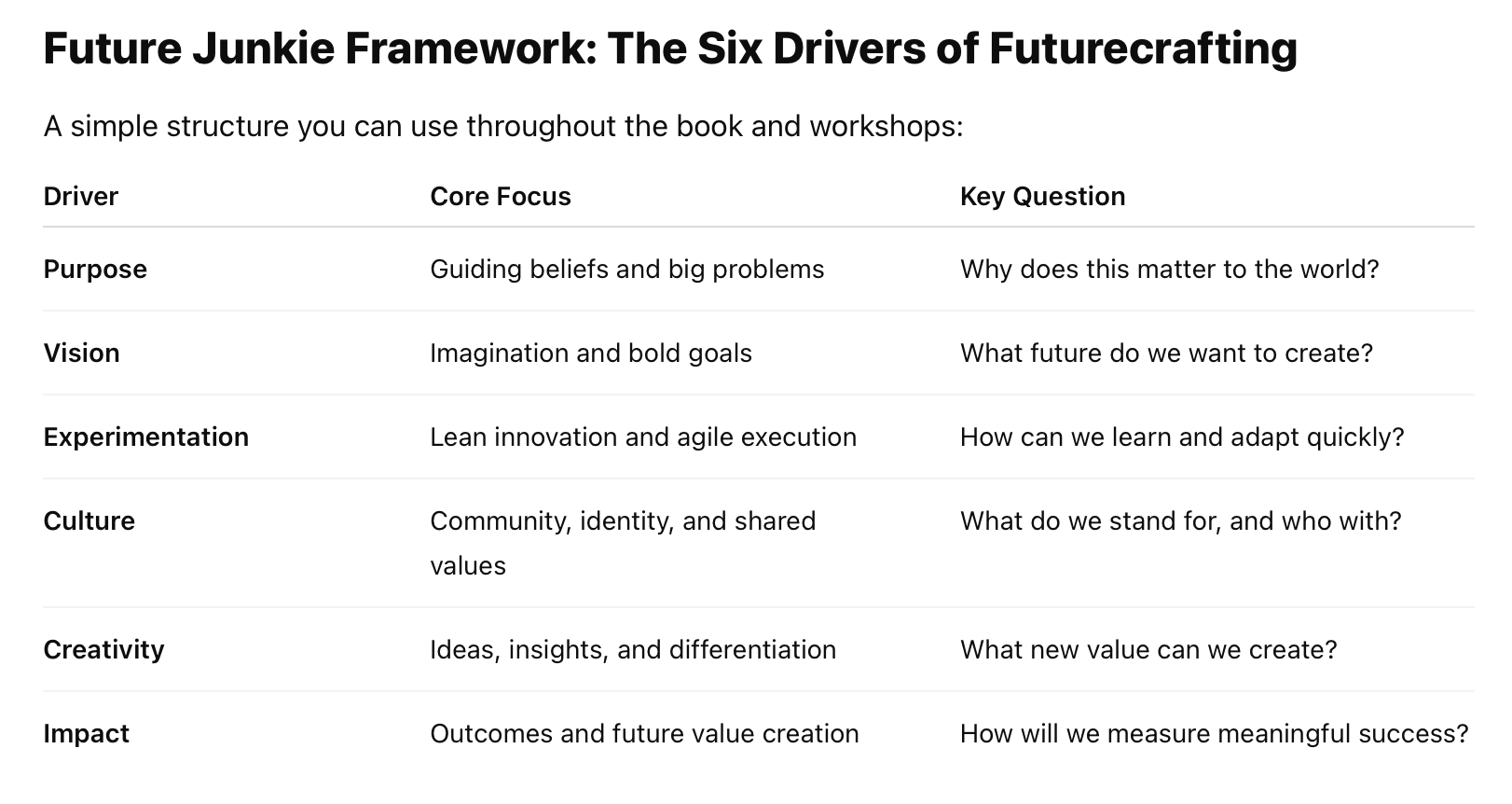
The Four Tests of Purpose-Driven Ambition:
-
Relevance: Does this matter to the world right now?
-
Differentiation: Does this set us apart in a meaningful way?
-
Actionability: Can we actually make this happen?
-
Scalability: Will this grow in influence as it grows in size?
At its best, purpose-driven ambition unlocks what Stanford’s Tina Seelig calls the “innovation engine”—the loop between knowledge, attitude, imagination, and environment.
Purpose provides the gravitational pull, ambition the propulsion system. Together, they define the trajectory of the Future Junkie.
Chapter 3: Foresight and Strategy
Diving deeper into how Future Junkies don’t just react to trends, but actively anticipate and design for them with imagination, insight, and agility. Cultivating ideation as a discipline, not a moment. Reframing constraints as creative catalysts.
Strategy used to be a static, annual process. But for Future Junkies, it is a living, dynamic act of foresight. In a world defined by complexity and constant disruption, they don’t just plan for the future — they craft it.
Foresight is the ability to anticipate change before it happens, identify emerging signals, and reframe possibilities into strategic choices. Future Junkies fuse data with intuition, pattern recognition with imagination. They zoom out to see systems, zoom in to spot opportunities, and act in real time to shape advantage.
The Strategy Shift
Traditional strategy starts with analysis: where are we now, what’s our SWOT, how do we optimise our resources?
Futurecrafting strategy starts with ambition: what future do we want to lead, what new value can we create, and who can we shape it with?
Future Junkies use foresight not as prediction, but as provocation. It’s not about being right — it’s about being ready. They run scenario labs, map weak signals, and create vision prototypes. Their aim is to stretch thinking, reveal assumptions, and build capability to adapt quickly.
- DBS Bank, Southeast Asia’s leading digital bank, didn’t wait for fintech disruption to hit—it led the way. Under CEO Piyush Gupta, the bank invested heavily in future-focused strategy: embedding design thinking, cloud architecture, and AI into its DNA. DBS won “World’s Best Bank” multiple times by seeing itself not as a bank, but as a technology company in the service of finance.
- Illumina, genomics business’ strategy has been to radically drive down the cost of gene sequencing—unlocking entirely new markets and medical possibilities. By anticipating the convergence of AI, bioinformatics, and personalised health, Illumina positioned itself not just as a toolmaker, but a shaper of the health future.
- Nike uses foresight to fuel not just product innovation, but brand relevance. From digital fitness platforms to sustainable materials and NFTs, it acts early on cultural and technological shifts. Its strategy team isn’t isolated—it co-creates with designers, technologists, and athletes to shape what’s next.
Five Strategic Practices of Future Junkies
- Signal Sensing – Constantly scan for early signals across sectors, geographies, and subcultures. Use horizon scanning and cross-industry benchmarking.
- Future Narratives – Create compelling visions of alternative futures. Use speculative design, storytelling, and visual prototypes to build belief and alignment.
- Strategic Experimentation – Run fast, low-risk experiments to test new business models, customer needs, or technologies. Think ‘minimum viable future’.
- Ecosystem Mapping – Define your role in a broader system. Who are your future collaborators? What platforms, partners, or movements will amplify your impact?
- Agile Portfolios – Manage your strategy like a venture portfolio: balance core optimisation with adjacent growth and transformational bets.
In the Future Junkie playbook, strategy isn’t a PowerPoint. It’s a prototype. It’s adaptive, inclusive, and imaginative.
Because in a nonlinear world, the best strategy isn’t the smartest prediction—it’s the fastest evolution.
Chapter 4: Experimentation and Innovation
This chapter shows how Future Junkies turn imagination into action, building new value through bold, disciplined experimentation.
Future Junkies don’t just think big — they test fast. Innovation is not a one-off initiative or a department. It is a behaviour, a habit, a system. In the hands of a Future Junkie, experimentation becomes the engine of transformation.
Where traditional organisations prioritise efficiency, Future Junkies prioritise learning. They create space for exploration, embrace uncertainty, and design experiments that de-risk bold ideas. They understand that every breakthrough begins as a hunch, and every hunch must be stress-tested in the real world.
From Idea to Experiment to Impact
In legacy businesses, the innovation process often dies in committee. Ideas are over-analysed, delayed, or diluted before they’re ever tested.
Future Junkies flip the script: they move quickly from idea to action, using lean methods and real-world feedback loops. They test assumptions, prototype early, and scale what works.
- Spotify is a master of this approach. Its engineering culture is built around autonomous “squads” that rapidly develop, test, and launch new features. From Discover Weekly to Wrapped, these innovations weren’t perfect at launch—but they got better fast.
- Amazon’s mantra—“it’s always Day One”—is a call to constant experimentation. Jeff Bezos famously said, “Our success is a function of how many experiments we do per year, per month, per week.” Prime, Kindle, AWS—all began as internal experiments driven by user need and long-term ambition.
- Airbnb grew by testing radically different models for trust, pricing, and experience. Its founders used guerrilla tactics, like professional photography for listings, long before the market believed people would rent out their homes to strangers.
The Innovation Mindset
To craft the future, Future Junkies blend creativity and discipline:
-
Curiosity — asking better questions
-
Empathy — understanding real needs
-
Imagination — seeing what doesn’t yet exist
-
Speed — testing fast and learning faster
-
Resilience — learning from failure without losing momentum
Importantly, innovation isn’t just about tech. It’s about new ways to create value — new business models, new experiences, new partnerships.
- Zipline, a drone logistics company in Africa, reimagined how life-saving medicine could be delivered in remote areas. Instead of building roads, they used autonomous drones. Their innovation wasn’t just technology — it was rethinking the system.
The Innovation Stack
Future Junkies build layered innovation capability. Here’s how they do it:
-
Micro – Everyday experiments in teams. Fast tests, small bets.
-
Meso – Strategic innovation portfolios. Structured ventures and programs.
-
Macro – Transformational moonshots. System redesign, business model reinvention.
Each layer feeds the next. Micro experiments fuel meso initiatives. Meso builds momentum for macro breakthroughs.
The Big Shift: From Projects to Platforms
Future Junkies often evolve their innovation from isolated initiatives to open platforms.
-
Shopify turned an e-commerce toolkit into a global developer platform.
-
GitLab open-sourced its roadmap and created an ecosystem of contributors.
-
Tesla opened up its patents to accelerate the entire EV market.
This shift allows innovation to scale, connect, and multiply.
Key Tools to Use
-
Lean Canvas: Define problem, solution, key metrics, and early adopters.
-
Hypothesis Testing: Make assumptions visible and testable.
-
Innovation Sprints: Use 5-day sprints to ideate, prototype, and validate.
-
Innovation KPIs: Track learning velocity, not just output.
In short: innovation is not magic. It’s a repeatable, learnable discipline. Future Junkies turn experimentation into a daily habit — because if you’re not testing the future, you’re defaulting to the past.
Chapter 5: Culture and Community
We explore how Future Junkies build organisations and brands not just around products or profits, but around shared values, identity, and participation.
At the heart of every Future Junkie business is a living culture — a deep sense of who we are, what we care about, and how we work together. Culture is no longer a “soft” element. It is the operating system of innovation, agility, and progress.
Future Junkies understand that a great culture does more than attract talent — it multiplies creativity, accelerates change, and shapes customer loyalty. And they go further: building not just internal cultures, but communities around their brands, products, and movements.
Culture as Strategy
Traditional companies treat culture as an HR function. Future Junkies treat it as strategic infrastructure. Culture shapes decision-making, drives behaviour, and fuels collaboration — especially across distributed teams, ecosystems, and global networks.
- GitLab — the world’s largest all-remote company — built its entire business on transparency, trust, and radical documentation. With over 2,000 employees in 65+ countries, GitLab’s culture is designed to enable asynchronous collaboration, fast feedback, and psychological safety.
- Canva deliberately cultivates a culture of “empowered creativity.” Employees are encouraged to experiment and contribute ideas company-wide. Internally, design thinking is a way of life — not just a method. Externally, Canva’s free tools and templates are a gateway to its larger mission of accessible creativity.
- Patagonia integrates its environmental mission into everything — from product design and customer experience to hiring and governance. The culture is activist, authentic, and proud to challenge industry norms. This isn’t just good ethics; it’s great strategy. Patagonia’s loyal community returns again and again not because it’s the cheapest, but because it stands for something bigger.
Community as Catalyst
Future Junkies understand that in the connected world, value is co-created. They don’t just talk to customers — they build with them. They host conversations, create platforms, and inspire participation. They know that the strongest brands behave more like movements.
- Glossier, the beauty brand born from a blog, turned its fans into collaborators. Product development starts with conversations in its community. Its rapid growth was powered not by ads, but by advocacy.
- Notion, the productivity tool, grew a cult following through its fanbase of creators and educators. Templates, how-to guides, and design hacks turned users into evangelists — and into a global movement that built the brand faster than any marketing spend could.
Future Junkie Culture Principles
-
Open by Default – Share information, encourage feedback, invite contributions.
-
Purpose-Fueled – Make the mission real in everyday decisions.
-
Learning First – Reward curiosity, not perfection. Celebrate experiments.
-
Diverse Voices – Build inclusion into innovation. Different views drive better ideas.
-
Community-Driven – Engage users and stakeholders as co-creators.
The best cultures today are not about perks or posters — they are about participation, trust, and meaning.
In the age of the Future Junkie, culture is what enables speed. And community is what fuels scale.
Chapter 6: Long-Term Value and Impact
How Future Junkies measure success not just by short-term gains but by sustainable, meaningful outcomes that last.
For Future Junkies, success is measured not only in quarterly profits or market share, but in the lasting impact they create — for customers, communities, and the planet. They understand that the most valuable businesses are those that generate enduring value.
Beyond Traditional Metrics
Traditional business success often hinges on tangible, short-term financial indicators: revenue growth, EBITDA, share price. But these can be misleading in a fast-changing world.
Future Junkies adopt a broader set of metrics that capture:
-
Customer trust and loyalty
-
Brand strength and reputation
-
Talent engagement and retention
-
Environmental and social impact
-
Innovation velocity
-
Ecosystem health and partnerships
These intangible factors build resilience and future opportunity, even when near-term earnings fluctuate.
Examples of Impact-Driven Leaders
- Schneider Electric shifted its strategy towards sustainability and digital transformation, embedding environmental goals into its core operations. Its market cap has grown alongside its positive impact on energy efficiency and carbon reduction.
- Unilever moved beyond “corporate social responsibility” to embed purpose in its business model, driving growth through brands like Dove and Ben & Jerry’s that champion social causes. This has strengthened consumer loyalty and opened new markets.
- Tesla redefined value creation by linking long-term vision—accelerating the world’s transition to sustainable energy—with relentless innovation and brand passion. Its market value reflects not just car sales but the ecosystem it is building.
Building for the Future
Long-term value requires Future Junkies to balance bold bets with prudent stewardship:
-
Investing in talent and culture to build capabilities for the future
-
Fostering ecosystems and partnerships to unlock collective advantage
-
Measuring impact rigorously to guide strategy and communicate value
-
Engaging stakeholders authentically to build trust and alignment
The Future Junkie’s Value Compass
A practical tool to align purpose, ambition, and impact:
| Dimension | Question to Ask |
|---|---|
| Financial | Are we profitable and growing sustainably? |
| Customer | Are we delighting and retaining customers? |
| Talent | Are we attracting, developing, and inspiring people? |
| Innovation | Are we continuously creating new value? |
| Social/Environmental | Are we improving society and the planet? |
| Ecosystem | Are we cultivating strong, mutually beneficial partnerships? |
In the next chapters, we will explore the leadership mindset and practical methods that enable Future Junkies to craft the future — turning ambition and imagination into lasting transformation.
Chapter 7: Leadership for the Future
How Future Junkies lead with vision, empathy, and adaptability to inspire progress in complex times. The leadership mindset to craft the future, turning ambition and imagination into lasting transformation.
In a world of accelerating change, leadership must evolve. Future Junkies lead not just with authority, but with curiosity, courage, and connection. They create environments where creativity thrives, purpose guides, and agility is second nature.
The New Leadership Paradigm
Traditional leadership often emphasizes control, hierarchy, and predictability. Future Junkies embrace complexity, uncertainty, and distributed power. They are servant leaders — enabling others to lead, innovate, and grow.
They understand that leadership is less about giving answers, more about asking the right questions:
-
What possibilities are emerging on the horizon?
-
How can we unlock the potential in our people and partners?
-
What assumptions are we holding that need challenging?
Emotional Intelligence at Scale
Empathy is central to Future Junkie leadership. Leading diverse, distributed teams requires deep listening and authentic connection. This emotional intelligence fosters trust and psychological safety, enabling risk-taking and resilience.
Vision as Compass
Visionary leaders paint a compelling picture of the future — not as a fixed destination, but as an evolving journey. This vision inspires alignment, commitment, and hope amidst ambiguity.
- Satya Nadella, CEO of Microsoft, is a prime example. By shifting the company culture toward “growth mindset” and cloud-first innovation, Nadella reinvigorated Microsoft’s purpose and growth.
Leading Innovation
Future Junkie leaders embed innovation into strategy and culture. They remove barriers, allocate resources, and reward experimentation and learning — even when failure is inevitable.
Inclusive and Adaptive
They embrace diversity of thought and background, knowing that better ideas come from varied perspectives. They are comfortable adapting course quickly, learning from data and feedback.
Leadership Practices of Future Junkies
- Amplify Purpose — Constantly remind teams why the work matters.
- Empower Autonomy — Trust teams to make decisions and act fast.
- Cultivate Curiosity — Encourage exploration and questioning.
- Model Resilience — Show vulnerability and learn from setbacks.
- Build Networks — Connect across ecosystems to share knowledge and resources.
Leadership is no longer a role reserved for a few at the top. It’s a distributed capability — a mindset to be nurtured across the organisation.
Future Junkies don’t just manage the future — they lead it.
Chapter 8: Talent and Creativity
How Future Junkies attract, nurture, and unleash the creative energy needed to craft the future.
In the fast-evolving landscape of the Future Junkie, talent is the ultimate differentiator. It’s not just skills or experience that matter most—it’s creativity, adaptability, and a mindset oriented to learning and experimentation.
Future Junkies know that to create what’s next, they must build organisations that inspire passion, empower initiative, and foster continuous growth.
The Creative Organisation
Traditional companies often view talent as resources to be managed for efficiency. Future Junkies see talent as the source of innovation — the spark that turns vision into reality.
- Google’s famed “20% time” is an example of encouraging employees to explore ideas beyond their core tasks, sparking innovations like Gmail and Google News.
- IDEO, the design consultancy, cultivates a creative culture where diverse teams collaborate using human-centred design principles to solve complex challenges.
Attracting Future-Focused Talent
Future Junkies don’t just hire for today’s skills—they seek curiosity, courage, and a growth mindset. They value diversity of backgrounds and thinking styles, knowing this broad perspective fuels better ideas.
Flexible working models, meaningful missions, and opportunities for learning help attract top talent who want to make a difference.
Nurturing Creativity and Learning
Innovation flourishes where psychological safety exists—where people feel safe to take risks and fail without fear.
Future Junkies build feedback-rich environments with regular learning loops, coaching, and cross-pollination between teams.
They invest in continuous skill development—often using digital platforms, peer learning, and external partnerships.
Enabling Autonomy and Collaboration
Creative work requires freedom. Future Junkies empower teams with autonomy to experiment while fostering collaboration to connect ideas and expertise.
Decentralised decision-making and agile ways of working enable fast iteration and responsiveness.
Examples of Talent-Led Innovation
-
Spotify uses “squads” and “tribes” to create small, autonomous teams with clear missions, fostering ownership and rapid innovation.
-
Salesforce invests heavily in upskilling through Trailhead, its digital learning platform, to keep talent future-ready.
-
NVIDIA attracts world-class AI researchers by offering challenging projects and an innovation-driven culture.
Talent and Creativity Principles
- Hire for Potential and Purpose — Prioritise mindset and values alongside skills.
- Create Safe Spaces for Experimentation — Encourage learning from failure.
- Enable Cross-Disciplinary Collaboration — Break silos to spark new ideas.
- Support Continuous Learning — Provide resources and time for growth.
- Balance Autonomy with Alignment — Empower teams while maintaining shared goals.
Future Junkies see their people as partners in crafting the future—not just workers executing plans. They invest in unleashing creativity at every level, recognising that the next big idea can come from anywhere.
Chapter 9: Brands as Culture and Communities
How Future Junkies build brands that are living ecosystems — cultural forces powered by engaged communities, not just marketing campaigns.
In the Future Junkie era, brands transcend logos and slogans. They become vibrant cultures, reflecting shared values, identities, and narratives that bind people together. Brands evolve from messages delivered to communities into movements co-created with them.
The Shift from Product to Purpose
Traditional branding often focused on features or differentiation. Today’s Future Junkies build brands grounded in purpose — a meaningful “why” that resonates deeply with customers, employees, and partners.
- Patagonia exemplifies this. Its brand stands for environmental activism and sustainability, shaping customer loyalty and advocacy beyond any single product.
- Tesla isn’t just a car company; it’s a movement for sustainable energy, inspiring fans who see themselves as part of a broader mission.
Brands as Living Cultures
A brand is a shared culture expressed through behaviours, stories, and rituals. Future Junkies nurture brand cultures internally—through values, leadership, and employee experience—and externally by engaging customers and communities.
- Glossier transformed beauty marketing by involving customers directly in product development, creating a tribe of advocates who shape the brand’s identity.
- Nike builds a culture around empowerment and performance, connecting deeply with athletes and communities worldwide, turning customers into lifelong brand ambassadors.
Community as Co-Creation
Future Junkies know that the strongest brands harness community energy. They invite customers and users to participate — through social media, events, user-generated content, and collaborative innovation.
- Notion, a productivity platform, grew through a passionate user base who shared templates, tutorials, and ideas, fueling rapid growth and product evolution.
- LEGO builds global communities of builders and fans, hosting events and challenges that deepen engagement and spark creativity.
Brand Principles for Future Junkies
- Purpose First — Start with a meaningful mission that guides everything.
- Authenticity — Be real and transparent to build trust.
- Participation — Invite customers to co-create and engage.
- Consistency — Align internal culture and external expression.
- Adaptability — Evolve the brand with community feedback and changing contexts.
Brands are no longer owned by companies alone—they are ecosystems, constantly evolving with the communities that bring them to life.
For Future Junkies, building a brand is not a campaign. It’s crafting a culture that inspires, connects, and accelerates progress.
Chapter 10: Futurecrafting
The Mindset and Discipline to Accelerate Progress, tying together the book’s themes into a practical guide for creating the future with purpose and agility.
Future Junkies don’t wait for the future to arrive — they craft it. Futurecrafting is both an art and a discipline: a way of thinking, acting, and leading that stretches ambition, harnesses imagination, and turns possibility into progress.
The Futurecrafting Mindset
At its core, futurecrafting blends:
- Stretching Ambition: Bold visions that challenge what’s possible
- Imaginative Curiosity: Openness to new ideas, technologies, and insights
- Purpose-Driven Action: Aligning ambition with meaning and impact
- Experimentation: Learning fast through prototyping and iteration
- Resilience: Embracing uncertainty and adapting quickly
Futurecrafting leaders and teams don’t just predict trends—they create them.
Practical Strategies for Futurecrafting
- Visioning and Foresight
Use scenario planning, trend analysis, and horizon scanning to explore multiple futures and identify opportunity spaces. - Idea Exploration
Encourage ideation sessions, hackathons, and cross-disciplinary collaborations to generate new possibilities. - Rapid Experimentation
Prototype ideas quickly, test in real-world settings, gather feedback, and pivot as needed. - Ecosystem Engagement
Collaborate with partners, customers, startups, and academia to expand capabilities and co-create innovation. - Purpose Alignment
Constantly connect projects and initiatives back to the organisation’s core mission and values.
Examples of Futurecrafting in Action
- SpaceX reimagined space travel through iterative rocket development and ambitious goals of Mars colonisation, challenging decades-old assumptions.
- DeepMind combines cutting-edge AI research with practical applications, pushing the boundaries of what machines can learn and solve.
- On Running blends sports science, design, and sustainability to craft running shoes that redefine performance and environmental impact.
Building Futurecrafting into Your Organisation
- Embed futurecrafting into leadership development and talent management.
- Create structures that enable cross-functional teams and rapid cycles of learning.
- Foster a culture that tolerates failure as a path to discovery.
- Measure progress not only in outputs but in learning, adaptation, and impact.
Futurecrafting is not a one-time project but a continuous journey — the discipline that turns future obsession into future creation.
Conclusion: Becoming a Future Junkie
The future is no longer a distant horizon to watch from afar. It’s a dynamic, ever-shifting landscape that calls for boldness, creativity, and relentless curiosity. Future Junkies are those who refuse to wait passively — they dive in, experiment, and lead the charge to build what’s next.
This book has explored the mindset, methods, and movements powering these pioneers — from ambitious vision to purposeful action, from cultural craftsmanship to ecosystem engagement. It has highlighted how the world’s most innovative leaders and organisations harness imagination and discipline to accelerate progress that matters.
Becoming a Future Junkie is a journey, not a destination.
It means embracing uncertainty as opportunity, cultivating a learning mindset, and anchoring your work in meaning beyond profits. It requires both dreaming big and grounding ideas in practical experimentation.
You have the tools, stories, and frameworks to start crafting your future today. Whether you lead a startup, a global corporation, or a community initiative, the principles of Future Junkies can unlock new possibilities and impact.
The challenge now is yours: stay curious, stay bold, and keep shaping what comes next.
The future is waiting. Are you ready to build it?
Leaderboard of Future Junkies
Sam Altman (OpenAI)
Sam Altman is perhaps the most consequential future junkie of our time, steering AI from speculation to reality. Formerly president of Y Combinator, Altman co-founded OpenAI with the mission to ensure that artificial general intelligence benefits humanity. His vision isn’t just technical—it’s existential: how to responsibly accelerate and direct the most powerful technology ever created. He believes in open, cautious, yet relentless progress. Under Altman, OpenAI launched ChatGPT and redefined the public’s relationship with AI. He combines startup speed with philosophical depth, shaping new governance models, partnerships, and research frontiers. Altman’s future is one of augmented intelligence, collaborative evolution, and societal transformation.
Daniel Ek (Spotify)
Daniel Ek didn’t just create a music app—he reshaped how the world listens, creates, and pays for music. Inspired by Napster-era chaos and the desire to fairly compensate artists, Ek launched Spotify to marry access with legitimacy. His product vision is obsessively user-centric, focused on personalisation, frictionless UX, and data-powered discovery. Under Ek, Spotify evolved into an audio platform with global reach—transforming playlists into cultural signals and creating a new creator economy. Ek’s strategy combines platform thinking, algorithmic curation, and constant experimentation. He sees the future of media as fluid, connected, and interactive—and Spotify as a key architect of that future.
Elon Musk (Tesla, SpaceX)
Elon Musk is the archetypal Future Junkie—obsessed with stretching human potential through bold ideas and relentless experimentation. Whether revolutionising electric cars with Tesla or planning interplanetary travel with SpaceX, Musk sees the future as a canvas for human survival, progress, and purpose. His drive to “fail fast, iterate faster” has redefined the pace and ambition of innovation. Musk builds organisations designed for reinvention—vertically integrated, engineering-led, and mission-driven—delivering exponential breakthroughs in industries once thought untouchable.
Lei Jun (Xiaomi)
Lei Jun believes digital reinvention is not just about technology, but accessibility and agility. Inspired by Silicon Valley pioneers and China’s rapid tech evolution, he founded Xiaomi to offer high-quality, affordable devices by leveraging user communities and lean product cycles. He scaled from smartphones to an interconnected ecosystem of smart devices, driven by user feedback and design-led thinking. Xiaomi’s success is rooted in Lei’s vision of innovation at scale—low-cost, high-speed, open-source and community-centric.
Paul Polman (ex-Unilever)
Paul Polman reimagined corporate leadership by placing sustainability and long-term thinking at the heart of business success. As CEO of Unilever, he abolished quarterly reporting and championed brands with purpose. Inspired by global inequality and climate urgency, he pioneered the “net positive” movement—business as a force for good. His future-focused leadership model has reshaped ESG frameworks globally, proving that sustainability can drive profitability, stakeholder trust, and brand value.
Jessica Tan (Ping An)
Jessica Tan blends technology and finance to reinvent the future of services. A Harvard-trained technologist, she steers Ping An’s transformation into a fintech and healthtech ecosystem. Inspired by the potential of AI and platform models, Tan restructured the company around digital innovation, data intelligence, and user-centric design. Ping An now offers banking, insurance, telemedicine, and smart city solutions—built on seamless integration and scalability. Tan exemplifies how future junkies rewire legacy systems for exponential growth.
Hamdi Ulukaya (Chobani)
Hamdi Ulukaya embodies values-led disruption. A Kurdish immigrant to the U.S., he turned a small yogurt plant into Chobani, a billion-dollar brand by challenging Big Food with authentic, natural products. Inspired by inclusivity and justice, he built a purpose-driven company that offers employee ownership and hires refugees. His model fuses social impact with bold entrepreneurship, proving that doing the right thing can be a future-ready business advantage.
Melanie Perkins (Canva)
Melanie Perkins saw a future where design was democratic. Frustrated by the complexity of creative tools, she built Canva to empower anyone—regardless of skill—to create visual content. Her vision of simplicity, accessibility, and collaboration created a platform with over 100 million users globally. Inspired by purpose, Canva donates millions in design services and leads in climate initiatives. Perkins shows how vision plus user obsession scales creativity into a movement.
Martina Gadringer (Europe)
Martina Gadringer combines sustainability, advanced engineering, and regenerative aesthetics in industrial design. She envisions a world where circular economy principles are built into every object—merging beauty with environmental intelligence. From designing modular, recyclable furniture to driving innovation in zero-waste manufacturing, she sees futurecrafting as a physical art. Inspired by nature and systems thinking, her work influences how European firms fuse design, material science, and carbon responsibility.
Hana Al Rostamani (UAE)
As Group CEO of First Abu Dhabi Bank, Hana Al Rostamani reimagines finance as a tool for inclusive prosperity and digital transformation. She believes the future of banking lies in embedding sustainability, fintech, and financial literacy into the heart of customer value. Inspired by a modern, diverse UAE, she advances gender equity, green finance, and AI-powered platforms. Under her leadership, FAB has become a leading bank in ESG and innovation in MENA.
Jessica Jackley (Kiva)
Jessica Jackley is a pioneer of microfinance and a champion of economic empowerment. Inspired by encounters with entrepreneurs in East Africa, she co-founded Kiva to democratise lending through peer-to-peer technology. Kiva enables anyone to invest in small business owners worldwide—building a model of hope and human connection. Jackley’s future is one of bottom-up innovation, where financial systems become more inclusive, empathetic, and empowering.
Nicolas Julia (Sorare)
Nicolas Julia leads the charge in reimagining sports fandom and digital ownership. As co-founder of Sorare, a blockchain-based fantasy sports platform, he unlocks a future where fans own, trade, and compete using NFTs. Inspired by gaming, decentralisation, and new forms of engagement, Julia creates value through community and play-to-own economies. Sorare’s rapid rise shows how Future Junkies are building new markets at the edge of culture, tech, and commerce.
Tobi Lütke (Shopify)
Tobi Lütke didn’t just build an e-commerce platform—he gave power to entrepreneurs everywhere. A former snowboarder-turned-coder, he created Shopify as a side project and transformed it into a global infrastructure for digital retail. Inspired by decentralisation and maker culture, Lütke believes the future belongs to creators, not corporations. His philosophy of “arming the rebels” led Shopify to support over a million merchants, enabling microbrands to compete with giants. A fan of long-term thinking and deep engineering, Lütke’s obsession with elegant tooling, open APIs, and simplicity helped reinvent commerce as a service. He cultivates a culture of trust, curiosity, and autonomy—values critical to sustaining innovation at scale. For Lütke, the future is not about domination, but distribution.
David Vélez (Nubank)
David Vélez founded Nubank to democratise finance across Latin America. Frustrated by the inefficiency and elitism of traditional banks, he saw an opportunity to reinvent banking as a digital-first, customer-centric, transparent service. Built in Brazil and scaled regionally, Nubank uses data, design, and AI to create financial inclusion at scale. Vélez’s future vision is rooted in fairness—where simplicity, access, and trust replace bureaucracy and opacity. Nubank is now the world’s largest digital bank by customer count, and Vélez’s journey shows how Future Junkies transform entire systems by putting people, not institutions, at the centre of innovation.
Jessica Jackley (Kiva)
Jessica Jackley envisioned a future where lending became personal, empowering, and radically inclusive. She co-founded Kiva to allow individuals to fund entrepreneurs in underserved regions through microloans. Jackley was inspired by her experiences in East Africa, where she saw how even small investments could unlock dignity and independence. Her approach fused technology with empathy, creating one of the world’s most impactful peer-to-peer platforms. Jackley’s model is a blueprint for social innovation: combining grassroots understanding with scalable digital infrastructure. Her legacy is a redefinition of capital—built on trust, stories, and shared humanity.
Work in progress
II: CRAFTING THE FUTURE
Chapter 4. Futurecrafting: A New Discipline
-
Defining “Futurecrafting” as the fusion of foresight, design, and execution.
-
Strategic imagination meets practical experimentation.
-
Tools: Future wheels, scenario design, backcasting, narrative prototyping.
-
Case study: DBS Bank’s transformation through foresight-led reinvention.
Chapter 5. Innovating with Exponential Technologies
-
How AI, quantum, bio, and materials are not just tools—but mind expanders.
-
Case study: Waymo, DeepSeek, Illumina, Rocket Lab.
Chapter 6. Business as a System, Not a Silo
-
Ecosystem thinking: beyond the org chart to platforms, partners, and purpose.
-
Designing for flow and impact, not control.
-
Case study: Jio (India), Shopify, KlimaDAO (Web3 + climate).
Part III: THE FUTURE JUNKIE PLAYBOOK
Chapter 7. The Strategy of Stretch
-
Strategic thinking beyond annual plans: playing in multiple time horizons.
-
How to stretch from core to edge to transformation.
-
Tools: Three Horizon Framework, Strategic Options Portfolio.
-
Case study: DSM’s radical shift from chemicals to nutrition & biosciences.
Chapter 8. Culture of Possibility
-
Creating cultures that say “yes” to the future.
-
Talent, teams, and spaces that enable experimentation and courage.
-
Case study: 37signals (Basecamp), IDEO, Valve (decentralised orgs).
Chapter 9. Designing Impact
-
Rethinking performance: growth, value, impact.
-
Measuring invisible assets: trust, imagination, influence.
-
Tools: Future-Fit Benchmark, Net Positive Impact frameworks.
-
Case study: Patagonia, Interface, Schneider Electric.
Part IV: FUTURE JUNKIES IN ACTION
Chapter 10. The Global Future Junkie Map
-
Profiles of inspiring business leaders around the world:
-
Lei Jun (Xiaomi) – digital reinvention
-
Martina Gadringer (Europe) – industrial design meets sustainability
-
Hana Al Rostamani (UAE) – financial inclusion with a future focus
-
Jessica Jackley (Kiva) – economic empowerment through innovation
-
Nicolas Julia (Sorare) – the rise of play-to-own economies
-
Chapter 11. Creating Your Future Junkie Practice
-
A practical chapter: how to develop future-forward practices as an individual or organisation.
-
Daily disciplines, leadership habits, team rituals.
-
Worksheets, canvases, and challenges.
Conclusion: Becoming Addicted to the Future
-
A final call to action: this is not a moment—it’s a movement.
-
Your next future is already in the making.
-
“Don’t predict the future. Craft it.”
Appendices
-
Tools and frameworks (Futurecrafting canvas, ecosystem maps, foresight toolkit).
-
Further reading: books, podcasts, innovation networks.
-
Index of companies and people mentioned.