We live in a culture obsessed with youth. Silicon Valley entrepreneurs in their twenties are hailed as the ultimate visionaries, Olympic athletes in their thirties are considered veterans, and companies often prize “fresh thinking” as if it is exclusively the province of the young. The unspoken assumption is that mental sharpness, creativity, and problem-solving peak early in life and then decline in an inevitable slide.
But what if that assumption is wrong? What if, in fact, the human mind is designed to reach its peak not in the frantic energy of youth but in the reflective depth of maturity? New research from Dr. Gilles Gignac at the University of Western Australia has quantified what many have sensed: that overall brain performance — when you blend knowledge, judgment, perspective, and emotional balance — does not peak until around 60 years old.
This finding challenges more than just stereotypes. It suggests that the very arc of human development is different than we thought. And it invites a powerful question: if our brain is capable of reaching new heights later in life, how do we train ourselves — mind and body — to ensure we actually get there? And what does it mean for how we live, work, and organise society?
The cult of youth, the virtue of age
Walk into any gym and you’ll find posters of athletes in their twenties, physiques at their physical prime. Open the business pages and you’ll see stories of young disruptors breaking rules and changing industries. The message is everywhere: the best years are early years.
It is true that certain mental functions — particularly those linked to raw processing speed, memory recall, or reaction times — are sharper in youth. Psychologists call this fluid intelligence, and like sprinting ability, it tends to peak earlier.
But the human brain is not built only for speed. Over decades, it accumulates knowledge, builds patterns of recognition, refines judgment, and develops what researchers call crystallized intelligence. This is the wisdom that lets an experienced investor spot market shifts, a seasoned doctor diagnose complex conditions, or a grandparent know just when to step in with the right advice. It’s why Warren Buffett made the bulk of his fortune after fifty. It’s why Nelson Mandela, released from prison at 71, became one of history’s most revered leaders.
I’m not saying all this because I’m 60 (well, I am in my 50s!), but society assumes that it’s all downhill from your 40s. Wrong, there is so much more to give.
Why the brain peaks at 60
So why does peak performance arrive so late? Neuroscience and psychology give us several clues:
- Accumulated Knowledge
Decades of learning, working, reading, and engaging with the world build a vast library of information. At 60, the brain is a well-stocked archive. - Pattern Recognition
Experience wires the brain to recognize patterns more quickly. A chess master in their sixties may not move as fast as a teenager, but their intuition about which move to make is far more accurate. - Emotional Regulation
Studies show older adults are generally better at managing stress, emotions, and interpersonal dynamics. They bring calm and perspective where younger people may react impulsively. - Judgment and Wisdom
Decisions aren’t made only on facts — they’re shaped by values, trade-offs, and long-term consequences. Older adults draw on decades of judgment. - Neuroplasticity Continues
Once thought to stop in youth, we now know the brain continues to rewire itself throughout life. Learning new skills, practicing mindfulness, or exercising can stimulate fresh neural connections even at 70 or beyond.
In short, youth gives us raw horsepower, but age gives us the steering wheel. At 60, the two meet in a unique balance.
Training your brain for its peak
If our best mental years can arrive later, the question becomes: how do we make sure we actually reach them? Just as an athlete trains their body, we can train our brain — and the two, in fact, are inseparable. Here’s how:
1. Keep Learning, Always
The brain is like a muscle: it grows with use. People who continue to learn languages, study history, explore new technologies, or take up musical instruments maintain cognitive agility far longer. It is no coincidence that some of the most innovative entrepreneurs, like Reid Hoffman (LinkedIn) or Arianna Huffington, are perpetual learners who reinvent themselves midlife.
2. Exercise the Body to Exercise the Brain
Physical activity is one of the most powerful brain enhancers. Aerobic exercise boosts blood flow, delivers oxygen, and stimulates growth factors that promote neuroplasticity. Walking, running, swimming, or yoga can all keep neural pathways sharp.
3. Sleep, Rest, Recover
Sleep isn’t downtime — it’s brain training time. Memory consolidates, synapses reset, and creative insights emerge in dreams. Consistent, quality rest is an underrated tool for long-term mental performance.
4. Mindfulness and Meditation
Mindfulness practice thickens areas of the brain linked to attention and reduces stress hormones that impair memory. Leaders from Steve Jobs to Ray Dalio have credited meditation with sharper judgment.
5. Social Connection
Loneliness accelerates cognitive decline, while strong relationships stimulate emotional and intellectual engagement. Conversations challenge the brain in ways puzzles cannot. In fact, research shows that regular social interaction is as critical to longevity as not smoking.
6. Purpose and Curiosity
The most important driver may be purpose. People who believe they still have meaningful work, relationships, or contributions to make continue to stretch their abilities. Think of Jane Goodall, still traveling and advocating for the planet at nearly 90. Purpose keeps the brain alive.
Examples of Genius at 60
History is full of people who demonstrate the late flowering of human potential.
-
Leonardo da Vinci – Painted Mona Lisa in his early 60s.
-
Claude Monet – Painted the Water Lilies series in his 60s.
-
Mark Twain – Wrote The Adventures of Huckleberry Finn in his 60s.
-
Laura Ingalls Wilder – Published Little House on the Prairie series in her 60s.
-
Frank McCourt – Published Angela’s Ashes at 66.
-
Charles Darwin – Published On the Origin of Species at 50, continued groundbreaking work into his 60s.
-
Dmitri Mendeleev – Refined the periodic table in his later 50s–60s.
-
Benjamin Franklin – Invented bifocals and engaged in diplomacy in his 60s.
-
Peter Higgs – Developed the Higgs boson theory in his 60s, recognized with Nobel Prize later.
-
Ray Kroc – Built McDonald’s into a global empire in his 50s–60s.
-
Colonel Sanders – Franchised KFC at 65.
-
Vera Wang – Entered fashion design at 40, but global influence peaked in her 60s.
-
Warren Buffett – While active for decades, his most transformational acquisitions (Berkshire Hathaway conglomerate expansion, Coca-Cola investment) occurred in his 60s–70s.
-
Charlie Munger – Partnered with Buffett, peak influence in investment strategy well into 60s and 70s.
-
George Soros – Quantum Fund major bets and philanthropic strategy peaked in his 60s.
-
Walt Disney – Launched Disneyland at 60 (opened 1955 when he was 53, continued innovating into 60s with new projects).
-
Amancio Ortega (Zara/Inditex) – Major global expansion of Inditex occurred in his late 50s and 60s.
-
Henry Ford – Continued to innovate (Model T, production methods, Ford Foundation) into his 60s.
-
John Pemberton (Coca-Cola) – Commercialized Coke, with major business growth post-50s.
-
David Rockefeller – Built Rockefeller family banking and philanthropic influence well into his 60s and 70s.
-
Bernard Marcus & Arthur Blank (Home Depot) – Launched Home Depot in their 50s; expansion continued aggressively into their 60s.
-
Peter Thiel – While an outlier in youth entrepreneurship, his major strategic influence at PayPal, Palantir, and Founders Fund peaked in his 50s–60s.
Closer to home, think of the colleague who becomes the “go-to” problem solver not because they are the fastest, but because they’ve “seen it before” and know what matters. Or the mentor whose one sentence reframes a dilemma you’ve wrestled with for weeks. That is the power of brains that have ripened, not just raced.
What it means for business
If people truly peak later than we thought, businesses need to rethink how they value, deploy, and develop talent.
1. Rethinking Retirement
Mandatory retirement at 60 or 65 may cut people off just as they reach their prime. Imagine if Warren Buffett had been forced out at 60. Companies may need new models that blend senior talent with emerging leaders.
2. Multi-Generational Teams
The best organizations will harness both youthful speed and mature wisdom. Young staff may drive experimentation; older colleagues provide context and judgment. Together they are stronger.
3. Training and Reskilling Across Life
Education shouldn’t stop in our twenties. Businesses that invest in mid-career and late-career learning will unleash new levels of innovation.
4. Leadership Development
Boards should reconsider the bias toward younger CEOs. Some of the most effective leaders — Satya Nadella at Microsoft, Christine Lagarde at the IMF, Tim Cook at Apple — took the helm later in life.
5. Designing Work for Cognitive Longevity
Flexible schedules, remote work, and roles that emphasize judgment over speed can help older employees thrive. These aren’t perks; they are performance multipliers.
What it means for Society
Beyond business, the findings have profound social implications.
- Ageism Needs to End
The idea that older people are less valuable is not only unfair — it’s scientifically wrong. Societies that sideline elders waste their richest human capital. - Healthcare Priorities
Investing in cognitive health — from fitness programs to lifelong education — should be a public health priority, not a luxury. - Politics and Policy
If peak judgment arrives at 60, perhaps we should not worry that leaders are “too old.” The problem is not age itself but whether they maintain curiosity, energy, and purpose. - Redefining Success in Life
The obsession with “achieving everything early” creates unnecessary pressure. If the best is yet to come, then life is a marathon, not a sprint.
Unlocking your brain power
The science is clear: the brain does not burn out early; it matures into brilliance. But like an athlete training for the Olympics, reaching your peak at 60 requires preparation. The choices you make at 30, 40, and 50 determine how strong, resilient, and creative your mind will be when it blossoms later.
The formula is simple but profound: move your body, feed your mind, rest deeply, connect widely, and live with purpose.
Imagine a society where 60 is not seen as the beginning of decline but as the arrival of mastery. Where businesses design careers that crescendo, not taper. Where individuals know that each decade is not a fading echo of youth but a step toward the fullest expression of who they can be.
Brilliant at 60
If you are 25 and anxious about “running out of time,” relax — your best years are still ahead. If you are 45 and wondering if you’ve peaked, remember: you are only halfway to your summit. And if you are 60, welcome — you are entering the golden age of your mind.
 The late bloom of brilliance is not an accident of nature; it is the very design of human life. Train your brain, move your body, stay curious, live with purpose — and the best of you will still be to come.
Dove’s Campaign for Real Beauty launched in 2004, challenging beauty stereotypes by featuring “real women” of different shapes, sizes, ages, and ethnicities instead of traditional models. Sparked by research showing only 2% of women considered themselves beautiful, the campaign sought to redefine beauty standards and boost self-esteem. Memorable initiatives included the “Evolution” video (2006), exposing the manipulation of beauty through digital editing, and the “Real Beauty Sketches” (2013), highlighting women’s self-perception versus how others saw them. Over two decades, it has evolved into a movement, sparking global dialogue on inclusivity, authenticity, and body confidence.
20 years of real beauty
To mark 20 years of advocating for Real Beauty, Dove launched a campaign addressing a new threat to authentic representation: the influence of AI-generated imagery. Recognizing that standard AI prompts often produce idealised, unrealistic beauty norms, Dove saw an opportunity to shift how beauty is reflected in digital environments.
Their proprietary prompts, grounded in their longstanding Real Beauty philosophy, led to more inclusive visual outputs—proving the brand’s enduring cultural relevance. Supported by a global study that revealed one in three women feel pressured to change their appearance due to online beauty standards, Dove committed to redefining beauty once again—this time within the algorithms that shape our digital world.
To counter the narrow definitions embedded in AI’s outputs, Dove partnered with Pinterest on an initiative that empowered women to define beauty on their own terms. Users were invited to select characteristics that reflected their vision of beauty. In turn, these preferences populated their Pinterest feeds with diverse, authentic imagery.
This custom experience launched with a high-impact homepage takeover and was reinforced by a strategic paid campaign and robust full-channel rollout. The campaign didn’t just challenge AI’s defaults—it transformed them, ensuring Dove’s Real Beauty message re-emerged at the top of the algorithm. The initiative primarily targeted millennial women aged 25 to 54, strengthening their connection with Dove’s Real Beauty values.
The campaign delivered an impressive 787 million impressions and exceeded all key benchmarks. It achieved a 2.9 percentage point increase in brand association and drove engagement levels that were 21.4% higher than Pinterest’s norm for women. Ultimately, the personalized Pinterest feeds became visual proof of Dove’s continued leadership in shaping how beauty is represented—and celebrated—online.
There’s Nothing Like This: The Strategic Genius of Taylor Swift
Kevin Evers book is a compelling exploration of how one of the world’s biggest pop stars became one of its savviest business leaders. More than a biography, the book offers a strategic playbook—showing how Taylor Swift built, evolved, and protected a global brand with what Evers argues is the foresight and discipline of a top CEO.
He tells the story chronologically, tracing Swift’s evolution from teenage songwriter to cultural icon. He begins with her decision to sign with a small record label over a major one, allowing her greater creative control—a rare move at just 14 years old. This set the tone for a career defined by calculated risks, long-term thinking, and a deep understanding of underserved markets. Her early music catered directly to teenage girls—an overlooked demographic in country music at the time—positioning her as an immediate disruptor.
At the heart of Swift’s strategy is her ability to build and maintain deep, emotional connections with her audience. The book highlights how she transformed the fan-artist relationship through handwritten notes, personal invitations to listening parties, and pioneering use of social media. She wasn’t just promoting songs—she was building community. Evers calls this a model of “fan obsession,” where loyalty and engagement are not byproducts of fame, but drivers of it.
What’s most striking in the book is how Swift consistently turned obstacles into opportunities. Whether it was the fallout from the Kanye West VMAs incident, the backlash around her political silence, or the loss of ownership over her master recordings, she responded not with retreat but with reinvention. Her decision to re-record her entire back catalog to regain ownership wasn’t just a business move—it was a cultural moment, reshaping how artists think about intellectual property and control.
Swift’s artistic reinventions—from country to pop, indie-folk to electro—are framed as strategic expansions into new markets, not just aesthetic choices. And her command of digital platforms, from Tumblr to TikTok, shows her fluency in how attention works in the modern age.
- Teenage country star: At 14, Swift turned down a deal from RCA to sign with Scott Borchetta’s nascent Big Machine Records, advocating to write her own song, targeting an untapped teen-girl demographic. Her debut album spent 24 weeks at number 1, affirming the “Blue Ocean” strategy of serving underserved audiences.
-
Fan obsession and connection: Swift would personally hand-write notes, invite fans to intimate listening sessions, and cultivate deep relationships via early social media. This “fan-obsession” helped turn followers into lifelong advocates.
-
Resilience and anti-fragility: Post-2009 MTV VMA incident, she doubled down on songwriting authenticity in Speak Now, showcasing her ability to turn setbacks into strengths. The book argues she doesn’t just recover; she grows stronger from adversity.
-
Genre and platform reinvention: Strategic shifts: from country to pop (1989), then onto indie-folk (Folklore/Evermore), leveraging disruption as opportunity. Harnessed TikTok and streaming to drive speculation and algorithm-friendly campaigns.
-
Ownership and monetisation: Re-recorded her masters—an unscripted, high-stakes strategy that gained her rights control and royalties. Expanded product ecosystem: vinyls, direct deals with AMC, and merch—leveraging her “conglomerate” status.
-
Economic powerhouse: the 151-date Eras global tour grossed nearly $2 billion. Each album-era integrated into live experiences, delivering hours of content and underlining brand maturity.
The book devotes significant attention to her financial ecosystem, culminating in the global success of that Eras Tour. Evers portrays the tour not just as a performance spectacle but as a masterclass in product bundling, scarcity, and immersive branding—with impacts stretching into the billions of dollars in economic activity.
Ultimately, There’s Nothing Like This argues that Swift is a blueprint for the modern brand: adaptable, emotionally resonant, fan-powered, and strategically self-aware. Her career is not just an artistic journey but a case study in how to lead, evolve, and endure in a volatile world.
Why do I like this book? This is not just a book for Swifties, it’s essential reading for anyone interested in strategy, branding, or leadership in the 21st century.
Another Way: Building Companies That Last… and Last… and Last
Dave Whorton and Bo Burlingham present a bold alternative to the high-growth, venture-backed startup model that dominates Silicon Valley. Instead of building companies designed to “get big fast” and exit quickly, the authors advocate for the Evergreen approach: building purpose-driven, profitable, and enduring companies that prioritize people over hype, and values over valuations.
At the heart of the book is the belief that business can be both principled and prosperous—and that long-term thinking leads to deeper impact and more resilient success. Drawing on the experiences of dozens of founders who rejected the startup treadmill, Whorton (a former VC himself) and Burlingham (author of Small Giants) identify seven core principles that define Evergreen companies, known as the Seven Ps:
-
Purpose – A compelling reason for being that goes beyond making money.
-
Perseverance – The grit to stay focused on the long game, not just quarterly results.
-
People First – Prioritizing employees, customers, and communities over short-term gains.
-
Private – Remaining privately held to avoid the pressures of public markets or outside investors.
-
Profit – Using profitability as a discipline and fuel for growth, not an end in itself.
-
Paced Growth – Choosing steady, manageable growth over rapid scaling.
-
Pragmatic Innovation – Embracing change and technology when it serves the company’s mission and culture—not for its own sake.
Through compelling case studies—ranging from small family-run businesses to mid-sized industry leaders—the book demonstrates how Evergreen companies often outperform flashier competitors in the long run. These businesses tend to have higher employee retention, stronger cultures, deeper customer loyalty, and greater resilience in economic downturns.
The book also tracks Whorton’s own journey from working at Kleiner Perkins to founding the Tugboat Institute, which champions Evergreen businesses. His story reflects the broader theme: that meaningful, values-driven work is not only possible in business—it may be the best way to build something truly lasting.
In an era obsessed with unicorns and IPOs, Another Way is a powerful reminder that enduring value comes from integrity, intention, and investment in people—not from chasing the next big thing. It offers both inspiration and a practical framework for entrepreneurs, leaders, and investors who want to build businesses that endure for generations.
Why do I like this book? Because reinvention, or rather relentless reinvention, is now the big challenge and opportunity for every business in a world of continuous change.
AI First: The Playbook for a Future‑Proof Business and Brand
Adam Brotman and Andy Sack have created a clear, action-oriented guide for business leaders navigating the transformative power of artificial intelligence. Rather than treating AI as just another tool, the authors argue that businesses must reimagine themselves from the ground up—placing AI at the very heart of how they operate, innovate, and grow. Becoming “AI-first” is not about chasing hype; it’s about building a new kind of organization that can thrive in a radically different era.
Drawing on their experience at companies like Starbucks and Forum3, Brotman and Sack lay out a practical framework to help leaders understand what it truly means to be AI-first. The shift begins with mindset: AI isn’t a department or a plug-in—it’s a strategic capability that must be championed from the top. The book emphasizes that CEOs and executive teams must lead this transformation by fostering a culture that’s data-fluent, experimentation-friendly, and deeply aligned around AI’s role in shaping the customer experience and brand identity.
The book advocates for starting small—using pilot projects to demonstrate value quickly and generate internal momentum. But they also stress that this is not just a technology shift; it’s a business and cultural one. Companies must redesign jobs, retrain teams, and rethink how humans and machines work together. AI should not replace people, but elevate their contributions—freeing them to focus on creativity, strategy, and empathy.
One of the strongest messages is about brand: in a world where AI makes everything more personalized and efficient, your brand becomes your greatest differentiator. How you use AI—transparently, ethically, and intelligently—will shape customer trust and loyalty more than ever.
-
95% of marketing to be AI-driven within five years, says Sam Altman
-
AI-first leadership mindset is pivotal—begin with executive awareness and advocacy
-
Talent and job design must evolve, redefine roles and nurture AI fluency across teams
-
Early pilot wins demonstrate practical ROI, critical to gaining buy-in
-
Brand differentiation as AI becomes ubiquitous, strategic integration is ke
Ultimately, AI First offers both inspiration and a practical roadmap. It’s for leaders who understand that the future won’t wait—and that preparing for it means rethinking the fundamentals of how their business works, delivers value, and earns attention in an increasingly intelligent world.
Why do I like this book? Because too many books have become tech obsessed about AI. The real insights come from how to apply it to business, in radical, creative and profitable ways.
Building a StoryBrand: Clarify Your Message So Customers Will Listen
Donald Miller offers a powerful marketing guide built around a deceptively simple truth: if customers don’t understand what you offer within the first few seconds, they’ll tune out. To solve this, Miller introduces the StoryBrand Framework, a seven-part storytelling formula that helps businesses clarify their message and make it irresistibly compelling.
At the heart of the book is the idea that the customer is the hero of the story—not the brand. Too many companies position themselves as the star, talking about their history, features, and accomplishments. But great marketing, Miller argues, casts the brand as the guide—the wise mentor who helps the customer overcome challenges and achieve success.
Using the structure of classic storytelling, Miller breaks the framework into seven key elements:
-
A character (your customer)
-
Has a problem (external, internal, and philosophical)
-
And meets a guide (your brand)
-
Who gives them a plan (clear steps or solutions)
-
And calls them to action (buy now, sign up, etc.)
-
That helps them avoid failure (what’s at stake)
-
And ends in success (what transformation they’ll achieve)
The book is full of practical examples, website critiques, and brand scripts that make it easy to apply the framework across all types of messaging—websites, sales pitches, ads, social media, and presentations. Whether you’re a startup founder or a marketing director, Miller shows you how to cut through the noise and tell a story your customers will actually care about.
The result is clearer communication, stronger customer engagement, and a more consistent, confident brand voice. Building a StoryBrand isn’t just a marketing book—it’s a strategic toolkit for anyone trying to grow their business by making their message matter.
Why do I like this book? Brands are my first love – I started out 35 years ago as a brand manager – but have become trivialised and marginalised by many business leaders. Yet in a world of intangible assets, they matter more than ever.
Superagency: What Could Possibly Go Right With Our AI Future
Silicon Valley legend and Linkedin founder Reid Hoffman has written a hopeful, deeply reasoned exploration of how artificial intelligence can enhance—not replace—human potential. Rather than focusing on fear or speculation, Hoffman (co-founder of LinkedIn and a long-time AI investor) builds a pragmatic, optimistic case for how AI, if developed and deployed thoughtfully, can amplify human agency and make us more capable of solving the world’s biggest challenges.
The central idea of the book is that AI should not be seen as a threat to humanity, but as a partner—a “thinking companion” that augments our abilities, expands our choices, and helps us navigate complexity. Hoffman calls this enhanced capacity “superagency,” and argues that it represents a new era of empowerment, much like past revolutions in language, printing, and computing.
Hoffman organizes the book around a series of key ideas:
-
AI as Amplifier: Like fire, electricity, or the internet, AI doesn’t have values—it takes on the intent of the people using it. That’s why shaping its future starts with us.
-
Informational GPS: AI can serve as a guide, helping individuals and institutions make better decisions faster, by mapping possibilities and clarifying consequences.
-
Deploy, Then Reflect: Hoffman champions an iterative approach—build AI applications, deploy them responsibly, observe impacts, and refine. Waiting for perfection is too slow; improvement comes through use.
-
Human-Centered Design: AI should be built to support human goals—enhancing learning, creativity, entrepreneurship, and empathy. He gives examples like AI tutors, AI coaches, and tools for scientific discovery.
-
Guardrails and Governance: While optimistic, Hoffman is clear-eyed about the risks—from misinformation to bias to power concentration. He argues for collaborative governance involving companies, governments, and civil society.
-
Private Commons: A call for shared access to powerful models and tools to ensure AI benefits are widespread—not monopolized by the few.
Throughout, Hoffman shares insights from his experience at the frontlines of tech innovation and policy, and makes the case that ethical ambition, not fear, should guide our approach to AI. He warns against paralysis through pessimism, urging readers to engage actively, thoughtfully, and with purpose in shaping the AI era.
In short, Superagency is a manifesto for building a future where human and artificial intelligence work together, not in competition. It’s a refreshing, empowering vision for leaders, technologists, and citizens who want to shape AI not just to do more—but to be more.
The Thinking Machine
This is a compelling biography of Jensen Huang by Stephen Witt, the visionary co-founder and CEO of Nvidia, and a deep dive into how he transformed a struggling graphics chip company into a dominant force powering the modern AI revolution.
Witt chronicles Huang’s journey from his early days as a Taiwanese immigrant with a passion for technology to his breakthrough leadership at Nvidia. The book highlights Huang’s remarkable ability to anticipate and shape future technology trends, especially his foresight in recognizing the potential of graphics processing units (GPUs) beyond gaming—pioneering their use for artificial intelligence and deep learning.
Central to the story is Huang’s relentless focus on innovation, risk-taking, and building a strong company culture that thrives on boldness and agility. Under his leadership, Nvidia not only revolutionized computer graphics but became the backbone of AI infrastructure, powering everything from data centers to self-driving cars.
Witt also explores the technical breakthroughs Nvidia made, such as the development of CUDA, a parallel computing platform that allowed GPUs to be used for general-purpose processing, unlocking new possibilities in AI research and applications.
Beyond the technology, The Thinking Machine portrays Huang as a strategic thinker and charismatic leader who blends engineering expertise with business acumen, inspiring his teams to push boundaries and redefine industries.
In essence, the book is both a portrait of a singular leader and a case study in how vision, innovation, and perseverance can create a company that not only adapts to change but shapes the future itself.
The Optimist
This is a detailed and intimate biography of Sam Altman, one of the most influential figures in the tech world today. Keach Hagey’s book traces Altman’s journey from a precocious young entrepreneur in St. Louis to becoming the CEO of OpenAI, a leading organization at the forefront of artificial intelligence development.
Hagey paints a portrait of Altman as a visionary leader driven by a combination of relentless ambition, intellectual curiosity, and a deep sense of responsibility toward the future of technology and humanity. The book explores Altman’s unique leadership style, characterized by bold decision-making, a willingness to embrace risk, and a rare ability to navigate complex ethical and business challenges.
A central theme is Altman’s optimistic belief in technology’s potential to solve some of the world’s most pressing problems, balanced by his awareness of AI’s risks and the need for careful governance. The biography covers major milestones, including Altman’s time at Y Combinator, his efforts to steer OpenAI toward commercial success while maintaining its mission, and his role in popularizing transformative AI technologies like ChatGPT.
Hagey also delves into the personal side of Altman’s life—his relationships, doubts, and the pressures of leading in an era of rapid technological change. The book provides insights into the challenges of managing a cutting-edge tech company amid public scrutiny, ethical dilemmas, and intense competition.
Ultimately, The Optimist presents Sam Altman as a complex figure whose optimism about technology’s future is tempered by realism, making him a compelling example of modern leadership in a disruptive age.
AI is reshaping the way we live, work, and create. Algorithms now draft marketing copy, suggest medical treatments, trade stocks, and design products. In the rush to harness these tools, a fear lingers: what remains for humans to contribute? Yet, instead of competing head-to-head with machines, the most forward-thinking companies are learning to blend human and artificial intelligence — creating what many call augmented intelligence.
In this partnership, AI provides speed, scale, and precision. But what truly unlocks value is the “human umami” … the unique, hard-to-replicate contribution that people bring. Like the “fifth taste” in cooking, human umami is subtle yet essential. It’s what gives augmented intelligence depth, richness, and resonance.
Umami is often called the “fifth taste.” It’s subtle, savory, and hard to define—less obvious than sweet, salty, sour, or bitter, but it makes food richer, deeper, and more satisfying. Without umami, a dish might still be edible, but it lacks depth, resonance, and completeness.
When applied to people, “human umami” means the secret ingredient humans bring that artificial intelligence cannot replicate. AI can be faster, more accurate, more scalable—but it lacks the deep flavour of humanity.
So, what is this “human umami”, and how are organisations using it to build advantage?
Meaning-making … asking “why”
Machines can analyze billions of data points in seconds, but they don’t care what any of it means. Humans, by contrast, are wired for meaning. We seek context, purpose, and narrative.
In healthcare, for instance, AI systems can flag anomalies in scans with remarkable accuracy. But it is the doctor who explains the diagnosis, who situates it in the patient’s life, and who helps them understand why the treatment matters. The human role is not just technical — it’s about translating data into stories people can act on.
Some companies are explicitly recognizing this. Philips, which has repositioned itself around health technology, frames its AI solutions not just as diagnostic tools but as decision support for clinicians. The machine sees, but the human interprets.
Moral and ethical judgment … the compass
AI is indifferent to ethics. It optimizes for the objectives it is given. If those objectives are flawed, biased, or incomplete, the results can be harmful. Humans are the ones who bring a moral compass to augmented intelligence.
Consider the financial sector. Algorithmic trading systems are capable of executing thousands of trades per second. But left unchecked, they can destabilize markets or exploit vulnerabilities. That’s why regulators and firms alike rely on human oversight, embedding ethical considerations into system design.
Microsoft has tried to institutionalize this through its Office of Responsible AI, ensuring every deployment is reviewed not just for functionality but for fairness, transparency, and safety. Here, human umami means setting the rules of the game and taking responsibility for consequences.
Creative leaps and intuition … the sparks
AI is powerful at remixing what already exists. But true breakthroughs — the leap across domains, the imaginative spark — remain stubbornly human.
Take product design. When Nike designs a new sneaker, it may use AI to simulate materials or predict customer demand. Yet the spark of originality — combining fashion, sport, culture, and emotion — comes from human designers who sense what might resonate next. AI can assist, but it cannot originate in the way humans do.
Some firms are now using this deliberately. Adobe’s “Firefly” AI tools are marketed not as replacements for designers but as amplifiers of creativity. The human sets direction, experiments with wild ideas, and makes judgment calls; the machine speeds up iterations. It’s a dance, not a substitution.
Emotional resonance … feeling and belonging
Perhaps the sharpest line between human and artificial intelligence is emotional depth. Machines can simulate empathy — they can detect sentiment, adjust tone, and mimic warmth. But only humans can truly feel and share in another’s joy, grief, or awe.
In customer service, many companies now use AI chatbots to handle basic queries. Yet when emotions run high — a lost shipment, a medical emergency, a bereavement — customers crave human connection. Airlines like Delta still emphasize the human touch in customer care, especially during disruptions, while using AI in the background to give staff faster insights.
Leaders, too, rely on emotional resonance. Satya Nadella at Microsoft or Mary Barra at GM are not simply steering organizations strategically; they are inspiring belief, building trust, and rallying teams. This is something no machine can replicate.
Contextual wisdom … navigating grey zones
AI thrives on patterns and rules. But real life is full of nuance, contradiction, and ambiguity. Humans excel in grey zones, where judgment matters more than calculation.
Law firms, for instance, are increasingly adopting AI to sift through case law or draft routine contracts. But when cases hinge on cultural nuance, precedent interpretation, or the delicate reading of intent, human lawyers still lead. The “wisdom” to know when rules should bend — or when a precedent should be challenged — remains human territory.
In retail, too, contextual wisdom matters. AI can recommend products, but only a human can grasp the subtleties of cultural trends or ethical backlash. Consider Patagonia: its decision to discourage over-consumption, or to donate profits to environmental causes, wasn’t the product of a data model. It was a judgment rooted in values and context.
Agency and vision … choosing the future
The most profound element of human umami is agency. Machines don’t define goals; they pursue them. Humans, by contrast, imagine futures, set ambitions, and decide what matters.
AI can simulate thousands of scenarios for a city’s energy grid. But it is human leaders who choose whether the priority is lowest cost, lowest emissions, or most resilient supply. That choice is not computational — it is political, ethical, and visionary.
Tesla, for example, uses immense AI capabilities in self-driving technology. But the larger vision — to accelerate the world’s transition to sustainable energy — is distinctly human. Elon Musk’s bold (sometimes polarizing) ambition frames the work; the AI merely enables it.
Companies harnessing “Human Umami”
Forward-looking organizations are beginning to formalize the role of human umami in augmented intelligence:
-
IDEO, the design firm, blends machine learning into its design process but insists that the most valuable ideas come from empathic design research — understanding people’s unarticulated needs through observation and conversation.
-
Unilever uses AI to optimize supply chains but balances it with human oversight on sustainability trade-offs, ensuring the pursuit of efficiency does not erode ethical commitments.
-
DBS Bank in Singapore has introduced AI for fraud detection and personalized finance, but it also trains its employees in “human skills” — storytelling, ethical reasoning, empathy — to complement the technology.
-
L’Oréal uses AI to help customers test beauty products virtually, but the brand’s resonance rests on human creativity in campaigns and cultural relevance in messaging.
These companies recognize that technology alone is not enough. What differentiates them is their ability to blend — to combine machine efficiency with human judgment, imagination, and care.
The future of AI
As AI grows ever more capable, the temptation will be to let machines take over more tasks. But the organizations that thrive will be those that nurture the human umami — the meaning, ethics, creativity, empathy, wisdom, and agency that only people can bring.
In practice, this means redesigning work. Rather than asking “What can AI replace?” the better question is “How can AI amplify what humans do best?” It means investing in human skills — not just technical upskilling, but deepening our capacities for imagination, ethics, and emotional intelligence. And it means leaders articulating bold visions that machines can never supply.
Human umami is not a relic to be protected against automation. It is the essential ingredient that makes augmented intelligence flavorful, meaningful, and humane. Without it, AI is efficient but hollow. With it, we create a partnership that is not only more productive but also more purposeful.
We live in a time of great promise but also great uncertainty.
Markets are more crowded, competition is intense, customer aspirations are constantly fuelled by new innovations and dreams. Technology disrupts every industry, from banking to construction, entertainment to healthcare. It drives new possibilities and solutions, but also speed and complexity, uncertainty and fear.
As digital and physical worlds fuse to augment how we live and work, AI and robotics enhance but also challenge our capabilities, whilst ubiquitous supercomputing, genetic editing and self-driving cars take us further.
Technologies with the power to help us leap forwards in unimaginable ways. To transform business, to solve our big problems, to drive radical innovation, to accelerate growth and achieve progress socially and environmentally too.
We are likely to see more change in the next 10 years than the last 250 years.
- Markets accelerate, 4 times faster than 20 years ago, based on the accelerating speed of innovation and diminishing lifecycles of products.
- People are more capable, 825 times more connected than 20 years ago, with access to education, unlimited knowledge, tools to create anything.
- Consumer attitudes change, 78% of young people choose brands that do good, they reject corporate jobs, and see the world with the lens of gamers.
However, change goes far beyond the technology.
Markets will transform, converge and evolve faster. From old town Ann Arbor to the rejuvenated Bilbao, today’s megacities like Chennai and the future Saudi tech city of Neom, economic power will continue to shift. China has risen to the top of the new global business order, whilst India and eventually Africa will follow.
Industrialisation challenges the natural equilibrium of our planet’s resources. Today’s climate crisis is the result of our progress, and our problem to solve. Globalisation challenges our old notions of nationhood and locality. Migration changes where we call home. Religious values compete with social values, economic priorities conflict with social priorities. Living standards improve but inequality grows.
Our current economic system is stretched to its limit. Global shocks, such as the global pandemic of 2020, exposes its fragility. We open our eyes to realise that we weren’t prepared for different futures, and that our drive for efficiency has left us unable to cope. Such crises will become more frequent, as change and disruption accelerate.
However, these shocks are more likely to accelerate change in business, rather than stifle it, to wake us up to the real impacts of our changing world – to the urgency of action, to the need to think and act more dramatically.
The old codes don’t work
Business is not fit for the future. Most organisations were designed for stable and predictable worlds, where the future evolves as planned, markets are definitive, and choices are clear.
The future isn’t like it used to be.
Dynamic markets are, by definition, turbulent. Whilst economic cycles have typically followed a pattern of peaks and troughs every 10-15 years, these will likely become more frequent. Change is fast and exponential, uncertain and unpredictable, complex and ambiguous demanding new interpretation and imagination.
Yet too many business leaders hope that the strategies that made them successful in the past will continue to work in the future. They seek to keep stretching the old models in the hope that they will continue to see them through. Old business plans are tweaked each year, infrastructures are tested to breaking point, and people are asked to work harder.
In a way of dramatic, unpredictable change, this is not enough to survive, let alone thrive.
- Growth is harder. Global GDP growth has declined by more than a third in the past decade. As the west stagnates, Asia grows, albeit more slowly.
- Companies struggle, their average lifespan falling from 75 years in 1950 to 15 years today, 52% of the Fortune 500 in 2000 no longer exist in 2020.
- Leaders are under pressure. 44% of today’s business leaders have held their position for at least 5 years, compared to 77% half a century ago.
Profit is no longer enough; people expect business to achieve more. Business cannot exist in isolation from the world around them, pursuing customers without care for the consequence. The old single-minded obsession with profits is too limiting. Business depends more than ever on its resources – people, communities, nature, partners – and will need to find a better way to embrace them.
Technology is no longer enough; innovation needs to be more human. Technology will automate and interpret reality, but it won’t empathise and imagine new futures. Ubiquitous technology-driven innovation quickly becomes commoditised, available from anywhere in the world, so we need to add value in new ways. The future is human, creative, and intuitive. People will matter more to business, not less.
Sustaining the environment is not enough. 200 years of industrialisation has stripped the planet of its ability to renew itself, and ultimately to sustain life. Business therefore needs to give back more than it takes. As inequality and distrust have grown in every society, traditional jobs are threatened by automation and stagnation, meaning that social issues will matter even more, both globally and locally.

A new generation of businesses
In an era defined by disruption, businesses around the world are undergoing profound transformation. No longer can companies operate with the same assumptions, structures, and models that defined success in the 20th century. The “future business” is emerging as a new breed of organization—adaptive, intelligent, sustainable, and deeply connected to the world around it. Driven by converging forces such as rapid technological innovation, sustainability imperatives, geopolitical realignment, and economic volatility, the nature of business is shifting in fundamental ways.
We are not just seeing marginal improvements but deep rewiring of how companies create value, engage with stakeholders, and evolve. The question is no longer how to optimize the old system, but how to reimagine business from the ground up for an uncertain, fast-moving, and interconnected world.
Having a megatrend mindset
The future is more uncertain and complex. Future businesses must thrive amidst ever greater ambiguity – more foresight, learning faster, being adaptive, and building resilience into their DNA. However the macro directions of change are clear, fundamentally challenging how businesses work, and where they focus.
Megatrend 1: Converging tech … AI, quantum computing, robotics, and biotech are converging to radically reshape industries. Generative AI could add $2.6 to $4.4 trillion in global economic value annually (McKinsey, 2023). The synthetic biology market alone is projected to grow to $100+ billion by 2030. Automation, smart systems, and deep tech are transforming how value is created—making innovation faster, cheaper, and more scalable. The fusion of AI, biotech, robotics, and quantum computing will create entirely new industries, products, and capabilities.
Megatrend 2: Climate crisis … Environmental risk is now economic risk. Climate change, resource depletion, and consumer expectations are forcing companies to adopt sustainable models. $4.3 trillion in annual climate damages projected by 2050 if global temperatures rise by 2.5°C (Swiss Re, 2021). The global market for clean energy technologies will surpass $1.2 trillion by 2030 (IEA, 2023). The era of extractive capitalism is being challenged. Companies face growing regulatory and market pressure to decarbonize, shift to circular models, and build climate-resilient operations.
Megatrend 3: Societal reorder … An aging population in the Global North, youth bulges in the Global South, and growing urbanisation will reshape labor markets, consumption, and health systems. By 2035, people aged 65+ will outnumber those under 18 in most OECD countries. 68% of the world’s population will live in urban areas by 2050 (UN). Over 90% of global population growth from now to 2050 will occur in Africa and Asia (UN). Businesses must adapt to new generational needs, health demands, urban infrastructure pressures, and talent migration.
Megatrend 4: Economic shifts … The global order is shifting from unipolar to multipolar, with rising powers reshaping trade, alliances, and global governance. By 2030, Asia will account for over 60% of global GDP growth (World Economic Forum). The Global South will comprise more than half of the global middle class by 2035. Over 75% of global manufacturing capacity now lies outside the G7 (World Bank). Economic gravity is shifting, and businesses must rethink supply chains, alliances, and growth strategies around new regional centres of influence.
Megatrend 5: Reinventing work … Technology, automation, and cultural shifts are reshaping the nature of work, skills, and organizational design. 40% of current job skills are expected to change in the next 5 years (WEF Future of Jobs Report, 2023). 85 million jobs may go unfilled by 2030 due to a lack of skilled talent, potentially costing the global economy $8.5 trillion (Korn Ferry). 77% of Gen Z workers say company values are more important than salary (Deloitte, 2023). Organizations must compete for purpose-driven, digitally fluent talent while reimagining leadership, learning, and hybrid work.

Reinventing organisations
Traditional businesses were optimized for efficiency, stability, and scale. Now, companies prioritize agility and resilience over rigid efficiency. They are restructuring to move faster, make decisions closer to the customer, and respond dynamically to change. Transformation used to be episodic; now it’s continuous. Companies must reinvent not just once, but as a habit—strategically and culturally.
The core drivers of business value have shifted to intangible assets—data, software, brands, algorithms, and culture. These are harder to see but more scalable and valuable. There’s a growing focus on sustainability, purpose, and ethics. Leading firms now embed ESG goals into their business model—not as charity, but as a competitive advantage.
Long-term planning is being replaced by real-time sensing, experimentation, and iteration. Businesses are using AI, data analytics, and digital twins to simulate, test, and adapt on the fly. Innovation is no longer confined to R&D labs. Leading firms tap into open innovation, crowd-sourcing, and co-creation with customers and partners.
The focus has moved from selling products to delivering experiences and outcomes. Subscription models, access-based services, and embedded experiences are rising. Businesses are shifting from standalone products to platforms and ecosystems that create and capture value across a broader network of partners, customers, and developers.
- From Backwards to Forwards: Organisations are driven by future opportunities rather than legacy capabilities. They embrace foresight, scenarios and collaborations to anticipate what next, rather do what they’ve always done. DBS Bank in Singapore uses future-focused “strategic war-gaming” to stress-test decisions.
- From Efficiency to Agility: Stable markets found advantage through efficiency and standardisation, while dynamic markets demand agility and resilience. Apple redesigned its supply chains after COVID-19 and geopolitical tensions, prioritising redundancy and regional flexibility.
- From Shareholders to Stakeholders: Business needs to be than a money machine, more a platform for mutual value creation between all stakeholders. Unilever integrates social, environmental, and governance metrics into long-term strategy alongside profit.
- From Hierarchy to Networks: The old command and control structures drove stability and efficiency, but have given way to more decentralised, more collaborative organisation models. GitLab operates as a remote-first, asynchronous, global team with radical transparency.
- From Products to Platforms: Producing physical products and services have been replaced by new business models that are ecosystems of partners, driven by data and technology. Shopify enables millions of merchants through a scalable, API-driven commerce platform.
- From Linear to Circular: As business recognises its role in society and responsibility for the environment, circular and regenerative (give more than take) systems replace old linear value chains. IKEA has committed to becoming fully circular by 2030, including designing all products with reuse and recycling in mind.
In this environment, the most successful businesses are those that treat change not as a threat but as a capability. They build the muscle for transformation—structurally, technologically, and culturally—so that they can evolve faster than the world around them.
Being future-ready
The most future-ready organizations are those that treat reinvention not as an occasional strategy but as a continuous state of being. These companies operate in a state of “permanent beta”—constantly evolving, experimenting, and preparing for the next wave of disruption before it arrives. They understand that long-term success doesn’t come from defending existing models, but from boldly letting go of what made them successful in the past and embracing the uncertainty of what comes next.
The dominant metaphor for this mindset is the S-curve: the lifecycle of growth that begins with experimentation, rises through scaling, and eventually levels off in maturity and decline. Future-ready businesses don’t wait for stagnation. They intentionally jump to the next S-curve—whether through new technologies, products, markets, or business models. In fact, they often disrupt themselves before competitors or external shocks do. This requires strategic foresight, cultural agility, and a tolerance for ambiguity that most traditional organizations struggle to maintain.
Take Microsoft, for example. Its transformation under Satya Nadella from a software-licensing giant into a cloud-first, AI-driven platform company was not a defensive move, but a proactive reinvention. It cannibalized its own legacy products, bet early on open-source and cloud technologies, and reimagined its purpose around empowering others. Similarly, Netflix moved from DVD rentals to streaming—and then again to original content—each time destroying a still-profitable business to make room for the next.
These organizations don’t view change as a threat—they see it as fuel. They embed experimentation into their culture, reward learning over perfection, and build structures that allow for rapid iteration. Amazon’s “Day One” philosophy is a well-known example, a mindset designed to keep the company in startup mode regardless of its size. Leaders of future-ready companies cultivate a culture of curiosity, encouraging teams to test, fail, and adapt without the fear of blame.
Moreover, future-ready companies don’t merely focus on digital tools or efficiency—they reimagine their value in ecosystems. They understand that being adaptable also means being open: to partnerships, new customer needs, and entirely new industries. Tesla isn’t just a car company—it’s a platform for energy, AI, robotics, and infrastructure innovation. DSM is no longer a chemicals firm, but a biosciences pioneer reshaping food, health, and materials.
To operate in permanent beta is to accept that the game is never won. Future-ready organizations embrace uncertainty as the new normal, transformation as the new routine, and learning as the only true competitive advantage. In doing so, they don’t just survive disruption—they create it. They lead not with certainty, but with vision, agility, and a restless drive to build what comes next.
Here are some of the most future-ready businesses globally—companies that are actively transforming, innovating, and positioning themselves for leadership in a rapidly changing world. These organizations stand out for embracing technology, sustainability, adaptability, and purpose:
Patagonia: Purpose as Strategy
Patagonia has long defied traditional business logic, reinvesting profits into environmental activism and regenerative agriculture. In 2022, it went further—its founder Yvon Chouinard transferred ownership to a trust and nonprofit designed to fight climate change. This radical model puts purpose at the core, not just as marketing but as governance. Patagonia proves that the future business can be both deeply principled and profitable.
Schneider Electric: Digitizing Sustainability
Headquartered in France, Schneider Electric reinvented itself from an industrial equipment maker to a global digital energy management and automation firm. It provides smart energy solutions that help other businesses reduce emissions and waste. Through IoT platforms, AI analytics, and services, Schneider blends sustainability and digitization, offering a template for how legacy firms can reinvent themselves around global needs.
DBS Bank: Startup Culture
Singapore-based DBS Bank transformed from a traditional state-run bank into a digital innovation powerhouse. It adopted agile practices at scale, flattened hierarchies, and empowered cross-functional teams. Its “platform organization” enables it to respond to shifting customer needs with speed and experimentation, making it one of the most tech-savvy banks globally.
Tesla: Energy Ecosystem
Tesla didn’t just build electric vehicles—it built an entirely new system of mobility, energy storage, charging, and AI-enabled autonomy. It merged software and hardware in a way that traditional carmakers struggled to match. Tesla’s vertical integration, open innovation model, and iterative product updates through software are blueprints for future industrial businesses.
ASML: Deep Tech
Dutch company ASML produces the world’s most advanced semiconductor lithography machines—essential to chip manufacturing. ASML is a quintessential “invisible business” powering global innovation. Its ability to lead in a hyper-specialized, capital-intensive, and geopolitically sensitive sector shows how future businesses must navigate complexity while dominating niche ecosystems.
Strategic business design
Such future-ready companies consistently demonstrate a set of core attributes that allow them to adapt, lead, and grow in a world of constant change. These shared traits go beyond sector or size; they reflect how these businesses think, operate, and evolve:
-
Strategic Foresight: Future business anticipate change and proactively reshape their business models rather than reacting passively. They use scenario planning, real-time data, and trend analysis to inform decisions. Microsoft, as an example, shifted from a license model to cloud-first, subscription-based services—years ahead of competitors.
-
Intelligent Systems: Future businesses are embedding AI not just into products, but into the very fabric of decision-making, forecasting, and customer engagement. Examples include Amazon’s AI-driven supply chain and Salesforce’s AI-enabled CRM tools.
-
Agile Architecture: They build modular organizations that can flex, pivot, and scale. This includes using microservices in tech infrastructure and cross-functional squads in organizational design.
-
Regenerative Thinking: They don’t just aim to “do less harm” but to “do more good”—whether through circular design, regenerative agriculture, or inclusive employment models.
-
Radical Transparency: Trust is currency. Open strategy, published roadmaps, stakeholder reporting, and community co-creation are becoming new norms—seen in companies like Buffer, Notion, and GitLab.
- Continuous Reinvention: Perhaps most critically, they treat change as a constant. Companies like Microsoft, once stagnant, reinvented themselves under new leadership, embracing cloud, open source, and cross-platform ecosystems.
Looking Ahead
The business landscape of the 2030s will look dramatically different. Climate shocks, AI breakthroughs, demographic shifts, and geopolitical fragmentation will challenge every assumption about value, work, growth, and leadership. The companies that thrive will not be those that predicted the future with certainty, but those that designed themselves to evolve.
Future businesses are not defined by industry, size, or geography—but by mindset. They see complexity as opportunity, technology as a partner, and sustainability as strategy. They reject zero-sum thinking, build networks over silos, and lead with purpose rather than compliance.
This is not just a moment of transformation. It’s a redefinition of what business is, what it is for, and what it must become. The future business is already emerging—bold, adaptive, and designed to thrive in the age of relentless change.
We’re bombarded by the hype of AI. It will transform our world, every industry, every task. And it probably will, eventually. But it also feels like not much has changed. Yes we listen to music, navigate maps, and search information differently. But is doesn’t feel like a revolution. Yet.
Technological revolutions rarely arrive all at once.
They unfold in waves, each one reshaping how we work, live, and think. From electricity to the internet to artificial intelligence, transformative technologies follow a pattern of adoption that moves through three distinct paradigms of progress.
These can be seen as successive S-curves of change, where the initial promise evolves into deeper reinvention.
-
Doing things efficiently
-
Doing things smarter
-
Doing things differently
Understanding these three paradigms is essential for leaders, innovators, and societies seeking to harness new technologies not just for marginal gains, but in time for fundamental transformation.
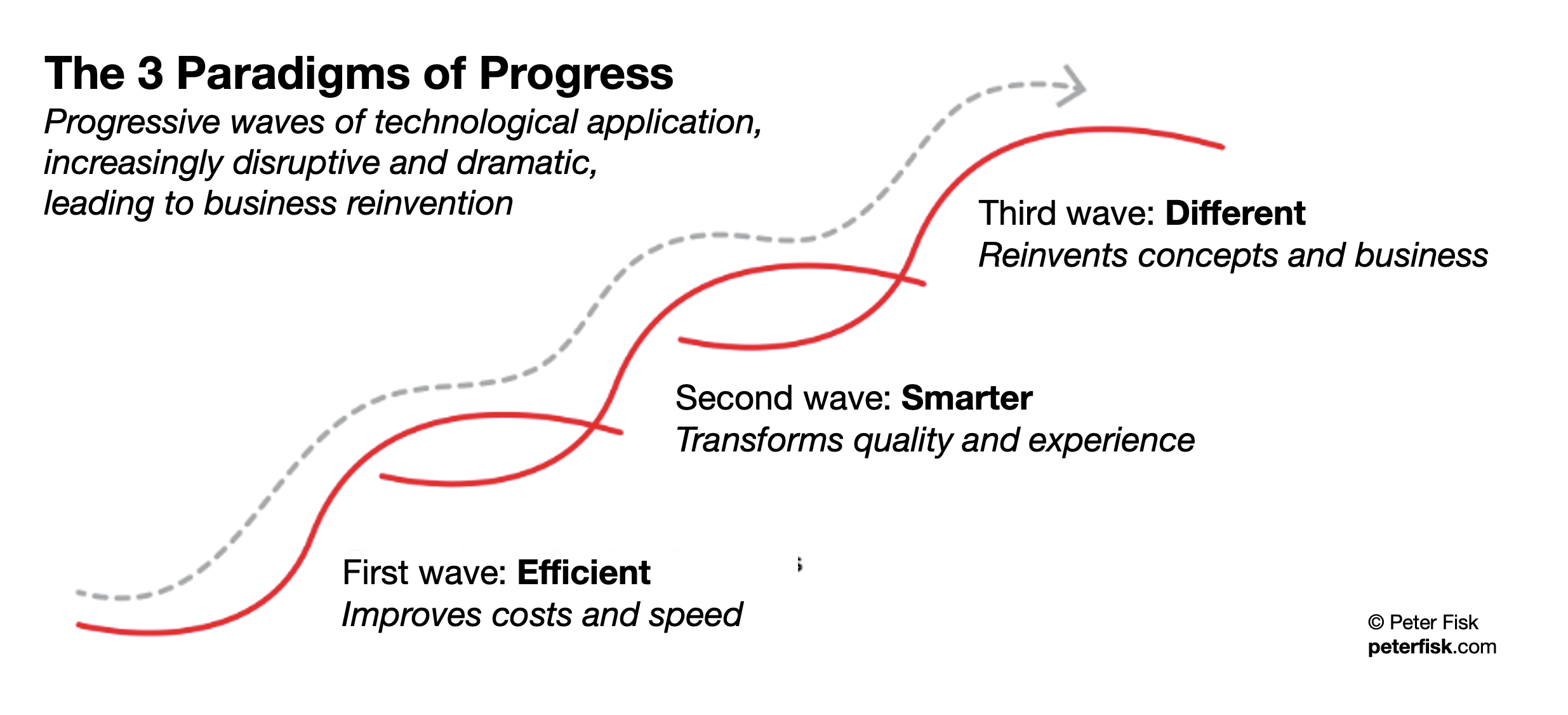
Think about how AI has the potential to transform customer service, for example – initially by making processes faster or cheaper, then by enhancing services through more intelligence or personalisation, but eventually by completely reinventing services and the user experiences.
Or consider banking. Initially AI improved efficiency, automating services, and reducing fraud. Now we see a new generation of products, from embedded payments to peer to completely new services. The real shift will come in the third wave, making banks anticipative, connected, and invisible.
We can see the same three s-curves playing out in every sector, from retail to automotive, finance and entertainment, doctors and lawyers. Maybe slowly at first, but the drama and disruption will definitely come. And yet most companies get stuck on the first wave. Their mindset is fixed, limited by what they know, and seeking to improve the known.
The opportunity is to ride the waves of progress, and ultimately to unlock the new possibilities, to reinvent your business.
How far are you willing to go?
1. Doing Things More Efficiently
“Let’s do what we’ve always done—just faster, cheaper, or with fewer people.”
In the first phase of any major technology adoption, organizations use it to streamline existing processes. The focus is operational efficiency: reduce costs, automate repetitive tasks, and increase productivity. Technology is seen as a tool to optimize the status quo.
Consider artificial intelligence. The earliest commercial applications of AI were centered around automating call centers, tagging images, processing invoices, or assisting with code generation. In each case, the work being done remained largely the same—but now it could be done quicker and with fewer resources.
Historical parallels abound. The arrival of electricity didn’t immediately lead to new kinds of factories—it simply replaced steam engines. It took decades for architects and engineers to redesign factories in ways that leveraged electric power’s full flexibility.
Efficiency is a seductive starting point because it promises fast returns and low risk. But it’s also the least transformative.
Technology is used to optimize existing operations.
-
Amazon (early years): Initially applied algorithms and automation to optimize warehouse logistics and online order fulfillment—doing traditional retail more efficiently at scale.
-
Banks & Financial Services: Robotic process automation (RPA) is widely used to handle repetitive tasks like onboarding, compliance checks, or data entry, saving time and labor but not transforming the service itself.
-
Legal industry: Tools like e-discovery platforms and contract review software use AI to speed up document analysis—reducing billable hours, but still following the same legal workflows.
2. Doing Things Smarter
“Let’s use technology to improve the quality, experience, and outcomes of what we do.”
Once technology proves its utility, a second paradigm emerges: using it to enhance outcomes, not just reduce inputs. This is about improving quality, personalization, speed, accuracy, and scale in meaningful ways.
With AI, this might mean using large language models not just to draft documents faster, but to generate better insights, recommendations, or creative content. In healthcare, AI shifts from automating administrative tasks to supporting better diagnoses. In education, it moves from grading tests to creating adaptive learning experiences tailored to each student.
At this stage, industries begin to rethink customer value. Products become services. Services become platforms. Decisions become more data-driven. Human-AI collaboration becomes a strength, not a threat.
This second curve usually requires more investment, redesign, and cultural change—but it also starts to deliver deeper competitive advantages. Still, it often works within the current paradigm of how business is structured.
-
Spotify: Goes beyond delivering digital music efficiently. Its recommendation engine uses machine learning to personalize listening experiences, improving engagement and satisfaction.
-
Tesla: Uses AI not just to manufacture cars more efficiently but to deliver a better product—integrating software updates, self-driving capabilities, and connected services that continuously improve over time.
-
Healthcare providers: Mayo Clinic and others use AI to assist with diagnosis, image analysis, and treatment recommendations—resulting in better patient outcomes rather than just administrative savings.
3. Doing Things Differently
“Let’s reimagine what’s possible. Let’s create entirely new ways of solving problems.”
The final paradigm is the most powerful—and the most disruptive. Here, technology enables us to do things we couldn’t do before, in ways that redefine markets, organizations, and even social norms.
This is the territory of reinvention.
AI doesn’t just improve the current supply chain—it creates autonomous, self-optimizing systems. It doesn’t just enhance education—it enables new forms of peer-to-peer learning untethered from institutions. It doesn’t just help us write emails—it changes the nature of communication and creativity itself.
Companies that embrace this third curve become platforms of innovation. They don’t just use technology—they are technology. Think of Uber (redefining transport), Airbnb (redefining hospitality), or OpenAI (redefining human-machine interaction). In each case, the underlying technology unlocked a new business model, a new ecosystem, and a new way of creating value.
To operate on this third curve requires bold leadership, vision, and a willingness to break with tradition. It’s risky—but the rewards are exponential.
-
Airbnb: Didn’t just improve hotel booking—it redefined hospitality by enabling people to monetize spare space, shifting the industry from centralized providers to a peer-to-peer network.
-
OpenAI & ChatGPT: Rather than just making writing faster, generative AI allows entirely new modes of interaction, creativity, education, and problem-solving—altering how we produce, consume, and think about information.
-
Zipline: In Africa and parts of the U.S., Zipline uses drones and AI logistics to deliver medical supplies to remote areas. It’s not just faster—it reimagines access to healthcare, overcoming infrastructure gaps entirely.
-
Shopify: Went beyond helping merchants set up websites. It enabled a new generation of entrepreneurs to create entire businesses from anywhere, while integrating payments, logistics, and data in a single platform.
-
Decentralized Finance (DeFi): Blockchain technology powers decentralized exchanges, lending, and insurance—removing the need for traditional financial intermediaries altogether.
Navigating the Three Curves
Each paradigm of progress builds on the one before. Organizations often move through them sequentially, but the most adaptive ones intentionally leap ahead—investing not just in operational tools, but in strategic transformation.
Here’s how leaders can think about the journey:
-
Efficiency is about survival. If you don’t automate, someone else will.
-
Effectiveness is about differentiation. This is where trust, loyalty, and growth emerge.
-
Reinvention is about leadership. It’s how you shape the future rather than react to it.
Technology is not a single destination—it’s a shifting landscape of possibilities. Whether you’re a startup founder, a corporate executive, or a policymaker, recognizing these three paradigms of progress will help you unlock not just productivity, but potential.
And yet most companies get stuck in phase one—focusing solely on cost reduction. The real value, however, lies in moving up the curve. By recognizing these three paradigms, companies can better map their digital strategy, avoid incrementalism, and unlock the full transformative power of technology.
Progress isn’t just about doing things faster. It’s about doing them smarter—and ultimately, differently.
In the age of AI and exponential change, the question isn’t whether to adopt new technologies. It’s how far you’re willing to let them take you.
This toolkit is taken from Peter Fisk’s new book The Reinvention Playbook, and are also offered as an executive workshop for business leaders, connecting personal development and preparing to transform their organisations.
In a world defined by relentless change—technological disruption, climate imperatives, geopolitical shocks, and shifting consumer aspirations—business reinvention is no longer optional. The companies that thrive are not simply resilient; they are reinventive. They embrace change as a constant, and build the ability to transform themselves repeatedly and deliberately.
But reinvention is not an abstract aspiration. It requires practical tools—frameworks, mindsets, and methods—that help leaders reimagine markets, business models, organizations, and themselves.
Here we explore the 10 best tools for business reinvention, drawn from research and practice, and illustrated by companies that have reinvented with purpose and performance.
1. Future Ready
Tool: Future Readiness Frameworks, Scenario Stress Tests, Strategic Agility Indices
Before embarking on transformation, companies must ask: how future-ready are we? Tools that assess preparedness allow organisations to benchmark against disruption, resilience, and innovation capabilities.
Tools like the IMD Future Readiness Indicator or frameworks from McKinsey’s Resilience Compass provide structured ways to assess readiness across dimensions such as innovation, digitalization, sustainability, adaptability, and talent.
A readiness assessment surfaces strengths and vulnerabilities. For example, Fujifilm recognized early in the 2000s that its reliance on photographic film would not survive the digital wave. A candid assessment of market trends and internal capabilities drove its bold pivot into healthcare, materials science, and document solutions.
Similarly, Ping An of China, ranked consistently highly: it transformed from a traditional insurer into a sprawling fintech and health-tech ecosystem, building AI, big data, and platform capabilities long before incumbents recognized the shift.
How to use it:
-
Conduct scenario stress tests to see how your business model holds up against shifts (e.g., carbon taxes, AI adoption, consumer activism).
-
Use benchmarking surveys to measure agility across leadership, digital infrastructure, and culture.
-
Identify capability gaps—the difference between where you are and what the future will demand.
Leaders should use readiness tools not only diagnostically but also prescriptively: to chart specific gaps and create action plans. This gives reinvention a fact-based foundation.
2. Change Radar
Tool: Strategic Foresight, Trendspotting, Early-Warning Radar Systems
The best companies don’t just respond to market shifts—they sense them early – and change before they have to. Tools for market sensemaking include horizon scanning, scenario planning, and weak-signal analysis. Rita McGrath’s concept of “seeing around corners” is particularly useful: it trains leaders to spot inflection points—moments when industries change shape.
Consider Disney, which sensed the streaming revolution and moved aggressively with Disney+. Despite cannibalizing parts of its traditional media empire, the move ensured it stayed relevant in the digital-first content economy. Similarly, Ping An anticipated that finance was moving toward ecosystems, not siloed products, and invested early in fintech, health tech, and smart city services.
How to use it:
-
Build dedicated foresight teams to scan adjacent industries, emerging technologies, and societal shifts.
-
Invest in ethnographic research to uncover unarticulated customer needs.
-
Develop a “change radar”—a dashboard of indicators that trigger leadership attention when trends accelerate.
Reinvention requires peripheral vision—seeing sooner and acting faster than rivals. Sensemaking tools help businesses act before they are forced to—driving proactive, not reactive, reinvention.
3. Market Making
Tool: Blue Ocean Strategy, Jobs-to-Be-Done, Market-Making Playbooks
Reinvention often requires creating entirely new market spaces—what W. Chan Kim and Renée Mauborgne call Blue Oceans. Tools like customer journey mapping, jobs-to-be-done frameworks, and non-customer analysis help organizations imagine new demand frontiers.
Mercado Libre is a prime example. Originally an e-commerce marketplace, it created new growth spaces by adding payments (Mercado Pago), logistics (Mercado Envios), and lending. This market-making mindset turned Mercado Libre into Latin America’s leading digital ecosystem, not just an online retailer.
How to use it:
-
Identify customer frustrations and unmet aspirations, then design solutions that dissolve old industry borders.
-
Map “jobs to be done” in people’s lives—then ask, how can we serve them more fully?
-
Pursue adjacency plays: use core strengths to create new demand spaces.
Reinvention is often about expanding the canvas, from serving markets to shaping them. Market-making tools help companies shift from defending old boundaries to imagining new possibilities.
4. Business Model Reinvention
Tool: Business Model Canvas 2.0, Circular Economy Frameworks, AI Value Maps
The Business Model Canvas remains a vital tool, but reinvention today often requires expanding it with lenses like sustainability and AI capabilities. Companies must ask:
-
How do we integrate environmental and social value creation?
-
How do we embed new technologies into the core of the model?
Ørsted, for instance, transformed its business model from fossil fuels to renewable energy, becoming the world’s largest offshore wind producer. Ping An embedded AI across healthcare and insurance to scale new models of risk management and preventive care. These cases highlight that the next wave of business models are regenerative, data-driven, and ecosystem-oriented.
How to use it:
-
Map your existing business model—then ask, how can AI, sustainability, or ecosystems transform each building block?
-
Explore circular models (reuse, recycling, sharing) that align with global climate agendas.
-
Stress-test models against digital disruption and ESG demands.
Reinvention demands transformational new models of value creation, not just incremental efficiency.
5. Future Portfolios
Tool: Dual Transformation Frameworks, Ambidextrous Organizations
One of the most practical reinvention frameworks is Dual Transformation: Transformation A strengthens the current core, while Transformation B builds the future. The bridge between them is new capabilities.
Fujifilm exemplifies this: Transformation A kept its imaging and printing businesses profitable; Transformation B built new pillars in healthcare and advanced materials. Similarly, Microsoft under Satya Nadella kept Windows and Office profitable while reinventing itself around Azure cloud and AI.
Similarly, you might define two portfolios – exploit and explore. The exploit portfolio brings together all of the initiatives that improve and innovate the current business, while the explore portfolio focuses on the initiatives that invent and innovate the future business. You need to manage both portfolios simultaneously.
How to use it:
-
Structure innovation portfolios with distinct metrics for core, adjacent, and transformational bets.
-
Build ambidextrous leadership teams, with different incentives and governance for exploit vs. explore.
-
Foster “strategic patience”—accepting that new businesses need time to mature.
The dual transformation tool helps leaders avoid the “either/or” trap. Reinvention is about both exploiting today and exploring tomorrow, managed as a portfolio.
6. Burning Ambition
Tool: Making the Case for Change, Transformation Storytelling, Disruption Simulations
One of the hardest parts of reinvention is mobilizing urgency before crisis hits. Tools like Kotter’s change model and storytelling frameworks for “burning platforms” help leaders articulate why transformation is needed now—not later.
Netflix, under Reed Hastings, famously disrupted its own DVD rental business by launching streaming long before physical rentals collapsed. It framed the shift as essential for survival and growth. Pfizer’s rapid pivot during Covid-19 showed the power of urgency. By embracing mRNA technology and partnering with BioNTech, Pfizer transformed its R&D model in record time—mobilizing its entire workforce and ecosystem toward a single mission.
The lesson: leaders must create urgency without waiting for disaster, using tools that combine data, foresight, and narrative power.
How to use it:
-
Use simulations to show how disruption could erode your market if no change occurs.
-
Craft narratives that emotionally connect employees and stakeholders to the necessity of reinvention.
-
Balance the “fear of loss” with the “hope of opportunity.”
Transformation requires a burning ambition, not just a burning platform.
7. Change Alignment
Tool: Culture-Strategy Alignment Maps, Operating Model Redesign, Humanocracy Principles
Reinvention fails when external strategies outpace internal change. Tools like the Operating Model Canvas, McKinsey’s 7S Framework, or alignment maps help ensure that new market strategies align with internal culture, processes, and capabilities.
Ping An’s reinvention was not just about launching fintech products—it built an organizational model where technology capabilities, AI, and ecosystems were integrated into the operating DNA. Similarly, Unilever has aligned its sustainability-driven external strategy with deep cultural change inside the company, embedding purpose and ESG into decision-making.
Haier, the Chinese appliance giant, reinvented itself into a network of entrepreneurial micro-enterprises, aligning its internal model with its external strategy of hyper-customer responsiveness. Netflix, through its “No Rules Rules” culture, aligned radical empowerment with the demands of a fast-changing streaming market.
How to use it:
-
Map how your strategy requires cultural and organizational shifts.
-
Use operating model redesign tools to break bureaucracy and empower teams.
-
Adopt principles of humanocracy—making organizations more human, less bureaucratic.
Reinvention fails when strategy races ahead of culture. Both must transform together. Alignment tools keep reinvention coherent, so the inside matches the outside.
8. Transformation Roadmap
Tool: Transformation Roadmaps, S-Curve Mapping, Capability Maturity Models
Business transformation is rarely a one-off project; it’s a multi-year journey. Tools like transformation roadmaps, agile metrics, and portfolio governance models help structure reinvention in phases.
Disney’s transformation under Bob Iger illustrates this. Over 15 years, Iger reimagined Disney through acquisitions (Pixar, Marvel, Lucasfilm), digital platforms (Disney+), and cultural renewal. Each phase built on the previous, compounding value creation.
Siemens used a staged transformation roadmap to pivot from industrial conglomerate to digital-industrial leader, focusing sequentially on digital twins, IoT platforms, and smart infrastructure. Each phase built capabilities for the next.
How to use it:
-
Design transformation as a staged journey: defend, extend, transcend.
-
Map required capabilities and investments at each stage.
-
Regularly update the roadmap to reflect evolving external realities.
The roadmap tool ensures reinvention is sequenced, measurable, and adaptive—rather than chaotic. Reinvention is not a sprint. It’s a marathon of S-curves.
9. Value Impact
Tool: Value Creation Scorecards, ESG-Integrated Metrics, Long-Term Incentives
Reinvention is only complete when performance is measured differently. Tools like the Integrated Reporting Framework, ESG scorecards, and long-term value creation metrics (used by the World Economic Forum) help leaders move beyond short-term profit toward holistic impact.
Danone, during its transformation into a health-focused food company, adopted integrated reporting to balance financial, social, and environmental metrics. BlackRock now pressures portfolio companies to show long-term value creation beyond quarterly earnings.
For instance, Mercado Libre reinvented Latin American commerce while also building financial inclusion for millions of underbanked citizens. Its performance is measured not just in GMV growth, but in the new ecosystem of opportunity it has created.
How to use it:
-
Redesign performance dashboards to include innovation, sustainability, and inclusion metrics.
-
Link executive incentives to long-term reinvention outcomes, not just quarterly EPS.
-
Benchmark against peer leaders in value creation (e.g., McKinsey’s Long-Term Value Index).
By adopting new performance tools, companies ensure their reinvention creates enduring impact, not just temporary wins. Reinvention pays off when it creates enduring, transformational value.
10. Reinvent Yourself
Tool: Adaptive Leadership Models, Resilience Training, Personal Reinvention Journeys
Finally, reinvention is deeply personal. Leaders cannot expect organizations to transform if they themselves cling to old mindsets. Tools for self-reinvention—coaching, resilience practices, adaptive leadership models—equip leaders to navigate uncertainty with clarity and courage.
Satya Nadella’s leadership at Microsoft is a case in point. By reinventing himself as a learning-driven, empathetic leader, Nadella unlocked cultural and strategic reinvention across Microsoft—from a combative “know-it-all” culture to a collaborative “learn-it-all” mindset.
Bob Iger’s leadership at Disney, chronicled in The Ride of a Lifetime, shows reinvention leadership in practice: bold acquisitions (Pixar, Marvel, Lucasfilm), digital transformation (Disney+), and a culture of creativity.
How to use it:
-
Embrace lifelong learning, especially in emerging fields like AI, sustainability, and systems thinking.
-
Build resilience practices to thrive under ambiguity.
-
Model vulnerability and curiosity—creating psychological safety for reinvention.
Reinvention starts with you, and with self-reinvention.
In summary:
Business reinvention is no longer episodic—it’s continuous. The 10 tools outlined here provide a practical playbook for leaders:
-
Assess your future readiness.
-
Sense markets and time change.
-
Create new market spaces.
-
Reinvent business models with new agendas.
-
Balance exploit and explore.
-
Make the case for change.
-
Align strategy with culture and organization.
-
Map multi-year journeys.
-
Reinvent performance metrics.
-
Reinvent yourself as a leader.
The examples of Ping An, Fujifilm, Mercado Libre, Disney, Pfizer, and others remind us that reinvention is not only possible, but powerful. It requires courage, foresight, and discipline. More than anything, it requires leaders who embrace reinvention not as a one-time act, but as a way of life.
The New Zealand footballer and his woolly sneakers, the Swiss climate entrepreneurs in remote Iceland, the French energy innovator who creates prosumers, the 87 year old fisherman who stood up to Trump, and the Swedish oat milk pioneer who can’t sing … How can they help you to innovate with more impact, and deliver more sustainable growth?
Challenge as Opportunity
As global challenges mount—climate change, biodiversity loss, inequality, resource scarcity, a new generation of companies is not only responding but thriving.
These sustainability-driven innovators are reframing capitalism, embedding environmental and social goals into the core of their strategy, and leveraging breakthrough concepts like circularity, regenerative design, stakeholder capitalism, and systems thinking.
They represent the vanguard of a new economic era—one in which commercial performance and positive impact are not in conflict but are mutually reinforcing.
Sustainability is no longer a compliance exercise or marketing trend. It is a core driver of innovation, competitiveness, and resilience. The most advanced sustainable innovators are those who view environmental and social challenges not as constraints, but as opportunities to innovate products and services, grow in new ways, and reimagine value creation.
They are leading the way toward an economy that is not only profitable, but also just, regenerative, and future-fit.
As pressures mount from investors, regulators, consumers, and the planet itself, more companies will be forced to follow this path. The future will belong to those who can align their business models with the well-being of people and the planet—and turn that alignment into enduring advantage.
Net Zero to Net Positive
Sustainability in business has long been framed by concepts like CSR, ESG, net zero, and circularity. While these remain critical, the next wave of innovation demands that companies go far beyond managing risk or reducing harm. Today’s leading businesses are embracing bold, transformative approaches that position sustainability as a powerful driver of innovation and growth, unlocking entirely new possibilities.
One of the most exciting shifts is the move toward regenerative economics and business models. Rather than simply minimizing environmental impact, companies are designing systems that actively restore natural capital and rebuild communities. This regenerative mindset pushes businesses to innovate products and supply chains that regenerate soil health, replenish biodiversity, and revive local economies—turning sustainability into a net positive force.
Conventional sustainability (CSR, ESG, and most “green” and “circular” initiatives) have typically been about causing less damage, making the world less bad, getting to net zero. Now is the time to go beyond those conventions – it’s time to give back more than you take, to make the world better, to create net positive impact. After all, every business should have a purpose as a fundamental premise, about how it creates a world better than if it didn’t exist.
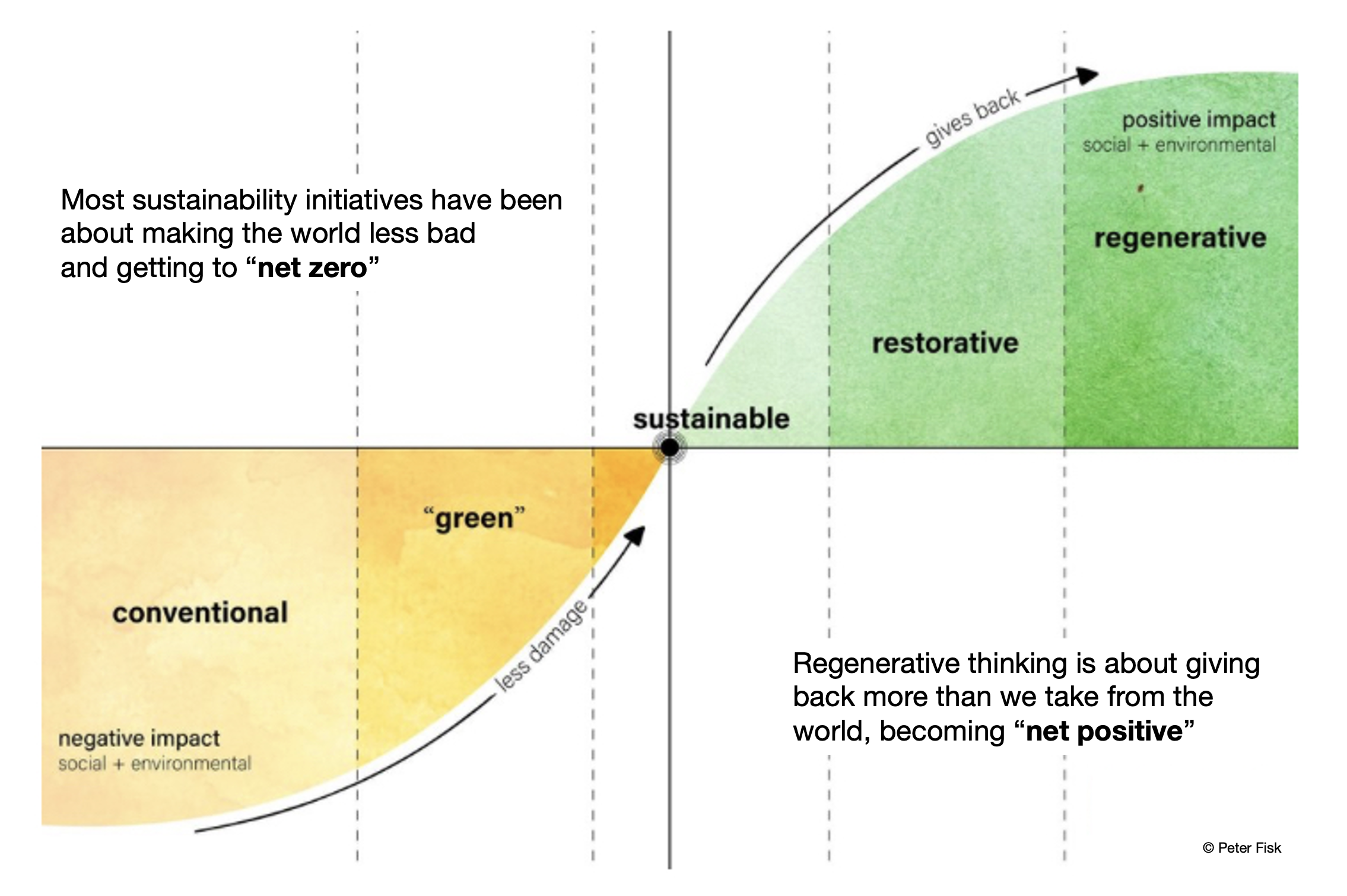
Reinventing business
To truly transform, companies are also adopting systems thinking—understanding the complex interconnections between their business, society, and the environment. This systemic perspective drives cross-sector collaboration, where competitors, NGOs, governments, and communities co-create solutions to challenges no single actor can solve alone. From regenerative ocean farming coalitions to circular electronics ecosystems, this collective approach unlocks scale and impact.
Purpose-driven ecosystem leadership is another emerging trend. Here, companies act as platforms or hubs, orchestrating innovation networks and enabling suppliers, startups, and partners to align around shared sustainability goals. Embedding purpose deeply into governance and culture transforms sustainability from a compliance task into a strategic advantage and growth engine.
Nature-positive innovation is also redefining product development. Companies increasingly draw inspiration from biomimicry and invest in nature-based solutions that provide climate, biodiversity, and social benefits simultaneously. Advances in synthetic biology and biofabrication enable breakthroughs like lab-grown leather and mycelium packaging, disrupting traditional resource-intensive industries.
Digital sustainability and climate tech offer game-changing tools. AI, blockchain, IoT, and digital twins bring unprecedented transparency and precision to carbon tracking, resource efficiency, and supply chain optimization. New frontiers include carbon removal marketplaces and tokenized nature assets, opening fresh pathways to monetize and scale impact.
Embedding sustainability into human experience through behavioral design and well-being further advances impact. Products and services are crafted to nudge sustainable habits, connect people to nature, and support mental health—recognizing that personal and planetary health are intertwined.
Resilience and antifragility gain prominence as companies design systems that don’t just withstand shocks but thrive in disruption. Distributed energy, adaptive governance, and diversified supply chains prepare businesses for uncertainty while fostering long-term stewardship.
Finally, decentralization and democratization give communities, employees, and customers direct roles in sustainability through blockchain-enabled DAOs and crowdsourced innovation—making sustainability a shared, transparent endeavour.
Positive and profitable
Many business leaders have lost confidence in sustainability as a business priority over recent years. This is because most sustainability initiatives were developed separately from the core business model – for compliance, for reputation, and usually as a cost. They fail to deliver profits, and sustainable growth. But these ideas are absolutely not incompatible.
The term net positive, first used by former Unilever CEO Paul Polman, seemed like a distant ambition at the time. Today, with a new generation of companies on the rise, and new technologies to support their radical business models, it has now become far more possible. Climeworks, the direct air capture business, is a great example of this progress.
Business can be a force for good. Social regeneration and inclusive prosperity—moving beyond philanthropy to rebuild social capital and equitably value creation. Innovative business models like cooperatives and profit-sharing foster inclusion, while social metrics on well-being and equity, become as vital as environmental KPIs.
The best “net positive” companies do more for the world, and for their shareholders too. They create products and services that are good for the environment and society, but also better than competitors too. It tastes better, looks better, performs better. This requires more thoughtful innovation. Their brands align with the values of conscious consumers, and their propositions are more desirable and worth paying more for too.
They can grow, although maybe less physically, and deliver profits. Indeed, as investment gurus like BlackRock’s Larry Fink realised, they typically deliver more sustained (and sustainable) value creation. By rethinking how they innovative, how their business models and ecosystems work, and how they deliver mutual value for all stakeholders.
Look at the examples below, Allbirds to NextEra, Schneider Electric to Oatly. And many more.
At the heart of these trends lies transformative leadership and culture change. Leaders who embrace complexity, humility, and empathy cultivate cultures of experimentation and learning—turning sustainability into a continuous journey of innovation and impact.
Allbirds … Reinventing sneakers from wool, trees, and sugarcane
Allbirds, the San Francisco-based footwear company founded in 2016 by Tim Brown and Joey Zwillinger, has emerged as a standout example of how sustainability can be embedded in the DNA of a business—driving innovation, market differentiation, and financial growth. Born from the simple idea of creating a more sustainable shoe, Allbirds has transformed the footwear industry with radical transparency, regenerative materials, and a bold commitment to carbon accountability.
From the outset, Allbirds challenged the norms of an industry plagued by synthetic materials and high carbon footprints. Instead of petroleum-based fabrics, the company focused on natural, renewable alternatives—most notably, merino wool sourced from New Zealand, sugarcane-based EVA (branded as SweetFoam), castor bean oil insoles, and tree fiber uppers from FSC-certified eucalyptus. Each material choice was a deliberate attempt to lower the environmental impact while enhancing performance and comfort.
But Allbirds didn’t stop at sustainable materials—it reimagined the entire business model around carbon-conscious decision-making. In 2019, Allbirds began labeling every product with its carbon footprint, much like nutritional facts on food packaging. This level of transparency set a new standard in consumer goods and pressured competitors to follow suit. By internalizing the true cost of emissions, the company made sustainability a tangible and trackable part of its brand proposition.
Leadership has played a critical role in this transformation. Zwillinger, with a biotech and cleantech background, brought a systems-thinking approach to scaling green innovation. Together with Brown, they have fostered a culture that integrates design, science, and sustainability at every level of decision-making—from product R&D to supply chain logistics.
Allbirds also took the unusual step of open-sourcing its SweetFoam technology, allowing competitors to adopt the carbon-negative innovation in an effort to reduce the overall industry footprint. This move underscores the company’s belief in collaborative impact over competitive secrecy—a principle that has resonated with climate-conscious consumers and investors alike.
As of 2024, Allbirds has expanded into performance running shoes and apparel, while continuing to refine its carbon reduction goals. It became one of the first fashion brands to commit to near-term science-based targets (SBTi) and a net-zero trajectory by 2030. However, growth has not been without its challenges—especially in maintaining profitability during expansion and responding to shifting consumer demand post-COVID. Nevertheless, the company’s focus on innovation and long-term impact has positioned it as a resilient and future-facing brand.
The result is a business that not only delivers stylish, comfortable shoes but also serves as a proof point for how purpose and profit can be mutually reinforcing. Allbirds exemplifies the next generation of climate-native brands—those that view environmental urgency not as a constraint, but as a launchpad for rethinking everything.
Sustainability pillars:
-
Using natural materials like merino wool, eucalyptus fiber, and sugarcane-based EVA.
-
Developing carbon-negative foam and partnering with Adidas on the lowest-emission sneaker ever made.
-
Aligning its entire business with Life Cycle Assessments (LCAs) and SBTi (Science Based Targets initiative).
Allbirds is proof that sustainability can be both stylish and scalable.
More about Allbirds
Climeworks … accelerating decarbonisation through direct air capture
Climeworks, a Swiss startup founded in 2009 by engineers Christoph Gebald and Jan Wurzbacher, has positioned itself at the frontier of climate innovation by building one of the world’s first commercially viable direct air capture (DAC) companies. In a time when decarbonization alone is no longer enough, Climeworks has reimagined what it means to lead in the climate economy—not by reducing emissions, but by removing them from the atmosphere entirely.
The company’s mission is both ambitious and urgent: to empower a climate-positive world by permanently removing CO₂ from the air. Climeworks’ proprietary technology uses modular DAC machines that capture atmospheric CO₂ using specialized filters and low-grade heat. Once captured, the CO₂ can be either stored underground—via partnerships like the one with Carbfix in Iceland—or reused in industrial processes. Unlike traditional offsets, which often come with questions around permanence and verification, Climeworks focuses on verifiable, measurable, and durable carbon removal.
In 2021, Climeworks launched Orca, the world’s largest DAC facility at the time, built in just 15 months in Iceland. Orca permanently stores around 4,000 tons of CO₂ per year underground in basalt rock formations. In 2024, it unveiled Mammoth, its second-generation facility with ten times the capacity, as part of its roadmap to scale carbon removal into the megaton range by the end of the decade.
Climeworks’ innovation is not just technical—it’s strategic. Recognizing that voluntary carbon markets were fragmented and often untrustworthy, the company set out to build an entirely new category of carbon removal, certified by independent standards and embraced by climate-conscious brands. Its early clients included Microsoft, Shopify, Stripe, and Swiss Re—companies that saw carbon removal not just as an offset, but as an investment in future-proofing their operations.
The leadership of Gebald and Wurzbacher has been defined by bold vision and patient capital. Rather than chasing short-term profits, they focused on scaling infrastructure, refining cost curves, and building long-term trust. In 2022, Climeworks raised over $600 million in the largest-ever investment in the DAC sector, a vote of confidence in its scalable model and technological credibility.
Climeworks also invests in public transparency and education, offering individual subscriptions for carbon removal and communicating openly about its methodologies and progress. This “consumer layer” adds visibility to a complex sector and helps normalize the idea of permanent carbon removal in everyday decision-making.
As the climate crisis accelerates, carbon removal is gaining acceptance not as a niche add-on but as a critical pillar in achieving net-zero and eventually net-negative emissions. By leading the commercialization of DAC, Climeworks is helping to define what responsible, science-based climate leadership looks like in the 21st century.
More than a startup, Climeworks is emblematic of the next wave of businesses built around planetary limits, systemic change, and regenerative innovation. It is not merely adapting to environmental challenges—it is shaping the very architecture of a decarbonised future.
Visiting Climeworks in Iceland
Danone … from food giant to a healthy planet, and sustainability champion
Danone, the French multinational food company, has repositioned itself over the last two decades as a pioneer of responsible capitalism—driven by a mission to “bring health through food to as many people as possible.” This strategic reinvention has touched every part of the business, from governance and branding to sourcing and innovation.
Former CEO Emmanuel Faber played a transformative role in turning Danone into a purpose-led enterprise. Under his leadership, Danone adopted a “dual project” model—pursuing both economic and social goals—and in 2020 became the first listed company in France to adopt Entreprise à Mission legal status. This change hardwired environmental and social objectives into the company’s bylaws and oversight mechanisms.
Danone has embedded sustainability into its supply chain, particularly through regenerative agriculture programs for dairy and plant-based ingredients. It is one of the world’s largest B Corp-certified corporations, with over 70% of its global subsidiaries independently certified for social and environmental performance. Its strategy includes reducing greenhouse gas emissions across the value chain and aiming for carbon neutrality by 2050.
The company has expanded its portfolio toward plant-based nutrition (via acquisitions like Alpro and Silk) and medical and early-life nutrition, aligning growth with health outcomes. Despite facing investor pressure that led to Faber’s departure, Danone’s purpose-driven model continues to influence how global food companies define performance—combining nutrition, sustainability, and stakeholder value.
More about Danone
IKEA … designing a circular and climate-positive future for furniture
IKEA, the world’s largest furniture retailer, has undergone a major transformation to integrate sustainability into the heart of its business. Once associated with mass production and disposable products, IKEA is now reengineering its entire value chain—from sourcing to product design to end-of-life recovery—to align with a circular and climate-positive strategy.
Under the leadership of Jesper Brodin, CEO of Ingka Group (which operates most IKEA stores), the company set bold goals: to become climate positive by 2030, using only renewable or recycled materials, and ensuring all products are designed for reuse, refurbishment, or recycling. It has already phased out single-use plastics and is transitioning toward regenerative sourcing for wood and cotton.
IKEA is pioneering circular retail with furniture take-back, repair, and resale programs in multiple markets. It has launched services for leasing furniture and developed modular, disassemblable products to extend product life. The company also invested heavily in renewable energy—installing solar panels on stores and becoming one of the largest corporate buyers of wind and solar globally.
This reinvention has been critical to maintaining relevance with younger, sustainability-conscious consumers while unlocking new revenue streams and efficiencies. IKEA’s vision blends environmental impact with affordability—proving that a circular economy can be accessible and profitable at scale.
Interface … from carpets and flooring tiles, to mission zero and climate take back
Interface, a global flooring manufacturer, is a pioneer in sustainable business reinvention. In the mid-1990s, founder Ray Anderson underwent a personal epiphany after reading The Ecology of Commerce, shifting the company’s trajectory from a conventional carpet tile maker to an environmental leader.
Anderson launched Mission Zero—a commitment to eliminate all negative environmental impact by 2020. Interface overhauled its supply chain, shifted to recycled and bio-based materials, and developed closed-loop recycling for its products. It redesigned carpets to be modular and glue-free, reducing waste and enabling easy replacement.
More recently, Interface launched Climate Take Back, aiming not just to reduce harm but to reverse global warming. The company introduced the first carbon-negative carpet tile, using materials and processes that sequester more carbon than they emit. It also created a roadmap for regenerative design, using biomimicry and cradle-to-cradle principles.
Interface has demonstrated strong financial performance alongside its environmental mission, consistently ranking among the most sustainable companies in the world. Its journey has inspired entire industries to rethink what’s possible in manufacturing.
Its next challenge is “Climate Take Back”, aiming not just to reduce harm but to reverse global warming by:
-
Creating carbon-negative carpet tiles.
-
Using bio-based and recycled materials.
-
Leveraging life cycle thinking and industrial ecology to design regenerative systems.
Interface exemplifies deep systems change through innovation and purpose.
Next Era Energy … from electricity utility to clean energy leader
NextEra Energy, based in Florida, has transformed from a traditional electric utility into the largest producer of wind and solar energy in the world. Its reinvention is a case study in turning regulatory and environmental pressure into innovation and market leadership.
Led by visionary former CEO Jim Robo, and now by John Ketchum, NextEra invested early in renewable energy through its subsidiary NextEra Energy Resources. Instead of resisting change, the company embraced the clean energy transition, pouring billions into wind farms, solar parks, and advanced battery storage systems.
NextEra also modernized its grid infrastructure and began using data and digital tools to improve efficiency and resilience. It shuttered coal plants, committed to net-zero by 2045, and positioned itself as a leader in decarbonizing the U.S. energy system.
The company’s green transformation has been rewarded by markets: NextEra’s market cap has surpassed most of its fossil fuel peers, and it has become a preferred partner for corporations and governments seeking clean energy solutions.
NextEra proves that a fossil-based utility can reinvent itself not only to survive but to thrive in the renewable era, combining environmental leadership with long-term profitability.
Oatly … reimagining milk for the climate-conscious age, and having fun too
Oatly, the Swedish oat milk company, has turned a niche product into a global movement. Founded in the 1990s and relaunched in the 2010s under CEO Toni Petersson, Oatly’s reinvention is based on a provocative, purpose-driven brand and a climate-forward mission: to shift the world away from dairy.
Oatly’s business model directly addresses the environmental impact of livestock agriculture, which is a major source of global greenhouse gas emissions, land use, and water consumption. By offering a plant-based alternative that requires 80% less land, 60% less energy, and 80% fewer emissions than cow’s milk, Oatly presents sustainability as a delicious and mainstream choice.
The company’s packaging and marketing are bold and transparent, often including detailed carbon footprints and advocacy messages. Oatly has also committed to supply chain transparency, regenerative farming, and localizing production to reduce environmental impact.
The brand has scaled rapidly across Europe, the USA and Asia, with a successful IPO in 2021. It now partners with major foodservice brands and retailers, helping plant-based options go mainstream. Oatly’s reinvention of a commodity—milk—demonstrates how sustainability, storytelling, and innovation can create new categories, consumer loyalty, and global growth.
On … Swiss engineering for sporting excellence, great shoes and a better world
Founded in Switzerland in 2010, On Running emerged as a performance footwear disruptor, blending elite athletic engineering with a deep commitment to sustainability. The company’s breakthrough innovation was its patented “CloudTec” cushioning, offering a unique running feel. But what sets On apart is how it has embedded sustainability into its product lifecycle, supply chain, and innovation engine.
Under the leadership of co-founder Caspar Coppetti, On has pursued a bold vision: create high-performance sportswear that leaves the smallest possible environmental footprint. In 2021, On launched the world’s first fully recyclable running shoe, the Cyclon, made from castor beans and available only via a subscription-based circular economy model. Customers return worn shoes for recycling and receive new ones—decoupling revenue from raw material extraction.
On’s sustainability strategy includes using recycled polyester, reducing carbon-intensive materials, and eliminating harmful chemicals. Its partnership with Climeworks—a Swiss carbon capture startup—further underscores its climate-forward thinking. It even used carbon emissions to create a running shoe (Cloudprime) in collaboration with CarbonBuilt and Novoloop.
The result? Rapid growth and IPO success in 2021. On’s revenues have soared past $2 billion, and the brand has won loyal consumers who value both performance and purpose. It has reinvented not only what a running shoe can do—but what a sustainable brand can be.
Patagonia … pioneer of regenerative business, fighting climate change with every cent
Patagonia has long been the gold standard for environmental activism in business. Founded by Yvon Chouinard, the outdoor apparel company has used its business as a platform for change. But in 2022, it redefined corporate sustainability entirely—by giving away the company.
Chouinard transferred ownership to a specially designed trust and nonprofit (Holdfast Collective) that directs all profits not reinvested into the company toward fighting the climate crisis. This radical move capped decades of Patagonia integrating sustainability into every part of its model.
Patagonia’s innovations include the Worn Wear platform (for repair and resale), using recycled and organic materials, and pioneering regenerative organic agriculture. Its supply chain is audited for fair labor practices and environmental impact. The company champions corporate activism—suing the Trump administration to protect national parks, and calling out greenwashing in the industry.
Patagonia has grown into a $1+ billion business, proving that doing good and doing well are not mutually exclusive. It has reinvented outdoor apparel, influenced generations of brands, and challenged traditional models of ownership and value.
Patagonia’s innovations include:
-
Regenerative agriculture in its supply chain to draw down carbon and restore ecosystems.
-
A thriving Worn Wear program for repairing and reselling gear to extend product life.
-
Transparent B Corp practices and a strong advocacy stance on political and environmental issues.
Its model demonstrates how mission-driven capitalism can create lasting brand value and deep customer loyalty.
Schneider Electric … digitalising the future of energy with microgrids and prosumers
Schneider Electric, the French energy and automation giant, has undergone a profound transformation over the last two decades—shifting from a traditional electrical equipment firm to a global leader in sustainability-enabling technology.
Under CEO Jean-Pascal Tricoire, the company aligned its strategy with solving the world’s energy paradox: how to provide more energy to more people, while reducing carbon emissions. Schneider’s digital platform EcoStruxureempowers companies to monitor and reduce energy consumption and emissions in real-time—enabling entire industries to decarbonize.
Internally, Schneider has committed to net-zero across its operations and supply chain by 2050, and already uses 100% renewable electricity in many facilities. The company also helps suppliers meet ESG targets, turning sustainability into a shared ecosystem challenge.
Named the world’s most sustainable corporation by Corporate Knights in 2021, Schneider’s innovations are driving both impact and income: it has consistently delivered strong financial performance and shareholder returns, while helping thousands of companies meet climate goals.
Schneider has reinvented its role—from a utility equipment vendor to a catalyst for sustainable transformation across the global economy.
Core innovations include:
-
EcoStruxure, an IoT-enabled platform for real-time energy monitoring and efficiency.
-
Services in microgrids, smart grids, and renewable integration.
-
Sustainability-as-a-service, helping clients decarbonize operations and supply chains.
Schneider Electric’s “Impact Company” model emphasises resilience, empowerment, and ESG-driven leadership.
Unilever … you can still enjoy great ice-cream, and make the world better at the same time!
Unilever, the Anglo-Dutch consumer goods giant behind brands like Dove, Ben & Jerry’s, and Lifebuoy, has redefined what a global FMCG company can be. Over the past 15 years, it has placed sustainable living at the core of its strategy, driving brand growth and business transformation.
The shift began under former CEO Paul Polman, who launched the Unilever Sustainable Living Plan in 2010. The plan aimed to decouple growth from environmental impact, while improving health and livelihoods for billions. Unilever tackled climate emissions, water use, waste, and sourcing across its value chain.
Today, 80% of Unilever’s agricultural inputs are sustainably sourced, and many of its brands are carbon-labelingproducts. Dove’s campaigns promote real beauty and self-esteem; Lifebuoy improves handwashing habits; and Ben & Jerry’s speaks out on social justice—all while delivering strong margins.
Under current CEO Hein Schumacher, Unilever is focusing even more on climate resilience, circular packaging, and supply chain inclusion. It plans to reach net-zero emissions by 2039 and halve the footprint of its products by 2030.
Unilever’s purpose-led brands are growing faster than others in its portfolio. The company has proven that sustainability is not a cost—but a competitive advantage, enabling reinvention at scale in one of the most resource-intensive industries on the planet.
Unilever’s strategic frameworks include:
-
The Sustainable Living Plan, which linked sustainability to innovation and growth.
-
“Brands with Purpose”, where brands like Dove and Ben & Jerry’s are used to drive social and environmental impact.
-
A deep integration of SDGs (Sustainable Development Goals) into product and sourcing strategies.
Despite market volatility, Unilever has consistently outperformed peers in ESG rankings and brand trust.
New metrics of a net positive business
As the world transitions into an era defined by planetary boundaries, social inequality, and digital acceleration, the question is no longer whether companies should be sustainable—but how to measure what truly matters. Traditional corporate responsibility metrics, framed by CSR (Corporate Social Responsibility) and ESG (Environmental, Social and Governance), have helped integrate sustainability into business. Yet, they often remain compliance-driven and incremental.
Today, a growing number of companies are aiming not just to reduce harm, but to create net positive impact—to put more into the world than they take out. These are businesses that deliver superior financial performance and systemic societal and environmental progress. To do this credibly, they need new metrics: ones that are strategic, integrated, forward-looking, and regenerative by design.
1. True Value Creation: Profit with Purpose
At the heart of any business performance system lies profit. But in a sustainable and net positive business, profitability is contextualised by how it is earned—with what impact on people and the planet. Contemporary metrics look not only at shareholder returns but multi-capital value creation.
-
Integrated Value Metrics: These combine financial, manufactured, natural, human, social, and intellectual capital to assess how businesses create or erode value across systems.
-
Value-to-Society Accounting: Pioneered by companies like Novo Nordisk and SAP, this approach monetises positive and negative externalities to reflect the company’s real contribution (or cost) to society.
-
Profit per Impact Unit: Forward-thinking firms begin to express profit not just in dollars but relative to the positive impact delivered—e.g., profit per tonne of carbon avoided or per low-income customer served.
2. Net Environmental Contribution: Beyond Carbon
Most companies now measure their carbon footprint, but a net positive organisation seeks to go further: to become nature-positive and climate-regenerative. This requires a broader and more ambitious set of metrics.
-
Carbon Handprint vs Footprint: The handprint measures the positive carbon impact of products or services (e.g. emissions avoided by using a clean-tech product) and is increasingly used alongside footprint.
-
Science-Based Targets (SBTi) + Beyond Value Chain Mitigation: Companies like Microsoft and Ørsted now set SBTs that include Scope 3 emissions and commit to removing more carbon than they emit—factoring in nature-based solutions, removals, and restoration.
-
Biodiversity Net Gain: Leading firms like Holcim and Nestlé have adopted biodiversity metrics, such as hectares of habitat restored, or improvements in species richness on company-managed land.
3. Circularity and Regenerative Flows
Circular economy metrics go beyond recycling rates. They assess how effectively companies decouple growth from resource extraction, redesign systems for reuse, and regenerate ecosystems.
-
Material Circularity Indicator (MCI): Developed by the Ellen MacArthur Foundation, it quantifies how restorative the material flows of a product or company are.
-
Circular Revenue Ratio: Measures the share of revenue derived from circular business models—products-as-a-service, resale, remanufacturing, etc.
-
Water Positivity: Companies like PepsiCo and Google aim to return more water to the environment than they withdraw, with metrics on replenishment volumes and watershed restoration impact.
4. Social Impact and Equity Outcomes
Contemporary social metrics go far beyond headcount and charitable donations. Net positive companies measure the depth, scale, and sustainability of their impact on human lives, especially among underserved communities.
-
Decent Work Index: Tracks not just jobs created but their quality—wages, rights, progression, and security. Used by groups like Unilever and Accenture.
-
Social Return on Investment (SROI): Converts social outcomes into financial value to assess how effectively a company creates impact for each dollar spent.
-
Access and Inclusion Metrics: How many people get access to essential products and services—clean energy, education, healthcare—especially in low-income or marginalised areas? d.light and Safaricom use these metrics to track impact at scale.
5. Wellbeing and Human Flourishing
Employee experience is no longer measured only by engagement scores. A regenerative business recognises people as whole humans, and tracks wellbeing, growth, and purpose as part of organisational health.
-
Employee Net Promoter Score (eNPS): Captures how likely employees are to recommend the company—used as a proxy for loyalty and morale.
-
Psychological Safety Index: Gauges whether people feel safe to speak up, take risks, and innovate—key to adaptive, inclusive cultures.
-
Purpose Activation Score: Measures how well individual employees connect their work to the broader purpose of the company—a concept applied by companies like Danone and Lush.
6. Governance for Regeneration
Strong ESG governance is critical—but in net positive companies, governance is more than compliance. It actively steers the business toward long-term value creation and stakeholder balance.
-
Stakeholder Engagement Index: Tracks how systematically and transparently the company involves stakeholders—customers, suppliers, communities—in shaping decisions.
-
ESG-Linked Compensation: The proportion of executive and board pay linked to ESG and net positive outcomes. Schneider Electric, DSM, and Intel integrate such metrics.
-
Purpose Compliance: In countries like France, companies with “Entreprise à Mission” status must report how effectively they deliver on their legally embedded purpose.
7. Transformation and Innovation Capacity
A sustainable organisation isn’t one that simply avoids harm—it’s one that adapts and leads change. That requires investment in innovation, agility, and the ability to scale transformative ideas.
-
Impact Innovation Ratio: Percentage of R&D or capital invested in sustainable, regenerative, or inclusive innovation—e.g., low-carbon tech, inclusive fintech.
-
Transition Readiness Score: Measures how aligned a company’s assets, culture, and capabilities are to a sustainable future—pioneered in ESG risk frameworks like Transition Pathway Initiative (TPI).
-
Speed of Scaling Positive Impact: How fast can the company scale solutions that address climate, health, or social equity challenges?
8. Reputation and Trust as Strategic Assets
Trust and reputation are among the most valuable yet intangible assets of any company. Net positive organisations earn trust through action and accountability.
-
Trust Index: Often measured via global reputation surveys (like Edelman Trust Barometer), or customer trust scores.
-
Transparency Scores: From public disclosures, third-party ESG ratings, and real-time dashboards—used by companies like Patagonia and Tesla to signal openness.
-
Net Trust Gap: The difference between what stakeholders expect and what the company delivers across key environmental and social dimensions.
Examples of metrics in companies
-
Interface, the carpet manufacturer, measures its “Climate Take Back” progress via carbon-negative product sales, gigaton-scale carbon reduction targets, and employee sustainability engagement metrics.
-
IKEA tracks the circularity of its entire product portfolio, sets science-based climate and forest-positive goals, and uses wellbeing indicators across its global workforce.
-
Climeworks, a Swiss carbon capture firm, quantifies its positive climate impact by the tonnes of CO₂ permanently removed—not offset—and has third-party verification in place.
The shift to a net positive business is also a shift in mindset. It redefines success—not as being less bad, but as being actively good. It values long-term over short-term, systems thinking over silos, and deep purpose over shallow PR. And crucially, it builds new metrics to make these ambitions real.
The new performance frontier asks bold questions:
-
Are we helping the world thrive, or just survive?
-
Are we solving problems we helped create—or preventing them in the first place?
-
Are we creating value for all stakeholders—not just shareholders?
In answering these, the best companies are not only building better futures—they are measuring them, managing them, and proving that profit and purpose are not trade-offs, but a route to more holistic success.
Exploring more
Net positive companies—those that aim to give more to the world than they take—can be among the most profitable and value-creating because they align their growth with solving social and environmental challenges. Rather than seeing sustainability as a cost, these companies treat it as a source of competitive advantage, innovation, and long-term resilience.
Achieving net positive impact often requires deep business reinvention: rethinking core strategies, reimagining products and services to deliver environmental or social benefits, and designing new business models that generate value through regeneration, circularity, or shared prosperity.
This transformation demands bold leadership—leaders willing to challenge short-term thinking, set ambitious goals, and embed purpose across the organization. Companies like NextEra, Patagonia, and Schneider Electric show that when sustainability drives innovation and is integral to strategy, it can unlock new markets, reduce risk, attract top talent, and build strong, trusted brands. In today’s economy, doing more good isn’t just ethical—it’s a smart, future-focused way to grow.
- Sustainable Futures Project by Peter Fisk
- World’s Most Sustainable Innovators by Peter Fisk
- People Planet Profit: Guide to Sustainable Innovation by Peter Fisk
From AI labs in London to climate pioneers in Zurich, Europe’s cities host a wealth of innovation. Each city offers a unique perspective on solving global challenges — from how we move, eat, bank, and live to how we explore space or communicate across languages.
Europe’s rich innovation heritage stretches back centuries, from the Renaissance to the Industrial Revolution, and has been shaped by a unique blend of scientific curiosity, cultural diversity, and deep philosophical inquiry. Its long history of invention — from Galileo and Gutenberg to Pasteur and Tesla — reflects a tradition of challenging established norms and imagining new possibilities. Europe’s patchwork of nations, languages, and ideas has fostered a culture of cross-border collaboration and creative problem-solving.
This legacy continues today, particularly in the realm of sustainable innovation, where historical values of craftsmanship, social welfare, and environmental stewardship intersect with cutting-edge technologies. As Europe grapples with climate change, energy transition, and circular economy goals, its commitment to responsible progress is inspiring a new wave of innovations — from green hydrogen and vertical farming to eco-design and regenerative business models — rooted in a vision of a more resilient, equitable, and sustainable future.
Over the last 6 months, I’ve worked in 15 European cities – coaching business leaders and supporting innovation teams, inspiring keynotes and educational workshops. Travel is also a way to discover so much more, and for me, that means seeking out the most interesting companies (typically start-ups, but not always!) lurking in each city.
So here is my travel log around Europe’s capitals, discovering the entrepreneurs and innovators shaping Europe’s future:
London … DeepMind
Once the heart of a global empire, today London is a sprawling metropolis known for its culture, finance, and innovation. Landmarks like the Tower of London and the Shard showcase its journey from royal power to modern skyline. London is also where I live, and I recently delivered the FT/Headspring Summer Lecture, launching my new Megatrends 2035 report.
London has become a hotbed for artificial intelligence, and DeepMind stands at its summit. Founded in 2010 and acquired by Google in 2014, DeepMind develops general-purpose AI with transformative potential. Its most famous breakthrough — AlphaGo — defeated the world’s Go champion, while AlphaFold cracked the protein folding problem, revolutionising biology. DeepMind’s London HQ remains its creative epicentre, blending neuroscience, computer science, and ethics to push the limits of machine learning in health, energy, and science.
Other innovators: Improbable (virtual worlds), ZOE (personalised nutrition), Wayve (autonomous vehicles).
Paris … Mistral AI
Paris, the City of Light, is known for its art, cuisine, and architectural grandeur. I was in Paris to work with the OECD and various other international organisations like IMF and ECB, helping them drive innovation inside their organisations, and with the businesses they seek to inspire. From the Eiffel Tower to the tech-driven Station F, Paris is reinventing itself as a European AI hub.
Mistral AI is leading the Parisian AI revolution. Founded in 2023 by former Meta and Google DeepMind engineers, the company is developing open-source large language models (LLMs) that rival closed American counterparts. Its Mixtral model shocked the tech world with high performance and transparency. Mistral is betting on Europe’s regulatory-first ethos to drive innovation responsibly — making cutting-edge AI accessible, sovereign, and secure.
Other innovators: Doctolib (telehealth), Back Market (refurbished tech), Ynsect (insect protein).
Amsterdam … Adyen
Once a maritime trading powerhouse, Amsterdam today is a hub of design, cycling, and digital business. The city blends historic canals with cutting-edge tech. Amsterdam is also a city of entrepreneurs and innovators, and I was here to support them with a keynote on future business models, particularly driven by AI.
Amsterdam’s fintech scene, in particular, is thriving, and Adyen is its crown jewel. The global payment platform powers seamless transactions for companies like Uber, Spotify, and eBay. What makes Adyen innovative is its single-platform architecture that handles everything from point-of-sale to online payments, risk management, and real-time analytics. By eliminating fragmented systems, Adyen empowers businesses to scale effortlessly, while staying agile in the fast-moving world of digital commerce.
Other innovators: Framer (no-code design), Mosa Meat (cultivated meat), Bunq (green banking).
Copenhagen … Too Good To Go
Copenhagen is a city of hygge, cycling lanes, and sustainability. With historic sites like Nyhavn and the royal Amalienborg Palace, it blends charm and progress. I spend a lot of time working with Danish companies, and recently launched a new executive learning program, ESP, with all the best new ideas to build a better business.
Copenhagen is home to some of the most purpose-driven startups in Europe, and Too Good To Go exemplifies this ethos. The app connects users to surplus food from restaurants, bakeries, and grocery stores — letting them buy meals that would otherwise go to waste, at a discount. It’s a clever blend of impact and convenience, with over 100 million meals saved so far. By making food rescue easy and rewarding, Too Good To Go is turning sustainability into a mainstream habit.
Other innovators: Lunar (neobanking), Labster (virtual science labs), Seaborg (compact nuclear energy).
Stockholm … Klarna
Stockholm, set across 14 islands, is renowned for its design, music, and tech startups. From ABBA to IKEA, it’s a city of global impact. I was working with Nordea Bank, helping its leaders to navigate a new world, and be inspired by some of the banking innovators locally and from around the world.
Born in Stockholm, Klarna helped define the “Buy Now, Pay Later” model — now used by over 150 million shoppers globally. But Klarna’s innovation goes deeper: it’s building an entire financial ecosystem for consumers, from price comparison and budgeting tools to loyalty rewards and banking services. Klarna’s approach to credit is rooted in transparency and user control — challenging traditional banks with sleek UX, low fees, and real-time payments.
Other innovators: Northvolt (green batteries), Epidemic Sound (music for creators), Normative (carbon accounting).
Helsinki … ICEYE
Helsinki, perched on the Baltic Sea, is a design-forward city with a thriving startup scene. Landmarks like the Oodi Library and Suomenlinna Fortress reflect its past and future.
ICEYE is changing the way we observe Earth. This Helsinki-based company has launched dozens of microsatellites with synthetic aperture radar (SAR) that can capture high-resolution images of the planet, day or night, rain or shine. Its tech is used in flood response, defense, insurance, and environmental monitoring — giving governments and companies near real-time insights. With its agile and affordable space tech, ICEYE is making satellite data more useful and accessible than ever.
Other innovators: Wolt (food delivery), IQM (quantum computing), Varjo (mixed reality headsets).
Tallinn … Bolt
Tallinn, with its medieval old town and digital infrastructure, is a pioneer in e-governance and startup culture. I’ve been visiting the Baltics for many years, and Tallinn, with its recent enetrepreneurial history of companies like Skype is definitely the most tech advanced. Just look at the incredible e-Estonia journey of the last decade or more, making Estonia the world’s most advanced digital nation.
Tallinn’s Bolt started as an Uber competitor — but today, it’s much more. From ride-hailing and e-scooters to grocery delivery and car sharing, Bolt has evolved into a full-blown super-app for urban mobility. Its key innovation lies in localisation and sustainability — operating with lower fees, faster service, and greener fleets than global rivals. Bolt’s vision is a cleaner, more convenient future of transport, built on tech, not traffic.
Other innovators: Veriff (identity verification), Pactum (AI negotiation), Skeleton Technologies (ultracapacitors).
Dublin … Flipdish
Dublin, a city of literary giants and fast-growing tech firms, combines Georgian elegance with startup grit. Dublin has become a tech city, largely attracting US tech giants with its low tax incentives, and acting as a European base for many. I was here talking to Irelend’s business leaders about business reinvention, and how to drive effective transformation.
Dublin’s Flipdish helps restaurants thrive in a world dominated by big delivery apps. It offers white-label digital ordering solutions, allowing eateries to manage orders, marketing, and customer data without surrendering margins or brand identity. Flipdish’s innovation lies in empowerment — giving small and medium businesses the tools to build loyalty and profitability online. As hospitality increasingly goes digital, Flipdish puts local control back on the menu.
Other innovators: LetsGetChecked (health diagnostics), Workhuman (employee recognition), Tines (security automation).
Berlin … Celonis
Berlin, with its creative energy and layered history, has become Germany’s startup capital. Beyond the Brandenburg Gate, a huge number of entrepreneurs are thriving, particularly in digital engineering of different forms. I first visited Berlin just days after the wall came down (and still have many fragments of the wall which lay all around!).
Celonis is a global leader in process mining, a technology that visualises and optimises how work flows across large organisations. By tapping into data from ERP and CRM systems, Celonis identifies inefficiencies, delays, and bottlenecks — then recommends fixes, often automated with AI. Its customers include Siemens, Dell, and Lufthansa. Celonis is turning enterprise data into a strategic weapon, powering faster, cleaner operations in complex industries.
Other innovators: CoachHub (digital coaching), Infarm (urban farming), N26 (digital banking).
Prague … GoodAI
Prague, with its gothic spires and baroque beauty, is also home to future-focused tech. I was here with a venture capital business, working with the leadership team to explore the best opportunities for investment in Central Europe.
While many AI startups chase immediate productisation, Prague’s GoodAI takes the long view. Founded by computer game developer Marek Rosa, the company focuses on building artificial general intelligence (AGI) — machines that learn, reason, and adapt like humans. GoodAI is developing cognitive architectures and cooperative multi-agent simulations, exploring what it means to learn in open-ended environments. It’s a quiet but ambitious lab imagining AI that evolves with purpose.
Other innovators: Productboard (product management), Rossum (document automation), Mews (hotel software).
Vienna … Gustav
Vienna, city of music and imperial history, is also a rising player in the HR tech world. On this occasion I was delivering a keynote for Raiffeisen Bank, exploring what it takes to be an innovative business culturally and organisationally, as leaders and in terms of potential value creation.
In Vienna, Gustav is transforming the way companies source temporary talent. It connects businesses with pre-vetted staffing agencies and freelance recruiters, cutting out middlemen and speeding up hiring. Its platform is powered by AI matching and workflow tools that make external hiring faster, cheaper, and more transparent. Especially for industries with high churn or seasonal needs, Gustav offers a smarter way to manage contingent workforces.
Other innovators: Refurbed (circular tech), PlanRadar (construction SaaS), Mostly AI (synthetic data).
Zurich … Climeworks
Zurich, nestled by the Alps is a hub for banking and engineering. Working with the nearby St Gallen Business School gave me the opportunity to explore the Swiss business world. My largest client is currently Holcim, the Swiss building materials companies seeking to be a leader in decarbonisation.
Zurich is also the home of Climeworks, the world leader in direct air carbon capture, who I first met in Iceland when visiting their new Mammoth facility. Their technology literally pulls CO₂ from the atmosphere, using giant fans and filter systems, then stores it safely underground or reuses it. Climeworks opened the world’s largest DAC plant in Iceland, and is scaling fast. As climate urgency grows, Climeworks offers one of the most promising paths to reversing emissions.
Other innovators: Scandit (computer vision), Sygnum (crypto banking), Numab (biotech).
Rome … Brumbrum
Rome, city of Caesars and cobblestones, is embracing digital reinvention. My Italian clients range from Ferrari, seeking to diversity its business beyond automative as a lifestyle brand, to industrial companies like Coesia, creating smart factories.
Rome’s Brumbrum is bringing the digital-first experience to used car buying. Customers can browse inspected, warrantied vehicles, finance them, and have them delivered — all online. Brumbrum uses dynamic pricing, 360° imagery, and end-to-end logistics to simplify what was once a stressful process. In a country where car ownership is cultural, Brumbrum is reshaping the market for convenience, trust, and tech.
Other innovators: Telespazio (space services), Greenrail (recycled rail infrastructure), BeSafe (travel insurance tech).
Madrid … Wallbox
Madrid, with its grand boulevards and electric vibe, is probably where I spend most of my working life. I love the central Retiro park for morning runs, but then head to IE Business School where I lead their senior executive programs.
Wallbox, headquartered in Madrid, builds smart EV chargers for homes and businesses. Its devices do more than charge — they sync with the grid, optimise energy use, and enable vehicle-to-grid (V2G) functionality. Wallbox is pioneering bidirectional charging, where your car can return power to your home or the grid during peak hours. As EV adoption grows, Wallbox is turning every driver into an energy innovator.
Other innovators: Cabify (mobility platform), EcoAlf (sustainable fashion), Jobandtalent (gig work platform).
Lisbon … Unbabel
Lisbon, a sun-drenched city of cobbled alleys and ocean breezes, is now a rising tech star. To be honest I love spending time in nearby Cascais, a short 20 minute train ride along the coast, which is home to surfers and those in search of a relaxed life. It’s also a great location for conferences, which is why Im often there.
Lisbon’s Unbabel combines neural machine translation with human post-editing to deliver fast, high-quality customer support in any language. Its platform integrates with Zendesk and Salesforce to help global brands communicate authentically with local customers. Unbabel’s innovation is in scaling empathy — blending AI speed with human nuance to make customer service both efficient and personal, across borders and time zones.
Other innovators: Sword Health (digital physiotherapy), Codacy (code quality), Pleez (AI menu pricing).
Europe’s future
- London: DeepMind, Octopus Energy, ZOE, Improbable, Wayve
-
Paris: Mistral AI, Back Market, Ynsect, Doctolib, Qonto
-
Amsterdam: Adyen, Mosa Meat, Framer, Dott, Cradle
-
Stockholm: Northvolt, Klarna, Epidemic Sound, Normative, Spotify
-
Helsinki: ICEYE, Wolt, IQM, Varjo, Supercell
-
Lisbon: Unbabel, Sword Health, Codacy, Pleez, Kitch
-
Copenhagen: Too Good To Go, Lunar, Seaborg, Labster, Dixa
-
Berlin: Celonis, Infarm, CoachHub, Zalando, N26
-
Madrid: Wallbox, Cabify, Bdeo, Spotahome, Jobandtalent
-
Zurich: Climeworks, Scandit, Numab, Sygnum, Beekeeper
-
Prague: Productboard, Rossum, Mews, Resistant AI, GoodAI
-
Tallinn: Bolt, Veriff, Skeleton Technologies, Salv, Pactum
-
Dublin: Flipdish, LetsGetChecked, Workhuman, Tines, Fenergo
-
Rome: Brumbrum, BeSafe Group, Telespazio, Greenrail, Farewell
-
Vienna: Refurbed, PlanRadar, Mostly AI, Gustav, TTTech Auto
In my first week as a CEO, way back in 2003, I gave my leadership team a book to read (it’s short, you can read it in an evening). It’s a book that had inspired me to think differently – about work, and life – for entrepreneurs, but equally for anyone in business.
“The Monk and the Riddle: The Art of Creating a Life While Making a Living” by Randy Komisar is a short semi-fictional tale, set in Silicon Valley during the frenetic “dotcom” times of the late 1990s.
Komisar is a seasoned entrepreneur, venture capitalist, and Stanford professor. With a Harvard law degree, he was a co-founder of TiVo, was a key player in Apple’s early growth, co-founded and led a series of other companies, then became a leader of VC firm Kleiner Perkins Caufield.
The entrepreneur, and his life plan
The book starts in a meeting with a young entrepreneur named Lenny, who is seeking funding for his startup called Funky Funeral—a company that aims to revolutionise the funeral industry by allowing people to plan their own funerals in fun and quirky ways. Lenny has a well-prepared business plan and is trying to convince Komisar, a venture capitalist and experienced entrepreneur, to back the idea.
Komisar listens politely but senses something off—not in the business model per se, but in Lenny’s motivation. Lenny admits that he doesn’t really care about the funeral business; he’s only doing it because he thinks it will make money quickly, and then he can go do what he really wants with his life. It’s a classic example of what Komisar calls the “Deferred Life Plan.”
The encounter with Lenny is a setup to introduce the book’s central conflict: Should you do what you love now, or delay gratification in hopes of someday living the life you want? Komisar uses the story as a metaphor for a broader conversation about entrepreneurship, life design, and finding fulfillment. He wants the reader to ask “What would you be willing to do even if you knew you might fail?”
As the story unfolds, Lenny begins to confront his own assumptions about success and happiness, ultimately reflecting the core message of the book: that you should design your life around your values, not around an exit strategy.
The monk, and the riddle
So who is “The Monk”?
The monk appears in the book’s prologue as part of a story Komisar tells about traveling in Myanmar (Burma). During a long, dusty ride to a monastery, he meets a Buddhist monk who poses a riddle—not with words, but through presence and perspective. The monk seems to live with deep contentment despite having few possessions and no ambition in the Western sense.
The monk embodies a life of purpose, simplicity, and spiritual clarity, in stark contrast to the Silicon Valley culture of constant striving, planning, and deferred gratification.
And what is “The Riddle”?
The riddle is this: “What would you be willing to do for the rest of your life, even if you knew you would never be financially rewarded for it?” This question is at the heart of the book. It challenges the reader—and Lenny, the fictional entrepreneur Komisar mentors—to think beyond business plans and exit strategies. It asks you to define: What you truly care about, what gives your life meaning, and whether you’re building your life intentionally, or simply following a socially conditioned script.
The monk and his riddle serve as a moral compass for the entire book. As Komisar listens to Lenny pitch his “Funky Funeral” startup, he realizes Lenny is driven by the deferred life plan: make money now, do something meaningful later. Komisar, inspired by his experience with the monk, encourages Lenny to flip the script: do what you love now, and trust that meaning and success will follow—even if they don’t come with a big financial payoff. The riddle becomes a recurring theme, urging both Lenny and the reader to rethink the purpose of work and life.
The monk’s riddle is really Komisar’s way of asking “Are you designing a life or just building a resume?” It’s a call to pursue passion over prestige, purpose over profit, and to avoid the trap of postponing joy and meaning until it’s too late.
What are the takeaways?
Here are my takeaways from the book, relevant to every entrepreneur or business leader:
1. Don’t pursue the “deferred life plan”
“The deferred life plan is when you do what you have to do so you can do what you want to do.”
-
Many people fall into the trap of working a job they dislike now with the hope of eventually doing something meaningful “later.”
-
Instead consider integrating purpose and passion into your work today rather than postponing fulfillment.
2. Passion and purpose matter more than business plans
-
Success in business (and life) isn’t just about clever strategies or perfect business plans—it’s about being passionate about your work.
-
If you don’t care deeply about the venture, you’ll burn out before it pays off.
-
Investors look for people who are committed, not just ideas.
3. Create a life, not just a career
-
The central theme is about aligning your personal values with your professional pursuits.
-
Build a life that is meaningful and fulfilling—not just financially lucrative or impressive on paper.
4. The journey is the reward
“The experience of the journey has to be enough, because the outcome is never guaranteed.”
-
The path for any entrepreneur or business leader is uncertain, so your motivation must come from enjoying the process, not just chasing a pot of gold at the end.
-
If you don’t love the journey itself, the risks may not be worth it.
5. Integrity and authenticity build trust
-
In both life and business, being true to yourself, honest with others, and consistent in your values builds the trust you need for success—especially in startups and leadership.
6. Leaders pursue meaning, not just money
-
Many of the best entrepreneurs and business leaders are purpose-driven, they seek meaning as well as money from what they do.
-
They build companies to solve real problems or make a positive impact, not just to flip them or make a quick return.
7. Luck favours the prepared and passionate
-
While chance plays a role in success, those who are truly invested and persistent are more likely to capitalize on opportunities.
-
Passion fuels resilience and attracts talent, investors, and momentum.
8. Riddles over resumes
-
The “monk” in the title symbolizes mystery and purpose; the “riddle” reflects the ambiguity of life’s choices.
-
Embrace the unknown and explore deeper questions about why we do what we do, not just how to achieve it.
“The Monk and the Riddle” is a call to pursue meaningful work, reject empty careerism, and find fulfilment in the journey, not just the destination. It’s about creating a life with purpose while still being entrepreneurial, strategic, and ambitious.