Banking is one of the oldest industries in human civilization, yet today it stands at a profound inflection point. For centuries, banks have played the same roles: safeguarding money, enabling transactions, and allocating capital. Their architecture—branches, balance sheets, bureaucracies—has endured revolutions, wars, and crises. But in today’s world of rapid and relentless change, banks face pressures unlike any in their history.
This change is being driven by megatrends—deep, structural forces that reshape economies and societies over decades. Megatrends are not fads or short-term shifts; they are global, transformative, and unavoidable. Among the most powerful are digitization, democratization, personalization, and sustainability. Together, they are redefining markets, reshaping customer aspirations, and opening the door to radical new business models. For banks, they pose a stark question: are you fit for the future, or destined for irrelevance?
Megatrends shaking up every market
Megatrends are already disrupting industries once thought stable:
-
Digitization has transformed music from physical products (vinyl, CDs) into streaming experiences. Spotify doesn’t sell songs; it sells moods, discovery, and personalization. Banking too will move from rigid products to seamless financial experiences.
-
Democratization has reshaped retail. Platforms like Shopify and TikTok empower anyone to become a merchant or influencer. The power is shifting from institutions to individuals. In finance, democratization means fintech apps that let people invest, trade, and borrow without a traditional bank.
-
Personalization has redefined travel. Airbnb offers not just rooms but customized experiences, curated through data and algorithms. For banking, personalization means moving beyond one-size-fits-all products to services tailored to individual life goals.
-
Sustainability is transforming professional services. Leading consultancies and law firms now advise on ESG, inclusion, and climate strategy, recognizing clients expect impact beyond profit. For banks, sustainability will define lending portfolios, risk models, and purpose.
These examples reveal a profound truth: markets are no longer about selling standardized products within rigid sectors. They are becoming customer-centric spaces—health, mobility, wealth, learning—where solutions are fluid, integrated, and often invisible.
Why banks are not fit for the future
Traditional banks struggle to adapt to this new reality. Their weaknesses are structural:
-
They are product-centric—mortgages, credit cards, savings accounts—rather than customer-centric.
-
They are bound by legacy IT systems and compliance-heavy cultures that slow down innovation.
-
They are focused on risk avoidance rather than value creation.
Worse, banks face a deeper existential problem: their core functions—moving money, safeguarding deposits, assessing risk, and allocating capital—can now be done by algorithms, platforms, and protocols. AI can underwrite credit instantly. Blockchain can move assets across borders in seconds. Platforms like Revolut or Nubank deliver financial services without the bureaucracy of traditional banks.
Just as music labels lost control to streaming platforms, or travel agents vanished in the age of Expedia and Airbnb, banks face the risk of becoming irrelevant intermediaries—utilities in the background of ecosystems they no longer control.
Thinking differently
Banks have traditionally looked inward for inspiration—benchmarking peers, regulators, or fintechs. But to truly reinvent themselves, they should look to unexpected innovators in culture and technology.
Take Taylor Swift. She has reinvented herself repeatedly across genres and eras, owning her narrative and deepening emotional bonds with fans. The “Eras Tour” is more than music; it’s an immersive experience and community. For banks, the lesson is that reinvention is not just about products—it’s about storytelling, transparency, and belonging. Just as Swift re-recorded her masters to reclaim ownership, banks could help customers reclaim ownership of their data and financial future, turning dry transactions into empowering journeys.
Or consider Roblox, the gaming platform where users create, trade, and interact in virtual worlds. It thrives on co-creation and ecosystems, not top-down control. Banking could move from closed systems to open, participatory platforms where customers, fintechs, and even communities co-create value—whether in the metaverse, through programmable money, or shared investment spaces.
Other inspiring parallels abound. Lego rebuilt itself by listening to fans, opening its innovation process, and turning into a collaborative platform for creativity. Banks could follow, letting customers shape services, from personalized savings “quests” to community-driven lending. Patagonia shows how purpose-led reinvention can build trust and resilience; banks could embed sustainability and ethical finance at the core, not the periphery.
The common thread? These innovators put people, participation, and purpose at the heart of reinvention. They treat audiences as collaborators, not passive consumers. If banks could learn to think like a pop star, a gaming platform, or a purpose-driven brand, they could transform themselves from bureaucratic utilities into living, adaptive, customer-centric ecosystems.
Reimagining banks
The AI Money OS
Imagine an AI-driven personal financial operating system—a Money OS—that sits on your phone or wearable, not inside a bank. Instead of opening different accounts, credit cards, or apps, you’d have a single intelligent assistant managing everything: payments, savings, investments, insurance, taxes, even philanthropy. This AI doesn’t just process transactions; it learns your life goals, risk appetite, and preferences, then proactively optimizes your financial world.
Need to save for a house? The AI automatically reallocates spending, negotiates better mortgage rates across providers, and locks in your best option. Planning a holiday? It bundles travel insurance, hedges currency risk, and smooths cash flow—all invisibly. It could even plug into your health data to lower premiums or carbon footprint to channel money into greener investments. In this model, the “bank” disappears into the background, while the Money OS becomes your financial brain.
Embedded and Invisible Finance
Beyond AI, we are already seeing banking dissolve into everyday experiences. Buying a Tesla with built-in financing, paying via Uber or Amazon without noticing, or insuring your iPhone at checkout—these are signals of a world where finance is embedded in ecosystems. In the future, mortgages could come bundled with your home purchase, investment products could sit inside your favorite social platform, and wealth advice might be delivered via your gaming avatar.
Community and Tokenized Banking
Decentralized finance (DeFi) points to another radical model: community-driven, tokenized banking. Imagine local or interest-based communities issuing their own tokens, raising capital, and funding shared projects without traditional banks. These tokens could represent not just money, but identity, loyalty, and belonging. Banks might survive as custodians of trust and compliance, but the economic value creation shifts into networks and communities.
Bank as API, not Institution
Some banks may embrace radical reinvention by becoming financial infrastructure providers. Rather than competing on products, they supply regulated rails—identity verification, settlement, compliance—as “banking-as-a-service” for fintechs, platforms, and enterprises. In this future, customers may never see the bank brand at all; it becomes invisible plumbing, like electricity or internet protocols.
Inspired by pioneering peers
Some organizations already glimpse the future:
-
DBS talks about “invisible banking”—embedding finance seamlessly into life’s moments.
-
Nubank disrupted Latin America by offering simplicity, transparency, and fairness to customers exploited by traditional banks.
-
Revolut is building a financial super-app: payments, crypto, insurance, investments, all in one interface.
-
WeBank, the Tencent-backed digital-only bank with no branches, focusing on micro-lending and SME finance powered by AI and data from WeChat.
-
KakaoBank is a mobile-only bank leveraging South Korea’s super-app culture; profitable and massively popular among younger customers.
- Apple shows how non-banks can dominate finance by leveraging trust, design, and integration. Millions use Apple Pay and Apple Card without thinking of them as “banking.”
The lesson is clear: the most transformative financial services may not come from banks at all.
The big shifts
Are banks doomed? Not if they are willing to reinvent themselves radically. Reinvention requires:
-
Shifting from products to platforms: Don’t just sell loans or cards—curate ecosystems like “housing journeys” or “mobility solutions” that integrate finance with life goals.
-
Owning the trust layer: In a world of AI and decentralized systems, banks could reposition as the guarantors of security, ethics, and fairness. Trust may be their last—and greatest—asset.
-
Partnering with big tech and fintechs: Rather than fighting Apple or Amazon, banks can provide the regulated backbone while tech partners deliver user experiences.
-
Radical transparency and purpose: Future customers will demand values-driven finance—carbon-neutral, inclusive, fair. Reinvention means putting purpose at the heart of business models.
-
Becoming AI-powered organisms: Banks must evolve from bureaucracies into intelligent systems that learn, adapt, and anticipate customer needs.
Leading the change
Leadership is the critical differentiator. To reinvent, leaders must shift their mindset:
-
From ownership to orchestration: Banking’s future is about co-creating ecosystems, not controlling customers.
-
From safety to experimentation: Standing still is now the riskiest strategy. Leaders must embrace experimentation and fast learning.
-
From scarcity to abundance: In digital finance, value comes not from scarcity but from personalization, trust, and insight.
-
From institutions to intelligence: Reimagine banks as intelligent, adaptive systems that think and act in real time for customers.
-
From sectors to spaces: Stop defining banking as a narrow sector. Instead, think about wealth, health, mobility, or learning as integrated customer spaces where finance plays an enabling role.
Reinvention or irrelevance
The megatrends of digitization, democratization, personalization, and sustainability are shaking every market—and banking is no exception. The question is not whether finance will change, but whether banks will be part of that change.
The future of banking may not be about banks at all. It may be about AI Money OS systems, embedded finance meshes, or decentralized wealth commons. It may be about fintech super-apps or tech giants embedding finance invisibly into daily life.
Traditional banks still have assets—scale, regulation, and trust—but they must reinvent radically to stay relevant. They must move beyond products to experiences, from intermediaries to platforms, from risk-averse bureaucracies to adaptive, intelligent systems.
The winners will not be those who protect the past, but those who embrace the future—who recognize that the world doesn’t need “banks” so much as it needs better ways to enable people to live, thrive, and achieve their aspirations.
For leaders, the choice is stark: reinvent or disappear.
Few companies in modern history have undergone as many profound transformations as DSM. Born in the soot and struggle of Europe’s early industrial age, DSM has travelled further, over more decades, across more sectors, and with more reinvention than almost any other global business. Its journey from Dutch State Mines to a world leader in life sciences and materials is a story of strategic courage, long-term stewardship, and an ability to escape the gravitational pull of one’s past.
This is not just a tale of diversification or repositioning. It is a case study in how an organisation repeatedly sheds its skin, anticipates change, confronts the realities of its environment, and—perhaps most importantly—chooses purposefully what it will stop doing as well as what it will grow. DSM shows how to move from the harsh economics of commodities to the superior dynamics of high-value, science-based markets. Few firms begin their lives digging coal from the ground and end up developing nutrition formulas for infants, enzymes for animal health, coatings for electronics, low-carbon materials for mobility, and biology-based solutions to global challenges.
This long arc of reinvention offers inspiration and instruction for any business seeking to escape commoditisation, create a new strategic identity, or build a future rooted in knowledge, innovation, and societal value.
Born in the Age of Coal
DSM began in 1902 as a state-owned coal mining company. Its purpose was simple: secure the Netherlands’ domestic energy supply. Coal was the backbone of industrial progress, fuelling factories, transport, and the modern state. For decades, DSM’s mines powered Dutch development. Thousands of workers descended into the shafts each day, and DSM became a symbol of national resilience.
But coal was a brutal, low-margin, high-labour industry. It was cyclical, politically charged, and increasingly threatened by technological change. By the 1950s and 60s, it was clear that coal was losing its primacy to oil and gas. The geology of Dutch coal was challenging, and costs were rising. DSM’s leaders faced a stark question: if the nation no longer needed coal, what was DSM for?
That question would become the defining theme of DSM’s next century.
Reinvention One: From Coal to Chemicals
Most state-owned industrial giants cling to their origins. They double down, defend their turf, and decline. DSM did the opposite. In the 1960s, it embarked on its first great metamorphosis: a deliberate, disciplined pivot from mining to chemicals.
This was not an intuitive shift. Chemicals required new skills, new assets, new technologies, and new markets. DSM knew little about the field. But it was pragmatic: chemistry was adjacent to energy; it made use of by-products; and it aligned with broader industrialisation trends. The company closed its mines and invested the cash into petrochemicals, fertiliser plants, and industrial chemicals.
The closure of the last DSM coal mine in 1974 symbolised the end of one industrial era and the birth of another. But this transition also taught DSM three important lessons:
-
You cannot begin a transformation until you stop defending the past.
-
Reinvention requires building new capabilities before the old ones fade.
-
Purpose must evolve with the world, not against it.
This shift gave DSM economic resilience and placed it into sectors with higher technological intensity, but chemicals too were competitive and cyclical. The company had moved up the value chain—but not far enough.
Reinvention Two: From Petrochemicals to Performance Materials
By the 1980s and 90s, DSM recognised a second threat: petrochemicals, like coal, were commoditising. Global supply was rising. Prices were unstable. New producers from Asia and the Middle East were emerging.
Again, DSM chose the harder road: move to higher value. It began shedding commodity assets and reinvesting in performance materials—engineering plastics, resins, coatings, and high-strength fibres. These were areas where specialised chemistry, application know-how, and long-term collaboration with customers created barriers to entry and pricing power.
Products such as Dyneema—one of the world’s strongest fibres—became emblematic of this new DSM: innovative, highly engineered, premium, global.
This shift marked DSM’s transition from an industrial giant to a knowledge-based enterprise. No longer just a producer of molecules, DSM became a developer of solutions.
Key strategic traits emerged:
- A willingness to prune the portfolio:
DSM exited commodity products even when they were still profitable, understanding that strategic coherence and future value matter more than short-term earnings. - A commitment to R&D:
DSM invested heavily in science, linking research to customer problems and market trends. - Building through partnerships:
Rather than invent everything itself, DSM forged alliances in technology, universities, start-ups, and industry. - Shaping markets, not just serving them:
DSM helped define emerging categories in performance materials, positioning itself as a thought leader rather than a follower.
Yet the company wasn’t finished. Another, even more radical shift lay ahead.
Reinvention Three: Into Life Sciences and Nutrition
In the late 1990s and early 2000s, DSM made its boldest strategic jump: from chemicals and materials into life sciences, nutrition, health, and biological solutions. This was not adjacency. This was reinvention at DNA level.
Why such a leap?
Several forces converged:
-
The global push for healthier food and better nutrition.
-
A need for sustainable agriculture and animal health.
-
Scientific advances in biology, enzymes, and fermentation.
-
Higher margins and stronger growth in nutrition markets.
-
A belief that the world’s biggest challenges would be biological, not industrial.
DSM embarked on a series of transformative acquisitions—vitamins, enzymes, food ingredients, and human and animal nutrition businesses. It created a global platform spanning food fortification, dietary supplements, animal feed, infant formula, personal care ingredients, and biotechnological innovations.
The company redefined itself as a “life sciences and materials sciences” business, eventually dropping materials entirely to focus on nutrition, health, and bioscience.
This reinvention was grounded in a new strategic mindset:
- From selling products to solving human problems:
Malnutrition, animal productivity, sustainable proteins, healthy ageing. - From industrial chemistry to biological science:
Enzymes that reduced waste, fermentation processes that replaced chemicals, bio-based ingredients for global brands. - From resource extraction to knowledge creation:
DSM’s value now lay not in what it mined, but what it understood, developed, and designed.
Reinvention Four: DSM-Firmenich and the Era of Bio-innovation
DSM’s most recent transformation was its merger with Firmenich, the Swiss fragrances, taste, and ingredients leader. This created a company at the frontier of nutrition, wellness, and sensory experience.
This move did several things:
-
It reinforced DSM’s exit from industrial chemicals.
-
It placed the business in premium consumer-linked categories.
-
It fused bioscience with creativity—biology with design, molecules with experience.
-
It created a platform for sustainable proteins, biotech-based foods, and next-generation nutrition.
The merger signalled DSM’s belief that the future of food, wellness, beauty, and consumption will be shaped by biology, digital science, and experiential chemistry. Consumers will demand healthier, more sustainable, more personalised products—and DSM-Firmenich wants to be at the heart of those supply chains.
Secrets of DSM’s Success … How to Reinvent Again and Again
DSM’s story is not luck or accident. It is methodical reinvention built on seven deep capabilities that other companies can learn from.
1. The Courage to Let Go
Most organisations fail to transform not because they can’t imagine the future, but because they can’t leave the past. Every DSM transformation began with decisive exits:
-
Closing mines.
-
Selling petrochemicals.
-
Exiting commodity materials.
-
Shrinking exposure to low-value categories.
These choices freed capital, talent, and organisational attention. DSM understood that you must dismantle the old business architecture to build the new one.
The courage to let go is a leadership quality as much as a strategy.
2. Reinvention as a Continuous Discipline
DSM did not transform once; it transformed repeatedly. Reinvention was not an event but a capability. The company built muscles for change:
-
Early detection of decline in sectors.
-
Willingness to pivot years before crises forced it.
-
Leaders who embraced disruption rather than resisted it.
-
Talent systems that valued learning and cross-disciplinary skills.
DSM institutionalised transformation so deeply that reinvention became its identity. Where other companies feared change, DSM treated it as a source of advantage.
3. A North Star: Solving Societal Needs with Science
At every strategic pivot, DSM aligned itself to emerging societal challenges:
-
Energy security (coal).
-
Industrial modernisation (chemicals).
-
Advanced manufacturing (materials).
-
Human and animal health (nutrition).
-
Sustainable food systems (bioscience).
-
Wellness and sensory experiences (DSM-Firmenich).
This tethering to global needs gave DSM relevance, resilience, and legitimacy. It was never a business searching for markets; it was a business responding to the world’s next set of problems.
This purpose-driven approach galvanised employees, attracted partners, and offered a long-term compass for strategic decisions.
4. Science as the Ultimate Differentiator
DSM understood that science—not scale—would be the basis for competitive advantage. It invested in laboratories, universities, research networks, and long-term technological bets.
Unlike commodity industries, where competition is driven by cost, logistics, and pricing, science-based sectors reward knowledge, patents, formulation expertise, and customer collaboration. Science allowed DSM to move into categories with higher margins, lower cyclicality, and greater loyalty.
And crucially: science-based businesses are harder to replicate. They create defensible moats.
5. Strategic M&A and Portfolio Management
DSM became a master of buying and selling businesses to shape its strategic direction. It did not diversify randomly. Every acquisition or divestment was part of a coherent migration up the value chain.
When DSM entered nutrition, it bought capabilities it didn’t possess and sold assets that no longer fit. It was unsentimental and analytical—but also long-term and patient.
Many companies acquire for scale; DSM acquired for transformation.
6. Partnership Ecosystems Rather Than Vertical Integration
DSM did not try to build everything. It partnered—with universities, start-ups, NGOs, food companies, energy firms, and governments. These partnerships accelerated innovation, reduced risk, and enabled entry into new sectors.
Partnerships also positioned DSM as a collaborator in solving global challenges, not merely a supplier.
7. Culture That Balances Purpose and Performance
DSM cultivated an internal culture of responsibility, sustainability, and curiosity. Staff believed they were working on meaningful challenges: malnutrition, climate change, healthy living. This engagement created loyalty, pride, and motivation.
At the same time, DSM maintained disciplined financial governance, operational excellence, and strategic clarity. Purpose was not a substitute for performance, but a driver of it.
What DSM’s transformations achieved
DSM’s reinventions generated several long-term impacts that offer lessons to others:
- Escape from Commodity Traps. Moving away from volatile markets improved margins, stability, and valuations.
- Creation of a High-Value Identity. DSM became associated with innovation, life sciences, and sustainability—not coal or chemicals.
- Global Relevance. By aligning to nutrition, wellness, and biology, DSM integrated itself into global supply chains serving billions.
- Talent Transformation. DSM attracted scientists, technologists, and innovators, creating a flywheel of capability development.
- Resilience Through Diversity. The business evolved so far from its origins that macrotrends in energy or basic chemicals no longer constrained it.
- Social Legitimacy and Brand Strength. DSM became known for sustainability, public responsibility, and ethical governance—traits that enhanced its ability to operate globally.
Lessons for companies seeking to add value
Any organisation wishing to emulate DSM’s journey—whether in mining, fertilisers, materials, energy, or industrial sectors—can learn from these strategic principles.
Reinvention Starts with Letting Go of Legacy
You cannot become a premium, high-value company if your systems, culture, and capital are tied up in low-margin industries. Strategic exits are essential to strategic growth.
Define the Future by Problems, Not Products
Rather than asking, “What can we sell?”, ask: “What global problems are we uniquely positioned to help solve?” This reframes strategy around value creation, not volume.
Build Capability Stacks, Not Just Categories
DSM moved from chemistry to materials to biology—not by switching sectors, but by building the capabilities that connected them. The real engine of transformation is capability development.
Make Science and Innovation the Heart of Advantage
To escape commoditisation, a company must create knowledge that others cannot easily replicate. This requires sustained investment in R&D and the courage to build expertise for the long term.
Use M&A to Accelerate Reinvention, Not Patch Gaps
Acquisitions should be used to build the future, not protect the past. Sell businesses that limit strategic coherence. Buy businesses that expand your innovation frontier.
Become a Platform, Not Merely a Producer
Companies that offer ecosystems—knowledge, tools, solutions, partnerships—gain deeper customer intimacy and stickiness. This makes margins sustainable and positions the company as indispensable.
Anchor Transformation in Purpose
Purpose gives direction in moments of uncertainty. DSM’s purpose evolved, but always focused on societal betterment. Purpose made tough decisions easier and gave reinvention moral legitimacy.
Transformation Must Be Continuous, Not Episodic
True reinvention is not a one-off strategic project. It is a continuous capability, supported by talent, governance, innovation, and organisational culture.
DSM’s example of a blueprint for reinvention
DSM’s journey shows that transformation is not about prediction but about readiness. The company did not know in 1902 that biology would be its future, nor in the 1960s that nutrition would become a global megatrend. But DSM constantly prepared itself for opportunity by:
-
watching the world carefully,
-
identifying shifts early,
-
discarding fading businesses,
-
investing in knowledge,
-
building relationships in emerging sectors,
-
betting on science,
-
and embedding a culture that welcomed change.
This is the real secret of DSM: it became a company that is more afraid of standing still than moving forward.
The Reinvention Imperative
DSM stands as one of the most remarkable transformation stories in modern business—a company that has reinvented its purpose, portfolio, and identity again and again. Its journey offers a beacon for companies locked in commodity markets, squeezed by competition, or seeking relevance in a volatile world.
The DSM story teaches that transformation is neither linear nor comfortable. It demands courage, clarity, and a willingness to sacrifice familiar assets for future potential. But it also shows that the rewards—strategic freedom, premium margins, global impact, and societal value—are profound.
DSM began life in the darkness of deep coal mines. Today, it operates in the light of biological science, nutrition, and health—industries that enrich and sustain life.
Its century-long journey demonstrates that, with vision and resolve, any company can escape its past, reinvent its future, and become something radically new.
“The future of music is access, not ownership” says Daniel Ek, founder and CEO of Spotify. “We no longer compete for shelf space, we compete for attention” adds Lucian Grainge, the CEO of Universal Music Group.
TikTok has become the new radio. It’s the primary platform for launching new music. Or YouTube, or Fortnite, or QQ. Artists now have to think like startups. It’s no longer just about the song, but the story, the brand, the community.
The music industry has undergone one of the most radical transformations of any creative sector in the past two decades.
From vinyl and CDs to downloads and now streaming, it has shifted not just in how music is distributed and consumed, but in how value is created, shared, and monetised. At the heart of this reinvention lies ecosystem thinking—a strategic mindset where companies co-create value by building interconnected platforms, partnerships, and services rather than operating as isolated entities.
Ecosystem thinking
Ecosystem thinking transformed the music industry from a linear value chain—where record labels controlled production, distribution, and promotion—into a dynamic, digital-first network of platforms, creators, tech companies, rights holders, fans, and brand partners. This reinvention enabled new business models, global scale, personalised experiences, and powerful feedback loops of data and innovation.
Before the digital era, the music industry operated under a vertically integrated model. Artists signed to labels who controlled recording, marketing, manufacturing, and distribution. Revenues flowed primarily through physical sales. This model was lucrative but rigid, and power was concentrated in the hands of a few major players.
The rise of file-sharing platforms like Napster in the late 1990s exposed the vulnerability of this model. While illegal, peer-to-peer sharing revealed the latent consumer demand for digital access, personalization, and convenience. The industry’s initial response was defensive—lawsuits and DRM restrictions—rather than innovative.
This fragmentation of control marked the beginning of a new phase: reinvention through ecosystems.

Phase 1: The rise of platform ecosystems
The true shift began with Apple’s iTunes in 2001, which offered a legal alternative to piracy by unbundling albums into single tracks, priced affordably. iTunes created a platform ecosystem in which Apple aggregated content from labels and delivered it through proprietary devices like the iPod. The key shift was toward access over ownership—users didn’t need CDs, they just needed a device and a store.
Apple’s model integrated hardware, software, and content. The success of iTunes proved that digital music could be monetized at scale—but the model still emphasised downloads, a one-time transactional economy.

Phase 2: Streaming and the subscription ecosystem
The next leap came with Spotify (founded in 2006, launched in 2008), which championed streaming as a service. Instead of buying individual tracks, users could subscribe and gain access to an entire music library. This was not just a new revenue model—it was an entirely new ecosystem logic:
-
Platform-centric: Spotify didn’t own the content but created a platform where listeners, artists, labels, curators, advertisers, and developers could interact.
-
Data-driven: Personalization engines like “Discover Weekly” used listening behavior to recommend new music, creating a virtuous cycle of engagement.
-
Global reach: Spotify scaled rapidly by partnering with mobile operators and telecoms in emerging markets.
-
Multi-sided revenue: Free users brought in ad revenue; premium users brought subscription income; artists and labels got new promotional and monetization tools.
This shift made continuous access, algorithmic discovery, and social sharing central features of music consumption.
“Streaming didn’t just change the format; it changed the business model, the marketing, and the global flow of culture” says Rob Stringer, Chairman, Sony Music Group
Ecosystem value creation
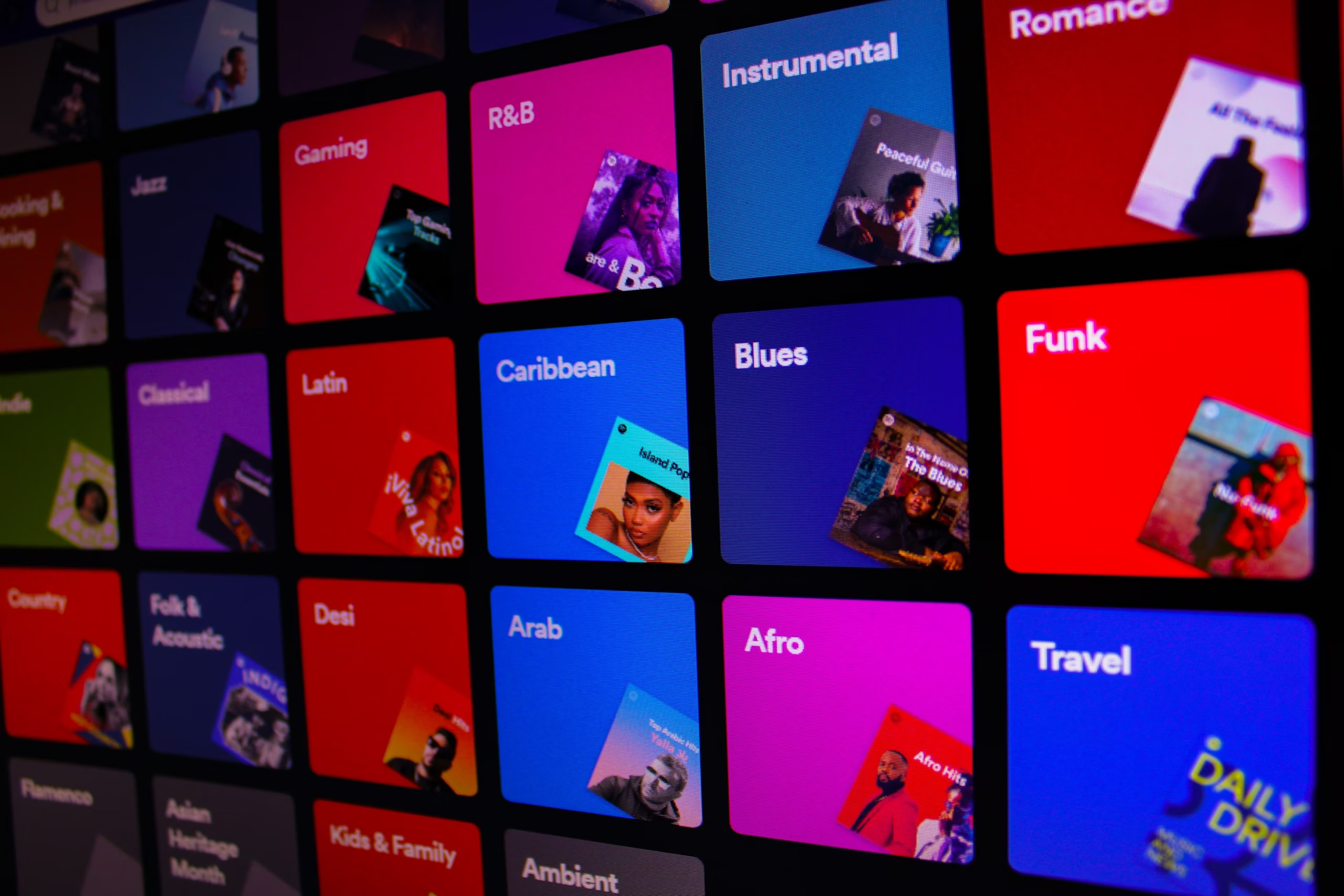
Spotify and competitors like Apple Music, YouTube Music, Amazon Music, and TikTok now function as platform orchestrators—connecting and enabling a vast range of ecosystem participants:
-
Artists: Self-publishing tools (e.g. Spotify for Artists, SoundCloud) allow artists to release and promote music directly, monitor analytics, and monetize streams—democratizing entry.
-
Fans: Personalized playlists, AI-generated recommendations, and social features deepen emotional connections and increase engagement.
-
Labels & Rights Holders: Gain access to real-time data on performance, regional preferences, and virality—transforming strategy.
-
Advertisers & Brands: Can target specific audiences through audio ads, branded playlists, and partnerships with artists.
-
Third-party Developers: Build integrations via APIs for DJ tools, fitness apps (e.g., Peloton), or AI-music analysis platforms.
In this model, value is co-created through the interplay of multiple participants. The platform becomes more than a distributor; it is a marketplace, a promoter, a data provider, and a collaboration space.

Ecosystem reinvention beyond streaming
The reinvention of the music industry didn’t stop at streaming. It extended into a broader creative and commercial ecosystem, with music integrated into:
-
Social media platforms like TikTok, where music clips go viral, sparking new hits and reviving old ones.
-
Gaming environments such as Fortnite or Roblox, where artists hold virtual concerts, selling digital merchandise and building new fan experiences.
-
Brand partnerships, where companies use music and artists to tell stories, build cultural relevance, and reach new audiences.
-
Fitness and wellness, through collaborations with apps like Calm, Strava, or Apple Fitness+.
Artists now think in ecosystems too—launching podcasts, virtual experiences, NFTs, fashion collaborations, and exclusive fan clubs (like Patreon or Discord communities).

Monetization and new value pools
Through ecosystem thinking, the music industry has found new monetization streams:
-
Subscriptions (Spotify, Apple Music)
-
Ad revenues (YouTube, free-tier platforms)
-
Live-streamed events and virtual concerts
-
Digital merchandise, NFTs, and metaverse performances
-
Brand partnerships and sync deals
-
Fan subscriptions and exclusives
In some cases, artists make more from social integrations or brand deals than from streams alone. The rise of “middle class” musicians—who don’t top charts but thrive within niche ecosystems—is enabled by direct fan relationships and alternative monetization.

Ecosystem enablers: data, AI, and open APIs
Data is the nervous system of the modern music ecosystem. Spotify’s discovery algorithms, YouTube’s content ID, and TikTok’s trend monitoring all use AI to connect artists to fans more efficiently than ever before. APIs allow innovation at the edges, enabling third parties to build remix apps, lyric tools, visualizations, and fan engagement features.
Moreover, open data helps drive artist-centric tools like Songkick for tours, Chartmetric for insights, and LANDR for mastering and promotion—extending the value chain horizontally.

Winning in an ecosystem world
Reinvention through ecosystems has required a new kind of leadership in music:
-
Orchestrators like Spotify or TikTok balance the needs of creators, users, brands, and regulators.
-
Labels now operate more like venture capitalists—investing in artist development, building brands, and managing rights across platforms.
-
Artists act as entrepreneurs—developing personal brands, multi-platform presence, and diverse revenue streams.
Ecosystem thinking is strategic, collaborative, and adaptive. Success is no longer about controlling assets, but enabling others to create value with them.
Despite its many successes, the music ecosystem still faces challenges, and need for further business model reinvention:
-
Artist compensation remains a hot topic—many argue that streaming revenues are too low.
-
Market concentration is a risk, with a few platforms controlling discovery and monetization.
-
Algorithmic influence shapes not just consumption, but what gets created—potentially narrowing diversity.
-
Copyright management across platforms and countries remains complex.
Nonetheless, the industry continues to innovate, exploring AI-generated music, blockchain-based rights tracking, immersive virtual experiences, and deeper fan personalisation.

Music as a living ecosystem
The reinvention of the music industry through ecosystem thinking has redefined how music is made, discovered, shared, and monetized. It has turned passive listeners into active participants, centralized players into enablers, and static catalogues into living, evolving digital experiences.
More than a technological shift, this transformation reflects a deeper change in business philosophy: from ownership to access, from control to coordination, and from isolated value chains to dynamic, networked ecosystems.
As platforms, creators, fans, and brands continue to co-evolve, the music industry stands as a powerful example of how ecosystem thinking can unlock growth, resilience, and creativity in a digital world.
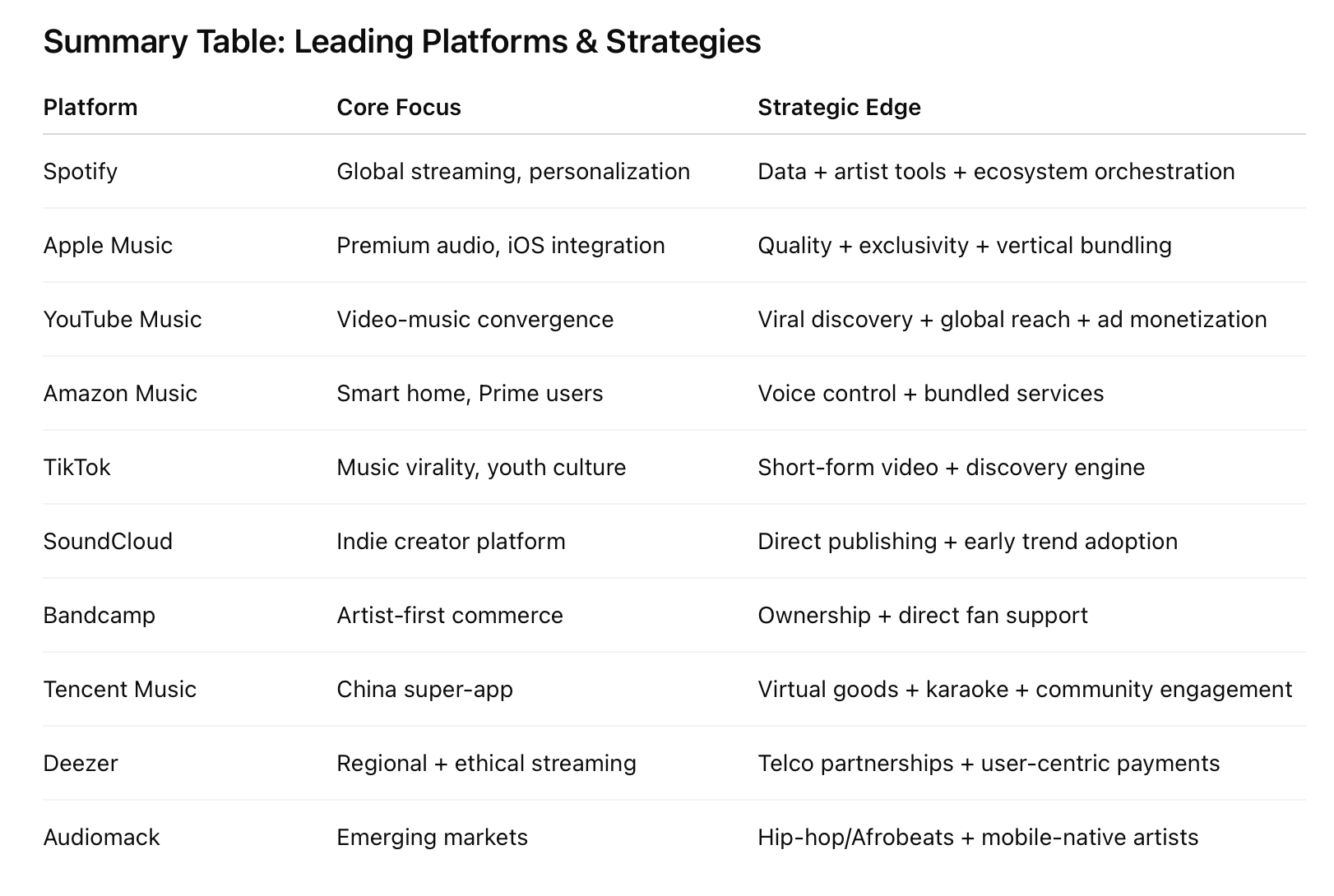
Here are profiles of the leading digital music platforms and how each has strategically positioned itself within the new music ecosystem:
1. Spotify
Founded: 2006 (Sweden)
Business Model: Freemium streaming (ad-supported + subscription)
Strategy: Ecosystem Orchestrator + Data Innovator
Spotify is the world’s largest music streaming platform by users, with over 600 million monthly active users and around 236 million premium subscribers (as of 2025). Its core strength lies in data-driven personalization, with features like Discover Weekly, Release Radar, and Wrapped. Spotify positions itself as a neutral platform between creators and listeners, offering artist tools (Spotify for Artists), podcasts, and an expanding AI stack (e.g. AI DJs, real-time lyric translation). It has made strategic acquisitions in podcasting (e.g. Anchor, Gimlet) and is moving into audiobooks, aiming to become the “audio home” across formats.
2. Apple Music
Founded: 2015 (USA)
Business Model: Subscription-only streaming
Strategy: Premium Experience + Vertical Integration
Apple Music leverages the Apple ecosystem (iOS, AirPods, Apple Watch) to deliver a high-quality, seamless user experience. It emphasizes exclusive content, artist-led shows (e.g., Elton John’s Rocket Hour), and higher-quality audio (lossless, Dolby Atmos). Unlike Spotify, Apple focuses less on social discovery and more on curation and integrationwith user lifestyles, including fitness, spatial audio, and live radio (e.g. Apple Music 1). Apple uses music as a value-added feature to retain subscribers within its larger services bundle.
3. YouTube Music
Founded: 2015 (USA)
Business Model: Freemium streaming + integrated with YouTube Premium
Strategy: Video-Music Integration + Global Reach
Owned by Google, YouTube Music benefits from deep integration with YouTube, the world’s most-used platform for music videos. It excels in global accessibility and virality, especially in emerging markets and among Gen Z. Its ecosystem strength lies in combining video, audio, user-generated content, and fan engagement. Many music trends now begin on YouTube Shorts. Google’s AI also helps power personalized recommendations and smart playlists, while its advertising infrastructure supports monetization for both majors and independents.
4. Amazon Music
Founded: 2007 (as Amazon MP3), rebranded in 2016
Business Model: Bundled with Prime + stand-alone subscriptions
Strategy: Ecosystem Bundle + Smart Devices
Amazon Music leverages its Prime ecosystem and Alexa-enabled smart devices to build frictionless music experiences. Its strategy emphasizes access through voice, integration with shopping and home automation, and bundling music with Prime subscriptions. While it has less cultural influence than Spotify or YouTube, it is strong in households and among passive users. It also offers high-definition and spatial audio options to compete on quality.
5. TikTok (ByteDance)
Founded: 2016 (China)
Business Model: Ad-based + e-commerce + music licensing
Strategy: Viral Discovery + Creator-Driven Ecosystem
TikTok has emerged as the most powerful music discovery platform for younger audiences. Songs often go viral on TikTok before reaching traditional charts. The platform’s short-form video format and algorithmic feed prioritize engagement and shareability. TikTok is building a deeper music ecosystem through SoundOn (artist distribution platform), licensing deals with major labels, and partnerships with streaming services. It doesn’t replace music platforms but acts as a catalyst for discovery and culture, influencing everything from Spotify playlists to brand campaigns.
6. SoundCloud
Founded: 2007 (Germany)
Business Model: Freemium streaming + creator subscriptions
Strategy: Independent Artist Hub + Creator Monetization
SoundCloud pioneered open music sharing and remains a go-to platform for independent and experimental artists. Its strategic focus is on creator empowerment—offering tools for publishing, monetizing, and analyzing tracks. It allows artists to control rights and monetize directly through SoundCloud Premier, Repost, and fan-powered royalties. The platform is a testing ground for trends, subcultures, and new genres, often ahead of mainstream platforms.
7. Bandcamp
Founded: 2008 (USA)
Business Model: Direct artist-to-fan sales
Strategy: Ethical Commerce + Artist Control
Bandcamp offers an alternative model centered around ownership and direct support. Fans can buy digital downloads, vinyl, merch, and more, with a majority of revenues going directly to artists. Bandcamp Fridays (fee-free sales days) have become a cultural event. It fosters niche and indie communities by emphasizing transparency and artist-first ethics. While small in scale, it has loyal users and is often used by creators as a primary income source.
8. Tencent Music Entertainment (TME)
Founded: 2016 (China)
Business Model: Freemium streaming + virtual gifts + karaoke + social
Strategy: Super App Ecosystem + Monetization Variety
TME operates QQ Music, Kugou, and Kuwo, dominating China’s streaming space. Its strategy blends music, social interaction, gaming, and virtual gifts, making music part of a broader entertainment super-app. Revenue comes not just from ads or subscriptions, but also from microtransactions, digital merchandise, and fan-driven economies. TME is a case study in ecosystem monetization diversity, with an emphasis on engagement and community.
9. Deezer
Founded: 2007 (France)
Business Model: Freemium streaming
Strategy: Open Partnerships + Local Curation
Deezer positions itself through localization, openness, and integration. It has partnered with telcos, hardware makers, and brands to expand globally. It also advocates for user-centric payment models, aiming to create fairer revenue shares. Deezer emphasizes editorial curation and regional content, particularly in Europe and Latin America.
10. Audiomack
Founded: 2012 (USA)
Business Model: Freemium streaming
Strategy: Emerging Market Focus + Hip-Hop & Afrobeats Culture
Audiomack is a fast-growing player in Africa, the Caribbean, and the U.S. urban music scene. Its strategy centers on youth culture, mobile-first consumption, and direct artist uploading. It builds local ecosystems by investing in emerging artists and providing tools for real-time metrics and monetization.

Ecosystems Inc … examples of how to reinvent every industry
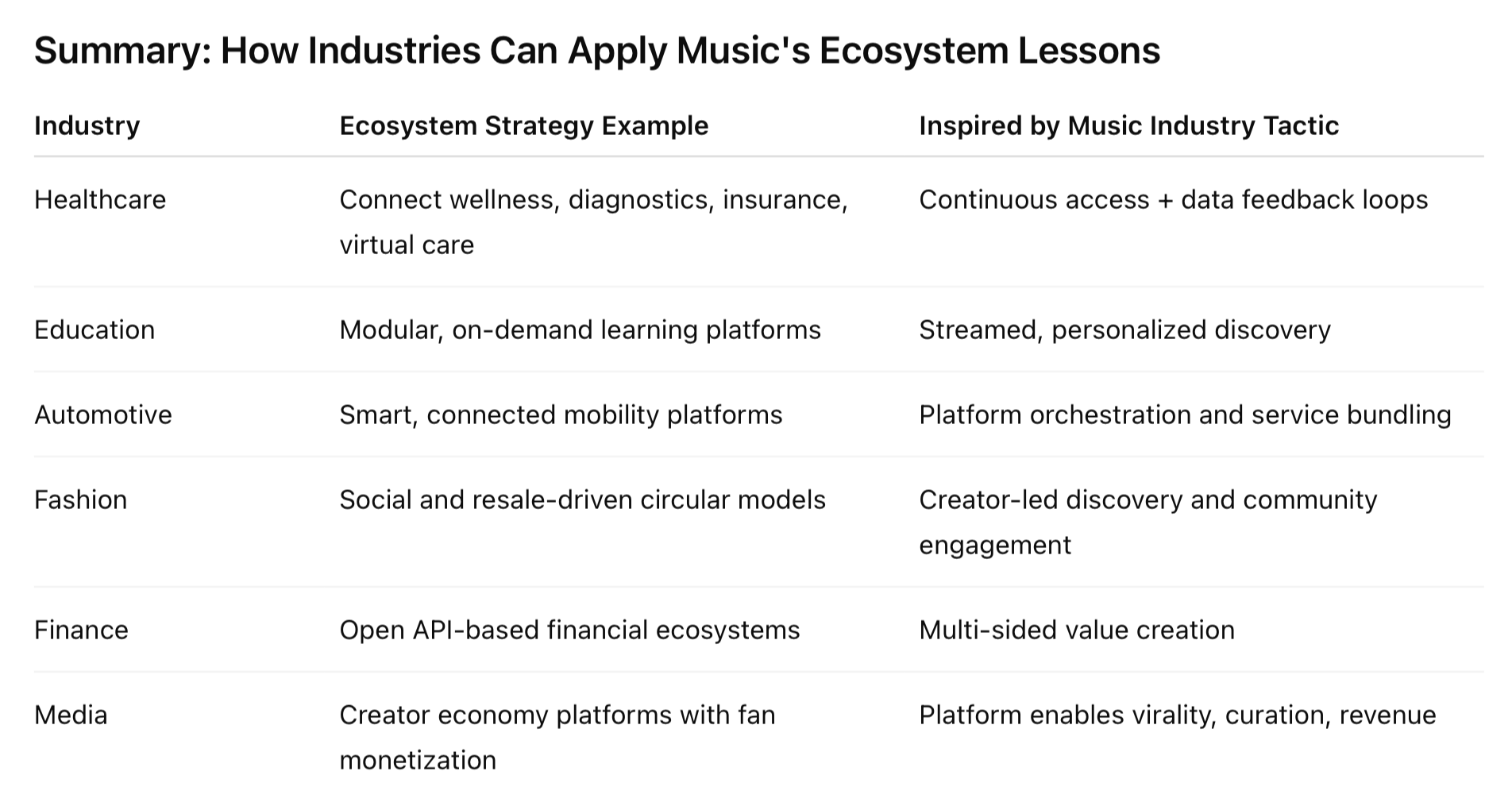
The reinvention of the music industry offers powerful lessons for other sectors. Once dominated by physical sales and industry gatekeepers, music has evolved into a dynamic, digital-first ecosystem led by platforms like Spotify, YouTube, and TikTok. These platforms don’t just distribute content—they connect creators, fans, advertisers, developers, and data in ways that continually generate value and innovation.
Other industries—from healthcare to fashion, education to finance—can learn from music’s transformation by embracing ecosystem thinking. This means shifting from linear, siloed value chains to multi-sided platforms where different actors co-create value. Key characteristics include:
-
Connectivity: Linking diverse stakeholders through digital platforms.
-
Personalization: Using data to tailor experiences in real-time.
-
Continuous value creation: Delivering ongoing services rather than one-off transactions.
-
Network effects: Gaining value as more users, creators, and partners join.
-
Open architecture: Allowing integration, innovation, and adaptation over time.
The result is not just a better product, but a more responsive, scalable, and future-ready business model. Just as music moved from ownership to access, so can many other industries—from selling to streaming, from control to collaboration.
1. Healthcare … from treatments to health ecosystems
Old Model: Siloed providers offering one-off services (e.g. hospitals, insurers, pharmacies).
Ecosystem Model: Platforms like CVS Health, Ping An Good Doctor, or Babylon Health connect care, diagnostics, insurance, wearables, and virtual consultations into integrated health ecosystems.
-
Personalization: Just like Spotify recommends music, health ecosystems can use AI to personalize treatment plans or preventive care.
-
Platform Strategy: Connect patients, doctors, insurers, pharmacies, and digital health startups.
-
Value Creation: Continuity of care, lower costs, and better outcomes through real-time data sharing.
Ping An Good Doctor, launched by Ping An Insurance, is China’s largest digital health platform. With over 400 million registered users, it offers online consultations, diagnostics, health checkups, medicine delivery, and AI-powered triage — all in one app.
-
Platform Orchestration: Connects patients, doctors (both in-house and external), hospitals, pharmacies, and insurers.
-
AI-Driven Personalization: Uses AI to provide initial diagnoses, route patients to the right doctor, and suggest health plans.
-
Vertical Integration: Builds offline “One-Minute Clinics” (smart booths) across Chinese cities to bridge physical-digital care.
Ping An’s ecosystem model has reduced friction, increased access to care, and allowed rapid scaling. Like Spotify’s hybrid model of human + algorithmic curation, it blends AI with professional expertise.
2. Education … from institutions to learning ecosystems
Old Model: Universities and schools as gatekeepers of learning.
Ecosystem Model: Platforms like Coursera, Khan Academy, and Duolingo offer modular, lifelong learning through content, tools, and community.
-
Access over Ownership: Just as music moved from CDs to streaming, learning is shifting from degrees to continuous, on-demand content.
-
Ecosystem Design: Involve content creators (e.g. professors), learners, employers, edtech tools, and credentialing bodies.
-
Feedback Loops: Learning paths are continuously updated based on learner performance and job market needs.
Coursera, founded in 2012 by Stanford professors, is a global online learning platform with over 140 million users and partnerships with 300+ top universities and companies.
-
Multi-Sided Platform: Connects learners, educators, institutions, and employers — creating a rich, interconnected education ecosystem.
-
Modular Learning: Offers flexible, stackable credentials (courses, certificates, degrees), much like how Spotify unbundled albums into playlists and songs.
-
Personalization & AI: Suggests learning paths based on skills, career goals, and usage patterns. Uses AI to tailor content recommendations, mirroring music algorithms.
-
Corporate & Government Partnerships: Offers Coursera for Business, Government, and Campus — embedding education into workforce systems.
Coursera has become a leading force in democratizing education globally, moving from a content library to a full ecosystem of skills, credentials, and career pathways. Like Spotify, it redefined access and empowered both creators (educators) and consumers (learners).
3. Automotive … from selling cars to mobility-as-a-service
Old Model: Buy or lease a vehicle from a dealership.
Ecosystem Model: Platforms like Tesla, Uber, and MaaS apps like Bolt connect cars, ride-hailing, energy, insurance, and smart city infrastructure.
-
Platform Logic: Tesla connects software, EV charging, insurance, and over-the-air updates.
-
Network Effects: Uber builds an ecosystem of drivers, riders, restaurants, and logistics.
-
Data as Asset: Predictive maintenance, usage-based insurance, route optimization—all fed by real-time data.
Tesla is not just a car company — it’s an integrated mobility, energy, and software platform. Its success lies in treating the car as a node in a broader ecosystem, not just a product.
-
Vertical Integration: Controls everything from battery production to software, energy services (Powerwall, Solar Roof), and even insurance.
-
Continuous Upgrades: Like Spotify’s streaming updates, Tesla delivers over-the-air software updates to improve vehicle performance and add features post-purchase.
-
Network Effects: Connects Tesla vehicles into shared systems — from autonomous driving data learning to Supercharger networks.
-
AI + Data Loop: Uses real-time driving data for autopilot training and fleet optimization, akin to music platforms using listening data for personalization.
Tesla’s integrated model offers a seamless user experience while continuously expanding into adjacent spaces (robotaxis, energy storage, grid services). This mirrors how platforms like Apple Music or YouTube built adjacent services around core content.
4. Fashion … from product-driven to creator-driven ecosystems
Old Model: Seasonal collections pushed by fashion houses to retailers.
Ecosystem Model: Platforms like Instagram, Depop, and StockX empower creators, resellers, and consumers to co-create and trade fashion in real time.
-
Creators as Brands: Influencers and micro-brands gain traction without traditional backing.
-
Circular Economy: Secondhand marketplaces and upcycling apps form part of the fashion loop.
-
Digital Goods: Virtual fashion in gaming and the metaverse (e.g. Balenciaga in Fortnite).
StockX launched in 2016 as a “stock market of things,” enabling users to buy and sell sneakers, streetwear, and luxury items with price transparency, authentication, and real-time demand signals. It now processes billions in GMV annually and has become a cultural hub for sneakerheads and collectors.
- Two-Sided Marketplace: Connects sellers (resellers, retailers, individuals) and buyers (enthusiasts, investors) in a transparent pricing environment, like Spotify connects artists and fans.
-
Data as Currency: Provides real-time pricing charts, historical trends, and volume data — turning fashion into a speculative, dynamic asset class.
-
Trust Infrastructure: Builds authentication, condition grading, and transaction security — key to ecosystem health and stickiness.
-
Cultural Integration: Acts as a hub for sneaker culture, drops, and community-driven demand, leveraging scarcity and social influence like viral hits in music.
StockX transformed secondhand goods into financial assets. Much like how Spotify allowed obscure tracks to gain global traction, StockX gave niche fashion products global visibility and liquidity. The company monetizes not just transactions but the data, culture, and community around them.
5. Finance … from products to financial wellness ecosystems
Old Model: Banks offering siloed services—checking, loans, investing.
Ecosystem Model: Platforms like Revolut, Alipay, and Plaid connect personal finance, investing, insurance, crypto, and rewards.
-
API-driven Ecosystems: Fintechs connect to banks, credit bureaus, payroll providers, and e-commerce platforms.
-
User Control: Like artists using Spotify for Artists, customers can manage their financial data and insights in one place.
-
Embedded Finance: Financial services appear within non-financial platforms (e.g. BNPL in retail).
Revolut started in 2015 as a travel-focused money app and evolved into a financial super app, offering banking, crypto, stock trading, budgeting, and more to 40+ million users worldwide.
-
All-in-One Platform: Combines checking, saving, FX, trading, lending, and insurance — turning financial services into a continuous engagement experience, like Spotify’s audio ecosystem.
-
Personalized Insights: AI-driven notifications and budgeting tools help users manage money better, mirroring personalized recommendations in music apps.
-
APIs + Open Banking: Connects with third-party fintechs, creating a modular system where users can plug in services.
-
Gamified UX: Rewards, challenges, and community engagement drive usage, similar to TikTok’s engagement mechanics.
Revolut is redefining consumer expectations in banking — focusing on UX, real-time updates, and financial control. Like Spotify gave users control over what and how they consume music, Revolut puts customers in control of their financial lives.
6. Media and Entertainment … from channels to content ecosystems
Old Model: Studios create, control, and distribute content through owned channels.
Ecosystem Model: Platforms like Netflix, YouTube, and Twitch enable content creation, distribution, monetization, and fan engagement across communities.
-
Creator Economy: Anyone can be a content creator, and monetization is built into the ecosystem (ads, subscriptions, donations).
-
Personalization: AI-driven recommendations akin to Spotify’s playlists.
-
Community-Driven Discovery: Fans co-create culture, memes, remixes—similar to how TikTok shapes music.
Netflix, founded in 1997 as a DVD rental company, became the first major streaming service in 2007. Today it’s a global media powerhouse, with 270+ million subscribers in 190+ countries, and a leader in both content production and delivery.
-
Vertical Control of Value Chain: Produces, distributes, and curates content end-to-end — like Apple in music or Tesla in mobility.
-
Data-Driven Personalization: Uses viewer data to drive algorithmic recommendations, content commissioning, and global rollouts (e.g. “House of Cards” was greenlit based on viewer preferences).
-
Global Localism: Builds region-specific content ecosystems (e.g. K-dramas, Spanish thrillers) that scale globally, turning local hits into global phenomena (à la “Squid Game”).
-
Multi-Stakeholder Platform: Connects creators, audiences, advertisers (in ad-tier), and now game developers — extending the platform into new media.
Netflix reshaped how content is consumed, produced, and monetized. Like Spotify, it removed traditional industry gatekeepers and used algorithms and audience feedback to shape creative direction. It turned entertainment into a dynamic, participatory, data-led experience.
Explore more
- Next Generation Business Models: Redefining value, ownership, scale, and trust by Peter Fisk
- Reinventing business ecosystems for more profitable growth by Peter Fisk
- Building a Butterfly Brand: How “branded ecosystems” achieve more in a world of relentless change by Peter Fisk
- Has Apple become more or less innovative in recent years? by Peter Fisk
- Cross Industry Innovation for Future Business Ecosystems by Z Punkt
- Ecosystem Strategy Map by Julian Kawohl
- How do you Design a Business Ecosystem by BCG Henderson
Over the past two decades, Asia has transformed from being the world’s factory to becoming its innovation engine. From super apps and AI platforms to smart logistics and consumer electronics, Asian companies are now at the forefront of technological disruption and business reinvention. They are reshaping industries, influencing global standards, and outpacing many Western counterparts—not just in scale but in the speed and imagination of innovation.
How did this transformation happen? And why are companies like Bytedance, DJI, Grab, Jio, Haier, Ping An, Sea and Tencent now regarded as among the world’s most innovative?
1. Massive, Demanding, Digital-First Markets
Asia’s biggest asset is its population: more than 4.7 billion people, including the fastest-growing middle class in the world. These markets are mobile-first, young, and digitally native—forcing companies to innovate quickly and at scale.
Take Bytedance, the parent company of TikTok. Founded in China in 2012, it leveraged AI-driven personalization to reimagine content consumption. Unlike platforms that rely on social graphs, TikTok’s content is algorithmically curated, creating an addictive user experience that has since been copied globally. The Chinese market’s diversity and size gave Bytedance an ideal sandbox to refine this model before going global.
Similarly, Grab, founded in Malaysia and now headquartered in Singapore, has evolved from a ride-hailing app into Southeast Asia’s leading super app. It integrates transportation, payments, food delivery, insurance, and more—meeting the needs of consumers in fragmented, infrastructure-light environments. This model was born out of necessity in a region where digital infrastructure had to leapfrog traditional systems.
2. Innovating for Inclusion and Scale
Asian innovators often solve problems unique to their regions—lack of physical infrastructure, informal economies, or underserved populations. These constraints inspire inclusive innovation that often proves globally relevant.
Jio, the Indian telecom and digital services company launched by Reliance Industries in 2016, disrupted India’s telecom market with free calls and ultra-low data costs. By building its network from scratch using 4G and investing heavily in digital content, cloud, and services, Jio connected over 450 million Indians online in just a few years. This was not just innovation in pricing—it was a digital nation-building strategy. Now, Jio is extending into healthcare, education, fintech, and AI with homegrown ambition.
Ping An, one of the world’s largest insurance and financial services companies, turned itself into a technology-first enterprise. It uses AI, big data, and blockchain to serve over 220 million customers and 500 million internet users. Its Good Doctor app became China’s leading health tech platform, with AI-driven diagnostics and 24/7 telemedicine. Ping An’s transformation reflects how Asian firms are embedding tech at the core of traditional sectors like insurance, banking, and healthcare.
3. Reimagining Business Models
Many Asian companies are not just adopting Western models—they are inventing new ones. The concept of the super app, for instance, did not originate in Silicon Valley but in China and Southeast Asia.
Tencent’s WeChat is a prime example. Starting as a messaging app, it became a platform for payments, news, games, shopping, and government services. By enabling third-party mini-programs within the app, Tencent created a mobile-first operating system for everyday life. This level of integration, with seamless UX across services, is rare outside Asia and has influenced global tech giants like Meta and PayPal.
Similarly, Sea Group, based in Singapore and best known for its gaming arm Garena and e-commerce platform Shopee, has created regionally tailored services that blend social engagement with transaction. Shopee’s gamified shopping experience and localized promotions turned it into a leading e-commerce player across Southeast Asia and Latin America.
4. Flexible Ownership and Ambitious Leadership
Ownership structures in Asia are often more flexible and founder-led than in the West. This allows for bold decisions, long-term thinking, and alignment between innovation and execution.
Consider Haier, the Chinese home appliance giant. It reinvented itself into a modular, platform-driven organization using a management philosophy called “Rendanheyi”—empowering small, autonomous teams to act like startups. Haier’s shift from manufacturing to an ecosystem-based innovation model allowed it to acquire GE Appliances in the US and become a leader in smart home solutions globally.
Asian founders and leaders often exhibit a unique blend of nationalism and entrepreneurial drive. Masayoshi Son of SoftBank exemplifies this with his long-term, global investment thesis built around AI and connectivity. Similarly, Mukesh Ambani’s Jio strategy was as much about transforming India as it was about dominating markets.
5. Supportive Governments and Innovation Ecosystems
Governments across Asia have played a crucial role in enabling innovation through infrastructure, policy, and funding.
In China, the government’s “Made in China 2025” strategy incentivized R&D in AI, robotics, and semiconductors. The creation of special economic zones and digital infrastructure hubs enabled companies like DJI (the global leader in drones) and SenseTime (a major AI player) to scale rapidly.
Singapore and South Korea have long invested in education, IP protection, and startup incubation. Singapore’s EDB (Economic Development Board) and Temasek have backed ventures in fintech, biotech, and green energy. South Korea’s Samsung and Hyundai ecosystems are supported by government-led research and supplier networks, allowing them to stay globally competitive in semiconductors, mobility, and clean tech.
Even in India, digital public goods like Aadhaar (digital identity) and UPI (real-time payments infrastructure) have given startups a massive platform to innovate and scale. IndiaStack is now being exported to other developing economies.
6. Bold Visions, Global Playbooks
Asian innovators are increasingly building for the world. Ant Group, for example, pioneered mobile payments with Alipay and now drives global fintech innovation. Tokopedia and Gojek merged to create GoTo Group, aiming to be Southeast Asia’s leading digital ecosystem.
Japanese firms like Rakuten are combining e-commerce, fintech, and mobile telecoms under one brand, while NTT is pushing the boundaries of smart cities and digital twins. In South Korea, Kakao has replicated the super app model with a creative edge in content, entertainment, and NFTs.
Even in frontier tech, Asia is advancing rapidly. SK Hynix and TSMC are global semiconductor leaders. Baidu and Naver are pioneering autonomous vehicles and language AI. In Japan, Preferred Networks is pushing the edge in deep learning for industrial automation and robotics.
7. A Future Shaped in Asia
The next decade of innovation will be increasingly shaped in Asia—not just because of its population or capital, but because of its mindset.
Asian companies are not afraid to leapfrog. They build for complexity, scale, and inclusion. They merge physical and digital worlds. They rewire traditional industries with AI, data, and platform logic. And they move fast.
As the world grapples with climate change, aging populations, urban congestion, and economic inequality, Asia’s innovation playbook—problem-solving at scale, embedding tech everywhere, and integrating services around user needs—may become the global blueprint.
Companies like Bytedance, Grab, Jio, Haier, Ping An, and Tencent are just the beginning. The next wave—from Indonesia to India, Japan to Korea, China to Vietnam—is coming. And they’re not just competing with Silicon Valley. They’re defining what innovation looks like in the 21st century.
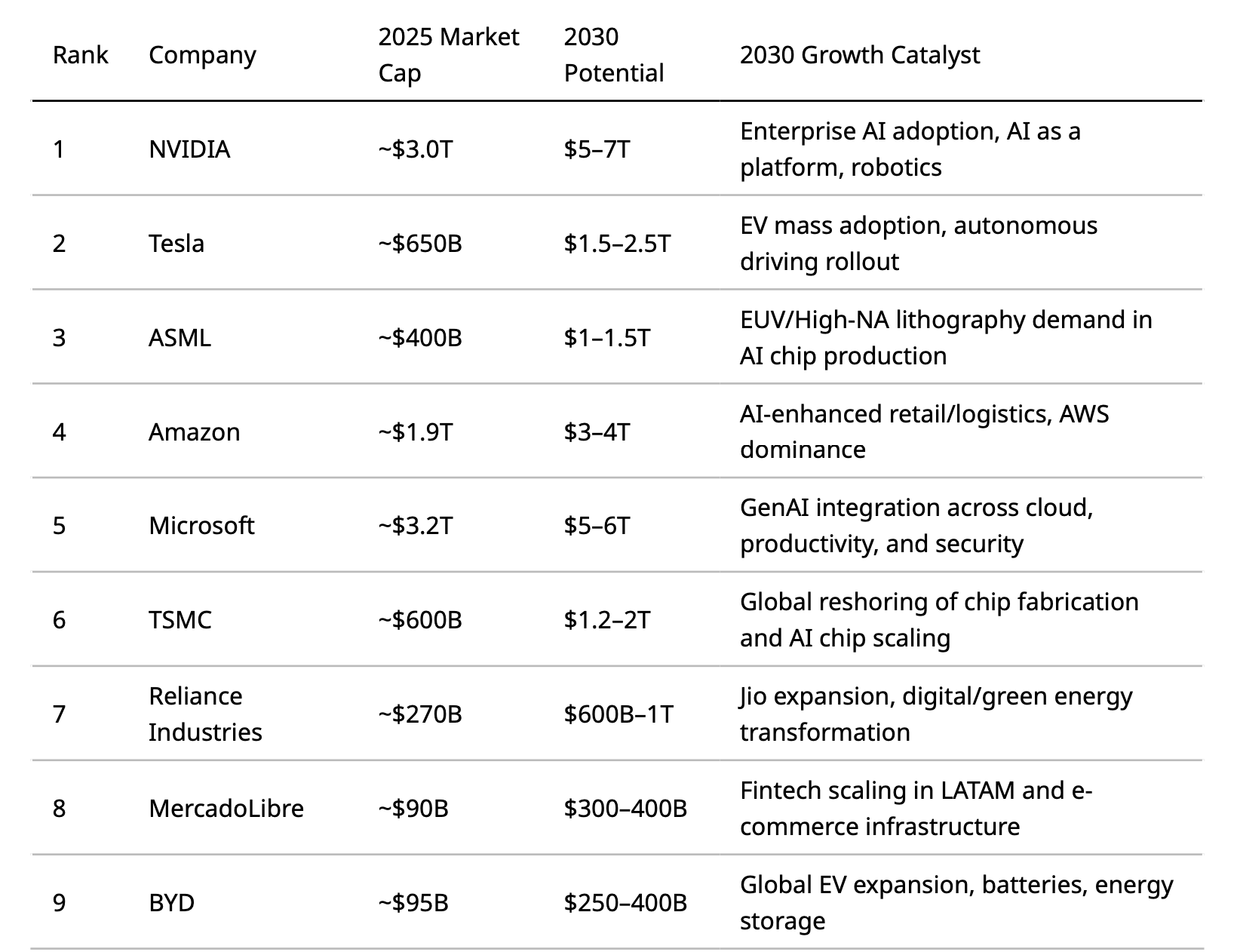
Predicting which companies will see the most significant stock market growth by 2030 involves identifying those best positioned at the intersection of exponential technologies, structural global shifts, and strong execution. These are companies driving or benefiting from megatrends such as AI, climate tech, biotech, digital transformation, and changing demographics.
Here is a curated selection of companies across sectors and geographies that are well-positioned for outsized growth — along with the reasons why. (Remember these are not investment recommendations, simply an analysis of markets and companies, and illustration of their value-based growth potential!).
For each company we consider the strategic significance of the company—”why” it is well-positioned to grow significantly. We also identify the “2030 growth catalyst”, meaning the specific events likely to supercharge the company’s growth by 2030, and the broader “growth drivers”, ie the structural, longer-term factors that will sustain and support the company’s growth over time – technologies, capabilities, business models, partnerships, or geographic expansion.

1. Nvidia … powering the AI revolution
Founded in 1993 by Jensen Huang, Chris Malachowsky, and Curtis Priem, NVIDIA began as a graphics chip company for gaming. Under CEO Jensen Huang, it has evolved into a dominant force in AI computing, data centers, autonomous vehicles, and more. It grew exponentially with the rise of GPU computing and now leads the AI revolution with its full-stack AI platform, including CUDA software, GPUs, and supercomputers like DGX.
- 2025 Market Cap: $3 trillion
- 2030 Potential Market Cap: $6 trillion
- Why: The foundational infrastructure provider for AI, from GPUs to full-stack AI computing platforms.
- 2030 Growth Catalyst: Enterprise adoption of generative AI, AI-as-a-platform services, expansion into robotics and autonomous systems.
- Growth Drivers:
- World’s leading supplier of GPUs, central to AI, machine learning, and edge computing.
- Expanding into AI software, networking, and data centre platforms.
- Strong ecosystem dominance, high margins, and strategic leadership in generative AI.
2. ASML … the machines that make semiconductors
Founded in 1984 as a joint venture between Philips and ASM International, ASML is headquartered in Veldhoven, Netherlands. Under CEO Peter Wennink, it has become the global monopoly in extreme ultraviolet (EUV) lithography. ASML plays a pivotal role in the semiconductor value chain, enabling the production of the smallest and most advanced chips. Its technology is critical to Moore’s Law and the future of AI and high-performance computing.
- 2025 Market Cap: $500 billion
- 2030 Potential Market Cap: $1.2 trillion
- Why: Sole supplier of EUV lithography, essential for advanced semiconductor manufacturing.
- 2030 Growth Catalyst: Surge in demand for next-gen chips across AI, 5G, and quantum.
- Growth Drivers:
- High-margin, high-barrier tech monopoly
- Long-term supplier contracts with TSMC, Intel, Samsung
- Expanding capacity to meet global reshoring demand
3. Tesla … accelerating the transition to clean energy
- 2025 Market Cap: $750 billion
- 2030 Potential Market Cap: $2.5 trillion
- Why: Beyond EVs: energy, AI robotics, and autonomy leader.
- 2030 Growth Catalyst: Commercialisation of autonomous vehicles and Tesla Energy at scale.
- Growth Drivers:
- Energy storage and solar business
- Robotaxi network
- Dojo AI training platform and humanoid robots
4. BYD … dreams driving the future of mobility
BYD (Build Your Dreams) was founded in 1995 by Wang Chuanfu as a rechargeable battery company. It entered the auto industry in 2003 and became one of the world’s largest EV makers. Known for vertical integration, BYD manufactures its own batteries, chips, and EV components. Backed by investors like Warren Buffett, it leads China’s EV market and is rapidly expanding into global markets.
- 2025 Market Cap: $100 billion
- 2030 Potential Market Cap: $450 billion
- Why: Vertically integrated EV manufacturer dominating China and expanding globally.
- 2030 Growth Catalyst: Global mass-market EV adoption, battery exports.
- Growth Drivers:
- In-house batteries and chips
- Affordable EV models for emerging markets
- Global expansion (ASEAN, LATAM, EU)
5. Reliance Jio … becoming India’s leading lifestyle brand
- 2025 Market Cap: $250 billion
- 2030 Potential Market Cap: $800 billion
- Why: India’s most diversified conglomerate, pivoting from oil to digital, retail, and clean energy.
- 2030 Growth Catalyst: Jio as India’s dominant digital ecosystem across telecom, finance, and commerce.
- Growth Drivers:
- Jio Financial, JioMart, JioCinema, and 5G services
- Green hydrogen and solar investments
- 1.4B person digital consumer base
6. MercadoLibre … the digital backbone of Latin America
Founded in 1999 by Marcos Galperin in Argentina, MercadoLibre is Latin America’s leading e-commerce and fintech platform. It operates in 18 countries, offering online marketplaces, digital payments, logistics, and credit services. With its MercadoPago and MercadoEnvios platforms, it serves both consumers and merchants. Under Galperin’s leadership, it continues to scale digital services in a region with growing internet penetration and fintech demand.
- 2025 Market Cap: $80 billion
- 2030 Potential Market Cap: $350 billion
- Why: Amazon + PayPal of Latin America with strong moat in logistics and fintech.
- 2030 Growth Catalyst: Latin America’s digital finance revolution and rising e-commerce penetration.
- Growth Drivers:
- MercadoPago’s banking and credit services
- Logistics and fulfillment infrastructure
- Cross-border commerce expansion
7. Eli Lilly … biotech powerhouse, AI-powered drugs
- 2025 Market Cap: $850 billion
- 2030 Potential Market Cap: $2.2 trillion
- Why: Dominates obesity and diabetes treatment with Mounjaro; strong biotech pipeline.
- 2030 Growth Catalyst: Mainstream use of GLP-1 drugs for metabolic disease and longevity.
- Growth Drivers:
- FDA approvals for Alzheimer’s and cancer drugs
- Global rollout of Mounjaro/Zepbound
- Expansion in emerging health markets
8. TSMC … the world’s largest chip maker
Founded in 1987 by Morris Chang, TSMC (Taiwan Semiconductor Manufacturing Company) pioneered the pure-play foundry model. Headquartered in Hsinchu, Taiwan, and led by C.C. Wei, it is the world’s largest contract chip manufacturer. TSMC produces the most advanced chips for top tech companies globally and is central to innovation in AI, smartphones, and high-performance computing.
- 2025 Market Cap: $600 billion
- 2030 Potential Market Cap: $1.2 trillion
- Why: World’s most advanced semiconductor foundry powering Apple, Nvidia, AMD, etc.
- 2030 Growth Catalyst: AI, automotive, and IoT chips becoming core infrastructure.
- Growth Drivers:
- Geographical diversification (US, Japan, EU fabs)
- Leadership in 3nm and advanced packaging
- Supply chain resilience and premium pricing
9. NextEra Energy … America’s leading clean energy business
Founded in 1984 and headquartered in Florida, NextEra Energy is the parent of Florida Power & Light and NextEra Energy Resources. Under CEO John Ketchum, it leads in wind and solar energy generation in North America. The company is at the forefront of the clean energy transition, investing in grid modernization and storage, and leveraging policy support like the Inflation Reduction Act.
- 2025 Market Cap: $150 billion
- 2030 Potential Market Cap: $300 billion
- Why: Largest renewable energy generator in the US.
- 2030 Growth Catalyst: Scaling solar, wind, and grid-scale battery storage.
- Growth Drivers:
- IRA subsidies and regulatory tailwinds
- Digital grid infrastructure
- Distributed energy services for businesses and consumers
10. ARM … designing next generation chips
ARM was founded in 1990 as a joint venture between Acorn Computers, Apple, and VLSI Technology. Based in Cambridge, UK, it designs energy-efficient chip architectures widely used in mobile and embedded systems. Now led by CEO Rene Haas, ARM has expanded into data centers and AI edge computing. Its flexible licensing model powers over 250 billion chips globally, making it foundational to modern electronics.
- 2025 Market Cap: $120 billion
- 2030 Potential Market Cap: $400 billion
- Why: Dominant CPU architecture for mobile, AI edge, IoT, and increasingly cloud.
- 2030 Growth Catalyst: AI at the edge, IoT proliferation, and high-margin licensing.
- Growth Drivers:
- Embedded AI chips for smart devices
- Expanding royalty streams from data centers
- Strategic shift toward value-based licensing
In summary

In addition here are some “bonus picks” … smaller, high-potential, higher-risk companies that could see significant stock market growth by 2030:
1. UiPath … smart robotics from Romania
Founded in 2005 in Romania by Daniel Dines and Marius Tîrcă, UiPath is a global leader in robotic process automation (RPA). Headquartered in New York, the company helps enterprises automate repetitive tasks across systems using AI-powered bots. Led by co-founder and CEO Daniel Dines, UiPath has grown rapidly with a strong customer base in finance, healthcare, and logistics. Its automation-first platform is expanding into intelligent automation and process mining.
- 2025 Market Cap: $10 billion
- 2030 Potential Market Cap: $100 billion
- Why: UiPath is a leader in robotic process automation (RPA), offering AI-powered tools that automate repetitive tasks in enterprise workflows. With the convergence of AI and automation, demand for intelligent systems to boost productivity is surging.
- 2030 Growth Catalyst: Enterprise AI adoption, mass automation of back-office functions, AI copilots for every worker.
- Growth Drivers:
- Expansion into end-to-end AI-powered automation platforms
- Deeper integrations with cloud platforms (Microsoft, AWS, Google)
- Growing demand in finance, healthcare, government sectors
- Upselling AI-based orchestration and analytics services
2. Palantir … making sense of complex data
Founded in 2003 by Peter Thiel, Alex Karp, and others, Palantir started as a data analytics company for defense and intelligence. Under CEO Alex Karp, it expanded into commercial sectors with platforms like Foundry and Gotham that help organizations integrate and make sense of complex data. With increasing adoption in healthcare, finance, and manufacturing, Palantir is gaining traction as AI-driven decision-making becomes mission-critical.
- 2025 Market Cap: $55 billion
- 2030 Potential Market Cap: $300 billion
- Why: Palantir specializes in AI-driven big data analytics, serving defense, intelligence, and commercial clients. It’s gaining traction for its Foundry and AIP platforms that offer mission-critical decision-making tools powered by LLMs.
- 2030 Growth Catalyst: AI-infused enterprise decision platforms; scaled use across commercial sectors and public infrastructure.
- Growth Drivers:
- Accelerating shift from bespoke to scalable AI platforms
- Strong US and NATO government contracts (defense, healthcare, intelligence)
- Commercial expansion in pharma, manufacturing, energy
- Thought leadership in AI ethics, security, and national resilience
3. Sea Group … Singapore retail meets entertainment
- 2025 Market Cap: $30 billion
- 2030 Potential Market Cap: $120 billion
- Why: Sea operates Southeast Asia’s dominant e-commerce (Shopee), digital financial services (SeaMoney), and gaming (Garena). With Southeast Asia’s growing middle class and digital infrastructure, Sea is well positioned as a regional tech super-app.
- 2030 Growth Catalyst: Regional super app combining shopping, fintech, and entertainment in one platform.
- Growth Drivers:
- Shopee scaling e-commerce in Indonesia, Vietnam, Philippines, Brazil
- SeaMoney expansion into payments, insurance, lending
- Return of gaming growth via Garena’s new titles or cross-border IP
- Digital infrastructure and logistics play in fast-growing economies
4. Illumina … leading the genomics revolution
Founded in 1998 and based in San Diego, Illumina is a pioneer in DNA sequencing technologies and genomics solutions. The company, now led by CEO Jacob Thaysen, enables researchers, hospitals, and pharmaceutical companies to sequence genomes quickly and affordably. Despite recent strategic challenges, it remains critical to the advancement of precision medicine, population genomics, and biotech R&D.
- 2025 Market Cap: $30 billion
- 2030 Potential Market Cap: $120 billion
- Why: Illumina is the global leader in DNA sequencing technology. Its platforms power genomics research, precision medicine, and diagnostics, all central to the healthcare revolution.
- 2030 Growth Catalyst: The “genomics-as-infrastructure” moment: sequencing becomes routine for population health, cancer, rare diseases, and AI-informed medicine.
- Growth Drivers:
- Rapid adoption of genomic testing by health systems
- Falling cost of sequencing (towards $100/genome)
- New clinical diagnostics partnerships and AI applications
- Strategic spinouts or divestments (e.g. Grail) to focus on core
5. CleanSpark … sustainable bitcoin mining
Founded in 1987 and headquartered in Nevada, CleanSpark is a Bitcoin mining and energy technology company that focuses on sustainable mining powered by renewables. Led by CEO Zachary Bradford, CleanSpark distinguishes itself by leveraging energy-efficient operations and vertically integrated power sourcing. The company is also investing in microgrids and grid-interactive energy systems, making it a unique clean-tech and crypto hybrid growth story.
- 2025 Market Cap: $2 billion
- 2030 Potential Market Cap: $12 billion
- Why: CleanSpark provides sustainable Bitcoin mining and microgrid energy solutions. It bridges crypto infrastructure with renewable energy tech — offering a scalable model for energy-intensive industries.
- 2030 Growth Catalyst: Convergence of clean energy + crypto infrastructure + grid balancing services.
- Growth Drivers:
- Renewable-powered mining leadership (low carbon footprint)
- Expansion into smart microgrid tech and virtual power plants
- Leverage of carbon credits and green finance
- Positioned well in US-based digital asset ecosystem with policy tailwinds
6. KlimaDAO … blockchain for climate change
Launched in 2021, KlimaDAO is a decentralized autonomous organization (DAO) aiming to accelerate climate action through blockchain and carbon markets. Built on the Polygon network, it tokenizes carbon credits into the KLIMA token, incentivizing demand for verified carbon offsets. KlimaDAO operates without a central corporate leadership but is stewarded by a community of developers, climate activists, and governance token holders. It seeks to create a transparent, liquid, and scalable market for environmental assets, and is part of a broader trend toward regenerative finance (ReFi).
- 2025 Market Cap: $100 million (token-based market cap)
- 2030 Potential Market Cap: $10 billion
- Why: KlimaDAO is a decentralized autonomous organization creating a programmable carbon market via blockchain. It tokenizes carbon credits to create transparency and liquidity in the voluntary carbon market.
- 2030 Growth Catalyst: Institutional and government adoption of on-chain carbon markets and climate finance infrastructure.
- Growth Drivers:
- Rise of nature-based carbon markets and climate tokens
- Integration with ESG reporting platforms and supply chains
- Partnerships with climate registries and offset projects
- Regulation and demand for transparent carbon accounting
In today’s world of accelerating change, disruption is no longer the exception, it is the norm.
Technology, climate imperatives, shifting customer expectations, and geopolitical volatility are reshaping the business landscape. In this environment, incremental improvement is no longer sufficient. True business transformation—a fundamental reinvention of how a company creates and captures value – is necessary for survival and long-term success.
But what does transformation really mean? At its core, transformation is about reimagining the future of the business: what it stands for, how it competes, how it works, and how it wins. It’s a step beyond operational change or digital upgrades. It is a whole-system shift—combining purpose, strategy, operating model, culture, capabilities, and performance.
What is business transformation?
Business transformation involves a step change in performance driven by a shift in core business logic—how value is created and delivered. This could mean moving from products to platforms, from fossil fuels to renewables, from a local to a global model, or from analogue to digital. In some cases all of these.
True transformation usually touches four interconnected domains:
-
Reimagining purpose and vision – defining the ‘why’ of the organisation; its role in a rapidly changing world, its aspirations, and what it uniquely offer, supported by a vision of what better can look like.
-
Redefining strategy and priorities – refocusing ‘where and how’ to play – reshaping the strategy, business model, customer propositions, innovating products and services, and future business portfolio.
-
Reinventing culture and organisation – creating the internal conditions—leadership, mindset, capabilities, behaviours, structures, and systems—that enable change and innovation.
-
Rewiring operations and performance – shifting the core activities, capabilities, and technology infrastructure to support new ways of working, and delivering performance short and long-term, for sustained value creation.
At its best, business transformation results in significant growth, market leadership, and renewed relevance. It can mean, over time, a fundamental shift in the core business. It can transform performance, creating significant new profit streams, and doubling or tripling the market value over 4-5 years. At its worst, it is superficial, disconnected, and fails to deliver impact. All the more reason to get it right.

Transformational companies around the world
Some companies have stood out in recent years for their ability to successfully reinvent themselves, responding to massive shifts with agility and vision.
DSM … science-led reinvention
Originally a Dutch coal mining company, DSM has continuously reinvented itself for over a century. Most recently, it divested from chemicals and refocused on biosciences, nutrition, and health. The merger with Firmenich accelerated this pivot, creating a purpose-driven leader in sustainable ingredients. DSM’s transformation illustrates how companies can shed legacy businesses to focus on high-growth, impact-led markets.
Schneider Electric … the world’s most sustainable company
Once a provider of electrical components, Schneider Electric transformed into a global leader in energy management and automation. Its purpose—“to be the digital partner for sustainability and efficiency”—has guided a decade-long pivot towards software, smart systems, and decarbonisation. The company reorganised around digital platforms and embedded sustainability into every part of its strategy and culture. It now helps thousands of companies monitor and reduce their carbon footprint while achieving sustained double-digit growth.
Fujifilm … from camera film to healthcare
When digital photography disrupted its core market, Fujifilm—unlike Kodak—chose to radically reinvent itself. It leveraged its deep expertise in chemistry and materials to pivot into healthcare, cosmetics, and advanced materials. Its diversification into medical imaging, regenerative medicine, and pharmaceuticals allowed it not only to survive the death of film but to thrive in new sectors. Fujifilm’s transformation is a masterclass in strategic foresight, reinvention of capabilities, and disciplined execution.
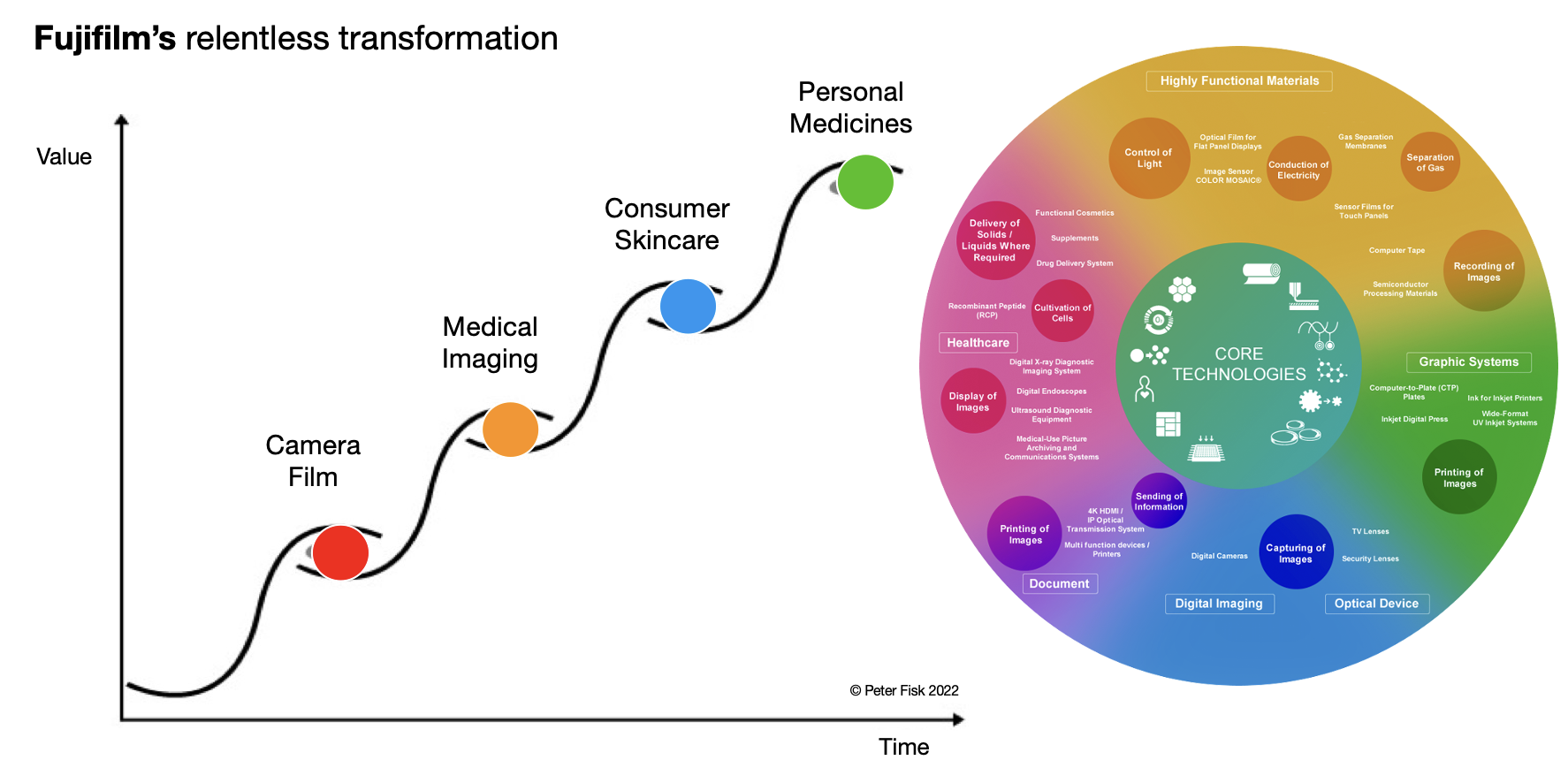
Ping An … from insurer to multi-sector ecosystem
Ping An, one of world’s largest insurers, has undergone a radical transformation into a technology-driven ecosystem for financial and healthcare services. Recognising the disruptive potential of digital platforms, Ping An invested in AI, blockchain, and cloud, creating industry-leading apps like Good Doctor (healthcare) and Lufax (finance). Its strategy involved turning traditional financial services into tech-powered, data-rich customer experiences—while also developing internal AI tools to increase operational efficiency. Ping An’s transformation exemplifies how traditional players can redefine their core by embedding technology at scale.
Microsoft … ready to win in an age of AI
Under CEO Satya Nadella, Microsoft reimagined itself from a PC-centric, legacy software firm into a global cloud powerhouse. Nadella reinvigorated Microsoft’s purpose “to empower every person and every organization on the planet to achieve more,” steering it towards cloud infrastructure (Azure), remote collaboration (Teams), and generative AI (Copilot). The transformation was cultural as well as strategic—moving from internal rivalry to openness and innovation. The result: a trillion-dollar leap in market value and renewed relevance.
IKEA … from flatpacks to circularity
IKEA has evolved from a low-cost furniture retailer to a purpose-led sustainability leader. It has committed to becoming climate positive by 2030, embraced circular product design, and explored new service models including buy-back, rentals, and urban formats. The transformation includes not only rethinking its supply chain and materials, but also transforming its culture—empowering employees to innovate and enabling faster experimentation.
On … scaling a start-up into lifestyle leader
Swiss sportswear brand On Running combines elite performance with sustainability. Its transformation is unique—scaling rapidly while maintaining its core design ethos and environmental focus. The CFO played a pivotal role, helping develop a circular subscription model for recyclable shoes and using data to optimise global expansion. It exemplifies how newer companies can build transformation into their growth journey from the start.
Relentless reinvention … once you’ve transformed, transform again
Business transformation, of course, is no longer a one-off project, it’s a relentless, continuous process. As markets evolve due to technological disruption, shifting customer expectations, environmental challenges, and geopolitical uncertainty, companies must constantly reinvent themselves to stay competitive. Transformation is not just about reacting to change; it’s about building the capabilities to anticipate, shape, and lead it.
This requires becoming an ambidextrous organisation—able to simultaneously optimize today’s core business while exploring and scaling tomorrow’s opportunities. It means balancing operational efficiency with strategic innovation, and fostering cultures where adaptability and experimentation thrive alongside discipline and performance.
Amazon exemplifies this duality, continually reinventing its model—from retail to cloud services, logistics, and AI—while maintaining tight operational excellence. Schneider Electric has pivoted from hardware manufacturing to smart energy solutions, combining legacy strengths with digital innovation. DBS Bank, once a slow-moving institution, has transformed into a technology-driven, customer-centric bank by embedding agile practices and a startup mindset across the organization.
Agility is central to this model—organizational structures must be flexible, decision-making decentralized, and leadership aligned on a shared purpose. Spotify’s “squad” model, for instance, empowers cross-functional teams to experiment quickly and bring new value to market fast.
Many organisations seek to build a dual approach to transformation, most simply illustrated by the double portfolio of “exploit and explore” – developing a portfolio of initiatives to enhance today’s business, while also initiatives to create the future. You need to work on both, and gradually explore becomes exploit. Some companies do this structurally like Ping An, with co-CEOs, one exploiting its core insurance business, the other developing new businesses in healthcare, mobility and real estate. Or think about Alphabet’s X company, working on exploring the future beyond search. Investors, of course, seek both.
Ultimately, transformation is no longer about fixing broken parts; it’s about continuously reimagining the whole—products, models, ecosystems, and ways of working. Businesses that embed this capacity to evolve—who see reinvention as a muscle, not a moment—will be best placed to thrive in an age where change is the only constant.
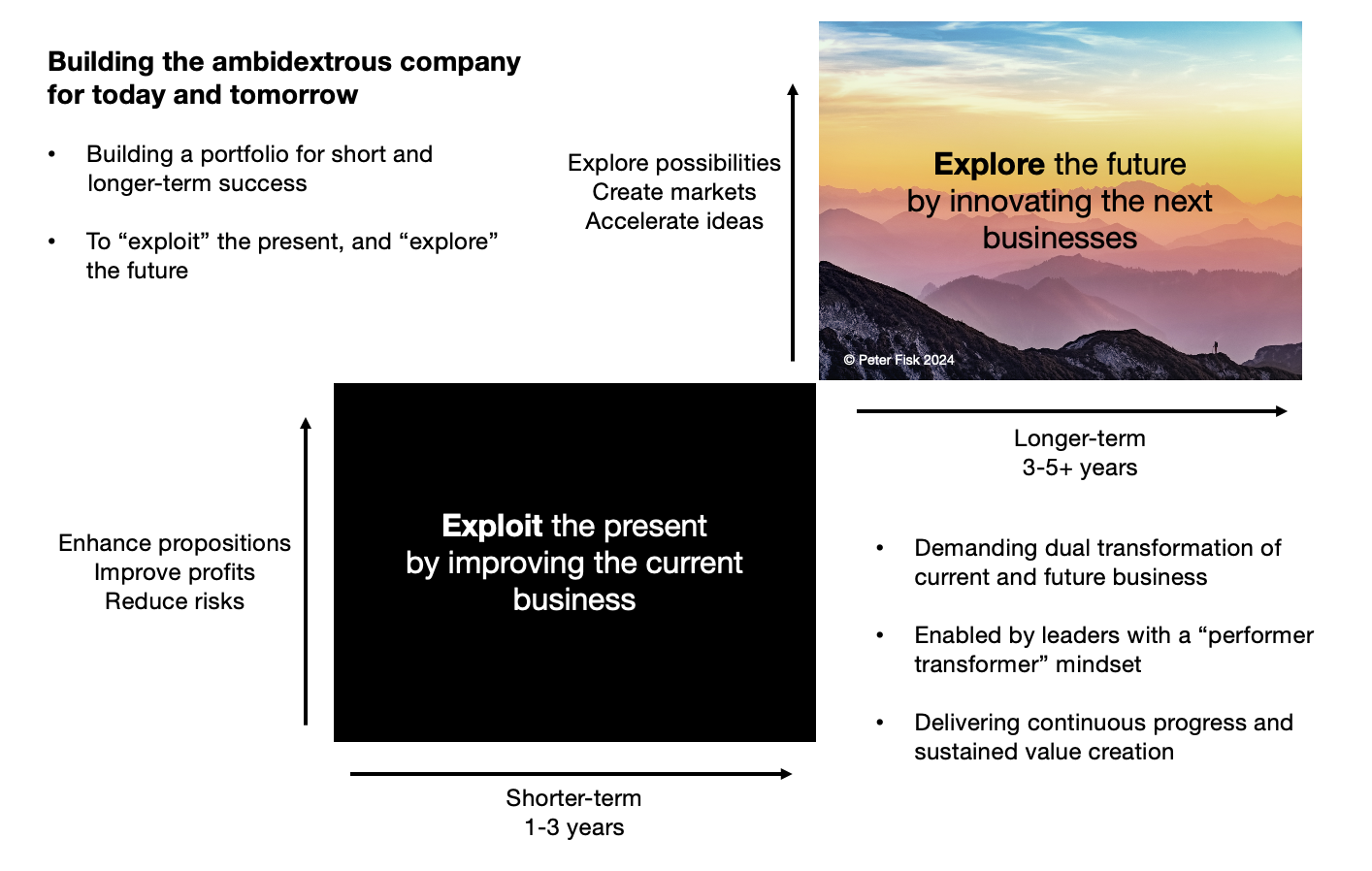
3 of the biggest challenges for transformation
Even the most visionary leaders face deep challenges in delivering transformation at scale. Three of the most critical and complex leadership challenges are balancing a portfolio of innovations, navigating dual transformation (external and internal), and aligning the board and executive team.
1. Balancing today and tomorrow
Leaders must manage a dynamic portfolio of innovations that span immediate improvements and longer-term reinvention. This means simultaneously optimising the core business (Horizon 1), incubating adjacent innovations (Horizon 2), and exploring radical new ventures (Horizon 3). The challenge is resource allocation: how to invest in transformative opportunities without compromising current performance. Leaders must create space for experimentation while maintaining operational excellence. This tension between “running the business” and “changing the business” often stretches leadership focus and organisational attention. This demands leaders who are performer-transformers, and a dual transformation approach.
2. Combining strategic and organisational change
Transformation must occur both externally—through a new strategic vision, value proposition, and business model—and internally, through organisational structure, culture, processes, and capabilities. It’s not enough to define a new direction; leaders must also mobilise the company to deliver it. This requires orchestration across functions, integration of digital and sustainability agendas, and active engagement with customers, partners, and ecosystems. Internally, leaders must rewire the organisation for agility, collaboration, and learning. That means letting go of legacy hierarchies, empowering cross-functional teams, and developing new talent and mindsets. Strategic ambition must be matched by organisational readiness.
3. Aligning the board and executive team
Perhaps the most overlooked but critical challenge is aligning the leadership at the top. True transformation starts with a shared dream—a compelling vision that stretches beyond today’s constraints. Yet many boards are anchored in risk management and short-term financials, while transformation requires bold bets and long-term thinking. Leaders must bridge this gap, building trust, framing transformation in terms of future value creation, and managing performance across multiple time horizons. Within the executive team, cohesion is vital: alignment of goals, clarity of roles, and a shared commitment to lead the change. Without unified leadership, even the best strategies falter.
In short, transformation is as much about leadership as it is about strategy. It demands courage, coherence, and collaboration across the leadership system to shape the future and deliver it with discipline.
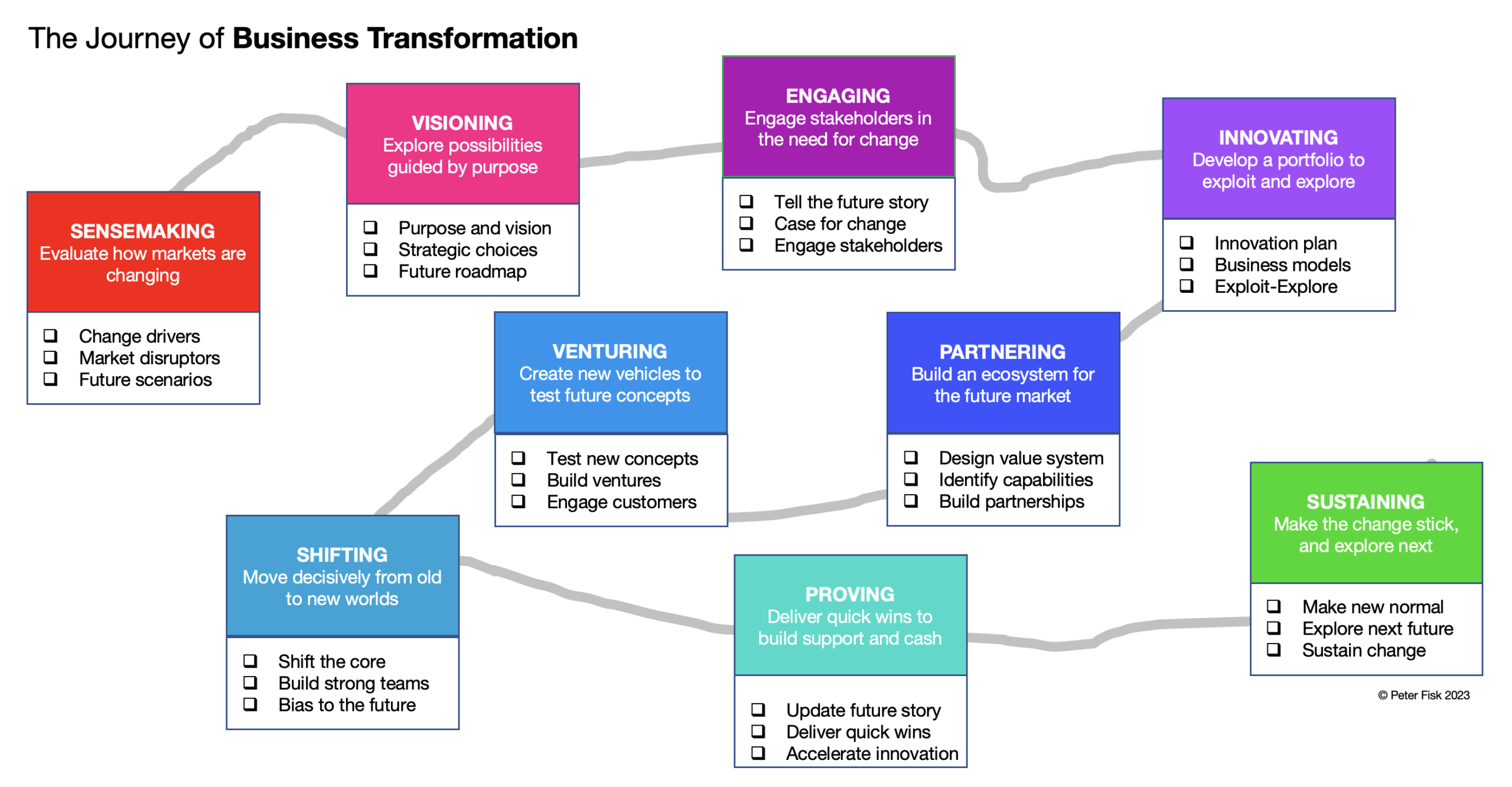
Accelerating the transformation journey
While every company’s journey is unique, successful transformations tend to follow several common principles and practices:
1. Start with purpose
Transformation is more likely to succeed when anchored in a compelling, future-facing purpose. Purpose inspires stakeholders, provides clarity during uncertainty, and guides strategic choices. Companies like Unilever and Danone have demonstrated how a strong sense of purpose can align business transformation with broader societal needs.
2. Envision a bold future
Companies need to articulate a bold vision—not just improve the present. A compelling narrative about the future energises teams and creates direction. Disney, for instance, didn’t just go digital—it reimagined itself as a streaming-first, direct-to-consumer company.
3. Redesign the business model
Transformation involves rethinking how the business creates and captures value. This may involve shifting from selling products to services, building platforms, or monetising data. Adobe transitioned from packaged software to cloud subscriptions. Ørsted moved from fossil fuels to renewable energy production. These moves require strategic courage and long-term investment.
4. Make culture a strategic asset
Culture often makes or breaks transformation. Companies need to foster learning, psychological safety, accountability, and openness to change. Microsoft’s cultural reset—from “know-it-alls” to “learn-it-alls”—was a critical enabler of its business transformation.
5. Invest in capability building
Transformation demands new skills—in AI, customer experience, sustainability, or agile working. Leading companies build these capabilities through training, hiring, and partnerships. DBS Bank, for example, turned itself into a “technology company in banking,” with internal accelerators and digital talent programs.
6. Structure for process and cultural agility
Legacy hierarchies often slow down transformation. High-performing companies redesign around networks, cross-functional teams, and empowered local units. Amazon’s “two-pizza teams” and Spotify’s squad model are iconic examples of agile structures supporting innovation.
7. Operationalise with systems and metrics
Transformation should be operationalised—translated into targets, incentives, and accountability systems. Schneider Electric embedded sustainability KPIs across the organisation, ensuring that purpose translated into performance.
8. Deliver quick wins while shaping the long term
Transformation is a marathon, but quick wins build momentum. Successful leaders sequence transformation to deliver near-term impact—such as new product lines, cost savings, or customer wins—while building the foundation for longer-term shifts.

Transformation as a leadership imperative
Great business transformations start with great leadership. In times of radical change, leaders play an essential role—not just as decision-makers, but as visionaries, mobilisers, architects, and role models. They must be bold enough to imagine a future beyond today’s business model, and disciplined enough to bring it to life across the entire organisation.
Here’s a detailed breakdown of what leaders must do to drive successful transformation—starting with vision, and following through with strategy, organisation, and execution—along with powerful real-world examples.
1. Have the courage to imagine a different future
The first and most critical responsibility of a transformative leader is to define a new vision that breaks from legacy logic. This demands courage—because it often involves letting go of what made the company successful in the past.
- Challenge the status quo. Leaders must ask: What business are we really in? What future could we shape—not just survive? They must be willing to explore and articulate a future that may not yet exist in their industry.
- Inspire ambition. A bold vision isn’t just a stretch target—it’s a compelling narrative about how the organisation can solve bigger problems, serve new needs, or change how value is created.
Satya Nadella became CEO in 2014 when Microsoft was in decline. He reframed its purpose as “empowering every person and every organization on the planet to achieve more,” moving beyond Windows to cloud, AI, and collaboration tools. His vision reinvigorated the company—and set the direction for all future strategy and culture.
Masahiko Uotani redefined Shiseido’s identity in the face of stagnation —from a Japanese cosmetics brand to a global beauty innovator focused on skin science and wellness. This allowed the company to pivot strategically into health, tech, and sustainability.
2. Translate vision into strategy and bold priorities
Vision without strategy is just a dream. Leaders must translate vision into clear, actionable priorities that redefine how the company competes.
- Redefine the business model. This might involve shifting from products to services, analog to digital, or linear to circular models. Leaders must make deliberate choices about where and how to play.
- Create new value propositions. What does the customer of the future need? Leaders must reimagine how they deliver value—and sometimes who they serve.
- Make hard trade-offs. Strategy is about focus. Leaders must say no to legacy businesses or behaviours that don’t support the transformation.
Henrik Poulsen led Ørsted’s exit from fossil fuels, reorienting the business around offshore wind. The strategy was clear: become a global leader in renewable energy. This meant divesting legacy assets and doubling down on future growth, even when it meant short-term pain.
Peter Ma led Ping An’s transformation from a traditional insurer into a tech-powered ecosystem. He strategically invested in AI, blockchain, and platforms like Good Doctor and Lufax—turning disruption into opportunity.
3. Mobilise the organisation and lead cultural change
No transformation succeeds without people. Leaders must create the conditions—mindsets, structures, and behaviours—for the organisation to embrace the future.
- Model the new mindset. Leaders must embody the values and behaviours they expect. If they want curiosity, agility, and collaboration, they must live them daily.
- Flatten hierarchy and empower teams. Organisational agility is critical. Leaders should enable cross-functional teams, decentralised decision-making, and rapid learning.
- Create psychological safety. Transformation involves risk and failure. Leaders must build trust, reward experimentation, and make it safe to speak up.
Shigetaka Komori led a deep cultural shift at Fujifilm, from a traditional, hierarchical firm to an entrepreneurial, innovation-led company. He protected R&D budgets during crisis and empowered teams to explore healthcare and materials science as new business areas.
Piyush Gupta transformed DBS Bank into “a tech company in banking.” He broke silos, invested in digital skills, and created an innovation culture that permeated all levels. DBS now regularly ranks among the world’s most innovative banks.
4. Align Systems, capabilities, and resources
Once strategy is defined and culture is shifting, leaders must align the business system to support the new model. This means rewiring the organisation for execution.
- Build future-ready capabilities. Leaders need to invest in the skills, technologies, and partnerships/ecosystems that the new strategy requires—whether it’s AI, sustainability, digital, or data.
- Redesign metrics and incentives. People do what they’re measured and rewarded for. Leaders must update KPIs, dashboards, and incentives to reflect transformation goals.
- Fund the future. Capital allocation is critical. Leaders must direct investment toward the bold bets—while responsibly managing legacy operations.
Jean-Pascal Tricoire embedded sustainability into the Schneider Electric’s performance metrics, linking executive pay to ESG outcomes. He built capabilities in digital energy and IoT, aligning strategy, talent, and structure to make sustainability a core growth engine.
Shantanu Narayen led Adobe’s shift from boxed software to cloud subscriptions. This meant new pricing, capabilities, and go-to-market models. The company retrained teams, revamped platforms, and restructured to deliver recurring customer value.
5. Sustain momentum and communicate relentlessly
Transformation isn’t a single initiative—it’s a multi-year journey. Leaders must maintain belief, energy, and accountability through ambiguity and change.
- Celebrate progress. Leaders must share quick wins, milestones, and success stories to maintain momentum, the belief and desire for change, and deliver progress.
- Communicate consistently. A compelling transformation story should be repeated often—internally and externally—so everyone understands the vision, their role, and the journey ahead.
- Evolve as the future unfolds. Leaders must stay adaptive, revisiting assumptions and updating direction as conditions change. Transformation never really ends.
Paul Polman made sustainability the centre of Unilever’s strategy and communicated it constantly—with investors, employees, and customers. He built long-term credibility and trust by showing how purpose and profit could reinforce each other.
John Iossifidis sustained momentum at Al Ghurair by driving transformation progressively at all levels, built around a strong sense of shared, meaningful purpose and vision, then empowering business units and managers to innovate and transform.
Relentless reinvention, the engine of value creation
Here are some compelling examples of the performance impact of business transformation, showing how companies that reimagined their purpose, strategy, and organisation achieved substantial profit growth, market value gains, and long-term resilience—often from entirely new business areas.
- Fujifilm‘s operating profit from new business segments grew by over 400% from 2010 to 2023. Market cap rose from around ¥1.5 trillion in 2010 to almost ¥6.5 trillion in 2024, a 4x growth in value creation.
- Microsoft‘s cloud revenues grew from $6.3B in 2015 to over $117B in 2024 (Azure, Office 365, Dynamics). Market cap rose from $340B in 2014 to over $3 trillion by 2024, which is a 780% increase.
- Schneider Electric‘s doftware and services now contribute around 50% of revenues and growing. Share price increased from €60 in 2015 to over €220 in 2024, reflecting nearly 4x market cap growth.
- PingAn’s tech platform revenue grew to 15% of total group revenue, from almost zero in 2013. Group market cap rose from $60B in 2010 to over $200B by 2021. Return on equity consistently above 18–20%.
- DSM‘s EBITDA margins improved by ~400 basis points over 10 years. Share price rose from €40 in 2010 to €160+ by 2022 representing 4x growth in market value.
- Unilever‘s “Sustainable Living Brands” grew 69% faster than the rest of the portfolio and delivered 75% of growth (2019). Market cap increased from £70B in 2010 to over £110B+ by 2024, despite market volatility.
Transformation is not a one-off change, but a journey over many years of many change projects, and ultimately becomes an ongoing capability. In an era of rapid disruption and rising stakeholder expectations, companies must continuously reinvent themselves to stay relevant and create value.
The leaders who succeed have their heads up not heads down – not just managing their companies, but shaping their futures.
The most innovative businesses today are reimagining what it means to create, deliver, and capture value.
Moving far beyond traditional “new” models – like auctions and exchanges, licensing and subscriptions – a next generation of business models is emerging — powered by AI, new technologies like blockchain and robotics, ecosystems, unlocking intangible assets, and catalysed by urgent environmental and social challenges.
Across every sector, these radical business models are reshaping how companies grow and compete. What defines them is not just their use of technology — but their redefinition of value itself. They:
-
Shift from ownership to access, or from access to participation
-
Replace centralised control with decentralised collaboration
-
Convert data, trust, and relationships into monetisable assets
-
Build value systems where profit and purpose reinforce each other
The future of business isn’t just digital. It’s distributed, decentralised, and deeply human in its impact.
These models are the blueprint for the next generation of business — intelligent, inclusive, and built around the intangible assets that now drive competitive advantage. In a world where code, creativity, and climate matter more than capital, these pioneers are not just changing business. They’re reinventing it.
Here’s a global look at some of the most radical business models reshaping industries today.
1. Brand-led ecosystems and cultural capital models
Examples: Patagonia (US), On Running (Switzerland), Glossier (US)
Certain brands today are building entire ecosystems around cultural identity, shared purpose, and community contribution. Patagonia’s transformation into a non-profit trust reshaped its business into an engine for climate action. Glossier used its loyal fanbase to co-create products and fuel word-of-mouth growth. On Running leverages its elite athlete endorsements and sustainability credentials to grow a purpose-led premium community.
Here, the brand itself becomes the platform — an intangible asset that compounds over time through trust, activism, and user collaboration.
- These businesses monetise cultural alignment, not just products. Brands capture ideas and propositions that are much more than technology. Their model grows stronger the more people believe in it.
2. Data-native platforms and relationship-driven ecosystems
Examples: Tesla (US), Bytedance (China), Ping An (China)
Some companies have made data their central business model. Tesla doesn’t just sell cars; it continuously collects driving data to improve its autonomous systems and energy products. Ping An, a Chinese financial services group, builds interconnected services — from health to banking to insurance — around deep customer data and long-term trust.
In these models, relationships — often invisible — become the key strategic asset. The more a business knows about its users, the more predictive and sticky its offerings become.
- Data becomes the flywheel. The more it’s used, the more value it creates — forming a self-reinforcing advantage that’s hard to replicate.
3. Regenerative and circular value models
Examples: Notpla (UK), Bext360 (Africa/US), TerraCycle/Loop (US)
These models embed sustainability and circularity into the business logic itself. Notpla, a London startup, makes biodegradable packaging from seaweed. Bext360 uses blockchain and AI to trace every coffee bean back to its origin, rewarding sustainable farming practices. Loop, developed by TerraCycle, builds reusable packaging systems for brands like Nestlé and Unilever.
Here, transparency, traceability, and customer trust become key intangible assets. The brand value is inseparable from environmental impact and social equity.
- Consumers increasingly demand climate-positive action — not just neutrality. These businesses are turning sustainability into a competitive advantage, not a compliance burden.
4. AI-native autonomous enterprises
Examples: Lindy.ai (US), Cognosys (Global), Hypertype (EU)
These businesses don’t just use AI — they are built around it. Entire workflows, decision-making structures, and customer interactions are being run by AI agents and autonomous systems. Lindy.ai, for instance, creates a personalised “chief of staff” AI that handles scheduling, communication, and task prioritisation. As these systems mature, companies may no longer need large administrative layers.
These models rely heavily on intangible assets — particularly proprietary data, user behaviour insights, and relationship history — to continuously learn and personalise services at scale.
- These businesses radically lower operational costs and redefine scale. A team of five people with the right AI stack can now rival the output of a 100-person company
5. DAOs: decentralized autonomous organisations
Examples: KlimaDAO (Global), CabinDAO (US), BitDAO (Singapore)
DAOs replace traditional corporate hierarchies with decentralized governance, where decisions are made by token-holders and enforced by smart contracts. KlimaDAO, for example, is building a blockchain-based economy around carbon credits. CabinDAO is creating a global co-living network governed by its digital community.
The value lies in community trust, governance transparency, and open-source code — intangible assets that replace boardrooms with consensus mechanisms.
- DAOs challenge the fundamental idea of top-down control, instead enabling collective ownership and direction — a model better suited to borderless, digital-native organizations
6. Tokenized ownership and micro-incentives
Examples: Rally.io (US), RealT (US), Sweat Economy (UK)
Tokenization enables companies to convert physical or digital value into fractional, tradeable ownership. RealT tokenizes real estate properties, allowing individuals to buy shares and receive rental income in crypto. Sweat Economy rewards people for physical activity with tokens that can be traded or spent. Rally.io enables creators to launch their own branded tokens, giving fans both access and investment-like upside.
Here, brands and communities are transformed into economic ecosystems where participation equals ownership — and engagement drives value.
- These models offer new ways to align incentives and unlock value that used to be passive or inaccessible.
7. Emotionally Intelligent AI Companions
Examples: Character.ai (US), Replika (US), Soul Machines (NZ)
A new category of business is emerging at the intersection of AI, emotion, and digital identity. Character.ai lets users build AI personalities that can engage in realistic conversations. Soul Machines develops digital humans for customer service, healthcare, and education — capable of reading and responding to emotions.
The core value is in relationships and trust — ephemeral yet deeply powerful assets. Users don’t just use these services; they form bonds with them.
- These models shift business from transactional to relational. You’re not just selling a service — you’re co-creating an emotional experience.
8. Embedded climate accounting and ethical nudging
Examples: Doconomy (Sweden), Earthchain (UK), Klarna’s carbon insights (Sweden)
These businesses integrate carbon tracking and impact measurement into daily spending. Doconomy’s credit card tracks users’ carbon footprints and can even block purchases beyond a set CO2 limit. Earthchain works with retailers to embed product-level climate impact at the point of sale.
Such models rely on consumer consciousness and ethical engagement — new forms of value that turn impact awareness into competitive edge.
- These models turn climate literacy into action, and offer companies a new lever for differentiation beyond price and product.
Reinventing the concept of business
These radical new business models are reshaping how companies grow and compete. However organisations have been reinventing their organisations for quite some time – a concept that became very popular with the advent of online platforms like Airbnb or Uber. Everyone wanted to reinvent their business as a platform, an exchange, or subscription.
So while many of these forms of business models are not new, its worth taking a few steps back to remind ourselves about what is a business model, what are the diverse options available, and how to we build them and transition from old to new.
The evolution of business models
Historically, businesses were built on simple models:
-
Product sales (e.g., Ford selling cars),
-
Service models (e.g., legal firms billing by the hour), or
-
Retail and distribution (e.g., department stores buying wholesale and selling at a markup).
These models were linear and predictable — until they weren’t.
The digital revolution triggered a seismic shift. The rise of the internet in the 1990s enabled new intermediaries, such as eBay’s auction marketplace, and Amazon’s online retail model. In the 2000s, platforms and apps introduced further models based on ecosystems and data. Then came mobile, social media, and cloud computing — which reduced the costs of reaching customers and operating at scale.
Today, companies no longer compete only on products or services, but on the architecture of their business model. A superior product with an inferior model may lose. A simple idea with a breakthrough model can win big.
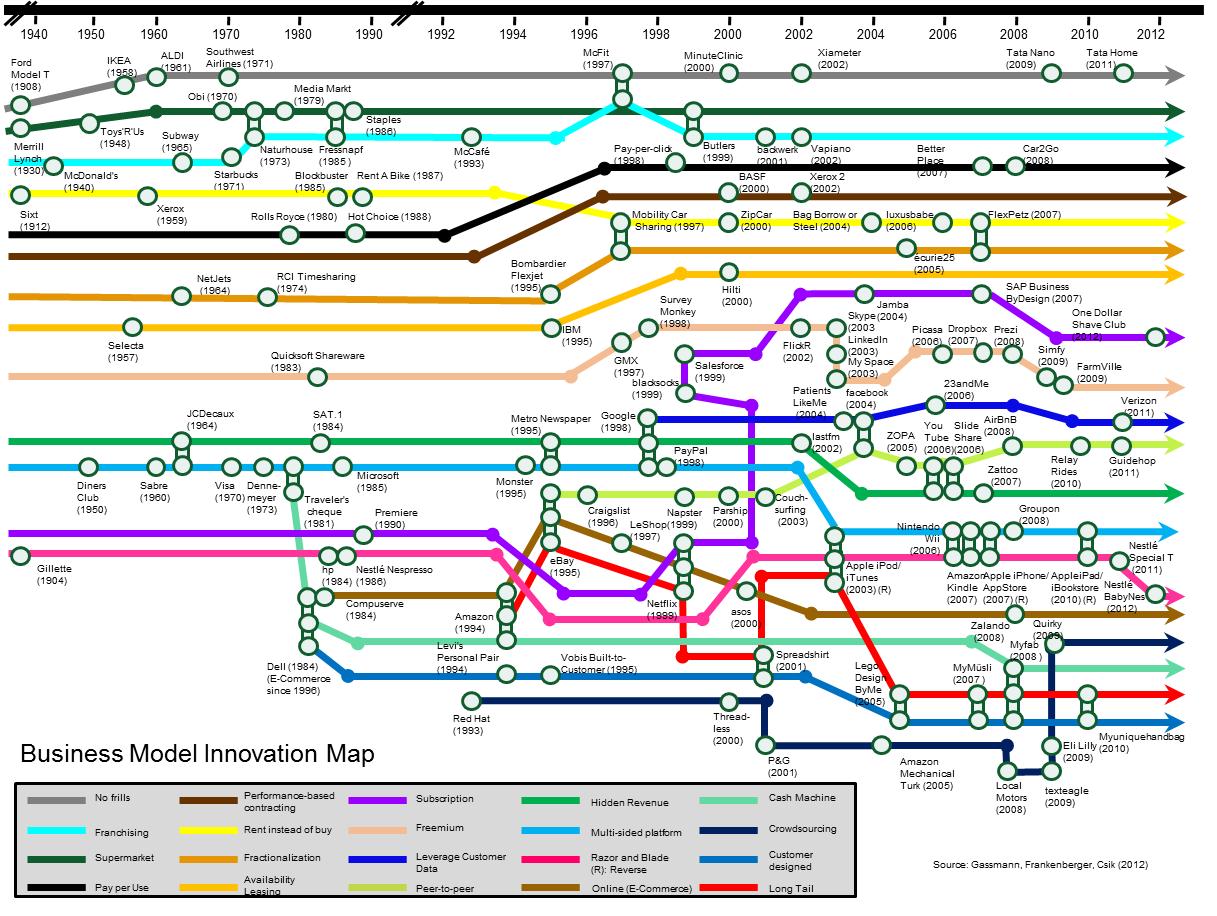
The expanding universe of business models
Over time, a wide range of business models has emerged. Some are classic, others born of digital transformation. Many combine multiple components. Here’s a snapshot of key types:
1. Product Sales
-
The most traditional model: make something, sell it for more than it cost.
-
Example: Toyota, Zara — selling cars or fashion with volume and margin.
2. Licensing
-
Charging others to use intellectual property.
-
Example: ARM Holdings licenses its chip designs to tech manufacturers around the world.
3. Razor and Blades
-
Sell one item cheap (the razor), make money on the consumables (the blades).
-
Example: HP printers and ink, or Nespresso and coffee pods.
4. Subscription
-
Recurring revenue in exchange for ongoing access.
-
Example: Netflix, Spotify, Adobe Creative Cloud.
5. Freemium
-
Offer a free basic version; charge for premium features.
-
Example: Dropbox, Zoom, and Notion — converting a small % of free users to paid ones.
6. Marketplace or Platform
-
Connect buyers and sellers, take a cut.
-
Example: Uber, Airbnb, Alibaba. These rely on building trust, liquidity, and network effects.
7. Franchise
-
License the brand and model to independent operators.
-
Example: McDonald’s, Anytime Fitness, or Marriott Hotels.
8. Auction and Exchange
-
Dynamic pricing based on demand.
-
Example: eBay, or StockX in the sneaker and fashion resale market.
9. Data Monetization
-
Offer free services, and monetize user data or insights.
-
Example: Google and Facebook generate vast revenues through targeted advertising.
10. Usage-Based or Pay-As-You-Go
-
Charge only for what’s used — ideal for cloud computing or utilities.
-
Example: AWS (Amazon Web Services), Twilio, Zipcar.
11. Crowdsourcing and Crowdfunding
-
Leverage communities to build or fund products.
-
Example: Kickstarter, GoFundMe, or Threadless for design.
12. Direct-to-Consumer (D2C)
-
Bypass traditional retail to own customer relationships and data.
-
Example: Warby Parker, Allbirds, or India’s boAt electronics.
13. Circular and Sharing Economy
-
Based on reuse or shared access instead of ownership.
-
Example: ThredUp, Fat Llama, or Lime scooters.
14. Ecosystem-Based
-
Creating a constellation of products, services, and partners that reinforce each other.
-
Example: Apple’s walled garden, or Tencent’s super app WeChat in China.
Examples of global business model innovation
- Haier evolved from a traditional appliance manufacturer into a platform of micro-enterprises. Each business unit within Haier operates like a startup — incentivized to serve customers directly, with shared services in the background. The result: agility, innovation, and resilience.
- Unilever in emerging markets uses a reverse logistics model for its “Shakti” initiative in India — empowering rural women as micro-entrepreneurs who sell hygiene products locally and collect packaging for reuse.
- Tesla’s model integrates software, hardware, and energy services — combining direct-to-consumer sales, over-the-air updates, energy storage, and AI-based autonomous driving. Its value is no longer just in vehicles but in data, brand, and energy platforms.
- Shopify enabled a new kind of distributed entrepreneurship — with tools, templates, and infrastructure that allowed anyone to become an online retailer. Its model grows by helping others grow.
How to build a new business model
Creating a new business model starts with rethinking the assumptions of your current one. Key questions include:
-
Who is our customer — and what job are they hiring us to do?
-
What unique value can we offer — and how can we deliver it differently?
-
What relationships, data, or brand assets can we leverage?
-
How can technology reshape the cost or experience of delivery?
-
Where is the money coming from — and is that the only way?
One powerful tool is the Business Model Canvas — a simple framework that breaks a business into nine components: customer segments, value propositions, channels, customer relationships, revenue streams, key activities, key resources, key partners, and cost structure.
To innovate, test different combinations:
-
Could we shift from selling to subscription?
-
Could we serve new customer segments through platforms?
-
Could we turn data into a new product or insight engine?
-
Could we create new value by collaborating with unlikely partners?
Transitioning from old to new models
Transitioning to a new business model is one of the hardest — and most critical — leadership challenges. It means letting go of legacy assumptions, revenue streams, and ways of working. The shift must often be staged and carefully managed.
Here are key steps:
-
Start small: Pilot the new model in one segment, geography, or customer base.
-
Learn fast: Measure what works, adapt quickly, and scale only what proves value.
-
Align incentives: Ensure internal teams are rewarded for embracing new models, not protecting old ones.
-
Communicate clearly: Customers, investors, and employees need to understand why the change matters.
-
Keep both engines running: During transition, companies may need to balance the legacy model (“Engine 1”) and the new model (“Engine 2”) — as explained in O’Reilly and Tushman’s ambidextrous organization framework.
Jump to the future
We now see even more radical models emerge — powered by AI, blockchain, sustainability pressures, and new social expectations. Business models will become more fluid, adaptive, and ecosystem-based. Value will increasingly flow from intangible assets like trust, brand, relationships, and data.
The ability to design, test, and evolve business models will be the most important skill of future-ready leaders. Because in a world of change, your business model — not just your product — will decide whether you win or vanish.
Business model innovation is no longer a luxury. It’s a necessity. Whether you’re a startup or a century-old corporation, your future depends on your ability to imagine new ways to create and capture value — and to let go of the past to embrace what comes next.
When technologist Luis von Ahn was building the popular language-learning platform Duolingo, he confronted a problem that reached far beyond software engineering. The challenge was not only how to teach millions of people to speak another language, but how to make them want to. How could an app designed for education compete with the attention-grabbing allure of Instagram or TikTok? How could learning itself become something people craved, rather than a duty they postponed?
Von Ahn, a Guatemalan computer scientist who had previously sold two companies to Google, understood the psychology of digital behaviour as much as he understood algorithms. He knew that to teach at scale, Duolingo had to feel less like school and more like a game — less like homework and more like a hit of dopamine. He wanted to make the learning experience so addictive that users would return to it as instinctively as they reached for social media.
The result was a revolution in the way people learn languages — and a profound case study in how education itself could be reinvented.
The psychology of learning meets the mechanics of play
Duolingo’s interface is deceptively simple: short lessons, friendly cartoons, bright colours, and the little green owl who celebrates your progress or scolds your neglect. Beneath this simplicity lies a sophisticated use of behavioural science. The app employs gamification — the use of game-like rewards and structures to motivate behaviour — with precision. Users earn points, climb leaderboards, and maintain “streaks” for consecutive days of study. They receive instant feedback for right and wrong answers. Progress is visible, tangible, measurable.
Von Ahn’s insight was that humans, regardless of age or culture, are wired to seek progress, status, and affirmation. He borrowed the mechanics of mobile gaming and social media — streaks, badges, notifications, rankings — and repurposed them for a nobler cause: learning. The psychological hooks that make Instagram endlessly scrollable or Candy Crush habit-forming became the same hooks that kept people returning to conjugate Spanish verbs or master Japanese kanji.
But Duolingo’s deeper innovation lies not just in gamification. It lies in democratisation. Von Ahn grew up in Guatemala, where access to high-quality education was limited to a privileged few. He wanted to build a platform that made learning free, fun, and universal. By using artificial intelligence to personalise lessons, by harnessing cloud computing to deliver it at scale, and by designing for mobile-first access, Duolingo broke open the gates of education for hundreds of millions of learners.
Today, over 600 million people use Duolingo. It teaches 40 languages, from English and Spanish to Swahili and Navajo. It is as likely to be used by a refugee learning a new country’s language as by an executive preparing for a global posting. And its impact goes beyond language: Duolingo has proven that learning can be delightful — that when designed right, it can be something we choose to do, not something we have to do.
What Duolingo tells us about the future of learning
The success of Duolingo poses a radical question: if education can be made this engaging, why isn’t all learning like this? Why do so many classrooms, lecture halls, and corporate training programmes still feel joyless, disconnected, and outdated?
Learning, as a human act, has barely changed in centuries. The dominant model — a teacher at the front, students in rows, content delivered in linear chunks — dates back to the industrial age. It was designed to produce compliant workers for predictable jobs. But the world has changed. Information is no longer scarce. Skills expire fast. Technology evolves faster. And the capacity to learn — to adapt, unlearn, and reinvent oneself — has become the most valuable skill of all.
If we are to keep up with this world, learning itself must be reinvented: made more immersive, more personal, more continuous, more creative, and more human.
Learning as experience, not instruction
The most powerful shift underway is from instruction to experience. Traditional education delivers content — lectures, textbooks, PowerPoints — as if learning were the passive absorption of facts. But research in cognitive science, from thinkers such as John Dewey and Jean Piaget to modern neuroscientists, shows that people learn best by doing, experimenting, and reflecting. Learning is not a transfer of information; it is the construction of meaning.
This idea is now being realised through technology in extraordinary ways. Virtual and augmented reality are allowing learners to step inside complex systems and stories. For example, Labster, a Danish company, creates virtual science laboratories where students can perform chemistry experiments without chemicals or risk. Immerse and ENGAGE XR offer virtual classrooms where learners interact as avatars, conducting debates or exploring 3D models. Medical students train on digital cadavers. Engineers learn by manipulating simulated machinery. History students walk through ancient cities reconstructed in VR.
These experiences are not just novel — they are more effective. The combination of visual, spatial, and emotional engagement creates stronger memory and deeper understanding. It turns learning from a cognitive act into a sensory one.
Learning becomes personal
Technology also enables a second revolution: personalisation. Every learner is different — in pace, style, motivation, and prior knowledge — yet most education still treats learners as identical. Adaptive learning platforms, powered by artificial intelligence, are changing this.
AI can now analyse how each individual learns, what mistakes they make, where they hesitate, and what excites them. It can adjust difficulty, sequence, and content in real time. Platforms like Knewton, Squirrel AI, and Century Tech are pioneering such adaptive models in schools, while corporate learning systems like Degreed, Coursera for Business, and LinkedIn Learning personalise pathways for professionals.
Duolingo itself uses machine learning to tailor lessons, ensuring that each learner stays in the sweet spot between challenge and mastery — hard enough to be interesting, easy enough to be achievable.
The result is a shift from standardisation to individualisation, from education as a conveyor belt to education as a compass. Learning becomes a lifelong conversation between the learner and the system, continuously refined by data and feedback.
Learning through play, purpose and community
But technology alone cannot make learning meaningful. Engagement requires emotion — curiosity, play, purpose, and belonging. The most successful learning experiences tap into these deeper drivers.
Gamified platforms like Duolingo and Kahoot! use play to trigger intrinsic motivation. Minecraft: Education Edition allows children to learn coding, architecture, and ecology by building virtual worlds. The LEGO Foundation promotes “learning through play” as a philosophy for all ages, including adults rediscovering creativity and collaboration.
Purpose adds another layer. When people learn in pursuit of a cause, not just a grade or promotion, they absorb knowledge more deeply. Programmes like Teach For All, One Young World, and Ashoka Fellows blend education with social impact, turning learning into action. The rise of sustainability-oriented business schools and ESG-focused executive programmes shows how purpose can re-energise professional learning.
Community is the glue that sustains it all. Humans are social learners. We learn best in groups, through dialogue, storytelling, and feedback. Online communities — from Reddit’s r/learnprogramming to MasterClass forums and peer networks on FutureLearn — have recreated the seminar in digital form. Meanwhile, in physical spaces, new schools and universities are designing campuses for collaboration rather than lectures.
Reinventing learning for children
The reinvention of learning starts with how we educate the young. Across the world, innovative schools are breaking free from the factory model of education, creating environments that nurture creativity, resilience, and agency.
Finland remains a global reference point. Its schools emphasise trust, autonomy, and curiosity over tests and homework. Teachers are highly trained and given freedom to design lessons. Students learn through projects that connect disciplines to real life — combining maths, art, and social studies around themes like climate change or sustainable cities.
In the Netherlands, Agora School allows students to design their own curriculum entirely, guided by coaches rather than teachers. There are no subjects, grades, or classrooms — only projects that align with each child’s interests. The result is extraordinary engagement: children take ownership of learning rather than compliance.
Elsewhere, schools like Green School in Bali and United World Colleges around the globe blend academic rigour with environmental and cultural immersion. Learning happens in bamboo classrooms, in forests, in communities. The emphasis is on empathy, sustainability, and global citizenship — the competencies the 21st century needs most.
These examples suggest that the future of education lies not in memorising what machines can already do, but in cultivating what makes humans unique: creativity, compassion, curiosity, critical thinking, and collaboration.
Universities in transition
Higher education, once the pinnacle of intellectual formation, is also under pressure to reinvent. Rising costs, shifting student expectations, and the digitisation of content are eroding the old model of the ivory tower. The pandemic accelerated the move to hybrid and online learning, revealing both the possibilities and the shortcomings of virtual education.
Leading universities are responding by blending digital access with experiential immersion. Minerva University, based in San Francisco but operating globally, has replaced the physical campus with a global network. Students live in different cities each semester — Berlin, Seoul, Buenos Aires — and attend live seminars online through an interactive platform designed for deep discussion. The focus is on critical thinking, interdisciplinary problem-solving, and cultural adaptability.
Other institutions are embracing micro-credentials and modular degrees. MIT’s MicroMasters, Harvard’s online certificates, and FutureLearn’s short courses allow learners to build flexible, stackable qualifications that evolve with their careers. Learning no longer needs to happen once, between 18 and 22; it can unfold continuously, anywhere, anytime.
Universities are also partnering with industry to close the gap between theory and practice. The rise of applied research labs, innovation studios, and entrepreneurship centres transforms campuses into ecosystems where students learn by creating, testing, and launching ideas.
Reinventing corporate and executive learning
If schools and universities are changing slowly, corporate learning is moving at breakneck speed. Businesses have realised that in an era of disruption, their greatest asset is not what they know, but how fast they can learn.
The traditional model of executive education — a week at a business school with case studies and networking dinners — now feels inadequate. In its place, a wave of new learning experiences is emerging that emphasise agility, experimentation, and future-readiness.
Programmes such as Singularity University in Silicon Valley immerse leaders in exponential technologies — AI, robotics, blockchain, synthetic biology — while challenging them to tackle global challenges. The d.school at Stanford and Hyper Island in Stockholm teach creative problem-solving through design thinking, rapid prototyping, and reflection.
Meanwhile, platforms like Coursera, edX, and Udemy are democratising access to world-class business education. Anyone, anywhere, can now learn from professors at Yale or practitioners at Google. The boundaries between formal and informal, physical and digital, education and entertainment, are dissolving.
Corporate learning is also becoming social and experiential. Companies like Unilever, Microsoft, and DBS Bank have replaced top-down training with internal “learning ecosystems” — networks of mentors, digital resources, and collaborative projects. Learning happens in the flow of work, through peer coaching and real-world challenges.
The most forward-looking organisations treat learning as culture, not curriculum. They reward curiosity, encourage experimentation, and view failure as feedback. They understand that in a volatile world, the organisation that learns fastest wins.
The neuroscience of engagement
Why do some learning experiences stick while others fade? Neuroscience is beginning to provide answers. Learning that triggers emotional engagement, novelty, and reward activates dopamine pathways in the brain, strengthening memory and motivation. In contrast, rote learning and passive listening fail to engage these circuits.
Duolingo’s success with streaks and rewards reflects this principle — it stimulates the same pleasure pathways as social media, but towards a positive end. Similarly, immersive simulations and storytelling activate multiple areas of the brain, making information more likely to be retained.
Understanding these mechanisms allows educators to design learning that works with the brain rather than against it. The future of pedagogy lies at the intersection of psychology, design, and data — in creating experiences that align cognitive science with human curiosity.
Learning as a lifelong pursuit
The old idea of education as a stage that ends with a diploma is collapsing. In a world where industries transform within a decade, lifelong learning is no longer optional. Workers must continuously reskill and reinvent themselves.
Governments and companies are responding. Singapore’s SkillsFuture initiative provides every citizen with lifelong learning credits to spend on courses. The European Union’s Upskilling Pathways programme encourages member states to provide personalised learning opportunities for adults.
Digital platforms are filling the space between education and employment. Google Career Certificates, IBM SkillsBuild, and LinkedIn Learning offer short, targeted programmes aligned with labour market needs. The barrier between learning and earning is dissolving.
But beyond employability, lifelong learning is becoming part of identity. It reflects a mindset of curiosity and adaptability. As the philosopher Alvin Toffler wrote, “The illiterate of the 21st century will not be those who cannot read and write, but those who cannot learn, unlearn, and relearn.”
It begins with curiosity and meaning
For all the power of technology, the essence of learning remains profoundly human. It begins with curiosity — the desire to know — and culminates in meaning — the ability to connect knowledge to life.
No algorithm can replace the spark of a great teacher, the insight of a mentor, or the inspiration of shared discovery. The danger of digital learning is that it can become efficient but soulless, reducing education to content delivery. The opportunity is to use technology to amplify humanity, not replace it — to free teachers from routine tasks so they can focus on dialogue, creativity, and empathy.
Reinventing learning, therefore, is not about gadgets or apps; it is about reimagining the relationship between humans and knowledge. Technology provides the tools, psychology provides the understanding, but imagination provides the purpose.
Building a positive culture of learning
What Duolingo has demonstrated at massive scale is that learning can be joyful, social, and self-propelling. The next step is to infuse that spirit across society — into schools, workplaces, and communities.
Imagine a world where learning is as ubiquitous and as habit-forming as social media. Where every person has a personalised learning companion powered by AI, curating pathways based on passions and goals. Where education systems reward curiosity over conformity. Where businesses measure success not by output but by growth in collective capability.
This culture of learning would transform economies and societies alike. It would narrow inequality by making opportunity accessible. It would accelerate innovation by multiplying minds able to think differently. It would humanise technology by aligning it with aspiration.
Reinventing learning … from Duolingo to the world
Luis von Ahn once said that Duolingo’s mission was not to teach languages but to make learning accessible to all. The deeper lesson of his story is that learning itself can be reinvented — by combining the psychology of motivation with the ethics of inclusion and the possibilities of technology.
From a small app on a smartphone to the reinvention of global education, the principles remain the same: make it personal, make it playful, make it purposeful, and make it possible for everyone.
If the 20th century was the age of schooling, the 21st will be the age of learning — continuous, connected, and creative. The tools are in our hands. The curiosity is in our nature. All that remains is to design systems that unleash it.
As Duolingo’s little owl might remind us, the future belongs to those who keep learning — one small lesson, one daily streak, one joyful discovery at a time.
The climate crisis has long been framed as a story of restraint — of cutting back, consuming less, flying less, wanting less. For decades the narrative has been one of limits, sacrifice, and slow adaptation. Yet a new generation of thinkers and innovators is turning that story on its head. What if the solution is not to shrink our world, but to redesign it? What if the answer to a warming planet is not paralysis, but possibility?
Around the world, engineers, entrepreneurs, and ecologists are no longer asking how to avoid disaster but how to cool the planet. Their thinking is bolder, their timelines shorter, and their tools more ambitious. They are drawing from nature’s own playbook — regeneration, restoration, and feedback — and combining it with the power of exponential technologies, circular economies, and creative human cooperation.
The Shift from Reduction to Regeneration
Paul Hawken’s Regeneration: Ending the Climate Crisis in One Generation has become a touchstone for this new mindset. Rather than framing climate action as damage limitation, Hawken invites us to see it as a design challenge — to restore the living systems that sustain life. His central insight is both scientific and spiritual: carbon is not the enemy, but the element of connection, cycling endlessly through plants, oceans, and soil. When we burn it, we break that cycle. When we restore it, we rebuild balance.
Hawken’s work has inspired a wave of regenerative thinking that transcends traditional environmentalism. Instead of merely “sustainability” — maintaining what we have — regeneration seeks to make the world better, richer, and more resilient. It’s a shift from doing less harm to doing more good; from neutrality to positive impact.
Across sectors, this regenerative logic is now shaping strategy and innovation. From companies reimagining materials and food systems, to cities investing in biodiversity and resilience, the emphasis is on circular, restorative growth — a new economy that works with nature rather than against it.
Cooling at Speed and Scale
If regeneration is the philosophy, then cooling the planet is its practical expression. Scientists and entrepreneurs are exploring interventions that actively lower global temperatures — not in centuries, but in decades.
Some of these efforts are strikingly direct. Carbon capture and storage, once a fringe idea, is now moving into the mainstream. In Iceland, Climeworks operates the world’s largest direct air capture plant, using geothermal energy to pull CO₂ from the air and mineralise it underground. In Canada, Carbon Engineering is building facilities capable of extracting a million tonnes of CO₂ per year.
Others are taking inspiration from the Earth’s own systems. Enhanced weathering projects, for example, accelerate natural rock processes that absorb carbon. In Kenya and Scotland, researchers are spreading basalt dust on farmland, turning agricultural soils into massive carbon sinks. Forest restoration, mangrove replanting, and seagrass regeneration — all old ideas — are being turbocharged with AI mapping, drone reforestation, and data-driven ecosystem management.
Then there are the moonshots: approaches once considered unthinkable. Stratospheric aerosol injection — mimicking volcanic eruptions to reflect sunlight — is back under serious study, as are marine cloud brightening projects off the coasts of Australia and California. These “solar reflection” techniques remain controversial, but the urgency of climate feedback loops has rekindled debate about whether we can afford not to explore them.
Nature as Technology
Perhaps the most profound innovation is rediscovering that nature itself is the most sophisticated technology we know. Photosynthesis, microbial metabolism, ocean currents — these are the planet’s original carbon management systems. Modern science is learning to harness and amplify them.
In Finland, a startup called Solar Foods produces protein from hydrogen and CO₂ using microbes — a process that turns air into food with minimal land or water use. In the Netherlands, researchers are engineering biochar systems that convert agricultural waste into stable carbon, improving soil health while locking carbon underground for centuries. In the United States, companies like Living Carbon are developing genetically enhanced trees that capture carbon faster than their wild counterparts.
These solutions share a radical optimism: that human ingenuity, guided by ecological intelligence, can not only stop the damage but reverse it.
Cities That Heal
Urban areas — responsible for 70% of global emissions — are becoming laboratories for planetary healing. Singapore is weaving greenery into its skyline with vertical forests and cooling corridors that lower city temperatures. Copenhagen aims to be the world’s first carbon-neutral capital, powered by renewable energy and circular waste systems. Paris has pledged to become a “15-minute city,” reducing car dependence while increasing local vibrancy.
London, too, is experimenting with a regenerative urban future. New heat networks, powered by underground and waste energy, now provide low-carbon warmth to thousands of homes. The city’s “superloop” of electric buses and expanding cycling infrastructure signal a broader cultural shift — from linear consumption to living systems design.
But cities are not only sites of emission; they are also centres of coordination. Urban innovation scales quickly, combining public policy, citizen behaviour, and technology deployment. If the industrial revolution began in cities, the regeneration revolution may well do the same.
A Revolution in Food and Farming
Few sectors illustrate the potential of regenerative design more vividly than agriculture. Conventional farming, dependent on synthetic fertilisers and monocultures, degrades soil and releases vast amounts of carbon. Regenerative agriculture, by contrast, treats the farm as a living ecosystem — integrating cover crops, composting, rotational grazing, and biodiversity to restore soil carbon and fertility.
Across Africa, Asia, and Latin America, smallholders are reviving indigenous techniques that store carbon while improving yields. In the American Midwest, large-scale farmers are adopting no-till methods and planting “carbon-smart” crops supported by data-driven platforms such as Indigo Ag.
Meanwhile, the future of protein is being reimagined. Precision fermentation, cellular agriculture, and mycelium-based foods are scaling fast. These technologies promise to cut land and water use while offering new markets for sustainable growth. Companies like Meati in the US and Solar Foods in Europe are showing that innovation and nature need not be opposites — they can be allies in regeneration.
Rethinking Capitalism Itself
But regeneration is not only technological. It is economic, moral, and cultural. The deeper question is: what kind of economy can sustain life, rather than deplete it?
The regenerative model challenges the very foundations of extractive capitalism. It asks companies not how to offset their impact, but how to embed their value creation in systems that restore. That means redesigning business models around circular flows, long-term stewardship, and ecological accounting.
Pioneers like Patagonia, Interface, and Unilever have already shown what this looks like in practice. Interface’s “Factory as a Forest” initiative aims to make each production site a net-positive ecosystem — generating more clean air, water, and biodiversity than it consumes. Unilever’s “Regenerative Agriculture Principles” now extend across its supply chains, connecting livelihoods and land restoration.
Financial systems, too, are beginning to adjust. Regenerative finance (ReFi) is emerging as a movement to align capital with planetary health. Tokenised carbon credits, nature-backed currencies, and biodiversity-linked bonds are early experiments in this new field. The aim: to make the health of ecosystems not an externality, but the core metric of economic value.
The Acceleration Imperative
Speed matters. Every year of delay compounds the challenge. The good news is that exponential technologies can compress timelines dramatically. AI-driven climate modelling now allows researchers to test thousands of interventions virtually before field trials begin. Advanced materials — from carbon-storing concrete to biodegradable plastics — are moving from lab to market at record pace.
Even public policy is learning to accelerate. The European Green Deal, the Inflation Reduction Act in the US, and China’s vast investment in clean technologies all signal a new industrial race — one defined not by fossil fuels, but by the energy transition. Nations are competing not only to decarbonise, but to lead in the industries of the future: batteries, hydrogen, fusion, and synthetic biology.
A Cultural Shift
Ultimately, the climate challenge is as much about imagination as engineering. For decades, we have been told that human activity inevitably harms the planet. Regeneration reframes that relationship: human systems can heal the planet when aligned with natural ones.
This demands a cultural transformation — from extractive to generative, from scarcity to possibility. Artists, educators, and storytellers play a crucial role in this shift. When people can see a hopeful future, they are more likely to build it.
Movements like “Planetary Health” and “Earth System Governance” are beginning to reshape disciplines, connecting climate to health, equity, and security. The younger generation — from climate scientists to startup founders — sees regeneration not as an ideology, but as an organising principle for civilisation itself.
From Despair to Design
The task ahead is immense, but not impossible. Every degree of warming avoided matters; every system redesigned adds resilience. The same ingenuity that built industrial civilisation can now be turned toward ecological repair.
The challenge is to move faster and think bolder — to treat climate not as a burden, but as a frontier for innovation. Whether through nature-based restoration, advanced carbon removal, or regenerative business, the path forward lies in imagination backed by action.
As Paul Hawken writes, regeneration is “the story of life continuing to create conditions for life.” It is not a distant dream but a practical blueprint. What began as a crisis of limits is becoming a movement of creation.
If we act decisively, the 21st century could be remembered not as the age of decline, but as the moment humanity learned to make the Earth thrive again. Cooling the planet, it turns out, may begin with warming the human spirit — to believe, once more, in our collective power to regenerate the world we share.
Technology is no longer a background enabler of business strategy; it is core to the strategy. Each year, the World Economic Forum identifies the most promising breakthroughs set to reshape markets, industries, and society. The Top 10 Emerging Technologies of 2025 is more than a list of inventions—it’s a roadmap to where value will be created, disrupted, and redefined.
For business leaders, the implications are immediate. These technologies—from AI that reasons like a human to sustainable materials that unlock circular economies—are not distant possibilities. They are investment priorities, talent magnets, and innovation accelerators already moving from lab to market. They will change customer expectations, supply chains, and competitive dynamics.
Understanding these shifts is essential for building resilience and seizing opportunity. The leaders who engage early—experimenting, partnering, and scaling—will not only navigate disruption but set the pace of progress in their industries.
Here are 10 emerging technologies that have the potential to reshape industries, redefine healthcare, and accelerate the transition to a more sustainable and intelligent world.
- Structural Battery Composites – Batteries integrated into the structure of vehicles or aircraft.
- Osmotic Power (Blue Energy) – Harvesting clean energy from the salt gradient between seawater and freshwater.
- Advanced Nuclear Technologies – Safer, simpler, and more cost-effective reactors.
- Engineered Living Therapeutics – Microbes programmed to produce drugs inside the body.
- GLP-1s for Neurodegenerative Disease – Repurposing weight loss drugs to tackle Alzheimer’s and Parkinson’s.
- Autonomous Biochemical Sensors – Real-time monitoring of health markers.
- Green Nitrogen Fixation – Sustainable ammonia production for fertilizers.
- Nanozymes – Synthetic nanomaterials mimicking enzymes for healthcare and industry.
- Collaborative Sensing – Networks of distributed sensors powered by AI.
- Generative Watermarking – Tracing the origins of AI content for trust and transparency.
Deep dives into each tech
Structural Battery Composites (SBCs)
What they are. Structural battery composites integrate the functions of a rigid, load-bearing material and a rechargeable battery in the same component. Instead of packing heavy cells inside a passive casing, the “case” itself becomes the battery—e.g., portions of an EV’s body, a drone’s wing spar, or even building panels doubling as energy storage.
Why it matters. Weight and volume are the enemies of electrification. SBCs promise large system-level gains: lighter vehicles (longer range with the same pack or same range with smaller packs), simplified architectures, fewer parts, and potentially lower costs and lifecycle emissions. In aerospace, where every kilogram counts, embedding storage into primary structures could unlock longer endurance for e-aviation and UAVs. In the built environment, SBCs hint at walls and facades that store and smooth on-site renewable electricity.
How it works. SBCs typically combine carbon-fiber reinforcement (mechanical strength) with solid-state or polymer electrolytes and engineered interfaces that can carry both ionic and structural loads. The technical challenge is balancing electrochemical performance (capacity, cycle life, safety) with mechanical properties (stiffness, toughness, crash behavior) in a single laminate or sandwich structure.
Trajectory and hurdles. Early prototypes exist, but scaling means qualifying entirely new multifunctional materials for safety-critical use. Key issues include damage tolerance and repairability, thermal management, fire safety, end-of-life recycling, and the need for new standards and test protocols (you’re crash-testing the “battery” as part of the chassis). Supply chains must adapt for co-manufacturing energy and structural layers at high yield. Still, the Forum frames SBCs as an inflection point for materials-energy convergence with cross-sector impact over the coming decade.
Bottom line. If validated at scale, SBCs could rewrite design rules for EVs, aircraft, marine craft, and buildings—collapsing separate subsystems into lightweight, power-storing structures and pushing electrification into domains where today’s batteries struggle.
Collaborative Sensing
What it is. Collaborative sensing links many disparate sensors—cameras, LiDAR, smartphones, vehicles, traffic lights, weather stations—into a network that fuses data in real time. AI sits atop this mesh to extract context and coordinate actions across domains such as mobility, emergency response, and environmental monitoring.
Why it matters. A single sensor has limited field-of-view and reliability; thousands working together create resilience, coverage, and richer situational awareness. Think traffic lights that dynamically retime based on live road, air-quality, and transit feeds; cars that “see” around corners using other vehicles’ sensors; mine sites and ports that coordinate machinery more safely; cities that detect floods or wildfire smoke early and route resources accordingly.
Enablers and challenges. Advances in edge computing, low-latency networks, and multimodal AI enable on-the-fly sensor fusion. The hard parts are governance and trust: privacy, security, data ownership, consent, and bias in models that make operational decisions. Powering massive sensor fleets, creating interoperable standards, and ensuring cyber-resilience are also essential. The WEF emphasizes that trust and safety frameworks must grow alongside deployments.
Outlook. As infrastructure digitizes, collaborative sensing becomes a backbone for smart cities and autonomy. Expect early value in controlled environments (industrial sites, campuses) and progressive rollouts in transport and public safety—where benefits can be measured in minutes saved and lives protected.
Green Nitrogen Fixation
What it is. Ammonia is indispensable for fertilizer, underpinning roughly half of global food production. Today it’s made mainly via Haber-Bosch, a high-temperature, high-pressure process fueled by fossil hydrogen—responsible for about 2% of global energy use and significant CO₂ emissions. “Green” nitrogen fixation swaps in low-carbon pathways: electrolytic or photochemical routes, bio-engineered microbes and enzymes, or hybrid systems that leverage renewable electricity.
Why it matters. Decarbonizing ammonia tackles a major industrial emitter while making food systems less exposed to gas price shocks. It also enables on-site or distributed production near farms, potentially reducing transport emissions and improving access in emerging markets.
State of play. The report notes momentum from lab to pilot scale across electrochemical nitrogen reduction, plasma catalysis, photocatalysis, and biocatalytic approaches, though achieving energy efficiency, selectivity (suppressing hydrogen evolution), and durability at scale remains tough. Systems engineering—coupling intermittent renewables to continuous production, storage, and safety—will determine competitiveness against incumbent Haber-Bosch.
Risks and policy. Certification of “green ammonia,” clear carbon accounting, and incentives (e.g., for green H₂) can accelerate adoption. Bio-based routes raise biosafety and containment questions; any distributed production must meet stringent safety standards given ammonia’s hazards.
Outlook. With fertilizer demand steady and shipping eyeing ammonia as a zero-carbon fuel, green fixation could influence both agriculture and maritime decarbonization if cost and performance targets are met.
Nanozymes
What they are. Nanozymes are engineered nanomaterials that mimic natural enzymes’ catalytic activity while often being more stable, cheaper, and easier to manufacture at scale. They can catalyze redox reactions, peroxidase-like activity, and more—opening use in biosensing, diagnostics, environmental remediation, and targeted therapies.
Why it matters. Natural enzymes are powerful but fragile (temperature, pH, proteolysis) and costly to produce. Nanozymes tolerate harsher conditions, can be tailored for activity and targeting, and integrate with electronics for readouts. Potential wins: faster, rugged point-of-care tests; catalytic filters that break down pollutants; oncology or neurodegeneration interventions where nanozymes activate drugs or scavenge reactive species.
Evidence and momentum. The WEF synthesis highlights accelerating research and early commercialization, including companies pursuing nanozyme-enabled diagnostics and therapeutics. Market forecasts anticipate rapid growth as materials and selectivity improve, though clinical use will demand rigorous safety and biodistribution data, plus regulatory clarity for nanomedicine.
Caveats. Key challenges are specificity (avoiding off-target reactions), biocompatibility and clearance, and standardized assays to compare catalytic performance with native enzymes. For environmental uses, lifecycle and ecotoxicity assessments are essential.
Outlook. By combining catalysis, materials science, and device integration, nanozymes could become a general-purpose tool for robust sensing and intervention in messy, real-world settings where proteins struggle.
Engineered Living Therapeutics
What they are. “Living medicines” use engineered microbes or cells that reside in the body and manufacture therapeutic molecules on demand—think programmable probiotics that sense inflammation and release anti-inflammatory factors, or bacteria that convert toxic metabolites into harmless products.
Why it matters. Conventional drugs are static; living systems can adapt, persist, and target niches (gut, skin, tumor microenvironments). That raises the prospect of long-acting, responsive therapies for chronic disease, metabolic disorders, infections, and even cancer, potentially with lower costs and improved adherence.
State of play. Synthetic biology, chassis optimization, and AI-assisted design are converging to improve safety circuits (kill switches, auxotrophy), delivery, and manufacturability. Early trials and regulated probiotics offer learnings, but regulatory pathways must evolve to assess genetically modified organisms living inside patients. Post-market monitoring, horizontal gene transfer risks, and environmental containment for excreted organisms are active considerations.
Outlook. The Forum frames engineered living therapeutics as a meaningful step toward adaptive medicine—if safety engineering and governance keep pace with ingenuity. Expect initial approvals in tightly controlled indications and delivery sites, then expansion as toolkits mature.
GLP-1s for Neurodegenerative Disease
What this means. GLP-1 receptor agonists (GLP-1 RAs)—best known for type 2 diabetes and obesity—are being investigated for Alzheimer’s and Parkinson’s. Mechanistically, they cross the blood-brain barrier and may reduce neuroinflammation, improve insulin signaling, enhance cellular energy management, and support clearance of toxic proteins.
Why it matters. Neurodegenerative diseases impose huge human and economic burdens, with limited disease-modifying options. If GLP-1s slow progression, even modest effects could extend independent living and reduce care costs. The report notes mixed early clinical results but enough signals to justify larger, rigorous trials now under way. Affordability and supply constraints remain salient.
Risks and realities. Translating metabolic benefits to neuroprotection is non-trivial; dosing, duration, and patient selection matter. Frailty and unintended weight loss in older patients require careful oversight. Policymakers may need new reimbursement models if upfront drug costs offset long-term care savings.
Outlook. Repurposing a mature drug class accelerates timelines. If efficacy is proven, GLP-1s could shift neurology from symptom management to disease modification and spur combination regimens with other agents (e.g., GIP co-agonists). W
Autonomous Biochemical Sensing
What it is. Analytical devices that continuously detect and quantify biochemical markers with minimal human intervention—wired for real-time data capture and often self-powered. Beyond glucose monitors, think wearables for inflammatory cytokines, continuous hormone tracking, microbial “whole-cell” biosensors that report pollutants or pathogens, and environmental nodes that surveil soil and water chemistry.
Why it matters. Continuous data can move systems from reactive to preventive: early infection warnings, real-time food safety validation, leak/spill detection before public exposure, and adaptive agriculture. During crises, a distributed biochemical “nervous system” can inform faster, targeted responses.
Hurdles. Sensors must balance sensitivity with longevity in messy environments; fouling and biofilms degrade performance. Engineered microbial sensors raise biosafety and permitting issues. Then there’s data governance: privacy for health signals, secure telemetry, and analytics that avoid false alarms.
Outlook. Expect early traction in industrial and regulated settings where ROI is clear (pharma, food processing, water utilities), followed by consumer health niches. As materials and wireless power advance, biochemical sensing will become a standard layer of digital infrastructure.
Osmotic Power Systems
What they are. Osmotic (salinity-gradient) power harvests energy when fresh and salty water mix, typically across a selective membrane that drives ion flow and electricity generation. Advances in membranes and system design have revived a previously niche concept, with pilot plants exploring coastal and estuarine deployments.
Why it matters. It’s clean, steady (not intermittent like wind/solar), and colocates with abundant coastal water flows. Integrating osmotic systems with desalination or wastewater treatment may share infrastructure and enable resource recovery (e.g., lithium from brines), improving project economics. The report cites research momentum and early investment signals.
Challenges. Membrane cost, durability (fouling, scaling), and energy density are central. Environmental permitting must address impacts on estuarine ecosystems and salinity plumes. Grid integration and hybridization with other renewables can improve capacity factors but add complexity.
Outlook. If new membranes and modular designs hit cost targets, osmotic power could complement baseload-seeking grids and provide resilient coastal microgrids—especially valuable as electrification and water stress rise.
Advanced Nuclear Technologies
What they are. A new wave of nuclear systems—such as small modular reactors (SMRs), alternative coolants, advanced fuels, and passive safety designs—aims to deliver firm, low-carbon power with improved safety, cost, and siting flexibility. These can serve grids, industrial heat, or hydrogen production.
Why it matters. Electrification (EVs, heat pumps, AI data centers) is driving demand for reliable clean power. Advanced nuclear offers high capacity factors with small land footprints and potential load-following. Modularization and factory fabrication promise better cost control than bespoke gigawatt plants.
Issues to solve. Licensing pathways, financing models, spent-fuel strategies, and public acceptance remain pivotal. Supply chains for advanced fuels (e.g., HALEU) and skilled labor must scale. Integration with district heat, desalination, or industrial processes can boost value but requires tailored regulation.
Outlook. The Forum highlights advanced nuclear as a repurposing of established tech for new demands—poised to help decarbonize grids if projects demonstrate schedule and budget discipline. Early deployments at industrial sites and remote locations are likely beachheads.
Generative Watermarking
What it is. Invisible (or machine-readable) markers embedded in AI-generated content—images, audio, video, and potentially text—to signal provenance and enable authentication at scale. Watermarks may be cryptographic, signal-processing-based, or standardized metadata, designed to persist through common transformations.
Why it matters. As synthetic media proliferates, societies need infrastructure to discern origin and maintain trust—especially during elections, disasters, or markets-moving events. Watermarking complements other provenance approaches (e.g., content credentials) and can help platforms, newsrooms, and courts assess authenticity. The Forum elevates this as a key trust-and-safety technology for the networked world.
Limits and governance. Determined adversaries may attempt removal or spoofing; standards and broad adoption are critical. Watermarks raise questions around privacy, interoperability, open vs. proprietary schemes, and how to treat non-watermarked content. The WEF flags the need for shared norms and technical collaboration to prevent fragmentation and evasion.
Outlook. Expect rapid maturation as major model providers and platforms adopt watermarking and provenance stacks, paired with detection and disclosure policies. It’s not a silver bullet against misinformation, but as part of a layered authenticity ecosystem, it’s a pragmatic step toward healthier information markets.
Themes that stand out
- Convergence of biology and technology: From programmable microbes to wearable health sensors, biotech is becoming deeply integrated into our daily lives.
- Energy reinvention: Clean, efficient power—from blue energy to structural batteries and next-gen nuclear—is reshaping the global energy mix.
- Healthcare reimagined: Therapies are becoming more personalized, real-time, and even self-generating inside the body.
- AI and accountability: As generative AI scales, watermarking and collaborative sensing show that transparency and ethics are rising priorities.
- Sustainability through innovation: Green nitrogen and osmotic energy represent a broader shift toward technologies that work with nature, not against it.
These breakthroughs remind us that technology is not just about speed or scale, it’s about direction. And the direction we choose matters.