In today’s rapidly evolving global landscape, the convergence of technological advancements, environmental imperatives, and social equity has redefined the role of private sector investments.
Beyond mere financial returns, investors are increasingly seeking opportunities that drive innovation, foster sustainability, and promote social inclusion. This paradigm shift underscores the potential of strategic investments to empower private companies, enabling them to not only achieve profitability but also become catalysts for positive environmental and social change.
“Purposeful profitability”
Historically, the pursuit of profit and the commitment to social good were often viewed as mutually exclusive. However, contemporary business models demonstrate that these objectives can be harmoniously integrated. By aligning financial strategies with sustainable practices and inclusive growth, companies can unlock new markets, enhance brand loyalty, and mitigate risks associated with environmental and social challenges.
This integrated approach is exemplified by companies that leverage innovation to address pressing global issues. Through strategic investments, these organizations harness emerging technologies and business models to create value that extends beyond the balance sheet, contributing to the achievement of the UNs Sustainable Development Goals (SDGs).
Case Studies of Innovative Investments with Positive Impact
1. M-KOPA Solar: Empowering Off-Grid Communities in Africa
M-KOPA Solar, based in Kenya, has revolutionized access to clean energy for off-grid households through its pay-as-you-go solar systems. By partnering with mobile money platforms like M-Pesa, M-KOPA enables customers to make affordable daily payments for solar energy, eliminating the need for costly and polluting kerosene. With over 2 million homes powered across East Africa, M-KOPA not only provides sustainable energy but also improves health, education, and economic opportunities for underserved communities.
In 2023, M-KOPA expanded its offerings by introducing electric motorbikes, further contributing to the reduction of carbon emissions and promoting sustainable mobility in the region.
2. Solinftec: Transforming Agriculture with Precision Technology
Brazilian agtech company Solinftec is at the forefront of precision agriculture, utilizing AI-powered robots and real-time data analytics to optimize farming practices. Their Solix robotic system autonomously manages tasks such as weeding and crop monitoring, reducing the need for chemical inputs and enhancing yield efficiency. By securing investments from entities like Lightsmith and Blue Like an Orange Sustainable Capital, Solinftec has expanded its operations across North and South America, demonstrating how technology can drive sustainable agricultural practices.
The company’s platform provides farmers with real-time actionable insights related to planting, spraying, fertilizing, and harvesting, leading to increased productivity and reduced environmental impact.
3. Atlas Renewable Energy: Scaling Solar Power in Latin America
Atlas Renewable Energy, a leading Latin American renewable energy company, has partnered with IDB Invest and other financial institutions to develop large-scale solar projects in countries like Colombia and Brazil. These initiatives contribute to significant reductions in greenhouse gas emissions and provide clean electricity to thousands of homes. By leveraging private capital and expertise, Atlas demonstrates how the private sector can play a pivotal role in advancing the global transition to renewable energy.
For instance, the Shangri-La project in Colombia, the largest solar project financed by IDB Invest in the country, is expected to generate approximately 403.7 GWh of clean energy annually, enough to power around 214,000 homes while preventing the emission of roughly 162,000 tons of CO2 per year.
4. Kubo Financiero: Expanding Financial Inclusion in Mexico
Kubo Financiero, a digital microfinance institution in Mexico, offers accessible financial services to underserved populations through its online platform. By providing loans, savings accounts, and investment products, Kubo empowers individuals to improve their financial well-being and build credit histories. Supported by investments from IDB Invest and Google for Startups, Kubo exemplifies how fintech innovations can bridge financial gaps and promote inclusive economic growth.
The company’s model allows for lower interest rates for borrowers and higher rates of return for depositors and investors, compared with traditional financial institutions, thus fostering a more inclusive financial ecosystem.
5. Grupo Bimbo: Integrating Sustainability into Core Business Practices
Grupo Bimbo, one of the world’s largest baking companies, has committed to integrating sustainability into its operations through its “For Nature” strategy. This includes achieving net-zero carbon emissions, eliminating waste, and promoting regenerative agriculture practices. By investing in renewable energy, sustainable packaging, and healthier product formulations, Grupo Bimbo not only enhances its brand value but also contributes to global environmental goals.
The company’s commitment extends to eliminating artificial colorings from all its products by the end of 2026 and ensuring that by the end of 2025, all its bread, buns, and breakfast items will carry a health star rating of at least 3.5, in response to increasing consumer preference for healthier foods.
The role of strategic investments in scaling impact
Strategic investments play a crucial role in scaling the impact of innovative companies. By providing the necessary capital and resources, investors enable these organizations to expand their operations, enhance their offerings, and reach a broader audience. This, in turn, amplifies the positive environmental and social outcomes associated with their business models.
Moreover, investments in innovation foster a culture of continuous improvement and adaptability. Companies that prioritize research and development are better equipped to respond to emerging challenges and capitalize on new opportunities, ensuring long-term sustainability and relevance in a dynamic market.
Some of the more innovative approaches include
1. Outcome-Based Financing: Linking Capital to Results
Traditional funding models often focus on inputs and outputs, but outcome-based financing shifts the emphasis to measurable results. By aligning financial returns with the achievement of specific social or environmental outcomes, investors can ensure that capital is directed toward initiatives that deliver tangible benefits.
For instance, the UP Fund, a $50 million pool of catalytic capital, aims to remove barriers to education and employment by deploying capital in two forms—student financing and organizational financing. This approach seeks to align the incentives between students, training providers, educational institutions, and employers through an outcomes-based methodology
2. Royalties-Based Financing: A Flexible Capital Structure
A novel investment model gaining traction is royalties-based financing, where investors receive a fixed percentage of future revenues instead of equity or rigid debt structures. This approach provides capital to companies without diluting ownership or imposing fixed repayment schedules, offering flexibility and aligning investor returns with company performance.
Althera42, co-founded by former BlackRock executive Caspar Macqueen, applies this model to late-stage private tech infrastructure companies in Europe and potentially North America. The fund targets companies with €10–€100 million in annual revenue from licensing-based models with strong intellectual property, low churn, and diversified customer bases. Investors receive quarterly distributions, combining venture capital-like upside with private debt’s steady cash flow.
3. Ecosystem Investing: Building Collaborative Networks
Ecosystem investing recognizes that complex social and environmental challenges require collaborative solutions. By viewing investments within the context of a broader ecosystem, funders can adjust their behavior in response to changes within that system, leading to more sustainable and scalable impact.
An example of this approach is the Nordic model of capitalism, which emphasizes collaboration between government, business, and civil society to address social issues. This model has proven effective in scaling social innovations by fostering an environment where various stakeholders work together toward common goals.
4. Digital Technology Integration: Enhancing Scale and Efficiency
The integration of digital technologies is transforming how social enterprises operate and scale. By leveraging digital platforms, companies can reach wider audiences, streamline operations, and enhance service delivery, leading to increased impact.
The Solinftec platform, for instance, provides farmers with real-time actionable insights related to planting, spraying, fertilizing, and harvesting. This digital approach has led to increased productivity and reduced environmental impact, demonstrating the power of technology in scaling sustainable agriculture practices.
5. Tradeable Impact Credits: Monetizing Social Outcomes
Innovative financial instruments, such as tradeable impact credits, are emerging to monetize social and environmental outcomes. These credits represent verified positive impacts and can be bought and sold, providing a new revenue stream for organizations delivering social value.
A recent report suggests that developing systems to create incentives to fund and scale these outcomes, focusing especially on the communities they aim to benefit, could significantly boost social funding
Creating lasting change, creating better lives
Investing in innovation is not merely a financial decision; it is a strategic approach to creating lasting positive change. By supporting companies that integrate sustainability and social impact into their core operations, investors contribute to the development of solutions that address some of the world’s most pressing challenges. The case studies of M-KOPA Solar, Solinftec, Atlas Renewable Energy, Kubo Financiero, and Grupo Bimbo illustrate the transformative potential of such investments.
As the global community continues to confront environmental degradation, social inequality, and economic instability, the need for innovative solutions has never been more urgent. Through thoughtful and strategic investments, the private sector can drive the development and scaling of these solutions, paving the way for a more sustainable and equitable future for all.
More from Peter Fisk
- Eyes on Tomorrow: What Leaders Must See before Everyone Else … exploring the most important megatrends that are transforming markets, and leadership mindsets, and how the best companies embrace them as opportunities … based on the new Megatrends 2035 report by Peter Fisk, and its implications for every business.
- The Reinvention Playbook: Thriving in a World of Relentless Change … the best organisations seek to continually reinvent themselves in a world of constant, uncertain and dynamic change. They rethink, refocus, and reinvent everything – embracing new agendas from AI to GenZ, climate change and social inequality.
- The Nexus Effect: Unlocking the Power of Connections … How can businesses and brands really unlock the power of data and networks, flywheels and AI, communities and ecosystems, to transform their futures?
- The New Growth Playbook: 9 New Ways to Accelerate Growth … many companies struggle to find new ways to grow their business … instead we look at how the best companies find radically new ways to grow.
- Super Innovators: Innovation Beyond the Normal … 10 radical ways to disrupt conventions, embrace deeper insights, unlock valuable assets, and stretch innovation for more dramatic impact.
- Consumer of the Future … “Aisha blinked twice, the smart lenses in her eyes had already scanned her biometric mood, cross-checked her carbon budget, and pulled up items her climate-positive friends were buying this week”
- Competing in the FLUX: How to develop a dynamic strategies in a world of relentless change … combining a strong, enduring direction with micro-moves that adapt quickly to emerging shifts:
- Business Transformation: The new superpower of business leaders … reimagining the future, redefining strategy, reinventing the organisation, rewiring performance … the journey to deliver step change in value creation.
- The Sustainable Consumer: Go on, do the Right Thing … how brands can accelerate the consumer shift to sustainable products and practices … from food and fashion, to energy and electric cars, making sustainability desirable and better.
- The “Performer Transformer” Leaders: How great leaders deliver today and create tomorrow … with dual thinking, to build dynamic ambidexterity, continually strategyzing, to perform and transform.
- The Hire-Wire Act of Leadership: Leading in a world of intense competition and relentless change … being visionary and innovative, learning to adapt and endure … inspired by Taylor Swift, Roger Federer, Beyoncé, and Lionel Messi
- Becoming a Future-Ready Business … in a world of relentless change, organisations need to anticipate change, embrace innovation, empower talent, and align deeply with the evolving needs of society and the planet
Leadership today is a high-wire act.
The world is more volatile, more interconnected, and more unpredictable than ever. New technologies disrupt markets overnight, competition is no longer local but global, and the speed of change leaves little time for complacency.
In this unforgiving arena, leaders need more than strategy; they need adaptability, resilience, creativity, and the ability to inspire people around a shared vision.
Some of the richest insights into modern leadership do not come from corporate boardrooms but from the worlds of music, sport, and politics.
Figures like Taylor Swift, Roger Federer, and Barack Obama have mastered the art of reinvention, performance, and influence in contexts where the stakes are high and the spotlight relentless. Alongside them, innovators like Lionel Messi, Beyoncé, Oprah Winfrey, Selena Gomez, and David Guetta show what it means to lead movements and industries through personal mastery, purpose, and collaboration.
For business leaders, these high performers offer profound lessons in how to thrive in times of intense competition, innovation, and change.
Taylor Swift: Reinvention as a Leadership Strategy
Few contemporary figures embody the art of reinvention better than Taylor Swift. Over nearly two decades, she has transformed herself from a teenage country singer into a global cultural force whose influence stretches far beyond music. Each “era” of Swift’s career represents not just an artistic pivot but also a strategic redefinition of her brand.
What makes her approach so powerful for business leaders is the intentionality behind her reinventions. She reads the cultural moment, anticipates shifts in her audience, and positions herself ahead of the curve. When country music felt limiting, she crossed into pop with 1989 and became a megastar. When the industry questioned her control over her own work, she turned the dispute into a campaign for artist ownership, re-recording her albums to regain her masters and reframing the narrative in her favor.
Swift’s lesson for leaders is clear: reinvention is not failure or a loss of identity — it is survival. In business, markets evolve and consumer tastes change. Leaders who cling too tightly to what worked yesterday risk irrelevance tomorrow. Like Swift, leaders must learn to treat reinvention as a deliberate act of growth, not a reaction to crisis.
Her mastery of digital platforms adds another dimension. Swift has used social media not merely as a promotional tool but as a community-building space. She creates intimacy at scale, making fans feel personally seen and valued. For leaders, this highlights the importance of authentic connection in the digital age. In a world of automation and AI, human connection and trust become scarce and valuable commodities.
- Parallel: Swift is like Netflix, which has constantly reinvented itself — from DVD rentals to streaming, from streaming to original content, from content to gaming — always staying ahead of audience expectations.
- Lesson: Reinvention is not reaction but anticipation. Leaders must actively redefine themselves before the market forces them to.
Roger Federer: Grace Under Pressure and the Long Game
Where Swift teaches reinvention, Roger Federer exemplifies longevity. Over a two-decade career, he maintained elite performance in one of the most physically and mentally demanding sports in the world. His grace on the court was matched by his resilience off it, adapting his game as his body aged and new competitors emerged.
Federer’s genius was not only technical but strategic. Early in his career, he relied on athleticism and aggressive shot-making. Later, he refined his style into one based on efficiency, conserving energy with shorter points, impeccable footwork, and tactical variety. He reinvented his game to extend his career, much as businesses must reinvent processes and strategies to remain competitive.
Just as important was his mental composure. Federer faced rivals like Nadal and Djokovic, who often seemed more physically dominant. Yet he rarely appeared flustered. His poise under pressure became a hallmark, turning critical points into opportunities rather than threats. Leaders in business face their own “match points”: moments of crisis, sudden disruptions, or high-stakes decisions. Federer shows that calm confidence, built on preparation and belief, can turn pressure into performance.
Beyond sport, Federer also curated his legacy. His retirement was not the end but the beginning of a new chapter as philanthropist, investor, and ambassador. For leaders, this demonstrates the importance of thinking not only about immediate wins but about long-term impact. Leadership is not just about quarterly results; it is about building enduring influence.
- Parallel: Federer’s adaptability mirrors Toyota’s philosophy of continuous improvement (Kaizen). Just as Toyota refines processes to extend product lifecycles and reduce waste, he refined his playing style to sustain high performance over decades.
- Lesson: Efficiency and composure are as critical as raw performance. Long-term leadership depends on resilience, adjustment, and the ability to deliver under pressure.
Barack Obama: Leadership Through Vision and Voice
If Swift embodies reinvention and Federer demonstrates resilience, Barack Obama shows the power of narrative and vision in leadership. Obama rose from relative obscurity to the U.S. presidency largely through his ability to articulate hope and possibility in a time of division.
What stands out is his mastery of voice — not only in speeches but in the way he connected across cultures and generations. Obama framed politics not as a technical exercise but as a story in which ordinary people could see themselves as protagonists. This skill of framing and storytelling is critical for business leaders. In times of uncertainty, data and analysis matter, but it is vision and narrative that mobilize people.
Obama also embraced the digital age of campaigning. His 2008 run pioneered the use of social media and online fundraising, redefining how politics engaged with citizens. Business leaders face a similar imperative: to harness digital platforms not merely for efficiency but for engagement, creating ecosystems where people feel part of a larger mission.
At the same time, Obama demonstrated equanimity under intense scrutiny. His presidency was marked by crises — economic collapse, wars, social upheaval — yet his leadership was defined by calm deliberation and the ability to bring people together. In business, where polarizing pressures can divide teams, the capacity to unify around shared purpose is a defining quality of great leadership.
- Parallel: Obama’s use of narrative resembles Apple’s brand storytelling. Both created movements not just through products or policies, but by telling stories that people wanted to believe in and be part of.
- Lesson: Data informs, but vision inspires. Leaders must be storytellers who give meaning to collective effort, especially in uncertain times.
Lionel Messi: Mastery, Consistency, and Adaptability
If Federer represents elegance, Lionel Messi represents relentless mastery. Across two decades, he has been one of the greatest footballers of all time, known for his vision, precision, and consistency under immense pressure. Unlike athletes who relied primarily on physical power, Messi thrived through creativity, anticipation, and relentless refinement of skill.
Messi’s career shows leaders the value of sustained excellence. In an era where businesses are tempted to chase the next big trend, Messi demonstrates the power of compounding mastery. His consistency on the pitch mirrors the importance of delivering value again and again for customers.
But Messi is not only about consistency; he is also about adaptability. Moving from Barcelona, where he had spent his entire career, to Paris Saint-Germain, and later to Inter Miami, he showed how even the greatest can reinvent themselves in new contexts. Business leaders often struggle with legacy: systems, habits, and reputations built in one environment may not translate to another. Messi proves that humility and adaptability are as important as raw talent.
Moreover, Messi’s leadership is quiet but powerful. Unlike more vocal figures, his example is through performance and presence. For leaders, this underscores that influence does not always require charisma or volume — sometimes excellence itself is the most compelling form of leadership.
- Parallel: Messi is like Amazon — consistently excellent in execution, yet willing to expand into new fields (from books to e-commerce, cloud, entertainment, and logistics) without losing the discipline of operational mastery.
- Lesson: Excellence compounds. Leaders who deliver consistently and adapt humbly to new environments build trust and longevity.
Beyoncé: Innovation, Empowerment, and Business Acumen
Beyoncé offers another perspective on leadership in a changing world: the fusion of creativity, innovation, and empowerment. Like Taylor Swift, she is not only an artist but also a business strategist who has built an empire across music, fashion, film, and digital streaming.
Her artistry is rooted in innovation. Albums like Lemonade or the surprise release of her self-titled record redefined how music could be launched and consumed. By bypassing traditional promotional cycles, Beyoncé disrupted industry norms and set new standards for direct-to-consumer engagement. Leaders in business can learn from this boldness: sometimes the best way to lead is to rewrite the rules of the game.
Equally important is her focus on empowerment. Beyoncé uses her platform to champion diversity, inclusion, and female empowerment, aligning her artistry with cultural relevance. In the corporate world, this translates into purpose-driven leadership: success today requires aligning business outcomes with values that matter to employees and customers.
Her ventures into streaming (with Homecoming on Netflix), fashion (Ivy Park), and even investments demonstrate strategic diversification. Beyoncé’s career is a case study in building ecosystems rather than products. Leaders should see innovation not as isolated projects but as interconnected strategies that reinforce each other.
- Parallel: Beyoncé’s strategy echoes LVMH, the luxury giant that blends heritage with innovation, building interconnected brands that thrive on cultural relevance and aspirational values.
- Lesson: Innovation works best when aligned with purpose. Leaders must expand influence by building ecosystems — interconnected ventures that reinforce each other — rather than isolated projects.
David Guetta: Collaboration and Digital Reinvention
David Guetta has transformed electronic music into a global phenomenon through relentless innovation, digital savvy, and strategic collaborations. Starting in the 1990s Paris club scene, Guetta leveraged the emerging digital music ecosystem to expand the reach of electronic dance music. He foresaw the potential of streaming, remix culture, and cross-genre collaboration long before they became mainstream.
Guetta’s leadership lies in his ability to connect talent and audiences in unexpected ways. By partnering with pop stars, rappers, and global musicians, he has expanded EDM’s appeal while continually reinventing his sound. He embraces technology as a tool for creativity, using digital platforms to release music directly to fans, monitor trends, and optimize engagement. His adaptability has allowed him to thrive in an industry marked by rapid obsolescence and fickle consumer tastes.
For business leaders, Guetta illustrates the power of ecosystem thinking. Success is not achieved in isolation; it emerges from partnerships, networked influence, and digital integration. He demonstrates that collaboration and digital reinvention are essential for sustaining relevance in fast-changing markets. Guetta’s career exemplifies agility, foresight, and the ability to blend creativity with strategic positioning — key traits for leaders navigating the modern competitive landscape.
- Parallel: Guetta is like Spotify — thriving by creating platforms for collaboration, remixing, and new discovery. Both show that in a digital-first world, leadership is about curating ecosystems of connection, not just producing content.
- Lesson: Collaboration fuels reinvention. Leaders must see partnerships not as threats but as multipliers of value in fast-changing environments.
Oprah Winfrey: Purpose and Cultural Impact
Oprah Winfrey’s career is a masterclass in purpose-driven leadership. Rising from a challenging childhood marked by poverty and adversity, she forged a media empire that blends business acumen, cultural influence, and authentic connection. Her success is rooted not in mere talent but in the ability to identify what people truly want: content that resonates emotionally, inspires, and empowers. Winfrey understood early that media could be a vehicle not only for entertainment but for influence and social impact.
Her leadership style is characterized by empathy, authenticity, and vision. She built her brand on trust, consistently delivering value to her audience while maintaining a strong ethical compass. From The Oprah Winfrey Show to the OWN network, Oprah has transformed industries by redefining what it means to be a media mogul. She champions purpose-driven business practices, demonstrating that profitability and impact are not mutually exclusive.
Winfrey’s approach offers lessons for business leaders in the modern era: embed authenticity in every decision, align operations with core values, and use influence responsibly. She demonstrates how a leader can shape culture, inspire loyalty, and drive systemic change. In a world of constant disruption, her example underscores the importance of vision, emotional intelligence, and resilience as critical leadership assets.
- Parallel: Oprah resembles Unilever, which aligns corporate strategy with sustainability and values. Both prove that purpose can be a competitive advantage, building loyalty in a crowded marketplace.
- Lesson: Values are the new currency of leadership. Authenticity and purpose inspire deeper engagement than financial incentives alone.
Selena Gomez: Vulnerability, Connection, and Building Community
Selena Gomez represents a new generation of leaders who combine creativity, entrepreneurship, and social advocacy. Emerging as a child star, Gomez transitioned seamlessly into music, film, and digital influence, demonstrating adaptability and long-term strategic thinking. Beyond entertainment, she built Rare Beauty, a cosmetics brand emphasizing inclusivity, authenticity, and mental health awareness, redefining the way celebrity brands interact with consumers.
Gomez’s leadership is grounded in vulnerability and relatability. She has publicly discussed mental health struggles, autoimmune disease, and personal challenges, turning transparency into a source of trust and community-building. This openness has allowed her to connect deeply with audiences and cultivate loyal followers across multiple platforms. In addition, her brand strategy emphasizes values-driven business: Rare Beauty is designed not just to sell products but to empower users and promote social change.
For business leaders, Gomez exemplifies modern leadership traits: the ability to diversify across domains, leverage personal influence responsibly, and embed mission-driven values into business operations. She shows that adaptability, authenticity, and purpose are competitive advantages, demonstrating that leaders can cultivate both emotional and commercial impact simultaneously. Her example underscores the importance of aligning brand, business strategy, and social responsibility in today’s fast-moving landscape.
- Parallel: Gomez’s approach echoes Patagonia, which turned environmental activism into a defining strength. Both built communities not by hiding imperfections but by sharing values openly.
- Lesson: Transparency is power. In an age of distrust, leaders who show vulnerability and align business with genuine social causes create stronger communities.
Lessons for Leaders
Drawing across these high performers, several themes emerge that are directly applicable to leaders navigating today’s competitive and innovative landscape:
-
Reinvent Relentlessly (Taylor Swift) – Stay ahead by redefining yourself before the market forces you to. Innovation is not a project; it is a way of being.
-
Play the Long Game (Roger Federer) – Adapt your strategies to sustain performance over time. Efficiency, resilience, and composure are as critical as short-term wins.
-
Lead Through Vision and Voice (Barack Obama) – Craft narratives that mobilize people, especially in times of uncertainty. Facts inform, but stories inspire.
-
Deliver Mastery with Adaptability (Lionel Messi) – Pursue excellence consistently while staying humble and ready to adapt when contexts change.
-
Build Ecosystems with Purpose (Beyoncé) – Innovate boldly, align with values, and expand influence through interconnected ventures rather than isolated products.
-
Reinvent Relentlessly (Taylor Swift/Netflix) – Stay ahead by redefining yourself before the market forces you to. Innovation is not a project; it is a way of being.
-
Play the Long Game (Roger Federer/Toyota) – Adapt your strategies to sustain performance over time. Efficiency, resilience, and composure are as critical as short-term wins.
-
Lead Through Vision and Voice (Barack Obama/Apple) – Craft narratives that mobilize people, especially in times of uncertainty. Facts inform, but stories inspire.
-
Deliver Mastery with Adaptability (Lionel Messi/Amazon) – Excellence must be consistent, but context demands flexibility.
-
Build Ecosystems with Purpose (Beyoncé/LVMH) – Create interconnected ventures rooted in cultural relevance and values.
- Harness Collaboration and Platforms (David Guetta/Spotify) – In a digital world, ecosystems and partnerships multiply impact.
-
Lead with Purpose and Authenticity (Oprah Winfrey/Unilever) – Trust and values are the ultimate foundation of influence.
-
Turn Vulnerability Into Strength (Selena Gomez/Patagonia) – Transparency builds community and deepens loyalty.
The common denominator across Swift, Federer, Obama, Messi, Beyoncé, Winfrey, Gomez, and Guetta is not talent alone but the deliberate cultivation of adaptability, resilience, and authenticity. They do not simply react to change — they anticipate it, shape it, and use it to fuel their influence.
For business leaders, this is the challenge of our age. AI, climate change, geopolitical shifts, and social transformation are rewriting the rules of every industry. In such a world, the best leaders will not be those who cling to traditional playbooks but those who, like these high performers, embrace uncertainty as a stage on which to perform their best work.
Leadership is no longer about commanding from above but about orchestrating movements, telling compelling stories, and embodying values that resonate. It is about combining strategic reinvention with human connection, turning moments of pressure into opportunities for transformation.
In short, the leaders who thrive in this world of intense competition, innovation, and change will be those who learn to lead not just with their heads but with imagination, resilience, and authenticity — much like the performers, athletes, and statesmen who inspire us far beyond their own fields.
More from Peter Fisk
- Eyes on Tomorrow: What Leaders Must See before Everyone Else … exploring the most important megatrends that are transforming markets, and leadership mindsets, and how the best companies embrace them as opportunities … based on the new Megatrends 2035 report by Peter Fisk, and its implications for every business.
- The Reinvention Playbook: Thriving in a World of Relentless Change … the best organisations seek to continually reinvent themselves in a world of constant, uncertain and dynamic change. They rethink, refocus, and reinvent everything – embracing new agendas from AI to GenZ, climate change and social inequality.
- The Nexus Effect: Unlocking the Power of Connections … How can businesses and brands really unlock the power of data and networks, flywheels and AI, communities and ecosystems, to transform their futures?
- The New Growth Playbook: 9 New Ways to Accelerate Growth … many companies struggle to find new ways to grow their business … instead we look at how the best companies find radically new ways to grow.
- Super Innovators: Innovation Beyond the Normal … 10 radical ways to disrupt conventions, embrace deeper insights, unlock valuable assets, and stretch innovation for more dramatic impact.
- Consumer of the Future … “Aisha blinked twice, the smart lenses in her eyes had already scanned her biometric mood, cross-checked her carbon budget, and pulled up items her climate-positive friends were buying this week”
- Competing in the FLUX: How to develop a dynamic strategies in a world of relentless change … combining a strong, enduring direction with micro-moves that adapt quickly to emerging shifts:
- Business Transformation: The new superpower of business leaders … reimagining the future, redefining strategy, reinventing the organisation, rewiring performance … the journey to deliver step change in value creation.
- The Sustainable Consumer: Go on, do the Right Thing … how brands can accelerate the consumer shift to sustainable products and practices … from food and fashion, to energy and electric cars, making sustainability desirable and better.
- The “Performer Transformer” Leaders: How great leaders deliver today and create tomorrow … with dual thinking, to build dynamic ambidexterity, continually strategyzing, to perform and transform.
- Becoming a Future-Ready Business … in a world of relentless change, organisations need to anticipate change, embrace innovation, empower talent, and align deeply with the evolving needs of society and the planet
Five athletes, with a shared ambition: to run the first ever sub-six-hour 100km in history.
Adidas called it “the story of how a group of radical minds ushered in a new era of performance, a story of elite athletes working alongside the world’s sharpest product innovators, and the jaw-dropping ultramarathon history that followed.”
Indeed it was exciting – Sibusiso Kubheka (South Africa), 100km world record holder Aleksandr Sorokin (Lithuania), Charlie Lawrence (USA), Jo Fukuda (Japan) and Ketema Negasa (Ethiopia) were each backed by precision-engineered Adidas footwear and state-of-the-art apparel designed for speed and endurance.
Kubheka was the athlete who pulled off the unthinkable in an astonishing 5:59:20, shaving 6 minutes and 15 seconds off the previous fastest time of 6:05:35.
In the same week Adidas also launched the world’s first specialist treadmill running shoe.
Over 50,000 people run on treadmills every day, yet nobody has designed a shoe for them before. An obvious gap in some ways, and yet a blue ocean for growth.
Most innovation focuses on products. Still. But we all know that it is the bigger context – the consumer experience, services beyond products, and the ecosystem of partners, the business model, the market model – where innovation can have more impact.
It is estimated that the market will be around USD 48,419.3 million in 2025 and USD 75,916.4 million in 2035 at a compound annual growth rate (CAGR) of 4.6% during the period of forecast.
Super shoes are now normal
As the world’s top athletes come together this week in Tokyo for the 2025 World Athletics Championships, the sport sits at an inflection point.
The “super shoe” era that began with the Vaporfly has matured: carbon plates, PEBA/TPEA-type foams, and aggressive rocker geometries have become mainstream across dozens of models and many brands.
At the same time, new materials and supply-chain priorities are reshaping design decisions, governing bodies have tightened rules, and a new generation of brands – some old, some reinvented, some startup – are pursuing different bets: sustainability, personalisation, embedded tech, direct-to-consumer culture, and niche community authenticity.
So what’s changing, who’s shaping the market, which new technologies matter, and how will shoes, apparel and accessories evolve over the next 5 years?
After a decade of rapid innovation, World Athletics and national federations have moved from reactive to proactive: setting clear limits on stack heights, limiting the number and construction of plates, and publishing approved-shoe lists.
Regulatory shifts (for example new consolidated limits for track and road shoes, and separate track/road rules that came into force after 2022 and evolved into further clarifications in 2024–25) constrain the absolute extremes of a single “secret” podium shoe and force brands to innovate within stricter boundaries.
That regulatory pressure pushes R&D into three places: smarter foam chemistry (durability and energy return), mechanical geometry (rocker profiles, localised stiffness), and supporting services (sensing, custom fit, coaching ecosystems). This matters: with obvious “game-changing” leaps less likely to be achieved by a single plate or a radical sole height, new winners will be brands that combine modest hardware gains with software, fit, durability, and ecosystem value.
They also need to think beyond the product, about the consumer – the runner – who they are, where, what and why they run.
Market analysis
According to FMI, from 2025 to 2035, the running shoes market boom will remain constant due to several factors, including an ever-growing awareness for health, an increasing engagement in sports and fitness activities, along with continuous ongoing innovations concerning the designs of athletic footwear.
Offering shock absorption, support, and traction, running shoes are an essential item for casual runners and ambitious professional athletes and fitness enthusiasts alike. It is estimated that the market will be around USD 48,419.3 million in 2025 and USD 75,916.4 million in 2035 at a compound annual growth rate (CAGR) of 4.6% during the period of forecast.
Growing global wellness trend, rising popularity of marathons and recreational running, and the use of advanced materials including lightweight foams and breathable uppers are promoting growth of the market. Namely, the emergence of e-commerce and brand partnerships with influencers enhance consumer involvement and product availability.
But obstacles such as counterfeit products, intense competition, and high product development costs still remain. Manufacturers have turned to opt for sustainable manufacturing, personalized fit/features technologies, and direct-to-consumer/DTC strategies to tackle these barriers.
The running shoes market has been segmented based on type as well as end user, which has seen increasing cat demand from both recreational and competitive runners. Key types include road running, trail running, and track shoes. These are mainly because road running shoes outnumber the others, being versatile and used on a daily basis, and trail shoes, with more focus on rugged outsole and trail performance.
Men are the largest consumers among end-users followed by women and children. The women’s category is seeing strong growth, aided by inclusive branding and expanding product lines. As consumers gravitate toward shoes focusing on various terrains, training intensities and foot anatomies, brands are investing in various systems for responsive cushioning, energy return and sustainability to meet changing expectations.
North America
The North America running shoes market continues to thrive, with factors including strong consumer spending on fitness, the presence of prominent athletic companies, and growing interest in endurance events. Smart and high-performance running footwear demand is significant in the United States and Canada.
Europe
The Europe market is driven by increasing sports participation, rising inclination towards eco-friendly products, and robust retail infrastructure. The UK, and France are asking for lightweight, sustainable running shoes which does not compromise style and function.
Asia-Pacific
The Asia-Pacific region is the fastest-growing running shoes market, primarily driven by rising middle-class income, fitness culture, and government-run health initiatives. In these countries, the national governments invest heavily in the domestic sports industries, people spend increasing time and expenditure on sports and the demand for footwear among urban and suburban population is inspired.
Challenges
Market Saturation and Short Product Lifecycle
One of the biggest challenges for the running shoes industry is the intense competition and rapid product turnover, with large brands constantly launching new designs, limited editions, and performance-enhancing models. Such saturation breeds price wars, brand dilution and inventory pressure, especially for retailers that serve non-competitive and casual runners.
Further, with the average running shoes having a short lifespan (300-500 miles) that adds pressure on consumers to replace the shoes often and worsens environmental waste found in the lack of recycling programs. And now, with the rise of counterfeits and cheap knock-offs, getting through to consumers has not just become noisy, but really muddy when it comes to brand loyalty and value perception.
Opportunities
Surge in Health Awareness, Personalization, and Sustainable Footwear
The positive aspect here is that the market still benefits from growing global interest in health, fitness, and outdoor activity which translates into steady demand for running and jogging footwear. With comfort, performance and injury prevention increasingly at the top of consumer priorities, brands are putting their budgets behind biomechanically optimized soles, responsive cushioning systems and foot-type-specific styles.
The growing utilization of 3D foot scanning, gait analysis and app-based customization is allowing firms to offer more tailored running journeys. At the same time, consumer demand for eco-conscious products is also driving investment in recycled materials, biodegradable outsoles and closed-loop takeback programs, enabling brands to differentiate themselves through sustainability and transparency of product lifecycle.
| Market Shift | 2020 to 2024 |
|---|---|
| Regulatory Landscape | Basic compliance with product safety and material labelling standards. |
| Technological Advancements | Launch of carbon-plated midsoles and breathable engineered mesh uppers. |
| Sustainability Trends | Early efforts in recycled polyester uppers and eco-friendly packaging. |
| Market Competition | Dominated by global brands with strong marketing and athlete endorsements. |
| Industry Adoption | Common in marathon training, casual jogging, and gym fitness. |
| Consumer Preferences | Demand for lightweight, cushioned, and stylish running shoes. |
| Market Growth Drivers | Growth fuelled by fitness trends and urban outdoor activity. |
| Market Shift | 2025 to 2035 |
|---|---|
| Regulatory Landscape | Expansion into eco-certification, carbon labelling, and footwear recycling mandates. |
| Technological Advancements | Growth in smart insoles, gait-responsive cushioning, and AI-designed performance features. |
| Sustainability Trends | Industry-wide shift to closed-loop systems, plant-based foams, and modular repairable shoe components. |
| Market Competition | Greater disruption from tech-integrated footwear startups and sustainability-focused challengers. |
| Industry Adoption | Expanded into custom training programs, virtual races, and terrain-specific running modules. |
| Consumer Preferences | Preference for sustainable, personalized, and smart shoes that track and adapt to performance. |
| Market Growth Drivers | Expansion driven by digital health integration, personalization, and sustainability awareness. |
Next generation materials
Smarter foams and tuned polymers
PEBA (often under trade names such as Pebax) and PEBA-like compounds have dominated the most lively midsoles because of exceptional rebound and lightness. By 2025 many brands—from Nike to Saucony, Hoka, New Balance, Puma and more—are using PEBA formulations or advanced TPUs to get that “bouncy” feel while trying to improve durability and reduce cost. Expect continuing work on hybrid foams (PEBA blended with more durable EVA variants), micro-architectured foams (engineered cell structures), and small additive blends that target specific distance profiles (tempo vs marathon).
Mechanical innovation without breaking rules
With one rigid plate usually permitted, designers will focus on multi-material plates (composite + thermoplastic inserts) that tune forefoot/heel dynamics and stability, and on macro-geometry: asymmetric stack heights, longitudinal channels that alter bending stiffness, and intelligent tread patterns. Stability winglets, localized pads and variable durometer inserts will let a single model serve multiple runner types via simple modular swaps (replaceable midsole pods or outsole sections). Recent race models from mainstream brands (and Puma’s Fast-R NITRO Elite 3 as a concrete example) show how intense iteration is yielding incremental but meaningful gains.
Durability, circularity and new supply-chain choices
One of the clearest future battlegrounds is resilience: historically the bounciest foams deliver the worst longevity. Runners and retailers are demanding better miles/dollar and lower lifecycle impacts. Brands like Allbirds have leaned into radical material choices (sugarcane-based midsoles, tree/eucalyptus uppers, “net-zero” experiments) and open-sourcing parts of their processes; expect more experimentation with recycled polymer formulations, reclaimed foams and take-back programs that convert used midsoles back into new compound feedstock. Sustainability will shift from PR to product economics: lighter-touch supply chains, modular replaceability and demonstrated carbon/reporting credentials will become competitive advantages.
The rise of brand clusters
When the shoe performance gap narrows, brand story and community matter. Three clusters will stand out.
Specialist performance houses
These are the mid-sized performance brands that double down on a focused promise: trail speed, marathon performance, or daily durability. Hoka (Deckers), Saucony, Brooks, Mizuno and Karhu are sharpening technical portfolios—race shoes with tuned foams, trainers that compete on mileage and stability, and trail models with plated rockered geometries. They capture serious runners who want performance but also fit, foot health and trustable customer support. Independent labs and media outlets continue to rank these brands highly in 2025 buyer guides.
Culture and community brands
Tracksmith, Allbirds, and smaller niche labels will continue to grow by selling identity as much as tech. Tracksmith’s retro, “running class” aesthetic and community activation (brick-and-mortar clubs and storytelling) prove that apparel and coaching culture are powerful. Allbirds proves a different playbook: mainstream comfort + sustainability, which wins urban runners and recovery-day buyers rather than elite racers. These brands matter because they expand the market and make running a lifestyle choice, not just a performance pursuit.
Platform and tech-driven entrants
Brands that add software and sensing to footwear (or partner closely with sensor companies) will find recurring revenue and coachable improvement loops. Expect partnerships or verticalizations with companies such as Nurvv, Stryd, RunScribe, and new insole/smart fabric ventures; the product is no longer just a shoe but a “performance platform” — hardware + firmware + training insights. Academic and commercial advances in low-cost insoles and textile sensors (solar-assisted power, thin pressure arrays) are making embedded sensing feasible at scale. That opens new revenue: subscriptions for gait coaching, injury-prevention analytics, and bespoke training plans based on actual strike mechanics.
Beyond shoes
The shoe is the hero, but apparel and accessories become differentiators:
-
Smart apparel: Textile strain sensors and deep-learning models are moving from lab papers to commercial trials (AI-driven smart sportswear and transformer-based insole pose estimation). Expect shirts and compression garments that combine breathing data, posture cues, and running form feedback via phone apps or coach dashboards. Elite teams and coaching hubs will adopt these first; consumer versions will follow.
-
Modular race kits: Clothing designed to be minimalist for races (integrated pockets, sweat shedding, aerodynamic seams) that pair with specific shoe geometries. Brands that offer combined shoe+apparel “systems” for a target outcome (10k PR kit, marathon comfort kit) will stand out.
-
Recovery and health accessories: Insoles, foot beds, and targeted muscle oxygen sensors will be bundled as part of premium offerings—an ecosystem play similar to cycling (shoes, and power meter, and coaching). Stryd and RunScribe prove business model possibilities by offering hardware that feeds platforms.
Next brands to watch
Beyond the household giants, Adidas and Asics, New Balance and Nike, a mix of incumbents and insurgents will lead:
-
Puma — aggressively repositioning itself as a performance player with the Fast-R NITRO series and R&D investment; their claims and lab testing show measurable efficiency gains and real marathon adoption. Puma is a big example of a legacy brand reasserting performance cred.
-
On Running — Swiss design culture, cloud-style cushioning and robot-woven uppers; they continue to push geometry and manufacturing novelities while expanding apparel and community events.
-
Hoka, Saucony — innovation leaders on foam tuning and marathoner-focused models. Hoka’s blend of cushioning and rocker geometry, and Saucony’s race DNA, give them runway in both everyday and elite markets.
-
Brooks , Mizuno — Brooks on everyday support and sustainability; Mizuno with wave technologies and a premium running heritage.
-
Allbirds, Tracksmith — not for podium dominance, but for convincing significant segments of runners that sustainability and culture matter; Allbirds’ net-zero experiments and open recipe approach are important industry signals.
-
Startups — Nurvv, Stryd, RunScribe and a wave of smart insole/lab spinouts: these companies will either be acquired by footwear brands or will become essential partners for “connected” product lines. New low-cost research from universities (solar-powered pressure insoles, sub-$1 e-textiles) hints at scalable consumer deployments.
-
Regional and heritage labels — Karhu, Diadora, Salomon, and other regional specialists will continue to find loyal markets by mixing authenticity with technical improvements. They might not have the global reach of Nike, but they have credibility in niches (trail, mountain, classic track).
Business models and retail
-
DTC and community: Direct-to-consumer stores that double as running hubs, coaching clinics and product test centres (increasingly what Tracksmith and On are doing). Community fuels loyalty and word-of-mouth.
-
Subscription and service offerings: Shoe+insole+app bundles with monthly coaching or injury monitoring subscriptions. This spreads lifetime revenue and makes premium margins more dependable.
-
Circularity programs: Trade-in, refurbished midsoles, and “replaceable pods” make shoes cheaper to own and more sustainable—appealing to younger consumers and urban markets that prize ethics.
-
B2B to pro teams and nations: Winning elite teams or federations (as showcased in world championships and Olympics) still offers halo effects. But the proof points will increasingly be on durability, measured gains in running economy, and analytics support rather than sensational PR claims alone.
Personalisation and data
Two trends converge: personalization (fit, stiffness, drop, orthotic) and data-driven coaching. Expect:
-
At-home gait scans and local 3D foot printing for insole/upper customization.
-
Adaptive shoes (semi-modular soles or insole inserts sold separately to tune for tempo vs long run).
-
App ecosystems that use every run to improve shoe life estimates, suggest training adjustments, and pre-empt injuries via gait drift detection from smart insoles and clothing sensors. Research prototypes and commercial offerings (Nurvv, Stryd, and academic sensor papers) show the pathway is real.
2025 and beyond
Tokyo 2025, and similar championships, function as the laboratory and the billboard. Race selections — who wears what on the start line — influence amateur choices. But by 2025 the story is less about a single dominant plate and more about brand ecosystems: fit, coach buy-in, and marginal gains from sensors/coaching.
We’ll see more elite athletes experiment with combinations: a PEBA-based race day shoe, a resilient daily trainer from a specialist brand, and data-driven recovery tools supplied by third-party tech companies. That diversification of athlete tech choices will be mirrored across recreational markets.
So what should you watch over the next 5 years?
-
Material breakthroughs: New foams that match PEBA rebound but improve durability or lower carbon footprint.
-
Modularity: Shoes with replaceable midsole pods or swap-in plates that let one shoe serve multiple roles.
-
Sensor mainstreaming: Affordable, durable smart insoles and textile sensors integrated into mass-market trainers.
-
Sustainable product lines: More mainstream, non-niche circular products (e.g., Allbirds commercializing net-zero techniques).
The short story: the future of running shoes is plural, not monopolistic. The era of a single brand defining “fast” is giving way to a richer ecosystem where materials chemistry, modular product design, data services, sustainability credentials, and community authenticity all matter. As Tokyo 2025 shows, elite competition will continue to be a laboratory that accelerates adoption, but the commercial winners will combine measured hardware gains with software, circular economics, and lived community value.
When Piyush Gupta took over as CEO of DBS Bank in 2009, he inherited a bank that was deeply rooted in Singapore’s institutional banking history. It was a strong bank, well-regarded, but also very much a traditional banking organisation—hierarchical, with legacy systems, heavy use of branches, and with relatively low expectations for what “digital” might allow. Over the next decade and a half, Gupta reimagined what DBS could be: not merely a bank that digitises, but a bank that becomes embedded in people’s lives in ways where banking itself becomes largely invisible.
The transformation has been multi-year, deep, and has involved changes in strategy, culture, technology, structure, mindset, and how success is measured. It is the story of an incumbent bank doing more than incremental change—of trying, experimenting, failing, learning, iterating, and gradually turning itself into something that, for many observers, has become a template for what banking might become in an era of fintechs, smartphones, changing customer expectations, and new competition.
The Purpose: “Live more, bank less” and the Invisible Bank
In 2018 DBS formally unveiled a new brand promise: “Live more, bank less.” This was more than marketing. It underlined a shift in how DBS conceived of its role: not to pull customers into banking, branches, apps, or complex financial products, but to push banking out of the way—to make it so simple, seamless, embedded, invisible—so people had more time and mental space for the things they care about.
Gupta described this as enabling an “invisible bank,” where banking services are woven into everyday life rather than standing apart. This could mean marketplaces for utilities, property, or cars embedded into the bank’s digital channels; seamless cross-border remittances; APIs; tools for small-businesses that reduce friction; services that anticipate customer needs; and generally reducing the cognitive and physical load of banking.
This positioning was meant to align with several trends: smartphone ubiquity, customer expectations of speed, convenience, fewer steps; the shift in many industries from product to experience; the rise of platform businesses; and competition from fintechs and large technology firms moving into financial services. DBS saw that just adding digital features to old banking wouldn’t be sufficient—it needed to reimagine processes, systems, and culture.
Early Stages: Culture, strategy, and the first moves
Gupta had a background in Citi, in operations, payments and technology, which gave him both credibility and a perspective that banking could be more than what it was. Upon taking the CEO role, he asked whether he really got to run the company and whether he could transform its culture. From early on, he believed culture was not optional—it had to come first if the other parts of the strategy were to succeed.
A turning point came around 2013, when Gupta and the board recognised that digitalization would not simply be an incremental improvement. They saw what companies like Alibaba and Ant Financial were doing — payments, insurance, lending, etc., all operating via digital platforms without traditional branch networks or salespeople—and realised DBS would have to change its frame of reference. They began asking “What would Amazon do?” or “What would big-tech do?”, rather than merely looking at what other banks were doing.
From that point forward, DBS embarked on several strategic shifts:
-
A strong emphasis on customer journey thinking: mapping customer pain points, redesigning processes end-to-end (not just slapping on a mobile app).
-
The ambition to digitise deeply: not just front-end changes but middle and back-end, operations, risk, compliance. “Killing paper” was one mantra: trying to eliminate paperwork and manual steps wherever possible.
-
Reorganising how the bank works: agile teams, open spaces, cross-functional squads, usage of design thinking, embedding human-centred design labs and anthropologists, etc.
Hackathons, experiments, and mobilising the imagination
One of the signature features of DBS’s transformation was how it opened up experimentation inside the bank. Gupta and senior leadership deliberately used hackathons, internal experiments, and required that many parts of the organisation run experiments. The idea was not just to generate new products, but to shift mindsets—so staff at all levels felt empowered, aware they could try, fail, iterate, learn. And by exposing many people to this process, you build muscle—both psychological and organisational—for change.
Some of the key elements in this experimental culture:
-
In 2015, hackathons (including “MegaHackathon”) involving senior executives as well as start-ups were run. Staff who had rarely engaged with prototyping or coding were thrown into fast, 72-hour challenge sprints to prototype ideas.
-
Many of the experiments were mandated: in 2015, for example, “everyone’s KPI” included running an experiment. Senior leadership also had KPIs tied to owning customer journeys or employee journeys.
-
Collaborations with FinTechs / start-ups: hack-to-hire events, accelerators, ecosystems. DBS did not try to do everything internally, but partnered, invested, borrowed methodology. That included embracing lean startup, design thinking, feedback loops.
This imagination was applied to services and products as well: digital-only banks like digibank in India, mobile apps like PayLah!, innovations for SMEs, tools for cash management (Treasury Prism), etc. The objective was not simply to bring features but to reimagine what banking could feel like in the digital age.
Technology as enabler: platforms, APIs, data and infrastructure
Transforming culture is necessary but not sufficient: the tech scaffolding must support the new kinds of services and the speed of experimentation. Under Gupta, DBS made substantial investments in technology infrastructure, data analytics, AI/ML, cloud and microservices.
Some of the tech infrastructure moves included:
-
Moving toward API-based architecture and integrating services via APIs, enabling both internal modularity and external partnerships.
-
Building tech development hubs (e.g. outside Singapore: e.g. in India, Hyderabad) that are not just cost centres but innovation and value centres.
-
Embracing agile methodologies, “chaos engineering” (similar to practice in tech companies where resilience, failure, stress-testing are built into development) so new services are resilient.
-
Using data and analytics deeply: tracking customer behaviour; distinguishing digital vs traditional customers; measuring cost-to-serve, engagement; developing internal metrics / KPIs for digital value capture.
Through these, the bank could launch new products more rapidly, respond more flexibly, solve friction points in customer journeys, reduce branch-centric dependency, lower operational cost, while improving customer experience.
Culture shift: mindset, leadership, organisation
For many incumbents, culture is the hardest piece. DBS’s transformation is perhaps as much about the “people stuff” as about tech or strategy.
Key culture shift dimensions:
-
Leadership behaviour: Gupta personally involved in innovation; chairs Customer Experience Council and Innovation Council; taking roles in setting KPIs around customer journeys.
-
Mandating experimentation: experiments not optional, but expected; hackathons as both learning / ideation events and as cultural signal.
-
Flattening hierarchies: more cross-functional teams, open space design labs, breaking down silos, encouraging collaboration between traditional bankers and tech talent. D
-
Employee empowerment & learning: offering training, exposing staff to digital, design thinking, encouraging staff outside of tech or innovation to engage.
All this combined to generate increasing internal momentum: people began to believe change was possible. The confidence to try new things rose. Errors and failures were tolerated as part of learning rather than punished. Over time, the culture of innovation became embedded rather than being seen as a specialist function.
Multi-year transformation: phases, challenges, and scaling
Such transformation does not happen overnight. DBS’s journey can be seen in roughly phases, with different challenges in each.
-
Early diagnosis and strategy setting (around 2009-2013): When Gupta takes over, identifies need to change, sets direction: what is digital, what customer expectations are changing. In these early years, foundations are laid: customer journeys, innovation teams, initial experiments.
-
Execution and embedding (2014-2017): Running many experiments; redesigning internal processes; building infrastructure; launching new digital-only banks (e.g. digibank in India); moving some services to paperless, signatureless, branchless forms; evolving the brand promise. The “Live more, bank less” positioning comes in 2018 after the bank has made considerable progress.
-
Scaling, measurement, and refinement: As the innovation programmes produce some early successes and bumps, DBS invests more heavily, monitors what works and what doesn’t; refines its approach; scales successful experiments; improves tech reliability; builds platforms; ensures regulatory compliance; builds out marketplace features; strengthens risk and operations to support scale.
-
Recognition, external proof, continuous renewal: As DBS’s transformation gained traction, awards, external recognition increased; the bank continued to develop its offering, shift into new geographies; introduce new services; partner; invest in sustainability and purpose; anticipate regulatory, technological, and customer trend shifts. Along the way, there have also been challenges: tech glitches, regulatory demands, maintaining reliability and trust as innovation pushes boundaries.
Recognition and awards: the World’s Most Innovative Bank
DBS’s transformation has not gone unnoticed. Over recent years, DBS has collected many high-profile awards, recognition, and was repeatedly cited as a leader in digital banking innovation.
Some of the recognitions include:
-
Euromoney “World’s Best Digital Bank” multiple times.
-
Awards from The Banker, Global Finance, IFR Asia among others, as “Asia’s Best Bank”, “Best Bank in the World,” etc.
-
In 2019, DBS achieved the rare feat of simultaneously holding three global titles: “Bank of the Year” by The Banker, “Best Bank in the World” by Global Finance, and “World’s Best Bank” by Euromoney.
-
Numerous other industry awards and trailblazer acknowledgements (Retail Banker International Asia Trailblazer Awards, etc.).
These recognitions serve two functions: external validation (useful for investor confidence, regulatory legitimacy, recruiting talent) and internal motivation (reinforcing that the transformation is real, that efforts are being noticed, giving internal stakeholders signals that change is paying off).
What Changed, what gains, what gaps?
By transforming in this way, DBS achieved many of its goals, though not without challenges and trade-offs.
Gains
-
Customer experience improvements: reduced waiting times, more digital channels, smoother journeys, more convenience. Branch-centric friction was reduced.
-
New digital products and services: digibank, mobile wallet apps, tools for SMEs, improved cash management, faster cross-border remittances, marketplaces embedded in bank platforms.
-
Operational efficiencies: with digital tools, automation, reduction of manual work, paper, more flexible tech stack, cost savings in some parts of the bank. Also improved data practices so that decisions are more evidence-based.
-
Cultural engagement: staff more involved, more skill development, more willingness to try new things. Many internally report that the bank feels different: faster pacing, more experimentation.
Challenges, Gaps, Tensions
-
Reliability vs agility: pushing innovation and speed can expose systems to strains. As reported in recent years, DBS has faced regulatory scrutiny for tech failures / service outages. These show that as banking becomes more digital and embedded, any failure can have bigger consequences.
-
Balancing risk, regulation, security: financial services are heavily regulated. Innovating in payments, data, AI, cross-border services demands strong risk, compliance, cybersecurity. Not trivial to keep pace.
-
Profitability of new ventures: some experiments take time to reach scale or profitability; getting the right customer segments (as in the digibank India vs Indonesia experience) is tricky. Learnings from early missteps inform later decisions.
-
Cultural inertia: no transformation completely resets all legacy behaviour. Old ways of doing things, risk aversion, silos, hierarchical decision-making persist. Changing mindset is slower than changing tech. Also attracting and retaining tech/innovation talent in competition with fintechs and tech firms is a challenge.
“Invisible Banking” in practice
What does the invisible bank look like when you pull back from all the rhetoric? What are some examples of how DBS has embedded banking deeper into customers’ lives, reducing friction and making banking less front-and-centre?
-
Marketplaces embedded in the bank’s digital channels (for cars, property, electricity) so customers can take care of non-banking life tasks in or adjacent to their banking experience.
-
digibank in India (branchless, paperless, signatureless) represents a leap toward banking that exists only in the mobile / digital sphere
-
Tools like Treasury Prism for corporate clients, which simplify cash-management operations.
-
For individual customers, mobile wallets (PayLah!), apps, digital onboarding, fewer in-branch requirements. Predictive analytics, personalisation, anticipating when customers need which product or service.
Through all this, DBS sought to reduce the need for customers to think about banking—to reduce steps, to eliminate friction, to anticipate needs. The idea is that paying for groceries, saving, transferring money, getting a mortgage, etc., become part of everyday life, not separate or onerous tasks. That is the invisible bank.
Scaling and sustaining transformation
For a bank as large as DBS, sustaining this transformation over many years has required discipline, investment, and continuous renewal.
-
Measurement and metrics: DBS developed a “digital value capture” methodology to measure things like return on equity for digital customers vs traditional customers, transaction frequency, cost to serve, etc. This helped make the business case for digital investments more concrete.
-
Investment in infrastructure: tech hubs, cloud migration, modular APIs, more insourced tech so as to reduce reliance on third-party legacy dependencies.
-
Governance and leadership alignment: senior leadership bought in; KPIs aligned; boards supportive; leadership behavior modelling change. Without alignment at the top (CEO, senior teams, board) many such efforts fail. Gupta insisted on leading from the front.
-
Repeat, iterate, learn: experiments often start small, then scaled; some failed; some succeeded; learnt from failures. For example, lessons from digibank in India fed into strategy in Indonesia.
Beyond awards, the legacy is visible in many fronts: the number of customers using digital channels; the bank’s ability to respond to disruptions; generally high customer satisfaction; consistent financial performance (profits, growth); and the reputational capital that allows DBS to compete both with legacy banks and with fintechs / tech-enabled challengers. Also visible in the way DBS has influenced other banks in Asia and beyond: its practices around design thinking, API architecture, innovation culture, experimentation are often cited case studies.
New CEO, and the journey continues
After some 14-plus years guiding DBS through this transformation, Piyush Gupta retired in March 2025. His deputy Tan Su Shan stepped up to succeed him as CEO
This leadership transition comes at an opportune and challenging time: while the foundation is strong (technology, culture, recognition, customer base), the bank must maintain momentum, handle rising expectations (from customers, regulators, investors), ensure reliability (especially digital infrastructure), keep up with rapidly evolving AI / machine learning / sustainability / regulatory pressures, navigate macroeconomic headwinds, and continue to adapt.
The question going forward is: how much of the transformation is institutionalised so that it survives CEO transitions, market shocks, technological disruption? Will the “invisible bank” thesis continue to guide strategy? Will experimentation continue to be a core competency, not a luxury? Will culture remain agile, learning-oriented, and focused on customer journeys?
Lessons from DBS’s Reinvention
DBS’s transformation under Piyush Gupta offers many lessons—for banks, for incumbents more broadly, and for organisations hoping to become more digitally native and customer-centric.
-
Start with purpose, not just technology. The purpose (“Live more, bank less,” invisible bank) gives direction. It helps align everything—culture, strategy, product, tech. Technology without purpose tends to produce disconnected experiments.
-
Culture is central. You can change systems, hire technologists, build apps—but unless the culture empowers experimentation, tolerates failure, gives people agency, aligns leadership, you will hit resistance, slow uptake, and reverse-sliding.
-
Experiment broadly, fail fast, learn and scale. DBS didn’t wait for perfect; it ran many experiments, some of which failed; many small, many in parallel; prioritized learning. Hackathons, KPIs tied to experiments, cross-functional teams helped.
-
Measure impact rigorously. Not just customer satisfaction or adoption, but linking digital customers to profitability, cost to serve, return on equity, etc. That gives legitimacy to investments.
-
Invest in tech infrastructure early and deeply. Legacy systems are a drag; to enable agility, scalability, reliability, embedding banking invisibly requires a robust, modular, API-friendly, cloud-capable stack.
-
Leadership matters. Having a leader who is deeply committed, willing to take risk, push culture, show up, lead from the front makes a big difference. Also, aligning incentives and governance so that leadership is held to building the future, not only delivering past metrics.
DBS’s transformation under Piyush Gupta is one of the clearest modern examples of how an incumbent financial institution can reimagine itself—not simply to digitise and reduce cost, but to become more of a platform, more invisible, more embedded in customer lives. The “Live more, bank less” purpose is not just a slogan; it has guided strategy, culture, product design and organisational form.
Because it has been sustained over more than a decade, with repeated experiments, learning, measurement, cultural change, and deep investment in technology, DBS has earned wide recognition—not just for innovation, but for performance, for customer experience and for being ahead of many peers in understanding what banking could become in the 21st century.
Looking back on Gupta’s transformational journey, the legacy is strong, though by no means perfect or fully complete. The challenges ahead are substantial: maintaining reliability under complexity; staying ahead of rapidly changing technology (especially AI, regulation, platform competition); staying true to the invisible bank promise when trade-offs between innovation, risk, and cost are difficult. But DBS has shown that transformation of this scale is possible; that culture, technology, imagination and purpose can combine to change what a bank is.
Each month The Brand Doctor, aka business expert Peter Fisk, takes a global brand that has lost its way, and considers how it could reinvent itself. If it’s your brand, do you have the courage to change? If not, what would you do, and how could you apply these ideas for reinvention to your own business?
Ecco
For decades, Ecco has been synonymous with comfort and craftsmanship. The Danish footwear brand earned its reputation producing high-quality, durable shoes and leather goods, combining elegant Scandinavian design with the promise of all-day comfort.
Yet as the global market evolves, consumer behaviour shifts, and sustainability becomes central to brand value, Ecco faces a pivotal moment: to remain a leader, it must reinvent itself for the future.
This reinvention requires more than incremental change—it demands a radical rethinking of the brand, its audiences, and its products.
The concept at the heart of this transformation is simple yet profound: “Live Outdoors.” By embracing the idea that life, wellness, and human experience thrive outdoors, Ecco can create a new lifestyle platform that appeals to a broad spectrum of global consumers while opening multiple revenue streams beyond traditional footwear.
Review: What’s the problem?
Despite a strong reputation for comfort, quality, and craftsmanship in footwear, the brand faces growing challenges in today’s fast-evolving global market. Its core strength—functional, all-day comfort—has limited appeal to younger, style-conscious consumers. Gen Z and Millennials increasingly prefer brands that combine trend-forward design, sustainability, and lifestyle relevance, leaving Ecco perceived as safe but uninspiring.
Of course, not every brand needs to focus on young people first. The money, and growth, is often in older audience.
Internationally, Ecco’s growth is constrained. While strong in Europe, it has underdeveloped presence in Asia and North America, regions where premium, experience-driven brands resonate with affluent urban consumers. Its products and marketing are not fully localized or digitally optimized for these markets.
The company is also overly reliant on footwear and leather goods, missing opportunities to diversify into apparel, equipment, and lifestyle services, unlike competitors such as Geox, Sketchers, Clarks – or even Allbirds, Lululemon, and others. Brand differentiation is weak; comfort alone no longer sets Ecco apart in a market where innovation, tech integration, and sustainability are key drivers of relevance.
It has yet to leverage sustainability as a premium, defining brand value and to offer immersive digital and retail experiences. Without addressing these gaps, Ecco risks remaining a functional, legacy brand, limiting growth, relevance, and long-term market value.
Ecco’s financial trajectory is not strong, particularly in 2024. Revenues were €1.49 billion, a decrease from €1.57 billion in 2023, resulting in a net loss of €37.59 million, compared to a €47.04 million profit in 2023.
Reframe: Live Outdoors
“Live Outdoors” is not just a slogan; it is a lens through which every product, service, and interaction with the brand can be reframed. The philosophy is rooted in three principles:
-
Mobility for Life: Shoes and accessories are designed to support an active lifestyle, whether that’s walking through city streets, exploring urban parks, hiking trails, or traveling the globe. it’s links to golf help support this. Comfort and ergonomic design remain central, but now coupled with functionality and style suitable for dynamic, outdoor-centric lives.
-
Wellness through Experience: Ecco can position itself as a lifestyle brand that promotes well-being through outdoor activity. Products, community programs, and digital services encourage walking, adventure, and mindful movement—turning a simple act of putting on shoes into an intentional wellness practice.
-
Sustainability as a Premium Promise: Outdoor living connects naturally with environmental stewardship. By committing to regenerative, carbon-negative materials and circular design practices, Ecco can appeal to conscious consumers seeking brands that reflect their values.
Refocus: Asian, urban and older
The “Live Outdoors” positioning opens access to three high-potential audience segments:
Active Older
Ecco’s heritage of comfort positions it perfectly to appeal to older consumers seeking health, mobility, and lifestyle continuity. By emphasizing ergonomic design, supportive footwear, and outdoor activity, the brand can:
-
Promote “longevity living” products, combining classic style with biomechanical support.
-
Offer wellness subscriptions including walking programs, health tracking, and lifestyle content.
-
Create community-based initiatives, such as guided urban walks or outdoor fitness meetups, fostering both engagement and loyalty.
This segment not only represents a growing global demographic but also a premium consumer base willing to invest in products that improve quality of life.
Active Urbans
Urban consumers could be any age, but more likely digital savvy, who value authenticity, sustainability, and experiences over mere possessions. They are highly active on social media and drawn to brands that allow co-creation, storytelling, and community participation. For Ecco, this means:
-
Developing limited-edition, tech-integrated footwear that combines comfort with street-style aesthetics.
-
Leveraging new channels to market, and tie ins with other brands – think of the modern work backpack, for example
-
Aligning with wellness in the city, at work – natural, sustainable, ecological, outdoor,
By connecting mobility, outdoor experiences, and digital engagement, Ecco can capture the attention and loyalty of urban consumers globally, particularly in Asia’s fast-growing urban centres.
Affluent Asians
Asia represents a significant growth opportunity for premium brands. Rising middle classes and aspirational consumers in China, Japan, and Southeast Asia are seeking lifestyle brands that combine quality, innovation, and status. Ecco can tailor its offering with:
-
Region-specific collections reflecting local trends and climate conditions.
-
Experiential retail spaces, such as “Ecco Labs” pop-ups, that combine product exploration, AR try-on, and interactive workshops on wellness, design, and sustainability.
-
Exclusive subscription programs offering early access to seasonal products or co-created limited editions.
This strategy positions Ecco not only as a footwear brand but as a premium lifestyle partner attuned to the aspirations of wealthy, experience-driven consumers.
Which of these matter most? Who comes first? Think about who personifies the brand, establishes its authentic positioning, and can be aspirational to others. While Nike shoes are predominantly sold to the mainstream, they still focus their brand, imagery and product innovation on the athletes, niche in volume, but critical in positioning. Likewise, Ecco should start with the urban actives, who are then aspirational to the Asian aspirants, and the older loyalists.
Reinvent: From shoes to lifestyle ecosystem
Traditionally, Ecco has focused on footwear and leather accessories. The reinvention as a “Live Outdoors” lifestyle brand allows a natural expansion into new categories:
1. Footwear
Ecco’s core remains its strength: comfort, craftsmanship, and durability. The innovation lies in integrating smart features, modular designs, and eco-conscious materials:
-
Smart footwear: Sensors tracking posture, walking habits, and wellness metrics.
-
Modular shoes: Interchangeable soles, uppers, and accessories to allow customization, durability, and sustainability.
-
Premium sustainable lines: Carbon-negative leathers, bio-based materials, and fully recyclable products.
2. Apparel
Technical, stylish, and eco-friendly clothing can complement footwear:
-
Urban outdoor apparel: Jackets, pants, and tops designed for mobility, comfort, and style.
-
Wellness wear: Breathable, ergonomic clothing suited for walking, fitness, and everyday movement.
-
Limited-edition collaborations: Co-created designs with artists or local designers to appeal to Gen Z and regional markets.
3. Equipment
Expand into gear and accessories that support the outdoor lifestyle:
-
Backpacks, ergonomic travel bags, and walking aids.
-
Wellness tools such as hydration systems, portable seating, or recovery kits for long walks and urban exploration.
4. Services and Digital Ecosystem
Ecco can monetize wellness, community, and engagement:
-
Subscription platforms: Monthly wellness packages including product delivery, walking challenges, or exclusive content.
-
Mobile apps: AI-driven insights into walking, posture, and activity.
-
Community programs: Urban exploration tours, outdoor fitness events, and digital social engagement tied to product experiences.
Rebuild: Life in every step
A radical reinvention requires bold storytelling and culturally resonant marketing:
-
Experiential retail: Pop-up “Ecco Labs” and flagship stores that blend shopping with interactive education, wellness, and sustainability experiences.
-
Sustainability narrative: Communicate material sourcing, regenerative practices, and carbon-negative production to build credibility among conscious consumers.
-
Global campaigns: Highlight universal themes of mobility, outdoor living, and wellness, while localizing content for Asian markets and older demographics.
By positioning Ecco as a facilitator of experiences rather than just a product, the brand moves into a cultural space where loyalty, engagement, and community drive revenue.
Value Impact
The radical reinvention carries significant strategic and financial potential:
-
Diversified Revenue Streams: Footwear, apparel, equipment, and wellness services together increase the total addressable market. Each product and service line builds ecosystem value and cross-selling opportunities.
-
Premium Positioning: By emphasizing sustainability, smart features, and lifestyle integration, Ecco can command higher margins, positioning it as a luxury-lifestyle brand rather than a standard comfort shoe maker.
-
Global Growth: Expansion into Gen Z and Asian urban markets captures high-value growth segments, while older consumers provide steady, premium revenue streams in Europe and North America.
-
Brand Equity: The combination of purpose, design, and technology strengthens the brand’s intangible assets, which are increasingly the primary drivers of valuation in today’s consumer sector.
-
Investor Appeal: Ecco is a private company, however sustainable innovation, international growth, and ecosystem-based revenue models make Ecco attractive to new investors.
Ecco 2035
Ecco stands at the threshold of a transformative opportunity. By embracing the “Live Outdoors” positioning, the company can transcend traditional footwear boundaries to become a global lifestyle and wellness brand, capturing the imagination of Gen Z urbanites, affluent Asian consumers, and active older adults alike.
What could its strategic roadmap look like?
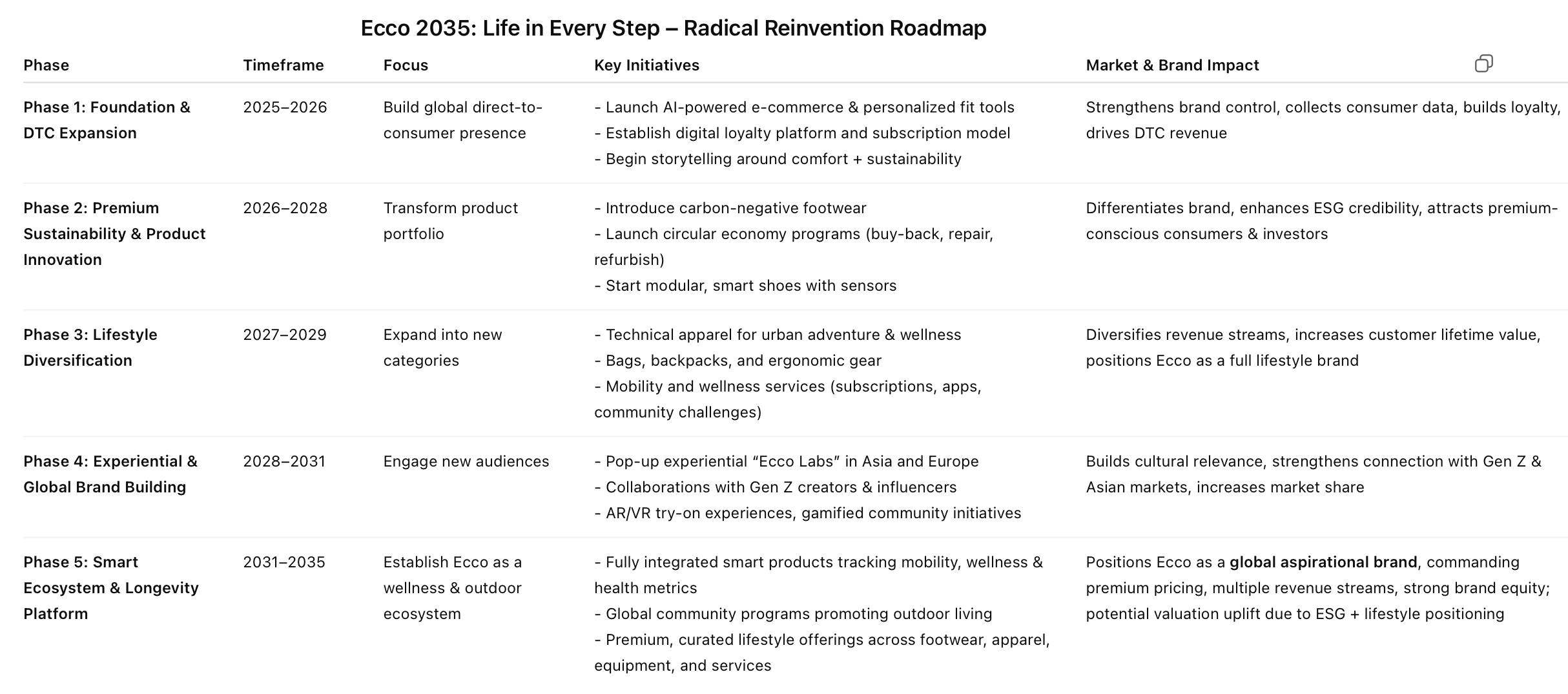
Through innovative products, expanded categories, premium sustainability, and immersive experiences, Ecco can increase revenue, build lasting brand equity, and significantly increase multiples compared to traditional footwear peers, potentially doubling or tripling current enterprise value.
The path forward is clear: Ecco’s next step is no longer just about shoes—it is about enabling a lifetime of mobility, wellness, and outdoor adventure. The future of Ecco is not simply worn on the feet; it is lived outdoors, everywhere.
Business reinvention has always been essential. From IBM’s pivot from hardware to services, to Disney’s evolution from animation studio to entertainment empire, to Mercado Libre’s leap from e-commerce into fintech, companies that adapt to changing times thrive while others fade. But in the coming decades, reinvention will no longer be occasional. It will be continuous, systemic, and existential.
The world is being reshaped by forces more profound than ever before: climate breakdown, exponential technologies, demographic realignments, shifting geopolitics, and cultural revolutions. Old, linear approaches to strategy and incremental transformation are insufficient. The challenge and opportunity is to reinvent at the scale of systems, not products; to shift business models as fluidly as water; to create futures that are regenerative, not extractive.
- Megatrends 2035: the 6 dramatic forces shaking-up every market, by Peter Fisk
- Business Reinvention: Lamborghini was a tractor company, Samsung was a grocery store, by Peter Fisk
- 10 Big Ideas for Business Reinvention: strategy to organisation, culture and performance, by Peter Fisk
In developing my latest book, The Reinvention Playbook, I explore 10 next-generation ideas for business reinvention — bolder, stretching concepts that will define the business landscape of tomorrow. Each idea is illustrated with cases, emerging signals, and speculative scenarios that point to where reinvention might lead:
1. From Ecosystems to Meta Systems
Ecosystems are already mainstream. The next step is meta-systems — companies orchestrating multiple ecosystems across sectors, creating value webs that shape whole societies.
Take Singapore’s Smart Nation initiative, where government, telcos, banks, and startups are creating a “city-as-a-platform” that integrates transport, health, education, and payments. Or Tencent, whose WeChat app is less an ecosystem than a national infrastructure — blending messaging, banking, entertainment, commerce, and even governance.
The stretch scenario: imagine a future operating system for daily life, where one company (or coalition) manages your healthcare, finances, energy usage, education, and mobility seamlessly. Rather than “super-apps,” think super-societal platforms — an Uber, a Tesla, or a Microsoft that doesn’t just serve markets, they’ll compete to define the operating systems of daily life.
2. From Purpose to Regenerative Systems
Purpose-driven reinvention evolves into regenerative business — actively restoring communities, nature, and trust.
The 2010s were defined by the rise of “purpose” and closely associated with sustainability as a core intent. Companies like Patagonia declared they were in business to “save our home planet.” Unilever, under Paul Polman, proved that doing good could align with profitable growth. But tomorrow, purpose alone will not be enough.
The frontier is regeneration: not just reducing harm, but actively repairing and restoring systems. Interface, the carpet maker, has pioneered regenerative design with factories that capture carbon and produce clean water. KlimaDAO, a decentralized finance protocol, monetizes carbon sequestration and channels capital into climate-positive projects.
The stretch scenario: businesses will measure success not by revenue growth, but by net-positive contribution — restoring forests, rebuilding trust, replenishing communities. A future retail chain might not just offset its footprint but operate as a distributed reforestation engine, where every purchase directly funds ecological repair. The business of the future could be a planetary healing machine.
3. From AI-Enabled to Cognitive Enterprises
Not just AI-enabled, but fully cognitive organisations where decision-making, creativity, and execution blur between human and machine.
Today, companies scramble to embed AI in workflows — smarter chatbots, predictive analytics, generative design. The next leap is the cognitive enterprise: an organization that thinks, learns, and reconfigures itself in real time.
JPMorgan already uses AI to reimagine risk, compliance, and customer insights. DeepMind’s AlphaFold cracked protein folding, accelerating biology by decades. XtalPi, a Chinese startup, uses AI to invent molecules for pharmaceuticals.
The stretch scenario: strategy itself becomes autonomous. Imagine a company that constantly senses markets, generates options, runs simulations, and deploys new business models algorithmically. Humans set direction, but the enterprise behaves like a living, cognitive organism. In such a world, companies no longer plan — they evolve.
4. From Hyper-Personalization to Anticipatory Living
Moving beyond tailoring to anticipation: businesses that sense needs before customers articulate them.
Personalization is now table stakes — Spotify playlists, Netflix recommendations, Nike By You shoes. The future is anticipation: organizations predicting and choreographing life needs before they arise.
Amazon anticipates your shopping list, often before you realize you need refills. John Hancock Insurance in the U.S. offers policies linked to wearables, adjusting premiums dynamically based on your health behaviors.
The stretch scenario: imagine a predictive healthcare ecosystem where your insurer, hospital, and grocery provider co-manage your wellbeing. Your fridge orders the right foods, your wearables trigger interventions before illness, your employer optimizes work to reduce stress. Reinvention shifts from personalization to life choreography — business as a partner in writing your future script.
5. From Business Model Fluidity to Shapeshifting Organisations
Future companies don’t just adapt business models; they morph their entire form — shifting from company to community to protocol.
Companies used to anchor themselves in a single model: IBM sold hardware, Adobe sold software licenses, Spotify sold subscriptions. But fluidity has become the norm: Adobe shifted to SaaS, Spotify layers freemium, subscriptions, and marketplace services.
The frontier is shapeshifting organizations — entities that morph not only their business model but also their very structure. DAOs (decentralized autonomous organizations) form, deliver, and dissolve like digital organisms. GitLaboperates fully remotely, with governance distributed across thousands of contributors.
The stretch scenario: tomorrow’s companies may act like liquid entities, sometimes corporations, sometimes communities, sometimes protocols. Reinvention will mean dissolving the traditional boundaries of ownership, governance, and identity — the company becomes a temporary constellation of capabilities around a mission.
6. From Sustainability to Climate Engineering
Not just “net zero,” but businesses solving systemic planetary challenges through radical innovation.
For decades, “sustainability” has meant efficiency: reducing waste, energy use, or emissions. That is no longer sufficient in a world of accelerating climate breakdown. The next generation will see businesses as climate engineers — actively reshaping Earth’s systems.
Climeworks captures CO₂ directly from the air at industrial scale. NextEra Energy is reinventing utilities with wind, solar, and storage as its growth engine. SpaceX is experimenting with geoengineering through orbital projects.
The stretch scenario: businesses will emerge as planetary stewards. Imagine a company whose “product” is lowering global temperatures by 0.1°C. Or an agritech giant whose regenerative farms restore soil biodiversity across continents. Sustainability shifts from compliance to geo-economic intervention — reinventing business as the architect of Earth’s resilience.
7. From Blurring Industries to Reality Convergence
Boundaries dissolve not only across industries but across realities (physical, digital, biological).
The 20th century defined companies by sector: banks, automakers, media houses. The 21st dissolves those boundaries: Tesla is a carmaker, an energy company, and an insurance firm; Apple is hardware, media, payments, and healthcare.
The next frontier is reality convergence: businesses that simultaneously operate in physical, digital, and biological domains. Apple’s Vision Pro hints at a spatial computing world where work, media, and commerce collapse into a single immersive layer. CRISPR biotech firms edit genes as easily as software.
The stretch scenario: companies that orchestrate convergent realities — imagine a fitness brand that operates simultaneously in your biology (gene-editing for health), your digital identity (VR coaching), and your physical environment (AI-optimized workouts). Reinvention moves from industry-blurring to reality-rewriting.
8. From Human+Machine to Post-Human Collaboration
Workforces reinvent not as humans plus machines, but entirely new hybrids — biological, digital, and synthetic.
Most companies still see automation as replacing humans. The real opportunity is superteams — humans amplified by machine intelligence. But the longer-term reinvention is post-human collaboration: redefining what counts as a worker, colleague, or creative partner.
KPMG’s audits combine AI analysis with human judgment. Neuralink is exploring brain–computer interfaces. Robotics startups like Figure AI are building humanoid co-workers.
The stretch scenario: organizations may soon integrate synthetic agents (AI with identities), biological hybrids(enhanced humans), and robotic teammates into their workforces. Imagine a company where half the board are algorithms. Reinvention means no longer assuming the enterprise is “human-centred” — it is post-human by design.
9. From Exponential Growth to Fractal Growth Loops
Beyond scaling fast, fractal businesses replicate themselves like living systems — modular, self-similar, endlessly adaptive.
Exponential growth has been the mantra of Silicon Valley: blitzscaling, hockey-stick curves, network effects. But exponential is fragile — it assumes a single dominant platform. The next frontier is fractal growth: businesses that replicate like biological systems, modular, adaptive, and endlessly scalable.
Shopify doesn’t just grow itself; it enables millions of merchants, who in turn enable their own micro-ecosystems. Minecraft and Roblox operate as fractal creativity engines, where every user becomes a developer.
The stretch scenario: imagine companies that reproduce themselves — spinning off micro-enterprises, autonomous ventures, and community-owned clones that replicate the parent DNA. Reinvention becomes less about “scale-up” and more about “self-similar replication.” Businesses behave like living organisms.
10. From Continuous Reinvention to Perpetual Beta Societies
The ultimate reinvention is not organizational but civilizational: companies helping shape societies in perpetual beta.
For years, consultants advised companies to adopt a “continuous transformation” mindset. But the next leap is perpetual beta: not just companies, but entire societies in a state of ongoing reinvention.
Estonia’s e-residency creates a nation as a digital platform, open to global entrepreneurs. Dubai reinvents itself every decade with new thematic economies — from trade to tourism to green energy to AI.
The stretch scenario: imagine a society where governance, infrastructure, and business are in permanent experimental mode — constantly pivoting, upgrading, iterating. Companies in such societies don’t adapt to change; they help engineer the pace of change itself. Reinvention becomes less a capability and more a cultural condition.
Reinventing business with a Future Mindset
These ten ideas point to a future where reinvention is not simply about keeping up with change, but about creating the frameworks of tomorrow.
-
Meta-systems will orchestrate life itself.
-
Regeneration will replace sustainability.
-
Cognitive enterprises will evolve in real time.
-
Anticipatory living will choreograph daily life.
-
Shapeshifting organizations will dissolve and reform.
-
Climate engineering will become a business model.
-
Reality convergence will rewrite industries.
-
Post-human collaboration will redefine work.
-
Fractal loops will make growth organic.
-
Perpetual beta societies will normalize reinvention.
The case studies — from Ping An to Climeworks, from Shopify to Estonia — are early signals of what’s to come. But the true stretch lies in imagining futures where companies are not merely adaptive, but ontologically different from what we call “business” today.
In the end, reinvention is not just a strategic necessity. It is the defining characteristic of the 21st-century enterprise. The organizations that thrive will not simply respond to disruption; they will be addicted to what’s next, obsessed with creating the future, and bold enough to reinvent not only themselves — but the very systems upon which life and society depend.
As a scientist, a career in marketing seemed like a step away from the logical, evidence-based pursuit of knowledge, and its systematic application.
When I started out, marketing was all about insight and creativity. We researched markets to find average needs, and success was more measured by the love of advertising spots, than the rigorous pursuit of business performance. CEOs and CFOs seemed to be happy if ads made them feel good. And there was little way of proving or disproving their commercial impact anyway.
How things have changed. In today’s data-driven, digitally-enabled world, marketing is the scientific engine of business success.
Science is defined as “the pursuit and application of knowledge and understanding of the natural and social world following a systematic methodology based on evidence. Scientific methodology includes the following: Objective observation: Measurement and data (possibly although not necessarily using mathematics as a tool) evidence.
Obviously it still requires insight and creativity. Although to be honest, science has always been a creative pursuit – to hypothesise the unknown, to explore and experiment in pursuit of a leap forward, and then to validate the outcomes.
Marketers are market-tectologists, data scientists and consumer psychologists. Marketers fuse science, creativity and strategic thinking to solve business problems to drive precision-based campaigns and deliver personal experiences – based on the use of data analytics and behavioural science.
Yet only 24% of CMOs say they use neuroscience.
But think about this:
- Subconscious thought processing is 200,000 times faster than conscious thought processing
- 95% of consumer’s decision-making takes place in the subconscious mind
- 70% of FMCG purchases are made at the shelf, typically in 2.8 seconds
- 80% of new product launches fail to deliver their predicted sales
The best marketing teams apply the best ideas of psychology, brain imaging and behavioural science to understand customers better than they know themselves:
- Pepsico studying the female brain discovered that using the term “guilt” as in descriptors like “guilt-free snacking” is ineffective, and have since shifted to more aspirational words like “healthy”
- Microsoft, using EEF (electro-encephalography) monitored brain activity of users during their interaction with computers in order to determine what gave them feelings of surprise, satisfaction and frustration
- Google used biometrics to measure the effectiveness of two different types of ads on Youtube, overlays vs pre-rolls. Overlays, for example banner ads, were founded to be much more effective in engaging people
- Daimler Chrysler used fMRI (functional magnetic resonance imaging) for a study that had men ranking the aesthetic attractiveness of cars. Logically they thought men were driven by performance metrics, but sound and scent mattered more.
The best marketers connect this knowledge with even more data, they sit in real-time data studios, with high-tech dashboards able to monitor every social post and customer interaction, to tweak brand messaging and engagement in seconds, to encourage consumers to influence each other, to customise solutions, and personalise experiences, the vast majority of markets are still hoping for the best, qualitatively.
Yet the potential benefits businesses can gain from using neuroscience to inform sales, marketing and service delivery is huge. Particularly given that science shows the majority of human decision-making and behaviour operates below the level of consciousness.
Understanding why people buy is nothing new. But in recent years the study of customer psychology has evolved — combining behavioural economics, digital nudging, cognitive neuroscience, habit research, affective science, social psychology and data-driven experimentation — giving companies far clearer insight into how customers actually think, feel, and choose. If a business cares about outcomes, it must also care about the mind of its customers. This article surveys the latest research (to 2025), introduces powerful techniques at a manager’s disposal, shows real-world examples of how companies apply them, and outlines practical guard-rails for responsible use.
Overview
When we talk about “customer psychology” these days, we are referring to a blend of allied fields: why people prefer one brand over another (brand psychology); how they make trade-offs (decision psychology); how habits form (habit science); how social context shapes choice (social psychology); and how small changes in presentation change behaviour (nudging and choice architecture). Increasingly, firms also draw on neuroscientific measurement (brain, eye-tracking and physiological signals) to better understand what customers feel — sometimes beneath conscious awareness. This multidisciplinary approach enables businesses to predict and influence behaviour: experiments reveal causality; big data reveals patterns; neuroscience reveals hidden emotional salience. Reviews of neuromarketing and behaviour-driven design confirm this is now a rigorous, credible approach — when used responsibly.
Two core truths animate modern practice. First: customers are predictably irrational — people rely heavily on heuristics, emotional frames and quick shortcuts rather than careful, utility-maximising calculation. Second: context is king — small changes to wording, order, defaults or visual salience often produce outsized changes in behaviour. These truths are at the heart of behavioural economics and digital nudging: techniques that once lived mostly in academic or policy circles but are now part of everyday business design.
Below I outline 20 techniques that matter today — explaining the psychology behind them — and give real examples or hypothetical applications of how firms can (or do) use them.
1. Defaults (the lazy path wins)
Psychology: People tend to go with the path of least resistance; inertia and effort-avoidance bias choice toward the default. In behavioural economics this taps into status-quo bias and present-bias: if one option is preselected, many will take it.
How firms use it: Subscription apps, SaaS platforms or services often default to “auto-renew” or “auto-subscribe” (opt-out rather than opt-in). By making renewal the default, retention rates tend to be far higher. Similarly, signup flows often default to the “most popular package” or “recommended for you” — guiding users gently toward the option the business prefers.
Why it matters: Default options don’t remove freedom — they simply change the friction. But because many people appreciate ease (or won’t consciously reconsider), defaults can dramatically shift behaviour.
2. Social proof (we follow others)
Psychology: Humans are social learners. In the face of uncertainty or many options, we look to what others are doing as a guide to what’s appropriate or sensible.
How firms use it: Reviews, ratings, endorsements, “best-seller” badges, counters (“X people are viewing this now”), user-generated content, social-media shares and testimonials. For example, an experiment published in November 2025 — Social Proof, Scarcity, and Discounts: Experimental Evidence on Digital Nudges in E-Commerce — showed that digital cues like “top-ranked,” “40% off,” and urgency timers significantly increase willingness to pay.
Why it matters: Social proof reduces perceived risk; it replaces uncertainty with a sense of consensus. For skeptical customers or high-effort purchases, seeing that “others like me” have opted in can overcome hesitation.
3. Scarcity & urgency (limited supply creates desire)
Psychology: Scarcity enhances perceived value, and urgency compresses deliberation — reducing procrastination or extended comparison. Humans dislike missing out; a limited chance or time-bound offer triggers a fear of loss.
How firms use it: Time-limited discounts, limited stock warnings (“Only 2 left”), flash-sales, countdown timers, or limited-edition releases. Many e-commerce retailers and booking platforms use scarcity and urgency to nudge customers to decide faster.
Evidence & nuance: The 2025 experiment above found urgency cues produced the largest boosts in willingness to pay — but also increased decision difficulty (i.e., cognitive strain) for some users. Advances in Humanities Research This suggests that urgency works — but at the cost of potentially making the decision feel more pressured or stressful.
4. Anchoring (first impressions set expectations)
Psychology: People often anchor on the first piece of numerical information they see. That first number — a high retail price, a premium option — becomes the reference point. Following numbers are judged relative to that anchor, which can distort perception of value.
How firms use it: Show a high “was” price beside a sale price; offer a premium “deluxe” product as the first, expensive option, to make the mid-tier seem like better value; list expensive packages first. Many retailers use “original price vs discounted price” framing to create an “anchor discount” effect.
Why it matters: Anchoring can make a “deal” seem appealing even if the sale price isn’t objectively cheap — simply because the original price sets expectations high.
5. Framing (it’s the story you tell)
Psychology: How options are described — the framing — influences decision-making. According to Prospect Theory, people are more motivated to avoid losses than to acquire gains. As such, loss-framed messaging (“Don’t miss out on …”, “Avoid paying more later”) can be more effective than purely gain-framed messaging.
How firms use it: Present benefits as avoiding a loss (“lock in this price now”), emphasise convenience or risk avoidance rather than gain, describe features in terms of avoiding pain rather than gaining pleasure. Where relevant, frame subscription or payment in monthly (small) amounts rather than a large annual lump sum to reduce perceived cost.
Why it matters: Framing changes the reference point and emotional impact — the same objective offer may feel very different depending on how it’s presented.
6. Reciprocity (give to get)
Psychology: People feel obliged to return favours. If a company gives something — like a free sample, a trial, a small gift, or helpful content — customers often feel a psychological urge to reciprocate, even if not consciously.
How firms use it: Free trials (SaaS), free samples (FMCG), content marketing (free guides, useful resources), small onboarding treats, free shipping over a threshold, loyalty bonuses — all effectively give something upfront, creating goodwill and commitment.
Why it matters: Reciprocity can build trust, goodwill and increase conversion — often more effectively than a discount or hard sell.
7. Commitment & consistency (public promises stick)
Psychology: Once we commit — especially publicly or in writing — we tend to act consistently with that commitment. This is partly because of the psychological discomfort associated with breaking a promise or appearing inconsistent (cognitive dissonance).
How firms use it: Pre-orders, wish lists, initial small commitments (e.g., “join wait-list”, “add to wishlist”), loyalty programmes, or asking customers to indicate preferences publicly. Fitness apps, for example, often get users to commit to a goal publicly — which increases follow-through.
Why it matters: Commitment mechanisms reduce drop-off and increase follow-through — because people dislike the feeling of inconsistency or failure to keep their own word.
8. Choice architecture & simplifying options
Psychology: Too many options paralyse decision-making (“choice overload”). Simplifying the decision environment — setting defaults, highlighting “recommended” or “popular” options, ordering choices strategically — reduces cognitive burden and increases conversion.
How firms use it: Instead of showing 15 product variants, show 3 curated options (“basic”, “standard”, “premium”); highlight the middle or “most popular” option; use filters or guided flows so users don’t have to examine every alternative; use progressive disclosure (show simple options first).
Why it matters: Less is often more. By reducing the mental effort required, businesses can make the decision process smoother and more comfortable, reducing abandonment and increasing conversion.
9. Personalisation & relevance (we value what fits us)
Psychology: Tailored messages and offers increase perceived relevance and reduce search/choice costs. When a product feels more “made for me,” the cost (in time, mental effort or risk) feels lower.
How firms use it: Recommendation engines (as used by streaming or e-commerce platforms), personalised email offers, dynamic ad creatives, segmentation-based copy and packaging. On digital platforms, machine-learning models can personalise content or offers in real time based on user data and browsing history. For many firms, personalisation is now core to the user journey.
Why it matters: The better the match between offer and customer preferences, the more likely the customer is to convert — and the more they feel seen, understood, and valued.
10. Emotional design & sensory cues (feelings guide choices)
Psychology: Decisions are rarely purely rational. Emotional responses — triggered by colour, texture, sound, imagery — strongly influence preference, memory, and purchase intent. Neuromarketing shows that subconscious responses often guide decisions more than what consumers articulate consciously.
How firms use it: In product packaging, store layouts, website design, adverts — using colours, shapes, visuals, music, imagery to evoke certain feelings. A simple change to a logo colour, image contrast or packaging shape can shift perceived value or emotional appeal.
Why it matters: Emotional resonance builds brand identity, loyalty and memory; rational arguments alone often don’t cut it.
11. Habit formation (make it routine)
Psychology: Repeated behaviour in stable contexts becomes automatic. Once a habit loop is established (cue → action → reward), decisions become fast, automatic, and not deliberative.
How firms use it: Subscriptions, “auto-refill”, timely reminders, push notifications, reward cycles, simplifying the repeat purchase process. For example, many online retailers encourage users to subscribe to recurring deliveries (household items, grooming products, etc.), locking in usage as part of a routine.
Why it matters: Habits increase lifetime value, reduce attrition, and make customers less price-sensitive once the behaviour becomes part of their routine.
12. Loss aversion & money framing
Psychology: People experience losses more intensely than equivalent gains (loss aversion). Money framing — how cost is presented — influences willingness to pay. Monthly subscription pricing often feels cheaper than annual pricing, even if the total cost is the same.
How firms use it: Present price as “£5/month” rather than “£60/year”; frame non-purchase as a potential loss (“You’ll miss out on X benefit if you don’t subscribe now”). Where applicable, companies emphasise avoiding a future loss rather than obtaining a future gain. This taps directly into human psychology.
Why it matters: Because losses feel worse than gains feel good — framing in terms of loss avoidance can be more motivating than framing in terms of gain.
13. Authority & expert cues
Psychology: People tend to follow the lead of credible authorities. Recommendations, endorsements or certifications from experts raise trust and legitimacy.
How firms use it: Featuring expert reviews, certifications, science-backing, credible quotes, influencer endorsements or third-party validations. For high-stake purchases (finance, health, complex tools), authority cues help reduce perceived risk and build trust.
Why it matters: Authority reduces uncertainty, and for many high-involvement decisions, perceived credibility and legitimacy are essential to drive conversion.
14. Storytelling & narrative transportation
Psychology: Stories engage attention, evoke empathy, build emotional bonds and are easier to remember than lists of facts or specifications. People are more persuaded by narrative than by pure data.
How firms use it: Brand films, case studies, user stories, founder stories, “behind the scenes” content, storytelling around values, origin or purpose (sustainability, heritage, social mission, craftsmanship). By connecting products to a broader narrative, brands create identity-based value — people buy into a story, not just a product.
Why it matters: Storytelling builds deeper, more lasting relationships — orders of magnitude beyond a simple transaction. It creates belonging, identity, and loyalty.
15. Micro-commitments (tiny steps to conversion)
Psychology: People are more likely to make a big commitment if they’ve already committed in smaller, incremental steps (the “foot-in-the-door” effect).
How firms use it: Multi-step checkout flows that ask for small bits of information (email first, then address, then payment), progress bars, “next-step” buttons rather than asking everything at once. Similarly, prompting users to “start free trial”, “add to wishlist”, or “subscribe for updates” are small commitments that can lead to a full purchase later.
Why it matters: Gradual commitment lowers psychological friction and increases the odds that a user eventually converts.
16. Visual attention & layout design (eye-tracking, heatmaps)
Psychology: Where people look matters — not only for conscious attention but for unconscious engagement. Visual salience (contrast, layout, placement) influences where users focus and what they choose.
How firms use it: Use heatmaps, eye-tracking and user-behaviour data to place calls-to-action, pricing, reviews, and other important information at spots that draw attention. In web design or retail-shelf layout, ordering, proximity, and prominence matter.
Why it matters: By optimising what draws attention, businesses can shape what users see first — and often first impressions drive decisions.
17. Surprise & delight (positive surprise drives loyalty)
Psychology: Unexpected pleasant experiences trigger strong emotional reactions — leading to loyalty, word-of-mouth, and a positive brand image. Humans remember surprises.
How firms use it: Occasional freebies, unexpected discounts, personalised thank-you notes, small upgrades, or unexpectedly good customer service. For example: free shipping or an extra small freebie with first order; loyalty rewards; occasional surprise discounts or upgrades.
Why it matters: These small, positive emotional “deltas” often create disproportionately strong loyalty and goodwill — much more than regular discounts.
18. Gamification & reward schedules (intermittent reinforcement)
Psychology: Intermittent rewards — unpredictable but possible — engage dopamine systems and build engagement habits. Progress tracking, streaks, levels, points, “unlockables” make behaviour feel like a game.
How firms use it: Loyalty programmes, progress bars, achievement badges, referral schemes, “points until reward”, or tiered membership levels. Many apps, subscription services or membership-based models use gamification to increase retention and engagement.
Why it matters: Gamification makes mundane actions feel engaging, fun, or valuable — increasing retention, repeated purchases, and lifetime value.
19. Priming & subtle cues (subconscious influences)
Psychology: Subtle cues — colours, ambient sounds, smells, background images, priming words — can influence behaviour unconsciously. While the evidence is more contested than for overt nudges, priming remains a tool in neuromarketing and retail design.
How firms use it: Soft background music in stores, scent marketing, colour palettes on websites, subtle imagery or language that evokes certain feelings (e.g. luxury, nostalgia, comfort), subliminal or peripheral cues that predispose a mood or mindset.
Why it matters: While subtle and harder to predict, priming can shape preferences and emotional states — sometimes nudging decisions under the radar of conscious deliberation.
20. Transparency & ethical nudging (long-term trust)
Psychology: As customers become more aware and privacy-conscious, trust and perceived fairness matter more. If people sense manipulation, trust erodes — harming long-term loyalty and brand reputation.
Why it matters: Ethical design is not just moral — it’s strategic. Misuse of psychological levers (dark patterns, deceptive scarcity, hidden defaults) may yield short-term gain but damage long-term relationships, brand trust, and can even attract regulatory scrutiny.
Modern reviews of “nudging” emphasise that while nudges can guide beneficial decisions, they can also distort self-perception: for instance, consumers may wrongly attribute their good behaviour to their own will rather than the nudge.
Real-world uses: how companies put these ideas into practice
-
E-commerce giants & marketplaces: Platforms such as major online marketplaces often combine defaults, social proof, scarcity, anchoring and personalisation. For example, many product pages show “best seller” badges (social proof), “only X left” stock warnings (scarcity), customer reviews (social proof), recommended or “frequently bought together” bundles (choice architecture + personalisation), and tiered product options (anchoring). These techniques lower friction, raise perceived value, and nudge customers toward larger baskets or quicker decisions.
-
Subscription / SaaS services: They rely on defaults (auto-renewal), micro-commitments (free trial → subscribe), habit formation (reminders, regular value), and commitment & consistency. Because customers don’t need to remember to re-order, and the service is often “set and forget,” companies benefit from increased lifetime value.
-
Brands focused on branding and identity: Companies that aim to build long-term loyalty or premium positioning use emotional design, storytelling, authority, sensory cues, and transparency. By creating a narrative or identity (sustainability, heritage, craftsmanship, social mission), they become more than a product — a expression of values or self-identity for customers.
-
Apps and digital platforms: Many use gamification (points, progress bars, streaks), personalisation, micro-commitments, and nudging to increase engagement and retention. For apps in wellness, education or habit formation (e.g. fitness, learning, subscription services), embedding behavioural triggers helps maintain usage.
-
Retail & FMCG (fast-moving consumer goods): In physical retail, emotional design, sensory cues (lighting, music, packaging, smell), priming, and layout design shaping what catches attention — all influence in-store purchasing. Packaging and store design often rely on neuromarketing insights about perception, memory, and emotional impact.
Measurement: why mixed methods & evidence-driven design matter
Because customer psychology operates partly beneath conscious awareness, it’s dangerous to rely solely on intuition. The most reliable way to know whether a psychological technique works is to experiment — randomised controlled trials (RCTs) for high-stakes decisions; A/B testing for digital flows; and field testing for subscription or habit-forming products.
In addition, combining behavioural metrics (activation, conversion, retention, churn) with financial KPIs (lifetime value, average order value, customer acquisition cost) helps link psychological levers to business outcomes. For creative, brand or emotional design — especially sensory or neuromarketing-driven design — firms may use biometric tools (eye-tracking, skin response, facial coding, EEG) to test emotional engagement and recall before launching broadly. This mixed-methods approach gives the best chance to build sustainable, effective design grounded in real human behaviour.
Ethics, regulation and unintended consequences
As companies become more skilled at influencing behaviour, ethical questions multiply. Nudges must be balanced against respect for autonomy, transparency, and long-term welfare. There are two major risks:
-
Manipulation / dark patterns: Overly aggressive nudging, hidden defaults or opaque interface design can trick customers into actions they wouldn’t consciously choose — eroding trust and possibly inviting regulatory response. Studies of “dark patterns” across thousands of websites show many instances of deceptive design that benefit sellers at the expense of consumers
-
Distorted self-perception: Recent research shows nudges can distort how consumers view their own choices — many people attribute positive outcomes to their own will rather than the nudge. This miscalibration may lead to overconfidence or skewed expectations.
Therefore, firms should adopt a code of ethical behavioural design: transparent purpose, easy exit options (opt-outs), respect for user autonomy, and design for user welfare as well as business goals.
Practical playbook for managers
If you lead marketing, product or user-experience teams and want to apply these insights:
-
Start with a clear outcome. What are you trying to change — increase trial sign-ups, reduce churn, increase average order value, improve conversion rate? Make the psychological lever tie to a measurable KPI.
-
Map the customer journey / decision path. Locate key friction points, where users hesitate or drop off — these are the spots where nudges, defaults or simplified architecture can help.
-
Choose low-cost, high-impact levers first. Defaults, micro-commitments, social proof, simplified choice architecture and framing tend to move metrics quickly and cheaply.
-
Design experiments — test the effect. Use A/B tests or controlled rollout; measure not only conversion but longer-term outcomes (retention, complaints, trust).
-
Use mixed methods for deeper insight. Combine quantitative metrics with qualitative feedback, and, where appropriate, biometric or eye-tracking data for emotional responses.
-
Have an ethical design protocol. Be transparent with customers; allow easy opt-outs; respect autonomy; never use dark patterns deliberately.
-
Monitor long-term impact, not just short-term lift. Short-term sales boosts are tempting — but long-term brand health, customer loyalty and trust matter more.
Where research is heading
Three trends are likely to shape customer psychology and business practice over the next few years:
-
Digital nudging at scale. As digital products proliferate, more firms will embed choice architecture directly into user flows — from banking apps to retail checkout and subscription services. This will increase the importance of interface design and behavioural testing. Some recent reviews highlight how nudge theory is being adapted from policy to commerce.
-
Rising importance of neuromarketing and neuroscience-informed design. As biometric tools, eye-tracking, and brain/physiological measurement become cheaper and more accessible, firms will use them to optimise emotional design, packaging, branding, and adverts — testing what evokes positive emotional engagement or memory.
-
Increased regulatory and normative scrutiny. As awareness grows — among consumers, watchdogs and regulators — of how choice architecture can be manipulative, we can expect demands for transparency, opt-outs, and possibly even limits on certain “dark nudges.” Ethical design will become not just good practice but a competitive advantage and risk management necessity.
Strategy, not trickery
Customer psychology offers more than levers for short-term sales spikes — it offers a language for designing humane, efficient, relevant experiences that reduce friction and improve customer well-being.
Used thoughtfully and responsibly, techniques from defaults to neurometrics, from storytelling to gamification, can create clearer choices, fair outcomes and stronger relationships. But they are tools — not ends in themselves. The best companies will balance scientific rigour (experiments, data, theory) with humanistic concern (transparency, fairness, respect).
In so doing, they transform psychology from manipulation into mastery — mastering product, experience, and enduring customer relationships.
Further reading
-
Nudge: Improving Decisions about Health, Wealth, and Happiness (by Richard H. Thaler & Cass R. Sunstein) — celebrated book introducing the core ideas of choice architecture and nudging.
-
“Nudging Toward Consumer Choices: Current Status and Future Directions” — a 2025 systematic review of how nudges influence consumer decisions across contexts. SpringerLink
-
“Social Proof, Scarcity, and Discounts: Experimental Evidence on Digital Nudges in E-Commerce” (2025) — recent empirical study examining digital nudges and their effect on willingness to pay and decision difficulty. Advances in Humanities Research
-
“Behavioral biases in marketing” — a comprehensive review of empirical marketing research on how biases, heuristics and non-rational behaviour shape consumer decisions. SpringerLink
-
“The Psychology of Choice: Designing Digital Experiences That Drive Decisions” — a 2025 article discussing how choice architecture is used in digital UX and marketing. BIMA
-
Overview of Neuromarketing and how neuroscience and biometric measurement are used to understand consumer responses at a subconscious level.
The bank of the future will need to embrace emerging technology, remain flexible to adopt evolving business models, and put customers at the centre of every strategy.
But that’s probably not enough …
Indeed, the bank might need to think even more radically, in order to be relevant in a rapidly changing world – a new world where smartphones are payment devices, and crypto seeks to become king.
Credit and debit cards have already replaced cash as the preferred payment tool. Only 29% of American consumers prefer to use cash over a card when paying for a good or service. While cash’s popularity has been decreasing, the rise of government-backed digital currency will be highly disruptive. Fast, simple, borderless.
So what is the role of a bank in the future, whether physical or digital?
Walking into a bank in the future might be drastically different, mainly because the customer might be the only human inside the building. Through AI and robotics, the banks of the future will be able to operate without any human assistance. 65% of banking executives believe that zero-human banking will become a reality in the future. And some banks are already testing human-less banks. The China Construction Bank has already launched a personless bank branch where everything is run by humanoid robots.
Perhaps DBS has the right idea …
The Singapore-based bank, ranked the world’s most innovative for many years, wants to “make banking invisible”. By bringing together an ecosystem of partners who are even more relevant and trusted by customers, it can embed finance into everyday life.
“Bank less, live more” … as they say.
Or consider Nubank, the digital bank from Brazil, that has gained 100 million new customers since launching 10 years ago with only a payment card. It has been on a mission to reach the unbanked, a huge part of populations in emerging markets, and offering a relevant portfolio of financial products, including education and support. Gamification has been a key engagement tool, learning how money works, and can work for you and your family, through digital simulations and games on your phone.
- DBS: how Pitush Gupta championed “live more bank less” in Asia Pacific
- Nubank: how David Vélez is reinventing financial services in Latin America
Megatrends shaking up banking, and beyond
Megatrends are disrupting every industry, including those once thought to be largely unaffected by new technologies. The shifts over the next 10 years will be profound. As examples:
-
Digitization has transformed music from physical products (vinyl, CDs) into streaming experiences. Spotify doesn’t sell songs; it sells moods, discovery, and personalization. Banking too will move from rigid products to seamless financial experiences.
-
Democratization has reshaped retail. Platforms like Shopify and TikTok empower anyone to become a merchant or influencer. The power is shifting from institutions to individuals. In finance, democratization means fintech apps that let people invest, trade, and borrow without a traditional bank.
-
Personalization has redefined travel. Airbnb offers not just rooms but customized experiences, curated through data and algorithms. For banking, personalization means moving beyond one-size-fits-all products to services tailored to individual life goals.
-
Sustainability is transforming professional services. Leading consultancies and law firms now advise on ESG, inclusion, and climate strategy, recognizing clients expect impact beyond profit. For banks, sustainability will define lending portfolios, risk models, and purpose.
These examples reveal a profound truth: markets are no longer about selling standardized products within rigid sectors. They are becoming customer-centric spaces—health, mobility, wealth, learning—where solutions are fluid, integrated, and often invisible.
Why banks are not fit for the future
Traditional banks struggle to adapt to this new reality. Their weaknesses are structural:
-
They are product-centric—mortgages, credit cards, savings accounts—rather than customer-centric.
-
They are bound by legacy IT systems and compliance-heavy cultures that slow down innovation.
-
They are focused on risk avoidance rather than value creation.
Worse, banks face a deeper existential problem: their core functions—moving money, safeguarding deposits, assessing risk, and allocating capital—can now be done by algorithms, platforms, and protocols. AI can underwrite credit instantly. Blockchain can move assets across borders in seconds. Platforms like Revolut or Nubank deliver financial services without the bureaucracy of traditional banks.
Just as music labels lost control to streaming platforms, or travel agents vanished in the age of Expedia and Airbnb, banks face the risk of becoming irrelevant intermediaries—utilities in the background of ecosystems they no longer control.
Thinking differently
Banks have traditionally looked inward for inspiration—benchmarking peers, regulators, or fintechs. But to truly reinvent themselves, they should look to unexpected innovators in culture and technology.
Take Taylor Swift. She has reinvented herself repeatedly across genres and eras, owning her narrative and deepening emotional bonds with fans. The “Eras Tour” is more than music; it’s an immersive experience and community. For banks, the lesson is that reinvention is not just about products—it’s about storytelling, transparency, and belonging. Just as Swift re-recorded her masters to reclaim ownership, banks could help customers reclaim ownership of their data and financial future, turning dry transactions into empowering journeys.
Or consider Roblox, the gaming platform where users create, trade, and interact in virtual worlds. It thrives on co-creation and ecosystems, not top-down control. Banking could move from closed systems to open, participatory platforms where customers, fintechs, and even communities co-create value—whether in the metaverse, through programmable money, or shared investment spaces.
Other inspiring parallels abound. Lego rebuilt itself by listening to fans, opening its innovation process, and turning into a collaborative platform for creativity. Banks could follow, letting customers shape services, from personalized savings “quests” to community-driven lending. Patagonia shows how purpose-led reinvention can build trust and resilience; banks could embed sustainability and ethical finance at the core, not the periphery.
The common thread? These innovators put people, participation, and purpose at the heart of reinvention. They treat audiences as collaborators, not passive consumers. If banks could learn to think like a pop star, a gaming platform, or a purpose-driven brand, they could transform themselves from bureaucratic utilities into living, adaptive, customer-centric ecosystems.
Reimagining money
If megatrends continue to accelerate, what replaces banks? Three radical models emerge:
1. The AI Money OS
An intelligent operating system manages your entire financial life. You tell it your aspirations—buying a home, retiring early—and it orchestrates everything: saving, investing, insuring, paying. It reallocates resources dynamically and negotiates across providers. Think of ChatGPT for your finances: autonomous, adaptive, personalized. In this model, you don’t “use a bank”; you trust an AI financial companion.
2. The Embedded Finance Mesh
Finance dissolves into everyday life. Paying for groceries automatically adjusts your budget. Renting an electric car auto-finances itself based on usage. Insurance is bundled into travel apps. Social platforms double as payment systems. In this model, banking disappears into the mesh of experiences. Nubank, Revolut, and Apple Pay hint at this future, but big tech ecosystems could make it universal.
3. The Decentralized Wealth Commons
Communities pool, lend, and invest directly through decentralized finance (DeFi). Trust lies in protocols, not institutions. Smart contracts replace bankers. Imagine neighborhood credit unions run on-chain, with AI governance ensuring fairness. In this world, the very concept of a “bank” becomes obsolete.
Inspired by pioneering peers
Some organizations already glimpse the future:
-
DBS talks about “invisible banking”—embedding finance seamlessly into life’s moments.
-
Nubank disrupted Latin America by offering simplicity, transparency, and fairness to customers exploited by traditional banks.
-
Revolut is building a financial super-app: payments, crypto, insurance, investments, all in one interface.
-
Apple shows how non-banks can dominate finance by leveraging trust, design, and integration. Millions use Apple Pay and Apple Card without thinking of them as “banking.”
The lesson is clear: the most transformative financial services may not come from banks at all.
The big shifts
Are banks doomed? Not if they are willing to reinvent themselves radically. Reinvention requires:
-
Shifting from products to platforms: Don’t just sell loans or cards—curate ecosystems like “housing journeys” or “mobility solutions” that integrate finance with life goals.
-
Owning the trust layer: In a world of AI and decentralized systems, banks could reposition as the guarantors of security, ethics, and fairness. Trust may be their last—and greatest—asset.
-
Partnering with big tech and fintechs: Rather than fighting Apple or Amazon, banks can provide the regulated backbone while tech partners deliver user experiences.
-
Radical transparency and purpose: Future customers will demand values-driven finance—carbon-neutral, inclusive, fair. Reinvention means putting purpose at the heart of business models.
-
Becoming AI-powered organisms: Banks must evolve from bureaucracies into intelligent systems that learn, adapt, and anticipate customer needs.
Leading the change
Leadership is the critical differentiator. To reinvent, leaders must shift their mindset:
-
From ownership to orchestration: Banking’s future is about co-creating ecosystems, not controlling customers.
-
From safety to experimentation: Standing still is now the riskiest strategy. Leaders must embrace experimentation and fast learning.
-
From scarcity to abundance: In digital finance, value comes not from scarcity but from personalization, trust, and insight.
-
From institutions to intelligence: Reimagine banks as intelligent, adaptive systems that think and act in real time for customers.
-
From sectors to spaces: Stop defining banking as a narrow sector. Instead, think about wealth, health, mobility, or learning as integrated customer spaces where finance plays an enabling role.
Reinvention or irrelevance
The megatrends of digitization, democratization, personalization, and sustainability are shaking every market—and banking is no exception. The question is not whether finance will change, but whether banks will be part of that change.
The future of banking may not be about banks at all. It may be about AI Money OS systems, embedded finance meshes, or decentralized wealth commons. It may be about fintech super-apps or tech giants embedding finance invisibly into daily life.
Traditional banks still have assets—scale, regulation, and trust—but they must reinvent radically to stay relevant. They must move beyond products to experiences, from intermediaries to platforms, from risk-averse bureaucracies to adaptive, intelligent systems.
The winners will not be those who protect the past, but those who embrace the future—who recognize that the world doesn’t need “banks” so much as it needs better ways to enable people to live, thrive, and achieve their aspirations.
For leaders, the choice is stark: reinvent or disappear.
Banking innovators around the world
In India, Jio, the lifestyle brand developed by Reliance Industries, has become a leading financial player. From energy to entertainment, grocery shopping and restaurant meals, the superapp has demonstrated not just the power of digital-enabled and data-driven convergence, but also the speed of disruption in markets.
While most super apps like WeChat and Grab in Asia, or Rappi in Latin America, have thrived on rides and food delivery, finance is the real driver. It’s no surprise then, that from WeChat, emerges WeBank (see below).
Financial super apps are ecosystems that enable users to access a wide variety of financial services under a single and unified platform. Instead of having to log into several apps, users will be able to sign into one super app, which pulls all these different services and lets customers maneuver everything from a “central hub”.
Legacy banks are struggling to see the wood from the trees. They are complex monoliths full of legacy systems, and legacy mindsets. Using technology to provide hyper-personalized products/services will be critical to the survival of traditional financial institutions.
72% of consumers view personalization as “highly important” for their banking experience. Some financial institutions have already started to embrace personalization. The Bank of Ireland recently announced its plans to become the “Netflix of Banking”.
“Netflix of Banking” refers to an initiative to implement AI and data science to better understand its customers’ preferences and make more precise product/service recommendations based on that information. As personalization becomes more advanced and common, dealing with a financial institution should feel like “working with a close friend”.
Länsförsäkringar, a Swedish bank, is trying to launch a Personal Finance Management solution that uses data to analyze their customers’ spending habits in real-time. Then, they will use this information to provide on-the-spot finance tips. Banks will continue to pursue this concept mainly because it makes sense financially.
Some estimates claim that for every $100 billion in assets, a bank can increase its revenue by as much as $300 million. In other words, a bank with $500 billion in assets can potentially increase its revenue by $1.5 billion through personalization initiatives.
- Banking business models of the future
- Future of banks: the $20 trillion break-up opportunity
- Bank business models must evolve to engage customers
Here are some more examples of banking innovations from around the world:
WeBank … social banking in China
WeBank, owned by the Chinese technology and social-media conglomerate Tencent, is an example of a commerce marketplace specialist (CMS) that leverages the strengths of big tech, especially network effects.
Tencent owns both one of the largest social-media companies and one of the largest video game companies in the world. Its instant-messaging apps WeChat and QQ have about 1.3 billion and 570 million monthly active users, respectively. Tencent is also changing how people access banking through WeBank.
WeBank’s strategy is built upon “the three As.” Its services are easily “accessible” via 24/7 mobile banking. They are “affordable” enough to appeal to underbanked demographics. It uses big data to target “appropriate” products and services for different customers and reduce risks to the bank. WeBank leverages the gigantic customer base and data from the Tencent ecosystem.
WeBank offers preapproved loans to qualifying users of QQ and WeChat, based on proprietary credit scores generated from Tencent data. The bank’s algorithm draws a customer portrait by analyzing many kinds of customer behaviors—what and how much a user buys, what games they play, whom they interact with on QQ and WeChat, and more—up to 200 different variables per customer.
Citibanamex … personalised engagement in Mexico
Citi operates in Mexico as Citibanamex, the second-largest bank in the country. In 2023, Citibanamex released several outstanding consumer banking innovations to improve user experience (UX). These include micro animations, messages, and its new user login splash page on its financial app.
“Our innovative mobile dashboard leverages cutting-edge UX techniques, including animated cards that dynamically display crucial information such as account balances, investment fund earnings through animated charts, and personalized offers enhanced with custom animations,” says Rosario Valdivia, Citibanamex’s CIO. “Additionally, we introduced app functionalities with animated tutorials, making complex processes simple and accessible, thereby enriching user engagement and satisfaction.”
The bank’s 360 Smart Client Hub provides personalized omnichannel customer journeys powered by artificial intelligence (AI). It uses real-time triggers to facilitate interactions, and a suite of management tools to boost operational efficiency and productivity.
“By harnessing insights from our customers through custom machine-learning models, we can meticulously analyze feedback to prioritize our digital channels backlog, provide live-moment relevant products and services, and improve our fraud detection systems,” Valdivia adds. “This approach not only enhances our responsiveness but also accelerates the delivery of tailored, value-driven solutions that elevate the customer experience to unprecedented levels. The next step is the adoption of generative AI to increase our capabilities further.”
HSBC … world’s first multicurrency digital bond
HSBC delivered the world’s first multicurrency digital bond offering in February 2024. In addition to being a game-changer for future digital bond issuances, this was the largest-ever digital bond deal. It generated investor demand unprecedented to date for a digital bond—with over 50 global investors. The multicurrency digital bond issuance included the US dollar, Chinese offshore renminbi, Hong Kong dollar, and the euro. It also stood out for the use by the Hong Kong Monetary Authority’s central securities depository, the Central Moneymarkets Unit, of the bank’s digital assets platform, HSBC Orion.
Meanwhile, the bank has implemented Project Ascend, a scalable first for the industry portfolio nonpayment insurance offering for trade finance assets. Partnering with three leading global insurers and insurance broker Marsh, HSBC has created a granular pool of diversified midmarket enterprise (MME) and small and midsize enterprise (SME) trade loans in Hong Kong. The insurance companies provide pro rata nonpayment insurance on the entire pool of loans without the need to underwrite individual loans for individual companies, helping them to gain more exposure to trade finance in a diversified manner. While HSBC retains certain uninsured exposure on these loans, the solution makes lending to MMEs and SMEs more attractive, as the bank now can efficiently distribute its risk and free up capital.
ING … genAI chatbot in Netherlands
Since ING launched a generative AI (genAI) chatbot in September 2023, thousands of the bank’s customers have interacted with it. It’s the first of its kind, as a customer-facing pilot conducted in Europe. Working as a team with global consultancy McKinsey, it took just seven weeks to build and deploy the service. Having created a path to double the performance of the chatbot in the subsequent six months, ING plans to build a scalable model that can be extended to all other ING countries and to set up a technical foundation for ING to address a comprehensive set of genAI use cases across the group. The pilot study helped define a blueprint to scale across 10 markets, with the potential to impact more than 37 million customers across 40 countries, far outpacing previous industry-standard chatbots that can take several years of programming and fine-tuning to get into shape.
Santander … cloud-defying gravity from Spain
By migrating its corporate and investment banking business to a new cloud-based digital banking platform, Gravity, Santander can now benefit from parallel processing. This enables it to run workloads on its existing core banking mainframe and the cloud simultaneously, allowing the bank to perform real-time testing without disrupting any of its businesses. Once satisfied with the new system’s stability and performance, the bank can transition from the mainframe system to the cloud.
Gravity allows Santander to deploy on both private and public clouds. Having successfully migrated all its commercial customers in the UK and its consumer business in Chile without any service interruption, Santander plans to relocate most of its core banking worldwide to the Gravity platform by the end of 2024, mostly in its private cloud.
“The Santander CIB migration to the cloud is a new milestone in the group’s transformation toward a simpler, more integrated model, contributing to enhanced profitability,” Dirk Marzluf, Santander’s chief operating and technology officer, said in a statement.
Santander CIB manages over a million accounting operations and half a million treasury operations daily on the cloud via the Gravity platform. Santander estimates that the Gravity platform will operate more than a trillion technical executions within the bank’s systems every year.
Nedbank … fast and collaborative in Africa
Nedbank Mozambique reinvented how it services customers with its client-oriented structure for the brand, people, branches, processes and systems. This strategy has been the pillar of Nedbank Mozambique’s success, growth and unique positioning in the market.
Among the arrows in the bank’s quiver is NedSnap, a robotic process automation (RPA) platform that supports Nedbank’s employees by facilitating more-effective communication and timely results. This floating widget provides immediate visual feedback for a more-efficient user experience and enables different bank departments to generate chained tasks for more-seamless and effective operations.
Other tools include Miyo, which is designed to work with ChatGPT. It provides intelligent analysis and insight on business statistics and strategic decision-making. It processes questions in natural language and converts them to structured query language (SQL) queries so that users can access relevant information without navigating complex datasets.
NedDocs is the bank’s software offering that streamlines document analysis and validation with optical character recognition (OCR) technology and a natural-language processing model. This solution integrates with RPA systems to automate document workflows.
DBS … AI applied to everything in Asia
More global banks are screening new clients these days, and one way they do this is by surfing the internet for potential bad news about a would-be customer. It’s usually a tedious, time-consuming process. DBS Bank, however, recently developed a new generative AI (genAI) tool for adverse-news screening that sifts through vast amounts of information rapidly and with heightened accuracy. It has already saved the bank the equivalent of five full-time employees across Singapore and neighboring regions. It has also shortened customer onboarding times and broadened risk coverage.
DBS also unveiled a new AI-based fraud-detection tool in 2023 that couples a high-tech machine learning algorithm with a more traditional rule-based detection engine. This has improved the bank’s precision and its capture rate by 50%.
The bank continues to innovate in the payments sector, too, including a cross-border QR payment linkage launched last year that lets consumers make real-time retail payments between Singapore and Southeast Asian countries by simply scanning the overseas merchants’ QR codes.
Tatra Banka … idea management platform from Slovakia
Tatra banka is usually quick to adopt emerging technologies, and this past year was no exception. It became Slovakia’s first bank to offer digital account opening and digital loans to non-clients through a process that relies heavily on biometrics. Launched in May 2023, the new process had onboarded more than 30,000 new users by year end.
The bank encourages its employees to generate new ideas, and they do so—so many that Tatra recently implemented IDEApp. This idea-management platform employs an AI digital assistant to help collect, evaluate, prioritize and report ideas. This enables staff to know who’s doing what and to track an innovation’s stage of development.
The bank also recently developed a tool to combat voice phishing, or “vishing,” in which fraudsters call consumers demanding important information in the bank’s name. Its anti-vishing protocol uses a push notification sent to a client’s phone with a unique code to prove the agent’s identity.
BTG Pactual … digital assets in Brazil
In recent years, Banco BTG Pactual developed a digital platform to leverage opportunities in Latin America. BTG Dol is the bank’s entrée into digital assets. This dollar-pegged stablecoin bridges the gap between digital and fiat currencies and is a reserve of value for economies experiencing volatility. BTG has a background in cash and reserve management, and integrating this expertise with blockchain technology has helped elevate BTG Dol as a stablecoin with a higher level of trust and security than existing stablecoins.
BTG is also focused on its environmental solution strategy: first with its impact-oriented reforestation investment strategy in Latin America; and lately, with its minority investment in Systemica, a developer of carbon-reduction projects. With this investment, the bank aims to have a more technical branch to support investments in the carbon markets and environmental assets. Systemica’s CarbonSpore platform provides an online tool that manages and develops carbon-asset generation projects while monitoring deforestation in legal reserves and permanent preserves.
Mashreq … reaching India from UAE
Mashreq’s innovation launches in 2023 were as varied as they are impressive. They included a nonresident platform for digital account opening with an Indian partner bank, allowing Indian customers, and very soon other nationalities, in the United Arab Emirates to open an account from the UAE in less than 10 minutes; a leasing platform for the real estate industry; inclusive wealth management services; an automation platform for trade asset sell down with predictive analytics and machine learning; real-time data-streaming analytics for contextual banking; an agency desk automation solution for syndicated loans; and a carbon-footprint calculator.
The bank also excelled with AI innovations, becoming the first bank in the region to release an integrated AI solution for hyperpersonalized insights to improve client experience and revenue growth by identifying opportunities and threats within portfolios. Corporate banking relationship managers, meanwhile, can benefit from an AI-based transaction deviation and early-warning signal system.
Bank of America … digital intelligence
Bank of America (BofA) is a leader in technological and digital innovation. The bank leverages its annual technology investments and corporate culture to support clients’ financial needs through improved user experience and products. As a mark of the bank’s progress, in 2023 its clients had a record 23.4 billion digital interactions, an 11% increase year over year.
BofA enhanced its digital banking platform with CashPro Data Intelligence, combining a client’s historical data with advanced analytics to suggest actionable insights, and benchmarking various areas. CashPro Developer Studio provides a solution for flexible, quick integration with instant issuance of application programming interface (API) sandbox credentials and production access. CashPro Chat enhancements extend the bank’s advanced virtual assistant to commercial clients.
“Client experience is very much front and center of our technology, and CashPro Chat now includes the same proprietary artificial intelligence and machine learning capabilities behind Erica—the company’s virtual financial assistant—so our corporate clients can submit queries and get real-time answers,” says Andrew McKibben, international head of technology at BofA.
CaixaBank … Spanish CX
CaixaBank pioneered lifestyle banking before most banks woke up to the need to integrate the banking experience with customers’ lives. The bank made several meaningful improvements throughout 2023 to improve customer journeys.
These include a custom-pricing simulator, which provides a first-mortgage offer with a personalized price in real time; an option whereby customers can use the website and the CaixaBankNow app to aggregate and view their pension plans held with other entities; a digitized will-making service; and the instant payment of taxes, rates, and fines via the Spanish mobile payment service Bizum.
To ensure it meets customer needs, CaixaBank guarantees that all digital products launched on the market have been tested, iterated and validated by actual customers—minimizing risks and improving the user experience without affecting time to market. CaixiaBank also established a Mobile Experience Lab—where employees can experiment with the market’s newest devices and gadgets and perform specific tests on their applications and those of third parties.
I work with many business leaders, coaching and advising them on their business futures, and personal leadership. The biggest challenge – or tension – they almost all say they experience, is between delivering immediate results and preparing for the future. And its probably more extreme than ever.
Markets evolve faster than annual planning cycles can track. Technologies emerge overnight. Competitors appear from unexpected corners. Social expectations and environmental imperatives demand change at unprecedented speed. In this world, companies cannot choose between performance and transformation. They must do both—simultaneously, continuously, and with coherence.
Enter the “Performer Transformer” leader: an individual or organization capable of balancing execution and exploration, efficiency and innovation, the short term and the long term. These are the leaders and organizations that outperform not because they excel at one thing, but because they master two. They deliver results today while inventing tomorrow. They do not see operational excellence and transformation as competing priorities—they see them as mutually reinforcing engines of growth.
The Paradox at the Heart of Leadership
For most executives, the demands of today are clear: meet financial targets, deliver on customer expectations, optimize processes, and maintain operational discipline. These are the hallmarks of high-performing organizations. Yet the world is moving so fast that yesterday’s strengths can become tomorrow’s liabilities. Companies that excel at execution can find themselves blindsided by new competitors or business models. Kodak, Nokia, and Blockbuster were all once paragons of operational excellence, yet their success trapped them in outdated logic, leaving them vulnerable to change.
On the other side lies transformation: the creation of new capabilities, products, services, or even entirely new business models. Innovation requires experimentation, ambiguity tolerance, and a willingness to fail. Yet when transformation is pursued without discipline, it can fragment resources, confuse priorities, and erode the performance that sustains the organization. Many innovation labs exist more to signal intent than to produce lasting impact.
The challenge, then, is not to choose between performance and transformation—but to orchestrate both. Performer Transformers navigate this tension with skill. They embed duality into the organization’s strategy, culture, and leadership practices, creating what can be described as dynamic ambidexterity: the ability to operate efficiently in the present while continuously reinventing for the future.
The Origins of Duality Thinking
The notion that organizations must balance exploitation and exploration has deep roots in management research. James March articulated the distinction between exploitation (refining existing capabilities) and exploration (pursuing new possibilities). Clayton Christensen highlighted how incumbent companies often fail to innovate effectively due to the constraints of their successful core businesses—a dilemma now widely known as the innovator’s dilemma. Michael Tushman and Charles O’Reilly further developed the concept of the ambidextrous organization, emphasizing the importance of structural separation and strategic integration: companies that organize discrete units for performance and innovation, but align them through shared purpose and leadership.
Ambidexterity provided a framework for understanding how high-performing companies could avoid the traps of either purely operational or purely exploratory focus. However, in today’s hyper-dynamic markets, ambidexterity alone is insufficient. Change is no longer episodic; it is constant. The Performer Transformer is a response to this reality: an organization or leader capable of continuous sensing, learning, and adaptation while sustaining performance.
The Performer Transformer Organization
At the heart of every Performer Transformer is a dual-engine system. One engine delivers operational excellence—the performance engine. It is optimized for scale, reliability, and predictability. It ensures that products reach customers, services are delivered, and financial results are met. The other engine drives transformation—the innovation engine—which focuses on exploration, experimentation, and learning.
These engines are not isolated. Performer Transformers create integrative mechanisms to ensure the two reinforce one another. Resources, talent, and insights flow between the performance and innovation engines. Leadership teams monitor both short-term outcomes and long-term potential. Metrics and incentives are designed not only to reward current success but also to foster exploration and agility.
Amazon exemplifies this approach. Its logistics network represents an extraordinary performance engine, delivering billions of transactions with precision. Simultaneously, its innovation engine experiments continuously—from AWS to Alexa, from Prime Video to robotics—building entirely new markets. What binds these two engines together is a unifying culture and leadership philosophy: the company is always in “Day 1” mode, relentlessly focused on both the immediate and the future.
Culture as the Fuel for Transformation
Structure alone does not make a Performer Transformer. Culture is the vital fuel. High-performing, transformative organizations nurture norms, behaviors, and values that make duality sustainable. They cultivate:
-
Curiosity and learning: A relentless desire to understand emerging trends, technologies, and customer behaviors.
-
Purpose alignment: A shared sense of why the organization exists, which integrates performance and transformation.
-
Empowerment and speed: Decision-making is pushed to where information is richest, allowing rapid experimentation and iteration.
-
Resilience and adaptability: Failures are seen as opportunities to learn, not reasons to punish.
Haier, the Chinese appliance giant, demonstrates this cultural integration vividly. Through its rendanheyi model, the company dissolves traditional hierarchies into micro-enterprises. Each unit is accountable for performance but also empowered to innovate. The result is an ecosystem that constantly renews itself—a living Performer Transformer organism.
Leadership: The Chief Ambidextrous Role
While organizations can be ambidextrous, the ultimate differentiator is leadership. Performer Transformer leaders combine operational intelligence with transformational foresight. They hold the tension of dual priorities without succumbing to paralysis. They create alignment, coherence, and energy across the organization.
These leaders are defined by five key mindsets:
-
Dual Focus: They manage short-term execution and long-term vision simultaneously.
-
Learning Orientation: Curiosity and experimentation are central to their decision-making.
-
Purpose-Driven: They anchor transformation in a larger “why,” ensuring coherence and engagement.
-
Systems Thinking: They understand the interdependencies between strategy, culture, processes, and capabilities.
-
Resilient Optimism: Disruption is seen as an opportunity to renew, not a threat.
Satya Nadella at Microsoft exemplifies this approach. He transformed Microsoft’s culture from “know-it-all” to “learn-it-all,” fostering curiosity while maintaining execution discipline. Mary Barra at General Motors is similarly a Performer Transformer, guiding the company through a massive pivot to electric vehicles while sustaining core operations and profitability.
Frameworks for Performer Transformers
Performer Transformers operate through clear yet flexible frameworks that embed duality into strategy, systems, and culture. Key frameworks include:
-
Dynamic Congruence: Extending Tushman’s Congruence Model, alignment is no longer static. Strategy, structure, processes, people, and culture are continuously adjusted to external shifts.
-
Portfolio Management: Balancing core operations, adjacent expansions, and breakthrough innovations in a coordinated investment and resource strategy.
-
Continuous Strategyzing: Rolling strategy cycles replace annual planning. Organizations constantly sense, decide, act, and learn.
-
Dual Metrics: Performance is measured through both operational KPIs and innovation potential (e.g., pipeline health, customer adoption, and learning velocity).
-
Talent Rotation: Leaders and teams rotate between performance and innovation roles, creating shared language, perspective, and empathy.
Adobe’s transition from boxed software to a subscription-based model illustrates these principles. The company maintained operational discipline in existing revenue streams while experimenting with the Creative Cloud model, ultimately transforming the market and its own business model.
Embedding Duality in Organizational Design
For Performer Transformers, duality is not accidental—it is intentionally engineered. Organizational structures, governance processes, and operating rhythms are designed to allow performance and transformation to coexist and reinforce each other.
Structural separation is often used: high-performing units run core operations with traditional hierarchies, predictable KPIs, and disciplined execution. Innovation units operate under more fluid structures, empowered to experiment, prototype, and pivot. The challenge is not separation itself, but integration. Performer Transformers align these units with shared purpose, leadership accountability, and cross-pollination of talent and ideas.
Haier exemplifies this model. Its micro-enterprise units operate autonomously but remain connected to corporate strategy through a dynamic network of accountability, performance tracking, and talent flows. This design ensures that innovation is not siloed from the business but instead continuously informs and is informed by operational realities.
Another model is two-speed strategy, blending stable planning for today with adaptive planning for tomorrow. At Schneider Electric, the core energy management business runs on precise metrics and structured operational reviews. Parallel to this, digital and sustainability ventures operate on exploratory timelines, testing business models, digital platforms, and ecosystem partnerships. Leaders at the top integrate these disparate timelines, shifting resources as opportunities emerge, while maintaining coherence across the enterprise.
The Performer Transformer Leader: Mindsets and Activities
Microsoft’s transformation under Satya Nadella provides a vivid illustration of Performer Transformer principles. The company’s performance engine—Windows, Office, enterprise sales—remained profitable and disciplined. Simultaneously, Nadella fostered a cultural and structural innovation engine: Azure, AI, and new productivity solutions.
The breakthrough was not only in innovation but in culture and leadership integration. Nadella shifted the company from “know-it-all” to “learn-it-all,” emphasizing curiosity, collaboration, and growth mindset. This allowed Microsoft to maintain execution rigor while embracing exploration. Azure, initially a distant second to AWS, became a core driver of Microsoft’s growth precisely because performance and transformation engines were connected through leadership vision, culture, and continuous learning loops.
While organizational design is vital, the ultimate differentiator is leadership. Performer Transformer leaders are dual-capable in thought, behavior, and impact. They bridge the operational and the aspirational, the present and the future.
Key mindsets include:
-
Dual Focus: Holding short-term execution and long-term vision simultaneously.
-
Learning Orientation: Curiosity drives decisions; experiments inform strategy.
-
Purpose Anchoring: Transformation is connected to a coherent “why” that guides all action.
-
Systems Thinking: Leaders see interconnections across strategy, people, processes, and culture.
-
Resilient Optimism: Disruption is an opportunity, not a threat.
In practice, these mindsets manifest as specific activities:
-
Rotating between performance and innovation roles: Ensures leaders understand both operational realities and emerging possibilities.
-
Engaging in continuous strategic dialogue: Combining financial, market, and technology signals to adjust priorities in real time.
-
Creating cross-boundary teams: Integrating operators, technologists, and innovators to tackle complex challenges.
-
Embedding learning loops: Using data, experiments, and feedback to shape both core and new initiatives.
-
Communicating purpose consistently: Ensuring teams align on both daily execution and long-term growth objectives.
Mary Barra at General Motors exemplifies this approach. She has guided GM through a pivot to electric vehicles and autonomous technologies while maintaining profitability in internal combustion operations. Her leadership integrates performance and transformation: quarterly results inform strategy, and strategic bets in EVs and mobility ventures reinforce operational learning and market relevance.
The Role of Continuous Strategyzing
Traditional strategy is episodic—annual planning cycles, multiyear forecasts, and static roadmaps. Performer Transformers embrace continuous strategyzing, a dynamic process of sensing, deciding, acting, and learning in real time.
-
Sensing: Regularly monitoring technology shifts, customer behaviors, regulatory changes, and competitor activity.
-
Deciding: Rapidly evaluating options, reallocating resources, and prioritizing initiatives across both performance and innovation engines.
-
Acting: Executing initiatives with discipline in the core business while testing and scaling new ideas in the innovation pipeline.
-
Learning: Embedding structured reflection to capture insights, refine strategy, and adjust operations.
At DBS Bank, CEO Piyush Gupta operationalized continuous strategyzing through digital experimentation. Hackathons, agile sprints, and rapid prototyping coexist with rigorous operational oversight. Transformation is no longer episodic but a continuous capability, allowing the bank to lead in digital banking while delivering reliable financial results.
Portfolio Thinking and Metrics
Performer Transformers manage a balanced portfolio of initiatives across three horizons:
-
Core (Horizon 1): Existing business units and products, delivering predictable returns.
-
Adjacent (Horizon 2): Extensions of the core into new markets or technologies.
-
Breakthrough (Horizon 3): Radical innovations that could redefine the company or industry.
Metrics for success are equally dual. Traditional KPIs track operational efficiency, profitability, and customer satisfaction. Transformation metrics assess pipeline health, adoption of new offerings, learning velocity, and strategic optionality.
Adobe demonstrates this dual measurement. Core Creative Suite operations maintained high profitability, while Creative Cloud adoption and associated digital transformation initiatives were tracked with innovation-specific metrics. The combined approach ensured short-term performance while enabling the subscription pivot that transformed Adobe’s market position.
Embedding Performer Transformer DNA in Organizations
Building a Performer Transformer organization is not a one-time initiative. It requires systematic embedding of duality into processes, structures, and culture:
-
Strategy Systems: Replace rigid annual cycles with rolling planning, scenario modeling, and adaptive roadmaps.
-
Talent Systems: Rotate high-potential leaders across operational and innovation units; embed dual-capability development into leadership programs.
-
Organizational Design: Combine structural separation with integrative mechanisms; use networks, hubs, and micro-enterprises to allow autonomy with accountability.
-
Cultural Norms: Encourage experimentation, tolerate calculated failure, reward learning as much as results.
-
Metrics and Incentives: Blend KPIs for current performance with indicators of future capability, such as innovation adoption, learning outcomes, and ecosystem engagement.
Nike provides a clear illustration. Its core apparel and footwear business is disciplined and performance-driven, while its digital and direct-to-consumer innovation ventures experiment with new technologies, data-driven personalization, and customer engagement. Leadership rotates talent between units, ensuring cross-pollination of expertise. Purpose—“to bring inspiration and innovation to every athlete”—anchors duality, creating alignment across performance and transformation.
Performer Transformation also depends on human factors. Organizations must provide psychological safety for employees to operate in the tension between execution and exploration. Teams must feel empowered to challenge assumptions, propose experiments, and pivot quickly without fear of punitive consequences.
Spotify, for example, embeds this through its “squad” model: small, cross-functional teams that own specific missions, combine delivery and innovation, and operate with autonomy while adhering to broader company goals. Failure is reframed as learning; success in experimentation feeds back into operational excellence.
The Flywheel of Continuous Reinvention
Performer Transformers build a self-reinforcing flywheel:
-
Operational excellence generates resources, credibility, and insight.
-
Investments in exploration create new growth options and capabilities.
-
Insights from transformation improve performance and inform strategic adjustments.
-
Aligned purpose and leadership sustain energy, engagement, and direction.
Amazon’s continuous innovation loop—from e-commerce to AWS to logistics automation—is the archetypal example. Each engine fuels the other, creating cumulative advantage over competitors.
Why Performer Transformers Outperform
Research and observation suggest that organizations and leaders who embody duality consistently outperform peers:
-
Financially: They achieve stable profits while growing new revenue streams.
-
Strategically: They anticipate disruption rather than react to it.
-
Culturally: They attract and retain talent that thrives in both disciplined and creative environments.
-
Resiliently: They can pivot, recover, and scale in response to environmental shocks.
In short, Performer Transformers are not just effective—they are perennially relevant.
Future Horizons
The world is accelerating. Emerging technologies—from AI to biotechnology—will continue to redefine industries. Markets, customer expectations, and societal norms are in constant flux. Performer Transformers, as individuals and organizations, will increasingly define competitive advantage.
The challenge for executives is to embed continuous strategyzing, dual operating systems, and integrative leadership into the DNA of the enterprise. The reward is the ability to deliver today while inventing tomorrow—a rare and decisive capability in an era of relentless change.
Performer Transformers redefine leadership and strategy for the 21st century. They combine operational discipline with transformative foresight, purpose with agility, and performance with reinvention. Through deliberate organizational design, culture, and leadership practices, they make duality sustainable.
In doing so, they not only outperform peers—they reshape the very rules of business. The future belongs to those who can simultaneously master execution and exploration, deliver results today, and invent the markets of tomorrow.
As one CEO of a global technology firm put it: “The moment you stop performing is the moment you are vulnerable. The moment you stop transforming is the moment you are obsolete. Our job is to do both, every day, in every decision.”
Performer Transformers have mastered that art—and their organizations are the ones that will thrive in the decades to come.
Most organisations are full of good managers. They make sure plans are executed, resources are allocated, and operations run smoothly. Good managers provide clarity, stability, and focus — all essential in keeping things on track. But the leaders who truly transform organisations, win markets, and inspire people operate at a different level. They thrive in ambiguity, confront impossible challenges, and innovate under pressure.
The transition from good manager to great leader is one of the hardest, but also one of the most important shifts for anyone in business. It’s certainly not a simple step up the ladder, doing more or the same, perhaps with more responsibility and power, and more reward. It’s different.
It is the difference between a doctor who provides excellent clinical care, and a department head who must reimagine how a hospital serves patients amid shrinking budgets and rising demand. Between a consulting manager who delivers projects efficiently, and a partner who must build long-term client relationships and deliver bold growth in uncertain times. It could also be a slightly different shift, from a corporate CEO with vast power and resources to a small-tech founder who has to rewrite the rules with limited cash and relentless competition.
In today’s world of relentless change, complexity, and external shocks, the leadership bar has risen. What matters most is not managing the known, but leading into the unknown. This requires courage, boldness, and a leap.
From manager to leader
At IE Business School, I created the Global AMP, the flagship executive program for developing business leaders in today’s fast-changing world. Every year we bring together leaders from every type of industry, from all over the world. Their markets, organisations and personal styles are all different. But they all share a common desire to “step up” as a business leader, in role, in behaviour, and in impact. To make the leap.
There is no simple formula, no one-size-fits-all approach, but there is commonality in the challenge – the leap from management to leadership involves a shift in mindset and capability:
-
From clarity to complexity: Managers thrive when roles, processes, and outcomes are defined. Leaders operate when rules are fluid, outcomes uncertain, and priorities competing.
-
From control to influence: Managers rely on authority and process. Leaders must inspire, shape, and empower others across silos, organizations, and even ecosystems.
-
From solutions to questions: Managers find answers quickly. Leaders ask deeper questions, reframe challenges, and open new possibilities.
-
From delivering to creating: Managers execute projects and ensure efficiency. Leaders create new value, redefine markets, and set the direction others follow.
Sometimes we use the “T” shaped metaphor – as a functional manager, you were the expert, and rose vertically with expertise. As a leader, you now grow horizontally, connecting the organisation, a bigger picture, more strategic, and more challenges. It’s not about having all the answers but asking the right questions, making sense of complexity, solving difficult problems.
For me, despite the leadership shift being essentially an internal challenge, it can often be most effectively sparked from the outside. Particularly in today’s frenetic marketplaces of relentless, uncertain and chaotic change. When you’re inside an organisation it’s easy to put the blinkers on, keep doing the same thing, winning in the same way.
Externally, therefore, stepping up to become a leader often means embracing a challenger mindset with clients. Instead of merely meeting needs, great leaders teach customers something new about their world, reframe their challenges, and co-create innovative solutions. Internally, it means navigating ambiguity, iterating solutions, and enabling teams to move faster and smarter, even when the path is unclear.
The challenger model
The “Challenger Sale” approach developed by Matt Dixon and Brent Adamson in 2011 found that the most effective salespeople weren’t those who built the warmest relationships, but those who challenged clients’ assumptions and taught them to see their business differently. This can equally be applied to leadership externally, and internally.
The model distills into the 3Ts:
-
Teach for Differentiation – Bring unique insights that reframe how the client thinks about their business, their risks, or their opportunities. Leaders don’t just sell; they teach clients something they didn’t know.
-
Tailor for Resonance – Customize the story to each stakeholder’s priorities. A CFO cares about cost structure, a CMO about growth, and an operations lead about efficiency. Great leaders adapt messages to resonate with multiple perspectives.
-
Take Control of the Sale – Guide the conversation assertively, create urgency, and resist being commoditized. Leaders don’t let clients dictate the entire process; they shape the journey toward value creation.
This external Challenger thinking mirrors the internal leadership challenge. Leaders inside organisations must also teach, tailor, and take control — offering new ways of thinking, tailoring approaches to diverse teams, and guiding organisations with confidence through uncertainty.
Examples of the leadership shift
I have worked with many leaders, at all levels of organisations. One of the most inspiring for me, was Satya Nadella at Microsoft, who over the last 20 years has become a legend in stepping up, and helping his organisation grow from $300m to a $3 trillion market cap business. There are many other examples:
-
Satya Nadella at Microsoft: As a manager of engineering teams, Nadella delivered products effectively. As CEO, he transformed Microsoft from a shrinking software giant into a cloud-first innovator by redefining culture, encouraging curiosity, and shifting focus from “know-it-alls” to “learn-it-alls.”
-
Angela Ahrendts at Burberry: As a good manager, she could have focused on cutting costs and tightening operations. Instead, as a leader she reimagined Burberry as a digital-first luxury brand, embracing online engagement before the rest of the fashion industry and delivering tenfold growth.
-
Howard Schultz at Starbucks: Managers would have optimized store performance. As a leader, Schultz reframed Starbucks as a “third place” between home and work, making it a cultural movement as much as a retail business. His focus on a bigger purpose, gave his people a North Star to be much more creative, but aligned at the same time.
In smaller companies, many founders face the challenge of stepping up as their businesses evolve. As entrepreneurs they often love the tech and the detail, and running a small team is about managing products and developers. But leading a growing business requires building culture, attracting investors, making hard trade-offs, and setting strategic vision.
- Brian Chesky at Airbnb: From renting out air mattresses, his early years were about hustling to survive. As CEO he shifted to leading a global platform with millions of hosts and guests, navigating regulation and crises. Now he acts as a visionary leader, shaping trust, culture, and the future of travel.
- Melanie Perkins at Canva: The Australian started as a young designer teaching peers and building a simple online tool. She grew into leading a fast-scaling unicorn, balancing investors, product innovation, and global teams. And then evolved into a mission-driven leader focused on empowerment, culture, and lasting impact.
- Daniel Ek at Spotify: Started as a coder and entrepreneur determined to solve music piracy with streaming. He then transitioned into building and scaling a disruptive platform across industries and geographies. Now he leads as a strategist, redefining media, creator economies, and Spotify’s cultural influence.
Seven actions for making the leader’s leap
So how can a business develop a leadership team that rises above good management into true leadership? Here are seven actions:
1. Redefine purpose beyond performance
Managers hit targets; leaders define the bigger picture. A leadership team must articulate a clear and compelling purpose, why the organization matters, what change it seeks to create, and how it will serve clients, employees, and society. Purpose provides direction when the path is unclear. It is the north star that guides teams through turbulence.
Action: Hold strategy sessions not just on “what we do” but “why we do it,” and continually communicate that purpose across the organisation.
2. Embrace ambiguity and complexity
Leaders cannot wait for perfect information or clear rules. They must learn to interpret signals, connect disparate insights, and act decisively in the fog. Complexity is not a threat but a field of opportunity.
Action: Develop scenario planning and war-gaming practices that expose leadership teams to multiple futures, encouraging flexible thinking and adaptive strategies.
3. Challenge and reframe client thinking
Externally, leaders must step up from transactional sales to challenger conversations. This means teaching clients something they didn’t know, offering provocative insights, and co-creating solutions that help clients see their challenges differently. This approach elevates the business from vendor to trusted advisor.
Action: Develop your teams in challenger sales skills — insight-led selling, storytelling, and provocative questioning — and reward people not just for closing deals but for deepening client impact.
4. Empower through influence, not authority
Great leaders don’t just manage teams — they build movements. They empower people across the organization to take ownership, experiment, and innovate. Leadership is less about giving instructions and more about creating the conditions where people perform at their best.
Action: Shift performance management from tasks to outcomes, and replace rigid hierarchies with networks of empowered teams.
5. Model curiosity and learning
The best leaders don’t have all the answers; they ask better questions. They are learners who embrace curiosity, experimentation, and iteration. This attitude signals to teams that it’s safe to explore, fail fast, and adapt.
Action: Encourage reverse mentoring, reading groups, and innovation labs where senior leaders engage in active learning alongside junior staff.
6. Navigate complexity with creative problem-solving
Complex challenges — whether climate change, digital disruption, or global supply chains — cannot be solved with yesterday’s playbook. Leaders must combine analytical rigor with creative imagination. This often involves building cross-disciplinary teams, experimenting rapidly, and iterating toward solutions.
Action: Use design thinking and agile sprints not just in product development, but in strategy-making and organizational problem-solving.
7. Balance short-term delivery with long-term creation
Managers focus on efficiency and short-term results. Leaders must simultaneously protect today’s business and create tomorrow’s. This dual lens requires setting bold long-term goals, while managing near-term execution.
Action: Adopt an “ambidextrous” leadership model — dedicating resources to core performance while carving out innovation teams tasked with reinventing the business.
The Leader’s Leap: building next generation leaders
The shift from good manager to great leader doesn’t happen overnight. It requires businesses to intentionally develop their leadership teams. That means moving beyond technical skills and operational excellence, and investing in adaptive capability, strategic insight, and human influence.
It is not as simple as a linear shift, and everyone will have their own path, but over time it is a dramatic change in mindset, behaviour and impact:
-
From Tasks to Thinking
Managers focus on clarity of tasks, execution, and outputs. Leaders elevate into critical and creative thinking — framing big questions, shaping direction, and navigating ambiguity. -
From Team to Trust
Managers organize teams to deliver work. Leaders build trust across the whole system — empowering, inspiring, and multiplying the impact of others. -
From Tactics to Transformation
Managers optimize the short-term and tactical. Leaders lean into transformation — challenging assumptions, exploring new possibilities, and guiding through change.
Together, this creates a pivotal shift that enables individuals (and leadership teams) to move beyond managing the known into leading the unknown.
The best way to develop these leadership capabilities is out in the marketplace, working with clients, helping them to make sense of change and complexity, and find new directions for their businesses. It’s about helping them with the same chaos which you yourself of faced with, being a challenger, but really a guide, a trusted authority, a partner for innovation and growth. This then is reflected in how the organisation aligns behind the leader to deliver the clients, and in the business impact it brings.
This is personal capability development, but for leaders, with a direct business impact. Often it goes hand in hand – transform yourself, transform your business.
Great leadership is not about knowing more than anyone else. It is about creating clarity in chaos, shaping possibilities in uncertainty, and inspiring people to do more than they thought possible. As the world grows more complex, the businesses that thrive will be those whose leaders embrace the unknown with curiosity, courage, and creativity.