The pace of change is not just accelerating—it’s relentless. From technological disruption to geopolitical shocks, from shifting customer expectations to climate urgency, leaders face a world in constant motion.
Traditional business strategy, built on fixed choices, multi-year plans and rigid forecasts, is no longer fit for purpose. Businesses need a new way to think and act: how to think, work, compete and win, in the FLUX.
FLUX businesses are built on a paradox: a strong, enduring direction anchored in purpose, paired with micro-moves that adapt quickly to emerging shifts. The acronym itself captures the mindset leaders must embrace:
-
Fast – moving at the speed of change.
-
Liquid – fluid in structures, roles, and approaches.
-
Uncharted – navigating uncertainty with curiosity and courage.
-
Experiential – learning by doing, testing, and iterating in real time.
Rather than locking into static plans, organizations working in flux treat strategy as a living system—constantly sensing, responding, and evolving while staying true to their core purpose.
FLUX: Anchoring with agility, enduring direction with micro moves
The term flux has been used in management writing for decades to describe constant change. Charles Handy wrote about “the age of unreason” and organisations in flux, for example.
The specific idea of FLUX as a strategy approach is developed in my new book, based on research in working with hundreds of business leaders around the world. In particular they struggled with how to replace the traditional form of business strategy, while still bring focus and alignment, alongside agility and empowerment.
FLUX emerged as a new concept.
The cornerstone of FLUX is clarity of direction. In turbulent waters, an organization’s why becomes the compass. Patagonia’s enduring commitment to “save our home planet” has enabled it to make bold moves, from donating profits to environmental causes to reshaping its supply chains. Tesla’s mission to “accelerate the world’s transition to sustainable energy” allows it to pivot across sectors—from cars to batteries to solar—while keeping a coherent trajectory.
This enduring purpose enables businesses to act with confidence, even when specific pathways remain uncertain. Without it, constant change risks leading to drift, fragmentation, and reactive decision-making.
Fast: Dynamic strategy at the speed of change
Traditional strategy cycles—annual budgets, five-year plans—are too slow for a world where new competitors, technologies, and customer behaviors can emerge overnight. A FLUX approach replaces slow cycles with rapid sensing and fast decision-making.
For example, Amazon’s ability to launch, test, and scale new services (Prime, AWS, Alexa) is underpinned by a culture of speed. Teams are empowered to act quickly, guided by clear principles rather than waiting for approval chains. Fast doesn’t mean reckless—it means accelerating learning and execution.
Strategic reviews shift from yearly retreats to ongoing strategic sprints, where leadership teams revisit priorities monthly or quarterly. Instead of predicting the future, they practice continuous foresight: monitoring signals, experimenting in parallel, and reallocating resources rapidly.
Liquid: Structures and processes that flow
Strategy in flux requires liquid structures—organizations that flex, reconfigure, and adapt as contexts change. Rigid hierarchies and departmental silos slow response; fluid teams and networks unlock agility.
Spotify’s squad model exemplifies liquid organization—small, autonomous teams aligned by shared goals but free to adapt their methods. Similarly, Haier in China has reorganized into thousands of micro-enterprises that can form alliances, pursue opportunities, and dissolve if no longer relevant.
Planning, too, becomes liquid. Annual budgets freeze assumptions; in flux, organizations use rolling forecasts and dynamic resource allocation. Capital is released in smaller tranches, tied to milestones and outcomes rather than locked-in annual cycles. This mirrors venture capital models, where funding follows proof points, not rigid plans.
Uncharted: Embracing the unknown
Strategy has traditionally been about reducing uncertainty. But in a world of flux, the unknown is unavoidable. Leaders must shift from prediction to navigation, embracing experimentation and scenario thinking.
Consider SpaceX. Elon Musk does not have a step-by-step plan to colonize Mars. Instead, the company charts an ambitious direction, then pursues uncharted pathways through iterative rockets, each failure offering lessons for the next.
Businesses adopting a flux mindset treat uncertainty as fuel for innovation. Instead of fearing disruption, they explore uncharted opportunities—like DBS Bank in Singapore, which reimagined itself from a traditional bank into a digital platform, creating new ecosystems in health, education, and sustainability.
Strategic choices under flux are less about narrowing down to one “right” answer and more about keeping multiple options open—investing in parallel bets, partnerships, and exploratory ventures.
Experiential: Strategy as a learning journey
Finally, flux strategy is experiential. Rather than relying on thick reports and predictive analytics alone, organizations learn by doing—launching pilots, testing assumptions, gathering feedback, and scaling what works.
Nike exemplifies this by treating its digital ecosystem (apps, wearables, online communities) as living experiments, constantly refining the athlete experience. Airbnb scaled globally by testing new trust mechanisms, from reviews to identity checks, learning directly from user behavior.
In flux, planning is not an intellectual exercise—it’s a cycle of hypothesis, experiment, evidence, and iteration. Strategy becomes less about certainty, more about adaptive learning.
How FLUX changes the way business works
Adopting FLUX Strategy requires reimagining the rituals of strategy itself:
-
Strategic Choices: Instead of one dominant play, leaders pursue portfolios of options. Some are core bets, others are exploratory. Success comes not from rigid execution, but from knowing when to double down, pivot, or exit.
-
Strategic Planning: Planning shifts from static documents to living roadmaps. Plans are updated frequently, with space for flexibility and surprise. Planning is participatory, drawing insights from across ecosystems—not just the boardroom.
-
Quarterly Reviews: Reviews are reframed as strategic sprints. Rather than checking KPIs against static goals, teams ask: What have we learned? What signals are emerging? Where should we shift resources?
-
Annual Budgets: Budgets become rolling and adaptive. Instead of fixing resources once a year, leaders allocate dynamically, based on learning and shifting priorities. Agile funding enables rapid scaling of new opportunities or quick exit from failing bets.
Example: How Microsoft relearnt to win in a world of FLUX
Microsoft’s core purpose — to empower every person and organization on the planet to achieve more — functions as a long-term compass. That enduring direction made it possible for leaders to shift course radically when the world changed (cloud, mobile, open source, AI) while preserving coherence across the company. The transition under Satya Nadella demonstrates FLUX in practice: maintained purpose + continuous, experimental moves that reconfigured products, culture, partnerships, and revenue models.
Then — traditional strategy: Big, multi-year bets; monolithic product cycles (big Windows launches, boxed software); rigid annual budgets and siloed business units; gated-stage reviews and centralized approvals; internal competition for limited resources; success measured by product shipments and license sales.
Now — FLUX strategy: Purpose-led but flexible portfolio of bets; rapid market experiments and continuous delivery (cloud-first, service updates); rolling forecasts and milestone-based funding; cross-functional, empowered teams; open partnerships and acquisitions to extend capabilities; data-driven learning loops from telemetry and customer behavior.
What Microsoft did
- Re-anchor decisions in purpose, not product
-
-
Use the corporate mission to evaluate strategic trade-offs (e.g., Microsoft embraced cross-platform tools because empowering customers mattered more than protecting OS monopolies).
-
Action: Every new product idea is assessed for alignment with the mission and net ecosystem value.
-
- Move from product releases to continuous delivery
-
Office → Office 365 (subscription + continuous updates) and Windows features as services reduced big-bang risk and increased customer feedback loops.
-
Action: Implement telemetry, real-time metrics, and staged rollouts to learn and iterate rapidly.
-
-
Adopt a portfolio of bets
-
Azure was scaled while preserving investments in Windows and Office — not an either/or strategy.
-
Action: Allocate capital as a mix of core bets, opportunistic experiments, and strategic options. Use small tranches (“venture within the firm”) and scale winners quickly.
-
-
Create liquid structures
-
Break large org silos into product teams, engineering groups, business-led initiatives (e.g., “One Microsoft” integration).
-
Action: Empower cross-functional squads with P&L responsibility for outcomes, not just outputs.
-
-
Open, partner, and acquire to accelerate
-
Embrace open source (Linux on Azure), acquire strategic platforms (GitHub, LinkedIn), and partner even with prior competitors.
-
Action: Redefine M&A criteria to include speed-to-market and ecosystem leverage, not merely vertical ownership.
-
-
Reform culture and leadership
-
Shift from “know-it-all” to “learn-it-all” mindset; remove internal performance systems that punished collaboration.
-
Action: Leadership models curiosity, reward experimentation and timely failure, and invests in continuous learning.
-
-
Change funding and governance
-
From annual fixed budgets to rolling forecasts and milestone-based funding tied to evidence.
-
Action: Create an internal investment committee that reallocates funds monthly/quarterly based on emerging signals.
-
-
Design for resilience & compliance
-
Strengthen security, privacy, and governance as speed increases — cloud operations require new guardrails.
-
Action: Build enterprise-grade security and compliance into every fast experiment from day one.
-
What Microsoft stopped doing
-
Don’t treat strategy as an annual event.
-
Abandon the idea that strategy is finalized once a year. Replace with continuous sensing and re-prioritization.
-
-
Don’t gate everything in bureaucracy.
-
Reduce rigid approval chains that stall experiments. Let small teams try ideas and prove them quickly.
-
-
Don’t hoard capabilities; share them.
-
Stop withholding platform assets to preserve product feudalism; instead expose APIs and platforms to internal and external partners.
-
-
Don’t measure only outputs.
-
Stop rewarding lines shipped or features completed. Measure customer outcomes, retention, and learning velocity.
-
-
Don’t silo data or customers.
-
Avoid isolated analytics and separate telemetry. Centralize insights so experiments across teams learn from one another.
-
-
Don’t view failures as career-ending.
-
Stop stigmatizing failed experiments; treat them as information with clear post-mortems and learning capture.
-
How Microsoft did it
-
Real-time insights platform: Real-time signals from products that inform tiny pivots or large re-allocations.
-
Milestone-based funding: Small initial funding, clear go/no-go metrics, and automatic scale-up triggers.
-
Cross-functional squads: Product managers, engineers, marketers, and ops co-located around outcomes.
-
Rolling forecasts: Finance tied to outcomes and experiments rather than fixed annual allocations.
-
M&A playbook for speed: Integration playbooks that preserve the acquired team’s velocity while aligning with mission.
-
Leadership rituals: Frequent strategy “huddles” that review signals, test assumptions, and re-allocate resources.
However … FLUX isn’t chaos. Microsoft’s example shows you must combine speed with governance:
-
Over-experimentation can confuse customers and waste capital—limit experiments with clear hypotheses and sample sizes.
-
Cultural fatigue from constant change must be avoided—balance stability with bursts of transformation.
-
Regulatory exposure increases with scale and openness — maintain compliance and privacy as non-negotiable.
-
Loss of coherence if purpose isn’t constantly reinforced—leaders must narrate why each micro-move ties to the mission.
What can we learn from Microsoft?
Microsoft’s pivot shows FLUX is a disciplined blend of anchored purpose + micro-moves. The company preserved a guiding mission while rewiring form and process: smaller bets, faster learning, liquid teams, open ecosystems, and rolling finance. The lesson for leaders is clear — in a world where uncertainty is the norm, the right strategy is not a static blueprint but a dynamic operating system: purposeful, iterative, and relentlessly experimental.
-
Clarify an enduring purpose that’s action-guiding.
-
Build feedback loops (telemetry, customers, partners) into every initiative.
-
Fund as you would seed startups: small, fast, and outcome-tethered.
-
Make orgs liquid: create autonomous teams with clear alignment mechanisms.
-
Institutionalize learning: treat experiments as assets with documented insights.
-
Set governance that enables speed but preserves trust (security, ethics, compliance).
Leading in a state of FLUX
Embracing flux requires new leadership mindsets. Leaders must combine anchored vision with adaptive action. They must be comfortable with ambiguity, foster cultures of curiosity, and empower distributed decision-making. Most importantly, they must role-model resilience—showing that uncertainty is not a threat but a source of renewal.
This is not easy. Many executives were trained in eras of stability, where control, planning, and prediction defined good strategy. But as Satya Nadella of Microsoft notes, success today comes from a “learn-it-all” mindset, not a “know-it-all” one.
In a turbulent world, strategy can no longer be a fixed plan. It must be a living, breathing process—anchored by enduring purpose, but always in motion. FLUX Strategy captures this duality: the need to be fast, liquid, uncharted, and experiential.
The companies that thrive will not be those that resist change, nor those that chase it blindly. They will be those that flow with it—anchored, yet adaptive. Purpose gives direction; flux provides momentum. Together, they make strategy fit for a world where change is the only constant.
How can your business win in a world of FLUX? Email me for keynotes and workshops at peterfisk@peterfisk.com
Each month The Brand Doctor, business expert Peter Fisk, takes a global brand that has lost its way, and considers how it could reinvent itself. If it’s your brand, do you have the courage to change? If not, what would you do, and how could you apply these ideas for reinvention to your own business?
Gucci at the Crossroads
There is a peculiar cruelty in fashion’s calendar: brands that once seemed able to do no wrong are judged, in a heartbeat, as having done far too much. For Gucci — a house that, in living memory, turned stodgy heritage into unignorable cool and then multiplied that cool across demographics and continents — the turning point has been painfully public.
Once the engine of Kering’s fortunes, Gucci has seen precipitous declines in sales and relevance; commentators point to over-marketing, the erosion of exclusivity, an avalanche of products and collaborations that confused rather than clarified, and a failure to read the new rules of luxury consumption fast enough. The result has been a collapse in demand that ricochets through revenues, margins and market value.
At the same time, another luxury behemoth — Hermès — appears to have mastered the opposite lesson. By refusing to chase every trend, keeping its designs remarkably consistent and protecting scarcity, Hermès has accumulated a valuation that, for a period, eclipsed even that of LVMH. It is not merely a question of taste; it is a story about how brands generate durable value. Hermès’s patient stewardship of craft, queueing systems and carefully managed distribution has turned artistic conservatism into a financial superpower.
So: what went wrong at Gucci? How have markets shifted — notably across Asia and among Gen Z — and what can Gucci learn from the likes of Hermès and other resilient players? Most urgently: what must Gucci do now to arrest the decline and deliver fresh revenue, restore margins and rebuild long-term value? Below is a frank, magazine-style diagnosis, followed by bold prescriptions for reinvention — modest in some parts, radical in others — and a recommended path designed to rescue both brand and balance sheet.
The rise, the reinvention and the overstretch
Gucci’s story is a study in repeated reinvention. In the 1990s Tom Ford rebooted the label with a seductive, hyper-glamourous vision; Gucci became provocative and desirable in one deft pivot. Later, Alessandro Michele — a designer with a taste for maximalism and eclectic nostalgia — turned Gucci into a cultural phenomenon again, producing collections that read as both costume and status symbol. Those changes were not cosmetic; they re-wired demand and repositioned Gucci at the intersection of runway, music and internet culture. For a time, the house was unstoppable.
That success begets imitation, of course, and at scale it begets repetition. The strategy that made Gucci omnipresent — collaborations, limited drops, social-first marketing, rapid rollouts of logo-heavy categories — became the very engine of its over-exposure. By the early 2020s, the brand was ubiquitous: in high fashion, on the high street through knockoffs, in secondary markets, and in product lines that ranged from shoes and handbags to candles and dog-collars. In such ubiquity the brand’s aura faded. Exclusivity is a social signal; when the signal becomes noise, the value of the message drops.
The symptom was easy to measure. Sales fell sharply; Kering, heavily dependent on Gucci for revenue and much of its operating profit, struggled to regain momentum. The backlash was not merely commercial — critics accused Gucci of chasing short-term buzz over a coherent long-term identity. As experiments multiplied — more variants, more capsule collections, more licensed products — the wardrobe of the brand became crowded and its story diluted. The paradox was stark: in seeking to be everywhere, Gucci had gradually become nowhere in particular.
Not all luxury is equal: Hermès and the economics of scarcity
Hermès’s counterexample matters because it shows a very different way to create shareholder value. Hermès has leaned into craft, rarity and patience. It does not chase seasonal hype; it polishes and protects. Hermès limits supply, maintains long waiting lists for iconic items, and keeps a highly vertical supply chain that preserves quality and product mystique. Financially, the payoff is immense: scarcity begets price resilience, margins stay fat, and the brand’s valuation climbs as investors prize predictability and margin sustainability.
This is not simply conservatism as vanity. Hermès’s approach is a business model that optimises for durable pricing power and repeat purchasing among a wealthy client base that prizes provenance over novelty. Its valuation, in turn, reflects the market’s willingness to pay a premium for brands that can convert desirability into predictable profits. That is a lesson Gucci’s current owners must treat as more than an aesthetic observation: it is a stark commercial contrast.
The market has changed: Asia, Gen Z, resale and authenticity
Luxury’s growth engine in the 21st century was Asia. China’s booming demand rewrote the geography of luxury; during the 2010s one could almost predict growth by simply looking at luxury tourism flows and Chinese domestic consumption. But the early 2020s brought disruptions: economic slowdowns, shifting political sentiments and a new generation of consumers — Gen Z — whose attitudes to conspicuous consumption diverge from their elders’. For many young buyers the appeal of a brand is not merely its logo but its social meaning: sustainability, uniqueness, provenance, community and authenticity rate highly. They prize brands that tell a layered story and resist obvious flaunting.
Another seismic change has been the growth of the pre-owned market. Gen Z embraces resale not only for price but because second-hand goods are a route to individuality: a vintage Gucci jacket is different in a way that a brand-new logo print is not. The proliferation of resale platforms and a cultural shift towards circular fashion have undermined the old model where more product simply meant more control. A glut of new product fuels a robust secondary market — and that market, while not inherently negative, indicates a mismatch between supply and the deep, branded desire that powers true luxury pricing.
Asia itself is more nuanced now. Young consumers in tier-one cities are sophisticated and fickle; they are global in outlook and local in sentiment. They want luxury, but redefined: the “look at me” flash of the noughties has been replaced in many cohorts by a quieter wealth — ‘slow luxury’ — where craftsmanship and understatement, or culturally resonant collaborations, matter. Brands that read that shift and adapt their product cadence will find footholds; those that do not risk being judged as yesterday’s flex.
How Gucci compares to its peers
Gucci’s difficulties cannot be solely blamed on managerial missteps. The category has changed. Yet while many houses muddle through, a few have demonstrated the right kind of discipline.
-
Hermès has insisted on scarcity, vertical integration and product stability. Its strategy turns product restraint into a pricing lever.
-
Chanel similarly controls distribution tightly and resists discounting. It keeps its classic codes intact, and while it does innovate, the changes are incremental and usually feel like cultural continuations rather than riffs.
-
Louis Vuitton has blended heritage with forward creative appointments, but it too understands the need to keep many of its most powerful symbols rare and elevated.
-
Newer players — from streetwear collaborators to “neo-luxury” digital natives — have done well by carefully mediating how and when they appear. Too many drops, too many lines and too much exposure can be a brand’s undoing.
Compared with these peers, Gucci’s error has been a tempo problem as much as a design problem. It moved from high-frequency experimentation (which had short-term commercial upsides) to a cadence that undermined long-term desirability. The lesson is not that Gucci must freeze in amber, but that control and curation — not ubiquity — produce the sweet spot where both consumers and investors align.
Reinventing Gucci: strategy for brand and balance sheet
Rebuilding Gucci requires a dual mandate: win back cultural credibility with consumers, and repair the business model to restore revenues, protect margins and re-create shareholder value. The temptation is to tinker; the wiser move is to re-set guardrails. Below I set out a strategic plan that is bold yet financially focused.
1. Re-establish scarcity and slow the cadence.
Gucci must reduce the number of launches and limit the volumes of certain symbolic categories. Practically: cap seasonal capsule releases, control wholesale allocations, and create deliberate scarcity for headline SKUs (handbags, belts). Scarcity is not a marketing slogan; it is a pricing mechanism. Over time, fewer but more intentional drops will rebuild waiting lists and improve margin per item. Financially, this reduces discounting risk and improves gross margin.
2. Simplify the offer: focus on fewer product pillars.
Museums and markets show us that clarity creates value. Gucci should identify two or three definitive product pillars (say: handbags/leather goods, footwear, and tailoring/ready-to-wear) and commit to excellence in those areas. Peripheral categories (kitchenware, mass-market fragrances beyond strategic olfactory lines) should be ruthlessly audited. By concentrating investment in the highest margin, highest-status pillars, Gucci will enhance profitability and restore signal clarity to consumers.
3. Rebalance distribution: fewer concessions, more control.
Exclusivity is also about place. Gucci must tighten control over where its most coveted pieces appear, limit promotional partnerships and renegotiate wholesale terms. The company should prioritise direct retail (owned stores and e-commerce) where possible because these channels signal premium and deliver better margins. Financially, shifting mix towards DTC can lift gross margin and give closer customer data.
4. Rebuild desirability through craft and storytelling.
Hermès’s advantage is craft; Gucci’s advantage is cultural energy. Fuse the two. Invest in artisanal lines that foreground Italian craft, create limited craft series that are numbered and certified, and tell the human stories behind them. Consumers will pay a premium for provenance; the margin upside is direct.
5. Lean into circular and experiential commerce.
Rather than pretend resale is a threat to be denied, Gucci should partner with leading resale platforms for authenticated vintage Gucci—curated by the house. This keeps control over the second-hand narrative and captures transaction fees and customer data. Additionally, invest in flagship experiences — ateliers, bespoke workshops, immersive stores — to create reasons for high-value customers to engage physically. These initiatives drive revenue (through services and higher-ticket items) and signal stewardship rather than saturation.
6. Refine collaborations to be strategic, not shameless.
Collaborations should be numbered, purposeful and confined to a long-term cultural project. A handful of culturally compatible partners a year — ideally ones that reinforce craftsmanship or heritage — will keep Gucci culturally relevant without turning it into a playground of endless co-brands.
7. Recalibrate pricing architecture and margin protection.
Gucci must avoid the erosion that comes from frequent discounts. Establish clear tiering — classic, seasonal, and limited-edition — with explicit pricing strategy for each. Protect gross margin by ensuring limited editions and craft pieces command significant premium. Over time, as scarcity re-emerges, the house will be able to lift ASPs (average selling prices) without sacrificing volume in the higher tiers.
8. Reconnect with emerging luxury tastes: Gen Z and Asia.
Winning Gen Z requires authenticity and community. Gucci should invest in local cultural partnerships that are not merely promotional but co-creative: music, art, regional designers and story-led capsule projects that respect local aesthetics. In Asia, embrace local narratives: collaborate with regional artisans, host cultural dialogues in stores and create products that carry local meaning without diluting global codes.
A bolder idea: Gucci as a house of heirlooms
If the above are sensible reforms, here is a more stretching proposition: reposition Gucci as a “house of heirlooms.” This is not mere marketing spin; it is a structural shift in how product is conceived, manufactured and priced.
Under this plan Gucci would:
-
Create a certified “Heirloom” line, physically distinct and limited in production, with serial numbers, artisan documentation and repair guarantees.
-
Offer lifetime restoration services and an authenticated resale channel run by Gucci itself (a vertically integrated pre-owned business). Gucci would buy back, certify, and resell vintage items — capturing margin on both sale and resale, and tightening the product lifecycle.
-
Introduce an archival bespoke service where clients can commission one-off pieces based on historical Gucci motifs, at prices that better reflect the true cost of couture.
-
Use this architecture to justify fewer mass launches: mass market desirables could remain, but the brand’s centre of gravity would be a premium, durable, high-margin craft tier.
Financially, this model creates several benefits: higher ASPs for the Heirloom tier; new revenue streams from services and authenticated resale fees; improved gross margins due to premium pricing; and, crucially, higher brand equity that supports long-term valuation. The downside is that implementation requires investment in workshops, artisan hiring and resale infrastructure — but those are investment items with multiyear payback and positive operating leverage if executed properly.
Rebuilding the brand
Whatever path Gucci chooses, execution must be surgical. Recommended immediate actions:
-
90-day sprint: prune lower-margin product lines, halt permissive wholesale deals, and announce a “refinement” strategy to signal seriousness to consumers and investors.
-
12-month plan: roll out the Heirloom pilot, renegotiate key distribution contracts, and launch the authenticated resale partnership.
-
24-month horizon: scale artisan workshops, open experiential flagships, and reveal a curated calendar of collaborations for the next three years.
KPIs to measure progress are straightforward: ASP movement, gross margin by product tier, proportion of revenue from DTC, resale channel take rate, inventory days, and brand desirability metrics (waiting lists, secondary market prices, social sentiment). Restoring profitability is not just about cutting costs; it is about re-creating willingness to pay.
The risks of the plan are real. Scarcity can appear contrived if not supported by product quality. Vertical resale requires competencies Gucci may lack. Slowing product cadence could suppress short-term revenue. But the cost of inaction is greater: continued erosion of brand equity leads to diminished pricing power, frozen margins and a vicious cycle of discounting that delivers immediate sales but destroys long-term value. The market has demonstrated, repeatedly, that investors prize predictability and sustainable margins. Hermès’s premium valuation is the market’s reward for patience; Gucci must aim to reclaim some of that discipline.
The luxury of restraint
Gucci’s predicament is a lesson about the economics of desirability. Ubiquity makes a brand visible; scarcity makes it valuable. In turbulent markets — as Asia’s tastes evolve and Gen Z reshapes the rules — the houses that will win are those that understand not only how to be loved today, but how to remain coveted tomorrow.
The path forward for Gucci is less about radical stylistic reinvention and more about strategic self-discipline. Reduce noise. Invest in craft. Curate scarcity. Privatise resale. Make fewer, more meaningful things, and charge appropriately for them. Rewire distribution so that the most prized items are truly rare. In so doing Gucci will rebuild both its cultural cachet and its financial muscle: higher ASPs, improved margins, more reliable cashflows and — in time — restored market value.
That is the paradoxical freedom of luxury: by choosing to do less, Gucci can again become the house that commands the world’s attention.
More from Peter Fisk
- What’s New and Next in Branding? Brands capture an irresistible idea, compelling and intuitive, engaging and inspiring people in ways that companies and products cannot. They build platforms and connections through which customers and business can achieve more.
- Eyes on Tomorrow: What Leaders Must See before Everyone Else … exploring the most important megatrends that are transforming markets, and leadership mindsets, and how the best companies embrace them as opportunities … based on the new Megatrends 2035 report by Peter Fisk, and its implications for every business.
- The Reinvention Playbook: Thriving in a World of Relentless Change … the best organisations seek to continually reinvent themselves in a world of constant, uncertain and dynamic change. They rethink, refocus, and reinvent everything – embracing new agendas from AI to GenZ, climate change and social inequality.
- The Nexus Effect: Unlocking the Power of Connections … How can businesses and brands really unlock the power of data and networks, flywheels and AI, communities and ecosystems, to transform their futures?
- The New Growth Playbook: 9 New Ways to Accelerate Growth … many companies struggle to find new ways to grow their business … instead we look at how the best companies find radically new ways to grow.
- Super Innovators: Innovation Beyond the Normal … 10 radical ways to disrupt conventions, embrace deeper insights, unlock valuable assets, and stretch innovation for more dramatic impact.
- Consumer of the Future … “Aisha blinked twice, the smart lenses in her eyes had already scanned her biometric mood, cross-checked her carbon budget, and pulled up items her climate-positive friends were buying this week”
- Competing in the FLUX: How to develop a dynamic strategies in a world of relentless change … combining a strong, enduring direction with micro-moves that adapt quickly to emerging shifts:
- Business Transformation: The new superpower of business leaders … reimagining the future, redefining strategy, reinventing the organisation, rewiring performance … the journey to deliver step change in value creation.
- The Sustainable Consumer: Go on, do the Right Thing … how brands can accelerate the consumer shift to sustainable products and practices … from food and fashion, to energy and electric cars, making sustainability desirable and better.
- The “Performer Transformer” Leaders: How great leaders deliver today and create tomorrow … with dual thinking, to build dynamic ambidexterity, continually strategyzing, to perform and transform.
- The Hire-Wire Act of Leadership: Leading in a world of intense competition and relentless change … being visionary and innovative, learning to adapt and endure … inspired by Taylor Swift, Roger Federer, Beyoncé, and Lionel Messi
- Becoming a Future-Ready Business … in a world of relentless change, organisations need to anticipate change, embrace innovation, empower talent, and align deeply with the evolving needs of society and the planet
- Ecosystems Inc: from music disruption to every industry by Peter Fisk
- The Nexus Effect: unlocking the power of connections by Peter Fisk
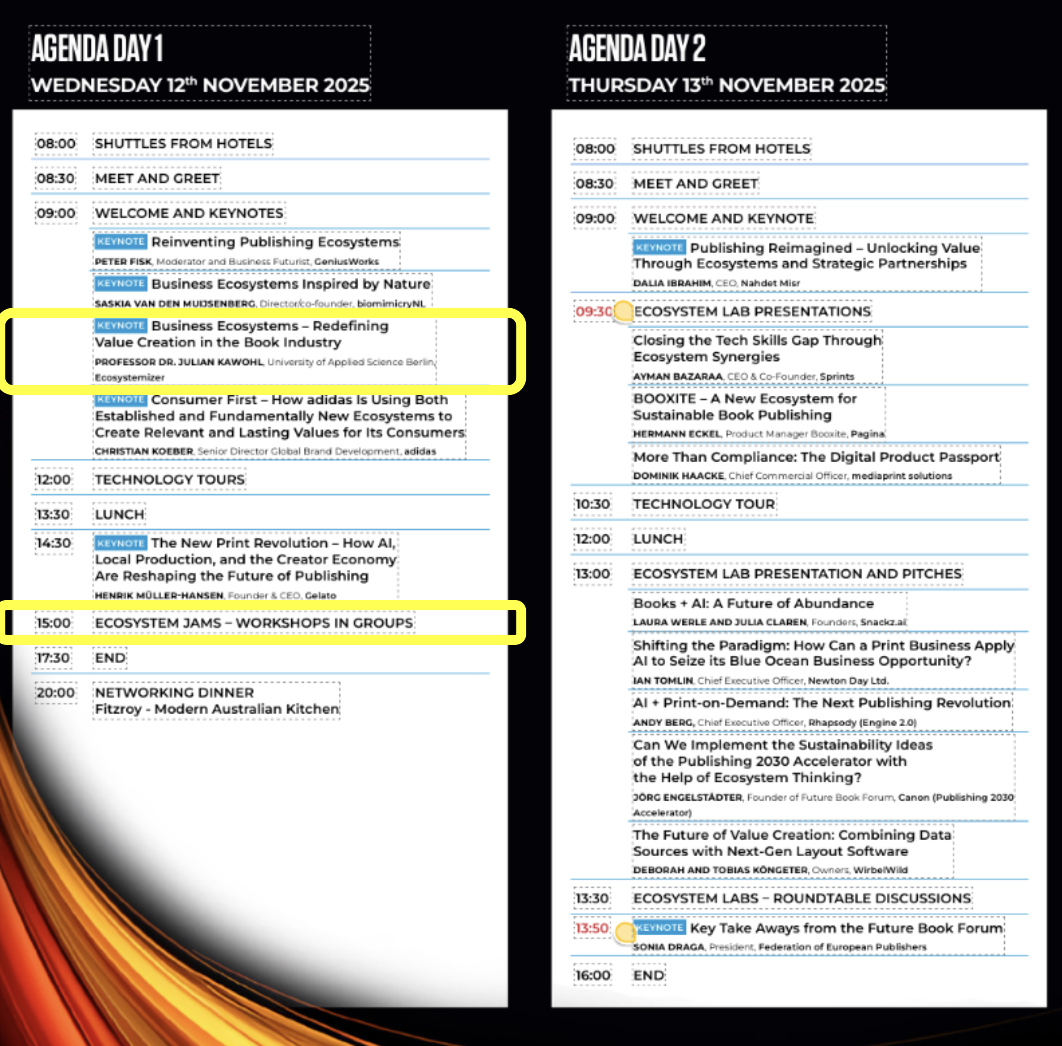
- FBF25: Beyond Books, Unlocking the Power of Ecosystems hosted by Peter Fisk
In nature, everything is connected. Every leaf, river, bird, and grain of soil participates in a complex dance of energy, matter, and meaning. Forests breathe life into the air that oceans carry across the planet; fungi whisper through root networks beneath our feet; coral reefs bloom and fade in cycles of abundance and renewal. Nature is not a static system, nor is it controlled by a single actor. It is an ever-evolving web of relationships that thrives through adaptation, interdependence, and diversity.
Today, as business leaders seek to navigate turbulent times — climate crises, technological disruption, social fragmentation, and global realignment — they might look to nature for lessons in how to thrive amidst complexity. For billions of years, life has experimented, failed, evolved, and reinvented itself. In doing so, it has developed a timeless wisdom for how systems grow, sustain, collapse, and regenerate. Understanding this can help us build, manage, and evolve business ecosystems that are not only more resilient but more meaningful and humane.
We explore how natural ecosystems form, function, and transform, before drawing deep parallels with the business ecosystems of today — networks of organisations, technologies, and people that co-create value and shape markets. Nature, it turns out, is the ultimate strategist.
Understanding Natural Ecosystems
The Format of Nature’s Systems
A natural ecosystem is a living system of interrelated organisms and their physical environment. It encompasses the flow of energy, the cycling of nutrients, and the intricate web of relationships between producers, consumers, and decomposers. From tropical rainforests to polar tundra, from coral reefs to desert plains, each ecosystem has a unique structure — its own format, one might say — that reflects the interaction between life and environment.
An ecosystem is not just a collection of species; it is a dynamic network of exchanges. Plants harness sunlight and convert it into chemical energy; herbivores consume plants; carnivores consume herbivores; decomposers recycle the waste and return nutrients to the soil. These interactions are circular, not linear. Nothing is wasted. Everything feeds something else.
The format of a natural ecosystem can be described in three layers:
-
Energy Flow: The fundamental movement of energy through the system — from the sun to plants, animals, and decomposers.
-
Nutrient Cycling: The continuous recycling of essential materials like carbon, nitrogen, and phosphorus, ensuring long-term fertility.
-
Trophic Structure: The hierarchy of feeding relationships — producers, consumers, predators — that maintains balance and diversity.
Healthy ecosystems are self-organising. They do not rely on external control. They maintain stability through diversity, redundancy, and feedback loops. When one species declines, others adapt; when resources change, the system reorganises. This is what ecologists call dynamic equilibrium — a balance achieved through constant movement, not stasis.
Formation: How Ecosystems Emerge
Ecosystems are born from opportunity — from the interplay between environment and life’s restless creativity. A bare rock after a volcanic eruption becomes the stage for pioneering lichens; their acids break down stone into soil, inviting mosses and ferns; these invite insects, which attract birds; and soon a thriving forest stands where once there was only lava.
This process, known as ecological succession, unfolds in stages:
-
Pioneer Stage: Hardy species colonise barren environments, breaking down rock and enriching soil.
-
Intermediate Stage: Grasses, shrubs, and small trees establish themselves, stabilising the landscape.
-
Climax Community: Mature, stable ecosystems emerge, with complex food webs and high biodiversity.
But stability never lasts forever. Fires, floods, disease, and climate shifts periodically disrupt even the most ancient forests. Yet these disturbances are not merely destructive — they are agents of renewal. In nature, disturbance is part of design. The old gives way to the new; nutrients are released, sunlight reaches the forest floor, and new life begins again.
Thus, ecosystems are constantly forming, transforming, and reforming. The cycle of birth, growth, death, and regeneration is not a failure of the system but its essence. Nature’s resilience comes not from rigidity but from its ability to adapt, reorganise, and evolve.
Disruption and Renewal: The Logic of Change
To the untrained eye, a forest fire looks catastrophic. Yet within months, green shoots emerge; within years, animals return; within decades, a richer, more diverse ecosystem may stand where the old one burned. Ecologists call this the adaptive cycle — the logic of nature’s renewal.
This model, originally developed by ecologist C.S. Holling, describes the recurring pattern through which complex systems evolve. It consists of four phases:
-
r – Growth: Rapid expansion, innovation, and exploitation of new opportunities.
-
K – Conservation: Maturity, efficiency, and accumulation of structure and resources.
-
Ω – Release: Collapse, disturbance, or creative destruction — when accumulated rigidity breaks down.
-
α – Reorganisation: Renewal, experimentation, recombination, and the emergence of new forms.
Every natural ecosystem moves through this cycle at its own rhythm. A pond may evolve and dry up over seasons; a forest may take centuries. The critical insight is that collapse is not an endpoint — it is a phase in the perpetual dance of life. In Holling’s words, “In nature, collapse becomes compost for the next generation.”
What We Can Learn from Nature’s Systems
Nature’s systems thrive because they follow a few timeless principles — elegant operating conditions that enable life to persist and flourish through endless change.
1. Context Is Everything
Every organism is locally attuned and responsive. A cactus conserves water because it lives in the desert; a willow bends with the wind because it grows by rivers. No universal strategy works everywhere — survival depends on fit.
For businesses, the lesson is profound. Many organisations attempt to impose standardised models across regions, cultures, or industries. But thriving ecosystems — biological or commercial — emerge when participants are contextually intelligent. They sense their environment, adapt behaviours, and co-evolve with their surroundings. In other words: strategy should emerge from place, not be imposed upon it.
2. Relationships Before Tasks
In nature, relationships matter more than roles. The success of a forest is not determined by any single tree but by the symbiosis between trees, fungi, insects, and animals. Cooperation, reciprocity, and mutual benefit are the building blocks of resilience.
In business ecosystems, value creation increasingly depends on networks of partners rather than isolated firms. Apple’s iPhone succeeded not because of the device alone but because of its surrounding ecosystem — app developers, accessory makers, and content providers. The same is true for Amazon’s marketplace, Tesla’s charging network, or Shopify’s developer community. Healthy business ecosystems, like natural ones, thrive on trust, shared purpose, and mutual interdependence.
3. Change Happens
Evolution is continuous; renewal follows disturbance. In nature, there is no such thing as permanent stability. Life adapts — or it dies. Systems that cling to the past become brittle; those that embrace change flourish.
For organisations, this is a call to build adaptability into the core. Instead of resisting disruption, leading companies harness it as fuel for renewal. They experiment, iterate, and evolve — constantly shedding what no longer serves them. The capacity for renewal is the true measure of longevity.
The Adaptive Cycle in Business
The adaptive cycle provides a powerful lens through which to understand the evolution of industries, markets, and organisations. Every business ecosystem — whether in publishing, technology, fashion, or energy — moves through its own rhythm of growth, conservation, collapse, and reorganisation.
Let’s translate the four phases of nature’s adaptive cycle into the language of business.
r – Growth: Exploration and Innovation
This is the entrepreneurial phase — a time of opportunity, creativity, and rapid expansion. In nature, this is the pioneer stage: grasses colonising bare soil after a fire. In business, it is the startup or early growth phase, marked by experimentation and risk-taking.
Examples abound: the early days of Silicon Valley; the rise of digital publishing; the renewable energy revolution. The focus is on discovering niches, testing ideas, and establishing footholds. Diversity flourishes; competition is intense but generative.
In this phase, energy is abundant but structure is weak — just like the first shoots of a forest. The challenge for leaders is to nurture diversity without losing coherence, to allow innovation while maintaining purpose.
K – Conservation: Efficiency and Stability
As ecosystems mature, resources become concentrated and networks stabilise. Energy flows efficiently, but flexibility declines. In business, this corresponds to the maturity phase — when companies optimise for efficiency, scale, and predictability.
Industries standardise processes, dominate markets, and extract value from established systems. This is the phase of consolidation — and often of complacency. Innovation slows; bureaucracy grows; margins tighten.
The ecosystem becomes tightly coupled — highly efficient but fragile. Like an old-growth forest, it looks stable but is vulnerable to shock. The lesson here: efficiency without adaptability is the prelude to collapse.
Ω – Release: Disruption and Collapse
Eventually, rigidity meets reality. A drought, a pest, or a wildfire disrupts the forest; in business, it might be a new technology, regulation, or shift in consumer behaviour. The structures that once created strength now become liabilities.
This is the creative destruction phase — what economist Joseph Schumpeter called the essential driver of capitalism. The book industry, for instance, moved through growth and consolidation and now finds itself in a release phase, disrupted by digital platforms, self-publishing, and AI.
For leaders, the challenge is not to resist collapse but to use it as compost. Decline, if embraced with humility and imagination, becomes the seedbed of renewal. The key is to let go of what no longer serves — rigid hierarchies, outdated models, or unhelpful assumptions — to make space for new growth.
α – Reorganisation: Renewal and Regeneration
After fire comes renewal. The soil is rich, the landscape open, and opportunity abundant. In business, this is the moment of reinvention — when new ideas, players, and structures emerge.
Startups flourish in the ashes of incumbents; new technologies unlock latent value; new networks form. The most successful companies in this phase embrace experimentation, recombination, and learning. They don’t rebuild the old system; they design the next one.
This is where purpose, imagination, and collaboration matter most. Renewal is not about recovery; it is about regeneration — the creation of something more resilient, diverse, and adaptive than before.
The Architecture of Business Ecosystems
Business ecosystems, like natural ones, are living systems of interdependence. They are not linear value chains but networks of collaboration, connecting suppliers, partners, platforms, customers, and even competitors in shared value creation.
Formation
Just as a pioneer plant colonises a barren landscape, new business ecosystems often begin with a catalyst — a technology, idea, or unmet need that opens a new niche. Think of how the iPhone spawned a mobile app ecosystem, or how the rise of renewable energy has birthed vast collaborations between utilities, battery makers, and software firms.
These ecosystems attract participants who see mutual opportunity. Over time, shared platforms emerge — standards, technologies, or marketplaces that enable coordination. The structure evolves organically as participants specialise, collaborate, and compete.
Structure
Healthy business ecosystems exhibit several characteristics:
-
Diversity: Multiple actors with complementary roles and perspectives.
-
Interdependence: Each participant contributes to, and depends on, others for success.
-
Feedback Loops: Continuous exchange of information and value.
-
Adaptability: The capacity to evolve in response to change.
In digital ecosystems, these dynamics are visible in platform economies — from Amazon’s marketplace to Microsoft’s developer network. But similar logics apply in local innovation clusters, such as Silicon Valley or Shenzhen, where dense networks of collaboration fuel creativity and speed.
Disruption and Renewal
Like forests, business ecosystems eventually face disruption. Technologies mature, consumer needs shift, and environmental or social pressures demand change. Some ecosystems collapse; others evolve. The difference lies in whether participants treat disruption as a threat to stability or a trigger for evolution.
Learning from Nature’s Design Principles
The parallels between natural and business ecosystems offer powerful guidance for leaders seeking to design systems that endure.
1. Diversity Creates Resilience
Monocultures — whether of crops or corporations — are inherently fragile. Diversity allows systems to absorb shocks, innovate, and adapt. In business, diversity of thought, talent, and partnership fuels creativity and robustness.
2. Redundancy Is Strength, Not Waste
In nature, multiple species perform similar roles, ensuring that if one fails, others can fill the gap. In business, redundancy — overlapping capabilities, flexible teams, distributed authority — increases adaptability. Lean efficiency must be balanced with slack for resilience.
3. Feedback Loops Maintain Balance
Ecosystems regulate themselves through feedback — predator-prey relationships, nutrient cycling, climate response. Similarly, businesses need mechanisms for sensing, learning, and adjusting in real time. Data analytics, customer feedback, and agile management all mirror nature’s feedback intelligence.
4. Collaboration Outperforms Competition
Nature is not a gladiatorial arena but a network of cooperation. Mycorrhizal fungi connect trees through underground networks, sharing nutrients and information. Likewise, companies in ecosystems succeed by creating value together, not merely competing for share. Partnership is strategy.
5. Renewal Follows Disturbance
Disturbance is not failure; it is the engine of evolution. In times of disruption, leaders should focus less on restoring the old order and more on designing the conditions for renewal — cultivating experimentation, decentralising authority, and inviting new voices.
From Sustainability to Regeneration
The language of business has long borrowed from nature — “growth,” “roots,” “organic,” “ecosystem” — but too often superficially. Sustainability has become a corporate mantra, but nature teaches us something deeper: regeneration.
Sustainability seeks to maintain what exists; regeneration seeks to renew what has been depleted. In natural terms, sustainability is equilibrium; regeneration is evolution. A regenerative business ecosystem restores value to society, nature, and the economy — creating positive feedback loops that enhance the whole system.
Companies like Patagonia, Interface, and Unilever are embracing this logic: designing circular supply chains, investing in social capital, and aligning growth with planetary health. These are not acts of altruism; they are acts of adaptation. As in nature, survival depends on symbiosis.
The Future of Business Ecosystems
We are entering an age when no company can thrive alone. The challenges of our time — climate, AI, inequality, health, trust — are systemic, not isolated. They require systemic responses. Business ecosystems are the organising structures of the future.
But to build them wisely, we must look beyond the mechanical metaphors of the past and rediscover the living intelligence of nature. The future belongs to leaders who think like gardeners — who cultivate conditions for others to grow, nurture diversity, and trust the self-organising power of relationships.
As with forests and reefs, the most vibrant business ecosystems are those that continuously renew themselves, balancing order and chaos, stability and change, growth and release. The art of leadership, then, is not control but cultivation — creating the conditions for life to flourish.
Nature’s Mirror
In nature, everything is connected, and everything changes. Systems rise and fall, species appear and disappear, yet life endures — endlessly creative, adaptive, and interdependent. The same is true of business.
To understand ecosystems, in nature or commerce, is to understand the flow of energy, the importance of relationships, and the inevitability of transformation. Nature teaches us that collapse is not the end, but the beginning of renewal. The ashes of the old forest nourish the seeds of the new.
As we face our own age of disruption, the wisdom of nature offers both comfort and challenge. Comfort, in knowing that change is part of the pattern; challenge, in learning to let go of what no longer serves, and to design for life, not control.
In the end, the businesses that endure will not be those that conquer markets but those that co-evolve with them — alive to context, rich in relationships, and ready to renew.
- Join me at this year’s Future Book Forum (FBF25)
- Read my article The Spotify of Books about Gelato
The traditional model of book publishing—author, editor, publisher, print production, distribution, reader—is increasingly under pressure. New technologies, changing reader habits, globalisation and the surge of digital formats all point to a future in which a printed book is just one node in a far broader ecosystem of content, services and experiences. At the heart of that transformation lies artificial intelligence (AI). But the real opportunity is not merely in using AI as a tool; it’s in rethinking publishing as an ecosystem, where books become platforms for engagement, data, interaction and value creation.
Why AI matters
AI brings several powerful shifts to publishing:
-
Production efficiency and scale: What once required months of editing, design, typesetting, translation, layout and distribution can now often be compressed, automated or significantly accelerated via AI tools. For example, one study of the African book-publishing sector notes that AI is altering “content acquisition by authors and publishers, content and product development, as well as the marketing and distribution of products.”
-
Smarter metadata, discoverability and rights-management: AI can analyse manuscripts for market potential, suggest keywords and metadata, translate text, generate alt-text for accessibility, and optimise cover design or pricing. A vendor dossier on “AI in Book Publishing” highlights use-cases such as trend prediction, demand forecasting, translation & audio, rights management and e-book generation.
-
Personalised experiences: Readers are no longer passive recipients of a static artifact. With AI we can imagine more adaptive reading journeys (e-books that change sequence based on reader behaviour), multi-format companions, recommendations based on engagement signals, and interactive or branching content.
-
Global reach and localisation: AI driven translation, region-specific case-studies, localised editions, voice-narration for audiobooks all expand the book’s potential into global micro-markets with much faster turnaround and lower cost.
-
Ecosystem monetisation beyond one-time sales: With digital platforms, memberships, courses, spin-offs, communities and data streams, books can become recurring-value products rather than single-purchase events.
Why ecosystems matter
The real leap for publishing isn’t just adding AI tools; it’s embracing ecosystem-based models. What does this mean?
-
Platform thinking: Instead of treating each book as a one-off artefact, publishers and authors build platforms that host a network of content, services, reader engagement, community feedback, micro-products and data-flows. The book becomes entry-point.
-
Interconnected services and content: A book might lead to a companion app, interactive webinars, live events, workshops, subscriptions, spin-out micro-editions, localised versions, audiobooks, case-study databases, community networks.
-
Data and feedback loops: Reader behaviour (time spent, dropout points, commentary, sharing) feeds back into the platform and shapes subsequent content, editions, formats, spin-offs. AI helps interpret the data, identify niches, prompt authors/publishers to act.
-
Rights and licensing fluidity: Rather than waiting years for spin-offs, rights to translation, adaptation into courses, games, apps, merchandise can be activated more rapidly. The ecosystem spans industries.
-
Global and local hybridisation: Ecosystems serve global reach while enabling local flavour. A central edition might be adapted regionally using AI translation + local examples + print-on-demand.
-
Reader as co-creator: In some ecosystem models, the reader becomes part of the creative economy—via annotations, feedback, branching narratives, community-led spin-outs. This shifts the role of reader from consumer to collaborator.
Why this matters now
For authors (especially self-publishing), for smaller presses, and for innovators, the convergence of AI + ecosystem thinking offers a generational opportunity: lower barriers to entry, richer forms of engagement, faster time-to-market, greater global reach, and diversified revenue streams. But it also demands new skills (digital platform design, community building, data insight, rights strategy), new mindsets (book as service not just product) and new ethics (AI-use transparency, quality control, author compensation, localised value). The risk is that without thoughtful design, the publishing floodgates may open so wide that quality, trust and distinctiveness are lost.
People plus machines
The UK’s Publishers Association commissioned a report titled People plus Machines: The Role of Artificial Intelligence in Publishing. Among many findings: two-thirds of large AI-active publishers reported they are already seeing benefits from AI investment. The report also documents specific case-studies: for example, Taylor & Francis partnered with Danish AI-technology firm UNSILO for a three-year collaboration to deploy AI tools in content workflows.
-
This case shows the shift from individual publisher projects to ecosystems of organisations: publishers working with AI-vendors, universities, research centres, tech firms.
-
It illustrates how internal publishing workflows (editing, metadata, layout, translation) are being embedded into broader service ecosystems where machine + human co-operate.
-
By strengthening workflows, the book becomes faster to market, better tailored, and more discoverable — which supports the platform + ecosystem model: the book sits within a network of data, analytics, user insights and downstream services.
Even in “traditional” publishing, the future is not outsourcing one tool but building partnerships (ecosystems) across functions—machine + human + network—to drive smarter, more efficient publishing.
Pioneers of the ecosystem future
Here are illustrative examples from around the world—platforms, publishers, start-ups, services—that demonstrate different facets of the AI-ecosystem future of publishing. For each, I outline what they are doing, why it matters and what you might learn from them.
Case 1: Spines .. self publishing
Spines is an AI-powered self-publishing platform founded by Israeli entrepreneur Yehuda Niv, that allows authors to upload manuscripts and, through an AI-augmented workflow (editing, proofreading, cover design, formatting, distribution), reach global markets in as little as two weeks.
Why it matters: It exemplifies how automation and platformisation make publishing faster, cheaper and more accessible. It lowers the barrier to publishing many voices, thus broadening the ecosystem of content.
What to learn: If you’re self-publishing your business book, adopting a workflow that is efficient, uses AI tools for editing/formatting and links to global distribution, you reduce cost/time and can focus more on value-creation (content, marketing, ecosystem) rather than purely production minutiae.
Case 2: Gelato … print on demand network
Gelato offers a global POD network with production partners across dozens of countries, enabling local fulfilment, regional print runs, low inventory, global distribution for books and other print products.
Why it matters: Physical print still matters, and the ecosystem must integrate print-on-demand, local fulfilment and on-demand versions of books (including regional variants). POD networks unlock localisation and rapid market response.
What to learn: For your business book, consider using POD networks to support regional versions (e.g., Europe, Asia) without large print runs. Localised editions + print-on-demand = cost-efficient global reach.
Case 3: Bookmaker … authoring and production platform
Bookmaker is an AI-based platform (developed by Keenethics) which supports book creation—from interview transcription, outline generation, drafting, to formatting and publishing. It integrates generative AI for text outlining, proof-reading and style consistency.
Why it matters: This shows the fundamental transformation of the authoring and production stage—not just distribution. Authors and publishers can engage AI earlier in the process to accelerate ideation, drafting and revision.
What to learn: You could use AI tools during the ideation phase of your book: outline generation, style templates, translation hints. Treat drafting as part of an ecosystem workflow rather than isolated weeks of writing.
Case 4: Wattpad … trans-media ecosystems
Wattpad, a digital storytelling community, turns popular user-generated stories into books, films or TV. In Japan the model of manga publishers like Shueisha extends into games, merchandise, anime and global licensing.
Why it matters: These are quintessential ecosystem models: the “book” is content that flows into other media, formats and experiences. The value isn’t locked in the book alone.
What to learn: Even for a business book, think beyond the print: webinars, interactive apps, spin-out micro-stories, podcasts, subscription communities. Your book becomes a node in a multi-format ecosystem.
Case 5: Notion Press … self-publishing platform
Notion Press is an Indian self-publishing platform that supports authors with services (editing, marketing, distribution) and aims to reduce lead-times and cost.
Why it matters: It reinforces that platforms are democratising publishing globally; the ecosystem includes many voices, micro-niches and regional markets.
What to learn: If you are self-publishing, leverage the ecosystem of services (editing + marketing + distribution) rather than only doing everything yourself. Platform-supported publishing enables scale and quality.
Case 6: Xynapse Traces … experimental imprint
Xynapse Traces is a publishing imprint built around a multi-model AI infrastructure: ideation pipelines, automated production, human oversight, delivering 52 books in a year, reducing time-to-market by ~90 % and cost-by ~80 % compared to traditional workflows.
Why it matters: This is a glimpse of what publishing might become: high-throughput content factories integrated with data, AI, and distribution. It points to how niche markets or fast-moving topics can be served far more quickly.
What to learn: Consider whether your topic—business innovation/reinvention—is time‐sensitive and whether you might use a quicker production model (e.g., digital-first, micro-editions) rather than a slow annual book cycle. The ecosystem mindset means you can publish chapters, updates, regional spin-outs, rather than one static edition.
Case 7: SnackzAI … book summaries
SnackzAI provides AI-generated summaries of popular books, oriented to busy readers. It invites partnerships with authors and publishers.
Why it matters: This shows how the book ecosystem includes derivative formats—summaries, micro-learning modules—targeting different audience segments. The full-book becomes part of a larger suite.
What to learn: Your ecosystem could include “micro-lessons” extracted from chapters of your book (for executives on the move), short audio bites, quick reference guides. These formats extend reach and engagement.
Case 8: iAuthor …digital platform
iAuthor is a UK-based crowdsourced book-platform linking authors and readers, enabling sharing of samples, analytics, promotional packages.
Why it matters: Platforms that connect author ↔ reader communities provide additional value layers (analytics, discovery, marketing) as part of the ecosystem.
What to learn: You might consider embedding your book launch into a platform/community where readers can sample, comment, engage. The ecosystem becomes relational.
Case 9: Publishing.ai … workflow and production tools
Publishing.ai (and similar platforms) offer dashboards for topic idea generation, outline creation, manuscript generation, and sales analytics.
Why it matters: The authoring/production stage is being re-imagined as a platform. This matters for all authors, especially in self-publishing.
What to learn: Consider adopting (or partnering with) such tools to accelerate your production and free up time for engagement, ecosystem design, marketing, localisation.
Case 10: Rhapsody Media … content-production services
Rhapsody Media’s Engine 2.0 offers content‐production services blending automation, AI and human workflows, enabling “100 pages or 100,000 pages” scale outputs.
Why it matters: It shows how the ecosystem of content (books, serials, marketing assets) is supported by high-scale infrastructure; publishers can outsource parts of the ecosystem rather than building everything in-house.
What to learn: For your project think of the ecosystem’s infrastructure: editing, layout, branding assets, micro-content, marketing collateral. Use service-providers or platforms rather than build everything from scratch.
What the future looks like and how to prepare
As these cases show, the future of publishing is not just incremental change—it is structural. The book becomes less a standalone artefact and more a node in a dynamic ecosystem of content, platforms, community, data and services. To prepare and thrive, authors and publishers need to think differently.
A vision of 2028-2030
Imagine this scenario: You publish a business book on reinvention. Upon release you don’t just sell print copies; you launch a digital platform. A month after publication you roll out: a companion app with interactive tools (frameworks from the book, personalised prompts), a membership community of readers sharing case-studies and experience, short “snack” micro-lessons for busy executives, a podcast series featuring deeper interviews with the book’s leaders and entrepreneurs, regional localised editions (Europe, Asia, Latin America) with tailormade case-studies and print-on-demand fulfilment. All are powered by AI analytics: the system monitors which chapters resonate, where readers drop off, what questions they ask; your team uses that insight to commission short-run spin-out titles, webinars, workshops. The book evolves: an updated edition appears six months later with new region-specific content; localisation adaptations follow and are printed via local fulfilment networks. The whole is a “learning-and-engagement ecosystem”, not simply a one-time product.
Key strategic questions
-
What is the ecosystem you want around your book? It might include membership, online tools, micro-content, live events, community, regional versions. Chart the nodes.
-
How will AI enable your production, distribution and engagement? Which parts of your process can be automated or augmented? How will you use data, analytics, recommendation, translation?
-
How will you engage readers beyond the purchase? How do you build retention, community and ongoing value? How will you generate recurring revenue rather than only book sales?
-
How will you go global and local at the same time? Which markets will you target? How will you localise content? How will you manage regional versions, local fulfilment and language adaptation?
-
How will you manage quality, trust and brand? With AI you may scale fast, but you must also guard quality, ethical use of AI, authenticity of author voice, rights management.
-
What partnerships will you need? Platform providers, AI-tools, print-on-demand networks, localisation services, distribution partners, marketing/analytics services.
-
What are your intangible assets? Your author brand, community network, data on reader behaviour, content rights, platform membership – these become central value drivers.
Practical roadmap
-
Preparation/Ideation Phase
-
Use AI tools (e.g., outline generators, topic research) to refine the book’s themes, market positioning, case-study selection.
-
Sketch the ecosystem: what companion content, micro-formats, community, regional versions do you want?
-
Map the production workflow: manuscript → editing → design → e-book/audiobook → print-on-demand → distribution.
-
-
Production Phase
-
Adopt efficient tools/platforms for editing, layout, metadata, translation (e.g., XML workflows like BOOXITE-style, generative drafting tools like Bookmaker).
-
Produce core formats: print, e-book, audiobook. Use POD for print runs to reduce risk.
-
Prepare companion formats: summary modules, micro-lessons, interactive worksheets, online course components.
-
-
Launch & Ecosystem Activation
-
Launch the core book, but simultaneously launch the ecosystem (membership portal, app, webinars, community).
-
Monitor reader engagement via analytics: which chapters are visited, how long users stay, which micro-modules are used.
-
Use AI-driven recommendation: “If you liked chapter 3, try micro-module X”, “Here’s a live workshop relevant to you”.
-
-
Iteration & Extension
-
Based on data, revise content: maybe release updated edition, regional spin-offs, tailored case-studies for local markets.
-
Expand formats: podcasts, live events, certification modules, corporate training packages.
-
Monetise via subscriptions, services, membership upsells, regional licences, spin-off books.
-
-
Global & Local Scaling
-
Use AI-assisted translation/localisation to launch editions in other languages/markets.
-
Use POD networks for regional print fulfilment to keep inventory minimal.
-
Build regional communities or affiliate networks (e.g., Europe, Asia) around localised content.
-
-
Long-Term Ecosystem Management
-
Keep your reader community alive: quarterly updates, member-only content, new case-studies, interactive live events.
-
Maintain data insights: reader behaviour, engagement patterns, conversion to services.
-
Keep investing in your intangible assets: brand, platform, data, community. These become more valuable than the individual book.
-
The future of book publishing is not merely about faster production or cheaper global distribution (though both are real). It is about reimagining what a book is. A book in 2030 will often be the hub of an ecosystem: digital tools, community, services, data flows, global & local versions, multi-format experiences. AI is the engine that makes this scale feasible, but the strategic shift is adopting the ecosystem mindset.
Join me at this year’s Future Book Forum to explore more!
Appendices
More about Gelato
Gelato is a global print-on-demand (POD) platform with a network in 32+ countries (140+ production partners) that enables creators and publishers to produce and fulfil print products (photo-books, children’s books, notebooks, apparel) locally without inventory. While primarily about POD products (not always traditional trade books), it demonstrates how physical publishing/distribution can become on-demand, localised and connected to digital/creator ecosystems.
-
Inventory-free, global fulfilment: Key for enabling regional versions of books, regional print runs, rapid adaptation, without large stocks.
-
Creator economy link: Authors/publishers can link to POD networks to offer special editions, personalised books, regional spins, and integrate with e-commerce platforms.
-
Extending beyond the book: The same infrastructure can serve spin-offs (merchandise, interactive personalisation, ancillary products) — so the book becomes part of a broader product ecosystem.
More about Booxite
Booxite is a new production-platform announced in June 2025 by German publishing-technology firm pagina GmbH (in collaboration with partners such as SiteFusion) that offers an “end-to-end” digital workflow for book publishing: from manuscript ingestion, author/editor collaboration, through automated typesetting (InDesign server), digital asset management, print-ready layout, e-book output, accessibility (alt-text), all on one XML-based platform. Notably, Booxite adopts a “pay-per-use” model rather than large software licensing: a publisher pays for each title processed, making it attractive for small and mid-sized presses. It also explicitly aims to be “KI-ready” (AI-ready) by virtue of having structured XML workflows designed for downstream AI tools (e.g., automatic alt-text generation, metadata extraction).
-
Smarter production: By moving the publishing workflow into a digital, collaborative, structured platform, Booxite reduces manual cost, turnaround time and error-rates.
-
Platform thinking: Booxite effectively turns the publisher’s production chain into a software-and-services ecosystem rather than a purely in-house process. The platform is a node connecting author, editor, typesetter, printer, digital output.
-
Foundation for AI/analytics: With consistent XML data, publishers can feed downstream AI tools (metadata extraction, recommendation, cost-analysis).
More about Rhapsody
Though not a traditional book-publisher, Rhapsody Media offers “Engine 2.0” — a proprietary content production system blending automation, AI tooling and human oversight — targeted at high-volume publishing, catalogues, book-brands, digital asset workflows. Their platform supports large-scale production: “From one-off creative to full-scale editorial programmes … whether you’re producing 100 pages or 100,000”.
-
Workflow scalability: Large content volumes (books, serials, related marketing assets) become manageable via AI + automation.
-
Enabling platforms: Entities like Rhapsody Media become part of the publisher ecosystem — service nodes providing infrastructure for publishers/brands.
-
Cross-media extension: The same workflow system can handle books, marketing assets, digital media — enabling the “book-plus” model.
More about SnackzAI
SnackzAI is an app described as “the first AI-book summary app” that uses generative AI to provide high-quality book summaries across topics like entrepreneurship, personal development, management and leadership. It offers a “Author and Publisher Partner Programme” inviting collaborations to expand its summary catalogue.
-
Audience engagement & new formats: SnackzAI captures the attention of time-poor readers by providing condensed knowledge experiences. It shifts reading from “full book” to “snackable micro-learning” — a different user journey.
-
Platform + service model: Rather than selling a single book, the app offers a subscription or service to access many summaries, making the book’s content part of a larger digital ecosystem.
-
Up- and downstream flows: For authors and publishers, partnering with such a platform opens new rights/licensing, derivative content, and possibly leads-to-full-book sales.
If you’ve ever felt simultaneously exhilarated and exhausted by the world of business, you’re not alone. The phrase “there’s never been a better time, never been a worse time” could be the unofficial motto of modern leadership.
On one hand, the possibilities seem limitless: global markets, artificial intelligence, sustainability innovation, and digital connectivity offer unprecedented opportunities for those bold enough to seize them. On the other hand, disruption, volatility, ethical scrutiny, and relentless pace make every decision feel like stepping onto a tightrope during an earthquake.
For today’s leaders, this paradox is not an abstract concept—it is lived experience. Every board meeting, product launch, and strategy session carries both the thrill of opportunity and the dread of risk.
In many ways, the modern business leader is a tightrope walker, acrobat, and visionary rolled into one. This article explores how business leaders navigate this contradictory terrain, drawing lessons from experience, innovation, and ingenuity, and offering inspiration for anyone charged with shaping the future of enterprise.
Paradox
Consider this: a start-up founder in London can prototype a product, access a global customer base, and scale operations internationally in months, not years. Meanwhile, geopolitical tensions, economic uncertainty, supply-chain fragility, and AI ethics loom over every decision. It is a world where yesterday’s certainties dissolve overnight, yet yesterday’s limitations have been obliterated by technology and connectivity.
It is both a renaissance and a minefield. Leaders must simultaneously dream and calculate, embrace experimentation while managing existential risk. This duality is the heart of our paradox: the very conditions that make the present the “best time” are inseparable from those that make it the “worst time.”
Technology
Take artificial intelligence, for example. A few decades ago, predictive analytics and machine learning were the stuff of research labs. Today, AI can write, compose, drive, design, diagnose, and even inspire. A CEO can use AI to forecast trends with uncanny accuracy, automate customer service, or optimise production schedules. The upside? Efficiency, creativity, insight, and scale.
The downside? Every advance brings new responsibilities. Data privacy concerns, algorithmic bias, regulatory uncertainty, and reputational risk lurk behind every line of code. AI can be a lever for growth or a lightning rod for criticism. Leaders must be technologists and ethicists in equal measure, guiding their organisations through uncharted waters with both curiosity and caution.
An anecdote captures this perfectly. A European CEO once recounted a boardroom AI debate where the same team argued simultaneously that AI would either save the company or destroy it. The room laughed, but the truth was, both outcomes were plausible. That is the paradox of our time: opportunities and threats exist in the same moment.
Leadership
Leaders who thrive today embrace ambiguity as a resource, not a threat. They understand that paradox is not a puzzle to solve but a reality to navigate. Several qualities distinguish these leaders:
1. Visionary Flexibility
The best leaders hold a clear vision but allow strategy to flex with circumstance. Satya Nadella’s transformation of Microsoft illustrates this perfectly. He knew the company’s mission—empower every person and organisation—but recognised the changing technological landscape. By pivoting to cloud and AI services, he simultaneously honoured the past and anticipated the future. Vision and flexibility are not opposites—they are complementary.
2. Courageous Experimentation
Emma Walmsley at GSK faced a similar paradox: restructuring a major pharmaceutical company in a sector governed by regulation, public scrutiny, and ethical imperatives. Her success lay in calculated experimentation—reorganising portfolios, doubling down on R&D, and innovating within constraints. Leaders today must be comfortable making informed bets, knowing failure is not only possible but sometimes necessary.
3. Human-Centric Thinking
In a world dominated by data and automation, human empathy has become a strategic differentiator. Jensen Huang at NVIDIA, while steering the company through AI revolutions, emphasised the importance of teams, collaboration, and cultivating curiosity. A machine can process information, but only humans can interpret, contextualise, and inspire. The paradox is clear: technology accelerates progress, yet human insight remains irreplaceable.
4. Ethical Anchoring
Purpose is not a marketing slogan—it is a lifeline. Mary Barra’s leadership at General Motors demonstrates the delicate balance between commercial ambition and social responsibility. By committing to electrification and sustainable mobility, she navigates the dual pressures of market growth and societal expectation. Leaders who ignore ethics risk reputational ruin; those who embrace it can transform constraint into competitive advantage.
Reality
Paradoxes are most instructive when lived. Consider a mid-sized technology firm that decided to implement AI-driven hiring. The system dramatically reduced bias in early-stage screening, yet initially introduced new forms of hidden bias in algorithmic scoring. The leadership team could have retreated to old methods, but instead, they iterated, tested, and adapted. The result? A hybrid system that amplified fairness while accelerating talent acquisition.
Or take a retail CEO expanding into Southeast Asia. Market research suggested the move was high-risk, yet the potential rewards—emerging middle-class consumers, digital-first adoption, and under-served regions—were immense. With careful local partnerships, culturally attuned marketing, and agile supply chains, the expansion became a template for growth in complex environments.
These stories illustrate the paradoxical principle: the same actions can carry simultaneous risk and reward. Leaders who acknowledge this ambiguity, rather than deny it, gain a psychological and strategic advantage.
Paradoxes extend beyond strategy into culture, organisational design, and even product development.
-
Remote Work: Flexibility empowers employees, yet hybrid models complicate culture and cohesion.
-
Innovation: Rapid experimentation drives differentiation, yet over-iteration can create confusion and inefficiency.
-
Sustainability: Environmental initiatives attract customers and investors, yet often require upfront capital and can limit short-term agility.
A playful anecdote captures this well. At a London-based tech start-up, the CEO joked that the company’s greatest innovation was “learning how to disagree beautifully.” Teams argued, iterated, and sometimes failed spectacularly—but by embracing paradox and conflict constructively, creativity flourished. The lesson? Paradox is fertile ground for leadership if navigated consciously.
Opportunities
While challenges dominate headlines, the upside is extraordinary. Leaders who embrace paradox can unlock unprecedented value:
-
Technology as Multiplier: AI, automation, and digital platforms allow scaling creativity and efficiency simultaneously.
-
Purpose as Profit Driver: Organisations that embed ethical, environmental, or social purpose attract loyalty, talent, and investment.
-
Globalisation with Local Intelligence: Understanding diverse markets allows leaders to reap rewards while hedging risk.
-
Ecosystem Collaboration: Strategic partnerships amplify innovation, reduce cost, and accelerate impact.
-
Resilience as Differentiator: Organisations that thrive under uncertainty outcompete those that rely solely on predictability.
In short, leaders can treat paradox not as paralysis but as opportunity. The same forces that threaten can propel growth; the same risks that intimidate can differentiate.
Inspiration
In a world of dualities, inspirational leadership becomes a vital tool. Storytelling, authenticity, and connection transform ambiguity into action. Leaders who share both the risks and the opportunities of change invite teams to co-create solutions.
Consider the words of a fintech entrepreneur: “I tell my team we’re either about to fail spectacularly or succeed magnificently—sometimes both at once. The only question is, which lessons we choose to act on.” Quirky, perhaps, but deeply resonant. Leadership is not about certainty; it is about courage in ambiguity.
For leaders seeking to navigate today’s “better-worst” world, several practical principles emerge:
-
Embrace Duality: Recognise that challenges and opportunities coexist; act with awareness of both.
-
Iterate and Learn: Treat strategy as a living experiment; adapt quickly, fail intelligently, and scale what works.
-
Invest in People: Technology is powerful, but culture, talent, and human judgement remain decisive.
-
Balance Boldness with Ethics: Risk-taking is essential, but must be grounded in values and integrity.
-
Communicate Transparently: Share the paradox with teams, investors, and stakeholders—clarity inspires confidence.
-
Celebrate Ambiguity: Encourage curiosity and experimentation; ambiguity is fertile soil for innovation.
The leaders who thrive are those comfortable holding two opposing truths simultaneously: that the world is full of peril and promise, risk and reward, chaos and opportunity.
Thriving
“Never been a better time, never been a worse time” is both a caution and a rallying cry. It reminds us that volatility and possibility are inseparable, that every decision carries both risk and reward, and that true leadership is measured by the ability to navigate ambiguity with courage, curiosity, and purpose.
It is also a call to creativity. In embracing paradox, leaders discover innovative solutions, new markets, and untapped potential. They learn that failure and insight are intertwined, that uncertainty can be energising rather than paralyzing, and that impact grows when risk is managed thoughtfully.
Ultimately, the paradox teaches a profound lesson: leadership is not about eliminating uncertainty, but about thriving within it. The very forces that make our era daunting are those that make it exhilarating. Leaders who understand this can harness change as a force for growth, resilience, and inspiration.
Business leadership in the modern era is a tightrope walk over a chasm of paradox. It is a time of extraordinary possibility and unprecedented peril. The greatest leaders of today—and tomorrow—are those who see opportunity where others see risk, who act decisively where others hesitate, and who inspire their organisations to flourish amid uncertainty.
In a world where volatility and potential coexist, where technology accelerates both progress and risk, and where societal expectations are higher than ever, the challenge is to embrace the contradiction. To see “never been a better time” and “never been a worse time” as two sides of the same coin. To act boldly, ethically, and creatively.
The age of paradox is here. The question is whether you, as a leader, will navigate it, or be swept aside.
In a business world now defined by rapid technological change, shifting consumer behaviour, and global uncertainty, businesses are navigating a landscape more complex and interconnected than ever before. The forces shaping markets today are not isolated trends—they are converging, accelerating, and creating unprecedented opportunities and risks. To thrive, leaders need a comprehensive understanding of these dynamics, their relative economic impact, and the strategic choices they demand.
This list of 250 megatrends is designed to serve as a blueprint for business leaders, strategists, and innovators. Each trend has been carefully ranked by its relative economic influence, reflecting the potential to transform industries, generate revenue, disrupt markets, and reshape value creation. From the transformative power of artificial intelligence and cloud computing to the growing imperatives of sustainability, renewable energy, and circular economies, this compilation offers a panoramic view of the forces shaping the present—and the future.
What makes this list particularly powerful is its diversity. It encompasses high-impact technological revolutions like generative AI, autonomous vehicles, and quantum computing, alongside societal shifts such as aging populations, urbanization, and remote work transformations. Environmental challenges, from climate change adaptation to water scarcity solutions, sit alongside innovations in food tech, biotech, and personalized healthcare. It includes financial and business model revolutions—fintech, blockchain, subscription economies—as well as emerging industrial innovations like advanced robotics, smart manufacturing, and next-generation materials. Each trend is accompanied by a concise description, highlighting not just what it is, but why it matters and the opportunities or challenges it presents.
For executives and decision-makers, the implications are clear: these trends are interconnected. The adoption of AI in logistics, for example, is enhanced by IoT-enabled smart grids and autonomous transport, while renewable energy innovations create new opportunities in electric vehicles, hydrogen, and circular manufacturing. Similarly, social and demographic shifts, such as mental health awareness and urban mobility demands, intersect with technology-enabled solutions, presenting novel market opportunities for businesses agile enough to respond.
Understanding the economic weight of each trend allows leaders to prioritize strategic initiatives, identify high-value opportunities, and anticipate disruptive risks. The ranking provides a lens through which to assess not only what is “trending,” but what truly matters in terms of revenue potential, market transformation, and long-term sustainability.
In short, this compilation is more than a list—it is a navigational tool. It equips leaders to think broadly and act decisively, connecting innovation with strategy, technology with society, and sustainability with growth. Whether your organization is a global powerhouse, a nimble startup, or a regional player, these 250 megatrends reveal the forces reshaping every industry, every business model, and every leadership agenda today.
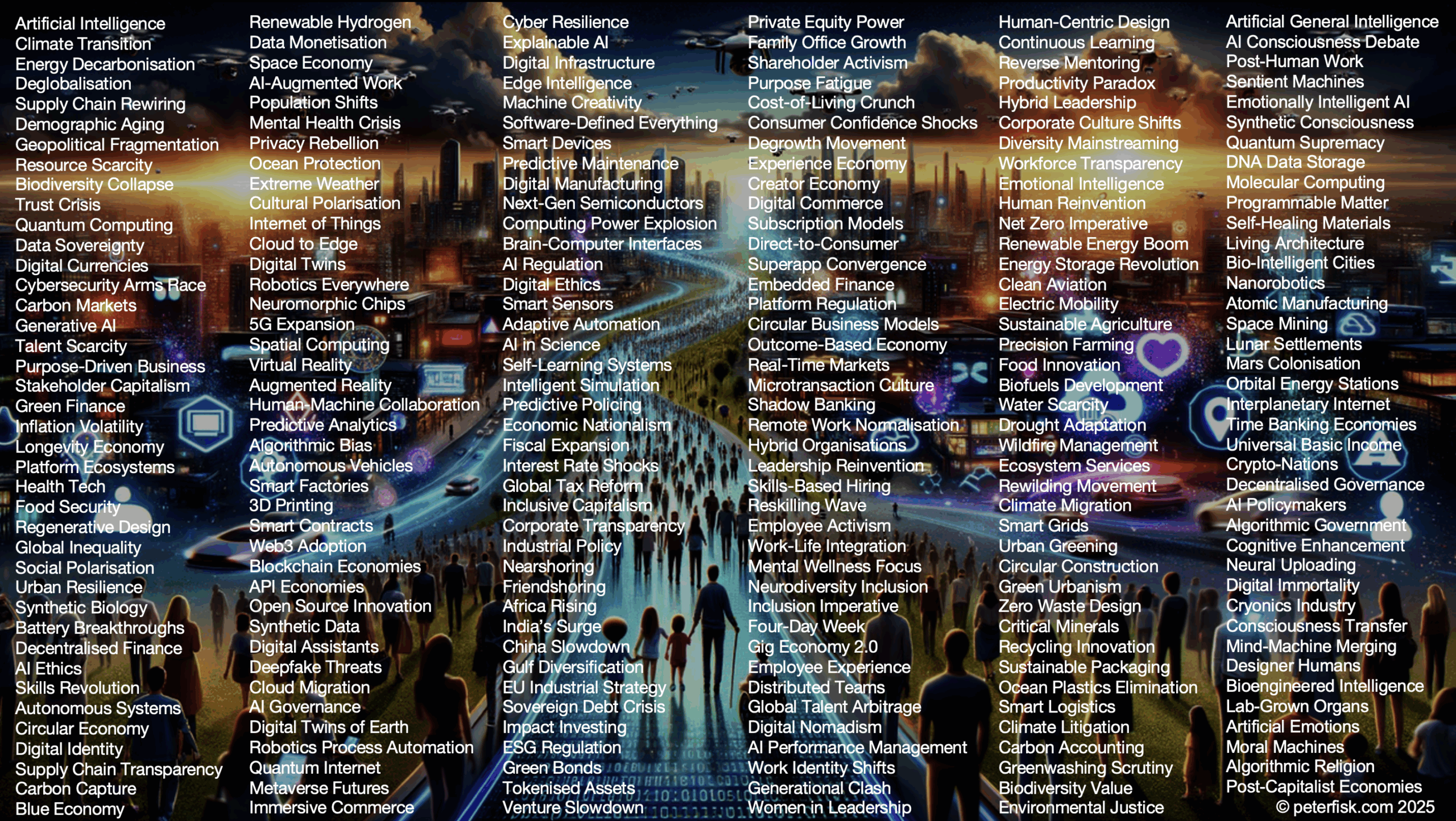
1. AI and Machine Learning
Artificial intelligence and machine learning are revolutionizing industries, enabling predictive analytics, automation, personalized services, and faster decision-making, transforming productivity, costs, and innovation across sectors globally.
2. Cloud Computing
Cloud infrastructure drives scalability, cost efficiency, and global access to software and data, enabling businesses to operate virtually, integrate AI, and compete in a rapidly digitalizing economy.
3. Globalization and Trade Networks
Complex supply chains, international markets, and global capital flows create economic interdependencies, offering growth opportunities while exposing businesses to geopolitical, regulatory, and logistical risks.
4. Digital Transformation
Organizations adopt digital tools, AI, and data-driven strategies to reinvent operations, customer experiences, and business models, fundamentally reshaping competitiveness and industry structure worldwide.
5. E-Commerce Expansion
Online retail growth, accelerated by changing consumer behavior, drives direct-to-consumer models, global reach, and data-driven personalization, disrupting traditional brick-and-mortar retail.
6. Renewable Energy
Solar, wind, and other renewables reduce reliance on fossil fuels, drive innovation, create jobs, and transform the energy landscape amid global climate commitments.
7. Electric Vehicles
The shift from internal combustion engines to EVs accelerates decarbonization, creates new industrial ecosystems, and reshapes automotive supply chains.
8. Autonomous Vehicles
Self-driving technology revolutionizes transportation, logistics, and mobility services, impacting infrastructure, insurance, and urban planning.
9. 5G Connectivity
Ultra-fast, low-latency 5G networks enable real-time communication, IoT expansion, AI applications, and transformative changes in healthcare, manufacturing, and smart cities.
10. AI in Healthcare
AI-driven diagnostics, personalized medicine, and predictive analytics enhance patient outcomes, reduce costs, and create new opportunities for biotech and pharmaceutical industries.
11. Genomics and CRISPR
Gene editing and sequencing technologies transform healthcare, agriculture, and synthetic biology, enabling targeted therapies, disease prevention, and bioengineering innovations.
12. Cybersecurity Threats
Rising cyberattacks force businesses to invest in protective measures, shaping technology development, risk management, and regulatory frameworks globally.
13. Digital Payments
Cashless economies, fintech platforms, and blockchain-based transactions improve efficiency, financial inclusion, and cross-border commerce.
14. AI-Driven Automation
Robotics and AI automate repetitive and complex tasks, increasing productivity, reducing labor costs, and reshaping industrial operations.
15. Sustainability and ESG
Environmental, social, and governance considerations drive investor focus, regulatory compliance, and operational strategies, redefining corporate accountability.
16. Climate Change Adaptation
Rising global temperatures and extreme weather force businesses to rethink supply chains, risk management, and infrastructure resilience.
17. Circular Economy
Resource efficiency, recycling, and waste reduction reshape manufacturing, packaging, and consumer goods, enabling sustainable growth.
18. Urbanization
Rapid city growth increases demand for infrastructure, smart technology, housing, and urban services, creating opportunities and congestion challenges.
19. Aging Populations
Demographic shifts in developed nations drive healthcare, retirement, and workforce planning innovation.
20. Emerging Market Growth
Rapid development in Asia, Africa, and Latin America expands consumer bases, industrial investment, and global trade opportunities.
21. Biotechnology Innovation
Synthetic biology, therapeutics, and agricultural biotech accelerate health and food sector transformation.
22. Space Economy
Commercial space ventures, satellite internet, and space tourism open new markets and technological frontiers.
23. AI Ethics and Regulation
The ethical deployment of AI and associated regulations shape innovation, corporate responsibility, and public trust.
24. Robotics in Manufacturing
Advanced robotics drive efficiency, precision, and scalability in production, reshaping traditional industries.
25. Quantum Computing
Emerging quantum technologies promise unprecedented computational power, disrupting finance, logistics, cryptography, and scientific research.
26. Digital Twins
Virtual modeling of real-world systems enhances predictive maintenance, urban planning, and industrial design.
27. Edge Computing
Processing data closer to devices improves real-time decision-making, IoT functionality, and low-latency applications.
28. Advanced Batteries
Energy storage innovations accelerate EV adoption, renewable integration, and grid stability.
29. Hydrogen Economy
Hydrogen as an energy source transforms transport, industry, and decarbonization strategies globally.
30. Internet of Things (IoT)
Connected devices across industries drive efficiency, predictive maintenance, smart cities, and consumer convenience.
31. AI-Generated Content
Generative AI transforms marketing, media, design, and entertainment, creating new workflows and content strategies.
32. Social Media Evolution
Social platforms influence consumer behavior, brand strategy, political influence, and digital commerce.
33. Fintech Innovation
Blockchain, neobanks, lending platforms, and AI-driven finance disrupt traditional banking and democratize financial services.
34. Cryptocurrency & Blockchain
Digital currencies and blockchain systems reshape finance, contracts, and digital ownership frameworks globally.
35. Personalized Medicine
Tailored treatment plans using genomics and AI improve outcomes and drive new healthcare business models.
36. Smart Cities
Urban planning leverages IoT, AI, and sustainable design to improve infrastructure, mobility, and services.
37. Remote Work Transformation
Hybrid and remote work models reshape real estate, corporate culture, and productivity metrics.
38. Digital Identity
Secure online identification systems are critical for e-commerce, banking, healthcare, and governance.
39. AI-Powered Supply Chains
Predictive analytics, automation, and IoT optimize logistics, reduce costs, and improve resilience.
40. Cloud AI Integration
Cloud platforms combining AI and big data enable scalable enterprise solutions and innovation acceleration.
41. Food Tech Innovation
Plant-based foods, lab-grown meat, and AI-driven production transform agriculture and consumer nutrition.
42. Advanced Materials
Nanomaterials, smart polymers, and composites enable stronger, lighter, and more sustainable products.
43. GenAI for Business
Generative AI enhances R&D, design, marketing, and personalized experiences across industries.
44. Water Scarcity Solutions
Innovations in water management, desalination, and recycling address critical global resource challenges.
45. Mental Health Awareness
Increased focus on workplace and societal mental health drives services, apps, and corporate policies.
46. Mobility-as-a-Service
Integrated transportation platforms offer on-demand, multimodal urban mobility solutions.
47. Circular Fashion
Clothing brands adopt recycling, upcycling, and sustainable materials to reduce environmental impact.
48. AI Regulation
Global governments develop frameworks to manage AI risks, ensuring safety, ethics, and fair competition.
49. Edge AI
Local AI processing accelerates real-time applications in vehicles, manufacturing, and robotics.
50. Carbon Capture & Storage
Technologies remove CO₂ from the atmosphere, helping industries meet climate goals and sustainability mandates.
51. Electric Aviation
Emerging electric and hybrid aircraft reduce carbon emissions, lower operational costs, and revolutionize regional air transport, urban air mobility, and sustainable logistics across global aviation markets.
52. Digital Health Platforms
Telemedicine, AI diagnostics, and remote monitoring platforms enhance healthcare access, reduce costs, and enable patient-centric, data-driven treatment models in global healthcare systems.
53. E-Learning & EdTech
Digital education platforms, AI tutors, and adaptive learning systems expand access, personalize curricula, and reshape traditional schooling, upskilling, and corporate training programs.
54. AI-Driven Marketing
Machine learning optimizes targeting, content creation, predictive consumer behavior, and ROI measurement, transforming how brands reach and engage customers worldwide.
55. Biodegradable Materials
Eco-friendly alternatives to plastics, packaging, and industrial materials reduce environmental impact, meet regulatory demands, and support sustainability-led brand strategies.
56. Voice & Conversational AI
Voice recognition and conversational agents enhance customer service, productivity tools, and smart devices, creating more intuitive human-machine interaction.
57. Smart Manufacturing
IoT sensors, AI monitoring, and robotics optimize production efficiency, reduce downtime, and lower costs, driving Industry 4.0 adoption.
58. Predictive Analytics
Data-driven forecasting in finance, logistics, marketing, and operations enables proactive decision-making, risk reduction, and revenue optimization.
59. Autonomous Drones
Unmanned aerial vehicles enhance delivery, surveillance, mapping, and industrial operations, reshaping logistics, agriculture, and defense sectors.
60. Sustainable Agriculture
AI, IoT, and precision farming technologies increase yields, reduce resource use, and address climate and population pressures in global food production.
61. AI in LegalTech
Automation and predictive analytics streamline legal research, contract review, and compliance, transforming law practice efficiency and corporate governance.
62. Biometric Security
Fingerprint, facial recognition, and other biometrics improve cybersecurity, fraud prevention, and secure access for financial, corporate, and government systems.
63. Personalized Retail
Data-driven recommendations, virtual try-ons, and AI-enhanced customer journeys create hyper-personalized shopping experiences, increasing engagement and sales.
64. Space Mining
Asteroid and planetary resource extraction opens long-term opportunities in rare materials, minerals, and space-based industrial ventures.
65. Next-Gen Batteries
Solid-state, lithium-sulfur, and other advanced batteries increase energy density, charging speed, and longevity for EVs and renewable storage.
66. AI in Finance
Algorithmic trading, fraud detection, and personalized investment platforms enhance efficiency, risk management, and profitability in banking and capital markets.
67. Smart Homes
Connected devices, AI assistants, and energy management systems improve comfort, convenience, and energy efficiency in residential environments.
68. Urban Air Mobility
Flying taxis, drones, and urban aerial transport networks reduce congestion, improve mobility, and create new urban transportation markets.
69. Low-Code/No-Code Platforms
Simplified software development empowers businesses to rapidly deploy apps, automate workflows, and reduce IT costs without heavy coding expertise.
70. Green Hydrogen
Sustainable hydrogen production supports clean energy strategies, industrial decarbonization, and new fuel markets globally.
71. AI-Powered Customer Service
Chatbots and virtual agents enhance efficiency, reduce costs, and improve satisfaction across industries, from retail to financial services.
72. Wearable Technology
Health monitoring, fitness tracking, and augmented reality devices enable real-time insights, personalization, and new consumer and healthcare applications.
73. Direct-to-Consumer Models
Brands bypass intermediaries to control pricing, customer engagement, data, and loyalty, disrupting traditional retail channels.
74. Advanced Robotics
Collaborative robots, AI-guided arms, and autonomous machinery enhance productivity in manufacturing, logistics, and healthcare.
75. AI Ethics
Companies adopt frameworks to ensure responsible, transparent AI deployment, addressing bias, privacy, and societal impact.
76. Food Supply Chain Transparency
Blockchain and IoT ensure traceability, reduce fraud, and meet consumer demand for ethically sourced products.
77. Subscription Economy
Recurring revenue models drive customer loyalty, predictable cash flow, and data-driven service optimization across industries.
78. Digital Twins in Infrastructure
Virtual replicas of buildings, factories, and cities optimize design, maintenance, and operational efficiency, reducing costs and risks.
79. Connected Cars
Automotive IoT enables vehicle-to-vehicle and vehicle-to-infrastructure communication, enhancing safety, efficiency, and autonomous driving capabilities.
80. Global Talent Mobility
Remote work, gig economy, and international recruitment expand access to skilled talent, driving productivity and innovation.
81. AI in Energy Management
Smart grids, predictive analytics, and automation optimize energy use, reduce costs, and integrate renewables efficiently.
82. Cyber-Physical Systems
Integration of computation, networking, and physical processes transforms manufacturing, logistics, and industrial operations.
83. Digital Advertising Evolution
Programmatic ads, AI optimization, and multi-channel strategies redefine consumer engagement and media monetization.
84. Generative Design
AI-driven design optimizes product performance, materials usage, and manufacturing efficiency across engineering and architecture.
85. Mixed Reality
AR/VR applications enhance education, entertainment, training, and remote collaboration, reshaping immersive experiences.
86. Smart Logistics
IoT sensors, AI forecasting, and autonomous vehicles improve supply chain efficiency, transparency, and cost-effectiveness.
87. AI-Enhanced Drug Discovery
Machine learning accelerates identification of molecules, reduces R&D costs, and shortens time-to-market for new therapies.
88. Blockchain for Enterprise
Decentralized ledgers streamline contracts, transactions, and supply chains, enhancing security, transparency, and operational efficiency.
89. Digital Nomad Economy
Remote work policies, global connectivity, and flexible living reshape talent retention, corporate culture, and real estate demand.
90. AI Governance
Regulations and frameworks ensure ethical, safe, and accountable AI adoption across industries.
91. Edge Analytics
Real-time data processing at the edge reduces latency, enhances IoT functionality, and supports autonomous systems.
92. Eco-Tourism
Sustainable travel trends reshape hospitality, conservation, and local economic development.
93. Data Sovereignty
National and regional data regulations influence cloud strategy, cross-border commerce, and technology deployment.
94. Climate Finance
Investments in low-carbon projects and green bonds shape capital allocation and corporate sustainability strategies.
95. Shared Mobility
Ride-sharing, car-sharing, and micro-mobility solutions reduce congestion, pollution, and personal transport costs.
96. AI-Powered Creativity
Generative tools support advertising, media, and design innovation, transforming workflows and ideation processes.
97. Circular Electronics
Recycling and sustainable design in electronics reduce waste, recover rare materials, and extend product lifecycle.
98. AI-Enhanced Security
Machine learning improves threat detection, cybersecurity, and fraud prevention across sectors.
99. Sustainable Packaging
Innovations in materials, design, and logistics reduce environmental impact and enhance brand value.
100. Smart Retail
AI, IoT, and omnichannel integration personalize experiences, optimize inventory, and increase operational efficiency.
151. AI in Predictive Maintenance
Machine learning anticipates equipment failures, reduces downtime, optimizes repair schedules, and saves costs across manufacturing, energy, and transportation industries, enhancing operational efficiency and reliability.
152. Smart Waste Management
IoT sensors, AI sorting, and automated recycling improve efficiency, reduce landfill dependency, and optimize resource recovery in cities and industrial operations.
153. AI-Driven Retail Analytics
Predictive insights into customer behavior, inventory trends, and sales performance enable targeted marketing, dynamic pricing, and optimized product offerings.
154. AI-Enabled Drug Repurposing
Machine learning identifies new uses for existing pharmaceuticals, accelerating R&D, reducing development costs, and shortening time-to-market for therapies.
155. Digital Twins in Healthcare
Virtual models of patients, organs, and treatment plans enable personalized medicine, surgical planning, and optimized care delivery.
156. AI in Fraud Detection
Advanced algorithms monitor financial transactions, detect anomalies, and prevent cybercrime, protecting businesses and consumers globally.
157. Renewable Aviation Fuels
Sustainable jet fuels reduce carbon emissions in aviation, supporting decarbonization goals and regulatory compliance.
158. AI-Optimized Advertising
Real-time ad placement, targeting, and creative content generation improve campaign efficiency and ROI for digital marketing platforms.
159. AI in Drug Discovery
Generative and predictive algorithms accelerate molecule identification, optimize trials, and improve therapeutic success rates.
160. Smart Buildings
AI-enabled HVAC, lighting, and security systems enhance energy efficiency, occupant comfort, and operational savings in commercial and residential spaces.
161. AI-Powered Investment Platforms
Machine learning supports portfolio management, risk assessment, and automated trading, democratizing access to sophisticated financial strategies.
162. Smart Grid Cybersecurity
Protecting energy networks with AI and IoT ensures reliable, secure, and efficient power distribution amid increasing digitalization.
163. AI in Agriculture Yield Prediction
Predictive models optimize planting schedules, fertilizer use, and irrigation, improving crop output and reducing environmental impact.
164. Smart Ports and Logistics Hubs
Automated cargo handling, predictive scheduling, and AI analytics enhance efficiency, reduce bottlenecks, and optimize global shipping.
165. AI-Powered Fraud Prevention
Real-time monitoring of banking, e-commerce, and insurance transactions reduces financial risk, enhances compliance, and protects consumers.
166. AI-Assisted Clinical Trials
Predictive patient selection, trial simulations, and data analysis accelerate drug development while reducing costs and improving success rates.
167. AI in Energy Forecasting
Machine learning predicts energy demand, optimizes generation, and improves integration of renewables for grid stability.
168. Circular Consumer Electronics
Reuse, repair, and recycling programs reduce e-waste, recover critical materials, and support sustainability initiatives.
169. AI in Urban Traffic Management
Predictive traffic flows, adaptive signaling, and autonomous systems reduce congestion, emissions, and commute times.
170. Smart Factories
IoT, robotics, and AI integration enable real-time monitoring, predictive maintenance, and adaptive production, improving efficiency and scalability.
171. AI-Powered Credit Scoring
Machine learning enhances financial inclusion, improves risk assessment, and personalizes lending products in global markets.
172. Sustainable Shipping
Electric, hydrogen, and wind-assisted vessels reduce emissions, optimize fuel use, and meet regulatory sustainability requirements.
173. AI in Insurance Claims
Automated processing, predictive fraud detection, and analytics enhance customer experience, efficiency, and risk management.
174. AI-Driven Personalized Learning
Adaptive education platforms use machine learning to tailor curricula, improve engagement, and optimize learning outcomes for students and corporate learners.
175. Next-Generation Semiconductors
Advanced chips, neuromorphic computing, and AI accelerators drive high-performance computing, AI applications, and next-gen electronics.
176. AI-Enhanced Energy Management
Smart grids, predictive maintenance, and automation optimize generation, distribution, and consumption for cost savings and sustainability.
177. Blockchain in Logistics
Distributed ledgers provide transparency, traceability, and efficiency in supply chains, reducing fraud and operational costs.
178. AI-Assisted Translation
Real-time multilingual translation enables global collaboration, remote work, and cross-border commerce with improved communication accuracy.
179. Sustainable Packaging Innovations
Compostable, reusable, and reduced-material packaging reduces environmental impact, regulatory risk, and enhances brand reputation.
180. AI-Enhanced Retail Inventory
Predictive stock management, automated ordering, and demand forecasting minimize waste, reduce costs, and improve customer satisfaction.
181. AI-Driven Weather Prediction
High-resolution climate modeling supports agriculture, energy planning, disaster mitigation, and supply chain optimization.
182. AI in Fraud Analytics
Pattern recognition and predictive modeling detect financial anomalies, cybersecurity threats, and operational irregularities in real-time.
183. Smart Farming Sensors
IoT-enabled soil, water, and crop sensors optimize inputs, improve yield, and reduce environmental footprint.
184. AI in Traffic Flow Optimization
Machine learning predicts congestion, coordinates autonomous vehicles, and manages urban transportation for efficiency and reduced emissions.
185. AI in Predictive Policing
Data-driven analytics enhance crime prevention, resource allocation, and community safety while raising ethical and privacy considerations.
186. AI-Powered Recruitment Analytics
Predictive tools analyze candidate performance, cultural fit, and retention risk, improving hiring outcomes.
187. Smart Metering
IoT-enabled energy and water meters provide real-time consumption data, improve efficiency, and enable sustainable resource management.
188. AI-Assisted R&D
Machine learning accelerates product development, simulation, and innovation in pharmaceuticals, materials, and technology.
189. AI in Customer Insights
Predictive models analyze behavior, sentiment, and trends to optimize marketing, product design, and engagement strategies.
190. Carbon-Neutral Supply Chains
Decarbonization strategies, renewable integration, and AI optimization reduce emissions and meet ESG targets.
191. AI-Powered Legal Drafting
Automation in contract creation, compliance, and research reduces time, costs, and human error.
192. AI-Driven Investment Insights
Machine learning identifies trends, predicts risks, and supports strategic capital allocation for investors and corporations.
193. Precision Livestock Farming
Sensors, AI, and monitoring improve animal health, productivity, and sustainability in agriculture.
194. AI-Enhanced Fraud Risk Management
Predictive analytics reduce operational and financial risk across industries, enhancing regulatory compliance.
195. Smart Urban Mobility
Connected transport systems integrate shared vehicles, autonomous fleets, and micro-mobility solutions to improve efficiency and sustainability.
196. AI-Powered Market Research
Natural language processing and predictive analytics generate insights faster, cheaper, and with higher accuracy for strategic decisions.
197. Digital Asset Management
Blockchain, NFTs, and tokenization enable secure ownership, trade, and monetization of digital content.
198. AI in Climate Risk Assessment
Predictive modeling identifies vulnerabilities in infrastructure, agriculture, and finance, supporting adaptation and mitigation strategies.
199. AI-Enhanced Cyber Insurance
Data-driven underwriting and risk modeling improve pricing, coverage, and claims handling for cyber threats.
200. Smart Waste-to-Energy
Converting waste into electricity or fuel reduces landfill usage, supports renewable energy, and creates circular economic value.
201. AI-Powered Climate Modeling
Machine learning predicts temperature, precipitation, and extreme weather patterns, enabling governments, businesses, and communities to plan mitigation, adaptation, and investment strategies effectively.
202. Smart Water Recycling
IoT sensors and AI optimize industrial and municipal water reuse, reducing consumption, lowering costs, and supporting sustainability goals.
203. AI-Driven Logistics Forecasting
Predictive analytics improve inventory management, route planning, and demand forecasting, reducing costs, emissions, and delivery times in global supply chains.
204. AI-Powered Customer Experience
Intelligent chatbots, recommendation engines, and sentiment analysis personalize interactions, increase satisfaction, and drive revenue growth across industries.
205. Vertical Urban Mobility
Elevators, drones, and aerial transport integrate into urban infrastructure, enabling efficient, space-saving mobility solutions.
206. AI-Assisted Manufacturing Quality Control
Machine vision and predictive analytics detect defects, optimize processes, and reduce waste in production environments.
207. AI-Powered Risk Management
Algorithms identify financial, operational, and environmental risks, improving decision-making and strategic planning across industries.
208. Sustainable Real Estate Development
Energy-efficient buildings, green certifications, and smart technology reduce operational costs and environmental impact.
209. Smart Agriculture AI
Machine learning analyzes weather, soil, and crop data to optimize planting, irrigation, and fertilization, improving yields and reducing environmental impact.
210. Digital Health Records
Blockchain and cloud integration enable secure, accessible, and interoperable patient data for better healthcare delivery.
211. AI-Powered Predictive Marketing
Analytics forecast customer preferences, optimize campaigns, and enhance conversion rates for targeted, cost-effective advertising.
212. AI-Driven Financial Auditing
Automated transaction analysis detects anomalies, ensures regulatory compliance, and reduces audit costs.
213. Renewable Heating & Cooling
Geothermal, solar thermal, and heat pump technologies reduce carbon emissions in commercial and residential buildings.
214. Smart Grid Demand Response
AI and IoT optimize energy consumption in real-time, reducing peak loads and supporting renewable integration.
215. AI-Powered Drug Formulation
Machine learning accelerates development of safer, more effective pharmaceuticals while lowering R&D costs and time-to-market.
216. AI-Enhanced Fraud Analytics
Real-time pattern recognition and anomaly detection prevent financial crime across banking, insurance, and e-commerce.
217. Predictive Traffic Management
Data-driven solutions reduce congestion, optimize public transport, and improve urban mobility.
218. AI in Predictive Maintenance for Utilities
Sensors and machine learning anticipate equipment failures, minimize downtime, and reduce operational costs for energy and water networks.
219. Digital Twin Cities
Virtual city models support urban planning, resource allocation, infrastructure monitoring, and sustainability initiatives.
220. AI-Driven Investment Risk Analysis
Algorithms forecast market trends, assess asset risk, and optimize portfolio strategies for investors and corporations.
221. Smart Waste Sorting
Automation and AI improve recycling efficiency, resource recovery, and sustainability in industrial and municipal operations.
222. AI-Assisted Legal Analytics
Predictive tools streamline litigation strategy, case evaluation, and compliance, reducing time and cost in law practices.
223. AI-Powered Renewable Forecasting
Machine learning predicts solar, wind, and hydro output to optimize energy trading and grid integration.
224. AI-Enhanced Transportation Safety
Predictive analytics, vehicle sensors, and autonomous systems reduce accidents, improve routing, and enhance mobility safety.
225. AI in Predictive Maintenance for Manufacturing
Real-time monitoring and machine learning minimize downtime, improve efficiency, and reduce costs in industrial operations.
226. Smart Healthcare Devices
Connected wearables monitor vitals, provide predictive insights, and support remote care for personalized health management.
227. AI-Powered Talent Analytics
Predictive tools assess workforce performance, retention risk, and engagement to optimize HR strategy and development programs.
228. Smart Grid Storage Integration
AI and advanced storage solutions improve renewable energy utilization, grid stability, and operational efficiency.
229. AI-Driven Fraud Risk Scoring
Predictive models detect anomalies and evaluate risk in financial transactions, protecting institutions and customers.
230. AI-Powered Marketing Optimization
Machine learning identifies audience segments, predicts behavior, and optimizes campaigns for improved engagement and ROI.
231. AI-Enhanced Renewable Energy Management
Predictive maintenance, load balancing, and optimization algorithms increase reliability and efficiency in solar, wind, and hydro power.
232. AI-Powered Healthcare Decision Support
Machine learning assists clinicians with diagnosis, treatment planning, and risk assessment, improving patient outcomes.
233. AI in Supply Chain Resilience
Predictive analytics optimize sourcing, logistics, and inventory to mitigate disruptions and improve operational efficiency.
234. AI-Assisted Drug Targeting
Algorithms identify potential molecular targets, accelerating therapeutic development and personalized medicine solutions.
235. AI-Powered Insurance Underwriting
Machine learning assesses risk, optimizes premiums, and streamlines policy issuance, improving efficiency and accuracy.
236. AI-Driven Climate Risk Analytics
Predictive models guide corporate strategy, insurance pricing, and investment decisions based on environmental risks.
237. AI-Enhanced Customer Insights
Data-driven models analyze behavior, sentiment, and trends to improve engagement, product design, and marketing strategies.
238. AI-Powered Predictive Maintenance in Transportation
Real-time monitoring and machine learning prevent breakdowns, optimize fleet utilization, and reduce operational costs.
239. AI in Smart Retail Operations
Automation, predictive analytics, and inventory optimization improve efficiency, reduce costs, and enhance customer experience.
240. AI-Enhanced Urban Planning
Predictive modeling supports sustainable infrastructure, traffic management, and resource allocation in rapidly growing cities.
241. AI in Predictive Healthcare Analytics
Machine learning forecasts patient needs, disease outbreaks, and resource allocation for improved healthcare delivery.
242. AI-Powered E-Commerce Recommendations
Algorithms analyze browsing, purchasing, and preference data to increase engagement, sales, and personalization in online retail.
243. AI-Driven Renewable Energy Trading
Predictive analytics optimize buying, selling, and storage of renewable electricity for profitability and grid efficiency.
244. AI-Powered Fraud Prevention in E-Commerce
Real-time monitoring and machine learning detect payment anomalies, prevent fraud, and protect businesses and customers.
245. AI in Personalized Education
Adaptive learning platforms use data and AI to tailor teaching methods, improving outcomes for students and employees.
246. AI-Assisted Clinical Decision Making
Machine learning supports diagnosis, treatment planning, and predictive risk assessment in medical care.
247. Smart Microgrids for Industry
Localized, AI-optimized energy networks reduce costs, improve resilience, and integrate renewable energy for manufacturing and industrial facilities.
248. AI-Powered Risk Assessment in Finance
Algorithms analyze market trends, credit risk, and operational threats, improving investment decisions and compliance.
249. AI in Smart Transportation Systems
Connected vehicles, traffic prediction, and autonomous systems improve efficiency, safety, and sustainability in urban mobility.
250. Circular Economy Platforms
Digital marketplaces and AI optimize reuse, recycling, and resource sharing, reducing waste, lowering costs, and supporting sustainable business models globally.
Turning trends into actions
Recognising and understanding the 250 megatrends shaping the global business landscape is only the first step. The real challenge—and opportunity—lies in translating insight into action. These trends represent both disruption and possibility, and the organisations that succeed will be those capable of connecting strategic vision with operational execution, leveraging technology, data, and human talent in concert.
For today’s leaders, the message is clear: no business operates in isolation. The convergence of technological innovation, demographic shifts, environmental imperatives, and evolving social norms creates a dynamic environment where agility, foresight, and experimentation are critical. Companies that integrate AI, automation, and advanced analytics into their core operations can unlock new efficiencies and capabilities, while those embracing sustainability and circular economy principles can differentiate themselves in an increasingly conscientious market. Similarly, businesses that leverage digital platforms, fintech solutions, and new business models like subscription services or direct-to-consumer strategies can create stronger customer engagement, resilient revenue streams, and a competitive edge.
The diversity of these trends underscores the necessity for cross-disciplinary thinking. Innovations in biotech, genomics, and personalized healthcare intersect with AI and big data, transforming not only medical outcomes but also the business models and regulatory landscapes of healthcare providers. In manufacturing, smart factories, robotics, and IoT integration reduce costs, enhance productivity, and enable predictive operations, while circular design and sustainable materials drive environmental and reputational value. In consumer-facing sectors, trends in digital retail, immersive experiences, and smart mobility reshape how products and services are delivered, monetized, and consumed.
Effective action requires prioritization. The ranking by economic impact provides a roadmap for identifying which trends offer the most immediate influence on growth, disruption, and profitability. Organizations should evaluate each trend not in isolation, but in the context of their industry, market position, and long-term strategic goals. Scenario planning, pilot projects, and ecosystem partnerships are practical approaches to test, validate, and scale innovations while mitigating risks.
Leadership is the differentiator. In a world of accelerating change, executives must combine vision with courage, balancing short-term performance with long-term transformation. Building a culture that encourages experimentation, continuous learning, and collaboration across technology, sustainability, and social responsibility domains ensures that companies are not just reacting to trends—they are shaping them.
Ultimately, these 250 megatrends offer a lens into the forces that will define success in the coming decade. They highlight the challenges businesses must confront, from climate risk to cybersecurity threats, while illuminating the extraordinary opportunities available to those willing to innovate, adapt, and lead. By synthesizing knowledge, prioritizing strategically, and acting decisively, companies can convert insight into impact, turning global trends into tangible advantage.
In short, the future belongs to those who see these forces not as distant possibilities, but as immediate imperatives, who transform complexity into clarity, disruption into opportunity, and insight into action.
For years, Europe has carried a reputation for economic maturity rather than dynamism—steady, but slow. The narrative often cast Silicon Valley as the engine of global innovation, while Europe seemed weighed down by regulation, fragmentation, and tradition.
Yet in 2024–2025, something remarkable is happening. Europe’s largest companies are not just holding their ground; they are creating value on par with America’s technology titans—albeit in their own, distinctive way.
The clearest proof comes from the so-called “GRANOLAS”—a group of 11 European companies named by Goldman Sachs: GSK, Roche, ASML, Nestlé, Novartis, Novo Nordisk, L’Oréal, LVMH, AstraZeneca, SAP, and Sanofi.Collectively, these firms have grown into a bloc with the same weight in Europe as the “Magnificent 7″—Apple, Amazon, Alphabet, Microsoft, Meta, Nvidia, and Tesla—have in the USA.
While the American stars dazzled investors with exponential growth, Europe’s GRANOLAS, rooted in health, luxury, and industrial technology, have steadily accumulated market power, revenues, and global relevance.
Europe’s distinct path to growth
The difference is not simply in sector focus, but in strategy. U.S. giants thrive on digital scale, winner-takes-all platforms, and consumer lock-in. Europe’s leaders, by contrast, win through reinvention of traditional strengths—science, engineering, design, and culture—infused with new technologies and global reach. They are creating extraordinary value in areas where Europe’s competitive edge has long been underestimated:
-
Health and biotech breakthroughs (Novo Nordisk, Roche, AstraZeneca)
-
Luxury and cultural capital (LVMH, L’Oréal, Hermès)
-
Deep tech and industrial innovation (ASML, SAP, Schneider Electric)
This is not Silicon Valley disruption. It is what one might call “La Renaissance of Growth” … rooted in heritage, yet alive with reinvention. Here are 9 stories of that renaissance, and the reinvention drivers that have accelerated new growth:
Adyen
Founded in 2006 by Pieter van der Does and Arnout Schuijff, Adyen emerged from the Dutch tech scene with a vision to streamline global payments. Recognizing the inefficiencies in the fragmented payments landscape, they aimed to build a unified platform that could handle all payment methods seamlessly.
-
Revenue: €2.01 billion (23.91% YoY growth)
-
EBITDA: €543.7 million (50% margin)
-
Market Cap: $52.81 billion
Adyen’s robust growth in 2024 underscores its position as a leading global payments platform, despite challenges from geopolitical factors.
Reinvention Drivers:
-
Unified Technology Stack: Adyen’s in-house developed platform integrates payment processing, risk management, and financial services, reducing reliance on third-party vendors and enhancing control over the payment experience.
-
Global Expansion: The company has expanded its services to over 150 countries, catering to international merchants and enabling them to accept payments in multiple currencies.
-
Focus on Enterprise Clients: By targeting large-scale enterprises like Uber and Spotify, Adyen has positioned itself as a trusted partner for businesses with complex payment needs.
-
Adaptation to Market Trends: The company continuously evolves its offerings to include emerging payment methods, such as cryptocurrency transactions, ensuring it stays ahead of industry trends.
ASML
ASML, another Dutch business, was established in 1984 as a joint venture between Philips and Advanced Semiconductor Materials International. Over the decades, it has grown into a pivotal player in the semiconductor industry, specialising in photolithography systems essential for chip manufacturing.
-
Revenue: €28.3 billion
-
Net Income: €7.6 billion
-
Gross Margin: 51.3%
-
Market Cap: $297.72 billion
ASML’s dominance in the semiconductor equipment sector is reflected in its strong financial performance, driven by high demand for advanced lithography systems.
Reinvention Drivers:
-
Technological Innovation: ASML’s development of extreme ultraviolet (EUV) lithography has revolutionized chip production, enabling the creation of smaller and more powerful semiconductors.
-
Strategic Partnerships: Collaborations with major semiconductor manufacturers like TSMC and Intel have bolstered ASML’s position in the market.
-
Investment in Research and Development: Continuous R&D efforts ensure that ASML remains at the forefront of technological advancements in semiconductor manufacturing.
-
Supply Chain Optimization: Streamlining its supply chain processes has allowed ASML to meet the growing demand for its advanced lithography systems.
AstraZeneca
AstraZeneca was formed in 1999 through the merger of Sweden’s Astra AB and the UK’s Zeneca Group PLC. It is a global biopharmaceutical company focused on the discovery, development, and commercialization of prescription medicines.
-
Revenue: $54.07 billion (18.03% YoY growth)
-
Net Profit: Not specified
-
Market Cap: $246.41 billion
AstraZeneca’s strong performance in oncology and rare disease treatments has driven significant revenue growth, reflecting its commitment to innovation.
Reinvention Drivers:
-
Focus on Oncology and Rare Diseases: AstraZeneca has concentrated its research and development efforts on oncology and rare diseases, areas with high unmet medical needs and potential for significant impact.
-
Strategic Acquisitions: The acquisition of Alexion Pharmaceuticals has bolstered AstraZeneca’s presence in the rare disease market, expanding its product portfolio.
-
Innovation in Drug Development: The company has invested in innovative drug development platforms and technologies, accelerating the delivery of new treatments to patients.
-
Global Expansion: AstraZeneca has expanded its operations in emerging markets, increasing access to its medicines and driving growth in these regions.
Hermès
Founded in 1837 by Thierry Hermès as a harness workshop in Paris, Hermès has evolved into a global luxury brand renowned for its craftsmanship and timeless designs.
-
Revenue: €15.2 billion
-
Recurring Operating Income: €6.2 billion (40.5% margin)
-
Net Profit: €4.6 billion (30.3% margin)
-
Market Cap: $254.86 billion
Hermès continues to exemplify luxury and exclusivity, achieving significant profitability through its commitment to craftsmanship and selective distribution.
Reinvention Drivers:
-
Commitment to Craftsmanship: Hermès maintains a strong focus on artisanal skills, with many of its products handcrafted by skilled artisans, ensuring high-quality standards.
-
Selective Distribution: The brand controls its distribution channels, selling primarily through its own boutiques, which helps maintain exclusivity and brand integrity.
-
Limited Production: By producing limited quantities of certain items, such as the iconic Birkin bag, Hermès creates a sense of scarcity and desirability among consumers.
-
Sustainable Practices: The company has increasingly adopted sustainable practices in sourcing materials and manufacturing processes, aligning with growing consumer demand for ethical products.
LVMH
LVMH was formed in 1987 through the merger of Moët Hennessy and Louis Vuitton. Under the leadership of Bernard Arnault, it has become the world’s largest luxury goods conglomerate.
-
Revenue: €88.12 billion
-
Operating Income: €19.6 billion (23.1% margin)
-
Net Profit: €12.6 billion
-
Market Cap: $276.23 billion
LVMH’s diverse brand portfolio and strategic acquisitions have solidified its position as a leader in the global luxury market.
Reinvention Drivers:
-
Brand Portfolio Diversification: LVMH has expanded its portfolio to include a wide range of luxury brands across various sectors, including fashion, cosmetics, and beverages.
-
Strategic Acquisitions: The company has acquired several prestigious brands, such as Fendi and Bulgari, enhancing its market presence and product offerings.
-
Innovation in Marketing: LVMH invests heavily in innovative marketing strategies, including collaborations with artists and designers, to keep its brands relevant and appealing to consumers.
-
Global Expansion: The company has expanded its retail presence globally, tapping into emerging markets and increasing its customer base.
Revolut
Founded in 2015 by Nik Storonsky and Vlad Yatsenko and based in the UK, Revolut began as a digital banking alternative offering currency exchange and international money transfers without hidden fees.
-
Revenue: £3.1 billion (72% YoY growth)
-
Net Profit: £790 million
-
Market Cap: Not specified
Revolut’s expansion into various financial services has driven substantial growth, positioning it as a prominent fintech player in Europe, with superapp ambitions.
Reinvention Drivers:
-
Product Diversification: Revolut has expanded its services to include cryptocurrency trading, stock trading, insurance, and budgeting tools, transforming into a comprehensive financial platform.
-
Technological Integration: The company leverages advanced technologies like artificial intelligence and machine learning to offer personalized financial services and enhance user experience.
-
Global Reach: Revolut has expanded its services to multiple countries, catering to a diverse customer base and facilitating international transactions.
-
Regulatory Compliance: The company has worked towards obtaining necessary licenses and complying with financial regulations in various jurisdictions, ensuring trust and reliability among users.
Schneider Electric
Established in 1836, Schneider Electric began as a steel manufacturer before transitioning into electrical equipment and automation solutions. Today, it is a global leader in energy management and industrial automation.
-
Revenue: €39.7 billion
-
Net Profit: Not specified
-
Market Cap: $144.64 billion
Schneider Electric’s focus on energy management and automation solutions has contributed to steady revenue growth, reinforcing its market presence.
Reinvention Drivers:
-
Digital Transformation: Schneider Electric has embraced digital technologies, offering IoT-enabled solutions like EcoStruxure to optimize energy usage and improve operational efficiency.
-
Sustainability Initiatives: The company has committed to sustainability, aiming to achieve carbon neutrality and helping its customers reduce their carbon footprint.
-
Strategic Acquisitions: Acquiring companies like Aveva has expanded Schneider Electric’s capabilities in software and digital solutions, enhancing its value proposition.
-
Customer-Centric Approach: By focusing on customer needs and providing tailored solutions, Schneider Electric has strengthened its market position and customer loyalty.
Spotify
Launched in 2008 by Sweden’s Daniel Ek and Martin Lorentzon, Spotify revolutionized music consumption by offering a streaming platform with a vast library of songs accessible on-demand.
-
Revenue: €15.6 billion (17.9% YoY growth)
-
Net Profit: €1.1 billion
-
Market Cap: $150.48 billion
Spotify’s investment in diverse content offerings and premium services has enhanced its profitability and market valuation.
Reinvention Drivers:
-
Expansion into Podcasts and Audiobooks: Spotify has diversified its content offerings by investing in podcasts and audiobooks, attracting a broader audience and increasing user engagement.
-
Personalized Recommendations: The platform utilizes advanced algorithms to provide personalized playlists and recommendations, enhancing user experience and retention.
-
Creator Partnerships: Collaborations with artists and creators have enriched Spotify’s content library and attracted exclusive content, differentiating it from competitors.
-
Monetization Strategies: The company has introduced various monetization avenues, including premium subscriptions, advertising, and partnerships, to drive revenue growth.
(Data in these cases is to end of 2024, where appropriate)
Europe’s Growth Rankings
This ranking is based on value growth (Growth in market cap, derived from Morningstar data capturing the percentage growth in market capitalisation for Europe’s largest companies between November 30, 2013 and November 30, 2023)
- ASML +735% … Exclusive provider of EUV lithography; massive demand from AI-chip boom
- Novo Nordisk +495% … Ozempic/Wegovy obesity treatments creating blockbuster revenue and valuation.
- LVMH +424% … Luxury dominance across its ‘Maisons’ and resilient affluent demand.
- Astra Zeneca +256% … New drug launches and strong global pharma execution.
- SAP +143% … Cloud and SaaS transformation driving investor confidence and re-rating.
- Nestle +69% … Strong consumer staples brand resilience.
- Shell +113% … Energy price cycles and integrated oil and gas operations.
- Total Energies +51% … Energy diversification into renewables and hydrocarbons.
- Novartis +35% … Steady pharma player with diversified portfolio.
- Roche +19% … Diagnostics and oncology strength under market volatility.
What’s their growth formula?
What can we learn from these companies? And indeed others across Europe who are growing at almost similar pace – companies like Adyen, the Dutch payments system, Delivery Hero, Germany’s food delivery network, or France’s Mistral AI?
A number of strategic characteristics stand out:
-
Own a bottleneck or platform.
Be it EUV systems, multi-product fintech, AI infrastructure, embedded payments, or defence tech—these companies control what others depend on. -
Compound via multiple engines.
Hardware + services (ASML); subscriptions + ads (Spotify); payments + embedded finance (Adyen); delivery + monetization (Delivery Hero). -
Operational rigour meets strategic flexibility.
Each scales shipping cadence, cost structure, or deployment speed in ways that rival incumbents can’t easily mirror. -
Monetise installed scale.
From software upgrades to cross-sell within platforms or continued use monetization, they squeeze more value from existing channels. -
Transparent, credible growth guidance.
Rather than overpromising, they maintain investor trust through disciplined forecasting, even as they push boundaries.
Europe’s growth story is not a straight headline, it’s a tapestry of reinvention across sectors, where established players and rising stars alike rewrite the rules of scale. Whether through embedded finance, sovereign AI, or infrastructure tooling, these companies prove that growth, and credible value creation, are not mutually exclusive.
In a landscape often written off as slow, that’s the kind of quiet revolution worth paying attention to.
Aisha blinked twice, and the shelves around her re-arranged in mid-air. The smart lenses in her eyes had already scanned her biometric mood, cross-checked her carbon budget, and pulled up items her climate-positive friends were buying this week. Somewhere in the background, her AI assistant was bidding for the best delivery slot — one that would arrive by drone before dinner, bundled with her neighbour’s order to save emissions. In the plaza outside, a live-streamed launch of limited-edition sneakers was gathering thousands of avatars, their purchases instantly minted as proof-of-belonging tokens in their social tribes. Aisha didn’t think of herself as shopping. She was signalling — to herself, to her circles, and to the world — exactly who she was, what she valued, and which futures she wanted to support.
- Megatrends 2035: the 6 dramatic forces shaking up every market
- What’s New and Next for Customers: exploring the next customer agendas
- Talk Human to Me: how brands need to use the voice of the consumer
- Customer Genius: Peter Fisk’s bestselling book on building a customer-centric business
The next 10 years will not simply see people shopping through new channels or switching brands more often. The consumer of the future will be far more fluid, far more discerning, and far more driven by values and lived experience than any previous generation. They will vote with their attention, their time, and their data. Loyalty will have to be re-earned continuously.
It’s tempting to believe the forces shaping tomorrow’s purchasing decisions are the same ones we know today — climate change, digital convenience, social influence, economic pressure. And they are. But they’re combining in new ways, at new speeds, with new cultural overlays that will change the meaning of preference, trust, and brand loyalty in every sector and every market.

Trust will be earned in public
If there’s one currency more precious than money in the next decade, it will be trust. Future consumers won’t just be swayed by polished brand stories; they’ll demand proof — independent audits, behind-the-scenes access, even raw disclosure of mistakes and how they’re being fixed. Brands that are open about their shortcomings, and show how they’re improving, will be seen as more trustworthy than those who maintain an immaculate but opaque façade.
Openness will extend to data practices too. Customers will want clear control over what they share, and they’ll reward companies that treat their information with respect. In this sense, privacy and transparency will be twin pillars of brand credibility.
Life orchestration
We’ve already seen how digital tools can make buying faster and easier. But for the consumer of the 2030s, convenience will be about more than speed — it will be about orchestration. Brands will compete to integrate seamlessly into people’s lives, anticipating needs before the customer even realises them. This might mean predictive replenishment of household essentials, health and finance services bundled into a mobility subscription, or cross-brand integrations that smooth the edges between separate parts of life.
The early blueprint for this is visible in Asia’s superapps, where payments, messaging, ride-hailing, food delivery, and entertainment sit side by side. Elsewhere, brands will achieve similar integration through partnerships and open data ecosystems.
Beyond green
For decades, brands could get away with sprinkling their advertising with images of greenery and vague commitments to sustainability. That era is ending. For the consumer of the 2030s, environmental action must be tangible, verifiable, and built into the core of the product or service. Carbon neutrality claims will be interrogated, supply chains will be scrutinised, and “circular” will mean more than just a recycling logo — it will mean repair programmes, resale markets, and longer-lasting products. Regeneration. And social issues will matter equally, often with more emotional impact.
The motivations differ by generation. Younger consumers will demand systemic change and radical transparency, calling out companies that fail to deliver. Older cohorts may be less activist in tone, but they will still demand proof that sustainability also delivers practical benefits: cost savings, health improvements, durability. In every case, brands that can show measurable impact — rather than just talk about it — will win loyalty.
Belonging to a tribe
Increasingly, buying is not just about the product — it’s about the tribe. The internet has made it easy to find communities centred around hyper-specific passions, aesthetics, or causes, from sneaker culture to wellness rituals to political activism. Within these micro-tribes, purchases are badges of belonging. A limited-edition drop, a co-created collection, or even a second-hand vintage find can become a kind of membership card.
This fragmentation of loyalty means brands can’t expect to dominate the mass market in the old way. The most successful will act more like community hosts than advertisers: creating spaces for members to connect, offering exclusive content or experiences, and recognising customers not just as buyers but as contributors.
The game is on
Shopping will increasingly resemble entertainment. Live-streamed product launches, play-to-earn loyalty schemes, in-app games, augmented reality try-ons, and even virtual goods will all play a role in winning attention and deepening engagement. These are not gimmicks — in markets like China, they already generate higher conversion rates than traditional e-commerce. Gamification makes purchasing social, immediate, and fun, collapsing the gap between browsing and buying.
Value beyond price
Economic pressures — from inflation to inequality — will ensure that value remains a deciding factor. But value won’t be measured only in pounds or dollars. Consumers will weigh time saved, convenience, product lifespan, ethical sourcing, and even the social capital of owning a brand. In this environment, “premium” will have to be earned not just through quality, but through relevance and meaning.
Generations, regions, and realities
Different age groups will navigate this future in different ways. And why a “generational” classification is not perfect, because everyone is different, it does illustrate some of the different attitudes and
Gen Z (mid-teens to mid-20s)
-
Drivers: identity expression, social justice, fast cultural cycles, creator economy.
-
Behaviour: fluid brand allegiances; rapid experimentation; high adoption of social commerce, short-form video shopping and in-app payments; preference for brands that co-create and provide platforms for self-expression.
-
What matters: authenticity, shareability, cause alignment, and seamless mobile experiences.
Millennials (late 20s to early 40s)
-
Drivers: life-stage (family, home), career, health and sustainability balanced with convenience.
-
Behaviour: hybrid — value experiences and sustainability but also convenience and time-saving services; open to subscriptions and premiumization if clearly useful.
-
What matters: trust, quality, value-for-time, and brands that help them manage complex lives.
Gen X and Boomers (mid 40s and onwards)
-
Drivers: reliability, simplicity, value, health and security.
-
Behaviour: slower to adopt new channels but rapidly embrace useful tech (telehealth, online banking) when it’s simple and demonstrably secure; brand loyalty persists when performance is consistent.
-
What matters: clear communication, customer service, product reliability and safety.
Regional context will matter enormously.
Asia
-
Early signals: live commerce, superapps, rapid payments infrastructure, AR/virtual try-on in fashion and beauty, and gamified marketing. Mobile-first behaviours create low friction for impulse purchases and community-driven commerce.
-
Result: higher conversion rates from entertainment-led shopping; brands must master short-form video, influencers who double as sellers, and integrated payment ecosystems.
North America, Europe
-
Early signals: heightened scrutiny on privacy and sustainability, regulatory pressure, growth of subscription and “as-a-service” models, increased importance of direct-to-consumer (DTC) relationships and first-party data.
-
Result: brands will need to prove both ethical standing and provide differentiated experiences to command loyalty.
Africa, Latin America
-
Early signals: mobile-first economies with strong peer-to-peer commerce (WhatsApp, social marketplaces); trust often built through personal networks; value-driven purchasing is dominant but aspirational segments seek premium global brands.
-
Result: localised distribution strategies, strong social selling and affordability innovations (microfinance, modular payment).
We already see some examples:
-
Live streaming commerce and short-form video fueling impulse and community purchases, especially in parts of Asia where commerce and entertainment are fused.
-
Gamified brand experiences: brands creating play-like environments (virtual stores, in-game goods) to capture attention and sell limited editions.
-
Virtual goods and brand extensions in metaverse-like environments acting as status markers — from digital sneakers to fashion NFTs used for social signalling.
-
Brands experimenting with circular models: buy-back, repair services, resale marketplaces to keep customers within their ecosystem.
-
Brands embedding into life through subscription and orchestration services: replenishment, connected services (insurance with purchase), and bundled ecosystems.
Every sector is shaken-up
Every sector will be shaken up in different ways, both those who typically engage directly with consumers (B2C), but also every other (B2B) business who ultimately has an end consumer. Technology is usually seen as the great disruptor, but it’s actually consumer behaviour, and how it will embrace these technologies that matter more. New market models of engagement will emerge (C2C, services, leasing, for example), and new business models including a shift to more branded ecosystems, and communities, will be important.
Food and drinks
-
Move from novelty to provenance: plant-based and regenerative labels win where taste, price and convenience align. Subscription meal kits, direct-to-consumer brands and local micro-food suppliers will grow.
-
Early brand moves: small challenger brands using transparency and community recipes; established players reworking supply chains to show measurable impact.
Fashion and retail
-
Circularity, rental and resale will become core. Gamified drops and virtual fashion (digital wearables) will create new status economies.
-
Early brand moves: launches of resale platforms, digital-only collections, and in-app try-ons linked to short-form live commerce.
Mobility and energy
-
Consumers buying mobility-as-a-service and valuing integrated, low-carbon travel. Ownership declines in dense cities; subscriptions and shared models increase.
-
Early brand moves: auto companies offering subscription bundles, energy companies offering home-as-a-service.
Financial services
-
Trust and convenience will shape fintech adoption. Embedded finance, contextual lending (BNPL) and personalized financial tooling will be decisive.
-
Early brand moves: banks partnering with platforms, productizing financial wellness and credential-based lending.
Healthcare and wellness
-
Preventive, personalized services bundled into daily life (wearables + telemedicine + medication subscriptions).
-
Early brand moves: integration of health data into platforms, wellness memberships offering predictive care.
Preparing for the decade ahead
Aisha is not a distant fiction. Many of her influences and behaviours are already here. Of course, it might not be with an AR headset, but it will be hugely influenced by AI, personal data, digital access, and the new possibilities which this technologies bring with them. Brands that want to thrive with the consumer of the future will need to make some fundamental shifts.
-
Design for proof: publish measurable impact metrics, make supply chains auditable, and let customers validate claims (blockchain provenance, third-party seals).
-
Host communities, don’t just target audiences: enable co-creation, reward contributors, and design for long-term social value — community members should feel ownership.
-
Treat loyalty as an experience stack: combine utility (discounts, early access), recognition (status badges, visible contribution), and play (events, gamified quests).
-
Invest in orchestration capabilities: APIs, partnerships and data systems that allow your brand to be part of people’s routines without being intrusive.
-
Regionalise and localise: what works in one mobile-first market won’t map directly onto another. Build local experimentation squads and partnerships with local platforms.
-
Design products for longevity and circularity: guarantee repairability, modular upgrades and secondary markets — these will be demanded by climate-conscious consumers and those seeking value.
Above all, brands must accept that the next decade’s consumer will not be one archetype but many. Loyalty will be fluid, trust will be hard-won, and every purchase will carry layers of meaning — about values, belonging, and personal identity. Commerce will not just be a transaction; it will be a moment of community, entertainment, and self-expression.
The brands that understand this will not just follow the consumer into the future — they will help shape the very way the future consumer sees the world.
More from Peter Fisk
- Eyes on Tomorrow: What Leaders Must See before Everyone Else … exploring the most important megatrends that are transforming markets, and leadership mindsets, and how the best companies embrace them as opportunities … based on the new Megatrends 2035 report by Peter Fisk, and its implications for every business.
- The Reinvention Playbook: Thriving in a World of Relentless Change … the best organisations seek to continually reinvent themselves in a world of constant, uncertain and dynamic change. They rethink, refocus, and reinvent everything – embracing new agendas from AI to GenZ, climate change and social inequality.
- The Nexus Effect: Unlocking the Power of Connections … How can businesses and brands really unlock the power of data and networks, flywheels and AI, communities and ecosystems, to transform their futures?
- The New Growth Playbook: 9 New Ways to Accelerate Growth … many companies struggle to find new ways to grow their business … instead we look at how the best companies find radically new ways to grow.
- Super Innovators: Innovation Beyond the Normal … 10 radical ways to disrupt conventions, embrace deeper insights, unlock valuable assets, and stretch innovation for more dramatic impact.
- Consumer of the Future … “Aisha blinked twice, the smart lenses in her eyes had already scanned her biometric mood, cross-checked her carbon budget, and pulled up items her climate-positive friends were buying this week”
- Competing in the FLUX: How to develop a dynamic strategies in a world of relentless change … combining a strong, enduring direction with micro-moves that adapt quickly to emerging shifts:
- Business Transformation: The new superpower of business leaders … reimagining the future, redefining strategy, reinventing the organisation, rewiring performance … the journey to deliver step change in value creation.
- The Sustainable Consumer: Go on, do the Right Thing … how brands can accelerate the consumer shift to sustainable products and practices … from food and fashion, to energy and electric cars, making sustainability desirable and better.
- The “Performer Transformer” Leaders: How great leaders deliver today and create tomorrow … with dual thinking, to build dynamic ambidexterity, continually strategyzing, to perform and transform.
- The Hire-Wire Act of Leadership: Leading in a world of intense competition and relentless change … being visionary and innovative, learning to adapt and endure … inspired by Taylor Swift, Roger Federer, Beyoncé, and Lionel Messi
- Becoming a Future-Ready Business … in a world of relentless change, organisations need to anticipate change, embrace innovation, empower talent, and align deeply with the evolving needs of society and the planet
The next decade will be defined not by incremental progress but by seismic shifts in how the world works. Megatrends aren’t background noise; they’re the blueprint for what’s next. From AI to aging populations, climate collapse to geopolitical fracture, companies that thrive will be those that reinvent themselves in response to the tectonic forces reshaping society.
These are the “megatrends”, the dramatic forces shaping industries and economies, societies and lives.
In my new Megatrends 2035 report I focus on these super-pathways to the future, and how they are disrupting, shaping and reinventing every industry. There are 6 megatrends:
- Exponential Intelligence … by 2035, tech convergence will have dramatic impacts – AI, blockchain, genomics, robotics, and energy storage could together drive over $200 trillion in new market value.
- Generational Remix … by 2035, one in six people worldwide will be aged 60 or over, rising to nearly 1.5 billion by 2035, over-65s are growing twice as fast as the under-18s.
- Asian Century … by 2035 emerging Asia will contribute about two-thirds of global growth, China and India will together exceed $78 trillion GDP – larger than the US and Europe combined.
- Regenerative Systems … only 6.9% of materials are reused globally, by 2035 the share of regenerated or recycled inputs in global supply chains is forecast to quadruple.
- Multipolar World … by 2035 regional supply-chain investment will triple as companies localise production, while cross-regional trade could shrink by up to 70%.
- Humanity Rising … by 2035, tech and green transitions will create with 170 million new roles – mostly in people-centred sectors; purpose-driven companies show 30% higher productivity and growth.
Each of these shifts will also profoundly impact the development of cities of the future … why they exist, how they are designed, who lives there, how they are built, what they do, and how we live in them.
Megatrends and the Future of Cities
Across the globe, governments, developers, and planners are attempting the audacious: to build cities for the next century — not just functional, but intelligent, sustainable, inclusive, and resilient.
By 2035, urban landscapes will be:
-
Intelligent: Real-time responsive infrastructure, autonomous transport, and predictive services.
-
Inclusive: Serving multiple generations, cultures, and lifestyles with equity and accessibility.
-
Regenerative: Low-carbon, circular, and restorative to ecosystems.
-
Globally Connected: Interlinked trade, technology, and talent networks, yet locally resilient.
-
Human-Centred: Prioritising well-being, creativity, participation, and culture.
The boundary between technology and life will blur; cities will no longer simply house people, but amplify human potential. They will be ecosystems, laboratories, and communities rolled into one.
From the ambitious King Abdullah Economic City (KAEC) in Saudi Arabia to Woven City in Japan, from the digital-first Songdo in South Korea to the historic yet adaptive streets of Barcelona, urban life is being reimagined.
Megatrend 1: Exponential Intelligence … Cities at the Speed of Thought
The fusion of artificial intelligence, robotics, blockchain, and smart infrastructure is creating urban environments capable of responding in real time. Exponential Intelligence is not merely a technological advantage; it is a transformational framework for planning, living, and governing cities.
In Songdo, a master-planned smart city in South Korea, sensors monitor traffic, waste, energy use, and public safety, creating a city that knows itself intimately. Woven City, Toyota’s experimental city in Japan, is designed from the ground up as a living laboratory for autonomous mobility, robotics, and sustainable energy systems. And in KAEC, smart grids and intelligent logistics corridors aim to combine efficiency with economic growth.
Opportunities:
-
Predictive Infrastructure: AI can anticipate traffic congestion, energy peaks, and water demands, enabling cities to operate more efficiently.
-
Dynamic Services: Autonomous vehicles, drone delivery, and real-time public transport adjustments respond to citizen behaviour and needs.
-
Innovation Ecosystems: Technology districts and incubators become the lifeblood of urban economies, attracting global talent and capital.
Challenges:
-
The risk of technological obsolescence requires cities to adopt modular, upgradeable systems.
-
Data privacy and cybersecurity are critical; a city that collects real-time information must also protect it.
-
High upfront investment can strain budgets, demanding long-term strategic vision and partnerships.
By 2035, every successful city will be part machine, part human, harnessing technology to amplify human potential while reducing inefficiency and waste.
Megatrend 2: Generational Remix … Cities for Every Age and Culture
The global population is ageing even as urbanisation continues at pace. By 2035, the over-65 population will outnumber children under 18 in many countries, and urban residents will increasingly demand inclusive, adaptable, and culturally sensitive environments.
Cities like Amsterdam, Copenhagen, and Barcelona are already rethinking urban mobility, housing, and public spaces to accommodate older populations, while simultaneously catering to vibrant young communities. Multi-generational design — accessible transport, mixed-use housing, intergenerational recreation — is no longer a luxury; it is essential.
Opportunities:
-
Inclusive Design: Walkable streets, flexible public spaces, and universal access make cities functional for all ages.
-
Cultural Diversity: Urban planners can embrace multiculturalism, integrating food, festivals, and public spaces that celebrate difference.
-
Adaptable Infrastructure: Buildings, transport, and public spaces must evolve as demographics shift, from families to retirees to solo urban professionals.
Challenges:
-
Competing demands between older residents seeking stability and younger, mobile populations seeking dynamism.
-
The need for lifelong learning infrastructure, from libraries to digital hubs, that supports an ever-changing skillset.
Cities that succeed will be those that design for longevity and adaptability, balancing continuity with constant evolution. Navi Mumbai, India’s fast-growing urban development, illustrates the potential: it seeks to accommodate a diverse population with a mix of affordable housing, commercial districts, and transport links that anticipate decades of growth.
Megatrend 3: Asian Century … Economic Power Shifting East
The twenty-first century is witnessing a dramatic shift in economic gravity towards Asia. Cities in China, India, and Southeast Asia are not merely growing; they are innovating, exporting, and redefining urban life.
Shenzhen, once a small fishing village, now thrives as a high-tech manufacturing and innovation hub. In India, Navi Mumbai is designed as a planned city to accommodate the country’s surging urban population while linking to Mumbai’s financial and commercial sectors. Trade corridors, global connectivity, and technology clusters position these cities at the heart of the next global economy.
Opportunities:
-
Global Investment Hubs: By 2035, cities can attract foreign capital by combining infrastructure with regulatory and lifestyle incentives.
-
Talent Magnet: Education, innovation districts, and cultural vibrancy draw skilled workers from across the region and world.
-
Trade Gateways: Ports, airports, and logistics hubs convert geographic location into economic advantage.
Challenges:
-
Intense competition for talent, capital, and innovation between regional hubs.
-
Regulatory and policy volatility can affect investment confidence.
Cities that integrate global outlooks with local culture and governance will thrive. Singapore exemplifies this: decades of strategic urban planning, efficient governance, and technology adoption make it one of the most resilient and attractive cities in the world.
Megatrend 4: Regenerative Systems … Cities That Restore
Sustainability has evolved from a buzzword into an existential imperative. New cities must embrace regenerative systems, where energy, water, and waste cycles restore rather than deplete ecosystems.
Masdar City in the UAE has pioneered this approach with net-zero energy buildings, renewable power, and car-free districts. KAEC integrates green corridors, low-carbon construction, and sustainable logistics. Even in established cities, Copenhagen and Amsterdam are demonstrating how urban planning can combine density, mobility, and green spaces to reduce carbon footprints.
Opportunities:
-
Circular Infrastructure: Water recycling, renewable energy, and waste-to-resource systems.
-
Biodiversity in Cities: Parks, green roofs, and urban forests enhance resilience and citizen well-being.
-
Health and Happiness: Cleaner air, walkable streets, and access to nature improve quality of life.
Challenges:
-
High initial costs of sustainable infrastructure.
-
Integration of traditional building practices with modern regenerative systems.
-
Balancing density and green space in rapidly growing urban areas.
The cities that prioritise regenerative thinking will not only survive environmental shocks but attract residents and businesses that value sustainable living. Barcelona, with its commitment to green urbanism and energy efficiency, exemplifies how older cities can retrofit sustainability into historic fabric.
Megatrend 5: Multipolar World … Resilient and Adaptive Cities
The world is shifting from a unipolar order to a multipolar, fragmented system. Trade tensions, geopolitical volatility, and regional power shifts demand that cities become resilient, adaptable, and less dependent on distant markets.
Opportunities:
-
Local Self-Sufficiency: Cities can generate energy, produce food, and recycle materials to reduce exposure to global shocks.
-
Regional Hubs: By aligning with multiple economic blocs, cities can maintain trade, investment, and talent flows.
-
Economic Diversification: Beyond a single industry or export, cities develop a multi-layered economy.
Challenges:
-
Vulnerability to sanctions, tariffs, and political instability.
-
Rapid shifts in global investment flows require adaptable strategies.
Dubai demonstrates the potential: once reliant on oil, it has diversified into finance, tourism, and trade. Its resilience is reflected in infrastructure capable of supporting business continuity, tourism, and innovation simultaneously. Cities that embrace modular growth, decentralised systems, and diversified economies will be better equipped to navigate geopolitical uncertainty.
Megatrend 6: Humanity Rising … Cities for People, Not Just Machines
Perhaps the most profound transformation is the human-centred renaissance. People want cities that foster well-being, purpose, connection, and creativity.
Opportunities:
-
Livable Neighbourhoods: Walkable streets, parks, cultural spaces, and sports facilities enhance quality of life.
-
Participatory Planning: Residents co-create urban services and spaces through digital platforms and community forums.
-
Purposeful Cities: Cities can cultivate identity, culture, and meaning — not just efficiency.
Challenges:
-
Balancing economic growth with human needs.
-
Preventing social inequality and urban exclusion.
Singapore, Copenhagen, and Amsterdam illustrate how human-centred urban design enhances resilience and prosperity. From abundant green spaces to cycling infrastructure and civic participation, these cities show that quality of life is inseparable from urban success.
Global Lessons from Emerging and Established Cities
A comparison of new and established cities highlights the interplay of megatrends:
-
Songdo, South Korea: Entirely sensor-driven, smart-grid city; efficiency is maximised but human adoption and culture remain challenges.
-
Woven City, Japan: Living laboratory for robotics, autonomous vehicles, and AI; human-centred experimentation from day one.
-
Masdar City, UAE: Net-zero ambitions and renewable focus; lessons in scaling regenerative systems.
-
KAEC, Saudi Arabia: Integration of trade, industry, and livable urban design; poised to capture economic growth in the region.
-
Navi Mumbai, India: Planned for population growth; balancing rapid expansion with sustainability.
-
Shenzhen, China: Innovation, global trade, and economic dynamism; demonstrates the power of regional policy and investment.
-
Singapore: Long-term planning, global connectivity, technology adoption; a model for efficiency, inclusion, and resilience.
-
Amsterdam and Copenhagen: Established cities retrofitting sustainability, mobility, and inclusivity; human experience at the centre.
-
Barcelona: Cultural vibrancy combined with green urbanism; blending history with regenerative modernity.
-
Dubai: Rapid diversification, multipolar adaptability, and infrastructure resilience; thriving in a volatile world.
The overarching lesson: cities that integrate technology, sustainability, human-centred design, and global-local agility will thrive.
Strategic Agenda for Cities of 2035
So what matters most, for city developers with a “megatrend” mindset, seeking to vision into reality, but also to future proof their ideas, so that they will thrive in the changing world?
-
Embed Intelligence: Smart infrastructure, predictive analytics, and AI integration should be foundational.
-
Design for Diversity: Mixed-use neighbourhoods, intergenerational amenities, and cultural inclusivity must be central.
-
Adopt Regenerative Systems: Energy, water, and waste cycles should be circular, restorative, and climate-positive.
-
Balance Global-Local Connectivity: Attract talent, investment, and trade while maintaining local resilience.
-
Prioritise Well-being: Parks, cultural hubs, and civic participation enhance human experience.
-
Plan for Resilience: Modular infrastructure, economic diversification, and risk-aware strategies ensure longevity.
By integrating these principles, cities can become living systems, capable of adapting to demographic, technological, environmental, and geopolitical shifts.
Vision to Reality
Neom is a tale of ambition and caution. The city was launched as a bold vision for a futuristic, $500 billion‑plus megacity on Saudi Arabia’s Red Sea coast — featuring “The Line” — a 170‑km linear city, smart infrastructure, renewable energy, and a global innovation hub. The scale of ambition drew global attention.
However, reality is proving far harder than the dream. The project, according to the FT, is now under a “comprehensive review” amid budget pressures and falling oil revenue, with several components being scaled back. The ultra‑ambitious plans for The Line have been pared down significantly. Leadership changes and cost overruns flag the fact that vision alone no longer suffices; execution is proving the toughest challenge.
The challenge of building future cities is immense, yet the opportunity is unparalleled. Each new development — whether KAEC, Masdar, Woven City, or Navi Mumbai — is an experiment in combining intelligence, sustainability, inclusivity, and humanity. Established cities like Singapore, Amsterdam, Copenhagen, and Barcelona show that adaptation and reinvention are possible even with deep historical roots.
The cities that succeed will not only move people and goods efficiently, but also connect hearts, minds, and aspirations. They will foster innovation, purpose, and collective progress, creating urban life that is economically vibrant, environmentally regenerative, socially inclusive, and humanly inspiring.
By 2035, cities will be more than settlements: they will be manifestations of the future we choose to create, shaped by foresight, imagination, and the courage to design life at scale.
The next decade will be defined not by incremental progress but by seismic shifts in how the world works. Megatrends aren’t background noise; they’re the blueprint for what’s next. From AI to aging populations, climate collapse to geopolitical fracture, companies that thrive will be those that reinvent themselves in response to the tectonic forces reshaping society.
These are the “megatrends”, the dramatic forces shaping industries and economies, societies and lives.
In my new Megatrends 2035 report I focus on these super-pathways to the future, and how they are disrupting, shaping and reinventing every industry. There are 6 megatrends:
- Exponential Intelligence … by 2035, tech convergence will have dramatic impacts – AI, blockchain, genomics, robotics, and energy storage could together drive over $200 trillion in new market value.
- Generational Remix … by 2035, one in six people worldwide will be aged 60 or over, rising to nearly 1.5 billion by 2035, over-65s are growing twice as fast as the under-18s.
- Asian Century … by 2035 emerging Asia will contribute about two-thirds of global growth, China and India will together exceed $78 trillion GDP – larger than the US and Europe combined.
- Regenerative Systems … only 6.9% of materials are reused globally, by 2035 the share of regenerated or recycled inputs in global supply chains is forecast to quadruple.
- Multipolar World … by 2035 regional supply-chain investment will triple as companies localise production, while cross-regional trade could shrink by up to 70%.
- Humanity Rising … by 2035, tech and green transitions will create with 170 million new roles – mostly in people-centred sectors; purpose-driven companies show 30% higher productivity and growth.
Each of these shifts will also profoundly impact the world of book publishing — not just how books are made and sold, but what they mean, how they are experienced, and who controls their stories. The next decade will redefine publishing as a living, intelligent, and regenerative ecosystem — one that combines technology and humanity in entirely new ways.
-
Evolve from products to ecosystems … shifting from selling books to building connected knowledge experiences – combining print, digital, audio, events, courses, and communities – forming partnerships with tech, education, entertainment, and creator platforms to extend reach and relevance.
-
Harness intelligent technologies … using AI for content creation, discovery, translation, and personalisation, but guided by strong human editorial oversight – adopting blockchain for transparent rights, royalties, and provenance management.
-
Reinvent the reader relationship … moving beyond distribution to direct, data-driven engagement — using communities, subscriptions, and micro-learning formats – thinking of every reader as a lifetime learner, not a one-time buyer.
-
Embrace sustainability as strategy … making print-on-demand the default, powered by regional production networks – embedding regenerative principles in materials, logistics, and brand proposition – promoting books and publishing as net positive.
-
Localise globally … building regional hubs that adapt content for local languages, values, and education systems – partnering with Asian, African, and Latin American ecosystems to access fast-growing audiences.
-
Champion human creativity and purpose … more authentic voices, storytelling, and ideas that matter — a premium in the age of AI content saturation – redefining publishing as an engine of human progress, not just entertainment or information.
Megatrend 1: Exponential Intelligence … business at the Speed of Thought
Artificial intelligence, blockchain, genomics, and clean energy are converging into a wave of exponential intelligencethat is transforming every industry — including publishing. By 2035, AI alone could add more than $200 trillion in new market value globally.
For publishers, this means a fundamental reimagining of creativity, production, and distribution. Generative AI tools can already write, translate, and design content in seconds. Machine learning algorithms identify what readers want before they know it themselves. Blockchain is enabling smart contracts that ensure transparent royalties, protect intellectual property, and track provenance across global supply chains.
The role of the publisher will shift from managing products to orchestrating intelligent content ecosystems — curating, verifying, and amplifying ideas in ways that humans and algorithms together could not achieve alone.
Who’s Leading the Change?
Companies like Storytel, Wattpad, and Radish have already redefined storytelling with algorithmic recommendations and serialized, data-driven content. Springer Nature and Elsevier are using AI to summarise complex research for faster scientific discovery. Amazon and Apple Books continue to push the boundaries of predictive personalisation.
By 2035, every publisher will need to integrate intelligent systems — not just to compete, but to remain visible in a world where content is infinite and attention is scarce.
Megatrend 2: Generational Remix … Older, Urban, More Different, More Personal
The world’s population is ageing and diversifying. By 2035, there will be more people over 65 than under 18 for the first time in history. Urban populations will account for 70% of humanity. New generations will live longer, learn differently, and demand more inclusive and personalised forms of content.
For publishers, this means embracing a world of multi-generational, multi-format storytelling. Older readers are seeking meaning, purpose, and lifelong learning. Younger audiences want interactivity, speed, and social connection. Successful publishers will create ecosystems that bridge both — blending the emotional depth of books with the dynamic, shareable nature of digital culture.
Who’s Leading the Change?
Penguin Random House’s Audio division is booming as audiobook listening crosses age and cultural lines. Platforms like Spotify and Audible have made audio a new frontier of publishing. Meanwhile, Blinkist, Headway, and Shortformcater to time-poor readers who want insights in minutes rather than hours.
At the same time, Wattpad Webtoon Studios has created a community where Gen Z writers and readers co-create stories, with thousands of fan-fictions evolving into published books, films, and series. The generational remix is not a threat — it’s a creative opportunity to reinvent storytelling for every stage of life.
Megatrend 3: Asian Century … Economic Power Shifting East
By 2035, Asia will generate nearly two-thirds of global growth, led by China, India, and Southeast Asia. These regions are not just new markets — they are becoming the cultural and technological engines of the global publishing industry.
Asian readers are digital-first and multilingual. Education spending is soaring, while mobile and online learning platforms are booming. The global centre of gravity for publishing will shift eastward, driven by innovation and scale.
Who’s Leading the Change?
In China, China Literature (owned by Tencent) has over 200 million active users generating billions of online reading hours each month. In India, Byju’s and UpGrad are blending education, content, and community into powerful learning ecosystems. Japan’s Kadokawa Corporation is turning manga, anime, and gaming into global storytelling franchises.
Western publishers are beginning to collaborate — Pearson, for example, is building partnerships with Asian education providers; Oxford University Press and Cambridge University Press are localising content for regional languages and curricula.
By 2035, success in publishing will depend on global-local agility — the ability to adapt content to cultural nuance while tapping into global platforms and technologies.
Megatrend 4: Regenerative Systems … From Climate Crisis to Net Positive Impact
Sustainability is no longer optional — it’s existential. The publishing industry, long reliant on resource-intensive printing and global logistics, faces mounting pressure to become regenerative by design.
By 2035, circular business models and net-zero commitments will define the leaders. Print-on-demand will be standard. Digital-first workflows will eliminate waste. Transparent supply chains will ensure every book is traceable from source to shelf. The rise of eco-conscious readers will create a competitive advantage for publishers who can demonstrate true impact.
Who’s Leading the Change?
HP’s Indigo presses and Ingram’s Lightning Source are revolutionising local print-on-demand networks, drastically cutting waste and emissions. Hachette Livre and HarperCollins are experimenting with carbon-neutral printing and greener materials. Independent houses like Patagonia Books and Chelsea Green Publishing have made sustainability part of their identity — aligning editorial purpose with planetary ethics.
In the future, publishing will be as much about responsible stewardship as creative storytelling. The industry’s transformation will be measured not just in books sold, but in resources saved, ecosystems preserved, and values shared.
Megatrend 5: Multipolar World … The End of Globalisation as We Knew It
The next decade will be defined by fragmentation and reconfiguration. Globalisation is being replaced by a multipolar order — one of competing blocs, localised supply chains, and divergent cultural narratives.
For publishers, this means rethinking scale and resilience. Global operations built on efficiency will need to become modular, adaptive, and regional. Data, censorship, and trade restrictions will make agility critical. Meanwhile, cultural sovereignty will rise — readers will demand content that reflects their values and context.
Who’s Leading the Change?
Pan Macmillan, Bertelsmann, and Hachette Livre are increasingly decentralising decision-making to regional hubs. Kobo Rakuten, a Japanese-Canadian hybrid, demonstrates how regional strength can coexist with global presence. African publishers such as Cassava Republic Press and Narrative Landscape are amplifying local voices for global audiences, while Latin American networks like Planeta and Penguin Random House Grupo Editorial are expanding bilingual publishing.
By 2035, the global industry may look less like a few giants and more like a federation of regional creative ecosystems— interconnected but locally grounded.
Megatrend 6: Humanity Rising … More Purposeful, Human and Collective Progress
Perhaps the most profound megatrend is the rediscovery of humanity itself. As technology accelerates, people are searching for meaning, belonging, and well-being. The “human economy” — built on care, creativity, empathy, and purpose — is becoming the foundation of progress.
For publishers, this marks a cultural renaissance. Books and ideas remain one of the most powerful tools for reflection, empathy, and transformation. The rise of mindfulness, activism, and social consciousness creates new audiences hungry for ideas that inspire, heal, and connect.
Who’s Leading the Change?
Hay House and Sounds True have built thriving businesses around personal growth and conscious living. The School of Life Press publishes philosophy and psychology for the modern age. Unbound, a crowdfunded platform, has shown how communities can collectively support books that challenge convention and celebrate authenticity.
By 2035, the most successful publishers will be those that help people not just learn more, but live better — amplifying the voices, values, and visions that move humanity forward.
Strategic Imperatives for Publishers
To thrive in this new world, publishers must think bigger — beyond the book, beyond the author, beyond the industry. The next decade calls for strategic reinvention across six dimensions:
-
From Products to Ecosystems
Publishers must evolve from producing books to building connected ecosystems of knowledge. Books become entry points to learning journeys, events, and digital communities. Partnerships with edtechs, streaming platforms, and cultural institutions will be key to staying relevant. -
From Efficiency to Intelligence
AI, automation, and data analytics will underpin competitive advantage — from predictive acquisition to real-time marketing. The winners will be those who use technology not to replace creativity, but to amplify human insight. -
From Distribution to Relationships
Direct-to-reader models, subscriptions, and communities will replace anonymous sales with ongoing engagement. Publishers will need to own their audiences, building emotional and informational connections that transcend single purchases. -
From Growth to Regeneration
Sustainability will move from compliance to strategy. Leaders will integrate environmental impact into every decision — creating business models that restore rather than exploit. -
From Globalisation to Localisation
The new publishing map will be polycentric — global reach built on local resonance. Translating across cultures, not just languages, will define the next generation of bestsellers. -
From Content to Meaning
In a world flooded with information, the greatest value will come from curation, credibility, and conscience. Publishers become trusted guides — helping readers navigate truth, complexity, and hope.
The Publishing World in 2035
By 2035, the global publishing industry will be larger, more digital, and more diverse than ever — but also fundamentally different in shape and form.
-
Size: Global revenues could grow from around $150 billion in 2025 to $230–250 billion by 2035, driven by growth in Asia, digital learning, and new content ecosystems.
-
Shape: Over 70% of reading will occur digitally — across e-books, audiobooks, and immersive formats. Education, business, and lifestyle learning will dominate over traditional fiction.
-
Form: The “book” will no longer be a static object, but a dynamic experience — interactive, adaptive, and participatory. AI and AR will enable personalised learning journeys; readers will co-create with authors and communities.
Independent creators, micro-publishers, and communities will flourish alongside major global players. The barriers to entry will fall — but so too will the barriers to discovery, making curation and authenticity more valuable than ever.
From Books to Living Systems of Knowledge
By 2035, publishing will not simply be about creating and selling books — it will be about amplifying ideas, empowering voices, and enriching lives.
The future belongs to publishers that think of themselves as stewards of meaning — combining technology with humanity to nurture learning, empathy, and imagination. The great publishing houses of the future will not just distribute stories; they will curate the collective intelligence of humanity.
The next decade offers the most profound opportunity for reinvention since the invention of the printing press. The convergence of intelligence, diversity, purpose, and sustainability will reshape what publishing means and why it matters.
Those who cling to the old model — of mass printing, narrow audiences, and one-way storytelling — will fade. Those who embrace the new — open, intelligent, regenerative, and human — will thrive.
Because in 2035, publishing will no longer be about the business of books.
It will be about the art of progress — helping people and ideas move the world forward.