Business futurist. Innovative strategist. Leadership advisor. Bestselling author. Inspiring speaker.
How do you find growth in stagnant, disrupted and uncertain markets?
For decades, growth in business was treated as a linear journey. Companies extended existing products, squeezed efficiency, expanded to new geographies, and pursued predictable market share battles. That logic worked in a more stable, slower-moving world.
But the 21st century is anything but stable. Growth is buffeted by global shocks, technological disruption, social shifts, and ecological pressures. The future is no longer an extension of the past, it must be actively created.
Today, growth requires systems thinking, agility, and a willingness to reimagine the future itself. It demands that companies not only respond to trends but anticipate, influence, and shape them.
Leading organizations leverage a combination of foresight, strategy, culture, and technology to generate exponential impact, often across industries and geographies. These organizations understand that growth is not just an outcome; it is a continuous process of acceleration, amplification, and multiplication. Often enabled by data, AI, networks and communities.
Leaders must build new engines of growth: adaptive, future-focused, regenerative, and deeply human. Growth is not about squeezing the old machine harder, but about inventing new machines entirely.
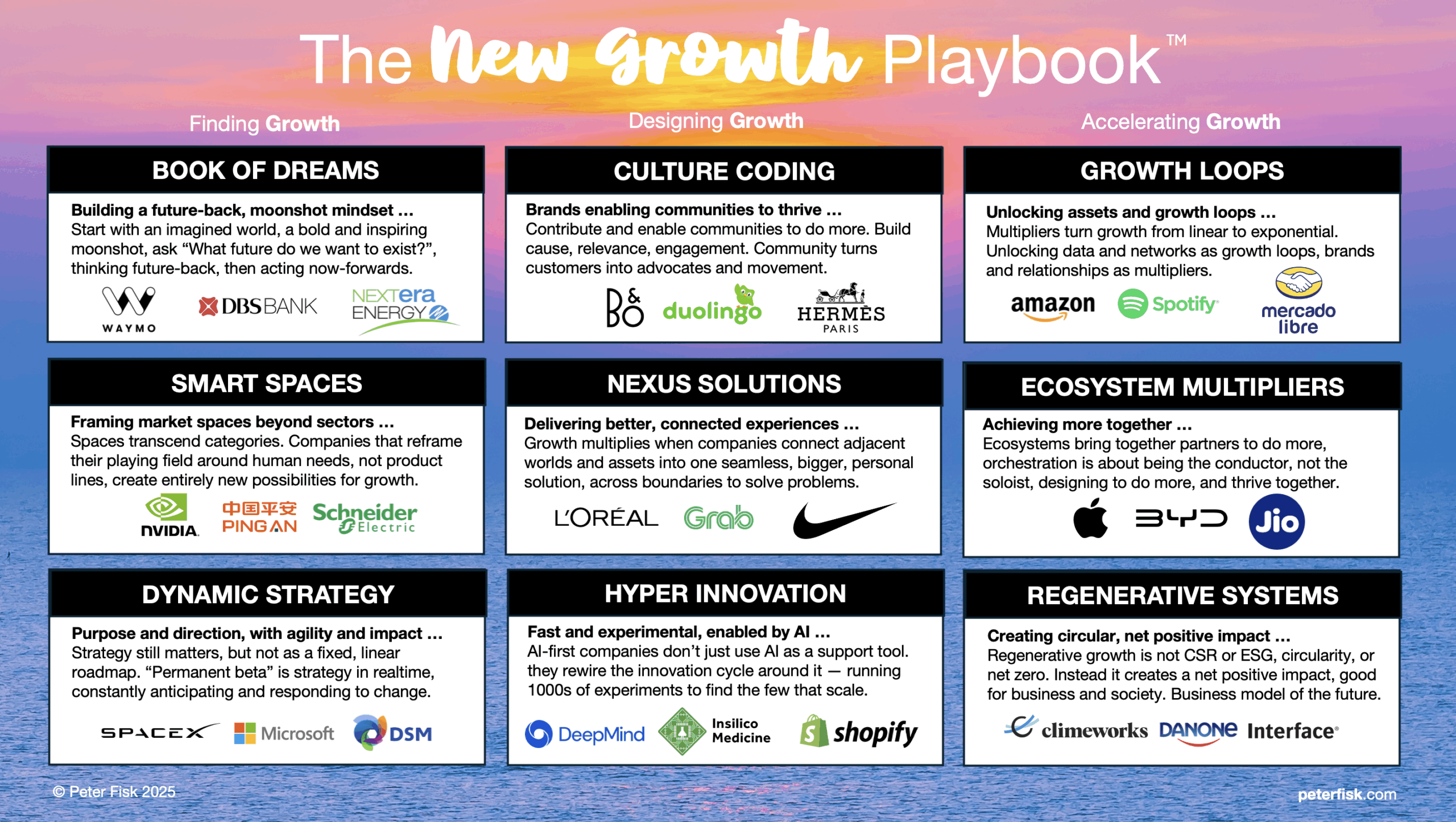
The New Growth Playbook defines 9 strategies, or growth engines, that the world’s most progressive companies are already using to accelerate growth in a world of relentless change. Each represents a powerful lever, and together they form a new framework, a toolkit, for exponential and sustainable growth.
Growth Engine 1: Book of Dreams … a moonshot mindset, from the future back
Most organizations still think now-forward, meaning they plan incrementally from what they know – annual budgets, three-year roadmaps, incremental extensions. But transformative leaders think future-back, meaning they imagine a bold possibility and then design pathways to get there. Future-back thinking reframes ambition and unleashes radical possibility. The Book of Dreams captures and structures foresight-driven imagination into evaluated opportunities for new growth.
Waymo: ask the right question
Waymo began in Google’s X “moonshot factory,” where the question wasn’t “How do we improve cars?” but “What if cars no longer needed drivers?” That framing unlocked a future-back journey toward safer, more efficient mobility. Waymo’s technology has logged more than 20 million miles on public roads and billions more in simulation. In Phoenix, it operates a driverless ride-hailing service, while in Los Angeles and San Francisco it tests urban deployment. What makes Waymo powerful isn’t just technology, but the ecosystem it catalyzes: partnerships with logistics companies, city planners, and automakers. Its moonshot vision is reshaping urban design, redefining insurance models, and forcing regulators to reimagine traffic laws. Waymo shows how thinking future-back creates industries, not just products.
DBS Bank: making banking invisible
Singapore’s DBS didn’t set out simply to digitalise banking services. Led by CEO Piyush Gupta, they asked “What would banking look like if it were invented today?” That question reframed DBS as a technology company in financial services. They went further, exploring “What if banking was invisible?” That question reframed everything. Rather than competing on branches or fees, DBS reimagined itself as a digital-first platform that integrates seamlessly into customers’ lives. Its AI-driven credit scoring, mobile-first interfaces, and partnerships with ride-hailing firms and retailers allow banking to happen effortlessly in the background. By 2020, DBS was named the “World’s Best Bank” by Euromoney, and it now earns more than half its revenue through digital channels. The invisible banking moonshot didn’t just modernize services; it reinvented DBS’s identity.
NextEra Energy: leading the renewable revolution
Florida-based NextEra Energy was once a conventional utility reliant on fossil fuels. But in the early 2000s, it asked: “What if the future grid was carbon-free?” At a time when most utilities saw renewables as risky, NextEra bet big on wind and solar. That bold future-back vision led it to become the world’s largest producer of renewable energy. Its massive investments in clean energy infrastructure paid off as costs dropped and regulation tightened. Today, NextEra not only leads in renewables but actively shapes policy, grid innovation, and storage technology. By imagining a decarbonized future decades early, NextEra positioned itself as an industry shaper rather than a follower.
Growth principle: Future-back leaders ask “What future do we want to exist?” and forces today’s decisions to align with tomorrow’s ambition. Instead of seeking to optimize the existing model, they pull their organizations into the future by starting with an imagined world, a bold and inspiring moonshot, then designing the pathway to get there.
Organisations limited growth by conventional thinking, not least by creating boundaries defined by sector and geography. Instead, think of human-centred spaces: mobility, learning, health, belonging, sustainability. These spaces might be new (like energy drinks) or convergent sectors (like wellbeing). Leaders grow faster by framing their own space, enabling them to be more relevant to customers, and more innovative themselves.
Nvidia: powering the AI space
Nvidia could have stayed in its niche making graphics chips for gamers. Instead, it redefined itself around the intelligence space — powering AI and machine learning across industries. Its GPUs became the backbone of deep learning, enabling breakthroughs in autonomous vehicles, drug discovery, financial modelling, and generative AI. Nvidia also built CUDA, a developer platform that turned its hardware into a global standard. The result: Nvidia is not just a semiconductor firm, but the infrastructure of intelligence, with a market capitalization greater than most tech giants. By framing itself in a space rather than a sector, Nvidia positioned itself at the heart of tomorrow’s economy.
Ping An: from finance to wellbeing
China’s Ping An is one of the world’s largest financial services companies. But rather than limiting itself to banking and insurance, it reframed its role in the space of wellbeing. Through Ping An Good Doctor, it launched a telemedicine platform with over 400 million users. Its AI diagnostics tools now conduct millions of medical consultations annually. Combined with financial services, Ping An helps customers manage both financial health and physical health, creating a stickier ecosystem. This shift makes Ping An more than a financial institution — it is a partner in wellbeing, crossing boundaries between finance, healthcare, and technology.
Schneider Electric: energy and sustainability as one space
Schneider Electric, once a seller of electrical equipment, reframed itself into the sustainability and energy management space. Through smart sensors, digital platforms, and IoT, it enables cities, factories, and homes to monitor and optimize energy use in real time. Its EcoStruxure platform integrates software, services, and hardware to deliver energy efficiency and carbon reduction. Schneider positions itself not as a supplier but as a sustainability partner, helping clients achieve carbon neutrality.
Growth principle: Spaces transcend categories. Companies that reframe their playing field around human needs, not product lines, create entirely new possibilities for growth.
Growth Engine 3: Dynamic Strategy … inspiring direction with real-time agility
Traditional strategies assume stability: five-year plans, predictable markets. But in a volatile world, winners adopt a more flexible strategy, a living, adaptive approach that flexes with circumstances. FLUX stands from fast, liquid, unchartered and experimental. Flux strategies combine purpose and direction, with micro-moves, antiocipating and responding to change, for more sustained value creation.
SpaceX: Occupy Mars, eventually
SpaceX thrives in flux. It has redefined aerospace by iterating rapidly on rockets and spacecraft. Instead of waiting years for perfect rockets, it launches, fails, and learns at breathtaking speed. Its agile development process allows simultaneous testing, learning, and scaling, rather than sequential engineering. Each launch generates data to improve future missions. Each explosion is treated as data, not disaster. SpaceX’s purpose, reducing space costs and enabling Mars colonization, drives long-term focus. Flux strategy allows SpaceX to take calculated risks, accelerate innovation, and build compounding advantages in space transport.
Microsoft: purpose, platforms and empowerment
Microsoft under Satya Nadella shifted from a stagnating PC software business to a cloud-first, AI-integrated ecosystem. The company emphasized cultural transformation, internal collaboration, and openness to partnerships. Its purpose — “empower every person and organisation on the planet to achieve more” — guided the reinvention. Investments in Azure, GitHub, and AI initiatives illustrate a flexible approach that balances short-term performance with long-term market relevance. Microsoft shows that dynamic strategy allows legacy organizations to reinvent themselves and capture new growth trajectories without abandoning core competencies. Within a decade, it became one of the world’s most valuable companies again, proving flux strategy works at scale.
DSM: continuous reinvention, from coal mining to life sciences
Dutch multinational DSM demonstrates flux over a century, and how purpose-driven adaptability can preserve relevance, enable innovation, and sustain growth across multiple business cycles. From coal mining to chemicals to materials to today’s focus on nutrition and life sciences, DSM has constantly reinvented itself. Its pivots weren’t random; they aligned with purpose: improving health, nutrition, and sustainability. Each reinvention turned disruption into advantage. DSM shows that long-term resilience is built not on rigidity but on continuous adaptation anchored in values.
Growth principle: Strategy still matters, but not as a fixed, linear roadmap. Instead, companies are in “permanent beta” — strategy in realtime, constantly anticipating and responding to change.
The most powerful growth doesn’t come from advertising or sales, it comes from culture and community. Growth companies code culture into their DNA, and specifically into their brand, their identity, and build tribes that customers want to belong to.
Hermès: craft as culture
Hermès is not just a fashion house; it is the epitome of cultural continuity. Founded in 1837 as a harness workshop for European nobility, Hermès has resisted the pull of mass production, digital hype, and celebrity quick wins. Its success comes from coding its culture as one of timeless artistry, scarcity, and permanence. Every Hermès product is imbued with ritual. A Birkin bag takes a master artisan 18–24 hours to produce, and no two are identical. Craftspeople spend years training, inheriting techniques like stitching, leather selection, and finishing, passed down like cultural DNA. This devotion to handcraft elevates every object into a cultural artifact.
Hermès doesn’t sell handbags — it sells membership in a cultural lineage. When a customer buys a Birkin or a silk carré, they aren’t buying leather or fabric; they are entering a world coded with Parisian refinement, discretion, and permanence. Scarcity is intentional: production volumes are tightly controlled, and waiting lists sometimes stretch years, turning the act of ownership into cultural validation. By holding culture above commerce, Hermès thrives in ways fast-fashion or hype-driven brands cannot. It proves that when culture is coded deeply enough, it becomes immune to trend cycles, commanding not just desire but reverence.
Duolingo: the learning tribe
Where Hermès builds prestige through exclusivity, Duolingo creates culture through inclusion and play. Founded in 2011 with the mission of “making education free and accessible to everyone,” it reimagined language learning as a global cultural movement — quirky, gamified, and fun. The culture of Duolingo is shaped less by grammar and vocabulary and more by rituals and shared identity. Its green owl mascot, Duo, has become an internet icon — sometimes cheeky, sometimes threatening (“You missed your lesson!”). Notifications, memes, and inside jokes form a connective tissue that binds users across geographies.
Gamification tools like streak counts, leaderboards, and XP levels transform language learning into cultural performance. Completing lessons isn’t just personal progress; it’s participation in a global game where millions share the same rituals. The real culture is not about fluency, but about belonging to a tribe of learners who value persistence, resilience, and humour. Duolingo shows that culture can scale digitally — it’s less about the content itself and more about how people feel inside the experience. What Hermès does with exclusivity, Duolingo achieves with shared inside jokes, playful accountability, and the feeling of being part of a quirky tribe.
Bang & Olufsen: designing an aesthetic life
Danish audio-visual brand Bang & Olufsen (B&O) has, since 1925, thrived not by competing on decibels or processor speed, but by cultivating a culture of aesthetic living. Its DNA is rooted in Scandinavian modernism, where beauty and function are inseparable. Every product, from its sleek BeoLab speakers to its minimalist televisions, is a statement of cultural belonging. Consumers don’t just buy speakers; they join a design-conscious community that celebrates purity of form, craftsmanship, and aesthetics. The B&O home is not filled with gadgets, but with artful companions that harmonize with architecture and lifestyle.
B&O’s strategy is to elevate technology into cultural symbols of taste. Limited editions, collaborations with architects and designers, and museum-quality design objects reinforce its role as curator of aesthetic life. While rivals compete on technical specifications, B&O competes on cultural aspiration: its products signal refinement, connoisseurship, and artistic values. Like Hermès, B&O thrives on slow culture — it doesn’t chase trends but instead cultivates a heritage of design integrity. In doing so, it has become more than a brand; it is a cultural codebook for how technology can coexist with beauty in modern life.
Growth principle: Cultures and communities already exist, the secret is to be a meaningful contributor and enabler of them. Culture coding makes a company more than a business. Community turns customers into advocates and growth into a movement.
Customers don’t live in silos. They want seamless solutions and immersive experiences that cross boundaries – that connect adjacent markets, brands and capabilities. Growth accelerates when companies connect worlds into “nexuses”.
L’Oréal: beauty as a service
L’Oréal uses technology to expand beauty into an entire personalized experience. Its AI-powered skincare diagnostics (via Modiface), AR virtual try-ons, and connected devices transform cosmetics from static products into interactive services. The company’s “Perso” device, for example, can analyze a customer’s skin, environment, and preferences to 3D-print customized skincare or makeup formulations at home. In its retail stores, digital mirrors let customers try on lipsticks or hairstyles virtually before buying. These aren’t just gadgets. They make beauty a continuous journey: L’Oréal learns from customer data, refines products, and integrates services into everyday routines. By blending science, digital interfaces, and retail experiences, L’Oréal creates a nexus of beauty-as-service, deepening engagement far beyond one-time purchases.
Grab: the everyday super-app
Grab began with ride-hailing, but quickly realized that growth came from solving multiple daily needs. Today, its app is a gateway to transport, food delivery, grocery shopping, bill payments, insurance, and even micro-investments. What sets Grab apart is how deeply it embeds into the rhythms of life in Southeast Asia. A commuter might book a Grab ride in the morning, order GrabFood for lunch, send money via GrabPay in the afternoon, and buy insurance on the same app in the evening. Grab also integrates small merchants into its ecosystem, enabling them to reach customers, access digital payments, and secure microloans. By orchestrating this nexus, Grab becomes an everyday essential, not just a utility. Its growth is not about any single service, but about being the digital hub of daily life.
Nike: from shoes to sports performance
Nike exemplifies the nexus strategy by transforming from a sportswear brand into a holistic fitness ecosystem. Beyond selling shoes, Nike connects customers through apps like Nike Run Club and Nike Training Club, which provide workouts, challenges, and social communities. Nike also links physical products with digital services. For example, its smart shoes integrate with apps to track performance, while exclusive product drops are tied to app engagement. Its retail stores host events, training sessions, and running clubs — extending the nexus from digital to physical spaces. The result: Nike doesn’t just sell products. It curates an entire lifestyle experience of sport, fitness, and motivation. Customers don’t just wear Nike; they live in Nike’s ecosystem.
Growth principle: Growth multiplies when companies stitch together adjacent worlds into one seamless, bigger solution.
Growth Engine 6: Hyper Innovation … fast and experimental, enabled by AI
Growth comes from relentless innovation — experimenting faster, learning smarter, and commercialising at scale. With AI and frontier tech, companies can now run thousands of experiments simultaneously, compressing cycles of discovery and application. Make AI your co-creation partner.
DeepMind: solving the Biggest Problems with AI
DeepMind, a subsidiary of Alphabet, is a leading AI research lab based in London. The company employs between 1,000 and 5,000 people and is renowned for breakthroughs like AlphaGo, AlphaFold, and Gemini.
DeepMind is not focused on consumer apps but on grand scientific challenges. With AlphaFold, it solved the 50-year puzzle of protein folding, enabling breakthroughs in medicine and biology. DeepMind’s hyper-innovation model combines scientific ambition with practical applications, producing both intellectual breakthroughs and commercial value. Its approach shows that AI-first innovation doesn’t just speed up business processes; it can rewrite the frontiers of science. It demonstrates the synergy between cutting-edge research and real-world impact.
Insilico Medicine: AI-Powered Drug Discovery
Drug discovery has historically taken 10–15 years and billions of dollars. Insilico Medicine uses AI to compress that timeline. Its algorithms design new molecules, predict efficacy, and test virtually before physical trials. In 2021, it brought its first AI-designed drug for fibrosis into clinical trials — in less than 18 months. This speed radically alters pharma economics and opens the door to tackling diseases once considered intractable. By compressing timelines and reducing costs, Insilico exemplifies how hyper-innovation can disrupt entrenched industries, enabling breakthroughs that were previously unimaginable.
Shopify: democratising digital retail innovation
Shopify is taking the world’s retailers online. As the world locked down amidst pandemic, stores great and small lost their entire footfall. Overnight, many turned to the Canadian tech company for the tools that allowed them to relaunch, not just with a virtual store, but with the marketing, warehousing, payment and distribution infrastructure too. A small town store could instantly transform itself into a global player. Shopify now supports more than 6.2 million live websites globally, and its merchants processed over $292 billion in gross merchandise volume in 2024. Its trailing-12-months revenue is about $10 billion, up from US $8.88 billion in 2024. Its market capitalisation has risen to around $190–200 billion as of September 2025, making it one of Canada’s most valuable companies
Shopify’s hyper-innovation lies in continuous platform expansion for global merchants. From e-commerce storefronts to payment systems, fulfilment solutions, and app ecosystems, Shopify iterates rapidly based on merchant feedback. Its model allows thousands of developers to build on its platform, creating a multiplying effect of innovation. Shopify shows how hyper-innovation can scale globally while empowering millions of entrepreneurs.
Growth principle: AI-first companies don’t just use AI as a support tool. They rewire the innovation cycle around it — running thousands of experiments to find the few that scale. Run 1,000 experiments. Scale the 10 that work.
Growth Engine 7: Growth Loops … unlocking data to create a flywheel effect
Traditional assets, like factories and stores, grow linearly. But intangible assets – like data, networks, brands, IP — grow exponentially when designed as multipliers. Create a flywheel model, where you learn and gain more from existing customers, who become your drivers of compounding growth.
Amazon: The Prime Effect
Amazon generated about $638 billion in revenue in 2024, with AWS contributing $108 billion. It serves over 310 million active users, including 200 million Prime subscribers, and paid out substantial profits of around $59 billion that year. The company combines e‑commerce, cloud computing, subscriptions, and logistics across the globe. In 2024, Amazon earned over $44 billion from Prime subscriptions and related services. Prime members spend on average 2–3 times more per year than non-members, driving higher e-commerce sales across categories.
Amazon’s flywheel connects selection, price, and customer experience. More customers attract more sellers, increasing variety and lowering costs, which further attracts customers. Prime membership and AWS services create additional loops, reinforcing growth across business units. Amazon’s growth is driven by a self-reinforcing loop: more sellers, leads to more selection, to more customers, to more sellers. Its logistics, data, and Prime ecosystem reinforce the loop, creating exponential growth. Each new investment — from Alexa to AWS — plugs into the flywheel, making it spin faster. Growth becomes exponential, not linear. Amazon exemplifies how well-designed loops compound engagement and value, turning customer interactions into systemic growth drivers.
Spotify: Personalised growth loops
Spotify has around 696 million users worldwide, including about 276 million paying subscribers. Its annual revenue in 2024 was about €15.7 billion, and it paid out more than $10 billion to artists and rights-holders that year. The platform now hosts content from more than 10 million creators, making it the world’s largest music streaming service.
Spotify uses data loops to refine content delivery and recommendations. More users provide more listening data, enhancing algorithmic personalization. It leverages every play to improve recommendations. Its playlists like “Discover Weekly” deepen engagement, which generates more data, which sharpens recommendations. This loop keeps users loyal and gives Spotify unique leverage in negotiations with artists and labels, expanding the catalogue, which in turn increases user engagement. Spotify illustrates that feedback-driven loops can maintain market dominance in fast-changing digital environments.
Mercado Libre: Latin America’s digital flywheel
Mercado Libre has become Latin America’s leading e-commerce and fintech company. In 2024 it generated about $21 billion in revenue, with sales on its marketplace reaching more than $51 billion in gross merchandise value. Over 100 million people bought through its platform, and its logistics arm, Mercado Envios, delivered nearly 1.8 billion items, many within one or two days. Its fintech arm, Mercado Pago, is also booming. It now serves more than 65 million active users each month, processed nearly $200 billion in payments in 2024, and is expanding rapidly into credit, with a loan portfolio of almost $8 billion.
Mercado Libre integrates e-commerce, payments, and logistics to create reinforcing loops. More merchants attract more buyers, more transactions enhance logistics efficiency, and improved service drives further adoption. It connects e-commerce, payments (Mercado Pago), and logistics into one reinforcing system. More sellers attract more buyers; payments feed trust; logistics improve speed. Each component strengthens the others, generating network-driven compounding growth across its diverse markets. It’s not a retailer but an exponential system, often called the digital backbone of Latin America, and now the region’s most valuable company.
Growth principle: Multipliers turn growth from linear to exponential. The art lies in designing loops where value compounds with every use.
Growth Engine 8: Ecosystems Multipliers … network effects to achieve more together
No company wins alone. The most powerful growth comes from ecosystems — orchestrating partners, developers, and collaborators into value-creating networks. Leading companies orchestrate their chosen ecosystems, but can also participate in others.
Jio: building India’s digital nation
When Reliance Industries launched Jio in 2016, it didn’t simply enter India’s telecom sector — it redefined it. By offering ultra-low-cost data and free voice calls, Jio democratized internet access almost overnight. Within a few years, it had added over 400 million subscribers, creating the largest mobile network in the world’s second most populous country. But Jio’s ambition was never just telecom. Mukesh Ambani’s vision was to build a national digital ecosystem — a foundation for India’s digital economy. Cheap data was only the first layer. On top of it, Jio began layering services in commerce, entertainment, payments, education, and health. JioMart integrates millions of kirana (mom-and-pop) stores into digital supply chains, enabling them to compete with modern retail. By digitizing inventory, logistics, and payments, Jio empowers small businesses to thrive in a digital-first economy. JioSaavn (music), JioCinema, and tie-ups with major streaming providers turned Jio into India’s entertainment hub, bundled into its network.
Jio partnered with global investors like Facebook (Meta), Google, and Silver Lake to scale its digital payments and fintech ambitions, embedding payments within WhatsApp and other consumer apps. Jio is investing in e-learning platforms, remote medical services, and AI-enabled diagnostics, targeting the underserved segments of society. What makes Jio’s ecosystem unique is its inclusivity. Unlike Silicon Valley ecosystems that often target affluent, urban users, Jio’s design is aimed at India’s next billion digital citizens — people in villages, small towns, and lower-income groups. By providing cheap access, localized content, and easy-to-use apps, Jio pulls in communities that were historically excluded from the digital economy.
BYD: mobility meets energy
BYD (Build Your Dreams), founded in China in 1995, began as a battery company. Today, it’s not just an electric vehicle leader — it’s the architect of a mobility-energy ecosystem that stretches from personal cars to citywide transit to renewable energy.
BYD controls its entire value chain — from mining lithium, to making its own batteries and chips, to producing EVs and buses. This creates a self-sufficient ecosystem that compounds resilience and scalability. Beyond vehicles, BYD produces solar panels and energy storage systems, connecting renewable energy to mobility. Homes, businesses, and even cities can plug into BYD’s grid. BYD supplies fleets of electric buses, monorails, and taxis to cities worldwide, embedding itself into public transport ecosystems from Shenzhen to Los Angeles.
What sets BYD apart is its systemic approach: it doesn’t just sell EVs, it designs a future where clean energy, batteries, and mobility form an integrated loop. In doing so, it shifts from being a car company to an infrastructure partner for sustainable cities.
Ping An: the financial-health super-ecosystem
Ping An operates one of the world’s most ambitious ecosystems. Its vision: finance + health + technology as one integrated life platform. Through Ping An Good Doctor, it connects hundreds of millions of users with doctors, hospitals, and pharmacies, while integrating insurance and payments seamlessly. Its Lufax platform provides online wealth management, while its auto ecosystem connects buyers, sellers, insurers, and lenders in one digital journey. Ping An invests heavily in AI and cloud technology, allowing these ecosystems to scale. Its model is sticky: once customers enter for health or finance, they often use multiple services. By orchestrating across life needs, Ping An becomes deeply embedded in its customers’ daily existence — far beyond what traditional banks or insurers could imagine.
Growth principle: Ecosystems expand growth horizons. Ecosystem orchestration is about being the conductor, not the soloist. Growth comes from enabling partners to thrive together.
Growth Engine 9: Regenerative Systems … creating circular, net positive impact
The old model of business growth extracted and depleted. The new one regenerates: creating value while restoring the environment and society, and scaling the business.
Climeworks: capturing CO₂ at scale
Swiss startup Climeworks builds direct air capture plants that pull CO₂ from the atmosphere and store it underground. Partnering with Microsoft, Stripe, and Shopify, it turns carbon removal into a business model. Its Orca plant in Iceland is the world’s largest carbon removal facility. Pioneering a new tech-led approach is not easy, and Climeworks has had to show resilience in a world of changing public policy, complex technology break through, and uncertain partners. However by proving viability through a series of ever-larger operations, Climeworks is pioneering an entirely new industry of climate regeneration.
Danone: food for one planet, one health
Danone reframed itself around the purpose “One Planet. One Health.” It invests in regenerative agriculture, plant-based nutrition, and stakeholder governance. By aligning growth with planetary wellbeing, Danone is building resilience while responding to consumer demand for sustainable, ethical food. It wasn’t easy, and at first the initiative championed by Emmanuel Faber lost direction, over focused on transformation, and not retaining short-term performance. That has now been corrected, and Danone exemplifies how embedding regenerative systems into core operations can deliver both societal benefit and scalable growth.
Interface: the positive carpet pioneer
Interface, once a conventional carpet maker, set a radical goal: to become carbon negative. Its “Climate Take Back” initiative uses recycled materials, biomimicry, and renewable energy to design carpets that remove carbon. Regeneration became its competitive advantage. Customers like architects and governments now choose Interface not just for quality but for sustainability leadership. Its approach illustrates that regeneration can become a growth engine, fostering loyalty, brand differentiation, and industry influence.
Growth principle: Regenerative growth is not philanthropy, CSR or even limited by ESG, not just about circularity, or getting to net zero. Instead it creates a net positive impact, good for business and society. It is the business model of the future.
How to use the playbook
The New Growth Playbook reframes growth for a new era. It is not about squeezing efficiencies or chasing fads. It is about imagining bold futures, driving purposeful ambition, finding the best market spaces, engaging customers more deeply, solving problems better, embracing the power of AI, unlocking data and networks, turning businesses into a regenerative system, that delivers more impact for society, and sustained value creation.
The power lies in combination: no single lever is enough, but together they form a growth engine. Different companies combine the accelerators in different ways:
Nvidia connects Book of Dreams and Smart Space, with Hyper Innovation and Network Multipliers. 30 years in development, its dream took off with AI, growing exponentially to $4 trillion in the last 5 years.
Ping An, the world’s biggest insurer, weaves together Space Framing, Dynamic Strategy, Nexus Solutions, and Growth Loops. It has created new businesses like Good Doctor, the worlds largest healthcare platform in 5 years.
Nubank, the Brazilian bank thrives Smart Spaces, on Culture Coding, Network Multipliers, and Hyper Innovation. It started by targeting Brazil’s unbanked, educating and supporting local people, and now thrives across Latin America.
Business leaders, executive teams and boards, must ask:
Which engines drive us today?
Which are dormant or untapped?
How can we combine them for exponential acceleration?
Growth in this century is not about squeezing efficiencies or clinging to industries. It is about reinventing the game: imagining bold futures, orchestrating ecosystems, harnessing AI, regenerating systems, and compounding long-term value.
The New Growth Playbook is a call to action for leaders obsessed with what’s next. Whether you’re Duolingo gamifying education, Hermès elevating craftsmanship, or Climeworks regenerating the planet, the engines of growth are clear.
The future belongs to the bold, the adaptive, the regenerative. The leaders who master it will not just survive — they will accelerate into the future.
More from Peter Fisk
Eyes on Tomorrow: What Leaders Must See before Everyone Else … exploring the most important megatrends that are transforming markets, and leadership mindsets, and how the best companies embrace them as opportunities … based on the new Megatrends 2035 report by Peter Fisk, and its implications for every business.
The Reinvention Playbook: Thriving in a World of Relentless Change… the best organisations seek to continually reinvent themselves in a world of constant, uncertain and dynamic change. They rethink, refocus, and reinvent everything – embracing new agendas from AI to GenZ, climate change and social inequality.
Consumer of the Future … “Aisha blinked twice, the smart lenses in her eyes had already scanned her biometric mood, cross-checked her carbon budget, and pulled up items her climate-positive friends were buying this week”
The Sustainable Consumer: Go on, do the Right Thing … how brands can accelerate the consumer shift to sustainable products and practices … from food and fashion, to energy and electric cars, making sustainability desirable and better.
Becoming a Future-Ready Business … in a world of relentless change, organisations need to anticipate change, embrace innovation, empower talent, and align deeply with the evolving needs of society and the planet
In an age of accelerating disruption, every company faces a choice: adapt, transform, or fade away.
The next decade will be defined not by incremental progress but by seismic shifts in how the world works. Megatrends aren’t background noise; they’re the blueprint for what’s next. From AI to aging populations, climate collapse to geopolitical fracture, companies that thrive will be those that reinvent themselves in response to the tectonic forces reshaping society.
In a world of relentless disruption, business leaders need more than strategy, they need a megatrend mindset.
That means looking forward, not back. It means anticipating the seismic shifts reshaping our economies, societies, and technologies, and acting before others do. Leaders must use them to galvanise their organisations, mobilise talent, and reimagine what their business is for. Reinvention can no longer be occasional or reactive, it must become a core capability, a cultural instinct, a superpower.
The future won’t wait. The companies that lead it will be those bold enough to shape it.
So, what is driving the future, and how can you be part of it?
Megatrends are long-term, transformative forces that are global in scope, cross-industry in impact, and inevitable in their trajectory. From climate change and technological convergence to demographic shifts and urbanization, megatrends are not just fleeting headlines—they are the undercurrents shaping the future of markets, societies, and business itself.
Ignoring megatrends is no longer an option. They influence how people live, what they value, how they consume, how they work, and how economies evolve. For businesses, this means rethinking what they offer, how they operate, and why they exist. Companies that spot these shifts early and act boldly are the ones that leapfrog competitors, shape new markets, and earn the right to lead.
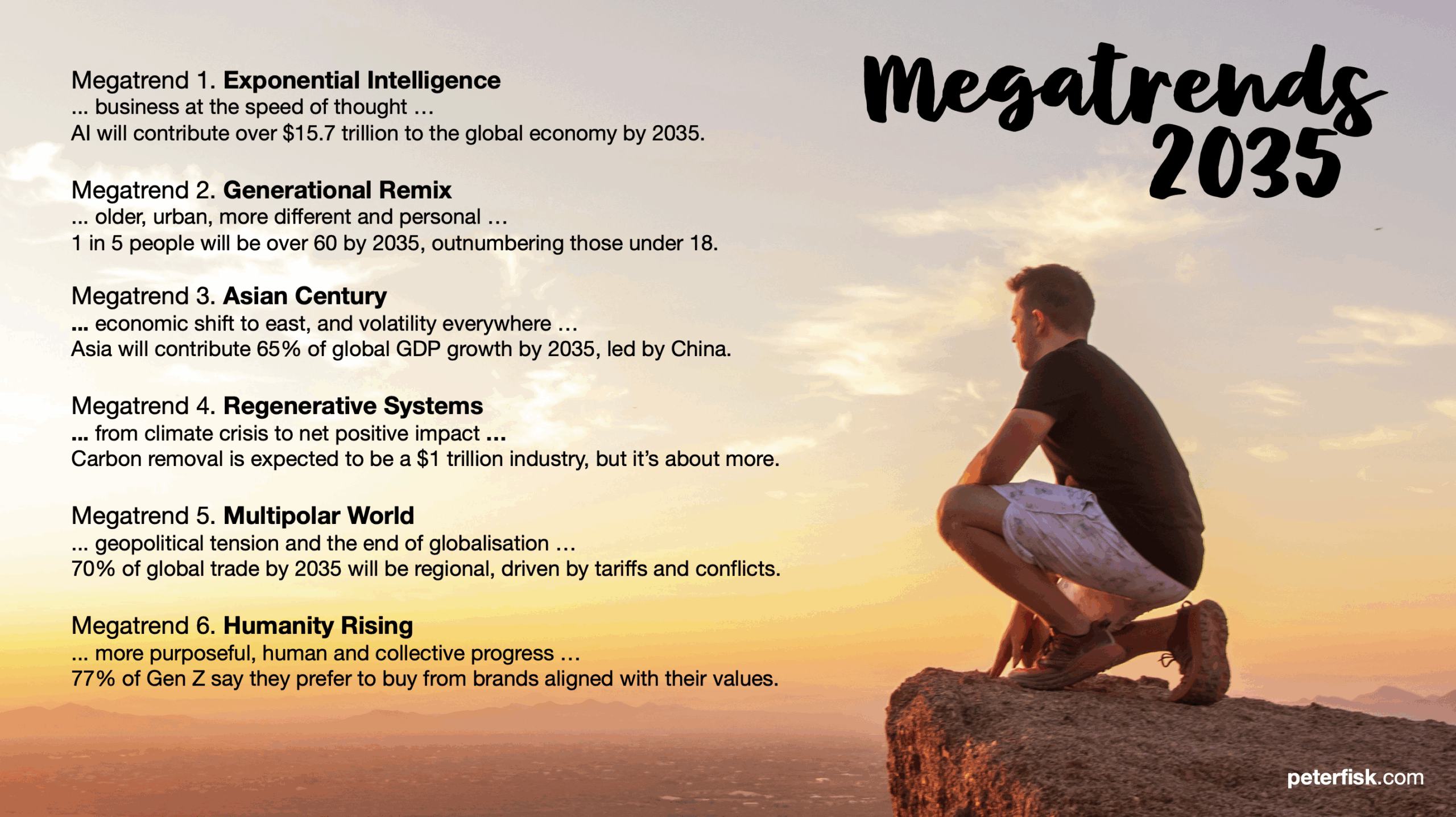
We explore six megatrends with a 10-year perspective, already shaking up every market. They are the disruptive forces that threaten your existence, but equally your biggest opportunities, superhighways to future possibilities, driving innovation and growth. And then we consider what they mean for your industry. How will they drive reinvention? What are the critical actions for business leaders, and the broader mindset to adopt? And who can we learn from?
Ultimately, the question is what will you do as a business leader – now – to create a better tomorrow, to shape the future that you want, and in which your business can thrive.
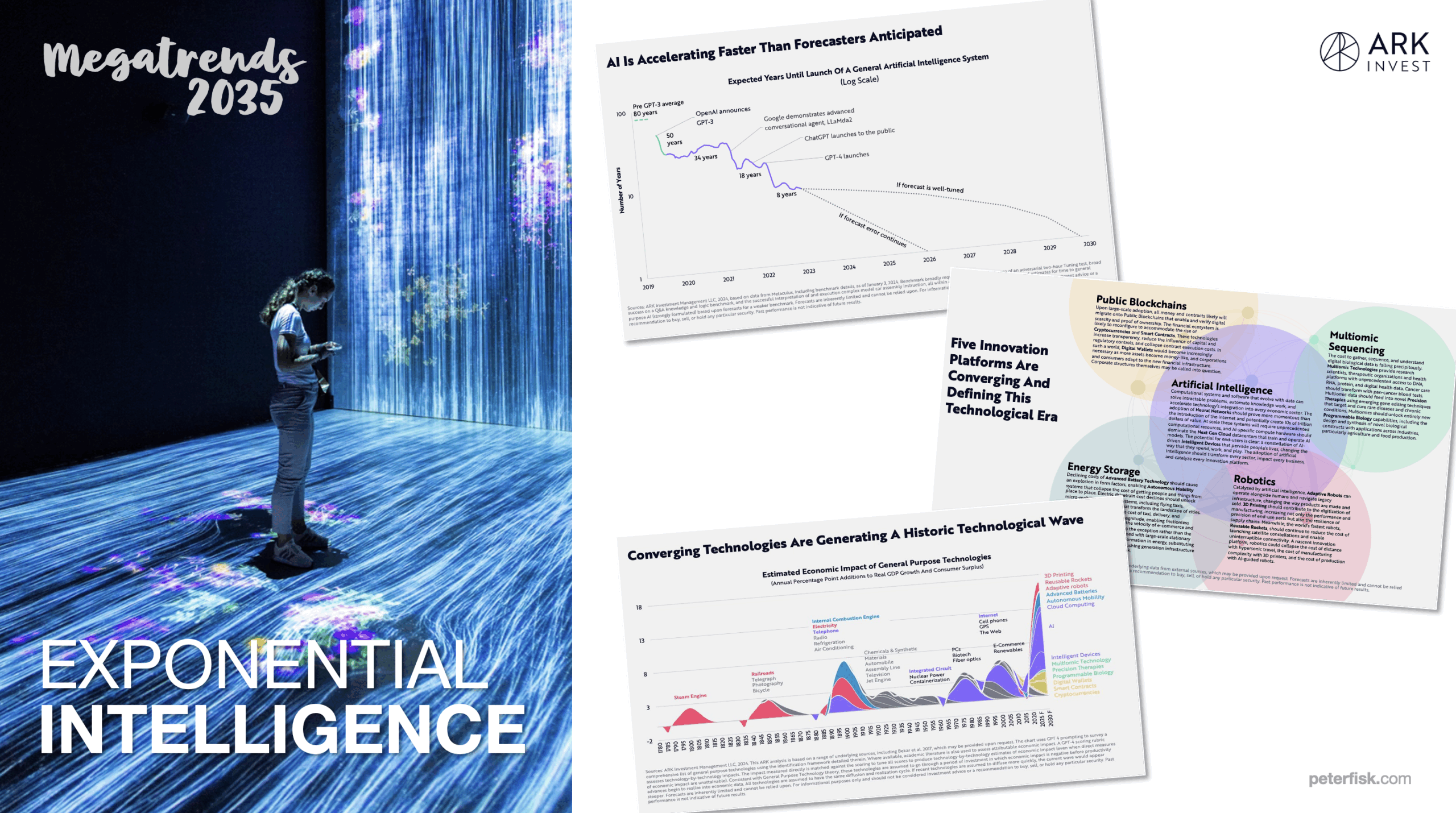
Megatrend 1. Exponential Intelligence … business at the speed of thought
By 2035, AI will be embedded in every business process. Intelligent systems will generate over 90% of digital content.
The line between human and machine thinking will blur. Exponential Intelligence represents the rapid acceleration of AI, and the convergence of technologies – in particular genomics, robotics, blockchains and energy storage – and new capabilities such as quantum computing.
AI’s application are profound, from accelerating new personalised medicines to fighting climate change, and new business models that deliver hyper personalisation.
This megatrend signifies a shift from linear progress to exponential possibility, where machines increasingly augment human decisions, also enabling people to add value in new ways. In the future AI will not just support businesses, it will co-create with them.
Companies must embed AI across every core function, from operations to marketing to finance, and develop proprietary models tailored to their domain. Leading firms are reimagining customer experiences through predictive, hyperpersonalised interfaces and training their workforces for human-machine collaboration.
Why does it matter?
AI will contribute over $15.7 trillion to the global economy by 2035 (PwC).
90% of online content is projected to be AI-generated by 2026 (IBM).
Over 40% of all jobs will be impacted by AI and automation (WEF)
What do we need to do?
Apply AI models to core business activities to radically transform speed and costs, analysis and development
Predict and personalise user interfaces to anticipate customer needs and serve them better and faster
Build ecosystem business models to unlock mutual capabilities that capture the best new opportunities for growth.
Who’s doing it?
Insilico Medicine: using AI to reinvent the process of drug discovery, development and evaluation, 10 times faster, 100 times cheaper
Siemens: co-developing self-optimising autonomous factories using digital twins and AWS infrastructure
Duolingo: Language learning reimagined with GPT-powered conversational roleplay, adapting instantly to user fluency and goals.
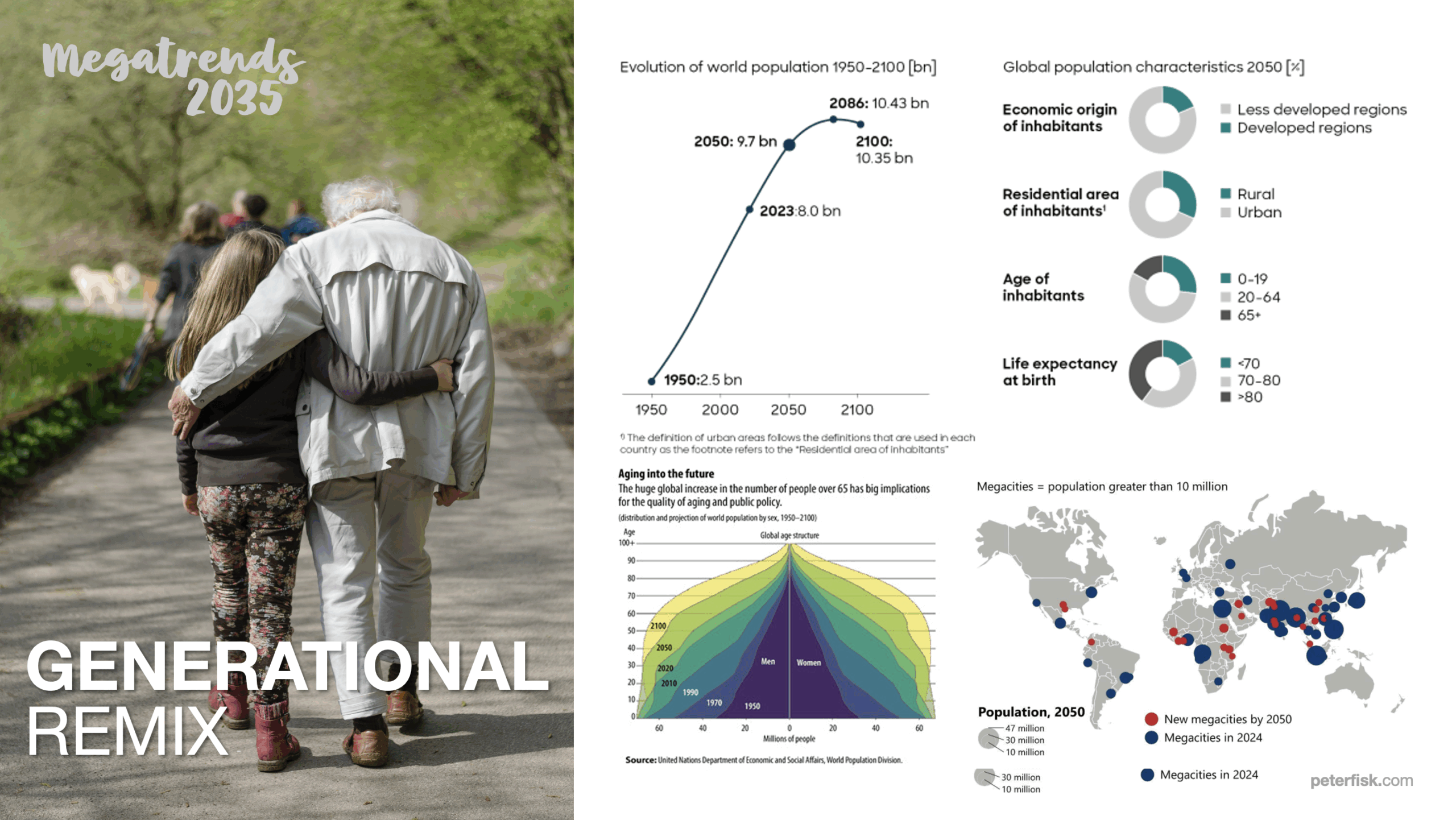
Megatrend 2. Generational Remix … older, urban, more different and personal
By 2035, society will be older, more urban, more different and personal — and yet also more connected than ever. Businesses must design for diversity, longevity, and identity.
Generational Remix captures the profound social transformation underway: populations are aging rapidly, cities are expanding, and cultural identities are becoming more diverse, fluid, and personal.
This megatrend is about designing for complexity and individuality – where different generations, values, and needs collide and co-create. It also drives fundamentally different support – older people are living longer with more affluence, for leisure and travel. Pensions will need to last longer, and healthcare costs will inevitably rise. Similarly urbanisation drives the reinvention of many services, from education and entertainment to how communities are built, and the rising power of city states.
Businesses must develop inclusive, intergenerational products and services; personalise offerings based on lifestyle rather than age; and embrace cultural plurality in design and communication. Planners must design cities, homes, and brands for 100-year lives, build inclusive, multigenerational workplaces, and address loneliness, mental health, and community. It is also about embedding cultural and demographic diversity into R&D. This is about treating every customer—and employee—not as a demographic, but as a unique human.
Why does it matter?
20% of global population will be over 60 by 2035, more than under 18
68% of the world will live in cities by 2035, and more in single homes
90% of global population growth to 2050 will be in Africa and Asia (UN)
What do we need to do?
Develop intergenerational products and services, personalise offerings based on lifestyle and diverse identities
Urban planning to design cities, homes, and brands for 100-year lives, build inclusive, multigenerational workplaces
Reinvent urban services, from education and entertainment to how communities are built, and the rising power of city states.
Who’s doing it?
Philips HealthSuite: Cloud-based health platform for remote care, chronic condition monitoring, and aging-in-place solutions.
Nestlé Health Science: Investing in personalised nutrition, gut health, and senior wellness—especially in fast-aging markets.
Toyota Woven City: A prototype smart city in Japan designed for autonomous vehicles, robotic assistance, and aging-friendly living.
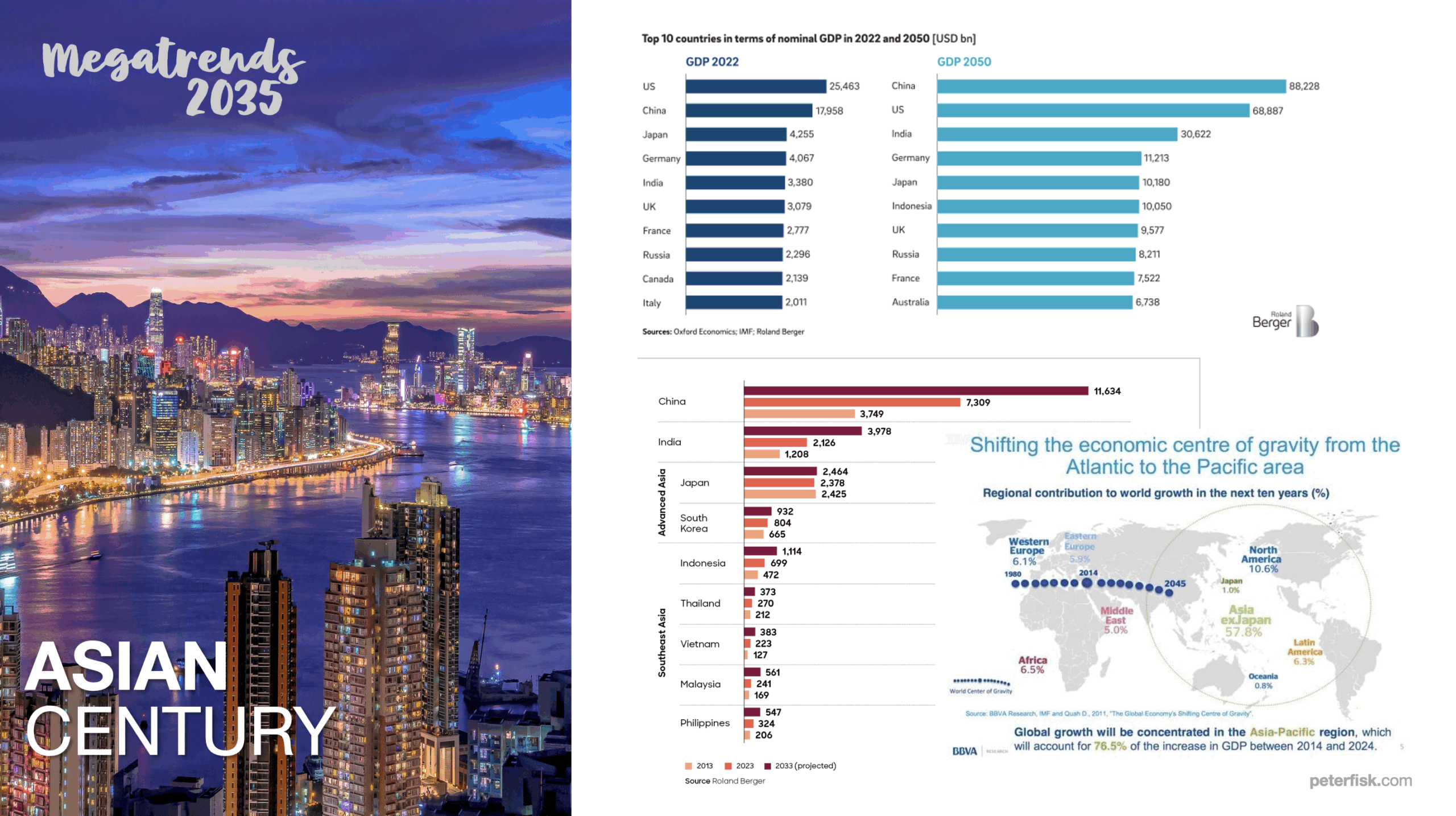
Megatrend 3. Asian Century … economic shift to the east, and volatility everywhere
Asia is the gravitational centre of global growth. By 2035, most middle-class consumers will live in Asia. The region will lead in innovation, consumption, and complexity.
The Asian Century represents the rebalancing of global economic power towards Asia and the Global South. These regions are not just growth markets—they are innovation hubs, cultural trendsetters, and geopolitical forces reshaping the future.
While Asia’s huge population with increasing disposable income will increasingly dominate the world’s consumer markets, Asia’s businesses have also dramatically shifted from cheap imitators of western goods, to leaping ahead in their application of new technologies, new business models, and innovations.
Businesses must do more than export to Asia—they must co-create in and for Asia, localising products for fast-rising middle classes in Tier 2/3 cities, collaborating with Asian startups, and embedding cultural relevance into innovation. India, Vietnam, Indonesia are popular locations for global R&D hubs. New digital trade corridors (eg RCEP, BRICS+ alliances) are reconfiguring markets. Superapps like Jio and Grab provide easy access to markets, through collaboration with their ecosystems. But with growth, prepare for volatility.
Why does it matter?
Asia will contribute 65% of global GDP growth by 2035 (IMF)
Over 50% of global consumer spending will be Asian by then.
83% of global AI-related patents are filed by Asian companies (Wired)
What do we need to do?
Seize the Asian market opportunity, finding effective ways to access and compete eg Indonesia, Vietnam, tier 2/3 cities, BRIC trade corridor
Localise and co-create with local partners, finding cultural relevance and sourcing and manufacturing locally.
Learn from the best Asian companies, who have leapfrogged the west, and are typically the most innovative, agile and efficient in the world.
Who’s doing it?
BYD: China’s batteries to EV giant has become the global leader, and in clean energy too
Xiaomi: Creating consumer electronic products equal or superior to western peers but 90% cheaper
LVMH Asia Studios: Culturally attuned luxury innovation, where Asian consumer no longer want western goods
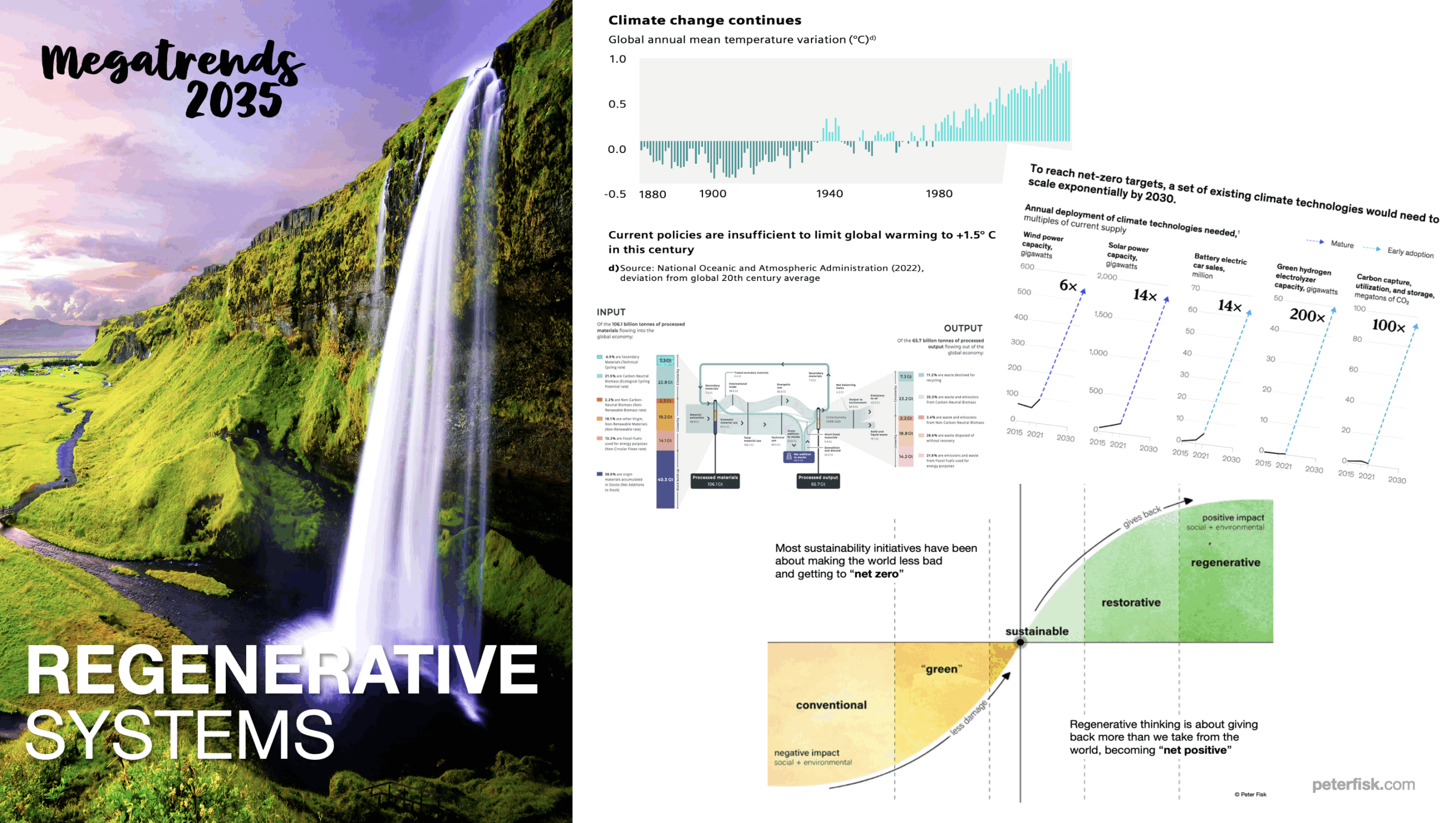
Megatrend 4. Regenerative Systems … from climate crisis to net positive impact
Climate change is the defining risk and opportunity of our time. But the frontrunners are moving beyond carbon-neutral to climate-positive and nature-regenerating models.
Regenerative Systems is about moving beyond sustainability as damage limitation toward a model that actively restores, replenishes, and reimagines the relationship between business and the planet. With the climate crisis accelerating and ecosystems under pressure, the regenerative economy is a shift from extractive to circular, from carbon-neutral to climate-positive.
The impact however can be even greater when we look beyond carbon – to other materials and resources – in particular, water and biodiversity. It can be greater still when we embrace social and environmental issues together, as they are often systemically connected.
This is when businesses really can reinvent for net positive impact.
Businesses must transition from compliance to leadership—transforming supply chains into regenerative ecosystems, adopting circular design, and tying executive incentives to sustainability performance. This includes decarbonising supply chains with digital ESG tracking, linking executive pay to sustainability goals, restoring biodiversity and natural capital, and creating planet-positive products and services.
Why does it matter?
The world’s business systems are still only 6.9% “circular” (IPCC)
Clean energy will be 60% of the global energy mix by 2035 (IEA)
Embedding the 17 SDGs is worth $12 trillion, and 380 million jobs (UN)
What do we need to do?
Develop regenerative business models, going far beyond CSR and ESG, circular and net zero, to create net positive impact
Think beyond carbon to embrace other challenges eg biodiversity, water, but also social issues eg equality, fairness, etc
Focus innovation on the big problems, AI to address climate change and disease, to create 40% more food, 50% more energy, in new ways
Who’s doing it?
Schneider Electric: Helping cities and factories go carbon-neutral through connected, AI-managed energy efficiency platforms.
Interface: creating net-positive floor tiles that absorb carbon, creating the “factory as the forest”
Nubank: world’s fastest growing bank from Brazil, targeting the unbanked, building financial literacy, reducing poverty, and building inclusion.
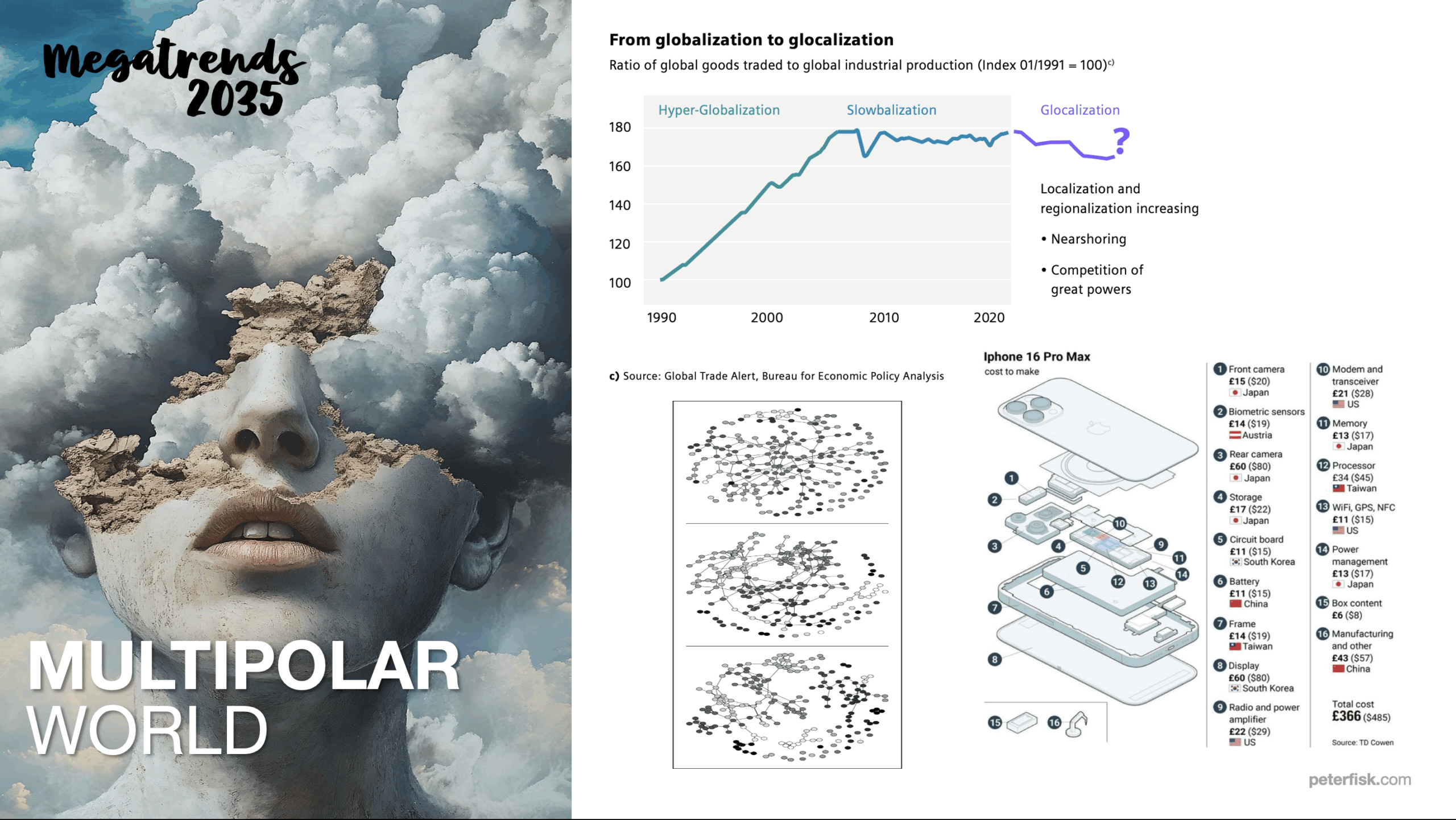
Megatrend 5. Multipolar World … geopolitical tension and the end of globalisation
The old model of seamless globalisation is fragmenting. Economic nationalism, digital sovereignty, and supply chain shocks driven by conflicts and tariffs are reshaping business strategy.
Multipolarity marks the end of the unipolar, globalised world as we knew it. With growing geopolitical tensions, trade fragmentation, and inwards facing economic policies, companies are navigating a world of shifting alliances, digital borders, and regional blocs.
By 2035, over 70% of global trade will occur within regional networks. Data sovereignty regulations will be in place in dozens of countries, and supply chains will be redesigned for resilience, not just cost.
Businesses must nearshore manufacturing, create flexible, modular operations, and navigate complex trade relationships with agility and foresight. The reinvention challenge is to build resilience without retreat—balancing localisation with global ambition.
Why does it matter?
Global trade as a % of global GDP has declined since 2008 (OECD)
By 2035, over 70% of global trade will occur within regional networks
84% of global executives now rate geopolitical as their top risk (McKinsey)
What do we need to do?
Redesign supply chains for resilience, agility not cost, nearshoring and partnering closer to customer markets,
Diversify your global spread of markets and operations, to spread risk and be more responsive to change.
Address data sovereignty, and other issues such as IP protection, regulation, cybersecurity, with foresight and influence.
Who’s doing it?
Apple: Accelerating iPhone and chip production in India to diversify away from China, including flagship stores in Mumbai and Delhi.
Inditex: Strengthening local production in Europe and the Americas to respond faster and reduce geopolitical exposure.
Flexport: Creating tech tools to reroute and de-risk global supply chains in real-time amid fragmentation and shocks.
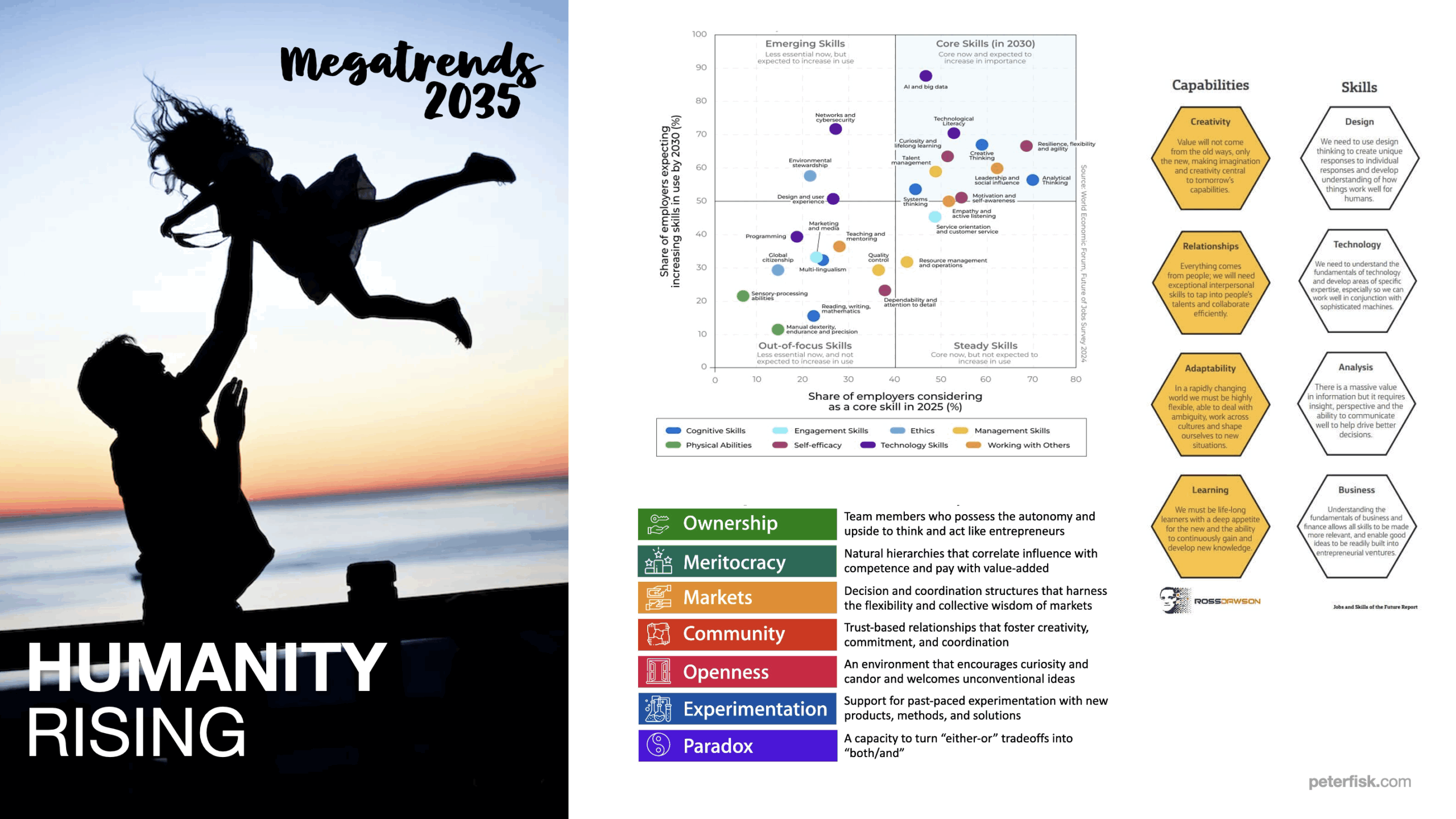
Megatrend 6. Humanity Rising … more purposeful, caring and collective progress
The most powerful force in business is the human one. Trust, wellbeing, meaning, and social contribution are now core to business strategy.
Humanity Rising is a movement toward putting people and purpose at the heart of business. It reflects a shift from transactional to meaningful work, from shareholder primacy to stakeholder ecosystems, and from short-term profit to long-term wellbeing.
As automation, and specifically AI, takes on the repetitive tasks of many workflows, business need to redesign human roles for more added value.
Companies must rewire culture around empathy, trust, and meaning; invest in human-centred leadership; and design work for life, not just productivity.
By 2035, businesses that lead on purpose and wellbeing will significantly outperform their peers. Mental health will be a core performance metric, and the human experience of work—flexibility, autonomy, growth—will shape loyalty and innovation.
Humanocracy calls for ”organisations as amazing as the people inside them”. Microsoft’s Satya Nadella recognised this calling for his organisation to be a platform to showcase each person’s unique talents, to let them achieve their ambitions, rather than just being the cog in the works of a corporate machine.
Why does it matter?
Purpose-driven brands grow 2.5x faster than average brands (WARC)
77% of GenZ seek meaningful work, and buy meaningful brands (McKinsey)
AI augmentation is likely to improve human productivity by 40% by 2035
What do we need to do?
Create purposeful business strategies, that turn purpose into real action and delivers better progress – profitable growth and positive impact.
Redesign for human added value so that technology automates processes, releasing people to achieve more
Build organisations as amazing as the people inside them: empowering, democratic, enabling, caring, dynamic, resilient and daring.
Who’s doing it?
Danone: Legally binding mission-driven governance (B Corp), in its shift from food to becoming a health business
Salesforce: Flexibility, purpose, ethics as a platform, mental health through “Success from Anywhere” strategy
Mindera: Portuguese software “made by humans” … people-first culture fostering innovation through community, autonomy, and trust.
How megatrends drive business reinvention
Every industry is being reinvented.
These 6 megatrends create a perfect storm of technological breakthroughs, shifting consumer expectations, environmental imperatives, and economic uncertainty that are driving radical transformation across every sector. The boundaries between industries are blurring, value is migrating to new models and ecosystems, and the winners of tomorrow are being shaped today.
From automotive to insurance, banking to retail, energy to healthcare, established players face existential pressure to change. Legacy systems, slow-moving cultures, and risk-averse mindsets are being outpaced by fast, bold innovators—companies that use data, AI, and platform thinking to deliver better, smarter, more sustainable solutions. Tesla isn’t just a car company. Amazon isn’t just a retailer. They’re both operating systems for the future.
Disruptors are emerging from every corner of the globe—scaling faster, experimenting more aggressively, and harnessing the power of technology to solve meaningful problems.
These next generation leaders are obsessed with what’s next. They blend purpose and profit, long-term impact and short-term agility. But incumbents aren’t out of the race. The most forward-looking are reinventing themselves, acquiring new capabilities, and unlocking value from their intangible assets—brand, trust, ecosystems, and intelligence.
The next five years will be decisive. Growth will come not from doing more of the same, but from reimagining what’s possible—through smart automation, regenerative design, AI-powered personalization, and bold new business models. The winners will be those who stretch their vision, embrace uncertainty, and build for the future—not the past.
Reinventing Automotive
When Lei Jun unveiled the SU7 electric supercar from his smartphone maker Xiaomi, with comparable features but over 90% cheaper than a Porsche Taycan, we knew the industry was not just being disrupted, but fundamentally reinvented. No longer just about horsepower and design, the future of cars became about software, autonomy, and energy ecosystems. Disruptors like Tesla, BYD, and Rivian are redefining mobility, while incumbents like GM and VW scramble to catch up. The future belongs to firms that can merge electric drivetrains with data-driven intelligence, build direct customer relationships, and plug into renewable grids.
Key Drivers: EV revolution, autonomy, mobility-as-a-service
Incumbents: VW and Hyundai invest heavily in EVs and batteries; GM pivots toward all-electric by 2035
Future Winners: Tesla remains dominant due to its integrated energy + mobility model; Chinese EV players like BYD are poised to lead on affordability and scale; Apple and Sony may emerge through software-first approaches
Outlook: $5T transformation underway; platforms and ecosystems will define winners
Reinventing Banking
In Brazil, David Vélez launched Nubank to free people from bureaucratic, fee-heavy traditional banks. With nothing more than a smartphone and a smile, customers signed up for accounts in minutes. Nubank now serves over 90 million users. Fintechs are rewriting the rules with embedded finance, AI risk models, and crypto rails. Traditional banks must become platforms, not fortresses. Future leaders will be those who turn trust, data, and user experience into intelligent financial ecosystems.
Outlook: Banking becomes invisible, embedded in lifestyle
Reinventing Construction
Using 3D printing, Icon built a house in 24 hours using a giant robotic arm and a special concrete blend—radically reducing time, cost, and environmental impact. This illustrates the kind of breakthrough needed in a notoriously slow-moving industry. Innovation now means modular, smart, and zero-carbon construction. Giants like Skanska are investing in digital twins and low-carbon cement. Winners will combine automation, green design, and tech-savvy talent to transform how we build the future.
Key Drivers: Green buildings, modular methods, robotics
Incumbents: Skanska, Bouygues, Holcim, and Turner adopting digital twins and zero-carbon materials
Future Winners: Tech-integrated construction firms that deliver faster, cleaner, cheaper buildings; smart infrastructure providers
Growth Areas: Smart cities, digital twins, sustainable housing
Outlook: $1T green retrofit and smart build opportunity
Reinventing Energy
Octopus Energy is disrupting utilities by putting customers at the heart of a clean energy revolution—offering dynamic pricing, transparency, and rapid green energy switching. In an industry long dominated by giant incumbents, it proved agility can win. The transition to net zero, powered by solar, wind, hydrogen, and AI-managed grids, is accelerating. Winners will not just produce energy, but orchestrate energy flows, storage, and demand across intelligent, decentralised networks.
Disruptors: Tesla Energy, Octopus Energy, Vestas, Climeworks
Incumbents: Shell, TotalEnergies, and BP redefining themselves as energy transition companies
Future Winners: Companies that integrate solar, wind, storage, and smart grids into unified platforms
Growth Areas: Renewables, green hydrogen, carbon capture, virtual power plants
Outlook: Clean energy to dominate mix by 2030; trillion-dollar opportunity
Reinventing Entertainment
When Roblox went public, it revealed that kids were spending more time building and playing in virtual worlds than watching TV. Entertainment is no longer passive—it’s immersive, participatory, and social. New models powered by creators, fans, and algorithms are dominating, as traditional studios play catch-up. Netflix disrupted distribution; now AI and generative content are the new frontiers. Winners will build platforms that blend content, community, and co-creation.
Key Drivers: Streaming, gaming, AI content, creator economy
Disruptors: Netflix, Epic Games, Roblox, TikTok
Incumbents: Disney+ reinvention; Warner Bros. bets on streaming + IP
Future Winners: Firms that merge entertainment, social engagement, and immersive tech; those who own IP and fan relationships
Outlook: Creator platforms to become dominant media forces
Reinventing Fashion
Pangaia isn’t just a fashion brand—it’s a material science company using seaweed fibers and bacteria-based dyes to reinvent sustainable clothing. Fashion is being reshaped by digital identities, circular design, and transparent supply chains. Fast fashion disruptors like Shein use real-time data and micro-inventory, while luxury players are experimenting with resale and digital fashion. Future winners will merge purpose with personalization, creating garments that are smart, sustainable, and story-driven.
Key Drivers: Sustainability, digital fashion, circularity
Disruptors: Shein, ThredUp, Pangaia, DressX
Incumbents: LVMH and Zara building closed-loop supply chains and digital experiences
Future Winners: Brands that mix identity, impact, and innovation; digital-native and circular-first businesses
Growth Areas: Resale, AI design, bio-materials, virtual clothing
Outlook: Fashion shifts from volume to value, driven by tech + conscience
Reinventing Food and Drink
At NotCo, AI named Giuseppe creates plant-based versions of animal products by analyzing molecular similarities. It made mayo, milk, and meat that taste like the real thing—but aren’t. This signals a shift toward food as software: designed, personalized, and planetary. The food revolution is being driven by sustainability, health, and technology. Giants like Nestlé are investing in alt-proteins. Winners will feed the future with science, values, and delicious innovation.
Incumbents: Nestlé and Unilever invest in plant-based and direct-to-consumer (DTC) platforms
Future Winners: Brands that align with planetary and personal health; those who digitize the food chain
Growth Areas: Alt protein, fermentation tech, personalized nutrition
Outlook: $300B alt-protein industry by 2030; data becomes the key ingredient
Reinventing Healthcare
During the COVID-19 pandemic, BioNTech—once a little-known biotech firm—partnered with Pfizer to deliver a vaccine in record time using mRNA technology. It was a moonshot moment. Healthcare is being reinvented through genomics, AI, and patient-centric platforms. Startups like Tempus and Babylon offer predictive care and digital diagnoses, while incumbents digitize clinical pathways. Future leaders will move from treating illness to preventing it—personalized, predictive, and precision-driven.
Key Drivers: AI, genomics, personalized medicine
Disruptors: Tempus, BioNTech, 23andMe, Babylon Health
Incumbents: Pfizer, Novartis and Roche embed AI across drug discovery and diagnostics
Future Winners: Companies delivering preventive, digital, and personalized care at scale
Growth Areas: AI drug discovery, wearable diagnostics, gene therapies
Outlook: From reactive to proactive care; multi-trillion-dollar ecosystem
Reinventing Insurance
Lemonade turned heads by settling some claims in under 3 seconds, using AI and behavioral economics. It proved insurance doesn’t have to be slow, opaque, or distrusted. Climate volatility and shifting lifestyles demand real-time, proactive coverage. Incumbents like Munich Re are adapting with prevention-as-a-service. The winners will anticipate, not just insure—embedding risk reduction, AI insights, and customer trust into everything.
Key Drivers: Risk prevention, personalization, AI pricing
Disruptors: Lemonade, Zego, FloodFlash, Trōv
Incumbents: AXA and Munich Re building smart risk platforms and climate resilience tools
Future Winners: Insurers who evolve into risk-reduction partners powered by real-time data
Outlook: Reinvention from safety net to proactive value provider
Reinventing Manufacturing
Relativity Space is using 3D printing to make rockets—95% fewer parts, far faster iterations. It’s a symbol of manufacturing’s new age: flexible, intelligent, and software-defined. Automation, IoT, and AI are transforming everything from design to delivery. Legacy players like Siemens and GE are embracing digital twins. The factories of the future will be smart, sustainable, and continuously learning.
Key Drivers: Industry 4.0, robotics, sustainability
Disruptors: Relativity Space, Xometry, Vention
Incumbents: Siemens, GE, and Bosch digitizing supply chains and factory floors
Future Winners: Agile, hyper-automated, sustainable manufacturers with digital cores
Outlook: $1T+ productivity gains from intelligent manufacturing
Reinventing Retail
Shopify gave small businesses global reach with a few clicks—and now powers millions of storefronts. Retail is shifting from stores to ecosystems, driven by social commerce, AI curation, and instant fulfillment. Amazon, Temu, and ThredUp are reshaping expectations. Incumbents must combine digital agility with deep human insight. The next winners will create seamless, personalized, and values-based retail experiences.
Key Drivers: Omnichannel, AI personalization, circularity
Disruptors: Amazon, Shopify, Temu, ThredUp
Incumbents: Walmart and Target investing in AI, last-mile, experiential retail
Future Winners: Ecosystem retailers blending physical, digital, and sustainable offerings
Growth Areas: Social commerce, live shopping, AI recommendation engines
When OpenAI released ChatGPT, it stunned the world—and ignited an AI arms race. Technology is the force multiplier of every transformation. AI, quantum, chips, and decentralised platforms are reshaping what’s possible. Disruptors like DeepMind and Anthropic push the frontiers, while incumbents like Microsoft integrate AI into everything. The winners will be ecosystem architects, building the foundations of a superintelligent, secure, and inclusive digital world.
Key Drivers: AI, cloud, quantum, cybersecurity
Disruptors: OpenAI, DeepMind, Anthropic, Nvidia
Incumbents: Microsoft and Google integrating GenAI across platforms
Future Winners: Platform-native firms owning data, chips, and AI layers
Growth Areas: GenAI, autonomous agents, AI operating systems
Outlook: Tech drives all other industries; $10T+ value shift imminent
Reinventing Telecoms
Starlink launched satellites fast enough to beam high-speed internet to war zones and remote villages alike. It showed how agile, hardware-software integrated telecom can leapfrog legacy infrastructure. With 5G, edge computing, and AI, telecom is evolving into a platform for everything—especially B2B. The leaders will connect not just people, but machines, data, and intelligence.
Outlook: Telcos reinvent as enablers of digital society
Reinventing Travel
Airbnb changed not just where we stay—but how we experience the world. It made travel more local, personal, and flexible. Now, the rise of conscious travelers, nomadic workers, and immersive tech is redefining journeys. EcoHotels and digital nomad platforms are growing fast. Future winners will offer sustainable, seamless, and soul-nourishing travel—with data-driven personalisation and low-impact design.
Growth Areas: Bleisure (business + leisure), digital nomad services, green destinations
Outlook: Travel reimagined around purpose, data, and experience.
Building a megatrend mindset
What the 6 megatrends share is a combination of inevitability and complexity.
They unfold over years, even decades, but their effects are accelerating. They create new winners and losers, and they require a mindset that is radically different from the one that dominated business in the past.
Traditional business thinking is rooted in linear assumptions, efficiency optimization, and incremental growth. But megatrends don’t follow linear rules. They interact with one another in unpredictable ways. They often create inflection points—sudden, nonlinear changes—that disrupt even the most well-defended industries.
Just consider how the fusion of mobile technology, social platforms, and AI enabled the rise of entirely new business models like Uber, and then TikTok which is as much about entertainment and shopping as networking. And over the last 18 months, AI platforms like ChatGPT have accelerated rapidly to challenge the very existence of the likes of Google.
In this environment, the most dangerous mindset is one of stability and control. The world no longer rewards those who cling to certainty or simply extrapolate the past forward. Instead, it favours those who embrace perpetual reinvention—those who can sense, adapt, and act at the speed of change.
To do that, leaders need to cultivate what we might call a “megatrend mindset”—a deep awareness of the forces reshaping the world, combined with the humility to question assumptions, the curiosity to explore what’s emerging, and the courage to make bold moves before the path is clear.
What Is a Megatrend Mindset?
A megatrend mindset is not just a set of insights or predictions—it’s a new operating philosophy for how leaders think, decide, and lead in uncertainty. It is defined by several key shifts:
From short-term to long-view thinking: Leaders must look beyond quarterly targets and focus on building future-fit businesses. This means identifying long-term opportunities and investing in capabilities that align with where the world is going—not just where it is now.
From control to navigating complexity: Instead of trying to manage complexity away, leaders must learn to navigate it. This includes using systems thinking, scenario planning. Strategies become more directional and agile, as embiguity and uncertainty are part of normality.
From optimisation to reinventing everything: Efficiency alone won’t drive tomorrow’s growth. Reinvention does. Leaders must be willing to rethink their business model, reshape their value proposition, and reimagine their entire organisations and ecosystems for how they deliver impact—over and over again.
From fixed expertise to dynamic learning: Expertise is becoming perishable. What matters more is learning agility—the ability to learn, unlearn, and relearn faster than the pace of change. A megatrend mindset fosters a culture of exploration, experimentation, and continuous growth.
From reactive to proactive transformation: Waiting for change to hit before acting is a losing strategy. The megatrend mindset pushes organizations to lead change—to shape emerging markets, experiment with new models, and continually challenge their own relevance.
Why This Mindset Matters Now
The world is entering a new era where change is not just fast—it’s relentless.
As technologies compound, environmental pressures intensify, and social expectations shift, the gap between what businesses are and what they need to become is growing wider. Those that fail to evolve will fall behind. Those that embrace change will define the next generation of value creation.
Companies like DSM have learnt to continually reinvent themselves – from Dutch coal mining to chemicals to lifesciences – or Fujifilm – from camera film to medical imaging to cosmetics and personalised medicines.
India’s Jio superapp was born out Reliance, a petrochemical giant seeking to diversify, beyond industrial markets. It built a lifestyle brand, built an ecosystem of connected services, and then a payments platform, to capture the wallets of a billion consumers.
Even legacy giants like Microsoft and Schneider Electric have transformed themselves by aligning deeply with sustainability, cloud, and AI megatrends.
The lesson is clear: Reinvention is not a one-off event. It is a mindset, a discipline, and a continuous act of strategic courage.
A Megatrend Mindset applied to business is in reality a Reinvention Mindset.
How to Lead with a Megatrend Mindset
For leaders looking to build this mindset into their organisation, here are some actions to consider:
Scan broadly, think deeply: Build a habit of horizon scanning—actively tracking megatrends across sectors, geographies, and disciplines. Then connect the dots to your business.
Reimagine your core assumptions: Regularly challenge the core beliefs that underpin your strategy. Ask: What if they’re no longer true?
Build strategic foresight capacity: Equip teams with tools like scenarios, futures thinking, and trend mapping to make uncertainty a source of advantage.
Invest in transformative innovation: Go beyond incremental improvement. Explore bold ideas, fund experiments, and build partnerships at the edges of your ecosystem.
Develop future-fit talent: Prioritize skills like creativity, critical thinking, and digital fluency—traits essential for navigating complexity.
Lead with purpose and resilience: Anchor your organization in a clear purpose that aligns with societal needs, while building the agility to adapt as the context changes.
How will you lead your future?
In a world where megatrends are reshaping everything, the biggest risk is not disruption—it’s irrelevance. The future will not be inherited by the largest or the strongest, but by those who are the most adaptable, visionary, and bold. Developing a megatrend mindset isn’t optional—it’s essential.
For business leaders, this is a moment of truth. Will you merely react to change—or lead it? Will you wait for the future to arrive—or help shape it?
The answer will define not just your next quarter, but your next decade.
Welcome to the age of reinvention.
More from Peter Fisk
Eyes on Tomorrow: What Leaders Must See before Everyone Else … exploring the most important megatrends that are transforming markets, and leadership mindsets, and how the best companies embrace them as opportunities … based on the new Megatrends 2035 report by Peter Fisk, and its implications for every business.
The Reinvention Playbook: Thriving in a World of Relentless Change… the best organisations seek to continually reinvent themselves in a world of constant, uncertain and dynamic change. They rethink, refocus, and reinvent everything – embracing new agendas from AI to GenZ, climate change and social inequality.
Consumer of the Future … “Aisha blinked twice, the smart lenses in her eyes had already scanned her biometric mood, cross-checked her carbon budget, and pulled up items her climate-positive friends were buying this week”
The Sustainable Consumer: Go on, do the Right Thing … how brands can accelerate the consumer shift to sustainable products and practices … from food and fashion, to energy and electric cars, making sustainability desirable and better.
Becoming a Future-Ready Business … in a world of relentless change, organisations need to anticipate change, embrace innovation, empower talent, and align deeply with the evolving needs of society and the planet
“I’ve no time to think” says the frantically busy CEO, trying to keep pace with customers and innovation, economic shifts and investor expectations, let alone stay on top of his (or her) inbox.
In an age of relentless speed and constant noise, the ability to think strategically has never been more valuable, or more misunderstood.
Too many people mistake strategy for planning, or for the art of producing a glossy presentation once a year. But true strategic thinking isn’t about prediction or paperwork. It’s about perception, the ability to see what others miss, to simplify complexity, and to act with intention in a world that rarely sits still.
The best strategists — in business, sport, politics, or life — share a certain calmness amid chaos.
They notice patterns that others overlook. They connect dots between emerging trends and human behaviour. They know that being strategic isn’t a single skill, but a mindset — a disciplined way of observing, questioning, and choosing. It’s the difference between reacting to events and shaping them.
This is the essence of Be More Strategic, Charlie Curson’s new guide to thinking and acting with greater clarity and purpose.
I first worked with Charlie 20 years ago, and he always struck me as a calm, curious and thoughtful guy.
Rather than presenting strategy as an intellectual exercise, Curson reframes it as a series of human practices — behaviours anyone can learn, refine, and embody. His framework of twelve essential practices moves from personal awareness to organisational impact, showing that strategy begins not in the boardroom, but in the mind.
Strategy as a Living Practice
Curson begins with a simple but provocative premise: strategy is a behaviour, not a document. It lives in conversations, choices, and everyday decisions — often made under pressure and with limited information. To “be more strategic” is to bring foresight, perspective, and discipline to those moments, ensuring that action aligns with intention.
He divides his twelve practices into four developmental levels:
Self-Awareness
Open-Mindedness
Capabilities
Impact
Each builds on the last, transforming the way people think, decide, and influence.
1. Building Strategic Self-Awareness
Strategic thinking starts with the self. Before you can understand systems or shape futures, you must understand your own biases, habits, and triggers.
Curson calls this the foundation of strategy — knowing what drives you, what derails you, and how you think under pressure. The best strategists are those who can manage their emotions when others are swept away by urgency or fear. Emotional discipline creates the space for clear thought.
Think of Satya Nadella’s transformation of Microsoft. When he became CEO, he focused first on shifting mindset, not market share. He moved the company away from a culture of know-it-alls to one of learn-it-alls. That began with self-awareness — acknowledging where the company’s thinking had become rigid and defensive. The result was not just new strategy, but renewed curiosity and purpose.
Strategic self-awareness also requires practice — time to think, reflect, and observe. In Curson’s view, leaders should deliberately create “white space” in their calendars: time to step back from the whirlwind of activity and consider the bigger picture. Some of the most strategic organisations — from Amazon to Unilever — institutionalise this by running reflection days, post-mortems, or “stop-doing” reviews, recognising that what you don’t do is as important as what you do.
2. Cultivating Open-Mindedness
Once grounded in self-awareness, Curson turns outward. To think strategically, you must learn to listen deeply, question assumptions, and explore perspectives that challenge your own.
Curiosity, he argues, is the lifeblood of strategy. The leaders who thrive in fast-changing industries are those who remain endlessly curious — about technology, culture, and the future. It’s why companies like Patagonia or Netflix continually evolve; they don’t defend the past, they interrogate it.
Listening, too, is an underrated strategic act. The best strategists don’t dominate conversations — they notice what isn’t being said. A CEO who walks the shop floor or listens to customer service calls often discovers insights more valuable than any management report. True listening reveals the weak signals — small patterns that hint at major shifts ahead.
Finally, critical thinking — the ability to separate fact from assumption, and opinion from evidence — is central to strategic reasoning. In an era of data overload, being rational isn’t about cold detachment; it’s about disciplined curiosity. What is true? What else could be true? What if our basic premise is wrong?
3. Developing Strategic Capabilities
With awareness and openness established, Curson moves into the active skills of strategy — imagination, comfort with uncertainty, and future orientation.
Strategic imagination means seeing possibilities beyond the obvious. It’s the mindset that led Elon Musk to see rockets as reusable, or IKEA to imagine furniture as flat-packed. Creativity, Curson insists, isn’t an optional extra; it’s a core competence of strategic thinkers. They constantly reframe problems, look across industries for inspiration, and ask: “What if we started again today?”
Equally vital is comfort with uncertainty. The strategic thinker doesn’t fear the unknown; they learn from it. In fast-moving environments — like fintech or AI — waiting for complete certainty is paralysis. The art is to make provisional choices, test assumptions, and adapt quickly. This experimental approach defines the best modern strategists, from venture capitalists to climate innovators.
And then comes future focus — the ability to look beyond the immediate. Great strategy blends future-back thinking (starting from a vision of what could be) with now-forward execution. Leaders like Jensen Huang at NVIDIA or Mary Barra at General Motors illustrate this duality: they build today’s business while imagining tomorrow’s industry.
4. Scaling Strategic Impact
The final level is about execution and influence. Strategy only matters if it changes behaviour, mobilises people, and creates results.
First, the strategist must be decisive. Action delayed is opportunity lost. Curson encourages making decisions with “enough” information — not perfect knowledge. It’s about balancing boldness with reflection. Jeff Bezos famously used the 70% rule: make most decisions when you have about 70% of the information you wish you had. Too little, and you’re reckless; too much, and you’re late.
Next comes inclusivity. Strategy isn’t a solo sport; it’s collective sense-making. The most effective leaders draw diverse voices into the process, creating psychological safety so people can challenge ideas and contribute insights. When Schneider Electric or DBS Bank reinvented their strategies, they involved employees at every level — turning vision into shared ownership.
Finally, persuasion. Strategy fails without belief. The ability to communicate a vision, tell a compelling story, and connect strategy to purpose is what turns ideas into movements. Leaders who inspire — from Steve Jobs to Jacinda Ardern — understand that strategy lives in narrative. It’s not just about what you say, but how you make people feel about the future.
Be More Strategic
What makes Be More Strategic distinctive is its humanity. It doesn’t glorify genius or power. It shows that strategy is a practice — a set of repeatable behaviours that can be cultivated by anyone willing to think a little longer and see a little further.
To think strategically is to pause when others rush, to question when others assume, and to focus when others flail. It’s the art of connecting small daily decisions to a larger sense of direction. Whether you’re leading a global company, managing a team, or planning your career, strategic thinking is the difference between drifting and designing your future.
Curson’s message is ultimately optimistic. Strategy is not reserved for the few; it’s a discipline for the many — a way to navigate complexity with clarity and confidence. In a world that celebrates speed, he reminds us that the greatest competitive advantage is still thoughtfulness.
Thinking bigger, smarter, better
Now that we’re thinking, here are five more of my favourite books on thinking.
Genuine thinking has become a rare and radical act. We are drowning in information yet starved of insight. Our minds are busy but not necessarily bright. To think clearly now is to resist the pressure to react, to slow down when everything screams speed.
A new wave of writers — from Daniel Kahneman to Michael Watkins, Megan Reitz, Chirag Gander and Sahil Vaidya — explore how we might reclaim the art of thinking in a noisy, distracted age. And when viewed alongside the provocations of Nassim Nicholas Taleb — the philosopher of uncertainty — their ideas form a striking map of modern intelligence: a guide not only to how we think, but how we might survive our own overconfidence.
Kahneman, the behavioural economist, opened the door. Thinking, Fast and Slow revealed how much of human judgment is governed by two mental systems: the rapid, intuitive “System 1” and the deliberate, analytical “System 2.” His warning was elegant and unsettling — that what we call rationality is often an illusion, that our quick-thinking brains are riddled with cognitive biases and blind spots. We trust patterns that aren’t there; we mistake luck for skill; we prefer the comfort of stories to the chaos of reality.
Taleb, in The Black Swan and Antifragile, takes this further. Where Kahneman studies bias, Taleb exposes hubris. He argues that the world is governed by randomness, that humans are chronically blind to rare, high-impact events, and that our obsession with prediction is our undoing. His answer is not to think faster or plan harder, but to build robustness against uncertainty — to design systems that grow stronger under stress, to think in probabilities not certainties.
If Kahneman diagnoses the mechanics of our flawed minds, Michael Watkins offers a kind of cognitive remedy. His Six Disciplines of Strategic Thinking transforms insight into method — a disciplined way of seeing patterns, systems, and possibilities that others miss. For Watkins, strategic thinking is not an innate gift possessed by a few; it’s a practice that can be trained, much like a muscle. Where Kahneman warns of bias, Watkins builds structure. Yet even Watkins’ most rigorous frameworks would resonate with Taleb’s skepticism. Both agree that no strategy survives contact with the unpredictable. The best thinkers, therefore, are those who prepare for volatility — who see not just what is, but what could break. Strategic thinking, in this light, becomes a form of antifragile reasoning: flexible, experimental, alive to surprise.
Then there is Megan Reitz, whose Spaciousness speaks to a subtler, often neglected aspect of thinking: attention. She argues that modern life leaves us no room to think at all. We confuse motion with progress, busyness with purpose. Her concept of “spacious mode” — the ability to slow, reflect, and expand awareness — offers a quiet antidote to the tyranny of urgency. Taleb might call this cultivating optionality: by pausing, we create the possibility of better choices, of seeing the hidden asymmetries in life. Reitz’s work is less about intellectual technique than mental ecology — the inner and outer environments that enable thought to breathe. Without such space, even the sharpest intellect becomes reactive, trapped in what Taleb calls “the noise of small data.”
Chirag Gander and Sahil Vaidya’s Think Like a Minimalist takes the argument in another direction — from depth to clarity. They urge us to declutter not only our physical spaces but our cognitive ones. In an era of complexity, minimalism is not about austerity but about focus. The minimalist thinker, they argue, sees essence over excess, chooses clarity over quantity. It is a principle that Taleb would recognise: he too advocates “via negativa” — improvement by subtraction, the art of removing the unnecessary to strengthen what remains. Complexity often hides fragility; simplicity can reveal resilience. In business and life alike, minimalist thinking becomes a discipline of discernment: knowing what not to think about, what not to do, what not to believe.
Seen together, these authors trace the spectrum of modern thought. Kahneman exposes the traps; Watkins builds the scaffolding; Reitz restores the space; Gander and Vaidya clear the clutter; Taleb shakes the whole edifice and tests what survives. They differ in tone — the scientist, the strategist, the contemplative, the designer, the contrarian — yet they converge on a single truth: that in an uncertain, accelerated world, how we think matters more than what we know.
To think well today requires multiple disciplines. We must be conscious of bias yet bold in imagination. We must design strategies that embrace uncertainty rather than deny it. We must create the conditions — temporal, cultural, emotional — for deeper thought to emerge. We must value subtraction as much as addition. And above all, as Taleb insists, we must be humble before randomness: the recognition that no model, however elegant, can capture the fullness of reality.
Perhaps the art of thinking now lies in synthesis — the ability to move between Kahneman’s analysis and Reitz’s spaciousness, between Watkins’ rigour and Gander’s restraint, between Taleb’s scepticism and creative daring. To think strategically, clearly, and wisely is not to eliminate uncertainty, but to dance with it — to slow the rush of information, to see patterns without clinging to them, to simplify without oversimplifying, and to remain open to the unexpected.
The future will not belong to those who think fastest, nor to those who think most. It will belong to those who think differently — those who make room for doubt, design for resilience, and find clarity amid the noise. In a world addicted to speed and certainty, true strategic intelligence may be nothing more — and nothing less — than the courage to pause, to simplify, and to see.
Most business leaders believe they are strategic.
They talk about strategy, attend strategy meetings, and present plans that have the word “strategy” stamped proudly across the cover. Yet in practice, many remain deeply rooted in operational activity. Their days are consumed by urgent issues, functional pressures, and short-term demands. They are rewarded for efficiency, execution, and control. The practical machinery of running a business becomes their identity.
True strategic leadership is something very different. It is not simply thinking further ahead, nor is it about being cleverer or “more visionary” than colleagues. Strategic leadership is a way of seeing, of choosing, of connecting, of shaping. It requires a shift in perspective from the narrow to the broad, from the immediate to the long-term, from the functional to the enterprise-wide, and from certainty and control to curiosity and exploration.
This article explores how managers make that leap. It examines the mindsets, frameworks, and tools of strategic leadership, and, crucially, how these elements fit together. It shows how some of the most successful European and global businesses apply these approaches, and how leaders in any sector can use them to move from operational management to strategic influence. Finally, it concludes with a simple, memorable method for becoming more strategic every day — a practical compass for modern leaders.
The Shift From Managing to Leading Strategically
Most managers rise through their functional expertise: operations, finance, product, marketing, technology. They are rewarded for mastering processes and solving problems within their domain. But as they progress, their role changes. Their success is no longer measured by what they personally deliver, but by the clarity they create, the direction they set, the connections they influence, and the value they help generate for the organisation as a whole.
Strategic leaders work differently. They are not trapped in the operational weeds, nor are they detached ivory-tower thinkers. They create coherence between aspiration, context, choice, investment, and action. They bridge the present and the future. They amplify organisational capability.
They focus not only on what the organisation does, but what it could do.
To achieve this shift, leaders need both a strategic mindset and a strategic toolbox. The mindset allows them to look beyond the noise; the toolbox provides structure for analysis, decision-making, and alignment. When these two elements are combined consistently, strategic leadership emerges.
Strategic Mindsets: The Foundation of Strategic Leadership
Before exploring the frameworks, it is important to understand the attitudes and habits that underpin strategic thinking. Without these, the tools become mechanical — used for slides, not for insight.
1. Zoom Out Before Zooming In
Strategic leaders begin by looking outward. They scan markets, technologies, customer behaviour, social expectations, competitors, and geopolitical shifts. They understand that change rarely originates inside the organisation; it happens around it. By zooming out first, they avoid solving yesterday’s problems or optimising a business model that may be losing relevance.
European companies such as IKEA, Maersk, and Schneider Electric exemplify this. IKEA is constantly observing demographic change, urban lifestyles, and sustainability norms. Maersk studies global trade routes, political shifts, and supply-chain vulnerabilities. Schneider Electric anticipates environmental regulation, energy storage trends, and digital infrastructure needs. Their strategic insight begins with understanding the world they operate in, not merely the business they run.
2. Choose, Don’t Accumulate
Managers often add. Strategic leaders choose. They recognise that strategy is not a long list of initiatives, but a few decisive commitments that shape what happens next. They are comfortable deciding what not to do. They resist the gravitational pull of activity and focus instead on the levers that create material impact.
3. Think in Systems
Operational thinking tends to be linear: if X happens, do Y. Strategic thinking is systemic: it looks for patterns, interdependencies, feedback loops, and leverage points. It recognises that organisational dynamics often behave like ecosystems, not machines. A change in one area can produce unexpected consequences elsewhere.
Companies like Unilever, BMW, and Novo Nordisk are strong systemic thinkers. They understand that supply chains, regulatory expectations, social perception, brand equity, talent culture, digital capability, and product innovation are interconnected. A strategic decision in one domain must be assessed for its ripple effects across the whole.
4. Embrace External Curiosity
Strategic leaders are curious about other industries, regions, technologies, and business models. They observe start-ups, research labs, social movements, and consumer trends. They read widely, travel intentionally, and engage with people who challenge their assumptions.
Adidas, for example, built its sustainability strategy partly by studying material science, recycling ecosystems, and circular-economy innovators. Similarly, Spotify’s platform expansion was inspired by observing patterns in the wider creator economy. Strategic leaders borrow ideas from everywhere.
5. Create Strategic Space
The operational world demands immediacy; the strategic world requires time. Leaders who spend all their hours in meetings, emails, and crisis management never achieve strategic clarity. They must carve out time for thinking, sensing, exploring, discussing, and reflecting.
Many European CEOs build thinking time into their weekly rhythm — deliberately stepping back from execution to review assumptions, examine trends, or discuss emerging opportunities with their teams. This is not indulgence; it is essential.
Strategic Tools and How They Fit Together
Strategic tools are often taught separately, but in reality they form an interconnected system. Each tool asks a different type of question — and when used in sequence, they guide leaders from understanding context to making choices, designing value, testing ideas, aligning teams, and adapting over time.
This section lays out the most powerful tools and shows how they link.
The 3 Horizons: Understanding Today, Tomorrow, and Beyond
The 3 Horizons framework distinguishes between three types of activity:
Horizon 1: strengthening the core business
Horizon 2: scaling emerging opportunities
Horizon 3: creating future options and experiments
This helps leaders avoid the trap of focusing exclusively on short-term operations. It also forces resource balance: investment should not be consumed entirely by Horizon 1.
Companies like Siemens, BMW, and Nestlé use this approach to manage portfolios of technologies, product lines, and innovation programmes. Horizon 3 might involve early exploration of AI-enabled mobility, alternative proteins, or new energy platforms; Horizon 2 might scale promising capabilities; Horizon 1 ensures the existing business remains healthy during transition.
How it connects:
The 3 Horizons frame provides the temporal map that guides all other tools. It ensures strategy is not one plan but three layers of value creation.
Strategy Choice Cascade: Turning Insight into Choices
Once leaders understand their horizons, they must define their strategic direction. The Strategy Choice Cascade offers a structured way to make the essential choices:
Winning aspiration
Where to play
How to win
Required capabilities
Supporting system
This helps leaders avoid vague statements of intent. It pushes them into specificity and coherence.
For instance, when LEGO reinvented itself, its choices became clear: the aspiration was creativity and learning; the playing fields were children, families, and adults-at-play; the win came from timeless physical play blended with digital engagement; capabilities centred on design, storytelling, manufacturing excellence, and partnership ecosystems.
How it connects: The cascade turns the 3 Horizons into concrete strategic priorities. Horizon 1, 2, and 3 each require their own set of choices.
Business Model Canvas: Designing How the Organisation Creates Value
Once the strategic choices are defined, leaders need to design or redesign the business model that will deliver them. The Business Model Canvas allows teams to visualise:
value proposition
customer segments
channels and relationships
revenue streams
key capabilities
partners
cost structure
This is where strategy meets practicality: new value often requires new capabilities, partners, and economics.
European examples demonstrate this clearly. When Volvo Cars shifted towards electric vehicles and subscription mobility, it redesigned its business model around software services, lifetime customer relationships, and digital channels. When Zalando expanded beyond e-commerce into a fashion platform, the canvas helped orchestrate partners, logistics networks, and new value streams.
How it connects: The Business Model Canvas operationalises the Strategy Choice Cascade. Each choice becomes an element of the model.
Value Proposition Canvas: Understanding Customers Deeply
Strategic leaders do not assume they know the customer. They explore their jobs, pains, and gains. The Value Proposition Canvas ensures the business model is anchored in real human needs.
This tool has been essential for companies like Philips, which transitioned from selling equipment to delivering health technology solutions; or Nespresso, which aligned convenience, taste, consistency, and lifestyle branding into a precise value fit.
How it connects: The Value Proposition Canvas feeds the Business Model Canvas; both together refine the choices defined by the cascade; and they help leaders focus resources across the 3 Horizons.
Scenario Planning: Seeing Multiple Futures
Strategy is not prediction; it is preparation. Scenario planning forces leaders to imagine different versions of the future and test their strategy against them.
European energy companies use scenario planning extensively. Shell has been doing it for decades to anticipate geopolitical shifts, environmental change, and technological transformations. Ørsted used it to explore renewables long before it became mainstream, enabling the company to pivot from oil and gas to offshore wind leadership.
How it connects: Scenario planning strengthens the zoom-out mindset and stress-tests the entire strategic system: horizons, choices, business models, and capabilities.
Systems Thinking: Understanding Interdependencies
No strategy succeeds in isolation. Systems thinking helps leaders map interconnections within the organisation — across processes, culture, incentives, digital infrastructure, customer experience, and external stakeholders.
Companies like Unilever, Danone, and Toyota use systems thinking to align sustainability commitments, supply chains, consumer behaviour, investor expectations, and regulatory realities. It helps reveal bottlenecks and leverage points that traditional linear plans miss.
How it connects: Systems thinking ensures that the work of the other tools is coherent. It helps leaders identify where strategic interventions create maximum impact.
OKRs: Translating Strategy into Action
Once the horizon priorities, strategic choices, business models, and value propositions are clear, teams need alignment and accountability. OKRs (Objectives and Key Results) link strategy to execution while maintaining focus and transparency.
Adopted widely across European technology and digital-first companies — such as Spotify, Revolut, and Delivery Hero — OKRs help teams prioritise, measure progress, and stay aligned with enterprise goals.
How it connects: OKRs operationalise each horizon and business model into specific, measurable outcomes. They ensure the strategic choices cascade through the organisation.
Innovation Funnels and Testing Methods
Strategic change requires experimentation. Innovation funnels guide ideas from exploration to validation to scaling, using prototypes, minimum viable products, and data-driven testing.
Organisations such as Roche, ING, and Airbus use structured experimentation to refine new digital services, partnerships, and product innovations.
How it connects: Innovation funnels feed Horizon 2 and 3 opportunities, reduce risk, and inform strategic choices with real customer insight.
Strategic Dashboards and Leading Indicators
Finally, leaders need visibility. Strategic dashboards track customer signals, market shifts, capability readiness, innovation pipeline health, talent flow, and risk exposure — not just financials. These dashboards keep strategy alive between formal reviews.
Companies like Vodafone, L’Oréal, and BMW use strategic dashboards to maintain strategic discipline throughout the year.
How it connects: Dashboards provide feedback loops that inform system maps, scenario reviews, OKRs, and resource allocation.
Building the Strategic Leader: How the Tools Become a System
Individually, each tool is useful. Together, they create a coherent strategic system that supports leadership thinking, organisational alignment, and continuous reinvention.
You can see the sequence:
Zoom Out — using scenarios, external scanning, and horizon thinking.
Choose — using the Strategy Choice Cascade.
Design — using Business Model and Value Proposition Canvases.
Connect — using systems maps and stakeholder analysis.
Test & Learn — using innovation funnels and prototyping.
Align & Execute — using OKRs and strategic dashboards.
Adapt Continuously — using quarterly strategic reviews.
This is not a linear process but a dynamic cycle. Strategic leadership is ongoing sense-making, choice-making, and people-aligning.
Examples of Strategic Leadership in Practice
Schneider Electric
Schneider transformed itself from a hardware-centred electrical company into a global digital energy-management leader. Its strategy emerged from a deep understanding of energy transitions, climate imperatives, digitalisation, and systems thinking. The Business Model Canvas guided its shift from selling equipment to offering integrated energy-management and automation solutions. Scenario planning helped frame its environmental commitments, while OKRs ensured alignment across its global workforce. The company placed innovation funnels at the heart of its digital platforms, enabling continual evolution.
Maersk
Maersk recognised that global trade would be reshaped by digital technology, geopolitical tension, and supply-chain vulnerability. Using horizon thinking and scenario analysis, it identified opportunities to become a logistics integrator, not just a shipping line. The Value Proposition Canvas revealed customer desires for visibility, reliability, and integrated solutions. A new business model emerged around end-to-end logistics, digital platforms, and data-driven services. OKRs and systems thinking aligned its vast global operations behind this shift.
Lego
After a near-collapse in the early 2000s, Lego rebuilt itself using the Strategy Choice Cascade: a clear aspiration around creativity, a clarified playing field, a refined win based on brand storytelling, and the capabilities required to deliver it. Its business model and value proposition were redesigned. Later, the company embraced digital transformation with horizon-based experimentation, testing new forms of play, partnerships, and experiences. Strategic thinking became embedded in both innovation and commercial decisions.
Ørsted
Once an oil and gas company, Ørsted used scenario planning and systems thinking to foresee a future dominated by climate constraints and renewable energy. It shifted its strategic choices, redesigned its business model around offshore wind, and aligned its organisation to the opportunity. Today it is one of the world’s leaders in renewable energy — a direct product of disciplined strategic leadership.
The Human Side of Strategic Leadership
Tools and frameworks matter, but strategic leadership is also emotional, relational, and cultural.
Strategic leaders create clarity. They give people a sense of direction amidst uncertainty. They communicate the “why” behind decisions and help teams see how their work contributes to a bigger picture.
They build coalitions and align stakeholders. They develop talent by connecting people to meaningful challenges. They encourage healthy debate while protecting the organisation from fragmentation.
They tolerate ambiguity. They navigate complexity without needing all the answers. They ask better questions. They remain grounded while imagining better futures.
Strategic leadership is not performed through heroic actions but through disciplined thinking, shared sense-making, and coherent choices.
Becoming More Strategic: A Practical, Memorable Approach
Many leaders find strategy overwhelming. To make it manageable, here is a simple, actionable compass — an easy-to-remember method called S.T.A.R.S. It captures the five essential steps for becoming a more strategic leader every day.
S.T.A.R.S. — The Strategic Leader’s Compass
S — Scan the Environment
Look outward. Observe markets, customers, competitors, technology, regulation, and social change. Make scanning a weekly habit.
T — Think in Horizons
Separate immediate priorities from longer-term opportunities. Keep the three horizons visible in all decision-making.
A — Articulate Clear Choices
Use the Strategy Choice Cascade to define what the organisation will do — and what it will choose not to do.
R — Re-design the System
Align business models, capabilities, partnerships, talent, incentives, and culture. Think in systems, not silos.
S — Set and Sustain Momentum
Use OKRs, dashboards, reviews, and experimentation to execute, learn, and adapt continuously.
The Strategic Leap
Becoming more strategic is not about brilliance or complexity; it is about perspective, structure, and discipline. It is about seeing further, choosing better, and connecting more thoughtfully. Strategic leadership is ultimately an act of stewardship — guiding the organisation to create long-term value in a fast-changing world.
Managers who master the S.T.A.R.S. approach rise above operational demands and lead with purpose, clarity, and confidence. They transform their organisations by transforming how they think. They shape the future rather than reacting to it.
And in doing so, they make the courageous leap from managing the present to leading the possibilities ahead.
20 Principles for Strategic Leaders
Start with purpose, end with value. Anchor every decision in why the business exists and how it creates long-term value.
Think in systems, not silos. Understand how functions, markets, technologies, and partners connect — strategy is always cross-boundary.
Look outside more than inside. Spend more time with customers, competitors, and emerging trends than with internal reports.
Separate the urgent from the important. Protect time for big questions, not just immediate fires.
Compete for the future, not the past. Build capabilities, assets, and positions for markets that do not yet exist.
Use data to illuminate, not dominate. Combine analytics with human insight, imagination, and judgement.
Be hypothesis-driven. Always start with a point of view and test it fast — strategy favours those who frame questions well.
Focus on choices, not plans. Strategy is deciding what you will do — and what you will not do.
Link strategy to behaviour. Ensure leadership actions, incentives, culture, and rhythm reinforce the choices you’ve made.
Design from the customer backwards. See the world through their jobs-to-be-done, frustrations, and emerging expectations.
Make technology central, not peripheral. Treat AI, data, and automation as strategic levers, not support tools.
Craft distinctiveness, not just competitiveness. Be meaningfully different in ways competitors find hard to copy.
Invest in the intangible. Prioritise brand, culture, talent, data, IP, relationships — today’s real drivers of enterprise value.
Build multiple horizons. Drive today’s performance while seeding tomorrow’s growth and exploring longer-term disruptions.
Experiment relentlessly. Strategy emerges from smart, disciplined exploration — test, learn, and scale what works.
Tell the story. Strategy must be explainable, energising, and memorable — narrative is the bridge to execution.
Measure what matters. Use KPIs that reflect future readiness, not just past performance.
Create leverage through partnerships. Build ecosystems that extend your reach, speed, capabilities, and access to markets.
Lead with courage. Make the tough choices, challenge orthodoxy, back new ideas, and stay true to long-term value even under pressure.
Luxury companies operate at the intersection of aspiration, craftsmanship, and experience.
Unlike mass-market businesses, luxury trades not merely in products but in emotion, narrative, and identity. Its value is largely intangible, built on brand, heritage, quality, and trust.
Today, data, AI, and digital ecosystems are redefining what is possible for luxury. Yet, transformation in this sector is often misunderstood. It is not incremental change. It is a profound reorientation of strategy, culture, operations, and customer engagement to unlock new levels of relevance, growth, and resilience.
So what does transformation really means for luxury companies, how does it differs from change, what are the strategic, commercial, and operational shifts it can enable, and the leadership mindset required to succeed?
Transformation versus Change
Many executives conflate change with transformation. Change is often incremental: updating a process, launching a new marketing campaign, or adding a service. Transformation is holistic. It challenges the organization’s identity, business model, and relationship with customers.
In luxury, transformation must balance continuity and evolution. Customers expect timeless craftsmanship yet demand contemporary relevance. Hermès exemplifies this balance. Its transformation is subtle yet strategic: modernizing supply chains, embedding sustainability, and selectively innovating without compromising artisanal expertise. The lesson is clear: transformation can be evolutionary yet profound, if guided by a disciplined strategy and a clear understanding of brand essence.
Transformational Shifts
Luxury transformation unfolds across three interconnected dimensions:
Strategic Shifts: From Product to Ecosystem
Luxury is no longer defined solely by objects. The most successful brands curate ecosystems of experience. Apple provides a quintessential example. It transcends product-centricity by integrating hardware, software, and services into a seamless ecosystem that touches every aspect of users’ lives. AI and analytics enable predictive personalization, delivering tailored experiences at scale while maintaining brand coherence.
Similarly, Nio, the premium EV-and-lifestyle brand from China, has created a connected ecosystem combining vehicles, digital services, and community engagement. Nio’s transformation illustrates that luxury today extends beyond ownership—it is about lifestyle, experience, and community.
Hermès also demonstrates ecosystem thinking in a subtler way. By carefully managing its boutiques, client experiences, and bespoke services, the company ensures that every touchpoint reinforces the brand’s narrative of exclusivity and craftsmanship. The ecosystem is therefore not only technological but relational.
Commercial Shifts: From Exclusivity to Intimacy
Traditionally, luxury defined itself through scarcity and price. AI and data now enable hyper-personalization, allowing brands to create intimacy without diluting exclusivity. Omega exemplifies this approach. Using predictive insights, Omega anticipates client preferences, customizes communications, and curates experiences that deepen emotional engagement. Hermès applies similar principles through personal client services, ensuring rarity is meaningful, not arbitrary.
Exclusivity in the AI era becomes about relevance, not just scarcity. Personalized experiences, tailored communications, and proactive service redefine the relationship between brand and customer, creating a new dimension of luxury.
Operational Shifts: From Intuition to Precision
Operational excellence is foundational to luxury. Today, AI and data analytics amplify precision and foresight. Porsche, for instance, integrates analytics into production planning, inventory optimization, and predictive maintenance, ensuring operational efficiency while preserving the high-touch experiences expected by luxury clients.
Bang & Olufsen balances its heritage craftsmanship with data-driven insight. Analytics inform design decisions, supply chain planning, and after-sales service. The company demonstrates that operational transformation reinforces—not compromises—the brand promise.
These shifts illustrate a critical principle: operational excellence is not an end in itself but a strategic enabler of customer experience, brand integrity, and commercial growth.
Patterns of AI-Driven Luxury Transformation
Across luxury, recurring patterns of transformation emerge, particularly where AI and digital capabilities enhance strategy:
From Heritage to Reinvention – Balancing timeless brand values with contemporary relevance, leveraging data to guide innovation.
From Storytelling to Co-Creation – Platforms and AI enable clients to participate in shaping experiences, from product customization to engagement in digital communities.
From Product to Ecosystem – Extending luxury beyond objects into connected services and experiences.
From Exclusivity to Intimacy – Using predictive insights to create personal and meaningful interactions.
From Intuition to Prediction – Augmenting human judgment with data to anticipate trends, demand, and customer needs.
Luxury transformers
Burberry: Digital-first intimacy
Burberry has embraced digital transformation as a strategic lever for luxury engagement:
Transformation in luxury is not a technological project—it is a human and strategic discipline. It integrates leadership, culture, operations, and customer experience to create brands that are simultaneously timeless and adaptive. AI, data, and digital tools enable unprecedented insight, operational precision, and customer intimacy, but their value depends on human judgment, strategic vision, and purposeful execution.
These shifts require emotional intelligence, patience, and courage. Leaders must navigate paradoxes: preserving heritage while innovating, maintaining exclusivity while fostering intimacy, and blending intuition with data-driven insight.
Luxury executives who embrace transformation as a mindset—not a one-off initiative—position their brands to thrive in a world of disruption and opportunity. They ensure that heritage and innovation coexist, experiences amplify emotion, and brands continue to delight and inspire. In the age of AI, transformation is not just an advantage; it is the defining capability of enduring luxury.
More from Peter Fisk
Eyes on Tomorrow: What Leaders Must See before Everyone Else … exploring the most important megatrends that are transforming markets, and leadership mindsets, and how the best companies embrace them as opportunities … based on the new Megatrends 2035 report by Peter Fisk, and its implications for every business.
The Reinvention Playbook: Thriving in a World of Relentless Change… the best organisations seek to continually reinvent themselves in a world of constant, uncertain and dynamic change. They rethink, refocus, and reinvent everything – embracing new agendas from AI to GenZ, climate change and social inequality.
Consumer of the Future … “Aisha blinked twice, the smart lenses in her eyes had already scanned her biometric mood, cross-checked her carbon budget, and pulled up items her climate-positive friends were buying this week”
The Sustainable Consumer: Go on, do the Right Thing … how brands can accelerate the consumer shift to sustainable products and practices … from food and fashion, to energy and electric cars, making sustainability desirable and better.
Becoming a Future-Ready Business … in a world of relentless change, organisations need to anticipate change, embrace innovation, empower talent, and align deeply with the evolving needs of society and the planet
Do customers care about banks, or about their wealth? Do they care about insurance, or their protection and peace of mind? Do they care about cars, or travel?
Michelin got it right. The French tyre brand always said it was about the journey, not the rubber. And as a result, it was able to add value in more human, more relevant and inspiring ways – from better maps to the best restaurants.
In a world of rapid change, defining your business by traditional sectors – like banking, retail, telecommunications, or automotive – is increasingly limiting. Conventional categories frame the conversation around products or services, not the outcomes customers truly care about. Businesses that cling to these outdated labels risk irrelevance and missed opportunities for growth and innovation.
A more powerful approach is to reframe markets in customer-centric market “spaces”.
These “spaces” are defined not by what you sell, but by the human outcomes you enable: the experiences, goals, and aspirations your customers seek. By thinking in terms of spaces rather than sectors, companies can create far more relevance, unlock new value, and identify opportunities that conventional market definitions obscure.
When somebody asks you, what kind of business are you, think about your space, not your sector.
What are spaces?
For most of the 20th century, companies defined themselves by the industries they operated in and the products they sold. Banks belonged to “financial services,” carmakers to “automotive,” hospitals to “healthcare,” retailers to “grocery” or “apparel.” Strategy was industry-centric: benchmark competitors, gain market share, defend (increasingly limited) margins.
But that world no longer fits the way consumers live or the way markets evolve. Technologies converge, industries blur, and consumers no longer live their lives in neat silos. What matters to people are not categories but outcomes — mobility, well-being, security, belonging, joy.
This is the essence of the shift from product-centric sectors to human-centric spaces.
A space is defined by the human aspiration at its core, not the product that delivers it.
Instead of “financial services” your space could be wealth, or enablement, or security, or more.
Instead of “automotive” your space could be mobility, or freedom, or status, or more.
Instead of “healthcare” your space could be wellbeing, or fitness, or longevity, or more.
Instead of “media” your space could be entertainment, or learning, or connection, or more.
This redefinition matters because consumers do not buy sectors; they pursue goals. They do not want a mortgage — they want a home. They do not want a car — they want convenience, safety, or status. They do not want a hospital — they want health and vitality.
Why spaces matter more than sectors
1. Consumers live in spaces, not sectors … Consumers never wake up wanting “financial products.” They want peace of mind, opportunity, and prosperity. By aligning with life aspirations, companies become more relevant, trusted, and emotionally resonant.
2. Boundaries are blurring … Tesla competes in automotive, energy, and software. Apple competes in computing, music, health, finance, and entertainment. Amazon is simultaneously a retailer, cloud provider, film studio, and healthcare entrant. Defining competitors by industry makes leaders blind. Defining by spaces clarifies who and what you’re really up against.
3. Spaces spark innovation … By focusing on customer aspirations, companies open new fields of play. Nike innovates in digital fitness communities, not just sneakers. Disney creates immersive parks and streaming, not just films. Innovation becomes systemic, not incremental.
4. Spaces unlock growth … Sectors eventually saturate. By reframing around spaces, companies discover natural adjacencies. IKEA shifts from furniture to housing, energy, and sustainable living. DBS Bank moves from accounts to “invisible finance.” Growth flows from human needs, not industry constraints.
Competing in spaces
Apple: From Devices to Human Experiences … Apple plays in multiple spaces: creativity (Mac, iPad, Final Cut), connection (iPhone, iMessage, FaceTime), health (Apple Watch, Fitness+, medical records), finance (Apple Pay, Apple Card, BNPL). Apple never defines itself by sector. It defines itself by empowering human lives, seamlessly bridging domains through design and ecosystem thinking.
Tesla: From Automaker to Energy and Mobility Ecosystem … Tesla reframed from an EV company to a sustainable mobility and energy player. That makes sense of its cars, solar panels, Powerwall batteries, charging networks, and autonomous driving AI. Tesla competes not in automotive but in the space of clean, connected, intelligent mobility.
Disney: From Studio to Imagination and Immersion … Disney competes for imagination and family experiences. That’s why it operates films, streaming platforms, theme parks, cruises, merchandising, and soon the metaverse. Its competitive set is not Warner Bros. but anyone capturing human attention and wonder.
IKEA: From Furniture to Better Living … IKEA reframed its mission as “better everyday living.” That supports moves into affordable housing, renewable energy, circular economy solutions, and even urban farming. IKEA competes for the sustainable living space, not just home furnishing.
Nike: From Shoes to Human Performance … Nike no longer sees itself as an apparel company but as a catalyst for athletic performance and lifestyle. Its mission — “to bring inspiration and innovation to every athlete” — frees it to operate in apps (Nike Training Club), wearables (Apple Watch integration), digital communities (SNKRS), and sustainability (circular design). Nike sells identity, not sneakers.
DBS Bank: From Products to Joyful Finance … Singapore’s DBS shifted from bureaucratic banking to the “world’s best digital bank” by embracing invisible banking. By integrating services into ride-hailing, shopping, and food delivery ecosystems, DBS aims to “make banking joyful.” The reframe allowed it to play in life convenience and empowerment, not just financial services.
Patagonia: From Apparel to Environmental Action … Patagonia competes in the space of environmental stewardship through lifestyle. Its activism, materials innovation, and customer community all flow from this reframe. It sells belonging to a cause, not just jackets.
How to move to space thinking
Where do you start? Space thinking is customer-centric thinking. Reframing your business, and your chosen market spaces, around your customers and their lives, their needs and aspirations:
Reframe around human experiences … Ask: What job are we really doing for people? Lemonade Insurance redefined its purpose from “claims processing” to “peace of mind, powered by fairness and AI.”
Adopt human language … “Mobility,” “wealth,” “well-being” are more meaningful than “automotive,” “financial services,” “healthcare.” Language signals empathy and relevance.
Build ecosystems … paces are broad, requiring partnerships. Ant Group built an ecosystem connecting payments, credit, wealth, and insurance — all serving financial well-being.
Design experiences not transactions … Nike delivers the experience of achievement; DBS the experience of joyful convenience. Experiences anchor loyalty better than transactions.
Continuously redefining the spaces … Netflix moved from DVDs to streaming to original content to interactive storytelling. Its space — “entertainment anywhere, anytime” — evolves with technology and consumer behavior.
The intellectual roots of this shift run deep:
CK Prahalad and Gary Hamel, in Competing for the Future (1994), argued that companies must look beyond products and industries to the underlying competencies and customer benefits that shape the future. They asked leaders to define their business by what customers are trying to accomplish, not by what they currently sell.
Joe Pine and James Gilmore, in The Experience Economy (1999), showed how economic value is migrating from goods and services to staged experiences that resonate emotionally. Experiences, not products, become the competitive frontier.
AG Lafley and Roger Martin, in Playing to Win (2013), reframed strategy around choices: where to play and how to win. Crucially, “where to play” increasingly means life domains such as beauty, mobility, or connection — not rigid industries.
Rita McGrath, in Seeing Around Corners (2019), embraced this into her concept of arenas: fluid, customer-defined domains where needs are met across industry boundaries. The “mobility arena,” for example, encompasses automakers, ride-hailing, public transport, and energy storage.
Together, these thinkers point to the same trajectory: away from industries and toward human-centric arenas, domains, or spaces where companies compete to solve meaningful life challenges.
Leading with space thinking
This can seem easy, obvious, but it’s not. It can be profound. Not just in being able to engage customers with more relevance, innovate with more vision, grow in new ways. But also, in what drives your vision, culture and people. Also, how do investors see you – in a declining sector, or in an area of future growth?
Leaders must think differently to win in spaces:
Empathy over expertise. Understand human lives, not just product performance.
Systems over silos. Think across ecosystems, not within categories.
Collaboration over control. Partner to serve whole aspirations.
Purpose over product. Anchor in meaning, not merchandise.
As Lafley and Martin stress, the hardest choice is not “how to win” but “where to play.” In a world of blurred industries, “where to play” must be defined by human life domains.
The shift from product-centric sectors to human-centric spaces is not just semantic; it is existential. Consumers live in spaces. Technologies dissolve boundaries. Growth lies in serving aspirations, not defending categories.
Prahalad and Hamel told us to look beyond industries. Pine and Gilmore told us to compete in experiences. Lafley and Martin told us to choose where to play. McGrath told us to see arenas. Today, companies like Nike, Apple, Tesla, Disney, IKEA, DBS, and Patagonia show us what this looks like in practice.
The lesson is simple: In the future, winners will not be the best in their industry. They will be the companies that best understand and serve the spaces where human life happens.
Here’s a practical cheat sheet of conventional sectors reframed as customer-centric spaces:
Sector
Space
Banking / Financial.
Wealth, Financial Freedom, Life Planning
Insurance
Risk & Security, Peace of Mind
Automotive
Travel, Mobility, Adventure
Airlines / Aviation
Exploration, Connection, Experiences
Telecommunications
Connection, Communication, Collaboration
Internet Services
Access & Discovery, Digital Life
Retail
Lifestyle & Experience, Daily Joy, Convenience
E-commerce
Frictionless Shopping, Discovery & Desire
Fashion / Apparel
Self-Expression, Identity & Style
Footwear / Sportswear
Performance & Potential, Movement
Food & Beverage
Nutrition & Wellbeing, Pleasure & Sharing
Grocery / Supermarkets
Everyday Convenience & Health
Restaurants / Hospitality
Hospitality & Togetherness, Memorable Moments
Hotels & Resorts
Belonging & Escape, Comfort & Experience
Travel & Tourism
Adventure & Discovery, Memory-Making
Entertainment / Media
Storytelling & Emotion, Fun & Engagement
Music / Streaming
Emotional Connection, Creative Expression
Film / TV
Imagination & Emotion, Shared Stories
Gaming
Play, Achievement, Social Connection
Sports / Recreation
Performance, Thrill, Community
Healthcare
Health & Vitality, Thriving & Longevity
Pharmaceuticals
Wellbeing, Life Enhancement
Fitness / Gyms
Energy, Performance, Personal Growth
Beauty & Personal Care
Confidence & Self-Care, Expression
Home / Furniture
Comfort, Sanctuary, Self-Expression
Real Estate
Home & Belonging, Life Foundations
Utilities / Energy
Empowered Living, Freedom & Comfort
Renewable Energy
Sustainability, Future Security
Technology / Hardware
Creativity & Productivity, Capability
Software / SaaS
Efficiency, Collaboration, Empowerment
Cloud / Data Services
Insight & Intelligence, Freedom from Complexity
Logistics / Delivery
Convenience, Seamless Access, Reliability
Transport
Mobility, Freedom to Move, Efficiency
Automotive Services
Reliability, Peace of Mind, Ownership Ease
Education
Knowledge & Growth, Future Readiness
e-Learning / Platforms
Skill & Opportunity, Lifelong Learning
Financial Planning
Life Goals & Security, Freedom to Choose
Consulting / Advisory
Insight & Confidence, Transformation
Marketing / Advertising
Influence & Connection, Engagement & Meaning
Social Media
Connection, Belonging, Voice & Influence
Consumer Electronics
Creativity, Capability, Lifestyle Integration
Smart Home / IoT
Comfort, Control, Convenience
Health Tech / Wearables
Insight into Wellbeing, Empowered Choices
AI / Automation
Possibility & Efficiency, Human Augmentation
Gaming / VR
Immersion, Adventure, Skill Mastery
Pet Care
Companionship, Health & Happiness
Sports Equipment
Achievement, Performance, Enjoyment
Luxury Goods
Prestige, Self-Expression, Experience
Automotive Luxury
Status, Emotion, Experience
Green / Eco Products
Responsibility, Sustainability, Impact
Nonprofit / Social Impact
Purpose, Contribution, Change
Government / Civic Services
Safety, Opportunity, Inclusion
Banking Tech / Fintech
Financial Freedom, Ease, Inclusion
More from Peter Fisk
Eyes on Tomorrow: What Leaders Must See before Everyone Else … exploring the most important megatrends that are transforming markets, and leadership mindsets, and how the best companies embrace them as opportunities … based on the new Megatrends 2035 report by Peter Fisk, and its implications for every business.
The Reinvention Playbook: Thriving in a World of Relentless Change… the best organisations seek to continually reinvent themselves in a world of constant, uncertain and dynamic change. They rethink, refocus, and reinvent everything – embracing new agendas from AI to GenZ, climate change and social inequality.
Consumer of the Future … “Aisha blinked twice, the smart lenses in her eyes had already scanned her biometric mood, cross-checked her carbon budget, and pulled up items her climate-positive friends were buying this week”
The Sustainable Consumer: Go on, do the Right Thing … how brands can accelerate the consumer shift to sustainable products and practices … from food and fashion, to energy and electric cars, making sustainability desirable and better.
Becoming a Future-Ready Business … in a world of relentless change, organisations need to anticipate change, embrace innovation, empower talent, and align deeply with the evolving needs of society and the planet
For most of the twentieth century, business value was relatively easy to understand. Companies created value by making things efficiently, captured value by selling more units at lower cost, and sustained value through scale, assets, and barriers to entry. Strategy was about positioning within an industry, optimizing operations, and defending market share.
That world has fundamentally changed.
Across every sector — from food and beauty to construction, chemicals, energy, and finance — value is shifting. Not incrementally, but structurally. Profit pools are moving. Sources of competitive advantage are changing. Capabilities that once mattered deeply are becoming commodities, while previously “soft” assets such as data, trust, ecosystems, and brand are now decisive.
These changes are not about trends or technologies alone. They reflect deeper shifts in where value is created, how it is captured, and what organizations must do differently to win. Leaders who understand these value shifts can reinvent their businesses proactively. Those who do not often find themselves optimizing models whose economic logic has already expired.
This article explores the most important cross-industry value shifts, explains why they have occurred, and shows how leading companies have responded — and with what impact.
What are value shifts?
A value shift is a durable change in the underlying logic of an industry — a change in:
Where value is created (which activities, capabilities, or outcomes matter most)
How value is captured (pricing models, revenue streams, profit pools)
Who captures value (producers, platforms, partners, customers)
What sustains advantage over time
Value shifts are not short-term disruptions. They reflect deeper forces: changing customer expectations, technological leverage, capital flows, regulation, sustainability pressures, and system complexity.
When value shifts, doing the same things better is no longer enough. Organizations must do different things — and often become different kinds of organizations.
Why value is shifting now
Several forces are converging to accelerate value shifts across industries:
Customers want outcomes, not inputs Time-poor, risk-averse customers increasingly pay for certainty, performance, and impact — not products or processes.
Technology amplifies leverage Digital platforms, AI, data, and connectivity allow value to scale without proportional increases in physical assets.
Complexity exceeds organizational boundaries No single firm can innovate or solve problems alone. Ecosystems outperform standalone players.
Capital, talent, and regulation are repricing risk Sustainability, resilience, and trust now determine access to capital and growth.
Speed of change compresses advantage Learning faster matters more than owning more.
These forces explain why value is shifting consistently across sectors, even when the products look very different.
A framework for tracking shifts
What follows are the most significant value shifts visible across nearly every industry today. For each shift, we explore:
What is changing
Why it matters
What organizations do differently
Who has successfully made the shift — and with what impact
1. From Products to Outcomes
Where Value Is Created
Value moves from manufacturing and selling products to delivering measurable outcomes: performance, productivity, health, sustainability, uptime, or experience.
How Value Is Captured
Revenue shifts from one-off transactions to contracts linked to usage, performance, or results.
Why This Shift Happened
Customers increasingly want certainty, not ownership. Complexity and risk have increased, and buyers prefer partners who take responsibility for outcomes rather than vendors who deliver components.
What Organizations Do Differently
Redesign offerings around customer success
Build service, analytics, and monitoring capabilities
Share risk — and reward — with customers
Examples & Impact
Hilti shifted from selling tools to providing productivity services and fleet management. This deepened customer relationships, stabilized revenues, and increased lifetime value.
Rolls-Royce pioneered “Power by the Hour,” charging airlines based on engine uptime rather than sales, transforming cyclicality into predictable cash flow.
Philips moved from selling lighting to lighting-as-a-service, capturing value over the asset lifecycle.
Impact: Higher margins, stickier relationships, and differentiation beyond price.
2. From Linear Supply Chains to Ecosystems
Where Value Is Created
Value shifts from controlling assets to orchestrating networks of partners, developers, suppliers, and customers.
How Value Is Captured
Platforms capture value through coordination, data, and access rather than ownership.
Why This Shift Happened
Innovation cycles are too fast and complex for any single organization. Ecosystems allow faster learning, broader solutions, and shared risk.
What Organizations Do Differently
Invest in platforms and standards
Design incentives for partners
Focus on orchestration rather than control
Examples & Impact
Apple captures enormous value not from devices alone, but from its developer ecosystem.
Haier transformed into a platform of micro-enterprises, enabling entrepreneurial innovation at scale.
Alibaba built infrastructure for commerce rather than competing with merchants.
Impact: Accelerated innovation, scalable growth, and ecosystem lock-in.
3. From Physical Assets to Intangible Assets
Where Value Is Created
Value moves from factories and inventory to data, IP, algorithms, brand, and relationships.
How Value Is Captured
Margins increasingly reflect intellectual leverage rather than capital intensity.
Why This Shift Happened
Intangibles scale faster, depreciate slower, and compound over time — unlike physical assets.
What Organizations Do Differently
Invest heavily in data, software, and IP
Measure and manage intangible assets explicitly
Protect learning as a strategic resource
Examples & Impact
Microsoft transformed from software licensing to cloud platforms and AI capabilities.
ASML dominates semiconductor lithography through decades of accumulated knowledge and IP.
L’Oréal uses data and brand ecosystems to personalize beauty at scale.
Impact: Higher returns on capital and stronger defensibility.
4. From Efficiency to Resilience and Adaptability
Where Value Is Created
Value shifts from cost minimization to flexibility, optionality, and resilience.
How Value Is Captured
Organizations that avoid disruption capture value others lose during shocks.
Why This Shift Happened
Geopolitical risk, climate volatility, pandemics, and supply disruptions are now persistent, not exceptional.
What Organizations Do Differently
Diversify supply chains
Build redundancy intentionally
Design modular systems
Examples & Impact
Toyota built resilient production systems that recovered faster than competitors.
Schneider Electric invests in decentralized energy systems and grid intelligence.
NextEra Energy diversified renewables early, reducing regulatory and fuel risk.
Impact: More stable earnings and long-term investor confidence.
5. From Scale to Speed and Learning
Where Value Is Created
Value shifts from size and market share to decision quality, learning speed, and adaptability.
How Value Is Captured
Faster learners out-innovate slower incumbents, even at smaller scale.
Why This Shift Happened
Digital technologies compress feedback loops and shorten competitive cycles.
What Organizations Do Differently
Decentralize decision-making
Use data for rapid experimentation
Reward learning over perfection
Examples & Impact
Netflix iterates content and algorithms continuously based on real-time data.
Tesla updates products through software rather than model cycles.
Nubank scaled rapidly by learning faster than traditional banks.
Impact: Faster growth and stronger customer relevance.
6. From Ownership to Access and Subscription
Where Value Is Created
Value moves from asset sales to recurring access and usage.
How Value Is Captured
Revenue becomes predictable and cumulative through subscriptions and usage-based pricing.
Why This Shift Happened
Customers prefer flexibility; companies value lifetime relationships and recurring cash flow.
What Organizations Do Differently
Redesign pricing models
Build retention and engagement capabilities
Focus on lifetime value, not unit sales
Examples & Impact
Adobe moved from packaged software to subscriptions, dramatically increasing valuation.
Spotify monetized access to music rather than ownership.
Value shifts from minimizing environmental harm to creating solutions for a low-carbon, circular economy.
How Value Is Captured
Premium pricing, new markets, and access to capital reward sustainability leaders.
Why This Shift Happened
Capital markets, regulators, and customers now price sustainability into decisions.
What Organizations Do Differently
Embed sustainability into strategy
Innovate materials, processes, and models
Measure impact rigorously
Examples & Impact
Ørsted reinvented itself from fossil fuels to renewables.
Holcim built sustainable construction solutions as growth platforms.
Unilever linked sustainability brands to faster growth.
Impact: Long-term relevance and capital access.
8. From Mass Markets to Personalisation
Where Value Is Created
Value shifts from standardization to data-driven relevance.
How Value Is Captured
Higher conversion, loyalty, and pricing power.
Why This Shift Happened
Data and AI enable customization without losing scale economics.
What Organizations Do Differently
Build customer data platforms
Use AI for segmentation and personalization
Design modular offerings
Examples & Impact
Amazon personalizes discovery and pricing.
Nike builds direct-to-consumer relationships.
Duolingo adapts learning paths individually.
Impact: Stronger engagement and differentiation.
9. From Transactions to Partnerships
Where Value Is Created
Value shifts from deal-making to long-term relationships and shared risk.
How Value Is Captured
Lifetime value exceeds transaction margins.
Why This Shift Happened
Complex problems require continuity, trust, and collaboration.
What Organizations Do Differently
Align incentives with customer success
Invest in relationship capital
Move from selling to partnering
Examples & Impact
Accenture embeds deeply in client transformations.
Salesforce builds ecosystems around trust and continuity.
Ping An integrates finance, health, and services.
Impact: Durable growth and defensibility.
10. From Human Effort to Human + AI Augmentation
Where Value Is Created
Value shifts from labor intensity to decision leverage.
How Value Is Captured
Organizations that augment judgment outperform those that automate tasks alone.
Why This Shift Happened
AI scales insight faster than human effort.
What Organizations Do Differently
Redesign roles around augmentation
Invest in data and decision systems
Reskill leadership and teams
Examples & Impact
Autodesk embeds AI in design workflows.
Microsoft integrates AI across productivity tools.
Palantir enables complex decision-making at scale.
Impact: Productivity, quality, and strategic clarity.
What must organisations do differently?
Across all value shifts, winning organizations share common behaviors:
Think in portfolios, not products
Invest ahead of visible demand
Redesign business models, not just operations
Collaborate across boundaries
Lead culture and capability change, not just strategy
Value shifts are not delegated to innovation teams. They are leadership decisions.
Value does not disappear, it moves. The most successful organizations are not those that defend the past best, but those that understand where value is going and reorganize themselves accordingly.
In every industry, the question is the same: If we were building this business today, how would we create value — and how would we capture it?
Where the answer differs from today lies the next value shift.
Gen Z, born roughly between 1997 and 2012, is the first generation to grow up fully immersed in the digital world. They don’t know a reality without smartphones, social platforms, or instant access to global information. This shapes not only how they consume media but also how they perceive themselves, brands, and culture.
Unlike Millennials, who were marked by optimism, idealism, and a desire to curate perfect lives online, Gen Z is more pragmatic, ironic, and sceptical.
They are the masters of memes, fluent in layered internet humour, and adept at calling out inauthenticity. They are also socially conscious, with heightened awareness of climate change, inequality, and social justice. But they express these concerns differently, often through sharp satire, irreverence, and collective online commentary.
At the heart of this is a cultural shift: brands can no longer sell a polished aspirational image. Instead, they must embrace imperfection, vulnerability, and sometimes even ridicule to resonate with this audience.
The rise of “cringe culture”
To understand Gen Z engagement, we need to make sense of “cringe culture.”
Cringe is more than embarrassment—it’s the visceral reaction to inauthenticity, try-hard behaviour, or outdated attempts at being “cool.” A brand using stale memes, forced slang, or heavy-handed virtue signaling risks being instantly called out as “cringe.”
Cringe culture is both ruthless and playful. For Gen Z, it’s a way of enforcing authenticity online. By collectively mocking what feels artificial, they preserve the ironic, self-aware tone of their digital spaces. Brands have learned this the hard way: a campaign designed in a boardroom without an ear to the rhythm of internet humor is bound to flop.
But interestingly, some brands have turned cringe on its head—embracing it deliberately. Instead of pretending to be perfect, they lean into absurdity, self-deprecation, and irony, creating engagement through entertainment rather than traditional persuasion.
1. From Polished to Playful
Traditional advertising was built on control: clear messaging, consistent brand image, and polished production. Gen Z engagement flips this. Raw, lo-fi content often performs better than slick ads. TikTok in particular rewards spontaneity, humor, and participation in trends rather than over-produced spots.
Duolingo’s owl mascot is the perfect case study. Initially designed as a simple, friendly app icon, the green owl has been reimagined on TikTok as a chaotic, unhinged character who flirts, dances, and jokes about stalking users who neglect their lessons. This exaggerated personality is intentionally absurd—borderline “cringe”—but it works because it shows Duolingo doesn’t take itself too seriously. By playing into the platform’s chaotic humor, Duolingo has built a cult-like following, far beyond the utility of its app.
2. Embracing Irony and Self-Awareness
Brands like Ryanair have taken a similar approach. Known in Europe for its budget flights and minimal service, Ryanair leaned into its “unloved” image and turned it into entertainment. Its TikTok account uses snarky filters, meme references, and self-deprecating humour to joke about cramped seats or strict baggage rules. Instead of defending its shortcomings, Ryanair amplifies them in ways that feel brutally honest but also funny. For Gen Z, this transparency and irony builds trust—paradoxically by not pretending to be better than it is.
Other brands worldwide mirror this playbook. Wendy’s in the US became famous for its savage Twitter roasts. Chinese brand HeyTea plays with whimsical product launches and pop culture collaborations that border on parody. In India, Zomato (a food delivery service) adopts a meme-heavy tone, blending Bollywood references with absurd humor. These brands thrive because they don’t speak at Gen Z—they play with them in their own language.
3. Influencers as Translators
Influence also looks different for Gen Z. Whereas Millennials were drawn to aspirational Instagram influencers, Gen Z prefers creators who feel like peers—relatable, messy, and authentic. Micro-influencers, niche meme accounts, and TikTok personalities often outperform celebrities for this audience.
For example, Gymshark built its global fitness brand by cultivating partnerships with up-and-coming fitness creators who posted unpolished, real-life workout content. Likewise, beauty brand Glossier initially grew by empowering everyday consumers to share their own routines and looks, rather than relying on glossy campaigns.
These influencers act as cultural translators—showing brands how to participate in Gen Z spaces without crossing into try-hard territory.
4. Design for Participation
Another hallmark of Gen Z engagement is participatory design. This generation doesn’t just want to consume; they want to remix, comment, and co-create. Brands that open up space for participation thrive.
Nike’s SNKRS app uses drops and scavenger-hunt-like releases to gamify engagement. Roblox collaborations (with brands like Gucci, Vans, and Chipotle) allow Gen Z to interact with products in virtual spaces, not just physical ones. Even more traditional sectors are adopting this: banks like Monzo and Revolut have tapped into bold, playful design and community-driven product feedback, positioning themselves as part of a lifestyle rather than a dry financial service.
5. Values Through Action, Not Preaching
Finally, Gen Z is highly values-driven—but wary of tokenism. A brand that loudly declares support for sustainability without concrete action will be dismissed as performative. Patagonia, for instance, wins credibility not through campaigns but through tangible commitments, like its “Don’t Buy This Jacket” ads urging customers to consume less, or its decision to redirect profits to environmental causes.
For Gen Z, credibility is earned by what brands do, not what they say.
Global examples
While the principles are consistent, execution varies worldwide:
North America: Fast-food chains (Wendy’s, Taco Bell) and consumer apps (Duolingo) dominate with meme-heavy, ironic humour.
Europe: Brands like Ryanair and Burger King Germany lean into self-deprecation, while luxury fashion houses experiment with digital drops and ironic campaigns.
Asia: In China, Gen Z consumers embrace “cute-chaos” aesthetics—brands like HeyTea and Bilibili thrive by blending playfulness with cultural references. In Japan, mascots remain powerful, but brands give them surreal, ironic twists to match Gen Z sensibilities.
Latin America: Food and beverage brands often tie memes with community and cultural pride—like Rappi’s irreverent local humour in its ads.
The flip side of engagement is misfire. Brands that misjudge tone or co-opt trends too late risk being branded as cringe in the worst way—out-of-touch. Pepsi’s infamous Kendall Jenner protest ad is a textbook example, attempting to co-opt social justice aesthetics without substance. Similarly, brands that overuse slang (“lit,” “yeet,” “vibes”) in inauthentic ways often face ridicule.
The danger isn’t just embarrassment. In a world where Gen Z can instantly mock and spread missteps, a brand’s reputation can be damaged overnight. The safer bet? Embrace humility, admit flaws, and let Gen Z shape the conversation.
The Gen Z Engagement Playbook
Engaging Gen Z means rewriting the brand rulebook. Where previous generations prized polish, aspiration, and control, Gen Z rewards playfulness, irony, and authenticity. Cringe culture keeps brands accountable—forcing them to shed artificiality and meet consumers in a space of humor, honesty, and participation.
Duolingo’s unhinged owl, Ryanair’s self-deprecating TikToks, Wendy’s savage Twitter voice, and countless others show that success comes not from trying to be cool but from leaning into imperfection, chaos, and self-awareness.
In the end, the brands that win with Gen Z are not those that avoid cringe, but those that embrace it—owning their quirks, making fun of themselves, and inviting consumers to laugh along.
5 Rules for Brands
Rule 1: Don’t Be Cool, Be Real
Gen Z can smell inauthenticity instantly. Forced slang, polished perfection, or late attempts to jump on trends get labeled “cringe.” The only way forward is self-awareness.
What to Do:
Show vulnerability and imperfection.
Use humor to acknowledge flaws instead of covering them up.
Speak with, not at, your audience.
Case Study: Ryanair … The airline has leaned into its reputation for cheap, no-frills service by turning its TikTok into a meme factory. Instead of hiding its cramped seats or strict baggage rules, Ryanair jokes about them with self-deprecating filters and snarky captions. The irony feels honest—and Gen Z rewards it with millions of likes.
Rule 2: Lean Into Cringe (On Purpose)
Cringe culture is Gen Z’s way of policing authenticity. But when brands deliberately embrace absurdity, they flip cringe into comedy.
What to Do:
Create characters, mascots, or exaggerated personas that play into chaos.
Experiment with unhinged humor, layered irony, or memes that parody yourself.
Don’t be afraid to look ridiculous—done right, it builds love.
Case Study: Duolingo … The once-simple green owl has become an internet sensation on TikTok, transformed into a chaotic mascot who dances, flirts, and stalks users. It’s over-the-top, intentionally absurd, and exactly what works in Gen Z’s meme-driven ecosystem. The owl is no longer just a logo—it’s a cultural character.
Rule 3: Trade Aspirations for Participation
Millennials were sold polished aspirational lifestyles. Gen Z wants participation: the ability to remix, co-create, and shape the brand conversation.
What to Do:
Design campaigns that invite user-generated content.
Use gamified drops, challenges, or Easter eggs.
Allow your brand to live inside platforms like Roblox, Fortnite, or TikTok.
Case Study: Nike & Roblox … Nike created “Nikeland” on Roblox, where users can dress avatars in virtual sneakers and play branded games. This isn’t passive advertising—it’s active play, where the brand becomes part of the culture Gen Z builds for itself.
Rule 4: Let Influencers Translate, Not Sell
Gen Z trusts people more than polished ads—but they want influencers who feel like peers, not celebrities.
What to Do:
Work with micro-influencers and creators in niche communities.
Give influencers creative freedom rather than scripted messaging.
Build long-term relationships instead of one-off endorsements.
Case Study: Gymshark … The fitness brand exploded by partnering with micro-influencers and everyday fitness enthusiasts on Instagram and TikTok. Instead of glossy campaigns, it leaned on relatable creators posting raw workout content. The result? A global brand that feels grassroots.
Rule 5: Show Values Through Action, Not Preaching
Gen Z is socially conscious—but deeply cynical about performative marketing. They want proof, not promises.
What to Do:
Back up values with tangible commitments.
Be transparent about both progress and shortcomings.
Build activism into your brand DNA—not just campaigns.
Case Study: Patagonia … Rather than talking endlessly about sustainability, Patagonia acts. From its “Don’t Buy This Jacket” campaign to donating profits to environmental causes, it earns Gen Z trust by showing—not telling—what it stands for.
Letting go
Engaging Gen Z means relinquishing control. Brands that try to dominate the narrative risk being ridiculed. Brands that invite chaos, embrace irony, and co-create culture with Gen Z win loyalty.
The lesson: don’t fear cringe, own it. In the eyes of Gen Z, the brands that last will be those that are self-aware enough to laugh at themselves and bold enough to play in the unpredictable spaces where culture is made.
The story of AI is often told as one of automation — machines replacing human effort, algorithms outperforming human judgement. But this is the narrow view. The deeper truth is that AI isn’t just a new tool of production; it’s a new infrastructure of coordination.
Every great technological revolution — from steam to electricity to the internet — has reorganised how economies coordinate people, resources, and decisions. AI is no different, except that its impact is arriving faster, wider, and deeper than anything before it.
Sangeet Paul Choudary’s fabulous new book Reshuffle captures this shift perfectly.
He argues that every major technology wave has reshaped the “coordination fabric” of the economy — how we match supply and demand, distribute information, and align incentives. Steam power centralised production.
Electricity decentralised it. The internet created digital platforms that connected producers and consumers directly. Now, AI is creating an entirely new layer — one where intelligence itself becomes a coordination medium.
AI beyond automation … from output to orchestration
Last week I worked with one of the world’s largest luxury groups, Richemont, the parent company of brands like Cartier and Jaeger-LeCoultre. We explored the opportunities of AI, digital technologies and how they would shape the future business. The leaders I spoke to were adamant that this would never change their business – how products are made, how brands are built, how consumers buy – instead it would be a story of efficiency.
My response was frustration at how blinkered they were about this new superpower in their hands. As they invest millions in new AI platforms, data factories, and its intelligence, they could only see its value in reducing costs, and maybe increasing speed. Of the old business model. Nothing else would likely change, they reassured their colleagues.
The real story of AI isn’t about robots replacing humans on the factory floor or chatbots answering customer emails. It’s about how AI reorganises the flow of economic activity. It’s about how markets, industries, and entire ecosystems are being rewired around new patterns of coordination — where data replaces hierarchy, prediction replaces planning, and digital ecosystems replace traditional firms.
Think about logistics. A decade ago, companies like FedEx and Maersk relied on rigid, human-driven systems for scheduling, routing, and maintenance. Today, AI coordinates thousands of moving parts in real time — predicting demand, rerouting shipments, and allocating containers dynamically. Amazon’s logistics network is perhaps the clearest expression of this: a continuously learning organism optimising itself with every click, order, and delivery. It’s not automation; it’s synchronisation at scale.
Or take healthcare. Babylon Health in the UK, Ping An Good Doctor in China, and India’s HealthifyMe are all reorganising healthcare systems around AI coordination. They don’t just automate diagnosis — they coordinate patient journeys, link data across providers, and dynamically allocate scarce medical resources. These systems learn, anticipate, and reconfigure healthcare around need rather than procedure.
The coordination revolution
In Reshuffle, Choudary reminds us that each industrial revolution has expanded the boundaries of coordination:
The first (steam) created centralised factories that replaced craft-based systems.
The second (electricity) allowed decentralised production and global trade.
The third (digital) replaced physical intermediaries with platform ecosystems — Uber, Airbnb, Alibaba — which matched participants through data.
The fourth (powered by AI), takes coordination beyond human cognition. It doesn’t just connect people — it connects intentions, probabilities, and predictions.
In essence, AI turns decision-making into a network effect. The more data it ingests, the better it becomes at aligning incentives and resources across the system.
Consider Ant Group in China. What began as a payment app is now a financial coordination engine. AI-driven credit scoring connects small businesses to microloans, investors to opportunities, and consumers to personalised products — all without traditional bank structures. It’s not about automation of banking tasks; it’s about reorganising finance itself around intelligent coordination.
Or look at Tesla. Every car on the road feeds into a global learning network. Tesla’s AI doesn’t just automate driving — it coordinates learning across millions of vehicles, improving safety, efficiency, and performance in a self-reinforcing loop. The company’s real innovation isn’t in manufacturing cars but in orchestrating an ecosystem of data and intelligence that continually evolves.
The platform-to-protocol shift
If the 2010s were defined by platforms — centralised systems that mediated value (Google, Amazon, Facebook) — the 2020s may be defined by protocols — decentralised systems coordinated by AI.
Choudary argues that as AI integrates with blockchain, IoT, and other distributed technologies, the economy will shift from platforms that control interactions to protocols that govern them. Think of it as moving from orchestras to jazz ensembles — structured, but adaptive.
In energy, companies like NextEra Energy and Octopus Energy are already coordinating distributed generation through AI. Their grids are dynamic, balancing millions of data points — from wind turbines to household batteries — to optimise energy flow in real time. These are not utilities as we knew them; they are digital marketplaces of power, learning and adapting every second.
In agriculture, platforms like CropX in Israel or Agrosmart in Brazil use AI to coordinate water, soil, and weather data — connecting farmers, suppliers, and markets. The result isn’t automation of farming; it’s orchestration of the entire food system.
Reinventing the organisation
Every coordination revolution also rewrites the logic of the firm. The industrial corporation — hierarchically structured and vertically integrated — emerged to reduce transaction costs when coordination was expensive. The internet and platform era reduced those costs, giving rise to ecosystems and networks. AI takes this further: it collapses internal and external boundaries by enabling real-time, data-driven decision-making across distributed actors.
Firms like GitLab, Haier, and Shopify already operate as modular ecosystems. GitLab coordinates thousands of developers globally through AI-enhanced workflows. Haier’s “Rendanheyi” model turns employees into micro-entrepreneurs coordinated by digital data flows. Shopify enables millions of merchants to access AI-driven logistics, payments, and marketing tools — effectively functioning as a decentralised retail coordination system.
The lesson? The future firm is not a fortress but a network. Not a producer but a conductor. Its competitive advantage lies in how effectively it coordinates intelligence across boundaries — human, machine, and ecosystem.
Reimagining policy and society
If AI transforms how firms coordinate, it also transforms how societies do. Governments are beginning to use AI as a coordination infrastructure — reallocating resources, anticipating needs, and designing dynamic public systems.
In Estonia, digital government services are already coordinated through interoperable AI protocols, allowing citizens to access healthcare, tax, and education seamlessly. In Singapore, the Smart Nation initiative uses predictive models to manage traffic, healthcare, and energy flows. And in Kenya, M-Pesa and related AI-enabled fintech systems have turned mobile data into a backbone for financial inclusion.
AI’s coordination power can unlock new forms of economic participation — but only if governance keeps pace. Left unchecked, it could also centralise control in the hands of a few algorithmic gatekeepers. The challenge for policymakers is to design open coordination systems — transparent, fair, and adaptive — that amplify collective intelligence rather than extract individual value.
The global reshuffle
Across industries and geographies, AI is catalysing a great reshuffle of economic systems:
In finance, AI connects capital with opportunity in milliseconds.
In mobility, it synchronises real-time transportation flows.
In retail, it matches products, preferences, and logistics with uncanny precision.
In energy, it balances distributed generation and demand dynamically.
In education, it personalises learning journeys at scale, turning classrooms into living systems of feedback and growth.
In India, Reliance Jio and Airtel are using AI to coordinate digital commerce ecosystems for millions of small businesses. In Europe, Schneider Electric is building AI-powered platforms that coordinate energy efficiency across entire cities. In Latin America, Rappi and Nubank are using AI to connect consumers, merchants, and financial services into new hybrid economies.
Each of these is not just a story of automation — but of reorganisation. AI isn’t the end of work, it’s the end of linearity. It dissolves traditional boundaries — between industries, roles, and even human and machine.
The next frontier … intelligence as infrastructure
The next phase of the AI economy won’t be defined by apps or devices but by infrastructures of intelligence. These will operate like invisible nervous systems — constantly sensing, learning, and adjusting economic flows.
Choudary calls this the “intelligence fabric” — the layer where coordination becomes ambient, embedded into every transaction and interaction. When that happens, industries won’t just compete on products or efficiency, but on how intelligently they can reorganise themselves around real-time feedback loops.
Imagine a city where traffic lights, vehicles, and pedestrians coordinate dynamically. A supply chain that anticipates disruptions and reorganises instantly. A job market that matches skills and opportunities fluidly. This isn’t science fiction — it’s Shenzhen, Rotterdam, and Dubai today.
The real AI revolution
The automation story is ending. The coordination revolution is beginning.
AI’s true power lies not in replacing human labour but in amplifying human coordination — helping societies work smarter, faster, and fairer. The winners of this new era won’t be those who merely deploy AI tools, but those who rebuild their systems, structures, and strategies around its coordinating intelligence.
As Choudary writes in Reshuffle, “The institutions that define the economy — firms, markets, and governments — are being re-architected by AI.”
We are no longer living through an automation age, but a reorganisation age. A world where intelligence itself becomes the connective tissue of progress — binding together the atoms of an economy into a smarter, more synchronised whole.
Reshuffle … turning ideas into action
Here are my 7 takeaways from Reshuffle by Sangeet Paul Choudary:
Inconvenient Truths
Pithy slogans like “AI won’t take your job — but someone using AI will” sound empowering, but they miss the point. They keep our focus on personal competition when the real shift is structural. The rise of AI isn’t a battle between individuals — it’s a reconfiguration of entire systems.
Rewiring Architectures
AI isn’t merely automating tasks or assisting workers. It’s rewiring the architecture of work itself — how decisions are made, how roles interact, and how industries are organised. What used to be a chain of activities is now an intelligent network.
A New Logic of Work
The comforting assumptions of the 20th century — stable jobs, neutral tools, predictable wages, enduring firms — are all unravelling. Once AI enters the system, the logic of work changes. What was once fixed becomes fluid; what was once secure becomes open to reconfiguration.
Redefining the Value Equation
Productivity gains don’t automatically translate into prosperity. The benefits of AI tend to flow towards those who control coordination — the data pipelines, digital platforms, and algorithmic architectures that define who participates and how. Value creation and value capture are no longer the same thing.
Jobs are being Reinterpreted
Just as data analytics reimagined how basketball is played, or how shipping containers reinvented global trade, AI is dissolving traditional roles. Jobs aren’t disappearing — they’re being rebuilt around new constraints, new flows of information, and new sources of advantage.
Beyond Zero-Sum Thinking
This isn’t about being replaced by a machine or outperformed by a colleague using one. The real question is whether your capabilities remain relevant in a system where the basis of value — coordination, prediction, adaptation — has fundamentally shifted.
The Real Challenge
Preparing for the future of work isn’t about individual optimisation — learning a few new skills or mastering the latest tools. It’s about redesigning the systems themselves: how workflows connect, how organisations evolve, and how economies distribute value. The future won’t reward the best worker in yesterday’s model, but the architects of tomorrow’s.
Innovation has become surprisingly conventional.
Most companies are locked into group think, short-termism, blinkered perspectives and risk aversion. When innovation should be the rocket fuel of reinvention, it becomes the habit of incrementalism.
In an age of AI disruption, climate urgency, shifting geopolitics, and cultural upheaval, businesses that stand still are quickly left behind. Incremental improvements — shaving a few costs here, adding a product feature there, a tweak to the business model — may keep companies alive, but they won’t secure a bold future.
The leaders who thrive in today’s dynamic environment are embracing what I would call “super innovation”.
This is not “innovation as usual” but something more radical, ambitious, rapid and transformative. It’s about stretching creativity to its limits, imagining new markets, and reinventing entire industries. It is driven by the power of futures thinking, exponential technologies, creative imagination, platform ecosystems, and boundary-breaking collaboration.
Here are 10 radical, stretching, and exciting ways leaders and their companies can embrace hyper innovation — with inspiration from pioneers who are already showing the way.
1. Think future-back
Most corporate strategies extend today’s market trends into tomorrow, which usually means they fight the old fires, rather than exploring new possibilities. They become limited, distracted and incremental. Super innovators do the opposite: they start with a vision of the future they seek, and work backward to design the business that will thrive there.
Inspiration:Waymo is not designing cars for today’s drivers but imagining a future of autonomous mobility — where safety, accessibility, and shared services redefine transportation – and was recently ranked the world’s most innovative company. DBS Bank, Singapore’s financial giant, adopted a “future-back” model when it reinvented itself as a tech company with a banking license, embedding AI, digital ecosystems, and sustainability into its DNA. Google X‘s moonshot mindset, thinking 10x not 10% is also a future back mindset. Jumping to the impossible, then finding how to make it happen, leapfrogging convention and escaping the quagmire of today.
Lesson: Imagine your business in 2035, in a climate-conscious, AI-native, borderless economy. Then ask: what do we need to invent now to thrive there? Then work backwards, to map out how you could get there – not in 10 years, but much faster.
Innovation becomes revolutionary when technologies converge. AI on its own is powerful; combined with robotics, genomics, quantum computing, and nanomaterials, it reshapes entire industries. The impact becomes multiplying, particular when it harnesses network effects of one sort or another, be they marketing flywheels, social collaborations or more.
Inspiration:Illumina sits at the heart of the genomics revolution, driving down the cost of DNA sequencing and enabling breakthroughs in personalized medicine. Nvidia, once a graphics chip maker, has become the engine of the AI age by combining GPU architecture with machine learning and cloud ecosystems. Together, they show how combining exponential technologies can create whole new industries.
Lesson: Don’t just chase a single trend. Ask what intersections of technologies can we orchestrate to create industries of the future? How can we build network effects into our business model? How can we multiply the impact?
AI is not just a tool for efficiency — it’s a collaborative partner that sparks ideas, accelerates design, and reveals unexpected pathways. This might be in the creative process, by opening up thinking in novel and rapid ways, or in testing and evaluation again many times faster than normal, but most significantly as a core of the new solution or its business model.
Inspiration:Insilico Medicine uses AI to imagine novel drug compounds, cutting R&D timelines from years to months. L’Oréal applies AI to co-create with customers — from personalized beauty diagnostics to virtual try-on experiences. Hermès, though rooted in craft, experiments with AI in materials science to explore sustainable leathers, proving that even luxury houses can partner with technology.
Lesson: Treat AI as a partner in creativity — not just an optimizer, but a co-designer of future possibilities – and then in a transformational enabler of the new product, service, business model or more. This is where AI has real added value.
Innovators are notorious for their product centricity. The bright shiny object syndrome. Products still dominate design and development thinking because they are tangible. Customer-centricity, services, experiences, business models are a step forwards. Super innovation is about building ecosystems of value — platforms that empower others to innovate, collaborate, and scale.
Inspiration:Mercado Libre has become Latin America’s innovation powerhouse by building a platform spanning e-commerce, logistics, digital payments, and credit. BYD, meanwhile, has built an ecosystem that integrates cars, batteries, and solar energy, creating circular loops of value that extend beyond vehicles. Nvidia has similarly created an ecosystem of developers, startups, and researchers who build on its GPU platforms.
Lesson: Products have limits; platforms expand infinitely. Ask what ecosystem could we build that lets others innovate with us? What could partners better than us, so we don’t need to do it ourselves? Faster, cheaper, at less risk, with more agility?
The most radical innovators don’t just fight for share in existing markets, they create entirely new ones. When Dietmar Mateshitz created Red Bull he didn’t seeking to compete with Coke and Pepsi, but instead to create a new space, energy drinks. Think blue oceans rather than red oceans. Hybrid spaces like super apps. Layered spaces like ingredient brands.
Inspiration:Danone reframed its mission from selling dairy products to leading in “One Planet. One Health,” turning food into a driver of social and environmental change. Waymo is not competing with traditional carmakers but inventing a new market around autonomous mobility services. Revolut isn’t playing in traditional banking but creating a borderless, digital-first financial category.
Lesson: Don’t ask how do we compete in our market, instead ask what new spaces can we invent where we define the rules. Apply innovation to the market itself, not just to your business. This could be in terms of language, customer behaviours, education, price points, regulation, channels, and more. Shape the market to your advantage, then promote, protect and own it!
Leonardo da Vinci defined innovation as making unusual connections. As a polymath he was able to flow between different thinking – an artist, sculpture, mechanic and more. Breakthrough ideas emerge at the edges, where different disciplines and perspectives collide.
Inspiration:IDEO pioneered human-centered design by mixing engineers, artists, and psychologists. Hermès thrives on collisions between heritage artisans and avant-garde designers, blending timeless craftsmanship with digital experimentation. Illumina collaborates with healthcare providers, tech companies, and governments to fuse biology, AI, and policy. Liquid Death is fresh spring water, but marketed like heavy rock music.
Lesson: Engineer creative collisions in your culture. Invite outsiders in, mix disciplines, and create hybrid teams that spark fresh thinking. The connections may not seem obvious at first, because they are unusual. So they need work, creativity to explore the possibilities of fusion, and practical ways to exploit it, practically and profitably.
Most innovation still focuses on products, but with the least value impact. It is functional and blinkered. it focuses on transactional benefits. Super innovation is not just about creating things but about changing lives and driving impact. It is about understanding the real problem to solve, job to be done, dream to achieve. The real purpose could be individual, commercial, societal, or more. Purpose accelerates creativity and builds loyalty.
Inspiration:Patagonia uses innovation to fight climate change. Schneider Electric reframes its mission around decarbonization and energy efficiency. Danone anchors its transformation in health and sustainability. DBS Bank ties innovation directly to social outcomes, from digital inclusion to green finance.
Lesson: Innovation without impact is just novelty. Start with the customers bigger problem, the stretching ambition, and how you could innovate to address this. Anchor your breakthroughs to purposeful transformation.
Innovation is about connecting with, capturing and shaping, the culture of today and tomorrow. To be relevant, to be cool, to be desired, means having cultural alignment. And yet the cultural landscape shifts daily. Super innovators prototype fast, in real time, with real users. They connect their ideas, with brands, with people, with culture.
Inspiration:ByteDance (TikTok) is the ultimate cultural prototyper, testing thousands of features daily. Nio applies the same mindset to mobility, rolling out subscription and community-driven services at speed. Insilico runs thousands of AI-generated simulations, effectively prototyping drugs in silico before ever testing in labs.
Lesson: Don’t wait for perfect. Prototype in culture and context, and refine based on live feedback. Experimentation enables you to rapidly discovered what works and doesn’t, what’s liked and what’s not. It is hard, in the practical sense of functionality, but it is also soft, about emotional resonance.
Partners take you outside of your comfort zone. Beyond your industry, your conventions, your accepted possibilities. They open up a new sphere of possibility, do connect products and services in new ways, to engage customers who would not normally consider you, to give you new capabilities and power. Super innovators cross boundaries and collaborate with unexpected partners, even competitors.
Inspiration:Unilever works with NGOs and startups to accelerate sustainability. L’Oréal partners with AR/VR tech companies to reinvent beauty. Waymo collaborates with city planners, regulators, and automakers to make autonomous mobility viable. Hermès has even collaborated with Apple (on watch straps) — showing that heritage and tech can be unlikely but powerful allies.
Lesson: Ask who outside our world could 10x our innovation if we joined forces? Who could take me further, and in new directions, add new services, reach new audiences, add more value?
The ultimate super innovation is the ability to reinvent your company again and again. And yourself – your mind, your experiences, your skills. Yesterday’s success is often tomorrow’s trap.
Inspiration:Nintendo transformed from cards to gaming. DBS Bank shifted from bureaucracy to digital pioneer. Nvidia reinvented itself from a niche graphics chipmaker to the defining company of the AI era. BYD evolved from a battery maker into a global EV leader. These are all examples of relentless business reinvention, riding the S curves of changing markets, changing before you have to, and embracing change as your opportunity.
Lesson: Treat reinvention as a permanent state — a permanent beta – not a one-off reaction to disruption. This means that rethinking is relentless, transformation is a continuous journey, and innovation needs to go beyond the normal – to be super.
These 10 innovators exemplify bold thinking, creativity, and transformative impact across industries, from technology and finance to healthcare, sustainability, and consumer goods:
Silvio Campara, CEO of Golden Goose, has reimagined the luxury fashion experience by empowering customers to co-create their sneakers. This direct-to-consumer approach, combined with an emphasis on personalized experiences, has not only driven revenue growth but also positioned Golden Goose as a pioneer in interactive luxury retail.
Lucy Guo, co-founder of Scale AI, leveraged her early entrepreneurial instincts to dominate the AI data-labeling space. Her work accelerates AI applications across industries, demonstrating the power of combining technical acumen with bold business strategy.
Jensen Huang, CEO of Nvidia, has been instrumental in advancing graphics processing and AI technology. Under his leadership, Nvidia has transformed from a hardware company into a central pillar of the AI revolution, enabling breakthroughs in machine learning, autonomous vehicles, and scientific computing.
Inna Braverman of Eco Wave Power is pioneering renewable energy solutions. Her patented wave-energy technology demonstrates that innovative approaches to sustainability can create both environmental impact and commercial success, exemplifying purpose-driven entrepreneurship.
Fei-Fei Li, CEO of World Labs, has expanded the practical applications of AI, making complex technologies more accessible and ethical. Her work bridges academia, industry, and society, highlighting the role of thoughtful innovation in shaping the future of technology.
Ranjit Kapila, leading Parametric, has revolutionized investment strategies through direct indexing. By offering personalized, data-driven solutions, Kapila is reshaping the financial services industry and demonstrating how innovation can create value for both clients and markets.
Anna-Lisa Miller, at Ownership Works, champions employee shareholding. Her focus on wealth distribution and organizational engagement has transformed corporate culture, proving that innovation is not limited to products—it also extends to governance and ownership structures.
Arthur Sadoun, CEO of Publicis Groupe, has integrated AI and data-driven marketing strategies to reinvent advertising in the digital age. His leadership underscores how established industries can evolve through strategic adoption of technology and creative problem-solving.
Marin Gjaja, leading Ford Model e, has driven innovation in the automotive sector, particularly in electric vehicles. His initiatives position Ford as a competitive player in the EV market, blending traditional manufacturing expertise with cutting-edge sustainability technologies.
Prathibha Varkey at Mayo Clinic Health System exemplifies innovation in healthcare. By implementing technology-driven solutions to improve patient care and operational efficiency, Varkey demonstrates how thoughtful innovation can address complex societal challenges while enhancing organizational performance.
These 10 leaders illustrate that innovation is multidimensional—it encompasses product design, technology, business models, sustainability, organizational culture, and societal impact. What unites them is a willingness to challenge conventional thinking, leverage emerging technologies, and create solutions that not only drive business success but also positively influence society. They are the blueprint for the next generation of innovators: bold, visionary, and relentlessly focused on shaping the future.
Super innovation is not a toolkit — it’s a mindset. It means stretching beyond the obvious, embracing ambiguity, and daring to imagine futures others cannot yet see.
What unites pioneers like Jony Ive and Lei Jun, Lucy Guo and Lei-Fei Li, or the founders of companies like Waymo, Illumina, or Nvidia is not just what they invented but how they thought: future-back, impact-first, tech-enabled, and endlessly curious. They didn’t wait for markets to shift; they created the shift.
The challenge to today’s leaders is clear: don’t just innovate within your category. Super innovate across boundaries.Don’t just adapt to the future. Invent it.
The future belongs to those bold enough to stretch imagination, and courageous enough to turn those ideas into action.