In a world of dramatic change – from AI and robotics, to climate crisis and resource constraints, shifting consumer values and social expectation – the business imperative has shifted. Once the goal was efficiency: to do more with less. Then the narrative turned to sustainability and corporate social responsibility (CSR): reduce negative impact, comply with regulation, show you care. More recently, environmental, social and governance (ESG) frameworks have offered a mainstream rubric to investors and boards.
But today a deeper shift is underway: from “less bad” to “more good”. This is the domain of regenerative business models, companies that not only minimise harm, or reuse resources, but actively rebuild ecosystems, enrich communities, and embed purpose into the heart of their value creation. Regeneration is not a sideline—it becomes strategy.
Crucially, this shift is not merely moral or philanthropic. It is becoming commercial. Because in a world of increasing volatility, companies that embed resilience, long‑term value, stakeholder alignment and ecosystem thinking are more likely to thrive. Their intangible assets — brand trust, purpose alignment, supply‑chain partnerships, community goodwill — become the strategic differentiators. Regeneration and commercial success are not opposed; in many cases they are intertwined.
In this article we examine how leading European firms are walking this path. We explore their purpose and strategy, leadership and culture, business model and innovation, supply‑chain and ecosystem design, and financial and non‑financial performance. The cases illustrate how regeneration is more than a buzzword — it is a lens for business reinvention.
What do we mean by “regenerative”?
“Regenerative” is a difficult word in the corporate world, and has many interpretations. At one end sits compliance and efficiency; next comes sustainability and then circularity — strategies designed to reduce waste and reuse materials. Regeneration goes beyond: it aims actively to rebuild ecological systems and social capital. That means restoring soil health and biodiversity, rebuilding coastal and marine habitats, reversing carbon accumulation in the atmosphere by sequestering carbon in the ground and vegetation, and reweaving fair and resilient local economies. It’s not simply a product attribute; it is a systemic ambition encoded into corporate purpose, governance, investment, and metrics.
There are three distinctive features of regenerative business models:
-
Give more than take … business models and ecosystems, products and services, are designed so that, across their lifecycle, they return more social and environmental value than they extract.
-
Reinventing the way we work … companies partner with suppliers, communities and public actors to alter production systems (for instance, shifting commodity agriculture to regenerative farming practices).
-
Purpose and profit are equally important … structures and metrics (from ownership to capital allocation) are engineered so that long-term ecological and social outcomes are core to decision-making, not peripheral.
These criteria form the lens through which we explore a new mindset for business success.
Patagonia, of course, has long been held up as a trailblazer in this context. Yvon Chouinard’s business has show the way in conscious capitalism, showing the businesses can be platforms for good, creating a business model that looks beyond money making, and a brand as a community of people fighting for a bigger cause.
But what about some of the other companies around the world?
Europe’s Regenerative Leaders
Europe has become a hotbed of regenerative businesses over recent years, driven by social and political agendas, as well as an awakening among business leaders of a better way. No company, of course, is perfect; but each of the following companies show significant progress on their journey, combining ambition with practical transformation:
Acciona, Spain … regenerative infrastructure
Strategy:
Acciona has positioned itself at the forefront of regenerative infrastructure. Its business model integrates environmental and social value creation into construction, renewable energy, and water projects. The company’s master plan goes beyond reducing harm; it actively restores ecosystems and social capital. Climate mitigation, biodiversity recovery, circular construction, and water stewardship are embedded in each project, with an explicit goal of leaving a net-positive footprint on both natural and human systems.
Leadership:
Leadership at Acciona links executive remuneration and career progression directly to measurable sustainability targets. José Manuel Entrecanales and his team have cultivated a culture in which project managers and engineers consider ecological and social outcomes as integral to decision-making. Sustainability is treated not as compliance, but as a lens through which all operational and strategic choices are evaluated.
Innovation:
The company has pioneered low-carbon concrete, modular construction that allows for disassembly and reuse, and recycling of complex materials such as wind turbine blades. Nature-based solutions — including urban green corridors, pollinator habitats, and rewilded zones — are standard practice in large-scale infrastructure projects.
Ecosystem:
Acciona’s scale allows it to convene suppliers, local authorities, NGOs, and academic institutions in a shared agenda for regeneration. Supplier standards require low-emission materials and ethical sourcing, while urban development projects are designed to integrate biodiversity, local employment, and climate resilience.
Performance:
More than 90% of Acciona’s capital investments now align with the EU sustainable taxonomy. Renewable energy operations continue strong growth, and biodiversity indices show measurable gains across key project sites. Acciona demonstrates that infrastructure can generate ecological and social value alongside financial return.
Arket, Sweden … regenerative fashion
Strategy:
Part of the H&M Group, Arket differentiates itself through durable essentials for men, women, children, and home, combining minimalistic design with circularity. Its 2030 vision aims for fully sustainable sourcing and a circular product life cycle. Unlike conventional fashion brands, Arket measures success not by volume but by product longevity, reuse, and repairability, positioning sustainable consumption as central to its strategy.
Leadership:
Arket benefits from H&M’s global infrastructure but operates with a culture of transparency and accountability. Leadership incentivises teams to prioritise durability and traceability, promoting a mindset where design, materials, and supply chain choices are all scrutinised for environmental and social impact.
Innovation:
Arket’s circular innovations include children’s clothing rental, repair services, and mono-material garments designed for recycling. Regenerative fibres — organic cotton, Tencel, and recycled polyester — are standard, while low-impact dyes and sustainable packaging reduce the brand’s environmental footprint.
Ecosystem:
The brand leverages H&M’s supplier network to implement circularity at scale, working with textile recyclers, start-ups, and technology partners. Customer engagement campaigns educate consumers on care, repair, and reuse, effectively extending the life of products while reinforcing brand loyalty.
Performance:
Despite being relatively young, Arket has enhanced customer retention and brand value through sustainability-led differentiation. Its initiatives prepare the business for a market increasingly attentive to ethical consumption, while generating operational efficiencies from reduced returns and extended product lifespans.
BayWa, Germany … regenerative agriculture
Strategy:
BayWa AG combines agribusiness, renewable energy, and building materials under a regenerative framework. Its strategy focuses on sustainable crop production, carbon-smart farming, and energy efficiency. By integrating these sectors, BayWa decouples growth from environmental degradation while enhancing resource productivity.
Leadership:
CEO Marcus Pöllinger promotes long-term ecological stewardship. Leadership works with farmers and partners to adopt regenerative practices such as cover cropping, reduced tillage, soil restoration, and biodiversity initiatives. Training programmes, financial incentives, and knowledge-sharing mechanisms embed these practices across the ecosystem.
Innovation:
BayWa has developed digital farming platforms that measure soil health, track carbon sequestration, and optimise crop yields. Simultaneously, BayWa r.e. expands solar, wind, and biogas projects that provide energy back to farms and communities, creating integrated synergies between agriculture and renewables.
Ecosystem:
The company’s ecosystem spans farmers, suppliers, energy providers, and research institutions. These stakeholders collaborate to improve soil quality, increase biodiversity, and reduce environmental impact while maintaining productivity.
Performance:
BayWa reports consistent growth in renewable energy and sustainable agriculture. Pilot projects show measurable ecological improvements, demonstrating that traditional agribusiness can be transformed into a commercially viable regenerative enterprise.
Climeworks, Switzerland … regenerative carbon
Strategy:
Climeworks leads in direct air capture technology, removing CO₂ from the atmosphere to counter climate change. Its approach is regenerative at the planetary scale: by permanently storing carbon, the company contributes directly to restoring the balance of the carbon cycle.
Leadership:
Founders Christoph Gebald and Jan Wurzbacher foster a culture of scientific excellence and climate responsibility. Leadership emphasises transparency, verification, and the scaling of technology for systemic impact. The company’s ethos integrates ethical stewardship with commercial pragmatism.
Innovation:
Climeworks’ technology generates revenue through subscriptions, corporate partnerships, and government programmes. The Orca and Mammoth plants in Iceland exemplify industrial-scale carbon capture powered by renewable energy. Research and development focus on improving efficiency, reducing costs, and integrating storage solutions that secure long-term carbon removal.
Ecosystem:
The company collaborates with governments, energy providers, and research institutions, creating a networked ecosystem that multiplies impact. Partnerships with corporations such as Microsoft and Stripe demonstrate how private and public sectors can co-invest in scalable regenerative solutions.
Performance:
Climeworks has operationalised commercial-scale direct air capture and attracted substantial investment, proving the financial and technological viability of a regenerative carbon removal model.
Danone, France … regenerative food
Strategy:
Danone integrates regenerative agriculture across its global supply chain, focusing on soil health, water stewardship, and biodiversity. The goal is to transition from linear commodity sourcing to restorative farming models, ensuring that every litre of milk or plant-based ingredient contributes to ecological renewal.
Leadership:
Executives embed sustainability metrics into corporate strategy and remuneration. Leadership cultivates collaborative relationships with farmers, promoting shared learning, capacity building, and ecosystem stewardship. Strategic decisions are evaluated through a dual lens of financial and regenerative impact.
Innovation:
Danone combines consumer-facing innovation with upstream regenerative practice. Programmes include regenerative dairy, sustainable plant-based sourcing, circular packaging, and soil carbon monitoring. Technology and data allow the company to measure outcomes at scale, aligning commercial and environmental objectives.
Ecosystem:
Farmers, co-operatives, NGOs, and suppliers collaborate to implement regenerative methods. This networked approach creates resilience, enhances biodiversity, and stabilises supply chains. Cross-sector partnerships also advance financial models for soil-carbon crediting and sustainable investment.
Performance:
Danone reports measurable improvements in soil carbon, biodiversity, and sustainable sourcing, all while maintaining market share and product profitability. Its model demonstrates that regenerative agriculture can underpin both ecological restoration and commercial growth.
EcoAlf, Spain … regenerative fashion
Strategy:
EcoAlf transforms ocean plastics and other post-consumer waste into high-quality apparel and accessories. Its strategy is purpose-driven: tackle marine pollution while demonstrating that circular materials can deliver premium consumer products. By embedding regeneration into both supply chain and brand storytelling, EcoAlf converts waste into tangible ecological and economic value.
Leadership:
Founder, my good friend, Javier Goyeneche champions a culture of environmental responsibility and creativity. Leadership prioritises material innovation, transparency, and systemic thinking, motivating teams to pursue solutions that restore natural systems while appealing to conscious consumers.
Innovation:
EcoAlf uses recycled ocean plastics, discarded fishing nets, and textile offcuts to produce clothing and bags. Its innovation extends beyond materials to business models, integrating consumer education, transparent impact reporting, and premium branding that aligns profit with planetary benefit.
Ecosystem:
The company collaborates with local waste collectors, recycling facilities, and NGOs to close the loop. Partnerships extend across design, production, and distribution, creating a network that reinforces circularity and environmental awareness.
Performance:
EcoAlf has achieved global market penetration while retaining its regenerative focus. The company demonstrates that luxury and circularity can coexist, proving that consumer goods can be both profitable and restorative.
Ecosia, Germany … regenerative search
Strategy:
Ecosia merges digital technology with ecological regeneration. Its search engine business model channels advertising revenue into reforestation and ecosystem restoration globally. By aligning user activity with planetary benefit, Ecosia operationalises regeneration at scale in an otherwise digital sector.
Leadership:
Founder Christian Kroll instils a culture of transparency, ecological responsibility, and accountability. Leadership emphasises measurable impact, with quarterly reports on tree planting and project outcomes, fostering trust with users and stakeholders.
Innovation:
The company monetises search engine traffic to fund reforestation. Innovations include integrating geographic data to prioritise planting in biodiversity hotspots, developing local community engagement models, and tracking long-term ecological outcomes.
Ecosystem:
Ecosia works with NGOs, local governments, and community groups, forming a collaborative ecosystem that maximises social and environmental value. This network extends to technology providers, advertisers, and civic partners to scale regeneration globally.
Performance:
Ecosia has planted tens of millions of trees and restored degraded land, demonstrating that a simple digital model can generate measurable regenerative outcomes while sustaining a profitable platform.
First Milk, UK … regenerative dairy
Strategy:
First Milk operates as a farmer-owned co-operative, integrating regenerative agriculture into milk production. Its approach focuses on soil health, biodiversity, and carbon sequestration, while maintaining high-quality dairy outputs.
Leadership:
Leadership promotes long-term collaboration with farmer-members, incentivising regenerative practices through both technical support and financial rewards. The culture encourages stewardship over extraction, emphasising resilience and ecological value creation.
Innovation:
The co-operative combines traditional dairy techniques with soil-restorative interventions, such as rotational grazing, cover crops, and hedgerow restoration. It monitors regenerative outcomes, linking ecological performance to member remuneration.
Ecosystem:
Farmers, co-operatives, distributors, and local communities collaborate to implement regenerative practices across the supply chain. This network creates resilience and ensures alignment between ecological goals and operational realities.
Performance:
The programme has enhanced biodiversity, soil quality, and carbon sequestration while maintaining milk yields and market competitiveness. First Milk demonstrates that regenerative agriculture can underpin both ecological health and commercial stability.
Greiner, Austria … regenerative plastics
Strategy:
Greiner, a leader in plastics and foam, has come along way since I first worked with them 10 years ago. It has embraced regeneration through its “Blue Plan” framework, focusing on reducing emissions, increasing recycled content, and restoring material value. The strategy combines operational transformation with long-term ecological objectives.
Leadership:
Leadership integrates sustainability deeply into corporate culture, promoting generational thinking, science-based targets, and innovation in materials. The management ethos balances commercial ambition with environmental accountability.
Innovation:
Greiner’s innovations include mono-material designs for easier recycling, compostable packaging, and high-recyclate foam solutions. Product development actively substitutes virgin plastics with recycled alternatives without compromising performance.
Ecosystem:
Supplier audits, EcoVadis certification, and closed-loop recycling programmes exemplify ecosystem engagement. Greiner collaborates with partners, customers, and regulatory bodies to extend the regenerative impact of its products.
Performance:
With revenues approaching €2 billion, Greiner demonstrates that industrial-scale operations can align with regenerative principles. Emission reductions, increased recycled content, and product longevity all highlight the practical viability of heavy-industry regeneration.
Holcim, Switzerland … Cement and building materials
Strategy:
Holcim is one of my favourite clients, and I have worked with their leaders across the business. It aims to transform construction into a regenerative sector. Its focus is on low-carbon cement, circular aggregates, and climate-positive construction practices. By redesigning both materials and processes, Holcim seeks to mitigate the traditionally high environmental footprint of building materials.
Leadership:
Miljan Gutevic and his executive teams embed sustainability targets into operations, R&D, and capital allocation. Leadership emphasises systemic thinking, linking material innovation to broader environmental restoration goals. Their investor presentations (see the recent Capital Markets Day 2025) are a great example of putting sustainability and regeneration at the core of their strategy.
Innovation:
Holcim invests in alternative binders, recycled aggregates, and carbon capture technologies. Pilots of carbon-negative concrete and modular construction techniques demonstrate tangible regenerative outcomes in urban development.
Ecosystem:
Collaboration with construction companies, municipalities, architects, and NGOs creates a network that extends regenerative impact across the value chain. By sharing knowledge and materials solutions, Holcim accelerates sector-wide adoption.
Performance:
Holcim has reduced CO₂ emissions per ton of cement and launched the first commercial-scale carbon-negative concrete projects. This demonstrates that heavy construction materials can evolve from extractive to restorative business models, paralleling innovations seen in Interface flooring.
IKEA, Sweden … regenerative retail
Strategy:
IKEA aims to become climate-positive by 2030, embedding circular design, renewable materials, and forest stewardship into every aspect of operations. Its approach combines product innovation with supply chain regeneration to create systemic environmental benefit.
Leadership:
Leadership integrates sustainability into product development, corporate strategy, and capital planning. Teams are incentivised to optimise both environmental impact and customer experience, fostering a culture where regeneration is core to the business model.
Innovation:
IKEA has advanced circular design, enabling product repair, reuse, resale, and recycling. Renewable and recycled materials underpin the offering, while digital platforms facilitate product take-back and lifecycle management.
Ecosystem:
Suppliers, forest managers, recyclers, and logistics partners collaborate to achieve regenerative outcomes. This mirrors Arket’s approach to circularity but at a global scale, demonstrating the intersection of industrial and retail ecosystems in driving systemic change.
Performance:
IKEA has increased the share of sustainable materials, implemented energy-positive factories, and piloted resale and repair initiatives, all while sustaining global growth. The company exemplifies the commercial feasibility of large-scale regenerative retail.
Interface, Netherlands/US … regenerative flooring
Strategy:
Interface’s mission, articulated through its Climate Take Back initiative, is to reverse climate change by creating carbon-negative flooring and restoring natural systems. Unlike incremental sustainability measures, Interface targets net-positive impact, aiming to leave the planet better than it found it.
Leadership:
Leadership fosters mission-driven innovation and transparency. Executives embed environmental responsibility into every level of decision-making, from R&D to sales, cultivating a culture where long-term ecological and financial objectives coexist.
Innovation:
Interface produces modular flooring using recycled materials, bio-based alternatives, and closed-loop designs. Programmes like Net-Works convert discarded fishing nets into carpet tiles, simultaneously reducing ocean plastic pollution and supporting coastal communities. Innovative manufacturing methods reduce carbon intensity and water usage, creating a replicable model for regenerative industrial production.
Ecosystem:
Suppliers, recyclers, NGOs, and communities collaborate to extend impact across the supply chain. Partnerships combine ecological restoration, social benefits, and commercial viability, creating a systemic regenerative ecosystem that stretches beyond the company itself.
Performance:
Interface has reduced greenhouse gas emissions per square metre of flooring while expanding revenue from sustainable products. The company demonstrates that restorative industrial practices can scale, supporting both ecological regeneration and brand leadership.
Klima, Germany … regenerative living
Strategy:
Klima offers a digital platform that enables individuals and organisations to measure, reduce, and offset their carbon footprint. Its regenerative approach encompasses ecosystem restoration, carbon neutrality, and behaviour change, translating climate responsibility into tangible outcomes.
Leadership:
Leadership emphasises transparency, accountability, and measurable environmental impact. Teams are encouraged to integrate climate science into product design and user engagement, cultivating a culture of climate-conscious innovation.
Innovation:
Klima funds tree planting, ecosystem rehabilitation, and carbon offset projects through subscription services and corporate partnerships. Innovative algorithms track user emissions and measure reductions, linking behaviour change to actionable regenerative outcomes.
Ecosystem:
The company collaborates with reforestation NGOs, project developers, and local communities, creating a networked model of environmental restoration. Corporate clients and individual users amplify the regenerative effect, while technological integration ensures data-driven impact monitoring.
Performance:
Klima has facilitated measurable reductions in CO₂ emissions and supported ecosystem restoration projects across multiple continents. Its tech-enabled regenerative model demonstrates that digital platforms can play a vital role in systemic environmental impact.
Lush, UK … regenerative cosmetics
Strategy:
Lush integrates regenerative sourcing, ethical supply chains, and community engagement into its cosmetics business. Ingredients are chosen not only for quality but for their ability to restore and maintain ecological systems.
Leadership:
Leadership champions mission-driven culture, embedding social and environmental goals into product development, marketing, and operations. Lush demonstrates how corporate governance can directly reinforce regenerative outcomes.
Innovation:
Lush’s products use natural, ethically sourced ingredients. Programmes include packaging-free “naked” products, refill initiatives, and regenerative farming partnerships. Research and sourcing teams work to continually improve both environmental and social impacts.
Ecosystem:
Supplier networks are carefully managed to promote fair trade, biodiversity, and local community development. Collaborations with NGOs and farmers strengthen regenerative practices while creating resilient, traceable supply chains.
Performance:
Lush maintains strong financial performance alongside measurable social and environmental impact. Its approach illustrates that regenerative principles can be central to brand differentiation, loyalty, and profitability in consumer goods.
PulPac, Sweden … regenerative packaging
Strategy:
PulPac develops fibre-based alternatives to single-use plastics, aiming to regenerate natural systems by substituting renewable, recyclable materials for traditional plastics. The company positions itself at the intersection of material innovation and systemic environmental restoration.
Leadership:
Leadership integrates sustainability into R&D and business growth strategies. Corporate culture encourages material innovation that scales globally while reducing carbon intensity and environmental burden.
Innovation:
PulPac’s proprietary technology produces high-performance fibre packaging suitable for food, pharmaceuticals, and consumer goods. Innovations include high-speed manufacturing processes and compatibility with recycling infrastructure, ensuring low environmental impact at scale.
Ecosystem:
The company works closely with consumer goods brands, material suppliers, and recyclers to expand regenerative impact. Partnerships ensure that fibre substitution translates into measurable ecological benefits, closing the loop on single-use plastic reduction.
Performance:
PulPac has scaled operations internationally, demonstrating that fibre-based, low-carbon packaging solutions are commercially viable. Environmental impact metrics highlight reductions in plastic waste and carbon emissions, reinforcing the regenerative potential of industrial innovation.
Triodos Bank, Netherlands … regenerative finance
Strategy:
Triodos specialises in financing enterprises that deliver social, cultural, and environmental benefits. The bank’s regenerative approach integrates ethical principles into investment decisions, creating systemic positive outcomes across multiple sectors.
Leadership:
Leadership fosters a culture of transparency, ethical responsibility, and long-term thinking. Corporate governance aligns lending and investment policies with measurable regenerative outcomes, demonstrating that finance can be a driver of ecological and social restoration.
Innovation:
Triodos designs lending and investment products that prioritise renewable energy, regenerative agriculture, and social enterprises. Innovative financial instruments link returns to environmental and social impact, allowing capital to flow to projects that generate measurable regeneration.
Ecosystem:
Partnerships with NGOs, renewable energy developers, and social enterprises amplify systemic impact. Triodos’ approach demonstrates the catalytic effect of finance in scaling regenerative solutions across geographies and sectors.
Performance:
The bank has delivered stable financial returns while ensuring positive ecological and social outcomes. Its model proves that banking can be transformed into a regenerative enterprise that supports both profit and planetary well-being.
Veja, France … regenerative footwear
Strategy:
Veja integrates regenerative cotton farming and Amazonian wild-rubber sourcing into its footwear production. Its approach is systemic, targeting soil health, community empowerment, and ecosystem restoration within the supply chain. By embedding regenerative principles into raw material sourcing, Veja demonstrates that fashion can be both profitable and restorative.
Leadership:
Leadership emphasises transparency, environmental integrity, and social impact. Founders Sébastien Kopp and François-Ghislain Morillion cultivate a mission-driven culture, encouraging ethical decision-making across design, sourcing, and marketing.
Innovation:
Veja’s innovations combine sustainable materials, ethical production, and durable design. The company also develops traceable supply chains using digital tools, ensuring that each product reflects measurable regenerative impact.
Ecosystem:
Veja collaborates closely with cooperatives, smallholder farmers, and NGOs to implement regenerative practices. Partnerships support biodiversity, fair income, and local community development, creating a resilient and scalable regenerative ecosystem.
Performance:
Veja has achieved global recognition for sustainability, product quality, and profitability. Its model illustrates that regenerative sourcing can drive brand differentiation and commercial success simultaneously.
Vestre, Norway … regenerative furniture
Strategy:
Vestre designs and manufactures public furniture with a regenerative lens, prioritising biodiversity, low-carbon production, and social value creation. Its approach extends beyond product to factory and urban environment, aiming to leave a net-positive ecological footprint.
Leadership:
Leadership embeds long-term environmental and social objectives into strategic planning. CEO Olav Kristensen promotes a culture where design thinking, industrial manufacturing, and sustainability are inseparable, creating alignment between purpose and execution.
Innovation:
Vestre innovates with low-emission steel production, circular material usage, and design that encourages community engagement and ecological restoration. Its flagship factory, The Plus, embodies regenerative principles in architecture, energy, and workflow.
Ecosystem:
Suppliers, designers, urban planners, and municipalities collaborate to maximise social and environmental impact. Projects integrate ecosystem thinking at city scale, demonstrating how industrial design can influence urban regeneration.
Performance:
Vestre has secured international contracts while achieving significant reductions in carbon footprint and environmental impact. Its regenerative approach strengthens brand value, employee engagement, and global competitiveness, illustrating the viability of purpose-led industrial design.
Wildfarmed, UK/Belgium … regenerative food ingredients
Strategy:
Wildfarmed connects major food brands with regenerative farms, focusing on soil health, biodiversity, and carbon sequestration. Its purpose is to transform conventional agricultural supply chains into networks of ecological and social renewal.
Leadership:
Leadership prioritises systemic change, farmer engagement, and regenerative agriculture education. Founders cultivate a culture that balances commercial viability with environmental responsibility, ensuring that each product sourced contributes positively to the ecosystem.
Innovation:
Wildfarmed acts as a bridge between regenerative farms and industrial-scale manufacturers. Innovations include traceability platforms, impact measurement tools, and sourcing models that reward ecological stewardship, enabling regenerative practices to scale commercially.
Ecosystem:
The company’s ecosystem spans farmers, brands, and supply chain partners. By integrating regenerative criteria into purchasing decisions, Wildfarmed creates incentives for widespread adoption of soil-restorative practices, enhancing biodiversity and carbon capture across landscapes.
Performance:
Despite its smaller scale, Wildfarmed has enabled measurable ecological improvements while maintaining commercial viability for partners. Its model demonstrates that supply chain innovation can operationalise regeneration in global food systems.
Common Themes in Regeneration
Across Europe, leading regenerative companies reveal a coherent set of principles and practices that distinguish them from conventional sustainability initiatives. What unites these businesses is not just a commitment to reduce harm, but a deliberate strategy to create net-positive social, environmental, and economic impact.
From carbon-capturing technologies to circular fashion, regenerative enterprises demonstrate that business can restore ecosystems, strengthen communities, and redefine value creation. Several interlinked themes emerge as critical to their success.
Regenerative Strategy
At the heart of every regenerative company is a purpose-driven strategy that transcends traditional corporate responsibility. This strategy is proactive, systemic, and measurable: it aims not only to mitigate negative impact but to generate positive ecological and social outcomes. Companies like Climeworks target atmospheric carbon removal at scale, EcoAlf transforms marine waste into high-value apparel, and ACCIONA designs infrastructure projects that enhance biodiversity, water quality, and climate resilience.
Regenerative strategies are often codified into specific, quantifiable objectives—carbon neutrality targets, soil health metrics, circular material utilization rates, biodiversity enhancements, or water conservation goals. These metrics inform investment decisions, product development, and operational priorities, creating a clear line of sight between corporate purpose and measurable outcomes. Importantly, these strategies align with wider systemic agendas, such as the EU sustainability taxonomy, ensuring that regenerative ambition is compatible with regulatory frameworks and market incentives.
In effect, regenerative strategy reframes business from a transactional, extractive activity into a restorative system, where every decision—from sourcing to end-of-life design—contributes to environmental and social health.
Regenerative Leadership
Leadership is the engine of regenerative transformation. In these companies, executives do more than set high-level vision; they embed regenerative thinking into culture, governance, and performance systems. Senior leaders link remuneration, career progression, and investment priorities directly to ecological and social outcomes, signalling that regeneration is central to business success.
This leadership ethos cultivates a culture of long-term thinking, resilience, and adaptability. Employees are empowered to participate in sustainability initiatives, suggest innovations, and engage with communities. At Greiner, cross-departmental collaboration drives closed-loop plastics solutions, while at Vestre and Veja, leadership ensures that regenerative principles permeate daily operational decisions—from sourcing and design to logistics and retail.
Crucially, regenerative leadership extends beyond internal culture: it shapes external partnerships, drives advocacy, and aligns corporate strategy with systemic environmental and societal goals. It positions companies as both market leaders and ecosystem stewards, capable of influencing peers, suppliers, and regulators.
Regenerative Innovation
Innovation in regenerative companies is multidimensional, extending far beyond technology to business models, service design, and system-wide processes. Companies demonstrate that regenerative principles can be commercially viable, generating new revenue streams while restoring natural and social systems.
For example:
-
Arket experiments with rental and resale models for clothing, extending product lifespans and reducing resource demand.
-
Climeworks operates subscription-based carbon capture services, monetizing ecological restoration at scale.
-
PulPac produces fibre-based packaging as a high-performance alternative to single-use plastics, creating circular material flows in industries traditionally dependent on virgin resources.
-
Wildfarmed bridges regenerative farmers with industrial-scale food manufacturers, incentivizing soil restoration and biodiversity while maintaining commercial viability.
Such innovation challenges the linear “take-make-dispose” paradigm, fostering circularity, net-positive outcomes, and system-wide resilience. The regenerative mindset encourages companies to design offerings, processes, and collaborations that generate both ecological benefit and business advantage, proving that restoration and profitability are mutually reinforcing.
Regenerative Ecosystems
No company operates in isolation; regeneration is inherently collaborative and networked. Leading businesses actively engage suppliers, communities, NGOs, governments, and even competitors to achieve systemic impact.
Notable examples include:
-
Interface’s Net-Works programme, which collects discarded fishing nets to manufacture carpet tiles, simultaneously restoring marine ecosystems and supporting livelihoods for coastal communities.
-
Ecosia, which directs search-engine revenue into tree-planting initiatives managed in partnership with local NGOs.
-
Danone, collaborating with farmers and cooperatives across Europe to embed regenerative practices into dairy and plant-based supply chains.
In these cases, the supply chain functions not just as a cost center, but as a driver and amplifier of regenerative impact. Companies cultivate ecosystems where stakeholders share knowledge, align incentives, and jointly measure outcomes, demonstrating that regeneration is as much about relationships as it is about technology or products.
Regenerative Performance
A defining feature of regenerative enterprises is the mutual reinforcement of financial and environmental performance. Far from being a burden, regenerative initiatives enhance brand reputation, foster customer loyalty, engage employees, and strengthen operational resilience.
Financially, companies report growth in revenue from sustainable products, operational efficiencies, and risk mitigation. For example:
-
IKEA’s repair and resale programmes extend product life and reduce raw material costs.
-
Climeworks’ subscription revenue model scales alongside measurable carbon removal.
-
EcoAlf has built a profitable global fashion brand based on recycled materials.
Non-financial performance is equally critical and measurable:
-
Greenhouse gas reductions (Holcim, Interface)
-
Soil regeneration and carbon sequestration (Danone, Wildfarmed, First Milk)
-
Biodiversity enhancement (Acciona, Vestre, Veja)
-
Water conservation (BayWa, Acciona)
-
Social impact metrics including fair labor practices, community development, and employee well-being (Lush, Triodos Bank)
By quantifying both ecological and social outcomes, these companies demonstrate that regeneration is not a soft aspiration but a strategic, measurable, and profitable business imperative.
Regenerative Futures
The regenerative revolution is underway, offering a compelling narrative for the future of business. Across sectors, companies like Climeworks and Danone, Greiner and Holcim, demonstrate that restoring the planet and society need not compromise financial success. On the contrary, embedding regeneration can foster innovation, resilience, and long-term growth.
The cases illustrate that regeneration is both practical and scalable, spanning advanced industrial operations, consumer goods, agriculture, finance, and technology. Leadership, purpose, innovative business models, and ecosystem engagement form the pillars of success. Crucially, regeneration shifts the frame from avoiding harm to actively creating positive impact, aligning commercial success with the flourishing of people and planet alike.
In a world facing rapid ecological, social, and economic change, the regenerative revolution is not optional—it is a blueprint for sustainable prosperity, proving that businesses can thrive while restoring the very systems upon which they depend.
The companies above represent different routes to regeneration.
Greiner shows how heavy industry can reorient towards regenerative ends through product design, alliance building and operational decarbonisation. Ecoalf demonstrates how consumer brands can turn environmental restoration (marine clean-ups) into the raw material for premium products, creating jobs and local benefits. Interface and Patagonia reveal the power of governance and supply-chain redesign to make profound claims credible. Danone, Unilever and IKEA underline the systemic leverage of global buyers to alter agricultural and material systems. Vestre and VEJA show that industrial architecture and transparent supply chains can embed environmental renewal into daily life.
What can leaders learn?
-
Integration into Core Strategy: Regeneration is most successful when it is embedded into the business model, rather than treated as an ancillary initiative. Companies like Acciona, IKEA, and Interface exemplify strategic integration, linking financial performance with ecological outcomes.
-
Leadership and Culture: Executive commitment, performance incentives, and cultural alignment are essential. Across the sample, leadership consistently connects vision, operations, and measurable impact — from BayWa’s stewardship ethos to Triodos Bank’s ethical investment principles.
-
Innovation Across Products and Processes: Regeneration is driven by both material and process innovation. Holcim’s carbon-negative cement, PulPac’s fibre-based packaging, and EcoAlf’s marine-waste apparel show that regenerative thinking catalyses new product categories and business opportunities.
-
Ecosystem Thinking: Partnerships with suppliers, communities, NGOs, and governments amplify impact. Ecosystem approaches ensure that regenerative gains are systemic rather than localised, as seen in Climeworks’ carbon capture networks or Wildfarmed’s supply chain interventions.
-
Performance and Measurability: Financial and ecological metrics are increasingly intertwined. European regenerative leaders demonstrate that profit and impact are not mutually exclusive — measurable environmental restoration often correlates with customer loyalty, market differentiation, and operational resilience.
-
Scalability and Replicability: Many of these companies, from Greiner to Arket, show that regenerative models can scale across sectors, geographies, and industrial processes, proving that regeneration is commercially viable at multiple levels.None of this is easy. Regeneration requires patient capital, new metrics, policy support and an acceptance that short-term profit optimisation will sometimes be subordinate to long-term ecological and societal value creation. Yet the evidence is mounting that companies can — and some already do — write business models that replenish the natural and social capital on which all commerce ultimately depends.
Across sectors and geographies, Europe’s regenerative leaders reveal a new paradigm for business—one in which strategic purpose, leadership, innovation, ecosystem engagement, and measurable impact converge. Their approaches show that companies can go beyond sustainability, actively restoring natural systems, empowering communities, and generating commercial value.
In a world facing escalating ecological and social challenges, these examples provide a blueprint for business transformation, proving that regeneration is both a moral and economic imperative.
More from Peter Fisk
- Eyes on Tomorrow: What Leaders Must See before Everyone Else … exploring the most important megatrends that are transforming markets, and leadership mindsets, and how the best companies embrace them as opportunities … based on the new Megatrends 2035 report by Peter Fisk, and its implications for every business.
- The Reinvention Playbook: Thriving in a World of Relentless Change … the best organisations seek to continually reinvent themselves in a world of constant, uncertain and dynamic change. They rethink, refocus, and reinvent everything – embracing new agendas from AI to GenZ, climate change and social inequality.
- The Nexus Effect: Unlocking the Power of Connections … How can businesses and brands really unlock the power of data and networks, flywheels and AI, communities and ecosystems, to transform their futures?
- The New Growth Playbook: 9 New Ways to Accelerate Growth … many companies struggle to find new ways to grow their business … instead we look at how the best companies find radically new ways to grow.
- Super Innovators: Innovation Beyond the Normal … 10 radical ways to disrupt conventions, embrace deeper insights, unlock valuable assets, and stretch innovation for more dramatic impact.
- Consumer of the Future … “Aisha blinked twice, the smart lenses in her eyes had already scanned her biometric mood, cross-checked her carbon budget, and pulled up items her climate-positive friends were buying this week”
- Competing in the FLUX: How to develop a dynamic strategies in a world of relentless change … combining a strong, enduring direction with micro-moves that adapt quickly to emerging shifts:
- Business Transformation: The new superpower of business leaders … reimagining the future, redefining strategy, reinventing the organisation, rewiring performance … the journey to deliver step change in value creation.
- The Sustainable Consumer: Go on, do the Right Thing … how brands can accelerate the consumer shift to sustainable products and practices … from food and fashion, to energy and electric cars, making sustainability desirable and better.
- The “Performer Transformer” Leaders: How great leaders deliver today and create tomorrow … with dual thinking, to build dynamic ambidexterity, continually strategyzing, to perform and transform.
- The Hire-Wire Act of Leadership: Leading in a world of intense competition and relentless change … being visionary and innovative, learning to adapt and endure … inspired by Taylor Swift, Roger Federer, Beyoncé, and Lionel Messi
- Becoming a Future-Ready Business … in a world of relentless change, organisations need to anticipate change, embrace innovation, empower talent, and align deeply with the evolving needs of society and the planet
The boardroom on the top floor of a glass-fronted tower in Milan’s Porta Nuova district was silent. Outside, the Lombardy sun glinted off the spires of the Duomo. Inside, the atmosphere was deliberate, almost surgical.
The CEO of a global consumer goods company was not studying the quarterly P&L. He was staring at a digital signals map projected across an entire wall — a living mosaic of emerging behaviours, regulatory shifts and technological inflections. The falling cost of lab-grown collagen in Singapore. The rise of sober-curious social clubs in Berlin. A proposed EU directive on the “Right to Repair”.
“The 2026 budget is irrelevant,” he said eventually, turning to his executive team. “If we are still planning for a world where people buy things to own them, rather than access them, we are managing a museum — not a business. Our competitors are no longer just other FMCG firms. They are the companies that see the world from the outside-in.”
That moment marked the creation of the company’s new Impact Function — a mandate to connect foresight directly to strategy, capital allocation and everyday decisions. It also reflected a much broader shift now taking place in boardrooms from Milan to London to New York.
The definition of leadership is changing.
To lead today is no longer to be the custodian of past success. It is to become an architect of the future.
Why the future has arrived early
For decades, leadership was largely about managing what you could see. Markets moved slowly. Industries were stable. Strategy was a plan; execution was the challenge. The future could safely be left to forecasts, five-year cycles and specialist teams.
That era is over.
Today, the future arrives early — and unevenly. It breaks into the present through technology, regulation, climate, geopolitics and culture. It reshapes supply chains before it reshapes markets. It changes consumer expectations before organisations are ready to respond.
We are living in an age of outside-in volatility.
The most powerful forces acting on businesses no longer originate inside industries or value chains. They emerge from the margins — from social movements, youth culture, environmental limits, regulatory intervention and exponential technologies — and cascade rapidly into the core.
In this environment, long-term thinking is no longer a luxury. It is a prerequisite for relevance.
From performance to preparedness
Many organisations remain well run — operationally disciplined, financially strong, executionally capable. Yet they struggle not because they are inefficient, but because they are increasingly misaligned with the future.
Performance without relevance is temporary.
A future mindset reframes the central leadership question. Not:
How do we optimise what we do today?
But:
What will matter — and still matter — in five, ten or fifteen years?
This is not about prediction. It is about preparedness.
Every major strategic decision is a bet on the future — whether leaders acknowledge it or not. The difference between resilient organisations and vulnerable ones is whether those bets are conscious, tested and diversified.
Thinking like a futurist: discipline, not dreaming
Foresight is often misunderstood as speculation or trend-watching. In reality, it is a discipline — a structured way of observing how the world is changing and what those changes imply for strategy, capability and investment.
At its core, a future mindset involves three capabilities:
-
The ability to detect weak signals early
-
The discipline to interpret them systemically
-
The courage to act before certainty arrives
This is not about forecasting a single future. It is about preparing for multiple plausible ones.
The most future-ready leaders do not ask, “What will happen?”
They ask, “What would we do if this happened?”
From foresight to decision-making: what best practice looks like
To identify the gold standard in corporate foresight, it is not enough to look at companies with innovation labs or trend reports. The true leaders are those who have embedded foresight into governance, capital allocation and everyday operations.
Disney: backcasting the future of experience
Disney’s evolution from a traditional animation studio into a multi-platform entertainment ecosystem is the result of deliberate future thinking.
Rather than extrapolating from the present, Disney frequently uses backcasting — defining a desired future state and working backwards to determine what capabilities, technologies and acquisitions are required to get there.
When Disney asks, “What will immersive storytelling look like in 2040?”, the answer shapes decisions made today — from acquisitions such as Pixar, Marvel and Lucasfilm to investments in theme parks, streaming platforms and experiential technologies.
Disney also maintains a dedicated strategic foresight capability that works directly with the C-suite, identifying disruptive “black swan” events — from pandemics to shifts in travel behaviour — and exploring their implications long before they materialise.
The result is not agility alone, but coherence across decades.
Shell: making uncertainty governable
Shell is widely regarded as the pioneer of corporate foresight. Its scenarios team has been operating for more than half a century, famously helping the company navigate the oil shocks of the 1970s by having already rehearsed a world of volatile prices and geopolitical disruption.
What distinguishes Shell is not the quality of its scenarios, but how they are used. Shell does not attempt to predict a single future. Instead, it develops multiple, radically different “possible worlds” — and stress-tests strategy and investments against each of them.
Foresight at Shell is not advisory. It is institutionalised. No major capital project proceeds without a scenario resilience check. In effect, foresight functions as a governance mechanism, forcing leaders to confront uncomfortable possibilities before committing billions.
Uncertainty is not eliminated — it is made manageable.
Unilever: using the future as a strategic constraint
Unilever stands out for its deeply outside-in approach, particularly around social and environmental megatrends.
Through its Sustainable Living Plan — now evolved into the Unilever Compass — the company integrated foresight into its brand and portfolio strategy. Instead of asking what competitors are doing, Unilever asks what the world will require.
What does it mean to operate within planetary boundaries?
What will consumers expect of brands in a carbon-constrained, resource-limited world?
These questions become strategic constraints that shape innovation, sourcing, packaging and marketing decisions today.
Unilever uses “future-fit” benchmarks — measuring brands not just against current market norms, but against what will be necessary by 2030 and beyond. This forces earlier, sometimes uncomfortable, pivots — but builds long-term relevance and trust.
Siemens: turning foresight into investment logic
As an industrial technology leader, Siemens has institutionalised foresight through its “Pictures of the Future” methodology.
This approach combines systematic trend scouting with “wild card” analysis — low-probability, high-impact events that could fundamentally reshape markets. The output is not generic trend decks, but detailed future scenarios for specific domains such as energy systems, mobility and urban infrastructure.
Crucially, these future pictures inform R&D roadmaps and portfolio decisions. When foresight suggests that decentralised energy will dominate, Siemens begins reallocating investment away from centralised fossil-based systems years before markets peak.
Foresight becomes an early-warning system — and a trigger for capital reallocation.
Lego: designing for future relevance
LEGO’s turnaround from near-bankruptcy in the early 2000s was built on a profound commitment to foresight and human insight.
The company established a Future Lab that operates with startup-like autonomy, supported by a global scanning network of children, educators, technologists and cultural observers. The goal is not to track toy trends, but to understand how play itself is evolving — cognitively, socially and digitally.
This foresight reshaped LEGO’s strategy: expanding into digital gaming, movies and experiences, while simultaneously investing in sustainable materials and circular design.
LEGO did not abandon its core. It reinterpreted it for the future.
Foresight in action
Across these organisations, a clear pattern emerges. Foresight works when it meets four conditions:
It sits close to power
Foresight reports to the CEO or Chief Strategy Officer — not buried in marketing or innovation.
It balances time horizons
Leaders manage today’s performance, tomorrow’s growth and the day-after-tomorrow’s disruption simultaneously.
It welcomes diverse thinking
Anthropologists, scientists, designers and even science-fiction writers sit alongside economists and strategists.
It shapes decisions, not just dialogue
Foresight informs capital allocation, portfolio choices and risk appetite — not just workshops.
What leaders must do differently
A future mindset is not a function or a framework. It is a leadership stance.
It requires leaders to move:
- From certainty to curiosity
- From defending legacy to designing possibility
- From control to orchestration
- From short-term optimisation to long-term relevance
Making better decisions today
Crucially, a future mindset improves the quality of decisions made now.
Leaders use foresight to allocate capital more intelligently — shifting investment away from defending declining models and towards building future capabilities. Portfolios are actively rebalanced, with clear distinctions between businesses that generate cash today and those that create relevance tomorrow.
Risk is reframed. Instead of being treated solely as something to minimise, emerging risks — regulatory, technological, environmental — are surfaced early, when mitigation is cheaper and strategic options still exist. Foresight enables leaders to avoid costly late-stage pivots by acting before pressure becomes acute.
At the same time, opportunity is pulled forward. Future-ready organisations enter new spaces earlier, shape standards, build ecosystems and secure talent before competitors recognise the shift. This is how advantage compounds — not through speed alone, but through timing.
The result is not reckless ambition, but informed boldness.
What it means in practice
Across the world’s most future-ready organisations, the same patterns appear:
-
Foresight reports to the CEO or Chief Strategy Officer
-
Leadership balances today, next and beyond
-
Diverse thinkers complement traditional strategists
-
Insight is directly linked to investment and governance
Foresight works when it shapes decisions, not when it decorates presentations.
Perhaps most importantly, it requires leaders to create psychological safety — allowing uncomfortable signals to surface, inconvenient questions to be asked, and sacred assumptions to be challenged.
The future rarely fails loudly. It whispers first.
The future is built now
The future is not a distant destination. It is something organisations build — decision by decision, investment by investment, assumption by assumption.
Back in that Milan boardroom, the CEO did not simply admire the signals map. He acted on it. 20% of R&D investment was reallocated from line extensions to future-facing innovation.
The organisations that will define the next decade are already being shaped today — by leaders willing to think beyond certainty, act before proof, and design for a world that does not yet fully exist.
Leadership, now, is no longer about managing what is.
It is about architecting what comes next.
Food is no longer a slow-moving sector defined by incremental change. It has become one of the most dynamic arenas of reinvention in the global economy — shaped by economic pressure, scientific breakthroughs, cultural shifts and radically changing consumer expectations.
Across markets, consumers are rewriting the rules. They are trading down ruthlessly on staples while paying more for products that feel healthier, more ethical or more meaningful. They are sceptical of marketing claims yet hungry for innovation. They demand transparency, functionality and flavour — simultaneously. And they expect brands to evolve as quickly as the rest of their lives.
For food businesses, this creates tension — but also extraordinary opportunity. The winners of the next decade will not be those that merely defend market share, but those that reimagine value, redefine premium, and turn food into an experience, not just a product.
10 trends reinventing food
1. Value sensitive with premium splurges
Consumers everywhere are more price-conscious than they have been in decades. Staples are scrutinised, brands are swapped without hesitation, and private label continues to gain ground. Yet this is not a race to the bottom.
Instead, consumers practise strategic frugality. They save aggressively on basics in order to splurge on one or two items that matter — a healthier oil, a premium snack, a product with meaning or indulgence attached.
The new rule: Value and premium now coexist in the same basket.
2. Premium redefined as “better-for-you”
Luxury cues alone no longer justify higher prices. Today’s premium is increasingly nutritional, functional and preventative: more protein, more fibre, less sugar, cleaner labels, functional ingredients.
Health is no longer a niche — it is a decision filter. Consumers may still buy indulgence, but they increasingly want reassurance that it fits a healthier lifestyle.
The new rule: Premium equals credibility, not decoration.
3. Plant-based goes mainstream
The plant-based movement has moved beyond early adopters. The future is not strict veganism, but flexitarianism — consumers blending plant and animal proteins based on taste, health, cost and occasion.
Innovation is shifting from ideology to sensory performance: better texture, better taste, simpler ingredients and hybrid solutions.
The new rule: Plant-based wins when it feels normal, not worthy.
4. Technology enters the kitchen
AI, fermentation, precision processing and even 3D printing are reshaping food formulation. These technologies are closing the taste and texture gaps that once limited healthier or sustainable alternatives.
What was once R&D-led experimentation is now commercially viable at scale.
The new rule: Food innovation is becoming computational.
5. Private label becomes premium
Retailer brands are no longer generic substitutes. They are curated, premiumised and often more innovative than national brands — offering exclusivity, storytelling and price advantage simultaneously.
This shifts power in the value chain and forces brands to rethink their role.
The new rule: Retailers are no longer just distributors — they are brand builders.
6. Sustainability moves from ethics to economics
Sustainability has crossed a crucial threshold. It is no longer just a moral argument; it is a growth strategy. Brands that reduce waste, upcycle ingredients, shorten supply chains or improve transparency increasingly win loyalty and justify premium pricing.
Consumers reward brands that prove — not proclaim — their impact.
The new rule: Sustainability must pay its way.
7. Food as functional medicine
Consumers increasingly view food as a tool for long-term wellbeing — supporting gut health, energy, immunity and metabolic balance.
This blurs the boundary between food, beverage and wellness, opening new premium categories and consumption moments.
The new rule: Food is preventative care.
8. Convenience gets premiumised
Busy, urban lifestyles drive demand for convenience — but not at the cost of quality. Premium ready meals, meal kits and prepared foods are thriving by combining time-saving with restaurant-level expectations.
The new rule: Convenience is no longer cheap — it is curated.
9. Digital discovery reshapes brand building
Social platforms, influencers and DTC channels increasingly define what gets noticed, trialled and shared. Brands can scale faster than ever — but also lose relevance just as quickly.
Marketing is no longer about campaigns; it is about continuous participation in culture.
The new rule: Visibility beats shelf space.
10. Trust, provenance and local relevance
In many regions — particularly MENA — consumers place growing emphasis on halal integrity, traceability, local sourcing and family trust.
Global brands must feel local, authentic and accountable.
The new rule: Trust is the ultimate differentiator.
10 innovators reinventing food
These companies are not just innovative — they are commercially successful, reshaping categories and expectations.
1. NotCo … Reinventing food with AI
Origin and evolution
NotCo was founded in Santiago, Chile, in 2015 by a technologist, a food scientist and a brand builder who shared a provocative idea: food formulation could be radically improved if humans stopped relying solely on intuition and tradition. Instead of starting with ingredients, NotCo started with data. They built an AI platform — nicknamed “Giuseppe” — capable of analysing molecular structures, flavour compounds and consumer preferences to design plant-based foods that mimic animal products.
What they do differently
Rather than marketing plant-based food as an ethical compromise, NotCo focuses obsessively on taste, texture and familiarity. Their products — such as NotMilk, NotMayo and NotBurger — are designed to be direct replacements for everyday staples. AI allows the company to test thousands of ingredient combinations rapidly, dramatically shortening development cycles and improving sensory performance.
Commercial success and scaling
NotCo has raised hundreds of millions of dollars and expanded far beyond Latin America into North America and Europe. Crucially, it has partnered with major global food companies, using its AI engine to reformulate existing products — including dairy and ice cream — rather than positioning itself purely as a challenger brand.
Why it matters
NotCo demonstrates that the future of food innovation may be computational. It shows how AI can unlock scale, speed and consistency — turning plant-based from a niche ideology into a mainstream solution. For large food groups, it offers a blueprint for how technology can augment, rather than replace, industrial food systems.
2. Meati … Whole-food protein without compromise
Origin and evolution
Meati was founded in Colorado, drawing inspiration from traditional fermentation and the natural structure of fungi. Instead of isolating proteins and rebuilding them through heavy processing, Meati grows mycelium — the root structure of mushrooms — in controlled environments to create whole-food protein.
What they do differently
The company’s approach stands in contrast to earlier generations of alternative proteins. Meati products are minimally processed, naturally fibrous and nutritionally dense, containing complete protein, fibre and micronutrients. They are positioned not as substitutes, but as a new category of protein altogether.
Commercial success and scaling
Meati has attracted significant investment and experienced rapid growth in consumer awareness and retail distribution. Its products appeal not only to vegans but to mainstream consumers seeking healthier, less processed foods. The brand has gained traction in both retail and foodservice, accelerating trial.
Why it matters
Meati signals a shift away from ultra-processed alternatives towards biologically inspired food. It suggests that the future of protein innovation may lie in working with nature more intelligently, rather than engineering around it — a powerful idea for both consumers and regulators.
3. Tru Fru … Making health indulgent again
Origin and evolution
Tru Fru was founded in the USA to address a gap in the snacking landscape: the binary choice between indulgent treats and purely healthy options. The founders’ idea was deceptively simple — real fruit, lightly processed, coated in chocolate, yoghurt or freeze-dried for freshness. By bridging this divide, Tru Fru created a category of “health-forward indulgence” that appealed to children, adults, and health-conscious consumers alike. The brand emerged at a moment when consumers were increasingly seeking snacks that delivered both pleasure and nutritional reassurance.
What they do differently
Tru Fru distinguishes itself through a combination of clean ingredients and playful indulgence. Its products are visually appealing, portion-controlled, and approachable, making them feel like everyday treats rather than niche health foods. Branding is bold, modern and inclusive, emphasising fun and quality without moralising. The company also invests in flexible formats — from single-serve options to family packs — to meet multiple consumption occasions.
Commercial success and scaling
Revenue growth has been extraordinary, with repeat purchase rates demonstrating strong consumer loyalty. Distribution spans grocery chains, specialty retailers, and online channels, allowing the brand to scale nationally while maintaining a premium feel. Tru Fru’s success demonstrates that simplicity, when combined with strong branding and clear value, can outperform more complex product innovations in crowded snack categories.
Why it matters
Tru Fru shows that “better-for-you” doesn’t need scientific jargon or functional claims to resonate. It highlights the enduring power of intuitive value propositions, particularly when health and indulgence are combined seamlessly. For brands, it underscores the importance of making nutritious options emotionally and culturally compelling.
4. FieldGoods … Elevating ready meals to restaurant quality
Origin and evolution
FieldGoods, from Australia, was launched with the mission of challenging the perception that convenience food must compromise on quality. Drawing inspiration from fine-dining kitchens, the founders focused on seasonal ingredients, chef-driven recipes, and sustainable sourcing practices. The brand aimed to transform ready meals from mundane pantry staples into premium, restaurant-quality experiences that could fit into busy modern lifestyles.
What they do differently
FieldGoods pays meticulous attention to every touchpoint — from recipe development to packaging design. Meals are crafted to feel freshly prepared rather than mass-produced, with premium ingredients and authentic flavours. The brand also emphasises sustainability and transparency, ensuring sourcing practices and ingredient quality align with the values of its target consumers.
Commercial success and scaling
FieldGoods has consistently delivered strong year-on-year growth and secured listings with high-end retailers. Its products command a price premium justified by quality, convenience and ethical sourcing. The success of the brand demonstrates that consumers are willing to pay more for convenience when it is paired with a sense of craftsmanship and trust.
Why it matters
FieldGoods represents the premiumisation of time. In an era of increasingly busy lifestyles, convenience itself has become a luxury. The brand highlights how ready meals can be repositioned from utilitarian solutions to aspirational, value-driven offerings.
5. DASH Water … Turning waste into brand equity
Origin and evolution
DASH Water was founded in the United Kingdom to tackle two challenges simultaneously: reducing sugary drink consumption and addressing food waste. The brand uses surplus and “wonky” fruit — often rejected by conventional retail — to flavour sparkling water, turning ingredients that would otherwise be discarded into a central product proposition.
What they do differently
Sustainability is embedded into the product and brand DNA rather than being an afterthought. DASH positions upcycled ingredients as aspirational, playful, and desirable, making environmental responsibility both accessible and culturally appealing. Its branding combines transparency, humour, and clarity to create a compelling narrative that resonates with environmentally conscious consumers.
Commercial success and scaling
DASH has experienced rapid growth and wide distribution in the UK and beyond, becoming a recognised name in a competitive beverage market. Its B Corp certification reinforces credibility, building trust among premium-conscious consumers who care about ethical and sustainable consumption.
Why it matters
DASH proves that sustainability can drive commercial performance. By reframing food waste as an opportunity for innovation and differentiation, the brand illustrates that environmental responsibility can become a strategic growth lever rather than a compliance exercise.
6. Olipop ... Reinventing soft drinks for the gut-health age
Origin and evolution
Olipop was founded out of frustration with traditional soft drinks and early functional beverages that lacked mainstream appeal. The founders sought to reimagine soda as a functional, gut-friendly option by combining prebiotics, botanical extracts, and nostalgic flavours. The idea was to deliver both health benefits and the familiar sensory pleasures of classic sodas.
What they do differently
Olipop maintains the emotional and taste cues of traditional soda while providing tangible nutritional benefits. Its product positioning bridges wellness and enjoyment, making functional beverages appealing to consumers who might otherwise avoid health-forward drinks. Packaging, messaging, and product innovation all emphasise modern, approachable health without alienating mainstream audiences.
Commercial success and scaling
The brand is among the fastest-growing beverages globally, with strong retail presence in North America and e-commerce channels. It has achieved near-unicorn valuation territory, reflecting strong investor confidence and market traction.
Why it matters
Olipop illustrates how legacy categories can be revitalised by integrating science with emotional resonance. It demonstrates that even well-established markets like soda can be disrupted when health and nostalgia converge.
7. Banza … Disrupting the middle of the aisle
Origin and evolution
Founded by young entrepreneurs in the United States, Banza was created to address the nutritional shortcomings of staple foods like pasta. The founders sought to deliver a product that improved health without asking consumers to change familiar cooking or eating habits, using chickpeas as the primary ingredient.
What they do differently
Banza combines higher protein and fibre content with the taste, texture, and cooking experience of traditional pasta. The brand positions itself as approachable and fun rather than preachy, making nutritional enhancement feel natural rather than forced. Packaging, marketing, and messaging reinforce accessibility and everyday use.
Commercial success and scaling
Banza has become one of the largest pasta brands in the United States, with national retail presence and strong consumer loyalty. Its success demonstrates that health-focused innovation can thrive in conventional categories without requiring significant behavioural shifts.
Why it matters
Banza shows that transformation does not always require dramatic lifestyle changes. Instead, incremental improvements, smart ingredient choices, and relatable branding can shift the market from within.
8. Infinite Roots … Scaling through foodservice first
Origin and evolution
Germany’s Infinite Roots originated in Europe’s alternative protein ecosystem with a deliberate focus on foodservice rather than retail. The founders recognised that chefs could act as early adopters and taste influencers, accelerating the acceptance of plant-based protein formats that were unfamiliar to everyday consumers.
What they do differently
By targeting professional kitchens first, Infinite Roots ensured high-quality execution and rapid feedback loops. Foodservice acted as a credibility engine, allowing the brand to perfect formulations and build trust before entering mass retail channels.
Commercial success and scaling
The company’s products have been rapidly adopted across hospitality networks, creating momentum for broader retail expansion. Partnerships with premium restaurants and institutional buyers have established a strong foundation for growth.
Why it matters
Infinite Roots illustrates how channel strategy can accelerate adoption of innovative products. Targeting chefs and foodservice operators first can reduce consumer risk perception, build trust, and validate premium positioning.
9. Revo Foods and Juicy Marbles … Reinventing seafood alternatives
Origin and evolution
Revo Foods and Juicy Marbles joined forces in Germany to tackle one of the most challenging protein categories: seafood. The collaboration combined advanced plant-protein structuring, flavour science, and 3D technology to recreate fish fillets with realistic texture, taste, and nutritional profiles.
What they do differently
Unlike most plant-based brands focused on burgers or mince, this partnership prioritises whole-cut experiences. The products are positioned as premium, sustainable alternatives suitable for restaurants and retail consumers who value authenticity and culinary performance.
Commercial success and scaling
Early adoption in European markets has highlighted strong demand for sophisticated, category-expanding alternatives. The collaboration has generated investor interest and has set the stage for future expansion into new markets and species.
Why it matters
Revo Foods and Juicy Marbles push the boundaries of plant-based innovation, demonstrating that alternative proteins can move beyond simple meat replacements into complex, premium dining experiences.
10. Coccola … Transforming a beverage idea
Origin and evolution
Coccola emerged in 2025 as part of the next wave of food and beverage startups recognised at the World Food Innovation Awards. Founded by a team of Italian entrepreneurs with backgrounds in food science, branding, and sustainability, Coccola was conceived to address three simultaneous market gaps: the need for distinctive functional beverages, the growing consumer demand for sustainability, and the desire for playful, experiential brands.
The company started small, experimenting with unique flavour combinations and functional ingredients that could be positioned as both health-forward and indulgent. Coccola combined innovation in formulation with bold visual branding, creating products that stood out on crowded shelves and social media feeds.
What they do differently
Coccola’s innovation is multifaceted. First, it uses functional ingredients — such as botanicals, prebiotics, and adaptogens — but integrates them into beverages that feel fun and indulgent rather than clinical or medicinal. Second, it focuses heavily on brand experience: colourful, distinctive packaging, interactive marketing campaigns, and social-first storytelling. Third, sustainability is embedded into operations: ingredients are sourced responsibly, packaging is recyclable or plant-based, and supply chains are designed for transparency and minimal environmental impact.
The company also experiments with limited editions and collaborations, creating scarcity and excitement while testing new flavours or formats. This approach leverages both FOMO and social media-driven discovery, appealing to younger, digitally native consumers.
Commercial success and scaling
Although still early-stage, Coccola has achieved rapid growth and recognition. Its products are now stocked in select premium retailers and online platforms across Europe, generating significant consumer buzz and media attention. Winning the World Food Innovation Award has amplified its profile, opening doors for distribution partnerships and investor interest. The brand demonstrates how a small, agile company can punch above its weight by combining taste innovation, strong storytelling, and sustainability.
Why it matters
Coccola exemplifies the modern principles of food and beverage innovation: functional benefits, emotional engagement, and purpose-driven operations. It shows that new entrants can compete with established brands by creating differentiated experiences that resonate with both health-conscious and trend-sensitive consumers. For the industry, Coccola highlights that innovation is now as much about narrative and design as it is about formulation — and that small brands can scale rapidly by aligning product, brand, and social purpose.
What it means for food companies
Across these trends and innovators, five lessons stand out:
-
Premium must be justified — continuously
-
Technology is becoming a core food capability
-
Health and sustainability drive growth, not trade-offs
-
Speed and experimentation beat perfection
-
Trust and relevance are deeply local
For diversified food groups, the opportunity lies not in choosing one path, but in orchestrating a portfolio — value where it matters, premium where it pays, innovation where it differentiates.
From products to possibility
The next chapter of food will not be written by those who defend yesterday’s categories, but by those who reimagine what food is for — nourishment, prevention, pleasure, identity and impact.
The most successful food companies will behave less like manufacturers and more like curators of value — balancing price and purpose, scale and specificity, tradition and transformation.
Food has always fed the world. Now it must also earn trust, inspire choice and justify its place in a rapidly changing life.
That is the real reinvention underway, and it is only just beginning.
AI has evolved from a specialised tool for data analytics into a defining capability of contemporary leadership.
Its impact extends far beyond efficiency gains or process automation; AI now fundamentally reshapes how leaders think, decide, and act, creating a transformation in the very nature of organisational intelligence.
What began as a data revolution has now matured into a leadership revolution, changing not just what leaders know, but how they exercise judgment, unleash creativity, and adapt strategy in real time.
Across sectors and geographies, from the ateliers of Parisian luxury houses to Silicon Valley technology giants and electric vehicle innovators in China, AI is reshaping leadership itself. It is no longer merely a support tool for operations or market analysis; it has become an amplifier of human judgment, a catalyst for accelerated innovation, and a mechanism for continuous organisational reinvention.
Leadership in this context is less about command and control and more about orchestration: blending human intuition, emotional intelligence, and creativity with machine intelligence to act faster, more decisively, and with higher precision.
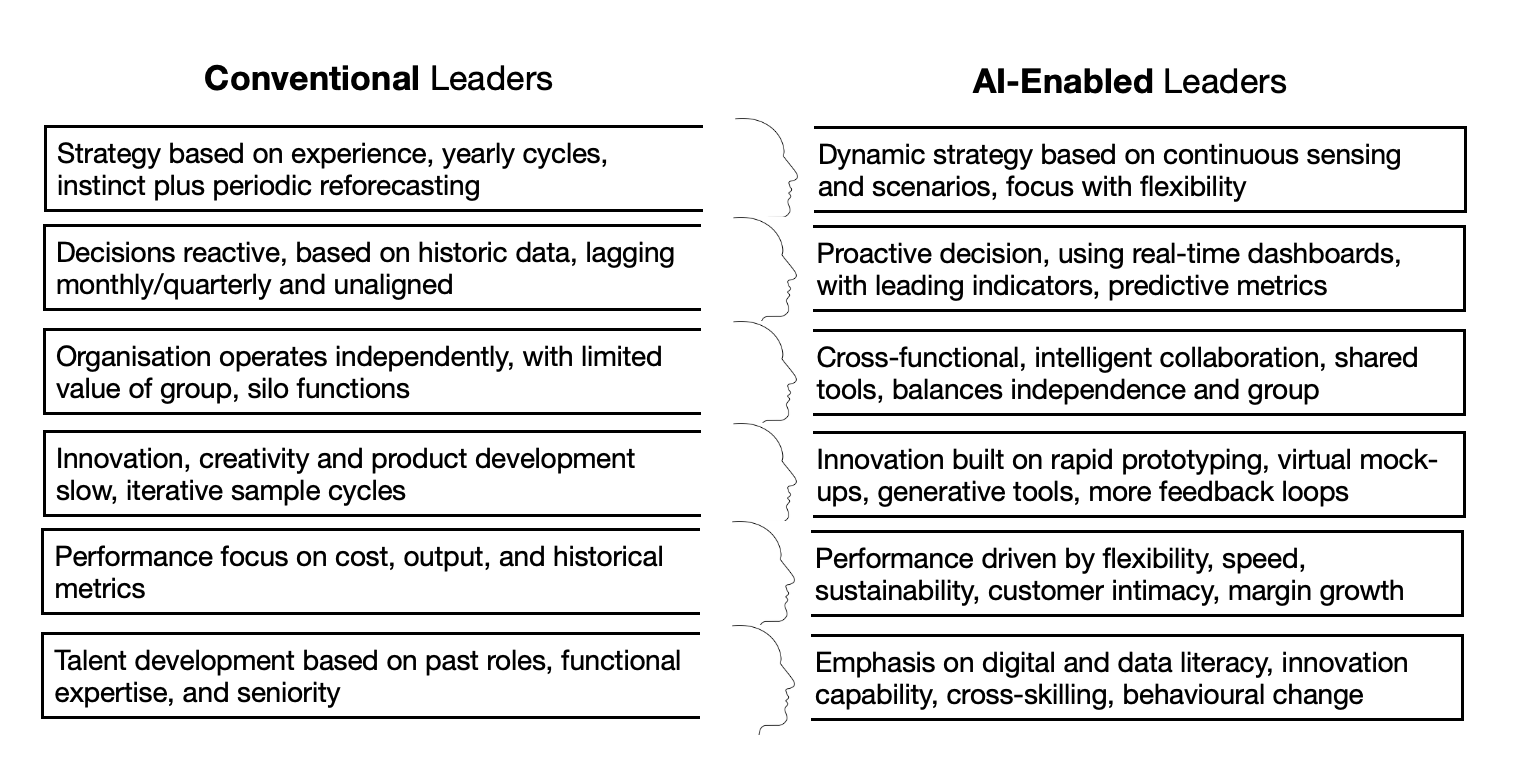
From Intuition to Intelligence
Historically, executives relied on experience, instinct, and pattern recognition. Leaders built mental models from years in the field, synthesizing disparate information into strategic choices. Today, AI augments these capabilities, providing leaders with real-time, actionable insights drawn from vast datasets.
- Consider LVMH, the French luxury conglomerate. Its executives leverage AI to inform inventory allocation, optimize merchandising strategies, and even guide creative decisions in design and product launches. AI helps balance the tension between exclusivity—critical to luxury brands—and responsiveness to changing consumer preferences.
- Apple has embedded AI into its internal operations to anticipate supply chain disruptions, optimise sourcing of components, and synchronise global product launches with a precision that would be impossible relying on human judgment alone.
- Meanwhile, Unilever and Procter & Gamble exemplify a broader trend among global consumer goods companies. By integrating insights from millions of data points—from consumer behavior to operational performance—into dynamic dashboards, leaders gain near-real-time visibility across their global operations.
These systems shift leadership from reactive decision-making to proactive orchestration. Executives no longer rely solely on instinct or historical trends; they act on intelligence, making decisions with a clarity and speed previously unattainable.
The broader implication is profound: AI is democratizing insight. Leadership is increasingly distributed, with intelligence flowing through organisational networks, empowering teams to act independently while aligning with strategic objectives.
From Planning to Dynamic Strategy
Strategy in the AI era is no longer a rigid, annual exercise confined to boardrooms. It has become a living, adaptive process, continuously informed by real-world signals.
- Inditex, the Spanish fashion powerhouse behind Zara, exemplifies this transformation. By monitoring social media trends, sales patterns, and local consumer preferences weekly, Inditex has reduced the time from concept to store to just ten days—a radical departure from the traditional six-to-nine-month fashion cycle.
- Similarly, Kering, owner of luxury brands such as Gucci and Saint Laurent, leverages AI to anticipate fashion trends, enabling creative and operational teams to adjust supply and marketing strategies without compromising brand integrity.
- BYD, China’s leading electric vehicle manufacturer, employs AI to simulate battery production and vehicle deployment across global markets. This allows executives to anticipate demand fluctuations, optimize production schedules, and make strategic investment decisions in real time.
Leaders in these organisations no longer wait for the next quarterly review or annual strategy session—they continuously adapt, turning foresight into a daily capability.
- Read my recent article Reinventing Strategy: Embracing “Dynamic Strategy” for a world that never stops
Dynamic strategy powered by AI also enables scenario planning at unprecedented scale. Leaders can model “what-if” scenarios spanning geopolitical risks, supply chain shocks, and regulatory changes, providing a level of preparedness and resilience that traditional planning could never deliver. The result is an organisation capable of continuous evolution rather than incremental adaptation.
From Control to Empowerment
AI is redefining not just what leaders decide, but how they lead people. Hierarchies of information are giving way to empowered networks of intelligent teams. Leadership is increasingly about creating the conditions for creativity, innovation, and accountability, rather than issuing commands.
- Unilever’s Flex Experiences platform is a compelling example. By leveraging AI to match employees to projects aligned with their skills, experience, and interests, the platform accelerates talent deployment and development.
- Luxury British auto brand Bentley Motors has embraced AI-driven collaboration tools to connect engineers, designers, and craftspeople worldwide, facilitating complex projects with a level of coordination and speed that traditional structures could not achieve.
- Nvidia, the world’s most valuable company, uses AI to provide teams with real-time insights into GPU performance, market adoption, and customer usage patterns, enabling cross-functional decision-making that is both rapid and informed.
Empowered teams are a natural consequence. Leadership becomes orchestration, not control: setting direction, providing context, and enabling people to make autonomous decisions aligned with organizational objectives. AI accelerates this transformation by serving as the connective tissue that links data, insights, and people across functions and geographies.
From Forecasting to Foresight
Traditionally, forecasting relied on historical data, extrapolated into the future—a method inherently limited in rapidly changing markets. AI introduces foresight: predictive analytics that integrate real-time signals to anticipate future scenarios.
- Coca-Cola, for instance, now predicts regional demand weeks in advance using a combination of weather data, local events, and social media trends, improving promotional efficiency by 20%.
- Ferrari leverages virtual simulations to test vehicle performance, reducing physical testing by 40% while refining models based on real-world driving data.
- Apple uses AI to forecast potential supply chain constraints, ensuring timely product launches and consistent customer experiences.
This shift from forecasting to foresight gives leaders the ability to act proactively, allocating resources and mitigating risks with confidence. Foresight, enhanced by AI, transforms decision-making from reactive to anticipatory, empowering leaders to shape outcomes rather than respond to them.
From Segments to Personalisation
AI transforms marketing by enabling hyper-personalized customer experiences. The shift moves beyond traditional demographic segmentation to individualized engagement based on real-time data.
- Netflix and Spotify pioneered personalisation in entertainment, from using data to learn about customer’s preferences and behaviours, to recommendations and exclusive offers, and the principle now extends across industries.
- Ferrari leverages customer data for predictive maintenance, driving analysis, and bespoke design options, increasing customer lifetime value by 15%.
- Sephora’s AI recommendation engine drives nearly 40% of online sales, tailoring product suggestions and virtual consultations to individual preferences.
Personalization strengthens loyalty, engagement, and revenue per customer, giving leaders unprecedented insight into their markets and the ability to cultivate deeper, more profitable relationships.
From Ideation to Augmented Creativity
AI enhances human creativity by accelerating ideation, testing, and refinement. While imagination, emotional intelligence, and craft remain uniquely human, AI can augment these capabilities to explore possibilities that were previously impractical or unimaginable.
- LVMH has reduced product development cycles by half through AI simulations, testing thousands of design variations before physical production.
- Nike uses AI to generate innovative shoe and apparel designs, often uncovering new material combinations and structural innovations that human teams alone might not conceive.
- Nvidia leverages AI to optimize GPU architectures in simulation, shortening R&D cycles while enabling collaborative innovation across its partner ecosystem.
Machine-augmented creativity allows leaders to experiment rapidly and with greater confidence, improving the probability of successful outcomes and enabling faster iteration from concept to market.
From Experimentation to Accelerated Prototyping
AI enables faster, safer, and more insightful experimentation. Digital twins, AI-driven simulations, and real-time feedback loops accelerate learning and reduce the risk associated with new product development.
- BMW and Bentley, for example, test thousands of design configurations virtually before production, often incorporating early consumer feedback to co-create products.
- Tesla continuously iterates vehicle software using data collected from cars in use, blurring the lines between product development and post-sale improvement.
- BYD uses AI to evaluate battery chemistries and EV powertrains virtually, optimizing production decisions and reducing development risk.
These capabilities shorten time-to-market, reduce costs, and allow organizations to scale innovation rapidly, giving leaders the confidence to take calculated risks and experiment at speed.
From Fixed Pricing to Dynamic Value
AI enables real-time, dynamic pricing, replacing static models with strategies that respond to market conditions, inventory, and consumer behavior.
- Unilever and Coca-Cola adjust promotions and pricing dynamically based on local demand and inventory, this happens both in direct Chanels, but also through partnerships with retailers.
- LVMH manages pricing integrity globally using AI, balancing currency fluctuations, scarcity, and brand value.
- Airlines like Emirates optimise fares, while Uber adapts pricing dynamically to ride demand. These approaches can increase yield by 5–15% while enhancing customer satisfaction and ensuring availability.
Dynamic pricing reflects a broader shift: leaders are using AI not just to maximize revenue but to deliver value in ways that respect brand equity and customer expectations.
From Sustainable Reporting to Regenerative Impact
AI is also transforming sustainability from a reporting exercise into a driver of operational and strategic decisions. It enables organizations to measure, model, and manage environmental impact in real time.
- France’s Schneider Electric, recognized as the world’s most sustainable companies, monitors energy usage across factories and client sites to reduce emissions by 30%.
- Kering’s AI-driven Environmental Profit & Loss (EP&L) system measures the environmental footprint of each product, guiding designers to make sustainable choices that reduce impact by 25% per product.
- Apple applies AI to optimize energy consumption across its supply chain and factories, supporting its carbon-neutral ambitions by 2040.
By integrating environmental and financial performance, AI allows leaders to align business growth with ecological responsibility, making sustainability a living component of strategic decision-making rather than a compliance obligation.
From Performance Metrics to Realtime Dashboards
AI also transforms performance management. Static reports and periodic reviews are giving way to real-time, AI-enabled dashboards that make organizational performance visible and actionable every day.
- L’Oréal continuously monitors sales, marketing impact, and digital engagement through dynamic dashboards, allowing managers to make informed decisions on a daily basis.
- Amazon employs AI feedback loops to optimize logistics, pricing, and customer experience in real time, creating a connected ecosystem of operational insights.
- BYD uses AI to track factory throughput, battery yields, and delivery logistics, allowing leaders to preempt bottlenecks before they affect production.
These “living dashboards” accelerate decision-making, improve operational efficiency, and give leaders a holistic, continuously updated view of performance. Leadership is no longer about reviewing reports; it is about navigating a dynamic stream of insights to drive continuous improvement.
From Incremental Growth to Reinvented Business Models
Perhaps most transformational is AI’s capacity to enable entirely new business models. Organizations are not just doing existing things better—they are reimagining how value is created.
- Nike has evolved into a digital ecosystem, with direct-to-consumer sales now exceeding 40% of total revenue. IKEA combines AR visualization with on-demand manufacturing, offering a service-oriented retail experience.
- Richemont and Kering connect artisans, boutiques, and customers digitally, enabling real-time traceability, pricing, and experiential retail. BYD leverages AI for predictive fleet services and smart mobility solutions.
- Apple enhances its hardware and services ecosystem using AI, from App Store recommendations to Apple Music and Apple TV+.
These business model transformations improve EBITDA margins by 20–30% and drive top-line growth of 10–15%, demonstrating AI’s ability to create both financial and strategic value.
Impact on Business Performance
Across industries, AI-driven leadership delivers quantifiable benefits:
-
Speed: Product development cycles reduced by 30–60% (L’Oréal, Bentley, BMW).
-
Efficiency: Operational costs fall by 15–25% (Unilever, Amazon, Schneider Electric).
-
Revenue Growth: 10–20% increase from personalization and dynamic pricing (Nike, Sephora, Ferrari).
-
Market Cap: AI-mature companies grow enterprise value 2–3x faster than peers (Accenture, 2024).
Executives report faster launches, more responsive supply chains, and deeper customer engagement—linking AI-enabled leadership behaviours directly to tangible business outcomes.
A New AI-Enabled Leadership Mindset
In practice, effective AI-enabled leaders exhibit five key habits:
- Curiosity over control: They ask better questions instead of expecting perfect answers.
- Transparency over hierarchy: They empower teams with shared intelligence.
- Experimentation over prediction: Strategy is treated as a living, evolving hypothesis.
- Learning over knowing: AI augments, rather than replaces, human intuition.
- Imagination over limits: They think bigger, bolder, and more creatively than ever before, using AI to amplify impact and turn ambitious ideas into reality.
These traits enable leaders to orchestrate intelligence across their organizations, balancing creativity, speed, and performance while driving continuous reinvention.
AI is not replacing leaders—it is enhancing what leadership can achieve. Luxury firms like LVMH, Kering, and Ferrari preserve craft and heritage while accelerating operations. Tech leaders like Apple and Nvidia optimize innovation, supply chains, and responsiveness. Global B2C leaders such as Nike, Unilever, and BYD transform personalization, operations, and business models.
The ultimate advantage lies in orchestrating intelligence: enabling leaders to act decisively, innovate continuously, and grow sustainably. Leadership in the AI era is an art of blending human insight with machine intelligence, creating organizations that learn, adapt, and thrive in a world of constant change.
As one LVMH executive put it, “AI hasn’t replaced our creativity — it has made it faster, smarter, and more precise. It allows us to focus on what humans do best: imagining the future.”
More from Peter Fisk
- Eyes on Tomorrow: What Leaders Must See before Everyone Else … exploring the most important megatrends that are transforming markets, and leadership mindsets, and how the best companies embrace them as opportunities … based on the new Megatrends 2035 report by Peter Fisk, and its implications for every business.
- The Reinvention Playbook: Thriving in a World of Relentless Change … the best organisations seek to continually reinvent themselves in a world of constant, uncertain and dynamic change. They rethink, refocus, and reinvent everything – embracing new agendas from AI to GenZ, climate change and social inequality.
- The Nexus Effect: Unlocking the Power of Connections … How can businesses and brands really unlock the power of data and networks, flywheels and AI, communities and ecosystems, to transform their futures?
- The New Growth Playbook: 9 New Ways to Accelerate Growth … many companies struggle to find new ways to grow their business … instead we look at how the best companies find radically new ways to grow.
- Super Innovators: Innovation Beyond the Normal … 10 radical ways to disrupt conventions, embrace deeper insights, unlock valuable assets, and stretch innovation for more dramatic impact.
- Consumer of the Future … “Aisha blinked twice, the smart lenses in her eyes had already scanned her biometric mood, cross-checked her carbon budget, and pulled up items her climate-positive friends were buying this week”
- Competing in the FLUX: How to develop a dynamic strategies in a world of relentless change … combining a strong, enduring direction with micro-moves that adapt quickly to emerging shifts:
- Business Transformation: The new superpower of business leaders … reimagining the future, redefining strategy, reinventing the organisation, rewiring performance … the journey to deliver step change in value creation.
- The Sustainable Consumer: Go on, do the Right Thing … how brands can accelerate the consumer shift to sustainable products and practices … from food and fashion, to energy and electric cars, making sustainability desirable and better.
- The “Performer Transformer” Leaders: How great leaders deliver today and create tomorrow … with dual thinking, to build dynamic ambidexterity, continually strategyzing, to perform and transform.
- The Hire-Wire Act of Leadership: Leading in a world of intense competition and relentless change … being visionary and innovative, learning to adapt and endure … inspired by Taylor Swift, Roger Federer, Beyoncé, and Lionel Messi
- Becoming a Future-Ready Business … in a world of relentless change, organisations need to anticipate change, embrace innovation, empower talent, and align deeply with the evolving needs of society and the planet
Disruption is everywhere. In every market, in every industry, relentless waves of technology are redrawing the boundaries of what’s possible. AI, synthetic biology, quantum computing, renewable energy, autonomous systems — each one carries the power to shake up established orders and open new frontiers of value.
Yet the real opportunity of disruption is not in the chaos it creates, but in the reinvention it enables. Disruption is the spark; reinvention is the flame. It’s what allows industries to evolve, companies to reinvent themselves, and societies to reimagine how we live, work and grow.
I remember being on stage with Scott Anthony five years ago in the Danish city of Odense. I was hosting a “strategy boxing match” — five rounds of ideas and intellectual sparring between Scott and Howard Yu. Scott narrowly edged the win, thanks in no small part to his gift for storytelling — the kind that makes you see the familiar world anew.
His latest book, Epic Disruptions, carries that same energy: full of rich stories about the great disruptions that have shaped our modern world. But its real impact lies not just in recounting the past — it’s in what these stories reveal about the future, and about how today’s business leaders can turn disruption into an opportunity for reinvention.
Here are 12 of those “epic disruptions” — moments when human ingenuity collided with technological possibility and reshaped the course of business, society and daily life. And what it means today.
1. Gunpowder: from alchemical discovery to global power shifts … harnessing serendipity in innovation
Historical Context:
Gunpowder was discovered in 9th-century China by alchemists seeking an elixir of immortality. Initially intended for fireworks and ceremonial displays, it quickly became a revolutionary weapon. The Mongol Empire used gunpowder to conquer vast territories, and centuries later, European armies adopted and improved it, fundamentally altering the nature of warfare and empire-building.
Impact:
Gunpowder shifted global power structures. It rendered traditional fortifications less effective, accelerated military innovation, and catalyzed geopolitical change. The ripple effects included the rise and fall of empires and new trade routes shaped by military dominance.
Lessons for Today:
Innovation often emerges serendipitously. Modern companies like BYD have thrived by identifying unexpected applications of technology. Initially a battery manufacturer, BYD leveraged its core expertise to become the world’s largest EV producer. Leaders today must cultivate curiosity, remain agile, and be ready to pivot when new possibilities arise.
2. The Printing Press: democratising knowledge and accelerating change … lessons in accessibility and scale
Historical Context:
Johannes Gutenberg’s movable-type press (c. 1450) transformed communication. Books, previously laboriously hand-copied, could now be mass-produced, making knowledge accessible to a wider public. This catalyzed the Renaissance, Reformation, and Scientific Revolution.
Impact:
The printing press undermined monopolies on knowledge, elevated literacy, and democratized education. It accelerated the spread of ideas and fostered cultural, scientific, and political revolutions.
Lessons for Today:
Accessibility drives adoption. Platforms like Canva echo this principle by enabling anyone to produce professional-quality design without formal training. Making tools and knowledge widely available creates new markets and shifts power toward those who can democratise creativity.
3. Bacon and Boyle: establishing the scientific method … systematic reinvention, a disciplined and repeatable process
Historical Context:
In the 17th century, Francis Bacon and Robert Boyle formalized the principles of modern scientific inquiry. By prioritizing observation, experimentation, and empirical evidence over tradition, they laid the foundation for systematic knowledge creation.
Impact:
The scientific method catalyzed the Industrial Revolution, enabling predictable innovation. It allowed discoveries to be reproduced and scaled, leading to advances in medicine, chemistry, physics, and engineering.
Lessons for Today:
Structured experimentation accelerates learning. Companies like BYD and Tesla apply rigorous testing and iteration to product development, ensuring resilience and adaptability. Reinvention is not a lucky accident — it is a repeatable, disciplined process.
4. Florence Nightingale: turning data into life-saving action … data-driven decision making
Historical Context:
During the Crimean War, Nightingale meticulously documented patient deaths and hospital conditions. Her visualizations demonstrated that sanitation, not battlefield treatment, drastically reduced mortality.
Impact:
Her work reshaped hospital design and public health policy, establishing the power of statistical evidence and persuasive storytelling in effecting systemic change.
Lessons for Today:
Data is transformative only when coupled with human insight. Modern platforms like Canva leverage user data to refine features, optimize experiences, and anticipate needs, demonstrating that data-driven decisions can drive meaningful innovation and customer engagement.
5. The Model T: mass production and affordability … reinventing access to everyday life
Historical Context:
Henry Ford’s assembly line (1908) transformed automobile manufacturing. By standardizing production, he reduced costs and made cars affordable to millions, fundamentally altering mobility and urban development.
Impact:
The Model T catalyzed societal change: people could travel farther, cities expanded, and industries such as oil and road construction boomed.
Lessons for Today:
Process innovation is as crucial as product innovation. Companies like BYD and Tesla scale efficiently by optimizing production, making sustainable technologies accessible. Affordability and scalability are essential levers in market reinvention.
6. The Transistor: from vacuum tubes to the digital revolution … enabling modular innovation
Historical Context:
Invented at Bell Labs in 1947, the transistor replaced bulky vacuum tubes, allowing electronics to become smaller, more efficient, and more reliable.
Impact:
It enabled the digital age, giving rise to computers, smartphones, and global communication networks, laying the foundation for modern technology ecosystems.
Lessons for Today:
The transistor demonstrates the power of modular, scalable technology. Cloud platforms like Canva rely on similar principles — compressing complexity into reusable, accessible tools that can reach millions. Reinvention occurs when innovation becomes composable and widely applicable.
7. Julia Child: making expertise accessible … scaling human passion
Historical Context:
Julia Child introduced French cooking to American households through her cookbook and television series. She transformed cooking from an elite art into a popular, approachable skill.
Impact:
Her influence reshaped American culture, culinary education, and the domestic sphere, inspiring generations to explore creativity in everyday life.
Lessons for Today:
Simplifying complex skills for broad audiences is a powerful form of disruption. Platforms like Canva democratize design, lowering the barriers for creativity and empowering millions to participate in professional-grade work.
8. McDonald’s: standardising experiences … scaling trust across borders
Historical Context:
Ray Kroc expanded McDonald’s, systematizing food preparation to ensure consistency worldwide. This operational innovation turned a local fast-food brand into a global franchise powerhouse.
Impact:
McDonald’s demonstrated how systems thinking and operational excellence could scale an experience, transforming consumer expectations and industry standards.
Lessons for Today:
Reliability and scalability are essential for modern businesses. Digital platforms that maintain consistent user experiences — Canva being a prime example — can achieve global reach and trust, transforming markets without physical presence.
9. Pampers: everyday innovation … reinventing daily life
Historical Context:
Procter & Gamble introduced disposable diapers, revolutionizing childcare by providing convenience, hygiene, and time savings for parents.
Impact:
Beyond profit, this innovation reshaped social norms, supported workforce participation for women, and sparked new consumer categories.
Lessons for Today:
Solving small, daily problems can have outsized impact. Modern innovators like Canva address user frustrations in everyday tasks, showing that solutions that improve quality of life create lasting market value.
10. The iPhone: convergence as disruption … redefining interaction and ecosystems
Historical Context:
Apple’s iPhone (2007) combined a phone, media player, and internet device, creating an ecosystem that integrated hardware, software, and services.
Impact:
The iPhone reshaped communication, commerce, and entertainment, establishing a platform for millions of applications and redefining human interaction with technology.
Lessons for Today:
Disruption often occurs at intersections. Canva, by integrating multiple design tools into a unified platform, mirrors the iPhone’s philosophy, demonstrating that convergence creates new user behaviours and business models.
11. Big Steel: industrial might meets market turbulence … the need for agile reinvention
Historical Context:
Bethlehem Steel once epitomized industrial power, supplying materials for skyscrapers and warships. By the late 20th century, global competition and technological lag forced its decline.
Impact:
Its collapse highlighted the risks of scale without adaptability and underscored the need for operational agility and continuous innovation in heavy industry.
Lessons for Today:
Even market leaders are vulnerable without reinvention. Modern industrial giants, and emerging competitors in sectors like EVs, must combine scale with flexibility, adopting new technologies and processes before market forces demand it.
12. SpaceX: reimagining the impossible … bold missions as catalysts for industry transformation
Historical Context:
SpaceX, founded in 2002 by Elon Musk, sought to reduce the cost of space travel and make interplanetary colonization feasible. By developing reusable rockets, it disrupted decades of aerospace orthodoxy.
Impact:
SpaceX lowered launch costs, catalyzed private space investment, and challenged national space agencies, accelerating innovation across the sector.
Lessons for Today:
Disruption is amplified by audacity. Companies that set bold missions — Tesla, SpaceX, BYD — attract talent, capital, and public attention, creating ecosystems that accelerate transformation. Reinvention often begins with a vision that seems impossible until it becomes inevitable.
Patterns of reinvention
Across these ten disruptions, patterns emerge that are as relevant today as they were centuries ago:
-
Technology plus transformation. Invention alone doesn’t disrupt; transformation of systems does. Gunpowder and transistors changed the world only when institutions adapted around them.
-
Standardisation enables scale. From Ford’s production line to McDonald’s kitchen, repeatability turns novelty into ubiquity.
-
Translation is key. Julia Child and Florence Nightingale show that making ideas understandable is itself an act of innovation.
-
Ecosystems multiply impact. The printing press, the transistor and the Model T all spawned industries that extended far beyond their originators.
-
Second-order effects shape the future. Disruption’s long tail — the cultural, ethical and environmental consequences — often matters more than the first shock.
Implications for today’s leaders
So what do these stories mean for leaders navigating today’s volatile, opportunity-rich environment?
-
Think systemically. Look beyond your product to the processes, partners and institutions that shape its adoption.
-
Design for reinvention. Build modular organisations and business models that can pivot as new technologies emerge.
-
Invest in translation. The winners will be those who can explain complexity simply — in healthtech, fintech, or AI ethics.
-
Balance scale with flexibility. Learn from Big Steel’s fate; embed agility into large systems.
-
Anticipate externalities. Every new convenience has a cost. Sustainable innovation is no longer optional; it’s the next competitive frontier.
Disruption is just the start, reinvention is what matters
Epic Disruptions is, ultimately, a book about reinvention. Each story shows that while disruption begins with surprise, its true significance lies in how people, organisations and societies respond. Gunpowder redrew empires; the printing press created knowledge economies; Ford, McDonald’s and Pampers redefined everyday life. Each wave of change bred new winners — those who saw not the threat, but the invitation to reinvent.
The same is true today. Technology will keep advancing at extraordinary speed, but its real power lies in human imagination — in the capacity of leaders to reshape their businesses and themselves around what’s next. Disruption, in the end, is only half the story. Reinvention is the other half — and the more important one.
Nike is no stranger to drama, with multiple reinventions, comebacks, and disruptions.
Since its founding by Phil Knight in 1964 as Blue Ribbon Sports and its transformation into a global cultural and athletic icon, the brand has ridden multiple waves: from performance‑innovation and athlete endorsements, to lifestyle fashion, to direct-to-consumer (D2C) bold moves, to digital, to sustainability. But even a giant can wobble when it forgets what made it great — or when the world around it shifts too fast.
But by the early 2020s, cracks were showing. Under John Donahoe, an outsider-turned-CEO (from Bain, later eBay/ServiceNow), Nike leaned heavily into D2C and lifestyle growth. Yet as competition intensified, consumer expectations changed, supply chains strained, and the brand’s innovation cadence slipped, the company began losing momentum. Retail partners felt alienated. The “core Nike” — the obsession with sport, performance, athlete insight — seemed diluted.
Enter Elliott Hill, a Nike lifer who began as an intern, worked across functions, left in 2020, then was recalled to helm the enterprise in late 2024. His return marks a moment of re-centering, of recovering what was lost — but also of boldly redefining Nike for a changed era. Under Hill, the narrative is not “turn it back” but “push forward differently.” His mantra is provocative: “Create epic shit, make athletes better.”
As a story in leadership, and specifically leaders driving innovation and reinvention, let’s retrace the missteps of the Donahoe era, how it opened the window for reinvention, and how Nike is now moving with urgency across strategy, structure, culture, and product.
What went wrong … Donahoe, dilution, and drift
To understand the reinvention, it’s crucial to diagnose the decline. What missteps allowed challengers — On, Hoka, New Balance, and even Adidas — to encroach on Nike’s turf? What internal tensions and misalignments blurred its purpose?
The outsider CEO
John Donahoe arrived in 2020 to replace long-time retiring CEO Mark Parker, with an impressive résumé: CEO of Bain & Company, then of ServiceNow, and with strong strategic credentials. But he was not from the core world of athletic performance, product innovation, or sports culture. That has consequences in a brand like Nike, whose credibility depends on authenticity, deep understanding of athletes (from elite to everyday), and product ethos.
Under Donahoe, Nike was reorganised more along consumer segments (men’s, women’s, kids) rather than sports (running, soccer, basketball etc). The emphasis shifted toward broadening the lifestyle side, pursuing growth in casual and direct channels, and scaling D2C. While those moves had logic – higher margin, closer control, omni-channel reach – they came with tradeoffs: slower speed in sport-led innovation, diffusion of identity, and frictions with wholesale partners who felt deprioritised.
Critics argue Nike became “big, dumb, slow.” It also got lost trying to move with fast fashion. In the fast-moving world of sports tech, wearable innovation, carbon tech, materials, and consumer narratives, that is not sustainable.
Over promotion
Another major issue: Nike became too promotional. The constant discounting, markdowns, “flash sales,” and reliance on steep promotions diluted brand premium and margin. Hill now cites this as one of his three central fixes: reduce promotional overreach, restore full-price discipline, and manage excess inventory (via Nike Value Stores) rather than erode core pricing.
When half your digital sales are promotional, brand positioning is under siege. Customers begin to expect lower prices; retail partners get squeezed; the premium halo fades.
Channel conflict
Nike’s push into D2C came at a cost: it strained relations with wholesale partners like Foot Locker, JD Sports, Dick’s, and others. By deprioritising wholesale, limiting allocations, and emphasizing Nike-owned channels, Nike created tension in the broader ecosystem. Some wholesale partners felt betrayed. Hill has since made rebuilding trust a priority, meeting retailers personally, rebalancing channel allocation, and promising more equitable partnerships.
When wholesale shelves narrow, your presence in physical retail — a vital discovery channel — weakens. Nike’s loss of shelf space gave competitors breathing room.
Nostalgia over newness
A central point: Nike’s innovation pipeline slid into safe zones. It leaned heavily on retro models, reissues, and familiar franchises, rather than daring new products. The brand’s radical edge dulled. Meanwhile, competitors like On (with carbon fibre plate shoes) or Hoka (bold cushioning) grabbed headlines and mindshare. Nike’s reputation as the innovation leader became more rhetorical than empirical.
In that lull, the market shifted: consumers expect rapid iteration, hybrid wearables, biofeedback, smart textiles, and integrated digital experiences. Nike’s inertia meant it was at risk of becoming incremental rather than discontinuous.
Consumer disconnection
As Nike broadened into lifestyle and fashion, some of what made it special — athlete-first credibility, performance insight, sport storytelling — got blurred. The brand lost some of its emotional edge. Some younger consumers saw the Swoosh as generic or even “cringe” in social-media-attuned Generation Z parlance. It needed a recalibration of authenticity.
Moreover, in a world fractured by identity, diversity, and hyper-narrative, a one-size-fits-all consumer segmentation approach felt flat. Nike risked losing resonance in subcultures, micro-communities, and sports tribes.
Economic challenges
Don’t discount exogenous pressures. COVID disruption, inflation, trade tensions, tariffs (notably from U.S.–China relations), and supply chain bottlenecks hit the industry hard. Nike reported revenue declines when Hill arrived: down ~10% year-on-year, with $1.5B in net profit erosion blamed on tariffs. The legacy of pandemic inventory mismatches, channel dislocations, and delayed demand also limited Nike’s agility.
In summary, Donahoe’s strategy had plausible elements — D2C, lifestyle push, margin expansion — but the execution and balance were off. Nike lost coherence, speed, partner goodwill, innovation leadership, and emotional connection in key growth segments. The stage was set for a reset.
The market has shifted … reinvention is urgent
Before diving into Hill’s turnaround, it’s worth noting that external dynamics have changed in ways that require more than just course correction. Nike must evolve in a transformed market. A few key shifts:
Consumer power
Consumers expect more now. They demand authenticity, brand purpose, micro community, experiences, and narratives. The era of broadcast marketing is fading; consumers want to shape stories, engage in participatory culture, and expect brands to lean into social values (sustainability, equity, mental health).
In that climate, Nike must pivot from selling objects to enabling identity, belonging, ritual, transformation. The new “athlete” is more mental, socio-cultural, and data-connected — not just physical.
Innovation velocity
Technology and science are converging: biodesign, neuroscience, sensors, battery tech, adaptive materials, generative AI. Product innovation is no longer incremental — it’s about hybrid domains. Nike must not only race in footwear cushioning or textiles, but explore sensory, cognitive, and powered systems.
In that sense, Nike is competing not just with sportswear brands but with technology labs, wellness platforms, wearable startups, and even fashion-tech hybrids.
Intense competition
Over the last year or so, arch rival Adidas had outperformed Nike on the field: winning more athletics medals at the Paris Olympics and outperforming Nike in major marathon events. The message was clear — even a market leader can lose its way.
Also, brands like On, Hoka, Allbirds (in sustainability), and others are lean, narrative-driven, innovation-led, and digitally native. They move fast, take risks, and leverage agility. Nike must tap into that same dynamism while holding scale.
Channel complexity
The days of channel silos are over. Consumers expect seamless transition across app, site, retail, community, events, social, second-hand, resale. Nike must master presence in every node, not just dominate D2C or wholesale in isolation.
Retailers, recovering from years of tension, are reasserting importance. Physical experience (pop-ups, sport labs, flagship activations) is re-emerging as discovery and storytelling centers. Nike needs to co-create with retail rather than sideline it.
Economic pressure
With macro pressures (inflation, discretionary cuts, shifting consumer priorities), luxury/high-premium tiers, performance niches, and meaningful differentiation (versus mass commoditised athleticwear) become more indispensable. Nike must lean into differentiation, not volume discounting.
In short: Nike can’t simply “undo” the missteps of Donahoe. It must leap to a higher plane: more daring, more integrated, more athlete‑centric, more narrative-rich, faster, more emotionally alive.
Elliott Hill’s mandate … culture reset, sport as north star
With clarity on what failed and the changed world, Hill’s mandate is sweeping. His strategic playbook rests on four interlocking pillars: culture reset, strategy & structural realignment, innovation acceleration, and brand storytelling & consumer resonance. Let’s unpack each.
Cautious to courageous
Internally, Nike needed a jolt. Hill’s arrival was intentionally quiet for a year; he embedded, listened, and oriented before making unveilings. He instituted a tone shift: more urgency, leaner structures, bigger bets, and a sharper ethos. Nike’s internal language now includes “Create epic shit, make athletes better” — a provocative, aspirational clarion.
Hill sees his role as head coach: articulating clarity, holding standards, and pushing for relentless execution. He has restructured teams, broken silos, and pushed for a return to obsession with sport (versus spread-thin consumer initiatives). One telling signal: the new innovation engine — a unified creation organixation combining Nike, Jordan, and Converse’s innovation, design, and product functions — is meant to break down fiefdoms, reduce friction, accelerate cross-pollination, and reorient all work around athlete insight. Hill’s cultural reset isn’t about kumbaya; it’s about accountability, speed, daring, and coherence. Ideation without execution is meaningless.
Sport-first, not consumer-first
Under Donahoe, Nike organized by consumer segment (men/women/kids). Hill is reversing that: he’s reorganising around “fields of play” — sport-specific franchises (running, basketball, football, training, etc.) across genders and age groups.
This realignment ensures that product innovation, stories, athlete partnerships, community engagement, and marketing all anchor back to athletic intent. No more chasing fashion trends at the expense of sport clarity.
Marketplace balance, direct and indirect
Hill is committed to balancing Nike’s direct platforms with wholesale partners. The goal is to rebuild trust, reallocate inventory rationally, reduce channel conflict, and align incentives. He’s meeting wholesale CEOs personally and signaling openness to collaboration. For physical retail to remain a discovery engine, Nike must be a good partner, not a bully.
Part of the reset is to “clean the marketplace” — withdrawing products that don’t meet standards, simplifying SKUs, pruning low-growth lines, and focusing on clarity over proliferation. Hill acknowledges that in the short term, revenue may dip, margins may be pressured, and expenses may rise — but that these are necessary investments for long-term brand health. He also plans to reduce overpromotion, shift more sales to full-price, and reserve markdowns for proper retail moments.
Innovation acceleration
This is where things get exciting — and high-stakes. Hill and his team are not simply tweaking old lines; they’re launching moonshots. Some of Nike’s new innovation bets include:
-
Nike Mind – The first neuroscience-based footwear platform designed to influence the wearer’s mental state (calm, focus) through design and sensory features. Nike’s Mind line (Mind 001 mule, Mind 002 sneaker) exemplifies a shift: not just performance for body, but performance for brain. Nike frames the human body as a “sensory antenna,” where every stimulus affects the brain. Mind aims to synchronise foot and brain in the pregame ritual — a “sensory intervention.”
-
Project Amplify – A motor-assisted, powered footwear system. Think of it as a wearable exoskeleton for the foot: a drive belt and battery module that deliver subtle thrust or assistance. Nike claims it can make hills feel flat and reduce effort. It’s designed for everyday athletes, not just elites.
-
Aero-FIT, Therma-FIT Air Milano – Adaptive performance fabrics, cooling systems, and shape/temperature-responsive layers. One outer jacket can inflate/deflate layers to regulate warmth dynamically.
These bets reflect an ambition: not incremental improvements but creating new categories and disrupting bits of the athletic-wearable space itself. With the newly unified innovation engine, Nike seeks to compress the product/idea-to-market cycle.
Team alignment around athlete insight, sharing best practices across Jordan/Converse, and pulling from adjacent domains (neuroscience, robotics, materials) are part of the formula.
Brand resonance
Innovation is nothing without meaning and narrative. Hill is re-energising Nike’s storytelling and consumer connection in several ways:
New slogan: “Why Do It?”
Nike is retiring (or at least evolving) its iconic “Just Do It” slogan — after 37 years — replacing it with the question “Why Do It?” The new campaign targets Gen Z’s relationship with earnestness and “cringe.” It reframes effort, risk, passion, and vulnerability as courageous, not embarrassing.
As Nike CMO Nicole Graham puts it, the campaign is about “taking cringe and turning it on its head.” The ad features athletes like LeBron, Caitlin Clark, Vini Jr. and asks: “why put it on the line? Why dare? Seriously, why?” This narrative shift is not just linguistic — it realigns brand posture. It’s not just about action, it’s about asking, daring, exploring — a more inviteful, curious tone.
Sporting moments
Nike’s new “gear” for storytelling operates at three scales: high‑impact sports (global events, tournaments), subculture moments (skate, local basketball courts, street culture), and community touchpoints (pop-ups, local activations). Nike wants to exist in the stadium and the street corner simultaneously.
Physical touchpoints are again important: the brand is leaning back into event-driven engagement, “street-level” presence, community tournaments, experiential activations. Being top-down brand voice is no longer enough; Nike must live among the people.
Authentic and emotional
This reinvention is also tonal. Nike under Hill is leaning into human, emotional, messy, vulnerable storytelling. The question “Why Do It?” invites reflection, not preaching. The brand aims to resonate with anxiety, ambition, self-doubt, resilience — all human terrain. That’s part of how it stays relevant in an age of emotional brands.
The internal metric: when you go to a Nike event or retail space, the energy, the product, the stories should feel like “Nike again” — connected, electric, alive. Journalists returning to Nike’s Beaverton campus have indeed observed a brighter, more energetic environment under Hill compared to the more muted Donahoe era.
Project Elevate … the reinvention engine
One of the monikers around Nike’s turnaround has been Project Elevate — a holistic effort to raise performance across every vector: product, brand, culture, channels, narratives, and metrics. (Though Nike hasn’t publicly published a “Project Elevate” roadmap as such, the concept aligns with the sweeping reorientation Hill is executing.)
Within Project Elevate, we can see several implicit subprojects:
-
Elevate Innovation Output – Boost the quantity and quality of breakthrough products (Mind, Amplify, fabrics) rather than holding in labs.
-
Elevate Athlete Listening – Re-root decision-making in athlete insight, feedback loops, community voice.
-
Elevate Marketplace Clarity – Cull weak lines, reorganise SKUs, re-balance price architecture.
-
Elevate Retail Partnerships – Reengage wholesale, co-create with retail, re-earn shelf presence.
-
Elevate Narrative & Identity – Push the brand story, tone, flagship campaigns, community engagement.
-
Elevate Culture & Execution – Speed, accountability, coherence across functions, fewer silos.
Project Elevate is the scaffolding — the meta-initiative that frames Hill’s leadership. Under that, Nike’s new slogan campaign (Why Do It), unified innovation engine, sport-led reorg, powered footwear lines, and marketplace reset all interlock.
Hill has repeatedly said: “We will put the athlete at the center of everything we do.” That becomes both a metric and North Star. Every action or product must pass the test: “Does this make an athlete (broadly defined) better?”
Nike Mind … walking the sensorium
One of the most intriguing and emblematic bets in Nike’s reinvention is Nike Mind, which signals a radical departure from traditional performance metrics to sensory, mental, and embodied experience.
What is Nike Mind?
Nike describes Mind as a new platform (in development for a decade) that translates neuroscience and sensory design into tangible wearables. Its first offerings — Mind 001 mule and Mind 002 sneaker — aim to help athletes lock into calm, focus, presence, or meditative states through stimuli tied to foot‑brain connections.
The concept: the human body is a “sensory antenna” — foot pressure, textures, micro-vibrations, stimuli feed signals to the brain. Nike Mind seeks to hack that dialogue. It’s not about performance metrics (distance, speed) directly, but about shaping the mental baseline from which performance emerges.
Imagine pre-match rituals: putting on Mind shoes helps your brain quieter, flush internal noise, and welcome clarity. That’s a powerful repositioning: gear as mental interface, not just physical enabler.
Symbolism
Nike Mind is not just a product — it’s a signal. It declares that the next frontier of athletic innovation is sensory, cognitive, psychological design. It shifts the category from “footwear + textiles + cushioning” to “experience engineering.” Nike is staking a claim in an adjacent frontier.
It also differentiates: few sportswear brands are seriously exploring neuroscience in apparel. Mind gives Nike a distinctive perch in the tech-wellness convergence era.
Moreover, given that Mind is part of Nike’s public roadmap, it helps anchor the reinvention narrative. It isn’t speculative R&D hidden behind walls — it’s frontstage vision.
Challenges
Of course, such an ambitious bet is fraught:
-
Efficacy vs placebo: will consumers perceive measurable benefit? Skeptics may see it as feel-good gimmickry. Nike must substantiate claims with credible science, trials, and transparency.
-
Price premium & accessibility: if Mind becomes ultra premium, it risks being niche. Nike must balance exclusivity with reach.
-
Category confusion: if not well communicated, customers may misinterpret Mind as fashion or wellness fad, not sports-relevant gear.
-
Execution & supply chain: integrating neuroscience, novel materials, sensor patterns, comfort, mass manufacturability is hard.
If Nike can nail Mind — blending science, feel, story, and scale — it could shift the brand’s identity for the next generation.
Project Amplify and beyond
Parallel to Mind, Hill’s Nike is pushing into powered performance with Project Amplify — a motor-assisted shoe system.
What is Project Amplify?
Project Amplify is Nike’s attempt to build a wearable drive system (battery + belt + mechanism) that gives subtle propulsion to walking or running. The concept: hills feel flatter, energy expenditure drops, and everyday movement feels easier — while retaining a natural feel.
It’s not intended solely for elites; Nike is positioning Amplify for everyday athletes who want performance assistance. Think of it as an “e-bike for feet.”
If successfully commercialised, Amplify would shift the category: not just cushioning or plate-based energy return, but actively assisted locomotion.
Strategic implications
- New category creation: Amplify could be a category-defining product, not just an incremental upgrade.
- Tech brand repositioning: Nike might encroach on wearables, robotics, assistive mobility — expanding its brand domain.
- Competitive moat: powered footwear is complex — battery, safety, weight, feel — creating barriers to entry.
- Narrative fuel: Amplify yields rich storytelling: more distance, less effort, pushing human boundaries.
It also signals ambition: Nike isn’t just pursuing marginal gains — it’s pushing systemic transformation.
Mind and Amplify are complementary — one inward (cognitive/sensory), one outward (mechanical assist). Nike’s new innovation engine is designed to let these threads interweave, cross-fertilise, and scale experiments faster. Other innovations (like Aero-FIT cooling, adaptive apparel) fill the layers around the body. All converge toward an ecosystem of athlete experience, not merely product catalog.
The new slogan … “Why do it?”
Often the most visible sign of reinvention is brand language. Nike’s new slogan “Why Do It?” is doing more than replace the iconic “Just Do It” — it’s a tonal and generational re-entry.
From imperative to inquiry
“Just Do It” is bold, authoritative, direct. It epitomises the old Nike energy: push, fight, overcome. But for a generation steeped in irony, vulnerability, meme culture, performance anxiety, and identity fluidity, such imperatives risk sounding hollow or cringe.
“Why Do It?” is an invitation — a question for reflection, for purpose, for courage. It acknowledges doubt, risk, fear. It re-centres meaning rather than command. It aligns with a generation that asks why, not just how. Nike wants to show it still gets emotional complexity, not just athletic theater.
Nike’s CMO Nicole Graham explicitly frames the new slogan as a “coming for Gen Z’s cringe culture.” In the age of “don’t be a try-hard,” “you’re cringe,” the brand wants to reclaim earnest effort as brave. By interrogating “why,” Nike flips the narrative: effort, ambition, vulnerability become courageous acts, not embarrassing ones.
Narrative alignment
The slogan isn’t a detached campaign — it ties into the reinvention:
-
It aligns with athlete-first depth: “why” comes before “what.”
-
It opens space for mental, emotional storytelling (which aligns with Nike Mind).
-
It invites consumer co-creation: “why do you do it?”
-
It supports a brand posture that is more curious, human, less condescending.
In execution, the campaign features major athletes (LeBron, Caitlin Clark, Vini Jr., etc.) asking the question in voiceover: “Why make it harder on yourself? Why try? Why risk it?” Importantly, Nike isn’t retiring “Just Do It” entirely; instead, it may treat it as legacy, core heritage, or a foundational ethos behind the question.
Of course, messing with an iconic slogan is no light matter. There’s risk of alienation among fans, confusion, or dilution. Nike must respect legacy while evolving it. The question approach must be deeply embedded, not just a superficial rebrand. If done right, “Why Do It?” becomes a generational bridge — acknowledging legacy while re-anchoring relevance.
Execution challenges
Reinvention is never guaranteed; for Nike’s reset to be durable, it must manage an army of execution risks. Some critical ones:
-
Overstretch & diffusion
Creating too many high-ambition bets simultaneously (Mind, Amplify, apparel systems, retail overhaul) risks overextension. Nike must assess sequencing and stage gating. -
Core business stability
While shooting forward, Nike must stabilise its cash cows — franchises like Air Max, Dunks, basketball/leisure lines, regional markets. If flagship revenue collapses, the runway shrinks. -
Consumer validation & feedback loops
Ambitious products (Mind, Amplify) must deliver credible results, not just hype. Nike needs rigorous testing, athlete pilot programs, transparency, and feedback iteration. -
Balancing exclusivity and scale
Ultra premium products must eventually find scale without cheapening. Pricing, distribution, and accessibility are a delicate balance. -
Retail partner alignment
Wholesale partners must feel respected. Nike must avoid repeat frictions, channel conflict, and trust erosion. -
Cultural inertia & internal resistance
Structural change meets legacy mindsets. Some teams may cling to silos, incremental habits, old metrics. Leadership execution must be relentless. -
Marketing coherence, not fragmentation
New slogan, new narratives, new stories — coherence is essential. Too many sub-narratives or campaigns fracture brand identity. -
Macroe volatility & supply disruption
Nike remains exposed to global trade, inflation, component supply, currency swings, tariffs. The reinvention must be resilient to shocks.
If Nike can navigate these pitfalls, Hill’s reinvention may hold. If not, the transformation may fracture midstream.
Early momentum
As of late 2025, there are several positive signs that Nike’s reinvention is gaining traction — though the real test will be long-term durability.
-
Journalists returning to Nike’s campus report renewed energy, more openness, more buzz around new product lines — a qualitative shift from the more cautious Donahoe era.
-
Nike’s Q4 2024 sales had dropped ~12% year-on-year, but the 2025 transition year is understood to be heavy as strategy resets take effect.
-
The stock market has responded with cautious optimism: when Hill was appointed, Nike’s stock rose ~8%.
-
Nike has publicly committed its innovation engine and disclosed its four major innovation platforms (Mind, Project Amplify, Aero-FIT, Therma-FIT Air Milano) as signals to market and partners.
-
The “Why Do It?” campaign has rolled out globally, bringing fresh media conversation and brand re‑engagement — especially among younger, socially-aware audiences.
-
Wholesale partners appear cautiously optimistic. In remarks, Foot Locker’s CEO commented that Hill is “taking the right actions for the brand” and said the relationship is improving.
-
Analysts and commentators describe Hill’s reset as a “rudder” for what had become a rudderless ship. R
These are only early indicators — the real turning point will be multi‑year traction in product launches, financial performance, brand resonance and competitive position.
The road ahead
Even if Hill’s first moves gain traction, the long arc of transformation will face new battlegrounds. Some of the key strategic bets ahead:
Ecosystem expansion: Nike as platform
Nike may evolve beyond “brand + product” toward platform thinking: connecting athletes, data, services, community, coaching, software, even mobility. Mind and Amplify hint at a future where Nike is a biome-tech platform, not just a gear brand. If Nike can build an ecosystem — hardware, apps, coaching, feedback loops — it gains recurring revenue, stickiness, cross-selling, and defensibility.
Sustainability & circular economy reimagination
Nike’s sustainability claims have been strong historically, but the next frontier is circularity, regenerative materials, and full life‑cycle design. The reinvention would be incomplete without doubling down on environmental impact, waste reduction, and supply-chain ethics — not as cost centre but as creative constraint.
Democratization vs premium segmentation
Acts of innovation must scale to the mass market without destroying premium distinction. Nike must balance serving elite, niche, and mass users. Tiering, platform hierarchies, regional adaptation, emerging markets will all be critical.
AI, data, digital integration
Nike has already dipped into consumer data, foot pressure, sensor insights, but the real reinvention will require deep AI, predictive analytics, performance forecasting, personalization, even generative design in footwear — essentially digital twin capabilities for your foot and movement. Mind and Amplify may be early instantiations of that vision.
Competitive arms race, protecting moats
As Nike moves further into tech/innovation frontier, it’s in direct proximity with tech firms, wellness startups, mobility ventures, wearables — competition is fiercer, intellectual property matters more, speed and iteration are critical. Nike must both attack and defend its moats.
Cultural consistency and scale
Scaling new culture across global geographies, regional offices, legacy units, partner markets is hard. Rebooting energy in Portland and Beaverton is easier than embedding it across Asia, EMEA, Latin America, supply chain hubs, licensee units. Maintaining coherence — not fragmentation — will test leadership.
A narrative reimagined … Nike in 2030
If Hill’s reinvention works, by 2030 Nike could look and feel quite different — while still being recognisable. Here is a speculative sketch:
-
Nike becomes a sensory-tech performance house, where gear optimises body and mind. You buy Mind shoes for calm, Amplify ones for distance, and adaptive apparel that responds to your metabolic state.
-
Nike’s storytelling is less about victory trophies and more about journeys, vulnerability, community, identity, exploration. The Swoosh becomes a symbol of daring, not just conquest.
-
Retail becomes theatrical: Nike Sports Labs, sensory pop-ups, immersive hubs, partly owned, partly co-created with partners.
-
Wholesale partnerships are healthier: Nike is a premium anchor in stores, not a monopolist. Retailers co-innovate local experiences.
-
The brand is deeply localised — subcultures, micro-communities, athlete voices across geographies, more than just global messaging.
-
Nike’s data and coaching ecosystem provides value: performance insights, movement tracking, community challenges, AI-led coaching — beyond just gear.
-
Nike’s sustainability story is bold: circular gear lines, take-back programs, regenerative materials, carbon-negative supply lines.
-
Nike holds agnostic leadership in sport-tech adjacent spaces — not just shoes and apparel, but wearable tech, mobility aids, sensory wearables.
In that world, Nike is not just the best athletic brand — it’s a frontier brand of human movement, emotion, experience, and identity.
Reinvention is the only constant
Nike’s leap under Elliott Hill is not about a return to old glories — it’s about reclaiming what worked and reinventing for a new world. The mistakes under Donahoe (over-promotion, innovation softness, channel conflict, identity drift) were serious, but they opened the opportunity for fresh direction.
Hill’s playbook is bold: reset culture, reorganise structure, launch transformative innovation platforms (Mind, Amplify), re-engage narratives (Why Do It?), restore marketplace balance, and re-anchor Nike’s brand in human emotion and athletic intent.
But execution will define whether this is merely a cosmetic refresh — or a generational reinvention. Nike’s next chapters must prove that the boldest bets can scale, that culture can transform globally, that audiences will embrace sensory‑cognitive innovation, that margins and growth can rebound, and that the emotional pulse returns.
If Nike pulls it off, it won’t simply be “Nike again” — it will be Nike reimagined. The aspirations are high. But for a brand born out of pushing boundaries, that’s exactly where it ought to be.
In a world where change is constant and disruption arrives from every direction, the old approaches to strategy are no longer fit for purpose.
Annual planning cycles, five-year roadmaps, and exhaustive spreadsheets may have served their purpose in the industrial age, but today they are relics. Markets shift in weeks, technologies evolve daily, competitors appear out of nowhere, and customer expectations recalibrate by the minute. The pace of change has outstripped the rhythm of traditional planning. Companies that cling to these old habits are not merely slow—they are vulnerable.
Dynamic Strategy is a new proprietary methodology developed through several years of collaboration with leading companies across industries.
Dynamic Strategy is a leadership capability, built on a curious mindset, and business discipline. It transforms strategy from a static artefact into a living system that senses, adapts, and learns in real time. It combines focus and flexibility, foresight with action, curiosity with rigour, and bold imagination with disciplined agile execution. It does not promise to predict the future; it equips organisations to shape it.
The organisations that have embraced Dynamic Strategy, like Amazon and DBS Bank, Schneider Electric and Microsoft, do not simply survive disruption, they thrive on it. They anticipate it, navigate it, and in many cases, create it. They understand that advantage is transient. Every breakthrough is copied, commoditised, or disrupted faster than ever.
The traditional goal of building a defensible position has been replaced by the imperative to evolve faster than change itself. Dynamic Strategy provides the compass for this journey—a living system for navigating uncertainty with clarity of purpose and direction, together with agility and speed.
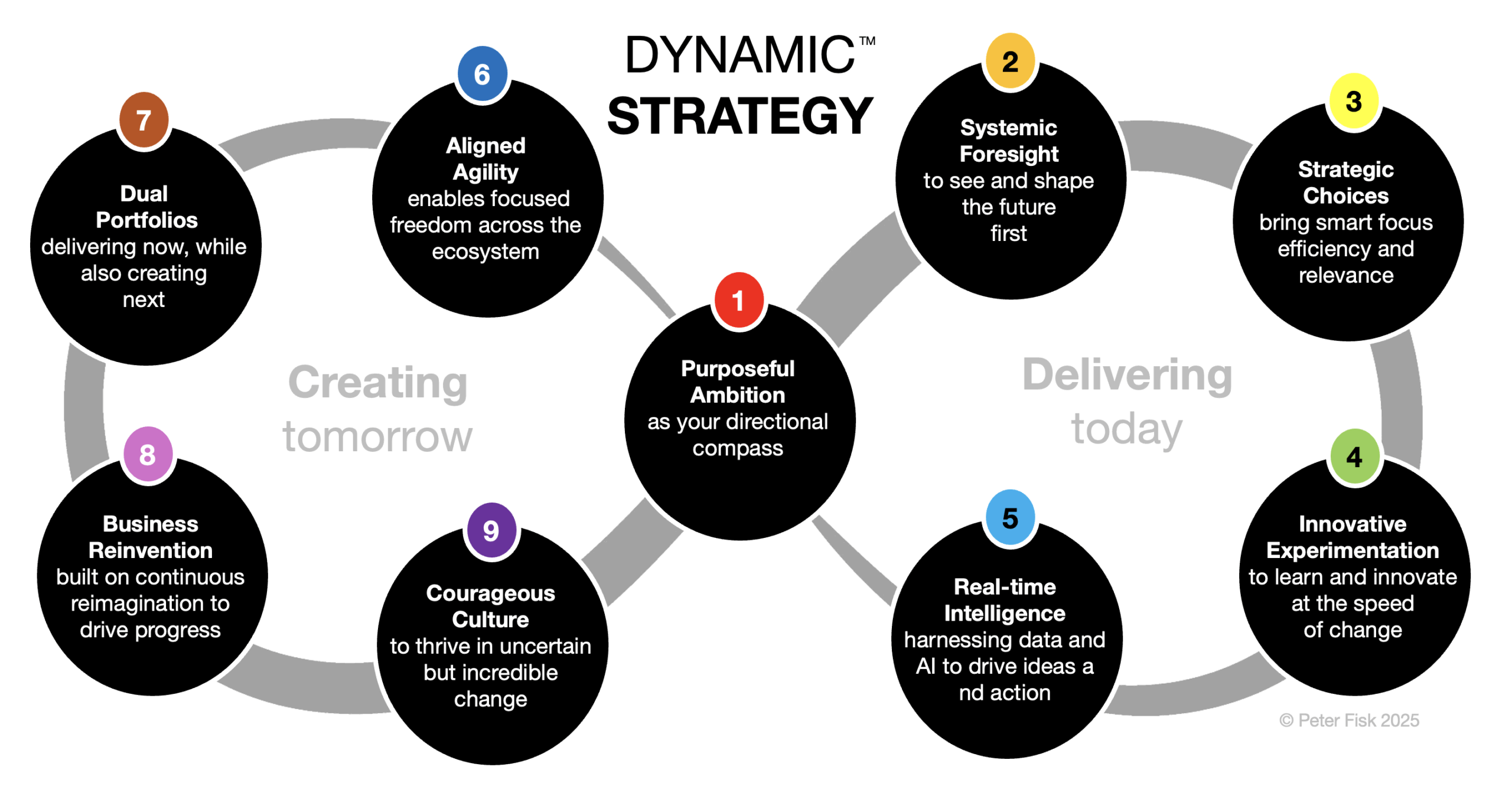
The concept of Dynamic Strategy
Dynamic Strategy is a proprietary methodology designed for today’s fast-moving world. It is not a single tool or document, but a comprehensive approach that integrates purpose, foresight, experimentation, data, and culture into a continuous feedback system. It enables business leaders to:
-
Sense change early and anticipate the best opportunities for innovation and growth.
-
Leap forwards with hypotheses, tested rapidly through experimentation.
-
Align resources and teams around purpose and values, but with freedom to deliver.
-
Balance exploitation of today’s business with exploration of tomorrow’s possibilities.
-
Integrate human imagination with AI-enabled intelligence to accelerate learning and progress.
Dynamic Strategy transforms strategy into a living capability, turning uncertainty from a threat into a source of competitive advantage.
10 principles of Dynamic Strategy
Dynamic Strategy rests on ten interconnected principles, each forming part of the DNA that enables organizations to thrive in complexity and uncertainty.
1. North Star: Inspired by purpose
In traditional strategy, purpose is often an afterthought, a line of rhetoric in a vision statement that rarely guides daily decision-making. In Dynamic Strategy, purpose is the anchor. It defines what matters most and provides coherence when everything else is in flux. Purpose is not about slogans, or short-term performance, it is about why the organisation exists, what it stands for, and how it delivers value to the world.
-
Microsoft: Satya Nadella’s articulation of Microsoft’s purpose “to empower every person and organisation on the planet to achieve more” became the anchor for the company’s transformation from software provider to cloud-first, AI-powered ecosystem. Purpose enabled coherence across business units, guiding investment, culture, and innovation.
-
DBS Bank: Piyush Gupta reinvented the bank of the future with an unexpected purpose, to “Live More, Bank Less” which transformed a conservative Asian bank into an agile, customer-centric powerhouse. Teams aligned behind this inspiring ambition, unlocking their creativity to innovate and grow, rather than do what every other bank does.
Dynamic purpose enables organisations to prioritise quickly, align teams globally, and make bold choices even in ambiguity. When purpose is clear, decision-making does not stall during uncertainty; instead, it accelerates, anchored in a shared ‘why’.
2. System Thinking: From plans to patterns
Where traditional strategy follows a linear process—analyse, decide, implement—Dynamic Strategy treats the organisation as a living system. It sees the company as a network of interdependent teams, processes, and experiments, all sensing and responding to the world in real time. Strategy is no longer a static plan but a pattern of evolving choices.
- Haier, for example, operates thousands of micro-enterprises under its Rendanheyi model. Each unit is empowered to sense customer needs, innovate independently, and iterate continuously. The corporation behaves less like a hierarchical machine and more like a living market, adaptive and aligned, capable of learning at scale.
-
Amazon’s “Always Day One” culture pervades the organisation, encouraging speed and creativity. Small “pizza” teams are empowered to make decisions, run experiments, and learn, forming an adaptive network that responds in real time to market shifts.
Decisions are continuous, emergent, and aligned with the shared purpose. This principle enables organisations to pivot rapidly, test multiple approaches simultaneously, and harness the collective intelligence of the system rather than relying on centralised, episodic decisions.
3. Perpetual Foresight: Seeing the future first
Traditional strategy assumes the future can be predicted and planned for. Dynamic Strategy assumes the future is uncertain and constantly evolving. Organisations must develop continuous foresight, not once a year but every day. This involves scanning for weak signals, modelling multiple scenarios, and actively exploring emerging opportunities and threats.
-
Shell: Scenario planning was originally developed by the Anglo-Dutch energy business, and has guided them through oil crises, renewables, and energy transitions for decades, turning foresight into strategic advantage. Scenario rooms in The Hague head office are constantly updated, and become the scenes for immersive strategic thinking.
-
Nvidia: Foresight informs product strategy and market entry, allowing them to anticipate shifts in energy, computing, and AI landscapes. This long term approach, typically focused on the markets of customers rather than just their own, enables them to great a more compelling future narrative, which inspires investors, and their share-prise.
-
Schneider Electric: Uses foresight to align sustainability initiatives with new technology adoption, creating early mover advantage in green energy markets. This has empowered its reinvention from equipment producer to energy management company, and to be continually ranked as the world’s most sustainable business.
Dynamic organizations don’t just react—they anticipate. The goal is not prediction—it is preparedness for multiple plausible futures, enabling rapid, informed action. Foresight also shapes resource allocation, investment decisions, and experimentation priorities.
4. Strategic Choices: Being smart, staying relevant
Strategy is, at its core, about choice. Traditional approaches often treat choices as final and unchanging. Dynamic Strategy treats them as hypotheses to be tested and refined. Choices are made, resources are allocated, and learning loops determine whether they remain valid or require adjustment. Dynamic Strategy treats choices as hypotheses, continuously tested and refined.
- Netflix provides a clear example. Its initial pivot from DVD rentals to streaming was only the first step. Subsequent moves into content production, gaming, and advertising illustrate a pattern of continual strategic recalibration, informed by data and experimentation.
- Fujifilm: As markets changed and disruptive new challenges emerged the Japanese business pivoted from film to healthcare to cosmetics, aligning strategic choices with emerging opportunities and core competencies. Skincare for example was a consequence of a capability in making thin films, previously for photographic imaging.
Dynamic strategic choices enable organisations to continually reassess “where to play and how to win” and thereby stay relevant, balance risk and reward, and evolve portfolio allocations with the market rather than reacting after disruption has occurred.
5. Experimentation Engine: Learning at the speed of change
Where traditional strategies often rely on analysis and committee approval, Dynamic Strategy embeds experimentation into the organisation’s DNA. An experimentation engine allows organisations to discover the future rather than predict it, accelerate innovation cycles, and reduce the cost of failure through controlled, evidence-based testing. Every initiative is treated as a hypothesis; every pilot generates evidence. Learning replaces assumption.
- Amazon exemplifies this principle. Bezos’s insistence on doubling experiments each year fuels innovation from Prime to AWS. Failures are expected and leveraged as insights. AI now amplifies this process, enabling rapid simulation, iteration, and predictive testing at scale.
-
Airbnb: Micro-experiments in pricing, search, and user experience drive constant adaptation and improved customer engagement. This was a behaviour championed by its founders who themselves pivoted many times in their early days, and was accelerated during Covid pandemic, when they had to quickly adapt to survive in a non-travelling world.
Dynamic organisations test rapidly, learn continuously, and scale successes. Experimentation, often supported and accelerated by AI, replaces assumption with evidence-driven strategy, enabling organisations to move faster and with higher confidence.
6. Data Pulse: Real-time intelligence for real-time strategy
raditional strategy often relies on lagging indicators—last quarter’s results, annual surveys, or delayed analytics. Dynamic Strategy thrives on real-time intelligence, continuously feeding operational, customer, and market data into decision-making loops.
-
Shopify: Uses live indicators for sales, engagement, retention, and supply chain performance, allowing decisions in real time across its entire ecosystem.
-
Uber: Dynamic pricing, routing, and service deployment are continuously updated based on a data pulse. AI integrates internal metrics with external signals, producing foresight in motion.
- Coca Cola: Starting with what’s happening in the real world, they actively monitor in real-time the posts and behaviours of consumers and merchants across the planet, able to instantly adapt demand, messages, promotions, pricing and more.
Strategy becomes a living conversation with the market, responsive to immediate changes and emergent trends. A strong data pulse allows organisations to sense trends as they emerge, make faster course corrections, and align resources dynamically rather than waiting for annual review cycles.
7. Aligned Agility: Focused freedom across the system
Dynamic Strategy balances freedom with focus. It requires organisations to balance autonomy with alignment. Traditional hierarchies can stifle speed, while completely decentralised approaches can fragment effort. It empowers teams to act with freedom while maintaining coherence with the organisation’s purpose and priorities.
-
Spotify’s model of “alignment with autonomy” allows squads to innovate independently but within a shared framework. These squads and tribes operate independently, innovating within the context of overarching objectives. Ideas are developed with more ownership, relevance, and impact.
-
DBS Bank: Employees co-create strategy through hackathons, jams, and digital workflows, aligning creativity with corporate purpose. They use creative catalysts – “What would Jeff Bezos do?” – “How can we be 10 times not 10% better?” – “Imagine if we were to the customer” – to continually rethink how to innovate and grow.
Aligned agility enables organisations to experiment, innovate, and adapt locally while maintaining global coherence, combining the best of decentralised initiative and centralised vision.
8. Dual Portfolios: Delivering today, creating tomorrow
Perhaps the most important tool is to manage the short and long-term initiatives of the business – to exploit the present and explore the future – not as a trade off, but to allocate resources effectively, and manage continuous progress. Developing two portfolios, typically one for 1-3 years, and the second beyond, means they can work dynamically:
-
Fujifilm exemplifies dual horizons. While exploiting its chemical and imaging expertise, it explored healthcare, regenerative medicine, and digital solutions, reinventing itself without abandoning its DNA. It actively manages both the exploit and explore portfolios to allocate resources, investments, and inspire investors.
-
PingAn has become much more than an insurance company – continuing to exploit that core business – but also explore new ventures – from healthcare to mobility and real estate – and its case by creating dual CEOs, one managing today, one managing tomorrow.
Dual horizon design allows organisations to deliver reliable results today while continuously investing in the future, reducing the risk of obsolescence and enabling sustained growth.
9. Reinvention Design: Continuous reimagination and renewal
Change can no longer be episodic. Dynamic organisations build reinvention into their rhythm. Innovation cycles, strategy sprints, and continuous improvement loops become permanent features, not one-off initiatives. They see themselves in “perpetual beta”, always evolving.
-
IKEA, through “democratic design” and circular supply chain experiments, continuously rethinks products, formats, and customer engagement. Renewal is no longer reactive, instead it is embedded, disciplined, and deliberate. Strategy and innovation become one.
-
Amazon: Constant re-evaluation of business units and experimentation enables continuous market adaptation. At a macro level, it becomes apparent how the business is evolving – from bookstore to everything store, business platform to market platform.
Reinvention by design ensures organisations never stagnate, continuously evolving to capture the new opportunities. This continuous cycle of reinvention, progress and growth means they shape markets, rather than just following them
10. Courageous Culture: Thriving in a world of uncertainty
Finally, strategy lives in people. Dynamic Strategy depends on a culture that values learning and transparency. Leaders admit uncertainty, invite exploration, and create psychological safety. It thrives on imagination, curiosity, and courage. Leaders model vulnerability, invite exploration, and replace fear with learning.
-
Schneider Electric’s approach of trust and empowerment at scale enables local teams to innovate while remaining aligned with global purpose. A courageous culture allows organisations to navigate uncertainty, embrace experimentation, and harness collective creativity as a competitive advantage.
-
Haier: Teams self-organize around customer needs, creating a culture of experimentation and ownership. Leaders at head office act more like VCs providing investment and guidance. This “rendanheyi” model unlocks more ownership, more creativity, more relevance, and collaboration, and more speed.
Dynamic organisations nurture people who think for themselves, challenge assumptions, and act decisively. AI may enhance intelligence, but it is human imagination that creates meaning and progress.

Dynamic Strategy in action
Dynamic Strategy is not theory. It is being practised, refined, and scaled by some of the world’s most dynamic companies, each using it to turn turbulence into transformation, to continually reimagine the future, and reinvent themselves.
Microsoft: Reinventing a tech giant
When Satya Nadella became CEO in 2014, Microsoft was still vast and profitable, yet widely seen as a relic of the past — a company defined by its legacy, not its future. Its products dominated the corporate world, but its spirit had stalled. Internal silos stifled collaboration, innovation was cautious, and culture had hardened around efficiency rather than exploration. The company that had once shaped the digital revolution now seemed to be standing still as new forces — Apple, Google, Amazon, and emerging start-ups — captured the imagination of the world.
Nadella’s arrival marked the beginning of one of the most remarkable corporate transformations of the century. His mission was not to fix Microsoft, but to reawaken it. He began by dismantling the silos that had divided product teams and mindsets for decades, replacing internal competition with shared purpose and open collaboration. The company’s mission was reframed from “a computer on every desk” to “empower every person and every organisation on the planet to achieve more.” This simple yet profound redefinition unlocked a new horizon — not about devices or software, but about human potential and digital possibility.
At the heart of this transformation lay the principles of Dynamic Strategy. Nadella recognised that Microsoft’s greatest challenge was not technological but cultural. Strategy, he believed, could no longer be a five-year roadmap delivered from the top; it had to be a living process that learned and evolved in real time. He replaced the company’s rigid planning cycles with shorter, iterative horizons. Teams were encouraged to experiment, collaborate across boundaries, and connect purpose to performance. Microsoft began to act like a networked ecosystem rather than a corporate fortress.
Purpose anchored the journey. Nadella championed empathy as a leadership value and curiosity as a strategic muscle. He frequently reminded teams that “our industry does not respect tradition — it only respects innovation.” The idea was not to chase competitors but to rediscover the company’s soul: a belief in empowering others through technology. This shift in mindset — from knowing to learning, from defending to exploring — became Microsoft’s new source of energy.
The growth mindset, inspired by psychologist Carol Dweck’s work and deeply embedded across the organisation, became both a cultural philosophy and a strategic tool. It replaced the old fixed mindset that prized optimisation and control with a living framework for continuous learning. Teams were encouraged to test ideas quickly, share feedback openly, and see mistakes as data rather than failure. The company that once feared change now designed for it.
This cultural reinvention laid the foundation for Microsoft’s technological and commercial transformation. Under Nadella, the company accelerated the evolution of Azure, its cloud platform, from a supporting service into the strategic backbone of global enterprise digitalisation. Azure’s open architecture, partnerships, and integration with AI positioned Microsoft as an indispensable partner in the world’s digital transformation — a shift from selling software to enabling ecosystems.
The pivot to AI and open collaboration exemplified Dynamic Strategy in action. Rather than seeing artificial intelligence as a side project, Nadella embedded it at the heart of the business. AI became a capability that every product and service could draw from — from Office 365 to GitHub Copilot to Dynamics. Microsoft’s acquisition of LinkedIn and partnership with OpenAI reflected this systemic approach: connecting platforms, data, and intelligence into a unified strategic network. The company’s bold move to integrate generative AI directly into its productivity suite — rebranding it as “Copilot for Everything” — not only reshaped the software landscape but redefined how humans and machines work together.
Nadella’s leadership was distinguished by its calm intensity. He led not with bravado but with belief — creating psychological safety that allowed experimentation to flourish. His ability to balance humility with ambition set a new tone across the organisation: strategy as learning, leadership as enablement. He famously described his role as “the curator of culture,” understanding that long-term advantage comes not from a single breakthrough but from building an environment where breakthroughs are continuous.
Foresight guided the journey. Microsoft stopped predicting the future and started building optionality — positioning itself at the intersections of emerging technologies rather than committing too early to any single path. The company’s investments in cloud infrastructure, developer ecosystems, AI research, and quantum computing illustrate this principle: each initiative designed to sense, adapt, and evolve in response to what emerges.
Experimentation accelerated everything. Thousands of micro-initiatives — from local innovation sprints to open-source collaborations — allowed Microsoft to learn faster than it grew. Its transformation into a platform company turned customers into co-creators, developers into partners, and competitors into collaborators. The result was a dynamic feedback loop: every product release, user interaction, and partner engagement fed insights back into the company’s learning system, reinforcing its adaptive capacity.
The outcome of this cultural and strategic renewal has been extraordinary. Microsoft’s market capitalisation has risen from around $300 billion to over $3 trillion, making it one of the world’s most valuable and admired companies. But the deeper success lies beneath the numbers — in the way Microsoft has redefined what enduring performance looks like in the digital era. It is no longer a company driven by plans and hierarchies, but by principles and possibilities. It no longer sees strategy as prediction, but as participation — a continuous dialogue between people, purpose, and technology.
Nadella’s Microsoft shows that reinvention is not an event but a habit — the disciplined practice of curiosity, empathy, and imagination applied at scale. Its story demonstrates that Dynamic Strategy is not about speed alone, but about rhythm — the rhythm of sensing, learning, adapting, and renewing. Microsoft became a company that learns faster than it grows, and in doing so, it grew further than anyone imagined.
DBS Bank: Making banking invisible
In Singapore, DBS has transformed itself from a bureaucratic state-owned institution into one of the world’s most admired and dynamic financial innovators. Once known as the “Development Bank of Singapore,” the organisation was structured for stability, not speed — focused on compliance, not creativity. But under the leadership of CEO Piyush Gupta, DBS embarked on a remarkable reinvention that redefined what a bank could be in the digital age.
At the heart of this transformation lies a bold guiding idea: “Live More, Bank Less.” Far more than a marketing slogan, it became the North Star for every strategic decision, innovation, and cultural shift within the company. Gupta’s vision was to make banking so intuitive, seamless, and integrated into people’s lives that it would disappear into the background — allowing customers to focus on living, rather than managing their finances. In his words, “people don’t want to do banking; they want to buy a home, travel, build a business, and secure their future.” The role of DBS, therefore, was to remove friction from these experiences — to humanise finance through technology and empathy.
To realise that ambition, DBS had to transform not just its technology but its operating system — the way it thought, worked, and learned. Gupta and his leadership team introduced a new rhythm of Dynamic Strategy, built around adaptability, experimentation, and co-creation. The bank shifted from long-term planning cycles to continuous iteration: short “strategy sprints” where cross-functional teams would test, learn, and scale new ideas rapidly. These teams were empowered to act like start-ups within the bank, each focused on solving specific customer problems — from digital onboarding to wealth management and SME lending.
DBS also built a data-driven nervous system, enabling real-time insight into customer behaviour, operational performance, and emerging risks. This intelligence infrastructure allowed the bank to sense change early and respond faster than competitors — whether through personalised digital experiences, instant credit decisions, or predictive fraud detection. By combining analytics with human-centred design, DBS created products that feel effortless: mobile apps that anticipate needs, chatbots that resolve issues instantly, and APIs that connect banking to the wider ecosystem of travel, commerce, and lifestyle.
Crucially, the transformation was cultural as much as technological. Gupta often described DBS’s journey as moving from “the biggest bank in Singapore” to “the best start-up in Asia.” He dismantled hierarchy, encouraged openness, and made curiosity a strategic asset. The bank adopted agile working principles long before they became fashionable in finance, embedding experimentation into everyday behaviour. Failure was reframed as learning; success was measured not only by profit but by progress — how fast teams could sense, respond, and improve.
This culture of dynamic learning fuelled an extraordinary performance turnaround. DBS became the first bank to be named World’s Best Bank by three major institutions — Euromoney, Global Finance, and The Banker — all within the same year. Its profitability reached record levels, even as it reduced cost-to-income ratios and dramatically increased digital adoption across its customer base. During the COVID-19 crisis, DBS was able to deploy emergency financial solutions and new digital services in weeks, not months — a testament to its adaptive capabilities.
One striking example of Dynamic Strategy in action was DBS’s move into ecosystem partnerships. Instead of building every service in-house, the bank opened its platforms to collaborate with fintechs, start-ups, and consumer brands. Through open APIs and co-creation labs, DBS connected banking to daily life — enabling customers to book travel, make purchases, invest, or even donate directly within their digital environments. This shift from closed systems to open ecosystems allowed the bank to innovate faster and scale more broadly, extending its reach without losing its human focus.
The results are both quantitative and qualitative. Customer satisfaction scores have soared. Employee engagement has deepened. Innovation has become a collective sport rather than a specialist function. Gupta calls this “the joy of banking”— not for the bank, but for its customers and people. Every process, product, and platform is designed around a simple premise: if it feels effortless, we’ve done our job.
DBS today embodies what Dynamic Strategy enables: a living organisation that continuously learns, experiments, and evolves in rhythm with its environment. It no longer waits for direction from the top or for certainty from the market. It acts, learns, and leads differently — turning data into empathy, purpose into performance, and adaptability into enduring advantage.
DBS’s story shows that transformation is not reserved for technology companies or start-ups. It is possible — and powerful — in the most traditional sectors when leadership reimagines the role of strategy itself. By making banking invisible, DBS made progress visible — proving that when an organisation aligns its purpose with its people, platforms, and principles, it doesn’t just adapt to the future; it helps create it.
Fujifilm: The science of endless possibilities
Fujifilm’s journey from near-death to rebirth stands as one of the most profound and enduring corporate reinventions in modern history. When the digital revolution disrupted the photographic industry in the early 2000s, most observers assumed the company’s fate would mirror that of its great rival, Kodak. Film was vanishing, and with it the entire foundation of Fujifilm’s century-old business model. But instead of retreating, Fujifilm reimagined itself — not as a photography company struggling to survive, but as a science company with endless possibilities for renewal.
This shift required more than diversification; it demanded a radical reframing of identity. The leadership team asked a simple but transformative question: What are we truly good at? The answer lay not in cameras or film rolls, but in chemistry, materials science, and the molecular technologies that underpinned the company’s photographic expertise. Fujifilm’s scientists had spent decades perfecting the manipulation of light-sensitive compounds, polymers, and collagen-based coatings — capabilities that turned out to be equally valuable in healthcare, life sciences, and high-performance materials. By seeing itself as a platform of capabilities rather than a product manufacturer, Fujifilm unlocked a new horizon of growth.
The company’s Dynamic Strategy was not about predicting where the world was heading, but about building the adaptive capacity to shape it. Fujifilm established a dual-horizon model: one horizon focused on maintaining the profitability of its imaging and optical technologies — a source of cash flow, heritage, and brand equity; the other dedicated to pioneering entirely new frontiers in healthcare, biotechnology, and advanced materials. This duality was not a compromise but a design principle: using today’s strengths to invest in tomorrow’s breakthroughs.
Out of this approach emerged a series of bold strategic moves. Fujifilm applied its expertise in collagen — once used in photographic film — to develop anti-ageing cosmetics and regenerative medical treatments. Its chemical know-how led to the creation of membranes for water purification and pharmaceutical production. The company invested in medical imaging, diagnostic systems, and contract drug manufacturing, culminating in Fujifilm Diosynth Biotechnologies — now a global leader in biopharmaceutical production. In doing so, Fujifilm turned what was once seen as industrial decline into a platform for health, life, and sustainability.
Crucially, the company maintained its connection to its heritage without being trapped by it. Its imaging business evolved into high-end digital photography, professional printing, and optical equipment for cinema and medicine. Rather than abandoning its roots, Fujifilm reinterpreted them through a modern lens — preserving identity while expanding purpose.
Under the leadership of Shigetaka Komori, this transformation became both philosophical and structural. Komori instilled a culture of kaizen (continuous improvement) fused with entrepreneurial experimentation. He encouraged teams to act like start-ups inside the company, challenging old assumptions and testing new ideas rapidly. Instead of waiting for certainty, Fujifilm learned to move with curiosity, confidence, and conviction — the essence of Dynamic Strategy in practice.
The results have been remarkable. While Kodak filed for bankruptcy, Fujifilm not only survived but thrived. Its revenue base is now more diversified and resilient than ever, with healthcare and high-functional materials accounting for the majority of its profits. Its imaging division continues to grow, not as nostalgia, but as a creative platform connecting art, science, and innovation. The company’s stock price and global presence have multiplied, but more importantly, it has redefined what reinvention means: a continuous process of learning, recombining, and regenerating.
Fujifilm’s story reveals that the most powerful strategy is not to predict the future, but to build one — through imagination, science, and disciplined adaptability. Its transformation is proof that legacy need not be a burden; it can be a source of renewal. In the age of disruption, Fujifilm embodies what Dynamic Strategy makes possible: an organisation that learns faster, adapts deeper, and creates new worlds from the remnants of the old.
Schneider Electric: Leading the green energy transition
Schneider Electric’s Dynamic Strategy brings together sustainability, digitalisation, and decentralisation into a single, coherent narrative — one that evolves continuously rather than being fixed in annual plans or top-down directives. For Schneider, strategy is not a document but a living system — powered by data, driven by purpose, and refined through constant learning at every level of the organisation.
At its core, Schneider’s purpose — to empower all to make the most of our energy and resources — serves not as a slogan but as the organising principle of how it operates. This purpose translates directly into operational logic: every product, platform, and partnership is measured by its contribution to efficiency, resilience, and sustainability. Instead of asking, “How do we grow?” Schneider asks, “How do we enable our customers to do more with less?” That shift — from self-interest to shared progress — turns strategy into an evolving commitment rather than a static ambition.
The company’s approach is deeply data-driven. Through real-time intelligence systems, connected sensors, and advanced analytics, Schneider gathers insights from factories, buildings, grids, and data centres across the world. These feedback loops allow teams to see, measure, and improve energy performance instantly — transforming information into action. Strategic decisions are now modular and iterative, built on living dashboards rather than fixed forecasts. This enables the company to adjust direction quickly, optimise resources dynamically, and co-create new solutions with customers in real time.
What makes Schneider’s model especially powerful is its decentralised execution. Rather than relying on central control, Schneider operates through a network of empowered local teams — each with the autonomy to adapt strategies to regional markets, regulatory shifts, and customer needs. These teams act as nodes in a larger system, connected by shared data platforms and a clear sense of purpose. In India, for example, Schneider has pioneered microgrid innovations for rural electrification; in Europe, it leads industrial decarbonisation projects; in North America, it partners with tech firms to build energy-efficient data centres. Each initiative is local in action, yet global in alignment.
This dynamic interplay between purpose, data, and decentralised decision-making has fuelled both growth and transformation. Over the past decade, Schneider has more than doubled in size, expanded its digital services portfolio, and emerged as a benchmark for environmental leadership. Its EcoStruxure platform — a digital architecture that connects everything from sensors to cloud analytics — has become the backbone of its adaptive strategy, enabling both operational agility and customer innovation.
Schneider’s story demonstrates that adaptability and responsibility are not opposites but allies. Its evolution shows how a business can be both profitable and planetary, both dynamic and disciplined. By embedding sustainability at the heart of its strategy system — not as a department or initiative but as a living principle — Schneider has redefined what performance means in the modern age: not only to deliver results, but to renew relevance, resilience, and impact every day.
Haier: Ecosystems of smarter living
Haier’s rendanheyi model represents Dynamic Strategy taken to its ultimate form, a living, breathing ecosystem of entrepreneurial energy. What began as a Chinese refrigerator manufacturer has evolved into one of the world’s most radical organisational experiments: thousands of micro-enterprises, each guided by shared purpose and enabled by digital platforms, operating with complete autonomy.
At the heart of Rendanheyi lies a profound shift in the relationship between people and the organisation. Ren refers to the employee, Dan to user value, and Heyi to their seamless integration. Every individual or small team acts as a mini-entrepreneur, directly accountable to customers, measured not by hierarchical goals but by the real impact they create in the market. This creates a system where initiative, not instruction, drives progress — where innovation arises naturally from those closest to the opportunity.
Haier doesn’t rely on a single corporate strategy. Instead, it hosts thousands of micro-strategies — each a dynamic response to specific user needs, emerging trends, or local contexts. The company’s central platforms provide the shared infrastructure — data, finance, technology, and talent marketplaces — that allow these micro-enterprises to experiment, connect, and scale. When one succeeds, it attracts more talent and resources; when one fails, it dissolves quickly and its learning is shared.
The result is an organisation that evolves organically, like a living ecosystem. Haier can incubate a new business in days, partner with external innovators seamlessly, and pivot entire networks of teams around new opportunities. Its refrigerator division, for instance, operates as an open innovation hub co-developing smart appliances with users. Its COSMOPlat platform, meanwhile, has become a standalone industrial IoT ecosystem used by thousands of other manufacturers — transforming Haier from a producer of goods into an orchestrator of value networks.
Haier demonstrates that strategy is no longer about control; it’s about creating the conditions for emergence. The role of leadership is not to plan every move, but to design the ecosystem — to set the purpose, build the platforms, and trust in the adaptive intelligence of people.
What makes Haier’s model so powerful is not only its agility but its humanity. It empowers individuals to act like owners, connects their passions with customer value, and transforms hierarchy into harmony. In doing so, Haier has shown that the future of strategy may not be a grand plan at all — but an evolving choreography of purpose, freedom, and collaboration at scale.
Leading as Performer Transformers
These examples show how Dynamic Strategy changes what strategy is. It is not a plan written by a few for the many to follow—it is a living system enacted by everyone. It’s not about predicting the future but becoming future-ready. It turns uncertainty into advantage, speed into learning, and disruption into possibility.
Organisations that embrace Dynamic Strategy think differently. They act faster. They grow smarter. And most importantly, they build resilience not through defence, but through dynamic coherence—the ability to stay true to purpose while continuously evolving form.
To lead in this world requires a new kind of leader, a “Performer Transformer”. These leaders exploit and explore, they balance delivery with discovery, discipline with imagination. They lead not by command, but by curiosity. They see the world as unfinished, strategy as evolving, and leadership as the art of enabling others to act with purpose and freedom.
They understand that the future will not be managed into existence—it must be imagined, tested, and built. Dynamic Strategy gives them the tools to do exactly that.
Strategy has always been about choice. But in the age of acceleration, the ultimate choice is this: Do we cling to the stability of plans, or do we embrace the vitality of change?
Dynamic Strategy invites you to choose the future, to choose change – to think dynamically, act boldly, and lead with imagination in a world that never stops moving.

The Dynamic Strategy Toolkit
The old tools of strategy, planning, innovation, and delivery are no longer fit for purpose. Dynamic strategy requires a new toolkit, new behaviours and practices, and overall process.
This Dynamic Strategy Toolkit provides a comprehensive suite of frameworks, tools, and approaches to help leaders navigate this dual imperative. Drawing on insights from Mintzberg, Tushman & O’Reilly, Christensen, Osterwalder, and contemporary agile and AI practices, the toolkit covers mindset, strategy, innovation, organisation, execution, learning, culture, and technology. Designed for senior executives, it offers practical processes and deliverables that transform strategic intent into actionable, adaptive, and measurable initiatives, enabling organisations to thrive in both today’s challenges and tomorrow’s opportunities.
There are over 60 tools, grouped as follows. You don’t need all of them, its about working out what is right for your organisational challenges and culture behaviours, and then how they flow together:
-
Dynamic Mindset Tools
-
Direction and Narrative Tools
-
Diagnostic Tools
-
Strategic Choice and Design Tools
-
Alignment and Execution Tools
-
Learning and Adaptation Tools
-
Culture and Behaviour Tools
-
Technology and Data-Enabled Strategy Tools
1. Dynamic Mindset Tools
1.1 Emergent Strategy Lens
Origin: Developed by Henry Mintzberg at McGill University (1970s–1990s), this framework challenged the notion of strategy as a fixed plan.
Role: Establishes the mindset that strategy is both planned and emergent. Used early to help leaders understand that real strategy often differs from intended strategy.
Process:
- Map the organisation’s intended strategy (plans, goals, roadmaps).
- Observe actions and initiatives that diverge from plans.
- Identify patterns of emergent behaviour.
- Compare intended vs. realised outcomes.
Deliverables: Visual map of intended vs. realised strategy, insights on emergent patterns, identification of gaps and adaptation points.
1.2 IDER Tracker (Intended → Dropped → Emerging → Realised)
Origin: Practical extension of Mintzberg’s model, designed for corporate strategy tracking.
Role: Tracks the evolution of strategic initiatives, clarifying which elements are retained, dropped, or newly emergent. Critical for continuous strategy monitoring.
Process:
- List all strategic initiatives.
- Categorise each as Intended, Dropped, Emerging, or Realised.
- Analyse reasons for dropping or emergence.
- Update the portfolio based on insights.
Deliverables: IDER dashboard showing initiative status, reasons for change, and emergent opportunities.
1.3 Ambidextrous Balance (Exploit & Explore)
Origin: Developed by Charles O’Reilly & Michael Tushman at Stanford/Harvard (1996+).
Role: Balances exploitation of current operations with exploration of new opportunities. Guides leadership mindset and organisational design.
Process:
- Identify core operations (exploit) and innovation/adjacent initiatives (explore).
- Allocate leadership focus and resources accordingly.
- Ensure structural and cultural support for dual focus.
Deliverables: Organisational map showing exploit vs explore activities, resource allocation plan, leadership alignment.
1.4 S-Curve Mapping
Origin: Derived from technological evolution theory; popularised by Richard Foster and Clayton Christensen.
Role: Visualises growth trajectories of products, technologies, or business units, highlighting when renewal or transformation is required.
Process:
- Plot historical performance over time.
- Identify plateau points or declining trends.
- Analyse triggers for next-curve investment.
Deliverables: S-curve charts, timing recommendations for strategic renewal or innovation investment.
2. Direction and Narrative Tools
2.1 Strategic North Star (Purpose, Vision, Mission)
Origin: Inspired by management classics (Drucker) and modern refinements (Collins & Porras).
Role: Provides the organisation’s guiding direction and inspiration for both operational efficiency and innovative exploration.
Process:
- Define organisational purpose (why the organisation exists).
- Develop vision statement (desired future state).
- Clarify mission (how the organisation operates today).
Deliverables: Aligned purpose, vision, and mission statements communicated across the organisation.
2.2 Storytelling Engine
Origin: Inspired by Denning, Simmons, and Sinek.
Role: Converts abstract strategy into compelling narratives that drive engagement and alignment across teams.
Process:
- Craft stories illustrating purpose, vision, and strategic pillars.
- Identify key stakeholder audiences and tailor messaging.
- Integrate stories into meetings, presentations, and communications.
Deliverables: A suite of narrative materials, presentations, and communications tools.
2.3 Pillars Framework
Origin: Contemporary strategic planning practice.
Role: Breaks strategy into clear, actionable pillars, linking objectives, initiatives, and outcomes.
Process:
- Identify 3–6 core strategic pillars.
- Assign objectives and key initiatives under each pillar.
- Communicate pillars and link them to individual and team KPIs.
Deliverables: Pillar map with initiatives and measurable objectives.
3. Diagnostic Tools
3.1 Congruence Checker
Origin: Developed at Columbia Business School, Nadler and Tushman
Role: Diagnoses alignment between strategy, culture, structure, and people, identifying friction points and misalignment.
Process:
- Map strategy, structure, people, and culture.
- Identify gaps, misalignments, or friction points.
- Develop corrective action plans to resolve misalignment.
Deliverables: Organisational congruence report with actionable interventions.
3.2 Must-Win Battles Focus
Origin: INSEAD research, Hägglund & Doz.
Role: Identifies critical priorities that will determine the organisation’s success in the short- and medium-term.
Process:
- List all strategic priorities.
- Select top 3–5 must-win battles.
- Assign accountability and metrics for each.
Deliverables: Prioritised battle list, responsibility matrix, and performance tracking dashboard.
3.3 Systems & Synergies Lens
Origin: Systems thinking principles, Prahalad & Hamel’s core competencies framework.
Role: Reveals interdependencies across units, value chains, and ecosystem partners to identify leverage points.
Process:
- Map key business units, products, or partners.
- Identify synergy opportunities and risks.
- Recommend integrated initiatives for cross-unit value creation.
Deliverables: Synergy map, integration opportunities, and strategic recommendations.
3.4 Complexity Radar (Cynefin, Weak Signals)
Origin: Developed by Dave Snowden (Cynefin) and Karl Weick (weak signals).
Role: Guides decision-making based on the complexity and uncertainty of the environment, distinguishing between simple, complicated, complex, and chaotic domains.
Process:
- Categorise business challenges into domains.
- Identify weak signals or early indicators of change.
- Determine planning vs. experimentation approaches per domain.
Deliverables: Complexity assessment report with action guidelines for different domains.
4. Strategic Choice and Design Tools
4.1 Strategic Dialogue Mapper
Origin: Inspired by Shell Scenarios (Pierre Wack) and modern facilitation practices.
Role: Integrates top-down strategic intent with bottom-up insights to ensure all perspectives inform decision-making.
Process:
- Convene cross-functional dialogues involving key stakeholders.
- Capture questions, options, and evidence using structured mapping.
- Identify converging priorities and areas of divergence.
- Synthesize insights into actionable strategic choices.
Deliverables: Dialogue map highlighting consensus, divergences, and priority areas for strategic action.
4.2 Business Model Canvas Designer
Origin: Alexander Osterwalder & Yves Pigneur (Strategyzer).
Role: Visualises, tests, and iterates on business model assumptions, providing a clear framework for innovation and growth.
Process:
- Map key components: value proposition, customer segments, channels, resources, partners, revenue streams, and cost structure.
- Identify assumptions and test them through pilots.
- Iterate based on feedback and market learning.
Deliverables: Business model canvas diagram, validated hypotheses, and improvement plan.
4.3 Infinity Loop Strategy
Origin: McKinsey digital practice and iterative strategy approaches.
Role: Treats strategy as a continuous learning cycle rather than a one-off plan, allowing rapid adaptation.
Process:
- Generate insights from market and internal performance data.
- Deploy actions and initiatives.
- Capture feedback, evaluate outcomes, and adjust strategy.
- Repeat the cycle continuously.
Deliverables: Iterative strategic dashboard, cycle metrics, and continuous improvement plan.
4.4 Three Horizons Portfolio
Origin: McKinsey & Sharpe (1990s).
Role: Balances core business (Horizon 1), adjacent opportunities (Horizon 2), and future growth engines (Horizon 3).
Process:
- Classify initiatives across the three horizons.
- Allocate resources proportionally.
- Track performance and adjust investment dynamically.
Deliverables: Horizon portfolio map, resource allocation plan, and horizon-specific KPIs.
4.5 Dual Transformation Guide
Origin: Nagji & Tuff, Harvard; Anthony, Innosight.
Role: Supports organisations in strengthening the core business while simultaneously creating new growth engines and linking the two.
Process:
- Identify core business (Transformation A).
- Identify adjacent or new growth opportunities (Transformation B).
- Establish capabilities and processes to link A and B effectively.
Deliverables: Transformation roadmap, resource allocation map, and integration blueprint.
4.6 Strategy Guardrails
Origin: Derived from military doctrine and corporate risk management principles.
Role: Provides boundaries for autonomous teams while preserving the integrity of the core business.
Process:
- Define non-negotiables, risk limits, and decision boundaries.
- Communicate guardrails across teams and functions.
- Monitor adherence and adjust where necessary.
Deliverables: Guardrail matrix, compliance monitoring tools, and risk dashboards.
5. Alignment and Execution Tools
5.1 Catchball
Origin: Toyota Production System
Role: Aligns top-down objectives with bottom-up planning, ensuring organisation-wide engagement and accountability.
Process:
- Define breakthrough objectives and key goals.
- Teams propose aligned action plans.
- Iterate using “catchball” feedback loops to refine plans.
Deliverables: Aligned strategic plan, team-level action sheets, and accountability mapping.
5.2 Cascade Logic Map
Origin: Kaplan & Norton, Balanced Scorecard.
Role: Translates strategy into actionable objectives, initiatives, and KPIs for clear organisational alignment.
Process:
- Break down strategy into objectives.
- Map initiatives to objectives.
- Assign KPIs and responsible teams for each initiative.
Deliverables: Visual alignment map, accountability dashboard, and performance tracking.
5.3 Capital Allocation Matrix
Origin: Influenced by Warren Buffett and private equity capital allocation practices.
Role: Links financial resources to strategic priorities with staged investment flexibility.
Process:
- Identify strategic priorities and initiatives.
- Allocate budgets with staged or milestone-based approvals.
- Monitor results and reallocate as outcomes unfold.
Deliverables: Capital allocation plan, financial dashboards, and decision logs.
5.4 KPIs & OKRs Engine
Origin: Andy Grove (Intel) and modern OKR practices (John Doerr).
Role: Tracks organisational performance, drives focus, and ensures alignment to strategic priorities.
Process:
- Consider the value added of the activity, what is the real purpose and role?
- Define objectives and measurable outcomes as key results.
- Align teams with KPIs.
- Review progress regularly and adjust targets as needed.
Deliverables: OKR dashboards, performance reports, and alignment heatmaps.
5.5 Rolling Wave Planner
Origin: Project and program management methodology.
Role: Plans the near-term in detail while keeping the long-term flexible, enabling agility.
Process:
- Break planning into short-, medium-, and long-term waves.
- Detail immediate tasks while outlining broader goals loosely.
- Review regularly and adjust based on progress and new insights.
Deliverables: Rolling wave plan, updated milestones, and agility indicators.
6. Learning and Adaptation Tools
6.1 Learning Loops (PDCA, OODA, Build-Measure-Learn)
Origin: Derived from W. Edwards Deming’s PDCA cycle, John Boyd’s OODA loop, and Eric Ries’ Lean Startup methodology.
Role: Enables continuous iterative improvement and adaptation by embedding learning into execution cycles.
Process:
- Plan / Build: Design initiatives or experiments.
- Execute / Measure: Implement actions and capture results.
- Analyze / Learn: Evaluate outcomes against expectations.
- Adjust & Repeat: Refine strategy or tactics based on learning.
Deliverables: Continuous learning dashboards, experiment reports, and adaptation plans.
6.2 Discovery-Driven Planning
Origin: Developed by Rita McGrath.
Role: Provides assumptions-based planning for initiatives in uncertain or highly dynamic environments.
Process:
- Identify key assumptions and potential risks.
- Construct reverse-income statement plans based on assumptions.
- Test assumptions through pilot projects or experiments.
- Adjust strategy and resource allocation based on validated learning.
Deliverables: Validated assumption lists, risk-adjusted plans, and early-stage initiative recommendations.
6.3 Experimentation Lab
Origin: Popularised by Lean Startup and corporate innovation labs.
Role: Validates ideas rapidly and inexpensively, uncovering emergent opportunities before large-scale investment.
Process:
- Define hypotheses or innovation concepts.
- Run small-scale experiments and prototypes.
- Measure results, learn, and iterate.
- Decide on scaling, pivoting, or terminating ideas.
Deliverables: Experiment reports, validated ideas, innovation pipeline recommendations.
6.4 Dynamic Capability Tracker
Origin: David Teece’s work on dynamic capabilities.
Role: Tracks an organisation’s ability to sense, seize, and transform in response to changing markets and technology.
Process:
- Assess sensing capabilities through market intelligence and trend monitoring.
- Review seizing capacity (decision-making, resource allocation).
- Evaluate transformation readiness (culture, processes, and leadership).
- Plan capability-building initiatives where gaps exist.
Deliverables: Dynamic capability assessment, capability-building roadmap, and performance metrics.
6.5 S-Curve Renewal Planner
Origin: Technological renewal theory, adapted from research by Foster and Christensen.
Role: Guides the timing for radical shifts, diversification, or next-generation investment.
Process:
- Map historical performance trajectories of products, services, or business units.
- Identify plateau points and triggers for next-curve investment.
- Allocate resources and plan transitions proactively.
Deliverables: Renewal roadmap, investment timing recommendations, and transformation plan.
7. Culture and Behaviour Tools
7.1 Alignment Triangle (Strategy – Culture – Leadership)
Origin: Organisational design principles and culture theory.
Role: Ensures strategy is embedded in behaviours, leadership actions, and organisational norms.
Process:
- Assess alignment between strategy, culture, and leadership behaviours.
- Identify gaps or misalignments.
- Recommend interventions to reinforce desired behaviour and values.
Deliverables: Alignment assessment report, behavioural interventions, leadership development plan.
7.2 Change Management
Origin: Organisational change research (Prosci Adkar, John Kotter, William Bridges).
Role: Manages human adoption of strategic initiatives to ensure change is sustained.
Process:
- Assess readiness and gaps in capability and mindset.
- Design interventions tailored to different groups.
- Monitor adoption metrics and adjust initiatives as needed.
Deliverables: Change management plan, adoption dashboards, and communication toolkits.
7.3 Behavioural Nudges
Origin: Richard Thaler & Cass Sunstein, behavioural economics.
Role: Shapes choices and behaviour in alignment with organisational strategy through subtle cues, incentives, or defaults.
Process:
- Identify critical behaviours needed for strategic outcomes.
- Design nudges, incentives, or choice architecture to encourage desired behaviours.
- Monitor effectiveness and refine interventions.
Deliverables: Nudge interventions, behavioural metrics, and impact reports.
7.4 Cultural Archetype Map
Origin: Edgar Schein, organisational culture theory.
Role: Reveals underlying assumptions, norms, and values that enable or block strategic objectives.
Process:
- Map observable artefacts, behaviours, and beliefs.
- Analyse alignment or gaps with strategic intent.
- Recommend interventions to reinforce desired cultural traits.
Deliverables: Cultural archetype map, gap analysis, and intervention plan.
8. Technology and Data-Enabled Strategy Tools
8.1 Data-Infused Strategy Engine
Origin: Emerging AI-driven strategy and analytics practices.
Role: Uses AI and analytics to detect trends, model scenarios, and optimise strategic decision-making.
Process:
- Integrate internal and external organisational data sources.
- Run predictive analytics, simulations, and scenario modelling.
- Feed insights into strategy cycles for decision-making.
Deliverables: Predictive dashboards, scenario simulations, and actionable recommendations.
8.2 Digital Twin Simulator
Origin: Engineering and Industry 4.0.
Role: Creates a virtual model of business processes, products, or markets to test strategic decisions in a simulated environment.
Process:
- Develop digital twin representing relevant business or operational systems.
- Simulate strategic changes, shocks, or new initiatives.
- Analyse outcomes to inform real-world decisions.
Deliverables: Simulation results, risk assessments, and optimisation recommendations.
8.3 AI-Augmented Ambidexterity
Origin: Emerging digital strategy practice combining AI and ambidextrous management principles.
Role: Accelerates dual strategy by optimising core operations (exploit) and guiding human-led exploration (explore).
Process:
- Deploy AI to optimise efficiency and decision-making in core business operations.
- Use AI insights to inform exploration of new growth opportunities.
- Integrate learning from both streams into iterative strategy cycles.
Deliverables: Operational optimisation reports, new growth opportunity insights, and integrated AI-human decision workflows.
Overview
This Dynamic Strategy Toolkit unites over 50 years of strategic thinking—from Mintzberg’s emergent lens to AI-driven adaptive planning—into a coherent, actionable framework. Each tool has a clear origin, role, process, and deliverable, and together they provide organisations with the ability to sense, adapt, execute, and renew continuously.
By following the logical sequence—from mindset foundations, direction, diagnosis, choice, execution, learning, cultural embedding, to technology-enabled strategy—leaders can navigate uncertainty, align teams, and sustain competitive advantage in fast-changing markets.
© Peter Fisk 2025
More from Peter Fisk
- Eyes on Tomorrow: What Leaders Must See before Everyone Else … exploring the most important megatrends that are transforming markets, and leadership mindsets, and how the best companies embrace them as opportunities … based on the new Megatrends 2035 report by Peter Fisk, and its implications for every business.
- The Reinvention Playbook: Thriving in a World of Relentless Change … the best organisations seek to continually reinvent themselves in a world of constant, uncertain and dynamic change. They rethink, refocus, and reinvent everything – embracing new agendas from AI to GenZ, climate change and social inequality.
- The Nexus Effect: Unlocking the Power of Connections … How can businesses and brands really unlock the power of data and networks, flywheels and AI, communities and ecosystems, to transform their futures?
- The New Growth Playbook: 9 New Ways to Accelerate Growth … many companies struggle to find new ways to grow their business … instead we look at how the best companies find radically new ways to grow.
- Super Innovators: Innovation Beyond the Normal … 10 radical ways to disrupt conventions, embrace deeper insights, unlock valuable assets, and stretch innovation for more dramatic impact.
- Consumer of the Future … “Aisha blinked twice, the smart lenses in her eyes had already scanned her biometric mood, cross-checked her carbon budget, and pulled up items her climate-positive friends were buying this week”
- Competing in the FLUX: How to develop a dynamic strategies in a world of relentless change … combining a strong, enduring direction with micro-moves that adapt quickly to emerging shifts:
- Business Transformation: The new superpower of business leaders … reimagining the future, redefining strategy, reinventing the organisation, rewiring performance … the journey to deliver step change in value creation.
- The Sustainable Consumer: Go on, do the Right Thing … how brands can accelerate the consumer shift to sustainable products and practices … from food and fashion, to energy and electric cars, making sustainability desirable and better.
- The “Performer Transformer” Leaders: How great leaders deliver today and create tomorrow … with dual thinking, to build dynamic ambidexterity, continually strategyzing, to perform and transform.
- The Hire-Wire Act of Leadership: Leading in a world of intense competition and relentless change … being visionary and innovative, learning to adapt and endure … inspired by Taylor Swift, Roger Federer, Beyoncé, and Lionel Messi
- Becoming a Future-Ready Business … in a world of relentless change, organisations need to anticipate change, embrace innovation, empower talent, and align deeply with the evolving needs of society and the planet
- Download my keynote, and new mini-book The Nexus Effect
Business has always been about relationships. From the earliest merchants in Mesopotamian markets to the industrial giants of the twentieth century, success was determined by who could connect supply and demand most effectively. Yet in today’s hyper-networked, digital-first world, connections matter in ways that are far more complex, pervasive, and valuable than ever before.
The twenty-first century economy is no longer defined by the simple transaction of product for price, but by ecosystems of value, experiences, and services that bind customers and companies together in ongoing relationships. The companies that thrive are those that don’t merely sell things, but create webs of connection — to customers, between products, across services, and through communities. This is the essence of what I call the Nexus Effect.
The Nexus Effect
A nexus is a focal point, a hub, or a set of connections that give meaning and power. In business, the nexus represents how companies integrate multiple touchpoints, technologies, and experiences to form a network that is greater than the sum of its parts. It is about creating systems in which customers are not one-time buyers but ongoing participants — members, subscribers, creators, fans, or even co-owners of the brand journey.
The most successful businesses today understand that value creation no longer ends at the point of purchase. Instead, it extends across the entire lifecycle — from discovery and engagement to usage, renewal, and advocacy. Every touchpoint strengthens the connection; every service deepens loyalty; every interaction reinforces the brand. In this world, customer relationships are no longer linear, but circular and exponential.
Eight global companies exemplify this phenomenon in unique and powerful ways: Amazon, Nespresso, L’Oréal, Disney, Spotify, Jio, and Apple. Each has built its own nexus of connections — spanning subscriptions, memberships, communities, services, and ecosystems — that transform customers from passive consumers into active participants. Each case shows how connections drive more than loyalty: they drive scale, innovation, resilience, and enduring growth.
We explore these stories in depth, before drawing out the patterns of nexus strategies and what they mean for leaders determined to succeed in a connected age.
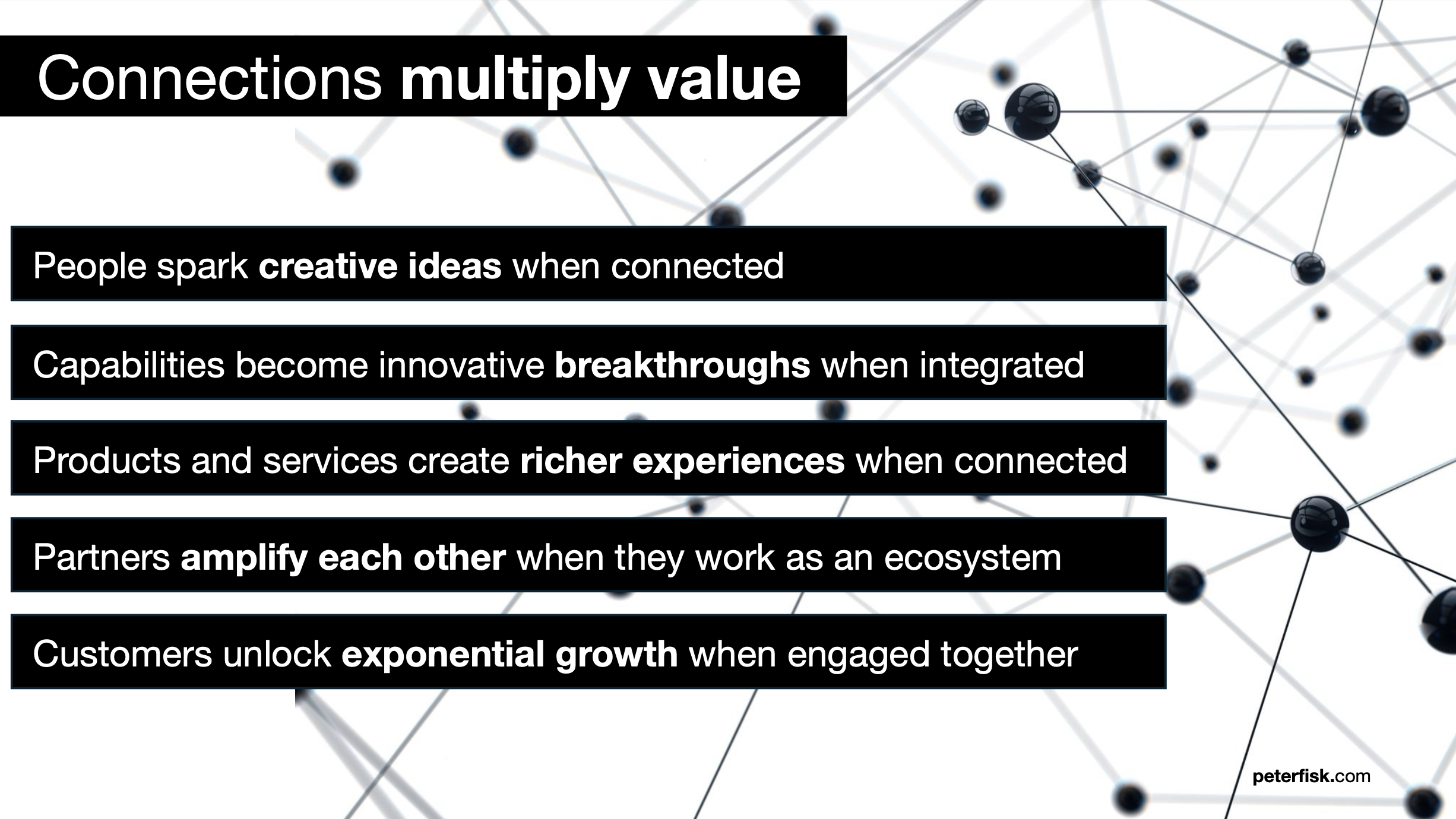
Unlocking the power of connections
Throughout history, the greatest leaps in human progress have often come not from isolated genius, but from connection — the ability to bring together different worlds, disciplines, and perspectives into something greater. These moments of “nexus” reveal the extraordinary power of connections to unlock knowledge, transform culture, and multiply impact.
Consider the Rosetta Stone. Discovered in Egypt in 1799, this single slab of granite carried the same decree written in three scripts: Egyptian hieroglyphs, Demotic, and Ancient Greek. For centuries, hieroglyphics had been an undecipherable mystery. The Rosetta Stone created a bridge between languages, allowing Jean-François Champollion and others to decode the ancient script and, with it, open the door to understanding one of the world’s great civilizations. It was not the stone itself but the connection it enabled — between languages, eras, and cultures — that made it transformative.
The Silk Road is another nexus on a grand scale. Stretching thousands of miles from China through Central Asia to the Mediterranean, it was more than a trade route for silk and spices. It became an artery through which ideas, religions, and technologies flowed: Buddhism spread to China, paper traveled westward, gunpowder reached Europe. Civilizations far apart began to influence one another, and the result was not just commerce but cultural and technological revolutions. The Silk Road showed that when societies connect, they reshape each other in ways neither could have achieved alone.
In the Renaissance, Raphael captured this spirit of connection in his masterpiece The School of Athens. Painted on the walls of the Vatican, it depicts the great philosophers of antiquity — Plato, Aristotle, Euclid, Pythagoras — gathered together in one imagined conversation. In reality, these figures spanned centuries, but Raphael’s vision connected their ideas into a single scene, linking classical wisdom with Renaissance humanism. The painting itself became a nexus of art, philosophy, and history, symbolizing the rebirth of learning through the fusion of past and present.
Centuries later, Pablo Picasso would do something similar in art. His groundbreaking Les Demoiselles d’Avignon in 1907 shocked audiences by fusing influences from Iberian sculpture, African tribal masks, and European painting. This cultural collision gave birth to Cubism, which would redefine the very language of modern art. Picasso’s work showed that when you bring together styles and traditions from disparate sources, you can create entirely new ways of seeing.
In the modern era, Steve Jobs demonstrated the nexus principle with the launch of the iPhone in 2007. It wasn’t just a phone — it was a fusion of three devices: a phone, an iPod, and an internet communicator. More importantly, it created an ecosystem where developers, users, and services could connect through the App Store. By uniting design, technology, and community, Jobs didn’t just launch a product — he created a platform that transformed industries and lifestyles around the globe.
And today, we see the same power in unexpected places, such as Riot Games’ headquarters, home of League of Legends. What began as a video game has evolved into a cultural hub — a nexus of gaming, esports, music, fashion, and global community. Riot connected players not only to the game but to each other, turning entertainment into a shared cultural phenomenon and pioneering a billion-dollar esports industry.
Across time and place, these examples remind us that breakthroughs come from connections. Whether decoding hieroglyphs, linking continents, blending artistic traditions, or uniting technologies, the nexus is where possibilities multiply. It is in the spaces between worlds — where cultures, ideas, and people meet — that the future is born.
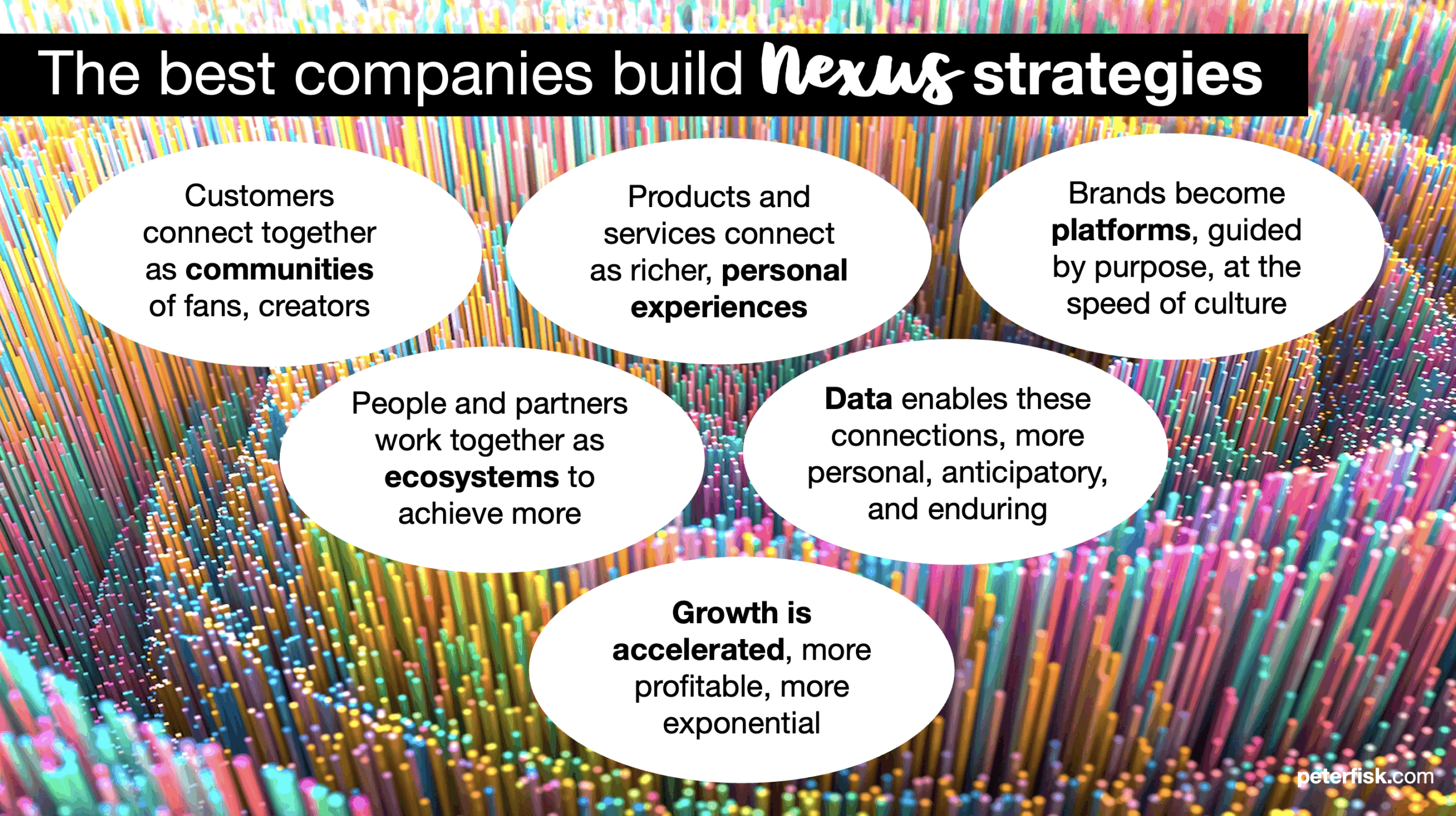
The best companies build “Nexus” strategies
Metcalfe’s Law, a little known concept which was conceived by 3Com founder Robert Metcalfe, states that the value of a network grows exponentially as more participants join — roughly proportional to the square of the number of users.
In other words, each new connection doesn’t just add value, it multiplies it, because every node can now connect with every other. This principle is at the heart of the nexus effect: the breakthrough potential that emerges when ideas, people, technologies, and cultures are linked. The power of connections lies not in their sum, but in their multiplication — where networks turn linear assets into exponential opportunities for innovation and growth.
The Nexus Effect is not a new phenomenon but has not been articulated holistically, and is more powerful today because of technological, social, and cultural shifts.
-
Platforms make it easier than ever to connect customers continuously.
-
Data and AI allow personalization at scale, turning relationships into uniquely tailored experiences.
-
Communities thrive online, creating spaces where customers connect not just with brands, but with each other.
-
Subscriptions and memberships create predictable revenue streams while binding customers into ongoing usage loops.
-
Ecosystems amplify value by linking products and services, making it harder for customers to leave without losing convenience or benefits.
Disney’s MagicBand transformed the theme park experience by connecting disparate services—tickets, hotel rooms, rides, food, photos—into one seamless system. Internally, it required unprecedented collaboration between IT, operations, customer service, and design teams. Externally, it deepened customer loyalty by making every interaction part of an integrated, magical journey.
LinkedIn grew slowly at first, but once it connected a critical mass of professionals, network effects kicked in. Each new member made the platform more valuable for recruiters, job seekers, and advertisers. Importantly, the company also fostered internal networks—teams working across data, product, and sales—to spot emergent patterns and build features like “People You May Know.” That feature alone became one of the most powerful engines of growth.
When IBM repurposed Watson, its AI system, from winning games to assisting doctors, it wasn’t about the technology alone—it was about connecting IBM’s computational power with the tacit knowledge of doctors, and then connecting hospitals, insurers, and researchers. This web of connections created a new capability: augmenting human decision-making in complex medical cases.
In essence, companies no longer compete simply as product providers but as architects of networks of value. The winners are those who can connect the dots between customers’ needs, aspirations, and lifestyles — and deliver continuously through a nexus of products, services, and experiences.
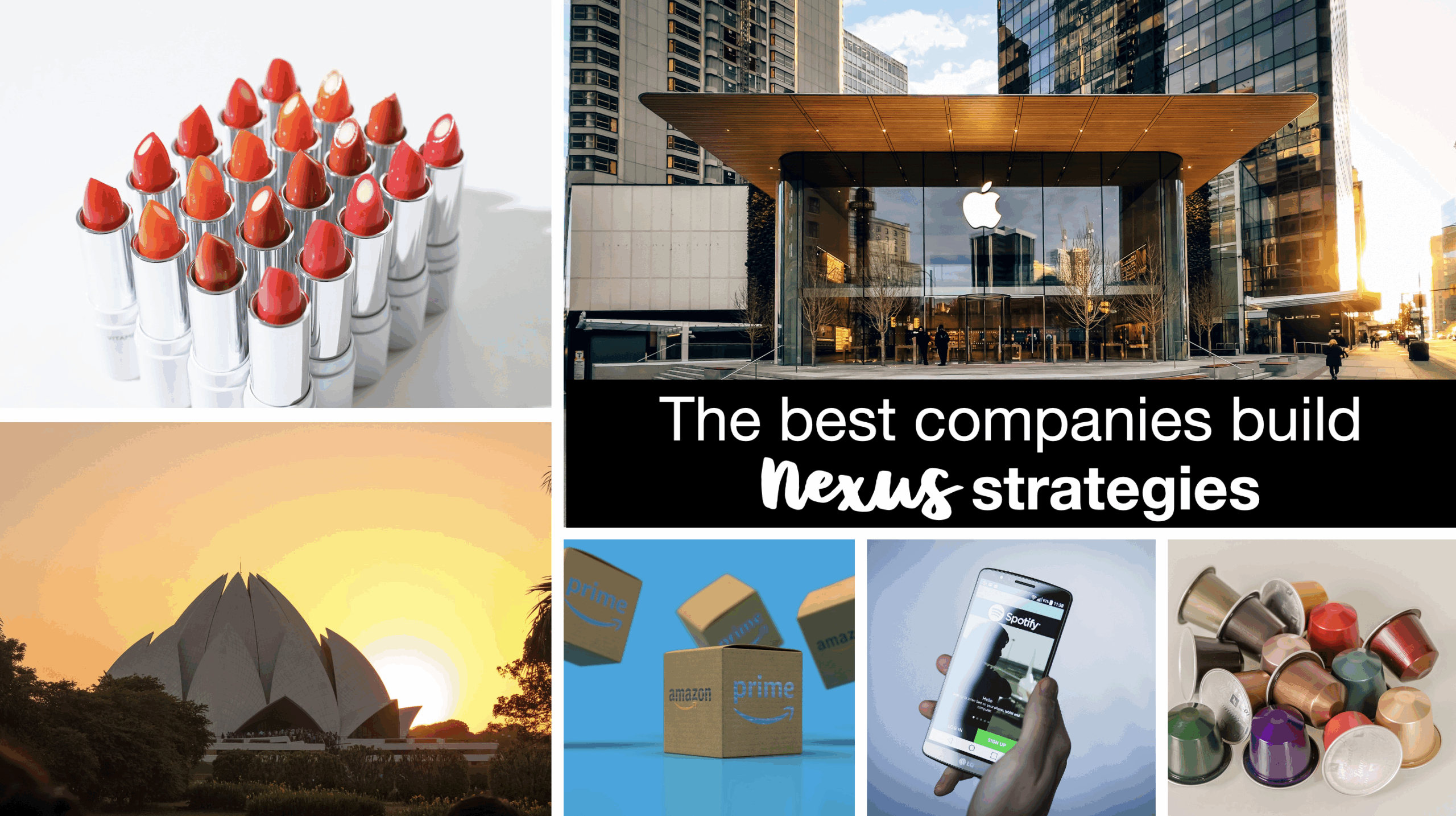
Let’s explore how these companies have unlocked the potential of connections.
Amazon … The Nexus of Retail
Amazon began in 1994 as an online bookstore. Its founder, Jeff Bezos, envisioned an “everything store” that could harness the internet’s limitless reach. What has made Amazon extraordinary, however, is not just scale, but its ability to build an ecosystem where connections multiply value.
At the heart of this ecosystem is Amazon Prime. Launched in 2005 as a free-shipping program, Prime has evolved into one of the most powerful membership platforms in the world. With more than 250 million global subscribers by 2025, Prime generates loyalty not because customers love paying annual fees, but because it integrates multiple forms of value:
-
Convenience: Unlimited fast shipping.
-
Entertainment: Prime Video, Prime Music, Prime Gaming.
-
Savings: Exclusive deals and discounts.
-
Everyday living: Grocery delivery (Whole Foods, Amazon Fresh), photo storage, audiobooks.
Prime exemplifies the Nexus Effect: every additional service makes the membership more “sticky,” increasing customer reliance. Prime members spend on average more than twice as much per year as non-members, and churn is astonishingly low.
Amazon’s ecosystem extends further. Alexa connects homes to shopping, entertainment, and smart devices. AWSconnects businesses to computing power and digital innovation. Marketplace connects millions of third-party sellers to global customers, while Amazon logistics links the entire supply chain. Each reinforces the other — a flywheel of connection that accelerates growth.
What makes Amazon unique is not simply breadth, but the way these services reinforce each other in the customer’s daily life. Customers don’t just shop at Amazon; they live within its ecosystem.
Nespresso … The Nexus of Coffee
When Nestlé launched Nespresso in 1986, it was a slow burn. The single-serve capsule coffee system seemed niche, even indulgent. But over time, Nespresso reinvented the coffee experience by building not just a product, but a lifestyle community.
The Nespresso Club has been central to this strategy. Customers who buy a machine are invited to join, gaining access to exclusive capsules, services, and experiences. The Club is not a traditional loyalty program; it is a membership ecosystem.
-
Direct-to-consumer channels: Nespresso pioneered selling capsules directly to members via boutiques, online platforms, and dedicated call centers.
-
Personalization: Members are offered curated selections, seasonal flavors, and limited editions.
-
Sustainability and responsibility: Capsule recycling programs invite members to participate in a shared mission.
-
Lifestyle branding: Partnerships with George Clooney and luxury positioning elevate the product beyond commodity.
By controlling the entire lifecycle — from machine to capsule to membership — Nespresso ensures recurring revenue and strong lock-in. The Club transforms coffee from a product into a relationship of rituals, identity, and belonging.
Today, Nespresso serves millions of members worldwide, with annual revenues exceeding $6 billion. Its success lies not in selling coffee pods, but in making customers feel like insiders in an exclusive global community.
L’Oréal … The Nexus of Beauty
Beauty is one of the most emotional and intimate industries, and L’Oréal has become the world’s largest cosmetics company by combining science, creativity, and connection. Its mission is simple yet powerful: “Beauty for all.”
In recent years, L’Oréal has embraced beauty tech as a way of deepening customer relationships. This includes:
-
Makeup Genius: An augmented reality app launched in 2014 that lets customers virtually try on products. It was downloaded millions of times and paved the way for AI-driven personalization.
-
ModiFace (acquired in 2018): Provides AR try-ons across L’Oréal brands, integrated directly into e-commerce.
-
Skin and hair diagnostics: AI-powered tools that recommend personalized regimes.
-
Communities: Platforms where beauty enthusiasts share tips, routines, and looks, reinforcing brand bonds.
L’Oréal doesn’t just sell lipstick or skincare; it connects customers with solutions that feel uniquely theirs. Every digital tool deepens engagement and makes switching less likely. Moreover, the company’s sustainability commitments (like refillable packaging and carbon-neutral operations) create an additional emotional nexus around shared values.
The result: L’Oréal connects across science, technology, and lifestyle, making customers participants in beauty innovation rather than passive buyers.
Disney … The Nexus of Magic
Few companies understand connection better than Disney. For nearly a century, Disney has built emotional bonds with audiences through storytelling. What makes Disney extraordinary today is how it weaves these stories into an integrated nexus of experiences.
-
Disney+: With over 200 million subscribers by 2025, Disney+ is the beating heart of its digital ecosystem. It doesn’t just stream content; it immerses fans in story worlds (Marvel, Star Wars, Pixar).
-
Parks and resorts: Physical spaces where fans live the stories they love, connected seamlessly to films and merchandise.
-
Merchandising and licensing: Extending characters into toys, clothing, and everyday life.
-
Community and fandom: Fans connect not only with Disney but with each other, from conventions to online forums.
Disney creates a virtuous cycle of connection: watch a Marvel movie, subscribe to Disney+, visit Avengers Campus at Disneyland, buy the merchandise, and discuss theories with fellow fans online. Each element reinforces the others, creating lifetime value that far exceeds a ticket price or subscription fee.
The nexus is emotional as much as commercial: Disney is not just entertainment but identity, nostalgia, and belonging. Customers don’t simply consume; they live inside Disney’s stories.
Jio … The Nexus of India
When Reliance Industries launched Jio in 2016, it disrupted India’s telecom market with ultra-cheap data and free voice calls. Within a few years, Jio amassed over 450 million subscribers, transforming connectivity in one of the world’s largest markets.
But Jio’s ambition went far beyond telecom. It has built a super app ecosystem that connects users to multiple aspects of life:
-
JioMart: Groceries and retail.
-
JioSaavn: Music streaming.
-
JioCinema: Entertainment.
-
JioMoney: Digital payments and financial services.
-
JioSecurity and JioCloud: Data and device protection.
In essence, Jio is creating an Indian equivalent of WeChat — an integrated platform where customers handle communication, shopping, entertainment, and finance.
By bundling services at low cost, Jio locks users into its ecosystem while bringing millions of first-time digital customers online. Its nexus strategy is not only commercial but national: Jio is shaping India’s digital future by connecting people, communities, and commerce at scale.
Spotify … The Nexus of Music
Music has always been social, but Spotify turned listening into a global, personalized community. Launched in 2008, Spotify pioneered streaming subscriptions and today has over 600 million users (more than 250 million paying subscribers).
Its nexus strategy rests on three pillars:
- Personalization: Playlists like Discover Weekly and Release Radar feel tailor-made. Algorithms connect users with music they didn’t know they needed.
- Community: Playlists are shareable, collaborative, and social. Fans follow artists and each other, building networks of taste.
- Creator connection: Through tools like Spotify for Artists and podcasting platforms, creators connect directly with fans.
Spotify Premium provides ad-free listening, downloads, and higher quality, while the free tier keeps the funnel wide. Beyond music, Spotify has expanded into podcasts and audiobooks, broadening its ecosystem.
Spotify’s true genius is that customers don’t feel like subscribers to a utility; they feel like members of a global music community. Music becomes not just consumed but shared, discovered, and lived through the platform.
Apple … The Nexus of Desire
If there is one company that epitomizes the Nexus Effect, it is Apple. With more than 1.5 billion active devicesworldwide, Apple has created the most valuable ecosystem in consumer technology.
Its nexus is built on four layers of connection:
-
Hardware: iPhone, iPad, Mac, Apple Watch, AirPods — beautifully designed, seamlessly integrated.
-
Software and services: iOS, iCloud, App Store, Apple Music, Apple TV+, Apple Arcade.
-
Membership and subscriptions: iCloud+, Apple One bundles, fitness subscriptions.
-
Community and lifestyle: Apple Stores, developer conferences, loyal fan culture.
Apple devices are designed to work best with each other, creating a walled garden that keeps customers inside. Switching out of the Apple ecosystem means losing convenience, integration, and emotional resonance.
Customers often own multiple Apple devices — with the average user connected to 2–3 products. This multiplies lifetime value, while services generate recurring revenues. In 2023, Apple’s services business alone surpassed $85 billion annually.
The magic lies not just in lock-in, but in emotional connection. Apple represents simplicity, creativity, and status. Customers feel not just like buyers but members of a global community united by design and innovation.
Patterns of nexus strategies
Across these cases, common patterns emerge:
-
Membership: Prime, Nespresso Club, Disney+, Spotify Premium, Apple One — all create predictable, ongoing engagement.
-
Ecosystem lock-in: Multiple products and services work better together (Amazon, Apple, Jio).
-
Emotional connection: Disney stories, Apple design, L’Oréal beauty personalization.
-
Communities of participation: Spotify playlists, Nespresso sustainability efforts, IBM co-creation, Disney fandom.
-
Lifecycle ownership: From discovery to renewal, companies manage the entire journey (Nespresso, Apple, Amazon).
-
Values-driven connection: Sustainability (L’Oréal, Nespresso), trust (IBM), empowerment (Spotify).
The Nexus Effect is not one model but a set of strategies that together deepen customer ties and amplify value.
Implications for leaders
For today’s business leaders, the lesson is clear: connection is strategy.
This represents a profound mindset shift for today’s business leaders. For much of the past century, companies were defined by their products and their ability to sell them. Success meant designing a better widget, producing it more efficiently, and pushing it into the market. But the world has changed. Value now lies less in the product itself and more in the connections it enables — with customers, with communities, with ecosystems of partners.
This requires moving from product obsession to customer centricity — understanding not just what customers buy, but how they live, what they aspire to, and how a brand can become a trusted companion across their journey. It shifts emphasis from sales to relationships — cultivating loyalty, engagement, and membership rather than just chasing one-off transactions. It redefines the meaning of assets: today, the most valuable assets are intangible — brands that inspire trust, data that unlocks insights, platforms that connect communities, and networks that multiply reach. Finally, it means moving from linear thinking to multiplier thinking — where the focus is not on selling one more product, but on creating systems of value that grow as more people and partners connect. Nexus thinking turns business from a pipeline into a platform.
To harness the Nexus Effect, leaders must:
-
Think in systems, not silos — Design offerings that interconnect, creating value loops rather than linear funnels.
-
Prioritize memberships and services — Shift from transactions to recurring models that reinforce loyalty.
-
Leverage data responsibly — Use personalization to create intimacy without eroding trust.
-
Foster communities — Enable customers to connect with each other, not just with the brand.
-
Align with values — Build emotional as well as functional bonds.
-
Design for lifetime value — Look beyond the first sale to the entire customer journey.
Leaders must recognize that customers today don’t just buy products; they buy into relationships, identities, and ecosystems. The companies that succeed are those that turn connections into compounding advantage.
What’s your nexus?
The Nexus Effect will only grow in power as technologies evolve and societies become more connected. Artificial intelligence will deepen personalization; augmented and virtual reality will expand immersion; blockchain and Web3 may redefine ownership and membership.
But at its heart, the Nexus Effect is timeless. It is about human connection — the need for belonging, convenience, trust, and shared meaning. The companies that master this will not just sell more, but will create enduring bonds with customers who become participants, advocates, and co-creators.
From Amazon’s Prime flywheel to Apple’s walled garden, from Disney’s story worlds to Jio’s national super app, the lesson is clear: connections are the new currency of business. Those who can unlock their power will define the future.
So, what’s your nexus?
Making it happen … The Nexus Playbook
This playbook is built on vast experience of working with leading companies implementing the principles of the Nexus Effect – from energy and entertainment, to finance and fashion, pharmaceuticals and publishing. The playbook is a practical, step-by-step guide for leaders and teams to design and implement a nexus strategy, with actionable checklists, real-world examples, and frameworks for each stage.
Step 1: Explore the best market opportunities
Objective: Identify areas where connections create disproportionate value.
Why: Most nexus strategies fail because companies try to connect assets without a clear market opportunity. Begin by understanding fragmentation points, recurring customer needs, and network multipliers.
How:
-
Map customer journeys: Identify friction points, gaps, or unmet needs.
-
Analyze recurring touchpoints: Look for daily, weekly, or seasonal interactions that can be linked.
-
Identify network effects: Determine where more users, partners, or interactions increase value.
-
Trend scan: Monitor emerging technologies, adjacent industries, and societal changes.
Example:
-
Amazon: Noticed fragmented online shopping experiences — multiple sellers, delayed deliveries, lack of discovery tools — and connected logistics, marketplaces, and subscriptions.
Checklist:
-
Have I mapped the complete customer journey?
-
Are there recurring needs we can connect into a service?
-
Can a network effect be created or amplified?
Step 2: Find your potential “nexus”
Objective: Determine the scope, participants, and connections that will form your nexus.
Why: A nexus must have a clear purpose: what connections generate value, and who participates. Without clarity, efforts scatter and impact is diluted.
How:
-
Identify primary participants: customers, partners, suppliers, developers.
-
Map interactions: what connections create the most value?
-
Determine scope: local, regional, or global network?
-
Set measurable goals: membership growth, engagement, revenue streams.
Example:
-
Nespresso: Transformed coffee machines into a nexus by connecting customers with capsules, a subscription club, recycling programs, and exclusive boutique experiences.
Checklist:
-
Have I identified all stakeholders?
-
Do I know which interactions drive the most value?
-
Have I defined success metrics?
Step 3: Unlock potential assets
Objective: Identify tangible and intangible assets that can be used to anchor and grow the nexus.
Why: Assets — physical, digital, or relational — are the building blocks of a nexus. Maximizing existing assets reduces risk and accelerates growth.
How:
-
Catalogue all assets: brand, IP, distribution, customer data, infrastructure, partnerships.
-
Identify leverage points: which assets can multiply value if combined?
-
Assess gaps: what new capabilities or partnerships are required?
Example:
-
Apple: Combined hardware (iPhone, Mac) with software (iOS, macOS) and services (iCloud, Apple Music) to create a platform that connects millions of users.
Checklist:
-
Have all existing assets been catalogued?
-
Are there opportunities to combine assets for higher leverage?
-
Do I know where gaps exist that need to be filled?
Step 4: Harness data and insights
Objective: Use data to guide decisions, personalize experiences, and enable compounding value.
Why: In a nexus strategy, data is the connective tissue — it links participants, products, and services while generating feedback loops for improvement.
How:
-
Integrate datasets across channels and touchpoints.
-
Establish analytics to predict and personalize customer needs.
-
Build feedback loops to continuously refine experiences.
-
Ensure privacy and ethical data handling.
Example:
-
L’Oréal: Uses AI and AR (ModiFace) to personalize beauty experiences, improving engagement and loyalty while generating rich insights for innovation.
Checklist:
-
Are all relevant data sources integrated?
-
Are personalization opportunities identified?
-
Are ethical and privacy considerations addressed?
Step 5: Identify the right business model
Objective: Determine how value is captured, monetized, and sustained.
Why: Traditional transaction-based models rarely support a nexus. Consider membership, subscription, platform, and bundled service models.
How:
-
Analyze lifetime value potential.
-
Evaluate recurring revenue opportunities (subscriptions, memberships).
-
Explore two-sided marketplaces or platform fees.
-
Bundle services to increase stickiness.
Example:
-
Amazon Prime: Membership drives more frequent purchases → attracts more sellers → increases selection → enhances perceived value → increases memberships.
Checklist:
-
Is the model focused on lifetime value?
-
Are recurring revenue opportunities leveraged?
-
Does the model align with ecosystem incentives?
Step 6: Build the ecosystem structure
Objective: Design a network of partners, developers, and participants that amplifies value.
Why: A nexus thrives on orchestration. No company can provide everything; ecosystem design enables scale and complementarity.
How:
-
Identify essential partners and contributors.
-
Determine governance: open vs. closed, collaborative vs. controlled.
-
Define incentives for participation.
-
Build APIs or integration points for third-party involvement.
Example:
-
Jio: The Indian super app orchestrates services and third-party apps into a single “digital life” ecosystem.
Checklist:
-
Have key partners been identified?
-
Is governance clear and fair?
-
Are integration points designed for scale?
Step 7: Activate brands and experiences
Objective: Use the brand and curated experiences to attract, engage, and retain participants.
Why: Brands are magnets; experiences are the glue. A strong brand creates trust, identity, and permission to extend into new categories.
How:
-
Design personalized experiences across channels.
-
Create community touchpoints (events, forums, social sharing).
-
Align experiences with brand purpose and identity.
-
Continuously innovate to keep engagement fresh.
Example:
-
Disney: Integrates films, streaming, parks, merchandise, and cruise experiences to create immersive, continuous engagement.
Checklist:
-
Are experiences personalized and compelling?
-
Is the brand positioned as a curator of the nexus?
-
Are community elements integrated?
Step 8: Design your flywheel
Objective: Create self-reinforcing loops that increase retention, engagement, and advocacy.
Why: Flywheels compound value and reduce reliance on acquisition alone. Each connection strengthens the network.
How:
-
Identify points where engagement reinforces loyalty.
-
Align incentives to encourage repeat participation.
-
Measure retention, membership growth, and advocacy.
-
Iterate to strengthen compounding effects.
Example:
-
Amazon Prime: More members → more purchases → more sellers → better selection → more members.
Checklist:
-
Is the flywheel clearly defined?
-
Are retention and advocacy metrics tracked?
-
Is the loop self-reinforcing and scalable?
Step 9: Scale and evolve your nexus
Objective: Continuously adapt the nexus to changing markets, technologies, and customer expectations.
Why: A static nexus loses relevance. Continuous evolution ensures ongoing value creation.
How:
-
Introduce new services or products to meet emerging needs.
-
Expand geographically or into adjacent markets.
-
Integrate new technologies (AI, AR/VR, blockchain).
-
Refine data, insights, and experiences based on feedback.
Example:
-
Apple: Expanded from devices to subscriptions (Apple TV+, Apple Fitness+, Apple One) to strengthen ecosystem stickiness.
-
Disney+: Expanded narrative universe and digital delivery to complement traditional parks and film revenue streams.
Checklist:
-
Are innovation pipelines feeding the nexus?
-
Are geographic or market expansions planned?
-
Is the ecosystem continuously refined with data insights?
Step 10: Monitor, measure, and adjust
Objective: Use metrics to ensure the nexus strategy remains effective and evolves with the market.
Metrics:
-
Membership and subscription growth
-
Customer engagement and retention rates
-
Network participation and contribution (data points, content creation)
-
Cross-platform usage
-
Advocacy and referral rates
How:
-
Establish a dashboard of key nexus metrics.
-
Monitor network health, retention, and engagement.
-
Conduct quarterly strategy reviews to refine connections.
-
Align incentives and rewards based on performance.
Checklist:
-
Are key metrics tracked in real time?
-
Is the nexus delivering compounding value?
-
Are adjustments made systematically based on insights?
Unleash your nexus strategy
A nexus strategy is a systematic approach to turning connections into competitive advantage. By following this step-by-step manual, leaders can:
-
Sense market opportunities for connection
-
Define the nexus opportunity and participants
-
Map and leverage existing assets
-
Harness data and insights to personalize engagement
-
Choose business models that support recurring value
-
Build ecosystems that amplify reach and complementarity
-
Activate brands and experiences to attract and retain participants
-
Design flywheels to compound retention and loyalty
More from Peter Fisk
- Eyes on Tomorrow: What Leaders Must See before Everyone Else … exploring the most important megatrends that are transforming markets, and leadership mindsets, and how the best companies embrace them as opportunities … based on the new Megatrends 2035 report by Peter Fisk, and its implications for every business.
- The Reinvention Playbook: Thriving in a World of Relentless Change … the best organisations seek to continually reinvent themselves in a world of constant, uncertain and dynamic change. They rethink, refocus, and reinvent everything – embracing new agendas from AI to GenZ, climate change and social inequality.
- The Nexus Effect: Unlocking the Power of Connections … How can businesses and brands really unlock the power of data and networks, flywheels and AI, communities and ecosystems, to transform their futures?
- The New Growth Playbook: 9 New Ways to Accelerate Growth … many companies struggle to find new ways to grow their business … instead we look at how the best companies find radically new ways to grow.
- Super Innovators: Innovation Beyond the Normal … 10 radical ways to disrupt conventions, embrace deeper insights, unlock valuable assets, and stretch innovation for more dramatic impact.
- Consumer of the Future … “Aisha blinked twice, the smart lenses in her eyes had already scanned her biometric mood, cross-checked her carbon budget, and pulled up items her climate-positive friends were buying this week”
- Competing in the FLUX: How to develop a dynamic strategies in a world of relentless change … combining a strong, enduring direction with micro-moves that adapt quickly to emerging shifts:
- Business Transformation: The new superpower of business leaders … reimagining the future, redefining strategy, reinventing the organisation, rewiring performance … the journey to deliver step change in value creation.
- The Sustainable Consumer: Go on, do the Right Thing … how brands can accelerate the consumer shift to sustainable products and practices … from food and fashion, to energy and electric cars, making sustainability desirable and better.
- The “Performer Transformer” Leaders: How great leaders deliver today and create tomorrow … with dual thinking, to build dynamic ambidexterity, continually strategyzing, to perform and transform.
- The Hire-Wire Act of Leadership: Leading in a world of intense competition and relentless change … being visionary and innovative, learning to adapt and endure … inspired by Taylor Swift, Roger Federer, Beyoncé, and Lionel Messi
- Becoming a Future-Ready Business … in a world of relentless change, organisations need to anticipate change, embrace innovation, empower talent, and align deeply with the evolving needs of society and the planet
The global banking industry is undergoing one of the most profound shifts in its history. After decades defined by regulation, risk management, and branch networks, a new generation of financial institutions is challenging the very foundations of how banks create value, deliver services, and build trust. These organisations—some incumbents, some digital natives—are not simply applying technology to old processes. They are reimagining the architecture, culture, and economics of banking itself.
What is striking about this new wave of innovators is not that they look alike, but that they differ so dramatically. Innovation in banking is no longer a single model; it is a portfolio of radically different strategies shaped by geography, regulation, customer needs, and technological context. The world’s most inventive banks come from Asia, Latin America, Europe, and beyond—each representing a distinct response to the same fundamental question: What is a bank in a digital, data-driven world?
DBS in Singapore demonstrates that a traditional institution can transform itself into a digital powerhouse, combining the strengths of an incumbent with the agility of a startup. It is proof that reinvention from within is not only possible but can outperform fintech challengers. Nubank in Brazil shows the power of simplicity, technology, and emotion to attract tens of millions of customers who were previously underserved or excluded from the financial system. It is a fintech with scale and purpose, building trust in markets where banks were often viewed with frustration or suspicion.
Revolut, headquartered in London but operating almost everywhere, embodies the ambition of a financial super-app: a platform that merges banking with travel, crypto, investing, and lifestyle features. It represents the horizontal expansion model—using software velocity and global reach to make money borderless and banking more consumer-centric. And WeBank in China, part of the Tencent ecosystem, illustrates what banking looks like when built natively on artificial intelligence, cloud infrastructure, and embedded distribution. It is the closest thing the world has to fully automated, invisible banking.
Together, these four institutions offer a unique lens on the future of the industry. DBS shows how incumbents can reinvent. Nubank demonstrates the potential of low-cost digital inclusion. Revolut represents the rise of global fintech super-platforms. And WeBank is the purest example of AI-native, ecosystem-embedded banking. Each succeeds not by copying the others, but by embracing a distinctive strategy grounded in local realities and technological capability.
Their stories matter because they show how finance is shifting from a physical, product-led sector to a digital, experience-led, data-driven system. In doing so, they highlight the new sources of competitive advantage: platform economics, customer obsession, cultural adaptability, real-time data, artificial intelligence, and the ability to build trust in new ways.
These four banks, diverse in origin and design, illustrate the many futures of banking emerging around the world. And in their success, they reveal not just where finance is heading—but what every bank must learn if it is to remain relevant in the next decade.
DBS Bank … reinventing an institution in Asia
DBS is widely regarded as the world’s most successful example of a traditional bank reinvented for the digital age. Based in Singapore, DBS began its transformation in the early 2010s after recognising that customer expectations were shifting faster than the institution. Under CEO Piyush Gupta, the bank adopted a bold vision: to become “the world’s best digital bank” by redesigning culture, technology, and customer experience. This was not digital as a channel but digital as an operating model—a 27,000-person startup.
DBS invested deeply in cloud, data, and artificial intelligence, but its real breakthrough was cultural. The bank embraced agile delivery, empowered teams, and applied human-centred design to simplify services. It pioneered digital ecosystems, embedding financial services into everyday journeys—cars, homes, travel, and sustainability. The result is a bank that feels more like a modern technology company: fast, frictionless, customer-obsessed.
Today, DBS consistently ranks among the world’s most innovative banks. It has achieved industry-leading cost efficiency, improved risk performance through AI, and significantly increased digital engagement. Most importantly, its transformation demonstrates that incumbents can not only compete with but surpass fintech challengers—if they reinvent the organisation from the inside out.
Strategic Positioning
-
Traditional bank transformed into a digital-first powerhouse.
- Strategy built around “Making Banking Invisible” embedded in everyday services from partners
-
Known for “Making Banking Joyful”—frictionless CX, agile culture, GovTech-like engineering mindset.
-
Uses technology as a lever to reinvent the full bank, not just the front end.
Model
-
Full-service universal bank with digital capabilities woven throughout.
-
Emphasis on ecosystem platforms (cars, property, sustainability marketplaces).
-
Deep investments in AI, data, cloud, and 24/7 digital processes.
Innovation Strengths
-
Industry-leading transformation culture (Becoming a 27,000-person startup).
-
Strong ESG and sustainability-linked banking products.
-
Uses AI for risk, personalization, fraud, and operational efficiency.
Economics
-
High profitability, low cost-to-income ratio, strong capital base.
-
Digital customers deliver significantly higher ROE.
Why it’s important
- DBS shows how an incumbent can reinvent itself faster than fintechs.
Nubank … digital challenger conquering Latin America
Nubank is the world’s largest independent digital bank and one of the most transformative financial institutions of the decade. Founded in Brazil in 2013, Nubank emerged in a market dominated by expensive, bureaucratic incumbents, where millions of people had limited access to fair financial services. Its proposition was radical in its simplicity: a beautiful mobile experience, transparent pricing, and customer service that treated people with respect. The purple card quickly became a symbol of empowerment.
Nubank built a hyper-efficient digital model with a fraction of the cost base of traditional banks. This allowed it to offer free accounts, low fees, and accessible credit—democratising finance in a region where consumers often paid some of the world’s highest banking charges. Its viral growth was driven by trust, word-of-mouth, and the emotional connection it built with young, underserved customers.
Underpinned by advanced data science, Nubank has excelled in underwriting thin-file and first-time borrowers—turning inclusion into a profitable model. It now serves more than 100 million customers across Brazil, Mexico, and Colombia, expanding with a disciplined focus on simplicity and delight. Nubank is proof that fintech at scale can be both socially transformative and commercially successful.
Strategic Positioning
-
The world’s largest independent digital bank by customers.
-
Mission: make finance simple, fair, and accessible in an underserved region.
Model
-
Hyper-lean mobile-first bank with a simple, highly trusted brand.
-
Freemium model: free account + paid credit products + growing cross-sell.
-
Uses data science and machine learning to underwrite thin-file customers.
Innovation Strengths
-
Lightning-fast product cycles.
-
Extremely efficient customer service powered by data.
-
Viral growth: product and brand loved by younger, overlooked customers.
-
Expanding into Mexico and Colombia with similar playbook.
Economics
-
Very low-cost operations → allows free pricing and fast growth.
-
Rising profitability due to scale and credit discipline.
Why it’s important
- Nubank demonstrates fintech at massive scale—banking the unbanked with simplicity and emotion.
Revolut … global financial super-app
Revolut is the most ambitious financial super-app to emerge from Europe. Founded in London in 2015, it began as a low-cost foreign exchange card but rapidly expanded into a multi-product platform powered by relentless engineering and product velocity. Revolut aims not simply to be a bank but a global operating system for money—combining accounts, payments, travel, crypto, trading, budgeting tools, and merchant services into a single modular app.
The company’s innovation strength lies in its speed. Product teams ship new features at a pace unmatched in Western banking, enabling Revolut to enter new verticals quickly and iterate based on usage data. Its business model blends subscription tiers, interchange, trading revenue, FX, and lending—making it one of the most diversified fintechs in the world.
Revolut operates with a mix of e-money and bank licences, expanding country by country with a global mindset. It resonates especially strongly with younger, international, mobile-first customers who value control, transparency, and flexibility. Though regulatory complexity remains a challenge, Revolut’s super-app strategy positions it uniquely at the intersection of finance, technology, and lifestyle—an approach that could define a new category of global digital banking.
Strategic Positioning
-
Aims to build a global super-app for money: banking, investing, crypto, travel, commerce.
-
Growth driven by product breadth, not deep credit relationships.
Model
-
Multi-product: accounts, FX, crypto, stocks, travel, merchant features.
-
Operates with a mix of e-money licences + full bank licences in selected markets.
-
Revenue mix diversified: interchange, subscriptions, trading fees, FX/crypto, lending.
Innovation Strengths
-
Highest velocity of product releases among fintechs.
-
Ultra-strong engineering culture and global talent density.
-
UX built for speed, personal control, and financial empowerment.
Economics
-
Moving towards profitability, but with large reinvestment into expansion.
-
High product cross-sell but lower credit depth than traditional banks.
Why it’s important
- Revolut is the closest version of a Western “super-app” for money, blending finance, lifestyle, and commerce.
WeBank … the AI-native bank from China
WeBank is China’s—and arguably the world’s—most advanced AI-native bank. Launched in 2014 as China’s first digital-only institution, it is backed by Tencent and deeply integrated into the WeChat ecosystem. This gives WeBank a distribution model no traditional bank can match: embedded, invisible financial services delivered at population scale.
What distinguishes WeBank is its extreme automation. It operates with no branches, a cloud-native architecture, and end-to-end artificial intelligence across onboarding, credit scoring, fraud detection, and servicing. Its micro-loan products are approved in seconds using machine learning models trained on diverse behavioural and transactional data. WeBank is also a global leader in federated learning and privacy-preserving AI, enabling high-quality risk models without compromising user data security.
Its economics are exceptional: one of the lowest cost-to-income ratios in global banking, high profitability, and near-zero marginal cost per additional customer. By focusing on individuals and SMEs often ignored by traditional lenders, WeBank delivers inclusive finance while maintaining strong risk discipline.
WeBank represents the purest expression of the next generation of banking—instant, embedded, algorithmic, and almost entirely automated. It offers a glimpse of what the financial system could look like when AI becomes the core engine rather than a supporting tool.
Strategic Positioning
-
China’s first digital-only bank; part-owned by Tencent.
-
Focuses on AI-driven inclusive finance for consumers and SMEs.
Model
-
100% digital, no branches, fully cloud-native.
-
Uses WeChat ecosystem for distribution—embedded, invisible banking.
-
Micro-loans and SME lending driven almost entirely by ML-based risk engines.
Innovation Strengths
-
End-to-end AI automation (KYC, underwriting, servicing).
-
Near-zero marginal cost per extra customer.
-
Pioneers in federated learning, explainable AI, and privacy-preserving analytics.
-
Ultra-fast processes: loans approved in seconds.
Economics
-
Exceptionally low cost-to-income ratio (among the lowest globally).
-
High volume, low-ticket lending with disciplined risk modelling.
Why it’s important
- WeBank shows what banking looks like when built natively on AI + ecosystems, not branches.
The future of banking
Taken together, DBS, Nubank, Revolut, and WeBank offer a powerful glimpse into the multiple futures now unfolding across global finance. Their differences are as instructive as their achievements. Each has chosen a distinct strategic path—incumbent reinvention, mass-scale digital inclusion, global super-app expansion, and AI-native, ecosystem-embedded banking. Yet all four illustrate the same underlying truth: the institutions that will define the next decade are those that treat technology not as an add-on but as the organising principle of the entire business.
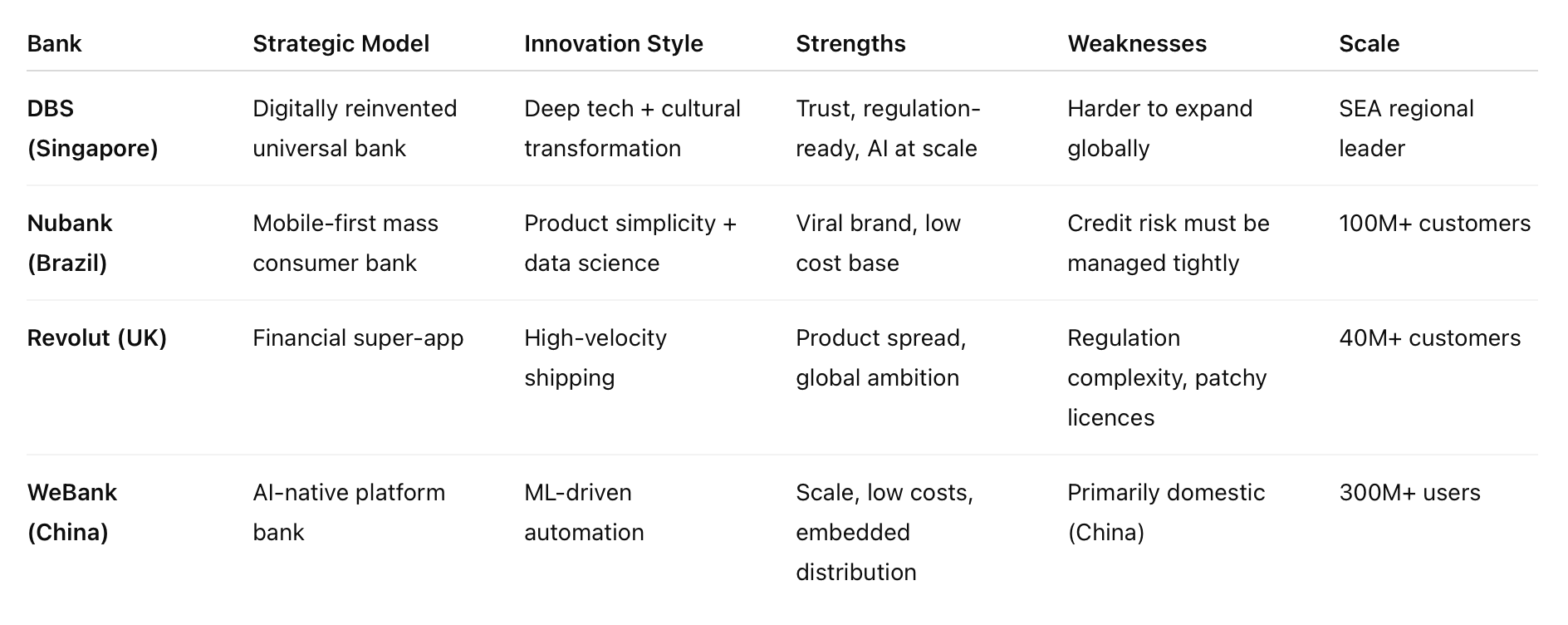
Their success also highlights a broader shift in the industry. Banking is no longer defined by products, branches, or balance sheets alone, but by experiences, intelligence, and participation in wider digital ecosystems. The leaders of tomorrow will be those that build trust through transparency, leverage data to deliver relevance at scale, and operate with the speed and creativity of modern software companies. They will be more open, more automated, and more integrated into daily life—often invisible, yet more impactful than ever.
These four organisations remind us that the future of banking will not be shaped by one model, but by a diversity of innovations emerging globally. They challenge every bank to reinvent itself, embrace possibility, and design a financial system fit for a digital world.
For more than two decades, I have had the privilege of working with many of Saudi Arabia’s most ambitious organisations — from STC, where my collaboration began twenty years ago, to companies like Almarai, Hungerstation and Savola. There’s also others like Alturki, Emdad and Mobily, and transforming government organisations like the Ministry of Health, the Ministry of Culture, and the evolving urban vision of new cities like KAEC.
Walking along the shoreline of the Red Sea in Jeddah, I watch families playing in the setting sun, couples walking for fitness, ice-cream kiosks serving incredible flavours, and cries of laughter come from the jet skis in the ocean. Nearby on the waterfront road, they are preparing for the Saudi Arabian Grand Prix, and indoors there’s the E-Sports World Cup. And global music acts like Jennifer Lopez and Travis Scott play to huge youthful crowds.
Across industries and generations, the story has been remarkably consistent: a nation determined to leap into the future while honouring its past; companies eager to redefine their purpose, their business models and their human capabilities; leaders pushing themselves and their people to climb the next summit, not because they have to, but because they believe the future of the Kingdom demands it.
How Vision 2030 reframed possibilities
The launch of Vision 2030 was not simply a national strategy. It was a mindset shift, a transformation of imagination as much as economics. It called on organisations to rethink who they were, what they stood for, and what role they could play in a diversified, globally connected economy. It set a new tone: the future was not something to wait for, but something to shape.
Vision 2030 articulated three broad ambitions — a thriving economy, a vibrant society, and an ambitious nation. Yet for businesses, its deeper message was about reinvention. It encouraged companies to see themselves not as oil-adjacent dependants, but as architects of a new economic landscape powered by knowledge, creativity, tourism, culture, and technology. It legitimised the idea that a Saudi company could be world-class, innovative, culturally influential, and globally admired. It created a licence for leaders to rethink everything: their purpose, their processes, their investments, their partnerships, and the experiences they deliver to customers and communities.
Most importantly, Vision 2030 elevated the role of human talent. It recognised that the greatest resource of the future would not be hydrocarbons, infrastructure or capital, but imagination — the ability of people to envision new possibilities and bring them to life.
A story of transformation
The transformation journey of Saudi organisations has not been uniform. Each sector, each company, and each institution has started from its own place and set its own pace. Yet the underlying pattern is clear: a shift from incremental improvement to strategic reinvention.
STC, for example, began as a traditional telecoms operator when we first worked together back in 2005. Today it is a digital powerhouse, a catalyst of infrastructure modernisation, a pioneer of platforms and services, and a talent engine attracting some of the most ambitious young Saudis. STC’s evolution mirrors the country’s trajectory — from utility mindset to innovation mindset; from national provider to regional challenger; from infrastructure to imagination.
Mobily, too, has experienced waves of reinvention — from rapid expansion to operational discipline, and now towards data-centric, experience-driven value creation. When we first met in 2010, I was astounded by its vision not just to be a communication platform, but the nation’s educator. Now part of e&, its focus on digital services, customer experience, and smart partnerships reflects a broader shift in Saudi business: technology is no longer the back-office engine; it is the front-line enabler of new business models.
Almarai and Savola represent another dimension of transformation: scale, quality and brand trust. These companies have long been pillars of the Kingdom’s food and consumer goods economy, yet Vision 2030 has pushed them to diversify, digitalise supply chains, elevate sustainability, and expand regionally. Their transformation is not simply about becoming more efficient, but about becoming more purposeful — feeding a growing region sustainably, innovating in categories shaped by demographic and cultural shifts, and building brands that resonate with both local heritage and global expectations.
At the other end of the spectrum is Hungerstation — a digital-native company that captured the Kingdom’s energy around entrepreneurship, convenience and lifestyle innovation. It reflects Saudi Arabia’s rising youth, its appetite for technology-driven experiences, and its growing position as an entrepreneurial hub for the Middle East. Hungerstation’s rapid growth illustrates how new entrants — agile, customer-obsessed, unburdened by legacy — are expanding the boundaries of what a Saudi company can be.
KAEC, meanwhile, represents transformation at an urban scale. It embodies the ambition to create globally connected cities that attract investment, talent and innovation; places where logistics, tourism, technology, education and creativity intersect. KAEC’s journey has not been linear, but its potential remains enormous — a living laboratory for new models of sustainable, integrated urban development that support the national goals of diversification and global connection.
On the governmental side, the Ministry of Health and Ministry of Culture are rewriting the playbook for public-sector transformation. The Ministry of Health is moving from a system defined by infrastructure and hospitals to a model focused on outcomes, prevention, digital health, and patient experience. Its mission is no longer simply to treat illness, but to improve wellbeing — a profound shift requiring new skills, data systems, partnerships and incentives.
The Ministry of Culture represents an equally striking transformation. For decades, culture in Saudi Arabia was seen as something to preserve quietly. Today it is an engine of identity, diplomacy, tourism and creativity. Cultural initiatives — from museums and festivals to film, fashion and food — are not only enriching society but also creating industries that employ thousands, attract global collaboration, and celebrate Saudi heritage on the world stage. This is transformation not just of policy, but of mindset: culture is no longer a backdrop, but a driver of national competitiveness and soft power.
Across these organisations — large incumbents, digital natives, new cities, ministries — the story is one of ambition meeting capability, imagination meeting execution. It is a story of transformation becoming not a project or programme, but a way of operating, thinking and leading.
What drives business transformation in KSA?
Saudi Arabia’s transformation is unique in scale and speed, but the underlying drivers echo global patterns: technology convergence, demographic change, geopolitical shifts, and the need for more sustainable, resilient models. Yet the Kingdom’s specific context adds additional layers of complexity — and opportunity.
At its core, business transformation in Saudi Arabia is driven by a number of connected forces:
- A national ambition larger than any individual organisation. Vision 2030 provides a north star that aligns sectors, investors, regulators and citizens. Companies are not transforming in isolation; they are contributing to a collective movement with shared expectations.
- A youthful, increasingly skilled talent pool. With median ages around 30, Saudis bring energy, digital fluency, and aspirations for meaningful work. They want to contribute, innovate, and be part of something that matters.
- Cultural confidence and global openness. The Kingdom is discovering — and projecting — its cultural identity in new ways. For businesses, this creates opportunities to blend tradition and modernity, local relevance and global standards.
- A shift from government-led to market-driven growth. Public-sector reform is enabling sectors like health, culture, tourism, logistics, energy and entertainment to evolve from cost centres to economic platforms.
- The rise of digital and data ecosystems. AI, cloud computing, 5G, fintech, platforms and automation are enabling Saudi companies to leapfrog legacy constraints and build next-generation operating models.
- International collaboration. Partnerships with global companies, universities, investors and institutions are accelerating capability-building, technology transfer and knowledge exchange.
These forces combine to create a rare moment in history: a national transformation that is both top-down and bottom-up, strategic and cultural, economic and human.
How organisations transform: Lessons from journey
Transformation is never simple. It requires more than a strategy deck or a new organisational chart. In Saudi Arabia, as elsewhere, the companies that succeed in transformation focus on a few foundational elements.
1. Start with purpose and vision
Every transformation begins with a compelling reason to change. In Saudi Arabia, Vision 2030 provides a national purpose, but each company must translate it into its own story: why it exists, who it serves, what value it creates, and what future it wants to shape.
When working with STC or Savola, a clear purpose became the anchor for innovation and organisational change.
A purpose rooted in more than business or financial success, but in heritage and values — feeding families, connecting people, enabling progress — becomes even more powerful when extended into future aspirations.
2. Build leadership that inspires confidence and courage
Transformation demands leaders who can balance ambition with humility, tradition with reinvention, and long-term vision with short-term delivery. In Saudi Arabia, leadership maturity has evolved rapidly. Many organisations once led by operational experts are now led by strategic thinkers who embrace experimentation, empower teams, and drive cultural change.
Great Saudi leaders share a few traits: they listen deeply, act decisively, embrace technology, invest in people, and frame change as an opportunity rather than a threat.
3. Create a culture of continuous innovation
Sustainable transformation requires innovation to be woven into everyday behaviours, not confined to labs or special projects. Companies like Hungerstation and Mobily thrive because they iterate quickly, listen to customers, and experiment boldly. Larger companies such as Almarai or Savola must create innovation systems that link strategy with experimentation, empowering teams to test ideas, learn rapidly and scale what works.
4. Adopt new business and operating models
Transformation demands not just doing new things, but doing them in new ways. This involves rethinking the entire value chain: how products are designed, how services are delivered, how experiences are shaped, how partners are integrated, and how value is monetised.
Saudi organisations are embracing platform models, digital twins, predictive analytics, ecosystem partnerships, new revenue streams, and more resilient, data-driven processes. Ministries are learning to operate like service organisations; private companies are learning to operate like agile digital businesses.
5. Invest in people, skills and talent pathways
Transformation is fundamentally human. It requires training, development, new career paths, new mindsets, and inclusive cultures where young talent is trusted to lead. The Saudi workforce is unique: ambitious, educated, globally aware, and motivated by purpose. Companies that invest in their people — through digital training, leadership programmes, learning academies, and cross-functional opportunities — will shape the Kingdom’s next competitive advantage.
6. Leverage technology as an enabler, not a strategy
Technology is essential — AI, automation, cloud, connectivity, data, platforms. But technology is a means, not an end. The real challenge is adopting technology in ways that improve experiences, unlock efficiency, enable new models, and elevate decision-making. The Ministry of Health’s shift towards digital health or Emdad’s platform-based approach illustrates this shift: technology enables smarter, more connected ecosystems that create more value.
7. Build the energy, resilience and governance for the long journey
Transformation is not linear. It is a journey marked by moments of acceleration and moments of consolidation. It requires governance systems that maintain momentum, learning loops that adapt to feedback, and resilience to navigate uncertainty. Successful Saudi organisations balance aspiration with discipline: they set bold goals, measure progress rigorously, invest consistently, and celebrate milestones along the way.
The role of heritage and identity
One of the most striking aspects of Saudi Arabia’s transformation is the interplay between future ambition and cultural heritage. Saudi companies are not trying to replicate Silicon Valley or European business models. They are crafting a model rooted in their own identity — a blend of modernity, tradition, hospitality, faith, creativity and community.
The Ministry of Culture exemplifies this. Its cultural renaissance — from film and literature to archaeology, design and music — creates not just economic opportunity, but social cohesion and pride. For businesses, this resurgence provides a wellspring of brand meaning, customer insight and creative inspiration.
Tourism and entertainment initiatives — from AlUla to Diriyah, from Red Sea to Riyadh Season — reinforce this connection. They are not simply commercial projects; they are expressions of history and imagination. They invite the world to see a Saudi Arabia that is dynamic, modern and culturally rich.
This is where transformation becomes more than economic. It becomes civilisational — a reawakening of heritage as a force for progress. For companies, the lesson is clear: the future is created not by abandoning the past, but by reinterpreting it for new contexts and new generations.
Saudi Arabia’s next transformation horizon
As the Kingdom moves deeper into the next decade, the transformation agenda is evolving. There are challenges, but also huge opportunities. Business transformation positively encourages cultural transformation, and success encourages progress.
The early wave focused on infrastructure, regulation, capability building, and strategy. The next wave will focus on integration, scale, and human capital. Some key themes will define this next horizon:
- From digital to intelligent. AI will underpin decision-making, operations, personalisation and prediction across sectors.
- From sector transformation to ecosystem orchestration. Tourism, culture, logistics, energy, finance, health and retail will converge through platforms and partnerships.
- From global benchmarking to global leadership. Saudi companies will increasingly define — not follow — global best practice in areas such as entertainment, sustainability, digital services and hospitality.
- From talent development to talent magnetism. The Kingdom will attract global talent while continuing to upskill nationals at scale.
- From economic diversification to value creation. The measure of success will shift from project launches to sustainable profitability, innovation, and societal impact.
Beyond 2030: A nation becoming what it imagines
Business transformation in Saudi Arabia is not just about economic modernisation. It is about becoming a nation that fully expresses its potential — creative, connected, confident, entrepreneurial and globally relevant.
The organisations I have been privileged to work with over the years are living proof of what is possible when leadership, talent, vision and imagination converge. Their journeys are not complete, but they are remarkable.
Saudi Arabia’s transformation is one of the most ambitious national projects of the twenty-first century. It demands courage, discipline, innovation and resilience. But above all, it demands a belief that the future is not inherited; it is created.
And in that sense, the Kingdom is already succeeding — not because it has reached its destination, but because it has become a nation determined to keep transforming, keep learning, keep imagining, and keep shaping the future it seeks.