This year’s top marketing campaign came from DoorDash.
The brand scooped the top prize, the Titanium Grand Prix, at Cannes Lions 2024, the advertising world’s self-indulgent booze fest on the French Riviera, plus a host of other awards at the D&ADs and OneShow.
You probably know DoorDash for restaurant delivery, particularly if you live in America.
DoorDash, originally founded as PaloAltoDelivery.com in 2013 by four Stanford University students, has become a dominant player in the online food delivery market in the USA.
The business expanded rapidly, reaching 70 restaurants in the Bay Area within its first year of operations. Y Combinator reported that DoorDash grew at a remarkable rate of 20% every week. The company’s goal was to build an AI system (named “Deep Red”) to optimize delivery by considering various factors and reducing errors. Aggressive market expansion helped DoorDash surpass competitors like Grubhub and Uber Eats. Acquisitions also played a key role: DoorDash acquired Square’s Caviar food delivery service and Wolt, gaining a foothold in the European market.
In 2021, DoorDash went public on the New York Stock Exchange with a valuation of $72 billion. In 2023, DoorDash reported revenues of $8.63 billion (a 31% increase from the previous year) and an annual net loss of $558 million (a 58% reduction from 2022). The company boasts 37 million users, primarily in the United States, and holds over 60% market share in the US food delivery app industry.
Now it wants to be more than just a food delivery company.
And so to the award-winning advertising campaign.
Wieden+Kennedy, the Portland-based creative agency that grew rapidly on the coat tails of local company Nike, is the agency behind DoorDash’s award-winning ad.
DoorDash, with a new brand platform “Your Door to More”, wanted to showcase their ability to deliver just about anything.
Where better to do this than the Super Bowl? Not just by telling people that DoorDash could deliver anything, but by proving it: delivering every product advertised during the Super Bowl broadcast to one lucky person.
In the days before the Super Bowl, as brands announced they were in the game, W+K added them to a DoorDash cart creating anticipation, excitement, and speculation about how big the prize would get. Then during the game, as ads aired, we continued to add them to our shopping cart, whether a pallet of Reese’s, four separate cars, or 60lbs of mayo – creating one epic prize that spanned 76 brands.
As the grand prize grew in scale, and absurdity, we updated consumers live. Social media was clamouring for hints and prize suggestions, and by the time our ad aired in the 4th quarter, anticipation was at a fever pitch. The film was simple: it told people to visit doordash-all-the-ads.com and enter a promo code. But of course, this promo code wasn’t going to be easy. Some got mad, many made memes, but most got crafty, banding together IRL and online to crack the code.
The 30 second ad became the catalyst to hours of conversation, interaction, and social. People didn’t just watch our ad: they rewatched it, over and over again – some missed overtime entirely. By turning every Super Bowl ad into a DoorDash delivery, W+K surpassed their goal with 11.9 billion earned impressions, 8 million+ entries, nearly 300 million earned social impressions, and 117 million viewers. But most importantly, the ad captured America’s attention, proving DoorDash’s ability to deliver just about anything.
Here are some more best campaigns of the year, winners from Cannes Lions:
Digital Public Library of America (DPLA) is fight America’s book banning crisis. Conservative politicians are silencing Black, Brown and LGBTQIA+ voices by forcing librarians to take their books off the shelf. In 2023 alone, 3,059 books were banned – more than in any other year. DPLA holds that our democracy relies on our freedom to read. And believes books should always be available to everyone.
The DPLA created the most up to date database of all of the books banned in America. Then, geo-fenced the exact footprint of every library that banned the books – and made those books available for any person when they are within those very libraries. Sending a strong message to the book banners – that every time they try to take a book off the shelf, the DPLA will put it right back, virtually.
The Banned Book Club was launched in partnership with President Barack Obama, the most notable defender of our freedom of speech. The campaign reached people in the more than 20 states that have books banned with geo-located Instagram and Facebook ads, that alerted people just as they were near those offending libraries. The Banned Book Club is a social first, digital solution designed for the future. Whenever a book is banned – it can simply be added to our dynamic database, making it available instantly in any library. Ensuring no book is ever banned again.
Dove has long been a campaigning brand. From women, it is now focused on kids. Kids are experiencing severe mental health issues from the onslaught of seemingly endless toxic beauty content on social media. Anxiety, depression, self-harm, eating disorders, PTSD, and even suicide – the harm social media can cause has no limits. Because neither does social media. In fact, the majority of young girls say they feel the pressure to look perfect and match what they see on social media. Our brief was twofold: first, highlight the scale of the social media-induced mental health crisis among kids; and second, inspire the world to act, demand change, and save kids from the dire consequences of toxic beauty content. Our goal was to mobilize the masses by creating a single, shareable film and get viewers to sign the petition to support the Kids Online Safety Act. Dove surpassed its goal of 50,000 petition signatures for the Kids Online Safety Act, resulting in the bill passing in the Senate.
3 in 5 kids experience mental health issues from social media. So, we told the story of Mary; a real girl who almost lost her life from an eating disorder. However, we didn’t need to shoot her story, Mary already had. Using her own photos, videos, and journal entries, spanning over a decade, we created a film that shows her downward spiral after getting her first phone and joining social media. Set to an emotional female cover of Joe Cocker’s ‘You Are So Beautiful to Me,’ we see how quickly social media shapes Mary’s view of her own beauty, causing her mental health to severely struggle. At the end, we learn this isn’t just Mary’s story. It’s the story of millions of girls. The film concludes with a rallying call for people to sign the petition in support of the Kids Online Safety Act.
Mercado Libre, Latin America’s leading e-commerce platform, executed a unique campaign named “Handshake Hunt” during Black Friday. Partnering with the TV channel Globo, the campaign displayed QR codes for discounts whenever a handshake appeared on-screen. This innovative strategy aimed to increase transactions in Brazil. Targeting the online retail market in Brazil, the campaign utilized various media channels including product placement, outdoor, out-of-home, and sales promotions.
In 2023, Mercado Libre’s Black Friday campaign achieved unprecedented success. The company saw a remarkable 39% year-over-year increase in overall sales during the period, and an extraordinary 80% year-over-year boost specifically on Black Friday itself. This impressive performance stands out even more considering the challenging market conditions in Brazil, where many competitors struggled.
Nativa, a Colombian beer from AB InBev, has initiated a creative and sustainable project called Nativa Meter, aimed at repurposing its traditional bottles to aid Colombian farmers in making more informed decisions about their crops. Teaming up with the globally recognized independent agency L&C New York, Nativa has transformed its bottles into rain gauges, providing a practical solution for farmers to plan their planting seasons more effectively.
The redesigned Nativa bottles now feature measurement indicators to gauge rainfall levels per square meter. This innovative initiative aims to repurpose packaging for a positive impact on Colombian farming communities.
“Cerveza Nativa is a brand that is committed to the Colombian countryside. For this reason, for us, initiatives like Nativa Meter are essential because they allow us to innovate and find creative solutions that arise from the real needs of the community,” said Diego Pomareda, Marketing Director of Cerveza Nativa. “This is a simple way to incorporate technology into an everyday product that farmers consume, and at the same time, help prepare them to face the challenges of a world that is being affected by climate change.” added Rolando Cordova, Co-Founder and Chief Creative Offier of L&C New York.
Siemens Healthineers introduces “Magnetic Stories”, an innovative technology transforming terrifying MRI sounds into enchanting children’s audio books. Imagine the daunting roar of an MRI machine, reaching decibel levels louder than a military jet. Now, consider the impact on a child undergoing cancer treatment.
This pioneering campaign seeks to replace anxiety with awe and fear with fascination, ensuring young patients experience a journey of magic and wonder during medical procedures. By harnessing the power of storytelling, Siemens Healthineers aims to redefine healthcare experiences, making them not just tolerable, but inspiring for every child in need.
WhatsApp, the messaging service, and The Lab, the creative incubator within the award-winning production company Anonymous Content, announced the release of their new documentary, “We Are Ayenda.” This film tells the extraordinary story of the Afghan Youth Women’s National Football Team and their remarkable escape from Afghanistan after the Taliban took power in 2021. The documentary debuted during the Women’s World Cup and is now available on Prime Video.
The half-hour film, adapted and produced by The Lab and directed by award-winning documentary filmmaker Amber Fares, showcases the bravery of these young women and their determination to continue playing the sport they love. The documentary aims to raise awareness of the challenges people face when forced to migrate and highlights the power of sport to unite people. It reveals the profound relationship between Farkhunda Muhtaj, the former captain of Afghanistan’s women’s national football team and a humanitarian activist, and the members of the women’s youth team.
Despite never having met in person, Farkhunda led the young women to safety through WhatsApp texts and voice messages, which are woven throughout the documentary to retell their story. “These incredible young women just want to continue competing in football and aspire to achieve their dreams,” said Farkhunda Muhtaj. “To help them escape successfully, I knew the stakes were extremely high for secure communication. If something was intercepted, whether it be their passports or IDs, not only would the mission be jeopardized but everyone’s life would be at risk.”
“From the moment we first shared this story with the WhatsApp team, we were all in awe of the girls and Farkhunda,” said Zac Ryder, Executive Producer at The Lab. “Everyone was on the same page that our number one job was to honor them and their families, which meant telling the story as authentically as possible. It takes a very brave client to sign up for something like that. We’re so fortunate to be working with such thoughtful, committed partners.” Vivian Odior, Global Head of Marketing at WhatsApp, added, “We are honored to support these brave women who are an inspiration to everyone pursuing their dreams.” The film captures the sheer determination and unwavering spirit of these young athletes, offering a unique perspective into their lives.
Since the Taliban took control of Afghanistan, women and girls have been denied their human rights, including the right to go to school, work, and play sports. According to UN estimates, eight million Afghans have been displaced from their homes due to violence, including millions of refugees now living abroad.
I’ve been a runner for over 45 years.
In my youth I competed over 1500m and cross country. In those early days I was inspired by local world champion Steve Cram and particularly by Brendan Foster who was a great event innovator, launching the Great North Run in 1981 (yes I was there, running 1 hour 30 as a 14 year old!).
Over the years I’ve continued to follow the sport of track and field athletics, with a passion. I still run, almost every day. The London 2012 Olympics were a pinnacle. In the stadium as Mo Farah won his double gold. Paris was nearly as good. And more recently I sat with World Athletics president Seb Coe, talking about the past, but more about the future.
Running is the world’s highest participation sport. But it is nowhere when it comes to public profile. Rarely does it attract big crowds, or live TV, or big sponsors, or million dollar pay days for champions like in other sports. Why? Because it hasn’t really innovated. As the world has changed beyond recognition in the last 45 years – digital, social, brands, celebrity, global – athletics hasn’t. It’s traditional, can be amazing, but it hasn’t innovated.
And then Michael Johnson, the superstar multi record holder and Olympic gold medallist, announced Grand Slam Track.
Grand Slam Track is a professional track and field league founded by four-time Olympic champion Michael Johnson. The league was announced in 2024, with its inaugural season set to run from April to September 2025. The concept behind Grand Slam Track is to create a professional, lucrative, and engaging league that focuses on rivalries rather than just times, aiming to draw more attention to the sport.
Michael Johnson, a former 200m and 400m world record-holder, had the idea for Grand Slam Track since the 1990s. He was inspired by how other professional sports leagues, such as the NFL and Formula One, operated and wanted to bring a similar model to track and field. Johnson’s vision was to create a league that would increase the sport’s visibility, attract more fans, and provide athletes with better opportunities and financial rewards.
The development of Grand Slam Track involved securing significant investments, including a $30 million funding round. Johnson also brought on board key personnel, such as former middle-distance runner Kyle Merber as Senior Director of Racing and Olympic champion Morolake Akinosun as Head of Athlete Relations. The league’s structure was designed to resemble other sports leagues, with global athletes competing in a series of events throughout the track season.
It consists of four “grand slam” events or meetings per season, held in different cities: Kingston, Miami, Philadelphia, and Los Angeles. Each event features six event categories for both men and women, including short sprints, long sprints, short hurdles, long hurdles, short distance, and long distance. A total of 48 athletes, known as “Racers,” are contracted to compete in one of six event groups in each of the four Slams. Additionally, 48 “Challengers” will compete against the Racers, with the identities of the Challengers changing from Slam to Slam.
Each Racer must participate in two different disciplines at each Slam, and the winner of each event group is determined by the highest point total across both events. The league offers substantial prize money, with the first prize for each Slam being $100,000. The overall prize pool for the season is the highest in the history of track racing.
Grand Slam Track aims to disrupt the traditional track and field landscape in several ways:
- Professional League Structure: By creating a professional league with contracted athletes, Grand Slam Track seeks to provide more stability and financial security for athletes. This model is similar to other professional sports leagues and aims to elevate the status of track and field.
- Focus on Rivalries: The league emphasiss head-to-head matchups and rivalries rather than just times and records. This approach is designed to create more engaging and exciting competitions for fans.
- Increased Visibility and Fan Engagement: Grand Slam Track aims to increase the sport’s visibility through live broadcasts on linear TV and streaming platforms, as well as partnerships with media and betting companies. The league’s focus on storytelling and promoting athletes’ personalities is intended to attract a broader audience.
- Global Reach: By hosting events in different cities around the world, Grand Slam Track aims to promote the sport on a global scale and attract international fans.
- Innovative Competition Format: The league’s unique format, with athletes competing in multiple disciplines and earning points across events, adds a new layer of strategy and excitement to the competitions.
- Financial Incentives: With the highest prize pool in track racing history, Grand Slam Track aims to attract top talent and provide athletes with significant financial rewards.
In summary, Grand Slam Track, seeks to revolutionise the world of track and field by creating a professional league that emphasises rivalries, increases visibility, and provides substantial financial incentives for athletes. The league’s innovative structure and global reach aim to attract more fans and elevate the sport to new heights.
Joshie the Giraffe
A family staying at a Ritz-Carlton hotel accidentally left behind their son’s stuffed giraffe, Joshie. When the hotel found the toy, they went beyond simply returning it. The staff took photos of Joshie enjoying various hotel amenities, like lounging by the pool and getting a spa treatment. They sent these photos along with the giraffe, creating a delightful and memorable experience for the family. What can we learn? Adding a personal touch and a bit of creativity to customer service can turn a potentially negative situation into a positive and shareable story.
Molly the Bride
Molly, a regular Zappos customer, needed shoes for her wedding and expressed concern about receiving them on time. A Zappos representative upgraded her order to overnight shipping at no extra charge. Molly received the shoes the next day, in time for her wedding, and was deeply grateful for the exceptional service. What can we learn? This story is one of many that highlight Zappos’ commitment to going above and beyond for its customers. Empowering employees to make decisions that benefit the customer can create memorable and positive experiences, fostering customer loyalty and brand advocacy.
Sam’s PlayStation
Sam, an Amazon customer, ordered a PlayStation during the holiday season. Due to a delivery delay, the package didn’t arrive on time. Before Sam even contacted Amazon, he received an email apologising for the delay, offering a full refund, and informing them that the item would still be delivered. Sam ended up receiving the PlayStation for free and was highly impressed by Amazon’s proactive customer service. Anticipating customer issues and addressing them proactively can prevent dissatisfaction and turn a negative experience into a positive one.
Having a Customer Mindset
“Hello, I am your customer. Do you see the world like I do? It’s simple really. Start with me and everything else follows. Together we can do extraordinary things … “
Customers are now in control of our markets, demanding that we do business on their terms. Their expectations are high, and loyalty is rare. They are individual and emotional, well-informed and highly organized. They know what they want, and only accept the best.
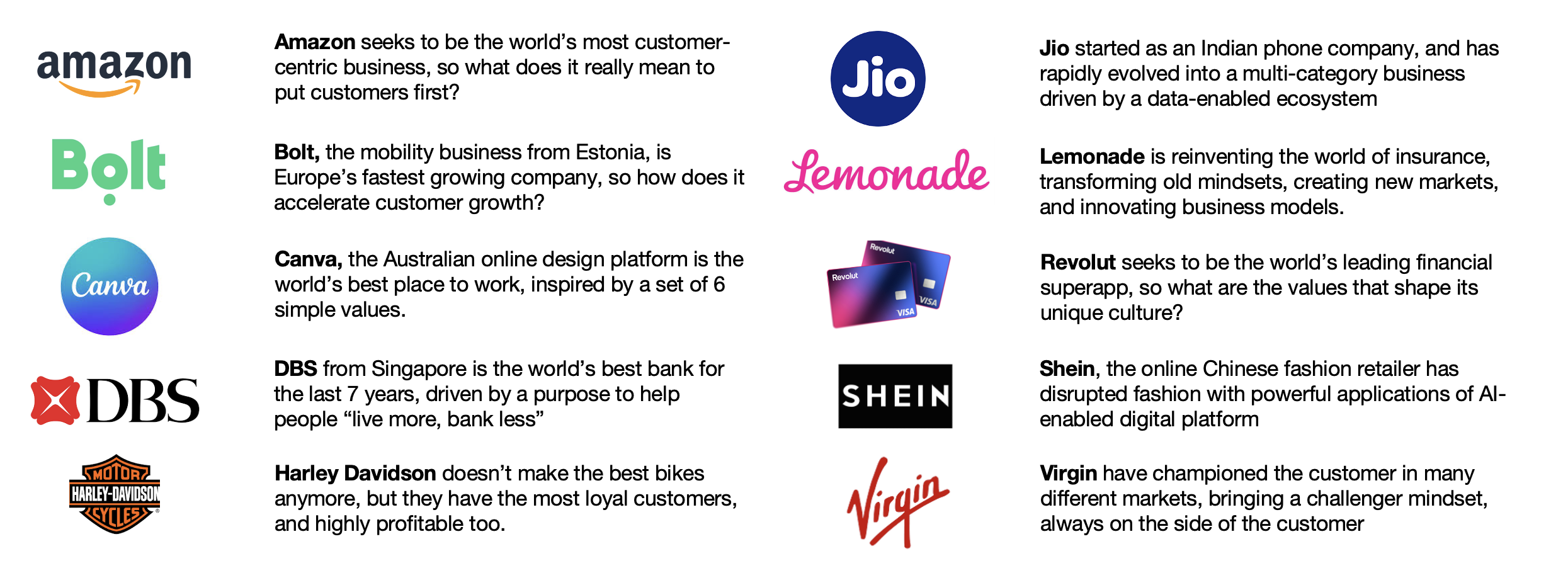
In my book “Customer Genius” I explore a 10 step blueprint for building a customer-centric business; proving that the right customer strategies, based on deeper customer insight, driving more compelling propositions and distinctive experiences, can engage those ‘wonderful people’ we call customers.
- Outside in. Power has shifted to customers, and business must learn to think and act from the outside in.
- Bigger picture. Customers see their challenges and solutions more holistically, without sectors or categories.
- Less is more. Better to attract and retain fewer, more profitable customers than to try to serve everyone.
- Deep diving. Use more personal immersion to discover what factors really drive attitudes and behaviours.
- Get personal. People are more irrational and emotional. Focus on the energisers, not just the essentials.
- Pull don’t push. Don’t sell products, engage people on what matters to them – where, when and how they want.
- Work together. Collaborative, help people to solve problems and achieve more with co-created solutions.
- Intuition rules. Throw away the rule book, and enable customer service people to be human and responsive.
- Word of mouth. Customers are more loyal to each other than any business, so harness the power of advocacy.
- Future results. Customer metrics are lead indicators, whilst financials only tell you about the past.
There’s nothing new about customer-centricity. Call if customer-focus, customer-driven, customer-intimacy, or customer-obsession, companies have been seeking to install a customer mindset in their organisation’s culture for many decades. It’s obvious, but not easy. It’s easy to start from what you know, what your organisation does, what products you offer, and what you think. It’s much more difficult to start with the customer.
Amazon seeks to be the world’s most customer-centric business, and indeed customer obsession means that every decision – strategic or operational – starts with what’s right for the customer, and then finding a way to make it happen practically, and hopefully profitably too. Disney has long communicated a story of magic, and seeks to deliver magic moments in everything it does. Apple famously don’t research what customers say they want, but use their intuition to solve the right problem, thinking like a customer. It’s about being human, its about looking beyond the transaction, and its more fun and rewarding too.
So what’s a customer mindset?
- Be me: put yourself in the mind of your customer, what’s going on in their world, what makes them tick; listen harder, what do they really want to achieve, use their language, make connections, meet their needs?
- Be more: how can you enable your customer to achieve more, not just the product or service they’re buying, but how they will use it, what it helps them to do; save time, live better, care for the environment?
- Be magic: what’s the special thing you can do for your customer; a small favour, something personal, a joke, a smile; how will you leave an impression, be a little different, and memorable?
And what does this take?
- Customer Purpose: start with why your business exists, what’s your purpose, how do you make the world better in some way, and typically the lives of customers.
- Customer First: make choices from the customer’s perspective first, meeting their need, solving their problem, and then find a way to achieve it practically and profitably.
- Customer Insight: remember Maslow’s pyramid has functional things at the bottom (and that includes price!), and more emotional things at the top (everybody is emotional, you just have to find it).
- Customer Problem: what’s the context, the job to be done, the bigger thing which your customer is trying to achieve; not just the product or service they say they need?
- Customer Journey: consider the stepping stones in what they’re doing, and how you can be a better part of it, not just by addressing your specific items, but facilitating more of it too.
- Customer Personalisation: how can you use AI, or data, or simple listening, to deliver a more personal solution for the customer, perhaps by anticipating what they need, or tweaking something to make it more relevant.
- Customer Loyalty: this starts with trust, and ideally moves to return, and recommendation; but look beyond the cards and points schemes, to think what genuinely earns the customer gratitude and support over time.
Here are some of the world’s most customer-centric companies:
Walk into an IKEA, pull out your phone and use their AR app, and you’re transported to your future home …
Nike is not a sportswear company, it’s a sports company … obsessed with helping people do better sport
Virgin is all about being human, as captured in its cultural values …
Buc-ee’s is a Texan gas station, ranked as the world’s most customer-centric business …
Zappos is a story of happiness, how to do more for every customer … happiness delivered
Disney seeks to bring out the magic in every human being … delivering moments of magic
It all started with a cheeseburger. Dinner and a movie… classic combo! What could go wrong?
Well, “dinner” turned out to be a Fudd 66 Green Chile Cheeseburger, cut down the middle (so was the check). And the movie? Well, that was a not-so-subtle invitation to “watch an awesome documentary about Peruvian jungle sloths” back at the dude’s apartment, which he shared with three roommates. No thanks!
But from this colossal bummer of a night came an idea—a bold, innovative way to make dating feel a little bit less like hell.
Dating insurance offers peace of mind against terrible dates that leave your mind in pieces. Even better—coverage is available nationwide, including high-risk areas like New York and Los Angeles. Take advantage of benefits, including full coverage for all “named perils,” such as Rebound Syndrome, “didn’t have anything better to do so why not,” post-11pm meet-ups, and “u up?” texts. Does your wallet need protection against your heart? We thought so.
Insurance companies have long struggled to innovate.
Lemonade is different.
Lemonade is reinventing insurance to be instant, easy, and transparent. It offers home insurance powered by artificial intelligence and behavioral economics. By replacing brokers and bureaucracy with bots and machine learning, Lemonade promises zero paperwork and instant everything. And as a Certified B-Corp, where underwriting profits go to nonprofits, Lemonade is remaking insurance for social good, rather than a necessary evil.
Lemonade is led by Daniel Schreiber, a British-trained lawyer, who was previously SVP corporate marketing at Sandisk where he was in charge of the press relation and social media. He then became president at Powermat, where he oversaw major transformations in the industry and various features for top brands like Samsung, Starbucks and GM. He also co-founded content security company Alchemedia.
In 2015, Schreiber and tech entrepreneur and inventor Shai Wininger founded Lemonade. Schreiber believes the current insurance model is outdated, frustrating and brings out the word in people. Quoting data from the Insurance Research Council, which suggests that insurance fraud costs an average family around $1300 yearly.
Lemonade prides itself as being a gamechanger in the insurance industry. He sees technology as the way going forward “We’ve got over a quarter million customers but less than 100 employees. It’s about using technology to do stuff that humans would otherwise be doing so that as we scale our company, there’s continuously innovation and processes that we try to automate both to collapse time and the hassle for customers and to collapse cost concurrently.”
Schreiber told Business Insider that “Insurance companies make money by disappointing their consumers. It’s difficult to think of another sector where that’s true. But if they delighted all of their consumers, they’d go out of business, because the way insurance providers make money is by denying your claim. Insurance companies now are justified in treating them with suspicion, and that spirals onwards and downwards.”
“Lemonade was founded on the idea that the current state of the insurance industry was frustrating, outdated, and brought out the worst in people,” says Schreiber. “Lemonade, built on AI and behavioural economics, is trying to change that. We’ve seen that a whopping 90 per cent of our consumers are first-time buyers. This means they did not have insurance before, and now they need coverage for their stuff and a home! The extraordinary benefits of having simple and inexpensive protection versus not having any coverage is significant.”
Like most startups challenging the increasingly creaky financial institutions, Lemonade has a familiar advantage: it’s nimble. Users (currently limited to certain states in the US) can make claims via their smartphones, and because the company only employs around 30 people and uses algorithms to process claims, it can make decisions more quickly, for less money. On top of that, Lemonade takes a flat fee out of its customers’ monthly payments which it uses to pay out on claims, taking away the traditional incentive for an insurer to deny claims to save cash.
“We have bots instead of brokers, and an app instead of paperwork. You can get insured in seconds, and get your claims paid in minutes. Insurance shouldn’t be more difficult than that. In fact, we recently reviewed, approved, and paid a claim in three seconds, setting a world record for fastest claim ever.”
There’s one more part in Lemonade’s pitch to potential customers that’s a little more left-field: when you sign up for its service, the company asks you to pick a charity. And then at the end of each year – if you and other supporters of the same cause don’t make too many claims – a portion of the money that you have paid to Lemonade is then passed on to your chosen nonprofit, as part of what Lemonade calls ‘Giveback’.
Richie McCaw, the former captain of New Zealand’s “All Blacks”, is regarded by many as the greatest rugby player of all time.
His teams won a remarkable 89% of their 110 matches in which he was their leader, including two World Cups. He even played through one cup final with a broken foot, knowing that he was a key component of the team. Whilst he recognises that the team is always more than any individual, he also believes that a leader defines a team, brings together and creates great individuals.
After lifting the World Cup in 2015, McCaw said “We come from a small Pacific island, a nation of only 4.5 million, but with a winning mindset. At the start of each game, when we lock together in our traditional Maori haka, we know that we are invincible”.
Create your “Kapa o Pango”
The All Blacks have a bold and unwavering ambition to win, working on a 4-year cycle with a common team, and setting mini goals along the way to retain sharpness and evaluate progress. They search out the best players who bring each technical specialism, but equally who will work best together, whilst also retaining a search for new talent and skills.
Being part of the team is everything, with a sacred induction, and commitment to the higher purpose.
As a team they constantly evaluate, challenge and stretch, themselves. They search the world of sport and beyond for new ideas, ways to improve physiological fitness, mental agility or technical skills. Like most sports, whilst they have a coach to guide them and captain to lead them out. Their approach once in the game is that every one of them is a leader, all equal, all responsible, and all heroes when they win.
In his book “Legacy” James Kerr says describes some of their team beliefs
- “A collection of talented individuals without personal discipline will ultimately and inevitably fail.”
- “A sense of inclusion means individuals are more willing to give themselves to a common cause.”
- “The first stage of learning is silence, the second stage is listening.”
- “High-performing teams promote a culture of honesty, authenticity and safe conflict.”
- “If we’re going to lead a life, if we’re going to lead anything, we should surely know where we are going, and why.”
- “Be more concerned with your character than your reputation or talent, because your character is what you really are, while your reputation is merely what others think you are.”
Richie McCaw talks about some of the distinctive beliefs which the team has embraced. These include many concepts from Maori culture, such as the “Kapa o Pango” which is the name of the haka, the traditional dance performed by the team before every match, and reflects the diversity of the nation’s Polynesian origins. Such rituals become important in bonding the team, but also in creating its identity to others.
Another Maori concepts is “whanau” which means “follow the spearhead” inspired by a flock of birds flying in formation which is typically 70% more efficient than flying solo. And finally “whakapapa” which means leave a great legacy, or translated more directly, plant trees you’ll never see by being a good ancestor.
The team always wins
Netflix has built a culture of “freedom and responsibility” which has helped it to dare to innovate more radically, and transform an industry. Pixar’s teams work together in wooden huts as an individual but collective workspace, embracing an openness of debate to turn initially mediocre ideas into billion-dollar hits.
Teams are where innovative ideas are most often conceived, futures shaped, projects implemented, and where employees experience most of their work. But it’s also where the biggest problems can arise in limiting the effectiveness of organisations.
Alphabet recently set about investigating what makes a great team, in what they called Project Aristotle, a tribute to Aristotle’s quote, “the whole is greater than the sum of its parts”.
Effective teams, they concluded, have a high degree of interdependence, more than just a group working on a project, or functionally aligned. They have a distinctive identity, and loyalty to each other. They plan work, solve problems, make decisions, and review together, and know that they need one another to achieve success.
Alphabet found that what really mattered was less about who is on the team, and more about how the team worked together. In order of importance, they found that effective teams are:
- Safe: this relates to people’s perceptions of the heightened risks of taking part, or reduced risks of acting together, determined by their confidence in each other.
- Dependable: participants trust each other to embrace their individual responsibilities, deliver work of quality and on time
- Structured: there are clear goals, with clear responsibilities of each participant, and an agreed way of working together.
- Meaning: the team has its own sense of purpose, which is relevant to the organisation, but also to the values and ambitions of the team
- Impact: each participant’s contribution is seen as important, whilst the real measure of impact is what the team can achieve together.
Each Whole Foods store manager can act largely autonomously, aligned by clear metrics but responsive to local communities and the passions of their local team. Zappos, the online fashion retailer, also now part of Amazon, embraces “weirdness and fun” as the ingredients to sustain their team success.
Fearless and fearsome
Amy Edmondson’s book “The Fearless Organisation” focuses on Alphabet’s top priority, that teams need to have psychological safety, and how teams create safe spaces in organisations for people to be open, creative and grow.
Organisations can easily become paralysed by fear, which reduces people to conformity, to easy compromises, to incremental developments, and mediocre performance. Leaders are responsible for creating such cultures of fear, and are equally responsible for creating an environment where people can be fearless, or even together, fearsome.
Psychological safety is created through 3 factors:
- Positive tension: It’s not about always agreeing, about being nice for the sake of harmony, or constant praise. Creating an environment where tensions are constructive not destructive requires trust, allowing and respecting people for talking openly, with different perspectives, and conflicting opinions.
- Complimentary styles: Team members will have different styles of behaviour, some extroverts and others introverts, some visionary and others pragmatic, some starters and other finishers. The team values these styles as complementary and equally important.
- Collective attitude: Whilst trust is important between participants, the key aspect of safety is that it is valued by each person as important to the group’s ability to function well. Whilst team members are individually different, they acknowledge they are much less without the whole.
Extreme teams, like the All Blacks, take these traits to the limit. They seek great individuals who are prepared to work collectively, with commitment and courage. They seek more diversity, bringing together differences of capability and opinion. They thrive on dynamic conversations that can embrace extreme ideas. And they have a profound belief, that together they can achieve amazing results.
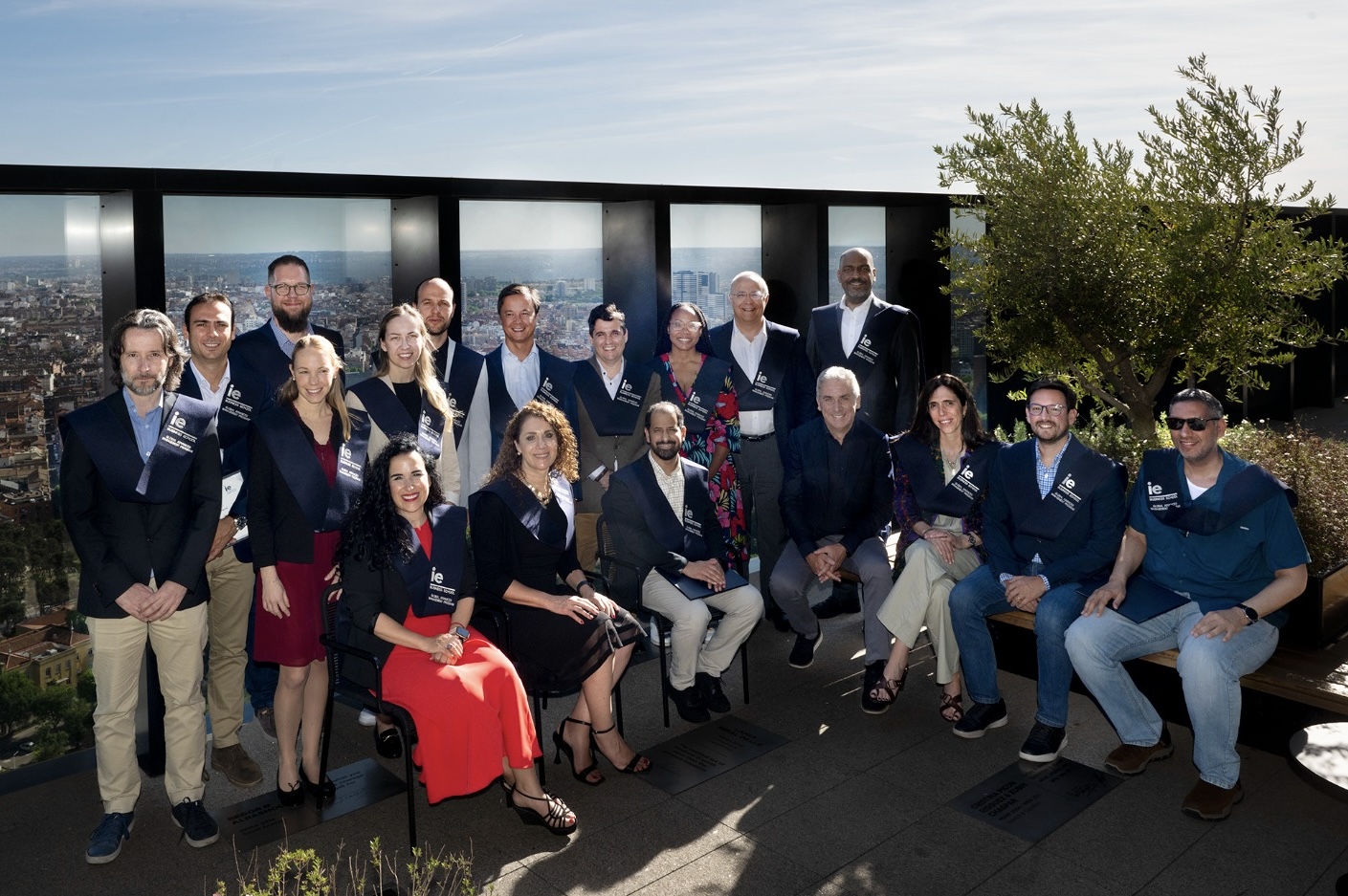
Each year I get to work with a group of incredibly talented business leaders from every part of the world. We spend 9 months together, in person and online, exploring the future of business, the disruptions, the opportunities, and how they can change their worlds. This is not a normal program.
Participants need to rise above conventions and expectations, they need to stretch possibilities and practicalities, and ultimately explore how they can transform their business, and themselves. It is a journey of discovery, sometimes uncomfortable, sometimes unknown. It demands that they let go of what has made them successful so far, and step up to imagine a better future.
This year the group represented 13 different nationalities, and 11 different industries. From Germany to Colombia, Netherlands to Saudi Arabia, Mexico to Denmark, Portugal to South Africa, they were leaders of diverse industries from energy and pharmaceuticals, to finance and agritech, telecoms and future tech, consulting and education.
On the final day of the journey, we call it Gamechanger Day, each participant gets to present their blueprint for the future of their business – how they seek to transform their business over the next 5 years. The goal is to be bold, disruptive, and go beyond the current paradigms of thinking within their organisation. It is the culmination of a 6 month project applying the best ideas from today’s business world to their own business and ambitions. It becomes their narrative, on which they can become leaders of the future.
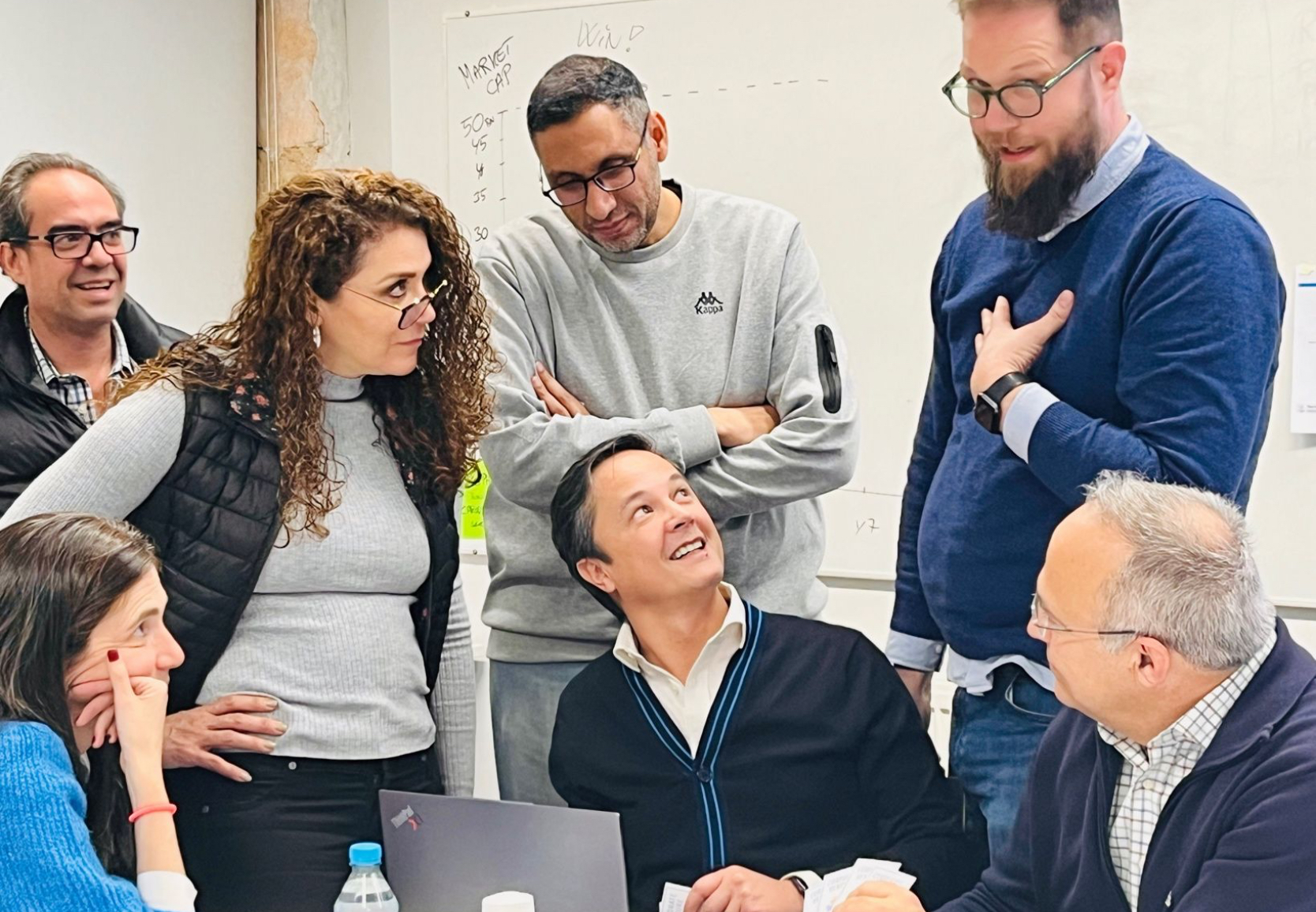
This year’s Gamechanger projects were of a disruptively high standard as always … how can we reduce the cost of cancer therapies 10 times, making them significantly more accessible to the world’s population, and at the same time helping the pharma company multiply its own market value five fold … how to convert Europe’s largest oil refineries into renewable refineries, turning captured carbon into new materials … how to use blockchain to build a fractional-owned digital infrastructure to galvanise African society … how to accelerate the development of better strains of strawberries using CRISPR … reinvent airlines with a non-volatile revenue model by developing in adjacent market … how to take Latin America’s leading retail chain to the world … create roboboats to secure the Middle East … how to develop AI-based strategy consultants … how to reinvent shrimp farming … how to optimise clean energy consumption … and much much more.
This is all built on 9 months of stimulation – bringing together the best ideas in business right now, delivered by some fantastic experts from around the world, hosted by IE Business School.
We start in the future – future back strategies, building on megatrends, embracing tech possibilities. And then to business innovation, new business models, innovation concepts, growth accelerators. And framed around the bigger idea of business transformation. All brought to life through a fabulous 8 week simulation of the future mobility sector – exec teams competing to build a $50 billion valued business, while also leading the intricacies of corporate finance, strategic disruption, portfolio growth, and how to really work as a winning c-suite team. And of course, throughout the program, lots and lots about leadership, and how to disrupt yourself to be a better leader.
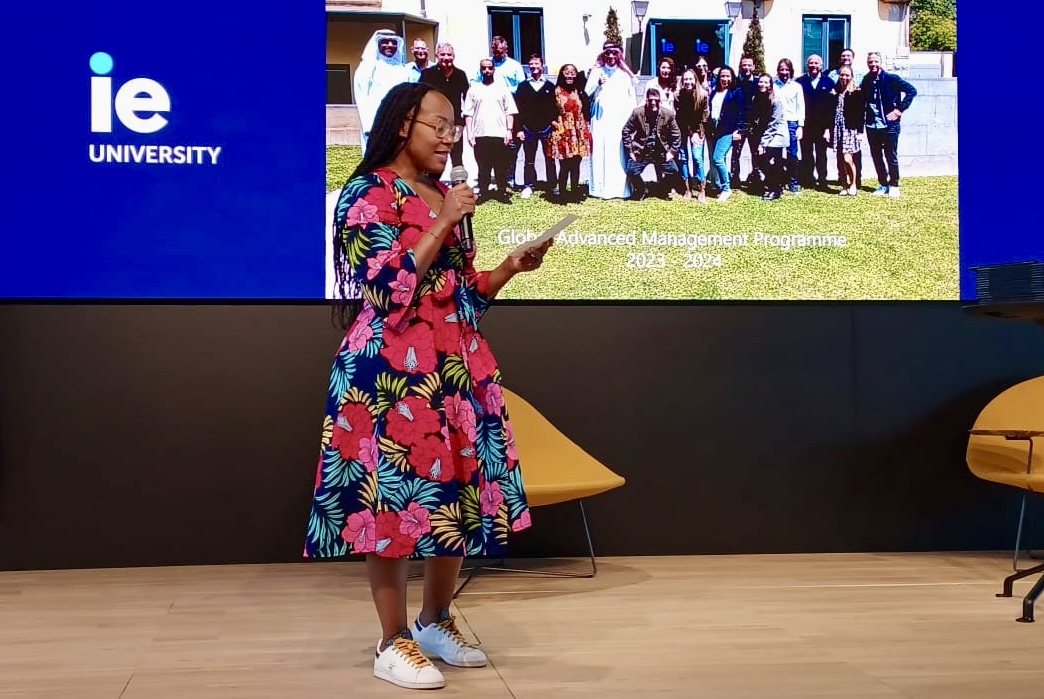
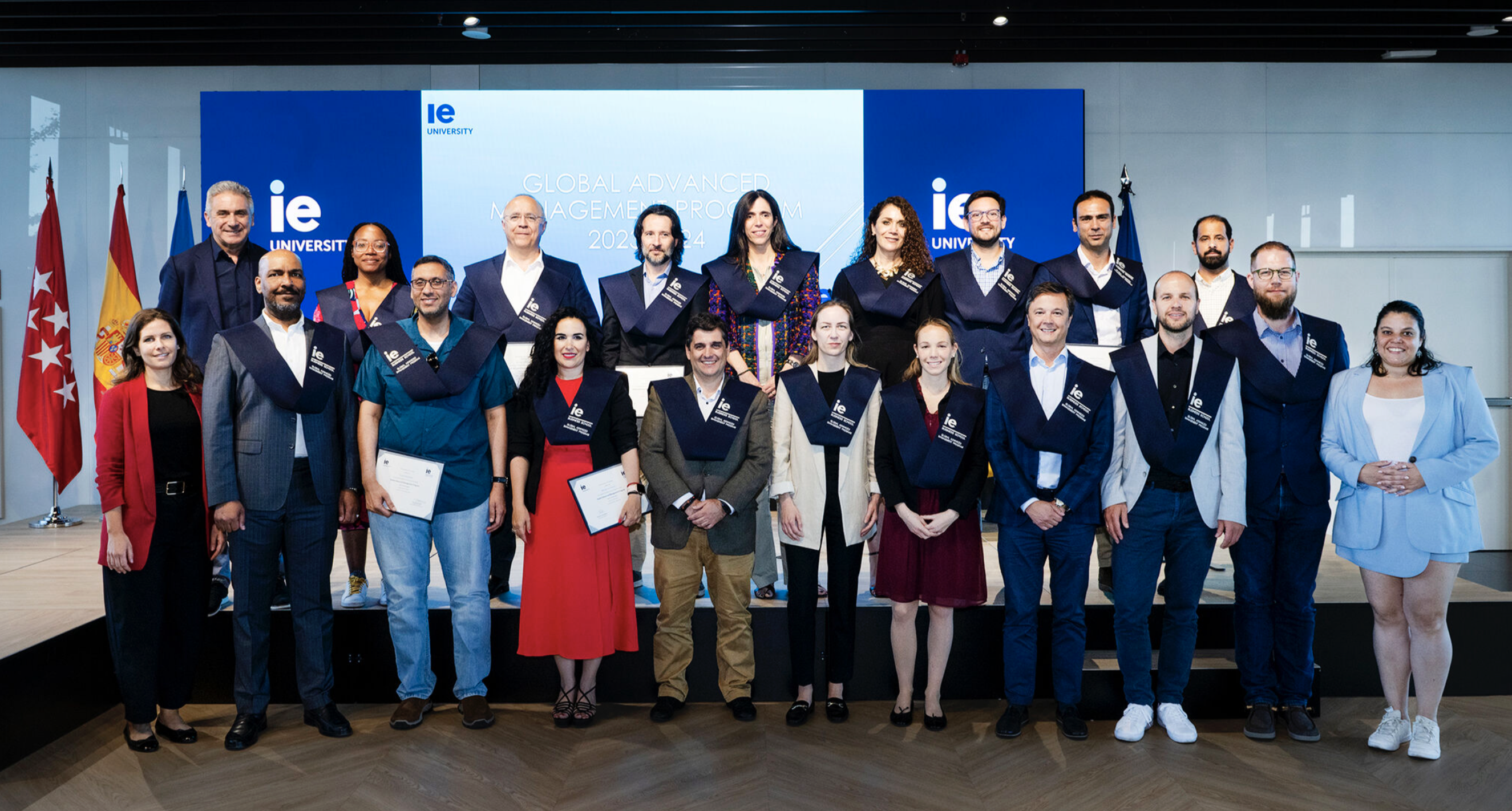
At the graduation, participants gain their wings, ready to step up as leaders of the future. We also ask them to put in words, what the program has meant to them. This year they brought together their takeaways from the program with poetic license, inspiring by Apple’s famous ad, Here’s to the Crazy Ones. It was a touching moment, a special moment for them, and myself. We’d been through so much together, and hearing how they now saw themselves, meant a lot to me:

Here’s to the transformative ones,
“I am a humble guy, I like to get things done, but I’m also very proud to have been ranked the world’s best CEO for two consecutive years”.
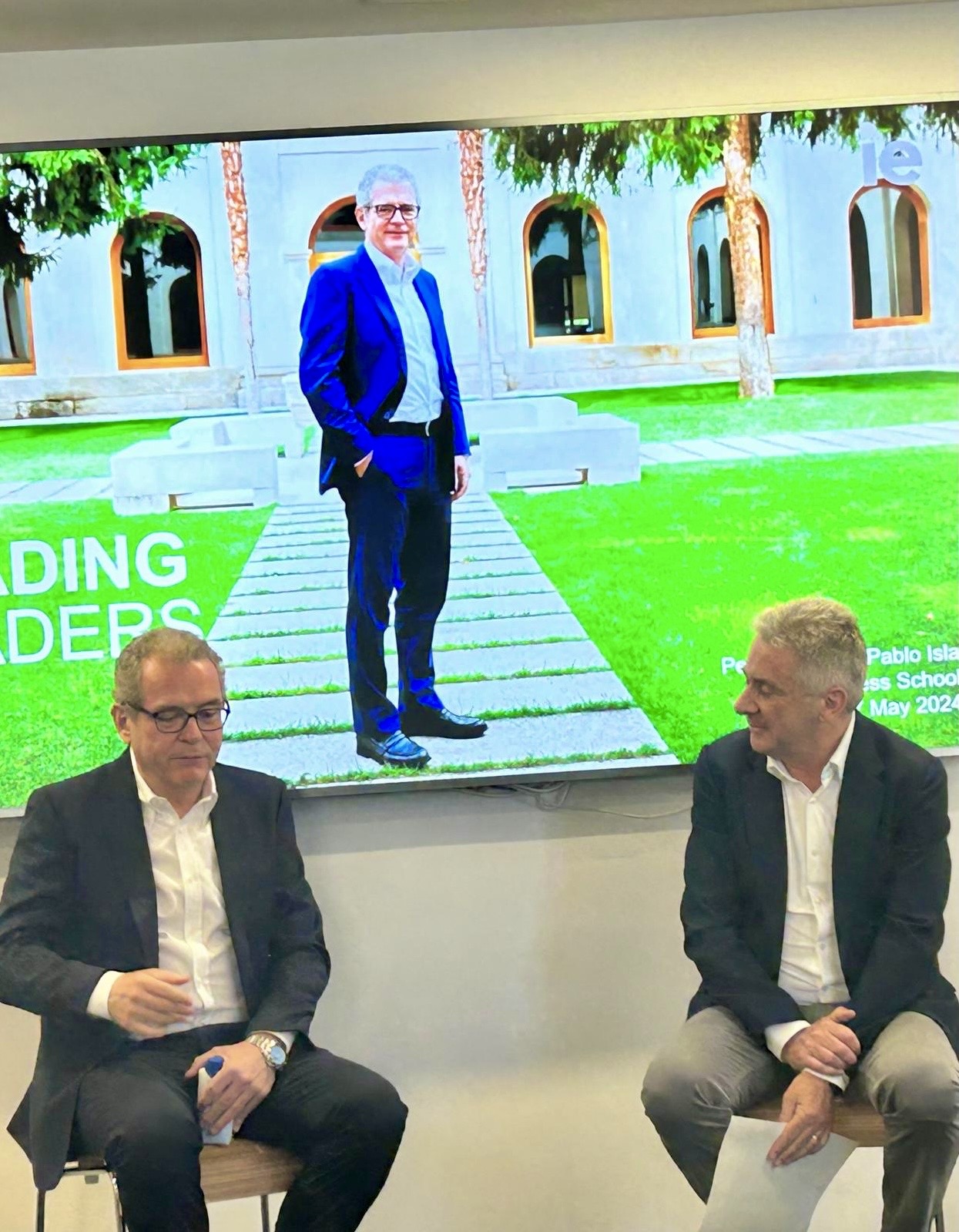
Pablo Isla is best known for his 17 year role as the Chairman and CEO of Inditex, the Spanish multinational clothing company that owns Zara, Pull & Bear, Massimo Dutti, Bershka, and many other brands. During that time he increased the market value of the business from around $15 to $85 billion.
This week at IE Business School in Madrid, where I lead their flagship executive program for business leaders stepping up to shape the future, I talked to him about his career, and in particular his approach to leadership, change and innovation.
Isla has just turned 60, and is a native of Madrid. He began his career in the legal sector, working as a corporate lawyer for various firms in Spain and the United States. He joined Inditex in 2000 as the Director of Legal Services. His deep understanding of corporate law and business strategy quickly propelled him through the ranks.
In 2005, he was asked to become the new CEO of the fast fashion company which was now one of the biggest in the world. “As a in-house lawyer I learnt a lot about the business very quickly. This meant that I could take on more operational roles because of I had a joined-up view of the business”.
5 years later, Inditex founder Amancio Ortega decided to step down as chairman, and asked Isla to step up to combine the chairman and CEO roles. “This was a huge honour” he told me. “To follow in the footsteps of a legend like Ortega was incredible. I immediately seized the opportunity to take on the responsibility of leading the business into the future”.
- He is widely praised for his strategic vision and leadership style. Under his leadership, Inditex has become one of the world’s largest and most successful fashion retailers.
- His strategy emphasizes a fast-fashion business model, which involves quickly responding to changing fashion trends and maintaining a high turnover of inventory.
- He is known for his hands-on approach and attention to detail. He is closely involved in all aspects of the company’s operations, from design and production to distribution and retail.
- During his 17-year tenure at Inditex, the group’s market cap rose sixfold. In 2021, his last full year leading the retailer, Inditex generated a net profit of €3.24bn on a turnover of €27.72bn.
In 2017, Harvard Business Review recognized Pablo Isla as the world’s best-performing CEO, by Harvard Business Review. And again in 2018. HBR said that what stands out is the single word description employees use to convey Isla’s management style. Humble. It’s how his employees talk about him and how he talks of his approach that’s the most telling. He is known for rejecting a meeting culture and the use of hierarchy to command, control, and ego-feed, instead favouring making decisions informally in partnership with his people as he “manages by walking around”.
In fact Isla is so notoriously shy of being in the spotlight that he doesn’t go to his own store openings. Isla described his approach to HBR: “What we want to be relevant is the company or the store opening, and everything always is the result of the work of a team of people. The strength of our company is the combination of everybody, much more than of any single person. And I can tell you that as a company, we try to be a low-profile company, being humble, of course being very ambitious, but being humble. And if we have a big store opening, we want the store to be the relevant thing, and not any particular person.”
Humble, but also very proud to have been ranked the world’s best CEO, I can tell. “When I was ranked world’s best CEO for two consecutive years, what pleased me most was that the metrics were not just financial. They also included the contribution to the environment and society”.
We talk about the current world, and the dramatic changes we are now seeing through technology, as well as through geopolitical shifts, and much more. “I don’t worry too much about everything happening around me – the markets, the competitors, the analysts” he says. Echoing the single-minded attitude of many sports people “I focus 100% on what I am trying to achieve. Not the strategies or agendas of others. The secret of leading a business is focus, focus, focus”.
I asked him what he thought of the rapid growth of Chinese “ultra-fast fashion” online retailers, Shein and Temu. Despite reaching more people than brands like Zara, he says “I am not interested in these companies, I have not looked at them in detail”.
Where he does focus, is putting the spotlight on what is most relevant to the consumer. The core shopper lusting for a $50 pair of affordable but high-fashion high heels from Zara wants to hear about the new store in her neighbourhood, not about how in control some privileged executive is. And he puts the spotlight on the most relevant employees – the front line store managers who are empowered to make product selections and whom he supports via a robust promote from within policy.
During his tenure as CEO, Inditex experienced significant growth and expansion. The company’s revenue and profits have consistently increased, and it has expanded its presence to over 7,000 stores in more than 90 countries.
Inditex’s success can be attributed to its innovative business model, efficient supply chain management, and focus on customer preferences. Under Isla’s leadership, Inditex has also prioritizsd sustainability and corporate social responsibility, implementing various initiatives to reduce its environmental footprint and promote ethical sourcing and labour practices.
His hands-on role as leader is very much about facilitated and inspiring teamwork. “The secret to getting things done is to give teams stretch and safety – plus confidence and courage”. He gave the example of launching Zara’s digital strategy. “The important thing was to make the right decision at the right time. It was crucial that we found somebody respected within the business to lead the project, and not to rush into a new idea which could alienate existing people or projects. We needed to ensure that digital added value to the existing business”.
And his view on leading in a world of relentless change? “Keep your eyes and ears open. Learn from everyone, not just in formal ways, but mostly informally. Read interesting articles, books. Meet new people, learn from other sectors”.
In 2022 he stepped down from Inditex, and reflected “After almost 20 years at the company I wanted to have more flexibility beyond always looking to the next quarterly report. It was time to hand over the business to the next generation, while also time for me to enjoy life more”. He has taken on a number of roles, including senior non-executive director of Nestle, an advisory role with private equity firm Cinvin, and chair of Italian clean energy company AmaraNZero.
“I have also started a film business, which I set up with two partners, and in which I love creative process”. Fonte Films is a production company seeking to revitalise the Spanish film-making sector. He talked about his deep passion for movies, and immediately started to share some of his favourites. I asked him whether he should have made this jump years ago, to combine his career with what he loves.
And then he pauses. “You know, what I really love is management” he said with all seriousness, and I believed him. “I love bringing teams of people together to solve problems, and to drive progress”.
This year’s Olympics were supposed to be a more inclusive and austere event, yet with the world’s largest luxury company as sponsor, they might seem like the ultimate showcase of exclusivity and wealth.
The best Moët champagne will toast the victors, as exquisitely crafted Chaumet medals are hung around their necks, by officials decked in the best of Louis Vuitton, in a sponsorship deal worth $160 million to the Olympic Organising Committee.
As LVMH described it “This global event resonates with the Group’s mission, “The Art of Crafting Dreams”. As creative partner of the Games, LVMH will play a major role by sharing the excellence and craftsmanship of its artisans for key celebratory moments throughout Paris 2024, making our Group the Artisan of All Victories.”
Olympics medals come from one of one of Paris’ most exclusive jewellers.
Conceived by the Chaumet design studio, the medals are said to convey “The Art of Crafting Dreams”. Chaumet drew inspiration from its “rich heritage, its powerfully evocative stylistic repertoire, as well as iconic symbols of France and Paris, resulting in a truly unique design that fuses tradition and modernity.”
The medals will arrive at the Olympic venue in the safety of Louis Vuitton’s most stylish luggage. While another LVMH fashion house, Berluti, is creating the uniforms that French athletes will wear during a “lavish opening ceremony on the Seine”.
Perhaps the combination of old wealth and youthful ambition is not so surprising.
Not so long ago, mass-appeal sporting events were seen as “beneath the highest-end luxury brands, which preferred to target jet-setting country-clubbers through golf, tennis, polo, sailing and Formula One.”
But in the age of social media, where athletes “seamlessly cross into the global influence market alongside pop stars and Hollywood actors,” their “reach and universal appeal has become too significant to pass up.”
Ahead of the Paris Games, Louis Vuitton sponsored a fencer and a swimmer, while Dior has backed a gymnast and a wheelchair tennis player.
LVMH’s deal “represents a delicate trade-off” as the company’s brands “cultivate a high-end image that’s potentially at odds with the idea of a toned-down Olympics.”
Changing world of LVMH
While the old world was about brand exclusivity and personal service, a boutique store on the Rue St Honoré in Paris, or Via Montenapoleone in Milan. Today’s luxury fashionistas sit online searching from their homes of Los Angeles or Shanghai.
They expect new collections as soon as they are shown in fashion shows, and personalised to their tastes. In particular the rapidly growing markets of Asia see luxury brands as a symbol of progress and status.
Bernard Arnault might be a 70-something Frenchman, but he understands this new world.
CEO of LVMH, the world’s largest luxury goods business, his personal wealth of almost $100 billion makes him the wealthiest man in Europe, and fourth richest in the world, which is not bad for an engineer who joined his father’s construction company at 22 years old.
Within a few years, Arnault already saw the world differently, persuading his father to sell the construction business and move into the real estate market. They created Férinel, a speciality vacation property business, of which he became leader in 1977, just before his thirtieth birthday. During this time, Arnault started to understand the luxury consumer, the power of brands, and how targeting premium niches could be incredibly profitable.
In 1984 he spotted an opportunity to acquire a finance company that had lost its way, but still owned some interesting assets including a rather staid and sensible Christian Dior, and department store Le Bon Marche. He quickly set about refocusing the business, and reenergising its best assets for a changing world.
The rebirth of Dior fuelled his vision and acquisition power in the luxury fashion world, and within 5 years by working with other investors, he had become the largest shareholder in the recently merged Louis Vuitton and Moet Hennesey, becoming the chairman of LVMH in 1989. The New York Times Magazine hailed Arnault a “superstar who has risen spectacularly to become head of the world’s largest luxury-goods company aged just 40”.
In the 30 years that followed, Arnault’s ambition has turned LVMH into the world’s largest luxury goods business, bringing together over 70 brands, or houses, like Givenchy and Fendi, Donna Karan and Marc Jacobs, retailers like Sephora and DFS, and jewellers Bulgari and TAG Heuer. Newer brands include Chinese red wine Ao Yun, as well as Rihanna’s Fenty Beauty range, whilst the oldest brand is wine producer Château d’Yquem, which dates its origins back to 1590.
Arnault has long realised that managing such a large and diverse portfolio requires a delicate balance of financial control and creative independence. Designers like John Galliano and the late Alexander McQueen demanded freedom to create, whilst brands in the group benefit from the long-term financial approach that can nurture brands over time, and support less profitable ones to grow stronger.
He sees LVMH as a family-business, with 4 of his 5 children working in different parts of the organisation, but also seeing all of his employees and brands as part of a long-term relationship. Indeed his motivation is much less about financial results, and much more about brand legacy, saying he is much less interested in quarterly results than he is in brand health and growth. During his leadership, however, has multiplied 20 times in value.
With rapid growth in Asia, but fairly stagnant performance in Western markets, Arnault is acutely aware of the changing global marketplace. In recent years he has accelerated online developments of each brand, often partnering with retail platforms and local businesses. He has also driven rapid growth of brand stores in major cities. With a personal fortune similar to Warren Buffett, his personal investments focus on digital businesses like Netflix and global retailers like Carrefour, keeping him tuned into a changing world.
The French billionaire likes to tell the story of how “Steve Jobs once asked me for some advice about retail, but I said, I am not sure at all we are in the same business.” However Jobs famously went on to say “You know Bernard, I don’t know if in 50 years my iPhone will still be a success but I can tell you, I’m sure everybody will still drink your Dom Pérignon.”
When someone says “grocery store,” do you instantly imagine fluorescent-lit, metal-clad buildings with soulless, towering aisles? Doing your grocery shopping is probably the least inspiring thing that you can do.
But it doesn’t have to be. What if there were stores somewhere on this planet that would stop you in your tracks to look up from your shopping list in awe and wonder?
Amazon to Buc-ee’s, Carrefour to Delhaize … Amazon continues to embed technological innovation into every aspect of its online and physical experiences, going far beyond Go. Buc-ee’s might be a gas station by definition, but is an incredible grocery store, and has just been ranked the world’s most consumer-centric brand. Carrefour redefined its entire business model around being digital first, but still a physical experience.
Whatever you think of Marks & Spencer, it’s still a great store, from the Flower Shop to Wine Shop, own-brand innovative product ranges and curated global inspirations. At Booth’s the upmarket supermarket supermarket in northern England, deli counters have been extended, hot food to go has been added and a concession partnership with the ingredients store Rafi’s Spicebox has been expanded. Customers can ask the Rafi’s employee for spice recommendations or recipe ideas, which are then paired with Booths products.
Wegmans frequently tops polls as America’s favourite grocery retailer. One of the pillars of its success is the offer of a full-service restaurant in each store, making it easier for shoppers to fit grocery shopping into their daily or weekly schedule. In addition, many of the dishes on offer are created using the Wegmans range, with the recipes available on the website or app. Stores have also been designed to resemble European open-air markets, but with extra-wide aisles and even the ability to chart a course through the store using the app or online after creating a shopping list.
Freshippo, owned by Chinese e-commerce giant Alibaba, prides itself on catering to contemporary lifestyles by fully embracing in-store, click and collect, and delivery. The Freshippo app elevates the shopping experience greatly – scan an item and the app provides recommendations on suitable food and drink pairings and then directs customers to the suggested item in-store, sends it to the till already packed or even sends it directly to the shopper’s home.Mercardo Libre continues to diversify into superapp-style categories and dominate in Latin America. And Zingerman’s, the cult grocery and food stores from Ann Arbor, continues to have a fanatical following.
- Pinduouo, shopping together, more savings, more fun: case study by Peter Fisk
- Trader Joes, local food stores with a cult following: case study by Peter Fisk
- Zingermans, a passion for food, and for people: case study by Peter Fisk
While economies are uncertain, and cost of living concerns pervade, it’s not all about price, or at least not for everyone. Latest global consumer research show that the younger and older consumers are the fastest growing segments. Young people are driven by aspiration, influence and wellness. Older people are driven by making the most of life, experiences and relationships. Which leaves the “squeezed but splurging” middle, some driven by price but still treating themselves. In general sustainability has given way to a preference for wellness, particularly amongst the young. One thing is for certain, the retail brand which tries to be average for everybody, ends up being special for nobody.
I always love a trip to Trader Joe’s when in the USA. Less of a chore, much more of an experience. I’m inspired by Coupang in South Korea, particularly its focus on technology as demonstrated by its super fast-est home delivery, and China’s incredible Pinduoduo. I love a trip to Eataly, a temple of Italian food, to buy, eat, cook, and savour. Of course, you should include q-commerce brands like Rappi, Grab and many others too as competitors, because they are in the customers eyes, offering a local convenience-driven grocery service. Or even take adjacent markets like HelloFresh and Blue Apron too.
At Edeka in Germany, even the floor tiles are working to tempt shoppers. In some stores, they advertise the availability of fresh food to go such as kebabs – and direct customers towards their whereabouts at the deli counter. Stew Leonard’s in USA takes inspiration from Disney. Singing animatronic characters, mooing cows and train sets placed overhead all play into the family-friendly ethos. “When you go shopping, you want your kids to enjoy it too,” says Chase Leonard, a third-generation member of the Leonard family.
Or if you want to see real innovation, in the most conventional grocery formats, take Spar’s flagship store in Hungary. The design, by LAB5 Architects, is as modern and as chic as it comes. If you visit here, you’ll quickly find yourself in a futuristic wooden wonderland. It feels like traversing through a space-aged cave, with wooden slats forming arches and tunnels, as well as stands for displaying goods.
Some of the most obvious trends in 2024 include:
- Improving margins: Retailers are focusing on streamlining operations, optimising supply chains, and enhancing inventory management to improve efficiency and reduce costs
- Smarter marketing: Retailers are leveraging their digital platforms to offer targeted advertising and promotional opportunities to brands, creating new revenue streams
- Personalised engagement: Adoption of technologies like AI, automation, and data analytics is driving personalised customer experiences and operational enhancements
- Healthier products: Consumers are increasingly prioritising health-conscious choices, leading to demand for organic, sustainable, and locally sourced products
- Sustainable operations: Retailers are committing to eco-friendly practices, addressing climate change, and promoting responsible sourcing.
Challenges abound amidst uncertain economic conditions:
- Loyalty without losses: loyalty doesn’t mean cheapest prices, people are engaged by emotions, loyalty cards are less about points collection more about special price treats, and services beyond products.
- Space and selection: while retailers stick to good/better/best segmentation of products, curation is even more valued, a carefully chosen limited range of brands and speciality products.
- Reducing footprint: Retailers face pressure to demonstrate genuine commitment to sustainability and reduce their environmental impact.
- Attracting staff: The industry grapples with workforce shortages, impacting store operations and customer service, linked to a shift in skills required with increasing use of tech.
- Resilient supplies: Disruptions in global supply chains require innovative solutions to maintain smooth operations, rethinking sourcing options, and business models.
Opportunities to embrace in 2024, as well as beyond:
- Doing more for you: Retailers can capitalise on the rising demand for health-focused products by offering curated selections and wellness services eg pharmacy, fitness classes, nutrition advisors, often using their own trusted brand.
- Digital-physical fusion: Combined online pre-planned and in-store top-up shopping experience, digital navigation, contactless checkouts, kerbside pick-up.
- Personalised and predictive: Leveraging AI and other technologies can enhance productivity, improve customer experiences, and drive growth.
- Transactional to experiential: From shopping based on transactions to experiences, more social, more destination-driven, more sensory, more participative, more gamified, more added-value.
- Mass to micro: Personalised offerings, local sourcing, micro fulfilment centres, and community engagement create opportunities for retailers to connect with consumers.
Explore more
- 24 for 2024: What Happens Next?
- Next is Now: How the future unfolds
- 250 Inspiring Companies to Learn From
- Deloitte Global Retail Outlook 2024
- McKinsey State of Grocery Retail in Europe 2024
- OliverWyman Future Supermarket
- PublicisSapient Store of the Future
- Making Shopping Great Again
Welcome to the future, right now.
Superfast-gaming chips and fat-busting superdrugs, asteroid-chasing rockets and carbon-capturing technologies, 4 day working weeks and chess reinvented as a reality TV game, health-enhancing fashions and the rebirth of the hairy mammoth. Nvidia is transforming tech, while Novo Nordisk innovates healthcare, KinetX changes the space race, while Climeworks eliminates carbon.
We used to marvel at innovations with a leap of imagination. Ideas and technologies that promised to transform our world, but seemed a little out of reach. Now, science fiction has collided with practical reality, powered by mind-boggling technologies that are evolving at incredible speed, but also rapid social and cultural change, accelerating human possibilities into practice.
Next is now, not only because of the pace of innovation, but also the convergence of pathways – technologies, industries, customers, applications and expectations.
What’s happening in gaming today, shapes new experiences in retail or finance. New possibilities of space travel accelerate the evolution of EVs. Clean energy meets green cement. Pharma tech meets fashion tech. Physical and digital are one, fast developing markets outpace the old stagnated developed markets, and GenZ outthink their GenX leaders.
The future is already here, even if it’s unevenly distributed. Curiosity drives creativity, enabled by new capabilities to address the biggest challenges. So what could you do? What’s your vision of next, and how do you start now?
Colossal, the de-extinction company
Colossal Biosciences seeks to reawaken the past, to bring back extinct species, to expand endangered populations through genetic rescue, to support biodiversity. In a world pushed to the brink, Colossal is optimising conservation, exogenous development, bioinformatics, modern genetics, cellular engineering, paleogenetics, biodiversity, genomics, embryology, stem cell reprogramming, computational biology, artificial intelligence, bioethics, and de-extinction.
The Austin-based genetic engineering company, founded by geneticist George Church and entrepreneur Ben Lamb, is working to de-extinct the woolly mammoth, the Tasmanian tiger, and the dodo.
Because the woolly mammoth and Asian elephant share 99.6% of the same DNA, Colossal is seeking to develop a proxy species by swapping enough key mammoth genes into the Asian elephant genome. Key mammoth genealogical traits include: a 10cm layer of insulating fat, five different types of shaggy hair, and smaller ears to help the hybrid tolerate cold weather.
Colossal launched as a fully-fledged business in 2021, with a mission to preserve endangered animals through gene-editing technology and use those same animals to reshape the world’s natural ecosystems to combat climate change.
Colossal’s lab will pair CRISPR/Cas9 with other DNA-editing enzymes, such as integrases, recombinases, and deaminases, to splice woolly mammoth genes into the Asian elephant. The company plans on sequencing both elephant and mammoth samples in order to identify key genes in both species to promote population diversification. By doing so, Colossal hopes to prevent any rogue mutations within the hybrid herd.
Back in a 2008 interview with The New York Times, George Church first expressed his interest in engineering a hybrid Asian elephant-mammoth by sequencing the woolly mammoth genome. In 2012, Church was part of a team that pioneered the CRISPR-Cas9 gene editing tool, through which the potential for altering genetic code to engineer the envisioned “mammophant” surfaced. He presented a talk at the National Geographic Society in 2013, where he mapped out the idea of Colossal.
Church and his genetics team used CRISPR to copy mammoth genes into the genome of an Asian elephant in 2015. That same year, his lab integrated mammoth genes into the DNA of elephant skin cells; the lab zeroed in on 60 genes that experiments hypothesized as being important to the distinctive traits of mammoths, such as a high-domed skull, ability to hold oxygen at low temperatures, and fatty tissue. By 2017 it had successfully added 45 genes to the genome of an Asian elephant.
While Colossal’s de-extinction business might seem like science fiction, the latest movie from Jurassic Park, it echoes the progress by companies like CRISPR Therapeutics in Zurich, led by Nobel prize winner Jennifer Doudna, who applying the same science to humans. With all the same technical and ethical challenges which it brings. It also demonstrates how rapidly ideas of fiction are now becoming reality.
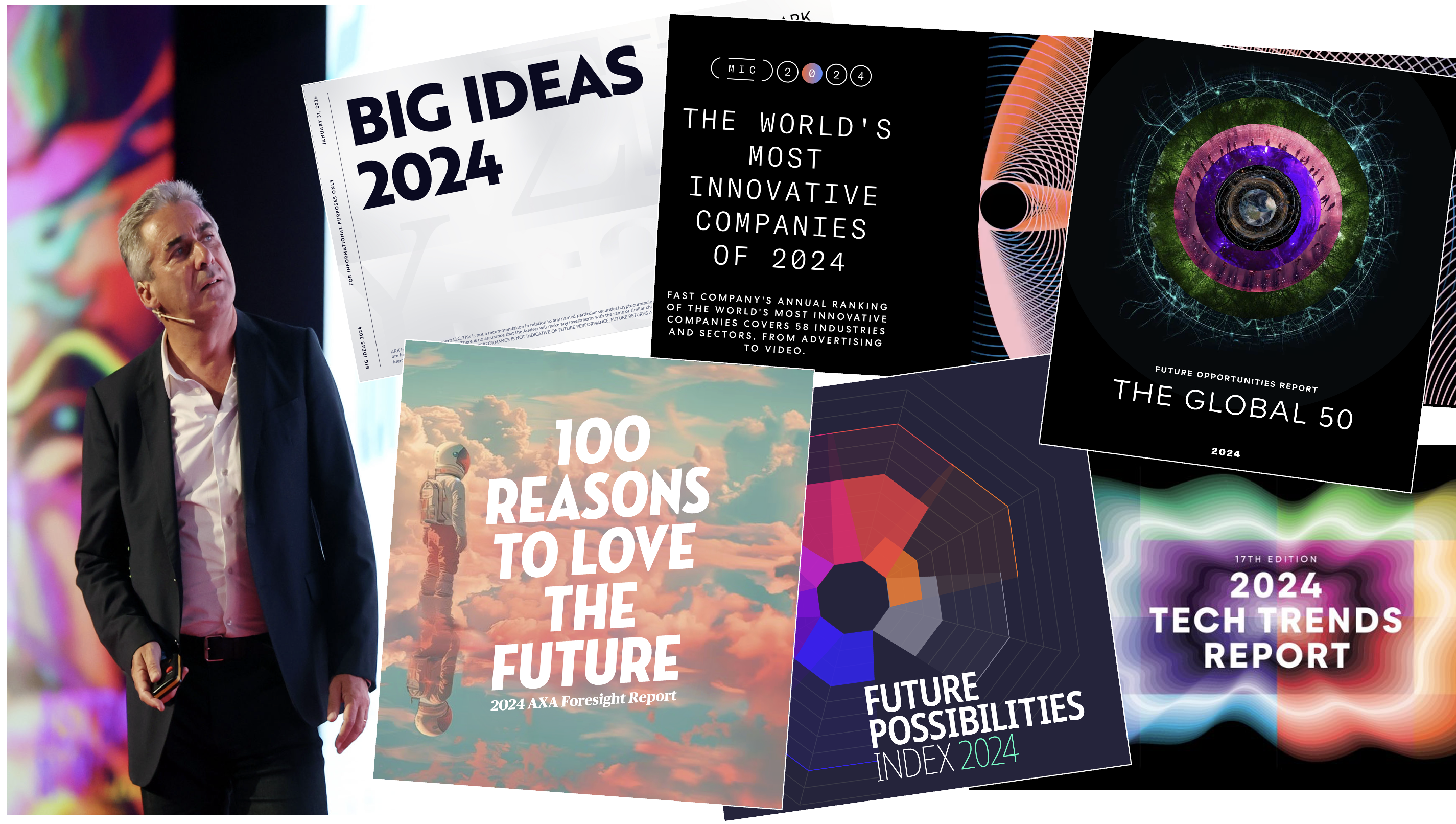
- Big Ideas Report 2024 … how tech is transforming business
- Future Possibilities Index 2024 … the next economies emerging right now
- Global 50 Opportunities 2024 … megatrends driving new opportunities
- 100 Reasons to Love the Future … new narratives that give hope amidst uncertainty.
Innovations enabled by incredible technologies
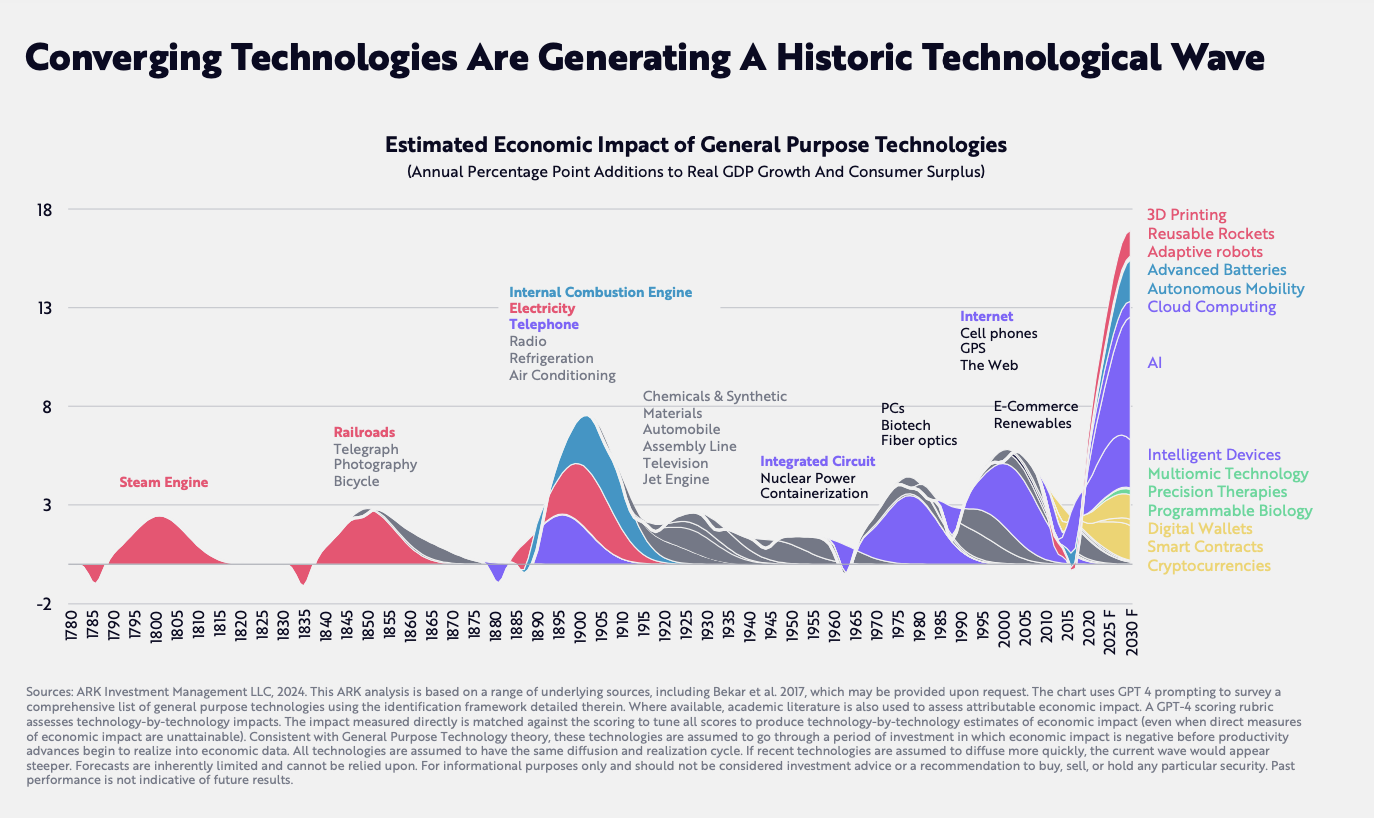
The new Big Ideas report by ARK Invest captures the disruptive impact of technologies right now. It suggests that by 2030, the convergence of 5 significant technologies, accelerated by artificial intelligence, will have an unprecedented economic impact. AI provides the “intelligent glue” to bring together the potential of public blockchains, multigenomic sequencing, energy storage, and robotics, in a way that could transform global economic activity more significantly than any previous industrial revolution.
Globally, real economic growth could accelerate from 3% on average during the past 125 years to more than 7% during the next 7 years as robots reinvigorate manufacturing, robotaxis transform transportation, and AI amplifies knowledge worker productivity.
As a result the global equity market value specifically associated with disruptive innovation could increase from 16% of the total to more than 60% by 2030, resulting in annualised equity returns of 40%, or increasing the total market capitalisation driven by disruptive tech from $19 trillion today to roughly $220 trillion by 2030.
The Future Possibilities Index 2024 also explores the applications of these fast-emerging tech, and how they will shape new economies. It focus on 6 transformational trends that are creating possibilities and the factors that determine our readiness and capacity to leverage these trends over the next 5-10 years. All have emerged from a combination of new business models, technologies, and changes in attitudes and behaviours. The six trends are the Exabyte Economy, the Wellbeing Economy, the Net Zero Economy, the Circular Economy, the BioGrowth Economy and the Experience Economy.
Fast Company’s latest ranking of the world’s Most Innovative Companies 2024 showcases some of the most exciting innovators who are both driving this tech acceleration, and embracing its benefits. While BCG also produces an innovation ranking each year, quantitatively evaluating the R&D efforts of corporations, the FC version is far more insightful, about the people driving the innovations, and the solutions that are emerging.
This year’s #MIC24 ranking includes:
- Nvidia is riding a wave of warp-speed AI progress, having lagged far behind Intel for decades, Jensen Huang’s $1.5 trillion business which he founded in 1993 on his 30th birthday, leapt ahead of tech monoliths like Alphabet and Amazon in recent months, driven by the rush for high-powered immersive gaming, and the relentless growth of AI.
- Novo Nordisk found in its latest diabetes drug Ozempic, an obesity-busting sensation, that together with its lower dosage sister-brand Wegovy, has taken the world by storm. The Danish pharma business can’t make enough of it, and has soared to become Europe’s most valuable company, and more valuable than Denmark’s entire GDP.
- Perplexity is creating an entirely new way to search the web, by leveraging AI to provide more contextualised and accurate answers, rather than a list of relevant links. It uses a combination of homegrown large language models (LLMs) and third-party models (like OpenAI’s GPT-4) plus retrieval-augmented generation (RAG).
- KinetX helped navigate a spacecraft on a 4.4 billion-mile mission to land on an asteroid and return home. Founded in 1992 as a spinoff of Lockheed Martin, it is partnering NASA on deep-space missions like New Horizons (to Pluto, then the edge of the solar system) and Messenger (orbiting Mercury for the first time).
- Climeworks uses direct air capture to scrub carbon from the atmosphere. It operates the world’s largest DAC plants, both in Iceland, which remove around 10,000 tons of CO2 from the atmosphere every year—and about half of that is being done by the Zurich-based DAC pioneer.
Innovations enabling radically better lives
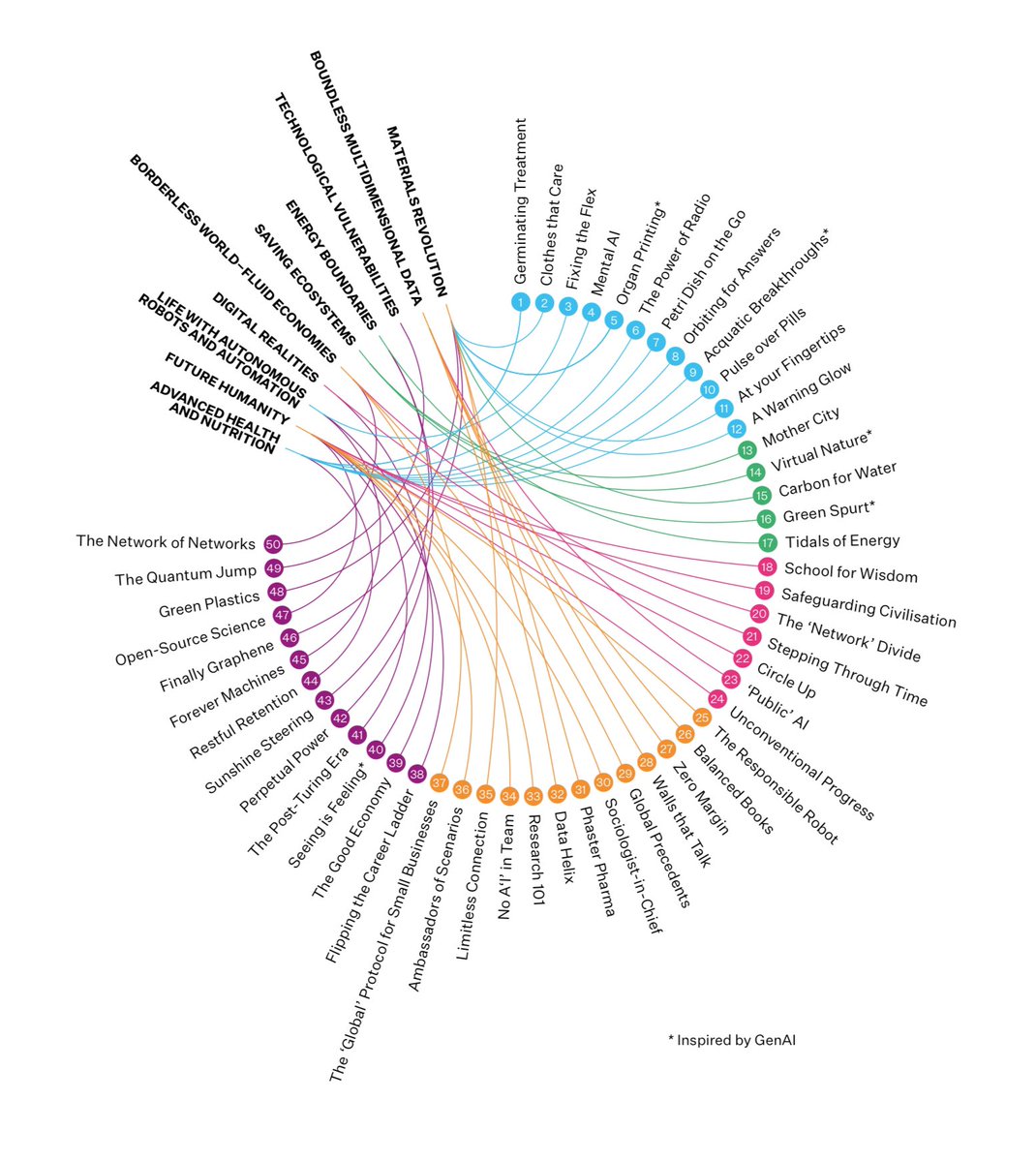
The new Global 50 Opportunities report by Dubai Future Foundation takes a global perspective on the innovative applications emerging from a rapidly changing world, partly driven by technologies, but much more too.
It starts by exploring the megatrends which it sees as most influential right now, and then how these are unlocking 50 opportunities for future growth, prosperity and well-being. Some opportunities may be in their early days of exploration, some require reflection, and some feel very far away. “Shaping the future cannot be done by just waiting for it but rather by utilizing the latest technologies and knowledge tools and meeting its challenges starting from today.”
The 8 megatrends include materials revolution (from which opportunities emerge like 3d printing of human organs, green plastics, and fashion with embedded health benefits), future humanity (school for wisdom, open source science, and flipping career ladders), and advanced health (mental AI, pulse over pills, and biohacking 2.0). These are just a few examples (dive into the digital report to explore the opportunities in more detail):
100 Reasons to Love the Future is a fabulous new report from AXA’s foresight team, promising “new narratives of hope” and inspiring us to “imagine utopia rather than retreat to dystopia”. The report argues that in a world of escalating risks, our societies and economies cannot afford to become paralysed by uncertainty. We are all living through a deep transformation. Far better to embrace it than retreat into anxiety and doubt.
In the midst of the 100 reasons is a great insight from Plurality University about what organisations could look like in 2050 – from the Marketrix to the Reactivator, the Enterpocine and the Zombinc. There’s also a great insight about Te Korekoreka, and navigating futures with Māori Wisdom. The New Zealand initiative uses social innovation to achieve equity in education, employment, and income for Māori people. And much more, a great report!
Take another look at Fast Company’s Most Innovative Companies 2024 list, and beyond the big names like Nvidia you will find a wealth of smaller companies making significant human impacts, harnessing tech for good, rather than just for tech. Yet the new tech capabilities are incredible, providing new ways to solve some of the biggest problems; while also shaping cultures through exponential social influence; and enabling people to access, and do, what they could never before:
- Solfácil the Brazilian solar investment company is bringing solar power to people living in the Amazon, and has financed approximately $450 million in solar loans, working with more than 4,250 active solar installers and has 66,000-plus customers to date.
- 4 Day Week Global convinced companies around the world to adopt a shorter work week, the nonprofit brought together hundreds of companies to create a post-pandemic revolution in the workplace, encouraged by its research which showed that a 4 day week delivered an average 36% rise in revenue.
- Chess.com is turning a centuries-old game into must-see reality TV. The freemium chess platform logged more games played (12.5 billion) than ever before, while establishing itself as the game’s cultural hub, full of everything from news to memes to the best Twitch streamers.
- Sea Forest, a Tasmanian business which scooped the 2023 Earthshot Prize, has a seaweed supplement to stop cows from burping up methane. It is the first company in the world to farm methane-busting Asparagopsis, a red seaweed native to Australian coastal waters, reducing methane production by up to 90%.
- Mattel took its 65 year old Barbie dolls and turned the brand into a $1.4 billion global movie blockbuster, the highest grossing film of 2023, with a series of agenda-setting messages not just saccharine sassiness, and became a cultural event that attracted diverse audiences, plus all types of pink-coloured spinoffs.
So while the world of technology is complex and relentless, with profound questions about ethics and humanity, our rapidly changing world can also be deeply human, sometimes frivolous, sometimes profound.
The opportunities to innovate are everywhere. And while average, old markets might seem to have stagnated, the world continues to move forwards at incredible pace. We have huge challenges, where issues like climate change will only be conquered with radical new thinking, and enabled by new technologies.
We also have an opportunity to create a happier, healthier world. Embrace utopia, don’t retreat to dystopia. By jumping to the future we can see problems differently, the impossible becomes possible, and we can accelerate progress.
Next is now. There is only ever today. Let the future begin.
Explore more
- 24 for 2024 … new ideas, new innovators, new possibilities
- Future Recoded … an online learning and knowledge platform
- Trend Kaleidoscope 2024 … curating all the best trend reports
- Megatrends and Strategies … defining your future strategy roadmap
- Waveriders and Transformers … developing leaders as future makers
- Future Radar of Trends and Innovations … analytical futures toolbox