Business futurist. Innovative strategist. Leadership advisor. Bestselling author. Inspiring speaker.
A recent Goldman Sachs survey highlighted the greatest fear of Fortune 500 CEOs … making the wrong decisions about AI.
Where are the biggest opportunities, and threats for my business? How should I embrace it? Who should I turn to for help, and which technologies to go for? What are the essentials, compared to the nice to haves? How can I test it, and mitigate risks? And how do I future proof my investment to ensure that it will stay relevant going forwards?
AI is reasonably seen as a trillion-dollar opportunity, not just for the tech companies creating AI models, but largely for how every kind of business will embrace it, to innovate and reinvent themselves.
Of course we already see AI in our daily lives … from Google Maps to Siri chat, passport face recognition and Netflix recommendations. But it is still a speck compared to its likely size and impact over the next 5-10 years.
Accenture suggests AI could boost global GDP by up to $15.7 trillion by 2035. PwC agrees with that figure, with $6.6 trillion coming from increased productivity, and $9.1 trillion from increased consumption. It suggests China will benefit most, with a 26% GDP boost, compared to North America with a 14.5% GDP boost.
Beyond the tech, beyond the hype
AI is not just another tool in the digital toolbox — it’s a transformative force reshaping how business is imagined, built, and scaled. For forward-thinking leaders, AI offers a once-in-a-generation opportunity to rethink the fundamentals: strategy, business models, products, services, and even leadership itself.
AI is not something to simply delegating to your CTO.
Capturing AI’s full potential requires more than deploying new technologies. It demands a shift in mindset — from efficiency-focused automation to reinvention-focused innovation. Leaders must not only understand AI but see it as a catalyst for bold experimentation. Spend 3-4 hours with ChatGPT asking it – about your future, your industry, your strategy – and you’ll start to appreciate its potential
The AI imperative for strategic reinvention
Traditionally, strategy has been based on periodic analysis, fixed frameworks, and linear planning. AI challenges all of that. With real-time data processing, predictive analytics, and generative capabilities, leaders can now:
Forecast demand, risk, and opportunity with greater accuracy
Simulate multiple scenarios to guide adaptive strategy
Personalize offerings and pricing at scale
Accelerate go-to-market testing through rapid prototyping and feedback loops
For example, Shell uses AI and machine learning in its strategic planning to optimize energy trading, predictive maintenance, and even forecast energy transitions. By integrating AI into its core strategy function, Shell is not just becoming more efficient — it’s evolving into a data-intelligent energy ecosystem.
Reinventing business models with AI
AI enables entirely new business models that were previously impossible. Leaders can now reimagine value creation and capture by:
Shifting from product-centric to service-centric models
Monetizing data and algorithms as assets
Using AI-driven platforms to orchestrate multi-sided marketplaces
Spotify has built its model on AI recommendation engines. Founder Daniel Ek understands that AI isn’t just a feature — it’s the foundation. From dynamic playlists to hyper-personalized advertising, AI enables Spotify to create “a unique music service for every user,” moving from content distribution to emotional resonance.
Ant Group, the Chinese fintech giant behind Alipay, exemplifies this transformation. Under the leadership of Eric Jing, the company built an AI-driven financial platform that not only serves hundreds of millions of consumers but also provides microloans, insurance, and investment tools — all powered by real-time machine learning. Their AI models assess risk more accurately than traditional financial institutions, opening access to underserved populations and reshaping the economics of financial services.
Accelerating product and service innovation
Airbus applies AI to develop autonomous flight systems and optimize aircraft design. Their “Skywise” platform aggregates operational data from fleets around the world and uses AI to predict maintenance needs, reduce downtime, and identify design improvements — turning aircraft into learning machines.
AI dramatically shortens the innovation cycle. Leaders can now:
Generate and test product ideas using generative design
Use customer behavior data to shape new features
Deploy AI agents to co-create with users in real-time
Consider Procter & Gamble, where AI is embedded across the product innovation pipeline. Using deep learning and computer vision, P&G tests packaging designs, optimizes formulations, and even simulates consumer product interactions before market launch. CEO Jon Moeller has championed an AI-first mindset, making data-driven creativity central to innovation.
Redefining customer engagement with AI
At the heart of AI’s power is personalization at scale. Business leaders can now:
Build real-time, omnichannel customer experiences
Use conversational AI to enhance service, sales, and loyalty
Predict customer needs before they express them
Sephora, under the leadership of CEO Jean-André Rougeot, has emerged as a global leader in AI-powered retail. Its Virtual Artist tool uses augmented reality and computer vision to help customers try on makeup digitally, while AI recommendation engines drive tailored product suggestions. This data-rich engagement strategy has transformed Sephora into a tech-enabled beauty platform.
In India, Reliance Jio, led by Mukesh Ambani, has used AI to provide millions of customers with personalized content, real-time support, and mobile commerce experiences — helping it go from telecom entrant to digital ecosystem leader in record time.
Reinventing the partner and supply ecosystem
AI doesn’t stop at the organization’s boundaries. It enables smarter, more adaptive networks of partners, suppliers, and collaborators. Leaders can use AI to:
Predict supply chain disruptions and optimize logistics
Match partners dynamically based on data signals
Build trust through transparent, AI-audited processes
Maersk, the global shipping giant, applies AI to optimize routes, reduce carbon emissions, and enhance visibility across its supply chain. By combining AI with blockchain and IoT, Maersk creates a responsive logistics network — and positions itself as a digital trade facilitator rather than just a shipping company.
Similarly, Unilever uses AI across its supply chain to manage inventory, predict demand, and even guide sustainable sourcing. CEO Hein Schumacher has continued the AI investments started by his predecessor, with a vision of building intelligent operations that align business growth with environmental responsibility.
The leadership shift
To lead AI-powered reinvention, business leaders must develop a new set of capabilities and behaviors. Here’s what it takes:
1. Digital Literacy at the Top
Leaders don’t need to be coders, but they must understand AI’s potential and limitations. They should be fluent in asking the right questions — about data quality, bias, model transparency, and use-case feasibility. Satya Nadella at Microsoft sets the standard here, championing AI across all business units while staying grounded in responsible AI principles.
2. Experimentation as a Leadership Norm
AI thrives in environments where leaders embrace testing, iteration, and learning. Leaders must create “safe zones” for rapid prototyping and encourage teams to take calculated risks. Ajay Banga, during his time at Mastercard, built innovation hubs around the world where teams explored AI in fraud detection, customer service, and financial inclusion — without fear of failure.
3. Ethics and Governance as Strategy
AI’s rise brings ethical and regulatory risks. Leaders must ensure AI is explainable, fair, and privacy-conscious. Embedding ethics into product design and decision-making is no longer optional. At DBS Bank, CEO Piyush Gupta ensures all AI initiatives undergo ethical reviews and adhere to a “responsible AI framework” — helping the bank retain trust as it digitizes.
4. Cross-functional Collaboration
AI can’t succeed in silos. Leaders must foster collaboration between data scientists, designers, marketers, and business strategists. At Amazon, teams work backward from customer needs, and AI is woven across everything — from Alexa’s NLP to warehouse automation and pricing algorithms. Jeff Bezos created a culture where tech, operations, and business were inseparable.
5. Vision Beyond the Hype
Leaders must cut through buzzwords and ground AI efforts in real business value. AI is not magic — it’s math, data, and execution. Those who succeed treat it as a capability, not a cure-all.
Economic potential of AI
Cathie Wood, of ARK Invest, is a leading thinker on the economic potential of AI in coming years. Her Big Ideas 2025 report envisions AI as a transformative force poised to drive unprecedented economic growth.She forecasts that AI, alongside other emerging technologies, will significantly enhance productivity and reshape the global economy.
She predicts that the USA economy is transitioning into a new era of productivity-led growth, powered by advances in AI, digital assets, and automation.She believes that these technologies will reduce costs, boost output, and help keep inflation under control even as growth resumes.
ARK’s report explores how AI is central to a convergence of five innovation platforms—AI, robotics, energy storage, DNA sequencing, and blockchain—that collectively have the potential to drive exponential economic growth.
Wood estimates that the US GDP could grow by 7.3%, the highest in modern history, as AI, automation, and cryptocurrencies reshape the global economy.She argues that these technological advancements will counter inflationary pressures while enhancing corporate efficiencies, marking the beginning of a long-term bull market.
As an example, in the pharmaceutical industry, companies like Recursion Therapeutics have seen the number of hypotheses a researcher can test increase from 20 per year to 200 per year, with drug development timelines potentially shrinking from 13 years to eight years and costs dropping from $2.4 billion to $600 million per drug.
Reimagining business with AI
AI offers more than productivity gains or incremental improvements. It offers the canvas for reimagining what a business is. But that transformation starts at the top. Leaders must disrupt their own thinking — moving from hierarchy to ecosystems, from static plans to adaptive systems, and from data-rich dashboards to insight-driven action.
The companies leading this revolution aren’t just using AI. They’re becoming AI-native in their strategies, cultures, and identities.
To harness the future, leaders must not only adopt AI — they must lead as if they were reinventing the business from scratch. Because in many ways, they are
Daniel Ek, founder of music streaming platform Spotify, was a great software engineer. But as the business grew, he was challenged by his investors to bring in more experienced and commercially minded business leaders. Ek resisted, and slowly realised that to be CEO, he needed to change himself. New skills, new behaviours, new mindset.
He set about reinventing himself. How could he most effectively lead a growing workforce, how will the business need to restructure as it innovates? What will he need to do commercially, to optimise his business model?
Over recent years the Swedish entrepreneur has morphed into a effective CEO – a bold deal-maker, an ecosystem strategist, and a vocal critic of Apple and platform monopolies. He’s also embraced AI, audio personalisation, and creator tools. His ability to pivot his leadership style and mindset — from coder to cultural architect — mirrors the shifts in Spotify’s own transformation to become a global leading business worth $150 billion.
Leading in a world of relentless change
In a world shaped by relentless technological advancement, shifting consumer expectations, and mounting global complexities, one truth stands clear: the only constant is change. For businesses, riding successive waves of innovation — the so-called “S-curves” — has become essential for survival. But organizations don’t transform themselves. People do. And at the core of any successful transformation lies a deeper, personal journey: the leader must disrupt themselves first.
“Disrupt yourself before the market does,” is no longer just a catchphrase. It is a strategic imperative for leaders who want to stay ahead, remain relevant, and build resilient organisations.
The S-Curves of business, and of leaders
The S-curve is a classic model of innovation and growth. It begins with a slow start (experimentation and learning), accelerates with rapid growth (scaling and adoption), and eventually flattens (maturity and decline) — unless a new S-curve is initiated. Most successful companies have ridden multiple S-curves: IBM from mainframes to AI, Netflix from DVDs to streaming to gaming, and Apple from computers to iPods to the iPhone and beyond.
But what’s less discussed is that leaders themselves follow similar S-curves. Leadership capabilities that were effective in one phase of a company’s journey may become obsolete in the next. A founder who excels at scrappy bootstrapping might struggle with building corporate systems. A CEO skilled in operational efficiency might falter in a time demanding radical reinvention. To stay effective, leaders must be willing to unlearn, relearn, and evolve — over and over again.
When Satya Nadella took over as CEO in 2014, Microsoft was seen as a lumbering giant, missing out on the mobile revolution. Nadella disrupted not just the company’s business model — pivoting from software licensing to cloud computing and SaaS — but also its culture. He embraced empathy, collaboration, and learning. Under his leadership, Microsoft became more open (even partnering with competitors), more agile, and significantly more valuable. Nadella had to shed the defensive, Windows-centric mindset and adopt a growth mindset — first for himself, then for his team, then for the company.
Originally a DVD rental company, Netflix’s founder Reed Hastings disrupted his own successful business model not once but twice — first with the pivot to streaming, then with the leap into content creation. Each transition required letting go of what had worked in the past and being willing to experiment with bold new ideas. Hastings consistently bet on future trends, even when it meant cannibalizing his own business. His leadership S-curve tracked the company’s: visionary, adaptive, and always one step ahead.
Disruption begins with you
Self-disruption is uncomfortable. It requires confronting deeply held beliefs, reexamining past success formulas, and letting go of control. But it’s also liberating. It opens the door to fresh thinking, new approaches, and personal growth.
Whitney Johnson, author of Disrupt Yourself, argues that intentional personal disruption is essential for sustained innovation. She likens it to jumping from one S-curve to another — before the first one flattens out. The personal S-curve, like the business one, begins with a learning phase, accelerates with competence, and plateaus with mastery. True leaders leap to the next curve before they stagnate.
This kind of reinvention is not about abandoning your identity — it’s about continuously reshaping it to meet new realities. It’s not just change for survival; it’s change for significance.
Akio Toyoda was CEO of Toyota from 2009 to 2023. He took the reins of a traditional, conservative automaker known for its lean manufacturing, but not for innovation. Recognizing the tectonic shifts in mobility — from electrification to autonomy to software-driven vehicles — Toyoda personally led a cultural shift.
He transformed himself from a manufacturing-focused executive into a tech-savvy mobility visionary. He promoted bold moves, including launching an in-house software division (Woven Planet), developing hydrogen fuel-cell vehicles, and positioning Toyota as a “mobility company” rather than a carmaker. This transformation began with his own willingness to question legacy thinking — a rare trait in Japanese corporate culture.
Perhaps one of the most radical corporate reinventions in history, Zhang Ruimin took Haier from a struggling refrigerator factory in Qingdao to a global IoT and appliance powerhouse. But what stands out most is Zhang’s own personal disruption.
Originally a bureaucratic factory manager, Zhang evolved into a radical management innovator. He repeatedly reinvented Haier’s business model — most notably by introducing the Rendanheyi model, breaking down traditional hierarchies into micro-enterprises where employees act like entrepreneurs. To do this, he had to let go of command-and-control leadership and become a facilitator of self-organizing teams. His transformation helped Haier avoid stagnation and maintain continuous relevance.
How to disrupt yourself?
1. Embrace Humility and a Growth Mindset Leaders must accept that what got them here won’t get them there. Success is often the enemy of reinvention because it fosters complacency. A growth mindset — the belief that abilities can be developed — is fundamental. This means being open to feedback, admitting what you don’t know, and seeing failure as a source of insight.
2. Learn Continuously and Curiously Self-disruptive leaders are voracious learners. They read widely, seek out diverse perspectives, experiment with new technologies, and stay alert to weak signals on the horizon. They never stop asking: What am I missing? What’s changing? What must I understand next?
3. Let Go to Move Forward The biggest barrier to transformation is often attachment — to a role, a way of working, or a sense of control. Leaders must shed old mental models and step into new paradigms. That may mean giving others more autonomy, retiring past assumptions, or redefining their purpose.
4. Surround Yourself with Challengers Echo chambers are the enemy of change. Great leaders invite dissent, debate, and difference. They hire people who complement their weaknesses and are unafraid to challenge their thinking. These “truth-tellers” are essential to seeing what you cannot yet see.
5. Redefine Success Self-disruption often requires rethinking what success looks like. It’s not always about power, control, or short-term wins. Sometimes it’s about long-term value, new impact, or even personal fulfillment. Leaders must reorient their compass as the terrain shifts.
Leadership reinvention
The future will not reward stability; it will reward adaptability. In a world of AI, automation, climate disruption, and geopolitical flux, the ability to reinvent is not a luxury — it’s a leadership necessity.
S-curves are not just for companies; they are for people. Leaders who ride their own curves of learning and renewal become more than just survivors. They become visionaries, builders, and catalysts of transformation.
It’s not enough to disrupt your market. First, you must disrupt yourself.
Leaders who successfully reinvent themselves tend to:
Challenge orthodoxy, including their own past beliefs
Move from expertise to curiosity, staying open to learning
Adapt their leadership style to match the company’s new phase
Embrace risk, even if it means betting against their earlier success
Anchor themselves in purpose, not just performance
In a world of accelerating change, the leaders who thrive will be those who see reinvention not as a crisis, but as a calling.
To lead in a world of exponential change, you must embrace personal reinvention as a continuous journey. Like great businesses, great leaders jump to new S-curves before the old ones plateau. They shed outdated beliefs, cultivate new capabilities, and lead with curiosity and courage.
The leaders of tomorrow will not be those who cling to the past, but those who are bold enough to reimagine themselves — again and again.
Disrupt yourself. Or be disrupted. The choice is yours.
Rick Rubin’s The Creative Act is not a conventional “how-to” manual on creativity. Instead, it’s a philosophical meditation on the nature of creativity itself.
Rubin is one of the most influential and unconventional producers in modern music history. His creative philosophy and approach have made him a cultural icon not just in music, but in how people think about creativity itself.
Rubin helped shape the sound of multiple genres – hip hop, rock, country, and even metal – often acting more like a creative therapist than a traditional producer. He has worked with Beastie Boys, LL Cool J, Run-D.M.C., Red Hot Chili Peppers, Johnny Cash, Adele, Kanye West, Slayer, and Linkin Park. He focuses less on technical production and more on helping artists express their truest selves.
He reframes creativity not as a skill but as a way of being—a state of openness, awareness, and alignment with the world. His core idea is that everyone is inherently creative, and the creative act is about tuning in to inspiration rather than forcing output.
Key Themes from The Creative Act:
The Artist as Receiver: Creativity is not generated, but received. Artists are antennas for ideas that already exist.
Process Over Product: The journey matters more than the end result. Focus on creating freely without attachment to outcome.
Minimalism and Silence: Quieting noise—both external and internal—is vital for accessing creativity.
Authenticity: True creativity comes from honesty, not from following trends or expectations.
Discipline and Ritual: While inspiration is mysterious, habits and environments that encourage openness are crucial.
Letting Go of Ego: Creativity thrives when we detach from fear, self-judgment, and the need for approval.
Rubin’s approach is more existential and meditative, compared to the goal-oriented pragmatism of design thinking or lean startup. It aligns more with mindfulness and artistic intuition, while others are often business- or user-centric.
Though Rubin’s ideas come from music, they translate powerfully to organizational creativity and innovation:
Apple: Simplicity as Art
Steve Jobs also valued intuition, simplicity, and aesthetic clarity—ideas Rubin champions. Apple’s early design ethos focused on eliminating clutter, like Rubin’s emphasis on removing noise to let signal emerge.
Patagonia: Creative Integrity
Patagonia creates products aligned with environmental values, resisting trends for short-term gains. Like Rubin, they let core purpose and authenticity drive innovation.
IDEO: Creative Environment
IDEO’s emphasis on non-judgmental brainstorming and fostering a psychologically safe creative space echoes Rubin’s idea of removing fear and ego from the process.
Spotify: Tuning In to Culture
Spotify balances tech innovation with deep sensitivity to user experience and music culture. Their curated playlists and artist partnerships reflect Rubin’s view that resonance and intuition matter more than metrics alone.
Pixar: Trust the Process
Pixar fosters a culture where creativity is not rushed. Directors often take years on a story. Rubin’s belief in unhurried, organic creation is echoed in Pixar’s commitment to process over product.
So what are the practical takeaways for business?
Prioritize authenticity over analytics when exploring new ideas.
Create quiet, open spaces where teams can reflect, experiment, and disconnect from reactive work.
Foster a culture where failure isn’t punished, and success isn’t the only measure.
Recognize that inspiration can come from unexpected sources—observe the world deeply and often.
Let go of control—some of the best creative breakthroughs emerge from surrender, not strategy.
Do customers care about banks, or about their wealth? Do they care about insurance, or their protection and peace of mind? Do they care about cars, or travel?
Michelin got it right. The French tyre brand always said it was about the journey, not the rubber. And as a result, it was able to add value in more human, more relevant and inspiring ways – from better maps to the best restaurants.
In a world of rapid change, defining your business by traditional sectors – like banking, retail, telecommunications, or automotive – is increasingly limiting. Conventional categories frame the conversation around products or services, not the outcomes customers truly care about. Businesses that cling to these outdated labels risk irrelevance and missed opportunities for growth and innovation.
A more powerful approach is to reframe markets in customer-centric “market spaces”—sometimes called arenas, domains, opportunity spaces, or experience spaces. This thinking builds on the discovery-based strategy work of Rita McGrath, the jobs to be done thinking of Clay Christensen, the adjacency models of Scott Antony, and blue oceans of Chan Kim and Renée Mauborgne.
These “spaces” are defined not by what you sell, but by the human outcomes you enable: the experiences, goals, and aspirations your customers seek. By thinking in terms of spaces rather than sectors, companies can create far more relevance, unlock new value, and identify opportunities that conventional market definitions obscure.
From sectors to spaces
Traditional sectors describe what a company sells. Market spaces describe what people actually want to achieve. The shift may seem subtle, but it has profound strategic implications:
from Banking or Financial Services … to Wealth, Financial Freedom, Life Planning
from Insurance … to Risk and Security, Peace of Mind
from Automotive … to Travel, Mobility, Adventure
from Telecoms … to Connection, Communication, Collaboration
from Food and Drink … Nutrition and Wellbeing, Pleasure and Sharing
from Retail … to Lifestyle and Experience, Daily Joy, Convenience
from Healthcare … to Health and Vitality, Thriving and Longevity
from Fitness and Gyms … to Energy, Performance, Personal Growth
from Education … to Knowledge and Growth, Future Readiness
from Technology and Software … to Creativity, Capability, and Enhancement
from Pet Care … to Companionship, Health and Happiness
This shift in language reframes strategy. Instead of asking, “Which sector do we compete in?”, businesses ask, “Which customer outcomes do we enable, and how can we do it better than anyone else?”
Practical examples of market spaces
Leading companies show how redefining markets in terms of customer outcomes drives growth and differentiation:
American Express: Reframed from credit cards to the market space of Membership & Experiences, emphasizing belonging, lifestyle, and privileges.
Nike: Operates in the Human Potential & Performance space, enabling achievement, self-expression, and empowerment.
Apple: Focuses on Creative Expression, helping people create, connect, and express identity.
Airbnb: Moves beyond rentals into Belonging / Travel Experience, creating emotional connection, cultural discovery, and memorable experiences.
Spotify: Competes in Music & Emotional Connection, highlighting the social and emotional value of music, not just streaming.
In each case, the company’s success comes from shifting focus from product categories to the experiences and outcomes that customers value most.
Why customer-centric market spaces matter
Focus on human outcomes, not products. Customers care about results and experiences more than products themselves. By aligning with these outcomes, companies build relevance and loyalty.
Unlock innovation opportunities. Thinking in spaces rather than sectors reveals adjacent opportunities for new products, services, and business models. For instance, a company in the Travel space can innovate across transport modes, experiences, and digital services—not just vehicles or airlines.
Guide growth and diversification. Market spaces help leaders identify areas to expand that naturally extend the value delivered to customers, reducing the risk of pursuing unrelated markets.
Differentiate your brand. Competing in a customer-centric space allows a company to stand out through experiences and outcomes, rather than features or pricing alone.
How to find and shape your space
1. Start with the human goal.
Ask: “What outcome does our customer truly seek?” Consider functional, emotional, and social dimensions of the experience.
Example: Rather than “How do we sell insurance?” ask, “How do we help people feel secure, confident, and cared for?”
2. Reframe the market in customer language.
Translate industry jargon into spaces that reflect the real-world experience of customers.
Identify where you can create additional value: products, services, experiences, partnerships, or technology. Seek natural extensions that enhance the customer outcome.
Example: A company in the Fitness & Performance space could expand into nutrition, mental wellbeing, wearable tech, or coaching services.
4. Innovate around the customer journey.
Examine the full journey customers take to achieve the outcome your space promises. Identify friction points, unmet needs, and moments of emotional impact.
5. Measure relevance and value, not transactions.
Focus on outcomes: engagement, loyalty, satisfaction, and impact. Your success in a space is determined by how well you deliver meaningful experiences.
50+ customer-centric market spaces
Here’s a practical cheat sheet of conventional sectors reframed as customer-centric spaces:
Sector
Space
Banking / Financial.
Wealth, Financial Freedom, Life Planning
Insurance
Risk & Security, Peace of Mind
Automotive
Travel, Mobility, Adventure
Airlines / Aviation
Exploration, Connection, Experiences
Telecommunications
Connection, Communication, Collaboration
Internet Services
Access & Discovery, Digital Life
Retail
Lifestyle & Experience, Daily Joy, Convenience
E-commerce
Frictionless Shopping, Discovery & Desire
Fashion / Apparel
Self-Expression, Identity & Style
Footwear / Sportswear
Performance & Potential, Movement
Food & Beverage
Nutrition & Wellbeing, Pleasure & Sharing
Grocery / Supermarkets
Everyday Convenience & Health
Restaurants / Hospitality
Hospitality & Togetherness, Memorable Moments
Hotels & Resorts
Belonging & Escape, Comfort & Experience
Travel & Tourism
Adventure & Discovery, Memory-Making
Entertainment / Media
Storytelling & Emotion, Fun & Engagement
Music / Streaming
Emotional Connection, Creative Expression
Film / TV
Imagination & Emotion, Shared Stories
Gaming
Play, Achievement, Social Connection
Sports / Recreation
Performance, Thrill, Community
Healthcare
Health & Vitality, Thriving & Longevity
Pharmaceuticals
Wellbeing, Life Enhancement
Fitness / Gyms
Energy, Performance, Personal Growth
Beauty & Personal Care
Confidence & Self-Care, Expression
Home / Furniture
Comfort, Sanctuary, Self-Expression
Real Estate
Home & Belonging, Life Foundations
Utilities / Energy
Empowered Living, Freedom & Comfort
Renewable Energy
Sustainability, Future Security
Technology / Hardware
Creativity & Productivity, Capability
Software / SaaS
Efficiency, Collaboration, Empowerment
Cloud / Data Services
Insight & Intelligence, Freedom from Complexity
Logistics / Delivery
Convenience, Seamless Access, Reliability
Transport
Mobility, Freedom to Move, Efficiency
Automotive Services
Reliability, Peace of Mind, Ownership Ease
Education
Knowledge & Growth, Future Readiness
e-Learning / Platforms
Skill & Opportunity, Lifelong Learning
Financial Planning
Life Goals & Security, Freedom to Choose
Consulting / Advisory
Insight & Confidence, Transformation
Marketing / Advertising
Influence & Connection, Engagement & Meaning
Social Media
Connection, Belonging, Voice & Influence
Consumer Electronics
Creativity, Capability, Lifestyle Integration
Smart Home / IoT
Comfort, Control, Convenience
Health Tech / Wearables
Insight into Wellbeing, Empowered Choices
AI / Automation
Possibility & Efficiency, Human Augmentation
Gaming / VR
Immersion, Adventure, Skill Mastery
Pet Care
Companionship, Health & Happiness
Sports Equipment
Achievement, Performance, Enjoyment
Luxury Goods
Prestige, Self-Expression, Experience
Automotive Luxury
Status, Emotion, Experience
Green / Eco Products
Responsibility, Sustainability, Impact
Nonprofit / Social Impact
Purpose, Contribution, Change
Government / Civic Services
Safety, Opportunity, Inclusion
Banking Tech / Fintech
Financial Freedom, Ease, Inclusion
.
This list is a practical tool for strategy and innovation, helping teams move from conventional product-focused thinking to customer-outcome-driven market spaces.
Compete in Spaces, not Sectors
Reframing markets from sectors to customer-centric spaces is more than a semantic shift—it’s a strategic imperative. Companies that succeed in spaces:
Deliver deeper relevance and loyalty by focusing on human outcomes.
Unlock innovation opportunities across products, services, and ecosystems.
Gain strategic flexibility to adapt and grow in a dynamic world.
Differentiate their brand through meaningful experiences rather than products alone.
Market spaces—whether called arenas, opportunity spaces, or experience spaces—allow businesses to anticipate unmet needs, design offerings that resonate, and create meaningful, lasting value. In a world of constant change, the organizations that thrive are those that define themselves not by what they sell, but by the outcomes and experiences they enable for their customers.
Business today is not about incremental improvements in familiar markets. The leaders shaping the future are those who see opportunity in connections that others overlook. They combine ideas, technologies, and human insights across disciplines to solve problems in novel ways, reframe markets, and unlock growth.
The new nexus of business is where these intersections happen — where AI meets climate, wellness meets finance, or Gen Z meets venture innovation. Here are 10 key nexus points that are redefining strategy, and creating new opportunities for business to think, lead and succeed in new ways:
From linear to systemic thinking
Traditional strategy was linear: analyze a market, define a position, build scale, defend it. But the world has become too fast, complex, and interconnected for such approaches. Technology accelerates change, global crises ripple across borders, and consumers navigate multiple identities and expectations.
The new paradigm is systems thinking. This means understanding business not as a closed entity but as part of a wider ecosystem. Success comes from mapping interdependencies, recognizing that an innovation in one domain (say, healthcare) can be accelerated by insights from another (AI, finance, or mobility). The companies that thrive in this environment are those that design strategies not in silos but as dynamic, adaptive networks of ideas.
AI as the superconnector
Artificial intelligence is the most powerful connector of all. At one level, AI is a tool for efficiency — automating processes, predicting outcomes, personalizing interactions. But at a deeper level, AI is a cognitive amplifier: it allows businesses to connect data and insights across domains in ways previously impossible.
In healthcare, AI links diagnostics with genomics, wearable devices, and behavioral data, enabling predictive medicine.
In finance, AI connects macroeconomic signals with personal spending patterns to create adaptive credit and investment models.
In mobility, AI combines traffic flows, weather data, and consumer preferences to optimize entire transport systems.
The most exciting potential lies not in single applications but in AI’s ability to create bridges. When healthcare meets finance through AI, new models of preventative insurance emerge. When AI is applied to climate data and agriculture, new approaches to food security take shape.
Yet AI also raises urgent human questions — about bias, ethics, inequality, and what it means to be human. Here again lies the nexus: technology and humanity must be thought together, not apart.
Being human, purpose and identity
Amid technological acceleration and systemic crises, people seek meaning and wellbeing. Wellness has expanded from gyms and spas into a $5 trillion global economy encompassing mental health, nutrition, mindfulness, and work-life integration.
The new nexus sees wellness not as an isolated sector but as an ingredient across industries:
In workplaces, companies integrate wellness to attract and retain talent, especially younger generations.
In finance, investors channel funds toward companies that protect mental health and foster inclusivity.
In consumer goods, nutrition and wellbeing are embedded in product design.
Crucially, wellness connects with being human in the age of AI. As machines take over tasks, the competitive advantage of people lies in empathy, creativity, and purpose. Businesses must design models that elevate human strengths rather than reduce them.
Asia, the home of nexus thinking
Asia is more than a geography; it is the world’s fastest-moving laboratory of nexus innovation.
China leads in AI, electric vehicles, and fintech.
India drives digital inclusion, renewable energy, and entrepreneurial dynamism.
Southeast Asia is experimenting with super-apps that combine mobility, finance, and healthcare in a single ecosystem.
Asia illustrates how diverse forces intersect. A young population in India drives mobile-first entrepreneurship, while an aging population in Japan spurs robotics and eldercare innovation. Cities like Shenzhen or Bangalore demonstrate how entrepreneurship, technology, and demographics can combine into entirely new business models.
Western businesses cannot ignore Asia’s role: it is both a market and a source of ideas. The future of strategy is as much about learning from Asia as it is about competing there.
Entrepreneurship as the Nexus mindset
Large corporations often struggle with silos and legacy systems. Entrepreneurs, by contrast, thrive in the nexus. They are natural connectors, spotting gaps, combining resources, and reimagining possibilities.
Consider Grab in Southeast Asia: it started as a ride-hailing company but evolved into a super-app connecting mobility, payments, food, and healthcare. Or Illumina in the US, which connects genomics with AI, pharmaceuticals, and population health.
Entrepreneurship is not just about startups — it is a mindset that larger companies can adopt. Nexus thinkers inside corporations are those who can connect unusual dots, break down barriers, and design experiments across functions and markets.
Reinvention and transformation
Ultimately, the new nexus of business is about reinvention. Companies must constantly reimagine their role, not as isolated players but as nodes in dynamic networks.
Disney, for instance, reinvented itself from a film studio to an ecosystem connecting storytelling, streaming, theme parks, merchandise, and now AI-driven personalization. Unilever reimagines itself as a nexus of brands, sustainability, and social impact. DBS Bank in Singapore transformed from a bureaucratic bank into a digital-first ecosystem connecting finance with wellness, sustainability, and entrepreneurship.
Transformation is no longer a one-off project but a permanent state — an ability to connect, adapt, and evolve.
So here are 7 examples of nexus in action:
Nexus 1: AI + Climate … smarter sustainability
The Nexus:Using artificial intelligence to tackle climate change in innovative ways, from predicting extreme weather to optimizing energy systems.
Examples:
DeepMind & Google Energy: AI reduced Google’s data center energy use by 40%, proving predictive optimization can dramatically lower carbon footprints.
Climeworks: Combines AI and engineering to scale carbon capture, connecting technology, climate finance, and ecosystem impact.
Impact: Companies leveraging AI in climate innovation not only reduce environmental risk but also cut costs and attract ESG-focused investors.
Nexus 2. Brands + Audiences … collaborative reach
The Nexus: Creative partnerships that connect brands with new audiences and cultural narratives.
Examples:
Adidas x Parley for the Oceans: Sportswear made from recycled ocean plastics connects sustainability with fashion-conscious consumers.
Hermès x Apple Watch bands: Luxury meets tech, attracting a younger, digitally native demographic.
Impact: Collaborations like these expand market reach, enhance brand storytelling, and create shared value across sectors.
The Nexus: Building business ecosystems that combine capabilities from multiple players to accelerate innovation and speed to market, for example to connect services which are traditionally from different sectors.
Examples:
Waymo & Stellantis: Autonomous mobility solutions are co-created through partnerships linking software, vehicles, and urban infrastructure.
Shopify App Ecosystem: Thousands of developers connect apps and services to merchants, enabling rapid experimentation and scale.
Impact: Ecosystems allow companies to move faster than single-player models, co-create value, and adapt in dynamic markets.
Nexus 4: Ventures + Gen Z … creating a start-up culture
The Nexus: Corporate venture arms and startup initiatives designed to capture the creativity, values, and purchasing power of Gen Z.
Examples:
PepsiCo’s Greenhouse Innovation Program: Invests in startups that resonate with younger, socially conscious consumers.
LVMH’s ‘La Maison des Startups’: Mentors and scales ventures that align with luxury trends and Gen Z interests.
Impact: Engaging Gen Z through venture initiatives accelerates brand relevance, fuels innovation pipelines, and attracts future talent.
The Nexus: Integrating wellness into business strategy to enhance productivity, retention, and creativity. It may sound soft and superficial, but it repeatedly shown to deliver improved results.
Examples:
Salesforce: Combines mindfulness programs, flexible work policies, and mental health resources to increase employee engagement.
On Running: Positions wellness at the center of product design, marketing, and community-building.
Impact: Businesses that embed wellness see stronger retention, higher innovation output, and better brand perception.
Nexus 6. Finance + Social Impact … good for the world
The Nexus: Linking capital flows with social and environmental objectives, making finance a tool for systemic change. Impact investment, specifically, can be a source of new capital, and also new customers and talent.
Examples:
DBS Bank: Uses sustainable finance to fund green projects while offering impact investment products to clients.
Impact: Financial institutions that embrace this nexus attract capital, mitigate risk, and differentiate in a crowded market.
Nexus 7. Inclusion + Innovation … better problem solving
The Nexus: Leveraging diversity — gender, age, and cultural perspectives — to fuel creativity and market insight. Seeing things others can’t, catalysing new ideas and innovations, building stronger and bolder teams.
Examples:
Patagonia: Inclusive practices drive both environmental campaigns and internal innovation.
Stripe: Gender-diverse leadership and global hiring policies have accelerated product innovation and market expansion.
Impact: Inclusion is both a social imperative and a competitive advantage, leading to better problem-solving and access to untapped markets.
Why the Nexus approach matters
These ten nexus points illustrate a fundamental shift in business strategy. Success is no longer about optimizing internal operations in isolation — it is about connecting unusual ideas, sectors, and human insights to create exponential value.
AI is not just technology; it is a bridge between efficiency, climate action, and personalized services.
Brand collaborations are not just marketing; they are pathways to new cultural relevance and audience expansion.
Ecosystems are not just networks; they are accelerators of innovation and adaptability.
The most forward-looking leaders understand that these nexus connections are multiplicative. Combining AI + climate + finance, for example, produces outcomes far beyond what any single intervention could achieve.
Think Systemically: Map the interconnections in your industry and adjacent sectors. Identify points where innovation can cascade across multiple areas.
Experiment Across Boundaries: Encourage teams to collaborate outside their functional silos. Corporate venture programs are particularly effective for testing nexus innovations.
Measure Impact Beyond Profit: Evaluate environmental, social, and human outcomes alongside financial results. Nexus thinking requires metrics that capture the full ecosystem.
Balance Speed and Reflection: Rapid experimentation is vital, but so is ensuring that connections are ethical, inclusive, and sustainable.
The new nexus of business is not a theory — it is a practical framework for the real world. AI, climate, finance, mobility, wellness, and human-centered design are not separate tracks; they intersect in ways that define tomorrow’s markets. Companies that succeed will be those who connect the dots others cannot see, orchestrating ideas, technologies, and human insight into ecosystems of value.
From startups engaging Gen Z to corporations reshaping sustainability, the future belongs to nexus thinkers — those who make the unusual possible, the improbable actionable, and the interconnected inevitable.
Business strategy is no longer linear. It is a web. And the nodes you choose to connect today will determine the markets of tomorrow.
As we stand at the edge of a rapidly accelerating future, the leaders who will thrive are not those who rely solely on data or those who dream without direction. The true game-changers will be those who master both: the analytical brilliance of Einstein and the creative genius of Picasso.
Business success in the next decade will demand a “whole brain” approach, where left-brain logic meets right-brain imagination, where scientific rigour partners with human empathy, and where leaders think like inventors, artists, and systems designers all at once.
In an age of complexity, volatility, and opportunity, siloed thinking no longer works. Business challenges — from climate change to AI transformation, from health innovation to space exploration — require integrated solutions that span disciplines and mental models.
The World of 2030: New skills for a new world
According to the World Economic Forum’s Future of Jobs Report 2025, the most in-demand skill for the next five years is analytical thinking. But not far behind are creative thinking, critical thinking, and technological literacy. In fact, while AI and automation will reshape work, they will not eliminate the need for human intelligence. Instead, they will elevate the value of uniquely human capabilities: curiosity, insight, synthesis, imagination.
By 2030, we will see:
Work dominated by collaboration between human and machine, requiring people to interpret, guide, and augment what AI can do.
The premium placed on problem-solving in unstructured environments, where data alone cannot dictate answers.
A growing need for innovation at speed and scale, as businesses must continuously adapt to market shifts, climate pressures, and technological disruptions.
A demand for empathy, ethics, and human-centred design in everything from customer experience to organizational leadership.
These are not tasks that machines can do alone. They require the human brain — fully activated.
To understand the skills that will shape the future, consider two icons of the 20th century: Albert Einstein and Pablo Picasso. Though from different worlds — one of science and the other of art — both men changed how we see reality.
Einstein represents the power of analytical thinking, with his theories unlocking the fabric of the universe.
Picasso embodies creative thinking, exploding traditional forms and reshaping how we perceive the world.
In today’s business environment, their combined mindset offers a metaphor for the superpowers we need: whole-brain thinking that unites logic and imagination, precision and play, insight and intuition.
Companies like Tesla, Unilever, and Apple have already demonstrated how combining engineering logic with creative design and purpose-led strategy can reshape industries. But the need now is deeper and broader: leaders must cultivate the full spectrum of human cognition to imagine new futures, model them rigorously, test them rapidly, and scale them with purpose.
The neuroscience of thinking
Emerging neuroscience reveals that the brain contains two powerful cognitive networks:
The Executive Control Network (ECN), centred in the prefrontal cortex, governs analytical, goal-directed tasks— associated with Einstein-like thinking: logical, structured, reductionist.
The Default Mode Network (DMN), active during daydreaming and introspection, fuels creative, associative thinking — the domain of Picasso-like thinking: intuitive, imaginative, abstract.
Whole brain thinkers toggle between these networks, balancing divergent thinking (generating ideas) and convergent thinking (narrowing them into solutions).
Left Brain: The Einstein Mindset
Analytical thinking, associated with the left hemisphere of the brain in popular psychology (though more complex in practice), is driven by:
Prefrontal Cortex Activation: This region manages logic, planning, and decision-making. Strong activation here supports systematic problem-solving and data-based reasoning.
Executive Control Network (ECN): Neuroscientific research shows this network is key to focused attention, evaluation of options, and rule-based processing. It’s essential in risk assessment, financial modelling, and optimizing supply chains.
Working Memory and Dopamine: Analytical tasks rely on working memory, enhanced by dopamine regulation— important for maintaining focus and solving structured problems.
In business, leaders with a strong Einstein mindset excel at:
Designing complex algorithms (eg at DeepMind, or Goldman Sachs)
Engineering new processes (like Toyota’s lean production)
Risk quantification in insurance and finance (like Swiss Re or BlackRock)
A 2014 Harvard Business School study confirmed that analytical leaders excel in stable, rule-based environments — but may struggle to adapt quickly unless they integrate more intuitive or creative elements into their leadership.
Right Brain: The Picasso Mindset
Creative thinking — often associated with the right hemisphere and the default mode network (DMN) — involves imagination, abstraction, and synthesis. Key factors that support creative cognition include:
Default Mode Network (DMN): Activated during introspection, daydreaming, and mind-wandering. It enables metaphorical thinking and novel idea generation.
Neuroplasticity and Divergent Thinking: Research shows highly creative individuals demonstrate greater neuroplasticity, allowing them to connect distant ideas and explore “what if” scenarios.
Serotonin and Alpha Brainwaves: Creative states are associated withalpha wave activity, particularly in the right temporal lobe, and neurotransmitters like serotonin and oxytocin, which encourage open-mindedness and empathy.
In business, the Picasso mindset thrives in:
Brand storytelling and experience design (like Apple, Nike, or Glossier)
Product innovation and prototyping (seen at IDEO, LEGO, or BYD)
Market visioning and cultural insight (exemplified by L’Oréal, Danone, or Unilever)
A Stanford study (2012) found that walking, especially in natural environments, boosts creativity by 60% — a practice used by leaders like Steve Jobs and Jeff Bezos, who scheduled walk meetings to spark ideas.
Whole-brain leadership
So how do we bring Einstein and Picasso together? The answer is whole-brain thinking.
Or in other words, analytical thinking + creative thinking = critical thinking.
This triad approach — analytical, creative, and critical — is how innovation moves from chaos to clarity.
Where Einstein sees a machine, Picasso sees a story. The future belongs to those who see both — and build systems that are technically sound, emotionally resonant, and culturally relevant.
Emerging cognitive neuroscience shows that whole-brain leaders actively switch between the executive and default mode networks, a process called neuroflexibility. Studies by MIT and McKinsey suggest that the best-performing leaders are those who can integrate:
Convergent thinking (Einstein) for narrowing down options and optimizing processes
Divergent thinking (Picasso) for expanding ideas and imagining new futures
This interplay is essential in:
Hypothesis-driven experimentation (as in biotech companies like Insilico Medicine or Eli Lilly, which blend scientific research with AI and design)
Strategic foresight and future-scenario modeling (practiced by companies like Shell or World Economic Forum)
Designing platforms and ecosystems that require both structure and creativity (eg Amazon, Airbnb, Xiaomi)
Neuroleadership pioneer David Rock emphasizes that psychological safety, diverse team composition, and frequent context-switching can enhance both modes of thinking, helping leaders cultivate what he calls a “whole-brain organization.”
This is evident in:
BYD, which applies rigorous engineering to reinvent green mobility, but also reimagines its brand as part of a sustainable urban future.
Xiaomi, which fuses affordable technology with elegant user-centric design.
Insilico Medicine, which integrates AI-driven hypothesis generation with biology, speeding up drug discovery by combining human creativity and machine learning.
MIT research into “cognitive flexibility” suggests that top-performing CEOs are those who can switch between focus and abstraction, strategy and empathy. They can zoom in and out — solving equations one moment, painting visions the next.
Skills for 2030 and beyond
As industries converge and technologies accelerate, business demands hybrid skills:
Data and Design: Being able to read the numbers, but also make them sing.
Hypothesis and Imagination: Running structured experiments, while dreaming up new markets.
Strategy and Storytelling: Modelling complex futures and communicating them in ways that mobilize people.
In practice, this means nurturing leaders who are:
Scientist-entrepreneurs (like Demis Hassabis at DeepMind)
Creative technologists (like Jony Ive at Apple)
Humanistic strategists (like Emmanuel Faber at Danone, or Indra Nooyi at PepsiCo)
And it means designing organizations that encourage cognitive diversity, where engineers collaborate with poets, data scientists with anthropologists, and AI tools amplify both insight and intuition.
Developing your whole-brain
Combining left-brain and right-brain gives us whole-brain thinking. Analytical thinking plus creative thinking gives us critical thinking. To cultivate whole-brain leadership:
Design for duality: Create space for both logic and intuition in decision-making.
Encourage diverse thinking styles: Cross-functional teams, design sprints, and role-rotation foster integration.
Rewire learning: Move from siloed specialisations to interdisciplinary fluency — from STEM to STEAM (Science, Tech, Engineering, Arts, Math).
Promote neuro-flexibility: Through practices like meditation, journaling, or divergent ideation exercises.
Adopt tools for balance: Use visual strategy canvases, systems maps, or narrative design frameworks alongside financial models and decision trees.
Brainskills: How will you be Einstein and Picasso?
Einstein and Picasso were not opposites. They were pioneers of different ways of thinking that, when combined, offer a blueprint for thriving in an unpredictable world.
Einstein once said, “Imagination is more important than knowledge.” Picasso added, “Every act of creation is first an act of destruction.” Together, they offer a manifesto for the future: one where we question old assumptions, challenge orthodoxies, and combine the best of human logic and wonder.
As we move towards 2030 and beyond, the most important business skill is not coding or accounting or even leadership in the traditional sense. It is the ability to think — to think analytically like Einstein, creatively like Picasso, and critically like a philosopher of the future.
In fact Einstein was a great dreamer and terrible mathematician – he could imagine new patterns, new concepts – like connecting energy and mass – but needed the help of others to prove them, to create the E=mc². Similarly, Picasso, initially a fan of geometry as taught by his mathematician father, then went beyond logic to leap forwards and create a new genre of art, cubism.
The next generation of leaders will not be either scientists or artists, strategists or storytellers — they will be all of these. They will think deeply, dream boldly, and build futures that are not only profitable, but possible.
So what will you do?
I’ve just launched a new portfolio of Einstein and Picasso Brainskills workshops for business leaders and managers, developing and stretching your whole-brain thinking, and applied to practical challenges and opportunities in your business at the same time. This is not just training, it is transformational thinking that can directly drive new strategies and innovations, to reimagine your future, and accelerate your present.
In an era where machines think faster, we must think deeper. This is the decade of whole-brain thinking.
Train your brain. Harness the power of AI. And unleash your imagination. To build a better future.
When Lei Jun tells the story, he usually begins not with triumph but with embarrassment.
The young engineer from Hubei, who grew up devouring computer magazines and teaching himself to code late into the night, was never meant to become one of China’s most influential industrialists. He was, by his own admission, an unlikely entrepreneur: shy, cerebral, a voracious reader who claimed that the most important thing he ever learned was simply that “all great companies come from continual self-renewal.” It sounds like a line you’d find in a management book. For Lei, it became a creed.
Years before Xiaomi became famous—before the packed online flash sales, before the stadium product launches, before the headlines dismissing it as Apple’s most audacious imitator—Lei Jun had already failed once. His first major venture, Joyo.com, was a Chinese online bookstore sold to Amazon long before it could reach its potential. He spent the next decade in relative quiet, investing, advising, wandering the sidelines of China’s exploding tech scene. But something in him remained restless: a belief that China could build world-class consumer technology, and that simplicity, affordability, and beauty did not have to be mutually exclusive.
Xiaomi was born in 2010 in a small office in Beijing with an aspiration that sounded grandiose at the time: to build a technology company that combined Silicon Valley software culture with the craftsmanship of Japanese manufacturing and the speed of Chinese supply chains.
For a while, the mixture worked brilliantly. Xiaomi’s smartphones—sold online, launched in limited batches, hyped through social media rather than advertising—became a phenomenon. By 2014, the company briefly held the number-one spot in China, the world’s largest smartphone market. Lei Jun became a celebrity, the “Steve Jobs of China,” a comparison he detested but couldn’t quite escape.
Yet underneath the excitement lay fragility. Xiaomi’s model depended on the intoxicating speed of the internet era: fast launches, fast sales, fast growth. Competitors copied the software. Others improved the hardware. The online-only strategy that made Xiaomi an overnight force quickly turned into a constraint. By 2016, the company’s market share collapsed. It fell from first to fifth place in just two years. Analysts began calling it a “unicorpse,” a unicorn company presumed dead on arrival. No modern technology firm, especially in hardware, had ever recovered from a fall that steep.
It was during this period, in the small hours of a winter night in 2016, that Lei Jun had the meeting that changed everything. The model was cracking, he admitted. What had once been Xiaomi’s magic was now its weakness. Competitors had crowded the low end of the market; online sales alone could no longer support the ambitions of a company that wanted to make premium devices; the brand identity—clever, scrappy, internet-native—was starting to look dated. Yet the most dangerous problem was internal: Xiaomi had become too comfortable with what had worked before.
What followed was one of the most radical strategy resets in modern consumer technology. Lei Jun did something many founders can’t bring themselves to do. He dismantled the very formula that made him successful.
The online-only model was abandoned in favour of physical retail—thousands of stores across China and, increasingly, overseas. Instead of a narrow focus on smartphones, he expanded into a vast ecosystem of interconnected hardware: smart home devices, wearables, scooters, televisions, air purifiers, robot vacuums. Xiaomi incubated or partnered with more than 200 companies, creating a hardware constellation so broad and so fast-moving that almost no competitor outside China could replicate it. Each product deepened customer loyalty and strengthened the brand’s reach in everyday life.
Lei Jun also made a rare branding move: he split Xiaomi’s identity into two—Redmi, the high-volume, value-driven sub-brand; and Xiaomi, a more premium line positioning itself closer to Samsung or Apple. It was a psychological reset as much as a commercial one. Xiaomi was no longer just “cheap and cheerful”; it was sophisticated, ambitious, willing to compete at the top of the market.
And then came the most audacious decision of all.
While analysts were still questioning whether Xiaomi would survive its turnaround, Lei Jun announced that the company would build a car. Not license software. Not partner with an automaker. Build a full electric vehicle from the ground up, at a cost of billions, with a five-year timeline that many experts called impossible. China’s EV market was already crowded; Tesla held the global imagination; BYD was rising with unstoppable force. Xiaomi had never built a car, never built a factory of this scale, never employed automotive engineers—until it began hiring them by the hundreds.
Yet Lei Jun understood something that critics didn’t: Xiaomi was not entering the car market to sell cars. It was entering the most important computing platform of the next decade. The company framed the SU7—the first Xiaomi electric vehicle—not as hardware but as a node in a vast software and service ecosystem. The car became the ultimate expression of Xiaomi’s strategy: a flagship device that unified everything the company had built over 30 years, from smartphones to home appliances to cloud services.
On launch day in 2024, the SU7 generated 50,000 orders in 27 minutes. By the end of the first day, the entire production run for the year had sold out. Lines formed outside Xiaomi stores not just for the car but for the experience of seeing it. A technology company once written off as a fading smartphone brand had reinvented itself as a fully-fledged mobility and AI business.
The irony is that Xiaomi’s improbable rise wasn’t luck; it was readiness. As Lei Jun likes to say, “A lucky break only matters if you’ve already done the work.”
What makes the story fascinating is not simply the comeback but the mindset behind it. Lei Jun’s reinvention was not a pivot but a re-wiring: a willingness to question his own legacy, to shift from an internet mindset to a manufacturing mindset, from selling devices to building an ecosystem, from being a follower to embracing innovation on an industrial scale. The Xiaomi of 2010 could never have built a car. The Xiaomi of 2024 could not afford not to.
In the end, the SU7 is not the conclusion of the story but a prelude. As Xiaomi positions itself as a company where phones, homes, and now vehicles all speak the same design and data language, the boundaries between industries are dissolving. Lei Jun’s true achievement is not that he built a car. It’s that he built a company capable of transforming itself—twice—and may well do so again.
Reinvention, in Xiaomi’s case, is not an emergency manoeuvre. It is the operating system.
Last weekend saw thousands of Adidas-sponsored athletes converged on the German sportswear company’s HQ in Herzogenaurach, Germany for a festival of running – only the best runners, only from Adidas. Established in 2021, the “Adizero: Road to Records” event aims to push the boundaries of human performance by providing a platform for world-class athletes to break records across various distances, including the 5K, 10K, half marathon, mile, and 800m races. It is broadcast live by brand partner RedBull TV.
The primary focus of the event is on elite athletes.Each year, Adidas invites top-tier runners from around the globe to compete on a specially designed course around their World of Sports campus.The event serves as a platform for these athletes to challenge themselves and set new records, contributing to the advancement of the sport of running.
It’s a celebration of speed, innovation, and the relentless pursuit of excellence.Held on the meticulously designed tarmac course around Adidas’ Herzogenaurach campus, the event provides a visually stunning backdrop for both athletes and spectators.The races are broadcast live, allowing fans worldwide to witness the high-stakes competition and the breaking of records in real-time . Participants compete in the latest Adizero footwear, designed for optimal performance.The event not only highlights athletic prowess but also underscores Adidas’ commitment to pushing the boundaries of sports technology and performance.
It’s also a great example of an ecosystem in action. Not just a brand that manufactures shoes – but a community of athletes, coaches, sports experts, brand partners – as well as everything from material developers to biotech scientists, sports retailers and technology companies, event organisers and running communities like Adidas Runners, employees and consumers.
Across the world, businesses are embracing ecosystem thinking to drive innovation, unlock new revenue streams, and enhance customer experiences. From Amazaon’s integrated digital economy to BYD’s renewable energy solutions, these companies exemplify the power of collaboration, interdependence, and interconnectedness. By expanding beyond linear, transactional models and recognizing the value of building comprehensive ecosystems, companies can position themselves for long-term, sustainable growth in an increasingly complex global market.
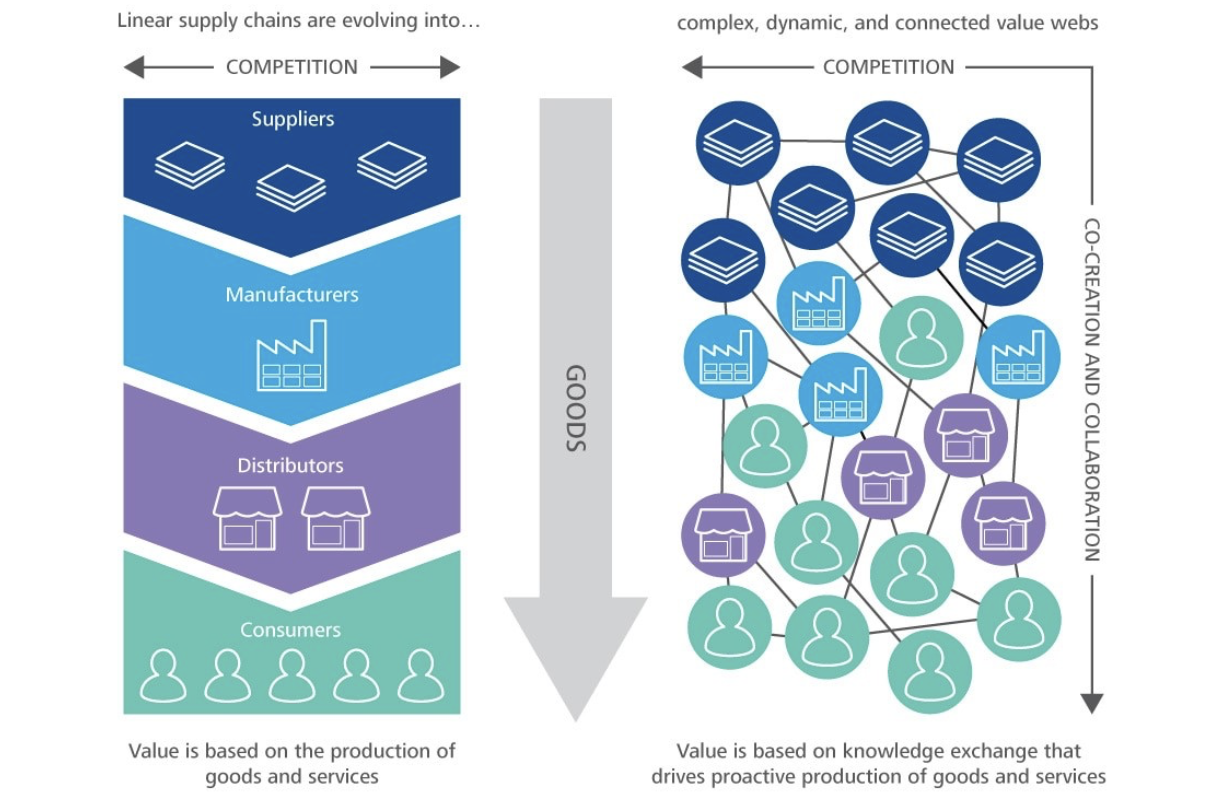
In today’s rapidly evolving business environment, companies are increasingly realising that the traditional linear thinking about supply chains, customer relationships, and market competition is no longer sufficient to drive sustainable, profitable growth. The world is shifting toward a more interconnected, collaborative approach — the ecosystem model. This new way of thinking revolves around networks of partners, suppliers, customers, and even competitors, all working together to create value. By embracing ecosystem thinking, companies can unlock new sources of growth, reduce risks, and achieve far more than what traditional models could ever deliver.
What Is a Business Ecosystem?
At its core, a business ecosystem is a network of organizations, people, and resources that work together to deliver a product or service. Unlike traditional business models where companies operate independently along a supply chain, business ecosystems thrive on interdependence and collaboration. These ecosystems are dynamic, often blurring the lines between competitors and collaborators, and extend beyond the firm’s traditional value chain. The key to ecosystem success is creating shared value that benefits all members, from raw material suppliers to customers and beyond.
The shift to ecosystem thinking is not just a philosophical one; it is driven by tangible business pressures and opportunities. Technology has made it easier for companies to connect with one another, data flows more freely, and customer demands are increasingly complex, requiring companies to collaborate more extensively. In turn, businesses are realizing that the future of growth lies not in isolated activities but in understanding the complex interconnections that drive success.
The Shift from Linear Thinking to Ecosystem Thinking
Traditional linear thinking about business operates on the assumption that companies are independent entities that control their value chains. Each player in a supply chain performs a specific function, and businesses operate in silos with little need for collaboration or interaction beyond transactional exchanges. A manufacturer might source materials from a supplier, sell to a distributor, and then distribute products to retailers or customers. This straightforward, one-directional process is often referred to as “linear thinking.”
In contrast, ecosystem thinking is characterized by relationships that are circular, interdependent, and collaborative. Rather than simply pushing products through a value chain, companies in an ecosystem work together to create a shared pool of value, often through the exchange of resources, knowledge, and technology. Ecosystem thinking recognizes that growth can emerge not only from within a company’s operations but also from the external relationships it cultivates and nurtures.
Key Differences Between Linear and Ecosystem Thinking:
Value Creation: In linear models, value is created primarily within a single company’s operations. In ecosystems, value is created through collaboration and the interdependence of various stakeholders.
Relationships: Linear models focus on independent, one-way transactions, whereas ecosystems thrive on two-way, symbiotic relationships.
Risk Mitigation: Traditional models may expose a company to risks from supply chain disruptions or market shifts. Ecosystem models spread risks across partners, making companies more resilient.
Innovation: In linear thinking, innovation is often isolated and happens in the R&D departments of individual companies. In ecosystems, innovation can happen collaboratively across the network, driving faster, more diverse breakthroughs.
By recognizing these differences, companies can better understand why ecosystem thinking has become a powerful tool for achieving sustainable growth in today’s interconnected world.
Successful Examples of Ecosystem Thinking
Several companies have successfully adopted ecosystem thinking to fuel their growth, often redefining entire industries in the process. Their ability to forge partnerships, create value for multiple stakeholders, and embrace complexity has been instrumental in their success.
1. Amazon: Building a Platform Ecosystem
Amazon’s rise to dominance is a perfect example of how ecosystem thinking can revolutionize a business. The company initially began as an online retailer but soon evolved into an ecosystem of businesses that collaborate with Amazon, rely on its platform, and benefit from its vast customer base.
Amazon Web Services (AWS): One of the most significant moves that Amazon made was the launch of Amazon Web Services (AWS), which has turned into one of the largest and most profitable cloud computing ecosystems in the world. By offering infrastructure as a service (IaaS), Amazon has transformed the way businesses approach technology, moving away from on-premise IT infrastructure and toward cloud solutions. AWS does not just offer a service; it creates an ecosystem that connects developers, businesses, and cloud customers, creating a thriving network of users, app developers, and service providers.
Amazon Marketplace: Beyond AWS, Amazon’s marketplace ecosystem has also been a game-changer. Third-party sellers use Amazon’s platform to reach customers, while Amazon itself provides the infrastructure and services needed for those sellers to thrive. This business ecosystem has turned Amazon into a global marketplace, where millions of products are sold by third-party sellers, and millions of customers benefit from the vast selection.
In both cases, Amazon has created an ecosystem in which it does not solely control the value chain but plays a central role, benefiting from the network effects that arise when more players participate. Amazon’s ecosystem is thriving because it enables others to build and innovate on top of its platform, making it a key player in the broader tech and retail ecosystem.
2. Apple: From Product Ecosystem to Service Ecosystem
Apple has long been known for its ability to build highly integrated hardware and software products, creating a seamless user experience across devices. However, in recent years, Apple has expanded its ecosystem to include services that further bind customers into its ecosystem.
Apple’s Hardware Ecosystem: The synergy between the iPhone, Mac, iPad, and Apple Watch is a fundamental component of Apple’s ecosystem. The company’s success in building a loyal customer base relies on how well its products work together. The integration of hardware and software makes the Apple experience unique — users can seamlessly transfer data across devices, use Apple services, and maintain a cohesive experience. Apple’s ecosystem encourages users to purchase multiple products, deepening their relationship with the brand.
Apple Services Ecosystem: In addition to its hardware, Apple has successfully expanded into services such as iCloud, Apple Music, Apple TV+, and the App Store. These services provide recurring revenue streams and deepen the engagement of Apple’s customers. The services ecosystem locks customers into using Apple’s platform for entertainment, storage, communication, and more. Apple’s strategy of moving from a product-based model to a service-based model is a prime example of ecosystem thinking — the company has turned its hardware base into an entry point for a much broader ecosystem of services.
3. Tesla: Reinventing the Auto Ecosystem
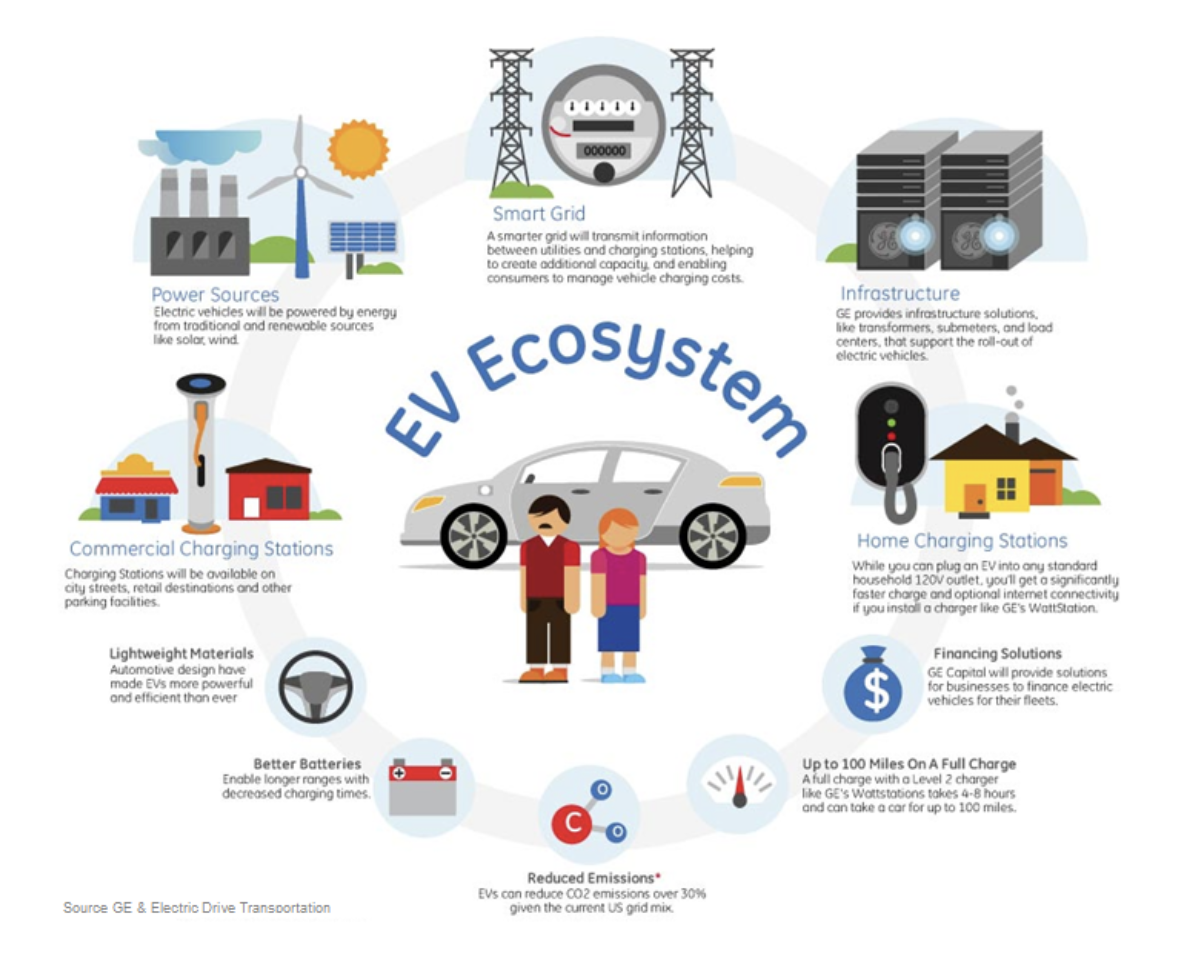
Tesla has redefined the automotive industry through its innovative approach to electric vehicles (EVs) and its broader vision of sustainable energy. By positioning itself as part of an ecosystem that includes renewable energy generation, electric vehicles, autonomous driving, and battery storage, Tesla has created a business model that goes beyond simply selling cars.
Supercharger Network: One key element of Tesla’s ecosystem is its proprietary Supercharger network. Unlike traditional car manufacturers, which are focused on selling cars alone, Tesla has built an infrastructure that supports its vehicles and enhances the customer experience. The Supercharger network allows Tesla owners to charge their vehicles quickly and conveniently, which is crucial for widespread EV adoption. This charging network is part of Tesla’s broader ecosystem that includes not only the car but also the energy storage (Powerwall) and solar solutions.
Autonomous Driving and AI: Another part of Tesla’s ecosystem is its focus on autonomous driving. The company’s AI-driven software allows for over-the-air updates and continuously improves the vehicle’s capabilities, which makes it a dynamic part of the overall transportation ecosystem. Tesla’s strategy is to integrate artificial intelligence, data analytics, and machine learning to enhance the driving experience and contribute to the broader movement toward smart, connected vehicles.
4. Microsoft: A Cloud Ecosystem of Products and Partners
Microsoft has transitioned from a traditional software company to a leader in cloud computing, using ecosystem thinking to dominate the cloud space. Microsoft Azure, its cloud platform, has become the backbone for businesses worldwide, helping companies build and deploy applications, store data, and manage their infrastructure.
Azure Ecosystem: Microsoft Azure isn’t just a cloud service; it’s an entire ecosystem that supports a wide range of third-party integrations, partnerships, and developer tools. This ecosystem allows companies to build on Azure, creating a thriving marketplace of apps, services, and solutions. By opening up its platform to partners, Microsoft enables others to innovate on top of Azure, while still maintaining control over its core infrastructure.
Microsoft 365: The Microsoft 365 ecosystem integrates tools like Word, Excel, and Teams with cloud services, creating a cohesive environment where businesses can work, collaborate, and communicate efficiently. The seamless integration between cloud storage, productivity tools, and collaboration software keeps users within the Microsoft ecosystem, creating long-term customer loyalty.
5. Alibaba: Creating a Digital Economy Ecosystem
Alibaba is one of the most powerful examples of a company that has transformed from a simple online marketplace into a global digital economy ecosystem. The company has built an interconnected network that combines e-commerce, cloud computing, digital payments, logistics, and entertainment, all feeding into one another to drive customer engagement and long-term growth.
E-commerce: Alibaba’s core platform, Taobao, is a massive online marketplace that connects buyers and sellers across China and internationally. The company also owns Tmall, a business-to-consumer platform catering to more high-end brands.
Cloud Computing (Alibaba Cloud): Alibaba Cloud is one of the largest cloud computing providers in China and the third-largest globally. The company’s cloud services are integrated with its e-commerce and logistics operations, offering businesses robust tools to build and scale their online presence.
Digital Payments (Alipay): Alipay, part of the Ant Group (an affiliate of Alibaba), is a dominant digital wallet in China and has expanded internationally. Alipay enables seamless payments across Alibaba’s e-commerce platforms, but it also integrates with a host of other merchants and service providers, creating a closed-loop ecosystem for digital financial transactions.
Logistics (Cainiao Network): Alibaba has built its own logistics network, Cainiao, to enhance delivery efficiency for e-commerce sellers. Cainiao leverages big data and AI to optimize supply chain and delivery management, helping sellers reduce shipping times and costs while improving customer satisfaction.
By combining e-commerce, cloud computing, logistics, payments, and entertainment (through Youku, its video streaming platform), Alibaba has created a highly integrated ecosystem where each part feeds into the others. This cross-pollination of services ensures that customers and businesses are deeply embedded within Alibaba’s platform, generating a continuous cycle of growth.
6. Huawei: Building an ICT and Consumer Electronics Ecosystem
Huawei, primarily known for its telecommunications and smartphone products, has successfully leveraged ecosystem thinking by developing a wide range of interconnected products and services spanning the ICT (Information and Communications Technology) sector.
Telecom Equipment: Huawei is the world’s leading provider of telecommunications infrastructure, including 5G technology. Its telecom equipment is used by many mobile network operators around the world, and the company’s proprietary technology allows for more advanced network connections, such as 5G and AI-powered automation.
Smartphones: Huawei’s Honor and Mate series smartphones operate within an integrated ecosystem of applications, services, and hardware. The company has developed its own Huawei Mobile Services (HMS) to replace Google services and create a self-sustaining ecosystem for mobile users.
Cloud Computing & AI: Through Huawei Cloud, the company provides cloud computing solutions to businesses, as well as AI-powered solutions for industries ranging from finance to healthcare. Huawei is actively working on building an open, collaborative ecosystem that supports a wide range of enterprise applications and uses.
Consumer Electronics: Huawei has expanded its product offerings beyond phones to include smartwatches, laptops, and smart home devices that integrate with its smartphone ecosystem, creating a connected experience for users.
Huawei’s ecosystem extends beyond consumer electronics into the telecom infrastructure that powers global communication networks. The company’s deep integration of AI, telecom, and cloud services within its product ecosystem allows it to offer a broad set of solutions for both businesses and consumers, making Huawei an integral player in the global ICT ecosystem.
7. Grab: The Superapp Ecosystem
Grab, originally a ride-hailing service, has evolved into a superapp that offers a wide array of services, from food delivery to financial services. The company’s success has been driven by its ability to build an interconnected ecosystem of services that address a wide range of consumer needs in Southeast Asia.
Ride-hailing: Grab started as a competitor to Uber in Southeast Asia and remains one of the region’s leading ride-hailing platforms. However, Grab quickly expanded beyond transportation to become a comprehensive platform.
Food Delivery (GrabFood): Grab launched GrabFood, a food delivery service that became immensely popular in Southeast Asia, particularly in countries like Singapore, Malaysia, and Indonesia. GrabFood is integrated with the rest of the Grab platform, allowing users to pay with GrabPay and earn rewards across services.
Digital Payments (GrabPay): GrabPay is a digital wallet that allows users to make payments across Grab’s services. It also allows users to pay for external services, such as utility bills and online shopping, making GrabPay a crucial part of Grab’s ecosystem.
Financial Services (Grab Financial Group): Grab has expanded into digital banking, insurance, and lending, making financial services an integral part of its ecosystem. Grab has partnered with various banks and financial institutions to offer digital wallets, lending products, and insurance options.
Grocery Delivery (GrabMart): With GrabMart, users can shop for groceries and have them delivered straight to their doorsteps. This service is another example of how Grab integrates multiple aspects of daily life into its ecosystem.
Grab’s ecosystem approach has allowed the company to increase engagement with customers by offering an array of services that address various consumer needs in one app. By becoming the go-to platform for transport, food delivery, digital payments, and financial services, Grab is building strong customer loyalty and increasing the frequency of interactions within its ecosystem.
8. Spotify: Building a Music and Audio Ecosystem
Spotify has transformed from a simple music streaming service into a multifaceted audio ecosystem, offering podcasts, audiobooks, and personalized music experiences. This expansion has helped Spotify fend off competitors and create a sustainable, profitable business model.
Music Streaming: At the core of Spotify’s ecosystem is its music streaming platform, which offers users personalized playlists, curated recommendations, and a vast catalog of music. The platform leverages AI to create music recommendations based on listening habits and preferences.
Podcasts and Audiobooks: Spotify has made significant investments in podcasts, acquiring companies like Anchor and Parcast to create a thriving podcast ecosystem. This has allowed Spotify to diversify its content and attract new audiences. The platform has also integrated audiobooks into its offering, making it a more comprehensive audio platform.
Spotify for Artists: Spotify has developed a robust ecosystem for artists, allowing them to upload music, engage with listeners, and monetize their content through ads and subscriptions. By providing artists with tools to promote and distribute their music, Spotify strengthens its position as the dominant player in the digital music ecosystem.
Partnerships with Hardware Providers: Spotify has also expanded its ecosystem by partnering with various hardware providers, including smart speakers, wearables, and car systems, to ensure that Spotify is accessible to users across all devices.
Spotify’s ability to expand from music streaming into podcasts, audiobooks, and a platform for artists has made it a central hub in the broader audio ecosystem. The company’s focus on personalization and user engagement, along with its growing content library, has allowed Spotify to differentiate itself from competitors and maintain its leadership position in the global audio ecosystem.
9. BYD: The Electric Vehicle and Renewable Energy Ecosystem
BYD (Build Your Dreams) has become one of the leading players in the electric vehicle (EV) market. The company’s approach to ecosystem thinking is centered on combining EV production with energy storage and solar technology, creating a closed-loop ecosystem for sustainable transportation and energy.
Electric Vehicles: BYD produces electric cars, buses, and trucks, with a focus on sustainable and eco-friendly transportation solutions. The company has become a major global player in the EV market, particularly in China and Europe.
Energy Storage (BYD Energy): BYD has integrated energy storage solutions into its ecosystem through BYD Energy, which produces lithium-ion batteries for both EVs and stationary storage systems. This allows customers to power homes and businesses with renewable energy, reducing reliance on traditional grid power.
Solar Energy (BYD Solar): BYD has expanded into solar energy production, offering solar panels and energy solutions to complement its EVs and energy storage systems. By integrating these elements into a single ecosystem, BYD provides customers with a holistic approach to renewable energy and sustainable living.
BYD’s ability to link electric vehicles, energy storage, and solar power into a single ecosystem has allowed the company to establish itself as a leader in the green energy space. This ecosystem thinking positions BYD as a key player in the transition to sustainable energy and transportation, making it a powerful example of how ecosystem thinking can drive profitable growth in the green economy.
The Future of Ecosystem Thinking
The shift to ecosystem thinking represents a fundamental change in how companies view value creation, partnerships, and growth. By building interconnected networks of customers, partners, suppliers, and even competitors, businesses can unlock new avenues of revenue, increase innovation, and become more resilient to disruptions.
Companies like Amazon, Apple, Tesla, and Microsoft have already demonstrated how ecosystem thinking can drive significant growth. Their ability to recognize and capitalize on the interconnectedness of the modern business world has allowed them to not only maintain relevance but also expand their market positions. The future of business growth will likely be defined by how well companies can integrate into and leverage these ecosystems, creating value not just for themselves but for the entire network they belong to.
As businesses continue to embrace this new mindset, it is clear that success will depend on a company’s ability to build, maintain, and expand its ecosystem. The companies that succeed will be those that think beyond linear, independent models and embrace the complexity and interconnectedness of the global economy. The time for ecosystem thinking is now — and those who fail to adapt risk being left behind.
I was recently described as one of the world’s leading thinker on business reinvention – quite an accolade, I thought – particularly when you look around at some of my peers and their great ideas, books and real-life examples of transforming organisations.
In today’s fast-evolving business landscape, standing still is equivalent to falling behind. Digital disruption, shifting consumer expectations, global crises, and the accelerating pace of technological change demand that organizations continually reinvent themselves.
So which leading thinkers, and recent books about business transformation, turnaround and regeneration, have inspired me?
The Ride of a Lifetime: Bob Iger’s memoir of his time as Disney’s CEO, highlighting leadership, strategic acquisitions, and transformational decisions that positioned Disney for long-term success.
Brick by Brick: David Robertson and Bill Breen chronicle Lego’s turnaround from near bankruptcy, focusing on innovation, customer engagement, and aligning culture with core purpose.
Innovation Out of Crisis : Shigetaka Komori, former CEO, details Fujifilm’s transformation from a film company to a diversified conglomerate, demonstrating how crises can catalyse innovation and reinvention.
See Sooner, Act Faster: George Day and Paul Schoemaker emphasise vigilant leadership, anticipating threats and opportunities, and developing organizational capabilities to respond proactively to disruption.
Resurgent: Julian Birkinshaw and John Fallon explore how incumbent companies navigate disruption, with strategies like fighting back, doubling down, retrenching, or migrating into new markets, using real-world case studies.
The New Nature of Business: André Hoffmann and Peter Vanham advocate purpose-driven, sustainable business strategies, integrating social, environmental, and human capital to create long-term value.
No Rules Rules – Reed Hastings with Erin Meyer explore Netflix’s culture of freedom and responsibility, demonstrating how culture can drive agility, experimentation, and repeated reinvention.
Humanocracy: Gary Hamel and Michele Zanini advocate flattening bureaucracy and empowering employees, arguing that human-centered organizational design unlocks creativity, innovation, and large-scale transformation.
Dual Transformation: Scott Anthony and Mark Johnson provide a framework for simultaneously optimising the core business (Transformation A) and building a new disruptive business (Transformation B) to navigate change successfully.
Across these diverse examples, from Disney’s blockbuster acquisitions to Lego’s turnaround, Fujifilm’s pivot and Netflix’s culture-driven innovation, emerge ten powerful ideas for business reinvention:
1. Develop business models as dynamic portfolios
Manage multiple business models concurrently to balance core exploitation with the exploration of new opportunities.
Alexander Osterwalder argues that sustainable reinvention demands managing a portfolio of business models rather than relying on a single core. This approach allows companies to maintain revenue from established operations while experimenting with new ventures.
For example, Amazon continues to rely on its retail platform as a foundation, while building new businesses such as AWS, Prime Video, and logistics innovations.
2. Pursue dual transformation: Strengthen core while building new ventures
Successful reinvention requires parallel attention to the present and future, leveraging existing capabilities while exploring new models.
Scott Anthony presents a framework for balancing short-term performance and long-term disruption. Transformation A focuses on optimizing and defending the core business, while Transformation B builds a new growth engine, often in adjacent or entirely new markets.
Adobe, for instance, maintained and optimized its Creative Suite products (Transformation A) while launching Creative Cloud (Transformation B), creating a recurring revenue model that redefined its industry. Similarly, Fujifilm leveraged existing imaging technologies to diversify into healthcare and cosmetics, applying core capabilities to new markets.
3. Embrace purpose-driven strategy and sustainable value
Integrate purpose into strategy to align employees, inspire customers, and sustain long-term value creation.
André Hoffmann argues that reinvention is increasingly purpose-driven. Purpose is no longer a marketing slogan; it shapes strategic priorities, informs decision-making, and aligns the organization around social, environmental, and human goals. Companies like Roche, LEGO, and others have embedded purpose into their core strategies, fostering long-term resilience and stakeholder trust.
A purpose-led approach encourages organizations to make decisions that benefit all stakeholders, not just shareholders, while positioning them to seize opportunities emerging from societal and environmental shifts.
4. Cultivate vigilant, adaptive leadership
Reinvention depends on leaders who anticipate change, inspire confidence, and enable rapid, informed action across the organization.
George Day emphasizes vigilant leadership, the ability to anticipate emerging trends, identify threats, and act proactively.
Disney’s Bob Iger exemplifies this principle. His strategic foresight in acquiring Pixar, Marvel, Lucasfilm, and 21st Century Fox, and positioning Disney for the streaming era, illustrates how leaders can steer organizations through complex transformations.
Vigilant leaders also empower teams to act quickly, providing frameworks that balance autonomy with accountability, enabling the organization to respond to change before competitors do.
5. Reinvent culture as a strategic asset
Shape culture to foster creativity, risk-taking, and alignment with organizational purpose and strategy.
Culture is central to transformation. No Rules Rules explores how Netflix’s freedom-and-responsibility culture drives agility and innovation, showing that removing bureaucracy, rewarding candor, and promoting accountability allows employees to experiment and innovate fearlessly.
Lego’s turnaround, detailed in Brick by Brick, similarly emphasizes aligning culture with purpose and product, nurturing creativity, and instilling operational discipline.
Culture is not incidental—it must be designed deliberately to enable strategic reinvention.
6. Innovate out of crisis: Leverage constraints as catalysts
View crises as opportunities to reimagine the business and apply existing strengths in innovative ways.
Shigetaka Komori’s Innovation Out of Crisis demonstrates that disruption can catalyze creativity and reinvention. Fujifilm’s film business collapse forced the company to pivot into healthcare, cosmetics, and digital imaging, leveraging existing technologies in new markets.
Similarly, economic downturns or competitive pressure often reveal latent capabilities that can be repurposed for growth.
Empower employees through flatter, more adaptive organizational structures to unleash innovation at scale.
Gary Hamel and Michele Zanini argue that bureaucracy stifles innovation and slows reinvention. By dismantling rigid hierarchies, reducing unnecessary rules, and empowering employees to make decisions, organizations can tap into collective intelligence and creativity. Companies that embrace human-centric structures—where individuals are trusted to solve problems and contribute ideas—can accelerate transformation far faster than rigidly managed firms.
This principle complements Netflix’s culture (freedom and responsibility) and Lego’s creativity-focused environment, highlighting that organizational design is as important as strategy and technology in enabling reinvention.
8. Customer-centric reinvention: Ground innovation in real needs
Effective reinvention starts with deep insights into customer behavior, enabling solutions that truly resonate.
Marc Randolph, through Netflix’s story, and Lego’s fan engagement, emphasize the power of listening to customers. Innovations should address real pain points rather than be technology- or internally-driven. Netflix iterated its DVD-by-mail and streaming models by testing hypotheses and responding to customer preferences, while LEGO co-created products with fan communities.
9. Strategic risk-taking with disciplined experimentation
Reinvention requires courage tempered with structured experimentation and disciplined execution.
Julian Birkinshaw highlights the need to balance bold experimentation with discipline. Companies like Lego, Disney, Fujifilm, and Netflix pursued calculated risks: exploring new markets, products, or content while maintaining operational and financial control.
Innovation portfolios, pilot programs, and scenario planning enable organizations to fail fast, learn, and scale successful initiatives safely.
10. Reinvention is continuous: Build organisational resilience
Treat reinvention as an ongoing capability, embedding learning, adaptation, and experimentation into organizational DNA.
Across all these examples, the unifying principle is that reinvention is not a one-time event. Lego continually innovates its products and engagement models; Disney regularly integrates new franchises; Netflix evolves its culture and content strategies; Fujifilm continues diversifying into healthcare and beyond.
The Invincible Company underscores the importance of institutionalizing innovation infrastructure, portfolio management, and adaptive leadership, making transformation a repeatable capability rather than a single project.
What can we take away?
10 powerful ideas emerge from these authors and their recent books, about what drives business reinvention, and the broader process of transforming an organisation and its performance:
Treat business models dynamically and manage them as portfolios.
Pursue dual transformation: optimize core operations while exploring new growth engines.
Embed purpose and sustainability into strategy.
Cultivate vigilant and adaptive leadership.
Design culture to enable creativity, alignment, and agility.
Leverage crises as catalysts for innovation.
Empower employees through human-centric organizational design
Ground reinvention in deep customer insights.
Balance bold experimentation with disciplined risk management.
Institutionalize continuous reinvention as an organizational capability.
Whether it’s Netflix redefining entertainment, Lego reinventing play, Disney integrating content and technology, Fujifilm pivoting industries, or human-centric organizations flattening bureaucracy to unlock creativity, these lessons converge on one point: successful reinvention is holistic, deliberate, and enduring. It aligns strategy, business models, culture, leadership, and purpose to respond to disruption proactively and continuously.
By integrating these insights, companies can chart a practical roadmap for transformation—balancing the exploitation of existing strengths with the exploration of new opportunities, fostering a culture of empowerment, embedding purpose, and building resilience into the very fabric of the organization.
For most of its history, insurance has been defined by a reactive model: customers pay premiums, disasters strike, claims are filed, and compensation is provided. This contract of risk transfer has been the backbone of the industry for centuries. Yet in a world of escalating climate extremes — floods, wildfires, hurricanes, and heatwaves — the reactive model is no longer sufficient. As losses mount into the hundreds of billions annually, and communities face repeated devastation, the very sustainability of insurance is under threat.
The future of insurance depends on reinvention — shifting from being a passive payer of claims to becoming an active partner in prevention. At the heart of this reinvention is artificial intelligence (AI). By combining predictive models, satellite imagery, sensor networks, and parametric triggers, insurers are discovering how to transform risk knowledge into actionable foresight. The promise is profound: instead of writing cheques after disasters, insurers can help clients avoid them in the first place.
From Claims to Prevention
The traditional insurance cycle was simple: underwrite, collect premium, pay claims. Yet the climate era has exposed its fragility. In regions from California to Queensland, insurers have pulled out of entire markets due to wildfire or flood losses, leaving households and businesses without cover. Governments and regulators, meanwhile, are demanding that insurers step up not only as financiers of recovery but as partners in resilience.
AI offers a path forward. By sifting through oceans of weather data, remote sensing imagery, and historical loss records, machine learning models can detect subtle patterns that human underwriters might miss. More importantly, they can provide real-time insights — enabling proactive measures that reduce exposure before disaster strikes. This is the essence of “smart avoidance”: combining risk intelligence with behavioural nudges, alerts, and incentives so that clients take action to prevent losses.
Example: Flood Foresight with Allianz
When heavy rains loom over Europe, Allianz’s AI-driven platform merges weather forecasts with river-gauge readings and vulnerability maps. Customers receive hyper-local alerts: move inventory upstairs, place sandbags, evacuate early.
Impact: Thousands of euros saved in avoided damages, stronger customer trust, and a new role for the insurer — from cheque-writer to proactive risk advisor.
Wildfire Prediction: Munich Re, AXA and AI-Powered Models
Wildfires, once seasonal, are now year-round risks in parts of North America, Europe, and Australia. Munich Re and AXA XL are leveraging satellite data, topographic information, and vegetation indices to build machine-learning models that assess wildfire spread in real time.
Clients receive risk scores and practical recommendations — from vegetation management around properties to evacuation timing. In some regions, insurers are even experimenting with offering lower premiums to households that implement defensible space or install fire-resistant materials, guided by AI risk assessments.
This is insurance as a catalyst for behavioural change: aligning financial incentives with proactive resilience.
Example: AI in the Fire Zone
AXA XL’s wildfire tool blends weather forecasts, historic fire data, and vegetation maps to predict fire paths. Businesses receive tailored advice on how to protect facilities, while homeowners are coached on defensible spaces.
The benefit: lower claims and, more importantly, safer communities.
Homes That Protect Themselves: Hippo and Smart Sensors
Not all extreme events are vast in scale. Everyday disasters like burst pipes or electrical fires also contribute to major losses. Insurtechs such as Hippo have taken prevention into the home itself, integrating IoT sensors with AI analytics. Leak detectors can signal a broken pipe before it floods a house; smart thermostats can shut down overheating systems before they ignite.
The data from these sensors is fed into AI systems that detect anomalies and send instant alerts to homeowners — often before the homeowner notices anything is wrong. For the insurer, it means fewer large claims; for the customer, it means peace of mind.
Example: Hippo’s “Prevent First” Model
Hippo offers free smart-home kits to policyholders, including leak detectors and fire sensors. Its AI platform analyses real-time data, alerting clients before small issues become catastrophes.
Result: reduced water damage claims by up to 20% in pilot markets, and happier customers who see their insurer as a partner, not just a bill.
Startups Rewriting the Risk Map
A new generation of AI-driven insurtechs is emerging to tackle risks once considered “uninsurable.” Companies such as Zesty.ai and Kettle use aerial imagery, building footprints, and climate data to generate highly granular wildfire and hurricane risk models.
These models not only improve underwriting accuracy but also create pathways for coverage in regions where legacy actuarial methods had failed. Properties once abandoned by insurers can be priced more fairly, often with incentives for retrofits that further reduce risk. Here, AI does more than improve actuarial precision — it democratizes access to insurance by making the uninsurable insurable again.
Example: Zesty.ai’s Risk Lens
Zesty.ai analyses over 200 billion data points — from roof shape to tree cover — to score wildfire risk at the individual property level.
Why it matters: homeowners previously denied coverage in high-risk regions can now access policies, often at fairer prices, if they commit to fire-resilient upgrades.
Parametric Innovation: Triggering Rapid Recovery
Another frontier of AI-driven prevention lies in parametric insurance. Unlike traditional policies, which rely on damage assessment, parametric covers pay out automatically when pre-defined triggers are met — such as wind speeds above a threshold, or rainfall exceeding a certain level.
Insurers like Swiss Re, FloodFlash, and Descartes Underwriting are using AI to refine these triggers, employing satellites, IoT sensors, and predictive models to ensure accuracy and minimize “basis risk.” The speed of payouts allows businesses and communities to recover before secondary impacts (like mould after floods or supply-chain collapse after storms) create larger damages. While parametrics do not prevent disasters, they mitigate their economic fallout and build resilience.
Beyond Technology: A New Social Contract
While the technology is advancing rapidly, the reinvention of insurance requires more than algorithms. It demands a new social contract between insurers, clients, and regulators. Transparency is critical: AI models must be explainable, so customers understand how their risk scores are derived and regulators can ensure fairness. Privacy must be safeguarded as insurers collect increasing volumes of personal and sensor data.
There is also the question of responsibility. Should insurers merely provide insights, or actively intervene in client behaviour? Already, insurers are nudging customers through lower premiums for risk-reducing actions. In the future, partnerships may extend further — insurers co-investing with municipalities in flood defences, or bundling climate-resilient retrofits with coverage.
Turning Crisis into Reinvention
The climate crisis is reshaping insurance in fundamental ways. Extreme events are not “black swans” but recurring certainties. Traditional underwriting cannot keep pace with their frequency or intensity. Without reinvention, the industry risks shrinking coverage, escalating premiums, and eroding trust.
AI offers a way out of this trap. By transforming disaster data into foresight, and foresight into prevention, insurers can shift their value proposition from “writing cheques when things go wrong” to “helping ensure things go right.”
The winners in this reinvention will be those insurers that harness AI not just as a back-office efficiency tool, but as the engine of a new business model. A model where risk is reduced, resilience is built, and customers see their insurer as a partner in safeguarding lives and livelihoods.
Reinventing Insurance: From Payers to Protectors
Reinventing insurance is not optional — it is an existential necessity. The convergence of climate change, digital technology, and shifting customer expectations is rewriting the rules of the sector. Insurers that cling to reactive claims models will find themselves overwhelmed by losses and abandoned by clients.
Those that embrace AI to drive prevention, however, can reinvent their role entirely. They can become protectors rather than payers, helping society anticipate and avoid disaster. In doing so, they will not only preserve their relevance but also contribute to building resilience in an era where extreme events are the new normal.
The message is clear: the future of insurance is not about disaster claims — it is about smart avoidance. And AI is the tool that makes that future possible.