Fashion has always been a mirror of the societies that create it.
Yet the pace of change over the past two decades has been unprecedented. What was once a relatively stable industry governed by seasonal calendars, wholesale distribution and predictable marketing cycles has been transformed by globalisation, digital technology and shifting consumer behaviour.
Today, fashion brands and retailers operate in a landscape defined by constant acceleration, where trends emerge overnight, supply chains must respond in real time, and technology increasingly shapes both design and consumer experience.
Megatrends reshaping fashion and retail
Understanding this transformation requires stepping back from individual brands or technologies and recognising the deeper forces reshaping the sector. Several powerful megatrends are redefining how fashion is created, marketed and consumed. Together they provide the context for the industry’s evolution from fast fashion, through social commerce, and into what might now be described as an emerging era of AI-native retail.
1. Technology as core infrastructure
AI, machine learning, and automation are no longer peripheral tools; they are becoming the operational backbone of modern retail. From predictive trend forecasting to virtual try-ons, intelligent systems enable brands to design, produce, and distribute more efficiently than ever.
-
Impact: Brands that integrate AI into product design, supply chain optimisation, and customer personalisation will achieve faster time-to-market, higher conversion, and reduced inventory risk.
2. Cultural acceleration
The pace of trend emergence and cultural shifts has accelerated due to social platforms, influencer networks, and algorithm-driven content. Fashion is no longer discovered primarily through advertising; it emerges through creators, communities, and viral micro-trends. It is not only inspired by culture, it becomes culture.
-
Impact: Brands must operate at the speed of culture, embedding themselves in communities, collaborating with creators, and co-developing products. Seasonal calendars alone are increasingly irrelevant.
3. Consumer expectations and personalisation
Consumers now demand personalisation, immediacy, and authenticity – with expectations shaped by tech, entertainment and more. They expect products that fit their identity, are easy to access, and are aligned with their values, including sustainability and inclusivity. They seek more humanity, fun, and emotional engagement too.
-
Impact: Retailers must offer customisation, intelligent sizing, curated experiences, and omni-channel continuity to maintain loyalty.
4. Social commerce and platform dominance
Platforms such as TikTok Shop, Instagram, and Snap have evolved into primary points of discovery and purchase. Consumers trust friends and peers more than brands ore retailers. Social content and commerce are converging. Ideas spread like wildfire. Influence is the growth engine.
-
Impact: The traditional funnel “advertise, distribute, sell” is being replaced by social-first discovery, creator-led engagement, and instant conversion.
5. Sustainability and regulatory pressure
Sustainability is shifting from a marketing differentiator to a regulatory and operational imperative. Carbon reporting, circular supply chains, and ethical sourcing are becoming minimum expectations. It goes beyond this, to regeneration. Net Positive rather than just net zero. Brands that contribute, environmentally and socially, globally and locally.
-
Impact: Companies must embed sustainability into product design, production, and logistics, or risk reputational damage and regulatory fines.
6. Geopolitical and economic volatility
Trade tensions, global supply chain disruptions, and inflationary pressures are forcing brands to rethink sourcing, manufacturing, and risk management. Resilience becomes key, particularly as price shocks can directly affect costs and demand. Brands need vision, but also agility.
-
Impact: Flexible, localised supply chains are increasingly advantageous. Companies that can pivot quickly will gain resilience and competitive advantage.

Fashion retail evolution in three phases
Understanding these megatrends provides the lens through which to view the three phases of retail evolution, from fast fashion supply chains, through social commerce engagement, to AI-native personalisation and operations.
Phase One: the age of fast fashion
- Consumer-driven, rapid cycle, fashion as culture, retail as entertainment
- Speed can drive market leadership, but only when paired with data and insight.
- Real-time analytics, both digital and physical, provide a competitive edge.
Examples:
- Inditex: Near-market production and small batch runs allowed design-to-store cycles in weeks.
- Shein: Algorithm-driven trend detection, micro-batch production, and social marketing.
- Edikted: Leveraging TikTok virality and influencer culture to drive rapid product turnover.
The first phase of modern fashion disruption emerged in the early 2000s with the rise of fast fashion. At its core, fast fashion was about speed. Traditional fashion houses operated on seasonal cycles, designing collections many months before garments reached stores. Fast fashion brands challenged this model by dramatically shortening the time between design and retail availability.
Companies such as Inditex, the Spanish group behind Zara, pioneered a system that integrated design, production and distribution into an agile network capable of responding rapidly to consumer demand. Rather than relying solely on long-term forecasts, Zara monitored sales data and store feedback in near real time, allowing designers to adjust collections continuously. Smaller production batches reduced the risk of unsold inventory while frequent product updates encouraged customers to visit stores more often.
The fast fashion model fundamentally altered the economics of the industry. By accelerating product cycles and lowering prices, these companies democratised fashion, making trend-led clothing accessible to a much broader audience. Speed became the central competitive advantage. Brands that could move quickly from design concept to retail shelf gained the ability to capture emerging trends while they were still relevant.
Over time, digital technology further amplified this model. Online data and social signals began to inform product decisions, while e-commerce enabled companies to reach global audiences. Perhaps the most dramatic example of this evolution has been the rise of Shein. Founded in China, the company built an extraordinarily agile supply chain supported by sophisticated data analytics. Shein analyses vast quantities of online behaviour—from search trends to social media activity—to identify emerging styles. It then produces small test batches of garments, scaling production only when consumer demand is confirmed.
Other brands have followed similar strategies. Edikted, a younger fast fashion player, has harnessed social media trends and influencer culture to drive rapid product turnover among Gen Z consumers. Its model combines fast production cycles with a strong understanding of online culture.
The lesson of the fast fashion era is clear: operational speed and supply chain agility can redefine an entire industry. Yet speed alone would not remain the dominant force for long. As social platforms transformed how consumers discover and engage with brands, the next phase of fashion retail began to emerge.
Phase Two: social and community retail
- Community and culture, not catalogue alone, drive loyalty.
- Discovery and commerce are merging; brands must adapt to social-first purchasing patterns.
- Co-creation and participatory design can reduce risk and increase engagement.
Examples:
- Gymshark: Built a global brand via influencer networks, micro-content, and community engagement.
- Halara: TikTok virality and algorithmic feedback inform both design and inventory decisions.
- Xillions: Fans co-create products, fostering participation, loyalty, and real-time insights.
By the mid-2010s, the rise of social media had begun to reshape the relationship between brands and consumers. Fashion was no longer simply produced and marketed by companies; it was increasingly shaped by communities.
Platforms such as Instagram, YouTube and later TikTok created new forms of influence. Individuals with large followings could shape trends more effectively than traditional advertising campaigns. Consumers began to discover products not through catalogues or magazines but through creators they trusted and admired.
This shift transformed the mechanics of brand building. Marketing budgets alone could no longer guarantee success. Instead, authenticity, community engagement and cultural relevance became critical assets. Brands that successfully embedded themselves within online communities often achieved remarkable growth.
Gymshark provides a powerful example. Founded in the United Kingdom in 2012, the fitness apparel brand built its identity around a network of influencers and athletes who promoted the brand through social media content. Rather than relying on conventional advertising, Gymshark cultivated a sense of belonging among its audience, organising events and collaborations that strengthened the community around the brand.
Halara, an athleisure brand that gained popularity through TikTok, demonstrates another variation of this model. Its products often go viral through short-form videos showcasing functionality and comfort, while social media engagement provides valuable feedback on which designs resonate with consumers.
The emergence of participatory commerce has taken this idea even further. Platforms such as Xillions allow fans and communities to contribute ideas or vote on product designs, effectively turning customers into collaborators. This approach not only strengthens loyalty but also provides valuable insight into consumer preferences before products reach production.
In this second phase, culture becomes as important as logistics. Speed remains essential, but the pace of cultural change now determines which trends matter. Fashion brands must monitor online conversations, collaborate with creators and remain sensitive to shifting tastes.
Another critical development during this period has been the merging of entertainment and commerce. Social platforms increasingly enable direct purchasing within the same environment where consumers discover content. TikTok Shop, for example, allows viewers to purchase products featured in videos without leaving the app. This integration of discovery and transaction has created entirely new pathways to market for fashion brands.
Yet even as social commerce reshaped the industry, a new transformation began to take shape—one driven by advances in artificial intelligence.
Phase Three: the emergence of AI-native retail
- AI enhances speed, accuracy, and personalisation across the value chain.
- Hybrid digital-physical strategies extend reach while preserving engagement with tangible products.
- Personalised and AI-informed products increase loyalty and reduce waste.
Examples
- SpreeAI: AI try-ons, sizing, and virtual stylists to improve physical product conversion; ~$1.5B valuation.
- Unspun: AI-assisted made-to-measure denim, reducing waste and producing personalised jeans.
- Choosy: AI trend and design platform feeding insights into physical product creation.
The next phase of fashion retail is defined not by a single technology but by the integration of intelligent systems across the entire value chain. AI is rapidly becoming the connective tissue that links design, manufacturing, marketing and customer experience.
In contrast to earlier digital innovations, AI does not merely support existing processes. It has the potential to fundamentally reshape how fashion is conceived and delivered.
One of the most visible applications of AI lies in personalisation. Consumers increasingly expect brands to understand their preferences and recommend products that match their tastes and needs. Technologies such as virtual try-ons and intelligent sizing tools address one of the most persistent challenges of online fashion retail: uncertainty about fit.
SpreeAI, a fashion technology startup founded in the United States in 2022, exemplifies this approach. Its platform uses advanced computer vision and generative AI to create photorealistic virtual try-ons that allow shoppers to see how garments would appear on their own bodies. By improving confidence in purchasing decisions, such technologies can increase conversion rates while reducing costly product returns.
AI is also transforming the design process itself. Algorithms can analyse vast datasets of images, search trends and social signals to identify emerging aesthetics before they reach mainstream popularity. Designers can then use these insights to guide product development.
Companies such as Choosy have explored AI-driven design models that analyse social media content to identify patterns in consumer taste. Rather than relying solely on intuition or traditional forecasting, these systems enable brands to respond dynamically to evolving trends.
Manufacturing is also evolving. The denim company Unspun uses advanced scanning and AI-powered pattern generation to create made-to-measure jeans tailored to individual customers. By producing garments on demand rather than in large batches, the company aims to reduce waste while delivering superior fit.
Even the visual representation of fashion is changing. Lalaland.ai, a technology platform used by many apparel brands, generates diverse digital models that can wear garments in online product images. This allows companies to showcase clothing on a wide range of body types without organising traditional photo shoots, improving both efficiency and inclusivity.
Hybrid models that blend digital and physical experiences are also emerging. DRESSX, originally known for digital-only fashion garments designed for online environments, has increasingly collaborated with brands to create augmented reality experiences and hybrid product launches. These initiatives allow consumers to experiment with fashion virtually while still purchasing physical garments.
Across all these examples, the common thread is the use of intelligence to enhance both operational efficiency and customer experience. AI enables brands to predict demand more accurately, personalise offerings at scale and reduce the environmental impact associated with overproduction.

Aligning speed, culture and intelligence
The convergence of these three phases—fast supply chains, social commerce and AI-native technologies—creates both enormous opportunities and significant challenges for fashion brands and retailers.
One of the greatest opportunities lies in the ability to combine speed, culture and intelligence. Brands that integrate data-driven design with strong community engagement can identify trends earlier and respond more effectively than competitors. Artificial intelligence can amplify this advantage by optimising everything from inventory allocation to personalised marketing.
Social commerce also offers new pathways for growth. Platforms that combine entertainment and shopping allow brands to reach global audiences without relying solely on traditional retail infrastructure. For emerging brands, this environment lowers barriers to entry and enables rapid scaling.
At the same time, technological innovation creates opportunities for greater sustainability. AI-driven demand forecasting, made-to-measure manufacturing and improved supply chain transparency can reduce waste and improve resource efficiency. As regulatory pressure increases, companies that invest in such systems may gain a competitive advantage.
Yet the challenges are equally significant. The pace of cultural change makes it difficult for brands to remain consistently relevant. Trends that emerge online can disappear just as quickly, leaving companies with unsold inventory or outdated designs.
The rise of social platforms also shifts power away from brands and towards the platforms themselves. Algorithms determine which products gain visibility, creating new dependencies and uncertainties. Companies must learn to navigate these ecosystems while maintaining direct relationships with their customers.
Technological adoption presents its own difficulties. Integrating artificial intelligence into existing operations requires substantial investment in data infrastructure, talent and organisational change. Many fashion companies must adapt traditional workflows to accommodate more dynamic and technology-driven processes.
Sustainability represents another complex challenge. While consumers increasingly expect responsible practices, implementing circular production models and transparent supply chains can be costly and operationally demanding. Balancing environmental commitments with commercial realities remains a delicate task.
Finally, geopolitical volatility continues to threaten global supply chains. Brands must build more resilient sourcing strategies capable of withstanding disruptions while maintaining efficiency.
The next future of fashion
Fashion retail has undergone a profound transformation over the past twenty years. What began as a revolution in supply chain speed evolved into an era defined by social media communities and creator-driven culture. Today the industry is entering a new phase in which artificial intelligence shapes how garments are designed, produced and experienced.
The most successful companies will not simply adopt one of these models; they will integrate all three. Operational agility, cultural awareness and intelligent technology must work together to create responsive, personalised and sustainable fashion businesses.
Ultimately, the greatest shift is not technological but conceptual. Fashion is no longer just about clothing. It is about data, identity, community and experience. In a world where trends move at the speed of algorithms and cultural conversations unfold in real time, the brands that thrive will be those capable of learning, adapting and innovating continuously.
The evolution of fashion retail is far from complete. Yet one lesson is already clear: in an industry shaped by speed, culture and intelligence, adaptability is the most valuable asset of all.
In today’s rapidly evolving global economy, businesses are facing unprecedented pressures to rethink how they create and capture value. The forces of digitisation, platformisation, globalisation, and sustainability are not merely shaping products or services; they are fundamentally reshaping the logic of competitive advantage. Companies that fail to grasp these shifts risk being marginalised, while those that anticipate and embrace them can redefine entire industries.
Central to this discussion is the distinction between
- Value Creation — how companies generate value for customers, or benefits.
- Value Capture — how companies turn this into value for them, or profits.
While the two are interconnected, they often move at different speeds, creating both opportunity and risk.
We explore the five most common types of shifts in value creation and value capture, illustrated with examples from around the world. Understanding these shifts allows firms to diagnose their industries, anticipate disruption, and design strategies that ensure they remain both relevant and profitable.
Value shifts in a digital world
Value shifts are not new, but a persistent feature of economic and social evolution, reflecting ongoing changes in what societies consider valuable and how that value is created and captured.
Historically, value has transitioned across eras: in agricultural economies it was rooted in land and labour; during the Industrial Revolution, it shifted to machines, factories, and scale; in the 20th century, brands, management, and mass production became central; and today, in the digital era, value is increasingly derived from data, networks, and attention. Each of these transitions reshaped which skills mattered, who accumulated wealth, and how power was distributed across society.
At the same time, the sources of value have continuously evolved, moving across different “centres of gravity.” These range from physical assets like land and infrastructure, to human capital such as expertise and education, to intellectual property including software and media, and more recently to network effects and algorithmic systems. The contrast between Standard Oil and Google illustrates how dominant companies in different eras rely on fundamentally different value engines.
Equally important are the changing mechanisms of value capture. These have progressed from ownership of land and resources, to control of production, to dominance over distribution, and now to control of platforms, ecosystems, and data flows. Companies like Amazon exemplify this shift by capturing value through logistics, infrastructure, and marketplace control rather than products alone.
What distinguishes the present is not the existence of value shifts, but their speed, abstraction, concentration, and global scale, driven by digital technologies. Yet the deeper pattern remains consistent: new innovations create value, early actors capture disproportionate gains, systems adapt through competition and regulation, and value shifts once again.
Shifts in “value creation” for customers
Value creation is, fundamentally, about improving the experience, outcomes, or utility that customers receive. Over the past two decades, several global trends have dramatically altered what customers consider valuable. These shifts are particularly visible in sectors such as technology, transport, media, healthcare, and consumer services.
1. From Products to Outcomes
Historically, companies sold tangible products or standardised services. Today, customers increasingly seek outcomes, rather than the items themselves – what they can do, rather than what they have. This shift is evident in industries where the end result — performance, uptime, or convenience — is more important than the physical object.
Examples:
- Rolls-Royce Holdings sells “Power by the Hour,” charging airlines for engine performance rather than the engines themselves.
- Netflix shifted from DVD rentals to streaming, focusing on seamless access to content and binge-worthy experiencesrather than ownership.
- Peloton combines connected fitness hardware with subscription-based classes, delivering measurable health outcomes.
The customer benefits from reduced risk, greater predictability, and simpler decision-making. For businesses, this requires investing in operational capabilities, data analytics, and service delivery to guarantee outcomes.
2. From Ownership to Access
Access-based models represent a profound shift in customer priorities. Rather than owning assets outright, users increasingly prefer temporary access or usage rights, which reduces upfront costs and maintenance burdens.
Examples:
- Airbnb enables travellers to access homes worldwide without property ownership.
- Grab bundles ride-hailing, deliveries, and payments, letting users consume services on demand.
- Vinted lets users buy, sell, or swap second-hand fashion, monetising trust and network effects rather than owning inventory.
Customers gain flexibility, affordability, and convenience, while firms must orchestrate platforms, manage trust, and ensure seamless access.
3. From Standardisation to Personalisation
Consumers increasingly demand tailored experiences. Mass-produced, one-size-fits-all offerings are giving way to products and services designed to suit individual preferences, behaviours, or needs.
Examples:
- Spotify curates personalised playlists and recommendations using listening data.
- Ant Group customises lending, insurance, and investment products through AI-driven insights.
- NikeID allows customers to design bespoke footwear, combining personal expression with brand engagement.
Personalisation increases relevance and loyalty, but requires sophisticated data management and analytics capabilities.
4. From Information Scarcity to Transparency
The digital era has empowered consumers with unprecedented access to information. Price comparison, reviews, and product ratings reduce asymmetry and shift bargaining power towards the customer.
Examples:
- Booking.com aggregates pricing, reviews, and availability for informed travel choices.
- Glovo provides real-time tracking and multi-service comparisons for urban deliveries.
- CarDekho gives detailed automotive reviews and dealer ratings, reducing uncertainty in purchases.
Transparency reduces search costs and perceived risk, while encouraging firms to compete on quality, experience, and trust rather than hidden advantages.
5. From Transaction to Experience
Increasingly, customers value holistic experiences over isolated transactions. Products must integrate functionality, convenience, and emotional satisfaction, creating loyalty and brand advocacy.
Examples:
- Apple integrates devices, software, and retail for a seamless ecosystem.
- Disney blends films, parks, and streaming for immersive storytelling.
- Hermès elevates retail into lifestyle experiences that foster loyalty.
Experience-focused value fosters differentiation and stickiness, particularly in commoditised markets.
Shifts in “value capture” by business
While value creation concerns the customer, value capture is about ensuring the company translates that value into economic profit. Shifts in capture reflect changes in revenue models, cost structures, control points, and sources of profit. They are increasingly evident in digital platforms, subscription businesses, and global ecosystems.
1. From Selling to Partnering
Or, from one-off sales to recurring revenues. The traditional model of one-off transactions is giving way to subscription, usage-based, or recurring revenue streams, enhancing predictability and lifetime value.
Examples:
- Adobe Creative Cloud transitioned from software licences to subscriptions.
- Microsoft 365 monetises ongoing engagement rather than one-off Office sales.
- Netflix and Spotify convert usage and engagement into recurring revenue.
2. From Ownership to Ecosystems
Modern firms increasingly capture value by orchestrating others’ assets rather than owning them directly. This reduces capital intensity while controlling access to economic flows.
Examples:
- Airbnb leverages hosts’ properties without owning real estate.
- Uber and Ola mobilise driver-partners’ vehicles for transport services.
- Rappi orchestrates gig labour and logistics without owning warehouses or fleets.
Control over the network, trust mechanisms, and platform algorithms becomes the key profit lever.
3. From Production to Connection
Economic rents increasingly flow to those who control platforms, marketplaces, or digital interfaces, even when they do not produce the underlying goods or services.
Examples:
- Apple collects App Store commissions while developers create apps.
- Tencent monetises social, gaming, and fintech platforms without owning content directly.
- Google profits from search advertising and Android’s ecosystem.
Ownership of the platform or interface secures economic rents independent of production.
4. From Profitability to Value Creation
Profitability increasingly depends on maintaining customers over the long term rather than extracting high margins from individual transactions.
Examples:
- Grab cross-sells rides, payments, and delivery services to enhance lifetime value.
- Netflix focuses on retention and tiered subscriptions.
- Spotify converts free users into paying subscribers while monetising ads.
Lifetime value optimisation strengthens loyalty, retention, and ecosystem profitability.
5. From Tangible to Intangible Assets
Profit increasingly derives from data, IP, brand, and network effects rather than physical products.
Examples:
- Google monetises search and advertising data rather than hardware.
- Tencent captures value from content, social networks, and digital payments.
- M-Pesa generates revenue from transaction fees while enabling financial inclusion.
Intangible assets offer scalability, resilience, and defensibility in competitive markets.
Strategic implications
An important insight is that value creation and value capture do not always shift in synchrony. Companies can create enormous customer value without capturing commensurate profits, or they can capture value from ecosystems without creating the primary end-user value themselves.
Examples:
- App developers create utility within the Apple ecosystem but Apple captures the bulk of economic rent.
- Traditional taxis created mobility but lost profit to Uber and other ride-hailing platforms.
- Newspapers produced content, but Google and Facebook captured the majority of digital advertising revenue.
Understanding this decoupling is essential for anticipating disruption and designing resilient business models.
Value in modern markets is no longer simply embedded in products or services. Customers now seek outcomes, access, personalisation, transparency, and holistic experiences.
Businesses that fail to recognise these shifts risk commoditisation and margin erosion. Meanwhile, firms that understand how value capture is evolving — through recurring revenue, asset orchestration, platform control, lifetime value optimisation, and intangible assets — can secure sustainable profit and industry leadership.
- Map Creation and Capture Separately: Identify shifts in customer value versus economic control.
- Prioritise Control Points: Data, interfaces, and network effects increasingly determine who captures profits.
- Reinvent Business Models: Subscription, outcome-based pricing, and platform orchestration are essential levers.
- Invest in Capabilities: Data analytics, AI, and service delivery must complement traditional product excellence.
- Monitor Global Innovations: Value shifts often originate in emerging markets or adjacent sectors and spread rapidly.
Recognising the five major shifts in value creation and the five major shifts in value capture is more than academic; it is a practical guide for navigating disruption. By examining global examples, it becomes clear that these shifts are universal, though manifested differently depending on regional context and industry structure.
Ultimately, the companies that excel will be those that simultaneously innovate in how they serve customers and in how they capture the resulting economic benefit. The future belongs to companies that can anticipate, adapt, and align these two dimensions before their competitors do.
I’ve worked with many organisations around the world – almost 300 companies in 50 countries during my 35 years in business. Adidas to Airbus, Arla and Asahi … to Vodafone and Volkswagen, Yildiz and Zacco.
So I decided to look back over more recent years at some of the companies I have supported, typically working with their business leaders on their strategies, innovation and transformations – as static advisor to boards, coach and inspiration to CEOs, and facilitator of executive and project teams.
So what have they done, and what impact did it make?

Adidas (Germany)
Adidas has shifted from being product‑centric to digitally oriented, prioritising direct‑to‑consumer channels, embracing data analytics to personalise customer experiences and forecast trends. Adidas also innovated with sustainable products, including materials made from recycled ocean plastics and ambitious climate targets. Organizational transformation included streamlining global supply chains, integrating automation, and fostering cross‑functional collaboration. Leadership focused on shortening product launch cycles, testing agile methods in design and marketing, and expanding e‑commerce capabilities. Strategic partnerships with athletes and cultural icons reinforced brand relevance among younger audiences. Operational advances included inventory optimization, enhanced CRM platforms, and AI‑driven demand planning. Adidas’s reinvention emphasized both sustainability and responsiveness, enabling the company to better navigate market disruptions and consumer shifts. My role: Working with VP Marketing and his team on a 5 year strategy for the business, bringing trends and ideas from adjacent sectors, and facilitating strategic thinking, new innovations and specific focus on achieving leadership in running category.
Airbus (France)
Airbus has doubled down on digital transformation and sustainability over recent years. The company, a collaboration between European partners, applied digital twin and predictive analytics across design, testing, and manufacturing, reducing errors and accelerating delivery times. Airbus embraced advanced materials and fuel‑efficient engines to lower environmental impact, while developing research programs for hybrid‑electric and hydrogen propulsion. In production, Airbus digitized assembly lines and implemented collaborative robotics to increase precision and responsiveness. Culture shifted toward cross‑disciplinary innovation, empowering engineers and software experts to work together on autonomous systems, AI applications, and real‑time analytics. Strategic ecosystem partnerships with suppliers, airlines, and startups improved supply chain agility. Airbus also invested in pilot training simulators driven by VR/AR to improve safety and efficiency. These integrated initiatives strengthened Airbus’s leadership in aerospace innovation. My role: Exploring future scenarios, and driving a culture of “pioneer” innovation, for the VP Commercial Development and his teams from across the world. This including keynotes and roundtables, bringing together commercial and technical leaders from across the world.
Al Ghurair (UAE)
Al Ghurair has grown as an innovative family business, from fishing in Dubai Creek to a become a regional leader, with integrated technology and sustainability across diversified operations. In food processing, digital quality control systems were implemented to ensure consistency and compliance with global standards. Now led by CEO John Lossifidos, but with family board members still actively involved, the group expanded supply chain automation, enabling real‑time tracking and inventory management across manufacturing and logistics. Partnerships with global technology providers enhanced manufacturing execution systems. Al Ghurair embraced smart building technologies in real estate, deploying energy‑efficient systems and IoT‑driven facility management solutions. Leadership nurtured a culture of innovation by establishing cross‑business innovation cells to identify opportunities for automation and data‑driven decision‑making. Environmental stewardship was reinforced with water recycling and energy optimization projects. Across sectors, the organization advanced digital literacy programs to upskill teams, enabling better use of analytics and process optimization. These integrated efforts strengthened Al Ghurair’s position as a diversified MENA leader focused on sustainable growth. My role: Working with CEO and executive team to develop new purpose and vision over a series of workshops, and strategic development. This was then translated into business unit innovation projects, from new education to retail propositions, auto franchises and financial services.
Aramco (Saudi Arabia)
Aramco has evolved from a conventional energy producer into a technology‑led energy enterprise. The company embraced digitalization across exploration, drilling, and refining through AI, advanced sensors, and predictive analytics to optimize production and reduce downtime. Aramco invested in carbon reduction technologies, including carbon capture, utilization, and storage (CCUS), and research in low‑carbon fuels and hydrogen. Operations incorporated real‑time data platforms connecting upstream and downstream functions, improving visibility and efficiency. Workforce development programs equipped engineers and technicians with skills in automation and data science. Strategic partnerships with global energy and technology firms accelerated innovation in petrochemicals and next‑generation materials. Aramco’s integrated strategy balanced traditional operations with forward‑looking energy solutions, reinforcing safety, sustainability, and competitiveness. Leadership cultivated an innovation mindset, encouraging experimentation and collaboration with startups and research institutions. My role: Exploring future megatrends, and strategic innovation opportunities, through a series of keynotes and workshops for senior leaders. In particular this looked at diversifying the business in practical and profitable ways, aligned with KSA’s Vision 2030
Arçelik/Beko (Turkey)
Arçelik has become a pioneer in smart, connected appliances, moving from local Turkish brand to global challenger. The company launched IoT‑enabled products that integrate with home ecosystems, offering remote diagnostics and predictive maintenance. Digital design and rapid prototyping accelerated product innovation cycles. Arçelik invested in sustainable manufacturing, deploying energy‑efficient production lines, waste reduction systems, and lifecycle assessments to shape eco‑friendly product development. Partnerships with tech firms enhanced software capabilities and user experiences. The organization adopted lean principles and data‑driven supply chain optimization. Cross‑regional innovation hubs enabled global collaboration and faster market adaptation. Workforce transformation programs focused on digital skills and cross‑functional teaming. These efforts strengthened Arçelik’s position as a technology‑forward appliance maker that balances sustainability, connectivity, and customer‑centric design. My role: Strategic brand building and marketing, working with the leadership team over a number of years, considering brand identity resonance by marketing, strategic brand narrative building to drive communication, and also including support for the Beko brand launch worldwide.
Arla Foods (Denmark)
Denmark’s Arla advanced dairy innovation centred on sustainability and nutritional science. The company implemented blockchain‑enabled traceability from farm to consumer, improving transparency and quality assurance. Arla developed new high‑value functional dairy products tailored to regional markets, leveraging consumer data analytics. Environmental initiatives included methane reduction programs and regenerative agriculture practices with farmer partners. Digital platforms empowered farmers with real‑time herd management and yield forecasting tools. Supply chain transformation integrated predictive logistics and waste‑reduction technologies. Leadership championed collaborative innovation with universities and nutrition institutes, resulting in scientifically differentiated products. Internal transformation focused on cross‑functional teams to accelerate R&D and commercial rollout. Through technology, sustainability, and consumer insight integration, Arla reinforced cooperative value for members and strengthened global market relevance. My role: Exploring new categories beyond dairy products, in response to the global trend towards healthier and dairy-free alternative foods. Key was to align consumer trends with value creation opportunities. This also extended to new business models, including direct to consumer sales.
Asahi (Japan)
Asahi has transformed from traditional brewing into a diversified beverage innovator. The company advanced product development using consumer behavior analytics, launching premium and low‑alcohol segments tailored to global tastes. Asahi deployed automation and advanced quality control in production facilities to maintain consistency and flexibility. Strategic acquisitions expanded geographic reach and brand portfolio. Asahi’s sustainability roadmap prioritized water‑efficient operations and renewable energy adoption. Digital marketing platforms enhanced customer engagement and e‑commerce penetration. Cross‑cultural innovation teams accelerated product localization for key markets. Internal initiatives improved agility, breaking silos between product, marketing, and distribution teams. These efforts strengthened Asahi’s brand relevance while balancing tradition with forward‑looking beverage innovation. My role: Accelerating brand and portfolio growth into growth markets, with particular focus on Europe, working with the regional leadership team to explore new possibilities, learn from similar industries, and explore new opportunities to enhance the consumer experience rather than just focus on product sales.
Aster Textile (Turkey)
Aster Textile has evolved into one of Turkey’s leading apparel manufacturing and design partners for global fashion brands. The Kocali family-owned company’s transformation centred on vertical integration, digital production planning, and speed-to-market capabilities. Investments in automation across cutting, sewing, and finishing improved efficiency, quality consistency, and scalability. Aster strengthened its design-to-delivery model by integrating product development, fabric sourcing, sampling, and logistics within a coordinated digital workflow. AI-driven demand planning and real-time production tracking enhanced responsiveness to fast-changing retail cycles. Sustainability became a strategic priority, with initiatives in water reduction, renewable energy use, certified materials, and traceable supply chains. Workforce development focused on technical expertise, lean manufacturing, and continuous improvement culture. Through innovation in operations, sustainability, and customer collaboration, Aster Textile positioned itself as a high-performance, export-driven apparel manufacturer aligned with global brand standards and evolving environmental expectations. My role: Over the last 10 years, I have become the strategic business partner to the family and executive team, including facilitating, structuring and shaping, their regular business strategy approach. This has been instrumental in moving the business to more profitable focus, including becoming the design and production partner of brands like Hugo Boss, Lacoste and Zegna.
Azercell (Azerbaijan)
Azercell has modernized its telecom offerings with major investments in 4G/5G infrastructure and digital services. The company introduced mobile financial services and integrated platforms for streaming and productivity apps, improving customer stickiness. Azercell implemented data analytics to optimize network performance and personalize customer experience. Automation and self‑service digital channels reduced operational costs and improved responsiveness. Strategic partnerships with global tech firms enhanced cybersecurity and IoT capabilities. Workforce transformation programs increased digital literacy and agile working practices. Community outreach initiatives strengthened the brand’s socio‑economic impact, supporting digital inclusion projects and startup ecosystems. These integrated innovations helped Azercell lead telecom and digital services evolution in a competitive regional landscape. My role: Working with CEO and leadership team to develop a new corporate strategy, including business purpose and vision, strategic priorities and financial aspirations, and innovation blueprint. This was set in the context of the merger of fixed and mobile telecoms companies in the country, and the alignment of their leadership and operations.
Bayer (Germany)
Germany’s leading pharma business Bayer reshaped its R&D engine to accelerate breakthroughs in human health and crop science. The company integrated digital biology and computational design to improve drug discovery and agricultural product development. Data science platforms empowered cross‑disciplinary teams to analyze complex datasets faster. Bayer embraced precision agriculture technologies, including sensors and satellite analytics, improving farmers’ yields while reducing environmental impact. In health sciences, telehealth and AI‑aided diagnostics enhanced patient insights and commercial strategies. Sustainability commitments guided product lifecycle planning and reduced ecological footprints. Organizational transformation emphasized integrated planning and cross‑portfolio teams to improve time‑to‑market. Leadership cultivated partnerships with biotech startups and research institutions to accelerate innovative pipelines, positioning Bayer at the intersection of science, technology, and global needs. My role: I worked with the CMO and team to explore what it means to build stronger brands in the pharma market, to be customer (patient)-driven. This explored the role of corporate versus product brands which have typically dominated, but have limited life given patent expiry. We explored how to build a brand around humanity rather than scientific products, focused on benefits of health and living bear lives.
Biocodex (France)
Biocodex focuses on scientific innovation in probiotics and pharmaceuticals. The company invested in R&D to develop microbiome-focused therapeutics and functional nutrition products. Advanced clinical research platforms enabled faster product testing and evidence-based positioning. Biocodex implemented digital supply chain tracking to ensure quality and traceability from production to market. Leadership encouraged cross-disciplinary collaboration between scientists, marketers, and regulatory experts to accelerate commercialization. Strategic partnerships with universities and biotech startups enhanced innovation capabilities. The company also embraced sustainability in packaging and responsible sourcing of raw materials. Internally, workforce development emphasized data literacy and research methodology skills. These integrated transformations strengthened Biocodex’s global footprint, improved product differentiation, and reinforced its position as a leader in probiotic innovation and health-oriented solutions. My role: I worked with the leadership team to explore how to build blockbuster brands in the pharma sector (like Viagra) which have a cultural and consumer impact. This was a keynote plus series of workshops to rethink consumer insight, brand narratives, and go-to-market strategies.
Bolton Group (Italy)
Italy’s Bolton Foods has modernised its operations and expanded its international footprint. Key innovations included automation of production lines, AI-powered demand forecasting, and advanced quality control systems. The company implemented digital supply chain management to optimize logistics across Europe and emerging markets. Leadership emphasized product innovation in confectionery, snacks, and spreads, leveraging consumer insight analytics to guide new offerings. Sustainability initiatives focused on energy-efficient factories, packaging reduction, and ethical sourcing of raw materials. Workforce development programs encouraged cross-functional collaboration and innovation culture. Strategic partnerships with retailers and distributors improved market responsiveness and shelf visibility. By integrating technology, sustainability, and consumer-driven innovation, Bolton strengthened its position as a leading European food company, capable of quickly adapting to evolving consumer trends while maintaining operational efficiency and product excellence. My role: I worked with CEO and senior leadership to propose a new foresight capability across the business, to drive longer yet strategy and decision making for growth. This was based on learning from other companies in food, and beyond, and how it could practically connect to the strategy, processes and culture of the Bolton Group.
BNP Paribas (France)
BNP Paribas has transformed into a digitally enabled financial powerhouse. The bank invested in AI and advanced analytics to enhance risk management, customer insights, and fraud detection. Digital channels were expanded for retail, corporate, and investment banking, improving accessibility and personalization. Leadership promoted innovation hubs for fintech collaboration, encouraging agile development of products such as mobile payments, digital wealth management, and sustainable investment solutions. Internal operations were streamlined with cloud adoption, automation of back-office processes, and enhanced cybersecurity protocols. Corporate culture shifted toward digital literacy, cross-functional teamwork, and continuous learning to support innovation. Environmental, social, and governance (ESG) factors were embedded into business strategy, from lending criteria to product offerings. These transformations strengthened BNP Paribas’s global banking leadership, improved customer experiences, and enabled rapid adaptation to evolving financial markets. My role: I worked with senior management to explore how to embrace new digital tools, platforms and processes into their client relationship management.
Bonnier (Sweden)
Bonnier has accelerated its media transformation from traditional publishing into a diversified digital content leader. Core innovations included digital subscriptions, multimedia storytelling, and mobile-first content strategies. Data analytics and AI were leveraged to personalize reader experiences and optimize content distribution. Bonnier expanded into digital education, streaming platforms, and niche media markets, creating new revenue streams. Leadership emphasized agile operations and cross-functional teams to speed content creation and marketing. Sustainability and corporate responsibility guided digital adoption and publishing ethics. Internal digital training programs enhanced employee skills and innovation capabilities. Strategic partnerships with tech platforms and startups strengthened Bonnier’s reach and engagement. Through these initiatives, Bonnier evolved from a conventional media company into a forward-looking, audience-centered digital content innovator with diversified offerings across multiple channels. My role: I worked with Bonnier leadership team, and some of their subsidiary companies, to explore the changing world of media, building an understanding and desire in leaders for digitally-enabled transformation, the power of data, and how to transform experiences.
CNN/Discovery (USA)
Discovery has expanded into streaming platforms, social media integration, and interactive news formats. AI-powered content recommendation systems improved personalization for viewers. Leadership invested in newsroom automation and collaborative production tools to enhance efficiency and real-time reporting. Strategic partnerships with tech firms supported innovations in mobile and OTT distribution. Internal cultural transformations encouraged cross-platform storytelling, data-driven decision-making, and agile content production. Initiatives in multimedia journalism, virtual reality, and live analytics increased engagement and strengthened brand authority. Key brands like CNN’s own digital transformation reinforced its relevance in a competitive media landscape, allowing faster adaptation to audience behavior while maintaining editorial integrity and global reach. My role: I supported the CMO of CNN in building a case for transformational change within the new media business, understanding new technology possibilities and consumer behaviours. A series of keynotes and workshops facilitated this process.
Campari (Italy)
Campari has embraced innovation in premium spirits and global brand expansion. The company developed new product lines, limited editions, and mixology-driven innovations to capture changing consumer tastes. Digital marketing strategies, e-commerce platforms, and AI-driven consumer insights enabled more targeted campaigns. Operationally, production efficiency was enhanced through modernized distillation processes and supply chain automation. Leadership emphasized sustainability in packaging, water usage, and energy efficiency. Strategic acquisitions broadened geographic presence and diversified brand portfolio. Workforce programs focused on innovation culture, cross-functional collaboration, and consumer-centric thinking. By integrating technology, sustainability, and creative marketing, Campari strengthened its competitive position in the spirits industry, improved consumer engagement, and reinforced its global premium brand identity. My role: I worked with the senior leadership of Campari Group, including the CEOs of each regional market, with focus on the leadership challenges in reinventing the business for a rapidly changing world where new tech-enabled channels deliver new types of experiences to new audiences.
Canon (Japan)
Canon has shifted from conventional imaging to diversified technology solutions. The company invested in industrial equipment, medical imaging, and networked printing technologies. Digitalization initiatives included AI-powered image processing and automation of manufacturing lines. Leadership promoted R&D collaboration, leading to innovations in optics, sensors, and software integration. Canon embraced sustainability in product design and operations, including energy-efficient devices and recycling programs. Strategic expansion into new markets and business segments strengthened resilience amid declining camera sales. Workforce development focused on technological literacy and cross-functional innovation. Canon’s transformation emphasized adapting legacy strengths in optics to emerging digital and industrial technologies, maintaining its leadership while driving future-ready innovation across multiple sectors. My role: 12 years ago I worked with their European CEO to create a new type of industry event, to position Canon as thought leader, and reach its customers customers. As an example, the Future Book Forum is now in its 10th year, and has been designed and hosted by me every year, bringing together 300 global leaders of the book publishing industry.
Carrefour (France)
Carrefour has accelerated transformation toward omni-channel retail and digitalization. The company implemented e-commerce platforms, home delivery, and click-and-collect services. AI-driven inventory management improved stock accuracy and customer satisfaction. Leadership focused on sustainability, reducing food waste, and promoting local sourcing. Store layouts were optimized using analytics, and loyalty programs became more personalized. Partnerships with fintech, delivery, and logistics startups enhanced operational agility. Internal cultural changes encouraged cross-functional collaboration and data-driven decision-making. Carrefour also introduced private-label innovations and smart retail technologies, including self-checkout and automated logistics. Through these initiatives, Carrefour evolved into a digitally connected, customer-centric retail leader with an emphasis on convenience, sustainability, and operational excellence. My role: Working with C suite and senior leadership to understand the key global trends in retail, in particular new hybrid models emerging from Asia, and how to apply them to different audiences, formats and geographies.
The Coca-Cola Company (USA)
Coca-Cola has accelerated its shift toward a total beverage company model. Innovation expanded into low-sugar drinks, functional beverages, premium water, and ready-to-drink coffee. Digital transformation strengthened data-driven marketing, AI-enabled demand forecasting, and connected bottling operations. Leadership streamlined the brand portfolio and restructured global operations for agility and efficiency. Sustainability initiatives focused on recyclable packaging, water stewardship, and carbon reduction across the supply chain. Workforce programs emphasized growth mindset, digital capabilities, and cross-market collaboration. Strategic partnerships enhanced e-commerce and direct-to-consumer engagement. By integrating brand innovation, operational simplification, and sustainability, Coca-Cola modernized its business model while strengthening global responsiveness to shifting consumer preferences. My role: Working with leadership teams in each region to understand what it means to be consumer-centric, and driving innovative go-to-market strategies for each country team.
Cisco (USA)
Cisco has transitioned from hardware-centric networking to a software, subscription, and cybersecurity-driven model. Core innovation areas included cloud-native networking, AI-powered security platforms, and edge computing solutions. Leadership emphasized recurring revenue models, ecosystem partnerships, and platform integration. Operational transformation included supply chain digitization, predictive analytics, and cloud-enabled collaboration tools. Sustainability programs targeted energy-efficient networking equipment and carbon-neutral goals. Workforce initiatives strengthened software engineering, cybersecurity expertise, and agile product development. Strategic acquisitions accelerated innovation in security and observability. Cisco’s transformation positioned it as a resilient, platform-oriented technology leader capable of delivering secure, scalable digital infrastructure for enterprises navigating cloud and hybrid environments. My role: Multiple keynotes for Cisco for internal and customer audiences, showcasing the changing nature of business models, and ways in which they can collaborate in new ecosystem-based approaches to drive profitable growth.
Cognizant (USA)
Cognizant has intensified its focus on digital engineering, AI integration, and cloud transformation services. Core initiatives included industry-specific digital platforms, automation-driven IT modernization, and cybersecurity solutions. Leadership emphasized operational simplification, performance accountability, and client-centric innovation. Investments in talent reskilling strengthened expertise in AI, cloud architecture, and agile methodologies. Sustainability initiatives included green IT advisory and energy-efficient delivery centers. Strategic partnerships with hyperscalers expanded service capabilities. Organizational restructuring improved responsiveness and execution speed. Cognizant’s transformation positioned it as a digitally native, engineering-led services firm delivering end-to-end enterprise modernization in a rapidly evolving technology landscape. My role: Helping Cognizant leadership teams, particularly in Europe to see the more strategic challenges of their client businesses, how they can enrich their tech-based consulting to have more impact strategically and in driving value creation.
Coty (USA)
Coty’s beauty and fragrance portfolio has grown dramatically following its acquisition of Procter & Gamble’s beauty brands. It has focused on organizational restructuring and global strategy and transformed its beauty and fragrance portfolio through innovation and digital marketing. Product development focused on premium and niche brands with influencer-driven campaigns. E-commerce platforms were enhanced, and AI analytics guided consumer insights for personalized offerings. Operational improvements included automation in manufacturing and streamlined supply chain management. Leadership fostered cross-functional collaboration between R&D, marketing, and digital teams. Sustainability initiatives included eco-friendly packaging and responsible sourcing. Strategic acquisitions expanded brand reach and global footprint. Coty’s cultural transformation encouraged agility, creativity, and faster market response. Through these integrated initiatives, Coty repositioned itself as a modern, innovative, and consumer-centric leader in the global beauty industry. My role: over multiple years was to help the CEOs of different business units to develop new growth strategies, based on changing markets, and innovative consumer experiences. This included the launch of the Philosophy brand, and new ventures using DTC models.
DP World (UAE)
DP World has modernized port operations and logistics through digital transformation. Key innovations included AI-enabled cargo tracking, automated container handling, and smart port infrastructure. The company integrated predictive analytics for operational efficiency and energy optimization. Leadership promoted partnerships with global technology providers and shipping firms to enhance supply chain reliability. Internal culture emphasized innovation, safety, and workforce upskilling. DP World also invested in digital trade platforms and IoT connectivity to improve trade visibility. Sustainable practices, including energy-efficient equipment and emissions reduction programs, were adopted. These transformations strengthened DP World’s position as a global logistics and trade enabler, combining technology, operational excellence, and sustainability to meet evolving international commerce demands. My role: Understanding the strategic opportunities of DP World beyond port operations, into the broader logistics business, and business growth more broadly, and thereby how to develop more strategic partnerships for clients.
Eczacıbaşı (Turkey)
Eczacıbaşı has accelerated innovation across healthcare, building products, and consumer goods. Key transformations included R&D investment in pharmaceuticals, smart bathroom solutions, and hygiene technologies. Leadership promoted digitalization in manufacturing, predictive maintenance, and product lifecycle management. Sustainability initiatives encompassed water efficiency, renewable energy, and circular economy practices. Workforce programs focused on innovation culture, agile project execution, and digital skills. Strategic collaborations with global partners enhanced R&D and market reach. Eczacıbaşı’s integrated transformation positioned it as a technologically advanced, sustainability-conscious industrial and healthcare leader in Turkey and regional markets. My role: Working with CEO and leadership teams over a number of years, to bring a global perspective to the organisation’s thinking, learning from global practices, driving new strategy and innovation in key areas, most specifically in Vitra, their homewares business.
Endesa (Spain)
Endesa has accelerated its transformation into a renewable energy leader. The company invested heavily in wind, solar, and hydroelectric projects while modernizing grid infrastructure with smart meters and digital monitoring systems. AI and predictive analytics optimized energy distribution and demand forecasting. Leadership emphasized energy efficiency programs for consumers and businesses, including digital platforms for real-time consumption insights. Internal culture prioritized sustainability and innovation, creating cross-functional teams to drive project execution. Endesa also pioneered energy storage initiatives and green energy solutions for industrial clients. Strategic partnerships with technology providers and municipalities supported digital grid modernization. By integrating clean energy, technology, and customer-centric services, Endesa evolved from a conventional utility into a digital, sustainable, and innovation-driven energy company, aligning operational excellence with environmental stewardship. My role: Over multiple years, working with VP and leadership team in the Renewables area to accelerate new business model thinking, and a shift to energy management, enabling more effective mix of energy sources, and accelerated sustainable impact.
Electrolux (Sweden)
Electrolux has embraced smart home and IoT-enabled appliances. The company introduced connected products allowing remote control, predictive maintenance, and integration with digital assistants. Innovation extended to energy-efficient technologies, recyclable materials, and circular economy practices. Manufacturing processes were automated and optimized using AI-driven predictive analytics. Leadership fostered cross-functional innovation labs to accelerate R&D and integrate design thinking across product lines. Strategic collaborations with tech startups enabled digital service models and subscription-based offerings. Employee development programs strengthened digital literacy and agile project execution. Electrolux also focused on sustainability in packaging and logistics. These transformations enhanced consumer experience, improved operational efficiency, and positioned Electrolux as a global leader in smart, sustainable, and digitally connected home appliances. My role: I worked with the Electrolux Asia leadership team to bring a more consumer-centric approach to the business and marketing strategies, moving from product to consumer driven thinking, innovation and planning.
Everllence Group (Germany)
Everllence Group, formally MAN Energy Systems, have modernised their business hugely. Core transformations included digitalization of client reporting, AI-driven portfolio analytics, and advanced risk management systems. Leadership promoted cross-asset collaboration and integration of alternative investments, including private equity, real estate, and venture funding. Sustainable investment strategies were embedded in client portfolios, guided by ESG analytics. Workflow automation improved operational efficiency, while digital platforms enabled real-time investment tracking and decision-making. Knowledge-sharing programs enhanced employee expertise across global offices. Strategic partnerships with fintech providers strengthened service offerings and client engagement. These transformations positioned Everllence as a forward-looking wealth management leader, balancing innovation, sustainability, and operational excellence while providing high-quality, data-driven investment solutions. My role: Inspiring the top 50 leaders to think different about their role from an engine maker to an ecosystem orchestrator. This included keynotes, and multi-day workshops to understand how to make the transformation, both in terms of strategy and internal processes/capabilities.
FEMSA (Mexico)
Mexico’s FEMSA has transformed its retail and beverage businesses through technology and innovation. Convenience stores leveraged digital payment systems, loyalty apps, and data-driven merchandising strategies. Beverage operations implemented smart production technologies, quality monitoring sensors, and automated distribution logistics. Leadership fostered collaboration between technology, operations, and marketing teams to enhance efficiency and customer engagement. Sustainability initiatives included energy-efficient store designs, water management, and packaging reduction. Strategic partnerships with tech providers enhanced e-commerce and last-mile delivery capabilities. Workforce programs promoted digital literacy and agile project management. These initiatives enabled FEMSA to modernize operations, strengthen customer experiences, and integrate sustainability with digital innovation across retail and beverage sectors, reinforcing its leadership in Latin America. My role: Having previously worked with group strategy and culture teams, I most recently worked with CEO, and leadership team, of OXXO, the world’s fastest growing convenience store chain, rolling out rapidly across South and North America. In particular we focuses on the transformation governance and management, to driving capital allocation that delivers short and long-term business results, enabling brand building with adaptive local implementation.
GSK (UK)
GSK has in recent years refocused R&D and commercial operations toward vaccines and pharmaceuticals innovation. The company adopted AI-driven drug discovery, advanced data analytics for clinical trials, and precision medicine approaches. Leadership emphasized cross-disciplinary collaboration and global partnerships to accelerate research pipelines. GSK implemented digital supply chain monitoring and automated manufacturing systems for improved efficiency. Sustainability initiatives included green chemistry practices and energy-efficient production. Workforce development programs enhanced scientific expertise, digital skills, and agile project management. Strategic alliances with biotech startups expanded innovation capabilities. These efforts transformed GSK into a more agile, science-driven, and digitally enabled healthcare company capable of rapidly responding to global health challenges. My role: Working with VP marketing to drive a patient-centric culture change across the organisation, from drug discovery to medical teams, sales and marketing, access and operational teams. This included consider new types of services to enhance the patient experience beyond blockbuster drugs, and working with health partners – HCP to hospital owners – to do this together.
Holcim (Switzerland)
Holcim has embraced sustainable construction and innovation in building materials. Core transformations included carbon-efficient cement production, alternative fuel utilization, and smart batching technologies. Digital platforms optimized supply chains, predictive maintenance, and quality control. Leadership emphasized collaboration between R&D, engineering, and operations to develop low-carbon, high-performance materials. Internal programs focused on sustainability literacy and agile project execution. Strategic partnerships with construction and infrastructure firms enabled integrated, sustainable project delivery. Holcim also promoted circular economy initiatives in waste reuse and material recycling. These innovations positioned Holcim as a leader in sustainable, technologically advanced construction solutions, combining operational efficiency, environmental stewardship, and industry innovation. My role: I have worked with Holcim for over 20 years, most recently with the CEO and CFO in developing their new sustainability-based business strategy, and capital markets day presentation. I have also worked extensively with business unit leaders in USA and Europe, helping them to reframe their business around innovative construction rather than commodity cement.
Henkel (Germany)
In recent years Henkel has transformed its adhesives, beauty, and laundry care businesses through digitalization and product innovation. Smart adhesives, sustainable detergents, and eco-friendly packaging were key initiatives. Leadership encouraged data-driven R&D, agile product development, and cross-market knowledge sharing. Manufacturing processes were digitized with automation, predictive maintenance, and energy efficiency. Strategic partnerships expanded innovation in materials science and chemical technologies. Workforce programs enhanced technical expertise, digital literacy, and innovation culture. Sustainability practices were embedded into production and supply chains. Henkel’s transformation strengthened its global leadership in consumer and industrial solutions while driving innovation, environmental responsibility, and operational efficiency. My role:: I was specifically asked by the group CMO to bring new thinking about brand strategy, with brands built around consumers rather than products, which led to a shake-up in their sales and marketing approach, and reorganisation of portfolio around consumer applications rather than product types.
Iberdrola (Spain)
Iberdrola has in recent years became a high growth global renewable energy innovator. Leadership prioritized large-scale wind and solar projects, smart grid deployment, and digital energy management platforms. Predictive analytics optimized energy production and distribution, while customer-facing platforms enabled real-time monitoring and smart solutions. Cross-functional innovation teams advanced energy storage and grid modernization initiatives. Sustainability programs included carbon reduction targets, biodiversity protection, and energy efficiency measures. Strategic partnerships with tech firms enhanced energy management and smart solutions. Workforce development focused on renewable energy expertise and digital capabilities. Iberdrola’s transformation reinforced its leadership in clean energy, combining innovation, sustainability, and operational excellence to meet the demands of the global energy transition. My role: Over last 5 years I have worked with senior leaders to bring a a more strategic perspective to their business, rethinking business models based on value shifts and changing agendas. In particular, we focused on a new 5 year roadmap which is continually updated.
IMF (USA)
The International Monetary Fund has modernized global financial research, risk assessment, and advisory services through digital and AI-driven platforms. Leadership emphasized predictive analytics for macroeconomic forecasting, real-time data integration, and scenario modeling. Operational efficiency was enhanced with workflow automation and cloud-based collaboration tools. Sustainability initiatives focused on climate risk modeling, green financing advisory, and ESG integration. Workforce development emphasized economic analytics, data literacy, and agile collaboration. Strategic partnerships with governments, development institutions, and fintech firms enhanced impact and reach. IMF’s transformation positioned it as a modern, technology-enabled, and innovation-driven institution, providing timely, data-informed economic guidance to member countries worldwide. My role: I have worked with them over last three years to bring a more commercial, strategic perspective to their challenges, how to embrace megatrends in their longer-term thinking, and to take a more business rather than government-driven approach to policy.
Keba (Austria)
Keba has advanced industrial automation and digital solutions for manufacturing and financial services. Core innovations included robotics integration, IoT-enabled machine controls, and software platforms for automated production monitoring. Leadership emphasized predictive maintenance, remote diagnostics, and smart factory solutions to improve efficiency and reduce downtime. Strategic partnerships with technology companies enabled accelerated R&D and global market penetration. Employee development programs focused on digital literacy and agile project execution. Sustainability initiatives included energy-efficient machinery and waste reduction in production. Keba also developed customized automation solutions for banking, logistics, and industrial clients. By combining technology, operational excellence, and client-focused innovation, Keba strengthened its reputation as a leading provider of intelligent automation solutions, enhancing productivity and competitiveness across multiple industries. My role: Working with C-suite team to understand the opportunities of AI in their robotics business. While the business are already experts in data and digital tech, my role was to help them explore how AI can transform business processes, and those of their clients, for example, the future of warehousing, logistics, shipping.
Koç Group (Turkey)
Koç Group has embraced digital transformation across its diversified holdings in automotive, energy, and finance. Leadership implemented AI, analytics, and automation in manufacturing and supply chains. Strategic investments in renewable energy and e-mobility initiatives modernized its automotive operations. Koç Group fostered innovation labs and cross-functional teams to accelerate product development and market responsiveness. Digital banking platforms and fintech partnerships enhanced financial services offerings. Sustainability programs targeted energy efficiency, waste reduction, and responsible sourcing. Employee upskilling focused on technology adoption and agile ways of working. By integrating digital innovation, sustainability, and operational excellence across sectors, Koç Group strengthened its leadership in Turkish and regional markets, positioning the organization for long-term resilience and growth. My role: Working with C-suites of multiple business units (most recently, Energisa, the leading energy company in Turkey) to hope them see the opportunities of working more collaboratively across the group, recognising key issues in common despite being in very different sectors. This included keynotes, strategy workshops, and group transformation projects.
McKinsey & Company (USA)
McKinsey has long been at the forefront of business advice to CEOs, but has accelerated its digital, analytics, and sustainability capabilities in recent years. The firm expanded its technology consulting, AI solutions, and data-driven transformation services. Investments in proprietary analytics platforms enhanced client delivery in strategy, operations, and ESG advisory. Leadership modernized governance, risk management, and cultural accountability. Digital collaboration tools improved global knowledge sharing and project execution. Workforce initiatives emphasized diversity, innovation culture, and advanced analytics training. Strategic acquisitions strengthened capabilities in software implementation and sustainability consulting. McKinsey’s transformation reinforced its evolution from traditional strategy consultancy to an integrated transformation partner combining analytics, digital engineering, organisational change, and sustainability expertise at global scale. My role: Providing inspiration to partner teams from around the world, to open their thinking beyond conventional expert areas, to explore how businesses are shifting, both corporate and start-ups, and to challenge their institutional approach.
Microsoft (USA)
Microsoft has transformed itself from a software-centric company into a cloud and AI-driven enterprise. Core innovations included Azure cloud expansion, AI integration across products, and platform interoperability. Leadership fostered a growth mindset culture, emphasizing collaboration, customer-centricity, and agile development. Teams adopted DevOps and data-driven decision-making to accelerate software delivery. Strategic partnerships with startups, enterprises, and governments enhanced AI and cloud solutions. Sustainability initiatives included carbon neutrality, renewable energy adoption, and circular device programs. Digital transformation initiatives extended to Microsoft 365, Teams, and LinkedIn, enabling remote collaboration and productivity. Workforce programs upskilled employees in AI, cloud, and cybersecurity. These integrated innovations positioned Microsoft as a global technology leader, combining operational excellence, digital innovation, and societal impact through sustainable, transformative technology solutions. My role: Over 5 years I worked with the CEO and exec team of their Enterprise Business division, helping them to establish a new approach to corporate clients, built on strategy co-creation, rather than product selling. This enabled their sales and technical teams to build more strategic and deeper client relationships, and embedded a lasting Gamechanger methodology in their business.
Minibea Mitsui (Japan)
Minibea Mitsui is focused on precision engineering, automation, and IoT integration in automotive components. Leadership emphasized smart manufacturing, predictive analytics, and robotics deployment to improve production efficiency and quality. Innovation initiatives included lightweight materials, energy-efficient production processes, and advanced testing systems. Workforce programs emphasized digital skills, technical expertise, and agile collaboration. Sustainability initiatives targeted energy optimization, waste reduction, and eco-friendly materials. Strategic partnerships with global automotive OEMs and technology providers expanded innovation and market reach. These transformations strengthened Minibea Mitsui’s position as a technologically advanced, reliable, and sustainable industrial partner in precision manufacturing. My role: A series of workshops with top 50 global business leaders to understand the changing business world, learn from adjacent industries, develop new strategies and innovative business models, and leadership capabilities.
Nestlé (Switzerland)
Nestlé is reshaping its portfolio toward health, nutrition, and premiumization. Innovation focused on plant-based products, medical nutrition, personalized supplements, and functional foods. Digital tools enhanced consumer insights, predictive demand planning, and direct-to-consumer channels. Leadership streamlined underperforming categories while investing in high-growth segments. Sustainability transformation included regenerative agriculture, recyclable packaging, and net-zero commitments. Manufacturing modernization improved efficiency through automation and advanced quality control systems. Workforce development emphasized scientific expertise, digital skills, and cross-category collaboration. Strategic acquisitions strengthened health science capabilities. By aligning innovation, sustainability, and operational excellence, Nestlé evolved from a traditional food conglomerate into a science-driven nutrition, health, and wellness leader. My role:Most recently, I worked with Nestle Purina CEO and team, the world’s largest pet food business, to reimagine their go-to-market business strategy, in particular using my Nexus methodology and creating a ecosystem of partners to support pet-owner communities.
NBK (Kuwait)
The National Bank of Kuwait has modernised retail and corporate banking through digital innovation. Core initiatives included mobile banking apps, AI-driven customer insights, and digital payment platforms. Leadership streamlined operations with automation in back-office processes and risk management. Data analytics enabled personalized client experiences and proactive financial services. Sustainability-focused programs were introduced in lending policies and corporate social responsibility initiatives. Strategic collaborations with fintech companies expanded product offerings and service efficiency. Internal transformation emphasized digital literacy, agile methodologies, and cross-functional team collaboration. These initiatives enhanced client engagement, operational efficiency, and innovation capability, positioning NBK as a forward-thinking financial institution within the Gulf region. My role: Over 3 years I was invited by NBK’s CEO to annually share the best new ideas in financial services with the broader leadership team of the bank. This included deep dives into emerging competitors and peers around the world like DBS, Nubank, Revolut and Webank. This was then embedded through multi-day innovation workshops focused on specific opportunities.
Novartis (Switzerland)
Novartis has reshaped itself into a focused, innovation-driven medicines company. The transformation centered on advanced therapies, gene and cell treatments, and AI-enabled drug discovery. Digital technologies improved clinical trial design, regulatory processes, and manufacturing efficiency. Leadership streamlined the portfolio, divesting non-core assets to sharpen focus on high-value innovative medicines. Sustainability initiatives addressed access to medicines, carbon reduction, and responsible manufacturing. Workforce transformation emphasized data science, agile R&D collaboration, and cross-functional innovation. Strategic biotech partnerships strengthened the development pipeline. By aligning scientific excellence with digital acceleration and organizational simplification, Novartis repositioned itself as a high-performance, research-led pharmaceutical leader built around breakthrough therapies and operational discipline. My role: Working with the Chief Medical Officer, to bring a more commercial and more patient-centric approach to their drug development and delivery processes, including across the business. This was a mic of keynotes and workshops.
NTT Data (Japan)
NTT Data is today a global IT services giant, and ranked as one of the world’s top 50 most innovative companies. Core initiatives included cloud migration services, AI-enabled analytics, and cybersecurity solutions. Leadership encouraged agile project execution, cross-border collaboration, and client co-creation. Automation, robotic process automation (RPA), and predictive analytics enhanced efficiency and scalability. Sustainability initiatives included green data centres and energy-efficient IT operations. Strategic partnerships with global technology companies facilitated advanced solutions for healthcare, finance, and public sector clients. Workforce development focused on digital skills, innovation culture, and knowledge-sharing programs. Through these integrated strategies, NTT Data strengthened its position as a global leader in IT services, offering innovative, sustainable, and technology-driven solutions across diverse industries. My role: Over the last 4 years I have worked with NTT Data teams in USA and EMEA to build a client-centric mindset in their leadership teams in each business unit. In particular this meant deep dives into target sectors, like data centres, infrastructure, entertainment, to understand the emerging client needs, and how the business can respond in a more integrated and solution-driven way for more impact.
OCP (Morocco)
OCP is the nation’s largest company, and has evolving from phosphorus mining to fertilizer production through technology and sustainability. Innovations included digital crop analytics, precision agriculture platforms, and AI-enabled soil monitoring for optimized fertilizer use. Operations were modernized with automated production, predictive maintenance, and energy efficiency programs. Leadership fostered cross-functional innovation teams to accelerate product development and service offerings. Strategic partnerships with agritech startups and research institutions enhanced global competitiveness. Sustainability initiatives focused on water conservation, emissions reduction, and circular economy principles. Employee programs emphasized scientific training, digital literacy, and agile project management. These transformations positioned OCP as a global leader in sustainable fertilizer solutions, integrating technology, environmental stewardship, and operational excellence to support agricultural productivity worldwide. My role: Working over last 6 months with Chairman and executive team to develop a new business strategy – purpose, vision, strategic pillars, portfolio management, goals and KPIs – and then cascaded to the top 50 leaders. This was complimented by strategy and innovation workshops for each business unit, transferring key skills and tools like scenario planning, strategic decision making, customer propositions, innovation management.
OECD (France)
OECD, a government-driven international organisation based in Paris, has embraced digital transformation to enhance global economic research, policy advisory, and data dissemination. Core initiatives included AI-powered analytics, interactive dashboards, and open data platforms for member countries. Leadership fostered cross-departmental collaboration, agile project execution, and global stakeholder engagement. Operational improvements included automated data processing, cloud-based research platforms, and enhanced visualization tools. Sustainability initiatives focused on green data centers and environmentally responsible operations. Workforce programs emphasized digital literacy, policy analytics, and innovation culture. Strategic partnerships with international institutions, think tanks, and technology providers improved research reach and impact. OECD’s transformation strengthened its role as a globally relevant, digitally enabled, and innovation-focused economic advisory organization. My role: Over the 3 years I have worked with the senior leaders to develop a more practical and applied approach to OECD initiatives, moving from policy to practical support and implementation to governments and business communities around the world.
Orascom (Egypt)
Orascom is a leading Egyptian business in telecom, construction, and technology operations. Key innovations included AI-driven network optimization, digital service platforms, and advanced construction technologies. Leadership fostered agile project teams and cross-functional collaboration to accelerate product and service delivery. Operational efficiency improvements included automated workflows, predictive maintenance, and integrated project management platforms. Sustainability initiatives encompassed energy-efficient infrastructure, smart building solutions, and environmental compliance programs. Strategic partnerships with global tech firms enhanced service offerings and market reach. Workforce development programs focused on digital skills, innovation culture, and entrepreneurial thinking. These transformations reinforced Orascom’s position as a diversified, technologically advanced conglomerate in Egypt and the region, combining innovation, operational excellence, and sustainability. My role: Examples of my projects in recent years include a c-suite workshop to develop the business model for new town developments like El Gouna on the Red Sea; and also with newly acquired businesses like the Weitz Company in USA, how they can drive growth in their local markets while benefiting from Orascom’s global reach and resources which are key for delivering large, highly profitable infrastructure projects.
Oracle (USA)
Oracle has shifted to a cloud-first, AI-driven technology strategy. Core innovations included autonomous databases, integrated cloud applications, and AI-enhanced business analytics. Leadership fostered a culture of innovation, cross-functional collaboration, and rapid product deployment. Automation and predictive analytics optimized customer service, infrastructure management, and security. Strategic acquisitions expanded cloud capabilities and market penetration. Internal transformation emphasized digital literacy, agile development, and knowledge sharing. Sustainability initiatives focused on energy-efficient data centers and carbon reduction strategies. Oracle also strengthened developer ecosystems and enterprise partnerships, accelerating adoption of cloud-native and AI solutions. These transformations positioned Oracle as a leading provider of integrated, intelligent, and sustainable enterprise technology solutions worldwide. My role: I was asked by CHRO to build a leadership accelerator, that would provide a series of provocative challenging sessions for their business unit leaders around the world, and also support in making these happen. These were delivered fully online, but with team workshops and one-to-one leadership support.
Pasha Group (Azerbaijan)
Azerbaijan’s Pasha Group has modernized its diversified operations across finance, logistics, and energy. Core innovations included digital banking platforms, automated logistics systems, and data-driven energy management solutions. Leadership emphasized operational efficiency through AI-enabled analytics, predictive maintenance, and process automation. Workforce programs promoted digital skills, agile project management, and cross-functional collaboration. Sustainability initiatives targeted energy optimization, responsible sourcing, and social impact projects. Strategic partnerships with global tech and infrastructure firms enhanced innovation capabilities and market reach. By integrating digital transformation, operational excellence, and sustainability, Pasha Group strengthened its regional leadership while modernizing legacy industries to meet evolving economic and technological demands. My role: Senior leadership team sought to better understand how new technologies are disrupting their business units, and provide opportunities for new types of innovation. This focused on the banking business, and how they could embrace a more platform-based banking model, learning from peers like DBS and Nubank.
Pfizer (USA)
Pfizer has transformed into a science-driven, technology-enabled pharmaceutical leader. Core innovations included mRNA vaccine technology, AI-assisted drug discovery, and precision medicine platforms. Leadership promoted cross-disciplinary collaboration across research, manufacturing, and commercial teams. Digital supply chain integration and automation improved production efficiency and responsiveness. Strategic partnerships with biotech startups, governments, and research institutions accelerated innovation pipelines. Sustainability initiatives focused on energy-efficient facilities and responsible waste management. Workforce programs emphasized scientific expertise, digital literacy, and agile methodologies. Pfizer’s transformation combined cutting-edge science, digital capabilities, and operational excellence, enabling rapid response to global health challenges while establishing leadership in innovative therapeutics and vaccines. My role: To provide leadership team inspiration, to think differently about their businesses, rather than with a purely pharmaceutical mindset. This became a catalytic coaching role, addressing specific leadership challenges by looking beyond their business and how to act differently inspired by others around the world.
Rakuten (Japan)
Rakuten has built a fully integrated digital ecosystem. Innovations included fintech platforms, mobile services, e-commerce marketplaces, and loyalty program integration. Leadership encouraged cross-platform synergies and agile product development to accelerate service rollout. AI and big data analytics were applied for personalized recommendations, fraud prevention, and marketing optimization. Operational efficiencies included automated fulfillment centers, predictive inventory management, and cloud-enabled IT infrastructure. Strategic partnerships expanded global reach and technological capabilities. Workforce transformation emphasized digital skills, innovation culture, and collaboration across business units. Sustainability initiatives included green IT and energy-efficient data centers. These integrated transformations positioned Rakuten as a technology-driven, customer-focused conglomerate with an innovative approach to digital commerce, fintech, and connected services. My role: Establish a business model innovation methodology in their c-suite and business unit teams, by which they can continually look for disruption opportunities in their multiple sectors and geographies, together with how to develop, evaluate, test and implement these effectively.
P&G (USA)
Procter & Gamble has long championed innovation in consumer products and operational transformation. Leadership focused on digital consumer insights, AI-powered product development, and personalized marketing campaigns. P&G modernized manufacturing through automation, predictive analytics, and advanced quality control. Sustainability initiatives included eco-friendly packaging, water efficiency, and energy reduction programs. Cross-functional teams accelerated product launches and enhanced global collaboration. Strategic partnerships with tech firms enabled digital supply chain optimization and smart retail solutions. Employee programs emphasized innovation culture, agile project management, and data literacy. These initiatives strengthened P&G’s ability to anticipate consumer trends, reduce environmental impact, and maintain leadership across diverse consumer goods categories. My role: CMO Europe asked me to bring disruptive approach to the brand leadership teams, to challenge their conventional mindsets, processes and success criteria. This resulted in an innovation program across European teams.
Ravensburger (Germany)
The German games company modernized its puzzles business while expanding into digital entertainment. Innovations included interactive apps, AR-enabled games, and smart board game integration. Leadership emphasized agile product development and rapid prototyping. Manufacturing processes were automated and optimized for efficiency. Strategic partnerships enhanced digital content delivery and international expansion. Workforce programs focused on cross-functional collaboration, design thinking, and digital skills. Sustainability initiatives addressed packaging, material sourcing, and production waste. By integrating technology, innovation, and operational efficiency, Ravensburger expanded its brand relevance, improved consumer engagement, and transitioned from a traditional toy company to a digitally savvy, globally recognized entertainment innovator. My role: Invited by the CMO to provide new consumer-driven thinking to the board and executive team, in order to identify new growth opportunities, and ways to achieve this, including new organisational structure, venturing and ecosystem building.
Red Bull (Austria)
Red Bull has evolved from an energy drink company into a global lifestyle and media powerhouse. The company innovated beyond beverages into sports ownership, media production, and experiential branding. Investments in Red Bull Media House transformed content creation through digital-first storytelling, streaming, and immersive event broadcasting. Operationally, Red Bull optimized global distribution, data-driven marketing, and direct-to-consumer engagement. Sustainability efforts included improved packaging efficiency and carbon-conscious logistics. Leadership emphasized brand authenticity, youth culture alignment, and athlete partnerships. By integrating media, sport, and beverage branding into a unified ecosystem, Red Bull built a highly differentiated business model where innovation lies not only in product formulation but in cultural positioning and audience engagement worldwide. My role: Working with their top 25 leaders to build more consumer-driven and commercial thinking in their business strategies, rather than a tactical sales focus. This evolved from initial keynotes into a series of workshops on specific innovation opportunities to extend their brand portfolio.
Richemont (Switzerland)
Luxury goods group, Richemont, has focused on luxury innovation and digital transformation. Key initiatives included e-commerce expansion, personalized customer experiences, and AI-driven marketing analytics. Leadership emphasized brand portfolio innovation, combining traditional craftsmanship with modern design and digital storytelling. Operational efficiency was improved through advanced inventory management, supply chain digitization, and predictive demand forecasting. Workforce transformation emphasized luxury expertise, digital literacy, and agile project execution. Sustainability initiatives targeted responsible sourcing, energy efficiency, and reduced environmental impact in production. Strategic partnerships enhanced global reach and customer engagement. Richemont’s transformation integrated technology, innovation, and operational excellence, reinforcing its leadership in luxury goods while modernizing consumer engagement and brand experience. My role: CIO asked me to run a keynote and workshop for their senior leaders of each key brand (eg Cartier), to understand how AI and new technologies can have a positive impact on a human/craftsman-driven business. The business leaders shifted from a very sceptical approach to seeing new opportunities to enhance and augment a traditional business.
Roche (Switzerland)
Pharma business Roche has transformed into a digital health and precision medicine leader. Core innovations included AI-powered diagnostics, genomics-driven drug development, and advanced clinical trial platforms. Leadership fostered collaboration across R&D, clinical, and commercial teams to accelerate innovation pipelines. Manufacturing processes were modernized with automation and predictive maintenance. Strategic partnerships with biotech startups and healthcare institutions strengthened innovation and market reach. Workforce programs emphasized scientific expertise, digital skills, and agile practices. Sustainability initiatives addressed energy efficiency, carbon reduction, and responsible waste management. Roche’s transformation integrated technology, scientific innovation, and operational excellence, reinforcing its global leadership in pharmaceuticals and diagnostics. My role: Supporting the Middle East leadership team in adopting a more patient-centric approach to brand building, sales and marketing, embracing group strategies and assets, but in a culturally sensitive way.
Sanko (Turkey)
Sanko has modernized its textile, energy, and construction operations through digitalization and operational innovation. Core initiatives included automated manufacturing lines, AI-driven supply chain management, and predictive maintenance in industrial facilities. Leadership emphasized product innovation in textiles, green energy projects, and construction technologies. Sustainability programs focused on energy efficiency, water conservation, and responsible sourcing. Workforce development encouraged digital literacy, cross-functional collaboration, and agile practices. Strategic partnerships with technology and logistics providers enhanced operational capabilities and market reach. Sanko’s transformation strengthened its industrial competitiveness, combining technological adoption, sustainability, and operational excellence to drive growth across its diversified business portfolio. My role: I specifically worked the the CEO of the ISKO business unit, which has developed an ingredient brand strategy for supper high quality denim provided to leading jeans makers around the world (eg Ralph Lauren). With the commercial team we develop an innovative business model, and strategy to build the brand and driven sales through strategic partners.
Santander (Spain)
Santander is transforming itself into a digital-first banking group. Leadership drove mobile banking innovations, AI-powered risk analytics, and personalized customer experiences. Operational efficiency was improved through automated processes, cloud adoption, and data-driven decision-making. Strategic partnerships with fintechs enabled new digital products and financial services. Sustainability initiatives included green financing, ESG-integrated lending, and carbon-reduction programs. Workforce programs emphasized digital literacy, agile methodologies, and cross-functional collaboration. Santander also expanded global e-commerce and digital payment solutions. By integrating innovation, sustainability, and operational excellence, Santander strengthened customer engagement, modernized banking operations, and positioned itself as a leader in digital finance. My role: Working with top 50 business leaders from investment to retail banking around the world, to understand how to lead business transformation, and how to engage colleagues, customers and investors in the journey.
Schroders (UK)
In recent years Schroders has transformed into a digitally enabled, sustainability-focused asset manager. Leadership emphasized AI-driven investment analytics, ESG integration, and multi-asset portfolio innovation. Digital platforms improved client reporting, engagement, and personalized investment strategies. Operational transformation included workflow automation and predictive data analytics for risk and performance management. Workforce programs strengthened expertise in sustainable investing, technology, and agile project execution. Strategic partnerships with fintechs and research institutions expanded innovation capabilities. Sustainability initiatives included climate-aligned investment solutions and responsible stewardship practices. Schroders’ transformation combined technology, ESG innovation, and operational excellence, reinforcing its global position as a forward-thinking, client-centric investment manager. My role: Working with CEO and CMO, I was asked to explore what innovation could mean to Schroders business, from new commercial models, brands and approaches, through to enhanced services and internal practices.
Savola (Saudi Arabia)
Savola has modernized its food, retail, and consumer goods operations in recent years, including multiple acquisitions. Core initiatives included automated manufacturing lines, AI-enabled demand forecasting, and digital supply chain management. Leadership emphasized product innovation in edible oils, sugar, and packaged foods, leveraging consumer insights for market-specific offerings. Sustainability programs focused on water conservation, energy efficiency, and responsible sourcing. Workforce development initiatives enhanced digital literacy, cross-functional collaboration, and operational agility. Strategic partnerships with suppliers and retailers strengthened market reach and logistics efficiency. Savola also implemented data-driven retail solutions, loyalty programs, and e-commerce platforms. These transformations positioned the company as a modern, technologically enabled leader in the Middle Eastern food sector, combining innovation, operational efficiency, and sustainability while adapting to evolving consumer trends. My role: Working with board, CEO and executive team to explore a new strategy for the group, from purpose through to strategic pillars and transformational projects. This included keynotes to share best practice form around the world, inspire new innovative thinking, and then facilitate these agreed strategic priorities into implementation projects.
Schindler (Switzerland)
Schindler is a leader in advanced smart mobility and elevator technologies. Innovations included IoT-connected elevators, predictive maintenance platforms, and automated monitoring systems for safety and performance. Leadership fostered cross-functional innovation teams to accelerate product development and digital integration. Manufacturing processes were modernized with automation, robotics, and quality control analytics. Sustainability initiatives targeted energy-efficient solutions, carbon reduction, and responsible resource use. Strategic partnerships with technology companies enhanced smart building solutions and urban mobility services. Workforce programs focused on digital skills, agile methodologies, and collaborative problem-solving. Schindler’s transformation strengthened its position as a global leader in urban transportation infrastructure, combining technology, operational excellence, and sustainability to deliver smarter, safer, and more efficient vertical mobility solutions. My role: Supporting the CEO in his desire to bring a more innovative approach to the business leadership team, shaking up their thinking, taking a end user perspective, and challenging conventional practices and priorities.
STC (Saudi Arabia)
STC has modernised KSA telecoms through digital innovation and network transformation. Core initiatives included 5G rollout, cloud-based service platforms, and IoT-enabled connectivity solutions. Leadership emphasized agile operations, customer-centric digital services, and predictive analytics for network optimization. Automation and AI were integrated across customer support, operations, and marketing. Strategic partnerships with global technology providers expanded digital offerings and enterprise services. Workforce programs strengthened skills in network engineering, data analytics, and innovation culture. Sustainability initiatives addressed energy efficiency in network operations and reduced emissions. These integrated efforts positioned STC as a regional telecom innovator, delivering advanced digital solutions, operational efficiency, and sustainable growth while enhancing customer experiences. My role: Since my first engagement with the CEO and leadership team in 2004, I have continued to work with STC over 20 years to inspire their innovative thinking, bringing new ideas and best practices from telecoms world, and adjacent sectors.
Sompo (Japan)
Sompo has transformed its insurance and financial services through digital and risk management innovation. Core initiatives included AI-assisted underwriting, predictive analytics for claims, and IoT-based risk monitoring. Leadership emphasized operational efficiency with automation, cloud adoption, and real-time data integration. Sustainability initiatives included green insurance products, climate risk modeling, and responsible investment programs. Workforce programs focused on digital literacy, agile methodology, and cross-functional collaboration. Strategic partnerships with fintech and health-tech startups enabled new service offerings and customer engagement solutions. Sompo’s transformation positioned it as a digitally empowered, innovative, and customer-focused insurance provider in Japan, combining technology, operational excellence, and sustainability to improve risk management and service delivery. My role: Over the last 3 years I have worked with the top 50 leaders worldwide to build new strategic thinking, particularly focused on “beyond insurance” with a resulting shift towards healthcare services and senior living.
Suntory (Japan)
Suntory modernized beverages and spirits through product innovation, sustainability, and digital engagement. Core initiatives included low-alcohol and functional beverages, AI-driven market insights, and connected consumer platforms. Leadership emphasized R&D collaboration for flavor innovation, smart production processes, and eco-friendly packaging. Digital transformation extended to e-commerce, social engagement, and consumer loyalty programs. Sustainability initiatives addressed water management, energy efficiency, and responsible sourcing. Workforce development programs fostered innovation culture, cross-functional teamwork, and agile execution. Strategic partnerships expanded global distribution and enhanced brand visibility. Suntory’s integrated transformation reinforced its position as a leading beverage innovator, balancing technology, sustainability, and consumer-centric solutions while maintaining global market competitiveness. My role: the group CMO asked me to bring a new perspective to value-driven strategic planning for their brand portfolio, and then for country leaders. This combined creative brand thinking, built around consumer change, with a commercial approach to finding what most effectively drives long-term future profitability.
Sura (Colombia)
Sura has accelerated digital transformation in insurance, pensions, and financial services. Innovations included AI-driven underwriting, predictive analytics for risk assessment, and customer-centric digital platforms. Leadership emphasized operational efficiency with automation, cloud adoption, and workflow optimization. Strategic partnerships with fintech and health-tech firms expanded product offerings. Sustainability initiatives included ESG-integrated investment products and responsible finance programs. Workforce programs strengthened digital literacy, innovation culture, and agile practices. Sura’s transformation enhanced service delivery, operational efficiency, and customer engagement, positioning it as a technology-forward, sustainable, and innovative financial services leader in Latin America. My role: In recent years I have coached a number of top executives to think strategically about their business units and future strategies, ranging from digital integration of legacy products and services, to new opportunities in adjacent areas to drive growth.
TÜV Nord (Germany)
TÜV Nord is a leader in inspection, testing, and certification services through digital transformation and process innovation. Core initiatives included AI-driven quality inspections, IoT-enabled monitoring, and predictive maintenance services for industrial clients. Leadership emphasized cross-functional innovation, agile project delivery, and client-centric digital solutions. Operational improvements included workflow automation, centralized data analytics, and cloud-based reporting. Sustainability initiatives integrated energy-efficient testing procedures and reduced environmental impact of operations. Workforce programs enhanced digital skills, technical expertise, and innovation culture. Strategic partnerships with technology providers enabled advanced service offerings and global expansion. TÜV Nord’s transformation positioned it as a leading provider of digitalized, innovative, and sustainable certification and testing solutions. My role: I led the CEO and top 20 executives on an executive retreat to Iceland last year, stepping back from business as usual to understand strategically where they seek to take the organisation, and collectively how they can more effectively work as a leadership team.
Vestas (Denmark)
Vestashas transformed the wind energy sector through technological innovation and digitalization. Core initiatives included AI-optimized turbine design, predictive maintenance, and energy forecasting platforms. Leadership emphasized R&D in high-efficiency turbines and offshore wind solutions. Digital tools improved installation efficiency, monitoring, and service delivery. Sustainability initiatives targeted carbon reduction, circular economy practices, and renewable energy integration. Strategic partnerships with energy companies and governments accelerated global deployment. Workforce programs focused on digital literacy, engineering expertise, and agile project execution. Vestas’s transformation positioned it as a global leader in wind energy, combining technology, operational excellence, and sustainability to deliver innovative renewable solutions at scale. My role: Working with CFO and team to develop a more rigorous approach to strategy development, portfolio management, innovation and capital allocation.
Vodafone (UK)
Vodafone has recently accelerated its digital transformation and network modernisation. Core initiatives included 5G deployment, IoT expansion, cloud-native infrastructure, and digital customer platforms. Leadership emphasized portfolio simplification, asset monetization, and operational efficiency. AI-driven analytics improved customer experience and predictive network maintenance. Sustainability initiatives targeted renewable-powered networks and carbon neutrality goals. Workforce programs strengthened digital engineering and agile collaboration. Strategic partnerships expanded enterprise services and fintech integration. Vodafone’s transformation enhanced connectivity leadership while repositioning the company as a digitally integrated telecommunications and technology platform serving both consumer and enterprise markets across Europe and emerging economies. My role: To work with new country-level CEOs in preparing them to step into their roles, key challenges and opportunities in their markets, and their role as CEO, and how they will engage their teams and business.
World Bank (USA)
The World Bank has modernised global development finance, data analysis, and operational efficiency. Core initiatives included digital project management platforms, AI-driven analytics for poverty and economic impact, and cloud-based collaboration tools. Leadership emphasized agile project execution and cross-departmental coordination for global initiatives. Sustainability and climate adaptation programs were embedded in lending practices and project planning. Workforce programs developed digital literacy, innovation culture, and project management expertise. Strategic partnerships with governments, NGOs, and tech providers enhanced implementation and monitoring. The World Bank’s transformation strengthened its capacity to deliver data-driven, innovative, and sustainable development solutions globally. My role:Bringing a more strategic perspective to their leadership team, how to embrace megatrends in their longer-term thinking, and to take a more business rather than government-driven approach to policy.
Yıldız Holding (Turkey)
Yıldız Holding has transformed its confectionery, food, and snack operations with technology and innovation in recent years. Core initiatives included automated production, AI-powered demand planning, and product innovation aligned with global taste trends. Leadership emphasized R&D investment, agile product development, and consumer-driven marketing. Sustainability initiatives focused on energy efficiency, water conservation, and responsible sourcing. Workforce programs enhanced digital literacy, cross-functional teamwork, and innovation culture. Strategic partnerships with retailers and technology firms optimized distribution and consumer engagement. Yıldız Holding’s integrated transformation strengthened global competitiveness, operational efficiency, and consumer relevance, positioning it as a leading, innovative, and sustainability-conscious food conglomerate. My role: Working with group CMO and international CEO and their teams, to explore new opportunities for growth, including the acquisition of Godiva chocolate brand, and how to use it to reposition the overall business.
Zacco (Sweden)
Zacco offers leading-edge ntellectual property and digital brand protection services. Innovation focused on AI-assisted patent analytics, automated trademark monitoring, and cybersecurity advisory. Leadership emphasized digital platforms enabling global IP portfolio management and predictive legal insights. Operational improvements included workflow automation, cloud-based client portals, and integrated data analytics. Workforce development strengthened expertise in technology law, data science, and cross-border advisory. Strategic partnerships expanded international coverage and technology capabilities. Sustainability initiatives addressed digital operations efficiency and responsible business practices. Zacco’s transformation positioned it as a forward-looking IP advisory firm integrating technology, analytics, and legal expertise to protect innovation in increasingly digital markets. My role: CEO asked me to build a broader mindset in how IP and specifically brand assets can be more innovatively managed beyond their legal trademark protection, how to help clients develop new business models, like licensing and franchising, and to drive growth for Zacco, and clients.
Transformation is one of the most overused and least understood words in business. Annual reports promise it. Strategy decks announce it. Yet too often what is described as transformation amounts to incremental efficiency, digital overlays, or selective restructuring.
Genuine business transformation is rarer and far more demanding. It is the deliberate reallocation of capital, talent, capability, identity and leadership attention to build a new engine of value creation — while the existing engine continues to operate.
Across industries and geographies, Adobe to Alibaba, Danone to DBS, Microsoft to Netflix, enduring reinvention follows a recognisable pattern. It is not improvisation. It is disciplined orchestration.
That orchestration can be understood through eight integrated leadership disciplines: “REINVENT”.
- R — Recognise value migration
- E — Examine and rewrite strategic logic
- I — Invest with conviction
- N — Navigate explore vs. exploit tension
- V — Validate and scale new value engines
- E — Evolve culture and capability
- N — Nurture leadership evolution
- T — Transform the core
Transformation is not innovation at the edges. It is structural renewal at the centre. “REINVENT” provides a framework for making that renewal deliberate.
R — Recognise the value shifts
Value does not usually disappear; it moves.
Profit pools migrate from products to platforms, from ownership to access, from hardware to software, from fossil fuels to electrification, from physical intermediation to digital ecosystems. The leaders who detect these migrations early preserve strategic freedom. Those who delay are forced into reactive restructuring.
- At Microsoft, Satya Nadella recognised that enterprise value was moving from perpetual software licences and desktop dominance towards cloud computing and subscription platforms. Rather than defend Windows as the company’s gravitational centre, he repositioned Azure and Office 365 as the new growth engines.
- Reed Hastings at Netflix anticipated broadband penetration and consumer impatience with physical media. He cannibalised the profitable DVD-by-mail model to accelerate streaming. Later, recognising that streaming would commoditise, he invested heavily in original content — shifting from distributor to intellectual property owner.
- Fujifilm saw the structural collapse of photographic film long before its full impact. Rather than decline with the category, leadership redeployed chemical and materials science expertise into healthcare, cosmetics and advanced materials.
Recognising value migration demands intellectual honesty. Boards must ask: if we were entering this industry today, would we design the same business model? Where are future profit pools forming — and are we positioned to capture them?
Perception is the first discipline of reinvention.
E — Evaluate your strategic logic
Recognition without redefinition is insufficient.
Strategic logic determines how a company creates and captures value — its revenue model, ecosystem role, cost structure and capital profile. When value migrates, legacy logic becomes constraint.
- Schneider Electric rewrote its logic from a manufacturer of electrical components to a provider of digital energy management and automation platforms. Software, analytics and services now sit at the heart of its value proposition.
- Ping An evolved from a traditional insurer into a technology-enabled financial ecosystem. Leadership invested heavily in AI, data platforms and fintech ventures, repositioning the group as a digital infrastructure provider across healthcare, banking and insurance.
- Maersk reframed itself from a shipping line to an integrated logistics provider. By building end-to-end supply chain capabilities and digital platforms, it shifted from asset-based transport margins to service-oriented orchestration.
Rewriting strategic logic often requires divestment. Siemens simplified its industrial portfolio through spin-offs and sharper focus on digital industries and smart infrastructure, improving coherence and capital discipline.
Such moves challenge identity. They demand that boards and executives let go of assets that once defined the company. Strategy is ultimately a choice about what not to be.
I — Investment as strategic choices
Transformation becomes credible when capital moves.
Many firms declare ambition but continue allocating the majority of resources to legacy units. Budgets reveal belief. If capital remains anchored in the past, reinvention is rhetorical.
- BYD redirected capital towards electric vehicles and battery technology well before global EV adoption accelerated. Heavy investment in battery innovation positioned the company as both manufacturer and technology supplier.
- Danone undertook portfolio refocusing towards health and nutrition categories, divesting commoditised assets and reallocating capital towards higher-growth segments aligned with long-term consumer trends.
- Microsoft reinforced its cloud pivot through sustained investment in data centres, AI research and strategic acquisitions.
Capital allocation also includes exit decisions. Fujifilm’s retreat from declining film markets freed resources for healthcare and materials science. Siemens’ portfolio simplification clarified investor narratives and strengthened strategic focus.
Conviction requires tolerance for short-term volatility. Leaders must articulate clearly why capital is moving and how long-term value will be created.
Without decisive investment, transformation remains aspiration.
N — Navigate “exploit vs explore” dynamically
Transformation is not sequential. The legacy engine must perform even as the new engine is built.
Exploitation demands operational discipline, efficiency and predictability. Exploration requires experimentation, risk tolerance and different metrics. Attempting to manage both identically produces frustration.
- Netflix managed declining DVD revenues while scaling streaming. Microsoft balanced enterprise licence stability with aggressive cloud expansion.
- John Deere continues to sell high-quality equipment while embedding precision agriculture capabilities through data analytics, GPS and AI — creating subscription-based service layers atop traditional product sales.
- Ping An operates regulated insurance and banking units while incubating fintech platforms with distinct governance structures.
The objective is not balance but a dynamic, actively managed, tension. Exploration must be protected without becoming indulgent. Exploitation must remain disciplined without suffocating innovation.
Boards should ask whether governance, metrics and incentives genuinely differentiate core optimisation from future exploration.
V — Validate and scale new value engines
Innovation becomes transformation only when it reaches material scale.
Many organisations pilot promising initiatives yet fail to industrialise them. Building a new engine requires integration across sales, operations, technology and supply chain.
- Schneider Electric scaled digital energy platforms globally, embedding software into hardware offerings and creating recurring revenue streams.
- Maersk invested heavily in logistics integration, validating its end-to-end model through customer adoption and then scaling digital supply chain platforms.
- John Deere turned precision agriculture into a meaningful contributor to revenue by integrating data analytics into equipment ecosystems.
Validation demands rigorous assessment of customer demand, scalability and economics. Scaling requires organisational alignment and capability reinforcement.
Leaders must decide when to double down and when to terminate experiments. Indecision drains capital and morale.
Transformation is measured not by the number of initiatives launched, but by the proportion of revenue generated by new engines.
E — Evolve culture and capabilities
Strategy without cultural alignment stalls.
Transformation disrupts identity and challenges established expertise. Without deliberate cultural evolution, organisations resist the very changes required for survival.
- At Microsoft, Nadella introduced a growth mindset, encouraging collaboration and continuous learning over internal competition. Cultural change supported technical reinvention.
- At Danone, leadership aligned brand portfolios around health and sustainability narratives, embedding purpose into strategic decision-making.
- Ping An invested not only in technology but in digital talent, reshaping recruitment and incentive systems to support platform thinking.
Capability reinvention often requires significant retraining and external hiring. Data scientists, software engineers and AI specialists become core rather than peripheral.
Culture is not decorative. It determines whether new strategies take root.
Boards should treat cultural indicators with the same seriousness as financial metrics.
N — Nurture leadership transformation
Organisations rarely evolve faster than their leaders.
Reinvention requires executives to abandon past success formulas. The cognitive models that built yesterday’s engine may obstruct tomorrow’s.
- Reed Hastings evolved from logistics entrepreneur to media studio leader. Satya Nadella shifted Microsoft’s tone from combative dominance to empathetic collaboration.
- Leaders at Fujifilm redefined corporate identity from film producer to diversified materials science and healthcare innovator.
- At Maersk, executives moved from asset-heavy shipping mentality to integrated service orchestration.
Leadership evolution demands humility, curiosity and resilience. Transformation is multi-year, often contested, and sometimes unpopular.
Boards must also evolve — expanding expertise in digital ecosystems, sustainability and technology strategy to provide informed oversight.
Personal reinvention is central to corporate reinvention.
T — Transform the Core
The final discipline is the anchor.
Transformation is not digital experimentation at the margins. It is structural change at the centre — in revenue composition, capital allocation, capability systems and valuation logic.
- When Microsoft migrated to cloud, its revenue model and investor narrative shifted. When Netflix invested in original content, its identity changed from distributor to creator.
- When BYD scaled electric vehicles, it reshaped competitive dynamics.
- When Schneider Electric embedded digital platforms, it altered its economic profile.
This is transformation: the deliberate construction of a new engine of value while the old engine still runs.
Legacy businesses must be managed responsibly even as they decline in strategic centrality. Emerging engines must achieve scale before legacy cash flows diminish.
Boards and CEOs should monitor migration trajectory — how rapidly revenue, capital and talent are shifting towards the future engine.
Bringing it together as REINVENT
The REINVENT disciplines are interdependent.
Recognising value migration without rewriting strategy creates awareness without action. Rewriting strategy without capital reallocation creates aspiration without substance. Investing without cultural evolution creates resistance. Exploration without scaling produces fragmentation.
When integrated, REINVENT becomes a repeatable capability.
Across cases, the pattern is clear:
Transformation is not innovation at the edges.
It is the deliberate reallocation of capital, talent, identity and attention to build a new engine of value creation — while the old one continues to operate.
In a world shaped by technological acceleration, geopolitical instability and environmental constraint, reinvention cannot be episodic. It must be institutionalised.
The leaders who endure are those who make reinvention a discipline — who repeatedly recognise value shifts, rewrite strategic logic, invest decisively, manage tension productively, scale new engines, evolve culture, nurture leadership growth and transform the core.
Transformation is not a programme.
It is a capability.
And those who master REINVENT do not merely respond to disruption.
They define the next curve of value creation.
Inspiring transformations
Business transformation can take many forms.
Leapfrogging legacy infrastructure, ecosystem building in volatile environments, scaling under capital constraints. Cannibalising legacy economics, re-architecting revenue logic, shifting valuation multiples. Letting go of identity-defining assets, managing activist pressure, rebuilding coherence after conglomerate complexity. Treating technology as strategy, capability reinvention at scale, talent model overhaul. IP as strategic anchor, direct-to-consumer economics. Lifetime customer economics, data monetisation, organisational shift from manufacturing to solutions. Moral conviction as strategic asset, long-term capital reallocation, regulatory foresight.
What is common, is that almost every business needs to reinvent itself in a world a dramatic, disruptive change.
- Adobe — Shifted from perpetual software licences to a SaaS subscription model, creating recurring revenue, predictable cash flow, and higher valuation multiples. Leadership embraced cannibalisation, redesigned revenue logic, and communicated the long-term growth narrative to investors, fundamentally re-architecting the company’s core economics.
- Amazon — Pivoted from retail to cloud infrastructure via AWS while orchestrating a broader ecosystem of services. Bezos balanced operational excellence in retail with autonomous exploration, capturing new profit pools, reshaping valuation, and institutionalising platform thinking across logistics, AI, and marketplace services.
- Spotify — Transitioned from music streaming to a creator-centric platform monetising advertising and subscriptions. Leadership encouraged experimentation, expanded data analytics, and monetised content directly while nurturing a dual-focus strategy balancing user growth and creator engagement, establishing a scalable, differentiated ecosystem.
- Shopify — Evolved from a website builder to global commerce infrastructure, providing payments, logistics, and marketplace integration. Leadership re-architected revenue capture, expanded ecosystem value, and prioritised platform extensibility, turning merchant support into a scalable and high-margin business engine.
- Tencent — Transformed from a gaming company to a super-app ecosystem integrating social, payments, entertainment, and commerce. Leadership executed platform orchestration, monetisation innovation, and ecosystem expansion, leveraging network effects while balancing regulatory scrutiny and competitive positioning.
- IBM — Divested hardware businesses to fund hybrid cloud and consulting growth. Rometty reallocated capital, redefined strategic focus, and overhauled capabilities while navigating client expectations and maintaining profitability.
- Siemens — Executed industrial portfolio simplification and spin-offs, concentrating on digital industries and infrastructure. Leadership emphasised coherent growth, managed complexity, and fostered alignment across business units.
- Hitachi — Restructured toward digital infrastructure, prioritising technology platforms and services over legacy hardware. Leadership combined capital discipline with capability redeployment.
- Thyssenkrupp — Radical portfolio reshaping through divestments and operational refocus, reclaiming strategic clarity and responding to activist investor pressure.
- Danone — Refocused on health and nutrition, divesting commoditised units, strengthening portfolio coherence, and aligning brand strategy with long-term consumer trends.
- Microsoft — Transitioned from Windows-centric to cloud-native platforms like Azure. Nadella integrated AI, rebuilt developer ecosystems, and embedded a subscription-based operating model.
- Ping An — Evolved from insurance to a tech-enabled financial ecosystem. Leadership invested in data platforms, AI underwriting, and fintech integration to create cross-business synergies.
- JPMorgan Chase — Modernised as a technology-driven bank with AI, digital payments, and operational automation. Leadership repositioned the bank from balance-sheet-centric to platform-oriented.
- DBS Bank — Executed “digital to the core” transformation, redesigning customer journeys, organisational structures, and talent models.
- Schneider Electric — Shifted from electrical equipment to digital energy management platforms, embedding AI analytics and services to increase recurring revenue and operational insight.
- Rolls-Royce — Moved from selling engines to “power by the hour” services, monetising uptime and lifecycle performance. Leadership recalibrated contracts and operations for recurring revenue.
- Caterpillar — Integrated machinery with data-driven lifecycle services. Leadership embraced predictive maintenance and IoT, increasing customer stickiness and margin.
- John Deere — Developed precision agriculture platforms combining equipment, data, and analytics. Leadership invested in ecosystems and partnerships for scalable solutions.
- Haier — Evolved appliances into a microenterprise ecosystem, enabling localised, customer-driven innovation. Leadership decentralised decision-making, aligning incentives with solutions revenue.
- Ørsted — Transitioned from fossil-fuel utility to global offshore wind leader. Leadership divested legacy assets, committed to ESG strategy, and leveraged long-term regulatory trends.
- Neste — Pivoted from oil refining to renewable fuels. Leadership invested in clean technologies, aligning capital with sustainability growth.
- Unilever — Transformed its brand portfolio toward purpose-driven offerings, embedding ESG metrics in product strategy.
- Patagonia — Integrated activism and sustainability into business model, influencing product design, marketing, and corporate governance.
- Reliance Industries — Moved from petrochemicals to a digital and retail ecosystem via Jio and commerce integration. Leadership combined scale, ambition, and risk tolerance to leapfrog legacy infrastructure.
- MercadoLibre — Evolved marketplace into fintech ecosystem with payments, credit, and logistics. Leadership executed integrated platform thinking under volatile economic conditions.
- Safaricom — Created mobile money platform M-Pesa, combining telecom services with financial inclusion. Leadership scaled infrastructure under capital constraints while capturing new revenue streams.
- Embraer — Transformed regional jets into global aerospace partnerships and service ecosystems. Leadership invested in collaborative innovation and new market access.
- Lamborghini — Revitalised heritage brand while expanding into SUVs. Leadership balanced exclusivity, volume growth, and design identity.
- Burberry — Pioneered digital luxury through e-commerce, social media, and digital marketing while maintaining brand cachet.
- LVMH — Orchestrated portfolio brands, scaling heritage, creativity, and global reach. Leadership maximised synergy without diluting individual brand identity.
- Ferrari — Maintains scarcity-driven pricing while expanding product line, enhancing valuation through exclusivity and brand management
- Netflix — Transitioned from distribution to original content creation. Hastings cannibalised legacy streaming model to secure intellectual property and subscription growth.
- Disney — Leveraged IP portfolio for streaming pivot, integrating content, platform, and direct-to-consumer strategy under CEO Bob Chapek.
- The New York Times — Shifted from print to digital subscription model. Leadership focused on product, data, and reader engagement to replace declining ad revenue.
Imagine running a company where every team, no matter how small, acts like a mini start-up. Every decision, every initiative, every expense is weighed against profit. Every employee sees, in real time, how their actions create value.
This is the essence of Kyocera’s “Amoeba Management”, a management system that has quietly transformed one of Japan’s most successful corporations — and could hold lessons for any organisation trying to navigate today’s fast-changing world.
Kyoto, 1959
Kyocera was founded in 1959 by Kazuo Inamori in Kyoto, Japan, as a small ceramics manufacturer. Inamori faced a familiar challenge: how do you grow a business fast while maintaining control, discipline, and innovation? His solution was brilliantly simple — and radical.
In the early 1960s, he introduced Amoeba Management, a system that divided the company into small, self-managed units — or “amoebas.” Each amoeba operates like a micro-business, with its own leader, revenue and profit responsibility. It wasn’t just about decentralisation; it was about creating entrepreneurs within the company.
“Profit is a by-product of pursuing purpose and service,” Inamori would say. The amoebas were designed to align financial performance with ethical decision-making and corporate purpose. Employees weren’t just cogs in a machine; they were stakeholders in a living enterprise.
From ceramics to tech giant
Kyocera’s Amoeba Management system has been the driving force behind the company’s remarkable growth, profitability, and global expansion since the 1960s. Where many companies rely on hierarchy and top-down control to scale, Kyocera took a radically different approach: it embedded entrepreneurial responsibility and accountability at every level, turning each small unit into a self-contained engine of performance. The result is a company that can innovate, optimise, and expand efficiently, while maintaining a strong sense of purpose and culture.
From Kyocera’s small beginnings, the company charted a trajectory few could have imagined. The amoeba model allowed each unit to operate as a mini-business, responsible for its own profits, losses, and strategic decisions. This approach meant that Kyocera could scale its operations without sacrificing control over costs, efficiency, or quality — a challenge that often undermines larger, centrally controlled organisations.
Over the decades, this flexible, decentralised structure became the backbone of Kyocera’s international expansion. From semiconductors and electronic components to telecommunications equipment, solar energy, and industrial systems, each new business line was managed through amoebas. These units could experiment, adapt, and respond quickly to local market conditions, giving Kyocera the agility of a start-up while operating at a global scale. The result was a company that could grow horizontally and vertically without losing its entrepreneurial soul.
The system also underpins Kyocera’s financial discipline. Even during periods of economic turbulence, the company has maintained consistent profitability. By measuring profit per person per unit time for every amoeba, inefficiencies are quickly spotted and corrected, creating leaner operations and higher productivity. The structure also instils a culture of smart capital allocation: each unit is incentivised to invest wisely, focus on ventures with real returns, and avoid wasteful spending, ensuring that growth is both strategic and sustainable.
Innovation, too, flows naturally from the amoeba system. Small, empowered teams can experiment with new products, processes, and markets independently. This autonomy has allowed Kyocera to pioneer advanced ceramic materials, precision electronics, and solar technologies, often outpacing competitors constrained by slower decision-making. The combination of speed, accountability, and experimentation has been critical in opening new markets and maintaining a competitive edge across multiple industries.
Amoebas also serve as an incubator for leadership talent. Managers running these mini-businesses gain hands-on entrepreneurial experience, developing the skills necessary to lead larger divisions or even entire companies. This approach fosters a continuous internal talent pipeline and ensures that corporate knowledge and expertise are retained across decades. Employees are motivated not just by pay or title, but by a clear line of sight between their efforts and the organisation’s success — a level of engagement rarely achieved in more traditional corporate structures.
Finally, the system supports strategic resilience. By giving each unit the autonomy to respond to market signals, Kyocera can diversify into new sectors without losing focus on its core businesses. This adaptability is complemented by the company’s commitment to ethical and purpose-driven growth: profit is never an end in itself, but a measure of the value created for customers, employees, and society. The result is a business that is not only profitable but also enduring, capable of navigating market shocks while remaining true to its founding philosophy.
In short, Kyocera’s amoebas are more than a management technique; they are a framework for long-term value creation. They show that decentralisation, accountability, and entrepreneurship can coexist at scale, producing a company that is agile, innovative, and resilient — a rare combination that explains why Kyocera has grown from a small ceramics firm into a multibillion-dollar global technology powerhouse.
How “amoebas” work
At its core, Amoeba Management is both structural and philosophical:
-
Small teams, big accountability: Amoebas are typically 5–50 people, each responsible for their own results.
-
Profit per person per unit time: Every amoeba tracks its contribution margin, turning abstract financials into tangible, actionable metrics.
-
Internal markets: Amoebas trade products or services with one another at internally set prices, simulating real market conditions.
-
Transparent metrics: Everyone knows how the amoeba is performing. There’s no hiding behind vague departmental budgets.
-
Leadership training ground: Running an amoeba is like running a small company. Managers develop entrepreneurial skills and are groomed for larger roles.
The genius of the system is its combination of micro-accountability, operational autonomy, and financial transparency. It’s a formula that encourages employees to act like owners while staying aligned with the broader corporate mission.
Why it works
Kyocera’s Amoeba system has been remarkably effective over six decades.
-
Financial discipline and growth
Kyocera grew from a small ceramics company into a multinational technology conglomerate spanning semiconductors, electronics, and industrial solutions. Even during economic downturns, the company has maintained steady profitability — a testament to the financial discipline embedded at the amoeba level. -
Agility in decision-making
Each amoeba can respond quickly to changes in the market. Small teams are free to innovate, test, and optimise without waiting for central approval. This agility has allowed Kyocera to remain competitive and responsive across diverse markets. -
Talent development and retention
Amoebas serve as a leadership incubator. Managers gain entrepreneurial experience, learn to balance risk and reward, and develop strategic thinking. Many have gone on to run major company divisions or even other firms entirely. -
Culture and engagement
Employees are not just executing tasks — they see how their work contributes to profits and purpose. The result is a highly motivated workforce aligned with the company’s mission.
Lessons for other companies
In an era of remote teams, flat hierarchies, and digital disruption, Kyocera’s amoeba approach feels strikingly contemporary. Here’s what modern leaders can take from it:
-
Micro-entrepreneurship works at scale: Even large organisations can benefit from small, accountable units. Think Spotify’s squads or Amazon’s two-pizza teams — the same principles apply.
-
Transparency drives engagement: When people see the impact of their work on revenue and profit, motivation skyrockets.
-
Internal markets sharpen decision-making: Trading between units or setting internal prices mimics the discipline of external competition.
-
Leadership grows from responsibility: Giving managers profit and decision-making responsibility develops future executives faster than traditional hierarchies.
Kyocera beyond Japan
Amoeba Management isn’t just a Japanese curiosity. Inamori applied the principles when he turned around Japan Airlines in 2010, using small, accountable teams to restore profitability and morale. Today, multinational companies and consultancies study the system as a model for decentralisation, agility, and intrapreneurship.
It also resonates with modern trends:
-
Agile squads in tech borrow the principle of small, empowered teams.
-
Platform and ecosystem businesses reflect the internal-market logic, where units must compete and collaborate to capture value.
-
Employee ownership and engagement strategies echo the sense of purpose and accountability central to the amoeba philosophy.
Deceptively simple
Kyocera’s Amoeba Management is deceptively simple. Break the organisation into small units. Give them clear financial responsibility. Make everything transparent. Train leaders in entrepreneurship. Align profit with purpose.
But simplicity is where its power lies. By embedding accountability, transparency, and micro-entrepreneurship at every level, Kyocera has built a self-sustaining engine of growth, agility, and leadership development that has endured for more than half a century.
In today’s fast-changing world, where digital disruption and market volatility are constants, the lessons of Kyocera are clear: empower your people like entrepreneurs, measure results like investors, and align everything with purpose.Do that, and even the smallest teams can drive transformational impact.
Kyocera’s amoebas prove it: the future of corporate growth isn’t top-down control. It’s entrepreneurship at every level, creating value that scales — one amoeba at a time.
In today’s increasingly saturated marketplace, where products, services, and even experiences are rapidly commoditised, one might wonder: what is the next frontier for businesses seeking lasting value?
For me, Joe Pine’s The Transformation Economy offers a compelling answer.
Building on his great book, The Experience Economy, he argues that the true competitive advantage no longer lies in delivering memorable experiences, but in orchestrating transformations — guiding customers toward measurable, enduring change. In essence, the highest form of economic value is helping people become something better.
He observes that while goods satisfy needs, services provide convenience, and experiences entertain or delight, transformations affect identity, capability, and aspiration. The purchase is no longer for the item or moment itself, but for the progress toward an aspirational self. This shift reflects a profound understanding of human motivation: customers are not merely buying products; they are investing in a vision of who they want to become.
I spend a lot of time with business leaders helping them to explore transformation internally, how organisations can reinvent themselves. But Joe reminds us that one of the best ways to achieve that, is to think about your transformational impact externally, how you can transform the lives and aspirations of customers.
From Commodities to Transformations
Pine revisits his now-famous “Progression of Economic Value,” illustrating the evolution from:
- Commodities – raw materials or basic essentials
- Goods – manufactured products
- Services – performed tasks or assistance
- Experiences – memorable, engaging interactions
And now,
- Transformations – customers pay for personal or professional growth.
Unlike experiences, which are valued for how they feel in the moment, transformations are valued for how they last beyond the interaction. They create change that can be measured, observed, and internalised, embedding the company into the customer’s journey of self-improvement.
Pine’s framework emphasises that in the Transformation Economy, outcomes outweigh outputs. Companies succeed not by how much service they provide or how entertaining the experience is, but by how effectively they facilitate change.
Understanding aspirations
At the heart of transformation lies the understanding of aspiration. While needs are functional and immediate, aspirations are deeply identity-based. They reflect what individuals hope to become or achieve. A fitness product, for example, is not simply valued for its design or calories burned; it is valued for its ability to help someone become healthier, stronger, or more confident.
Similarly, educational programmes are not just about content delivery; they are about guiding students toward leadership, mastery, or professional fulfilment. Pine’s insight reframes business as a guiding relationship: companies are no longer mere providers, but partners in their customers’ journeys toward self-realisation.
Designing transformative experiences
Transformation does not happen by chance; it is carefully orchestrated. Pine draws a parallel to the Hero’s Journey — the narrative structure found in myths and literature — where the customer assumes the role of the hero, and the company becomes the guide.
Key elements of a transformative journey include:
- Separation – leaving the ordinary world behind and recognising the need for change
- Liminality – navigating challenges, learning, and adapting
- Return – integrating new skills, behaviours, or perspectives into everyday life
Each stage is intentionally crafted to facilitate growth, with experiences designed to teach, challenge, and reinforce the desired transformation. Unlike an experience, which is a fleeting moment, transformation compounds over time, resulting in tangible, long-lasting change.
Personalisation and customer journeys
Not all customers begin at the same starting point, nor do they pursue identical aspirations. For transformation to succeed, personalisation is essential. A company must understand where a customer is today, what they hope to achieve, and how best to guide them along the journey.
Examples include:
- Health and Wellness: A user seeking a modest lifestyle adjustment requires a different plan than someone aiming for a complete overhaul.
- Corporate Learning: Professionals seeking incremental skill development have different needs from those pursuing radical career transformation.
Personalisation involves coaching, feedback, iterative refinement, and adaptive content — all geared toward ensuring the transformation is effective and meaningful.
Business models in the transformation economy
A key innovation in this economy is pricing based on outcomes rather than inputs. Customers might pay only when the desired transformation is achieved, aligning incentives and signalling confidence in the value delivered.
Examples of transformative business models include:
- Subscription programmes with milestone-based rewards
- Pay-for-results health or educational initiatives
- Coaching or advisory services tied to measurable progress
Such approaches foster long-term loyalty, because the company becomes invested in its customers’ success, not merely in transactions.
Transformation and human flourishing
Beyond strategy, Pine frames the Transformation Economy as a vehicle for human flourishing. Lasting change in skills, identity, or mindset is not only economically valuable, but also personally meaningful. Businesses that facilitate such transformations cultivate trust, advocacy, and enduring engagement. Customers invest in offerings that help them grow, learn, and evolve, making transformation both a commercial and societal imperative.
Examples
Examples of organisations that have embraced the principles of transformational experience include:
1. Eataly
Eataly transforms a simple shopping trip into a culinary and cultural journey. Customers do more than purchase ingredients; they learn about artisan foods, Italian culinary traditions, and sustainable sourcing. Cooking classes, tastings, and curated events help patrons adopt a new identity as knowledgeable, culturally-aware food enthusiasts. Each visit builds competence and confidence, reinforcing lifestyle changes in diet and appreciation for food craft. By integrating shopping, education, and experiential learning, Eataly shifts customers from passive consumers to active participants in a culinary lifestyle, turning consumption into a long-term personal transformation rather than a transactional experience.
2. Hydrafacial
Hydrafacial offers more than a cosmetic treatment; it’s a structured journey toward enhanced self-confidence and well-being. Clients experience visible skin improvements while learning about long-term skincare habits. The process combines assessment, treatment, and education, making customers active participants in their transformation. Over time, the routine encourages reflection, personal care, and identity change — from feeling insecure or indifferent to empowered and self-aware. Hydrafacial transforms a momentary indulgence into a sustainable habit that reinforces self-image, aligning with Pine’s model where the value lies not in the procedure itself, but in the enduring personal change it facilitates.
3. Johnnie Walker
Johnnie Walker transforms whisky drinking into a narrative of personal achievement and aspiration. Its branding and experiential offerings — from tastings to milestone celebrations — position consumers as participants in their own journey toward success and sophistication. Every interaction reinforces identity change: the customer becomes someone who celebrates progress, appreciates craftsmanship, and marks life milestones intentionally. By linking product consumption to personal growth and accomplishment, Johnnie Walker elevates the act of drinking into a symbolic transformation, where enjoyment of the whisky parallels personal development and aspirational identity, making brand engagement both emotional and transformative.
4. Noom
Noom transforms dieting into a behavioural and identity-based journey. Users are guided through structured programs combining education, coaching, and progress tracking. Rather than providing temporary weight-loss fixes, Noom helps clients adopt healthier habits, understand nutritional principles, and build long-term lifestyle change. The platform’s psychology-based approach encourages reflection, self-awareness, and accountability, transforming not just bodies but mindsets. By integrating data, personalised guidance, and behavioural science, Noom enables participants to internalise new health identities, achieving measurable transformation in habits, confidence, and wellness, exemplifying Pine’s vision of guiding customers toward lasting personal progress.
5. Symplany
Symplany provides tailored solutions that simplify life and improve personal efficiency, helping users focus on meaningful goals. By guiding customers to organise their priorities, manage tasks, and create routines, it transforms overwhelm into clarity and ineffective habits into structured, purposeful action. Clients gain not only improved productivity but also a sense of control, confidence, and capacity for long-term personal growth. The platform’s structured support, reflective prompts, and ongoing coaching enable participants to internalise changes and sustain new behaviours, turning everyday interactions into a transformational experience that reshapes both mindset and daily practice.
6. Burning Man
Burning Man is a transformational cultural experience, immersing participants in a community of radical self-expression and shared responsibility. Attendees engage in creative collaboration, art, and personal reflection, stepping outside conventional social norms. The event challenges participants to adopt new behaviours, confront personal limitations, and develop self-reliance, empathy, and creative confidence. By fostering intense engagement over several days, Burning Man creates a lasting sense of identity change, where participants return home with new perspectives, social awareness, and inspiration to enact personal and community transformation. The experience exemplifies Pine’s principle of identity-shaping journeys beyond commercial products or services.
Across industries, the common theme is guiding customers to a changed future self, embedding the business in the customer’s journey of improvement.
In summary
Joe Pine’s The Transformation Economy is more than a conceptual treatise; it is a strategic blueprint for modern organisations.
- Transformation as Economic Value: The highest form of economic offering.
- Focus on Aspirations: Helping customers achieve the identities they desire.
- Outcomes Over Outputs: Success measured by lasting change, not immediate transactions.
- Guided, Personalised Journeys: Structured, adaptive paths tailored to each customer.
- Outcome-Based Pricing: Customers pay for tangible results, aligning incentives.
In an era where experiences are increasingly commoditised, businesses that deliver transformative value— helping people become who they aspire to be — will hold a decisive competitive edge. By understanding customer aspirations, designing guided journeys, personalising interventions, and aligning incentives with outcomes, organisations can create profound and lasting connections. In doing so, they not only secure economic advantage but also contribute meaningfully to the lives of those they serve.
Over the past two decades, start-ups have thrived like never before.
The rise of unicorns — private companies valued at over a billion dollars — has become almost commonplace, from technology platforms to biotech innovators. Advances in cloud computing, AI, mobile connectivity, and access to venture funding have lowered the barriers to entry, enabling small, agile teams to challenge incumbents, disrupt markets, and scale rapidly. The “Lean Startup” methodology, with its emphasis on minimum viable products (MVPs), iterative testing, and rapid learning loops, has played a central role in this success.
Yet Lean Startup, powerful as it is, has its limits.
Its focus on validating products in the market and iterating quickly often emphasises speed over strategy, efficiency over ecosystem, and experimentation over the broader dimensions of growth. It assumes a single market, a single value proposition, and a linear path to scaling. In today’s complex, global, and highly networked markets, these assumptions no longer hold. Start-ups and scale-ups need new models for strategy, innovation, and growth that allow them to thrive faster, more sustainably, and at a larger scale.
Next-generation ventures are not just building products; they are designing ecosystems, orchestrating networks, and leveraging platforms. They combine technology, partnerships, and human insight in ways that create value that is bigger than the sum of their parts.

Below are five strategic models that define this next generation, illustrated with contemporary examples of companies pushing boundaries:
1. Hyper-personalisation
The first model moves beyond product-market fit into individual fit. Hyper-personalisation uses AI, behavioural data, and human insight to tailor experiences to each user, creating products and services that feel bespoke even at scale.
Example: Wander
Wander, a next-generation travel platform, integrates trip planning, local experiences, and bookings into one journey-centric system. Using AI-driven recommendations, it personalises itineraries for each traveller, removing friction from planning while creating delight and engagement.
Strategic Lessons:
-
Treat data-driven personalisation as a core strategic asset.
-
Focus on experience-first design, not just product functionality, to enhance engagement and loyalty.
2. Community leverage
Communities are no longer a marketing afterthought; they are growth engines. Start-ups can amplify reach, trust, and engagement by designing platforms that encourage interaction, co-creation, and network effects.
Example: Underdog Fantasy
Underdog Fantasy reimagines sports gaming by offering skill-based, short-term competitions that turn fans into active participants. Its vibrant community drives adoption, retention, and organic growth, showing that engagement and network effects can be as powerful as product innovation.
Strategic Lessons:
-
Build communities early, involving users as contributors rather than passive consumers.
-
Design products that benefit from network effects, creating self-reinforcing growth loops.
3. Ecosystem orchestration
Many next-generation start-ups operate less as individual companies and more as ecosystems in miniature, connecting partners, suppliers, users, and complementary services. This approach enables ventures to leverage external expertise, reduce development risk, and access new markets more rapidly.
Example: Insilico Medicine
In biotech, Insilico combines AI-driven drug discovery with partnerships across pharmaceutical companies, academic labs, and research institutions. Its ecosystem approach accelerates discovery, allows co-development, and provides access to global expertise that no single organisation could replicate internally.
Strategic Lessons:
-
Design ventures to orchestrate networks of partners, not just deliver products.
-
Use ecosystem thinking to reduce capital intensity while accelerating reach and learning.
4. Hybrid models
Next-generation ventures adopt hybrid business models — combining B2B and B2C, digital and physical offerings, or products and services — and think globally from the outset. Multi-geography approaches allow rapid scaling, access to diverse talent, and learning from different regulatory and cultural contexts.
Example: Exowatt
Exowatt’s modular renewable energy storage system is designed for deployment across multiple regions and energy infrastructures. Its hybrid model — combining hardware solutions, software optimisation, and partnerships with utilities — enables rapid international scaling and adaptation to local conditions.
Strategic Lessons:
-
Design modular, transferable products and services to enable international expansion.
-
Combine markets, channels, and geographies to diversify risk and accelerate learning.
5. Innovative venturing
Funding is no longer just venture capital. Next-gen start-ups use pre-orders, crowdfunding, revenue-based financing, corporate partnerships, and strategic co-investments to accelerate growth while retaining agility. Corporate venturing, in particular, allows start-ups to gain not only capital but also access to distribution channels, expertise, and co-development opportunities.
Example: Aptera Motors
Aptera has funded its solar-powered vehicles through a combination of pre-orders, venture capital, and strategic partnerships. This approach created upfront capital while validating demand and building a committed early adopter community.
Strategic Lessons:
-
Combine multiple funding sources to reduce dependency and risk.
-
Engage corporate partners strategically to leverage expertise, distribution, and co-innovation.
Implications for entrepreneurs and leaders
The next wave of start-ups demonstrates that growth and innovation are not purely about speed or MVPs; they require a broader, systemic view. Across these five models — hyper-personalisation, community leverage, ecosystem orchestration, hybrid/multi-geography approaches, and innovative funding — several consistent principles emerge:
-
Strategy is integrated with execution: Ventures align product design, customer insight, and business models from the outset.
-
Ecosystems multiply impact: Value is generated not only from the product but from the network of relationships, partners, and collaborators.
-
Learning is continuous and multi-dimensional: Experiments extend beyond product-market fit to pricing, channels, partnerships, and geographic expansion.
-
Technology is an enabler, not a crutch: AI, data analytics, and digital platforms amplify human insight rather than replace it.
-
Purpose drives resilience and adoption: Ventures with sustainability, social impact, or mission-aligned objectives can attract customers, employees, and investors aligned with long-term growth.
Going beyond lean
The Lean Startup methodology laid the foundation for modern entrepreneurship, but next-generation ventures operate in a more complex, networked, and opportunity-rich environment.
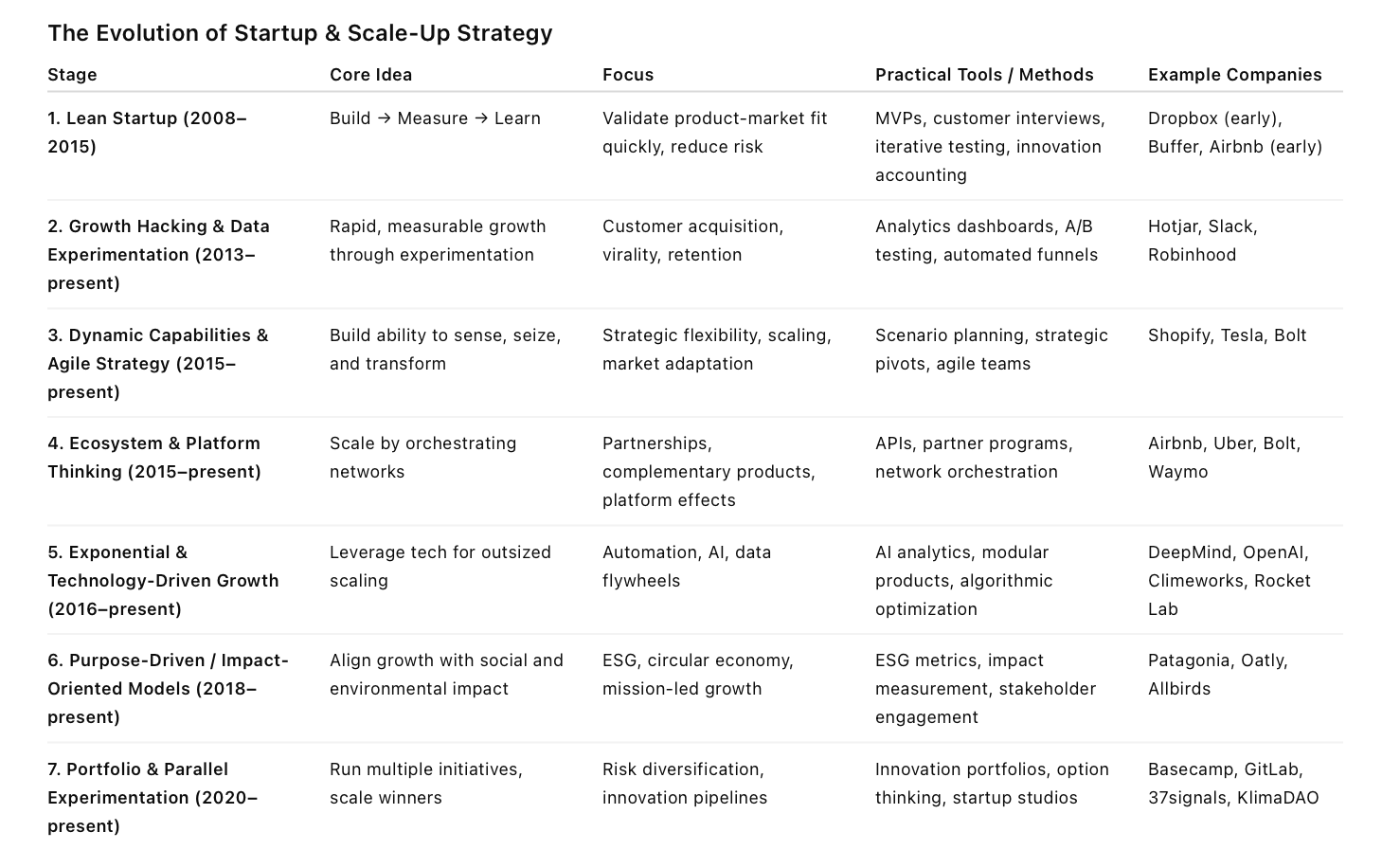
Start-ups like Aptera, Exowatt, Insilico Medicine, Perplexity AI, Underdog Fantasy, and Wander exemplify what is possible when ventures integrate strategic foresight, AI-driven discovery, ecosystems, hybrid business models, and community engagement.
Entrepreneurs and business leaders who embrace these models can accelerate growth, scale more sustainably, and create ventures capable of reshaping industries. Going beyond lean is not about abandoning experimentation; it is about thinking bigger, connecting broader, and innovating smarter — and doing so faster than competitors in a world where speed, insight, and adaptability define success.
The Next/Now Fast-Growth Toolkit
- Blitzscaling Playbook – Originating from Reid Hoffman, blitzscaling is about prioritising speed over efficiency in high-uncertainty markets. Use when your business has a defensible advantage and can scale network effects rapidly. Emphasises aggressive hiring, market capture, and risk tolerance. Best for capturing market share before competitors react, particularly in platform or networked businesses.
- AI-Driven Market Intelligence – Leverage AI and machine learning to analyse competitors, customer sentiment, trends, and emerging opportunities in real time. Use at product ideation, launch, or growth phases. Enables faster, more informed decisions than traditional research. Ideal for identifying market gaps, optimising campaigns, and personalising offerings at scale.
- Platform & Ecosystem Mapping – Maps not only partners but multi-sided networks, APIs, and platform leverage opportunities. Use before launching a marketplace, digital platform, or collaborative initiative. Highlights leverage points for growth, co-creation, and scaling impact. Helps start-ups identify which parts of the ecosystem to control, which to collaborate with, and how to capture value.
- Growth Loops and Flywheels – Instead of linear funnels, modern growth thinking focuses on self-reinforcing loops — product, virality, retention, and monetisation feed each other. Use when designing products or customer journeys to create sustainable, compounding growth. Enables start-ups to escape one-off growth hacks and build long-term momentum.
- Hybrid Business Model Canvas – Extends Lean Canvas by integrating subscriptions, platforms, services, and tokenised assets. Use when your business combines physical and digital, B2B and B2C, or multiple revenue streams. Encourages thinking about monetisation, ecosystem leverage, and network effects in one visual framework. Helps investors and teams understand complex models quickly.
- Strategic Options – Applies financial options logic to strategic decision-making: invest small, preserve optionality, scale when uncertainty resolves. Use in high-risk innovation or new market entry. Encourages experimentation without overcommitting capital. Particularly useful in AI, biotech, or frontier tech, where the upside is large but uncertain.
- Scenario Planning with AI – Classic scenario planning upgraded: combine simulation, AI forecasting, and stress-testing assumptions. Use for product launches, fundraising, or international expansion. Helps anticipate market shocks, regulatory shifts, or competitor moves. Encourages agile strategies that can pivot quickly in volatile or high-uncertainty environments.
- Network and Influence Analytics – Maps key investors, partners, customers, and influencers, using AI to understand relationship strength and strategic relevance. Use during fundraising, market entry, or ecosystem building. Modern tools integrate social graph analysis to accelerate introductions, partnerships, and adoption, replacing old-fashioned networking guesswork.
- Hybrid Metrics Dashboard (Growth, Impact, Resilience) – Combines traditional KPIs (revenue, churn, LTV) with systemic indicators: ecosystem influence, AI adoption, platform reach, resilience under stress. Use for board updates, investor discussions, and internal alignment. Encourages leaders to focus not just on growth, but on durable scale and strategic positioning.
- Corporate Venturing & Strategic Co-Innovation – Formalises collaboration with corporates, universities, or government labs to co-create products, access markets, and scale faster. Use when entering regulated or capital-intensive sectors. Enables start-ups to leverage expertise, distribution, and credibility without sacrificing agility. Complements internal innovation portfolios and traditional venture funding.
The Next/Now Fast-Growth Book List
- The Lean Startup – Eric Ries created this foundational guide to building businesses through validated learning and rapid experimentation. Ries champions Minimum Viable Products (MVPs), continuous testing and data-driven iteration to reduce risk and waste. Essential for early-stage founders, this methodology teaches how to pivot wisely, learn fast from customers, and build products that truly matter. Go beyond lean, but don’t forget the foundational principles of lean!
- Blitzscaling – Reid Hoffman explores the strategy of prioritising speed over efficiency to achieve market dominance. Hoffman draws on experiences at PayPal, LinkedIn, Airbnb and more to explain how winners scale fast under uncertainty. A must-read for founders seeking hypergrowth and competitive advantage in winner-take-most markets.
- The Startup Owner’s Manual – Steve Blank timeless step-by-step guide to building scalable businesses through Customer Development. Blank emphasises relentless customer discovery, rigorous hypothesis testing, and iterative learning before scaling. Practical, structured, and grounded in real start-up cases, this manual is a playbook for reducing risk and avoiding premature scaling.
- Competing in the Age of AI – Marco Iansiti and Karim Lakhani introduce a strategic manifesto on how artificial intelligence transforms business fundamentals. Iansiti and Lakhani show how AI reshapes value creation, operational models, competition, and strategy. Start-ups can use these frameworks to build AI-centric competitive moats and rethink core business design for the digital economy.
- The Mom Test – Rob Fitzpatrick offers a practical handbook for talking to customers without bias. Fitzpatrick explains how to ask questions that reveal true needs, avoid flattering but useless feedback, and validate business assumptions early. A vital companion for founders doing customer discovery, avoiding optimistic lies, and building real market insight.
- Exponential Organizations – Salim Ismail explains how modern businesses leverage technology, platforms, and networks to achieve rapid scaling. Ismail guides leaders on designing flexible, agile organisations capable of exponential growth. The book highlights organisational structures, culture, and ecosystem strategies that enable businesses to outpace competitors and capitalise on network effects.
- The Hard Thing About Hard Things – Ben Horowitz writes candidly about the brutal challenges of leadership during growth and crisis. From firing co-founders to navigating market downturns, this book offers practical wisdom, mental models, and emotional honesty. Essential for founders who want realistic guidance on handling adversity and scaling organisational culture.
- Accelerating Innovation – Phil Budden and Fiona Murray focus on ecosystem engagement as a driver of innovation. Budden and Murray show how start-ups interact with universities, corporates, investors, and governments to co-create technology and markets. Strategic frameworks help leaders orchestrate ecosystems, accelerate adoption, and turn networks into competitive advantage.
- Breakneck: The Speed of Markets and the Future of Strategy – Dan Wang examines how falling transaction costs are collapsing strategic time horizons. Wang explains why start-ups must rethink timing, sensing, response, and strategic rhythm in hyper-competitive markets. Breakneck is a forward-looking strategy book that helps founders design agile systems, anticipate competitor moves, and win in fast-shifting landscapes.
- Shoe Dog – Phil Knight wrote a great autobiography, an honest entrepreneurial memoir by Nike’s co-founder. Knight shares early struggles, moments of doubt, team challenges, and brutal financial realities. Unlike prescriptive business books, Shoe Dog offers emotional and strategic perspective on persistence, resilience, and the human journey behind building an iconic global brand.
The Next/Now Fast-Growth Online Resources
- Crunchbase – Comprehensive database of start-ups, funding rounds, investors, and market trends. Entrepreneurs and investors use it to track emerging companies, evaluate competitors, and identify partnership or investment opportunities. Real-time data on valuations, acquisitions, and growth signals makes it an essential tool for strategic decision-making and market intelligence.
- CB Insights – Provides research, analytics, and insights on technology trends, market disruption, and corporate innovation. Used to monitor emerging sectors, identify investment opportunities, and assess competitors. Its data-driven reports help entrepreneurs and executives make informed strategic decisions, anticipate disruption, and discover high-potential start-ups globally.
- AngelList – Platform connecting start-ups with investors, talent, and co-founders. Enables founders to raise capital, hire remotely, and showcase products to a global audience. Offers syndicates and investment networks, simplifying early-stage fundraising while providing a community of like-minded founders and investors to accelerate growth and credibility.
- Y Combinator Library – Resource hub featuring founder talks, guides, and practical start-up advice. Covers topics from fundraising and growth strategy to product development and team building. Offers actionable insights drawn from hundreds of YC-backed ventures, making it invaluable for entrepreneurs seeking to learn from experienced founders and proven playbooks.
- Harvard Business Review – Offers articles, case studies, and research on strategy, leadership, innovation, and organisational transformation. Combines academic rigour with practical insights, helping executives and entrepreneurs understand emerging trends, apply best practices, and make informed decisions to scale businesses and stay ahead in competitive markets.
- MIT Sloan Management Review – Research-driven publication focused on innovation, digital transformation, AI, and business strategy. Provides in-depth analysis, case studies, and emerging practices from global companies. Helps leaders anticipate market changes, adopt new technologies, and implement evidence-based strategies for growth and organisational effectiveness.
- TechCrunch – News and analysis covering start-ups, venture funding, technology trends, and disruptive innovation. Essential for tracking market developments, competitor activity, and emerging opportunities. Offers deep insights into investment rounds, product launches, and industry shifts, enabling entrepreneurs and investors to stay informed and react quickly.
- Product Hunt – Platform showcasing new products, software, and services. Offers early signals of market trends, consumer interest, and innovation. Entrepreneurs can launch products, gather feedback, and build early communities, while users discover emerging solutions and evaluate potential investments or partnerships in real time.
- Dealroom – Data and intelligence platform on start-ups, scale-ups, and venture activity globally. Offers insight into funding rounds, valuations, growth metrics, and market dynamics. Entrepreneurs and investors use it for strategic benchmarking, spotting high-potential ventures, and understanding emerging sectors or opportunities for partnerships and expansion.
- Indie Hackers / Medium Startups – Online communities where founders share stories, lessons, and practical advice. Offers peer support, tips on bootstrapping, growth hacks, product development, and monetisation. Enables entrepreneurs to learn from real-world experiences, access resources, and connect with others navigating the challenges of scaling fast in competitive markets.
The Next/Now Fast-Growth Role Models
- Aptera Motors – Developing ultra-efficient, solar-powered three-wheeled vehicles. Combines radical design, renewable energy integration, and aerodynamic efficiency. Demonstrates how visionary product design, early community engagement, and sustainable technology can challenge automotive norms while addressing energy and environmental concerns globally.
- Exowatt – Modular thermal energy storage for AI data centres and industrial applications. Provides reliable, renewable energy on-demand, addressing the growing need for sustainable infrastructure. Combines hardware, software optimisation, and flexible deployment, enabling scalability across regions while reducing environmental impact.
- Insilico Medicine – AI-driven platform accelerating drug discovery. Uses machine learning to identify molecules, predict outcomes, and reduce development costs and timelines. Combines internal expertise with external partnerships, demonstrating how AI can transform R&D, shorten innovation cycles, and improve success rates in pharmaceuticals.
- Perplexity AI – Conversational AI platform transforming search and knowledge discovery. Provides contextual, real-time answers to complex queries. Combines natural language understanding with user-friendly interfaces, offering enterprises and consumers faster, more accurate access to information, and redefining how people interact with data and AI.
- Underdog Fantasy – Skill-based, community-focused sports gaming platform. Reinvents engagement by making games accessible, social, and participatory. Its community-driven model creates viral adoption loops, loyalty, and differentiated user experiences, demonstrating the power of combining product innovation with network effects for fast growth.
- Wander – Personalised travel platform integrating planning, local experiences, and bookings. Uses AI to tailor journeys while orchestrating an ecosystem of partners and services. Delivers seamless, end-to-end travel experiences, showing how ecosystems and personalisation can differentiate offerings and create scalable, customer-centric platforms.
- Bolt – Mobility platform offering ride-hailing, scooters, and delivery services. Competes with incumbents by providing affordable, convenient, and eco-friendly transport options globally. Combines technology, local partnerships, and rapid scaling to redefine urban mobility and expand across multiple geographies efficiently.
- Climeworks – Developer of direct air capture technology for carbon removal. Focuses on climate impact by extracting CO₂ and enabling carbon-neutral solutions. Combines innovation, policy engagement, and partnerships, illustrating how mission-driven ventures can scale globally while addressing systemic environmental challenges.
- Notion – Modular productivity platform enabling individuals and teams to organise, collaborate, and innovate. Its ecosystem approach encourages community templates, integrations, and developer extensions. Demonstrates how flexible platforms and collaborative ecosystems can drive adoption, engagement, and networked value creation.
- Shopify – Commerce platform enabling SMEs to launch, scale, and manage online businesses. Offers an ecosystem of apps, payments, and services, empowering entrepreneurs globally. Its combination of ease-of-use, ecosystem leverage, and international scalability shows how platforms can democratise commerce and support fast-growth businesses.
The Next/Now Fast-Growth Inspiring Articles
- Eyes on Tomorrow: What Leaders Must See before Everyone Else … exploring the most important megatrends that are transforming markets, and leadership mindsets, and how the best companies embrace them as opportunities … based on the new Megatrends 2035 report by Peter Fisk, and its implications for every business.
- Consumer of the Future … “Aisha blinked twice, the smart lenses in her eyes had already scanned her biometric mood, cross-checked her carbon budget, and pulled up items her climate-positive friends were buying this week” … what are the new emerging trends reshaping markets, and how companies engage customers?
- The Reinvention Playbook: Thriving in a World of Relentless Change … the best organisations seek to continually reinvent themselves in a world of constant, uncertain and dynamic change. They rethink, refocus, and reinvent everything – embracing new agendas from AI to GenZ, climate change and social inequality.
- The Nexus Effect: Unlocking the Power of Connections … How can businesses and brands really unlock the power of data and networks, flywheels and AI, communities and ecosystems, to transform their futures? Network effects have long been the holy grail of digital businesses, but remain largely unexpoloited.
- The New Growth Playbook: 9 New Ways to Accelerate Growth … many companies struggle to find new ways to grow their business … instead we look at how the best companies find radically new ways to grow. Growth comes in many different forms, with new opportunities to grow in non-linear ways.
- Super Innovators: Innovation Beyond the Normal … Innovation has long been the lifeblood of growth businesses, but has become increasingly predictable. 10 radical ways to disrupt conventions, embrace deeper insights, unlock valuable assets, and stretch innovation for more dramatic impact.
- Business Transformation: The new superpower of business leaders … reimagining the future, redefining strategy, reinventing the organisation, rewiring performance … transformation is the journey to deliver step change in value creation … reinvention is continuous in a world of relentless change.
- The Sustainable Consumer: Go on, do the Right Thing … how brands can accelerate the consumer shift to sustainable products and practices … from food and fashion, to energy and electric cars, making sustainability desirable and better … its more than just being green.
- The Hire-Wire Act of Leadership: Leading in a world of intense competition and relentless change … being visionary and innovative, learning to adapt and endure … inspired by Taylor Swift, Roger Federer, Beyoncé, and Lionel Messi … how entrepreneurs and corporate bosses can be better leaders.
- Becoming a Future-Ready Business … in a world of relentless change, organisations need to anticipate change, embrace innovation, empower talent, and align deeply with the evolving needs of society and the planet … to deliver profitable growth and more impact, or even better, a multiplying effect of both together.
Each month The Brand Doctor, aka business expert Peter Fisk, takes a global brand that has lost its way, and considers how it could reinvent itself. If it’s your brand, do you have the courage to change? If not, what would you do, and how could you apply these ideas for reinvention to your own business?
Tetra Pak is so embedded in our everyday lives, it’s easy not to notice the Swedish brand.
Its products pass through the hands of hundreds of millions of people each day … poured into coffee, packed into school bags, stacked in cupboards … yet the company itself remains largely unknown outside industry circles. It does not advertise, it does not cultivate a consumer brand, and it has long preferred the quiet advantages of private ownership to the scrutiny of public markets.
And yet, for all its invisibility, Tetra Pak sits at the heart of one of the most important systems in the modern world: the global distribution of food.
That position, hard won over decades, now presents a subtle but profound challenge. For the world that Tetra Pak helped to build is changing, and the category it once defined—packaging—is no longer sufficient as a strategic destination. The future of the company, if it is to remain as consequential as its past, will almost certainly lie beyond packaging itself.
Imagining the possible futures of Tetra Pak
To understand why, it is worth beginning not with history, but with the present trajectory of the global food system. Three forces, in particular, are reshaping the terrain.
The first is environmental constraint. Packaging, once celebrated for its efficiency and convenience, is now subject to intense scrutiny. Multi-layer cartons, ingenious though they are, pose challenges for recycling. Regulators are tightening requirements, consumers are becoming more discerning, and the notion of a circular economy—once aspirational—is fast becoming an operational necessity.
The second is digital transformation. Manufacturing is no longer simply a matter of machines and materials; it is increasingly a question of data. Production lines are being instrumented, supply chains mapped in real time, and efficiency gains extracted not just from engineering, but from information. In such a world, value migrates toward those who control the system, not merely the component.
The third is geopolitical. Food security, once the domain of development agencies and agricultural ministries, has become a strategic concern for governments. Climate volatility, population growth, and supply chain fragility have elevated the question of how food is produced, preserved, and distributed into one of global significance.
Taken together, these forces expand the problem space. The question is no longer how to package food effectively, but how to deliver nutrition sustainably, reliably, and at scale. Packaging remains part of that answer, but it is no longer the whole of it.
For a company like Tetra Pak, this shift is both an opportunity and a risk. It is uniquely positioned to play a central role in the next phase of the food system, but only if it is willing to redefine itself.
What if Tetra Pak was more than a packaging company?
The most compelling version of Tetra Pak in the decades ahead is not simply a more sustainable packaging company. It is something broader and more ambitious: a provider of food system infrastructure.
In practical terms, this would mean extending its reach along several dimensions. Materials would still matter, but the emphasis would shift toward circularity—designing cartons that are not only efficient, but fully recyclable at scale, even in markets with limited waste infrastructure. The company has already begun investing in paper-based barrier technologies that reduce reliance on aluminium; the strategic question is whether it can go further, and faster, to define the standard rather than respond to it.
At the same time, the vast installed base of Tetra Pak equipment—thousands of machines embedded in factories around the world—offers a platform for digital transformation. Each of these machines generates data; collectively, they represent a global network of production. With the right capabilities, this network could be turned into a digital layer that optimises performance, predicts maintenance, and provides end-to-end visibility across the value chain. In effect, Tetra Pak could become not just the physical infrastructure of liquid food production, but its operating system.
There is also a more outward-facing dimension. For much of its history, the company has thrived in anonymity. That discretion has been a strength, allowing it to focus on customers rather than consumers. But as sustainability and transparency become central concerns, invisibility may become a limitation. There is a case for Tetra Pak to step, at least partially, into the light—to signal its role in enabling safer, more sustainable food systems, and to shape the regulatory and public conversations that will define its future.
None of this requires abandoning the core business. On the contrary, it requires extending its logic. For Tetra Pak was never, at heart, just a packaging company.
Origins
To see this more clearly, one must return to its origins. The story begins with Ruben Rausing, whose formative insight came during a period of study at Columbia University. Observing the rise of self-service grocery stores in the United States, Rausing grasped something that was not yet obvious in Europe: that the way food was sold was changing fundamentally.
In the traditional model, goods were dispensed by a clerk, measured out from bulk containers. Packaging was incidental. In the emerging self-service model, the package became central. It had to protect the product, convey information, and enable efficient handling, all while being produced at scale and at low cost.
Rausing saw that this shift would create an enormous demand for new kinds of packaging, and more importantly, for the systems that made such packaging possible. His ambition was not merely to design a better container, but to reimagine how food could be prepared for a new kind of retail environment.
The breakthrough came with the work of Erik Wallenberg, who conceived of a tetrahedral package formed from a continuous tube of paper. It was an elegant solution—stable, material-efficient, and well suited to automation. But as with so many elegant ideas, the simplicity of the concept belied the complexity of its execution.
To make the tetrahedron viable, Tetra Pak had to invent not just a shape, but an entire production process. Machines had to be designed to form, fill, and seal the packages continuously. Materials had to be developed that were strong, flexible, and capable of protecting perishable contents. Hygiene had to be ensured at every stage. It was a systems problem in the fullest sense, and it took years of experimentation, failure, and persistence to solve.
That pattern, of tackling interconnected challenges rather than isolated ones, would define the company’s trajectory.
Transformation
The next great leap came with aseptic technology, which allowed liquids to be sterilised and packaged in a way that extended shelf life dramatically. By combining ultra-high temperature treatment with sterile packaging environments and multi-layer materials, Tetra Pak made it possible for milk and other products to be stored for months without refrigeration.
The implications were profound. Entire regions of the world that lacked reliable cold chains could now be served. Distribution costs fell, food waste was reduced, and new markets opened up. In countries such as India, aseptic packaging played a role in large-scale dairy development programmes, helping to connect rural producers with urban consumers.
At this point, Tetra Pak had moved beyond packaging as such. It had become an enabler of food systems—providing the means by which nutrition could be processed, preserved, and delivered across vast distances.
The acquisition of Alfa Laval in the early 1990s reinforced this position. By integrating processing equipment with packaging and service, the company could offer end-to-end solutions to its customers. A dairy no longer needed to assemble its production line from multiple suppliers; it could rely on a single partner.
This model proved extraordinarily powerful. It created deep customer relationships, high switching costs, and a steady stream of recurring revenue. It also entrenched Tetra Pak at the centre of the industry.
The limits of packaging
Success, however, brings its own constraints. The very system that made Tetra Pak dominant now shapes how it sees itself. Internally, it remains organised around packaging, processing, and services. Externally, it is still widely perceived as a packaging company.
This matters because categories influence strategy. If one defines the problem narrowly, one risks missing the broader shifts that are taking place.
Today, those shifts are unmistakable. Environmental pressures are forcing a reconsideration of materials. Digital technologies are redefining industrial value chains. New forms of food production—from plant-based alternatives to fermentation—are emerging. And the global imperative to provide safe, affordable nutrition is becoming more urgent.
In this context, packaging is necessary, but not sufficient. The centre of gravity is moving outward, toward systems that integrate production, distribution, sustainability, and data.
Reinventing the food system
The task for Tetra Pak, then, is not to abandon its heritage, but to reinterpret it.
First, it must redefine its mission. The language of packaging, while accurate, is too narrow to capture the role the company can play. A framing centred on enabling safe and sustainable food systems would better reflect both its capabilities and its opportunities.
Second, it must invest with conviction. One of the advantages of private ownership is the ability to take a long-term view. This should be deployed aggressively in areas such as advanced materials, digital platforms, and new processing technologies. These investments may not yield immediate returns, but they are essential for maintaining relevance.
Third, it must integrate more deeply across its own operations. The boundaries between processing, packaging, and services are artefacts of history; the future lies in their convergence. Customers will increasingly value solutions that are seamless, data-driven, and adaptable.
Finally, it must engage more actively with the outside world. The challenges of sustainability and food security cannot be solved by any single company. They require collaboration with governments, NGOs, and industry partners. Tetra Pak has both the scale and the expertise to play a leading role in these ecosystems.
Reinvention is not new
There is a certain symmetry in all of this. In the 1940s and 1950s, Tetra Pak faced a problem that seemed, at the time, almost impossibly complex: how to package milk in a way that was cheap, hygienic, and scalable. The solution required new materials, new machines, and a new way of thinking about production.
Today, the problem is larger, but the pattern is the same. How does one build a food system that is sustainable, resilient, and capable of serving a growing global population? Once again, it is a systems challenge, and once again, it demands a willingness to look beyond existing categories.
The company’s history suggests that it is capable of doing so. It has, after all, done it before.
In the end, the future of Tetra Pak will not be decided by incremental improvements to the carton, important though those may be. It will be shaped by whether the company can once again see the larger system in which it operates—and choose to act upon that insight.
For decades, it has been the quiet enabler of how food moves through the world. The opportunity now is to become something more visible, and more ambitious: a shaper of the systems that will define how food is produced, preserved, and delivered in the years to come.
That would be a reinvention worthy of its origins.
More on brands
Peter Fisk is a leading authority on business and brand strategy, creating more innovative strategies, business models and experiences for the world’s best brands. His 35 years of experience spans Adidas to Amazon, Bosch, Campari to Cartier to DSM, having started as a brand manager of supersonic travel, with Concorde, and today working around the world supporting business leaders.
- The Brand Doctor: Aperol Spritz
- The Brand Doctor: Ecco
- The Brand Doctor: Gucci
- The Brand Doctor: Philip Morris
and
- What’s new and next in branding?
- What’s new and next in marketing?
- What’s new and next in innovation?
and more
- Eyes on Tomorrow: What Leaders Must See before Everyone Else … exploring the most important megatrends that are transforming markets, and leadership mindsets, and how the best companies embrace them as opportunities … based on the new Megatrends 2035 report by Peter Fisk, and its implications for every business.
- The Reinvention Playbook: Thriving in a World of Relentless Change … the best organisations seek to continually reinvent themselves in a world of constant, uncertain and dynamic change. They rethink, refocus, and reinvent everything – embracing new agendas from AI to GenZ, climate change and social inequality.
- The Nexus Effect: Unlocking the Power of Connections … How can businesses and brands really unlock the power of data and networks, flywheels and AI, communities and ecosystems, to transform their futures?
- The New Growth Playbook: 9 New Ways to Accelerate Growth … many companies struggle to find new ways to grow their business … instead we look at how the best companies find radically new ways to grow.
- Super Innovators: Innovation Beyond the Normal … 10 radical ways to disrupt conventions, embrace deeper insights, unlock valuable assets, and stretch innovation for more dramatic impact.
- Consumer of the Future … “Aisha blinked twice, the smart lenses in her eyes had already scanned her biometric mood, cross-checked her carbon budget, and pulled up items her climate-positive friends were buying this week”
- Competing in the FLUX: How to develop a dynamic strategies in a world of relentless change … combining a strong, enduring direction with micro-moves that adapt quickly to emerging shifts:
- Business Transformation: The new superpower of business leaders … reimagining the future, redefining strategy, reinventing the organisation, rewiring performance … the journey to deliver step change in value creation.
- The Sustainable Consumer: Go on, do the Right Thing … how brands can accelerate the consumer shift to sustainable products and practices … from food and fashion, to energy and electric cars, making sustainability desirable and better.
- The “Performer Transformer” Leaders: How great leaders deliver today and create tomorrow … with dual thinking, to build dynamic ambidexterity, continually strategyzing, to perform and transform.
- The Hire-Wire Act of Leadership: Leading in a world of intense competition and relentless change … being visionary and innovative, learning to adapt and endure … inspired by Taylor Swift, Roger Federer, Beyoncé, and Lionel Messi
- Becoming a Future-Ready Business … in a world of relentless change, organisations need to anticipate change, embrace innovation, empower talent, and align deeply with the evolving needs of society and the planet
AI is advancing at a breathtaking pace. Models are growing larger, systems more autonomous, and intelligence more deeply embedded into everything from healthcare and finance to logistics, defence and climate science.
Yet beneath the excitement lies a hard constraint that will shape the next era of innovation: processing power requires energy, and energy has limits on Earth.
AI systems depend on vast amounts of processing power. That power consumes electricity, generates heat, requires cooling, and increasingly competes with cities, industries and households for finite resources. As AI scales, so do carbon emissions, water usage and infrastructure strain. The uncomfortable truth is that today’s trajectory is environmentally, economically and politically unsustainable.
This is why a growing number of technologists, scientists and companies are looking upward. Not out of science fiction fantasy—but out of necessity. Space is emerging as the next logical home for energy-intensive intelligence and industry.
This week’s move by SpaceX to align satellite networks, AI and communications platforms are best understood in this context. Regardless of what you think of Musk, Grok or X, this is an early signal of a broader shift: the future of data processing, energy and advanced industry may be extra-terrestrial. Yes it will enhance the potential value of SpaceX’s IPO, but that’s because it symbolises a more fundamental shift in tech, and the exponential opportunities of space.
Or, to borrow from the movie … ET isn’t phoning home anymore. ET is building infrastructure.

AI’s energy challenge
AI is no longer constrained by imagination. It is constrained by physics.
Training and operating advanced AI systems requires specialised chips running continuously at extraordinary intensity. At global scale, this translates into:
- Data centres consuming gigawatts of electricity
- Cooling systems drawing heavily on water resources
- Rising carbon emissions despite efficiency gains
- Local resistance to new infrastructure projects
In some regions, AI facilities are already being delayed or blocked because power grids simply cannot cope.
This creates a structural tension. AI is promoted as a tool to optimise energy use, reduce waste and fight climate change—yet its own growth threatens to overwhelm the very systems it aims to improve.
If intelligence is to keep scaling, it needs abundant, clean, reliable energy—at a scale Earth increasingly struggles to provide.
Space offers limitless energy
Space offers something Earth cannot: near-limitless solar energy without competition.
Above the atmosphere, solar power is constant, uninterrupted by night, weather or seasons. Cooling is dramatically easier. There is no land scarcity, no local opposition, and no water stress. From an engineering perspective, space is uniquely well suited to hosting energy-hungry systems.
That logic applies not just to AI, but to a growing range of industries already experimenting beyond Earth.
What we are witnessing is not a single breakthrough, but the early formation of a space-based industrial ecosystem.
AI and processing power in orbit
The SpaceX–Starlink–AI alignment is one of the clearest examples of this shift.
Starlink already operates a global satellite network powered by solar energy. Adding intelligence and processing power into that network transforms satellites from passive relays into active, intelligent nodes – capable of analysing data, optimising traffic, and delivering real-time services without routing everything back to Earth.
This model points toward a future where:
- Processing power moves closer to where data is generated
- Networks become intelligent systems, not just pipes
- Energy generation and data processing are tightly integrated
- Carbon intensity per unit of intelligence falls dramatically
Even if the specifics change, the strategic insight remains: Earth-bound data centres are not the end state for AI.

Asteroid Mining
AI and data processing are only part of the story.
Companies like Planetary Resources pioneered serious efforts to explore asteroid mining—not as science fiction, but as a response to resource scarcity on Earth.
Asteroids contain extraordinary concentrations of rare metals, including platinum-group elements essential for electronics, energy systems and advanced manufacturing. In the long run, extracting materials in space—rather than digging deeper holes on Earth—could reduce environmental damage while unlocking new economic models.
While early asteroid-mining ventures struggled financially, their core premise has not disappeared. It has simply matured. Today, governments and private companies increasingly view space resources as:
- Strategic assets
- Inputs into clean energy technologies
- Enablers of off-planet manufacturing
As processing power, robotics and AI improve, the feasibility of autonomous space mining rises sharply.
Life Sciences
Another surprising frontier is healthcare.
The International Space Station has already hosted experiments in:
- Protein crystallisation for drug development
- Tissue engineering and regenerative medicine
- Cancer research and cell behaviour
- Bone density and muscle degeneration
Microgravity environments allow biological processes that are impossible on Earth. Crystals grow more perfectly. Cells behave differently. Certain diseases can be studied in accelerated or clearer ways.
As AI-driven analysis and processing power expand, space-based biomedical research could become dramatically more valuable—especially for personalised medicine, advanced therapies and longevity science.
In this context, space is not an escape from Earth’s problems, but a laboratory for solving them.
Climate Intelligence
Ironically, space may become essential to saving Earth.
Satellites already play a critical role in monitoring climate systems, deforestation, ice melt, ocean health and atmospheric changes. Adding more intelligence and processing power in orbit allows data to be analysed in real time, enabling faster response and better forecasting.
This matters because climate systems generate enormous data volumes. Processing that data on Earth adds energy costs and delays. Processing it in space—powered by solar energy—reduces both.
Here again, intelligence moves closer to the source, improving efficiency while lowering emissions.

Space Ecosystems
Taken together, these developments point to a profound shift.
For decades, technological progress assumed Earth as the sole stage. Now, the planet’s limits—energy, carbon, land, water—are forcing a rethink.
The emerging model looks different:
- Energy generation in space
- Processing power in orbit
- Intelligence distributed across planetary systems
- Networks spanning Earth and beyond
This is not about abandoning Earth. It is about supporting Earth from above.
SpaceX, Starlink and X
SpaceX’s integration of launch capability, satellite networks and AI is not unique—but it is visible.
It shows what happens when declining launch costs meet rising energy demands and accelerating intelligence. Others will follow, in different forms, with different governance models and values.
Whether one admires or dislikes Musk is almost beside the point. History rarely waits for consensus or comfort. It moves when constraints collide with ambition.
This move is not a conclusion. It is an early example of what’s to come.
ET is extending possibilities
The future of intelligence will not be confined to Earth.
As AI, data processing and advanced industry continue to scale, space offers a release valve for energy constraints, environmental impact and economic growth. From processing power and communications to mining, medicine and climate intelligence, the next industrial frontier is forming above our heads.
ET isn’t phoning home anymore. ET is generating power. ET is processing data. ET is building networks. And increasingly, ET is helping us to embrace new industries in better ways, and explore new possibilities.
© Peter Fisk 2026

Here are my top 10 most interesting space businesses right now, from rocket and satellite companies, to those using space to develop new breakthroughs that enhance life on earth:
1. SpaceX
- Origins: Founded in 2002 by Elon Musk to reduce space costs and enable Mars colonisation; now includes Starlink broadband and AI/communications assets through acquisition of xAI/X.
- Purpose: Launch reusable rockets, deploy Starship for interplanetary travel, operate Starlink global broadband, and develop space-based AI and computing.
- Progress: Dominates commercial satellite launches and crewed missions to the ISS; Starlink has thousands of satellites and millions of users; pre-IPO valuation of $1.25 billion reflects its scale and ambitions.
2. RTX/Raytheon
- Origins: Created in 2020 from the merger of Raytheon Company and United Technologies aerospace divisions.
- Purpose: Aerospace and defense leader providing satellite communications, sensors, radar, tracking, and ground control systems for civilian and military space applications.
- Progress: Longstanding contractor for U.S. government space programs; a cornerstone in satellite infrastructure, defense tracking, and advanced space systems. Market cap of around $230 billion.
3. Rocket Lab
- Origins: Founded in 2006 by Peter Beck in New Zealand; now publicly traded in the U.S.
- Purpose: Small satellite launch provider via Electron rockets, spacecraft manufacturing via Photon, and medium-lift Neutron launch development.
- Progress: 75+ successful Electron launches; strong backlog of missions; establishing itself as a major player in small and medium satellite delivery. Market cap around $12 billion.
4. AST SpaceMobile
- Origins: Founded in 2017 by Abel Avellan; went public via SPAC.
- Purpose: Build the first space-based cellular broadband network connecting standard smartphones directly to LEO satellites.
- Progress: Launched BlueBird satellites; signed partnerships with Verizon, Vodafone, and other carriers; raising over $2 billion in funding. Market cap around $8 billion.
5. OneWeb
- Origins: Founded in 2012, emerged from bankruptcy with ownership by the UK government and Bharti Global, later merged with Eutelsat.
- Purpose: Deploy a LEO broadband satellite constellation to provide global internet connectivity for enterprise, government, and underserved regions.
- Progress: Hundreds of satellites launched; providing low-latency broadband primarily for governments and business partners rather than direct-to-consumer. Estimated value of $5 billion.
6. Intuitive Machines
- Origins: Founded in 2013 by Stephen Altemus, Kam Ghaffarian, and Tim Crain; went public via SPAC in 2023. Read their investor presentation.
- Purpose: Lunar delivery services, cislunar communications, and NASA’s Commercial Lunar Payload Services program.
- Progress: Successfully flown lunar landers, secured multiple NASA contracts; expanding lunar and orbital services. Estimated value of $3 billion.
7. Varda Space Industries
- Origins: Founded in 2021 by Will Bruey and Delian Asparouhov; backed by Founders Fund and Khosla Ventures.
- Purpose: Space-based manufacturing of pharmaceuticals and advanced materials in microgravity for products impossible to make on Earth.
- Progress: Completed multiple funding rounds; collaborative in-orbit manufacturing tests with Rocket Lab; positioning itself as a pioneer in space biotech and materials. Estimated value of $1.5 billion.
8. Relativity Space
- Origins: Founded in 2015 by Tim Ellis and Jordan Noone to leverage 3D printing for rocket construction.
- Purpose: Produce fully 3D-printed rockets (Terran series) to simplify manufacturing, enable rapid reconfiguration, and build reusable heavy-lift launchers.
- Progress: Raised $1.3 billion; first flights of Terran R planned by 2026; unique approach focused on automation and additive manufacturing. Estimated value of $5 billion.
9. Firefly Aerospace
- Origins: Re-formed in 2017 after EOS Launcher acquired Firefly Space Systems assets; backed by AE Industrial Partners.
- Purpose: Small/medium satellite launches (Alpha), lunar lander technology (Blue Ghost), and developing orbital tugs.
- Progress: Successful Alpha launches; NASA CLPS lunar contracts totalling ~$176 million; expanding lunar delivery capabilities. Estimated value of $1.5 billion.
10. Yuri
- Origins: Founded by former SpaceX and space biotech entrepreneurs; privately held.
- Purpose: Space-based biotech research platform for pharmaceuticals, advanced materials, and biological experiments in microgravity.
- Progress: Completed multiple ISS missions; partnerships with NASA and pharmaceutical firms including GSK; emerging as a key player in orbit-based biotech innovation.
There is a moment, in almost every industry, when the leaders realise that incremental change will no longer suffice. That the old model of doing business, however successful, is quietly, inexorably, becoming irrelevant.
For banks, that moment arrived in the aftermath of the global financial crisis. Trust was eroded, technology was accelerating, and customers—conditioned by the seamlessness of digital platforms—began to expect something very different from financial services.
Most banks responded cautiously. They digitised channels, upgraded apps, and trimmed costs. A few went further.
DBS did something else entirely.
Under the leadership of Piyush Gupta, the Singaporean lender embarked on one of the most ambitious transformations in modern banking—not merely to become digital, but to become invisible. It is a phrase that sounds paradoxical for a business built on trust and brand. Yet it captures a profound strategic shift: from being a destination for financial products to becoming an embedded, often unseen, enabler of life itself.
Now, as leadership transitions to Tan Su Shan (widely seen as the natural successor), the question is no longer whether DBS has transformed. It is whether it can sustain—and extend—that transformation into a world where the boundaries of banking are dissolving altogether.
From bureaucracy to “Pixyish” Energy
When Gupta took the helm in 2009, DBS was a competent but conventional institution. Strong in its home market, respected regionally, but hardly distinctive. Internally, it carried the hallmarks of legacy banking: hierarchy, caution, and a certain inertia.
Gupta’s genius was not simply strategic. It was cultural.
He introduced what insiders often describe, only half-jokingly, as a pixyish energy. A willingness to challenge orthodoxy, to experiment, to reframe problems. This was not Silicon Valley cosplay. It was something more deliberate: the systematic dismantling of bureaucratic habits.
One of his earliest moves was to redefine the bank’s purpose. Not in abstract terms, but in operational ones: “We want to make banking invisible.”
That idea became a north star. It forced uncomfortable questions. If banking were truly invisible, what would remain? What would DBS actually do? And where, in a customer’s life, would it matter?
The Customer, Reimagined
Traditional banking begins with products: mortgages, loans, credit cards, deposits. Customers are segmented, targeted, and sold to.
DBS inverted the logic.
It began with life journeys.
Buying a home. Starting a business. Managing wealth. Travelling, spending, saving. These are not financial categories; they are human experiences. Money flows through them, but it is not the point of them.
By organising around these journeys, DBS shifted from:
- selling products → solving moments
- transactions → outcomes
- accounts → experiences
A mortgage, for example, became just one element of a broader property journey—alongside search, valuation, affordability, and advisory. For small businesses, financing became embedded within cash flow tools, invoicing systems, and operational platforms.
The bank was no longer a destination. It was becoming part of the fabric of the journey itself.
The Technology Rewrite
This shift would have been impossible without a fundamental reinvention of technology.
Rather than layering digital interfaces onto legacy systems, DBS rebuilt its architecture:
- migrating aggressively to the cloud
- adopting API-first design
- embedding artificial intelligence across processes
- restructuring teams into agile squads
Gupta famously described DBS as a “27,000-person start-up”. The phrase is overused, but in this case it was more than rhetoric. It signalled a reorientation of the organisation around speed, experimentation, and iteration.
Crucially, technology was not treated as a support function. It became the core of the business model.
This mattered for two reasons.
First, it enabled scale. DBS could deploy innovations rapidly across markets and segments.
Second, it unlocked data. And in modern banking, data is arguably more valuable than capital.
Data: The new balance sheet
Banks have always been data-rich. What they lacked was the ability to use that data intelligently.
DBS changed that.
By integrating transaction data, behavioural signals, and external inputs, and applying advanced analytics, the bank moved towards predictive finance:
- anticipating customer needs
- pre-approving credit
- offering personalised insights
- optimising risk in real time
The implications are profound. Banking shifts from reactive to proactive. From responding to requests to shaping decisions.
In effect, DBS began to build a new kind of balance sheet—one composed not just of financial assets, but of data and algorithms.
Embedded, then Invisible
As DBS deepened its integration into customer journeys, it naturally evolved into embedded banking.
Its services appeared within:
- property platforms
- e-commerce ecosystems
- SME operating tools
- payment environments
In these contexts, the bank was present but not dominant. Its brand receded. Its functionality mattered more than its visibility.
The next step was logical: invisible banking.
This is not simply about embedding services. It is about removing friction altogether.
- No forms to fill
- No applications to submit
- No conscious “banking moments”
Credit is extended when needed. Payments happen seamlessly. Savings and investments adjust automatically.
The customer experiences outcomes, not processes.
The Strategic Paradox
For a bank, invisibility is both an opportunity and a risk.
On one hand, it enables scale. DBS can operate across multiple ecosystems, reaching customers far beyond its traditional footprint.
On the other, it raises a question: if the bank is invisible, does its brand still matter?
DBS has navigated this tension with nuance.
In high-trust contexts—wealth management, complex financial decisions—the brand remains prominent. In transactional or embedded contexts, it recedes.
This flexibility may prove to be one of its most important strategic capabilities.
Financial impact
Transformation stories are often rich in narrative but thin on numbers. DBS is unusual in that its strategic reinvention has been matched by tangible financial performance.
Over the past decade, the bank has:
- significantly increased profitability
- improved cost-to-income ratios
- expanded its regional footprint
- strengthened return on equity
Most strikingly, its market capitalisation has risen dramatically, positioning it among the most valuable banks in Asia.
This is not a coincidence.
The market has rewarded DBS not simply for efficiency gains, but for strategic clarity. Investors recognise that the bank is not just optimising the old model; it is positioning itself for the next one.
In a sector often seen as commoditised, DBS has achieved something rare: differentiation that translates into valuation.
Ecosystems: The next frontier
If invisible banking is the current horizon, ecosystems are the next.
The logic is simple. Financial services do not exist in isolation. They are embedded within broader networks of activity—commerce, mobility, healthcare, energy.
The question is: who orchestrates these networks?
DBS is pursuing a dual strategy.
First, as a platform, it exposes its capabilities through APIs, enabling partners to embed financial services within their own offerings.
Second, as an orchestrator, it builds or participates in ecosystems around key journeys, curating partners and shaping experiences.
This duality allows DBS to:
- scale beyond its own channels
- capture value across multiple layers
- remain relevant even as boundaries blur
The leadership transition
As Gupta prepares to hand over to Tan Su Shan, DBS faces a delicate moment.
Transformations are often driven by charismatic leaders. Sustaining them requires institutionalisation.
Tan represents continuity. Deeply embedded in the bank’s strategy, she understands its cultural and technological foundations. But she also inherits a more complex landscape.
The easy gains of digitisation have been captured. The next phase—AI-driven, ecosystem-based, globally competitive—is more uncertain.
The new competition
Perhaps the most significant shift is competitive.
DBS is no longer competing primarily with other banks. Its real competitors are:
- technology platforms
- super apps
- e-commerce ecosystems
- fintech infrastructure providers
Companies like Amazon, Tencent, and Stripe are redefining the rules.
They do not think in terms of banking products. They think in terms of user journeys, data flows, and platform economics.
In this world, the question is not whether DBS can outcompete other banks. It is whether it can remain relevant within ecosystems it does not control.
AI and the next S-Curve
If the past decade was about digital transformation, the next will be about artificial intelligence.
AI has the potential to:
- automate decision-making
- personalise services at scale
- optimise risk dynamically
- enable entirely new forms of financial advice
For DBS, this represents both an opportunity and a challenge.
Its data capabilities provide a strong foundation. But the pace of AI innovation is relentless, and the competitive set extends far beyond traditional finance.
The bank must decide where to lead, where to partner, and where to simply participate.
The limits of invisibility
There is a deeper question underlying DBS’s strategy.
Can a bank ever be truly invisible?
Trust, regulation, and accountability require some degree of visibility. Customers need to know who holds their money, who manages their risk, who stands behind their transactions.
The answer may lie not in complete invisibility, but in contextual presence:
- visible when trust is paramount
- invisible when convenience is key
This nuanced approach could define the next generation of banking.
What can we learn from DBS?
DBS’s journey offers several broader lessons.
First, transformation is not about technology. It is about reframing the business.
Second, culture matters as much as strategy. Without the willingness to challenge assumptions, even the best strategies falter.
Third, differentiation in banking is possible—but it requires moving beyond products to experiences and ecosystems.
Finally, financial performance follows strategic clarity. Markets reward companies that articulate—and execute—a compelling vision of the future.
Never stop innovating
DBS is often described as the world’s best digital bank. That is accurate, but insufficient.
It is something more interesting.
It is an institution attempting to transition from:
- a provider of financial products
- to a platform for financial services
- to an orchestrator of financial decisions
And ultimately, perhaps, to something even more abstract: a contextual intelligence layer embedded within everyday life
If that sounds ambitious, it is. If it sounds uncertain, it is that too.
But one thing is clear.
The future of banking will not be defined by branches, apps, or even products.
It will be defined by who understands—and shapes—the moments where money meets life.
DBS has made an early, decisive move.
The next chapter will determine whether it can stay ahead—
or whether the very invisibility it pioneered becomes the stage on which new competitors quietly overtake it.