Kanye West is a nine-time Grammy Award-winning American rapper, record producer, and fashion entrepreneur.
He released his debut album The College Dropout in 2004, his second album Late Registration in 2005, and his third album Graduation in 2007. His first three albums have received numerous awards, critical acclaim, and commercial success. He also runs his own record label GOOD Music.
West grabbed the fashion world’s attention when he debuted sneakers designed in collaboration with Nike in 2009. Retailing at over $200, the shoes were released in extremely limited quantities and sold out instantaneously. He then switched to Adidas as his partner. They now resell in the thousands of dollars.
You are unlikely to miss West.
His matte-black Lamborghini SUV rumbles up his gated driveway on the outskirts of Los Angeles like an earthquake, and when he steps out, in a white T-shirt and dark sweats, the obsessiveness kicks in immediately.
First, there’s the house: The lushly landscaped exterior of the property he shares with his wife, Kim Kardashian West, and their four children (North, Saint, Chicago and Psalm) serves as stark contrast to the unadorned alabaster walls within. Nearly every surface is a monastic shade of white. The floors are made of a special Belgian plaster; if scuffed, the delicate material can be repaired only by a crew flown in from Europe. “The house was all him,” Kardashian West later tells me. “I’ve never seen anyone that pays such attention to detail.”
West is now a billionaire.
Over the years, his finances have remained mostly a mystery. However Forbes recently reported that the rapper-turned-footwear mogul has an estimated net worth of $1.3 billion. West can attribute most of his fortune to his lucrative sneaker company, Yeezy. The sneaker brand — which is now produced, marketed and distributed by Adidas — was on track to $1.3 billion in footwear revenue in 2019, according to Bloomberg.
While the bulk of West’s income is generated from Yeezy, the rapper also possesses about $200 million in other assets, including real estate properties and his music catalog. Bloomberg reports that his music catalogue — which includes everything from the albums The College Dropout to Jesus Is King — is worth about $110.5 million, according to a valuation by the Valentiam Group.
In true West fashion, soon after Forbes published its story proclaiming him a billionaire, the rapper argued that he’s actually worth more than that. “It’s not a billion,” West texted to Forbes. “It’s $3.3 billion since no one at Forbes knows how to count.” West’s personal accountant, David Choi, provided an unaudited balance sheet to Bloomberg, claiming the rapper’s net worth to be $3.15 billion.
Indeed, West has come a long way since claiming to be $53 million in debt just four years ago. In February 2016, after revealing his financial woes on Twitter, the rapper also used the social media platform to personally ask Facebook founder and CEO Mark Zuckerberg to invest $1 billion in his work.
“I write this to you my brothers while still 53 million dollars in personal debt… Please pray we overcome… This is my true heart…,” West tweeted at the time. “Mark Zuckerberg invest 1 billion dollars into Kanye West ideas … after realizing he is the greatest living artist and greatest artist of all time.”
Read his full story in this Forbes article Kanya’s Second Coming: Inside the Billion Dollar Yeezy Empire
The global pandemic is accelerating our shift to the future of work, the future of retail, the future of healthcare, the future of education … more “liquid” in the way it fuses physical and digital, employees and consumers, purpose and profit.
The pandemic has accelerated the “megatrends” which were already shaping our future.
Whilst some people say “nothing will change”, others say “everything has changed” … the reality is somewhere in between. 3 months of lockdown, and a likely 2-3 years of economic impact, are likely to have a lasting effect on business and markets, and also on our attitudes and behaviours.
New consumer behaviours … the shift to digital me
For consumers, whilst many underlying “jobs to be done” might not have changed – we still want to create a better meal with our family, to perform to our best in sport, to be educated to get a better job – the ways in which we achieve this may well have done.
Life under lockdown forced new behaviours upon us. Most significantly, the need to stay connected, and for most that meant using digital media in more fundamental ways – online chats, online shopping, online working, online learning. Zoom parties were happening in every room of our house. My 80 year old mother started using FaceTime, and shopping online. My daughters now prefer online lessons, and few colleagues look forward to long commutes to work again.
In particular, in this new “Zoom” world, belonging has become much more important. Not just wanting to stay in touch with families and friends, but also our awareness of neighbours, our concern for our communities, for local businesses. Whether this comes in the form of singing from balconies in room, favouring local suppliers, or clapping at front doors for frontline workers.

Our digital dependence has accelerated the shift from “physical me” to “digital me” … which in so many ways is no different: we are still human beings, just using technology to help achieve our enduring needs. But in Maslow’s hierarchy, one thing has changed in particular, and that is the increased important, or essentialness, of belonging.
So will these habits last? Neurologists say that it takes around 90 days for new bridges to form between synapses in our brain. If we interpret this as the time for new habits to emerge, then we have now had long enough in a Covid-19 world, for new behaviours to become new habits, and to have a lasting consequence.
New business models … the shift to “liquid” businesses
Indeed, thanks to a small bit of contagious RNA we are all now unwilling participants in a seismic experiment that is shaking the foundations of society, technology, economics, healthcare and more.
Dan Pink wonders if it’s a message from the future. Klaus Schwab calls it the bonfire of blinkered capitalism. Satya Nadella describes it as a shift “from hierarchies to wirearchies”.
And in every economic cycles, financial downturns are matched by innovation upturns. In fact 57% of the current Fortune 500 were founded in a downturn. Right now, the next generation of businesses are taking shape. So below today’s business turmoil, a tremendous digital revolution is taking shape.
Consider some of the “big pivots” right now, the ways in which companies are adapting to survive and thrive in these crazy times.
Fundamentally, we are seeing a rapid shift to more “liquid” business models.
In chemistry, you will remember, a “liquid” state exists between a solid and a gas – between a structured and unstructured state. In the business world, between a physical and digital world. “Liquid” is a much better word than hybrid – it means that we can fuse together the best of physical and digital formats, and also give consumers much more choice in how it is constructed.
Liquid businesses are more accessible and agile, responsive and personal.
These “liquid” attributes permeate both the inside and outside of business – shaping the new ways in which we work – how we communicate, collaborate and learn – and the new ways in which we compete – sell, create, manufacture, and support customers.

The megatrends which I have described in recent months will only be accelerated by this pandemic – the shift in economic power, the shift in demographic audiences, the shift in sustainable practices, the shift in urban development, the shift in intelligent technologies. Some of the details may change, but only to accelerate the realisation of these emerging futures.
Liquid Business … driven by human and tech ingenuity
The pandemic has seen rapid adoption of new technologies, and the “digital me” (belonging and connected) – in distributed working (remote and hybrid), intelligent healthcare (online and data-driven), digital retail (cashless and automated), personal mobility (electric and local) education (hybrid and collaborative).

In particular we will see
- Liquid Health … the fluid combination of digital technologies like Babylon Health and Good Doctor, providing smartphone consultations, AI-enabled diagnostics, robotic surgery, together with empathetic care.
- Liquid Work … the fluid combination of more distributed and remote working from anywhere, more flexible jobs and employment, and more diverse and collaborative teams, creative people augmented by tech.
- Liquid Production … the fluid combination of made remotely and on demand, embracing 3D printing to print what we like as we need it, the shift from fragile slow supply chains to dynamic personal ecosystems.
- Liquid Retail … the fluid combination of digital consumers, with physical delivery – dark kitchens of Deliveroo delivering restaurant meals to our home, luxury brands sold direct from Tiffany to Common Threads.
- Liquid Mobility ... the fluid combination of multi-modal transport, as we shift to electric and autonomous cars, we shift from ownership to subscription, enabling a choice of transport modes, as we become more local.
- Liquid Learning … the fluid combination of distance and physical learning experiences, for children to executives, lifelong learning becoming the norm with flexible qualifications, topped up over time, relevant and applied.
And many other forms of “liquid” transformation.
Time for leaders to step up … to create a better future.
It’s a watershed moment. As the virus followed the flows of money, goods and people around the world, the networks that facilitate our modern lifestyles facilitated the pandemic. 183 countries have reported Covid-19 cases, 3 billion people across the world have been under some form of lockdown, with a $2.7 trillion projected economic loss (according to Bloomberg).
Right now, we are seeing a huge unmasking of our current systems – the fragility of business and society, the consequences of urbanisation and globalisation, our dependence on technology and healthcare. Activities in which consumers are likely to change behaviour most are in travel, shopping, and socialising. And to some extent in work, education and health.
We are faced with a choice to re-build the world as it was, or to realise the possibilities before us. To build stronger economies and more inclusive societies, to harness the power of our resilience and ingenuity to shape a better world of our choosing. We each have a role and a stake in solving humanity’s most pressing challenges, and also seizing its opportunities.
In my forthcoming book Business Recoded I describe how organisations need a new code for success. And business leaders need to step up to make the 7 shifts:

I believe we will see a rising social conscience in business, more future-proofed portfolio-based strategies, an acceleration to digital, a humanising of technology, a shift to dematerialisation, to more personalised experiences, more distributed businesses, supported by more agile ecosystems of global and local supply and demand, a more flexible workstyle, fast projects replacing traditional jobs … and better leaders who look forwards not back.
As we move from survival to adjustment, from chaos to catalyst, the next normal (or abnormal) is being shaped right now. The next generation of businesses are being forged. The leaders of the future are stepping up.
Great leaders are made in a crisis, and innovation thrives in tough times. How will you seize this moment to do more, to be more, to create a better future?
More from Peter Fisk:
- How do you see the future? Future Recoded … Reimagine markets. Reimagine work. Reimagine business. Reimagine success.
- Why innovate in a downturn? Whilst everyone else is losing their heads, the companies of tomorrow are being created right now
- What are the impacts of COVID-19? What business leaders should do now, to support people and society, and secure their business future.
- The latest edition of my “Fast Leader” magazine … Time to move forwards, to reimagine the future … Reimagination, The Big Pivot, Word Changing Ideas, Ripples of Reinvention
The Global Advanced Management Program (Global AMP) is IE Business School’s flagship program for executives stepping up to lead the future of business.
It’s time for leaders to step up, to create a better future
It’s for leaders who are stepping up to become the next CEO, or maybe to join the C-suite, to run a business unit, or getting ready to do so. It’s for leaders who seek to be re-inspired, re-energised ready for an incredible future – to drive business-wide transformation, to reimagine their industry, to change the way their entire business and market works.
If you can see yourself leading your business into the future … if you can start to imagine a business of the future, beyond that currently imagined by your leaders and peers. … then this is for you.
New ideas for leaders to accelerate business recovery
The Global AMP is more relevant than ever, as the global Covid-19 pandemic has disrupted every market and business, demanding that leaders step up to think and act in new ways. As people around the world have shifted to digital technologies at home and work, we are likely to see an acceleration in new business models, new ways of working, and new lifestyles.
The pandemic has acting as a catalyst for innovation, not just to survive through crisis and uncertainty, but to adapt to a rapidly changing world. Indeed it is no surprise that 57% of companies are founded in a downturn, and most innovations are born out of crisis too. Now, more than ever is the time when business needs leaders with new mindsets, new skills, and who can combine advanced learning with simultaneous business transformation.
https://www.youtube.com/watch?v=Yu_5Vxufidg&feature=emb_logo
With a more liquid learning style, more accessible and convenient
To make the Global AMP program even more accessible, practical, and applied to the changing needs of you and your business, we have enhanced the format. It will now take on a much more liquid learning structure, so that you can continue to work, and accelerate your leadership development, during these uncertain yet important times. The program will combine online and physical formats over a longer period, enabling you to learn more, apply more, and get more practical value from the experience.
The content is entirely updated, anticipating the changing needs of business and its people as we emerge from crisis, and through the next decade – from the megatrends that drive global markets and intelligent technologies, to the convergence of markets and emergence of new business models, new ways of working and the challenges of leading for today, and tomorrow. The program takes on a more dynamic learning style, helping your to explore how to transform yourself and your business, for a world of rapid and continuous change.
Delivered by top business leaders, thinkers and experts
I will be joined by some of the world’s most inspiring and thoughtful faculty. This year it includes
- Jim Snabe, chairman of Siemens and Maersk, one of the world’s top leaders
- Tendayi Viki, a psychologist-based innovator, partner of Strategyzer
- Antonio Rodriguez Nieto, the world’s top project manager
- Joost Minaar, half of Corporate Rebels, all about making work more fun
- Bernard Marr, the world’s leading expert on big data, and more
- Verónica Reyero, anthropologist of a more human future.
They add to the existing IE team that includes
- Mark Esposito, leading futurist and AI pioneer
- Terence Tse, expert on the future of finance and healthcare
- Juan Carlos Pastor, leading on authentic leadership; media expert
- Lola Martinez, media expert, on storytelling and presenting
- Marcos Cajina, on the neuroscience of emotional engagement
- Steven MacGregor, on executive fitness, and many more
In addition to exploring the very latest business ideas and theories, the program is highly personalised in two ways – a personal leadership coaching program helps you to make sense of your own strengths and style, and coaches work with you to develop this, to respond to the new needs, and to prepare to step up to business leadership – and a personal “Gamechanger” project in which we work with you over the entire duration of the program to help you develop your own blueprint for transforming the future of your business, or industry.
Starting in September 2020, or January 2021
Modules 1 and 3 will be online, built around a 4 hour session each Friday for 10 weeks. During these sessions we will bring together the best ideas from around the business world, with expert faculty, and also take you on “deep dives” into what is happening right now in some of the world’s leading businesses.
Modules 2 and 4 will be residential, one week in Segovia, a world heritage site in Spain, and one week in the capital, Madrid. These weeks will also feature leading faculty brought together from around the world, and also enable more time for group networking and collaboration with colleagues who typically come from many different industries and every part of the world. Week 4 concludes with your graduation at IE Business School.
There are two alternative start dates – September 2020 or January 2021 (for the online module 1), and both groups will then merge together in March 2021 (for the residential module 2, and all subsequent modules). This gives you the option of starting at a more gradual pace this year, or waiting until the new year, when we all hope to return to less unusual times).
Module 1 (Online, half-day Fridays): Sep 25th – Dec 19th, 2020
Module 2 (Residential- Segovia Campus): Mar 22th – 26th, 2021
Module 3 (Online, half-day Fridays): Apr 9th- Jun 19th, 2021
Module 4 (Residential- Madrid Campus): Jun 28th -Jul 3rd, 2021
We are really excited by this new format, and also by all the enhanced content for the program. There never has been a more urgent or important time for leaders to step up, to make sense of a changing world, and prepare to create a better future.
Thanks to a small bit of contagious RNA we are all now unwilling participants in a seismic experiment that is shaking the foundations of society, technology, economics, healthcare and more. Dan Pink wonders if it’s a message from the future. Klaus Schwab calls it the bonfire of blinkered capitalism. Satya Nadella describes it as a shift “from hierarchies to wirearchies”.
As we move from survival to adjustment, from chaos to catalyst, the next normal (or abnormal) is being shaped right now. The next generation of businesses are being forged. The leaders of the future are stepping up. Great leaders are made in a crisis, and innovation thrives in tough times. How will you seize this moment to do more, to be more, to create a better future?
- How do you see the future? Future Recoded … Reimagine markets. Reimagine work. Reimagine business. Reimagine success.
- Why innovate in a downturn? Whilst everyone else is losing their heads, the companies of tomorrow are being created right now
- What are the impacts of COVID-19? What business leaders should do now, to support people and society, and secure their business future.
- The latest edition of my “Fast Leader” magazine … Time to move forwards, to reimagine the future … Reimagination, The Big Pivot, Word Changing Ideas, Ripples of Reinvention
It’s a watershed moment. As the virus followed the flows of money, goods and people around the world, the networks that facilitate our modern lifestyles facilitated the pandemic. 183 countries have reported Covid-19 cases, 3 billion people across the world have been under some form of lockdown, with a $2.7 trillion projected economic loss (according to Bloomberg).
Right now, we are seeing a huge unmasking of our current systems – the fragility of business and society, the consequences of urbanisation and globalisation, our dependence on technology and healthcare. Activities in which consumers are likely to change behaviour most are in travel, shopping, and socialising. And to some extent in work, education and health.
We are faced with a choice to re-build the world as it was, or to realise the possibilities before us. To build stronger economies and more inclusive societies, to harness the power of our resilience and ingenuity to shape a better world of our choosing. We each have a role and a stake in solving humanity’s most pressing challenges, and also seizing its opportunities.
I believe we will see a rising social conscience in business, more future-proofed portfolio-based strategies, an acceleration to digital, a humanising of technology, a shift to dematerialisation, to more personalised experiences, more distributed businesses, supported by more agile ecosystems of global and local supply and demand, a more flexible workstyle, fast projects replacing traditional jobs, a more liquid learning style … and better leaders who look forwards not back.
Steve Jobs thought that it was “more fun to be a pirate than to join the navy”.
Of course, trying to build your own startup is hard. But there is probably nothing harder in business than trying to innovate inside large corporations. While startups have enemies and competitors outside the company, innovators within large companies often have enemies and competitors inside their own company as well.
Large companies are faced with a paradox – they have to innovate for the future, while running their core business. It is the management of the core business that tends to get in the way of innovation.
And yet a lot of large corporations have entrepreneurial employees who are constantly trying to innovate. Although they can be viewed as disruptive rebel pirates, these innovators can see the future coming and they are passionate about ensuring that the company survives into the future. Most intrapreneurs recognize that they can not keep doing innovation as a series of one-off projects that have to jump through political hurdles. They realise that there is a need for some change inside their companies to allow innovation to happen as a repeatable process. But how do they get this done?
Tendayi Viki’s fabulous new book, Pirates in the Navy, is written for innovators working in large companies.
Some of his favourite soundbites include
- “Making innovation happen inside organisations is really hard, but innovation matters more than ever.”
- “Not just one-off innovation, but a repeatable cycle of taking new ideas to market successfully.”
- “The business case is the worst thing. The business case is what crushes innovation.”
- “Entrepreneurs inside organisations are full of ego, they rub people up the wrong way, and fail.”
- “Pirates, or more accurately privateers, can bring an entrepreneurial culture, and play the corporate game.”
- “Have a little humility, you are not Elon Musk or Steve Jobs and you don’t know everything.”
Tendayi Viki is a passionate innovator, putting his psychology background to good use, in seeking to make sense of organisation cultures, and how innovation can most effectively thrives in big companies.
Originally from Zimbabwe, he is now based at the University of Kent in Canterbury, England. He was shortlisted for the Thinkers 50 Innovation Award and named on the Thinkers50 2018 Radar List of emerging management thinkers to watch. He is co-author of The Corporate Startup and The Lean Product Lifecycle, part of the Strategyzer business model innovation team.
We’ve worked together a number of times, particularly at the European Business Forum. He is a fantastic, thoughtful, likeable guy. This year he joins me in delivering the flagship executive education programs at IE Business School.
If you have ever asked yourself the questions below, then Pirates in the Navy is for you:
- How do we actually create an innovation ecosystem and bring it to life?
- How do we change the culture within our company?
- How do we start a movement that transforms how innovation is managed?
- How do we influence our leaders to prioritize innovation?
- How do we work with detractors and naysayers?
- How do we collaborate with enablers such as finance, HR, legal and brand?
- How do we bring about lasting change that sticks and makes our company more innovative?
- In other words, we get the theory and we get that innovation is important – but how do we actually get it done in our companies?
He is convinced that it is possible for innovators to succeed as Pirates in the Navy.
He says his book will provide innovators with practice tools and guidance to navigate the choppy water of corporate politics while successfully transforming their companies. Hi colleague Alex Osterwalder, author of bestselling Business Model Generation, says “This book answers key questions for innovators and their managers: how to influence leadership to prioritise innovation, how to work with naysayers and how to start a movement that transforms the way innovation is managed within companies”.
Table of Contents
- Chapter 1: Be The Change – On how innovators need to have an authentic commitment to lean innovation and startup methods; and truly understand the underlying philosophy of these new ways of working. In other words, no innovation theatre!
- Chapter 2: Innovator’s Choice – On how innovators need to make a clear choice – Do they want to run innovation as an underground movement or do they really want to change how innovation is done within their company? Each choice has its pros and cons.
- Chapter 3: A Little Humility – On how you are not Elon Musk or Steve Jobs and you don’t know everything that will save your company. Relationships matter on this journey.
- Chapter 4: Start With Discovery – Before you are understood, seek first to understand. Eat your own medicine and take the time to understand your company in a deeper way.
- Chapter 5: Start Small – On how innovators should not try to change the whole company at once. Instead start with early adopters then slowly scale the change.
- Chapter 6: Early Wins – On how business is still about the bottom line. We don’t innovate for the fun of it, we do it because we believe we can create new revenue growth engines for the company. Getting an early win shows that our methods work.
- Chapter 7: The Catalysts – On how to create a network of support for your movement. This will include key stakeholders, leaders, enablers, coaches and innovation teams.
- Chapter 8: Options, Options, Options – Not all innovation has to happen in innovation labs and accelerators. What other options do we have for embedding innovation within our company.
- Chapter 9: Repeatable Process – On how to embed innovation as a repeatable process, rather than a series of one-off projects. How you can take your company through the four maturity levels of an innovation ecosystem.
- Epilogue – How To Run A Successful Underground Movement – If all else fails, how do we run an underground innovation movement that still succeed in building great new business models for our company.
Neil Blumenthal, Warby Parker
The idea for glasses retailer Warby Parker was borne out of a conversation its four founders had as students at Wharton business school. Fed up with the high cost of prescription glasses, they decided to do something about it.
Warby Parker was founded in 2010 in Philadelphia by Neil Blumenthal, David Gilboa, and two other colleagues, and is headquartered in New York City. The name “Warby Parker” derives from two characters that appear in a journal by author Jack Kerouac. The company’s official corporate name is JAND Inc. with “Warby Parker” the company’s trade name.
The company was started in the Venture Initiation Program of the Wharton School of the University of Pennsylvania, where the founders all studied. The company received $2,500 seed investment through the program and launched in 2010. Shortly after launching, the company was covered by Vogue. In 2011, Warby Parker shipped more than 100,000 pairs of glasses and had 60 employees. By the end of 2012, the company had grown to around 100 employees. By 2015, the company was valued at $1.2 billion.
Sonia Cheng, Rosewood Hotels
Sonia Cheng left a career in finance to run a hotel group despite knowing nothing about the hospitality industry. Jumping in feet first meant she had to create her vision as she learned
Cheng, born in 1980 in Hong Hong studied maths at Harvard and then joined Morgan Stanley and Warburg Pincus working in their USA and Hong Kong offices until she joined Hong Kong-listed New World Development, where she became CEO of their Rosewood Hotel Group. She is also non-executive director of Chow Tai Fook Jewellery Group.
Rosewood is the baby of Cheng, or rather, one of four babies. Hailed as a model Millennial, she’s the chief executive and also a mother of three under the age of 5; her husband runs a restaurant company. Under her, Rosewood has become one of the world’s fastest-growing luxury hotel brands. Read her full story in Forbes
Riccardo Zacconi, King
As the co-founder of gaming company King, Riccardo Zacconi spotted potential in an audience no one else in the industry was targeting: the casual gamer. The result? Candy Crush Saga.
After growing up in Rome, Zacconi worked as a consultant, for 3 years with LEK and then with BCG from 1993 to 1999. Attracted by the Dotcom boom, Zacconi joined the Swedish online messaging startup Spray before it was purchased by Lycos Europe in 2000. In 2001, he left Spray and moved to the UK as Entrepreneur in Residence for Benchmark Capital until August 2002 when he became vice president of European sales and marketing at uDate. He left this company shortly after its merger with Match.com and in March 2003, he co-founded King, becoming the CEO. He has since grown the company into one of the most successful mobile gaming businesses worldwide.
Arianna Huffington, Online Media
When Arianna Huffington spots a trend, she dives in head first. Trusting her gut has helped her build a successful online media platform and put her at the forefront of the mindfulness movement.
Originally from Greece, she moved to England when she was 16 . She is a co-founder of The Huffington Post which is now owned by Verizon, the founder and CEO of Thrive Global focused on health and wellness information, and the author of fifteen books. She has been named to Time Magazine’s list of the world’s 100 most influential people.
Mo Ibrahim, Celtel
Billionaire Mo Ibrahim made his mark in Africa by building mobile networks that connected a third of the population. Now he’s tackling another problem which he believes is holding the continent back from its potential – political corruption.
He worked for several telecommunications companies, before founding Celtel, which when sold had over 24 million mobile phone subscribers in 14 African countries. He sold the business in 2005 for $3.4 billion. He set up the Mo Ibrahim Foundation to encourage better governance in Africa, as well as creating the Mo Ibrahim Index, to evaluate nations’ performance. In 2007 he initiated the Mo Ibrahim Prize for Achievement in African Leadership, which awards a $5 million initial payment, and a $200,000 annual payment for life to African heads of state who deliver security, health, education and economic development to their constituents and democratically transfer power to their successors.
OYO Rooms, also known as OYO Hotels & Homes, is the world’s fastest-growing hospitality chain of leased and franchised hotels, homes and living spaces. The Indian brand was founded in 2013 by Ritesh Agarwal.
OYO’s portfolio combines fully operated real estate comprising more than 43,000 hotels with over 1 million rooms. Through its vacation homes business, the company offers travellers and city dwellers access to over 130,000 homes around the world. It operates in over 800 cities in 80 countries.
“What is OYO’s secret sauce?”, asks its website. “We offer tasteful spaces, whenever you need them, at unbeatable prices.”
On your own
At the age of 13, Ritesh Agarwal started selling SIM cards on the streets of Titilagarh in India, and moved to Delhi in 2011 to study at college, but soon dropped out.
In 2012, as an 18 year old, he launched Oravel Stays to enable listing and booking of budget accommodations, and was helped by $100k grant from Peter Thiel. A year later, he rebranded as OYO in 2013. OYO is said to mean “on your own”, based on how Agarwal experienced life travelling alone as a young man.
In 2018-19 OYO raised a $2.5 billion in funding, including from Softbank, and $2 billion through Agarwal’s own investments. In 2020 the company is said to be worth around $10 billion, and 26 year old Agarwal worth $1.1 billion, making him the world’s youngest self-made billionaire after Kylie Jenner.
OYO’s portfolio
OYO now partners with hotels to create a branded guest experience across cities, licensing its brand, and providing distribution and credibility in return for a royalty fee, and ensuring of common standards. The business currently has over 17,000 employees globally, of which approximately 8000 are in India and South Asia, whilst generating around a million job opportunities in the licensed partners. It has also set up 26 training institutes for hospitality enthusiasts across India
OYO Hotels & Homes has a multi-brand approach. These include:
- OYO Townhouse which is promoted as the neighbourhood hotel is in the midscale segment targeted at millennial travellers.
- OYO Home, which OYO claims is India’s maiden Home Management System that offers private homes in different locations and are fully managed by OYO.
- OYO Vacation Homes which claims to be the world’s 3rd largest vacation home brand with vacation rental management brands Belvilla, Danland, and DanCenter along with Germany-based Traum-Ferienwohnungen.
- SilverKey launched in April 2018, caters to the needs of the corporate travellers undertaking business trips for a short or long duration.
- Capital O offers hotel booking services.
- Palette offers the perfectly curated staycation for those in search of an intuitive experience at competitive prices, an upper-end leisure resorts category.
- Collection O offers booking and renting services to business travelers.
- OYO LIFE, targeted at millennials and young professionals in search of fully managed homes on long-term rentals, at affordable prices.
OYO Townhouse
These operate as 25% Hotel, 25% Home, 25% Cafe and 25% Store, and seek to become to the social hotspot of their neighbourhood. Every single element – from the breakfast menu to the booking process – has been re-engineered to deliver higher quality and better value. Also, unlike the lego-brick approach of traditional hotel chains, every OYO Townhouse is designed to complement its neighbourhood. The tastefully done properties are staffed with highly trained managers to deliver world-class and modern hospitality specially designed for millennials.
OYO says there are six features that make those Townhouses different from the other products, and “improves over the old hotel formula”: Smarter Rooms, Smarter Spaces, Smarter Menus, Smarter Buildings, Smarter Service, and Smarter Locations.
Creating the experience
The process of standardisation of the experience starts with what OYO calls a “150 point checklist” that goes from the booking experience to the support centre and the on-ground Cluster Managers, ready to solve any problem it might arise during the experience of guests.
OYO also brought Uber-style booking and “dynamic” pricing to hotels, and saw its operations grow 20-fold in just two years, from roughly 50,000 rooms in December 2017 to over 1 million in October 2019.
Controversy and change
However in early 2020 OYO started to run into some trouble, initially due to a range of complaints about hotel standards, and controversies about the ethics of its business practices. You can listen some of these problems, issues and allegations in the video below. It subsequently announced a significant number of job losses which it said was set to refocus its strategy.
This all happened at the same time as another Softbank investment, WeWork was exposed as having being overhyped and over valued prior to its IPO which was abandoned. Whether these are the “growing pains” of a 7 year old start-up, or a business which is in serious trouble because it has over stretched itself, grown too big and too fast, remains to be seen.
Have you noticed how many of the once maverick start-ups are becoming remarkably similar to the companies which they set out to disrupt?
Airbnb is becoming more corporate by the day … almost 25% of its 7 million listed properties are now operated by rental companies, rather than individuals rented our a room or home. Whilst its properties are still vastly more eclectic and interesting than the dire conformity of chain hotel rooms, they are not quite the quirky boutique homes from home which the ads still suggest. Airbnb has also diversified somewhat, into Experiences for example, adding more travel packages and adventures, but with limited success so far. Airbnb anticipates an IPO later this year, valuing it around $40 billion.
Netflix is now one of many streaming entertainment options … instead of being the disruptor of terrestrial and cable TV, many other streaming services – from Amazon to Disney, Snap and Youtube – have joined the market. Each is investing huge amounts in content development, buying rights to sports and shows, with low subscription packages. The quantity, and even quality, of many shows is good, but is it sustainable? But as we end up subscribing to many of them, its not so cheap anymore. Bundlers, looking a lot like cable companies, will soon emerge.
Uber is becoming more like a taxi company every day too … those companies which it worked so hard to disrupt. In some markets, you can now call an operator to organise a car, the prices have gone up by around 25%, and drivers can even charge what they want for some rides. As cities have demanded that gig workers be given full employment benefits, Uber has sought ways to reduce increase revenues, and find profits. At the same time it has splashed its investors’ $25bn on many crazy ideas, from self driving cars to robocopters, but with limited successes beyond its original act.
The challenge then is to keep innovating. Yet too many of these companies find that the only way to convert their start-up excess into corporate profitability, is to become more like the companies they disrupted. Too many of these companies have survived on hyped up brand PR, rather than sustainable business models. Airbnb made a $322m loss last year. WeWork was exposed as a far worse over-hyped charlatan.
Instead these companies need to renew their entrepreneurial flair, rekindle that burning desire to champion the consumer, to find better ways of serving people, to keep raising the bar. They need to challenge themselves, with the mind of a disruptor, not just to evolve further, but to find a new crusade, create a new revolution. They need to rise the S-curves of market change, from one to the next, and develop a portfolio of innovations, a balance of evolutionary enhancements and revolutionary breakthroughs.
Apple, Facebook, Google have had the same challenge for some time. Microsoft is one company that has managed to rekindle its fire. They need the disciplined leadership that can continue to look forwards, whilst also deliver today. They need to keep dreaming big, but also delivering on the detail. Become an ambidextrous company, with ambidextrous leaders.
The logistics business might not seem a natural place for disruption – its physical, process-driven and regulated (ships, rail, trucks, air). Yet there is a huge reluctance amongst big companies to change – most live in the past, both in terms of technology and mindset, protecting the margins made through the frictions and inadequences of the existing ways of working.
Think about the potential of new technology platforms (like Uber), new smart systems (like Amazon), new technology capabilities (mobile, cloud, big data, AI, drones, robotics, and more), and new business models (like crowd-based funding).
In short, it’s a perfect industry for disruption.
“Industry 4.0” explores the convergence of man and machines, and in particular the potential for AI, robotics and much more to drive fundamental innovation:
Major players like DB Schenker have then created their own visions, showing how they plan to shape the industry to their own advantage:
In Asia, the dramatic growth in industrial production and consumerisation is driving logistics companies to “jump to the future” in embracing smart systems:
Whilst DHL has been creative in exploring new delivery concepts, in this case inspired by the emerging Hyperloop designs being explored across the world:
Here then is a summary of some of the more interesting start-ups, innovators and real “gamechangers” emerging in the world of logistics:
Transport systems
Matternet
Matternet is a transportation system made up of Unmanned Aerial Vehicles (UAVs), landing stations and routing software. The system aims to transform the way we move goods locally, starting with the pharmaceutical delivery market in areas inaccessible by traditional infrastructure.
Freight rates
Freightos
A website – and a network of freight forwarders – that provides automated freight quotes and a contract management system for shippers.
Transporteca
A website giving shippers and consignees a much-needed tool to easily compare shipping and transportation prices from freight forwarders. The startup is Copenhagen-based and so far they focus only on moves from Asia to Denmark. But the service is rock-solid, and will hopefully include all locations soon.
iContainers
An end-to-end pricing tool and freight forwarding service offering best available prices for ocean and sea freight as well as international moves. With iContainers you can get a quote online instantly from multiple carriers.
Freight Filter
An easy-to-use service to help you find the best shipping options. It’s divided into three simple steps – get the price, book it, and ship.
Xeneta
A service that ads transparency to the shipping industry by enabling companies to benchmark their ocean freight rates. Useful for both importers, exporters and freight forwarders, e.g. for understanding the market and when negotiating prices.
Shippo
Shippo is “shipping made easy”. With the Shippo API and apps you can get discounted shipping rates and labels within minutes. Shippo is basically selling discounted labels when connecting shopping cart apps with carriers such as DHL, FedEx and UPS – making things easier and cheaper for those who want to ship.
ShipHawk
ShipHawk is a software solution that businesses can integrate into their shopping carts to provide buyers with the best option to ship any sized item, packed or unpacked. With ShipHawk, businesses and their customers access instant rate quotes for real items without having to figure out all of the details (traditional shipping solutions only provide estimates).
Veritread
Veritread is a heavy haul (transportation of oversized cargo) marketplace through which shippers can connect with and get bids from trusted (verified) carriers in this highly specialised field.
Logistitrade
An independent online platform where shippers can request quotes from a long list of freight forwarders. Once the quotes are in, shippers can compare, manage and book the shipments, ultimately helping them optimise their supply chain.
OpenSea
OpenSea is the first marketplace for ship chartering, enabling shippers to find the best matching vessels and cargoes at the best price – in effect connecting shippers and shipowners.
CargoHound
CargoHound is an online marketplace for international freight. Their tool connects exporters and importers with reliable freight forwarders and carriers – with the aim to reduce the time, cost and risk of shipping products internationally.
Cargobase
A platform for ad hoc freight where companies buy and manage freight services from pre-screened providers. It operates as a global network of providers that gives companies access to air freight services.
Shipwaves
Shipwaves is an end-to-end online ocean logistics platform catering to the needs of importers and exporters from India and globally in the near future. Shipwaves enables you to compare ocean freight rates and book your shipment online.
Containers
Staxxon
Has developed a shipping container folding/nesting technology that removes the air from empty shipping containers so you can move 5 empty shipping containers in the same space as 1.
Holland Container Innovations
As Staxxon, also folding containers. But focused on the 40 foot containers instead of the 20 foot product market.
Crowd shipping
PiggyBee
A crowd shipping service. PiggyBee connects people who want to get or ship something with travelers.
Friendshippr
A crowd shipping app focused on getting friends to ship for you when they travel.
Nimber
A crowd shipping service enabling you to either send or bring stuff locally. So far there’s more than 50.000 Nimbers and counting. Nimber – previously Easybring – is based in Norway and so far operates in Northern Europe, incl. the UK.
UberCARGO
User’s first stab at a global logistics service – so far only available in Hong Kong. With UberCARGO, a van arrives wherever you want it to be in minutes. You can load your items in the back of the van yourself or request the driver’s assistance. Deliveries can be tracked in real-time through the app, the item’s location can be shared with the recipient and, if you want to, you can choose to ride along with your goods.
Roadie
Roadie is a neighbour-to-neighbour shipping network. Users create a ‘gig’, i.e. a shipment or delivery, which is then matched with another Roadie user headed in the right direction. Or as they say: “It’s like carpooling for cargo. Simple, safe and fun!”
End-to-end shipping
Shyp
A mobile app and service aiming to ease up the on-demand shipping experience. A ‘Shyp Hero’ comes to you, collects your items, then takes them away to be professionally packed and shipped to their destination.
ShipBob
“ShipBob is shipping made uber simple.” After you’ve scheduled a pickup a Ship Captain will pick up your item in less than 30 minutes. ShipBob will then – for a pickup and packaging fee of 5 USD – package and ship the item using the lowest cost option.
Flexport
Flexport is an end-to-end freight forwarding solution in the form of an online dashboard. Here, you can request a freight quote, compare your options, book your shipment as well as track and manage your shipments. Flexport’s services include air freight, ocean freight, trucking, fulfillment, and cargo insurance. The startup has been backed by leading angel investors such as Google Ventures, Bloomberg BETA and First Round Capital.
3PL
Shipwire
An enterprise logistics platform from which you can handle all your logistics needs in the cloud, incl. warehousing, processing, shipping and sales channels.
Cloud Fulfillment
Cloud Fulfilment is a UK-based storage outsourcing solution for smaller businesses. Cloud Fulfilment also handles order processing and delivery requirements.
Shotput
Shotput is a freight, inventory and customer order platform in one place – with the clear goal to simplify fulfillment. Users connect their e-commerce site to Shotput who then picks them up at the factory and delivers to the end-customers.
Fleet Management
Local Motion
A car fleet management system for companies making it easy to share vehicles and monitor the fleet after installation of an onboard module.
MuniRent
MuniRent brings the sharing economy to government by enabling heavy duty equipment sharing between public agencies, e.g. the sharing of excavators, street sweepers etc. between cities. MuniRent’s solution can be used for both internal sharing (within large cities) and regional sharing (between cities).
Local delivery
Boxc
Boxc offers cheap 3-5 day international shipping to US buyers, and accept returns at a US address. Boxc achieves this by aggregating shipments, and choosing the optimal carrier for each leg of the journey.
Postmates
A crowd based local delivery app. Get your groceries delivered by a real person.
DoorDash
A local, on-demand FedEx in the SF Bay area, starting with restaurant food delivery, incl. areas where most restaurants didn’t deliver.
Deliv
An on-demand US delivery service, much like Zipments and Postmates. Deliv connects retailers, shoppers and drivers and provides same-day delivery of customers’ online orders.
Rickshaw
A local delivery solution for businesses in San Francisco. Rickshaw relies on a flexible delivery fleet through which businesses get their ‘own’ branded couriers at an affordable price. Among other things, Rickshaw is used for delivery of laundry, gifts, meal subscriptions, and produce boxes.
Parcel
Hand-delivery of packages in New York for those who don’t have a doorman. Instead of shipping to their home address, users ship to Parcel who then delivers when they’re actually home (usually in the evening).
Storage
Lockitron
A remote controlled lock and mobile app enabling users to store locally instead of using warehouses.
MakeSpace
An on-demand storage solution. MakeSpace provides pickup, urban storage, and on-demand retrieval.
ShareMyStorage
On sharemystorage.com people are brought together to provide a common sense self-storage solution – using space such as the attic, garage, basement, or spare room in the back-office. On the website you can either find or add storage space.
Keycafe
Store your keys securely at the local cafe and exchange them remotely with your home-rental guests via the app. Keycafe is not classic ‘storage’ but about managing access to your home remotely.
Swapbox
Shop online and ship your packages to a Swapbox located nearby. It’s a modern, always-open postoffice. You get notified via email and/or text message when your packages arrive.
Trucking
Cargomatic
A platform that provides shippers with instant access and real-time visibility to trucks around them via mobile app and cloud-based software.
TruckTrack
A cloud app for trucking business management, giving instant insight into business KPIs, fleet and human resources. The app also provides you business optimization recommendations.
KeepTruckin
A mobile app for drivers to track their driving logs. And for dispatchers to manage their drivers.
Youtruckme.com
A social network dedicated to truck drivers. On the platform they can do everything from locating their colleagues on the road, plan their trips, and sell, buy and find loads.
uShip
An online international shipping marketplace where transporters compete for your shipments. You can ship anything – standard shipments, household goods, vehicles etc. According to uShip, their model means savings of up to 80% on national and international transport. Transporters also benefit by getting more business. And it’s a more sustainable solution too as it helps fill empty trucks.
Transfix
Transfix is an app for interstate truck drivers, allowing them to plan their trip, manage their loads, and get paid. The platform acts as a freight marketplace matching truckers with shippers.
Got Freight
A mobile app that enables customers and carriers to submit and track deliveries in real time. With the app you can see your truck delivery from pickup to drop off. Also, you can leave carrier feedback.
Truckin
A platform that connects freight forwarders with local carriers to improve freight forwards local network and flexibility while providing local carriers with additional volume.
TrucksOnTheMap
A UK-based startup aiming to reduce empty freight runs by providing transparency. TrucksOnTheMap have created a “TimeMachine” to look for empty trucks at any time, anywhere on a online map. TrucksOnTheMap is the first truck-availability-map which visualises all your and your haulier’s free trucks in the future, for a much quicker and more efficient truck booking.
Moving
Ghostruck
Ghostruck is a mobile app that matches you with a Ghostruck-approved mover. You can move almost anything, only using your smart phone. Take a photo of your stuff, describe what you need, and Ghostruck will find a driver – a professional mover – going your way.
Bellhops
Bellhops is a moving company made up of 8,000+ students in 121 US cities. In other words: Instead of hiring an expensive, inflexible moving company, you book on-demand through Bellhops and a number of local (affordable) students will come help you.
Lugg
Lugg is an app-based on-demand moving company in the Bay Area. Set up the pick-up location using the map and add a photo of what you want to move, then Lugg promises to have two movers and a truck en route instantly.
Schlep
Schlep is an on-demand moving service connecting users in need of moving assistance with a reliable, local “Schlepper.” Schlep maintains a network of movers serving the Chicago metropolitan area. A user simply requests a Schlep, submits some preliminary information (day, time, number and size of items, pick-up and drop-off destinations, etc.), and waits for the schlepper to arrive (with coffee, if desired). The cost of a Schlep generally ranges from $50 to $150.
Monitoring
CargoBeacon
CargoBeacon an affordable and easy-to-use logger device connected to an app and a portal. It enables you to monitor how your valuable cargo is doing. Simply place the logger with your cargo before you ship. The logger then communicates with your mobile device and to the globally available CargoBeacon Portal.
Latest reports
Fast Company‘s annual World’s Most Innovative Companies ranking includes the 10 Most Innovative in Logistics including
- Attabotics … for saving thousands of square feet in warehouse space using vertical 3D robotic systems
- Footprint … for making compostable, recycled packaging solutions for everything from TVs to frozen dinners
- Target … for using retail stores to make same-day delivery its most appealing (and profitable) online-shopping option
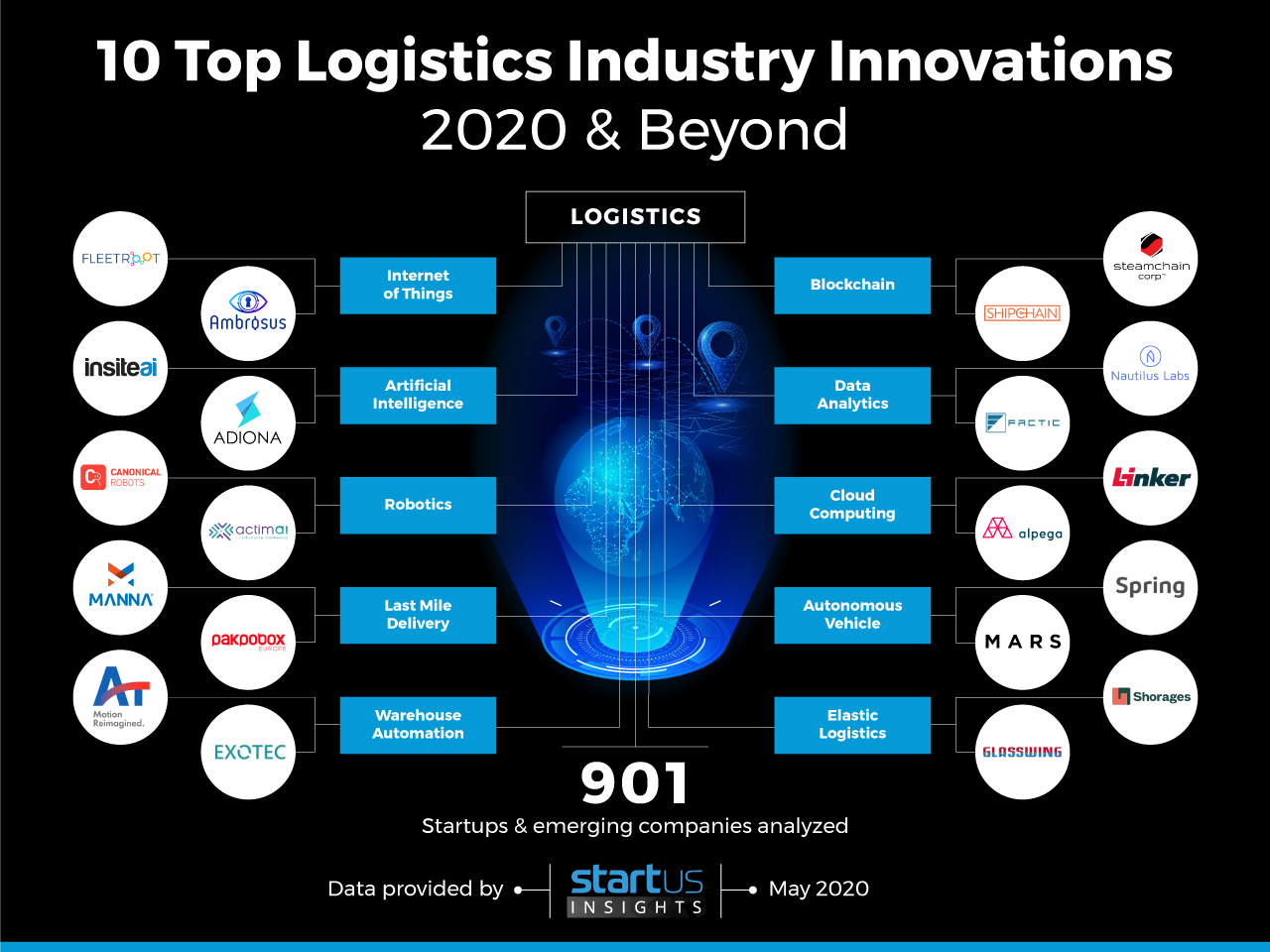
StartUs Insights have just produced a great report: Top 10 Logistics Industry Trends & Innovations: 2020 & Beyond
Remember Crocs?
A lot of people dismissed them as really ugly.
People who love to hate Crocs had cause to celebrate in 2008, when investors were writing the company off as a passing fad. Crocs lost over $185 million that year and cut 2,000 jobs. The stock plunged to just over $1 a share from a high of about $69 a year earlier.
But over the next decade, Crocs would go on to sell 700 million pairs of shoes worldwide.
Recently, the clogs have have been strutting down runways at luxury fashion shows. Celebrities like Justin Bieber, Ariana Grande and Post Malone are wearing the shoes. It’s a top brand among Gen Z. And limited edition Crocs are selling for up to $1,000 on the resale market. Crocs have become a collector’s item.
The wild, wacky and wonderful clogs were born in 2002 by three innovators: Scott Seamans, Lyndon Hanson, and George Boedbecker Jr. Boedbecker brought them all together as he knew Hanson in high school and they both attended the University of Colorado. Furthermore, Seamans knew Boedbecker through their shared love of sailing. So unsurprisingly, whilst all three were sailing in the Caribbean they came across a new boating clog made by the Canadian Company: Foam Creations. They were using a new material called Croslite. They discussed improvements and on returning home they quickly acquired the rights to foam creations manufacturing process. It wasn’t until 2004 Crocs completely secured exclusive rights to the Croslite technology.
The three were a compatible trio, with Seamans tweaking the design, Boedbecker became CEO and lined up investors whilst Hanson oversaw the operations. Through this process they made a really, really, really comfortable shoe. The first Crocs style they launched was named ‘the Beach’. Whilst the outrageous clog may have been created on a sailing trip, it wasn’t just boaters who wanted the bold, comfy brand on their feet. Soon millions of people were buying them!
It didn’t take long for a women’s style to be introduced in 2003 named the ‘Nile’. Then in October 2006, they also purchased Jibbitz, a manufacturer of popular accessories that snap into the holes of Crocs shoes. Afterwards Crocs continued to acquire various other companies in the footwear and fashion industry to increase its brand and product range. These included a women’s wedge range and some very funky trainers. Just because they are a relatively young brand does not mean they have neglected social responsibility. No, in fact the total opposite. In the past years Crocs have donated one pair of Crocs shoes every minute. This is through the programme called ‘Crocs Cares’, in which three million shoes have been donated to countries such as Kenya, Afghanistan, Cost Rica, Fiji and many less economically developed countries.
Crocs are also very environmentally aware, having recently changed their packaging to save nearly 640,000 lbs of landfill waste. That is more than 900,000 crocs saved in waste. Furthermore, it only takes 1.6kwh of energy to make one pair of croc shoes.
So, the phenomenal Crocs seem unstoppable as just before their tenth anniversary they had sold more than 200 million pairs in more than 90 countries, reaching sales revenues of $1 billion. Consequently, it seems the love and hate relationship of Crocs is here to stay as they continue expanding and developing their range of clogs, sandals, shoes and boots.