HRH Prince Charles, International Monetary Fund chief Kristalina Georgieva, and BP chief executive Bernard Looney were among those participating in the online launch of “The Great Reset” …
Tesla is now the world’s most valuable automotive company, with a market cap of $209 billion on 1 July, just ahead of Toyota. It is now worth more than the combined value of the top four European companies – Volkswagen, Daimler, BMW and Ferrari.
A decade ago, many questioned the ambitions of Elon Musk and his team in Palo Alto. Just two years ago, Musk was said to be sleeping on his factory floor, as he worked day and night to ramp-up production. And Tesla, of course, has never yet made a profit.
In recent months Covid-19 has accelerated demand for electric vehicles. Tesla also offers a uniquely low-touch experience, bought online and delivered to your home, and recharged remotely. There’s also features such as the “bio-weapon defence mode” air filtration system that has become popular in a pandemic.
Tesla, however is much more than a car brand. Musk has been particularly keen to accelerate development of its Tesla Semi all-electric truck, as the road haulage market is expected to rapidly migrate to electric, and then driverless models. 6 months ago he also launched the futuristic Cybertruck with striking angular design and (almost) unbreakable windows.
Even more significantly, in 2017 Tesla Motors changed its name to Tesla Inc. and has steadily diversified its business activities, most notably into battery energy storage, for both home and large-scale use. It also acquired Solar City, the solar roof tile business. Musk described Tesla’s purpose as “to accelerate the world’s transition to sustainable energy”.
Combining the capabilities in battery technology and vehicle development has particularly excited investment analysts, Musk has revealed plans for a “million mile” battery lasting up to 16 years, which Tesla’s Chinese supplier Catl has been working on and which is predicted to significantly lower the cost of electric vehicles.
Perhaps Tesla’s situation helps to explain why stock markets are proving remarkably immune to the economic turmoil created by the global pandemic, and felt by most of us right now. While stores are closed, jobs lost and the future seems uncertain, stock markets are booming, above pre-pandemic levels of early 2020, and around 10% up on last year.
Why? Firstly a stock market, like the value of any company, is a reflection of future potential profits, rather than current profitability. This is tempered by confidence in the future, which is still strong in the mid to longer-term. Secondly, most stocks are held by the wealthiest in society, who are less affected. And third, technology companies like Amazon and Apple, Google and Microsoft have done well during lockdown, as life has migrated to digital platforms, and are by far the largest players in the markets.
“There has never been a moment quite like this” said Cosimo Turroturro, as he introduced The Recovery Summit, an ambitious thought leadership ultra-marathon, a 40 hour webinar over 5 days. With a global audience of almost 10,000 people, inspired by 80 of the world’s leading minds, he continued “Individually and together we face challenges we have never encountered, but also opportunities which we have never had before.”
Participants included:
- Joseph Stiglitz – Nobel Laureate, ex Chief Economist at World Bank
- Paul Romer – Nobel Laureate, ex Chief Economist at World Bank
- Prof. Andrés Velasco – Dean of London School of Economics, former G20 member
- Muhammad Yunus – Nobel Peace Prize, Grameen Bank
- Jacques Attali – economist and social theorist, advisor to French presidents
- Ingrid Betancourt – anti-corruption activist who spent six years in captivity
- Dr Moisés Naím – international columnist, expert on global politics
- Pierluigi Collina – FIFA Referee’s Chairman, six times referee of the year
- Jim Hagemann Snabe – co-author of Dreams and Details, ex CEO of SAP
- Lord Sebastian Coe – President of World Athletics, Olympic Gold medallist
- David Coulthard MBE – former British Formula 1 racing driver
Here are some of the best quotes, from leaders of business, politics, sports and much more:
“Now is the time for leaders to accelerate the future, with an inspiring dream and practical capabilities” began Jim Hagemann Snabe, chairman of Siemens and Maersk, describing how to look beyond traditional strategies. He went on, “now is the time to be bold”, to create a more human, digital and collaborative future, and “to unleash human potential.”

“We were already in a bad place” declared Dambisa Moyo, Zambian economist, and board member of Chevron and 3M. “Economic growth had stagnated, and governments had built up enormous debt or deficits. The pandemic has accelerated this”.
“The pandemic has challenged old ideas of nations, hierarchies and strategies, and is teaching us that networks, collaboration, and communities across borders, are more important and powerful” said Sebastian Coe, President of World Athletics. “As leaders, we have suddenly found that with technology we can be much more accessible, collaborative and productive.”
“There are two crises – one is a health crisis, the other an economic crisis – that will hit the emerging world hardest. We already have a cure for the latter, if we have the courage to act now” added Andrés Velasco, Chilean economist, based at the London School of Economics. “People are asking is it worse to die of the virus, or of hunger. What will we do?”
“If we keep doing what we are doing now, it will be a long, slow recovery” warned Paul Romer, Nobel economics laureate and former Chief Economist of the World Bank. “We should be taking bolder action now, addressing the big issues of social inequality and environmental crisis”.
“We’re all now in a high-assumption environment, where strategy matters more than ever, with so many new opportunities to innovate. It’s time to be proactive” says Rita McGrath, strategy professor at Columbia Business School, and author of “Seeing Around Corners”.
“Covid-19 has accelerated change over the next 20 years into the next 2 years. The way in which awareness of Black Lives Matter spread across the world in days shows that we could be on the cusp of a better world” said Ian Goldin, director of the Oxford Martin Programme on Technological and Economic Change.
“People don’t like change, because they can’t see a better future. We like to live life in a straight line. We don’t like to deviate. If we reach an obstacle, we crash. Instead we need the courage to explore new directions” proclaimed Bertrand Piccard, Swiss psychiatrist, round the world balloonist, and founder of Solar Impulse. “Like a balloonist we need to increase altitude, by dropping our ballast”.

“You can’t stop the waves, but you can learn to surf … then take a moment to say ‘kia kaha’ to yourself, the Maori word for stay strong” said global adventurer Debra Searle, before also suggesting “Protect your mindset with the habit stack: songs, exercise, meditation, sleep, humour, and generosity”.
“There will not be a new normal (normal = ordinary, average, predictable) … Instead the new context is about 5Cs: chaos + crisis + complexity + confusion + constant change (chaos = exponential speed and uncertainty)” said Paulo Gallo, author of “The Compass and the Radar”.
“We need to build a new DNA for organisations that anticipates more shocks, that enjoys disruption, that thrives on constant change” said South African futurist Graeme Codrington. “Covid-19 is a unique invitation to reimagine our future”
“Asian companies have been much faster to adapt and pivot during the pandemic, to move online, to change activity” observed IMD’s Howard Yu, adding “Leadership teams need to be much more diverse – ethnicity, gender, religion, age, whatever – to embrace cognitive diversity”.
“I believe in 5 keys to personal resilience: clarity of purpose, perform under pressure, think positively, build a support network, manage your energy” shared Anna Hemmings, the six times world champion canoeist.

“How do you become an invincible company? Constantly reinvent yourself, compete on superior business models, transcend industry boundaries” said Alex Osterwalder, having just launched his great new book, “The Invincible Company”.
“We are only conscious of 5% of our behaviours. Most new behaviours become habits after around 66 days. Use marginal gains to make progressive change” said Steven MacGregor, author of “Chief Wellbeing Officer”, and founder of the Leadership Academy of Barcelona.
“Now is the time to try new things, the greatest risk is not to risk. We all need a challenger mindset, deep curiosity and fearless courage” offered Inc magazine columnist Terence Mauri summarising it as “a bit of Finnish sisu, and a bit of Japanese soshin”.
“Success in life is defined by how we overcome adversity” concluded Jay Sean, the record breaking R&B singer/songwriter, reflecting on how we are all faced with moments of big choices, “to take the blue pill or red pill” and “how we respond defines the next stage of our journey.”

Time to be bold and braver, to look forwards with courage and imagination, to create a better future for yourself, your business and the world.
Innovation failures are nothing new – we remember back, almost fondly, to the DeLorean car and New Coke, Sony’s Betamax rival to VHS and Philip’s Laser Disc, Persil Power detergent and Harley Davidson fragrances, Bic disposable underwear to Crystal Pepsi, Coors Zima water and Starbucks Mazagran carbonated coffee, Apple Newton tablet and Google Glass eyewear, Google+ social network and Amazon Local.
While the text books are full of stories of success, we can often learn more from the flop.
For those of us without distant memories, the sci-fi DeLorean car looks remarkably like the Tesla X with its wing opening doors, Coke now comes in a wide range of flavours which was never thought possible, the Newton foresaw the iPad for Apple, and whilst Google’s Glass project never really took off, both Apple and Microsoft now see eyewear as the next platform for personal computing.
So which are the most celebrated “failures” of the last decade, and what can we learn from them?
Some of them failed because they were fanciful dreams of technologists with little real insight into the latent needs of customers, others were just plain crazy, and some were just ahead of their time.
Google Allo (2018)
Google has tried again and again to field a viable messaging alternative to Facebook Messenger, WhatsApp, or Apple’s iMessage, and it has failed each time. The latest casualty is Allo, which launched in September 2016. After less than two years pushing Allo, Google announced in April 2018 that it was “pausing” development of the app in favor of a new messaging effort it’s calling “Chat.” This means Allo is effectively dead, even if it is supported for a few more years. Google’s own head of messaging Anil Sabharwal admitted that Allo didn’t even come close to meeting Google’s hopes. “We set out to build this thing, that it [would be] a product that we would get hundreds of millions of people to get excited about and use,” he told The Verge. “And where we are, we’re not feeling like we’re on that trajectory.” Why did Allo fail? To begin with, it did not have the advantage of being the default messenger on Android phones. Google had to push users to download it, and this was difficult, given the traction other platforms had already gained. Plus, Allo had no real differentiating features. It was basically just another good enough messaging app. In the end, only 50 million people downloaded it, The Verge reported. Allo’s failure can be seen as another Google defeat in the field of social apps. It’s not just messaging that has been a third rail for Google. More broadly, social apps have been a problem. From Google+ to Google Wave to Google Buzz (see above), and now Allo, Google can’t seem to build social platforms. It seems Google is better at delivering services like search, advertising, email and maps, than it is at content and connecting people.
Facebook Portal (2018)
Facebook Portal was released in 2018 as a standalone device designed to help people hold better video conferences. With computer vision AI and an auto-zoom feature, the Portal was able to follow people as they moved to better frame the video shot. The device was released just 8 months after the Cambridge Analytica scandal that embroiled Facebook, and consumers were suspicious of adding a Facebook camera to their living rooms. As Recode put it in its October 2018 review, “Facebook could improve video calls. The question is whether people will let it.” The answer so far has been a resounding “no.” Facebook initially said that the devices wouldn’t collect data for ad targeting, but reversed this statement shortly afterward, acknowledging that data from the devices could be used to inform the ads Portal owners see on other Facebook properties. Sales remained “very low” through the device’s first year, according to Fast Company, with some sources suggesting Facebook shipped as few as 54,000 units of the product’s first iteration. Facebook released a smaller, second-generation version of the device in September 2019. It remains to be seen whether global social distancing in the wake of the Covid-19 outbreak will spark a surge in sales.
Mercedes Home Battery Pack (2017)
Daimler, parent of the Mercedes-Benz car brand, decided that it would go after the US home energy market. It teamed up with Vivint, which installs solar systems, and marketed an energy storage battery that looked quite a bit like Tesla’s Powerwall system. Like the Powerwall, the Mercedes-Benz battery was intended to store energy from solar panels. The major flaw in solar power is that it obviously is basically produced during the day and in sunny weather, so storage systems are needed if electricity is to be generated at other times. However, in April 2018 Mercedes-Benz announced that it’s dissolving the US subsidiary set up to run this home energy business and ceasing manufacturing of home battery packs globally. What happened to the would-be Tesla killer? It was expensive for the market, and basically over-served its customers. One Daimler spokesperson told Greentech Media: “It’s not necessary to have a car battery at home: They don’t move, they don’t freeze. It’s over-designed.”
Samsung Galaxy Note 7 (2016)
Few corporate flops on this list have been as explosive as this one. Launched in August of 2016, the Note 7 boasted powerful hardware and had consumers chomping at the bit to get their hands on them. The anticipation quickly faded, though, as reports of Note 7s catching fire started hitting the news. By September 2, Samsung had stopped sales of the device. Next came a formal recall in the US on September 15th and a worldwide recall on October 10th. The product was completely abandoned on October 11th.
Keurig KOLD (2016)
The well-known coffee maker tried to get into the at-home soda machine market, but failed big time. For one, its machine was $369 compared to $79 for SodaStream. The pods themselves were also expensive, ranging from $3.99 to $4.99 for a pack of four. Each pod made an 8 oz glass of soda. Users complained that the machine was too loud and took a long time to cool down. The company pulled the product.
Nintendo Wii U (2016)
While a few Wii U consoles were still being produced early in 2017 in the Japanese market, the system that marked a low point in Nintendo’s corporate history was effectively killed at the end of 2016. The Wii U was a resounding failure. The Wii U sold only about 13.6M units in its entire lifetime. Meanwhile, the Nintendo Switch, its successor launched in 2017, is expected to sell that many units by April of 2018, just a year or so after launch. What made the Wii U so unlovable? It was a relatively complicated system with a UI that wasn’t up to the already mobile-influenced user standards of the time. It failed to innovate on its predecessors’ introduction of physical play and motion as an integral aspect of gaming. It also had relatively few hit titles tied to it once the buzz around launch titles had dissipated, so enthusiasm wore off. Nintendo’s huge success with the Switch, a whole new type of console that is portable and is being bolstered by a succession of hit games, shows the Japanese company learned its lessons well.
Hoverboards (2015)
Hoverboards seemed like the next big thing, until they started exploding. Thousands of hoverboards from at least eight brands were recalled in 2017 because the lithium-ion batteries in the devices caught fire. But the problems were occurring well before that, as several airlines banned hoverboards altogether in 2015.
Nike FuelBand (2014)
Nike’s wearable fitness tracker was well-received by reviewers, but failed to find a following with consumers, accounting for just 10% of the market two years after its release in 2012. By April 2014, Nike had fired most of the team behind Fuel.
Amazon Fire Phone (2014)
The Kindle Fire tablets were a hit with consumers, so the development of a phone wasn’t much of a surprise. But the device turned out to be clunky, have limited app options, and even the Firefly feature (which recognized products and songs) couldn’t win over customers.
Juicero (2013)
Juicero was a California-based startup that raised $120M for its fresh-squeezed juice device. But after it was found that its $400, Wi-Fi-enabled machines were no more effective at making juice than squeezing the pre-packaged fruit with your hands, the company shut down within months of its launch.
Facebook Phone (2013)
The Facebook Phone was surrounded by speculation from the moment the first rumors of it surfaced, so almost any product would have failed to live up to the hype. What the public got was the HTC First, an Android-skinned device whose main feature was being geared towards the Facebook Home application. The phone’s exclusive carrier, AT&T, drastically slashed the price to 99 cents in a “temporary sale” that became permanent until the phone’s death.
Lululemon Astro Pants (2013)
Yoga pants are designed to be form-fitting, but some models of pants and leggings from the yoga gear giant proved to be a bit too revealing, becoming translucent when wearers bent over. Inflammatory remarks from founder Chip Wilson only exacerbated the public relations fiasco. Wilson later issued an apology and the company issued a recall.
Pond’s Toothpaste (2012)
Pond’s is one of America’s oldest cosmetics brands, but when it launched a toothpaste in 2012, its customers couldn’t get on board. Ironically, the toothpaste itself wasn’t the problem — though most consumers failed to distinguish Pond’s toothpaste from Colgate’s — it was the Pond’s brand. Customers so strongly associated Pond’s with beauty and skincare products that they weren’t accepting of a different product. The toothpaste was eventually pulled off the shelves.
Bic for Her (2012)
Bic received heaps of derision in 2012 when it launched a line of Bic for Her pens designed specifically for women. Advertised as being built for women’s comfort and available in colors such as pink and purple, many consumers considered the product to be sexist and its Amazon page attracted a slew of mocking reviews — with some satirically suggesting that they would need their husbands’ or fathers’ permission to buy the pens.
Google Nexus Q (2012)
This weird black orb thing was a media device that could connect to your TV and speakers and stream a list of various music tracks and YouTube videos that you and your friends co-created. It only played Google-approved content (YouTube and music) and just couldn’t compete with other media-streaming offerings like Apple TV.
HP Touchpad (2011)
Following Apple’s unveiling of the iPad in 2010, dozens of companies released tablets of their own. HP launched its TouchPad in July 2011 — and discontinued after only 6 months. Sales of the device, which ran on HP’s proprietary webOS operating system, were disappointing. The product was largely ignored by the tech press in favour of Apple’s iPad 2, which went on sale in March 2011. Just 25,000 of the TouchPad’s initial 270,000-unit run were sold, prompting HP to dramatically reduce the price of the HP TouchPad in August. Retailers sold out of the significantly cheaper tablets almost immediately, but the product was ultimately discontinued.
Jawbone Fitness Tracker (2011)
Wearable company Jawbone was once valued at more than $3B. However, intense competition in the wearables market and a protracted legal battle with dominant incumbent FitBit resulted in considerable financial losses that ultimately sank the company. Jawbone, which was founded as AliphCom in 1999, originally developed military-grade audio hardware before moving into the consumer market with its popular Bluetooth-enabled wireless speaker. Jawbone diversified once again in 2011 when it unveiled its fitness-tracker wearable. Despite the popularity of Jawbone’s Bluetooth speakers, the company was beset by problems for more than a year prior to its closure. Jawbone struggled with inventory shortages and a series of high-profile executive departures, and customer service standards deteriorated as its legal battles wore on. The company finally entered liquidation in 2017.
Netflix Qwikster (2011)
Just as Netflix’s streaming service was beginning to take off, CEO Reed Hastings hit upon a plan to wring more money from consumers who wanted to continue receiving DVDs in the mail a la the service’s original process. His solution: rebrand the mailing option as “Qwikster” and require users to register (and pay) for both services. It was a PR nightmare and the idea was dropped weeks later.
PlayStation PSP Go (2009)
The PSP performed admirably, despite its weird format choice of UMDs for its games. The Go was smaller and sleeker, but lacked the ability to use UMDs, so there was little incentive for PSP fans to “upgrade” to this one. Go also had a weak catalog at the exact moment when phone games were storming onto the scene, trampling this underwhelming console beneath their heels.
Twitter Peek (2009)
This was a dedicated device that just sent out and received tweets, but couldn’t even do that properly, giving users only a 20-character preview of their tweets. Users passed on this gimmicky handheld.
Tata Nano (2008)
In 2008, Indian car manufacturer Tata Motors launched the Tata Nano, an ultra-compact hatchback designed specifically for the domestic Indian market. Tata Motors launched the Nano with motorcyclists in mind. To appeal to them, Tata manufactured the Nano as inexpensively as possible; the Nano was priced at 100,000 rupees, or approximately $2,500 in 2008 dollars. The company hoped the Nano’s compact design and low price would make it a popular choice with residents of urban areas, many of whom relied on motorcycles and mopeds for personal transportation. However, the low price tag led to numerous cut corners in production, which resulted in serious safety flaws. Reports of Nanos bursting into flames after rear collisions were common in the months after the vehicle’s debut. Tata ultimately sold fewer than 8,000 Nanos before pulling the vehicle from the market entirely.
Microsoft Windows Vista (2007)
Windows XP had been the Windows version for five years when Vista hit the scene, so many customers were loathe to change over. Even moreso when reviews revealed that the new OS was less user-friendly than XP. This led to users paying to have their Vista systems downgraded back to XP and Microsoft admitting its mistake and allowing computer manufacturers to offer XP on new computers. It hastened production on Windows 7.
Joost (2007)
Founded by the guys behind Kazaa and Skype, Joost was supposed to deliver content at near-TV quality via a peer-to-peer format. Despite financial backing, an innovative technological concept, and some early content deals with the likes of Viacom and others, a lack of international rights and pullouts by content providers ultimately hamstrung this fledgling service.
Heinz EZ Squirt Ketchup (2006)
The idea was simple enough: take ketchup, traditionally some shade of red, and turn it different colors through the magic of science. Seeing as how ketchup is the beloved condiment of choice for kids of all ages, this seemed like an easy win, and for a while it was, driving Heinz’s market share above 60% for the first time ever. The novelty wore off quickly and though it remained in production for 6 years, this house on fire had long since burned out.
Evian Water Bra (2005)
As one of the best-known brands of purified water in the world, Evian occupies an enviable position in the broader beverage industry. In 2005, the company decided to diversify by manufacturing a support brassiere that could be filled with water. The garment’s primary purpose was to offer women a cooler alternative to traditional bras during hotter months. It also featured a small pouch that could hold a bottle of mineral water. Perhaps unsurprisingly, the bra failed to catch on and was discontinued shortly after its introduction.
Segway (2001)
These two-wheeled, self-balancing scooters looked dumb and cost a fortune, so when they didn’t catch on, no one was surprised. Now reserved for mall cops only.
Most of us are feeling somewhat anxious, frustrated and uncertain right now.
For 12 weeks or more we’ve been living in different states of enforced lockdown as the Covid-19 pandemic sweeps across our world, reminding us of our global connectedness and human fragility. As we work from home, school from home, shop from home, miss our friends, worry about relatives, lose out on business, and watch economies plunge, it’s easy to get overwhelmed with these tough emotions.
It would be easy to obsess about our situation, about our feelings. It would also be easy to bottle our emotions, to pretend everything is sort-of normal or at least will be very soon. It would be easy to categorise our world as good or bad, positive or negative, happy or sad. But such polarisations are not a true reflection of humanity. Now is not the time to grit our teeth, or to simply persevere. It’s easy to try and pretend, most of us do, at times.
We can do better. Now is the time to cultivate the wisdom and courage to move forward with a more open mind, a flexible approach, to be resilient yet real, to engage with emotional agility.
Susan David’s book Emotional Agility is about the empowered navigation of our thoughts, feelings, and narratives as they relate to the various spheres of our lives.
She argues that the way we perceive our inner selves is the determinant of how we live and the successes we incur. To maintain a negative self-image is destructive, and impairs our potential for success. She acknowledges the inherent evolving structures that we possess, citing adaptation as the key to transforming ourselves in order to attain the success and happiness we desire.
To be emotionally agile is to be flexible with our thoughts and feelings, and not hold the beliefs of our past to be immutable, as this cannot lead to change. A seed cannot grow from concrete, only from a mixture of fertile soil, water, and sunlight. We must also allow a combination of different experiences and thoughts to shape us.
Her book explores adaptation and advocates for consistent values as the core of who we are—the only transient point for values being to refine them when necessary in order to evolve. We can never cling too strongly to one emotion, thought, or feeling, but must learn to accept these as fleeting and allow them to move on. Only when we do this can we catalyze and bring about healthy change.
She cites four key concepts: showing up, stepping out, walking your why, and moving on. These concepts emphasize the overall point in her book about creating emotional strength and adaptiveness to change.
1. Showing Up
To face your thoughts or feelings is arguably the most difficult thing to do but it is also the most imperative to facilitate positive change. David suggests being curious about them, accepting both your difficult and positive thoughts equally in order to see them for what they are.
2. Stepping Out
This concept is all about detachment—a detachment from your inner monologue, thoughts, and feelings in order to see that they are just emotions, not you. These emotions are not bound to you and are not an essential part of your being. To detach from them will result in you feeling far more autonomous over your actions and decisions.
3. Walking Your Why
You need to retain core values, as these are a fundamental part of who you are. You shouldn’t give these up, but use them to dictate your actions. They provide you with your substance, your identity and roles, and as long as they aren’t negative values then no refinement is needed. Your values are your driving force.
4. Moving On
Her next step of moving on involves making small, deliberate, and purposeful tweaks to your mindset, motivation, and habits to align them with your core values. In doing so, she says you can make a significant difference in your life.
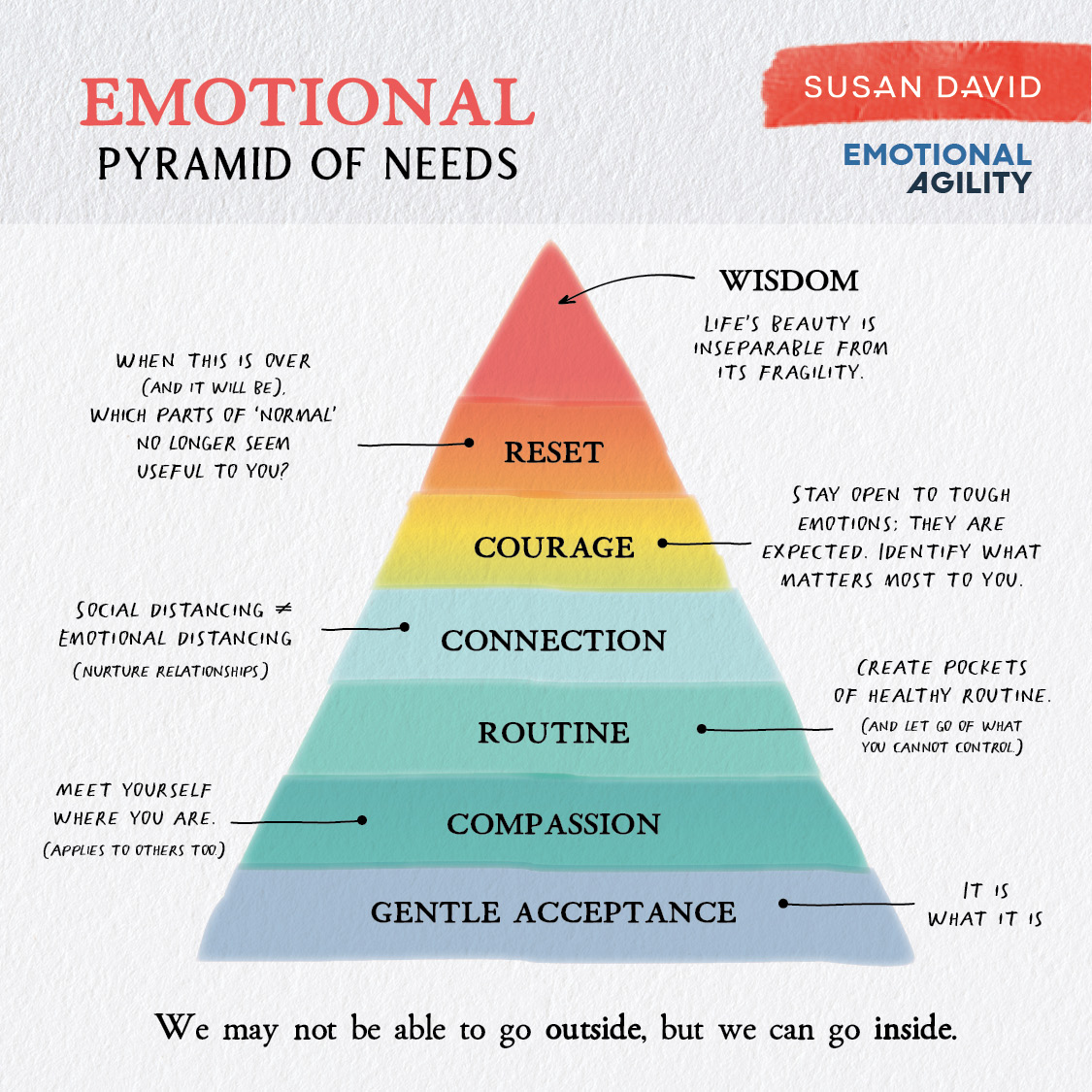
The pyramid model, developed by Susan David, illustrates the critical steps we can follow to deal with both the reality of our present and the emotions that come with this reality, in a healthy way. The steps outlined can leave us more resilient and stronger than ever.
- Gentle Acceptance: As much as we want to, we cannot control every situation–especially a global pandemic. There is no value in struggling to deny or suppress feelings of anxiety, hopelessness or grief. This only makes us feel worse. By showing up to a difficult situation and accepting it, we are freed up to move beyond it. Acceptance is the prerequisite for positive change.
- Compassion: You must be kind to yourself. These are not normal times: tens of thousands of people are dying and losing their livelihoods. Recognize with kindness that you are trying to live your life and juggle competing demands in abnormal circumstances. Give yourself a break and let go of perfectionism. Now is not the time for perfection but for forgiveness and flexibility. Also, see if you can let go of judging others. They, too, are doing the best they can. You don’t have insight into the history of the woman who is hoarding food or what it is she has seen in her past, but she is scared. Try to broaden your scope.
- Routine: Human beings need routine in order to maintain a sense of order. It’s the glue that holds us together from day to day. When we are faced with the unfamiliar, we tend to fill in the gaps with fear. We are currently away from our routines–working from home, homeschooling, and living in close quarters with others. We are adapting to unprecedented circumstances. This can be scary. So let’s fill in the gaps of the unknown with things that are comfortable, familiar, and connected with our values. Healthy routines are essential, specifically those associated with sleep, exercise and eating. Our bodies and minds are so interconnected and our physical health is reflected in our psychological state. Try to ground yourself during the course of the day by incorporating experiences that are reminiscent of your normal lifestyle. Whether that means waking up at the time you normally would to commute to work or maintaining your family tradition of Friday movie night, the preservation of these small habits will give you comfort. Remember that it may not be possible to adhere to all aspects of your regular routine and approach this new reality with grace instead of rigidity.
- Connection: It’s important to note that “social distancing” is really physical distancing. Connection is so important, now more than ever. Even though you cannot be in someone’s physical presence, you can continue to nourish your relationships, especially if you’re feeling lonely. You need that support. Also, if safe, make sure to hug your child and/or partner. Put down your phone and laugh with your family, play games, do puzzles.
- Courage: Research now shows that the radical acceptance of all of our emotions–even the messy, difficult ones–is the cornerstone to resilience, thriving, and true, authentic happiness. But courage is more than just the acceptance of emotions. Our emotions are data that tells us what we’re missing in our lives. A ‘guilty’ parent might be missing real connection with her child. Grief is love, looking for its home – reminding us of the our special times. Slow down and face into your difficult emotions with courage. What you find there will signpost to you how to make better decisions and take values-based actions.
- Reset: This is the time for reflection. What priorities did you once have that no longer seem important? What parts of ‘normal’ do you not want to rush back to? Gather your data, keep a journal, and reflect on what you learn about yourself. This information is valuable and it will guide you as you move forward.
- Wisdom: Life’s beauty is inseparable from its fragility. We are young until we are not. We walk down the streets sexy until one day we realize that we are unseen. We are healthy until a diagnosis brings us to our knees. The only certainty is uncertainty, and once we realize this as truth, the healthier and more authentically happier we will be. When I was little, I would wake up at night terrified by the idea of death. My father would comfort me with soft pats and kisses. But he would never lie. “We all die, Susie,” he would say. “It’s normal to be scared.” He didn’t try to invent a falsely positive buffer between me and reality. It took me a while to understand the power of how he guided me through those nights. What he showed me is that courage is not an absence of fear; courage is fear walking.
Our time on this earth is all too short and all too precious. Life is asking us all right now “are you agile?”
Let the answer be an unreserved “yes.” It’s a time to recognise who you really are. Because in seeing yourself, you are also able to see others, too. Emotional agility gives us a sustainable way forward in a fragile and uncertain, yet incredible and beautiful world.
https://www.youtube.com/watch?v=0_6hu6JLH98
The infographic below, from Forbes magazine, outlines how important emotional agility is in the workplace.
Research shows us that:
- Emotional intelligence and agility explain 58% of a leader’s job performance
- 90% of top performers are high in EQ
- Employees whose managers are open, approachable and emotionally agile are more engaged
- More engagement leads to lower turnover, higher operational efficiency and increased performance
Want To Increase Emotional Agility? Follow These Seven Steps
- Release Resistance: to make room for more choice
- Increase Rapport With Yourself: to build mental muscles and calm the mind
- Make New Meaning: and choose the story you want to tell
- Anchor The Outcome You Want: to make success inevitable for yourself and others
- Enroll And Engage With Others: as you bring emotional agility to your tribe
- Build Tribal Agility: to expand and keep change going
- Expand Tribal Power: to help your tribe navigate any obstacle, thrive on feedback and redefine their personal best
Here’s how many people find it helps
Benefits You Will Reap
- 87-93% less time in Critter State (fight/flight/freeze)
- 94% increased confidence that you can handle anything
- 92% increased compassion for others
- 85% increased compassion for self
The Net-Net
- Emotional agility is critical at work and in life overall.
- There are seven proven steps to increase emotional agility.
- The tangible benefits that you and your organization will reap are profound.
How emotionally agile are you? Take this 3-minute assessment and find out.

Find out more in my online seminars on
- Agile Mindset: The New Business Brain
- Surviving and Thriving in Turbulent Times
- The New Leadership DNA
Thanks to a small bit of contagious RNA we are all now unwilling participants in a seismic experiment that is shaking the foundations of society, technology, economics, healthcare and more. Dan Pink wonders if it’s a message from the future. Klaus Schwab calls it the bonfire of blinkered capitalism. Satya Nadella describes it as a shift “from hierarchies to wirearchies”.
As we move from survival to adjustment, from chaos to catalyst, the next normal (or abnormal) is being shaped right now. The next generation of businesses are being forged. The leaders of the future are stepping up. Great leaders are made in a crisis, and innovation thrives in tough times. How will you seize this moment to do more, to be more, to create a better future?
The leaders of tomorrow are being created right now. 57% of organisations were born in a downturn.
It’s a watershed moment. As the virus followed the flows of money, goods and people around the world, the networks that facilitate our modern lifestyles facilitated the pandemic. 183 countries have reported Covid-19 cases, 3 billion people across the world have been under some form of lockdown, with a $2.7 trillion projected economic loss (according to Bloomberg).
Right now, we are seeing a huge unmasking of our current systems – the fragility of business and society, the consequences of urbanisation and globalisation, our dependence on technology and healthcare. Activities in which consumers are likely to change behaviour most are in travel, shopping, and socialising. And to some extent in work, education and health.
We are faced with a choice to re-build the world as it was, or to realise the possibilities before us. To build stronger economies and more inclusive societies, to harness the power of our resilience and ingenuity to shape a better world of our choosing. We each have a role and a stake in solving humanity’s most pressing challenges, and also seizing its opportunities.
I believe we will see a rising social conscience in business, more future-proofed portfolio- based strategies, an acceleration to digital, a humanising of technology, a shift to dematerialisation, more agile ecosystems of global and local supply and demand, a more flexible workstyle, fast projects replacing traditional jobs, a more liquid learning style … and better leaders who look forwards not back.
“The pandemic represents a rare but narrow window of opportunity to reflect, reimagine, and reset our world” – Professor Klaus Schwab, Founder and Executive Chairman, World Economic Forum.
Larry Fink, CEO of BlackRock, recently said that he expects “at least a 24 month downturn” before most businesses get back to their pre-Covid performance. “But that all depends on how quickly we can find a vaccine”. Pascal Soriot, the French CEO of Astra Zeneca (which has just become the UK’s most valuable company, after 11 years of HSBC and 8 years of BP) believes that Spring 2021 is likely to be the earliest that a vaccine is ready. His business is currently in the middle of clinical trials of a Covid-19 vaccine developed with Oxford University.
Latest IMF economic forecasts say that most economies are unlikely to recover significantly for at least 18 months (with a global -3% global contraction in 2020, broken down by -6.1% in advanced and -1.0 in emerging economies).
China is most advanced in its recovery, three months since lockdown, and returned to around 90% of its pre-Covid performance. 90% recovery might not sound too bad, but analysis by The Economist says that this “could be catastrophic” for many companies.
“Factories are busy and the streets are no longer empty. However the missing 10% includes large chunks of everyday life. Travel on public transport and domestic flights are down by a third. Discretionary consumer spending, on such things as restaurants, has fallen by 40% and hotel stays are a third of normal.”

Every business will need to adapt how it works, from fundamental shifts in business model to new ways to serve customers. On my website I have captured over 250 “pivots” as companies seek to survive and thrive. Here are just a few:
- Airbnb has closed all rental and travel activities, and refocused on “online experiences” sourcing and selling everything from online cookery courses to tango dancing.
- Chinese cosmetics brand Lin Qingxuan closed its stores, but redeployed its instore beauty advisors as online influencers, driving over 200% sales growth.
- Sydney-based Stagekings, an events business that usually builds stages, sets and expo stands, has transformed itself to make bespoke home office furniture.
- YourChoice, based in LA, realised that in niclomaside, a contraceptive drug, they had a potential Covid-19 treatment, and immediately created ANA Therapeutics
Crisis is the catalyst for change, it transforms markets, and accelerates innovation. It challenges leaders to reimagine, refocus and reinvent themselves and their organisations. Whilst some are paralysed by uncertainty and change, others see new possibilities to create a better future. Time to embrace the change, to move forwards to create a better future.
In economic cycles, every financial downturn is matched by an innovation upturn. In fact 57% of the current Fortune 500 were founded in a downturn. Right now, the next generation if businesses are being shaped. And below today’s business turmoil, a tremendous digital revolution is taking shape.

Megatrends are accelerating … the shift in power from west to east (Asia continues to grow), the dependent needs of ageing generations (care, infrastructure), the huge concentration of people in megacities (healthcare), the fragility of our environment and natural resources (less is more), and the rise of intelligent, connected technologies (AI).

Driving human and tech ingenuity … pandemic has seen rapid adoption of new technologies, and the “digital me” (belonging and connected) – in distributed working (remote and hybrid), intelligent healthcare (online and data-driven), digital retail (cashless and automated), personal mobility (electric and local) education (hybrid and collaborative).

Creating a better future business… now is the time for leaders to step up, to find a better future, not just recover the old world – more enlightened (purpose beyond profit, human before technology), more agile (networks not hierarchies, fast and liquid), more resilient (innovation not efficiency, future-proofed portfolio).

It’s hard to imagine that there will be a new normal and what it might look like. But since “a crisis is a terrible thing to waste,” as the Stanford economist Paul Romer once noted, it is worth discussing what we can already learn from the crisis at this point, in order to reshape our economies and societies, redesign our organizations, and improve the way we work, live, and love. The pandemic has exposed what Otto Scharmer calls the three big disconnects: disconnect from our planet, disconnect from the other, and disconnect from ourselves. We can use this crisis as an opportunity to overcome these divides.
Next year’s World Economic Forum 2021 in Davos will adopt the theme of “The Great Reset” as the global business elite elbows its way into the Covid-19 debate. WEF will hold an online youth conference alongside its annual meeting at the Swiss resort next January, which will go ahead as planned despite the coronavirus pandemic. The virtual event is a first for the forum and will draw on thousands of young people in more than 400 cities to interact with Davos regulars such as Saudi oil sheikhs, international bankers and messianic tech tycoons as they grapple with the world’s problems.
The WEF says the Great Reset agenda should have three main components.
The first would steer the market toward fairer outcomes. To this end, governments should improve coordination (for example, in tax, regulatory, and fiscal policy), upgrade trade arrangements, and create the conditions for a “stakeholder economy.” At a time of diminishing tax bases and soaring public debt, governments have a powerful incentive to pursue such action.
Moreover, governments should implement long-overdue reforms that promote more equitable outcomes. Depending on the country, these may include changes to wealth taxes, the withdrawal of fossil-fuel subsidies, and new rules governing intellectual property, trade, and competition.
The second component of a Great Reset agenda would ensure that investments advance shared goals, such as equality and sustainability. Here, the large-scale spending programs that many governments are implementing represent a major opportunity for progress. The European Commission, for one, has unveiled plans for a €750 billion ($826 billion) recovery fund. The US, China, and Japan also have ambitious economic-stimulus plans.
Rather than using these funds, as well as investments from private entities and pension funds, to fill cracks in the old system, we should use them to create a new one that is more resilient, equitable, and sustainable in the long run. This means, for example, building “green” urban infrastructure and creating incentives for industries to improve their track record on environmental, social, and governance (ESG) metrics.
The third and final priority of a Great Reset agenda is to harness the innovations of the Fourth Industrial Revolution to support the public good, especially by addressing health and social challenges. During the COVID-19 crisis, companies, universities, and others have joined forces to develop diagnostics, therapeutics, and possible vaccines; establish testing centers; create mechanisms for tracing infections; and deliver telemedicine. Imagine what could be possible if similar concerted efforts were made in every sector.
© Peter Fisk 2020
Peter Fisk is a leading business thinker, bestselling author and inspiring speaker, whose career was forged in a superconductivity lab, accelerated by managing supersonic brands, shaped in corporate development, evolved in a digital start-up, and formalised as CEO of the world’s largest marketing network.
He now leads GeniusWorks, a strategic innovation accelerator based in London. He is also Thinkers50 Global Director, founder of the European Business Forum, and a professor of leadership, strategy and innovation at IE Business School in Madrid, where he leads their flagship executive programs.
He has 30 years of practical business experience, working with business leaders in over 300 companies and 55 countries, from Adidas to Aeroflot, Cartier and Coca Cola, McKinsey to Microsoft, P&G and Pfizer. His distinctive approach is future back and outside in, fusing insights with inspiration, creativity and structure.
His 8 books in 35 languages fuse the brains of Einstein and Picasso, explore the creativity of da Vinci, reframe sustainability for innovation, and explore the world’s most innovative companies. His most recent book was “Gamechangers” which will be followed by “Business Recoded” to be published in October 2020.
Find out more at www.theGeniusWorks.com or email peterfisk@peterfisk.com
More from Peter Fisk:
- How do you see the future? Future Recoded … Reimagine markets. Reimagine work. Reimagine business. Reimagine success.
- Why innovate in a downturn? Whilst everyone else is losing their heads, the companies of tomorrow are being created right now
- What are the impacts of COVID-19? What business leaders should do now, to support people and society, and secure their business future.
- The Big Pivot … How are companies adapting to survive and thrive in crazy times of Covid-19 and downturn
- The latest edition of my “Fast Leader” magazine … Time to move forwards, to reimagine the future … Reimagination and Ripples of Reinvention
At the age of 4, Esben Østergaard built his first Lego robot. Four decades later the Danish entrepreneur has developed and sold two robotics companies for €560 million and is an early pioneer of the “cobot”, which are nimble and flexible collaborative robots being deployed on factory floors across the world.
At his first company, Universal Robots, he deliberately chose to remain the CTO, rather than take on the CEO role, as he much preferred the excitement of technology to administration. When I interviewed him at the Thinkers50 European Business Forum, held in his home town of Odense, Denmark, he said he was looking forward to stepping back from everyday business.
“I’m a curious nerd” he confessed. “I was always interested in technology and changing the world. I studied robotics and AI to try to find out if consciousness is related to or separate from intelligence. I think robots can teach us something about what it means to be human since they are kind of mimicking us. They can do much of what we can do physically, sometimes better.”
He described how he now wanted to contribute more to doing good in the world, and how his wife had sat him down on Christmas Eve with a powerpoint presentation describing the UN’s 17 Sustainable Development Goals. She said “Now I have an opportunity to make a real difference” so he set about exploring how robotics could do more for society.
Within three months, the Cover-19 pandemic took hold. Østergaard knew he had to do something, and started exploring how to automate the swab-based virus testing process, as recommended by WHO. Last week he launched Lifeline Robotics with a team of 10 colleagues from the University of Southern Denmark (SDU), aiming to take their fully-automated “swab robot” from prototype to market in just 4 weeks.
The innovation will be operating in hospitals from later this month. “The robot picks up the swab after the patient has scanned her ID-card, and it then identifies the right points in the patient’s throat through artificial intelligence-based computer vision” he explains. “This means that medical staff are no longer in danger of infection, and can spend their time treating other patients who need more human care.”
The SDU newsletter takes the story further:
“In just four weeks, a team of the best robotics researchers from the University of Southern Denmark has succeeded in developing the world’s first fully automatic throat swab robot, scheduled to swab the first patients for Covid-19 already by late June.
With a 3D printed, specially designed disposable tool, the robot holds a swab and hits the exact spot in the throat from which the sample is to be collected. Subsequently, the robot puts the swab into a glass and screws the lid on to seal the sample. And the researchers have tested the robot.
“I was one of the first to be swabbed by the robot. It went really well. I’m still sitting here”, laughs Professor Thiusius Rajeeth Savarimuthu of SDU Robotics “I was surprised at how softly the robot managed to land the swab at the spot in the throat where it was supposed to hit, so it was a huge success.”
Savarimuthu is in charge of the team of ten researchers who have been working around the clock in the Industry 4.0 Lab at the University of Southern Denmark to develop the prototype as quickly as possible, so that the healthcare staff avoids the risk of infection when carrying out throat swabs. “We have successfully demonstrated the world’s first fully automatic throat swab and delivered a “Proof of concept” of the processes in a robotized throat swab” he says.
Test, test, test says WHO, but at the same time, health professionals are at risk of becoming infected when doing throat swabs on potential corona patients. Therefore, a throat swab robot was also high on the wish list when Savarimuthu, after Covid-19 made its entry in March, spoke with his research colleagues at Odense University Hospital, OUH.
“There are prospects in developing a throat swab robot so that robots can take over the throat swabbing work both in relation to Covid-19, but also in all future viruses” he says. In this, Medical Director Kim Brixen from OUH fully agrees. He has with keen interest been following the development of the robot in the hands of the researchers. He also sees great advantage in the fact that the robot doesn’t get tired and bored of monotonous work.
“Currently, healthcare professionals are carrying out throat swabs for Covid-19; but working conditions can be a challenge. The task entails long working days of monotonous work. At the same time, the employees are in great demand in other functions”, says Brixen, pointing out that the robot can also play a leading role in a new strategy against more common types of flu.
“Large-scale testing is part of our community’s reopening strategy. The robot has great potential for mass screening for Covid-19 in the healthcare sector, but also in connection with border control or at airports. At the same time, we see that regular flu seems to have decreased during the lockdown. This may imply that we may need to rethink our strategy against the flu.”
In the shadow of the coronavirus, the researchers have in record time managed to develop a robot that can safely be entrusted with the swab. Now the robot is ready to move out of the lab.
“We have created the company Lifeline Robotics A/S, where our vision is to get the robot out to do good on the global market as quickly as possible: in airports, in refugee camps or where else it might be needed” says Søren Stig from Lifeline Robotics.
While researchers have been struggling with robotics, power management and vision technology, Stig has been struggling to get investment in place and bring together a strong team aiming at turning the throat swab robot into a commercial success internationally, in line with other proud robotic bigwigs.
Other like co-founder of Universal Robots and investment company REInvest Robotics, Esben Østergaard, and Vækstfonden support the project, and if everything goes according to the ambitious plan, the robot will be swabbing the first patient’s throat in a month. “The Covid-19 pandemic abounds. The ambition is, therefore, that we must get on the market as soon as possible. The plan is that we have a prototype that swabs patients by the end of June, and that the robot is completed and ready for the market this fall when the second Covid-19 wave hits” says Stig, director of Lifeline robotics. “Everyone on the team is working incredibly hard. If our plan holds, we will have achieved in 3-4 months what usually takes three years.”
More robots in healthcare
Meanwhile robots have been doing much more in hospitals – from dispensing drugs to disinfecting rooms.
A cylindrical robot rolls into a treatment room to allow health care workers to remotely take temperatures and measure blood pressure and oxygen saturation from patients hooked up to a ventilator. Another robot that looks like a pair of large fluorescent lights rotated vertically travels throughout a hospital disinfecting with ultraviolet light. Meanwhile a cart-like robot brings food to people quarantined in a 16-story hotel. Outside, quadcopter drones ferry test samples to laboratories and watch for violations of stay-at-home restrictions.
These are just a few of the two dozen ways robots have been used during the COVID-19 pandemic, from health care in and out of hospitals, automation of testing, supporting public safety and public works, to continuing daily work and life.
The lessons they’re teaching for the future are the same lessons learned at previous disasters but quickly forgotten as interest and funding faded. The best robots for a disaster are the robots, like those in these examples, that already exist in the health care and public safety sectors.
Research laboratories and startups are creating new robots, including one designed to allow health care workers to remotely take blood samples and perform mouth swabs. These prototypes are unlikely to make a difference now. However, the robots under development could make a difference in future disasters if momentum for robotics research continues.
In hospitals, doctors and nurses, family members and even receptionists are using robots to interact in real time with patients from a safe distance. Specialized robots are disinfecting rooms and delivering meals or prescriptions, handling the hidden extra work associated with a surge in patients. Delivery robots are transporting infectious samples to laboratories for testing.
One important lesson is that during a disaster robots do not replace people. They either perform tasks that a person could not do or do safely, or take on tasks that free up responders to handle the increased workload.
Outside of hospitals, public works and public safety departments are using robots to spray disinfectant throughout public spaces. Drones are providing thermal imagery to help identify infected citizens and enforce quarantines and social distancing restrictions. Robots are even rolling through crowds, broadcasting public service messages about the virus and social distancing.
At work and home, robots are assisting in surprising ways. Realtors are teleoperating robots to show properties from the safety of their own homes. Workers building a new hospital in China were able work through the night because drones carried lighting. In Japan, students used robots to walk the stage for graduation, and in Cyprus, a person used a drone to walk his dog without violating stay-at-home restrictions.
Robodog on patrol
We have also seen Spot, the robodog, patrolling Singapore’s Bishan-Ang Mo Kio Park as part of a pilot trial to promote safe distancing measures during the COVID-19 pandemic. Built by Boston Dynamics, the yellow and black robodog will patrol the park during off-peak hours.
Far from barking its orders, Spot politely asks runners and cyclists to stay apart and keep to safe distancing measures. “Let’s keep Singapore healthy,” it said in English as it roamed around. “For your own safety and for those around you, please stand at least one metre apart. Thank you,” it added, in a softly-spoken female voice.
Boston Dynamics call Spot “a nimble robot that climbs stairs and traverses rough terrain with unprecedented ease, yet is small enough to use indoors. Built to be a rugged and customisable platform, ithas an industry track record in remote operation and autonomous sensing.”
The robot is controlled remotely, reducing the manpower required for park patrols and minimising physical contact among staff members, volunteer safe distancing ambassadors and park visitors. “This lowers the risk of exposure to the virus. Unlike wheeled robots, SPOT works well across different terrains and can navigate obstacles effectively, making it ideal for operation in public parks and gardens,” the authorities said.
Starship delivers your groceries
https://www.youtube.com/watch?v=pw1wqURD8Yo
Starship robots have been delivering shopping to homes in the British town of Milton Keynes while the country remains on lockdown. The robots have been in use for 2 years, but since the lockdown their popularity has surged. More than 100,000 autonomous deliveries have now been made using the robots.
The robots, which come up roughly to an adult’s knee height and look like smooth white plastic boxes mounted on six black wheels, are now a familiar sight in the town. “Lots of them are doing … 80-hour weeks and they don’t have time to go to the local grocery store, so they use our robots for their shopping,” said Henry Harris-Burland, of Starship. “We’re honoured that we can be part of that solution.” The robots have what looks like an antenna, topped with a small red flag to make it easier to spot them as they do their rounds. They are big enough to hold several bags of shopping as well as a pack of bottles.
Nuro, the autonomous vehicle startup founded by two ex-Google engineers, is using its small fleet of road-legal delivery robots to transport medical supplies around two California stadiums that have been converted into treatment facilities for people stricken with Covid-19.
Nuro’s robots are ferrying food, personal protective equipment (PPE), clean linens, and other supplies to workers at two facilities in California: the Event Center in San Mateo and the Sleep Train Arena, which is typically home to the Sacramento Kings.
RoboBarista serves your coffee
A robot barista is being used in a South Korean coffee shop to help maintain social distancing, as the country is successfully transitioning towards what the government calls “distancing in daily life”.
A café in Daejeon, South Korea’s fifth-largest metropolis, is using a robot barista to to handle orders, serve people lattes and make it easier for consumers to stay the recommended six feet apart, according to a report from Reuters.
“Our system needs no input from people from order to delivery, and tables were sparsely arranged to ensure smooth movements of the robots, which fits will with the current ‘untact’ and distancing campaign,” said said Lee Dong-bae, director of research at Vision Semicon, a smart factory solution provider, which developed the robot barista together with a state-run science institute.
The robot can make 60 different types of coffee and serves orders to consumers at their tables. It also senses the clearest routes in the shop for social distancing and communicates that information to other devices. An order of six drinks, processed through a kiosk, took just seven minutes, according to Reuters. Just one human works at the cafe to oversee operations and handle cleaning tasks.
The team from the factory and institute is estimating that they will distribute robots to a minimum of 30 cafes in 2020. Korean manufacturers have been researching ways to automate the café experience for years now, but the arrival of the covid-19 pandemic engendered a surge in demand as companies searched for ways to help keep customers safe from potentially spreading the virus.
Adapting to a low-touch economy
The Board of Innovation has just launched a great report on how to adapt, and thrive in a post-pandemic environment where social distancing and low-touch are the priorities for doing business.
The term Low Touch Economy refers to the way businesses across the globe have been forced to operate in order to succeed as a result of Covid-19. The best way to define its meaning is to list its main characteristics so far:
- To mitigate health risks, businesses have been forced to adapt to strict policies, including low-touch interactions, limited gatherings, travel restrictions, and so on.
- Multiple aftershocks in global markets can already be seen. These include shifts in consumer behavior, new regulations, and supply chain disruptions.
- Medical experts and business leaders assume Covid-19 will directly influence the economy until late 2021.
- Businesses that survive the Covid-19 pandemic will be those that rely on business models tailored to this new normal while keeping everyone as safe as possible.
The BOI report says that forced isolation and social distancing restrictions, put into place during the Covid-19 health crisis, are expected to have a lasting effect on the world as we know it. Or should I say, once knew it.


Robot sceptics had believed humans would have an edge in those jobs. That could be changing as lockdowns have made humans more comfortable with the idea of connecting remotely. The instructor or adviser on the screen doesn’t need to be a real person, it just needs to think and act like one.
A 2017 report by global consultants McKinsey predicted a third of workers in the US would be replaced by automation and robots by 2030. But events like pandemics have the potential to change all the timelines and experts say it’s really up to humans to decide how they want to integrate this technology in the world.
Having spent much of the last year working with Microsoft, helping them to reframe and reenergise their focus on their markets, it dawned on me how important their acquisition of LinkedIn was a few years ago.
While $26 billion might seem a hefty sum for what might seem like a side business, I don’t see it that way.
Networks are the future of tech companies. Networks are what connect people, and it’s in those relationships that value is created. Value in the form of co-created content, value in the form of mutual opportunities, value in new sources of revenue. And the exponential effect of networks, means that as the network grows, that value multiplies.
Maybe it’s not surprising then, that the tech geek behind Reid Hoffman’s brainchild, Kevin Scott, was the man chosen by Microsoft CEO Satya Nadella to be the new CTO of the combined Microsoft group. As Nadella urged a shift to cloud and AI solutions, as core Microsoft services to business, then Scott would have the insight into how to make these capabilities work for Microsoft in an exponential way.
Now, as Microsoft’s chief technology officer, and executive vice president of AI and Research, Scott has authored a new book, “Reprogramming the American Dream: From Rural America to Silicon Valley, Making AI Serve Us All.”
The book, published by Harper Collins is a great read. Here is Chapter 1.
In the book, Scott goes back to his roots in rural Virginia, making the case that there is a middle ground between the extreme viewpoints about the future of artificial intelligence — one in which short-term disruption is followed by long-term benefits as technology augments and improves human endeavours.
In a recent interview, Scott reflected on the messages in his new book, and also the implications of where we are now, in the midst of a pandemic. Here are some extracts:
On his rural upbringing:
“When we began the process of writing the book, one of the first things that I did was take a trip back home to rural Central Virginia, where my family still lives, and I still have a ton of friends and family. I had this ‘aha’ moment as soon as I started chatting with people. These are some of the most ingenious and industrious people that I have ever known.
“And they have always been able to take the tools that were available to them and create really interesting things to make businesses that did good things for their customers, that created jobs, that created benefits for their communities, that helped individuals fulfill their creative or entrepreneurial visions, and really let them do incredible and compelling things.
“It just became immediately obvious to me that they were going to be able to do great things with AI.”
On democratising AI:
“Because of open source software and cloud platforms and all of the educational materials that are available online, a motivated high school student could do what was a difficult thing for me, that took six months 16 years ago. They could do it in two days, over a weekend. The tools are there.”
“The things that we have to go solve in these communities are about access. How do you get kids educated, where they have the skills they need to participate in the digital future, to be able to take what is already available to them in terms of these AI tools and build things and create opportunity for themselves? How do you get them the role models that they need to see themselves in these jobs of the future?
“And then how do we solve things that should be prosaic at this point but that still are still barriers, like broadband access for everyone? You can’t expect businesses or individuals to be able to connect themselves to a digital future when they can’t connect to the internet.”
On AI and future jobs:
“If you look over very, very long periods of time, technology and automation is almost always a good thing for society. We’ve benefited from fire and agriculture and our existing industrial base, and we will benefit from AI, as well.
“There’s this pattern that happens when a new disruptive technology comes along. There are going to be jobs, for sure, that are impacted, but I think it’s actually more complicated than people imagine. Just thinking about it as a cost cutting tool is a colossal failure of imagination. How can this be a tool that enhances and augments human beings to let them do more of what they are truly great at? That’s the right way to think about AI.”
On the Covid-19 pandemic:
“We have a sobering set of circumstances right now, both in terms of the human cost of the virus and the economic impacts. We’re very fortunate that we have a technology infrastructure that allows us to remotely collaborate with our colleagues. Software development has been trending in this direction for a long while, where you can do virtually a lot of your work now, even from an operations perspective, in the cloud.”
“I don’t think that the pace of innovation, at least in software and biosciences, slows down as a consequence of this. I think if anything, what you’re going to see is, when you come out the other end of this, we will have the conditions for even more innovation than we’ve ever seen before in both of these areas, just because there’s going to be so much investment and such a very, very important and urgent need from the public for all of this stuff, the technology infrastructure and our capabilities with healthcare and pharmaceuticals, to get much, much better much more quickly.”
3 months after China’s lockdown was lifted, the nation is recovering from the worst effects of Covid-19, and the rest of the world is looking for clues as to how the post-pandemic world might look.
In many ways, China has returned to around 90% of its pre-Covid performance.
A 90% economic recovery might not sound too bad, but analysis by the Economist shows how it could be catastrophic
Factories are busy and the streets are no longer empty. However the missing 10% include large chunks of everyday life. Travel on public transport and domestic flights are down by a third. Discretionary consumer spending, on such things as restaurants, has fallen by 40% and hotel stays are a third of normal.
People are weighed down by financial hardship and the fear of a second wave of covid-19. Bankruptcies are rising and unemployment, one broker has said, is three times the official level, at around 20%
And this in a country which had one of the shortest lockdowns, and has huge state support.
The latest IMF economic outlook report shows that the pandemic is inflicting high and rising human costs worldwide, and the necessary protection measures are severely impacting economic activity.
As a result of the pandemic, the global economy is projected to contract sharply by –3 percent in 2020, much worse than during the 2008–09 financial crisis.
In a baseline scenario, which assumes that the pandemic fades in the second half of 2020 and containment efforts can be gradually unwound, the global economy is projected to grow by 5.8 percent in 2021 as economic activity normalises, helped by policy support.

The WEF says the crisis will catalyse some huge changes. Few industries will avoid being either reformed, restructured or removed. Agility, scalability and automation will be the watchwords for this new era of business, and those that have these capabilities now will be the winners.
Thanks to government stimulus packages, liquidity is coming back to the market, hoping to keep enough of the economy afloat, and accelerate a recovery. But the way much of it is structured means that it will likely benefit already better capitalized larger businesses, over the smaller operators who may struggle.
It would be an over-simplification, however, to paint this new era as one of “big” versus “small”, or “incumbents” versus “upstarts”. The past decade’s tropes that pitted fintechs and digital natives against big banks and consumer brands will seem dated by the middle of this year.
Indeed, one could see the current times as the first real test of the digital-first business mantras that have been extolled over the first part of this century. COVID-19 will force a rebirth of many industries as we all sit at home in lockdown, re-assessing and re-imagining modes of consumption, supply, interaction and productivity.
For instance, the shift from cash to digital payments is clearly accelerating. In the UK, ATM usage was already falling between 6% and 14% a year, but has now plummeted by more than half. As discussed in the “Future of Finance” report, this has major implications for: the resilience of payment forms – young and old; for banks’ business models; and society, as we work to ensure no-one is left behind in an increasingly digital economy.
In the workplace we’re already seeing a super-charging of the nascent bring your own device (BYOD) trend in business technology. As people scramble to work and socialize remotely, previously niche tools such as Zoom, Slack, Microsoft’s Teams, and even the Houseparty app, are suddenly supporting millions of personal and corporate interactions every minute.
Those businesses that have designed their solutions to use the full potential of cloud computing, will not buckle under the pressure. For instance, the cloud gives businesses easy access to digital payment methods. It has enabled companies to continue working, by rapidly and securely providing access to business applications to their employees working at home. Yet it also provides financial flexibility, allowing those seeing a slow-down to wind down the technology costs of business lines that are facing challenges.
The combination of scalable and agile capabilities is what will define the short and medium-term success of businesses, whether large or small. But in the longer term, change will have to be more fundamental. Resilience, combined with agility, must be the new focus of business leaders as we all emerge from this crisis.
To create long-term resilience we will likely see further robotic automation and artificial intelligence (AI) within our supply chains. These technologies reduce manual intervention and hand-offs, cutting transmission risks, and reducing the reliance on humans to work face-to-face. They can also enable production to scale and shrink in response to sudden demand.
Indeed, government interventions may have unintentionally accelerated this trend. Many countries’ fiscal stimuli amount to the largest scale experiment in Universal Basic Income (UBI) to date. UBI is considered by many to be a prerequisite for a successful AI-driven economy – by enabling businesses to potentially replace humans without impacting their welfare.
It’s clear that this crisis will end a lot of outdated practices, yet many more than we might think will continue. We will always want to travel, to eat out, to be entertained, and to have experiences in person. Just don’t expect any of these activities to be unchanged. Or to be delivered by the same brands, and by the same means to which we’ve become accustomed.
We will emerge from this period stronger, wiser and more connected as a global society. Resilience will be at the forefront of every strategy, yet it is agility that will ensure competitiveness, and an ability to respond to the unexpected. To achieve this, businesses will have to re-evaluate where they must be strong and where they must be flexible.
More from Peter Fisk:
- How do you see the future? Future Recoded … Reimagine markets. Reimagine work. Reimagine business. Reimagine success.
- Why innovate in a downturn? Whilst everyone else is losing their heads, the companies of tomorrow are being created right now
- What are the impacts of COVID-19? What business leaders should do now, to support people and society, and secure their business future.
- Liquid Business … Covid-19 is accelerating a shift in how we work and compete, with the emergence of new types of “liquid” business models
- The latest edition of my “Fast Leader” magazine … Time to move forwards, to reimagine the future … Reimagination, The Big Pivot, Word Changing Ideas, Ripples of Reinvention
Lots of companies have pivoted during the current Covid-19 pandemic. Companies from Burberry to Louis Vuitton sprang into action making protective equipment and hand sanitiser. Airbnb shifting to online experiences when its physical travel and accommodation business was decimated.
But the most urgent pivots are in healthcare, in the search for Covid-19 treatments.
Akash Bakshi, Nadja Mannowetz, and Andrew Bartynski are the co-founders of University of California, Berkeley-based biotech company YourChoice Therapeutics. When they realised that the drug they were working with, currently with completely different applications, had potential to be repurposed as a Covid-19 treatment, they immediately changed course.
Here’s Nadja talking about their original contraceptives business:
YourChoice was studying niclosamide, “a drug that had been thoroughly relegated to the dust bin of history” in spite of its safety and efficacy, for use as a spermicidal contraceptive. They had just filed with the USA Food and Drug Administration in early March 2020 when, in what was initially a joke, someone asked out loud whether niclosamide might be an effective treatment for Covid-19. That became their new mission.
It didn’t take much searching to find out that the drug had been tested against SARS, in the 2003 pandemic, and had proved effective against the replication of that virus. The virus that causes Covid-19 is closely related, so the team believed they had not just good reason but a moral obligation to start investigating whether niclosamide would also would also treat and possibly even prevent Covid-19.
ANA Therapeutics, their reimagined company (Akash, Nadja, Andrew!), was born. It was only a few more weeks before their analysis showed that showed not only that the drug prevents SARS-CoV-2 from replicating, but that “it does so more effectively (at a lower concentration) than any of the drugs currently being tested in the clinic.” From that moment, especially since they were the only biotech company with access to clinical-grade niclomaside, they were determined to get the drug into a phase 3 trial.
Along the way, from investors to suppliers to manufacturers, ANA Therapeutics had the unique experience of being a startup to which “no one said no, and everyone said yes.” This has allowed the company to move forward quickly alongside the many other biotech efforts looking for a vaccine. The whole industry, including the FDA, is moving at never-before-seen speeds in order to, as Akash told me, “take multiple shots on goal.”
I learnt about their story from Eric Ries, author of the Lean Start Up, in his Apple podcast interview with the ANA team.
Leaders are forged in times of crisis.
Most obviously we have seen the soaring leadership of Jacinda Ardern, Mette Frederiksen and Tsai Ing-wen as they calmly guided their nations – New Zealand, Denmark and Taiwan – through uncertainty. And we have seen the chaos of Boris Johnson, Jair Bolsonaro and Donald Trump as they dithered and delayed, blamed others and created confusion, and the consequences for their nations – UK, Brazil and USA – with some of the highest death tolls.
3 women, and 3 men … Maybe the distinction is already clear?
New organisations, new innovations, new projects are forged in a crisis too. 57% of all companies in the Fortune 500 were founded in downturns – as entrepreneurs and business leaders step up to not just survive but look ahead in a crisis. How CEOs respond to Covid-19 will shape our loyalty for some time to come. Handle this well and you’ll build respect and loyal customers. Handle it poorly, and you and your business may not survive the year.
Some key themes have emerged: empathy, clarity, honesty, decisiveness, humility, calmness, reassurance, togetherness and making progress.
Customers and shareholders will quickly revolt against a company that fails to be empathetic with human priorities, to put customers and employees first, their health and safety. They won’t even listen to anything else if this doesn’t comes first. People want to hear human not corporate speak. Thoughtful humility, not slick rhetoric. Companies need to communicate in a personal, authentic and even vulnerable way. Use stories, specific examples. We’re in this together and communications should come across that way. Small gestures matter too – like saying that its ok to take days off if you feel unwell, or need to care for others. “Nobody is counting days” said Dan Glaser, CEO Marsh & McLennan.
Here are some more examples of letters from CEO to their people in recent months. All men, I’m afraid, but still with a strikingly familiar style:
Kevin Johnson, CEO of Starbucks:
“As I write to you on this beautiful spring day in Seattle, I am reflecting on the fragility of the human experience. Six months ago, who could have predicted the world would be united in a common cause: overcoming the human impacts of COVID-19 – the loss of life, feelings of isolation and loneliness, concerns about health and fears of economic uncertainty. But here we are, navigating this together. During times of adversity, values are tested. I remain inspired by your resilience and am optimistic that together we can overcome this challenge. Words cannot capture the immense pride and gratitude I have for you, my Starbucks partners, as you demonstrate support for one another, your customers and the thousands of communities we serve.”
Mark Schneider, CEO of Nestle:
“First and foremost, we would like to thank you for what you have done already to weather this crisis and to get our company prepared to cope with this situation. Your commitment makes all the difference. We would also like to reassure you that as a company we are resilient. Over the course of 154 years, we have seen – and mastered – many challenging moments. We are convinced that we will overcome this one too. And we would like to remind you of the special responsibility that a company like ours has at this time. Food and beverage products are essential to peoples’ lives. In moments like these our purpose and values matter a lot to the people and communities we serve.
It is in times of crisis that heroes are born. In all modesty, we want Nestlé’s values to shine at this difficult hour. We earnestly and humbly request all of you to contribute to this. This is the moment for extra effort, for going the extra mile. I fully recognize we are asking a lot because all of us are also busy managing challenging personal and family situations at this moment. Your effort will make a huge difference to our company and to our society. We would like to recognize in particular our frontline employees and factory workers – your commitment and your discipline are critical at this time to maintain business continuity. It is our priority to support you in this important endeavor.
Jeff Bezos, Founder and CEO of Amazon:
“One thing we’ve learned from the COVID-19 crisis is how important Amazon has become to our customers. We want you to know we take this responsibility seriously, and we’re proud of the work our teams are doing to help customers through this difficult time. I am extremely grateful to my fellow Amazonians for all the grit and ingenuity they are showing as we move through this. You can count on all of us to look beyond the immediate crisis for insights and lessons and how to apply them going forward.
My own time and thinking is now wholly focused on COVID-19 and on how Amazon can best play its role. I want you to know Amazon will continue to do its part, and we won’t stop looking for new opportunities to help.
There is no instruction manual for how to feel at a time like this, and I know this causes stress for everyone. My list of worries right now — like yours I’m sure — is long: from my own children, parents, family, friends, to the safety of you, my colleagues, to those who are already very sick, and to the real harm that will be caused by the economic fallout across our communities. Please take care of yourselves and your loved ones. I know that we’re going to get through this, together.”
Larry Fink, Chairman and CEO of BlackRock:
“When I originally sat down to write this letter, I was in my office, thinking about how to describe the events of 2019 and what BlackRock achieved last year. Today that seems a distant reality. BlackRock’s offices globally are nearly empty and instead, I write to you in isolation from home, like millions of other people. Since January, the coronavirus has overtaken our lives and transformed our world, presenting an unprecedented medical, economic and human challenge. The implications of the coronavirus outbreak for every nation and for our clients, employees and shareholders are profound, and they will reverberate for years to come.”
Brian Chesky, Co-founder and CEO, Airbnb:
This is my seventh time talking to you from my house. Each time we’ve talked, I’ve shared good news and bad news, but today I have to share some very sad news.
When you’ve asked me about layoffs, I’ve said that nothing is off the table. Today, I must confirm that we are reducing the size of the Airbnb workforce. For a company like us whose mission is centered around belonging, this is incredibly difficult to confront, and it will be even harder for those who have to leave Airbnb. I am going to share as many details as I can on how I arrived at this decision, what we are doing for those leaving, and what will happen next.
Let me start with how we arrived at this decision. We are collectively living through the most harrowing crisis of our lifetime, and as it began to unfold, global travel came to a standstill. Airbnb’s business has been hit hard, with revenue this year forecasted to be less than half of what we earned in 2019. In response, we raised $2 billion in capital and dramatically cut costs that touched nearly every corner of Airbnb.
While these actions were necessary, it became clear that we would have to go further when we faced two hard truths:
- We don’t know exactly when travel will return.
- When travel does return, it will look different.
While we know Airbnb’s business will fully recover, the changes it will undergo are not temporary or short-lived. Because of this, we need to make more fundamental changes to Airbnb by reducing the size of our workforce around a more focused business strategy.
Out of our 7,500 Airbnb employees, nearly 1,900 teammates will have to leave Airbnb, comprising around 25% of our company. Since we cannot afford to do everything that we used to, these cuts had to be mapped to a more focused business.
A more focused business
Travel in this new world will look different, and we need to evolve Airbnb accordingly. People will want options that are closer to home, safer, and more affordable. But people will also yearn for something that feels like it’s been taken away from them — human connection. When we started Airbnb, it was about belonging and connection. This crisis has sharpened our focus to get back to our roots, back to the basics, back to what is truly special about Airbnb — everyday people who host their homes and offer experiences.
This means that we will need to reduce our investment in activities that do not directly support the core of our host community. We are pausing our efforts in Transportation and Airbnb Studios, and we have to scale back our investments in Hotels and Lux.
These decisions are not a reflection of the work from people on these teams, and it does not mean everyone on these teams will be leaving us. Additionally, teams across all of Airbnb will be impacted. Many teams will be reduced in size based on how well they map to where Airbnb is headed.
How we approached reductions
It was important that we had a clear set of principles, guided by our core values, for how we would approach reductions in our workforce. These were our guiding principles:
- Map all reductions to our future business strategy and the capabilities we will need.
- Do as much as we can for those who are impacted.
- Be unwavering in our commitment to diversity.
- Optimize for 1:1 communication for those impacted.
- Wait to communicate any decisions until all details are landed — transparency of only partial information can make matters worse.
I have done my best to stay true to these principles.
Process for making reductions
Our process started with creating a more focused business strategy built on a sustainable cost model. We assessed how each team mapped to our new strategy, and we determined the size and shape of each team going forward. We then did a comprehensive review of every team member and made decisions based on critical skills, and how well those skills matched our future business needs.
The result is that we will have to part with teammates that we love and value. We have great people leaving Airbnb, and other companies will be lucky to have them.
To take care of those that are leaving, we have looked across severance, equity, healthcare, and job support and done our best to treat everyone in a compassionate and thoughtful way.
Severance
Employees in the US will receive 14 weeks of base pay, plus one additional week for every year at Airbnb. Tenure will be rounded to the nearest year. For example, if someone has been at Airbnb for 3 years and 7 months, they will get an additional 4 weeks of salary, or 18 weeks of total pay. Outside the US, all employees will receive at least 14 weeks of pay, plus tenure increases consistent with their country-specific practices.
Equity
We are dropping the one-year cliff on equity for everyone we’ve hired in the past year so that everyone departing, regardless of how long they have been here, is a shareholder. Additionally, everyone leaving is eligible for the May 25 vesting date.
Healthcare
In the midst of a global health crisis of unknown duration, we want to limit the burden of healthcare costs. In the US, we will cover 12 months of health insurance through COBRA. In all other countries, we will cover health insurance costs through the end of 2020. This is because we’re either legally unable to continue coverage, or our current plans will not allow for an extension. We will also provide four months of mental health support through KonTerra.
Job support
Our goal is to connect our teammates leaving Airbnb with new job opportunities. Here are five ways we can help:
- Alumni Talent Directory — We will be launching a public-facing website to help teammates leaving find new jobs. Departing employees can opt-in to have profiles, resumes, and work samples accessible to potential employers.
- Alumni Placement Team — For the remainder of 2020, a significant portion of Airbnb Recruiting will become an Alumni Placement Team. Recruiters that are staying with Airbnb will provide support to departing employees to help them find their next job.
- RiseSmart — We are offering four months of career services through RiseSmart, a company that specializes in career transition and job placement services.
- Employee Offered Alumni Support — We are encouraging all remaining employees to opt-in to a program to assist departing teammates find their next role.
- Laptops — A computer is an important tool to find new work, so we are allowing everyone leaving to keep their Apple laptops.
Here is what will happen next
I want to provide clarity to all of you as soon as possible. We have employees in 24 countries, and the time it will take to provide clarity will vary based on local laws and practices. Some countries require notifications about employment to be received in a very specific way. While our process may differ by country, we have tried to be thoughtful in planning for every employee.
In the US and Canada, I can provide immediate clarity. Within the next few hours, those of you leaving Airbnb will receive a calendar invite to a departure meeting with a senior leader in your department. It was important to us that wherever we legally could, people were informed in a personal, 1:1 conversation. The final working day for departing employees based in the US and Canada will be Monday, May 11. We felt Monday would give people time to begin taking next steps and say goodbye — we understand and respect how important this is.
Some employees who are staying will have a new role, and will receive a meeting invite with the subject “New Role” to learn more about it. For those of you in the US and Canada who are staying on the Airbnb team, you will not receive a calendar invite.
At 6pm pacific time, I will host a world@ meeting for our Asia-Pacific teams. At 12am pacific time, I will host a world@ meeting for our Europe and Middle East teams. Following each of these meetings, we’ll proceed with next steps in each country based on local practices.
I’ve asked all Airbnb leaders to wait to bring their teams together until the end of this week out of respect to our teammates being impacted. I want to give everyone the next few days to process this, and I’ll host a CEO Q&A again this Thursday at 4pm pacific time.
Some final words
As I have learned these past eight weeks, a crisis brings you clarity about what is truly important. Though we have been through a whirlwind, some things are more clear to me than ever before.
First, I am thankful for everyone here at Airbnb. Throughout this harrowing experience, I have been inspired by all of you. Even in the worst of circumstances, I’ve seen the very best of us. The world needs human connection now more than ever, and I know that Airbnb will rise to the occasion. I believe this because I believe in you.
Second, I have a deep feeling of love for all of you. Our mission is not merely about travel. When we started Airbnb, our original tagline was, “Travel like a human.” The human part was always more important than the travel part. What we are about is belonging, and at the center of belonging is love.
To those of you staying,
One of the most important ways we can honor those who are leaving is for them to know that their contributions mattered, and that they will always be part of Airbnb’s story. I am confident their work will live on, just like this mission will live on.
To those leaving Airbnb,
I am truly sorry. Please know this is not your fault. The world will never stop seeking the qualities and talents that you brought to Airbnb…that helped make Airbnb. I want to thank you, from the bottom of my heart, for sharing them with us.
Brian