I have spent more than two decades writing books.
From Marketing Genius in 2004, to the award-winning Gamechangers, and most recently Business Recoded, translated into more than 35 languages, books have shaped my career, my thinking, and much of my life.
I know intimately the emotional and intellectual investment that goes into writing a serious book. A good business book is not simply assembled. It is researched obsessively, argued internally, tested through conversations, refined through experience, and then painstakingly written, rewritten, and rewritten again.
Typically, it takes me two years to complete a book (I’ve written 10 of them, so far!). Somewhere between 60,000 and 80,000 carefully chosen words emerge from that process. Every paragraph matters. Every idea is shaped over many hours of thinking. Every story has a purpose. Like many authors, I feel deeply protective of those words because they represent not just content, but years of accumulated experience, curiosity, failures, travels, conversations, inspiration and conviction.
And yet, despite all of that, I am also an enthusiastic advocate for AI.
Not reluctantly. Not cautiously. Enthusiastically.
That may surprise some people in publishing circles today, where the prevailing mood often swings between anxiety and outrage. Much of the debate about AI and publishing has quickly become polarized. On one side sit the technology evangelists proclaiming the end of traditional publishing and the limitless possibilities of generative AI. On the other sit authors, publishers, and creatives warning, often rightly, about copyright abuse, stolen intellectual property, collapsing business models, and the erosion of human creativity.
This month’s Fortune cover article about David Shelley, CEO of Hachette Book Group and Hachette UK, captures this tension powerfully. He argues passionately that publishers must defend authors against AI companies training models on copyrighted works without permission. He calls the current approach by some technology firms “parasitic” and warns that without sustainable economics for creators, society risks starving itself of future stories, ideas, and art.
He is right to raise the alarm. But I also believe there is another equally important conversation we need to have, one that moves beyond fear, beyond legal trench warfare, and beyond simply trying to preserve the publishing industry exactly as it is today.
Because while copyright matters enormously, readers matter too.
And readers are changing faster than publishing.
Publishing’s resistance to change
For decades, publishing has largely resisted radical reinvention. Yes, we have ebooks. Yes, we have audiobooks. But let us be honest: most digital publishing innovations have essentially reproduced the same linear content in slightly different formats. The core model remains remarkably unchanged. An author writes a long manuscript. A publisher packages it. A reader buys it. The reader consumes it sequentially from beginning to end.
That model worked brilliantly in a slower, less connected, less information-saturated world.
But today’s world is fundamentally different. Business leaders no longer consume knowledge in the same way. Nor do students. Nor do entrepreneurs. Nor do consumers generally. People increasingly seek modular knowledge, contextual insight, adaptive learning, real-time relevance, personalized recommendations, conversational exploration, multimedia engagement, and practical application.
In other words, people increasingly want knowledge to behave more like a living system than a static product.
The uncomfortable truth for publishing is that a 70,000-word book can often be an extraordinarily inefficient way to access a specific idea.
Imagine a CEO facing a strategic challenge in Indonesia next Tuesday morning. Does she really want to read an entire 300-page business book cover to cover to extract the three ideas most relevant to her immediate context? Or would she prefer a dynamic, adaptive knowledge experience that understands her market, her company, her industry pressures, and her preferred learning style?
That is not a threat to ideas. It is an evolution in how ideas travel.
This is why I believe AI, used wisely and ethically, could become one of the most important opportunities publishing has seen in generations. Not because AI should replace authors, but because AI could dramatically amplify the reach, usefulness, accessibility, and impact of human ideas.
The real question is not how to stop AI
As co-founder and host of the Future Book Forum held in Munich, where I engage every year with around 300 publishers from across the world, I see firsthand how deeply the industry cares about books. And rightly so. Books are beautiful objects. They carry emotional significance. They slow us down. They demand immersion. They reward contemplation. In a fragmented digital world, the physical book retains extraordinary cultural power.
But sentimentality alone is not a strategy.
Every industry today is being reshaped by changing technologies and changing human behaviour. Retail, banking, healthcare, automotive, media, education, hospitality — none can survive merely by protecting legacy formats. The winners are those who reimagine how they create value for people.
Publishing will be no different.
The key question is therefore not: “How do we stop AI?”
The key question is: “How do we reinvent knowledge?”
That distinction matters enormously. Because if we approach AI purely defensively, publishing risks becoming trapped in a nostalgic battle to preserve an increasingly outdated delivery model. But if we approach AI creatively, strategically, and humanistically, publishing could enter a remarkable new era.
From static books to living knowledge
Consider what becomes possible.
Imagine business books transformed into intelligent advisory systems that adapt insights dynamically for different industries, cultures, or business sizes. Imagine cookbooks that become interactive culinary companions, adapting recipes to dietary preferences, available ingredients, health goals, and skill levels. Imagine fitness books evolving into adaptive coaching systems that respond to age, injuries, schedules, biometric feedback, and motivation patterns.
The core intellectual property remains human. The ideas remain human. The expertise remains human.
But AI allows those ideas to become more useful.
This is not hypothetical. Consumers already expect personalization everywhere else. Netflix personalizes entertainment. Spotify personalizes music. TikTok personalizes discovery. Amazon personalizes commerce. Increasingly, people expect knowledge itself to become adaptive.
And frankly, they are right to expect it.
One of the great ironies of publishing is that we have often celebrated the democratization of knowledge while simultaneously clinging to highly inflexible formats for delivering it.
Books are magnificent containers for ideas. But they are still containers. AI potentially allows ideas to escape the container.
That should excite us.
Protecting authors while expanding impact
Of course, legitimate concerns remain.
Copyright absolutely matters. Consent matters. Attribution matters. Compensation matters. Transparency matters. If AI companies simply scrape authors’ work without permission or remuneration, then authors are right to object. Human creativity requires sustainable economics.
As David Shelley argues in the Fortune article, if creators cannot make a living, eventually the entire creative ecosystem weakens. But there is also a danger that the publishing world frames the debate too narrowly around ownership instead of usefulness.
The deeper opportunity is not simply to protect content. It is to expand impact.
As authors, surely our ultimate ambition is not merely to defend pages. It is to help people.
When I write about innovation, leadership, reinvention, strategy, or future business models, my real goal is not that somebody finishes Chapter 7. My goal is that they transform their business, challenge assumptions, create opportunities, inspire teams, and build a better future.
If AI helps those ideas reach more people more effectively, then I am interested.
Throughout history, publishing has always evolved through technological shifts. The printing press itself was once controversial. Paperbacks were dismissed as inferior. Radio threatened books. Television threatened reading. The internet threatened everything. Yet every technological wave ultimately expanded access to ideas.
AI will do the same — but only if the industry chooses reinvention over resistance.
Why human creativity matters more than ever
Importantly, embracing AI does not mean surrendering human creativity.
In fact, paradoxically, AI may increase the value of authentic human insight. As generative content floods the world, originality becomes more valuable, not less. Trust becomes more valuable. Experience becomes more valuable. Perspective becomes more valuable.
In a world of infinite synthetic content, people will increasingly seek what some are already calling the “human premium.”
That is actually good news for serious authors.
Because the best books are never simply information products. They are expressions of lived perspective. They connect ideas in unexpected ways. They challenge assumptions emotionally and intellectually. They capture nuance, contradiction, ambiguity, aspiration, and imagination.
AI can synthesize patterns. Humans create meaning.
The future therefore is unlikely to be humans versus AI. It is far more likely to be humans amplified by AI.
And publishers have an extraordinary opportunity to lead that future.
Reinventing the role of the publisher
Imagine publishers evolving from distributors of static products into orchestrators of dynamic knowledge ecosystems. Imagine subscription-based intelligence platforms built around authors. Imagine AI companions trained ethically and transparently on licensed author content. Imagine publishers monetizing not just book sales, but adaptive learning experiences, expert networks, real-time insights, simulations, coaching systems, and community engagement.
That is not the destruction of publishing.
That is the expansion of publishing.
Some publishers already understand this. The smartest conversations I hear at Future Book Forum are no longer about defending old formats. They are about reimagining the role of publishers in a world where knowledge flows differently.
Publishers still have enormous strengths — trust, curation, editorial quality, brand reputation, author relationships, discovery, distribution, communities, and intellectual rigor. But those strengths need to be applied to future models, not merely legacy ones.
Technology companies also need to engage differently. The current conflict between publishers and AI firms is understandable but unsustainable. Endless litigation may establish important legal precedents, but it will not create the future alone. Ultimately, publishers and technology companies will need each other.
The more enlightened path is partnership.
Transparent licensing models. Revenue-sharing systems. Author-controlled permissions. Attribution frameworks. Ethical training protocols. Consumer transparency. Shared innovation labs. New monetization architectures.
This is solvable.
And there are encouraging signs already emerging. Some AI companies are beginning to negotiate licensing agreements with publishers and media organizations. Others are exploring attribution systems. The legal framework will evolve. Business models will evolve. Consumer expectations will evolve.
They always do.
The bigger risk is irrelevance
The bigger risk facing publishing is not technological disruption itself. The bigger risk is intellectual stagnation.
If publishing becomes defined primarily by protecting yesterday’s formats instead of enabling tomorrow’s possibilities, it risks becoming culturally less relevant over time. Meanwhile, consumers will simply move elsewhere — and consumers always move faster than industries expect.
The most successful industries in periods of disruption are rarely those that defend products most aggressively. They are those that understand human needs most deeply.
People do not fundamentally want books. People want outcomes.
They want inspiration, insight, escapism, learning, transformation, possibility, connection, imagination, confidence, entertainment, and wisdom. Books have historically delivered those outcomes brilliantly. But they are not the only possible vehicle.
That may sound uncomfortable within publishing circles, but it is profoundly important to acknowledge. Because once we focus on human outcomes rather than legacy formats, innovation becomes much easier to embrace.
This is particularly true in business publishing. Executives today operate in conditions of extraordinary complexity. Markets shift rapidly. Technologies converge exponentially. Competitive advantage erodes faster. Geopolitics destabilize assumptions. Sustainability pressures intensify. Consumer behaviour changes continuously.
In that environment, static knowledge increasingly struggles to keep pace.
AI-enabled publishing models could potentially deliver living intelligence instead of frozen insight. Imagine a strategy book that updates dynamically as markets evolve. Imagine leadership frameworks contextualized by geography or industry. Imagine AI-curated learning journeys built around specific transformation challenges. Imagine conversational interfaces allowing leaders to interrogate ideas deeply and interactively.
That is incredibly exciting. Not because it replaces books, but because it extends them.
The next chapter for human ideas
Perhaps that is the most important mindset shift of all.
We should stop thinking about AI as the enemy of books. Instead, we should think about it as the next chapter in humanity’s long journey to spread ideas more effectively.
The publishing industry has always played a noble role in civilization. It preserves knowledge. Amplifies voices. Challenges power. Expands imagination. Fuels progress.
That mission matters more than ever. But missions endure precisely because institutions evolve.
The future of publishing will not belong solely to technology companies. Nor solely to traditional publishers. Nor solely to authors. It will belong to those who best combine human creativity, technological capability, ethical responsibility, and consumer relevance.
The winners will not ask, “How do we protect the book?” but “How do we maximize the value of human ideas?”
That is a far bigger ambition. And far more exciting too.
After all, as authors, what do we really want? Do we simply want people to buy our books? Or do we want our ideas to genuinely change lives, organizations, industries, and futures?
For me, the answer is easy. And that is exactly why I believe AI could become publishing’s greatest opportunity yet.
There is a tendency, when talking about innovation, to look for what’s grabbing attention.
We look for the visible signals: breakout consumer apps, billion-dollar valuations, charismatic founders on global stages, or sudden technological leaps that appear to rewrite the rules overnight. A new product launch at CES. Or at MacWorld. Or by a global influencer. For years, that narrative has been dominated by Silicon Valley and, more recently, China’s platform giants.
Japan has never been part of that game. And yet something more profound is now underway in the vibrant cities of Tokyo, Osaka, Yokohama and beyond. Less visible, but arguably more structurally significant.
I have always been fascinated by Japan, for the way it blends calmness with relentless determination. There is a quiet discipline in its culture, an obsessive yet philosophical mindset that runs from Zen monks to marathon runners, from its calming cherry blossom landscapes to the precision of the bullet train. It is a society where refinement is a lifelong pursuit, where craft becomes identity.
One of my favourite books is Adharanand Finn’s The Way of the Runner, which I have read and reread, and captures the Japanese psyche so well.
This is a mindset that has shaped generations of innovators, from Sakichi Toyoda’s mechanical ingenuity that produced the first automated loom, to Akio Morita’s global imagination at Sony. It lives on in brands, from the historic Kikkoman to the more recent Hello Kitty – simple on the surface, yet deeply intelligent in design, meaning, and enduring cultural resonance.
Today, Japan is not experiencing an innovation “boom” in the conventional sense. It is undergoing an innovation reconfiguration.
The centre of gravity is shifting away from consumer platforms and toward what might best be described as systems intelligence: the embedding of AI, robotics, materials science, and data systems into the physical and organisational infrastructure of the economy itself.
This is not disruption as spectacle. It is reconstruction as design discipline. And at the centre of this transformation are a small number of companies that, taken together, begin to define a new Japanese innovation model.

Mujin
Origin
- Founded in Tokyo in 2011
- Emerged from robotics and control engineering research
- Built by engineers focused on industrial automation challenges
Activity
- Develops AI software for industrial robots
- Operates in logistics, warehousing, and manufacturing environments
- Deploys globally across automation-heavy industries
Innovation
- Creates “physical AI” that replaces manual robot programming
- Enables real-time autonomous decision-making in machines
- Builds a universal intelligence layer for industrial robotics
To understand where Japan is heading, it is useful to begin not with software, but with machines.
Mujin represents one of the clearest expressions of Japan’s new industrial logic. The company works in a domain that is deceptively simple in appearance, robotics for factories and warehouses, but its ambition is far more foundational.
For decades, industrial robots have been powerful but constrained. They execute tasks with precision, but only within tightly pre-programmed environments. Any variation – an object slightly out of place, a change in lighting, a different product shape – requires reprogramming.
Mujin’s breakthrough is to remove that constraint altogether. Its systems allow robots to perceive their environment and make decisions dynamically, in real time, without explicit human programming for each task. In effect, it transforms industrial robots from scripted machines into adaptive agents.
But what makes Mujin particularly important is not just what it builds, but how it frames the problem. It does not see itself as a robotics company in the traditional sense. It sees itself as an infrastructure company for physical intelligence. That distinction matters. It implies permanence, scalability, and systemic relevance. Mujin is not trying to build better robots. It is trying to define the intelligence layer through which global automation will operate.
There is a deeply Japanese logic here: an obsession with robustness, a preference for systems that fail gracefully—or ideally, do not fail at all—and a long-term orientation toward industrial reliability rather than rapid iteration. It is innovation expressed as engineering discipline rather than creative rupture.
Sakana AI
Origin
- Founded in Tokyo by former global AI researchers
- Emerged from deep learning and systems research backgrounds
- Built as an alternative to large-scale model orthodoxy
Activity
- Develops AI systems inspired by nature and evolution
- Focuses on adaptive, efficient intelligence architectures
- Works on next-generation foundation model alternatives
Innovation
- Rejects pure scaling in favour of evolutionary intelligence
- Explores collective and distributed AI systems
- Reframes intelligence as emergent rather than centralised
If Mujin represents intelligence embedded in machines, Sakana AI represents a more radical shift: intelligence as a living system.
Sakana AI emerged from researchers who were deeply embedded in the global frontier of artificial intelligence, yet chose to step away from the dominant assumption that progress in AI is primarily a function of scale—more data, more parameters, more compute. Instead, Sakana AI asks a different question: what if intelligence is not something that is simply scaled up, but something that evolves?
Its approach draws inspiration from natural systems—collective behaviour in fish schools, evolutionary adaptation, distributed decision-making. In this framing, intelligence is not a monolithic structure but an emergent property of many interacting parts.
This is not merely a technical deviation. It is a philosophical one. Where much of the global AI industry is converging on increasingly large foundation models, Sakana AI is exploring whether smaller, more adaptive, more context-sensitive systems might ultimately be more powerful in real-world environments.
There is a subtle but important alignment with Japan’s broader innovation culture here. The emphasis is not on domination through scale, but on adaptation within complexity. Systems do not need to be the largest to be effective; they need to be the most responsive to their environment.
Sakana AI is, in many ways, a challenge to the dominant global narrative of artificial intelligence. It suggests that intelligence might be less about brute force computation and more about structured evolution.
Preferred Networks
Origin
- Founded in 2014 in Tokyo
- Originated from deep learning research communities
- Built to bridge academia and industrial application
Activity
- AI systems for manufacturing, mobility, healthcare, and science
- Works closely with Toyota and industrial partners
- Develops full-stack AI from research to deployment
Innovation
- Integrates AI directly into industrial production systems
- Fuses research and real-world deployment in one loop
- Treats AI as industrial infrastructure, not standalone software
If Sakana AI explores alternative definitions of intelligence, Preferred Networks operates at the point where intelligence becomes industrial reality.
Preferred Networks occupies a distinctive position in Japan’s innovation ecosystem. It is neither a pure research lab nor a conventional product company. Instead, it exists in the space between—where advanced machine learning, robotics, and scientific computation are translated directly into industrial systems.
One of the defining characteristics of Preferred Networks is its refusal to separate research from deployment. In many parts of the world, AI research happens in one organisational layer and application in another. In Japan, and particularly within PFN, the two are tightly interwoven.
This creates a different kind of innovation rhythm. Progress is not measured solely in algorithmic breakthroughs, but in whether those breakthroughs can survive contact with the physical world: factories, vehicles, healthcare systems, materials science laboratories.
Its collaboration with major industrial players such as Toyota reflects this philosophy. Rather than positioning AI as a disruptive force external to industry, PFN embeds it inside existing industrial ecosystems, enhancing rather than replacing them.
This is a crucial theme in Japan’s next wave: innovation that is absorbed into industrial structure rather than imposed upon it.
LayerX
Origin
- Founded in 2018 in Tokyo
- Built by digital-native entrepreneurs
- Focused on enterprise workflow transformation
Activity
- AI systems for finance, procurement, and corporate operations
- Digitisation of legacy Japanese enterprise processes
- Integration of AI into existing organisational systems
Innovation
- Embeds intelligence into workflows rather than replacing systems
- Enables gradual transformation of corporate Japan
- Redefines enterprise software as adaptive infrastructure
Not all innovation is visible at the level of physical machines or frontier algorithms. Some of the most important transformations are occurring inside the administrative and organisational fabric of corporations.
LayerX is a case in point.
Its focus is enterprise software, but not in the conventional sense of standalone tools or productivity applications. Instead, LayerX is building systems that embed intelligence into the everyday workflows of large organisations—finance, procurement, compliance, and internal operations.
In Japan, these systems have historically been characterised by complexity, manual processes, and a high degree of paper-based governance. They are deeply embedded in organisational culture, which makes them resistant to abrupt change.
LayerX’s approach reflects a different strategy: rather than attempting to replace these systems, it introduces AI-driven layers that gradually reshape how decisions are made and how work flows through the organisation.
It is not disruption. It is continuous architectural evolution.
This matters because Japan’s corporate sector is vast, structurally important, and deeply interconnected with global supply chains. Even incremental improvements in its operational efficiency can have outsized systemic impact.
LayerX is, in effect, helping to reprogram the internal logic of corporate Japan.
Carbon X
Origin
- Founded in Japan as part of climate-tech wave
- Built in response to industrial decarbonisation pressure
- Emerged from enterprise sustainability needs
Activity
- Carbon measurement across supply chains
- Industrial emissions tracking systems
- Enterprise climate optimisation platforms
Innovation
- Treats carbon as a measurable system variable
- Embeds climate intelligence into industrial operations
- Turns sustainability into a data infrastructure problem
One of the most distinctive aspects of Japan’s innovation culture is the way it reframes global challenges.
Where others often frame climate change in moral or political terms, Japan tends to translate it into a systems engineering problem.
Carbon X exemplifies this approach.
Rather than focusing on consumer-facing sustainability narratives, Carbon X builds infrastructure for measuring and managing carbon emissions across complex industrial supply chains. Its core proposition is that meaningful decarbonisation requires visibility, quantification, and continuous optimisation at the system level.
In other words, carbon is treated not as an abstract goal, but as a measurable variable embedded within production systems, logistics networks, and procurement decisions.
This reflects a deeper Japanese instinct: that complexity is not solved by simplification, but by better measurement and tighter system control.
Carbon X is therefore not just a climate tech company. It is building the informational infrastructure through which industrial decarbonisation becomes operationally executable.
Rapidus
Origin
- Established as a public-private semiconductor initiative
- Backed by Japanese government and industry leaders
- Created to restore advanced chip manufacturing capability
Activity
- Development of cutting-edge semiconductor fabrication
- Focus on 2nm node manufacturing technology
- Collaboration between state, industry, and research institutions
Innovation
- Rebuilds national semiconductor sovereignty
- Integrates industrial policy with advanced engineering
- Attempts frontier manufacturing at global scale
Few companies illustrate Japan’s strategic seriousness more clearly than Rapidus.
Rapidus is attempting something that goes far beyond corporate innovation. It is a coordinated national effort to re-establish Japan’s presence at the frontier of semiconductor manufacturing.
The ambition is to develop advanced 2nm chip production capability—one of the most complex industrial processes in existence today.
What makes Rapidus significant is not only its technical challenge, but its organisational structure. It represents a rare alignment between government, industry, and research institutions, unified around a single industrial objective.
In many ways, Rapidus reflects a different model of innovation governance: not fragmented entrepreneurial experimentation, but coordinated industrial reconstruction.
It is innovation as national infrastructure strategy.
ExaWizards
Origin
- Founded in Tokyo in 2016
- Built to address societal and demographic challenges
- Strong focus on social impact through AI
Activity
- AI for healthcare, ageing, energy, and public services
- Digital systems for societal infrastructure
- Applied AI for complex social systems
Innovation
- Uses AI to extend societal capacity
- Focuses on demographic and structural challenges
- Treats social systems as optimisation problems
ExaWizards operates in a different but equally important space: the application of artificial intelligence to societal systems.
Its work spans healthcare, ageing populations, energy efficiency, and public service optimisation. Japan’s demographic structure makes this particularly significant. With one of the oldest populations in the world, the country faces structural pressures that cannot be solved through traditional labour or productivity models alone.
ExaWizards positions AI not as a replacement for human systems, but as a way of extending societal capacity—supporting healthcare systems, augmenting decision-making, and improving service delivery in contexts where human resources are increasingly constrained.
This is innovation directed not at markets, but at societal continuity.
Abeja
Origin
- Founded in Tokyo in 2012
- Emerged from applied AI and data science backgrounds
- Focused on industrial use cases from inception
Activity
- Computer vision and edge AI systems
- Industrial monitoring and optimisation
- Retail, logistics, and manufacturing intelligence
Innovation
- Embeds AI into physical environments in real time
- Turns operations into continuously optimised systems
- Bridges digital intelligence and physical execution
Abeja represents another key strand of Japan’s innovation trajectory: the embedding of artificial intelligence into physical environments.
Its systems use computer vision and edge AI to monitor and optimise industrial processes in real time. Factories, retail environments, and logistics systems become continuously observable and adjustable.
What is important here is not the AI itself, but its placement—inside the physical flow of production and consumption.
Abeja reflects a broader Japanese pattern: intelligence is not a separate digital layer. It is something that must be embedded directly into operational reality.
Fast Retailing
Origin
- Founded in Hiroshima in 1949
- Transformed under Tadashi Yanai into global retailer UNIQLO
- Evolved from retail store to global system company
Activity
- Global apparel design, manufacturing, and retail
- Data-driven supply chain and inventory systems
- Large-scale retail operations across continents
Innovation
- Turns retail into a real-time data system
- Integrates design, production, and logistics into one loop
- Uses simplicity as a system optimisation strategy
Fast Retailing is often perceived as a retail company. In reality, it is one of the most sophisticated supply chain and data-driven manufacturing systems in the global consumer economy.
Its Uniqlo brand is built on radical simplicity at the product level. But beneath that simplicity lies a highly complex system of global demand sensing, inventory optimisation, and production coordination. Design decisions are informed by data. Manufacturing is tightly controlled. Distribution is dynamically adjusted across global markets.
Fast Retailing demonstrates a distinctly Japanese form of innovation: reducing visible complexity while increasing systemic sophistication underneath.
Ajinomoto
Origin
- Founded in 1909 in Tokyo
- Originated in food and amino acid research
- Evolved from food manufacturer to biotech company
Activity
- Amino acid science and fermentation technologies
- Health, nutrition, and biotech applications
- Global food and life sciences systems
Innovation
- Reframes food as biological system design
- Expands into precision nutrition and health science
- Converts legacy food expertise into biotech platforms
Ajinomoto illustrates another dimension of Japan’s innovation evolution: the transformation of traditional industries into science-led platforms.
Once known primarily for food products, Ajinomoto is increasingly positioned as a biotechnology company rooted in amino acid science and fermentation systems. Its expansion into health, nutrition, and life sciences reflects a broader shift: food is no longer seen simply as consumption, but as biological optimisation infrastructure for human health.
This is innovation through scientific reinterpretation of legacy industries.

Characteristics of Japan’s next wave innovators
Across these companies a coherent innovation logic emerges. It is not a style or aesthetic—it is a systemic philosophy of how value is created, scaled, and sustained in complex economies.
This is not just a story of automation. Many of these companies are emerging in response to very human problems: an ageing society, labour shortages, healthcare pressures, sustainability, and the need to maintain quality of life with fewer workers.
In Japan, automation has historically been framed less as replacing people and more as supporting society — augmenting workers, preserving craftsmanship, improving safety, reducing repetitive strain, and sustaining essential systems. Companies like ExaWizards focus on elder care and healthcare capacity, while robotics firms like Mujin are often solving labour scarcity in logistics and manufacturing.
Of course, profit matters, but one of the distinctive features of Japanese innovation is that it tends to optimise for long-term societal continuity as well as economic efficiency. In many ways, the real question Japan is asking is how can intelligent systems help society function better, not simply cheaper.
Here are 5 defining characteristics:
1. Systems over Products
In most dominant innovation ecosystems, success is defined by products: a platform, an app, a device, a model, a service. In Japan’s emerging wave, the unit of innovation is fundamentally different.
What these companies build are not products in isolation, but systems that coordinate many moving parts over time.
A robot is not the innovation at Mujin—it is the orchestration layer that allows thousands of robots across different environments to behave intelligently without bespoke programming. An AI model is not the innovation at Sakana AI—it is the underlying architecture for how intelligence itself can be composed, adapted, and evolved. At LayerX, the innovation is not workflow software—it is the gradual reconfiguration of how information, decisions, and approvals flow through entire organisations.
This systems-first mindset reflects a deep engineering heritage in Japan, where complexity is not avoided but embraced and structured. Instead of optimising a single interface or feature, these companies optimise entire value chains, decision loops, and operational ecosystems.
The result is that innovation becomes less visible but more durable. It is not something users interact with directly—it is something that shapes the conditions under which everything else operates.
In this sense, Japan is not building a collection of companies. It is building an interconnected architecture of industrial intelligence.
2. Physical World Intelligence
A striking feature of Japan’s innovation trajectory is its anchoring in the physical world. Unlike digital-first ecosystems where value is often created through software abstraction alone, Japan’s most important innovations remain tightly coupled to physical systems: factories, logistics networks, hospitals, infrastructure, materials, and energy systems.
Mujin’s robots operate in warehouses filled with unpredictable objects and shifting conditions. Abeja’s systems interpret real-time visual data from retail stores and manufacturing lines. Fast Retailing coordinates global supply chains that span manufacturing plants, shipping routes, and retail environments. Even AI companies like Preferred Networks are deeply embedded in industrial and scientific contexts.
This grounding in physical reality matters because it introduces constraints that fundamentally shape innovation. Physical systems are not infinitely scalable or easily replicated. They require reliability, safety, coordination, and resilience.
As a result, Japanese innovation tends to prioritise robustness over speed, adaptability over scale, and operational continuity over rapid iteration.
This creates a different kind of technological output. Instead of fragile systems that perform well in ideal conditions but break under complexity, Japan’s innovation ecosystem produces systems designed to operate under uncertainty, variation, and long time horizons.
In a world increasingly defined by the interaction between digital intelligence and physical infrastructure—autonomous logistics, smart manufacturing, climate systems, energy transition—this grounding becomes a strategic advantage.
Japan is not just building software. It is building intelligence that survives contact with reality.
3. Evolution over Disruption
Perhaps the most culturally distinctive feature of Japan’s innovation model is its approach to change itself.
In many Western narratives of innovation, progress is framed as disruption: new systems replace old ones, incumbents are displaced, and value shifts rapidly from one architecture to another. In Japan, however, innovation is more often framed as accumulation and refinement rather than rupture.
LayerX does not replace enterprise systems—it adds intelligence layers on top of them. ExaWizards does not rebuild healthcare systems—it extends their capacity through AI augmentation. Even Fast Retailing does not reinvent retail each season—it continuously refines a tightly controlled system of design, production, and distribution.
This approach is deeply pragmatic. Japan operates with a large base of mature, highly optimised industrial systems that are too complex and too critical to be rebuilt from scratch. Instead of disruption, innovation must therefore work through integration, compatibility, and gradual transformation.
This creates a different temporal rhythm of innovation. Change is slower in appearance, but often deeper in structural effect. Instead of visible shocks, there is continuous reconfiguration beneath the surface.
Over time, this produces systems that are remarkably stable yet constantly evolving—what might be described as quietly adaptive infrastructures.
The strategic implication is important: Japan’s innovation model is not designed to maximise short-term transformation, but to ensure long-term systemic continuity while still increasing intelligence and capability.
4. Industrial Embeddedness
Another defining feature of Japan’s innovation ecosystem is the degree to which startups and new technologies are embedded within existing industrial structures rather than operating independently of them.
Preferred Networks works closely with Toyota. Rapidus is structurally intertwined with government and major corporate actors. Mujin deploys into global manufacturing and logistics systems that already exist at enormous scale. Ajinomoto evolves from within a century-old industrial base in food science. Even AI companies frequently operate in close partnership with established corporations.
This is not incidental. It reflects a fundamentally different model of innovation diffusion.
In Japan, large corporations are not obstacles to innovation—they are co-architects of it. They provide scale, distribution, operational environments, and long-term investment horizons that startups alone cannot replicate.
This creates a hybrid innovation structure in which startups and incumbents are not in opposition, but in collaboration. Startups bring new technological paradigms; incumbents provide system integration, market access, and industrial depth.
The result is a form of innovation that is less about rapid independence and more about structured interdependence.
This embedded model may appear slower than more fragmented ecosystems, but it allows technologies to scale directly into real-world systems with fewer discontinuities. Innovation does not need to find its way into the economy—it is born inside it.
5. Reliability as Competitive Advantage
In most innovation narratives, success is measured by speed, novelty, or scale. In Japan’s next wave, another dimension is equally important: reliability as a form of value creation.
This is particularly evident in companies like Mujin, Fast Retailing, and Preferred Networks, where systems are designed not just to perform well, but to perform consistently over long periods of time in complex, high-stakes environments.
Reliability in this context is not a passive quality. It is an active engineering objective. Systems are built to minimise failure, anticipate variation, and maintain continuity under stress.
This reflects a deeper cultural and industrial logic. In sectors such as manufacturing, healthcare, infrastructure, and logistics, failure is not merely inconvenient—it is costly, sometimes catastrophic. As a result, trust becomes a core design constraint.
The innovation implication is profound: rather than optimising only for peak performance, Japanese systems often optimise for predictable long-term performance under real-world conditions.
This creates a different kind of competitive advantage. While other systems may scale faster or experiment more aggressively, Japanese systems often win on endurance, integration quality, and operational resilience.
In a global economy increasingly dependent on complex, interconnected systems—autonomous logistics, AI-driven infrastructure, climate systems, healthcare networks—reliability becomes not a conservative constraint, but a strategic asset.
知能化されたシステム経済
Japan’s next wave of innovators is not attempting to win the global technology race on the same terms as others. It is redefining the terms.
Instead of chasing speed, it builds stability. Instead of platforms, it builds systems. Instead of disruption, it builds continuity with intelligence layered into every component of the economy.
Taken together, companies like Mujin, Sakana AI, Preferred Networks, LayerX, Carbon X, Rapidus, ExaWizards, Abeja, Fast Retailing, and Ajinomoto suggest something larger than a startup ecosystem. They suggest the emergence of a new economic model: 知能化されたシステム経済 … meaning, a systems intelligence economy, where the boundaries between software, hardware, biology, and industry dissolve into integrated, adaptive infrastructures.
In a world increasingly defined by volatility, fragmentation, and acceleration, Japan’s quiet approach may turn out to be unexpectedly powerful. Because the most important innovations are not always the ones that move fastest.
They are the ones that become so embedded in the world that the world cannot function without them.
This week I’m working with a group of Estonian business leaders.
Estonia, and the Baltics more generally, are a great source of entrepreneurial spirit, with small companies thinking well beyond their physical size or geographical domains.
Some years ago I got together with my Estonian colleague Endrik Randoja in Tartu to launch a new type of business strategy – we called it the Pilot Fish Strategy – whereby small companies can partner with huge companies to reach distant shores. We had a great response, with many small local entrepreneurs and scale-up companies intrigued by the idea of ingredient branding, ecosystem models, and similar approaches – rather than the conventional lonely routes to growth.
More generally, as I think about Estonia this week, it feels like there is a quiet revolution underway in global innovation, and it is not being led by the usual giants.
Instead, it is being shaped by small countries that have discovered a powerful truth: when you cannot win through scale, you must win through systems. These nations do not compete by size, but by design. They build environments where entrepreneurship is not an exception but an expectation, where digital infrastructure replaces bureaucracy, and where global ambition is not aspirational, it is assumed.
At the centre of this shift is Estonia, which has turned constraint into competitive advantage more systematically than almost any other.
But Estonia is not alone. It belongs to a broader constellation of small, high-performance economies – from Ireland to Iceland, Singapore to Switzerland – each offering a different answer to the same question: how do small nations matter in a world dominated by scale?

Estonia … from post-Soviet reset to digital launchpad
Estonia’s transformation is one of the most deliberate acts of national reinvention in modern economic history. After regaining independence, it faced a simple but brutal reality: it was too small to compete conventionally. So instead of trying to mimic large economies, it redefined what a country could be.
It built a fully digital state—secure identity, online governance, paperless administration, and near-instant company formation. But the deeper innovation was psychological: Estonia turned the state into an invisible infrastructure layer for entrepreneurship.
The result is not just efficiency. It is a startup operating system for a nation.
This system has produced a series of globally significant companies that reveal how Estonia actually competes: not by serving its domestic market, but by treating the world as its native environment.
Skype: The moment when big thinking became normal
The first defining moment in Estonia’s modern economic identity was Skype.
Skype was more than a breakthrough communication tool. It was a proof of concept that geography no longer determined destiny. Built by a distributed team with strong Estonian engineering roots, it showed that a small country could produce a product used by hundreds of millions of people worldwide.
But its most important impact was internal. Skype created a generation of engineers and founders who no longer saw Estonia as a limitation. It established a cultural baseline: global scale was not extraordinary—it was expected.
This matters because innovation ecosystems are ultimately belief systems. Skype rewired Estonia’s beliefs about what was possible.
Wise: Rebuilding the hidden architecture of global money
If Skype was Estonia’s myth of possibility, Wise is its demonstration of structural intelligence.
Wise did not compete by building a better fintech product in a crowded category. It attacked the underlying inefficiency of cross-border payments itself. Traditional banking moves money through a chain of intermediaries, each adding cost, delay, and opacity. Wise instead re-architected the system: matching flows locally and settling net positions globally.
The genius is not in fintech features—it is in systems thinking. Wise treats global finance as something that can be redesigned from first principles.
Even more important is how it scales trust. In a heavily regulated industry, Wise does not treat compliance as friction. It embeds it into its architecture. This is a distinctly Estonian trait: trust is not a marketing layer; it is infrastructure.
Bolt: Speed as a structural advantage
Where Wise rewrote financial systems, Bolt rewrote execution dynamics.
Bolt competes in one of the most aggressively contested global markets: mobility platforms. Yet its strategy is not to outspend incumbents, but to out-iterate them. Its advantage is velocity—entering new cities quickly, adapting locally, and refining operations in real time.
Unlike centralised platform models, Bolt operates more like a distributed network. Each city becomes a semi-autonomous unit of experimentation. This creates a compounding advantage: learning is decentralised, and adaptation is continuous.
The deeper lesson is strategic. In platform markets, dominance does not always go to the biggest player. It often goes to the fastest learner.
Bolt reflects a broader Estonian principle: speed is not just operational—it is structural. In small systems, delay is expensive. That constraint becomes capability.
Starship Technologies: Delivery robots
The most forward-looking expression of Estonia’s model is Starship Technologies.
Starship builds autonomous delivery robots designed to operate in real urban environments. While many companies chase full-scale autonomy in complex systems like highways, Starship focuses on constrained autonomy—sidewalks, campuses, controlled urban zones.
This is a subtle but powerful strategic choice. It reflects an understanding that technological revolutions rarely arrive fully formed. They emerge through progressive deployment in environments where reliability can be tested, refined, and scaled.
Estonia’s role in this is not accidental. Its compact geography, digital infrastructure, and regulatory openness make it an ideal “real-world laboratory” for iterative autonomy systems.
Starship is not just building robots. It is building the pathway by which autonomy becomes commercially viable.
Beyond Estonia
Estonia’s story becomes even more interesting when viewed alongside other small, high-performing countries that have taken different paths to global relevance.
Singapore: the precision engine of state-led global connectivity
Singapore represents a different philosophy entirely: not radical decentralisation, but highly orchestrated central design.
Where Estonia builds openness and entrepreneurial frictionlessness, Singapore builds precision and strategic coordination. It has positioned itself as a global node for finance, logistics, biotech, and increasingly AI infrastructure.
Its success rests on three pillars:
- Exceptional governance capacity
- Long-term strategic planning
- Deep integration into global trade and capital flows
Singapore shows that small nations can win not only by being fast, but by being exceptionally well orchestrated. It is less a startup ecosystem and more a global command hub.
Switzerland: high-trust precision at global scale
Switzerland offers another model: deep excellence in narrow domains.
Switzerland is not a startup-dense ecosystem like Estonia or Israel. Instead, it excels in highly specialised global industries—pharmaceuticals, precision engineering, advanced manufacturing, and financial services.
Its advantage is not speed, but trust and depth:
- Extremely high institutional stability
- Long-term R&D investment
- World-class technical education
Switzerland demonstrates that small countries can dominate global markets not through rapid iteration, but through sustained excellence in high-value niches.
Ireland: the scaling platform for global technology
Ireland represents a different kind of leverage: not invention, but amplification.
Ireland’s role in the global economy is as a launchpad for multinational technology companies. Its advantages include EU access, a highly educated workforce, English language fluency, and a business-friendly regulatory environment.
While Ireland has developed its own startup ecosystem, its greatest strength lies in becoming a global scaling infrastructure for companies entering Europe.
It shows that small countries can win not only by producing startups, but by becoming indispensable nodes in global corporate expansion.
Iceland: extreme smallness, maximum agility
Iceland represents the edge case of small-state innovation.
With a tiny population and extreme geographic isolation, Iceland has focused on leveraging its unique strengths: renewable energy abundance, digital connectivity, and institutional agility.
While it has not produced global tech giants at the scale of Estonia, it demonstrates a different form of relevance: the ability to act as a rapid test environment for energy systems, sustainability models, and digital experimentation.
Iceland shows that even extreme smallness does not prevent sophistication—it can enhance adaptability.
Small nations as innovation systems, not markets
What unites Estonia, Singapore, Switzerland, Ireland, and Iceland is not similarity—but logic.
Each has recognised a fundamental shift in the global economy: value is no longer determined primarily by domestic scale, but by the ability to plug into global systems.
Yet each responds differently:
- Estonia: builds digital entrepreneurial infrastructure
- Singapore: builds orchestrated global command systems
- Switzerland: builds deep, trust-based industrial excellence
- Ireland: builds scaling infrastructure for global firms
- Iceland: builds agile experimental environments
Together, they represent a new geography of innovation: not large markets competing for dominance, but small systems competing on leverage.
Design beats size
The Estonian story, and those of its peers, points to a deeper truth about the future of economic development. In a world defined by digital infrastructure, network effects, and global talent flows, size is no longer the primary determinant of success. Design is.
The most successful small countries are not trying to become large countries. They are becoming something else entirely: high-leverage systems for producing global impact.
Estonia did not ask how to compete with larger nations. It asked a more radical question: What would a country look like if it were designed to produce global companies as a default output?
The answer to that question is reshaping not just Estonia, but the future possibility space of nations everywhere.
The traditional music business has always revolved around the artist: Find talent. Make music. Promote it. Sell recordings. Organise concerts. Repeat.
HYBE saw something bigger.
What if the real opportunity wasn’t simply producing more successful artists, but reinventing the relationship between artists and fans? What if music became the entry point into a much larger ecosystem of community, commerce, content, experiences and technology?
That is what makes HYBE one of the world’s most interesting Market Makers.
Its journey from a small independent Korean music agency to a global entertainment business is remarkable. In 2025, HYBE generated record revenue of KRW2.65 trillion (around US$1.8 billion), and up 17.5% in a year. Yet its significance goes beyond scale. HYBE has progressively challenged the assumptions of the traditional record label, expanding from music into platforms, communities, experiences, merchandise and intellectual property.
HYBE’s most important innovation might therefore not be BTS.
It might be the business system built around the fan.
From Big Hit to HYBE
HYBE began in Seoul, South Korea, on 1 February 2005 as Big Hit Entertainment. It was founded by Bang Si-hyuk, a successful songwriter and producer known professionally as “Hitman” Bang.
Bang had graduated from Seoul National University and established himself as a composer and producer before creating Big Hit. Unlike today’s HYBE, the original company was small, independent and vulnerable in an industry dominated by much larger Korean entertainment groups such as SM Entertainment, YG Entertainment and JYP Entertainment.
The company experimented with different artists and partnerships before assembling the seven-member group that would become BTS. The group debuted in June 2013.
BTS changed everything.
Rather than relying exclusively on traditional television, radio and entertainment-industry gatekeepers, Big Hit and BTS developed unusually direct relationships with fans through social media and digital content. The members communicated frequently, shared more of their personalities and journeys, and created an intimacy between artist and audience that was particularly powerful across borders.
The music mattered enormously, but so did the relationship.
BTS became one of the biggest music acts in the world. Big Hit used that success not simply to build a bigger record label, but to reimagine what kind of company it could become.
It listed on South Korea’s KOSPI stock market in October 2020. In March 2021, Big Hit Entertainment changed its corporate name to HYBE. The music label itself subsequently became Big Hit Music, while HYBE became the broader parent company. Its headquarters are now in Seoul’s Yongsan district.
The name change signalled something important. HYBE was no longer defining itself as an entertainment agency.
It wanted to become what it describes as an “entertainment lifestyle platform company based on music.”
From audience to fandom
The strategic insight at the heart of HYBE is deceptively simple.
Traditional media thinks in terms of audiences. HYBE thinks in terms of fans.
An audience consumes. A fan participates.
Fans follow artists between releases. They attend concerts, join communities, collect merchandise, create content, translate lyrics, discuss performances, celebrate anniversaries and introduce other people to artists they love.
That creates a very different economic relationship.
Traditional music economics has historically been highly transactional: album, download, stream or concert ticket. Fandom is continuous.
The opportunity therefore becomes much larger than increasing the number of transactions. It is about deepening the relationship between artist and fan.
That insight became the foundation for one of HYBE’s most significant innovations: Weverse.
Weverse: turning fandom into a platform
Weverse launched in 2019 as a digital community where artists and fans could interact more directly.
It progressively brought together community posts, artist communications, livestreams, media, memberships, merchandise and other services into one environment.
This matters strategically because traditional music companies often surrender much of the customer relationship to intermediaries.
Music lives on Spotify or Apple Music. Videos sit on YouTube. Conversations happen on Instagram, TikTok or X. Tickets are sold through another platform. Merchandise is distributed elsewhere.
The artist creates enormous emotional value, but other businesses often own much of the relationship and customer data surrounding it. Weverse changes that.
HYBE can create a more direct connection between artists and fans while integrating experiences that previously existed across disconnected platforms.
The logic resembles some of the world’s strongest ecosystem businesses. Apple didn’t simply create better devices; it connected devices, software, services and developers around the user. Mercado Libre didn’t simply build ecommerce; it connected commerce, payments, logistics and credit around the merchant and customer.
HYBE connects music, artist, community, content, commerce and experience around the fan.
HYBE says Weverse has established itself as the leading K-pop fandom platform and is now seeking to become a broader cross-genre global platform.
This is market making because HYBE is not merely taking share from another record label. It is expanding the definition of the market.
From one label to many
The second important innovation is organisational.
Rather than attempting to manage every artist through one enormous centralised record label, HYBE developed a multi-label system.
Its portfolio has included Big Hit Music, home of BTS and Tomorrow X Together; Pledis Entertainment, associated with Seventeen; Source Music, home of Le Sserafim; Belift Lab, home of Enhypen; KOZ Entertainment; and ADOR.
Each label can maintain its own creative identity and approach while accessing capabilities from the broader HYBE organisation.
The model attempts to resolve one of the great tensions in creative businesses: how do you achieve scale without destroying originality?
Centralise everything and creativity risks becoming formulaic. Decentralise everything and the organisation loses the advantages of scale.
HYBE’s answer resembles a federation: creative labels remain relatively distinctive while common platforms, technologies, distribution capabilities and global infrastructure can be shared.
It is effectively trying to industrialise the infrastructure around creativity without industrialising creativity itself.
That is an idea with implications far beyond music.
From K-pop to global pop
HYBE’s third strategic shift is geographic.
The first phase of K-pop’s internationalisation largely involved Korean artists becoming global.
HYBE increasingly wants something different: global artists created through locally embedded businesses using capabilities developed through K-pop. The distinction matters.
HYBE expanded into Japan and the United States, including its 2021 acquisition of Scooter Braun’s Ithaca Holdings, which brought businesses associated with artists including Justin Bieber and Ariana Grande into the group. It has also expanded into Latin America.
HYBE 2.0, the strategy announced in 2024, formalised this ambition around a “multi-home, multi-genre” model. Rather than exporting everything from Seoul, HYBE wants strong businesses in Korea, Japan, the US and Latin America capable of developing artists and audiences appropriate to each market.
This is an important evolution of globalisation.
- The old model was make at home, sell around the world.
- The emerging HYBE model is closer to create around the world, connect through a global system.
Its 2025 results suggest the model is gaining scale. Record revenue of KRW2.65 trillion was supported by strong global touring and a more diversified international business, although profitability fell sharply as HYBE absorbed restructuring costs and continued investing in new growth initiatives.
That tension is worth recognising. Market making requires investment, and expansion does not automatically translate into profitable growth. HYBE’s challenge is proving that its increasingly complex global ecosystem can create superior economics as well as superior reach.
From entertainment company to IP company
There is another important shift underway.
HYBE increasingly describes itself as an IP company.
An artist is obviously not a piece of intellectual property in the conventional sense. But the creative worlds surrounding artists — music, characters, stories, performances, formats, communities and experiences — can generate many different forms of value.
Instead of asking, How much revenue can this album generate?, the strategic question becomes: How many meaningful experiences can we create around this relationship?
That might include music, concerts, livestreams, documentaries, merchandise, games, memberships, fan events and collaborations.
HYBE recognises that music doesn’t have to remain music.
It can become the centre of an experience ecosystem. Technology meets emotion
HYBE’s next frontier is technology.
Its HYBE 2.0 strategy reorganised the business around three broad areas: music, platforms and technology-driven future growth. The company has highlighted gaming and advanced research into future forms of entertainment alongside continued development of Weverse.
The temptation would be to see AI primarily as a way to reduce production costs.
But HYBE’s more interesting opportunity lies elsewhere.
Technology can make fandom more global, personalised, interactive and continuous. Translation can remove language barriers. Digital environments can create new forms of artist interaction. Gaming can transform passive audiences into active participants. AI can personalise discovery and potentially enable entirely new creative experiences.
Yet HYBE also illustrates an important paradox of AI-era branding.
The more technology becomes abundant, the more valuable genuine human connection can become.
Music works because people care.
Fans do not spend hours following an artist because an algorithm has optimised engagement. They participate because they feel identity, emotion, belonging and connection.
Technology therefore creates the most value when it amplifies humanity rather than replaces it.
HYBE as a Future Brand
This makes HYBE particularly relevant to the Future Brand Manifesto.
- Traditional brands largely communicated with consumers. Future brands create environments in which people participate.
- Traditional brands built audiences. Future brands build communities.
- Traditional brands focused on transactions. Future brands build relationships.
- Traditional brands told stories. Future brands enable people to become part of the story.
HYBE demonstrates all four shifts.
The fan is not simply at the end of a marketing funnel. The fan is part of the value-creation system. That is why fandom is strategically more powerful than awareness.
A million people recognising your brand might be useful. A million people who care enough to participate, advocate, create, travel, collect and connect around it can create an entirely different kind of business.
HYBE as a Market Maker
HYBE also embodies the central idea of Market Makers.
Traditional music companies ask how to find better artists, produce more hits and capture more streams. HYBE progressively asked a bigger question: What if we reinvent the entire experience of being a fan?
That changes the possibility space.
Music becomes community. Community becomes platform. Platform becomes commerce. Commerce becomes experience. Experience strengthens fandom. Stronger fandom increases the value of artists and IP, which attracts more people into the ecosystem.
That creates a powerful fandom flywheel:
- Artists and music create emotional connection, giving people a reason to enter the ecosystem.
- Content and direct interaction deepen engagement, turning occasional listeners into active fans.
- Weverse creates community and continuity, connecting fans with artists and each other between releases and performances.
- Experiences, commerce and IP expand participation, while the resulting engagement strengthens the artist, community and platform again.
The individual elements are replicable. The interconnected system is much harder to copy.
The leadership challenge
Bang Si-hyuk remains HYBE’s chairman and creative architect, but he stepped down as CEO in 2021 to focus more heavily on music and strategic direction. HYBE is currently led by CEO Jason Jaesang Lee, who joined Big Hit in 2018, subsequently served as chief strategy officer and president of HYBE America, and became CEO in 2024.
That transition itself reflects HYBE’s evolution. The entrepreneurial challenge was creating something extraordinary around BTS. The institutional challenge is creating an organisation capable of repeatedly producing extraordinary outcomes without depending on BTS. That is a much harder test.
The controversies surrounding some of HYBE’s labels, the costs of global expansion and the volatility inherent in artist-dependent businesses demonstrate that ecosystems create complexity as well as opportunity.
The next chapter is therefore about organisational reinvention as much as entertainment innovation.
Lessons from HYBE
HYBE’s journey offers six wider lessons for leaders.
- Build around the customer relationship, not the product. Music attracted the fan, but the relationship creates the wider opportunity.
- Turn audiences into participants. Participation creates richer data, deeper loyalty, stronger advocacy and more possibilities for innovation than traditional communications.
- Own more of the relationship. Weverse reduces dependence on external platforms and gives HYBE a direct environment in which artist-fan relationships can develop.
- Scale the system, not just the star. BTS created extraordinary momentum, but HYBE’s enduring value depends on labels, platforms and capabilities capable of producing growth repeatedly.
- Globalise capabilities, not simply products. HYBE’s multi-home strategy seeks to apply what it has learnt about fandom and artist development within different cultures rather than merely exporting Korean content.
- Use technology to amplify emotion. The most valuable technology doesn’t replace the human relationship at the centre of entertainment; it enables that relationship to become richer and more accessible.
From making music to making markets
HYBE began in 2005 as a small Seoul music agency founded by one producer. BTS transformed its fortunes.
But HYBE’s most important strategic decision was not to remain the company behind BTS. It used that success to ask what else it could become.
- Record label became multi-label group.
- Music became intellectual property.
- Audience became fandom.
- Fandom became community.
- Community became platform.
- Platform became ecosystem.
- And a Korean entertainment company is attempting to become a global entertainment lifestyle business.
That is reinvention.
It is also the connection between HYBE, Future Brands and Market Makers.
The greatest brands don’t simply accumulate followers. They give people something meaningful to participate in.
The greatest market makers don’t simply win more customers. They redefine what customers can do, experience and become.
And the greatest reinventions happen when leaders stop asking “How do we become better at what we already do?” and start asking:
“What does our distinctive capability make possible next?”
For HYBE, the answer started with music. But its future is being built around something much bigger: the extraordinary economic and emotional power of belonging.
Pop Mart is easy to misunderstand.
At first glance, it is a toy company riding the extraordinary popularity of Labubu, the mischievous character with pointed ears and a toothy grin that has appeared on handbags, social feeds and celebrity collections around the world.
But look more closely and Pop Mart becomes a much more interesting business story.
It has built a system for discovering artists, developing intellectual property, creating physical products, engineering scarcity and surprise, building communities and turning characters into cultural phenomena. It has moved from retailing other people’s products to creating its own intellectual property; from selling toys to orchestrating experiences; and from serving an existing market to helping create a new one.
That makes Pop Mart a powerful example of two of my core ideas increasingly important to business leaders:
- the Future Brand, which expands what a company can mean and become
- the Market Maker, which creates new demand rather than merely fighting for existing market share.
Its remarkable growth suggests that culture, emotion and community can be every bit as powerful as technology in reinventing an industry.
The business was founded in Beijing in 2010 by Wang Ning, a young Chinese entrepreneur born in 1987 and educated in advertising at Zhengzhou University. After university and a brief period working at Chinese internet company Sina, Wang became interested in the emerging lifestyle retail scene.
The original company, Beijing Pop Mart Cultural & Creative Co., opened its first store in Beijing’s EC Mall in 2010. The location was significant: Zhongguancun, sometimes described as China’s Silicon Valley, was already becoming a centre of technology, entrepreneurship and a new generation of affluent urban consumers. Pop Mart’s original proposition was not particularly revolutionary. It was essentially a fashionable variety store selling toys, accessories, stationery, cosmetics and other lifestyle products aimed at young consumers.
For several years, Pop Mart expanded its stores but struggled to find a distinctive business model. The breakthrough came not from a strategic plan but from observing customer behaviour.
One product stood out: collectible figurines, particularly the Japanese Sonny Angel range.
Wang realised that customers were behaving differently around these products. They didn’t simply buy one because they needed it. They collected them. They compared them. They returned for more. They exchanged duplicates. They searched for rare versions.
He wasn’t just looking at a successful product. He was looking at the beginnings of a new consumer behaviour.
That observation would ultimately reinvent the company.
From retailer to IP creator
The strategic problem was that Pop Mart did not own the intellectual property driving this behaviour. Remaining a distributor meant that somebody else ultimately controlled its most important source of differentiation.
So Wang changed the business.
In 2016, Pop Mart began focusing much more strongly on proprietary and exclusive intellectual property. Its breakthrough came through collaboration with Hong Kong designer Kenny Wong and his character Molly, a wide-eyed girl with distinctive pursed lips.
Molly helped transform Pop Mart from retailer into IP operator.
This was much more significant than launching a successful toy. Owning or exclusively operating IP allowed Pop Mart to control design, product development, distribution, customer experience and economics. Instead of competing over somebody else’s products, it could create worlds of its own.
The company subsequently developed an expanding portfolio including Molly, Dimoo, Skullpanda, Crybaby, Hirono and The Monsters, the universe containing Labubu.
The corporate structure evolved too. Pop Mart International Group Limited was incorporated in the Cayman Islands in May 2019 as the holding company for the group and listed on the Hong Kong Stock Exchange in December 2020. It is therefore publicly traded, but Wang remains highly influential. Hong Kong filings in 2025 showed him interested in approximately 48.7% of the company’s voting shares through direct and associated holdings and trust structures. The group’s ultimate holding company is GWF Holding, controlled through arrangements associated with Wang and his wife, Yang Tao.
Pop Mart is therefore an interesting hybrid: a global public company that retains substantial founder influence.
That can matter when a business is trying to create markets that require imagination, experimentation and patience rather than merely optimising quarterly performance.
The genius of uncertainty
Perhaps Pop Mart’s most important innovation was not the character itself but the experience surrounding it.
The blind-box format deliberately removes certainty from the purchase. Consumers choose a collection but do not know precisely which figure they will receive until they open the box.
Traditional retail tries to eliminate uncertainty. Pop Mart monetises it.
The psychological transformation is profound. Purchasing becomes discovery. Anticipation becomes part of the product. Rarity creates status. Completing a collection creates motivation to buy again. Duplicates encourage swapping. Secret editions generate excitement. Unboxing creates social-media content.
Pop Mart therefore doesn’t simply sell an object. It creates a small experience of possibility.
This illustrates an important innovation principle. Businesses often assume they need to reinvent the core product to create dramatically more value. Sometimes the bigger opportunity comes from redesigning the behaviour around the product.
Pop Mart combines several elements into a reinforcing system:
- Characters create emotional connection, giving consumers something recognisable with which to identify.
- Blind boxes create anticipation and repeat engagement, turning a transaction into a discovery experience.
- Scarcity and collections create desirability, making some figures more sought after and socially valuable.
- Communities and social media amplify participation, as consumers share, trade, display and reinterpret what they buy.
The result is much more difficult to reproduce than simply manufacturing another plastic figurine.
Labubu and the power of story-making
Labubu demonstrates how powerful that system can become.
The character was created by Hong Kong-born artist Kasing Lung as part of The Monsters, a world influenced by European fairy tales and Nordic mythology. Pop Mart entered an exclusive licensing relationship with Lung in 2019 and progressively expanded the character across figurines, plush products and accessories.
Labubu was unusual. It was cute but slightly unsettling, innocent yet mischievous. That ambiguity helped it stand apart from conventional children’s characters.
Then consumers started creating their own meanings around it.
Labubu became an accessory attached to luxury handbags, a collector’s object, a social-media prop and a symbol of participation in a global cultural moment. Celebrity visibility — notably through figures such as Blackpink’s Lisa — accelerated the phenomenon.
This reveals an important distinction for the Future Brand Manifesto.
Traditional brands tell stories. Future brands increasingly enable story-making. Disney traditionally created a story, introduced audiences to characters through films and then extended those characters into merchandise.
Pop Mart can work in almost the opposite direction.
Consumers encounter a character. They feel something. They collect it, photograph it, dress it, share it, exchange it and incorporate it into their identity. The community progressively creates much of the cultural story around the character.
The consumer is no longer simply an audience. The consumer becomes a participant.
From Chinese success to global phenomenon
The financial impact has been extraordinary.
In 2025, Pop Mart generated RMB37.12 billion in revenue, an increase of 184.7% in one year. Adjusted net profit reached RMB13.08 billion, up 284.5%. Proprietary products represented 99.1% of revenue, demonstrating just how completely the business had moved away from its origins as a reseller of other companies’ products.
The Monsters alone generated RMB14.16 billion, increasing 365.7% in a year and representing 38.1% of group revenue. But the portfolio is broader: Skullpanda generated RMB3.54 billion, Crybaby RMB2.93 billion, Molly RMB2.90 billion and Dimoo RMB2.78 billion. Management describes its portfolio strategy as “one dominant IP with multiple strong ones”.
Its physical and digital ecosystem has expanded just as rapidly. By mid-2025, Pop Mart reported more than 550 stores and over 2,500 Robo Shops worldwide, while ecommerce extended its reach to consumers across more than 90 countries and regions.
This is significant beyond Pop Mart itself.
Chinese companies were once primarily associated internationally with manufacturing and cost advantage. More recently, businesses such as BYD, Xiaomi, DJI and TikTok have demonstrated China’s capabilities in technology, design and digital platforms.
Pop Mart adds another dimension: the ability to create globally desirable cultural intellectual property.
Building an IP flywheel
Behind the characters is a sophisticated strategic system.
Pop Mart searches globally for distinctive artists and designers. It helps turn their creativity into scalable IP. Product designers translate characters into collections. Manufacturing converts them into physical products. Stores and Robo Shops provide distribution and theatre. Blind boxes create repeat engagement. Digital platforms create reach. Communities generate cultural energy. Collaborations take characters into new contexts.
Each part strengthens the others.
More consumers attract more artists. Better artists create stronger IP. Stronger IP generates greater retail traffic. Greater traffic provides more customer insight. More engagement makes collaborations attractive. Collaborations introduce characters to new audiences.
That is Pop Mart’s real competitive advantage. It is not Labubu. It is the system capable of creating, amplifying and monetising cultural IP.
This distinction will become crucial. Labubu’s spectacular success also creates Pop Mart’s greatest risk. Cultural phenomena can fade rapidly. Scarcity can become oversupply. Collecting can turn into speculation. Consumers can move on.
The long-term test is therefore whether Pop Mart can repeatedly create and renew cultural relevance. One hit creates extraordinary growth.
A system that repeatedly creates hits creates an extraordinary company.
Pop Mart as a Future Brand
This is where Pop Mart connects strongly with the Future Brand Manifesto.
Traditional brand management focuses heavily on consistency: define the proposition, communicate it repeatedly, maintain visual identity and build awareness.
Future brands need to be more dynamic. They create worlds rather than products. They build communities rather than audiences. They encourage participation rather than persuasion. They create cultural meaning rather than simply communicating functional benefits. Most importantly, they expand the future possibilities of the business.
The conventional brand question is: How much value does our brand add to what we currently sell?
Preference, price premium, loyalty and reduced customer-acquisition costs all matter.
But there is another question: What else could this brand enable us to do?
Could Labubu become animation, gaming, fashion or entertainment? Could Pop Mart City evolve into a larger experiential platform? Could characters move into digital worlds? Could collaborations create entirely new categories?
A powerful Future Brand doesn’t merely make today’s products more valuable. It creates permission to enter tomorrow’s markets.
From market taker to Market Maker
Pop Mart also illustrates the central argument behind Market Makers.
Traditional strategy would define the collectible-toy market, analyse competitors, segment customers and determine how Pop Mart could gain share.
Wang Ning effectively did something different. He saw behaviours that suggested a market could become much bigger.
The strategic progression is revealing: Lifestyle retail → collectibles → designer toys → intellectual property → cultural experiences → entertainment.
At every stage, Pop Mart expanded the definition of its opportunity. That is market making. Instead of asking, How do we sell more toys?, it increasingly asks something closer to:
How do we create characters and experiences that people want to make part of their lives? That question generates a dramatically larger possibility space.
Lessons from Pop Mart
Pop Mart’s journey offers six lessons for businesses far beyond toys.
- Look for behaviours before markets. Wang Ning’s breakthrough was noticing what consumers were doing differently around collectibles, rather than simply analysing the existing toy category.
- Own the source of differentiation. Moving from distributing other people’s products towards controlling distinctive IP fundamentally changed Pop Mart’s economics and strategic possibilities.
- Design emotion into the business model. Surprise, anticipation, scarcity, belonging and discovery are not communications tactics; they are embedded in the customer experience.
- Turn consumers into participants. Communities create stories, content, trading networks and cultural relevance that conventional advertising could never manufacture alone.
- Build a capability, not a hit. Labubu is enormously valuable, but Pop Mart’s enduring advantage will depend on its ability to create the next Labubu — and the one after that.
- Define markets around possibilities. The biggest opportunity is rarely simply selling more of today’s product. It is imagining what else your distinctive assets could enable.
The value of what Pop Mart could become
Pop Mart began with one store in Beijing selling other people’s fashionable products.
- Then it noticed a behaviour.
- Retail became collectibles.
- Collectibles became proprietary IP.
- IP became community.
- Community became culture.
- And culture is increasingly becoming entertainment and experience.
That progression captures something fundamental about reinvention.
Companies do not always discover their future by predicting it perfectly. They discover it by noticing emerging possibilities, experimenting around them and having the courage to redefine themselves when something more interesting appears.
Pop Mart therefore leaves leaders with a much bigger question than how to build the next Labubu.
Don’t simply ask: How can we make our existing brand more successful? Ask: What could our brand make possible?
That is the connection between Future Brands and Market Makers.
- Future Brands build relevance around what people are becoming, not merely what they bought yesterday.
- Market Makers create new behaviours, new value and ultimately new markets rather than competing endlessly for existing demand.
Pop Mart started by selling products. Its future lies in creating worlds.
And its greatest value may therefore come not from what it sells today, but from the cultural possibilities it has built the capability to create tomorrow. Because the most valuable brands don’t simply win markets. They expand our imagination of what the market could become.
© Peter Fisk 2026


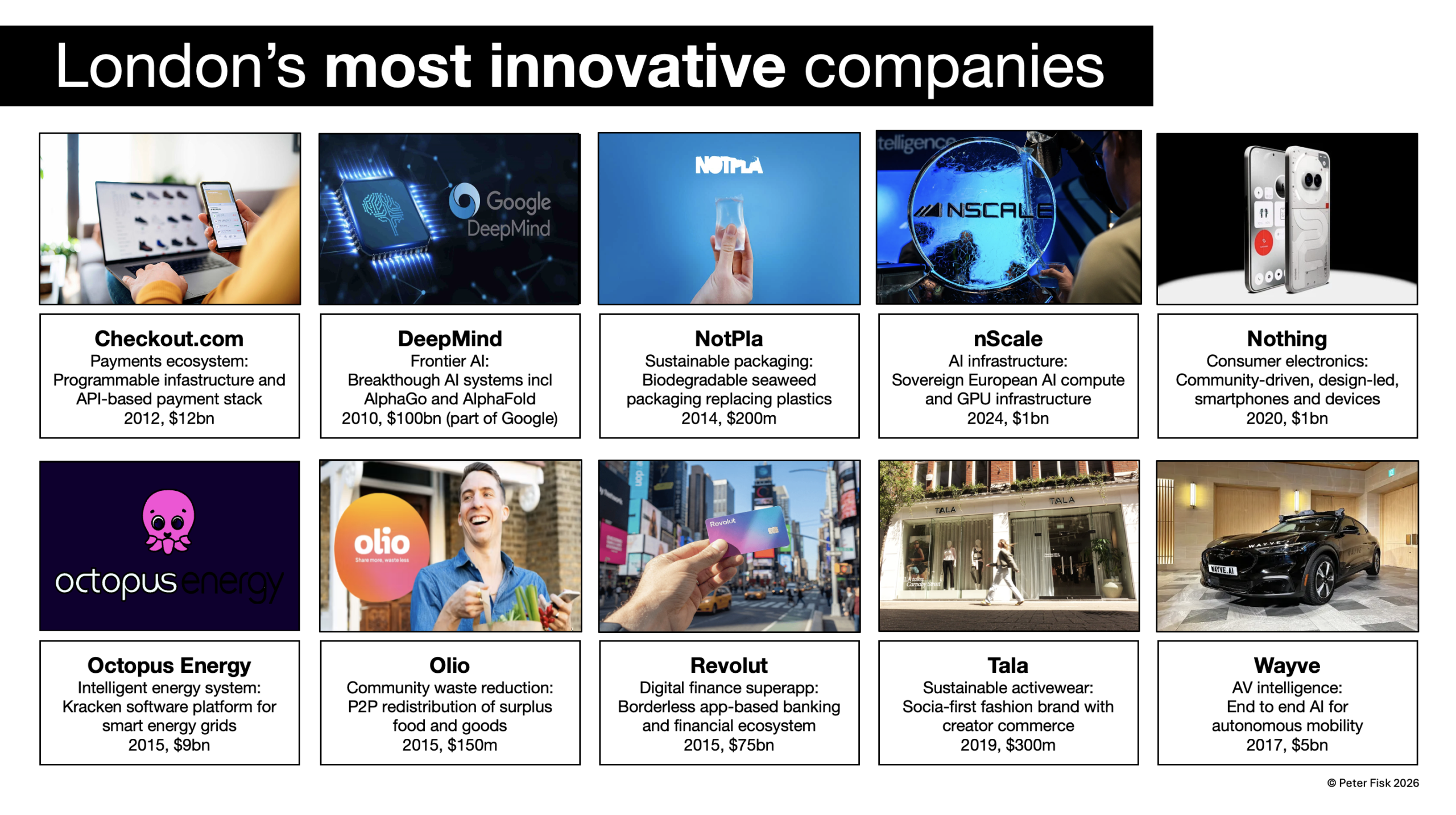
In many ways, Javier Goyeneche represents a new kind of entrepreneur for the 21st century: part fashion visionary, part systems thinker, part environmental activist, and part industrial innovator. While many sustainability pioneers focused on guilt, sacrifice, or anti-consumerism, Goyeneche took a radically different approach. His belief was simple but transformative: sustainability would only scale if it became desirable.
Rather than asking consumers to compromise, he wanted to prove that recycled fashion could be cooler, more premium, more technical, and more aspirational than conventional products.
That idea became ECOALF, now one of the world’s most recognised sustainable fashion brands.
Fashion Entrepreneur to Sustainability Pioneer
Born in Madrid, Goyeneche studied business in Spain, London and Paris, before completing postgraduate work in marketing at Northwestern University. Early in life he also competed internationally in equestrian sports, which shaped his discipline and global mindset.
His first major venture was Fun & Basics, launched in 1995. The company specialised in accessible contemporary handbags and fashion accessories. At its peak, the business grew to hundreds of points of sale and dozens of retail stores across Spain and internationally. Goyeneche became known as one of Spain’s most dynamic young fashion entrepreneurs, winning recognition including Madrid’s Best Young Entrepreneur award.
But success created discomfort.
As he travelled factories and supply chains, he became increasingly disturbed by the wastefulness of the fashion industry — one of the world’s most resource-intensive sectors. Massive water consumption, synthetic waste, overproduction, pollution, and disposable consumer habits all pointed to a broken system.
Then came a more personal turning point: the birth of his son Alfredo.
Reflecting on the world future generations would inherit, Goyeneche began asking a deeper question: could fashion exist without destroying the planet’s natural resources?
That question became ECOALF, named after his son Alfredo.
Making Recycling Cool
When ECOALF launched around 2009–2012, sustainability in fashion still largely meant earthy aesthetics, rough fabrics, hemp basics, and niche eco-products. Recycled materials were widely perceived as lower quality, ugly, or technically inferior.
Goyeneche wanted to overturn that perception completely.
His ambition was not to create “eco fashion.” It was to create great fashion — that happened to be sustainable.
That distinction mattered enormously.
Instead of leading with environmental messaging alone, ECOALF focused on:
- Minimalist premium design
- Urban aesthetics
- Technical performance
- Contemporary silhouettes
- High-quality materials
- Luxury-level finishing
The brand’s philosophy became: “Because there is no planet B.”
But unlike many activist brands, ECOALF avoided preaching. Its products had to compete first on desirability.
Consumers were not buying recycled jackets out of pity for the oceans. They were buying stylish outerwear that happened to be made from ocean waste.
That subtle shift changed everything.
Turning Trash into Raw Materials
The real breakthrough behind ECOALF was not branding alone. It was materials innovation.
Goyeneche quickly realised the market lacked high-quality recycled fabrics. Most available materials contained only small percentages of recycled content and performed poorly.
So instead of merely sourcing sustainable materials, ECOALF began building an entire innovation ecosystem.
The company spent years developing partnerships with factories, recyclers, textile specialists, polymer innovators, fishing communities, and manufacturing experts across countries including:
- Japan
- Taiwan
- Korea
- Portugal
- Spain
- Mexico
Together they developed new recycled fabrics, trims, linings, labels, yarns, soles, and technical materials.
ECOALF transformed:
- Plastic bottles into jackets
- Fishing nets into nylon fabrics
- Used tyres into shoe soles
- Post-industrial cotton into garments
- Coffee grounds into textile fibres
Goyeneche famously said “Where people see trash, I see raw materials.”
That mindset was bigger than fashion. It was industrial reinvention.
Building an Ecosystem, Not Just a Brand
One of the most important aspects of Goyeneche’s story is that ECOALF was never simply a clothing company. It evolved into a collaborative innovation ecosystem.
Rather than controlling everything vertically, Goyeneche orchestrated alliances across industries:
- Recycling facilities
- Material science companies
- Textile innovators
- Ocean cleanup organisations
- Fishermen associations
- Technology manufacturers
- Global retailers
This ecosystem approach allowed ECOALF to scale innovation faster than traditional fashion brands.
One notable initiative became the Upcycling the Oceans Foundation, launched with fishermen across the Mediterranean. The idea was brilliantly practical.
Fishing boats were already pulling huge quantities of marine plastic from the sea in their nets every day. Historically, that waste was simply thrown back into the water.
Goyeneche created a system where fishermen instead brought the waste back to port, where it could be sorted, recycled, and transformed into new products.
The initiative expanded across Spain and internationally, helping remove tonnes of marine debris while creating new recycled supply chains.
This was not just sustainability as branding. It was systems redesign.
Strategic Partnerships and New Ventures
Goyeneche also understood that partnerships could accelerate legitimacy and scale.
ECOALF collaborated with global retailers, department stores, technology companies, and lifestyle brands. One early breakthrough was working with Apple on recycled-material accessories and laptop cases, helping position ECOALF as a design-led innovation company rather than simply an ethical niche brand.
The company also partnered with Japanese firms including Sanyo Shokai, which became strategically important in expanding ECOALF into Asian markets and developing premium technical outerwear capabilities.
Japan proved especially aligned with ECOALF’s philosophy:
- Technical precision
- Minimalist aesthetics
- Material innovation
- Respect for craftsmanship
- Functional design
These collaborations helped elevate ECOALF beyond sustainability into premium lifestyle positioning.
Over time, the company expanded from accessories into:
- Outerwear
- Sneakers
- Swimwear
- Knitwear
- Lifestyle apparel
- Retail stores
- B2B collaborations
Scaling a Sustainable Business
Strategically, Goyeneche has grown ECOALF carefully rather than aggressively chasing fast-fashion scale.
The company positioned itself in the premium segment:
- Higher margins
- Longer-lasting products
- More conscious consumers
- Lower overproduction risk
- Stronger brand identity
This avoided one of the great contradictions of sustainability: endlessly producing cheap disposable products in the name of “green growth.” Instead, ECOALF built a brand around timelessness, durability, and responsible innovation.
Its flagship stores — particularly in Madrid — became embodiments of modern sustainable living: clean, contemporary, urban, and globally minded.
Importantly, ECOALF also became influential beyond its own revenues. It helped reshape how the wider fashion industry thought about:
- Circular materials
- Supply chain transparency
- Ocean plastics
- Technical recycled fabrics
- Premium sustainable branding
- Consumer perception of recycled goods
In many ways, ECOALF helped make sustainable fashion mainstream long before most global brands embraced it.
The Bigger Philosophy
At the heart of Goyeneche’s story is a profound strategic insight:
The future of sustainability is not about consuming less alone. It is about redesigning systems so that waste itself becomes value.
This is why ECOALF resonates far beyond fashion.
It represents:
- Circular economy thinking
- Regenerative business models
- Cross-sector ecosystems
- Design-led sustainability
- Innovation through constraints
- Emotional connection to environmental action
Goyeneche often argues that governments alone will not drive change fast enough. Instead, entrepreneurial companies must prove new models are commercially viable — then consumers, industries, and eventually regulators will follow.
His philosophy could be summarised as “Think micro, act macro.”
Small innovations, multiplied globally, can reshape industries.
What Comes Next?
The next chapter for ECOALF is likely far bigger than apparel alone.
Several strategic directions seem increasingly important:
1. Circular Materials Leadership
ECOALF is evolving from a fashion label into a materials innovation platform. Its future value may lie as much in intellectual property, partnerships, and recycled textile systems as in clothing sales themselves.
2. Ecosystem Expansion
Expect deeper collaboration with:
- Ocean recovery initiatives
- Biomaterials companies
- Advanced recyclers
- AI-enabled supply chains
- Textile traceability platforms
3. Global Lifestyle Positioning
The brand increasingly competes not simply with sustainable labels, but with premium global lifestyle brands focused on conscious urban consumers.
4. Regenerative Fashion
The next frontier may move beyond “less harm” toward regenerative systems:
- Carbon-negative materials
- Fully circular garments
- Textile-to-textile recycling
- Localised manufacturing ecosystems
5. Influence Beyond Fashion
Goyeneche himself has become an important voice in global conversations about business transformation, sustainability, and circular innovation.
His story increasingly matters not simply because he built a fashion company, but because he helped redefine what modern business can be.
Change your World
Many entrepreneurs build brands. Some build industries. A few help change mindsets.
Javier Goyeneche belongs in that final category.
He recognised early that sustainability would fail if it remained worthy but undesirable. So he fused ecology with aspiration, recycling with innovation, and environmental responsibility with beautiful design.
In doing so, he helped transform waste from a problem into a resource, and sustainability from a compromise into a competitive advantage.
That may ultimately be his greatest contribution: not simply making recycled fashion possible, but making it cool.
There are entrepreneurs who create companies, and there are entrepreneurs who fundamentally change how people think about innovation. Uri Levine belongs firmly in the second category. Best known as the co-founder of Waze, the crowdsourced navigation platform acquired by Google for more than $1 billion, Levine has become one of the world’s most influential voices on entrepreneurship, disruption and customer-centric innovation.
This week, as I work with Levine in Madrid, exploring the new challenges facing startups and scale-ups, it is striking how relevant his ideas are not only for entrepreneurs, but also for leaders of large established organisations seeking to drive radical innovation and transformation.
In a world of relentless disruption, geopolitical uncertainty, AI acceleration and collapsing industry boundaries, Levine’s core philosophy feels more urgent than ever: organisations must stop defending the past and become obsessed with solving the next generation of customer problems.
That philosophy is captured in the title of his bestselling book, Fall in Love with the Problem, Not the Solution. It sounds deceptively simple, but behind it lies a profound challenge to conventional management thinking. Most companies become emotionally attached to their products, systems and legacy business models. Levine argues that truly innovative organisations stay focused on customer frustration, adapting and reinventing solutions continuously as markets evolve.
His own entrepreneurial journey is perhaps the clearest proof of that mindset in action.
Growing up in a culture of reinvention
Levine was born in Israel in 1965, growing up in a country whose entrepreneurial culture has been well documented. Israel’s innovation ecosystem emerged from a unique combination of necessity, resilience, military technology expertise and global ambition. For Levine, this environment shaped not only his career, but his worldview.
Like many entrepreneurs, he developed an early appreciation for improvisation, problem-solving and challenging assumptions. There was little patience for hierarchy or rigid bureaucracy. Ideas mattered more than status. Resourcefulness mattered more than scale.
Before becoming an entrepreneur, Levine worked in telecoms and technology companies including Comverse, Celltrex and Openwave, building deep expertise in mobile communications at precisely the moment when mobile technology was beginning to reshape society. Yet he also became increasingly frustrated by the slowness of large organisations.
Big companies, he realised, often optimise the existing system instead of reimagining it.
That insight would later become central to his entrepreneurial philosophy.
The problem that inspired Waze
The inspiration for Waze came from one of the world’s most universal frustrations: traffic.
For decades, navigation systems relied on static maps and fixed routes. They could tell drivers where roads were located, but not what was actually happening on those roads in real time. Traffic jams, accidents and delays remained largely invisible.
Levine and his co-founders, Ehud Shabtai and Amir Shinar, saw an opportunity to rethink navigation entirely.
What if drivers themselves became the data network?
What if every smartphone user contributed live information about traffic conditions, hazards and congestion? What if maps evolved dynamically through community participation?
At the time, the idea seemed ambitious, even unrealistic. Established navigation companies such as TomTom and Garmin dominated the market, while Google Maps already appeared formidable. Investors questioned whether users would actively contribute information voluntarily.
But Levine understood something fundamental about human behaviour. People would participate if the experience delivered immediate value in return.
Every report about congestion helped other drivers — and improved the system for the contributor too.
Waze transformed navigation from a static utility into a living community.
Turning drivers into collaborators
The brilliance of Waze was never simply technological. Its genius lay in behavioural design.
Levine recognised that the most powerful digital platforms create network effects. The more people who participate, the more valuable the experience becomes. Every additional Waze user improved the platform’s intelligence and accuracy.
As smartphones spread globally, Waze grew rapidly. Drivers reported police activity, accidents, roadworks and traffic conditions in real time. The app constantly recalculated routes based on live information.
Commuters no longer felt powerless in traffic. They felt informed and connected.
This emotional dimension mattered enormously. Levine often emphasises that entrepreneurs must understand not only functional problems, but emotional frustrations. Traffic is not simply inefficient; it creates stress, uncertainty and wasted time. Waze reduced all three.
The company also moved quickly. Levine repeatedly argues that startups fail when they spend too long perfecting products internally rather than learning from real users. Waze evolved through continuous experimentation, iteration and feedback.
Its success came not from having a flawless original idea, but from adapting relentlessly.
Competing against giants
One of the most fascinating aspects of the Waze story was its willingness to challenge seemingly unbeatable competitors.
Levine was not intimidated by Google or traditional mapping companies because he understood a deeper truth about disruption: incumbents are often trapped by their existing business models and assumptions.
Large companies optimise.
Startups reinvent.
Waze did not try to build a slightly better map. It changed the nature of navigation itself, making it social, dynamic and community-powered.
Levine frequently says that entrepreneurs should seek markets where frustration is large and incumbents have become complacent. The bigger the problem, the bigger the opportunity.
Traffic congestion represented a global frustration affecting hundreds of millions of people every day.
That made the opportunity enormous.
The billion-dollar sale to Google
As Waze expanded internationally, interest from major technology companies intensified. Real-time mobility data was becoming strategically invaluable.
In 2013, Google acquired Waze for more than $1 billion.
For many founders, that would have marked the culmination of a career. Levine saw it differently. He has often spoken pragmatically about acquisitions, arguing that entrepreneurs should think rationally rather than emotionally about exits.
Sometimes, selling creates greater long-term impact than remaining independent.
Importantly, the Waze acquisition validated much more than a product. It proved that startups could disrupt giant industries by focusing relentlessly on customer pain points rather than technology alone.
It also reinforced another of Levine’s beliefs: community-powered platforms can scale extraordinarily fast when they solve meaningful everyday problems.
Falling in love with the problem
Levine’s book, Fall in Love with the Problem, Not the Solution, has become required reading in many entrepreneurial circles because it reframes innovation in such practical, human terms.
Most founders, he argues, make the same mistake: they become emotionally attached to their first idea.
But solutions evolve constantly.
Problems endure.
Entrepreneurs who obsess about the customer problem remain flexible and adaptive. Those who fall in love with their solution stop listening, stop learning and ultimately stop innovating.
It is a philosophy that applies equally to startups and multinational corporations.
Many established companies continue defending legacy products and business models long after markets have shifted. They optimise yesterday’s success rather than solving tomorrow’s frustrations.
Levine’s challenge to corporate leaders is therefore deeply uncomfortable: would your company be willing to disrupt itself before someone else does?
Entrepreneurship as a rollercoaster
One reason Levine resonates so strongly with founders is his honesty about the emotional reality of entrepreneurship.
He rejects the mythology of effortless startup success. Building companies, he argues, is a journey filled with setbacks, rejection and uncertainty.
Investors say no.
Products fail.
Customers disappoint.
Teams fracture.
Markets shift unexpectedly.
Entrepreneurship is not glamorous most of the time. It is exhausting.
Levine often describes startup life as a rollercoaster where founders experience emotional highs and lows constantly, sometimes within the same day. Managing psychology therefore becomes as important as managing strategy.
This realism gives his advice unusual credibility. He speaks not as a motivational guru, but as someone who has lived through repeated uncertainty.
Speed matters more than perfection
Another recurring theme in Levine’s thinking is speed.
Many organisations move far too slowly because they fear mistakes. Levine believes this is fatal in fast-changing markets. Startups learn through exposure to reality, not endless planning.
- Launch early.
- Test assumptions.
- Listen to users.
- Adapt quickly.
Perfection, in his view, is often the enemy of progress.
This mindset increasingly matters for larger organisations too. Many corporate innovation initiatives fail because they attempt to eliminate uncertainty before acting. Levine argues that uncertainty is unavoidable. The goal is to learn faster than competitors.
In an age of AI, platform disruption and rapidly shifting consumer expectations, that capability may become one of the most important competitive advantages of all.
Beyond Waze, building new ventures
Following Waze, Levine became involved in a wide range of startups and ventures, many focused on fixing broken or frustrating systems.
Among the most notable was Moovit, often described as the “Waze for public transport”. The platform used crowdsourced and real-time data to help people navigate buses, trains and urban transport systems more effectively. In 2020, Intel acquired Moovit for around $1 billion.
Again, the pattern was unmistakable.
Levine targeted markets characterised by friction, confusion and inefficiency.
He later became involved with more ventures — businesses spanning sectors from finance and travel to agriculture and mobility:
- Pontera: Fintech platform enabling financial advisors to securely manage clients’ 401(k) and retirement accounts to optimise long-term investment outcomes.
- Refundit: Travel tech app digitising VAT refunds for tourists, removing airport queues and paperwork while simplifying cross-border tax reclaim processes.
- FairFly: Airfare intelligence platform that monitors booked flights and automatically rebooks passengers when prices drop, saving money for travellers.
- SeeTree: Agritech platform using drones, satellites and data analytics to provide per-tree intelligence for orchards, improving yield and operational efficiency.
On the surface, they appear unrelated.
In reality, they all reflect the same philosophy: identify widespread frustration and redesign the customer experience from the ground up.
Levine does not chase fashionable sectors.
He chases broken systems.
Lessons for corporate leaders
Perhaps the most interesting aspect of Levine’s work today is how relevant it has become for large organisations facing disruption.
The challenge is no longer simply how startups grow.
It is how established companies reinvent themselves continuously.
Industries are converging rapidly. Automotive companies increasingly resemble software businesses. Banks are becoming digital platforms. Retailers are transforming into logistics, media and data ecosystems. Healthcare is shifting from hospitals to personalised prevention and digital services.
Levine argues that leaders must stop defining themselves by their current industry structure and instead focus on the customer problem they exist to solve.
This reframing changes everything.
It encourages organisations to think beyond traditional boundaries, legacy products and internal silos.
It also demands a very different leadership mindset — one based on experimentation, adaptability and humility.
Leaders no longer need all the answers.
They need the courage to ask better questions.
The human side of innovation
What ultimately makes Levine so compelling is that his philosophy is deeply human.
He is not fascinated by technology for its own sake. He cares about how innovation improves people’s lives. Technology matters only if it meaningfully reduces friction, stress, cost or complexity.
That perspective cuts through much of today’s AI hype.
Customers do not want artificial intelligence.
They want faster decisions, easier experiences, lower effort and better outcomes.
Levine consistently brings innovation back to that human reality.
His story also demonstrates that entrepreneurship is less about genius invention than deep empathy. The best entrepreneurs notice frustrations other people have simply accepted as normal. They see inefficiency not as inevitable, but as an opportunity.
That mindset transformed navigation through Waze.
And increasingly, it may become the defining capability for every organisation seeking relevance in a world of relentless change.
Reinventing the future
Uri Levine built one of the world’s most influential mobility platforms, but his greatest contribution may be the entrepreneurial philosophy he now shares globally.
A philosophy rooted not in hype, technology or valuation — but in solving meaningful human problems.
As companies everywhere confront disruption, uncertainty and accelerating technological change, Levine’s message feels more relevant than ever.
Stop protecting the past. Stop obsessing about existing solutions. Start with the frustration. Understand the problem deeply. Then reinvent relentlessly.
Or, as Levine himself puts it: fall in love with the problem, not the solution.
There is a moment in every great athlete’s journey when performance becomes something deeper than winning.
After years of relentless training, sacrifice, setbacks and recovery, they arrive at a different understanding of excellence. Peak performance is no longer about brute force or endless exertion. It becomes more holistic. More human. The greatest athletes learn that sustainable greatness comes from the integration of mind, body, emotion, purpose and resilience.
The pursuit shifts from simply pushing harder to becoming better.
The same transformation is now happening in business leadership.
For decades, leadership was largely defined by endurance, control and execution. Success meant working longer, driving harder, scaling faster. The corporate hero was the tireless executive who could absorb pressure without emotion and deliver results regardless of the personal or organisational cost.
That model produced extraordinary companies and immense economic growth. But it also created exhausted leaders, burned-out teams and cultures increasingly disconnected from meaning, humanity and long-term wellbeing.
Today, the context has changed dramatically.
AI is reshaping work. Markets are being reinvented overnight. Employees seek meaning as much as money. Younger generations expect businesses to contribute positively to society. Anxiety, uncertainty and complexity have become permanent features of organisational life.
The challenge for leaders is no longer simply how to perform. It is how to thrive whilst enabling others to thrive too.
This is not about lowering standards or becoming less ambitious. In many ways, the opposite is true. The leaders and organisations that will shape the future are those capable of sustaining extraordinary performance whilst remaining adaptive, energised, purposeful and deeply human.
In elite sport, the pursuit of greatness is not achieved through constant exhaustion. The best athletes understand rhythm — effort and recovery, intensity and reflection, discipline and renewal. They learn to manage emotional states, regulate pressure and maintain clarity amidst chaos.
Modern leadership increasingly demands the same sophistication.
The physiologist and endurance expert Alex Hutchinson has written extensively about the limits of human performance and the hidden role of the mind in extending endurance. His research demonstrates that peak performance is rarely just physical. It is shaped by belief, perception, emotional resilience and the stories we tell ourselves about our capabilities.
Business leadership is no different.
The future belongs to leaders who can expand possibility rather than transmit fear. Leaders who create trust under pressure. Leaders who combine ambition with empathy. Leaders who sustain energy rather than glorify burnout.
This is where “positive psychology” becomes deeply relevant.
The psychologist Martin Seligman spent decades challenging the assumption that psychology should focus only on dysfunction and weakness. Instead, he explored what allows people to flourish — optimism, meaning, resilience, strengths, hope and positive relationships.
His work transformed leadership thinking. Flourishing, he argued, is not naïve happiness. It is the ability to live with purpose, engagement, accomplishment and connection even amidst adversity.
In parallel, psychologist Susan David introduced the concept of “emotional agility” — the ability to engage honestly with emotions without becoming trapped by them. Her work is especially important in leadership because modern organisations often reward emotional suppression rather than emotional intelligence.
Yet emotions are not distractions from leadership. They are signals about what matters.
Leaders who ignore fear, uncertainty or exhaustion often make poorer decisions. Those who acknowledge emotions honestly — whilst responding with clarity and intention — create stronger cultures and greater resilience.
Perhaps few business leaders embody this shift more clearly than Satya Nadella.
When Nadella became CEO of Microsoft in 2014, the company was financially powerful but culturally stagnant. Internal competition, defensive thinking and institutional arrogance had weakened innovation. Nadella did not begin transformation primarily with technology. He began with mindset.
Influenced by psychologist Carol Dweck’s idea of the “growth mindset”, he encouraged the organisation to move from a culture of “know-it-alls” to “learn-it-alls”. Empathy became a strategic capability. Curiosity became more important than hierarchy. Collaboration replaced internal silos.
The results were extraordinary. Microsoft reinvented itself culturally and commercially, becoming once again one of the world’s most valuable and innovative companies.
Nadella demonstrated something profound: human-centred leadership is not separate from high performance. It is increasingly the foundation of it.
This insight sits at the heart of The Thrive Manifesto — ten commitments for leaders determined not merely to survive relentless change, but to flourish through it and help others do the same.
Because ultimately, leadership is not unlike elite sport.
The greatest athletes are never finished products. Even at their peak, they continue stretching limits, refining technique, strengthening mindset and redefining what is possible. They embrace discomfort because growth lives on the other side of it.
The best leaders do the same.
They remain curious. They adapt continuously. They recover intelligently. They develop emotional resilience. They sustain belief amidst uncertainty. And they inspire others to become more capable than they imagined possible.
In an age of volatility and transformation, thriving is not accidental. It is intentional.
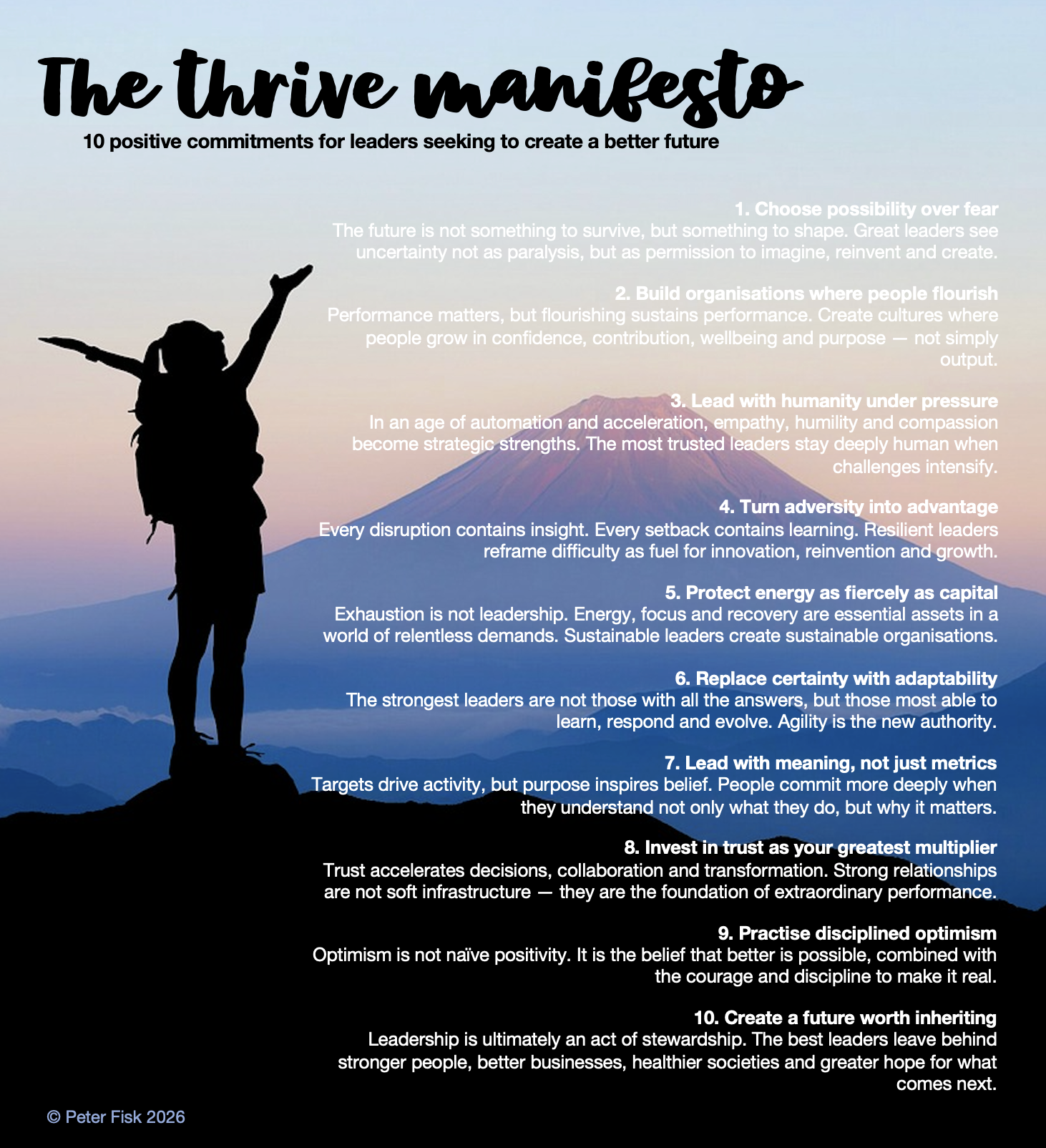
The Thrive Manifesto
1. Choose possibility over fear
The future is not something to survive, but something to shape. Great leaders see uncertainty not as paralysis, but as permission to imagine, reinvent and create.
Elite athletes understand that growth begins at the edge of discomfort. Improvement rarely happens inside familiar routines. It emerges through stretching limits — physically, mentally and emotionally.
Leadership works the same way.
Fear narrows perspective. It encourages defensive behaviour and incremental thinking. Possibility expands perspective. It encourages experimentation, reinvention and ambition.
Martin Seligman’s research into learned optimism showed that people who believe their actions can influence outcomes are more resilient, adaptive and persistent under pressure. Optimism is not wishful thinking. It is a strategic orientation towards possibility.
The leaders shaping the future are those willing to move before certainty arrives.
2. Build organisations where people flourish
Performance matters, but flourishing sustains performance. Create cultures where people grow in confidence, contribution, wellbeing and purpose — not simply output.
High-performance athletes do not train by destroying themselves every day. Their coaches carefully balance intensity with recovery, growth with restoration. The goal is sustainable excellence.
Yet many organisations still operate as though exhaustion equals commitment.
Flourishing cultures recognise that human energy is not infinite. People perform best when they feel psychologically safe, connected, valued and purposeful.
Seligman’s PERMA model — Positive emotion, Engagement, Relationships, Meaning and Achievement — provides a powerful framework for understanding human flourishing. Remarkably, these same qualities also underpin high-performing teams and organisations.
The best businesses increasingly understand that wellbeing and performance are not competing priorities. They are mutually reinforcing.
3. Lead with humanity under pressure
In an age of automation and acceleration, empathy, humility and compassion become strategic strengths. The most trusted leaders stay deeply human when challenges intensify.
Susan David argues that emotional agility begins by recognising emotions honestly rather than suppressing them. Difficult emotions are not weaknesses. They are information.
This is especially true in leadership.
During uncertainty, employees observe leaders intensely. They look for emotional steadiness, authenticity and trustworthiness. Leaders who communicate transparently create calm amidst chaos.
Satya Nadella often speaks about empathy not merely as a moral virtue, but as a source of innovation. Understanding human needs more deeply allows organisations to create better products, better cultures and better decisions.
In a world increasingly shaped by machines, humanity becomes a competitive advantage.
4. Turn adversity into advantage
Every disruption contains insight. Every setback contains learning. Resilient leaders reframe difficulty as fuel for innovation, reinvention and growth.
Elite athletes rarely develop resilience through victory alone. They grow through injury, defeat, setbacks and moments of doubt.
The same is true for organisations.
Alex Hutchinson’s exploration of endurance highlights how perceived limits are often psychological as much as physical. Human beings are capable of far more than they initially believe possible.
Great leaders cultivate this mindset inside organisations. They create cultures where setbacks become learning rather than shame.
Resilience is not passive endurance. It is intelligent adaptation.
5. Protect energy as fiercely as capital
Exhaustion is not leadership. Energy, focus and recovery are essential assets in a world of relentless demands. Sustainable leaders create sustainable organisations.
Many elite athletes obsess over recovery — sleep, nutrition, mental reset, reflection and restoration. They understand that peak performance requires deliberate renewal.
Yet business culture still often glorifies depletion.
The consequence is predictable: diminished creativity, poorer judgement and emotional fatigue.
Thriving leaders understand that energy management is strategic. Recovery is not separate from execution. It is part of execution.
The organisations that sustain innovation over decades will be those capable of sustaining human vitality too.
6. Replace certainty with adaptability
The strongest leaders are not those with all the answers, but those most able to learn, respond and evolve. Agility is the new authority.
In modern sport, champions constantly adapt — training methods evolve, strategies shift, technologies improve. Standing still means decline.
Leadership now requires similar adaptability.
Satya Nadella transformed Microsoft partly by embedding learning into culture. Curiosity became more valuable than certainty. Experimentation became more important than protecting ego.
Susan David’s concept of emotional agility also reinforces adaptability. Leaders who remain psychologically flexible respond more intelligently to complexity and change.
The future rewards leaders who evolve faster than circumstances around them.
7. Lead with meaning, not just metrics
Targets drive activity, but purpose inspires belief. People commit more deeply when they understand not only what they do, but why it matters.
Athletes pursuing greatness are rarely motivated purely by medals or rankings. They are driven by mastery, identity, purpose and contribution.
Business leadership is no different.
People want their work to matter. They want to feel connected to something larger than operational targets.
Purpose creates resilience because it provides emotional fuel during difficult periods.
Seligman’s work consistently demonstrated that meaning is central to flourishing. Achievement alone does not create fulfilment. Contribution does.
The most inspiring organisations therefore connect commercial ambition with human impact.
8. Invest in trust as your greatest multiplier
Trust accelerates decisions, collaboration and transformation. Strong relationships are not soft infrastructure — they are the foundation of extraordinary performance.
No athlete succeeds entirely alone. Coaches, teammates, medical staff and support systems all rely on deep trust.
Organisations are the same.
High-trust cultures move faster because people communicate openly, challenge constructively and collaborate more effectively.
Trust cannot be manufactured through slogans. It is built through consistency, integrity and empathy.
Nadella’s transformation of Microsoft succeeded partly because he rebuilt trust internally — replacing fear and rivalry with openness and collaboration.
Trust reduces friction. And in complex environments, reduced friction becomes a major competitive advantage.
9. Practise disciplined optimism
Optimism is not naïve positivity. It is the belief that better is possible, combined with the courage and discipline to make it real.
Elite athletes often maintain extraordinary belief even when evidence temporarily suggests otherwise. They trust the process. They persist through plateaus. They understand that progress is rarely linear.
Disciplined optimism operates the same way in leadership.
Martin Seligman’s research showed that optimistic people tend to recover faster from setbacks because they interpret adversity as temporary and solvable rather than permanent and defining.
This mindset becomes culturally contagious.
Leaders who communicate grounded optimism create confidence, resilience and momentum. They inspire people to continue moving forward despite uncertainty.
The future is created first through belief, then through disciplined action.
10. Create a future worth inheriting
Leadership is ultimately an act of stewardship. The best leaders leave behind stronger people, better businesses, healthier societies and greater hope for what comes next.
The greatest athletes eventually realise their legacy extends beyond medals or records. It lies in how they inspired others, elevated standards and expanded belief about what humans can achieve.
Leadership should aspire to the same standard.
Businesses today shape society profoundly — through technology, culture, employment, sustainability and innovation. Leaders therefore carry immense responsibility.
Thriving leaders think beyond short-term extraction. They build organisations capable of enduring contribution.
They ask not simply, “How do we grow?” but “What kind of future are we creating?”
Because ultimately, leadership is not about preserving the status quo. It is about expanding human possibility.
Thriving as the new advantage
The next era of business will not belong to the most ruthless organisations.
It will belong to the most adaptive, energised, purposeful and human ones.
The leaders who succeed will resemble elite athletes at the peak of their powers — disciplined yet curious, resilient yet reflective, ambitious yet grounded. Always learning. Always stretching. Always pursuing better.
They will understand that peak performance is not achieved through fear or exhaustion alone, but through belief, meaning, emotional resilience and human connection.
And perhaps that is the greatest leadership shift of all.
The future will not be shaped merely by smarter technologies or faster systems.
It will be shaped by leaders capable of helping human beings thrive amidst relentless change.