Each month The Brand Doctor takes an interesting, iconic brand that has lost its way, and considers how it could reinvent itself. If it’s your brand, do you have the courage to change? If not, what would you do, and how could you apply these ideas for reinvention to your own business?
Harvey Nichols was more than a place to shop. A Mecca of luxury brands, lifestyles, but it was also a bit different. It was never as grand or theatrical as Harrods, nor as broad and democratic as Selfridges. Instead, it had a sharper point of view, an edit rather than abundance, and bit more style.
It was a place of discovery: a carefully curated collection of fashion brands, emerging designers and contemporary lifestyle ideas. It did not overwhelm with abundance; it inspired through selection. It was somewhere to browse without urgency, to meet friends over coffee in its stylish café, or to find Christmas gifts that felt modern yet timeless.
More than a department store, Harvey Nichols was a window into what was next, a place where luxury felt less about tradition and more about curiosity, creativity and cultural relevance.
That was always the magic of Harvey Nichols. It understood that luxury was not only about abundance; it was about judgement. It was about knowing what mattered, what was next, and what deserved attention.
Yet affection alone cannot sustain a business. Despite its iconic location, powerful brand recognition and continued association with luxury, Harvey Nichols has struggled to maintain its distinctive position in a world where luxury itself has been transformed. The challenge is not that the store has lost its quality. The challenge is that the world around it has changed faster than the business model beneath it.
The next chapter of Harvey Nichols cannot be about incremental improvement. It cannot be achieved through a refreshed product mix, a better website or another refurbishment. Those things matter, but they are not enough.
Harvey Nichols needs a reinvention of the entire concept of the store. It needs to become something that comes after the department store. It needs to become “The Living Store”.
A heritage worth reinventing
The story of Harvey Nichols began almost two centuries ago, when Benjamin Harvey opened a linen shop in Knightsbridge in 1831. The business expanded when James Nichols joined the company, later becoming Harvey’s partner and giving the retailer the name it still carries today.
From those modest beginnings, Harvey Nichols evolved into one of Britain’s most distinctive luxury destinations. While Harrods built its identity around heritage, spectacle and global grandeur, and Selfridges around scale, creativity and mass appeal, Harvey Nichols found a different space.
It became the home of contemporary luxury.
Its reputation was built not on having everything, but on having the right things. It championed emerging designers, introduced customers to new ideas and created a more modern, fashion-forward interpretation of luxury. It became less a traditional department store and more a cultural signal—a place where London discovered what was coming next.
That identity was transformed further in 1991 when Hong Kong entrepreneur Dickson Poon acquired Harvey Nichols. His vision helped turn the business into one of the world’s coolest luxury stores during the 1990s. Harvey Nichols became part of London’s cultural landscape, famously referenced in Absolutely Fabulous, associated with fashion leaders and celebrities, and admired internationally for its contemporary attitude.
I remember meeting Dickson Poon around a decade after his acquisition. What struck me was not a lack of ambition. He clearly understood that retail was changing and that Harvey Nichols needed to evolve. But there seemed to be no single defining idea capable of reshaping the business for the next era.
Looking back, that conversation feels remarkably relevant today. The issue was never whether Harvey Nichols could improve. It was whether it could reinvent itself. And that distinction is critical. Improvement makes an existing model better. Reinvention creates a new model altogether.
The death of the department store
For more than a century, department stores succeeded because they solved a simple problem: they brought together the world’s best brands under one roof. That model was revolutionary. But the internet destroyed the scarcity that made department stores powerful. Today, consumers can access almost every luxury brand from anywhere in the world. They do not need a physical store to discover products.
Products are no longer the reason people visit. Experience is. The future competitive advantage of luxury retail will not be assortment. It will be imagination.
The question for Harvey Nichols is not“How do we sell more luxury products?” but “Why would someone choose to spend their precious time with us?” This is the fundamental shift taking place across luxury.
The world’s most successful premium businesses are no longer simply selling products or services. They are creating ecosystems around lifestyles, communities and aspirations. Luxury is moving from ownership to participation. From transactions to relationships. From stores to destinations.
Learning from the new icons of luxury
The most interesting examples of luxury reinvention increasingly come from outside traditional retail.
- Aman. It does not simply sell hotel rooms. It sells a philosophy of living—privacy, tranquillity, wellbeing and exceptional experiences. Guests are not buying accommodation; they are entering a world.
- Soho House. It does not sell access to buildings. It sells belonging. Its value comes from community, creativity and connection.
- Eataly. When Oscar Farinetti created Eataly, he did not simply build a premium supermarket. He reinvented food retail as an ecosystem of restaurants, producers, education, storytelling and culture. Customers do not just buy ingredients; they learn, experience and participate.
These businesses understand a fundamental truth: The product is only one part of the experience. The same principle can be seen in some of the world’s most innovative luxury destinations.
- Louis Vuitton has increasingly transformed its stores into cultural landmarks. Its retail spaces combine architecture, exhibitions, cafés, art and storytelling. The store is no longer simply where products are purchased; it is where the brand world comes alive.
- Dover Street Market turned fashion retail into a constantly evolving gallery, where designers, artists and ideas collide.
- 10 Corso Como in Milan created a new category entirely—part fashion store, part art gallery, part restaurant, part cultural salon.
These examples point towards a different future for Harvey Nichols. The store itself must become the experience.
The Living Store concept
The idea of The Living Store is simple.
A living store is not a static building filled with products. It is an evolving ecosystem that continuously creates reasons for people to return. It learns. It adapts. It surprises. It connects. It becomes part of people’s lives.
Harvey Nichols has the perfect foundations for this reinvention. It has a globally recognised name, an iconic Knightsbridge location, credibility in luxury fashion and a history of being more contemporary than its traditional rivals. But it needs to think much bigger.
The ambition should not be to create a better department store. The ambition should be to create London’s most inspiring luxury destination. Something closer to Battersea Power Station. Something closer to Marina Bay Sands.
When Battersea Power Station was transformed, the ambition was never simply to create another shopping centre. The vision was to reinvent a landmark as a living ecosystem combining retail, restaurants, offices, residences, culture and public space. Its value comes from the connections between the different elements.
Marina Bay Sands achieved something similar in Singapore. It became far more than a hotel. It integrated hospitality, entertainment, business, retail, architecture and experiences into a destination with global recognition.
Neither succeeds because of one individual component. They succeed because the ecosystem creates something greater than the sum of its parts. That is the opportunity for Harvey Nichols.
Reimagining the Harvey Nichols experience
If Harvey Nichols is to become The Living Store, the physical experience must be reinvented from the ground up.
The traditional department store is organised around categories: fashion, beauty, accessories, food, home. This made sense when customers came with a shopping mission. But tomorrow’s luxury customer is not looking for categories. They are looking for inspiration, discovery and a richer expression of how they want to live.
The future Harvey Nichols should therefore not be organised like a department store. It should be curated like a city. A place where different worlds connect.
Fashion remains at the heart of the proposition, but it should become more than a collection of designer concessions. Harvey Nichols should become the world’s most exciting showcase for contemporary fashion, combining established luxury houses with emerging designers, cultural collaborations, limited editions and experimental concepts.
The store should be where the next generation of luxury is discovered.
Imagine a space where a young designer from Seoul, Lagos or Copenhagen launches alongside an established Parisian fashion house. Where a fashion exhibition changes every month. Where customers can meet designers, understand craftsmanship and experience the stories behind the products.
Luxury becomes not just something you buy. It becomes something you understand.
Creating a new cultural experience
Food provides one of the clearest opportunities for reinvention.
Harvey Nichols has always understood that hospitality matters. Its restaurants and cafés have long been part of its appeal. But the future opportunity is much larger. The food experience should become one of London’s defining culinary destinations. Eataly provides the inspiration. Its genius was recognising that food is not simply a product category; it is a culture, a story and a social experience.
Harvey Nichols could create a luxury food ecosystem combining world-class restaurants, chef residencies, culinary festivals, wine academies, artisan producers, cooking experiences, sustainability showcases, future food innovations
The objective would not be to create another food hall. London already has those. The objective would be to create a place where people come to discover how the world eats. Food becomes a reason to visit Harvey Nichols even if someone never buys a fashion item. That is the essence of ecosystem thinking.
The same transformation applies to beauty.
The traditional beauty hall is one of the last remaining examples of twentieth-century retail thinking: rows of counters, brands competing for attention and transactions based around products. But beauty is being reinvented. Today’s consumers increasingly think about longevity, health, confidence, performance and wellbeing. The boundaries between beauty, healthcare and lifestyle are disappearing.
Harvey Nichols could become the world’s most sophisticated luxury wellbeing destination. Imagine combining advanced skincare with personal diagnostics, longevity science, nutrition, sleep optimisation, recovery therapies, fragrance creation, personalised beauty experiences
The future of beauty is not about looking better. It is about living better. A Living Store should reflect that.
Where customers become guests
Perhaps the greatest opportunity is the convergence of luxury retail and hospitality.
The world’s best luxury businesses understand that guests are more valuable than customers. Customers complete transactions. Guests build relationships.
Harvey Nichols should think like a luxury hotel. Could the upper floors become a small collection of exceptional residences? Not a conventional hotel, but a highly curated London experience for global luxury travellers.
Imagine twenty extraordinary suites designed with leading architects and fashion houses. Guests receive private shopping appointments, access to designers, exclusive dining experiences, cultural invitations and personal concierge services. The store becomes their London home.
This is how luxury ecosystems are built. Not by adding more products. By creating deeper relationships.
Building a luxury community
The traditional loyalty programme belongs to another era. Points, discounts and rewards are not the future of luxury. Belonging is.
Harvey Nichols should create a membership community—not based on spending levels, but shared interests and aspirations. Membership could include private fashion previews, conversations with designers, cultural salons, investment and entrepreneurship events, culinary experiences, travel partnerships, wellness programmes, access to creative communities
The goal is not to make customers buy more. The goal is to make them feel part of something. The strongest luxury brands have always understood this. People do not buy Rolex simply because they need a watch. They buy into a story. They buy into belonging.
The platform for the future of luxury
One of Harvey Nichols’ greatest opportunities is to become the global platform where the future of luxury emerges.
The luxury world is becoming increasingly diverse. The next generation of influential brands will not only come from Paris, Milan and London. They will emerge from Seoul, Mumbai, Lagos, São Paulo, Riyadh, Copenhagen and Mexico City.
Harvey Nichols has always had a heritage of discovery. It should reclaim that role. It should become the place where tomorrow’s luxury icons are first encountered. This means moving from being a retailer of brands to becoming a creator of brand value.
The world’s leading luxury companies no longer need another distribution channel. They need partners who can amplify their stories, create experiences around their products and connect them with communities. Harvey Nichols should become that partner.
A new business model
The biggest shift is commercial.
The Harvey Nichols of the past was primarily a retail business. The Harvey Nichols of the future should be a luxury ecosystem. Physical and digital, a curator of interesting brands and better experiences.
Revenue should increasingly come from retail, hospitality, restaurants, membership, events, education, wellness services, partnerships, media, experiences The store becomes a platform. The building becomes an ecosystem. The brand becomes a community.
This is not simply a turnaround strategy. It is a reinvention strategy.
Reinvention
The irony is that Harvey Nichols’ greatest weakness may become its greatest advantage.
It has struggled because it sits between worlds. It is not as historic as Harrods. It is not as broad as Selfridges. It is not as radical as Dover Street Market. But that also gives it freedom.
Harvey Nichols does not need to protect a century of tradition. It does not need to appeal to everyone. It has permission to reinvent.
The future belongs to companies that create new categories. Microsoft did not simply improve software; it created the cloud ecosystem. Fujifilm did not simply sell more film; it reinvented itself around healthcare and advanced materials. Lego did not simply make better toys; it rebuilt itself around creativity and communities.
Harvey Nichols has the opportunity to do the same. Not become a better department store. Become the first Living Store.
7 priorities for reinventing Harvey Nichols
The reinvention of Harvey Nichols should be built around seven strategic priorities:
- Redefine the Purpose: From Retailer to Lifestyle Curator: Harvey Nichols should move beyond being a destination where luxury products are sold and become the world’s home for contemporary luxury living—a place that brings together fashion, design, food, wellbeing, technology and culture.
- Reinvent the Store as an Ecosystem: The department store model should evolve into a living ecosystem where retail connects with hospitality, entertainment, education and creativity. Like Battersea Power Station and Marina Bay Sands, the destination itself becomes the source of value.
- Create Value Beyond the Brands: Luxury brands no longer need simple distribution. They need platforms that enhance their relevance. Harvey Nichols should become the place that makes the world’s best brands even more desirable through storytelling, experiences and community.
- Make Discovery the Core Experience: Harvey Nichols should return to its original strength: discovering what comes next. It should become the global showcase for emerging designers, new ideas and future luxury movements.
- Build Community, Not Just Customers: Replace traditional loyalty with membership, access and belonging. The goal is to create a global community of people connected by curiosity, creativity and a shared appreciation of exceptional experiences.
- Build a Multi-Dimensional Business Model: The future Harvey Nichols should generate value from retail, hospitality, food, wellness, events, education, media and partnerships. The business model must evolve from selling products to creating experiences.
- Lead the Reinvention of Luxury Retail: Harvey Nichols should not compete to become the best department store.
It should redefine what comes after the department store.
Every great era of business creates new winners by challenging old assumptions. The department store was one of the great innovations of the nineteenth century because it brought the world of products together in one place. The next generation of luxury destinations will succeed by bringing together something much bigger: products, experiences, ideas, communities and lifestyles.
Harvey Nichols has the heritage, location and credibility to lead that transformation. But the ambition must be bigger than retail. It must become a place where fashion meets culture, where technology meets craftsmanship, where food meets discovery, where wellbeing meets luxury and where people come not simply to buy, but to experience.
The world’s best luxury brands of tomorrow will not just create exceptional products. They will create exceptional places.
The opportunity for Harvey Nichols is to become one of those places. Not the department store of the past. But The Living Store of the future.
The FIFA World Cup is often described as the world’s greatest sporting event. But beyond the goals, rivalries and national pride, it has become something more: a global laboratory for understanding how organisations, nations and ecosystems compete in an age of constant change.
This year’s World Cup brought together 48 great teams: 1,248 players who play for 449 clubs across 71 countries. 72% of all players compete in countries outside their own. A truly global competition, Cape Verde to the USA.
The final four teams — England, France, Spain and Argentina — offer four different models of success. They demonstrate that competitive advantage no longer comes simply from size, resources or history. It comes from the ability to develop talent, build ecosystems, combine diverse capabilities and continuously reinvent.
This is the same challenge facing every organisation today.
Markets are becoming more volatile. Technology is accelerating change. Talent is increasingly global. Boundaries between industries are disappearing. The winners will not necessarily be those with the biggest resources, but those who can create the strongest systems for renewal.
Football provides a powerful lens through which to understand this new era.
National teams to global ecosystems
The World Cup is built around nations, but modern football is built around ecosystems.
The 2026 tournament has more teams than ever, reflecting the globalisation of the game. Yet the players representing those nations are themselves products of a deeply interconnected world.
A national team may carry a country’s identity, but its talent pipeline stretches across continents.
Argentina’s players represent a nation of around 46 million people, yet the vast majority compete outside Argentina — developed through global clubs and European leagues. France’s squad reflects decades of investment in diverse talent pathways, with players whose personal histories connect Africa, Europe and beyond. Spain combines domestic development excellence with international experience. England benefits from the global reach and financial power of the Premier League.
The modern footballer is a global professional. Born in one country. Developed in another. Playing in a third. Influenced by coaches, cultures and technologies from around the world.
This is not unique to sport. The same dynamics define the future of business.
Companies increasingly compete not by controlling every resource internally, but by orchestrating ecosystems — networks of partners, communities, customers, innovators and talent.
The question for leaders is changing: Not “What do we own?” but “What ecosystem can we create, influence and mobilise?”
4 models of competitive advantage
The final four nations represent four different approaches to winning.
France: The Global Talent Machine
France represents the future of talent competition.
Its national team is a product of diversity, migration and a sophisticated development system. Its strength comes from identifying potential, nurturing capability and creating pathways for individuals from different backgrounds to excel. France’s squad is the most valuable of the final four, estimated at around €1.5 billion.
But its advantage is not simply financial. Its real asset is its talent engine.
France demonstrates a critical lesson for organisations: diversity is not just a social value. It is a performance advantage. The best teams increasingly combine different experiences, perspectives and capabilities. Innovation happens at the intersection of differences. The organisations of the future will look less like traditional hierarchies and more like high-performing sporting ecosystems — constantly discovering, developing and deploying talent.
Spain: The Power of the System
Spain represents another model: the power of ideas, philosophy and operating systems.
Its success has rarely depended on simply acquiring the most expensive players. Instead, it has invested in a distinctive approach – technical development, intelligent movement, collective decision-making and a shared football philosophy. Spain demonstrates that sustainable advantage comes from capabilities, connection and intelligence, not just assets.
The same principle applies in business. Companies that rely only on individual stars are vulnerable. Companies that build strong systems can repeatedly create excellence. The question leaders should ask is “Are we dependent on exceptional people, or have we built an exceptional system?”
England: The Reinvention Story
England represents transformation.
For decades, England possessed one of the world’s strongest football cultures but struggled to convert potential into consistent success. The response was reinvention. Investment in academies, coaching, analytics, sports science and player development has transformed the national setup. England’s squad value, around €1.4 billion, reflects not only talent, but the strength of the ecosystem around that talent.
This is a lesson familiar to every established organisation. Past success can become a weakness if it creates complacency. The most dangerous competitors are not always new entrants. Sometimes they are established players who reinvent themselves faster. The future belongs to organisations that can combine heritage with renewal.
Argentina: The Power of Culture and Purpose
Argentina offers perhaps the most fascinating lesson.
With a squad value significantly below France, England and Spain, Argentina demonstrates that financial resources alone do not determine success. Its competitive advantage comes from culture. Football is deeply embedded in Argentine identity. Generations of players inherit a mindset of resilience, creativity and national pride.
Culture is often underestimated because it cannot easily be measured on a balance sheet. Yet culture shapes behaviour. It determines how teams respond under pressure, how people collaborate and whether individuals perform beyond expectations. In business, purpose and culture are becoming strategic assets. The strongest organisations do not simply have employees. They create communities of belief.
The new geography of talent
One of the biggest shifts in the global economy is the movement of talent.
Capital once moved faster than people. Today, ideas, skills and expertise flow across borders at extraordinary speed. Football illustrates this better than almost any industry. The best players are not confined by geography. They are attracted to the strongest development systems, competitive environments and opportunities.
Businesses face the same reality. The future workforce will be increasingly global, hybrid and fluid. Leaders will need to compete not only for customers, but for capability.
The organisations that win will be those that become talent magnets.
Teams beat individuals
Football also reveals an important leadership lesson.
The era of the lone superstar is fading. Even the greatest players need systems, teammates and environments that enable them to perform. The same is true in business.
Complex challenges — artificial intelligence, climate change, geopolitical uncertainty and shifting consumer expectations — cannot be solved by individual brilliance alone. They require teams that combine different skills, perspectives and experiences. The future organisation will look less like a machine and more like a championship team:
- clear purpose
- complementary capabilities
- adaptive strategy
- continuous learning
- shared accountability
Sport connects the world
Perhaps the most important lesson from the World Cup is not economic or strategic. It is human.
At a time of geopolitical tension, rising nationalism and increasing fragmentation, sport remains one of the few global experiences that can unite billions of people.
The previous World Cup final attracted around 1.5 billion viewers worldwide. The 2026 tournament, expanded across three nations and featuring 48 teams, will create an even larger shared experience.
Sport does not eliminate differences. It celebrates them.
Rival nations compete fiercely, but they also recognise each other’s excellence. Different cultures come together through a common language. This is an increasingly valuable lesson for our divided world.
The future belongs to the reinventors
The World Cup’s final four reveal four different pathways to success:
- France shows the power of diverse talent ecosystems.
- Spain shows the power of systems and shared intelligence.
- England shows the power of reinvention.
- Argentina shows the power of culture and purpose.
Together, they reveal a broader truth: In a world of constant change, competitive advantage is no longer something you possess. It is something you continuously create.
The winners of the future – in football, business and society – will be those who can attract talent, build ecosystems, adapt faster and bring people together around a shared ambition.
The beautiful game has always been about more than winning. It is about how humans come together to achieve extraordinary things.
A teenager in São Paulo sees a skincare routine on Instagram. She taps through a creator’s “get ready with me” video, follows a link to a livestream on a marketplace, compares bundles in an app, pays instantly through ApplePay, and picks up the product an hour later at a nearby locker. No shopping list. No store visit as a starting point. No “trip” to retail at all.
This is not a future scenario, it is already how retail works for many, particularly in the vast emerging markets of Asia and beyond. Discovery begins in entertainment. Commerce is embedded in content. Payment is invisible. Fulfilment is local, instant and omnipresent.
Retail has quietly stopped being a place. It has become a system.
I’ve seen this shift up close through my work this year with the business leaders of OXXO, the extraordinary proximity retail network built by FEMSA in Mexico and now expanding rapidly across North and South America, and also to Europe. What makes OXXO remarkable is not simply its scale, but its evolution: from convenience stores to everyday infrastructure for life itself.
In many communities, OXXO is no longer just where you buy snacks or drinks. It is where you pay bills, access financial services, send parcels, top up mobile data, pick up online orders, and increasingly where new services emerge – from healthcare clinics and government services, branded eateries to fuel partnerships, local market traders and community hub. It sits at the intersection of retail, finance, logistics, mobility and community life.
5 forces reinventing retail
Retailers are no longer competing to sell more products. They are competing to become the operating system of daily life.
What used to be a relatively stable value chain — manufacturers create, retailers distribute, consumers choose — has fragmented into a real-time, AI-mediated, platform-orchestrated environment where demand is continuously shaped, redirected, and monetised across multiple competing systems simultaneously.
And that shift is being driven by 5 powerful forces: discovery commerce, lifestyle ecosystems, strategic brands, autonomous retail and relationship-based membership. Together, they are rewriting what retail means—and who wins in the future.
The retail industry is seeing faster and more dramatic change than almost any other sector. Social influence, enabled by Instagram and TikTok has transformed the context in which consumers shop, integrators like Grab and Jio have transformed the channels by which they interact, and Walgreens to Walmart have transformed what they offer, and ultimately their reason for being.
We see a dramatic restructuring of the industry, built on a convergence of many adjacent sectors, an acceleration of technologies, and a disruptive change in business models, demanding new capabilities and new leadership. This goes far beyond new store formats, omnichannel delivery, and personalised loyalty. This is rapid, radical reinvention.
The world’s most innovative retailers – Amazon to Alibaba, Carrefour to Coupang, Getir to Gojek, Shopee to Sonae – increasingly look less like merchants and more like media companies, platform businesses, technology firms and lifestyle partners.
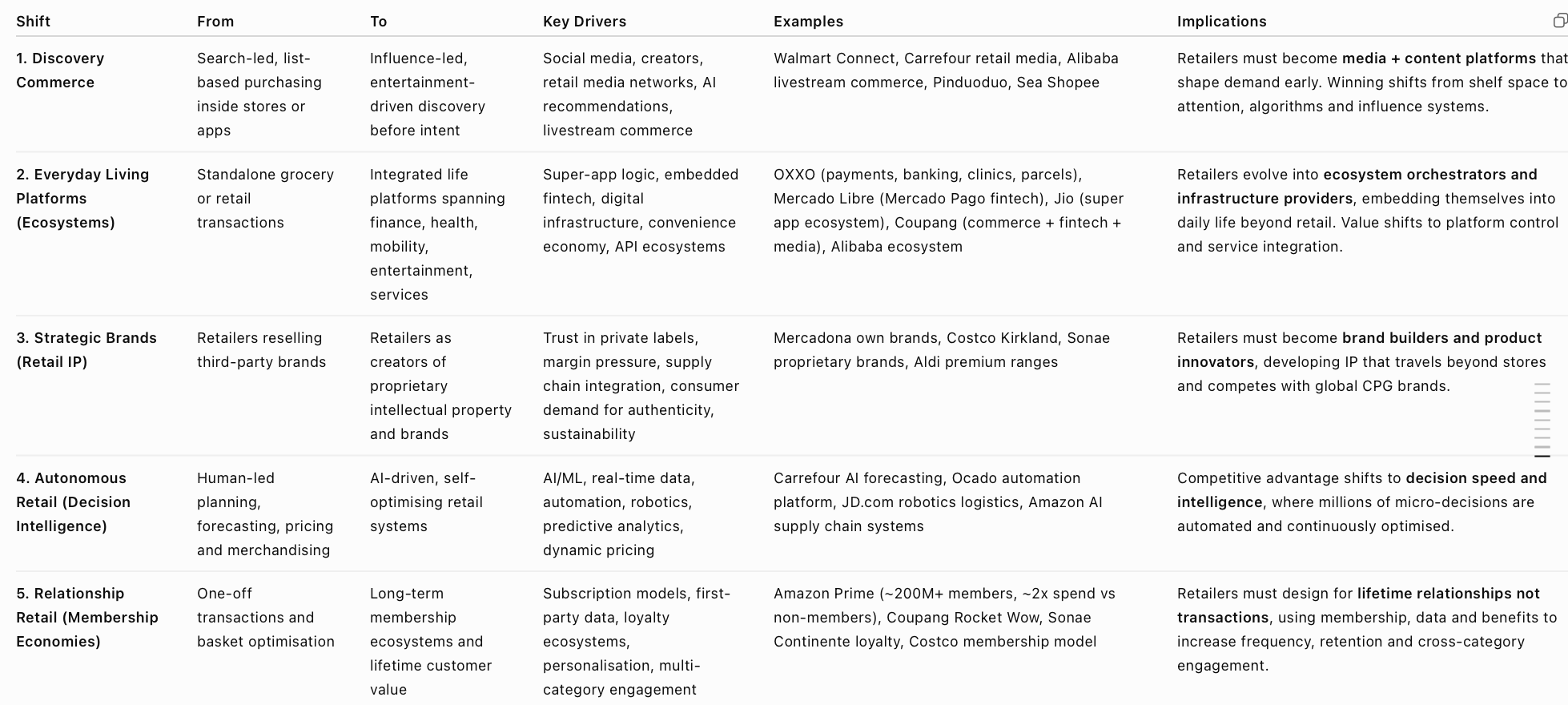
1. Discovery Commerce … from search to influence
Consumers increasingly buy what influences them, not what they search for. Shopping decisions are made long before a shopping list is written, shaped by creators, communities, AI recommendations, livestreaming and social media. The customer journey has shifted from “Search, Compare, Buy” to “Inspire, Discover, Validate, Purchase”.
The old journey was a functional journey, in the context of transactional retail. The new model typically starts elsewhere, on the sofa, in the gym, on vacation, with friends. On Instagram, or TikTok. Increasingly too, shopping is becoming entertainment. Consumers don’t simply discover products, they discover stories, experiences and communities.
Leading retailers are responding by becoming media businesses. Walmart Connect has become one of the world’s largest retail media platforms, enabling brands to influence shoppers long before they enter a store. Carrefour combines retail media with AI and loyalty data to personalise engagement, while Alibaba pioneered livestream commerce that blends entertainment and shopping. Pinduoduo transformed shopping into a social experience through group buying and gamification, while Sea’s Shopee combines gaming, creators and commerce to drive product discovery.
- More than 70% of purchase decisions are influenced before consumers enter a store, through digital content, recommendations and social engagement.
- Retail media is expected to exceed $175 billion globally by 2028, making it one of the fastest-growing advertising sectors.
- Livestream commerce already generates hundreds of billions of dollars annually in China, and is rapidly expanding globally.
What it demands: Retailers must stop thinking like merchants and start thinking like media companies. Systems thinking rather than funnel thinking. Winning is no longer about stocking products, it is about creating influence, shaping demand and building communities long before purchase.
2. Everyday Living … from food stores to lifestyle ecosystems
The world’s leading retailers are no longer building retail businesses—they are building platforms for everyday living. Grocery is becoming just one service within much broader ecosystems that include finance, healthcare, entertainment, logistics, telecoms, education and mobility.
The ambition is no longer to own a bigger share of a customer’s shopping basket, but a bigger share of their daily life.
OXXO has evolved into a neighbourhood services platform, offering banking, payments, parcel collection, telecom services and everyday financial transactions. Mercado Libre transformed an online marketplace into one of Latin America’s largest fintech businesses through Mercado Pago, alongside lending, insurance and logistics. Coupang combines retail with grocery, food delivery, streaming, fintech and its Rocket Wow membership, while Reliance Jio is creating India’s leading super app, integrating commerce, payments, pharmacy, entertainment, education and digital services. Alibaba has built an ecosystem spanning retail, payments, cloud computing, logistics, AI, entertainment and local services. Sea links gaming, digital finance and e-commerce into a single consumer platform.
Increasingly, retailers are becoming part of national and community infrastructure. They help people manage money, access healthcare, collect parcels, receive prescriptions, stream entertainment and navigate everyday life—not simply buy products.
- Mercado Pago now serves more than 60 million monthly active users, becoming one of Latin America’s largest digital financial platforms.
- Jio Platforms serves more than 490 million subscribers, creating one of the world’s largest integrated digital ecosystems.
- Ecosystem businesses consistently achieve significantly higher customer lifetime value because customers engage across multiple services rather than isolated transactions.
What it demands: Retailers must evolve from store owners into ecosystem orchestrators. Their role is to connect multiple services around the customer, creating indispensable platforms that customers use every day.
3. Strategic Brands … from private labels to IP advantage
Private labels are no longer cheaper alternatives, they are becoming strategic intellectual property. The strongest retailers are creating brands that stand for innovation, health, sustainability, premium quality and unique customer experiences. They have obvious advantages over conventional manufacturer brands, they can add services, become experiences, and be portfolios.
Increasingly too, these brands extend well beyond the retailer’s own shelves through licensing, partnerships, digital products and exclusive experiences.
Mercadona has built one of Europe’s most admired own-brand portfolios through relentless product innovation and deep supplier collaboration. Costco’s Kirkland Signature has become a global consumer brand in its own right, often outperforming traditional manufacturers. Sonae continues to develop proprietary brands that increasingly reach consumers beyond its own retail formats. It also means that sometimes more experiential stores can thrive like Eataly, where eating and cooking, come before buying.
- Private-label products account for more than 40% of grocery sales in several European markets.
- Premium private-label ranges continue to grow faster than value ranges as trust in retailer brands increases.
- Own brands typically deliver higher margins and stronger customer loyalty than equivalent national brands.
What it demands: The retailer is evolving from distributor to creator. Retailers must think like brand builders and product innovators, creating valuable intellectual property that customers actively seek rather than simply accept.
4. Autonomous Operations … from automation to decision intelligence
AI is becoming retail’s operating system. Rather than simply automating repetitive tasks, AI is increasingly making thousands of operational decisions every day—from demand forecasting and merchandising to dynamic pricing, inventory optimisation, personalised marketing and autonomous fulfilment.
Leading retailers are creating businesses that become progressively more self-managing. Carrefour uses AI to improve forecasting, optimise assortments and personalise promotions. Ocado has built one of the world’s most sophisticated AI-powered fulfilment platforms, combining robotics, automation and predictive analytics. JD.com deploys robot warehouses and autonomous delivery technologies, while Amazon continues to expand AI across merchandising, logistics and store operations.
- AI can reduce forecasting errors by 20–50%, significantly lowering waste and stock-outs.
- Leading retailers now deploy AI across merchandising, pricing, marketing, supply chains and customer service rather than isolated functions.
- Autonomous fulfilment can dramatically improve productivity while reducing operating costs and delivery times.
What it demands: Competitive advantage increasingly comes from decision intelligence—the ability to make millions of faster, smarter and more autonomous decisions than competitors.
5. Relational Experiences … from transactions to membership
The most valuable customers are not those with the biggest baskets, but those with the strongest relationships. The world’s leading retailers are shifting from transactions to memberships, creating recurring engagement, richer customer data and greater lifetime value.
Loyalty is evolving into subscription. Membership becomes the operating system that connects multiple services into one seamless customer relationship.
Amazon Prime has redefined retail membership by combining fast delivery, groceries, entertainment, healthcare and exclusive benefits into a single subscription. Coupang’s Rocket Wow performs a similar role by integrating grocery, commerce, food delivery, streaming and rapid fulfilment into one membership experience. Sonae’s Continente loyalty ecosystem connects supermarkets with health, fashion and partner services, creating a richer, more personalised customer relationship across multiple aspects of everyday life.
- Amazon Prime has more than 200 million members globally, with members spending approximately twice as much annually as non-members.
- Subscription and membership customers typically shop more frequently, remain customers for longer and demonstrate significantly higher lifetime value.
- The combination of membership, first-party data and AI is becoming one of retail’s most powerful competitive advantages.
What it demands: Retailers must optimise customer lifetime value rather than basket value—building relationships that become stronger with every interaction, across every format and service.
The Bigger Shift … retail beyond retail
Across all five shifts, one pattern repeats:
- From products, to platforms
- From stores, to systems
- From transactions, to relationships
- From operations, to intelligence
- From retail, to infrastructure to everyday life
Retail is no longer a sector defined by selling goods. It is becoming a set of overlapping influence systems, service ecosystems, brand factories, autonomous decision engines and relationship platforms.
The companies that win will not simply move along these axes individually—they will integrate all five simultaneously into a coherent operating model of modern life.
The future of retail is not a more efficient version of what exists today, it is a fundamentally different role in society.
Retail will increasingly disappear as a distinct “sector” at all. Instead, it will be woven into the fabric of everyday life: shaping what people want before they know it, orchestrating services across health, money, mobility and entertainment, and using AI to anticipate needs in real time. Stores will matter less as destinations and more as nodes in living networks. Brands will matter less as labels and more as trusted systems. And transactions will matter less than continuous relationships.
The most successful retailers will no longer ask how to sell more things. They will ask a deeper question: how do we become indispensable to how people live?
In that world, the boundary between retail, technology, media, healthcare, finance and infrastructure dissolves. What emerges instead are adaptive platforms that learn, evolve and respond—quietly shaping daily life in the background, while feeling effortless on the surface.
And perhaps the most profound shift of all: retail stops being something we go to.
It becomes something that is always with us.
For more than 35 years, I have been fortunate to work with business leaders in every corner of the world, helping them imagine what comes next and reinvent their organisations for a changing future. Along the way, I have worked with more than 300 companies across over 50 countries, from global giants to ambitious start-ups, from government agencies to family businesses.
One lesson has become increasingly clear. Great ideas are not confined to Silicon Valley, London or Shenzhen. Innovation can emerge anywhere. Not because one place has better technology than another, but because people everywhere face problems worth solving. The best innovators simply see those problems differently.
In Argentina, I helped Mercado Libre develop one of the world’s leading fintech platforms. In Egypt, I worked with Orascom to imagine entirely new cities. In Azerbaijan, Azercell reinvented telecoms as a life concierge. In China, I watched Haier transform from an appliance manufacturer into a global ecosystem of connected products and services. In Iceland, Climeworks pushed the boundaries of carbon capture. In Denmark, the city of Odense reinvented itself as one of the world’s leading robotics hubs.
These experiences have convinced me that the geography of innovation is being rewritten. Every country, city and organisation has the potential to shape the future in its own distinctive way. That is why Mehran Gul’s The New Geography of Innovation resonated so strongly with me. It captures a truth I have seen repeatedly throughout my career: the next great idea could come from anywhere.
Innovation without borders
It is a rethinking of one of the most persistent myths in modern business: that innovation is concentrated in a small number of global “hotspots,” most notably Silicon Valley. Gul challenges this idea directly, arguing instead that innovation is becoming increasingly distributed, multipolar, and shaped by a far more complex global landscape of cities, institutions, capital flows, and talent networks.
At its core, the book is about movement—of ideas, people, capital, and technologies—and how that movement is reshaping where innovation happens and who gets to participate in it. Gul’s central argument is that we are entering an era in which innovation is no longer anchored to a few dominant geographies, but instead emerges from a shifting mosaic of regional ecosystems, each with its own strengths, constraints, and strategic logic.
Rather than treating innovation as a purely technological phenomenon, Gul frames it as a geopolitical, institutional, and urban process. Where innovation happens depends not just on talent and venture capital, but on regulation, culture, infrastructure, education systems, state capacity, and global connectivity. In this sense, geography is not background—it is destiny-shaping.
Beyond Silicon Valley
One of the book’s central intellectual targets is the “Silicon Valley narrative”, the idea that breakthrough innovation is primarily the product of a unique concentration of talent, risk capital, and entrepreneurial culture in one region.
Gul does not deny Silicon Valley’s importance. Instead, he argues that its dominance has created a misleading mental model. For decades, policymakers and business leaders have assumed that replicating Silicon Valley requires copying its surface features: venture capital, startups, incubators, and tech campuses. But this overlooks deeper structural conditions that are far harder to replicate.
These include:
- deep university-industry linkages
- immigration-enabled talent inflows
- legal frameworks that support risk-taking
- massive defence and research spending
- dense professional networks
- a culture of failure tolerance
- global market access
Silicon Valley is not just a cluster of companies. It is an entire institutional ecosystem that evolved over decades, often through unique historical conditions.
Gul’s key point is that trying to reproduce Silicon Valley elsewhere often fails because it focuses on symptoms rather than systems.
The rise of new innovation hubs
Rather than a single dominant centre, Gul describes a world in which multiple innovation hubs are emerging simultaneously, each specialising in different dimensions of technological and industrial development.
He highlights the rise of cities and regions across Asia, the Middle East, Europe, and Latin America that are developing distinctive innovation profiles. Some excel in manufacturing ecosystems, others in digital platforms, fintech, biotech, or deep-tech research.
For example:
- Shenzhen represents manufacturing speed, hardware iteration, and supply chain density.
- Bangalore has become a global hub for software engineering and digital services.
- Tel Aviv stands out in cybersecurity and defence-related innovation.
- Berlin and London combine creative industries with fintech and digital entrepreneurship.
- Singapore has positioned itself as a regulated innovation hub, balancing state capacity with openness.
Rather than competing to become “the next Silicon Valley,” these regions are developingdifferent models of innovation suited to their institutional contexts.
Gul’s argument is that this diversity is not a temporary phase, but the defining characteristic of the next era.
Innovation as an ecosystem, not a place
A central conceptual shift in the book is the move from thinking about innovation as location-based to thinking about it as ecosystem-based.
In Gul’s framing, innovation is not simply what happens in a city. It is what happens when multiple systems align:
- universities producing research and talent
- firms commercialising ideas
- investors allocating risk capital
- governments shaping regulation and incentives
- infrastructure enabling connectivity
- global networks linking local ecosystems to markets
When these elements reinforce each other, innovation accelerates. When they are misaligned, even well-resourced regions struggle.
This explains why some cities with significant capital and talent still fail to produce sustained innovation, while others with fewer resources succeed.
Gul emphasises that ecosystems are dynamic. They evolve over time, responding to shocks such as technological shifts, geopolitical changes, and economic crises. This dynamism means that no innovation geography is permanently dominant.
The role of the state in shaping innovation
A particularly important theme in the book is the role of the state—not as a passive regulator, but as an active architect of innovation systems.
Gul argues that different countries adopt fundamentally different models of state involvement in innovation. Some adopt a laissez-faire approach, relying heavily on markets and venture capital. Others take a more interventionist stance, using industrial policy, strategic investment, and infrastructure development to shape outcomes.
Importantly, he suggests that both models can work—but in different contexts and for different types of innovation.
For example, state-led strategies have been particularly effective in scaling industries that require coordination, capital intensity, and long time horizons, such as semiconductors, renewable energy, and advanced manufacturing. Market-led systems tend to excel in software, platforms, and consumer internet innovation, where experimentation and speed matter more than coordination.
The implication is that there is no single optimal model of innovation governance. Instead, countries must align their institutional structures with their strategic ambitions.
Globalisation and fragmentation
Another key argument in The New Geography of Innovation is that globalisation is not disappearing, but transforming.
Earlier phases of globalisation were characterised by increasing integration, with supply chains spreading across borders in pursuit of efficiency. Innovation often followed this pattern, with multinational firms distributing R&D, production, and talent across global networks.
However, Gul argues that we are now entering a more fragmented phase, shaped by geopolitical competition, supply chain resilience concerns, and strategic decoupling in certain industries.
This fragmentation does not eliminate innovation networks, but it reshapes them. Companies and countries are increasingly building regionalised innovation systems, balancing global connectivity with strategic autonomy.
As a result, innovation is becoming both more global and more local at the same time: global in knowledge flows, but local in production and strategic control.
Talent as the true currency of innovation
Across the book, Gul consistently returns to one central resource: talent.
While capital is mobile and technology is increasingly accessible, talent remains the most important constraint on innovation ecosystems. However, talent itself is becoming more geographically fluid due to remote work, digital platforms, and global education networks.
This creates a paradox: talent is both more concentrated in certain hubs and more distributed globally than ever before.
Cities and countries that successfully attract, retain, and develop talent gain disproportionate advantages. Immigration policy, education systems, quality of life, and professional opportunity all become critical determinants of innovation success.
Gul suggests that in the long term, the most successful innovation ecosystems will be those that function as talent magnets rather than capital magnets.
The importance of institutional density
A subtle but important idea in the book is what might be called “institutional density.” Innovation ecosystems thrive not just because of individual companies or universities, but because of the richness of interactions between institutions.
Dense ecosystems allow:
- rapid knowledge transfer
- cross-sector collaboration
- faster commercialisation of research
- mobility of talent between firms
- feedback loops between markets and innovation
Silicon Valley’s enduring advantage, Gul argues, is not just venture capital or startups, but the density of relationships between universities, firms, investors, and government agencies.
Emerging hubs that want to compete must therefore focus not only on attracting anchor companies, but on building these deep relational structures.
Innovation cycles and shifting leadership
Gul also emphasises that innovation leadership is cyclical. Historically dominant regions eventually lose their edge as new technologies, industries, and institutional conditions emerge.
For example, leadership in industrial innovation has shifted over time from Britain to the United States, and now increasingly to a more distributed global system involving Asia, Europe, and beyond.
These shifts are not random. They reflect changes in:
- energy systems
- communication technologies
- production methods
- education systems
- geopolitical structures
The implication is that current innovation maps are temporary. The geography of innovation is always being rewritten.
The new geography
The most important idea in The New Geography of Innovation is that innovation is not anchored to place—it is anchored to systems of alignment.
Places matter, but only insofar as they enable the alignment of institutions, capital, talent, infrastructure, and governance.
This reframing has significant implications for governments, investors, and corporate leaders. Instead of asking “Where is the next Silicon Valley?”, the more useful question becomes:
Where are the ecosystems most effectively aligning the conditions for innovation in a particular domain?
A more complex innovation world
The New Geography of Innovation ultimately replaces a simple story with a more complex—but more realistic—one. Innovation is no longer the preserve of a handful of global cities. It is a distributed, competitive, and evolving system shaped by multiple overlapping forces.
Gul’s message is both cautionary and optimistic. Cautionary because no region can assume permanent leadership in innovation. Optimistic because the diffusion of innovation capabilities creates more opportunities for countries, cities, and organisations to participate in shaping the future.
The geography of innovation is no longer fixed. It is fluid, contested, and constantly being redrawn.
“The world is in perpetual motion, and we must invent the things of tomorrow. One must go before others, be determined and exacting, and let your intelligence direct your life. Act with audacity.”
Few quotations capture the essence of innovation and leadership as elegantly as these words from Madame Clicquot, the visionary behind one of the world’s greatest champagne houses. Written to her great-granddaughter more than 150 years ago, they read less like family advice and more like a timeless manifesto for anyone determined to shape the future.
Madame Clicquot understood something that many leaders still struggle to embrace: change is not an interruption to business, it is the natural condition of the world. Markets evolve, technologies redefine industries, customer expectations shift, and competitive advantage is always temporary. The only sustainable response is to keep inventing what comes next.
Her challenge to “go before others” is a call to lead rather than follow. The future is rarely created by those who wait for certainty or consensus. It belongs to those with the courage to explore new possibilities, question accepted wisdom, and act before the opportunity is obvious to everyone else.
Yet she also recognised that bold ambition without disciplined execution is little more than wishful thinking. She combined audacity with determination, precision and exacting standards. Innovation succeeds not simply because ideas are original, but because they are pursued with relentless excellence.
Perhaps her most important message is to “let your intelligence direct your life.” In an age overwhelmed by noise, opinion and convention, she reminds us to think independently, stay curious, trust evidence and exercise sound judgement.
The entrepreneurial life of Barbe-Nicole Clicquot
In 1805, at just 27 years old, Barbe-Nicole Ponsardin Clicquot was widowed when her husband, François Clicquot, died unexpectedly. François was heir to a small but promising Champagne house in Reims, a region already beginning to develop international recognition for sparkling wine.
Their marriage had been as much commercial partnership as personal union. François was interested in expanding the business, and Barbe-Nicole had been exposed early to commerce, finance, and disciplined thinking through her family background in French aristocratic banking circles.
When François died, the business was fragile. France was still in the turbulence of the Napoleonic era. Trade routes were unstable, and luxury consumption was unpredictable.
The opening of her story, often portrayed in modern retellings including the recent film Widow Clicquot, is strikingly stark. At François’s funeral, she stands in grief—but also at a crossroads that is both personal and structural.
Her father-in-law, Philippe Clicquot, saw only risk. He proposed selling the vineyards to the Möet family, effectively dissolving the enterprise into a rival dynasty.
This is where the story becomes strategic rather than sentimental.
The Möet family, already influential in Champagne, would later become part of what is now Moët Hennessy Louis Vuitton through modern consolidation. At the time, however, they represented competitive absorption: a reminder that industries tend to consolidate around stronger operators unless countered by decisive leadership.
Barbe-Nicole refused.
She resisted not just emotional loss, but structural absorption. She argued to retain control of the vineyards and the business. In doing so, she made a decision that transformed her from widow into operator, and eventually into one of the earliest examples of a global brand architect.
Widow Clicquot, the movie
Her life has recently been reinterpreted in the film Widow Clicquot, which opens with the emotional shock of François’s funeral in 1805 and the immediate threat of losing the vineyards.
A line from the film captures its symbolic resonance: “When they struggle to survive, they become more reliant on their own strength… they become more of what they were meant to be.”
While fictionalised in places, the film captures an essential truth: pressure reveals structure. Barbe-Nicole Clicquot’s life was not defined by inheritance, but by transformation under pressure.
The reinvention of champagne
What followed was not continuation, it was reinvention.
She took control of a fragile, regional wine house and, over the next decades, transformed it into one of the first globally recognised luxury brands in history.
Her leadership can be understood through four interlocking dimensions that remain foundational to modern branding and entrepreneurship.
1. Building a global business in a time of extreme disruption
Her first strategic act was international expansion under conditions that should have made expansion impossible.
France in the early 19th century was defined by war, blockade, political upheaval, and fragile trade infrastructure. Most producers contracted inward. She expanded outward.
Rather than treat instability as a constraint, she treated it as a directional signal: if domestic markets were unreliable, then survival required global imagination.
Her most important breakthrough came through Russia.
Following the Napoleonic wars, Russian aristocracy developed a strong appetite for French luxury goods as symbols of sophistication and cultural alignment with Europe’s elite traditions. Barbe-Nicole moved decisively into this market.
Her champagne became deeply embedded in aristocratic ritual—served at court celebrations, diplomatic gatherings, and elite social occasions. It was not merely exported; it was adopted as a cultural marker.
This was early-stage globalisation executed without modern infrastructure. She built distribution networks, navigated tariffs, managed political uncertainty, and ensured consistent supply in a volatile environment.
In doing so, she accomplished something rare: she turned Champagne from a regional product into an international category.
2. Innovation that made scale possible
Her second breakthrough was technical, but its consequences were strategic.
One of her most significant contributions was the refinement and commercialisation of the “riddling table” (remuage) process. This innovation allowed winemakers to gradually move sediment into the neck of the bottle, enabling clearer champagne after disgorgement.
Before this, champagne was inconsistent, often cloudy, and difficult to standardise. After it, it became reliable, scalable, and exportable.
This matters because luxury without consistency cannot scale.
In modern business terms, she solved the problem of industrial reproducibility in a product that depended on biological variability. This enabled export markets to trust the product across distance and time.
She effectively turned champagne into a manufacturable luxury good—without stripping away its craftsmanship identity.
3. Creating champagne as a global luxury brand
Her third contribution was perhaps the most profound: she did not just sell champagne—she created its meaning.
Before her intervention, champagne was a regional beverage. After her, it became a cultural symbol.
She understood something that modern brand strategists still emphasise: value is not inherent in the product, it is constructed in the mind of the consumer.
She positioned her champagne as a drink of celebration, refinement, and emotional significance. It became associated not with consumption, but with moments of transition and meaning: victory, joy, prestige, and occasion.
In Russia especially, champagne became part of elite identity expression. Her brand became embedded in aristocratic rituals, where opening a bottle signified not just hospitality, but status.
This is the origin of Veuve Clicquot as we know it today: not a beverage, but an emotional signal.
Modern Veuve Clicquot still reflects this legacy. Its branding, packaging, and tone continue to emphasise boldness, confidence, and celebratory modernity. The iconic yellow label is not merely aesthetic, it is semiotic. It signals recognition, prestige, and continuity with a two-century-old idea of luxury.
She created one of the earliest examples of what we would now call experience-based branding: where the product is secondary to the meaning it carries.
(Indeed while Veuve Clicquot translates from French as Widow Clicquot, the brand has reframed Veuve as “verve” meaning energy, confidence and celebration).
4. Execution … discipline, quality, and operational control
Her fourth contribution was executional excellence.
She was famously rigorous about quality control, production standards, and distribution discipline. She understood that luxury brands are not built through aspiration alone, but through relentless consistency.
In an era without modern logistics systems, she ensured that product integrity was preserved across borders and time. She personally oversaw decisions relating to production quality, pricing strategy, and export reliability.
This created something essential: trust.
And trust is the hidden infrastructure of luxury. Without it, branding collapses into marketing. With it, brands become institutions.
Her discipline ensured that every bottle reinforced the same promise: quality, refinement, and celebration.
A competitive landscape: Moët and industry consolidation
It is impossible to understand her achievement without situating it within the broader competitive landscape of Champagne.
One of her most important early competitors was the Möet family, already active in Champagne production during her time. While she was building Veuve Clicquot into a structured export business, Moët was also expanding its own presence.
This parallel evolution matters because it shows that Champagne was not a solitary success story—it was an emerging competitive ecosystem of houses defining different interpretations of luxury.
Over time, these brands evolved through mergers and consolidation. Today, both lineages sit within the same global luxury architecture under LVMH Moët Hennessy Louis Vuitton, one of the world’s largest luxury groups.
In a sense, what began as entrepreneurial competition in the early 19th century has become part of the foundation of modern luxury capitalism.
Madame Clicquot’s legacy therefore sits not only in Veuve Clicquot, but in the entire architecture of Champagne as a global category.
La Grande Dame … a woman ahead of her time
Her achievements become even more remarkable when viewed against the constraints of her era.
She operated in a legal and cultural system where women were rarely permitted to own or control businesses independently. She faced institutional scepticism, financial pressure, and social expectations that did not anticipate female leadership at scale.
Yet she did not merely participate in the system, she redefined its possibilities.
She became known as “La Grande Dame of Champagne”, a recognition that reflects both her commercial success and her cultural impact.
Veuve Clicquot, the brand today
Today, Veuve Clicquot stands as one of the most recognisable luxury champagne brands in the world. Its identity – bold, confident, slightly irreverent, but always refined – still reflects her original entrepreneurial DNA.
The brand operates across global luxury markets, from Europe and the United States to Asia, maintaining a positioning that blends heritage with modern cultural relevance. Its events, collaborations, and design language all reinforce a central idea: celebration is not passive, it is intentional.
That idea originates with her.
A legacy of audacity
Madame Clicquot’s legacy is not simply that she built a successful champagne house. It is that she helped invent the architecture of modern luxury branding.
She transformed a fragile inheritance into a global institution. She turned a regional product into a cultural symbol. She built consistency where none existed. And she defined meaning where there was only commodity.
Her life demonstrates four enduring truths
- Global growth is possible even in instability
- Innovation enables scale
- Meaning creates brand power
- Discipline sustains trust
And beneath all of it lies a more human lesson: leadership is not about position, it is about response.
“The world is in perpetual motion. Act with audacity.”
And in doing so, she left behind not just a brand, but a blueprint for how modern businesses create value in a changing world.
In 1993, I was working in Sunnyvale, in the heart of Silicon Valley.
One evening, three guys walked into a local Wendy’s burger restaurant and started talking about gaming, and their frustration with the limits of computing power. Why couldn’t tech companies create better chips? Why did they just serve the average productivity-seeking user, rather than hard-core users like them?
One of those 3 guys was Jensen Huang, a 30 year old mid-career chip engineer. Born in Taiwan, his family had emigrated to the US when he was 9, and he’d grown up in Oregon. They agreed to start their own business, focused on high powered chips. 30 years later, that business became the world’s first $5 trillion company.
The three founders were looking for a name which evoked speed, power, and desirability in graphics computing. They liked the word “invidia” which is Latin for envy. And from that burger, that frustration, emerged the (stylised in capitals) corporate name which now leads the world of technology, NVIDIA.
The Thinking Machine
Stephen Witt’s The Thinking Machine is one of the best narratives to explain the rise of NVIDIA and, more broadly, the transformation of artificial intelligence into the defining industrial system of the 21st century.
While it is structured as a corporate biography of Jensen Huang and NVIDIA’s evolution, its deeper purpose is to explain something far larger: how computing moved from being a tool of software companies into becoming the foundational infrastructure of the global economy.
At its core, the book is not really about chips. It is about the emergence of a new industrial stack, one in which compute power becomes the scarce resource that determines which companies, countries, and technologies can progress. In Witt’s framing, NVIDIA is not just a successful hardware company. It is the builder of the “thinking machine”: the distributed computational substrate that enables modern AI systems to exist at all.
The result is a story that sits at the intersection of entrepreneurship, semiconductor engineering, platform economics, and geopolitical strategy.
NVIDIA’s central idea: compute becomes intelligence infrastructure
Witt’s most important argument is that artificial intelligence did not emerge simply because of breakthroughs in algorithms or data availability. It emerged because of a parallel revolution in hardware—specifically, the GPU.
Originally designed for video game graphics, GPUs turned out to be uniquely suited for the kind of parallel computation required for deep learning. This accidental alignment between gaming hardware and neural networks created the conditions for the modern AI boom.
But Witt pushes the argument further. He suggests that once AI models began scaling, compute itself became the limiting factor of intelligence. The ability to train and run large models depends not just on clever software, but on access to vast, highly specialised computational infrastructure. From this perspective, NVIDIA did not just “win” a technology cycle. It became the gatekeeper of cognitive capacity at scale.
For CEOs, this reframes AI entirely. It is not a software category. It is an infrastructure dependency—similar to electricity in the industrial age or oil in the 20th century.
Jensen Huang and the philosophy of long-cycle thinking
A significant portion of the book is devoted to Jensen Huang, who has remained over three decades as the company’s long-serving CEO. Witt portrays Huang not as a conventional Silicon Valley entrepreneur, but as a leader shaped by long time horizons, technical obsession, and extreme resilience.
Unlike many tech founders who pivot frequently or chase market trends, Huang is characterised by consistency. NVIDIA’s strategy over decades has been remarkably stable: invest heavily in parallel computing architectures long before their commercial payoff is obvious.
Witt highlights a key leadership pattern: Huang repeatedly commits to architectures and platforms that take years—sometimes decades—to become fully realised markets. This includes the shift from gaming GPUs to general-purpose compute, and later to AI-specific architectures.
The strategic implication is profound. NVIDIA’s success is not the result of reacting quickly to AI. It is the result of anticipating a world in which parallel computation becomes the basis of intelligence itself.
For CEOs, Huang’s leadership model suggests that in deep technology industries, advantage accrues not to the fastest adapters, but to the most persistent system-builders.
The GPU revolution: from graphics to general intelligence
One of the most important narrative threads in The Thinking Machine is the transformation of the GPU from a niche gaming component into the central engine of AI.
Initially, GPUs were designed to render images for video games by processing thousands of small calculations in parallel. This architecture was ideal for graphical rendering, where many pixels must be processed simultaneously. However, researchers in machine learning discovered that neural networks also rely on parallel computation—specifically matrix multiplications across large datasets. This unexpected alignment meant that GPUs could accelerate AI training by orders of magnitude compared to traditional CPUs.
Witt emphasises that this was not a planned transition. It was a convergence of separate technological trajectories: gaming demand on one side, academic machine learning research on the other.
Once this convergence was recognised, NVIDIA began investing heavily in software ecosystems (particularly CUDA) to lock developers into its platform. CUDA effectively transformed GPUs from hardware products into programmable intelligence infrastructure. This shift is critical. It means NVIDIA is not just selling chips—it is selling a full-stack computational environment that defines how AI is built.
CUDA: the hidden moat
One of the most strategically important sections of the book concerns CUDA, NVIDIA’s proprietary software layer that allows developers to write programs for GPUs.
While hardware competitors can theoretically build similar chips, CUDA created a deep ecosystem lock-in. Over time, thousands of AI researchers and engineers built workflows, libraries, and systems around NVIDIA’s architecture. Witt describes this as one of the most powerful “invisible moats” in modern technology. It is not just technical superiority, it is ecosystem dependency.
For organisations trying to compete with NVIDIA, the challenge is not simply building better chips. It is recreating an entire developer ecosystem, which took more than a decade to mature.
For CEOs, this illustrates a broader principle of platform power: control of developer experience becomes control of the market.
The scaling laws and the AI demand explosion
Witt also situates NVIDIA’s rise within the emergence of scaling laws in AI research—the empirical observation that model performance improves predictably with increases in data, compute, and model size.
This insight transformed AI from a research domain into an industrial scaling problem. If performance improves with scale, then competitive advantage goes to the organisations that can deploy the most compute. This created an exponential demand curve for GPUs. Companies like OpenAI, Google, Meta, Amazon, and countless startups began competing for access to NVIDIA’s hardware.
Witt highlights a key structural shift: AI stopped being a marginal research activity and became a compute-hungry industrial process. This fundamentally changed NVIDIA’s position in the value chain. It moved from being a component supplier to being the central enabler of frontier AI.
The new industrial stack: chips, systems, and intelligence
One of the most important conceptual contributions of the book is its implicit mapping of the new AI industrial stack.
At the bottom layer are semiconductor fabrication processes, where physical constraints determine what is possible. Above that are chip designers like NVIDIA. Above that are system integrators building data centres. Above that are cloud providers. And finally, at the top layer, are AI model developers and applications.
Witt’s argument is that NVIDIA sits unusually close to the foundation of this stack, giving it disproportionate influence over everything built above it. This structure mirrors earlier industrial revolutions. Just as control of steel, oil, or electricity determined economic power in previous eras, control of compute infrastructure now determines AI capability.
For executives, this implies that competitive advantage in AI is not only about models or data, but about access to and control of computational infrastructure.
Supply chains and physical constraints
A major theme in the book is the physical reality behind digital intelligence. Despite AI often being framed as an abstract software domain, Witt repeatedly emphasises that it is grounded in extremely tangible constraints: fabrication plants, lithography machines, energy consumption, and global supply chains.
NVIDIA does not manufacture its own chips. Instead, it relies on TSMC in Taiwan, ASML in Europe, and a complex global network of suppliers. This introduces geopolitical fragility into the AI ecosystem. The entire global AI boom depends on a small number of highly specialised manufacturing nodes.
Witt uses this to highlight a paradox: AI is often described as dematerialised intelligence, but it is in fact one of the most materially constrained technologies in existence.
Nvidia as a platform company, not a hardware company
One of the most important reinterpretations in the book is that NVIDIA should not be understood as a semiconductor company in the traditional sense.
Instead, Witt frames it as a platform company for computational intelligence. This distinction matters. Traditional hardware companies compete on price, performance, and manufacturing efficiency. Platform companies compete on ecosystem control, developer lock-in, and network effects.
NVIDIA’s dominance is therefore not just technological. It is structural. The company has created a self-reinforcing ecosystem in which:
- developers build on CUDA
- researchers optimise for NVIDIA architectures
- cloud providers standardise NVIDIA hardware
- AI labs depend on NVIDIA GPUs for training
This creates a compounding advantage that is extremely difficult to dislodge.
The geopolitical dimension
Although not always framed explicitly as a geopolitical book, The Thinking Machine inevitably becomes one. NVIDIA sits at the centre of global competition between the United States and China over AI capability.
Access to advanced chips has become a strategic lever. Export controls, supply chain restrictions, and national AI strategies all reflect the recognition that compute is now a strategic resource.
Witt shows that NVIDIA’s position is unusual: it is simultaneously a private company, a global infrastructure provider, and a geopolitical chokepoint.
For CEOs, this raises a fundamental question: in strategically important industries, where does corporate strategy end and geopolitical exposure begin?
The economics of scarcity
A recurring insight in the book is that AI is defined not by abundance but by scarcity—specifically scarcity of compute.
Despite rapid innovation, demand for GPUs consistently exceeds supply. This creates pricing power, long waiting lists, and strategic allocation decisions by NVIDIA.
Witt highlights how this scarcity has reshaped the economics of AI development. Companies are forced to make trade-offs between model size, training time, and deployment scale based on compute availability rather than purely technical ambition.
This reinforces NVIDIA’s central position: it effectively controls the bottleneck of modern intelligence production.
The emergence of AI as industrialisation
Perhaps the deepest argument in The Thinking Machine is that AI represents not just a technological shift, but a new phase of industrialisation.
In earlier industrial revolutions, societies learned to harness energy (steam, electricity, oil) to amplify physical labour. In the AI era, societies are learning to harness compute to amplify cognitive labour. NVIDIA sits at the centre of this transition, providing the infrastructure for machine intelligence at scale.
Witt suggests that we are still at the early stages of this transformation. Just as electricity took decades to reshape economies, AI infrastructure will gradually reshape every industry—from finance and healthcare to manufacturing and logistics.
Strategic implications for CEOs
Although The Thinking Machine is not written as a business strategy manual, its implications for executives are clear. There are 5 takeaways which I would suggest are key for business leaders:
- AI should be treated as infrastructure investment, not software adoption. Competitive advantage will depend on access to compute, not just algorithms.
- Platform dependencies matter. Organisations building AI systems are increasingly dependent on a small number of infrastructure providers, creating concentration risk.
- Supply chain resilience is now part of AI strategy. Semiconductor geopolitics, energy availability, and hardware access are strategic variables.
- Long-cycle thinking is essential. NVIDIA’s success illustrates the value of sustained investment in foundational technologies long before they become obvious winners.
- AI should be understood as an industrial system rather than a tool. It requires rethinking organisational design, capital allocation, and operating models.
The machine beneath the intelligence revolution
The Thinking Machine ultimately reframes the entire AI revolution. It shifts attention away from applications and models and toward the underlying infrastructure that makes intelligence at scale possible.
Stephen Witt’s central contribution is to show that NVIDIA is not merely a successful company riding an AI wave. It is the builder of the wave’s physical substrate—the compute layer that enables modern artificial intelligence to exist.
The book’s lasting insight is simple but profound: every intelligence system has an industrial base. In the case of AI, that base is compute, and NVIDIA is its dominant architect.
For CEOs, the message is clear. Understanding AI requires understanding not just what it does, but what it is built on. And what it is built on is increasingly the most strategically important resource in the global economy.
Healthcare has an innovation paradox.
Medicine has become extraordinarily sophisticated at treating disease, yet the basic model through which most of us experience healthcare remains remarkably reactive. We feel something is wrong, make an appointment, undergo tests, receive a diagnosis and, eventually, begin treatment. For all the advances in science and technology, we still largely wait for illness to announce itself.
Neko Health starts with the opposite premise.
What if we could detect the signals of declining health before they become symptoms? What if sophisticated health assessment were something people routinely chose while they were well, rather than something prescribed once they were sick? And what if technology could make this kind of preventive healthcare fast, accessible and even desirable?
Founded in Stockholm in 2018 by Spotify co-founder Daniel Ek and engineer Hjalmar Nilsonne, Neko has developed a technology-enabled health assessment that combines advanced sensors, blood analysis, cardiovascular measurements, artificial intelligence and medical expertise. A Neko Health Scan takes around an hour, generating millions of data points that are interpreted and discussed with a doctor.
The technology is impressive. But the more interesting innovation is the market Neko is trying to create. It wants to shift healthcare upstream, from treating illness towards understanding and preserving health. In doing so, it offers a compelling example of what happens when entrepreneurs stop trying to improve an existing category and start questioning the assumptions on which the entire system is built.
Reinventing healthcare
Neko’s origins lie partly in another industry reinvention.
Daniel Ek co-founded Spotify in Stockholm in 2006 and helped transform the economics and experience of music. Spotify did not invent music or digital distribution. Its breakthrough was to rethink access. Instead of buying and owning individual recordings, listeners gained instant access to an enormous library, increasingly personalised around their tastes.
More than a decade later, Ek turned his attention to healthcare. In 2018, he approached Hjalmar Nilsonne, a Swedish engineer and entrepreneur whose experience spanned energy technology, hardware, software and artificial intelligence. Nilsonne also came from a family of doctors, giving him an appreciation of both medicine and the limitations of healthcare systems.
Their starting point was deliberately provocative: if the healthcare system did not exist and we were designing it today, with the technologies now available, would we build it the same way?
The answer was clearly no.
Ek became Neko’s co-founder, investor and strategic backer, while Nilsonne became co-founder and CEO. The company was established in Stockholm and, rather than rushing a minimally viable product to market, spent around five years developing its technology largely away from public attention. Engineers, researchers and clinicians worked together on proprietary sensors, software and a new clinical experience. The first Neko Health centre finally opened in Stockholm in February 2023.
That patient development process is significant. Healthcare is not consumer software. An imperfect music recommendation can be corrected with the next click; an unreliable medical assessment has much more serious consequences. Neko needed to combine the experimentation of a technology company with the evidence and discipline of medicine.
Reinventing the health check
Health screening itself is not new. Wealthy consumers have long been able to purchase executive health assessments, while public health systems routinely screen for particular diseases and risk factors. Neko’s innovation is to integrate a broad range of measurements into a fast, coherent and consumer-friendly experience.
Its proprietary scanning system uses more than 70 sensors and can collect around 50 million data points in minutes. It assesses hundreds of skin marks and combines this with measurements relating to cardiovascular health, circulation and body composition, as well as blood analysis. Cardiovascular measurements can include blood pressure, ECG, heart sounds, oxygen saturation, pulse and indicators associated with arterial health.
Yet the important innovation is not simply that Neko measures more things. More data does not automatically create better healthcare. The challenge is turning data into useful understanding.
At the end of the scan, a doctor reviews the results with the customer. Technology gathers information quickly and consistently; algorithms help organise and analyse it; the clinician provides interpretation, judgement and context. Neko is therefore not primarily pursuing the fashionable idea of replacing doctors with artificial intelligence. It is exploring something potentially more powerful: using machines to expand what doctors can see and humans to determine what that information means.
This combination of intelligence and humanity could become increasingly important across healthcare. AI is exceptionally good at identifying patterns across huge quantities of information. Humans remain essential when uncertainty, context, communication and judgement matter. Neko’s model brings the two together in the same experience.
From snapshots to trajectories
The deeper opportunity emerges when a customer returns.
A conventional health test provides a snapshot. Blood pressure, cholesterol, glucose or another indicator is measured at a particular moment and usually compared with population norms. That can be useful, but it tells us relatively little about the direction in which an individual is moving.
Repeated Neko scans potentially create something more valuable: a personal trajectory. Rather than simply asking whether a measurement is inside a conventional reference range, clinicians can increasingly ask how it has changed relative to that individual’s previous measurements.
This shifts the question from “Are you healthy?” to “How is your health changing?”
That distinction matters because many health problems develop gradually. A small change in isolation might mean little, while a consistent trend across several measurements could be more informative. Longitudinal data therefore creates the possibility of identifying meaningful change earlier.
It also changes the relationship between the individual and healthcare. Instead of waiting passively for symptoms, people can become active participants in understanding their own health over time. Healthcare begins to move from occasional intervention towards an ongoing relationship.
Making prevention something people want
Perhaps Neko’s most distinctive achievement is not technological but behavioural. It is attempting to make preventive healthcare desirable.
Traditional medical environments are designed primarily around clinical efficiency and necessity. Neko’s centres feel closer to sophisticated consumer technology spaces. The experience is intentionally simple and contemporary, with technology integrated into the journey rather than presented as a collection of disconnected medical procedures.
The economics reinforce this positioning. In the UK, Neko has priced its health assessment at around £299. That is clearly a premium consumer purchase, but it places the service in a very different territory from private whole-body MRI programmes and elite longevity clinics that can cost thousands.
Neko is therefore trying to create a new space between conventional primary healthcare and high-end preventive medicine: sophisticated enough to provide meaningful insight, but accessible enough to become a recurring behaviour for a much larger population.
This changes the emotional proposition. People do not necessarily visit because something hurts or because a doctor has told them to. They go because they want to know more about themselves and remain healthy.
The distinction sounds small, but strategically it is enormous. Most healthcare organisations compete for demand generated by illness. Neko is attempting to create demand around health itself.
From Stockholm start-up to global challenger
Consumer response has been striking. After launching in Stockholm in 2023, Neko expanded in Sweden and entered London in 2024. Demand significantly exceeded the number of available appointments, generating waiting lists as the company built additional capacity.
Investment followed. Neko raised €60 million in a Series A financing in 2023. In January 2025, it raised another $260 million in a Series B led by Lightspeed Venture Partners, alongside investors including General Catalyst, Lakestar and others. The round valued the company at approximately $1.8 billion.
By 2026, hundreds of thousands of people had registered their interest in Neko scans globally, and the company announced plans to enter the United States, beginning in New York before expanding to other major cities.
The US represents an important test. Neko has demonstrated that it can create curiosity and demand. It must now prove that it can scale a clinically credible service across different healthcare systems without losing the quality of the experience.
Healthcare does not scale like Spotify. Every geography brings different regulations, clinical standards, professional requirements and consumer expectations. Physical centres require capital and trained people. Medical decisions require accountability. Neko’s next phase is therefore as much an organisational challenge as a technological one.
Building a health-intelligence flywheel
The strategic potential becomes clearer when Neko is viewed not simply as a network of scanning centres but as a learning system.
Every scan produces data. Returning customers create longitudinal data. More longitudinal data creates the potential to understand patterns of change. Better analytical models can help clinicians identify which patterns deserve attention. Better insights increase the value of the service, encouraging more people to participate and return.
The result could become a powerful health-intelligence flywheel in which sensing generates data, data creates understanding, understanding enables earlier action, and repeated participation makes the system progressively more valuable.
This may ultimately become more important than the scanner itself. Hardware can be replicated. The combination of proprietary sensing technology, longitudinal health information, clinical knowledge, AI models and trusted customer relationships is considerably harder to reproduce.
It also creates opportunities beyond the annual scan. Neko could potentially connect its deeper periodic assessments with continuous information from wearables, nutrition, sleep, exercise and other health services. Companies such as Oura are already demonstrating the value of continuously monitoring signals such as sleep, temperature, heart-rate variability and recovery. Neko provides a different layer: deeper, clinically interpreted snapshots.
The future opportunity lies in connecting these forms of intelligence. Healthcare could become increasingly continuous without becoming intrusive, giving people and clinicians a much richer picture of how health is evolving.
From health scanner to Market Maker
This is where Neko becomes strategically more interesting.
If it defines itself as a body-scanning company, it has created a distinctive product in an emerging category. If it defines itself as a preventive-health company, the addressable opportunity becomes much larger. And if it defines its purpose around helping people extend their healthy lives, the possibilities expand again.
That is the essence of what I call Market Making.
Traditional strategy starts with an established market and asks how to capture more of it. Market Makers start with an unmet human need and ask what new behaviours, experiences and ecosystems could create significantly more value.
Neko is not primarily taking market share from hospitals. It is trying to create a behaviour that previously existed only at the margins: people choosing to engage systematically with sophisticated healthcare while they still feel healthy.
The progression could therefore be much larger than it first appears: from health scan to preventive relationship; from periodic measurement to longitudinal intelligence; from early detection to personalised intervention; and ultimately from managing disease towards extending healthy life.
The more broadly Neko defines the problem, the larger the market it can potentially create.
Neko as a Future Brand
Neko is equally interesting through the lens of my Future Brand Manifesto.
Traditional healthcare brands tend to be built around expertise, reassurance and authority. These remain essential, particularly when lives are involved. But Neko adds another dimension: aspiration.
The brand is not centred on disease. It is centred on the possibility of remaining healthy.
This turns healthcare from something people often fear or tolerate into something they can actively participate in. Technology, design and medical expertise combine to create an experience that feels oriented towards the future rather than towards what has already gone wrong.
That is a defining characteristic of Future Brands. They do not simply differentiate existing products. They make a different future tangible and give customers a role in creating it.
For Neko, the proposition evolves from “we will help when you become ill” to “we will help you understand yourself so that you have a better chance of remaining well.”
That creates a fundamentally different relationship.
The limits of disruption
There is, however, an important caution.
More screening does not necessarily mean better health. Screening healthy populations can generate false positives, anxiety and unnecessary investigations. Some abnormalities may never have caused harm. Other diseases remain difficult to identify early regardless of how much data is collected.
Neko’s long-term success must therefore be measured by more than customer numbers, waiting lists or valuation. It needs to demonstrate that its approach improves decisions and ultimately contributes to better health outcomes.
This is where healthcare disruption differs from disruption in entertainment, retail or financial services. Moving fast is useful; being right matters more.
Neko’s ability to combine entrepreneurial ambition with scientific evidence will therefore be crucial. Trust could ultimately become as important an asset as technology.
Reinvention needs outsiders and insiders
The partnership between Ek and Nilsonne also offers a useful leadership lesson.
Ek brings the outsider’s instinct to question why an established system works the way it does. Having helped reinvent music, he was willing to ask whether many of healthcare’s conventions were consequences of historical constraints rather than optimal design.
Nilsonne brings the engineer’s ability to translate that provocation into a functioning system while appreciating the complexity of medicine. Around them, Neko has assembled clinicians, researchers, engineers, designers and software specialists.
That combination matters because meaningful disruption often requires both perspectives. Insiders understand why systems are difficult to change but can become prisoners of established assumptions. Outsiders see possibilities more freely but can underestimate the consequences of changing complex systems.
Market Makers need both: the imagination to challenge the system and the expertise to rebuild it credibly.
Six lessons from Neko
Neko’s journey offers six wider lessons for leaders:
- Question the system before improving the product. Neko did not begin by asking how to create a better medical scanner. It asked what healthcare might look like if designed around today’s capabilities and needs.
- Move value upstream. Preventing problems, or identifying them earlier, can create more human and economic value than managing their consequences.
- Combine intelligence with humanity. AI and sensors can expand what organisations can see, but expertise, judgement and empathy determine what to do about it.
- Reinvent experiences as well as technologies. Breakthrough innovation often comes from redesigning how people engage with a system, not simply improving its technical components.
- Build relationships rather than transactions. The greater opportunity lies in understanding how health changes over time rather than providing an isolated annual test.
- Define markets around outcomes. Body scanning is a category. Helping people live longer, healthier lives is a possibility space.
From treating illness to creating health
Neko began with a powerful thought experiment: if we could design healthcare again today, would we build what we have now?
That question led Ek and Nilsonne towards sensors, AI, doctors and a new kind of health centre. But those are ultimately mechanisms for achieving something much more ambitious.
The real reinvention is conceptual.
Instead of waiting for symptoms, look for signals. Instead of treating patients as passive recipients, enable people to become active participants. Instead of relying on occasional snapshots, understand trajectories. Instead of organising healthcare predominantly around illness, build more of it around preserving health.
This is what connects Neko to both Market Makers and Future Brands.
- Market Makers do not simply compete harder within established categories. They redefine the problem, change customer behaviour and create new spaces for value.
- Future Brands do not simply tell better stories about what companies already make. They embody a future people want to participate in creating.
Neko’s ultimate opportunity is therefore much larger than building a successful chain of scanning centres. It is to help change our expectations of healthcare itself.
For more than a century, healthcare has largely asked: What is wrong with you, and how can we fix it? The more powerful question for the future might be: What is changing inside you, and what can we do now to keep you healthy?
That shift — from treating illness to creating health — could ultimately prove far more disruptive than the scanner that started it.
© Peter Fisk 2026
Yesterday, SpaceX became a public company. In the largest IPO in history, it raised $75 billion at a $1.77 trillion valuation. By the close, investors had pushed it beyond $2 trillion. It now ranks among the world’s most valuable firms, larger than most industrial giants and many national economies.
But the real story is not valuation. It is what SpaceX signals about the future of business.
For two decades, strategy favoured asset-light models. Companies owned brands, software and data, while outsourcing manufacturing and infrastructure to ecosystems. Airbnb to Uber, McDonald’s to Nike.
SpaceX reverses that logic. It designs, builds, launches and operates its rockets, satellites and communications networks. Instead of relying on partners, it integrates almost every layer of its stack.
This challenges the belief that ecosystems always win. In fast-moving technologies, control and speed of learning can outweigh coordination efficiency. Vertical integration becomes a strategic advantage.
It also marks the return of physical infrastructure as the core driver of value creation. AI, like space, is brutally physical. It depends on chips, energy, data centres and massive compute infrastructure. The next wave of value will be built on atoms, not just algorithms.
Already, tech giants are pouring hundreds of billions into energy and computing capacity. The direction is clear: intangible software alone is no longer enough.
SpaceX sits at the intersection of space and AI.
Today’s data centres consume vast land, power and water. But within a decade, some may move into orbit—powered by constant solar energy and cooled by the vacuum of space. Computing itself could become space infrastructure.
In that world, SpaceX becomes more than a launch company. It becomes the infrastructure backbone of the intelligence economy. Launch systems enable satellites. Satellites enable networks. Networks enable computing. Computing enables AI.
The significance of SpaceX’s IPO is therefore not financial alone. It marks a shift in business thinking—from owning platforms to owning the infrastructure of the future. The next winners may not rent the world. They will build it.
Exor … from Fiat’s industrial roots to a platform for influence
On the surface, Exor looks like a classic European holding company with deep industrial roots. Its history is inseparable from Fiat, founded in 1899 by Giovanni Agnelli in Turin. For much of the twentieth century, the Agnelli family’s influence was anchored in manufacturing scale, automotive engineering, and national industrial identity.
But over the past two decades, Exor has quietly undergone a profound transformation. It has moved away from being a controlling industrial shareholder toward becoming something more fluid and contemporary: a long-term investment platform designed to allocate capital, shape strategy, and connect businesses without necessarily controlling them.
Today, Exor’s portfolio includes globally significant companies such as Ferrari and Stellantis (including Fiat and Jeep), Iveco trucks to Philips healthcare, fashion brands like Christian Louboutin and Shang Xia, and even the Economist . Yet what is striking is not just the diversity of assets, but the deliberate absence of tight operational integration between them.
Exor does not behave like a traditional conglomerate. It does not attempt to impose a unified operating model or extract centralised synergies. Ferrari is not structurally integrated with Philips. The Economist is not managed alongside Stellantis. Instead, each company operates independently, with its own governance, leadership, and strategy.
The central question, therefore, is how Exor creates value at all.
The answer lies in a subtle but powerful shift. Exor operates less as an owner and more as a system of influence. It creates value through time horizon alignment, capital discipline, reputation, and carefully cultivated relationships between companies that would otherwise have little reason to interact.
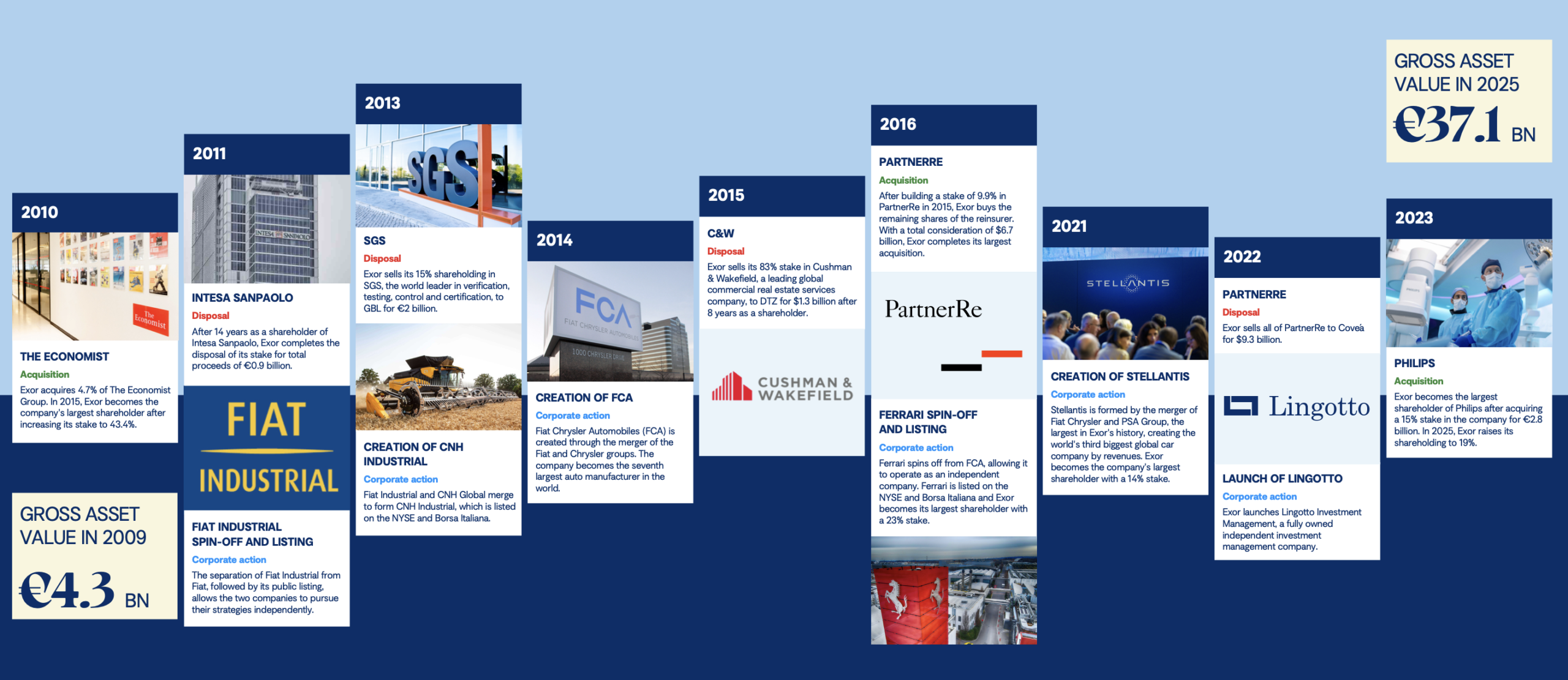
Inside the Exor system … how influence replaces integration
The Exor model works because it is deliberately selective about where connection matters and where it does not. It does not try to force integration across incompatible business models. Instead, it allows collaboration to emerge where intellectual or strategic spillovers are possible.
Within this ecosystem, value creation happens through four reinforcing mechanisms.
First, there is a shared investment philosophy. Across the portfolio, companies are encouraged to think in decades rather than quarters. This long-term orientation shapes decisions on innovation, capital allocation, and resilience. It is not imposed through operational control, but reinforced through governance expectations and repeated interaction.
Second, there is relational proximity. Leaders of portfolio companies interact through formal and informal channels, building familiarity and trust over time. These interactions rarely produce direct joint ventures, but they often lead to shared insights on strategy, risk, and transformation.
Third, there is reputational coherence. The Agnelli name still carries significant weight in global business. This reputation acts as a soft governance mechanism: companies benefit from being associated with a credible, long-term oriented investment steward, which in turn reinforces alignment.
Fourth, there is cognitive cross-pollination. Ideas travel between sectors not because systems are integrated, but because leaders are exposed to one another’s thinking.
However, Exor is also disciplined about where collaboration does not work.
Where collaboration works well in Exor-style ecosystems
These are areas where ideas and frameworks travel easily:
- Leadership philosophy and governance models
- Capital allocation discipline and long-term investment thinking
- Sustainability frameworks and ESG approaches
- Brand strategy and reputation building
- Innovation mindset and experimentation culture
- Executive networking and talent development
Where collaboration tends to fail or add limited value
These domains resist ecosystem integration because they are too context-specific:
- Core sales execution and go-to-market systems
- Operational IT and legacy infrastructure
- Supply chain and logistics design
- Product engineering and technical architecture
- Customer data systems and regulatory environments
This distinction is critical. Exor does not succeed by forcing integration—it succeeds by understanding where integration is structurally valuable and where autonomy is essential.
Exor is not an isolated case. It is part of a broader shift in global capitalism, where holding companies, sovereign investors, and brand platforms are increasingly moving away from control-based structures toward influence-based systems.
This shift can be understood as the emergence of ecosystem capitalism—a model in which value is created not just by what a firm owns, but by what it enables across a network of semi-independent actors.
Several organisations illustrate different versions of this model, each with a distinct coordination mechanism.
Singapore’s Temasek Holdings, for example, represents a more structured version of ecosystem capitalism. Rather than relying on brand or heritage, Temasek acts as a convenor of intelligence. It brings leaders from across its portfolio together to share insights on AI, sustainability, digital transformation, and macroeconomic trends.
The emphasis is not on forcing collaboration, but on accelerating learning.
Tata … culture as the hidden architecture of collaboration
The Tata Group represents one of the most powerful examples of cultural rather than ownership-based coherence.
Unlike Exor, Tata is not primarily a financial platform. It is a deeply embedded institutional ecosystem, historically shaped by the Tata family and now governed through complex trust structures. Its influence does not rely on tight operational integration or centralised ownership control.
Instead, it is held together by what is often called the “Tata Way”—a shared philosophy emphasising integrity, nation-building, long-term value creation, and social responsibility.
This creates a different form of ecosystem logic. Tata companies such as Tata Consultancy Services, Tata Motors, Tata Steel, and Tata Consumer Products operate independently in very different industries. Yet they remain connected through shared values, leadership pipelines, and institutional memory.
Where collaboration works well in Tata
Tata’s ecosystem strength is most visible in areas where culture and scale matter:
- Brand trust and reputation (especially in domestic and emerging markets)
- Leadership development and succession systems
- Sustainability and social impact initiatives
- Digital transformation frameworks and capability building
- Selective procurement and shared sourcing advantages
- Crisis response and institutional coordination
Where collaboration is limited
But like all ecosystem models, Tata also has clear boundaries:
- Business model design (each company operates in structurally different industries)
- Customer-facing sales and distribution systems
- Product innovation pipelines and R&D
- Data systems and technology architectures
Tata demonstrates an important truth: cultural unity does not require operational integration. In fact, attempting to over-integrate would likely destroy the autonomy that makes each business competitive in its own market.
Virgin … brand as a coordination system without ownership depth
A very different model is found in Virgin Group.
Here, the coordination mechanism is not ownership or culture, but brand. Virgin has historically expanded across aviation, telecoms, financial services, hospitality, and space exploration through partnerships, licensing agreements, and joint ventures rather than majority control.
The Virgin brand acts as a permission system. It signals a set of expectations—customer obsession, disruption, simplicity, and challenger behaviour—that allow independently owned businesses to align around a shared identity.
Where collaboration works in Virgin-style ecosystems
- Brand positioning and customer experience design
- Marketing narrative and identity creation
- Entrepreneurial culture and innovation mindset
- Customer service philosophy and tone of voice
- Strategic storytelling and market entry framing
Where it does not work well
- Operational integration across businesses
- Shared IT systems or infrastructure
- Supply chain coordination
- Financial systems alignment
Virgin shows that identity can sometimes substitute for integration—but only in specific domains where meaning matters more than machinery.
The pattern … what actually works in collaboration ecosystems
Across the above companies, a consistent pattern emerges. Collaboration is highly valuable, but only in specific domains where knowledge can be transferred without operational integration.
High-value collaboration domains
- Leadership philosophy and governance
- Strategic thinking and capital allocation
- Brand and reputation systems
- Sustainability and ESG frameworks
- Talent development and executive networks
- Innovation mindset and experimentation approaches
- Macroeconomic and geopolitical insight
Low-value or high-friction collaboration domains
- Core operations and supply chains
- Product engineering and technical design
- Customer-facing sales execution
- Data systems and analytics infrastructure
- Regulatory and compliance environments
The boundary between these two categories is the most important strategic insight in ecosystem capitalism. The strongest holding companies are not those that maximise integration, but those that are precise about where integration creates value and where it destroys it.
From ownership to orchestration
What Exor and its peers reveal is a fundamental shift in the nature of corporate power. The most sophisticated holding companies are no longer defined by what they own, but by what they orchestrate.
They succeed not by centralising control, but by designing environments in which independent companies choose to collaborate. Influence replaces authority. Trust replaces hierarchy. Networks replace structure.
In this emerging model, the role of the holding company is no longer to act as an operator of assets, but as an architect of ecosystems—carefully shaping the conditions under which value can emerge across boundaries that ownership alone can no longer define.
Water might be the world’s most important resource, yet we have traditionally managed it as if it were abundant.
Climate change is intensifying drought and flooding. Ageing infrastructure loses enormous quantities of treated water. Growing cities need more resilient systems. Industrial growth increases demand for clean water. New contaminants require more sophisticated treatment. Semiconductor fabrication needs extraordinarily pure water, while the growth of AI and data centres creates new demands for cooling, energy and water.
For most businesses, these are external risks.
For Xylem, they are the market.
Xylem has evolved from an industrial equipment business into something much more ambitious: a global water-solutions company seeking to make water systems smarter, cleaner, more resilient and more efficient.
Its story demonstrates a powerful principle of strategy: the greatest opportunities often emerge when you stop defining your business by the products you make and start defining it by the problem you can solve.
Born from ITT, built around water
Xylem does not have the conventional founder story of an entrepreneur starting a company in a garage.
Its origins lie within ITT Corporation, the American industrial conglomerate whose history stretches back to International Telephone & Telegraph, founded in 1920. By the early 2000s, ITT had accumulated significant businesses in water and wastewater equipment, pumps, analytics and fluid technologies.
In January 2011, ITT’s board decided to separate the corporation into three independent public companies. Its defence operations became Exelis; ITT continued as a more focused industrial company; and its water businesses became Xylem.
Xylem Inc. was formally incorporated in Indiana in May 2011 and separated from ITT on 31 October. Trading began on the New York Stock Exchange under the ticker XYL on 1 November. ITT retained no ownership after the separation. The company was initially headquartered in White Plains, New York, and Gretchen McClain, previously president of ITT’s Fluid and Motion Control business, became Xylem’s first chief executive.
Even the name expressed its new purpose. Xylem is the tissue within plants that transports water from the roots upwards. It gave an engineering business a more natural and human identity centred on the movement and essential nature of water.
The new company was hardly a start-up. It arrived with around 12,500 employees, operations in more than 150 countries and $3.8 billion in annual revenue. Its portfolio covered much of the water cycle, from collection and distribution through use, treatment and eventual return to the environment.
The opportunity created by independence was not to invent a water company from scratch. It was to reimagine what a water company could become.
From equipment to intelligence
Initially, Xylem was largely an industrial technology business. It made pumps, treatment equipment, testing technologies, controls, valves and other systems required to move and manage water.
These remain essential. But Xylem gradually recognised that the next revolution in water would not come from physical engineering alone.
It would come from intelligence.
Consider a city losing millions of litres of treated water through an ageing network. The traditional response is essentially physical: inspect infrastructure, repair leaks and replace pipes.
But which pipes should be replaced first? Where are the hidden leaks? Why is pressure changing? Where is consumption abnormal? Which assets are approaching failure? How should a utility allocate scarce investment?
Suddenly, the water problem becomes a data problem.
Xylem began building the capabilities to answer these questions. The $1.7 billion acquisition of Sensus in 2016 added smart metering, communications networks and data analytics. Pure Technologies subsequently strengthened infrastructure diagnostics and asset assessment. Its partnership with, and later majority investment in, Idrica expanded digital water management and software.
Each move pushed Xylem further from being a collection of equipment businesses towards becoming an intelligent water platform.
The strategic progression is important:
- From moving water to understanding water.
- From measuring infrastructure to predicting its performance.
- From selling individual products to connecting systems.
- From responding to failures to preventing them.
- From equipment performance to customer outcomes.
This is what digital transformation looks like when it genuinely changes a business model rather than simply adding technology to existing products.
Making water intelligent
The shift becomes tangible when applied to a real water network.
A smart water system combines meters, sensors and connected infrastructure with software and analytics. Instead of waiting for a pipe to burst, utilities can identify abnormal flows. Instead of maintaining every asset according to a fixed timetable, they can target those most at risk. Instead of increasing water production to meet demand, they can reduce the enormous amount already being lost.
- The product is no longer the meter, sensor or pump.
- The product becomes a better-performing water system.
This represents a fundamental change in innovation thinking.
- A product company asks: How can we build a better pump?
- A customer-focused company asks: How can we move water more efficiently?
- A market maker asks: How could we create a water system that wastes dramatically less water?
That final question opens an entirely different innovation space involving engineering, sensors, software, AI, data, services, behavioural change and new commercial models.
It also expands the market.
The Evoqua transformation
Xylem’s biggest strategic move came in 2023 with its approximately $7.5 billion all-stock acquisition of Evoqua Water Technologies.
Evoqua brought sophisticated water and wastewater treatment capabilities, together with a substantial service business and expertise in demanding industrial applications. The combination significantly strengthened Xylem in areas such as microelectronics, life sciences, food and beverage, power generation and the treatment of emerging contaminants.
The acquisition also illustrates an important distinction in corporate strategy. Some acquisitions simply make a company bigger. The best acquisitions change what a company is capable of becoming.
Evoqua expanded Xylem’s ability to combine water transportation, measurement, intelligence and treatment around integrated customer outcomes. That is particularly important because the future of water increasingly lies at the intersection of other industries.
Semiconductor fabs require ultra-pure water. Pharmaceutical plants require sophisticated treatment. Manufacturers want to reuse water rather than continually consume it. Cities need resilience against flooding and drought. Data centres need increasingly efficient cooling systems.
Water is therefore not simply an industry. Water is an enabling system running through almost every industry.
That gives Xylem an increasingly large possibility space.
From industrial company to Future Brand
This is also why Xylem is an interesting example of the principles behind my Future Brand Manifesto.
Traditional B2B brands were typically built around engineering excellence, quality, reliability and expertise. These attributes remain important, but they are no longer enough.
The strongest future brands stand for something bigger than the products they sell. They represent a future worth creating.
Xylem’s long-running “Let’s Solve Water” idea captures this particularly well. It doesn’t say “Xylem solves water”. It says let’s solve water.
That small word changes the relationship. Customers, utilities, cities, industries, engineers, communities, governments and technology partners all become participants.
The brand becomes an invitation to collaborate.
Future brands increasingly move from:
- Products towards outcomes and possibilities.
- Audiences towards participants and communities.
- Communication towards mobilisation.
- Corporate purpose towards shared progress.
- Describing today’s business towards enabling tomorrow’s opportunities.
That is as relevant to an industrial technology company as it is to a consumer brand.
Schneider Electric can stand for a more electrified and efficient world. Nvidia increasingly represents the infrastructure of accelerated intelligence. Xylem has the opportunity to stand for a water-secure world.
Its technologies make that ambition credible. But the ambition gives those technologies greater meaning.
Sustainability becomes the growth strategy
This also changes the relationship between sustainability and business performance.
In many organisations, sustainability remains adjacent to strategy: ESG targets, carbon reduction programmes, reporting requirements and corporate responsibility initiatives.
For Xylem, sustainability is increasingly inseparable from the market opportunity.
Every litre of water saved represents value. Every litre reused reduces demand on scarce resources. Every leak identified prevents waste. Every wastewater stream successfully treated can protect communities and ecosystems. Every more-efficient system can reduce the energy required to move and process water.
The bigger the world’s water problems become, the more valuable effective solutions become.
That does not mean social purpose automatically creates financial returns. It means that when a company builds distinctive capabilities around solving an increasingly important problem, positive impact and economic value can reinforce each other.
Xylem’s growth illustrates the potential. From $3.8 billion of revenue when it emerged from ITT in 2011, the company reached $9.0 billion in 2025, with revenue growing another 6% that year and adjusted earnings per share increasing 19%. (Xylem)
Growth has come not simply from selling more equipment, but from progressively expanding the problem Xylem is capable of solving.
From market competitor to market maker
This connects directly with the idea of Market Makers.
Traditional strategy begins with the existing market. How large is it? Who are the competitors? Where is the growth? How can we increase market share?
Market makers start somewhere else. They ask: What new value could we create?
If Xylem defines itself as a pump manufacturer, its competitive arena is pumps.
- Define it as a water-equipment company and the opportunity expands.
- Define it as a smart-water company and sensors, communications, software and AI become relevant.
- Define it around water security, and the opportunity expands dramatically again: climate resilience, infrastructure intelligence, industrial reuse, contamination management, semiconductor manufacturing, data-centre cooling and resource optimisation.
The strategic lesson is simple but profound: How you define your market determines how much opportunity you can see.
Xylem is interesting because its market boundaries have progressively expanded while its underlying purpose has become more focused.
Building the water intelligence flywheel
The pieces of Xylem’s portfolio increasingly reinforce each other.
Physical infrastructure creates access to water systems. Sensors generate data. Data creates visibility. Software creates intelligence. Intelligence enables optimisation. Treatment enables reuse. Services deepen customer relationships. Those relationships reveal new problems, which stimulate further innovation.
That creates a reinforcing water intelligence flywheel.
AI could accelerate it significantly.
Imagine water networks continuously sensing demand, pressure, leakage, contamination and asset condition; algorithms predicting problems before they happen; digital twins testing infrastructure decisions before billions are invested; industrial facilities dynamically optimising water use and reuse.
The opportunity is not to “add AI” to water equipment. It is to reinvent the water system around intelligence.
Lessons for every business
Xylem’s journey suggests six wider lessons for leaders.
- Define the business by the problem, not the product. Products inevitably constrain thinking. Problems create much larger spaces for innovation.
- Move from products to outcomes. Customers rarely want a pump, meter or analytics platform. They want reliability, efficiency, resilience and better economics.
- Acquire capabilities, not just revenue. Sensus, Pure Technologies, Idrica and Evoqua progressively changed what Xylem could do and therefore what markets it could address.
- Connect physical and digital innovation. Some of the greatest opportunities now emerge where engineering, data, software and AI converge.
- Turn purpose into an innovation brief. “A water-secure world” can guide investment, partnerships and innovation much more powerfully than a conventional product roadmap.
- Make markets rather than simply taking share. Redefining the problem can create more value than competing harder within yesterday’s category.
Solving bigger problems creates bigger possibilities
Xylem began as the water businesses of an American industrial conglomerate. Independence gave those businesses something more important than a new corporate structure.
It gave them the opportunity to redefine themselves.
- From equipment to systems.
- From systems to intelligence.
- From water technology to water security.
And potentially, from water company to the intelligence platform for one of the world’s most critical resources.
That is the connection between Xylem, and my concepts of Future Brands and Market Makers.
- A Future Brand is not simply a stronger expression of what a company does today. It gives the company credibility and permission to do more tomorrow.
- A market maker does not simply compete more effectively for existing demand. It identifies new problems worth solving and creates new value around them.
And the best strategy doesn’t merely optimise what a company already is. It unlocks the value of what it could become.
For every leadership team, Xylem therefore leaves one compelling question: are you defining your future by the products you currently make — or by the problems that will matter most in the world ahead?
© Peter Fisk 2026