Healthcare is entering a period of reinvention more profound than the arrival of telemedicine or electronic medical records. For decades, digital technology largely improved individual parts of an established system: information became searchable, records became electronic, appointments moved online, prescriptions became digital and consultations appeared on screens. The underlying architecture, however, remained much the same. When people became ill, they still had to navigate a fragmented world of GPs, specialists, hospitals, laboratories, pharmacies and insurers.
That architecture is now starting to change.
The forces identified in my Healthcare Megatrends 2036 framework (below) are converging. Intelligent healthcare is moving care from reactive towards predictive and personalised models; ageing and chronic disease are creating new populations with more complex, continuous needs; value is shifting from activity and treatment towards outcomes, prevention and experience; virtual and at-home care are moving healthcare beyond traditional institutions; and data interoperability is becoming essential to connecting the journey. At the same time, health geopolitics, data sovereignty and proliferating AI regulation make trust and compliance increasingly important.
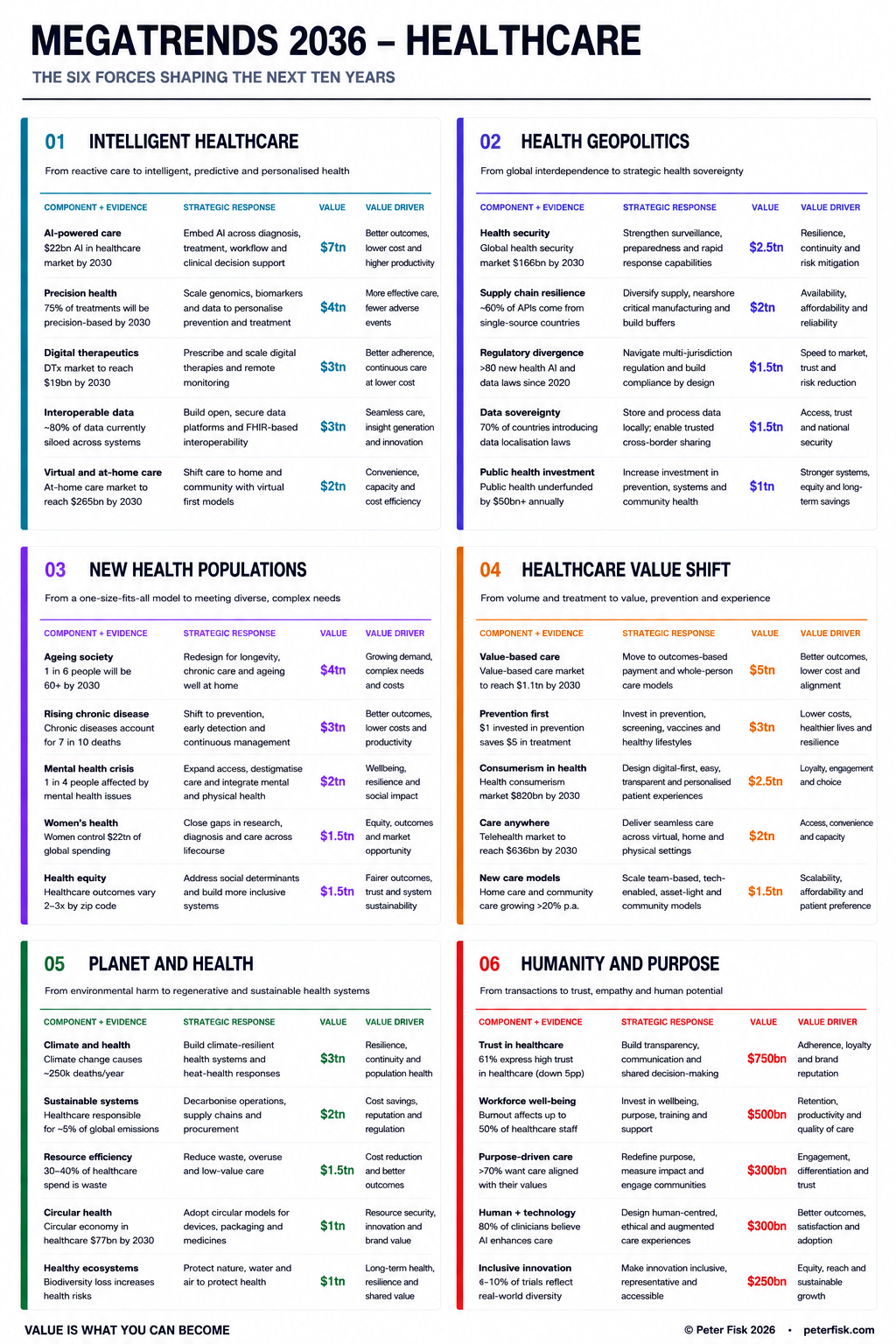
AI accelerates all of these shifts. But the important story is not simply that AI will make diagnosis faster or automate some of the doctor’s work. It is that AI, digital platforms and connected ecosystems can reorganise healthcare around the individual.
The emerging model can help understand what is happening, determine what should happen next, connect the person to appropriate expertise, coordinate the services required and increasingly take action on their behalf.
We are moving from the digital doctor as an app towards the personal health agent as an orchestrator of an ecosystem.
The first digital-health revolution was harder than it looked
The ambition is not new. The last decade is littered with businesses that promised to reinvent healthcare by making it digital.
Babylon Health was perhaps the most spectacular example. Founded in London by Ali Parsa in 2013, Babylon combined video consultations with an increasingly ambitious AI symptom-checking proposition. Its goal was essentially to put accessible healthcare into everyone’s pocket. It secured NHS relationships, expanded internationally and went public in New York in 2021 at a valuation of $4.2 billion. Less than two years later, the business collapsed into insolvency. Its UK operations were ultimately sold for around £500,000.
Babylon’s failure was not evidence that digital healthcare did not work. It demonstrated how difficult it is to make its economics, clinical governance and operating model work simultaneously. Rapid expansion created enormous costs; some contracts proved economically unattractive; clinical claims around its technology attracted controversy; and access to abundant capital encouraged scale before a sustainable model had been established.
Carbon Health followed a different trajectory. Founded in 2015 by Eren Bali and others, it sought to combine an elegant digital experience with real physical primary- and urgent-care clinics. That hybrid insight remains compelling and Carbon continues operating today. But its extraordinary pandemic-era expansion proved difficult to sustain. The company reached a reported valuation of around $3 billion, expanded rapidly and generated substantial COVID-related revenues, before repeatedly reducing staff and pulling back from areas such as remote patient monitoring and standalone chronic-care programmes to refocus on primary and urgent care.
The broader sector experienced the same reality check. Telemedicine usage surged during the pandemic, venture capital flooded into digital health and valuations assumed that changed behaviour would continue indefinitely. When physical healthcare reopened and capital became more expensive, the limitations of many models became apparent. Digital access alone was useful, but not necessarily differentiated; acquiring patients could be expensive; healthcare delivery remained labour-intensive; regulation constrained rapid scaling; and virtual care still had to connect with physical healthcare when diagnosis, testing or treatment demanded it.
Yet some simpler models proved remarkably resilient.
- Doctolib, founded in France in 2013, initially concentrated on a very specific frustration: finding and booking healthcare. Instead of trying to replace doctors, it made accessing them easier. It subsequently expanded into teleconsultation, communication, medical documents and software for healthcare professionals. Today it reports around 90 million people and 570,000 health professionals using its technologies across Europe.
- Zocdoc pursued a similar access problem in the United States. Launched in 2007 as something akin to an OpenTable for doctors, it progressively built a marketplace connecting available appointments, patients, providers, specialties and insurance networks. By 2026 it said it had helped more than 20 million people access care and was valued at about $2.3 billion in a secondary transaction. More interestingly, it is now turning its scheduling infrastructure into something AI agents can use: in August 2026, Zocdoc became a connected healthcare-booking partner for Google’s Gemini, allowing users to find and book from a network of more than 200,000 providers through an AI conversation.
There is an important lesson in these mixed fortunes. Digitising healthcare is not the same as reinventing it. Successful models solve a genuine consumer problem, fit into rather than ignore the realities of clinical care, establish sustainable economics, and progressively absorb more of the complexity surrounding the patient.
That evolution is now accelerating.
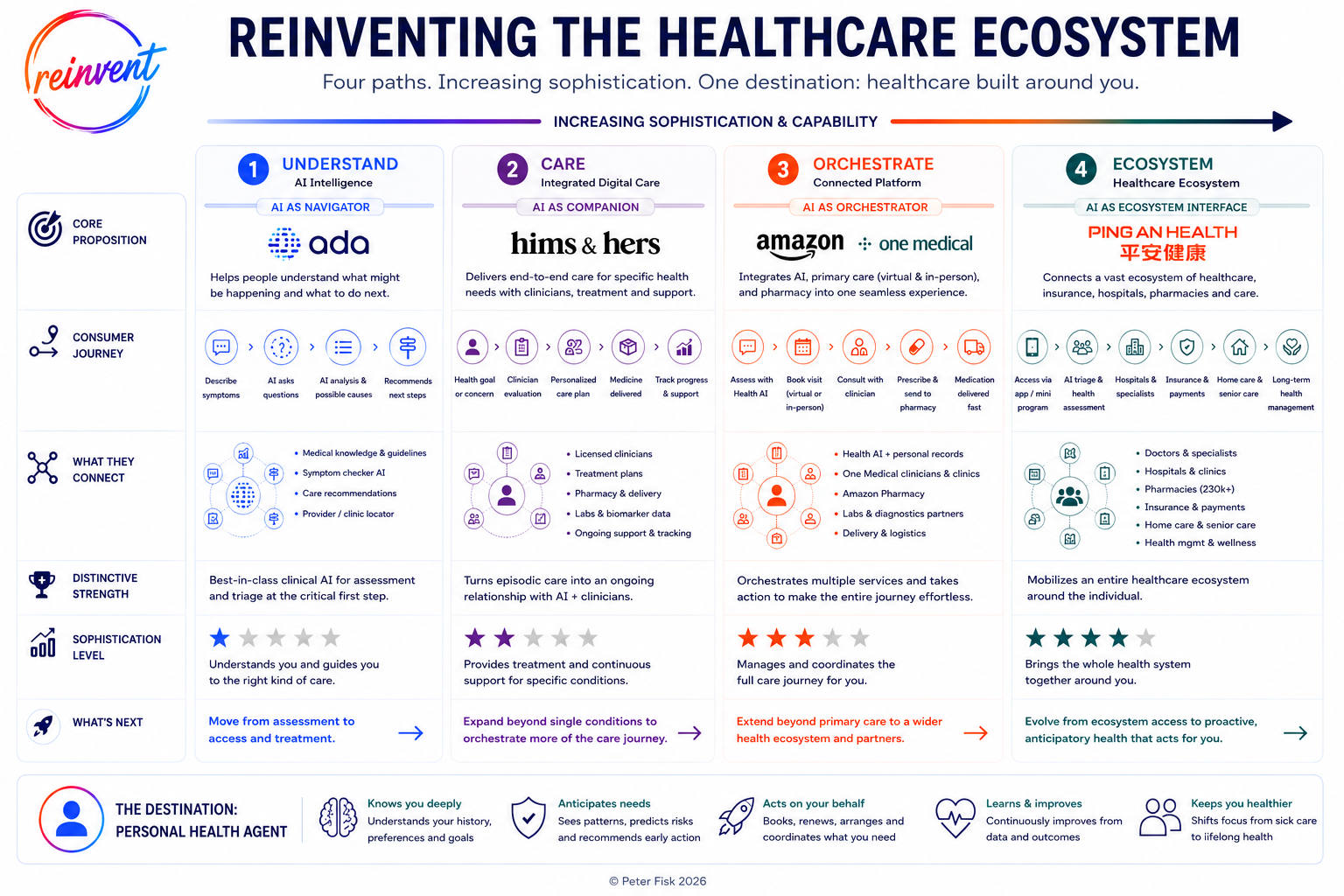
Reinventing healthcare with increasingly sophisticated models
Four businesses reveal the emerging architecture particularly well. They should not be regarded as direct competitors or ranked simply as better and worse. Instead, they demonstrate increasing sophistication in how much of the healthcare journey technology can understand, integrate and orchestrate:
- Ada Health (Germany): AI as intelligent navigator, helping determine what might be wrong and what to do next.
- Hims & Hers (USA): integrated digital care connecting consumer, clinician, treatment, medicine and continuous support.
- Amazon One Medical (USA): a connected platform bringing AI, records, virtual and physical primary care, pharmacy and fulfilment into one journey.
- Ping An Health (China): a broad healthcare ecosystem connecting AI, doctors, hospitals, pharmacies, insurance, payments and care.
Lets explore each business in turn:
1. Ada Health: making the front door intelligent
Ada Health began in Berlin in 2011, founded by physician-scientists Martin Hirsch and Claire Novorol with entrepreneur Daniel Nathrath. Interestingly, Ada did not originally begin as a consumer symptom checker. The founders spent years developing clinical decision-support technology for doctors before adapting that knowledge into a consumer app.
Ada focuses on one deceptively simple question: “Something doesn’t feel right. What should I do?”
That uncertainty is one of healthcare’s biggest sources of friction and inefficiency. People rarely know whether a symptom requires monitoring at home, speaking to a pharmacist, seeing a GP, consulting a specialist or seeking urgent medical attention. Consequently, some people consume scarce clinical resources unnecessarily while others delay seeking care when they should not.
Ada uses AI to conduct an adaptive health assessment. A person describes symptoms; the system asks follow-up questions; its clinical reasoning engine considers possible causes and severity; and it recommends appropriate next steps. The experience does not claim to eliminate the doctor. It helps determine when and what kind of doctor may be required.
That distinction has helped Ada navigate one of the central regulatory challenges of healthcare AI. The more an AI system claims autonomous diagnosis and treatment, the greater its clinical and regulatory exposure. Ada’s core proposition is centred on assessment, navigation and decision support, with its technology also embedded into healthcare organisations.
Scale has followed. Ada currently reports more than 14 million users and 34 million symptom assessments. A 2026 real-world study with Portuguese healthcare group CUF, published in NEJM AI, found that use of Ada changed the care-seeking behaviour of three in five participants and more than doubled the proportion receiving clinically appropriate care.
Its strategic importance is therefore greater than that of a sophisticated symptom checker. Ada demonstrates the potential for AI to become the intelligence layer at healthcare’s front door.
Its current journey is essentially: “Describe symptoms, AI questions, assessment, possible causes, recommended next step.”
The next opportunity is to connect that intelligence more deeply into treatment: moving from “here is what you should consider doing” towards “here is the appropriate care, and I can help you access it.”
2. Hims & Hers: from consultation to continuous care
Hims & Hers started from a very different insight. Founded in San Francisco in 2017 by Andrew Dudum, Hilary Coles, Jack Abraham and Joe Spector, it recognised that many healthcare experiences were not simply inconvenient; they were uncomfortable. Hair loss, sexual health and other conditions could be embarrassing to discuss and cumbersome to treat through traditional channels.
The company wrapped healthcare in a consumer proposition.
Instead of asking people to find a doctor, obtain a prescription and locate treatment themselves, Hims & Hers brought digital intake, licensed clinicians, personalised treatment, prescription and fulfilment into one branded experience. It subsequently expanded into areas including dermatology, mental health and weight management.
Its innovation was partly technological but equally about consumerisation: accessible language, transparent journeys, discreet delivery and strong brands designed around needs rather than healthcare institutions.
This has required careful navigation of healthcare regulation. Hims & Hers is not simply an ecommerce company selling prescription drugs. Clinical decisions must be made by licensed providers, prescribing must comply with medical requirements, and the boundary between consumer marketing and clinical judgement matters enormously. Recent controversy around compounded weight-loss medicines has demonstrated how commercially attractive but regulatorily sensitive this territory can become.
The model nevertheless has considerable momentum. Hims & Hers reported approximately 2.9 million subscribers and $753 million of quarterly revenue in Q2 2026, up 19% and 38% respectively year on year. It now forecasts 2026 revenue of $3.1–3.3 billion.
More important than the numbers is how the model is changing.
In August 2026, Hims & Hers introduced a doctor-led, AI-native experience initially for Hers weight-loss customers. Rather than providing a generic AI chatbot outside the clinical relationship, the system places the consumer, provider, care team and AI into a continuous conversation. With consent, it can retain context about goals, treatment and progress, while clinicians remain responsible for clinical decisions.
That begins to fill one of healthcare’s biggest gaps: the time between consultations.
Traditional healthcare is episodic. A person might spend fifteen minutes with a doctor and then manage a condition alone for months. Health, however, is continuous. People take medicines, eat, exercise, sleep, improve, deteriorate and change behaviour every day.
The Hims & Hers model increasingly becomes: Understand need, clinician, personalised plan, treatment, medicine, monitor, support, adapt.
Ada helps navigate you towards healthcare. Hims & Hers starts to stay with you through it.
3. Amazon One Medical: orchestrating the journey
Amazon represents another increase in sophistication: moving from an integrated care proposition towards orchestration of multiple healthcare capabilities.
One Medical itself predates Amazon. Physician Tom Lee founded the company in 2007 around a simple frustration with traditional primary care. It combined attractive physical clinics, easier appointment access and digital services with a membership model. Amazon announced its acquisition in 2022 and completed the approximately $3.9 billion transaction in February 2023.
The strategic logic becomes clearer when One Medical is considered alongside Amazon Pharmacy and Amazon’s growing AI capabilities.
Amazon Health Services now possesses three important layers: clinical delivery through One Medical, fulfilment through Amazon Pharmacy, and intelligence through Health AI.
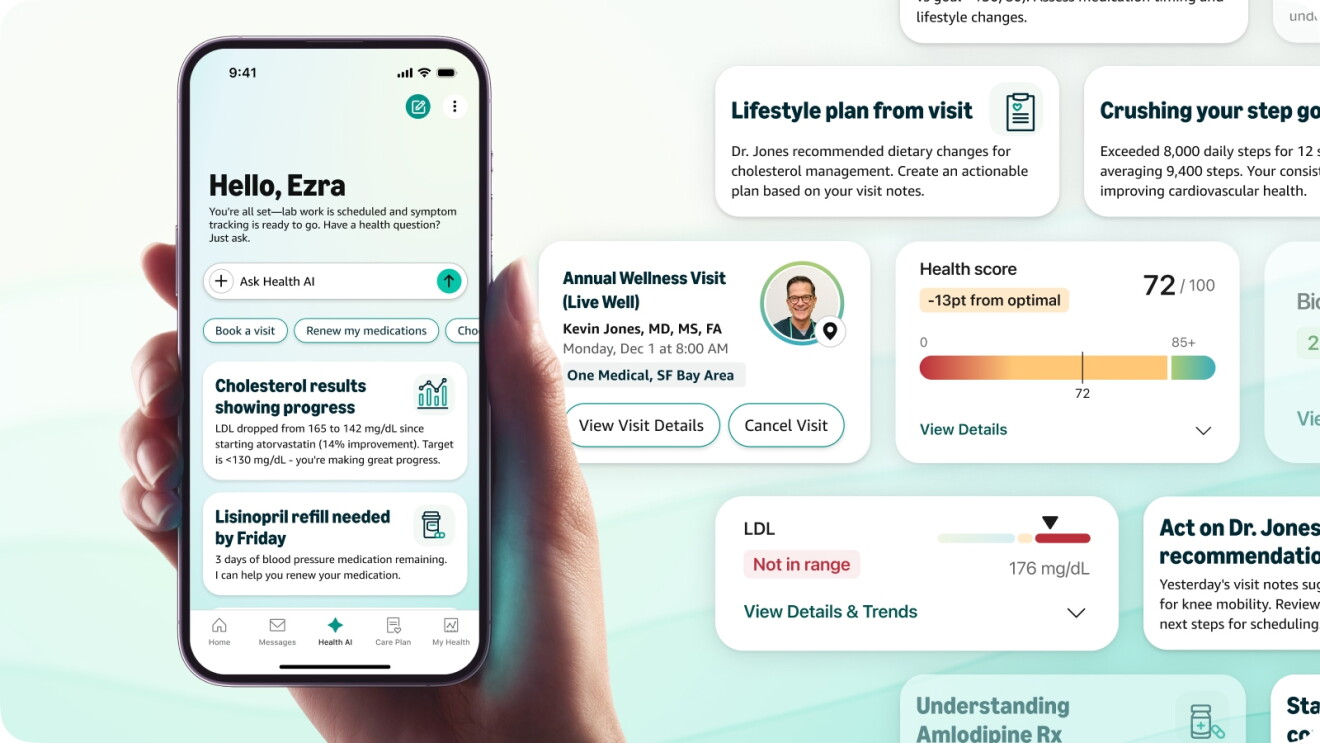
Health AI is particularly significant. Launched more broadly in 2026, it provides personalised health information and, with permission, can take actions such as initiating messaging-based care, booking appointments and helping manage prescriptions. Amazon reported that One Medical virtual-care visits had nearly tripled year on year, with a majority being initiated through Health AI.
Consider how different this feels from a traditional health app.
You develop a problem and describe it conversationally. AI helps assess what is happening using appropriate context. If clinical judgement is required, it can connect you to One Medical virtually or physically. The clinician can prescribe treatment. Amazon Pharmacy can fulfil it. The system can subsequently help manage the prescription and future care.
The journey becomes: Assess → book → consult → prescribe → fulfil → follow up.
Amazon’s distinctive competence is therefore not necessarily medicine. It is orchestration.
The company transformed retail by hiding extraordinary complexity behind a simple interface. Search, recommendation, transaction, payment, inventory, logistics and delivery became one consumer journey. Healthcare contains an analogous problem: the individual currently has to assemble the journey from separate organisations.
Amazon potentially makes the connections invisible.
This also explains why regulation and trust are so important to its model. Healthcare data combined with Amazon’s enormous consumer reach naturally creates privacy and competition concerns; the Federal Trade Commission scrutinised the One Medical acquisition. Clinical decisions also cannot simply become another recommendation algorithm. The platform must maintain clear boundaries between AI assistance, healthcare data and professional medical judgement.
If Amazon can establish that trust, however, its opportunity is formidable: AI + personal context + primary care + physical clinics + pharmacy + logistics.
Hims & Hers integrates a defined care experience. Amazon seeks to manage the journey for you.
4. Ping An Health: mobilising the ecosystem
The fourth model extends beyond orchestration towards the healthcare ecosystem itself.
Ping An Health / Good Doctor was established in China in 2014 as part of the much larger Ping An group and listed in Hong Kong in 2018. At IPO it was already operating China’s largest online healthcare platform, with more than 190 million registered users. By mid-2022 registered users had exceeded 440 million and cumulative consultations approached 1.3 billion.
But describing Ping An as a very large telemedicine app misses what makes it distinctive.
Its advantage comes from sitting within a group spanning insurance, financial services, healthcare and senior care. Ping An Health has consequently developed around a model combining managed care, family-doctor membership and online-to-offline healthcare services.
The consumer can enter digitally, but behind the interface sits a vast physical and financial network.
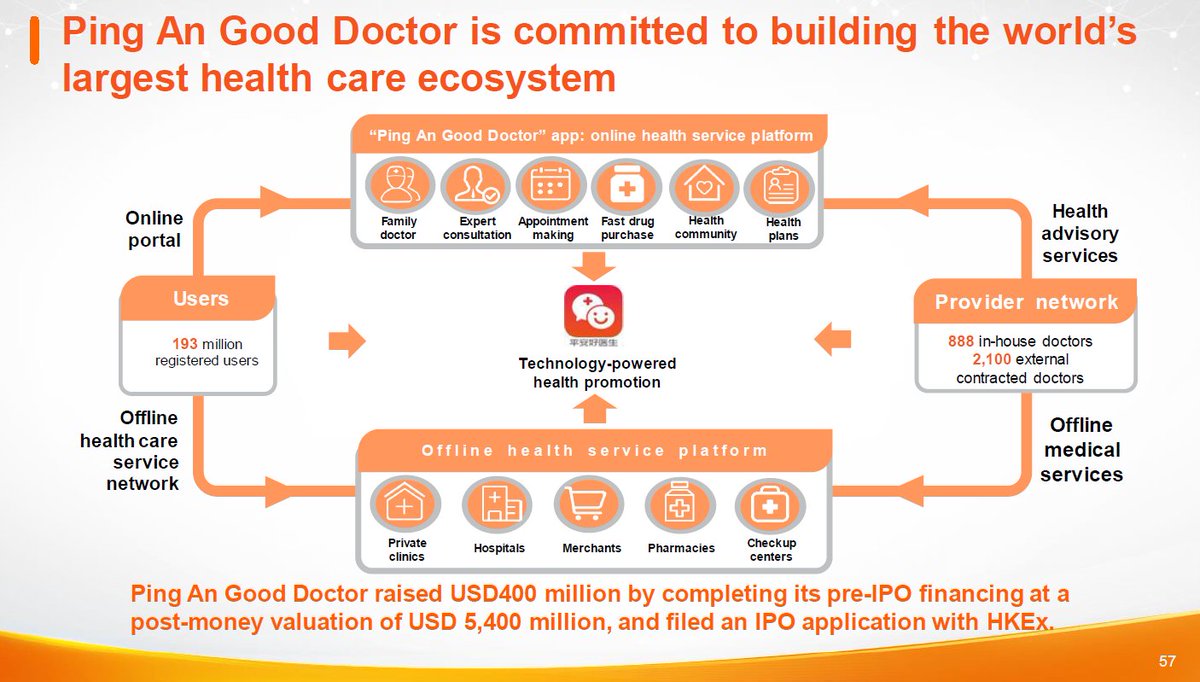
By June 2026, Ping An reported relationships with more than 38,000 hospitals, including China’s top 100 and all 3A hospitals, and nearly 245,000 pharmacies, representing more than 35% of the country’s pharmacies. Its broader health and senior-care services were being used by 11.5 million Ping An Life customers.
AI is becoming the intelligence layer across this network. In 2025 Ping An launched an AI Family Doctor, digital doctor avatars and an AI Senior Care Concierge. In the first half of 2026 its AI Doctor was used by more than 9.7 million people, while the group continued developing AI-assisted diagnosis and multidisciplinary support. Ping An Health itself generated RMB2.48 billion of revenue in the first half of 2026, following RMB5.47 billion revenue and RMB380 million net profit in 2025.
The consumer journey can therefore stretch much further: AI assessment → doctor → specialist → hospital → diagnostics → pharmacy → insurance/payment → home care → ongoing health management.
This is where the model becomes qualitatively different.
Ping An does not have to replace hospitals, doctors, pharmacies or insurers. Its opportunity is to make them behave more like one connected system around the individual.
There is also a powerful economic logic. An insurer benefits when customers receive appropriate care earlier and expensive interventions can be avoided. Healthcare services make the insurance proposition more valuable and frequent. Health data can support more personalised services. Home and senior care extend the relationship across life stages.
Ping An describes this as acting for payers while integrating providers. Strategically, it means moving from financing healthcare transactions towards orchestrating health outcomes.
From digital doctor to personal health agent
The four cases reveal a clear progression.
Ada understands. Hims & Hers cares. Amazon orchestrates. Ping An mobilises an ecosystem.
The next leap is to combine these capabilities.
Imagine a personal health agent with Ada’s clinical intelligence, Hims & Hers’ continuous relationship, Amazon’s orchestration capability and Ping An’s ecosystem reach. It would not merely respond when you became ill. With explicit permission, it could understand your medical history, prescriptions, diagnostic results, wearable data, sleep, activity, preferences and goals.
It could begin to recognise patterns before you do.
A change in resting heart rate means little by itself. So might several poor nights of sleep or declining exercise recovery. But an intelligent system that knows your normal baseline might recognise that the combination merits investigation. It could start a conversation, recommend an appropriate test and connect a clinician when human judgement is required.
This changes the role of AI. The objective is not necessarily AI replacing the doctor. It is AI knowing when the doctor is needed — and mobilising the right healthcare around you.
We can expect five capabilities to converge rapidly over the next few years:
- Know me deeply. Longitudinal health information, preferences, behaviour and goals create context rather than treating every interaction as a new episode.
- Anticipate my needs. AI recognises patterns, changing risks and potential interventions earlier.
- Act on my behalf. Agents book appointments, arrange tests, renew prescriptions and coordinate services within agreed boundaries.
- Learn continuously. Outcomes and new data make recommendations increasingly personalised over time.
- Keep me healthier. The objective progressively shifts from responding to sickness towards prevention, healthspan and lifelong wellbeing.
This is also why the interface will change. Today’s healthcare apps still resemble websites: appointments, results, records, prescriptions and messages sit behind menus. Agentic healthcare increasingly begins with conversation: Why has this blood result changed? My knee still hurts when I run, should I see someone? I’m nearly out of medication. I’m travelling to Thailand next month, what health precautions do I need?
The agent interprets the intent and mobilises the system.
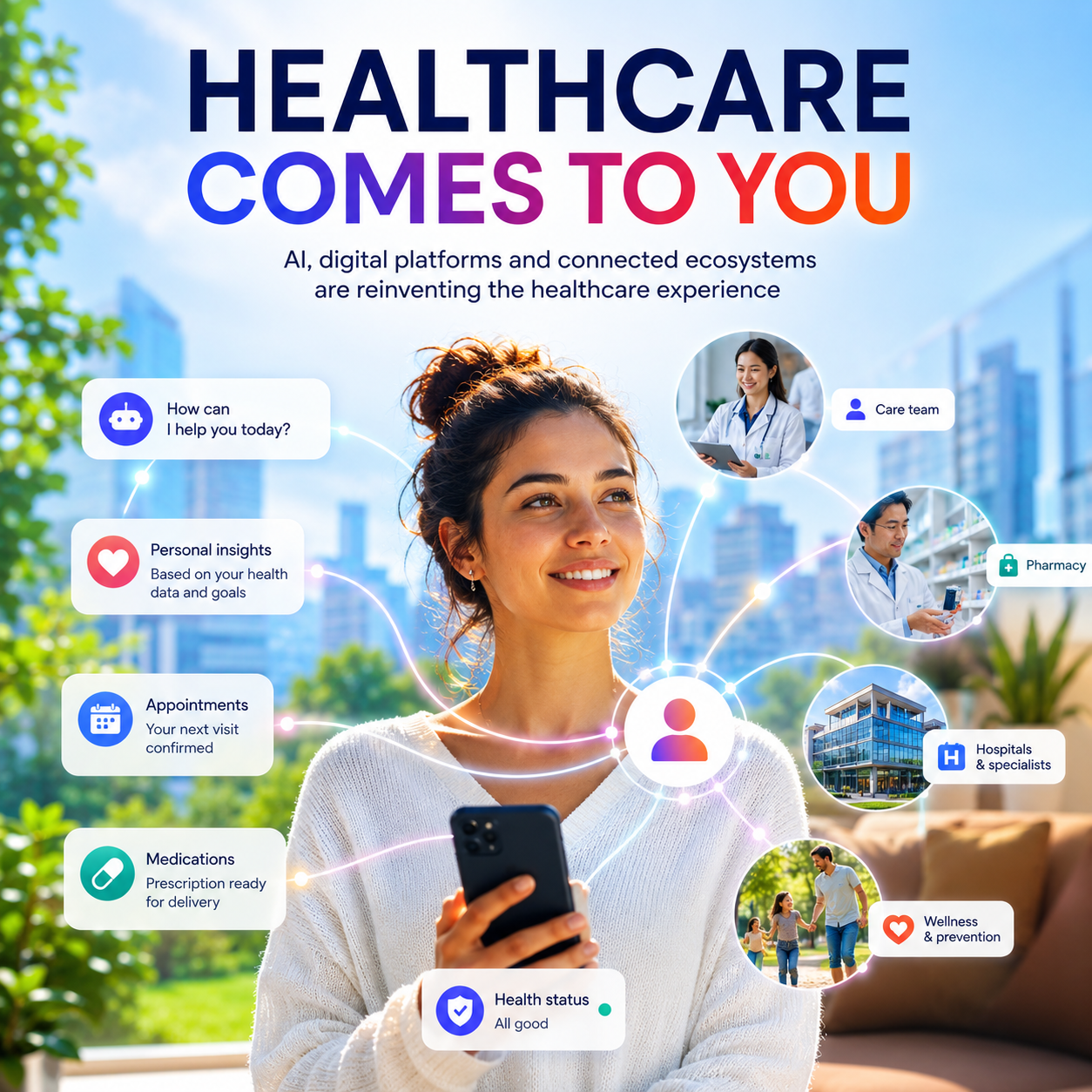
Healthcare comes to you
The strategic implication reaches far beyond health-tech companies.
Pharmaceutical companies traditionally make medicines. Hospitals provide treatment. pharmacies dispense drugs. insurers finance care. laboratories provide diagnostics. Technology businesses provide software. But consumers do not experience healthcare through these industry definitions.
They experience a need.
The organisation that can understand that need and connect it to information, diagnosis, professional expertise, treatment, fulfilment and ongoing support can establish an entirely different relationship with the individual.
That makes the emerging competitive question increasingly important:
Who will understand the individual, own the relationship and orchestrate the health journey?
The failures of the first digital-health boom provide an important warning. Technology alone is insufficient. Healthcare cannot simply be “disrupted” as though it were taxis or food delivery. Clinical evidence matters. Human judgement matters. Regulation matters. Privacy matters. Sustainable economics matter. Above all, trust matters.
But the successes point towards something equally important. Doctolib and Zocdoc demonstrated that digital platforms can dramatically simplify access. Ada is making access intelligent. Hims & Hers is connecting intelligence to continuous care. Amazon is connecting care to fulfilment. Ping An is connecting an entire ecosystem.
The direction is increasingly clear.
Healthcare is moving
- from access to intelligence
- from transactions to relationships
- from isolated services to connected journeys
- from platforms to ecosystems
- from reactive assistance towards intelligent agency.
For centuries, people have had to find healthcare and navigate its institutions. The most profound possibility created by AI is not simply a smarter digital doctor.
It is a healthcare system that increasingly knows you, anticipates you, organises itself around you … and comes to you.
The next decade will be defined not by a single disruptive technology, geopolitical event or environmental crisis, but by six powerful forces interacting with one another. Intelligence will accelerate. Global power will be reordered. Populations will diverge. Markets will shift. Planetary pressures will intensify. And people will demand a more human definition of progress.
These are more than trends. They are structural changes operating across societies, economies and industries over a ten-year horizon. Their individual trajectories matter, but their intersections will matter even more. Artificial intelligence will reshape ageing societies; geopolitical competition will redirect markets and supply chains; climate pressures will accelerate technological innovation; and declining trust will increase the value of distinctly human leadership.
This is an update on my previous megatrends work over the last decade, built on working with leading clients and research bodies around the world:
- Megatrends 2035: Eyes on Tomorrow, What Leaders See First
- Megatrends 2035: Download the Report by Peter Fisk
Each megatrend contains five significant components. Each creates risks, but also substantial opportunities for organisations prepared to respond. The economic estimates below represent indicative cumulative global value pools between 2027 and 2036. They combine potential revenues, investment, productivity improvements and avoided losses. Because many opportunities overlap, the figures should not be added together or treated as precise forecasts.
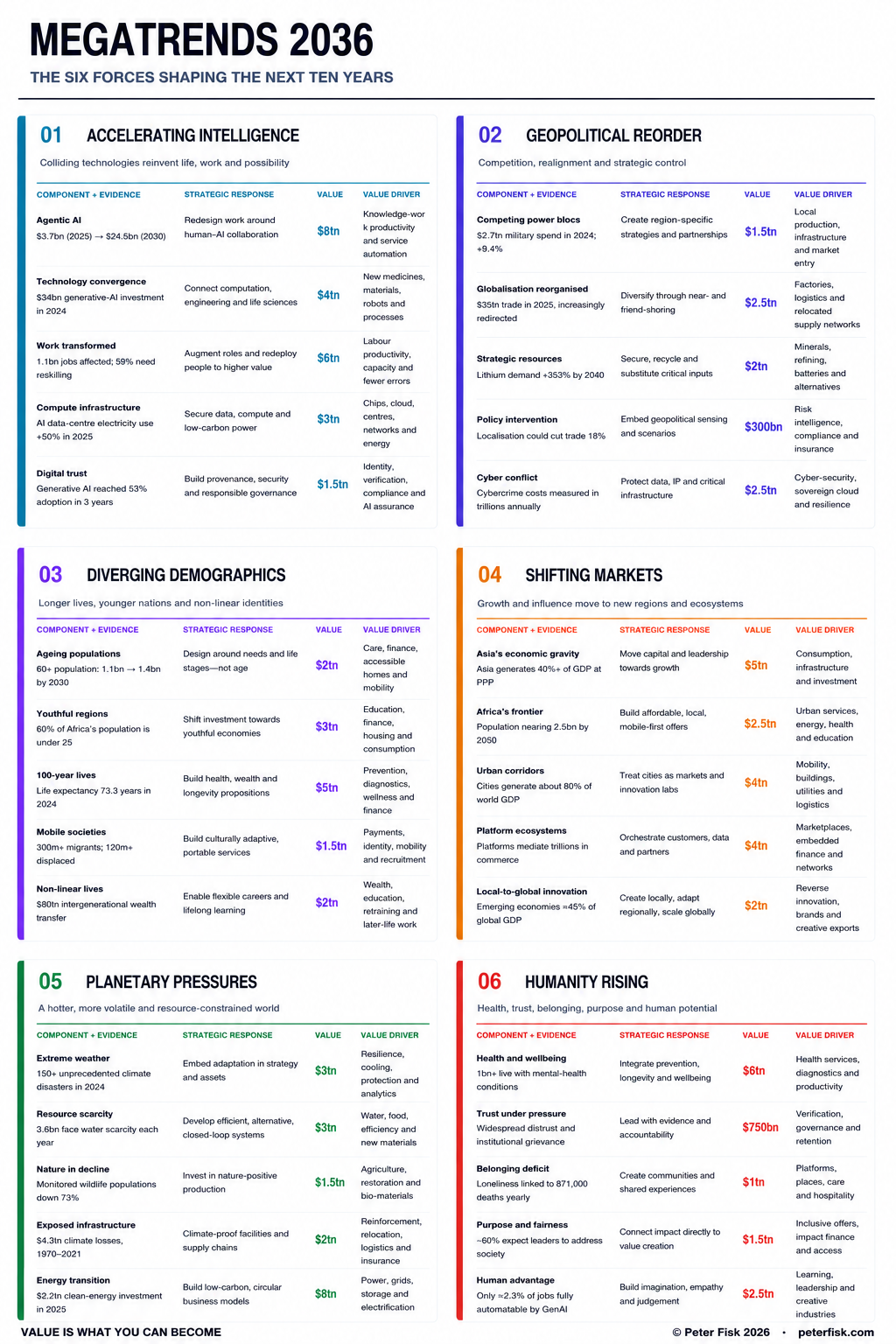
Megatrends help business leaders see further, think bigger and act earlier. They build a future mindset by shifting attention from today’s assumptions to tomorrow’s possibilities.
Leaders can explore how different forces intersect, build scenarios around alternative futures, and stress-test existing strategies against them. Megatrends stretch ambition beyond incremental improvement, revealing emerging needs, markets, technologies and business models that can spark breakthrough innovation.
Most importantly, they create first-mover advantage: identifying where future value is likely to emerge and acting before it becomes obvious. The goal is not simply to be ready for the future, but to shape it in your vision.
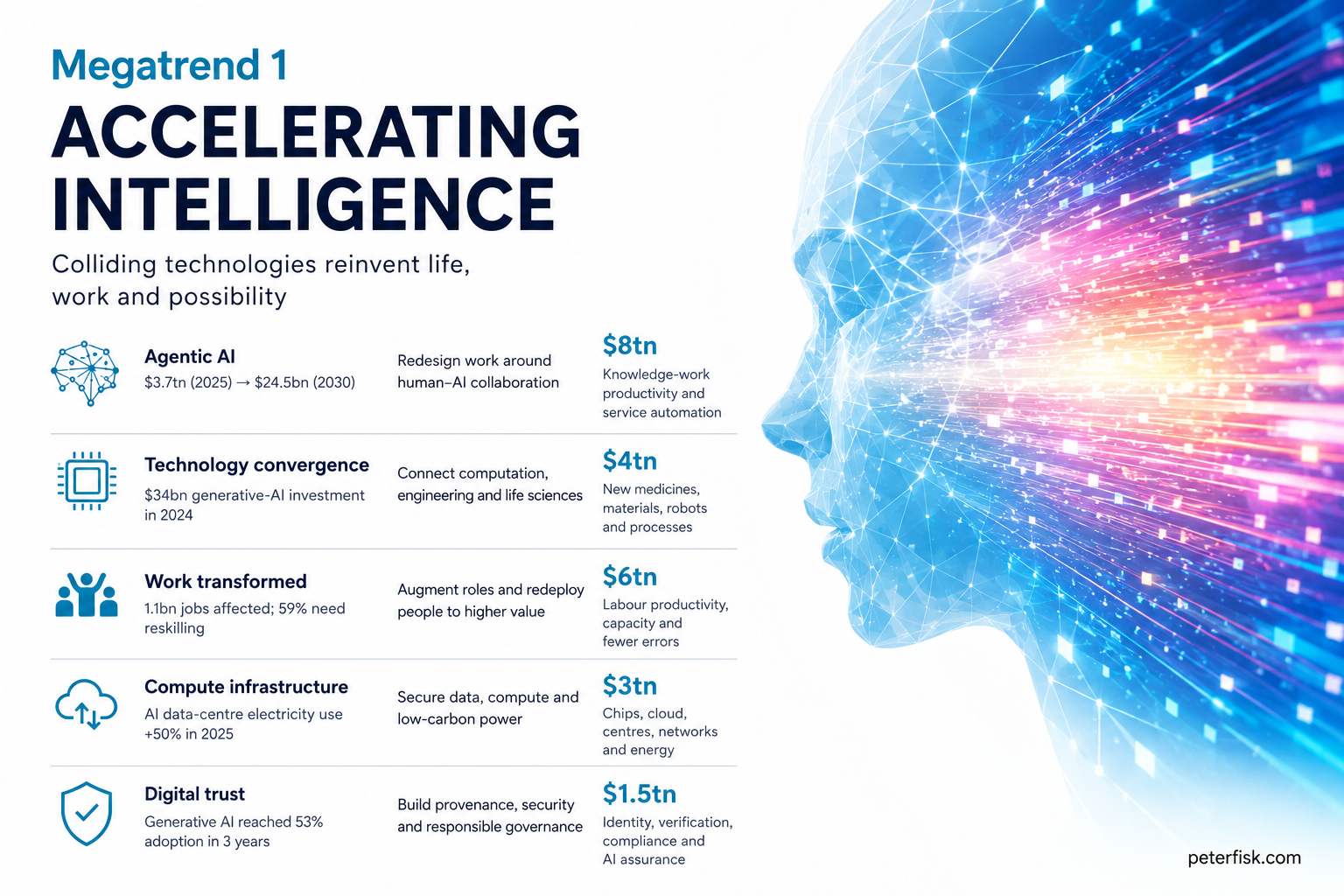
Megatrend 1. Accelerating Intelligence
Colliding technologies reinventing life, work and possibility
The technology story of the next decade will not simply be that artificial intelligence becomes faster or more capable. The more profound shift will be the convergence of AI with quantum computing, robotics, biotechnology, advanced materials and connected infrastructure.
Innovation is moving from linear acceleration towards combinatorial expansion: technologies amplify one another, creating possibilities that none could produce independently.
Component trends:
1. Agentic AI … AI is evolving from a system that answers questions into agents capable of planning, deciding and acting with limited supervision. The enterprise agentic-AI market has been estimated at approximately $3.7bn in 2025 and could reach $24.5bn by 2030. The real opportunity, however, is much larger than software sales. Agents will increasingly perform customer service, financial administration, supply-chain coordination, coding, research and decision support.
2. Technology convergence … Generative-AI investment reached approximately $34bn in 2024, but the next wave will come from AI combining with quantum computing, robotics and synthetic biology. These intersections could transform drug discovery, personalised medicine, material science, manufacturing and energy systems.
3. Intelligent work … Technology could transform around 1.1bn jobs over the next decade, while 59% of workers may require some form of reskilling by 2030. Most jobs will not disappear completely. Instead, their tasks, economics and required capabilities will change.
4. Intelligent infrastructure … AI depends on data, semiconductors, cloud platforms, networks and enormous quantities of electricity. Electricity consumption by AI-focused data centres rose by approximately 50% in 2025. Compute capacity and reliable low-carbon power are becoming strategic resources.
5. Digital trust … Generative AI reached an estimated 53% population adoption within three years. The same technology that democratises intelligence also increases fraud, manipulation, surveillance and synthetic content. Verifying what is real—and who can be trusted—will become an essential economic activity.
Responses:
- Redesign complete workflows around human–AI collaboration instead of adding AI to inefficient processes.
- Connect expertise from computing, engineering, design and life sciences to exploit technology convergence.
- Automate tasks while augmenting roles and redeploying people into higher-value work.
- Secure distinctive data, compute capacity, infrastructure and low-carbon energy.
- Build provenance, cyber-security, responsible-AI governance and accountable human oversight.
Impact:
- Human–AI workflow transformation: $8tn
- Convergent technology innovation: $4tn
- Intelligent automation and workforce augmentation: $6tn
- Data, compute and energy infrastructure: $3tn
- Digital trust, verification and AI governance: $1.5tn
These opportunities will be driven by productivity gains, increased organisational capacity, new scientific discoveries and rising investment in chips, cloud infrastructure, energy, cyber-security and identity.
The defining question is no longer how can we use AI, but how should we reinvent our organisation when intelligence becomes abundant, distributed and increasingly autonomous.
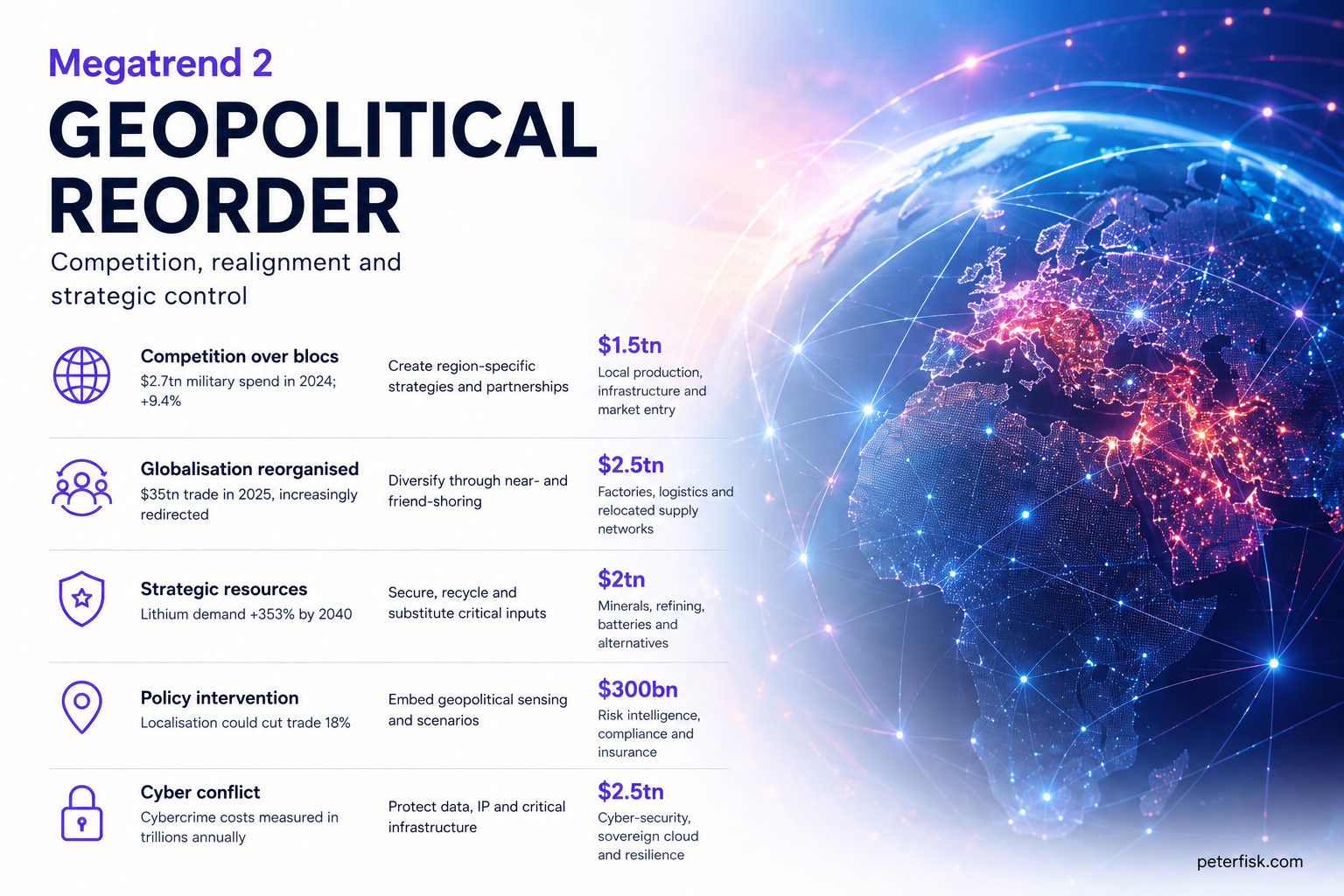
Megatrend 2. Geopolitical Reorder
A multipolar world of competition, realignment and strategic control
The relatively open, Western-led global order is giving way to a more contested and multipolar system. Globalisation is not ending: global trade exceeded $35tn in 2025. But its architecture is being reorganised around security, resilience, political alignment and control of strategic resources.
Efficiency is no longer the only objective. Nations and companies must now consider sovereignty, exposure and strategic dependence.
Component trends:
1. Competing power blocs … Global military expenditure reached approximately $2.7tn in 2024, rising 9.4% in a single year. The US and China remain central, but India, the Gulf states, Brazil, Turkey and other middle powers are gaining influence.
2. Globalisation reorganised … Advanced economies and China are redirecting trade towards geopolitically closer partners. Friend-shoring, near-shoring and regionalisation are reshaping production without eliminating global interdependence.
3. Strategic resources … Competition is intensifying for semiconductors, energy, data, water and critical minerals. Lithium demand could rise by 353% between 2024 and 2040. Restrictions on rare-earth exports could expose trillions of dollars of downstream production.
4. Economic intervention … Tariffs, subsidies, sanctions, investment controls and national industrial policies are becoming standard strategic instruments. OECD modelling suggests aggressive localisation could reduce global trade by 18% and substantially damage GDP without necessarily increasing resilience.
5. Cyber conflict … Digital networks, communications systems and critical infrastructure are becoming geopolitical battlegrounds. Cybercrime costs are already measured in trillions of dollars annually, while state-backed attacks increase the strategic importance of resilient infrastructure.
Responses:
- Create region-specific strategies, propositions and operating models.
- Diversify supply networks through near-shoring, friend-shoring and selective global sourcing.
- Secure strategic materials through long-term agreements, recycling, substitution and investment.
- Embed geopolitical intelligence and scenario planning into executive decision-making.
- Protect data, intellectual property, infrastructure and ecosystem connections.
Impact:
- Regional strategies and local partnerships: $1.5tn
- Diversified and relocated supply networks: $2.5tn
- Critical minerals and strategic resources: $2tn
- Geopolitical intelligence and compliance: $300bn
- Cyber-security and sovereign infrastructure: $2.5tn
The value will be generated through new factories, industrial zones, logistics networks, resource processing, cyber-security, sovereign cloud infrastructure and political-risk services.
The strategic challenge is to remain internationally connected without becoming dangerously dependent.
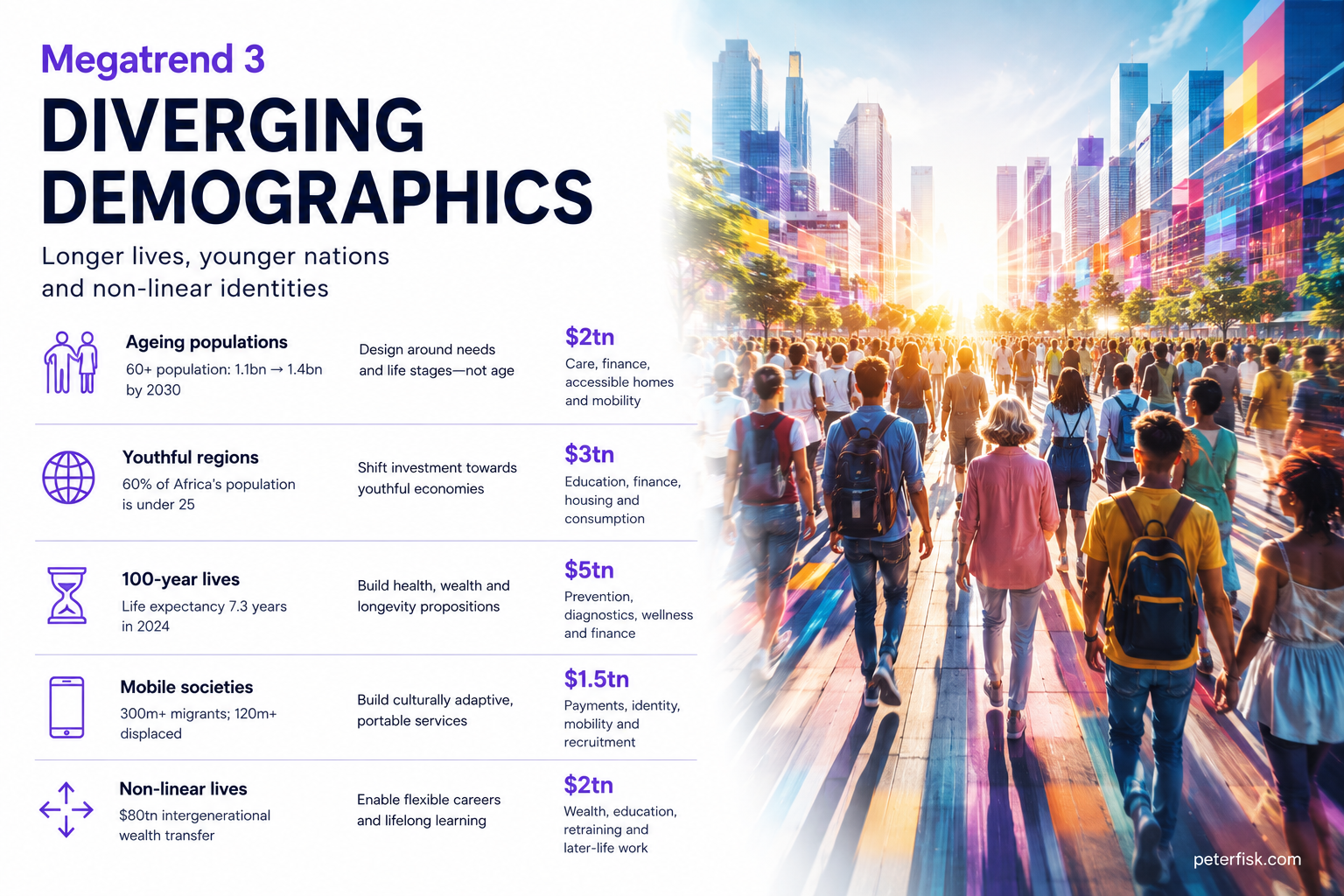
Megatrend 3. Diverging Demographics
Longer lives, younger nations and increasingly non-linear identities
The traditional population pyramid is fracturing. Some countries are ageing and shrinking while others are expanding through extraordinarily youthful populations. Longer lives, migration, changing identities and less predictable life stages are making conventional generational categories increasingly inadequate.
The future will not be uniformly older or younger. It will be demographically divergent.
Component trends:
1. Ageing populations … The global population aged over 60 is projected to rise from approximately 1.1bn in 2023 to 1.4bn by 2030. Ageing will reshape healthcare, employment, financial services, housing and consumption.
2. Youthful regions … Around 60% of Africa’s population is under 25. Africa and South Asia will supply increasing proportions of the world’s workers, consumers and entrepreneurs, even as workforces contract elsewhere.
3. The 100-year life … Global life expectancy reached 73.3 years in 2024 and could reach 77.4 by 2054. Centenarians are becoming a distinct demographic category, while conventional assumptions about education, work and retirement lose relevance.
4. Mobile societies … There are more than 300m international migrants, while forced displacement exceeds 120m. Migration will shape cities, labour markets, identities, political debate and consumer cultures.
5. Non-linear lives … An estimated $80tn could transfer from older generations to Millennials and Gen Z over the next two decades. At the same time, people will study, work, care, start businesses and retire in less predictable sequences.
Responses:
- Segment customers by needs, attitudes and life stages rather than chronological age.
- Redirect investment and capability towards youthful, fast-growing economies.
- Create longevity propositions spanning health, wealth, housing, work and participation.
- Build culturally adaptive organisations and portable services for mobile populations.
- Enable flexible careers, lifelong learning and intergenerational knowledge transfer.
Impact:
- Age-inclusive products and services: $2tn
- Youthful growth economies: $3tn
- Longevity and the 100-year life: $5tn
- Migration and portable services: $1.5tn
- Wealth transfer, learning and non-linear careers: $2tn
Opportunity will emerge in preventative health, diagnostics, wealth management, accessible housing, mobility, education, mobile finance and later-life employment.
The critical shift is from designing for standardised generations to designing for diverse and evolving lives.
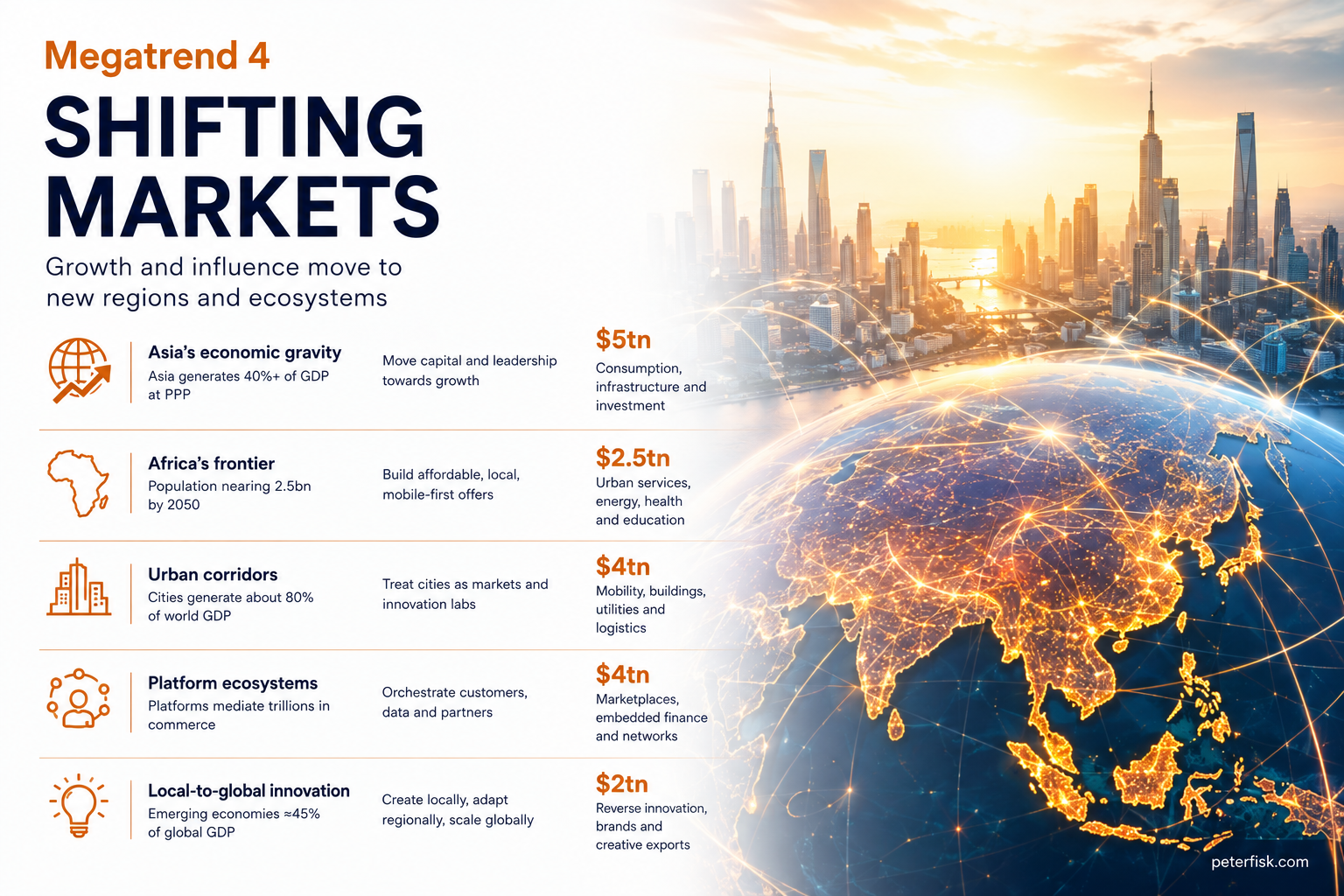
Megatrend 4. Shifting Markets
Growth, innovation and influence moving towards new regions and ecosystems
The geography and organisation of economic opportunity are changing. Growth is moving towards Asia, Africa and new urban corridors. At the same time, industry boundaries are dissolving as platforms and ecosystems connect previously separate products and services.
Markets are shifting both geographically and structurally.
Component trends:
1. Asia’s economic gravity … Asia produces more than 40% of global GDP at purchasing-power parity and contributes the majority of global growth. China remains important, but India, Indonesia, Vietnam and other Asian economies are expanding their influence.
2. Africa’s growth frontier … Africa’s population could approach 2.5bn by 2050, while its urban population may reach almost 1bn by 2035. This will generate enormous needs for housing, energy, finance, health, education and mobility.
3. Urban corridors … More than four billion people live in cities, which generate approximately 80% of global GDP. Growth will increasingly concentrate in megacities, secondary cities and connected economic corridors.
4. Platform ecosystems … Digital platforms already mediate trillions of dollars in commerce. Ecosystems are dissolving boundaries between finance, retail, healthcare, mobility, media and technology.
5. Local-to-global innovation … Emerging economies generate approximately 45% of global GDP at market exchange rates and considerably more at purchasing-power parity. Their companies, brands and business models are increasingly influencing global markets.
Responses:
- Reallocate capital, innovation and leadership towards future growth markets.
- Build affordable, locally relevant and mobile-first propositions with local partners.
- Treat cities and economic corridors—not only countries—as strategic markets.
- Orchestrate ecosystems connecting customers, data and complementary capabilities.
- Create innovations locally, adapt them regionally and scale them globally.
Impact:
- Asia’s expanding markets: $5tn
- Africa’s growth frontier: $2.5tn
- Cities and economic corridors: $4tn
- Platform ecosystems: $4tn
- Local-to-global innovation: $2tn
The opportunity will be driven by consumption, infrastructure, embedded finance, marketplaces, urban services and innovations developed around emerging-market needs.
The old model was to create in the West and export to the rest. The emerging model is to innovate everywhere—and scale the best ideas anywhere.
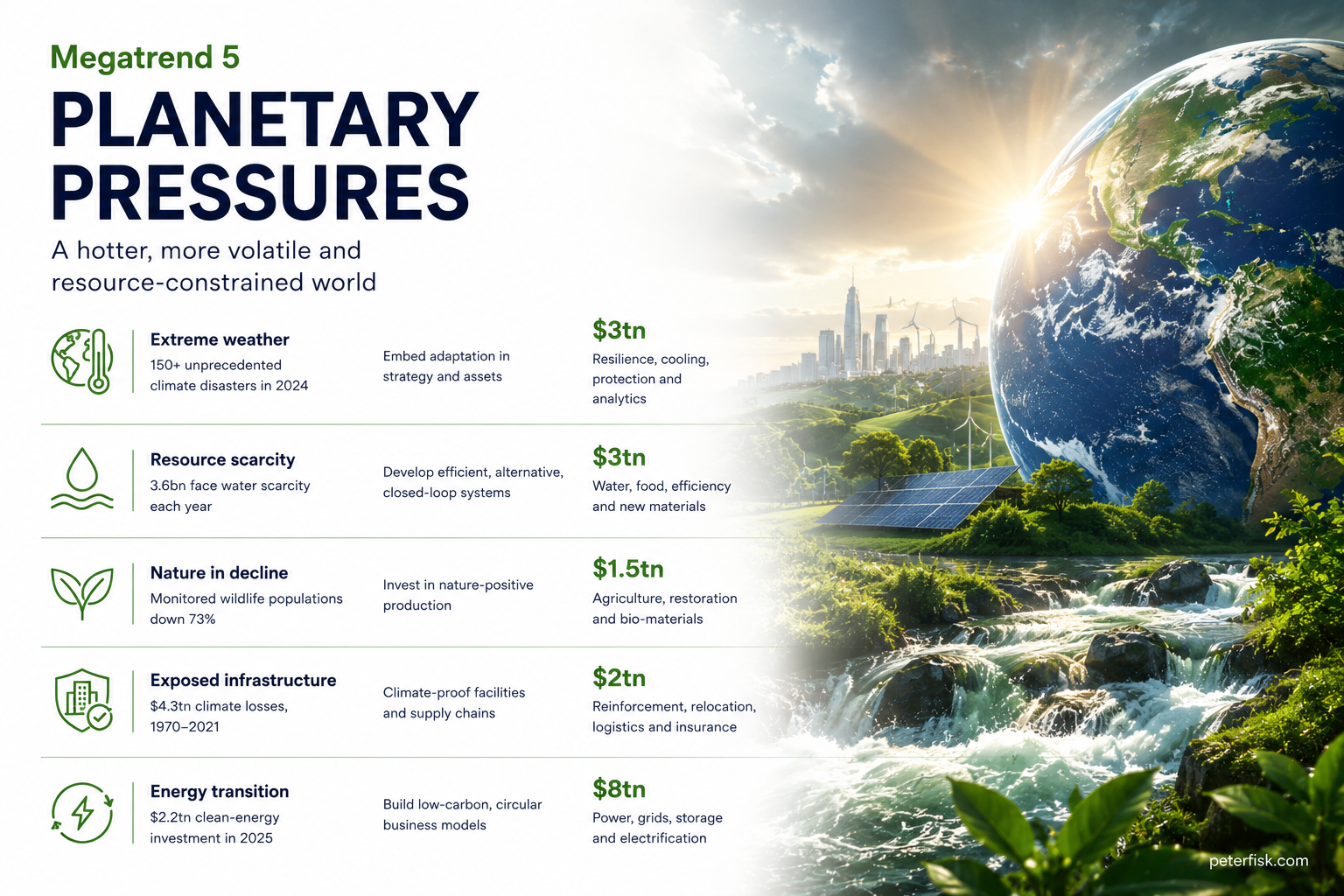
Megatrend 5. Planetary Pressures
A hotter, more volatile and resource-constrained world
“Regenerative futures” describes an important response, but it is not the underlying megatrend. The larger structural force is the intensification of climate disruption, ecological degradation and resource scarcity. Planetary pressures are the megatrend. Adaptation, resilience, circularity and regeneration are the strategic responses.
Component trends:
1. Extreme weather … More than 150 unprecedented climate disasters were recorded during 2024. Extreme heat, storms, flooding, drought and wildfire increasingly affect productivity, infrastructure, insurance and habitability.
2. Resource scarcity … Approximately 3.6bn people experience water scarcity for at least one month annually. Competition will intensify for water, food, energy and critical materials.
3. Nature in decline … Monitored wildlife populations declined by an average of approximately 73% between 1970 and 2020. Deteriorating ecosystems threaten agriculture, water systems, health and economic resilience.
4. Exposed infrastructure … Weather-, climate- and water-related disasters caused $4.3tn of reported economic losses between 1970 and 2021. Many facilities and supply networks were designed for a climate that no longer exists.
5. Energy transition … Global clean-energy investment reached approximately $2.2tn in 2025. Renewable power, storage, grids and electrification are becoming central to industrial competitiveness and energy security.
Responses:
- Embed adaptation into strategy, asset design, insurance and capital allocation.
- Develop efficient, alternative and closed-loop resource systems.
- Invest in nature-positive agriculture, production and ecosystem restoration.
- Climate-proof facilities, logistics and supply networks.
- Build low-carbon, circular and regenerative business models.
Impact:
- Climate adaptation and resilience: $3tn
- Resource-efficiency and alternatives: $3tn
- Nature-positive systems: $1.5tn
- Climate-resilient infrastructure: $2tn
- Energy and industrial transition: $8tn
Value will come from renewable energy, grids, storage, water treatment, precision agriculture, resilient buildings, circular materials and avoided climate losses.
Scarcity should not be treated only as a constraint. It can become a powerful catalyst for reinvention.
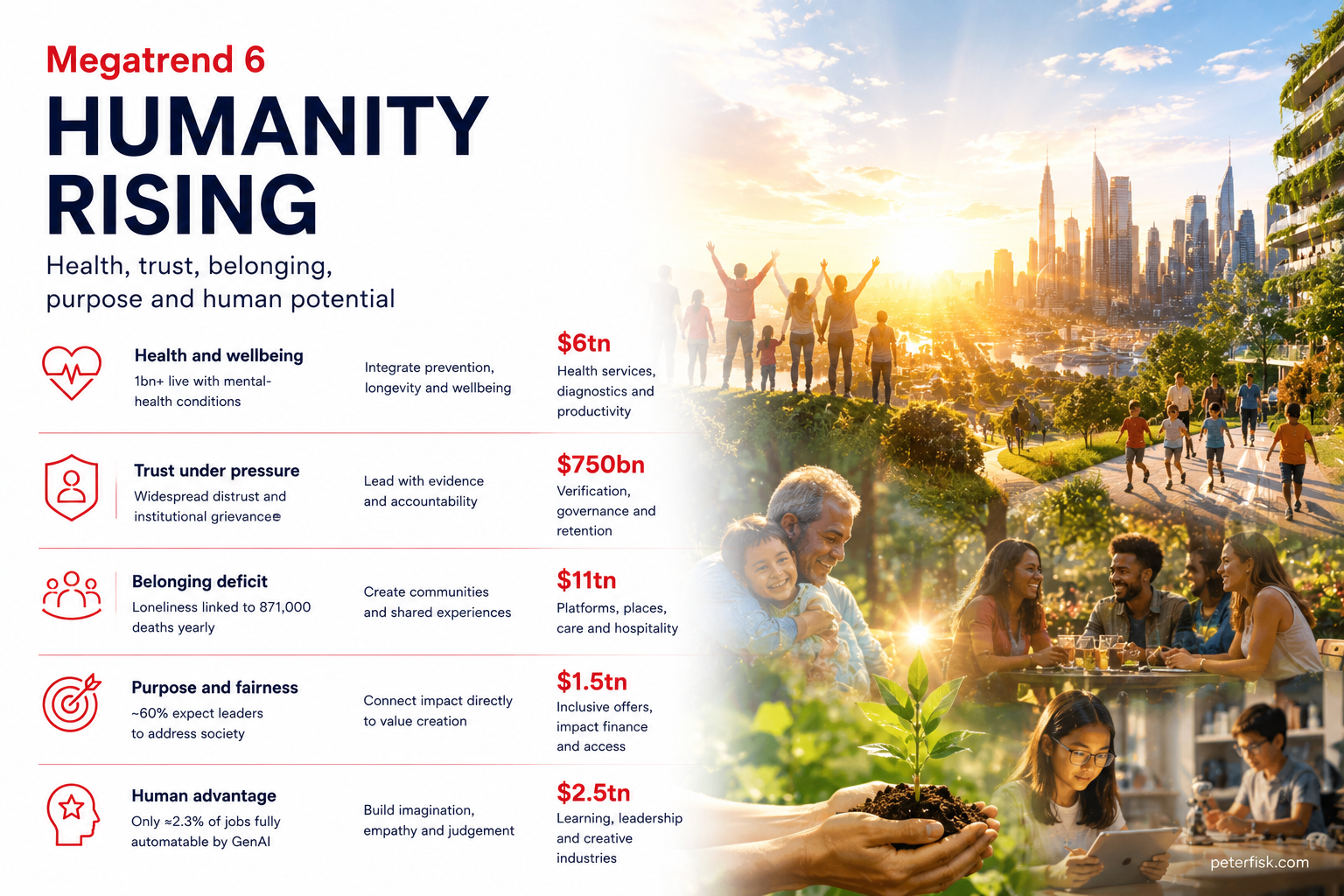
Megatrend 6. Humanity Rising
A growing search for health, trust, belonging, purpose and human potential
Humanity Rising is the counterforce to social fragmentation. As technology accelerates and institutions weaken, people place greater value on health, trust, belonging, fairness and agency.
This does not suggest that humanity will automatically triumph. It describes the growing demand for progress to serve people rather than simply increase efficiency.
Component trends:
1. Health and wellbeing … More than one billion people live with mental-health conditions, while non-communicable diseases cause approximately three-quarters of global deaths. Prevention, longevity and everyday wellbeing will become increasingly important.
2. Trust under pressure … Political polarisation, misinformation and institutional grievance are weakening confidence in governments, media and business. Trust is becoming a scarce and economically valuable asset.
3. Belonging deficit … Loneliness is associated with approximately 871,000 deaths annually. Digital connectivity has not necessarily produced meaningful human connection.
4. Purpose and fairness … Around six in ten people expect business leaders to address societal challenges. Employees and customers increasingly scrutinise whether corporate purpose translates into meaningful action.
5. Human advantage … Only around 2.3% of global employment may be fully automatable by generative AI, although far more work will be transformed. Imagination, empathy, judgement and collaboration become more—not less—valuable.
Responses:
- Integrate prevention, mental health, longevity and wellbeing into propositions and workplaces.
- Build trust through evidence, transparency, accountability and consistency.
- Create communities and experiences that enable participation and belonging.
- Connect social and environmental impact directly to value creation.
- Invest in imagination, empathy, critical thinking, judgement and leadership.
Impact:
- Health, longevity and wellbeing: $6tn
- Trust, transparency and verification: $750bn
- Community and belonging: $1tn
- Purpose-led and inclusive growth: $1.5tn
- Human capability and learning: $2.5tn
The opportunity spans healthcare, diagnostics, learning, leadership development, community platforms, hospitality, trusted intermediaries and inclusive financial services.
The most valuable organisations will combine machine intelligence with deeper human intelligence.
Leading the future
Leadership in this fast-emerging future requires a fundamentally different approach. It is more strategic — guiding organisations forwards rather than managing their stability.
Leaders need to look beyond today’s performance to understand what is changing, imagine what could be possible, and make choices before the answers are obvious. They must navigate uncertainty rather than eliminate it, exploring alternative scenarios, creating portfolios of options and experimenting their way forwards.
Leadership becomes less about control and more about direction, curiosity and courage — connecting long-term ambition with short-term action, mobilising people around possibility, and continually adapting the organisation as the future unfolds.
Strategy: building a dynamic portfolio of options
Strategy therefore becomes more exploratory, adaptive and future-back. Instead of extrapolating a single plan from today, leaders use the megatrends to identify structural shifts, build alternative scenarios and explore how different intersections could reshape customers, markets and sources of value.
They translate these possibilities into a portfolio of strategic options—some strengthening today’s business, some opening adjacent growth spaces and others testing more transformational futures. Investment is staged as evidence emerges, allowing the organisation to learn, adapt and accelerate without committing prematurely to one forecast.
Strategy becomes less about predicting the future correctly and more about remaining relevant across multiple plausible futures, while using the megatrends to guide where to explore, what capabilities to build and which opportunities to pursue.
Intersections: opportunities where megatrends collide
The greatest disruption, and the most valuable opportunities, will emerge where two or more forces collide.
A company looking only at artificial intelligence might invest in automation. A company looking at AI alongside ageing, healthcare costs and demand for longer, healthier lives might create an entirely new preventative-health platform. One improves the existing business; the other creates a new market.
This is the difference between responding to trends and exploiting their intersections.
Example 1. Accelerating intelligence × diverging demographics
Reinventing health, care and longevity
AI combined with ageing populations, longer lives, sensors and preventative medicine is shifting healthcare from periodic intervention towards continuous anticipation.
Neko Health demonstrates the opportunity. Its one-hour health scan combines imaging, cardiovascular assessment, blood biomarkers and metabolic data, capturing millions of data points and presenting the findings through a clinician. It is now integrating body-composition measures and Apple Health wearable data to create a more continuous view of the individual. Neko raised $700m in 2026 to support its international expansion, reportedly reaching a valuation close to $7bn. Neko Health, Neko’s 2026 health-platform expansion
Oura is making a similar move from wearable hardware towards a personal health-intelligence platform. The ring is merely the point of entry; the longer-term value comes from interpreting sleep, stress, activity, cardiovascular and hormonal signals over time.
The intersection extends beyond healthcare. AI-enabled homes can support independent living; robotic systems can address care-worker shortages; financial platforms can help people fund longer lives; and employers can redesign work for multigenerational teams.
The opportunity is not simply to sell more medical devices. It is to build the operating systems for a 100-year life—connecting prevention, personalisation, care, finance, housing and continued participation.
Example 2. Accelerating intelligence × geopolitical reorder
Turning technology infrastructure into strategic power
AI requires chips, data, compute, energy and communications infrastructure. Geopolitical competition is turning each of these into a strategic national resource.
TSMC’s international expansion illustrates the intersection. The company plans to increase its US investment to $165bn, including additional fabrication plants, advanced packaging facilities and an R&D centre in Arizona. It is also expanding in Japan and Germany. These investments are not based purely on production efficiency: they reflect governments’ and customers’ desire to reduce exposure to the concentration of advanced semiconductor manufacturing in Taiwan. TSMC’s US expansion
Microsoft and other cloud providers are simultaneously developing sovereign-cloud propositions that allow governments and regulated industries to retain greater control over where data is stored, how systems are operated and which jurisdictions govern them.
This intersection creates opportunities in:
- advanced semiconductor manufacturing;
- sovereign cloud and nationally controlled AI;
- regional data centres and energy infrastructure;
- cyber-security and quantum-resistant encryption;
- critical-mineral processing and recycling;
- trusted cross-border data systems.
Companies can no longer treat digital infrastructure as a globally interchangeable utility. Where intelligence is trained, hosted and governed will become part of competitive strategy.
Example 3. Diverging demographics × shifting markets
Building for the world’s next consumers and cities
The world’s fastest-growing consumer markets will increasingly be found where youthful populations, rapid urbanisation and digital leapfrogging intersect.
Reliance Jio offers one model. It did not approach India simply as another telecommunications market. It used affordable connectivity as the foundation for an ecosystem spanning entertainment, commerce, education, cloud services and digital applications. Jio reached more than 488m users by 2025, demonstrating how infrastructure can become a platform for an expanding range of services. Reliance Industries’ digital-services report
Similar opportunities are emerging across Africa. Mobile money, distributed energy, digital education, telemedicine and technology-enabled logistics can leapfrog physical infrastructures that were never fully developed. The most successful propositions will not be simplified Western products. They will be designed around local realities: mobile-first access, informal employment, intermittent infrastructure, affordability and community-based distribution.
The opportunity lies at the intersection of population growth, urban density and technological accessibility. By 2035, Africa’s urban population could approach one billion. The resulting need for housing, mobility, energy, water, food, education, finance and healthcare represents one of the largest market-creation opportunities of the coming decades.
The strategic unit is also changing. Companies should look beyond countries to cities and economic corridors, where population, infrastructure, talent and demand concentrate.
Example 4. Planetary pressures × geopolitical reorder
Converting scarcity into resilience and growth
Climate disruption and geopolitical competition increasingly reinforce each other. Water, energy, food and critical minerals are becoming matters of national security as well as sustainability.
Xylem is turning water scarcity into a growth platform. The company combines pumps, treatment systems, sensors, analytics and digital network management to help utilities and industrial customers reduce losses, reuse water and operate more resilient infrastructure. Xylem generated approximately $9bn of revenue in 2025, demonstrating that planetary pressure is already creating substantial commercial markets. Xylem’s 2025 results
Schneider Electric sits at the intersection of electrification, automation, AI infrastructure and decarbonisation. Demand for data centres creates greater electricity and cooling requirements; pressure to decarbonise creates demand for efficiency, renewable energy and intelligent management. Schneider can therefore benefit from the AI boom while helping address the energy pressures the boom produces.
Redwood Materials offers another intersectional model by recovering lithium, nickel, cobalt and copper from batteries. Recycling becomes simultaneously a circular-economy proposition, a source of lower-carbon materials and a way of reducing geopolitical dependence on concentrated mineral supply chains.
The opportunity is broader than “green business”. It includes:
- distributed and renewable energy;
- grids, storage and energy intelligence;
- water reuse and precision agriculture;
- resilient infrastructure and climate analytics;
- alternative and recycled materials;
- supply-chain traceability and resource security.
Planetary constraints will destroy value in exposed systems while creating value for companies that make adaptation, resilience and resource productivity possible.
Example 5. Accelerating intelligence × humanity rising
Making trust the essential layer of the AI economy
As synthetic media becomes indistinguishable from captured reality, trust moves from an abstract brand quality to a form of infrastructure.
Adobe’s Content Credentials provide an early example. They attach verifiable metadata to digital content, recording its origin, creator and editing history, including whether AI was involved. The underlying C2PA standard is supported by a coalition of more than 500 organisations, including Adobe, Microsoft, Google, Meta, Amazon, Sony, the BBC and OpenAI.
The larger opportunity is to build a trust layer for the intelligent economy:
- verified identity for people and agents;
- provenance for content and data;
- auditable algorithms and decisions;
- fraud detection and transaction security;
- privacy-preserving personalisation;
- accountable human oversight.
Trust will affect whether people accept AI-generated advice, autonomous financial decisions, algorithmic healthcare and machine-created information. Organisations able to demonstrate not only what their systems decide, but how and why they decide it, will gain an increasingly valuable advantage.
The best response is not to slow technological progress. It is to combine machine capability with transparency, consent and human accountability.
Example 6. Longevity × accelerating intelligence × humanity rising
Rewriting education, work and retirement
Longer lives are making the conventional sequence of education, employment and retirement obsolete. At the same time, AI is shortening the useful life of skills.
Coursera reached 191m registered learners in 2025 and recorded 5.4m enrolments in generative-AI courses—almost twice the previous year’s total. This reflects the growing demand for continuous, modular and employment-relevant learning. See Coursera’s 2025 learning trends
BMW addresses another aspect through its Senior Experts programme, which enables retired employees to return for temporary projects and transfer specialist knowledge to younger colleagues. It turns retirement from a permanent exit into a more flexible stage of contribution. See BMW Senior Experts programme
The emerging opportunity includes:
- modular learning subscriptions;
- AI-enabled personal tutors and career agents;
- skills credentials that travel between employers;
- flexible work for older professionals;
- intergenerational mentoring and knowledge platforms;
- financial products designed for less predictable working lives.
Education can no longer be understood as preparation for a first career. It becomes infrastructure for repeated reinvention throughout a longer life.
The overall scale of opportunity
The six megatrend value pools developed in this analysis are:
- Accelerating Intelligence: $22.5tn
- Geopolitical Reorder: $8.8tn
- Diverging Demographics: $13.5tn
- Shifting Markets: $17.5tn
- Planetary Pressures: $17.5tn
- Humanity Rising: $11.75tn
Arithmetically, these amount to $91.55tn of gross opportunity over 2027–2036. But this should not be presented as a single additive market forecast. AI-enabled longevity, for example, appears within both Accelerating Intelligence and Diverging Demographics. Smart, resilient cities sit within Shifting Markets and Planetary Pressures.
Allowing for these overlaps, a reasonable strategic estimate is that the six forces could create, redirect or protect approximately $50–70tn of distinct economic value over the next decade. This is an indicative scenario range rather than a prediction.
The value arises through four mechanisms:
- New market revenues
Longevity services, clean energy, cyber-security, digital identity, water technology and new urban services. - Capital investment
Data centres, semiconductor plants, grids, resilient infrastructure, mineral processing and regionalised production. - Productivity value
AI-enabled work, intelligent automation, healthier populations and more effective workforce development. - Avoided economic losses
Reduced cybercrime, climate damage, resource waste, supply-chain disruption and institutional distrust.
The crucial distinction is between markets that are merely growing and value that is being structurally redirected. Some industries will expand; others will be rebuilt around new technologies, locations, constraints and expectations.
What it will take
The central barrier is unlikely to be awareness. Most leaders already recognise AI, climate change, ageing and geopolitical instability. The challenge is translating these forces into distinctive strategic choices.
Capturing the opportunity will require six shifts.
1. Move from trend watching to intersection mapping
Instead of maintaining separate AI, sustainability and demographic reports, organisations should identify where those forces collide around specific customers, markets and capabilities.
2. Work future-back
Traditional strategy extrapolates from present products, customers and competencies. Megatrend-led strategy begins with the emerging world and works backwards. It asks:
- Where will future demand form?
- What will customers value differently?
- Which resources and capabilities will become scarce?
- Which assumptions behind the current business will become obsolete?
- What new value pools could the organisation credibly shape?
This is the foundation of my new Dynamic Strategy Playbook
3. Build portfolios of options
No organisation can predict precisely how the six forces will develop. Leaders need a portfolio spanning immediate performance, adjacent growth and more transformational opportunities. Small experiments create learning; staged investment preserves flexibility; explicit choices concentrate resources as evidence strengthens.
4. Orchestrate ecosystems
Most intersectional opportunities exceed the capabilities of any one company. Preventative health requires devices, clinicians, data platforms and insurers. Resilient cities require governments, utilities, financiers and technology providers. Advantage increasingly comes from orchestrating the system, not owning every component.
5. Reallocate capital before certainty arrives
Strategy only becomes real when resources move. Leaders must redirect investment from historically successful businesses towards future value pools before the financial evidence is complete. Waiting for certainty usually means entering after the most attractive positions have been captured.
6. Measure future value
Traditional measures favour mature businesses with predictable short-term returns. New metrics should track learning, options created, ecosystem strength, future customer relevance, capability development and the potential value of emerging businesses.
Are you ready?
Megatrends are your guide to a better future. As leaders, how will you embrace them, shape them, and seize the opportunities they offer?
The 6 forces can be expressed in one connected narrative: Intelligence accelerates. Power is reordered. Populations diverge. Markets shift. Planetary pressures intensify. Humanity rises.
The leadership challenge is not merely to predict these forces. It is to connect them, decide what they make possible and mobilise the organisation to build that future before somebody else does.
I work with boards, executive teams, strategists and innovators to translate megatrends into what they mean for their markets, customers and businesses.
Together, we look beyond forecasts to explore the possibilities ahead: how industries could evolve, where new value might emerge, and what choices leaders can make today. We use these insights to rethink purpose and vision, identify new strategic opportunities, design transformational roadmaps, and build innovation portfolios that balance performance today with potential tomorrow. The ambition is not simply to anticipate change, but to develop the confidence, choices and capabilities to shape the future rather than follow it.
Appendix
Below are a series of additional resources, diving into megatrends at a sector level, for use with clients in my workshops:
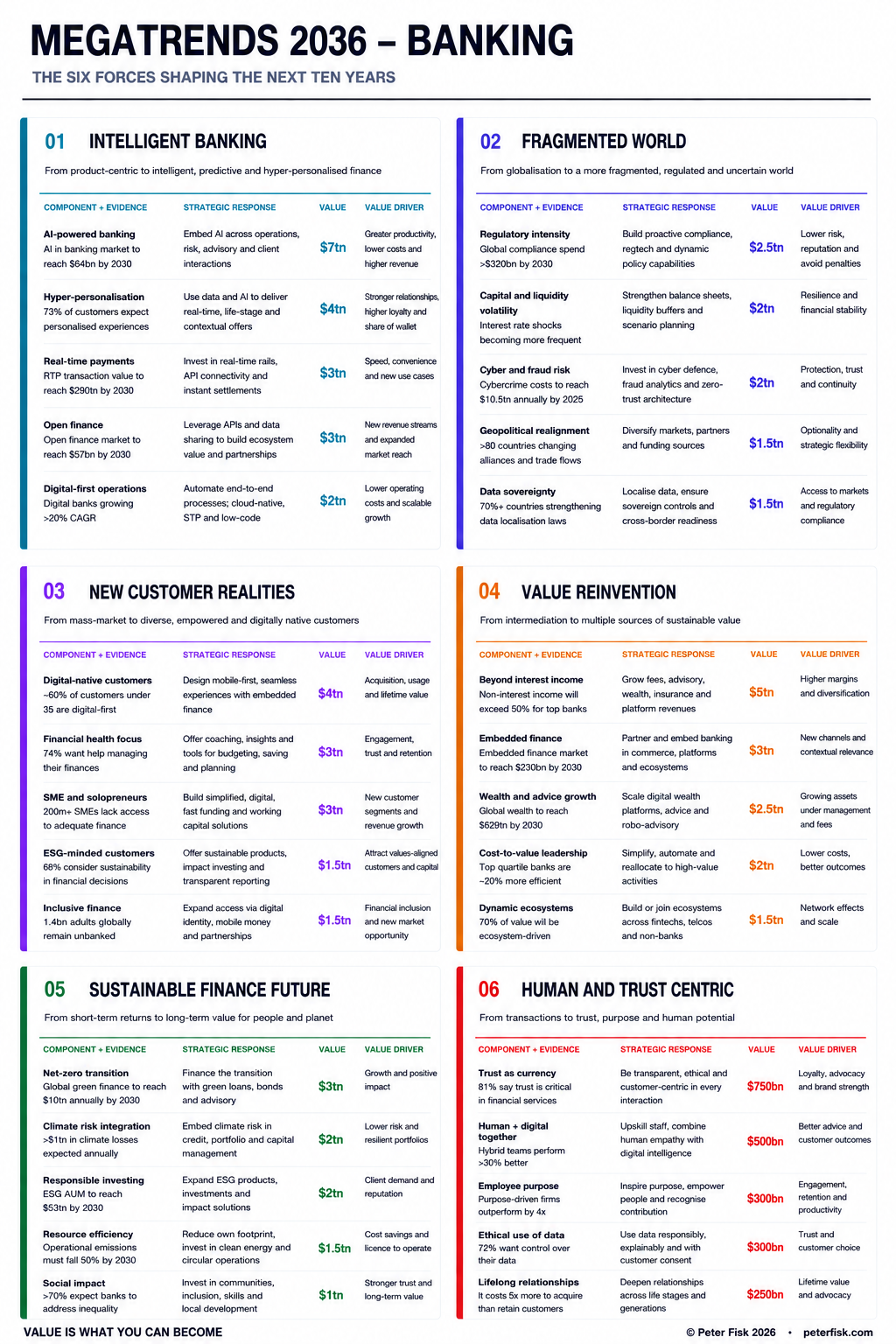
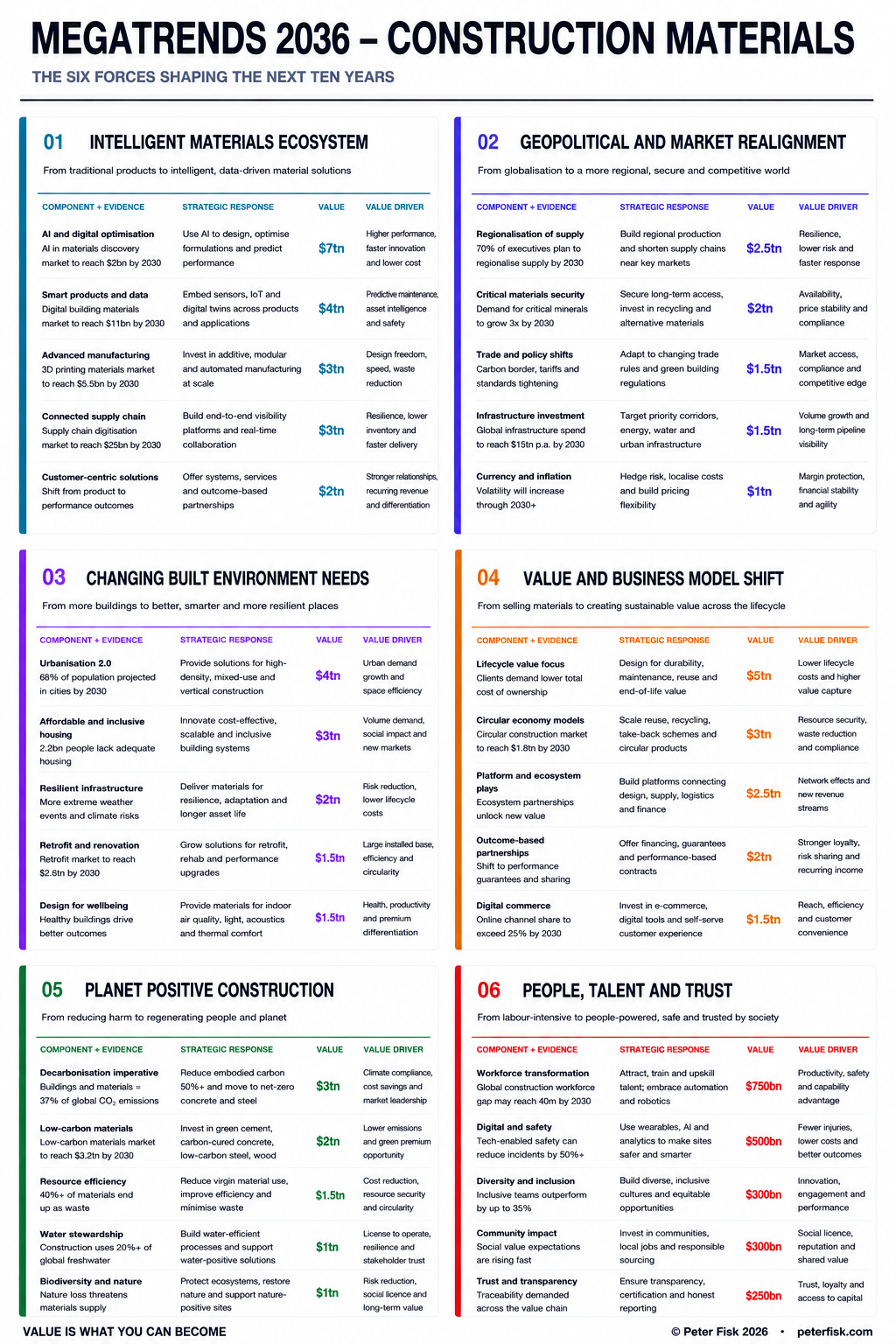
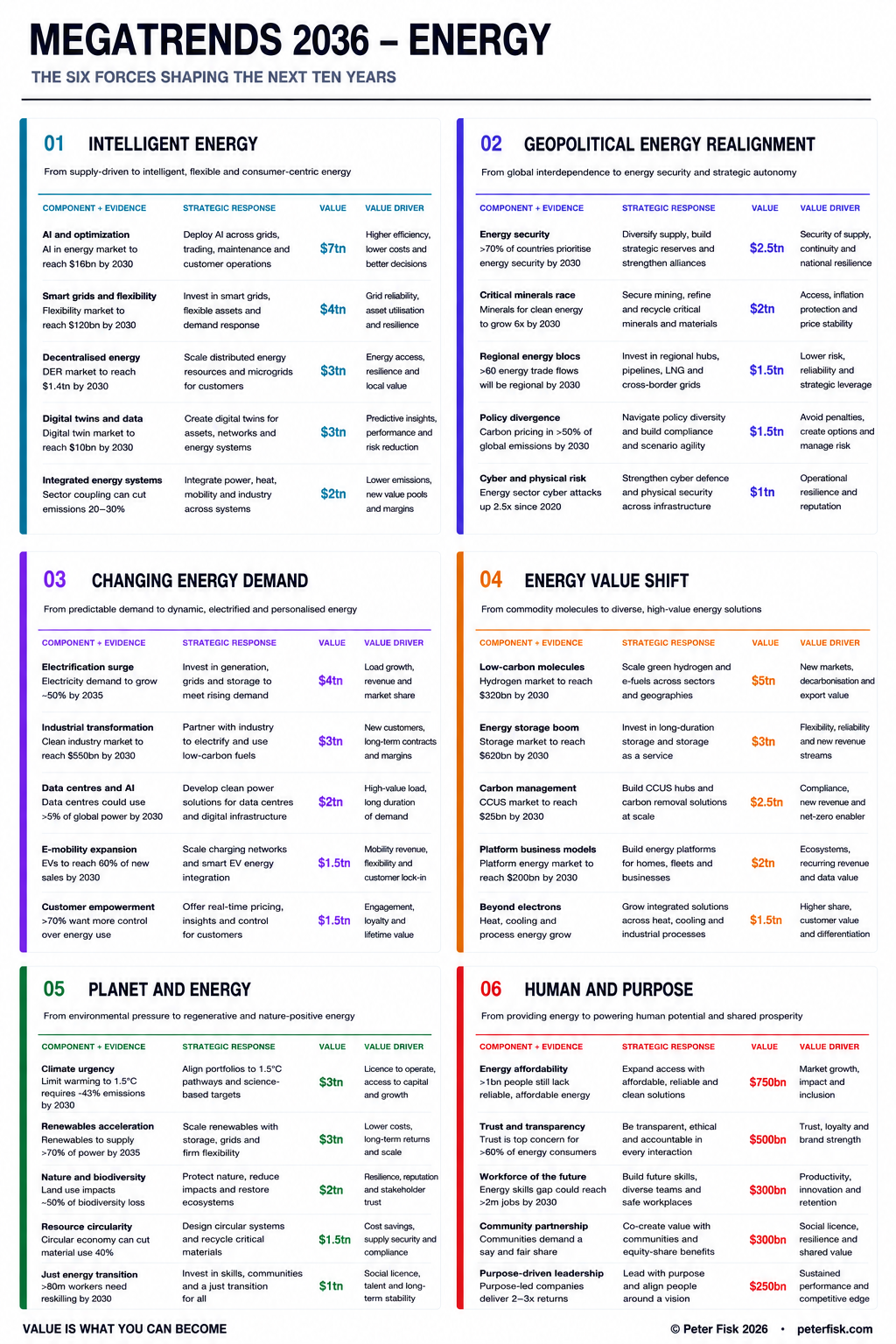
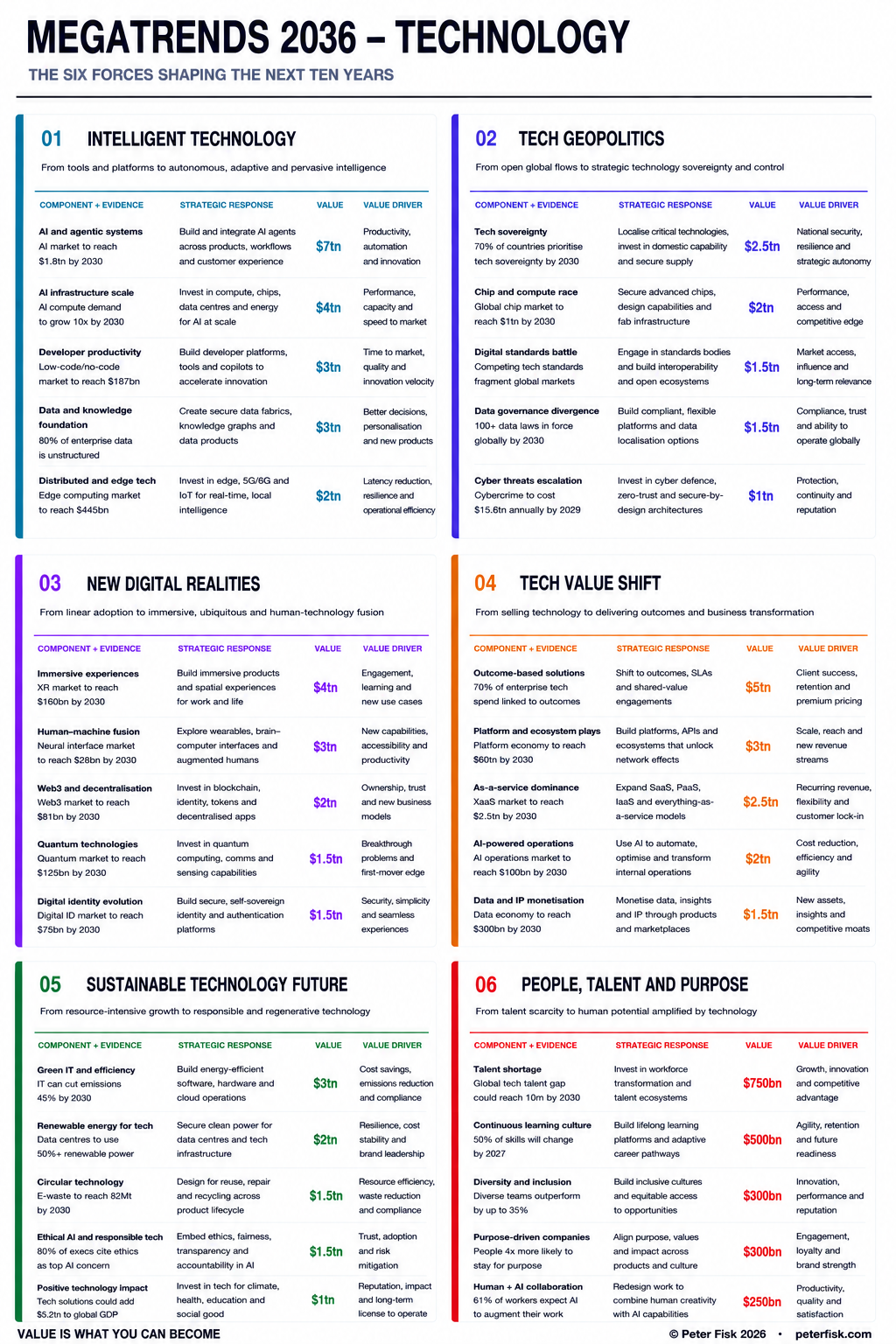
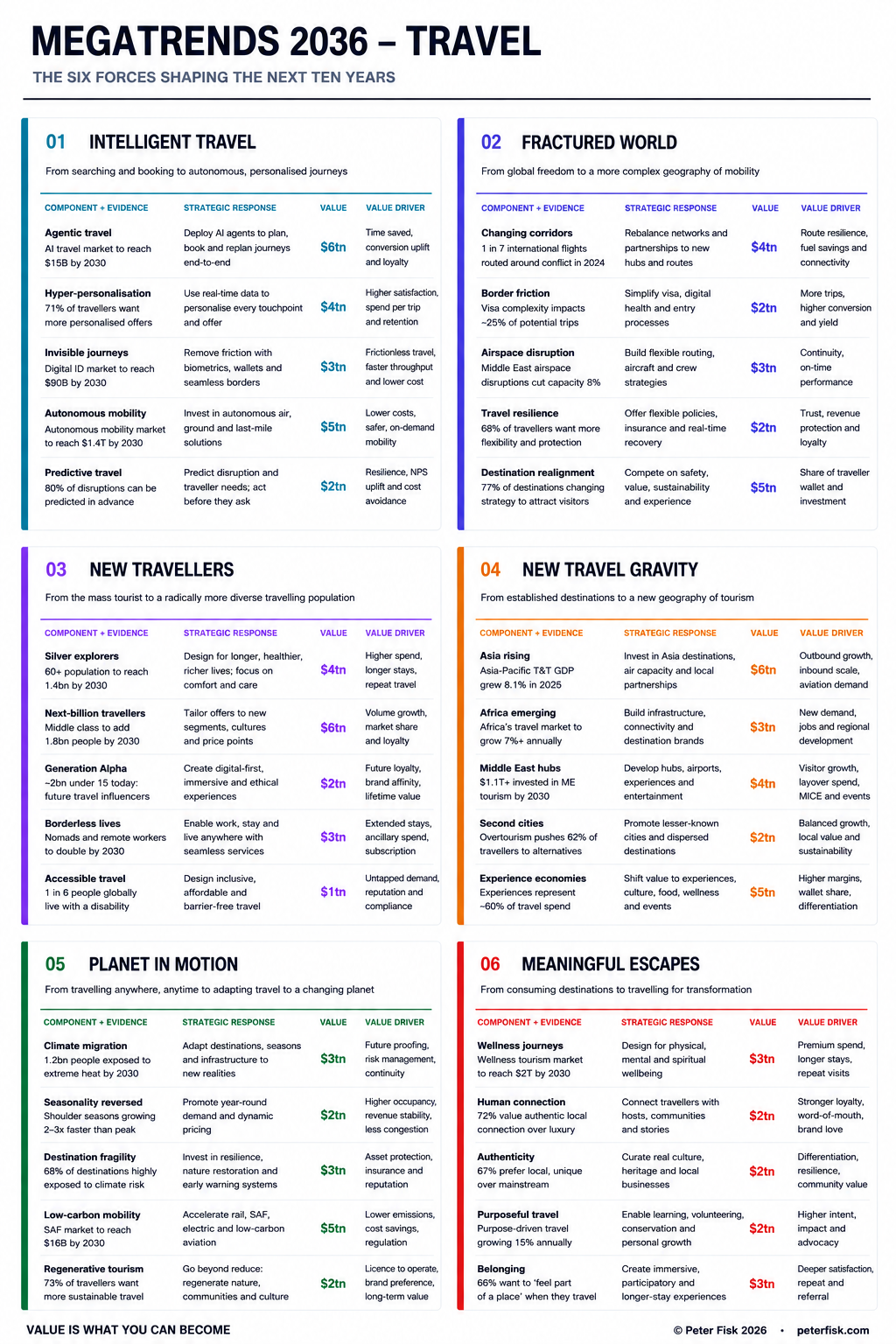
You come back from summer refreshed. Your leadership team comes back unchanged … But something is missing … maybe a possibility, or perspective, or even a person.
September has a particular energy. The inbox fills again, airports get crowded, calendars suddenly become impossible and leadership teams reconvene after a few weeks scattered across beaches, mountains, cities and homes. There is often a renewed sense of purpose. People have had time to think, perhaps to read something provocative, visit somewhere different, talk to different people, or simply gain enough distance from work to see it differently. For a brief moment, before the machinery starts moving again, there is an opportunity to look at the business with fresh eyes.
And then something strange happens. We sit back down in exactly the same chairs.
The same people return to the same leadership meetings, carrying broadly the same responsibilities, looking at broadly the same dashboards and asking broadly the same questions. How are revenues tracking? What has happened to margins? Where are we against budget? What is happening with customers, people and operations? The first meeting after summer might feel refreshed, but the architecture of the conversation has barely changed. Within days, we are back inside the assumptions, routines and priorities that shaped the organisation before we went away.
So before normality completely takes over again, there is a more interesting question for every CEO and leadership team to ask: what is missing from this room?
Not who is absent today, or which position remains unfilled on the organisation chart. The more important question is what capability, perspective, ambition or possibility nobody around the table adequately represents. What are we not seeing because nobody is looking for it? What are we not discussing because it belongs to nobody? What could become important remarkably quickly, yet remains peripheral to today’s agenda?
That is the Empty Chair. And it may represent some of the most significant unrealised value in your business.
Leadership teams are designed for the business they already have
Look around most executive tables and you can reconstruct the organisation from the people sitting there. Finance has a chair. Operations has a chair. Marketing and sales have chairs. HR has a chair. Technology increasingly has a chair. Depending on the business, there will be chairs for regions, products, supply chains, legal affairs and other important functions.
There is nothing wrong with any of these roles. The problem is more fundamental. Most leadership teams are essentially organisational maps of where value came from in the past, rather than possibility maps of where value could come from in the future.
The structure of the team reflects the structure of the existing business, and because organisational structures shape conversations, investment and attention, the existing business becomes remarkably good at reproducing itself. Finance naturally asks how to improve returns. Operations asks how to improve efficiency. Sales asks how to increase conversion. Marketing asks how to strengthen demand. HR asks how to attract and develop talent. These are all important questions, but they largely start with the organisation as it currently exists.
The questions that could determine the organisation’s future are different. What business should we be in five years from now? Which markets that barely exist today could become significant tomorrow? Who is the customer we do not yet serve? How could AI fundamentally change the economics of what we do, rather than simply make existing processes more efficient? Which partners could multiply our capabilities? What would happen if the boundaries between our industry and another disappeared? Which assumptions on which our current strategy depends are becoming obsolete?
These are not necessarily questions that fit naturally within anybody’s existing job description. And that is precisely the problem. What belongs to everyone often belongs to nobody; what lies beyond today’s business often lies beyond today’s organisation chart.
The Empty Chair gives those questions somewhere to sit.
The biggest constraint might not be resources
Leadership teams typically assume that their greatest constraint is resources: more investment, more people, more technology or more time. Increasingly, however, the bigger constraint is often imagination. Companies become prisoners of what they already know. Their existing capabilities become their boundaries, their industry definitions become their worldview, their competitors determine their benchmarks, and their current customers define their innovation agenda.
Success can make this worse. The better you become at today’s business, the more evidence you accumulate that today’s business is the right business to be in. Strong performance reinforces the existing paradigm, encourages further investment in proven capabilities and makes alternatives look unnecessarily risky. This creates what I call the Possibility Paradox: the stronger your performance within today’s paradigm, the harder it can become to imagine a fundamentally different one.
That is why reinvention rarely begins with an answer. It usually begins with somebody asking a question the existing organisation was not designed to ask. The Empty Chair gives that question legitimacy. Imagine physically leaving one chair empty at your next executive meeting and asking: who or what needs to sit here for us to see what we currently cannot see?
For one company, the chair might belong to AI — not someone discussing how to deploy another productivity tool, but someone asking how abundant intelligence could transform the fundamental economics, customer proposition and operating model of the business. For another, it might belong to the future customer, representing needs and behaviours that today’s market research barely captures. For another, it could belong to ecosystems, asking what becomes possible when the company stops thinking only about the assets it owns and starts combining its capabilities with those of others.
The chair might represent the next generation, an entrepreneur, a scientist, a future investor, an emerging market, the planet, or even a competitor that does not yet exist. The specific title matters less than the purpose: to bring into the room the perspective that today’s organisation is structurally least able to see.
Seven Empty Chairs
The most interesting Empty Chairs are therefore rarely traditional functions. They represent dimensions of future value creation that established organisational structures struggle to accommodate.
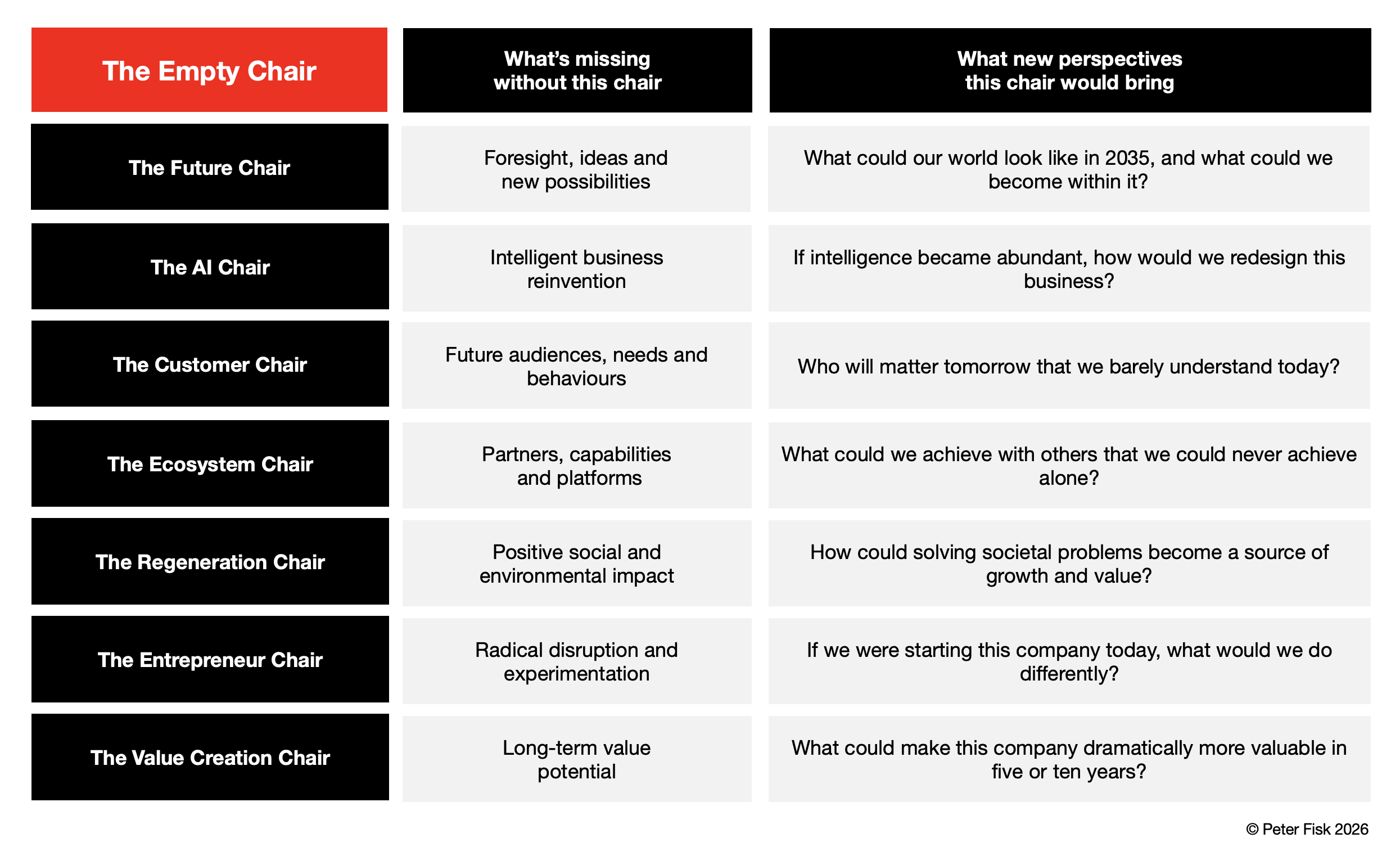
This does not mean hiring seven new executives. That would be to interpret the idea too literally. Sometimes the Empty Chair will require a permanent new capability, and the emergence of roles around AI, ecosystems, transformation and foresight reflects the growing inadequacy of traditional functional structures. But often the solution can be more fluid.
A leadership team could invite an entrepreneur into its meetings every quarter, create a future council drawn from younger employees, bring customers directly into strategy discussions rather than merely presenting research about them, or ask a different executive at each meeting to occupy the Empty Chair and challenge the team’s dominant assumptions. Scientists, technologists, artists, investors, activists and leaders from completely different industries can all provide perspectives that would never emerge naturally from within the existing executive structure.
The Empty Chair is therefore not primarily an organisational device. It is a mechanism for cognitive diversity. You cannot create a fundamentally different future using exactly the same assumptions that created your present.
When experience becomes a constraint
We naturally value experience in leadership, and rightly so. Experience brings judgement, pattern recognition and confidence. Yet experience contains an interesting contradiction: it teaches us how the world worked. That is immensely valuable when tomorrow resembles yesterday, but it becomes more problematic when the conditions that produced our experience are themselves changing.
The accelerating convergence of AI, biotechnology, climate transition, demographic change, new geopolitical structures and shifting consumer expectations means that leaders increasingly face situations for which nobody has meaningful direct experience. In such environments, experience can quietly become orthodoxy. “We tried that before”, “our customers wouldn’t want that”, “that isn’t how our industry works”, “we don’t have the capabilities” and “the economics don’t make sense” can sound like informed judgement, but they can also become defences of an existing paradigm.
Perhaps those statements are correct. But perhaps they describe the world that created our experience rather than the world now emerging. The Empty Chair challenges the tyranny of accumulated certainty. Its purpose is not to disrespect experience, but to stop experience becoming a boundary around possibility.
From organisation chart to possibility map
This suggests a different way to think about leadership teams. Most companies build their executive teams around accountability: who owns finance, people, operations, technology, customers and markets? But the leadership team of the future also needs to be designed around possibility. Who owns the future? Who owns reinvention? Who owns ecosystems? Who owns emerging technologies and new business models? Who owns the value we have not created yet?
That last question is particularly important because most businesses remain obsessed with performance: quarterly revenue, annual margin, market share, productivity and earnings. Yet markets ultimately value something bigger. A company is worth not simply what it produces today, but what investors believe it can produce tomorrow. Its value incorporates expectations about future growth, innovation, adaptability and the opportunities it might be able to capture.
This is the distinction at the heart of reinvention. Performance is the value you extract from what you already are; potential is the value embedded in what you could become. Leadership therefore has two jobs simultaneously: exploiting today’s business brilliantly while exploring tomorrow’s possibilities relentlessly.
Most executive teams are structurally overweight towards the first. Their meetings, metrics, incentives, budgets and organisational responsibilities overwhelmingly focus on improving what already exists. The Empty Chair represents the second. It deliberately introduces potential into a conversation dominated by performance.
The future lives between the boxes
There is another reason the Empty Chair matters. Many of the biggest emerging opportunities no longer fit neatly inside organisational functions. An AI-enabled proposition might simultaneously involve technology, strategy, customer experience, talent, operations and new business models. A regenerative business could connect innovation, supply chains, finance, sustainability and customers. A platform strategy might require competitors to become collaborators, customers to become creators and products to become gateways into wider ecosystems.
Who owns these opportunities? Often everybody, which can quickly mean nobody.
Organisations are remarkably effective at managing things that fit neatly inside boxes. They are much less effective at pursuing possibilities that cut horizontally across them. Yet increasingly, the future lives between the boxes.
This is what I call the Nexus Effect: disproportionate value increasingly emerges from connecting things that were previously separate — technologies, capabilities, industries, partners, customers and ideas. An executive team organised around yesterday’s vertical functions can therefore miss tomorrow’s horizontal opportunities.
The Empty Chair sits at that intersection. Instead of asking only how each part of the organisation can perform better, it asks what becomes possible when we connect the parts differently. That is a much more powerful starting point for reinvention.
The Empty Chair should keep moving
There is no reason why the Empty Chair should remain the same. Indeed, it probably shouldn’t. Perhaps this quarter it represents AI because the organisation urgently needs to understand how intelligent technologies could reshape its business model. Next quarter it might represent India, China, Africa or another geography because the centre of gravity in its market is shifting. Then it might represent a radically younger customer, an entrepreneur attacking the industry from outside, or an investor looking at the company from the perspective of 2035.
The chair changes because the world changes. That is precisely the point. Traditional organisation charts create permanence; the Empty Chair creates movement. It reminds the leadership team that relevance is temporary and that today’s winning formula almost inevitably contains the seeds of tomorrow’s constraint.
Indeed, asking “Who should occupy our Empty Chair now?” could become one of the most valuable quarterly questions a leadership team asks. It forces executives to scan beyond their current agenda and identify the perspective whose absence has become most dangerous — or whose presence could create the greatest new possibility.
From the performance gap to the Reinvention Gap
Leadership teams spend enormous amounts of time examining performance gaps. Why are sales 4% below plan? Why has margin fallen 70 basis points? Why is one region underperforming? Why has employee engagement declined? These questions matter because performance matters.
But there is another gap that rarely appears on executive dashboards: the Reinvention Gap. It is the distance between the value your organisation is creating today and the value it could create if it fully exploited the possibilities emerging around it.
That gap is harder to measure, but potentially far larger. Imagine a company worth £10 billion today. Management might spend months fighting for another £100 million of operating profit, yet a fundamentally different business model, ecosystem, technology platform or market position could potentially create billions in additional enterprise value. Operational improvement remains important, but it needs to be put into perspective. The greatest value creation opportunity may not come from doing today’s business 5% better; it may come from imagining a substantially more valuable business.
That is why I increasingly believe that value is what you can become. The Empty Chair represents everything preventing you from seeing it.
A different first meeting back
So perhaps the first leadership meeting after summer should begin differently. Rather than immediately opening the dashboard, forecast or strategy presentation, put an empty chair at the table and spend the first hour asking what belongs there.
Ask what perspective the team is missing, what uncomfortable voice has been excluded, what capability will matter enormously in three years but barely exists inside the organisation today, and what opportunity lies beyond the boundaries of the current industry. Ask which customers you are not listening to, which technologies you are treating merely as productivity tools when they could reinvent the business, and which partners could enable something you could never create alone. Above all, identify the assumptions everyone around the table shares, because those are precisely the assumptions nobody is likely to challenge.
Then ask the most important question: if we were building the leadership team for the company we want to become, rather than the company we already are, who would be sitting around this table?
That question changes the conversation because leadership is not simply about managing the organisation you inherited. It is about creating the organisation that needs to exist next.
The leadership team as a Becoming Engine
The best leadership teams are not simply management committees. They are Becoming Engines. Their purpose is to connect present performance with future potential, continuously moving between what the organisation is and what it could become. They protect the economic engine of today whilst simultaneously creating the possibilities that might eventually transform or replace it.
This demands a different rhythm of leadership: perform and explore, exploit and imagine, deliver and experiment, optimise and reinvent. These are not sequential phases. They need to happen simultaneously, because by the time today’s performance begins to fail, it is usually too late to start imagining tomorrow.
The Empty Chair keeps that tension alive. It creates space for perspectives that do not fit the existing structure, for people who challenge established assumptions, for opportunities that cannot yet be justified by today’s spreadsheet, and for possibilities whose economic value may only become visible once the organisation starts exploring them.
Most importantly, it prevents the leadership team becoming satisfied with the company’s current identity. It reminds everyone around the table that the organisation they lead today is not the destination. It is simply the latest version of something that must keep becoming.
So as everyone returns from summer and the familiar rhythm of business starts again, resist the temptation to immediately fill every space in the diary and every chair around the table. Leave one empty. Look at it and ask: what is missing from this room that could change what our business becomes?
Somewhere inside the answer may be your next market, your next capability, your next business model, your next source of growth — and perhaps billions in unrealised value.
The Empty Chair is not really empty at all.
It is occupied by your future.
For most of the industrial era, companies created value through improvement. They built better products, stronger brands, larger distribution networks and more efficient operations. They competed by doing what others did, but doing it better, faster or at greater scale.
This old logic created many of the world’s greatest companies of the past: Toyota mastered operational excellence. Walmart perfected supply chain efficiency. P&G built category leadership through brand management. General Electric became a symbol of industrial scale and management discipline.
The formula was clear: Build a strong position, optimise performance, defend competitive advantage. But that formula is becoming insufficient.
Today, the defining challenge for CEOs is not simply how to improve an existing business. It is how to ensure that the existing business remains relevant as the world around it changes.
AI is redefining knowledge work and competitive advantage. Biotechnology is reshaping healthcare. Climate technologies are transforming energy and materials. Demographic changes are altering markets and societies. New generations of consumers expect radically different experiences. Entire industries are being redrawn by companies that often began outside traditional sector boundaries.
The speed of change is no longer the only issue. The deeper issue is that the future is arriving faster than many organisations can reinvent themselves. The greatest danger for successful companies is not failure. It is becoming exceptionally good at a business model that belongs to the past.
This is why the greatest value creators of the next decade will not simply be companies that manage change well. They will be companies that master reinvention. Because the stock market increasingly rewards something different: Not only current performance. But future possibility.
The new value equation: from performance to possibility
The financial markets have always valued growth. But increasingly they value something deeper: the belief that a company can create entirely new futures.
Investors are not simply asking “how profitable is this company today?” They are asking “how much larger could this company become tomorrow?”
This distinction explains why some companies experience extraordinary valuation growth while others, despite strong execution, struggle to command a premium. The difference is often not operational performance. It is strategic possibility.
Microsoft provides a powerful example. In 2014, when Satya Nadella became CEO, Microsoft was one of the world’s most successful technology companies. Yet many investors viewed it as a mature software company built around Windows and Office. Its challenge was not that it was failing. Its challenge was that its future appeared smaller than its past.
The company reinvented itself. It moved from a software licensing company to a cloud, data and artificial intelligence platform.Azure, enterprise subscriptions, open-source collaboration and AI partnerships transformed investor expectations. Microsoft’s market cap grew from around $300 billion in 2014 to more than $4 trillion at its peak. The value creation did not come simply from selling more software. It came from investors believing Microsoft had become a fundamentally larger company.
The same pattern can be seen with Nvidia. For much of its history, Nvidia. was viewed as a graphics chip company serving gaming. But leadership anticipated a different future. The company invested in GPU computing, software ecosystems and developer platforms long before artificial intelligence became the defining technology wave. It moved from selling processors to powering the infrastructure of the AI economy. The result was one of the greatest value creation stories in modern corporate history, with market cap increasing from $35 billion to $5 trillion over the last decade.
The lesson is profound: The greatest market value is created when a company changes not just its performance, but the size of the future which investors believe it can capture.
The 4 levels of strategic change
One reason many leaders struggle with reinvention is that they confuse different forms of change. Change, innovation, transformation and reinvention are often used interchangeably. They are not the same.
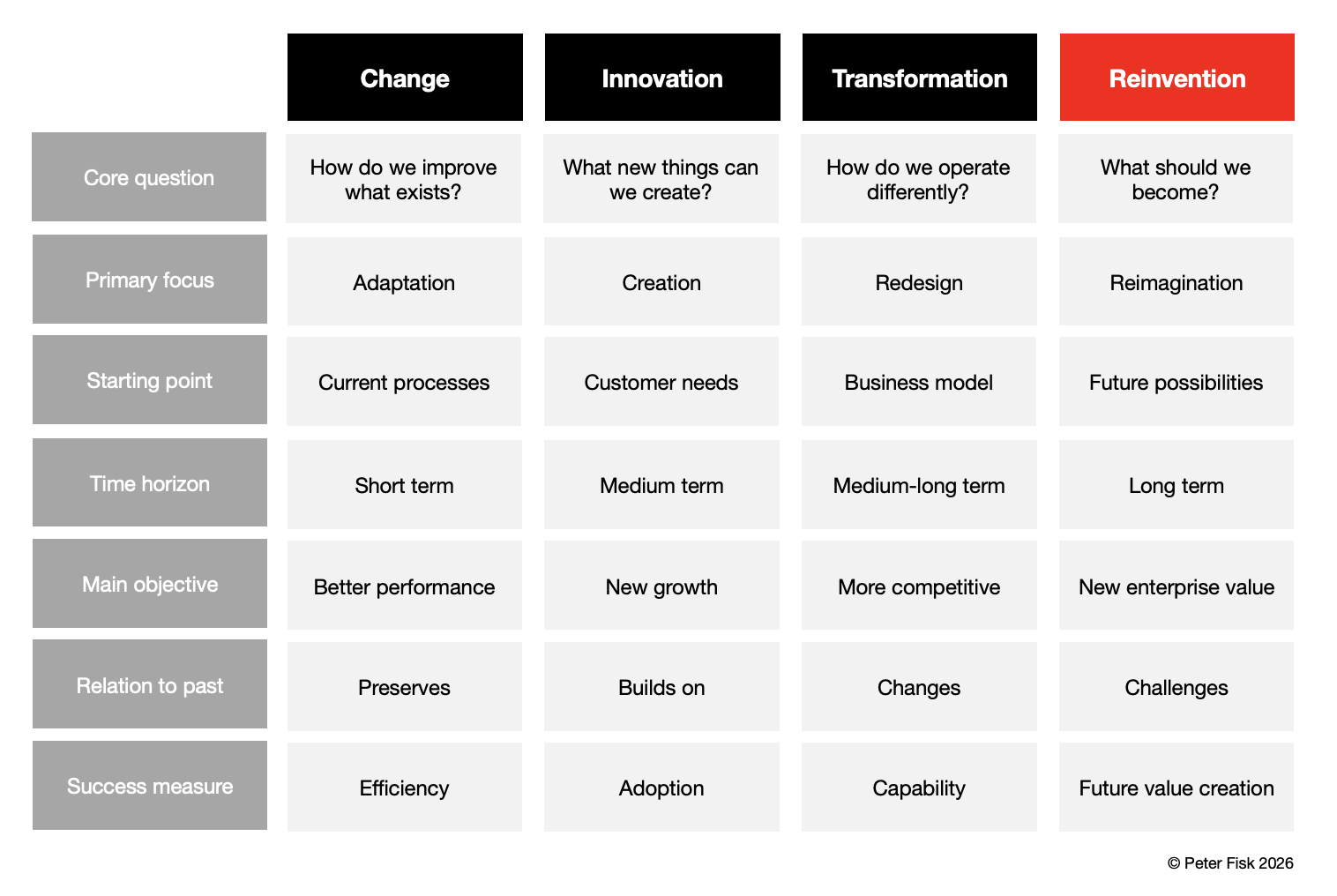
The four concepts, frequently used but poorly defined, represent different levels of ambition and different levels of value creation:
1. Change: Making the current business better
Change is essential. Every company must continuously improve. A manufacturer reducing waste, a bank improving digital services, or a retailer enhancing logistics are all examples of valuable change. But change usually improves the existing formula. It rarely changes the trajectory of the company.
2. Innovation: Creating something new
Innovation creates new products, services and experiences. Apple’s iPhone transformed mobile computing. Dyson reinvented household appliances. Lego expanded beyond physical toys into digital experiences and entertainment. Innovation creates opportunity. But companies can innovate successfully while still remaining vulnerable if their fundamental business model becomes outdated.
3. Transformation: Becoming better at what you do
Transformation goes deeper. It changes how an organisation operates. A traditional retailer becoming omnichannel is transformation. A bank moving from branches to digital platforms is transformation. A manufacturer adopting advanced automation is transformation. Transformation is essential. But it often begins with the assumption “We need to become a better version of ourselves.”
4. Reinvention: Becoming something new
Reinvention starts with a more challenging question: “if we created this company today, knowing what we know about the future, would we build it in the same way?” That question forces leaders to challenge assumptions about identity, industry and opportunity.
Fujifilm understood this better than Kodak. Both companies faced the collapse of photographic film. Kodak saw itself primarily as a photography company. Fujifilm recognised deeper capabilities in chemistry, materials science, precision engineering and imaging. It reinvented itself into healthcare, pharmaceuticals, cosmetics and advanced materials. It did not save the old business. It created a new one.
The difference between transformation and reinvention is therefore fundamental:
- Transformation changes the company you have.
- Reinvention creates the company you need to become.
The Reinvention Premium: financial markets reward future potential
The financial significance of reinvention is that it changes not only what a company does, but how investors perceive the company’s future.
Traditional value creation tends to be incremental. A company improves margins, expands into adjacent markets, gains market share or increases operational efficiency. These improvements matter, but they usually occur within the boundaries of an existing business model.
Consider some of the world’s leading reinvention companies:
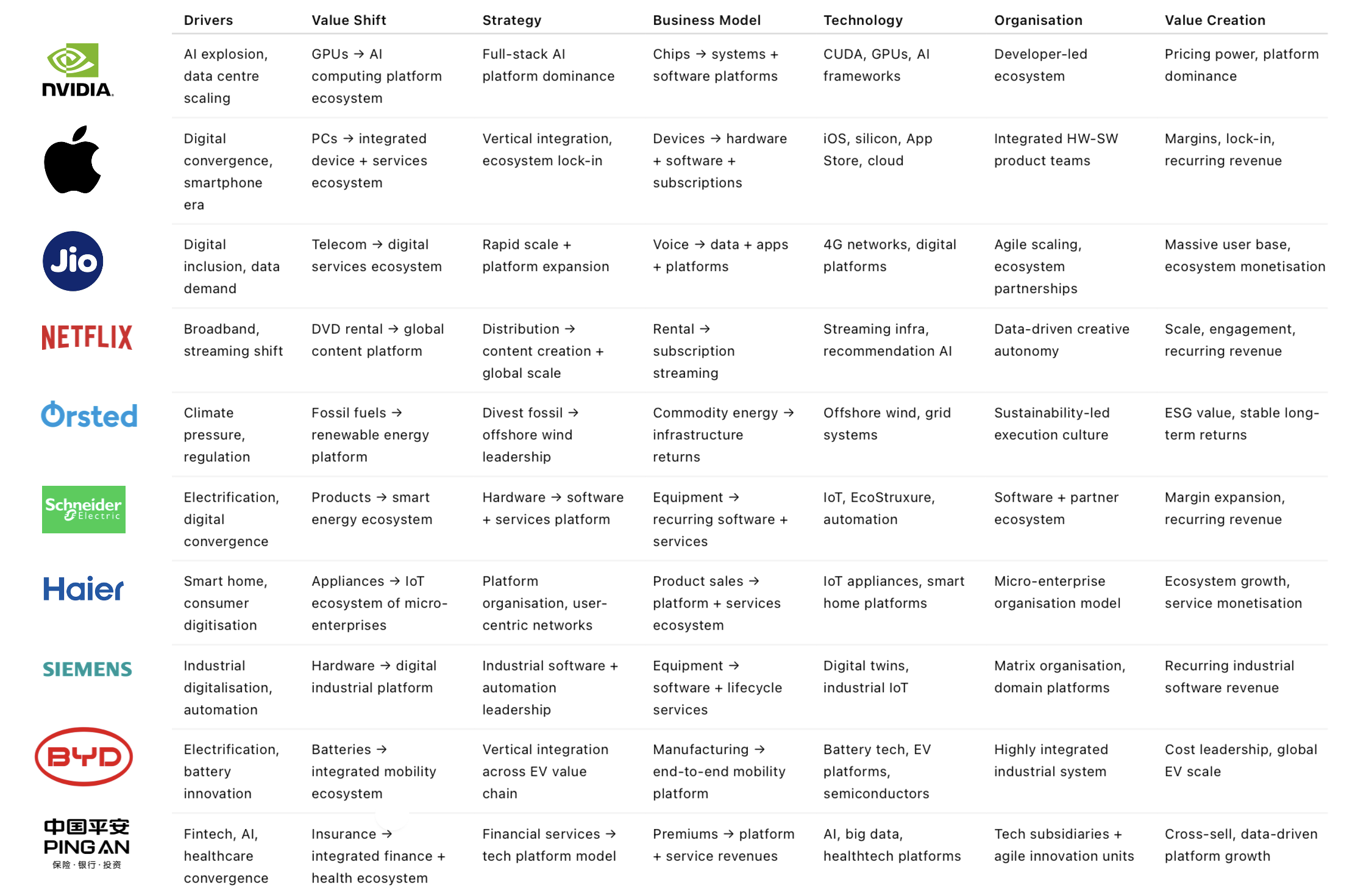
Reinvention is different because it expands those boundaries. It changes the size of the opportunity investors believe is available. A company that becomes more efficient may improve profitability. A company that discovers a new growth engine can change its entire valuation trajectory. This is why market cap often moves most dramatically when investors conclude that a company has become something different.
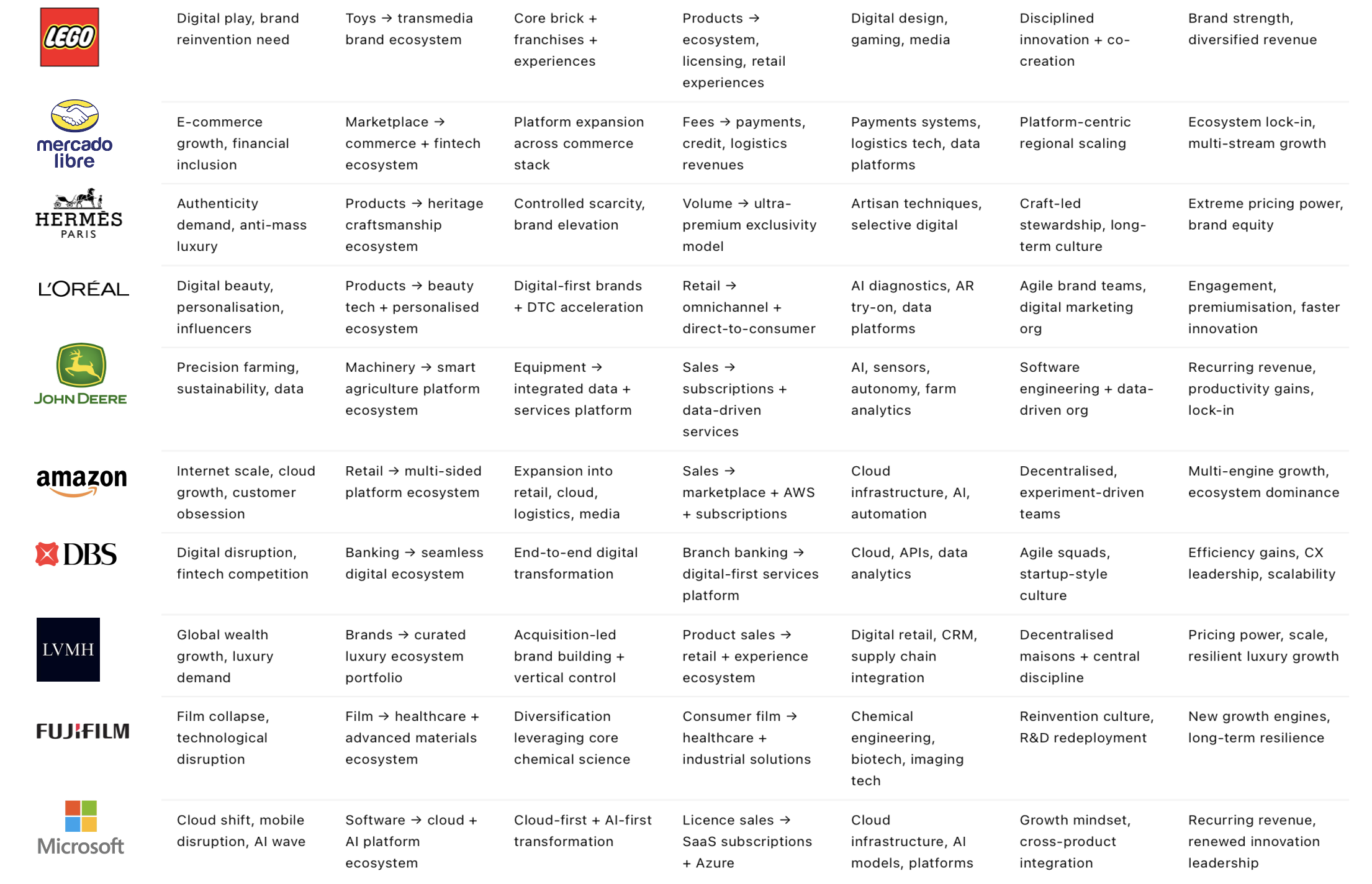
These examples are not simply stories of growth. They are stories of changed investor perception.
The market did not suddenly decide that Microsoft should be valued more highly because it had become a more efficient software company. It changed its view because Microsoft had become central to cloud computing and artificial intelligence. £300 billion to $5 trillion market cap.
Nvidia’s valuation did not explode because it sold more chips. Semiconductor companies have existed for decades. The market revalued Nvidia because it became a critical enabler of an entirely new technology era. $50 billion to $5 trillion.
Amazon’s value creation came from repeatedly creating new businesses around capabilities it had already developed. AWS, advertising and marketplace services were not simple extensions of retail; they changed the economic model of the company. $300 billion to $1 trillion.
This is the essence of what might be called the reinvention premium. The premium exists when investors believe that the future company is significantly larger than the current company.
The 3 CEO blind spots blocking reinvention
If reinvention creates such significant value, why do so many organisations struggle to achieve it?
The answer is that most companies are designed for stability. Their systems, incentives and cultures are built around protecting what made them successful.
That creates three major leadership challenges:
1. CEOs treat transformation as a project instead of building reinvention as a capability
Many organisations approach transformation as a defined initiative: A new strategy is announced. A transformation office is created. Teams are mobilised. New technology is deployed. The assumption is that once the programme is complete, the organisation will have changed. But this logic belongs to a slower era.
When markets evolve continuously, transformation cannot be an occasional event. It must become an organisational capability.
Amazon illustrates this distinction. Amazon’s advantage does not come from a single transformation programme. It comes from a culture designed around continuous reinvention. The company has repeatedly taken capabilities developed in one area and transformed them into new businesses. Its internal technology infrastructure became AWS. Its logistics challenges became a global delivery network. Its marketplace became an advertising platform.
Each reinvention created a new source of value. The company did not ask “How do we optimise ecommerce?” It asked “What capabilities are we building, and what else could they enable?” That is a very different strategic mindset.
2. CEOs optimise today’s business while underinvesting in tomorrow’s possibilities
Every successful company faces a fundamental tension: the activities that create today’s profits are often the activities that consume tomorrow’s opportunities.
Established businesses naturally favour certainty. They allocate resources towards proven markets, existing customers and predictable returns. Reinvention requires investment in possibilities that may not yet have obvious financial returns.
This is why the best companies operate with two simultaneous agendas:
- Performance agenda = deliver today’s results (optimise existing businesses, improve efficiencies, protect existing customers)
- Possibility agenda = create tomorrow’s growth (explore emerging opportunities, build new capabilities, discover future customers)
ASML provides a powerful example. The company invested for decades in extreme ultraviolet lithography technology before the market fully understood its importance. The research was expensive, uncertain and required extraordinary patience. But that investment created a strategic position few competitors can match. The lesson is not simply about technology. It is about time horizons.
Reinvention requires leaders who can see value before the market sees value.
3. CEOs still define their businesses too narrowly, defined by past not potential
The third barrier to reinvention is perhaps the most fundamental: many organisations still define themselves by the industries they were born into.
For much of the twentieth century, this made strategic sense. Industries created clear boundaries. Automotive companies built cars. Banks provided financial services. Insurance companies protected against risk. Telecommunications companies connected people. The boundaries of competition were relatively stable.
Today, those boundaries are dissolving. Technology has made it possible for companies to move across sectors at unprecedented speed. Consumer expectations are increasingly shaped not by competitors within an industry, but by the best experiences they encounter anywhere. A customer does not compare a bank only with another bank; they compare it with Amazon, Apple or any company that delivers simplicity, personalisation and convenience.
The result is that the most valuable companies increasingly compete around human needs rather than industry categories. They ask different questions:
- A traditional automotive company asks “How do we build better vehicles?” A reinvention-oriented company asks“How will people move in the future?”
- A traditional insurer asks “How do we sell more policies?” A reinvention-oriented company asks “How do we help people manage uncertainty throughout their lives?”
- A traditional retailer asks “How do we sell more products?” A reinvention-oriented company asks “How do we become part of customers’ everyday experiences?”
This shift explains why ecosystems have become such a powerful source of competitive advantage.
Examples of reinvention leaders
Ping An, reinventing insurance through the lens of human needs
China’s Ping An provides one of the clearest examples of ecosystem reinvention. The company began as an insurance business. A traditional interpretation of its opportunity would have been to become a more efficient insurer: improve underwriting, expand distribution and sell more policies.
Instead, Ping A questioned the underlying customer problem. Insurance is not fundamentally about policies. It is about helping people manage uncertainty — financial uncertainty, health uncertainty and life uncertainty. That insight led the company beyond insurance into banking, healthcare, technology platforms, artificial intelligence and digital services.
Ping An’s reinvention was not a diversification exercise. It was a redefinition of its purpose. It moved from “we provide insurance products” to “we help people manage the risks and opportunities of life.” That broader ambition opened new markets and allowed the company to create an ecosystem where finance, healthcare and technology reinforce each other.
The lesson for leaders is important: The strongest reinventions often happen when companies move upstream from what they sell to the deeper problem they solve.
Reliance Jio, reinventing an energy company as digital infrastructure
India’s Reliance Industries demonstrates another form of reinvention: using existing strengths to create an entirely new strategic position. For decades, Reliance was primarily known as an energy and industrial company, built around refining, petrochemicals and large-scale infrastructure. But India’s future economic growth was increasingly becoming digital. The company recognised that connectivity would become a foundational infrastructure for the next generation of businesses and consumers.
The creation of Jio transformed Reliance’s role. It moved from building the infrastructure of India’s industrial economy to building the infrastructure of India’s digital economy. Jio was not simply a telecommunications venture. It became the foundation for broader opportunities, a lifestyle super app built on an ecosystem of diverse partners and activities – from retail to banking, entertainment to work, delivery and cloud services.
The strategic insight was that the company’s future would not come from abandoning its capabilities. It would come from redeploying those capabilities into a new context. This is a recurring pattern in successful reinvention. Companies rarely reinvent by starting from nothing. They reinvent by discovering hidden potential in what they already know how to do.
BYD, reinventing the basis of competition
BYD illustrates another important principle: reinvention often requires changing the basis on which an industry competes. The automotive industry spent more than a century competing around mechanical engineering, manufacturing scale and brand heritage. BYD approached mobility differently.
Originally founded as a battery manufacturer, it recognised that the future of transportation would depend on controlling the technologies around electrification: batteries, software, electronics, manufacturing and energy systems. Rather than becoming simply another electric vehicle manufacturer, BYD built an integrated mobility ecosystem.
The company changed the question from “how do we build a better electric car?” to “how do we redefine mobility around the technologies of the future?” That shift helped transform investor perception. BYD became not just a car company, but a strategic player in the global transition towards electrified transportation.
The lesson extends far beyond automotive. When technology changes the foundations of an industry, the winners are often companies that understand the new foundations first.
Fujifilm, the ultimate test of reinvention leadership
Perhaps the most powerful example of reinvention is Fujifilm because it demonstrates the hardest leadership decision of all: the willingness to abandon the identity that created past success. When digital photography emerged, Fujifilm and Kodak faced the same challenge. Both understood the technology shift. Both had strong brands. Both had deep expertise. But they made different strategic choices. Kodak largely viewed itself through the lens of its product category: photography and film.
Fujifilm looked deeper. It recognised that its true capabilities were not film itself, but the underlying science behind film: chemical expertise, materials science, precision manufacturing, imaging technology. Those capabilities had value beyond photography. The company moved into healthcare, pharmaceuticals, cosmetics, advanced materials and digital technologies. Fujifilm did not preserve its original identity. It reinvented it.
This is perhaps the defining characteristic of reinvention leaders: They understand that their greatest asset is not their current business. It is their ability to create the next one.
7 strategic imperatives for Reinvention CEOs
If reinvention is becoming the defining source of competitive advantage, then CEOs need a different leadership agenda. The challenge is not simply to manage change faster. It is to build an organisation capable of continuously becoming something new.
1. Replace transformation programmes with reinvention capability. The goal is not to complete change. The goal is to create an organisation where change is continuous. Reinvention should become part of the operating system.
2. Balance exploitation with exploration. Great companies must run two businesses simultaneously: The business that creates today’s performance. And the business that creates tomorrow’s possibilities. Leaders must protect the core while constantly questioning it.
3. Measure future value creation. Financial performance remains essential, but boards need additional questions: What future markets are we creating? What capabilities are we building? How quickly are we learning? How adaptable is our organisation? This is the logic of the Reinvention Premium.
4. Organise around opportunities, not structures. Traditional organisations are built around functions. Future organisations will increasingly be built around missions, customer needs and emerging opportunities. The question should become “what combination of capabilities can solve this opportunity?” instead of “which department owns this?”
5. Build ecosystems, not just products. The future belongs increasingly to companies that can orchestrate networks of partners, technologies and communities. The ability to connect capabilities may become more valuable than owning every capability.
6. Make reinvention everyone’s responsibility. Innovation cannot sit in a laboratory. Transformation cannot sit in a programme office. Reinvention must become part of every leader’s responsibility. Every business unit must ask“what is the next version of ourselves?”
7. Reinvent before you have to. The greatest reinvention opportunities often appear when companies least feel the need to change. Waiting for decline reduces options. The strongest companies reinvent from a position of strength. They use today’s success as the foundation for tomorrow’s growth.
It’s not what you are, it’s what you can be
For decades, companies measured success through their ability to create and defend advantage. But in a world of accelerating change, where competitive advantage is always temporary, it is the ability to reinvent that matters.
The companies that create the greatest value in the future will not necessarily be those that predict change perfectly. Nobody predicted every detail of cloud computing, artificial intelligence, electric mobility or digital ecosystems. Instead, the winners will be those capable of responding faster, learning faster and reinventing faster.
The final question for every CEO and board is therefore not “how well are we performing today?” it is “are we creating the company that tomorrow’s world will value?”
Because the market no longer rewards companies only for what they are. It rewards them for what they can become.
That is the true meaning of the Reinvention Premium.
The world of business has changed. But the language of business hasn’t.
Competitive advantage. Core competencies. Strategic planning. Economies of scale. Performance management. Change management. These ideas shaped generations of leaders, and still shape how companies think, invest and act.
They were built for a more predictable world: clearer industries, familiar competitors, slower technologies and strategies that could extrapolate from the past. Scale won. Change was episodic. Strategy was planned, then executed.
That world has gone. AI is accelerating innovation, industries are converging, customer expectations are fragmenting and geopolitics is redrawing markets. New competitors and business models can emerge at extraordinary speed. Advantage is more transient; possibility is more abundant.
The language of business is stuck in the past. And that matters, because the words we use shape the way we think, the choices we make and ultimately the value we create:
- Encourage leaders to become future-ready and they prepare for what they think is coming … ask them to become future-shaping and they consider what future they want to create, and set about doing it.
- Define a company by its industry sector and leaders look at established markets and competitors … define its possibility space and they start with customers, bigger problems and more powerful outcomes.
- Tell your teams to strengthen competitive advantage and they look sideways at peers … ask them to create strategic advantage and they look forwards towards broader possibilities.
- Ask managers to improve business performance and they optimise today’s numbers … but ask them to create value and they must think about what the organisation could become.
Words shape questions. Questions shape choices. Choices shape investment. Investment shapes capabilities. Capabilities create possibilities. And, compounded over time, those possibilities determine the future value of the business.
The new lexicon therefore begins with a fundamental shift in perspective.
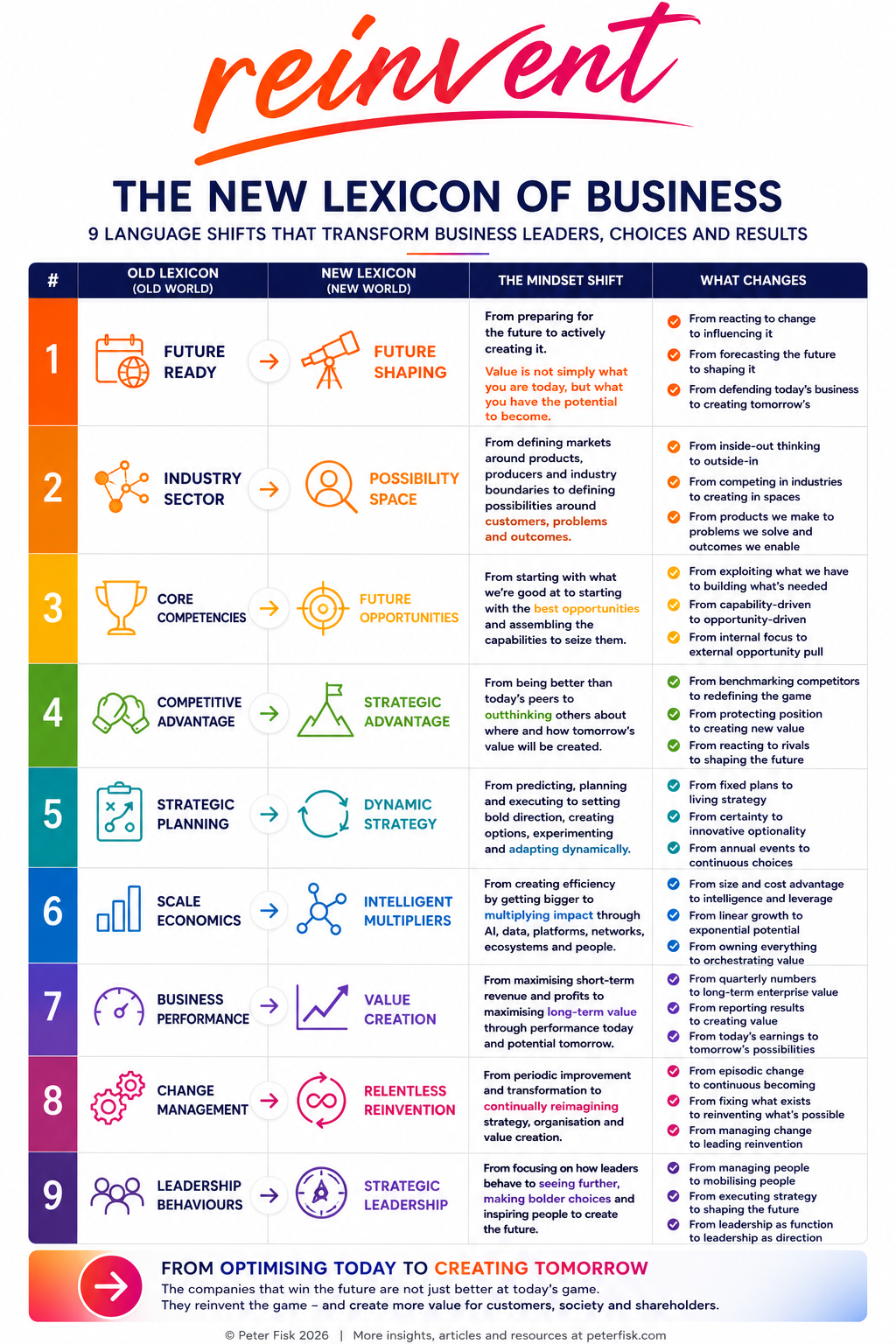
1. From Future Ready to Future Shaping
Being future-ready sounds progressive. But hidden within the phrase is a surprisingly passive assumption: that the future is something that happens to us. We forecast what might change, prepare the organisation and try to become sufficiently agile to respond.
Future shaping starts somewhere different. It asks leaders not simply to anticipate the future but to participate in creating it. The question changes from What is going to happen and how should we prepare? to What future could we create, and what role could we play in making it happen?
SpaceX did not simply prepare for the future of the aerospace industry. It sought to change the economics of access to space through reusable rockets. BYD did not wait for the global automotive industry to transition towards electric vehicles; it built capabilities across batteries, electronics, manufacturing and mobility that helped accelerate that transition. Nvidia’s Jensen Huang spent years advocating accelerated computing before generative AI transformed demand for it.
This reflects a deeper idea about value. Value is not simply what a company is today; it is also what people believe it has the potential to become. Current revenues, profits, assets and market positions matter enormously, but they tell only part of the story. Investors value future growth, future margins, future markets, future business models and, increasingly, an organisation’s demonstrated capacity to reinvent itself.
That changes the purpose of foresight. The objective is no longer to predict the future more accurately than everyone else. It is to understand emerging possibilities early enough to influence them.
The language shift is from readiness to agency. Future-ready organisations ask how they can respond to tomorrow. Future-shaping organisations ask how they can create it.
2. From Industry Sector to Possibility Space
Companies have traditionally defined themselves through industries. Automotive. Banking. Pharmaceuticals. Retail. Energy. Telecommunications. These classifications are convenient, but they can also become strategic cages.
Industries tend to be defined around products and producers: what companies make, how they make it and which other companies make something similar. A possibility space is defined differently. It starts with customers, problems and desired outcomes.
A car manufacturer can define itself as competing in the automotive industry, or it can explore the possibility space of mobility: how people and goods move safely, conveniently and sustainably. A pharmaceutical company can define itself around medicines, or around helping people live healthier for longer. A bank can define itself through financial products, or around financial wellbeing and economic progress. An energy company can think about producing and distributing electricity, or about enabling resilient, affordable, low-carbon economies.
The distinction matters because customers rarely think in industries. They have problems to solve, ambitions to achieve and outcomes they want. Technologies do not respect industry classifications either. AI, biotechnology, robotics, energy storage and digital platforms increasingly connect previously separate sectors, creating opportunities in the spaces between them.
Apple’s evolution illustrates this logic. It can be classified as a technology company, but its activities increasingly intersect communications, entertainment, financial services, health and intelligence. Ping An similarly expanded beyond conventional insurance into an interconnected ecosystem spanning financial services, healthcare and technology.
The language shift is therefore from boundaries to possibilities. Industry thinking asks, What business are we in?Possibility thinking asks, Who are we seeking to serve, what are they trying to achieve, and what new outcomes could we enable?
3. From Core Competencies to Future Opportunities
Core competencies became one of the most influential ideas in modern management: understand what makes your organisation distinctively good, invest in those capabilities and use them as platforms for growth. The logic remains useful, but it contains a potential trap. The capabilities that created yesterday’s success are not necessarily those that will create tomorrow’s.
Companies become emotionally, structurally and financially attached to what made them great. Kodak possessed extraordinary expertise in photographic film. Nokia developed formidable capabilities in mobile handsets. Traditional automotive companies invested for generations in combustion-engine technologies. Competencies create strength, but they also create strategic gravity, pulling companies towards opportunities that fit what they already know.
Future-oriented strategy reverses the sequence. Instead of beginning with What are we good at and where else can we apply it?, leaders ask Where are the most attractive future opportunities and what would we need to become capable of doing to seize them?
This is more than semantics. One approach starts inside the organisation and looks outward. The other starts with the future and works backwards.
And companies increasingly do not need to own every capability required. Some can be built internally, others acquired, and many accessed through partners and ecosystems. Apple orchestrates an extraordinary network of manufacturing, technology and developer capabilities. Businesses can access cloud infrastructure rather than building data centres, AI models rather than developing everything themselves, and specialist expertise through partners rather than permanent ownership.
The strategic question therefore becomes less What can we do with what we have? and more What opportunity is worth pursuing, and how can we assemble what is required to win?
The language shift is from competencies to opportunities — from allowing the past to define the future to allowing the future to determine what capabilities come next.
4. From Competitive Advantage to Strategic Advantage
Competitive advantage has been one of the defining concepts of strategy. Understand your market, identify an attractive position, differentiate yourself from competitors and develop capabilities they struggle to replicate. But the concept contains an increasingly problematic assumption: that today’s competitive arena is the most important one.
In fast-changing markets, being slightly better than today’s peers may matter far less than understanding where tomorrow’s value will come from. Strategic advantage starts with a broader question: not simply How can we outperform our competitors?, but How can we outthink others about where and how the future will be created?
Nvidia illustrates the difference. Had Jensen Huang defined the company’s challenge primarily as outperforming other graphics-chip manufacturers, Nvidia might have remained an exceptional semiconductor company. Instead, it progressively reframed the opportunity from graphics to accelerated computing, then AI infrastructure and increasingly towards a much broader computing platform.
Amazon followed a similarly expansive trajectory. Defining itself against booksellers would have produced one strategy; thinking about the future of commerce created another. That led from books to ecommerce, marketplaces and logistics. Understanding the potential of its underlying technology infrastructure opened another possibility altogether: cloud computing. Advertising, entertainment and AI created further opportunities.
Competitive advantage asks how to win the current game. Strategic advantage asks what the most valuable game could be and how the company might help create it.
This becomes particularly important when viewed through the lens of capital. Companies might compete with industry peers for customers, but they compete across sectors for investment. An investor allocating £1 billion can choose between a retailer, technology company, healthcare platform or energy business. The ultimate competition is therefore increasingly between organisations’ potential to create future value.
The language shift is from peers to possibilities, and the mindset shift is from outperforming today’s competitors to outthinking tomorrow’s opportunities.
5. From Strategic Planning to Dynamic Strategy
Traditional strategic planning was designed for a world in which the future could be forecast with reasonable confidence. Companies analysed markets, projected growth, chose initiatives and translated them into three- or five-year plans. Financial planning followed, allocating budgets against agreed priorities. Once approved, success largely meant executing the plan.
The further leaders look into the future today, however, the less useful detailed prediction becomes. Technologies change, competitors emerge unexpectedly, customer behaviours evolve and new business models alter industry economics. A detailed five-year plan can create an illusion of certainty precisely when organisations most need flexibility.
Dynamic strategy does not mean abandoning long-term ambition. Quite the opposite. Greater uncertainty requires stronger direction, but direction should not be confused with prescription.
A dynamic strategy combines bold strategic intent with innovative optionality. Rather than committing everything to one predetermined future, organisations create portfolios of opportunities. Some exploit today’s business. Others extend it into adjacent customers, propositions and markets. Others explore disruptive possibilities capable of becoming entirely new growth engines.
Amazon’s development of AWS is a classic example. Alphabet has pursued options across autonomous vehicles, AI, healthcare and quantum technologies. Mercado Libre progressively built interconnected growth engines across commerce, payments, logistics, credit and advertising.
Not every option should succeed. Optionality creates value because it allows organisations to experiment, learn and adapt before making disproportionate commitments. Leaders can then dynamically move people, capital and attention towards opportunities as evidence strengthens.
Traditional planning follows a sequence of predict, plan, execute. Dynamic strategy works through imagine, experiment, learn, choose, scale and adapt.
The language shift is from plans to choices. Strategy stops being something organisations periodically produce and starts becoming something leaders continuously do.
6. From Scale Economics to Intelligent Multipliers
For much of the industrial era, scale was one of the most reliable sources of superior economics. Larger factories reduced unit costs, mass marketing spread expenditure across more customers, distribution created barriers to entry and purchasing power increased with size. More volume meant lower cost, which enabled more volume.
Scale still matters. But the mechanisms through which businesses achieve disproportionate economics are changing.
Today’s most powerful businesses increasingly benefit from intelligent multipliers: technologies, relationships and capabilities that enable value to grow significantly faster than the resources required to create it.
AI multiplies human capability. Data multiplies intelligence. Software multiplies distribution at near-zero marginal cost. Platforms multiply participation. Networks multiply connections. Ecosystems multiply capabilities without requiring ownership. Brands multiply willingness to pay. Communities multiply advocacy and engagement.
Nvidia does not create its value solely through producing more chips. Its CUDA software ecosystem, developer relationships and expanding AI platform reinforce the economic value of its hardware. Apple’s value comes not simply from the volume of devices it sells but from the mutually reinforcing effects of hardware, software, services, developers, customers and brand. Mercado Libre’s commerce, payments, logistics, credit and advertising businesses strengthen each other as the ecosystem grows.
This represents an important evolution in the economics of growth. Traditional scale primarily multiplied volume while reducing cost. Intelligent multipliers can increase reach, capability, learning, engagement and value without resources increasing proportionately.
The language shift is therefore from scale to multiplication. The strategic question is no longer simply How can we become bigger? but What mechanisms can make everything we do more valuable?
7. From Business Performance to Value Creation
Perhaps the most consequential language shift concerns the ultimate measure of success. Management systems remain dominated by business performance: revenue, profit, margin, market share, productivity and quarterly growth. These metrics matter enormously. A company that cannot perform today will eventually lose the ability to invest in tomorrow.
But business performance is not the ultimate commercial outcome. Value creation is.
For a public company, market capitalisation provides an observable expression of that value. For a private company, enterprise value can be estimated through expected future cash flows, comparable businesses and future economics. Either way, value is inherently forward-looking. It reflects not simply what the business earns today but what investors believe it could earn tomorrow.
The shift is therefore more profound than replacing one financial metric with another. It changes the time horizon of management. Business performance tends to emphasise short-term revenue and profits. Value creation incorporates those results but also asks whether the organisation is increasing its future growth potential, strengthening its strategic position, creating new options and demonstrating an ability to reinvent.
Consider two businesses each generating £1 billion of annual profit today. The first concentrates primarily on optimisation and grows profit by 3% annually. After ten years, annual profit reaches approximately £1.34 billion. The second combines strong current performance with successful reinvention and compounds profit at 10%, reaching around £2.59 billion.
Now consider valuation. If investors value the slower-growth business at 12 times earnings, its indicative value would be around £16 billion. If the higher-growth company commands a 20-times multiple because investors believe it still possesses significant future potential, its indicative value approaches £52 billion.
These figures are illustrative, not valuation forecasts, but they expose a powerful mechanism. Reinvention can potentially produce a double multiplier: greater future earnings and a higher valuation of those earnings because investors believe further growth remains possible.
This returns us to the principle introduced at the beginning: value is what you can become. Performance tells us how successful the business is today. Value reflects both today’s performance and tomorrow’s potential.
The language shift is therefore from short-term results to long-term value creation. The question moves from Did we hit the numbers? to Did we make the business more valuable?
8. From Change Management to Relentless Reinvention
Change management emerged from a world in which change was largely treated as an event. Organisations operated normally until something required adjustment. Leaders launched a change programme, redesigned processes or structures, helped people adapt and eventually established a new steady state.
That model becomes increasingly problematic when there is no meaningful steady state.
Technology continues to advance. AI capabilities improve. Competitors emerge. Customer expectations move. Regulations evolve. Business models mutate. Change is no longer an interruption to normal business; increasingly, change is normal business.
Transformation represents an important step beyond traditional change management because it recognises that organisations sometimes require holistic and significant change over multiple years. But even transformation can imply a journey with a destination. Reinvention goes further. It assumes organisations will repeatedly need to reimagine their strategies, capabilities, organisations and underlying logic of value creation.
Microsoft under Satya Nadella demonstrates the distinction. Its resurgence was not one change programme. It involved successive shifts in culture, strategy and business model, moving from a Windows-centric software company towards cloud computing, subscriptions, platforms and now AI. Netflix moved from DVD rental to streaming, then from distribution to content creation, and subsequently towards advertising, gaming and live experiences. Each reinvention created capabilities and possibilities that enabled another.
The distinction is simple but important. Change improves what exists. Transformation significantly changes what exists. Reinvention reimagines what could exist.
And then does it again.
The language shift is from managing change to continual becoming. The ultimate organisational capability may be the ability to repeatedly become something more relevant and more valuable.
9. From Leadership Behaviours to Strategic Leadership
Leadership development has increasingly concentrated on behaviour. Executives learn how to communicate, coach, motivate, collaborate, listen, delegate, give feedback and manage conflict. These capabilities matter, and the shift towards more human leadership is welcome. But something fundamental has been lost.
We have become increasingly sophisticated at teaching leaders how to lead, while paying considerably less attention to where they should lead.
The defining responsibility of leadership is ultimately strategic. Leaders need to interpret a changing world, see possibilities others have not yet recognised, challenge assumptions created by previous success, make difficult choices with incomplete information, move resources from yesterday’s priorities towards tomorrow’s opportunities and inspire people to create something that does not yet exist.
Jensen Huang’s significance at Nvidia cannot primarily be explained through conventional leadership behaviours. It lies in his capacity to understand technological trajectories and make strategic commitments years before their potential becomes obvious. Satya Nadella’s cultural transformation of Microsoft mattered enormously, but culture enabled a much larger strategic reinvention. Mary Barra’s challenge at General Motors is not simply to motivate people effectively; it is to navigate profound technological, competitive and business-model shifts in mobility.
Strategic leadership reconnects the human and strategic dimensions of leadership. It combines foresight with judgement, ambition with choices, courage with adaptability, and strategic direction with the capacity to mobilise people.
Leadership behaviours ask, How do I get the best from people? Strategic leadership asks, How do I enable people to create the best possible future?
Great leaders need to do both. But ultimately, leadership is not simply about how leaders behave. It is about where they lead.
The New Language of Business
Taken together, these nine shifts describe more than a change in terminology. They represent a different operating system for business.
There is a clear progression. Shape the future. Explore possibility spaces. Find the best opportunities. Create strategic advantage. Develop dynamic strategies. Activate intelligent multipliers. Create long-term value. Reinvent relentlessly. Lead strategically.
And the financial consequences can become enormous because small differences in value creation compound over time. Consider two businesses worth £10 billion today. If one compounds enterprise value at 5% annually for a decade, it reaches approximately £16.3 billion. If another combines strong performance with greater strategic imagination and compounds at 12%, it reaches approximately £31.1 billion. After 20 years, those same illustrative rates produce approximately £26.5 billion versus £96.5 billion.
The point is not that adopting a new vocabulary somehow produces a 12% growth rate. It doesn’t. The causality is subtler and more important.
Language changes attention. Attention changes questions. Questions change choices. Choices change investment. Investment changes capabilities. Capabilities create possibilities. Possibilities create growth. And credible future growth creates value.
This is why the new lexicon is more than semantics.
The traditional management system was primarily designed to optimise the business you already have. It encouraged leaders to prepare for the future, define their industry, exploit competencies, beat competitors, execute plans, pursue scale, maximise performance, manage change and motivate people.
The emerging challenge is to create the business you could become.
That requires leaders to simultaneously perform and transform, exploit and explore, deliver and discover. They need sufficient conviction to make bold choices and sufficient curiosity to change them as they learn. They need to create value today while continually expanding the possibilities for tomorrow.
Ultimately, the greatest source of long-term value is rarely what an organisation already is.
It is what it still has the potential to become.
For generations, strategy has essentially asked: How can we make this business more successful?
The defining question for the age of reinvention is more ambitious:
What could this business become, and how much more valuable could that future be?
Marketing has spent much of the last decade becoming better at marketing.
More data. More channels. More content. More precise targeting. More automation. More sophisticated attribution. And now, exponentially more artificial intelligence.
Yet the biggest opportunity for marketing is not to do more marketing. It is to become something more important.
The world’s most innovative marketers are moving upstream. They are helping their organisations understand how the world is changing, anticipate what customers might value next, imagine new propositions, shape distinctive brands, create new experiences and even redefine the markets in which their companies compete.
They are becoming “market makers”.
This represents a fundamental change in the strategic purpose of the CMO:
Understand how the world is changing. Imagine what customers could value next. Shape the markets, brands, innovations and experiences that turn those possibilities into future growth.
The timing matters. Deloitte’s 2026 CMO Survey finds a 32% increase in revenue growth being regarded as a core marketing responsibility. Yet pressure from the C-suite is also pushing 47% of CMOs back towards established strategies and short-term wins. Deloitte’s conclusion is not that marketers should abandon the core, but that they need to combine it with disciplined experimentation and innovation.
- McKinsey’s State of Marketing 2026 Report
- Kantar’s Marketing Trends 2026
- Deloitte’s CMO Survey 2026
- McKinsey’s Campaigns to Continuous Growth
- WARC’s Marketer’s Toolkit 2026
At the same time, AI is transforming how customers discover, evaluate and buy. McKinsey finds that while 90% of CMOs are experimenting with AI, fewer than 10% have scaled it or captured value across marketing workflows. Only 28% of surveyed organisations are fundamentally rewiring teams and workflows around the technology.
The danger is obvious. Marketing could use the most transformational technology of our generation simply to make yesterday’s marketing faster. The opportunity is much bigger.
The rise of the market maker
For much of the twentieth century, the basic logic of marketing was straightforward. Companies made products. Marketing identified customers, positioned those products, communicated their benefits and stimulated demand. That model has been steadily unravelling.
Customers now discover brands through creators, communities, algorithms and AI agents. Categories converge. Products become services. Services become platforms. Competitors emerge from unexpected places. Social conversations shape reputation in hours. Culture travels across borders in seconds.
Kantar’s 2026 Marketing Trends report suggests that 24% of AI users already use AI-powered shopping assistants, while 74% of AI-assistant users regularly seek AI-driven recommendations. Brands increasingly need to be understood not only by people but by the algorithms acting on their behalf.
Yet technology doesn’t diminish the importance of brands. It potentially increases it. Kantar’s 2026 BrandZ ranking values the world’s 100 most valuable brands at $13.1 trillion, up 22% in a year. Its central conclusion is strikingly traditional: the winners continue to be brands that are meaningfully different.
When technology makes competent execution available to everybody, distinctiveness becomes more valuable. That is why the future of marketing requires ten shifts.
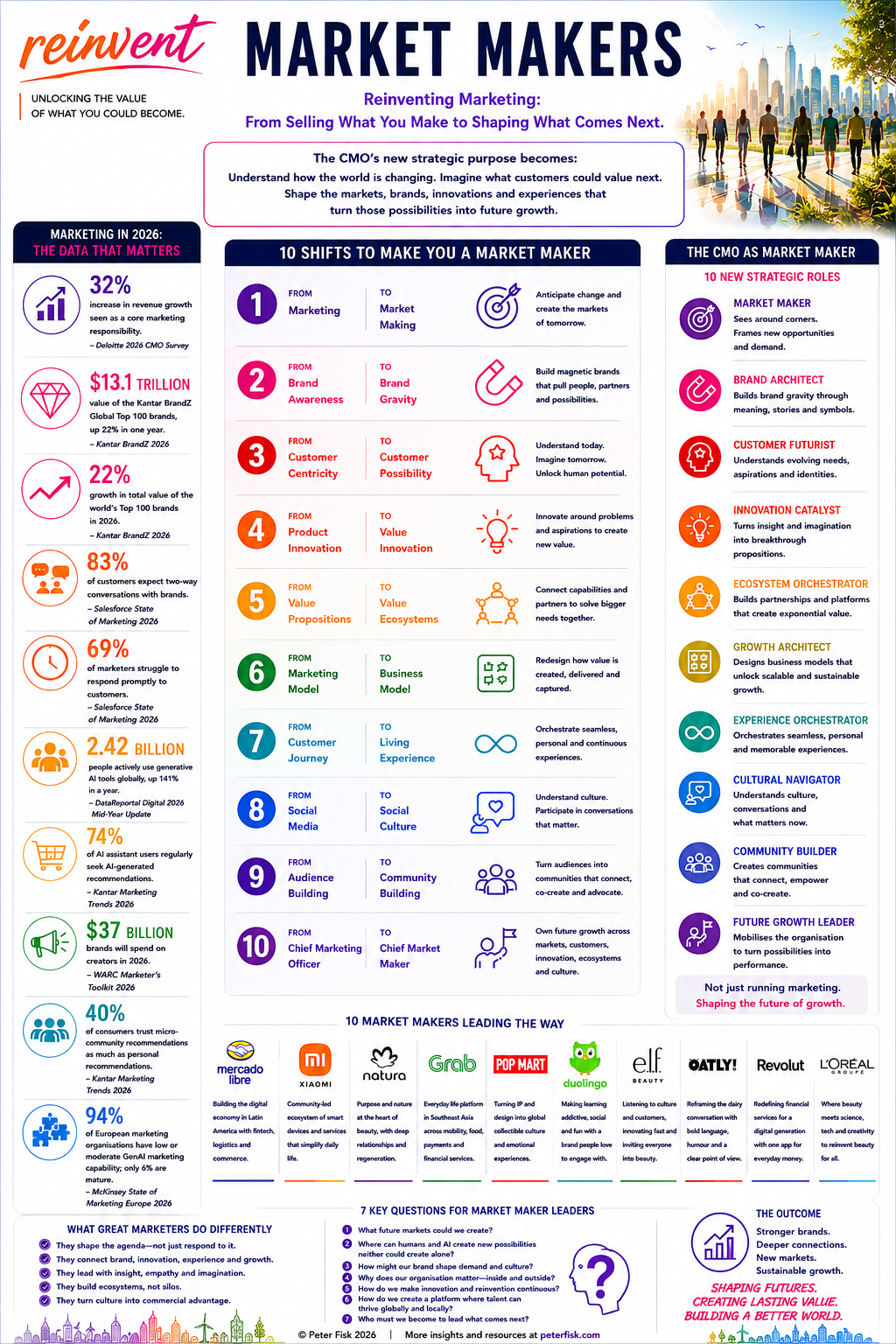
Here are the 10 shifts in more detail, with examples from some of the most innovative strategic marketing companies around the world which I currently observe, and what they mean for the changing role of marketing leaders:
1. From marketing to market making
Most marketers begin with an existing market: How big is it? Who are the segments? What is our share? How do we position ourselves against competitors?
Market makers start somewhere else: What could this market become?
They look around corners. They explore behavioural change, emerging technologies, unmet aspirations and shifting economics. Rather than accepting conventional category boundaries, they redraw them.
Consider Mercado Libre. It would be inadequate to describe it simply as Latin America’s ecommerce brand. By connecting commerce with payments, credit, logistics and advertising, it has helped build much of the infrastructure through which Latin America’s digital economy operates. Kantar’s global BrandZ research highlights Mercado Libre as Latin America’s representative among the world’s most valuable brands.
The strategic marketer therefore becomes a Market Maker — framing opportunities and creating demand rather than merely fighting for existing demand.
2. From brand awareness to brand gravity
For years, marketers have obsessed over awareness, reach and salience. Those still matter, but they are not enough.
The more interesting question is: why should people be drawn towards us?
Brand gravity is the accumulation of meaning, emotion, identity, trust and distinctiveness that makes customers actively choose a brand, recommend it and give it permission to do more.
China’s Xiaomi demonstrates the principle. What began around smartphones grew through fan participation into a much broader ecosystem of connected devices, wearables, smart homes and electric vehicles. The brand does not merely label products; it gives coherence to an expanding world.
AI makes this more important. Kantar warns that brands which fail to differentiate risk disappearing into a “sea of sameness” as AI increasingly mediates choice.
The CMO becomes the Brand Architect, creating meaning strong enough to attract both people and algorithms.
3. From customer centricity to customer possibility
Customer centricity was an important correction to product-centric business. But it can also become surprisingly conservative.
Ask customers what they want and they inevitably answer from the world they already know.
Market makers combine insight with imagination.
Brazil’s Natura demonstrates what becomes possible when a company looks beyond conventional category needs. Beauty becomes connected to wellbeing, biodiversity, relationships, communities and regeneration. The proposition expands because the understanding of the customer’s world expands.
The new question is not merely What does this customer need today? but What could become valuable to this person tomorrow?
The CMO becomes a Customer Futurist.
4. From product innovation to value innovation
Innovation is too important to be left solely to R&D.
Marketing frequently enters the innovation process far too late: somebody develops a product and marketers are asked to find the proposition, audience and launch campaign.
Reverse the sequence.
Start with changing lives, emerging tensions and new possibilities. Then bring together customer insight, technology, design, brand and commercial imagination.
e.l.f. Beauty has become an unusually powerful example. Its advantage is not simply affordable cosmetics or clever TikTok campaigns. It listens closely to cultural signals and customer conversations, moves rapidly and connects innovation with participation. Its latest collaborations continue to blur conventional boundaries between skincare, cosmetics, culture and entertainment.
The marketer becomes an Innovation Catalyst — turning insight and imagination into new value.
5. From value propositions to value ecosystems
Many customer needs are bigger than any single product.
That means the next competitive advantage increasingly comes from connecting capabilities rather than owning all of them.
Grab began with mobility in Southeast Asia, but the underlying customer opportunity was much larger: making everyday urban life easier. Transport could connect with food, deliveries, payments and financial services.
The strategic leap is from asking What else can we sell? to asking What larger problem can we solve?
Platforms, partners and ecosystems then become part of marketing strategy because they enable the brand to deliver a richer promise.
The CMO becomes an Ecosystem Orchestrator.
6. From marketing model to business model
A genuinely innovative proposition frequently requires a different way to create, deliver and capture value.
Marketing therefore needs to engage with subscriptions, memberships, marketplaces, platforms, freemium models, access rather than ownership, outcome-based pricing and ecosystem economics.
Consider Revolut. Its significance lies not simply in digitally marketing banking services. It has repeatedly expanded what a financial relationship can encompass — foreign exchange, payments, savings, investing, travel benefits, subscriptions and more. By August 2026, it had reached around 75 million customers across 40 countries.
Proposition and business model evolve together.
The CMO becomes a Growth Architect, asking simultaneously: What value should we create? How should we deliver it? How should we capture it?
7. From customer journey to living experience
The funnel increasingly looks like an artefact from another age.
Today’s customer might discover a product on TikTok, ask an AI agent about it, read a Reddit discussion, visit a physical store, buy through a marketplace and join a community — in no predictable sequence.
McKinsey argues that this behavioural transformation is pushing marketing beyond the campaign model towards continuous growth, built around five capabilities: insights, creativity, personalisation, agentic commerce and orchestration.
Duolingo illustrates what this feels like in practice. Learning, notifications, its irreverent owl personality, social content and cultural moments merge into one continuous experience. Marketing is not something attached to the product. The product itself is media, conversation and brand theatre.
The CMO becomes an Experience Orchestrator.
8. From social media to social culture
Too many brands interpreted social media as another broadcasting channel.
Create content. Accumulate followers. Generate engagement.
But social is not fundamentally about media. It is about culture.
The most effective brands understand conversations, humour, rituals, identities, creators and movements — and know when to participate rather than interrupt.
Pop Mart is a fascinating example from China. Its characters are not simply products. Through collectability, scarcity, physical retail, social sharing and fandom, properties such as Labubu have become cultural phenomena.
This is market making through meaning.
Kantar finds that a net 61% of marketers intend to increase creator investment in 2026, yet only 27% of creator content currently connects strongly to the brand. The implication is that brands need fewer disconnected influencer transactions and more coherent cultural platforms.
The CMO becomes a Cultural Navigator.
9. From audience building to community building
An audience watches you.
A community connects through you.
That distinction changes marketing profoundly.
Communities generate belonging, identity, advocacy, learning and co-creation. They turn customers from targets into participants.
Kantar reports that almost 40% of consumers trust micro-community recommendations as much as personal recommendations. In China, brands using knowledge-sharing micro-community platforms achieved 25% higher marketing ROI in Kantar’s database.
Oatly provides a different expression of the same principle. It did not build its brand merely around the functional characteristics of oat milk. Its provocative language, packaging and cultural stance helped consumers participate in a larger conversation about food, sustainability and established category conventions.
Community turns brand meaning into social energy.
The CMO becomes a Community Builder.
10. From Chief Marketing Officer to Chief Market Maker
These nine shifts ultimately converge in the tenth.
The CMO’s role itself needs reinventing.
Deloitte’s 2026 UK research explicitly observes that the role continues to broaden, while its US survey shows revenue growth becoming increasingly central to marketing’s responsibilities.
But broadening the CMO role should not mean simply adding more activities. It means moving upstream. The future CMO sits at the intersection of strategy, customers, brand, innovation, experience, technology, culture and growth.
France’s L’Oréal provides perhaps the clearest large-company example. Beauty Tech connects science and product innovation with AI, personalisation, digital services, creators and experience. Marketing is not simply the voice at the end of the innovation process; customer understanding and brand imagination help drive the innovation agenda itself.
The title CMO may remain. The mindset changes. The CMO becomes the Chief Market Maker.
AI is the multiplier, not the strategy
There is one deliberate omission from these ten shifts: AI. That is because AI should not be another box on the marketing organisation chart. It runs through everything.
AI can amplify foresight and customer insight. It can accelerate innovation. It can personalise experiences. It can dynamically generate and evaluate creative work. It can help orchestrate ecosystems and continuously experiment with propositions. But it cannot substitute for imagination.
McKinsey’s finding that 90% of CMOs are experimenting with AI but fewer than 10% have scaled it is revealing. The challenge is no longer access to technology. It is organisational reinvention.
Deloitte reaches a complementary conclusion: its 2026 survey finds marketers are roughly six times more likely to identify having the right talent than the right technology as the most important driver of revenue growth.
AI therefore becomes the intelligent multiplier. Humanity remains the differentiator.
From market takers to market makers
The most interesting marketers around the world are already demonstrating pieces of this new model.
Mercado Libre builds markets. Xiaomi builds ecosystems. Natura connects brand with purpose and regeneration. Grab expands customer needs into platforms. Pop Mart creates cultural phenomena. Duolingo turns experience into entertainment. e.l.f. Beauty converts cultural listening into rapid innovation. Oatly reframes categories. Revolut reinvents propositions and business models. L’Oréal connects customer insight, science, technology and creativity.
They are very different companies, from very different parts of the world. What connects them is a refusal to regard marketing simply as the function that promotes what the company already makes. That is the essential reinvention.
For decades, marketing has fought to earn its place at the top table by demonstrating the ROI of marketing expenditure. That remains necessary, but it is no longer sufficient. The bigger opportunity is to demonstrate the return on imagination.
To see markets before they are obvious. To understand customers beyond what they can articulate. To build brands that create meaning and gravity. To connect innovation with human possibility. To turn audiences into communities and social media into culture. To design ecosystems and business models capable of delivering propositions that did not previously exist.
And ultimately, to create future growth rather than simply compete for today’s.
The question for every CMO is therefore changing. Not simply “How can we market what our business makes?” but “What could our business become; and what new value, markets and possibilities could we create?“
The future belongs not to the organisations that become better at marketing the world as it is. It belongs to the market makers who shape what comes next.
Appendix: Interesting stats from recent reports
Marketing is becoming more technological, but its strategic advantage is becoming more human: imagination, meaning, innovation, culture, trust and the ability to shape markets before others see them.
- McKinsey’s State of Marketing 2026 Report
- Kantar’s Marketing Trends 2026
- Deloitte’s CMO Survey 2026
- McKinsey’s Campaigns to Continuous Growth
- WARC’s Marketer’s Toolkit 2026
From Marketing to Market Making
1. 32% increase in revenue growth being seen as a core marketing responsibility. That is a strong signal that CMOs are being pulled upstream into growth, not just communications.
2. 47% of CMOs are returning to established strategies and short-term wins because of increased C-suite pressure.The tension is important: marketing is being asked to drive growth while simultaneously being pushed towards safer execution.
3. Nearly 6× as many marketers cite “the right talent” rather than “the right technology” as the most important driver of revenue growth. Strategic judgement becomes more valuable as technology becomes ubiquitous.
From Brand Awareness to Brand Gravity
4. Branding is the #1 marketing priority for European marketing leaders in 2026. McKinsey finds that distinctiveness, value perception and creativity have moved back to the top of the CMO agenda.
5. The Kantar BrandZ Global Top 100 are worth $13.1 trillion — up 22% in one year. That is one of the strongest figures for demonstrating the continuing economic power of brands.
6. 72% of European CMOs plan to increase marketing budgets relative to sales in 2026. Marketing investment is not disappearing, but demands for demonstrable value are increasing.
From Customer Centricity to Customer Possibility
7. 83% of marketers say customers increasingly expect two-way conversations with brands. The customer no longer wants merely to receive marketing; they expect interaction.
8. Yet 69% of marketers struggle to respond promptly to customers. There is a huge gap between customer expectations and organisational capability.
9. 78% say they need more personalised content than they can currently produce. Personalisation is moving from a campaign technique towards an operating capability.
From Product Innovation to Value Innovation
10. Only 28% of organisations in McKinsey’s recent work are fundamentally rewiring teams and workflows around AI. The bigger opportunity is organisational and proposition innovation, not merely deploying tools.
11. 34% of organisations in Deloitte’s 2026 State of AI research are using AI to deeply transform products, services or business models. Another 30% are redesigning important processes; 37% remain largely at surface-level adoption.
12. 74% of organisations hope AI will drive future revenue growth, but only 20% say it is doing so already. There remains an enormous value-creation gap between AI aspiration and realised commercial innovation.
From Value Propositions to Value Ecosystems
13. More than 6.12 billion people were online by April 2026. Over 80% of adults aged 16+ globally now use the internet, creating the infrastructure for ecosystem-based propositions at unprecedented scale.
14. Global social-media user identities have reached 5.79 billion — equivalent to 69.9% of the world population.Market ecosystems increasingly span communities, platforms, commerce and content rather than individual channels.
15. Social-media user identities grew by 294 million between April 2024 and April 2026. Despite repeated predictions of “social decline”, participation continues to expand dramatically.
From Marketing Model to Business Model
16. Markets increasingly involve customer + brand + platform + agent. 24% of AI users already use an AI-powered shopping assistant. Commerce is starting to include a completely new participant: the customer’s agent.
17. 74% of people using AI assistants regularly seek AI-generated recommendations. Product visibility increasingly means being selected by machines as well as remembered by people.
18. 2.42 billion people now actively use generative-AI tools — around 29.2% of the global population. Active use grew by roughly 141% in a year, adding more than 1.4 billion users.
From Customer Journey to Living Experience
19. 75% of marketers are already using some form of AI. AI is becoming infrastructure rather than an experimental marketing channel.
20. Only 13% of marketers currently use AI agents — but high-performing marketers are 1.9× more likely to do so than underperformers. That suggests agentic marketing may be becoming an early performance differentiator.
21. Marketing teams satisfied with their unified customer data are 42% more likely to respond regularly to customers. They are also 60% more likely to deploy AI agents. Experience increasingly depends on data architecture behind the scenes.
From Social Media to Social Culture
22. Brands are projected to spend $37 billion on creators in 2026. Creator marketing is no longer marginal media activity.
23. Creator-economy investment is growing at 26% year-on-year — around four times faster than overall advertising expenditure. Attention and cultural influence are clearly migrating.
24. 74% of brands increased creator-marketing budgets in 2025 — yet only 27% of creator content is strongly connected to the brand. This is a fascinating stat: participation without strong brand meaning creates activity rather than cultural capital.
From Audience Building to Community Building
25. Kantar reports that almost 40% of consumers trust micro-community recommendations as much as recommendations from people they know. Small communities can carry disproportionate influence.
26. Brands using knowledge-sharing micro-community platforms in Kantar’s China database achieved around 25% higher marketing ROI. Community can therefore be a commercial growth model rather than simply an engagement tactic.
27. 36% of consumers say they are prepared to take on short-term debt to spend on things they enjoy. Kantar calls this “treatonomics”: changing life milestones and economic uncertainty are reshaping what people value and why they participate in categories and cultures.
From CMO to Chief Market Maker
28. 94% of European marketing organisations still have only low or moderate GenAI marketing capability. Just 6% regard themselves as mature. This shows how much organisational reinvention remains ahead.
29. Those mature GenAI marketers report average efficiency gains of 22%, with expectations of 28% within two years. Crucially, McKinsey says many are reinvesting those gains in growth rather than simply taking out cost.
30. 50% of CMOs identify GenAI-enabled marketing as one of their three fastest-growing investment areas — yet it ranks only 17th out of 20 strategic priorities for 2026. That contradiction neatly captures where marketing currently stands: enormous technological investment, but uncertainty about how profoundly it should change strategy.
More on marketing
Peter Fisk has over 30 years of marketing experience, from his first job as a brand manager in the airline industry, through many roles in developing marketing strategies for the likes of Asahi and Coca Cola, P&G and Unilever, Barclays and Santander. In 2002 he became the CEO of the Chartered Institute of Marketing, with over 60,000 global members, member of the World Marketing Council, a fellow of the Marketing Society, and judge of the annual Marketing Excellence Awards. His bestselling book “Marketing Genius” has been translated into 35 languages, and explores “the left and right brain of marketing thinking, how to be the Einstein and Picasso of brands, combining intelligence and imagination”.
- Book: “Marketing Genius: The left and right-brain of marketing” by Peter Fisk
- Book: “Brand Innovation” by Peter Fisk
- Book: “Gamechangers: Innovative strategies for brands and business” by Peter Fisk
Brands were built for a world of relative stability. That world has gone.
For much of the last century, brand building was largely an exercise in consistency. Companies created products, attached distinctive identities to them, positioned them against competitors and then invested relentlessly in awareness, familiarity and preference. Categories were reasonably stable, competitors were relatively predictable and media channels were sufficiently concentrated for companies to exert considerable control over the stories people heard.
The world in which brands now operate is almost the opposite.
We are living through simultaneous technological, economic, social and cultural disruption. Artificial intelligence is accelerating innovation and commoditising knowledge. Industry boundaries are dissolving as technologies and business models converge. Economic gravity is shifting towards Asia and other emerging regions. Generations increasingly coexist with very different attitudes, expectations and behaviours. Climate change is altering priorities. Creators and communities increasingly shape culture. Consumers move continuously between physical, digital and increasingly intelligent environments.
Products are becoming easier to create, competitors easier to launch and advantages harder to sustain. AI will amplify this dramatically. When almost any business can generate competent products, designs, content and customer experiences, competence itself becomes commoditised.
Yet whilst everything accelerates, human needs remain remarkably persistent. People still seek meaning, identity, belonging, aspiration and trust. Indeed, the more confusing and synthetic the world becomes, the more valuable these things become.
This creates one of the great paradoxes of modern business: the faster everything changes, the more valuable meaning becomes.
That is why brand matters more, not less.
The old brand primarily identified the business and differentiated its products. The future brand has a much larger role. It creates a system of meaning around which products, people, communities, partners and possibilities can gather. It connects the company to culture and gives customers ways to express who they are and who they want to become. It provides continuity whilst products, technologies and organisations continuously change.
Most importantly, it gives businesses permission to reinvent.
If your brand is defined by what you make, changing what you make becomes dangerous. But if your brand is anchored in a larger human aspiration, every new product, experience and business model can become another expression of that ambition. Brand moves from protecting consistency to enabling coherent change.
This is why the future of branding is much bigger than marketing. Brand sits increasingly at the intersection of strategy, innovation, culture, community and enterprise value.
The question for leaders is therefore no longer simply how do we build a stronger brand? It is how can our brand shape the future we want to create – for customers, for our market and for our business?
That requires new brand thinking, new brand building, and a new manifesto to guide it.
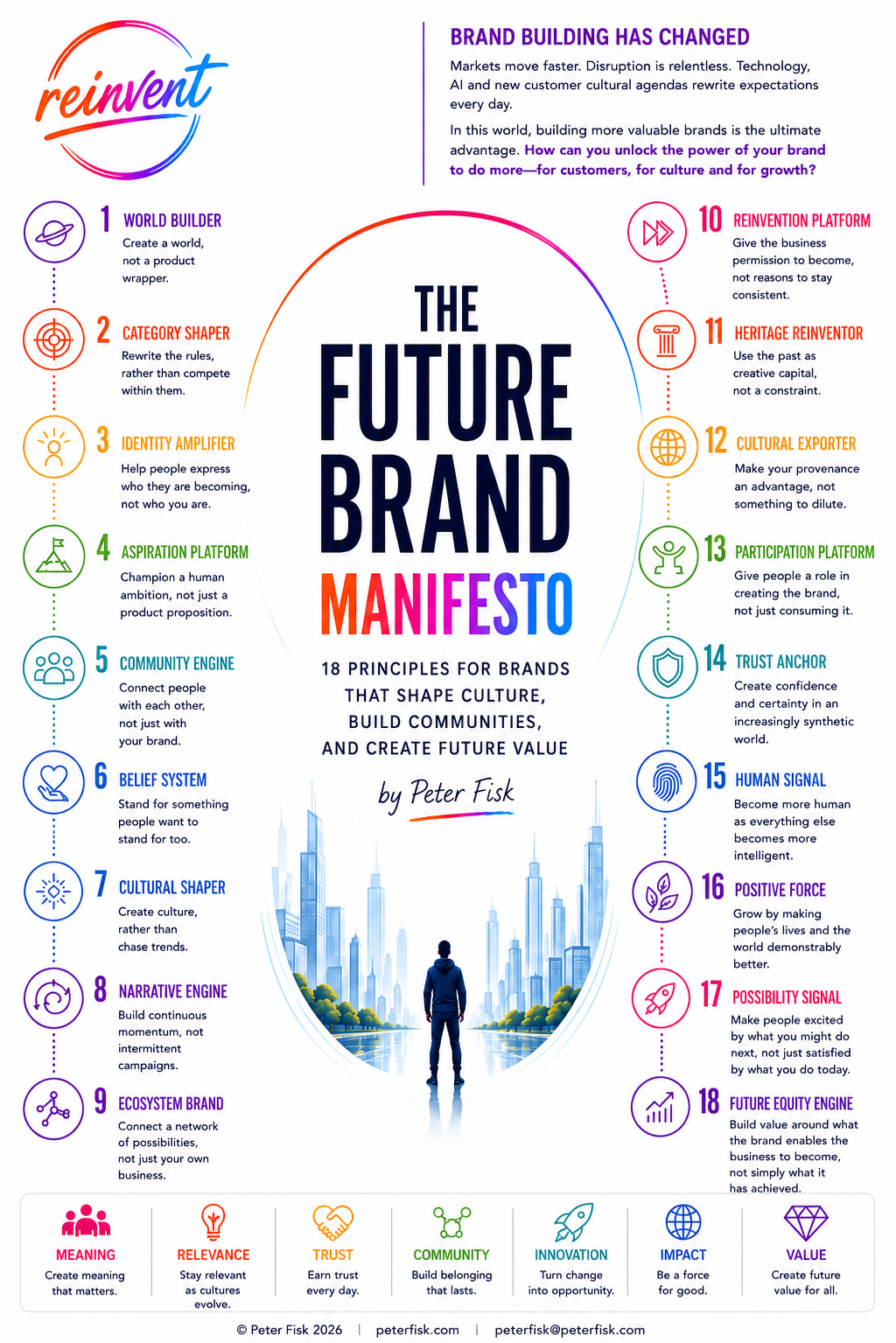
The Future Brand Manifesto
1. Be a World Builder, not a product wrapper.
Great brands will create worlds people want to enter. Pop Mart, LEGO and Disney demonstrate the potential: characters, experiences, products, stories, communities and places reinforce a larger imagined universe. The individual product becomes an entry point rather than the destination. This radically expands both emotional engagement and commercial possibility because the brand can continually create new expressions of the same world. The question therefore moves beyond what do we sell? towards something much more expansive: what world could we create that people actively want to become part of?
Examples:
- Pop Mart, China … Turns characters such as Labubu into expandable worlds of collectibles, scarcity, stores, experiences and fandom.
- Lego, Denmark … Has expanded creative play from bricks into games, films, education, entertainment, communities and destinations.
- Gentle Monster, South Korea … Turns eyewear retail into surreal cultural theatre, making the physical brand experience part gallery, part fantasy world.
Tools:
- World Map … Map the characters, rituals, experiences, places, content and communities that could populate your brand’s world.
- Entry Doors … Identify five different ways people could enter that world beyond buying your core product.
- World Bible … Codify the underlying beliefs, codes and rules so the world can continuously expand without losing coherence.
2. Be a Category Shaper, not a category competitor.
Average brands compete within established rules; exceptional brands change them. Airbnb reframed accommodation around belonging, Oura reframed wearables around understanding your body, and Liquid Death transformed water through entertainment culture. Category Shapers redefine what customers expect, what competitors must respond to and ultimately what constitutes value. Instead of obsessing about taking another percentage point of market share within existing boundaries, future brands will seek mindset share, changing how people understand what a category could become.
Examples:
- Oura, Finland … Reframes wearables from activity tracking towards understanding sleep, recovery, readiness and personal health.
- Liquid Death, USA … Took commodity water and reframed it through entertainment, irreverence and heavy-metal culture.
- Airbnb, USA … Shifted accommodation from rooms and hotels towards the broader human idea of belonging anywhere.
Tools:
- Category Kill … Write down the five assumptions everybody in your category takes for granted, then systematically challenge each one.
- Value Flip … Identify what customers currently compromise on and make that the centre of a new proposition, eliminating the compromise, they can have both.
- Mindset Map … Define how customers think about your category today versus how you want them to think about it tomorrow.
3. Be an Identity Amplifier, not an identity imposer.
Traditional branding asks what the brand should stand for. Future branding asks what choosing the brand allows somebody else to stand for. People increasingly use brands to communicate who they are, what they value and who they aspire to become. On, Patagonia, Apple and many luxury brands derive significant power from this identity effect. The strategic question therefore changes from what does our brand say about us? to what does choosing our brand enable people to say about themselves? The customer’s identity becomes more important than the company’s identity.
Examples:
- On, Switzerland … Combines performance, design and contemporary lifestyle into an identity customers actively wear beyond sport.
- Patagonia, USA … Makes environmental conviction part of what choosing the brand communicates about the customer.
- Farm Rio, Brazil … Allows consumers to participate in an exuberant, optimistic and unmistakably Brazilian expression of identity.
Tools:
- Identity Mirror … Complete the sentence: “People choose us because it says that I am…”
- Becoming Persona … Define customers not by who they are today but by who they aspire to become.
- Social Signal Test … Ask what choosing, wearing, sharing or recommending your brand communicates to somebody else.
4. Be an Aspiration Platform, not just a sales proposition.
Products solve problems; great brands mobilise aspirations. Nike is ultimately bigger than sportswear because human possibility is bigger than sportswear. LEGO is bigger than bricks because creativity is bigger than bricks. An Aspiration Platform identifies a human ambition sufficiently meaningful and expansive to survive multiple generations of products, technologies and business models. This allows innovation without losing coherence. Products become changing manifestations of an enduring aspiration, giving the company permission to keep exploring new ways to help people achieve more.
Examples:
- Nike, USA … Owns human potential through sport rather than defining itself through shoes and apparel.
- Duolingo, USA … Connects learning with expanding people’s worlds rather than simply teaching vocabulary; its own brand narrative explicitly frames learning around possibility.
- Oura, Finland … Is evolving from measuring health towards helping people understand and improve themselves.
Tools:
- Aspiration Ladder … Move from product → benefit → emotional outcome → human aspiration to discover your larger territory.
- 10-Year Stretch … Ask whether your aspiration could accommodate products you have not imagined yet.
- Human Progress Statement … Complete: “We exist to help people become more…”
5. Be a Community Engine, not an audience builder.
Audiences receive; communities participate. Future brands will create connections between customers rather than simply connections between customer and company. Strava, Gymshark and LEGO demonstrate how shared rituals, events, challenges, creation and achievement deepen engagement. This fundamentally changes the economics of marketing because customers create value for each other. Advocacy becomes distribution, participation creates retention and membership strengthens identity. The network becomes part of the brand and the community becomes part of the proposition.
Examples:
- Strava, USA … Turns individual exercise into shared achievement, comparison, encouragement and belonging.
- Gymshark, UK … Grew fitness apparel alongside a highly participative global fitness community.
- Lego, Denmark … Enables enthusiasts to build, exchange, collaborate and contribute ideas rather than remaining passive customers.
Tools:
- Community Canvas … Define the shared aspiration, identity, rituals, language and behaviours that could bind members together.
- Member-to-Member Value Map … Identify what customers can uniquely give each other without your intervention.
- Ritual Designer … Create recurring challenges, events, celebrations or behaviours that transform purchasing into belonging.
6. Be a Belief System, not a messaging system.
The most powerful brands increasingly organise around beliefs people genuinely share. Patagonia’s environmental conviction is powerful because it influences products, operations and actions rather than simply communications. In an age of institutional distrust and synthetic content, authenticity will increasingly come from alignment between what an organisation believes, what it does and what people experience. Messaging becomes evidence rather than invention. Belief becomes the deepest source of consistency, providing an organising principle that can endure even as the company’s activities continuously change.
Examples:
- Patagonia, USA … Makes environmental activism an organising conviction influencing its business, not merely its communications.
- Tony’s Chocolonely, Netherlands … Builds its identity around changing exploitation within the chocolate supply chain.
- Dove, UK … Has sustained a long-running challenge to narrow conventions of beauty through its Real Beauty platform.
Tools:
- Belief Statement … Complete: “We believe the world would be better if…” rather than “Our purpose is…”
- Belief–Behaviour Audit … Test every major business decision against what the brand claims to believe.
- Proof Points … Identify three costly actions you would willingly take that demonstrate the belief is real.
7. Be a Cultural Shaper, not a cultural follower.
Most brands chase culture after it happens. Great brands participate in creating it. Nike has shaped conversations around sport and human possibility; Apple influenced how society imagined creativity and technology; Duolingo behaves increasingly like an entertainment personality as well as an education business. Cultural Shapers understand emerging attitudes early and find ways to amplify them. Instead of constantly asking what is trending?, future brands will ask what cultural shift do we believe in, and how could we help accelerate it?
Examples:
- Nike, USA … Has repeatedly inserted sport into larger cultural conversations around identity, achievement and society.
- Duolingo, USA … Has turned Duo into a cultural character and uses social response itself as creative input; its social-first approach has become widely imitated.
- Skims, USA … Helped reshape cultural conversations around shapewear, body diversity and contemporary underwear.
Tools:
- Culture Radar … Track emerging behaviours, language, creators and tensions rather than conventional category trends.
- Culture Bet … Choose one emerging cultural shift the brand wants to actively accelerate.
- Edge Communities … Spend time with small groups whose behaviours today could become mainstream tomorrow.
8. Be a Narrative Engine, not a storyteller.
The perfectly controlled brand story belongs to the old broadcast media age. Brands now exist through millions of interconnected narratives created by companies, employees, customers, creators, critics, communities and increasingly AI. Future brands therefore need “narrative momentum”: a continuous stream of innovations, experiences, collaborations, conversations and cultural moments that keeps the central idea moving. The brand becomes episodic rather than campaign-based. Its meaning remains recognisable, but its expression continuously evolves, through its audiences, not its agencies. Great brands will become less like finished novels and more like compelling series people want to keep following.
Examples:
- Duolingo, USA … Treats its mascot almost as an evolving entertainment character rather than a static corporate identity.
- Jacquemus, France … Continually creates visually surprising cultural moments that make the brand inherently shareable.
- Red Bull, Austria … Sustains an endless narrative of extreme performance, sport, adventure and spectacle rather than relying on conventional product advertising.
Tools:
- Narrative Arc … Define where the brand story has come from, where it is now and what exciting chapter comes next. 52-
- Week Story Engine … Replace isolated campaigns with a continuous rhythm of moments, experiments and provocations.
- Conversation Loop … Listen → respond → remix → amplify, allowing audiences to influence how the narrative evolves.
9. Be an Ecosystem Brand, not a corporate badge.
The boundaries of businesses are dissolving. Mercado Libre, Xiaomi and other ecosystem businesses demonstrate how trusted identities can connect commerce, technologies, services, partners and experiences. Future brands will increasingly belong to networks rather than individual organisations. Their power will come from orchestrating complementary capabilities and creating value that no participant could generate alone. Brand therefore becomes connective tissue across an ecosystem — a shared promise capable of holding together a continually expanding constellation of partners, propositions and experiences.
Examples:
- Mercado Libre, Argentina … Connects commerce, payments, logistics, credit and advertising around participation in Latin America’s digital economy.
- Xiaomi, China … Is expanding from smartphones towards an integrated smart-living ecosystem spanning devices, homes and mobility; its latest Mijia expansion reinforces this direction.
- Apple, USA … Creates cumulative value as devices, software, services, payments, entertainment and health work together.
Tools:
- Ecosystem Map … Map every player who could contribute to or benefit from delivering your aspiration.
- 1+1=11 Test … Identify partnerships capable of creating propositions neither organisation could build independently.
- Orchestration Canvas … Define what the brand uniquely contributes to holding the ecosystem together: trust, standards, access, data or experience.
10. Be a Reinvention Platform, not a monument to consistency.
Traditional brand management prized consistency. Future brands require something more sophisticated: dynamic coherence. Their underlying meaning remains clear whilst their expressions continuously evolve. Apple can move across computers, music, phones, watches, payments, entertainment and health because its meaning is bigger than any one category. A powerful brand should enable rather than constrain innovation. The crucial test becomes not simply whether customers understand what you do today, but how much more your business can become tomorrow because people trust what your brand means.
Examples:
- Apple, USA … Has stretched across computing, music, phones, watches, payments, entertainment and health whilst retaining recognisable meaning.
- Xiaomi, China … Has moved from smartphones into connected living and electric mobility without abandoning its technology identity.
- Virgin, UK … Historically demonstrated how a sufficiently strong worldview could stretch across radically different categories.
Tools:
- Permission Map … Ask customers which adjacent worlds they would credibly follow your brand into.
- Brand Stretch Matrix … Plot opportunities by attractiveness versus brand permission.
- Dynamic Coherence Test … Separate what must remain constant in your brand from everything you should be willing to reinvent.
11. Be a Heritage Reinventor, not a heritage curator.
History should be creative capital rather than a museum. Loewe demonstrates how heritage, craftsmanship and provenance can provide foundations for experimentation rather than excuses for nostalgia. Future heritage brands will continually reinterpret their distinctive codes for new generations, technologies and cultures. They will identify what is genuinely timeless whilst being fearless about changing everything else. The principle is simple but demanding: respect the DNA; reinvent the expression. Heritage becomes valuable not because it preserves the past, but because it creates credibility from which to imagine the future.
Examples:
- Loewe, Spain … Uses 180 years of craft as a foundation for contemporary imagination and experimentation rather than nostalgia.
- Burberry, UK … Continually reinterprets Britishness, outerwear and its archive for new generations.
- Ferrari, Italy … Extends racing heritage into contemporary luxury whilst fiercely retaining distinctive codes of performance and exclusivity.
Tools:
- DNA/Expression Split … Identify timeless elements of the brand versus expressions that should continually change.
- Archive Mining … Search historical products, stories and codes for ideas capable of radical contemporary reinterpretation.
- Future Heritage Lab … Ask what you could create today that people will regard as an iconic part of your heritage in 20 years.
12. Be a Cultural Exporter, not a Western imitator.
The geography of brands is changing alongside the geography of economic and cultural power. BYD, Pop Mart, Mercado Libre and a new generation of Chinese, Indian, Korean, African and Latin American brands increasingly originate ideas rather than adapting themselves to Western conventions. Tomorrow’s global brands will make cultural specificity an advantage rather than something to dilute. Farm Rio’s Brazilian exuberance or Gentle Monster’s distinctly Korean imagination demonstrate how local cultural confidence can generate global fascination. The next globalisation of brands will be multipolar rather than homogenised.
Examples:
- Pop Mart, China … Demonstrates China’s growing ability to originate globally desirable consumer culture rather than simply manufacture it.
- Farm Rio, Brazil … Amplifies rather than dilutes Brazilian colour, energy and optimism for international audiences.
- Gentle Monster, South Korea … Exports a distinctive Korean sensibility of experimental retail, fashion and contemporary culture.
Tools:
- Cultural DNA Map … Identify the ideas, aesthetics, rituals and attitudes uniquely rooted in your origins.
- Untranslatable Advantage … Find what is distinctive precisely because competitors elsewhere cannot authentically reproduce it.
- Global/Local Dial … Decide deliberately what remains culturally specific and what should adapt in each market.
13. Be a Participation Platform, not a finished product.
Customers increasingly expect agency. They customise, create, review, remix, influence, collaborate and sometimes become producers themselves. Future brands will therefore be deliberately incomplete, leaving space for people to shape their meaning and experiences. LEGO provides the building blocks but customers provide imagination; gaming worlds provide environments but participants create cultures within them. The strategic question changes from what can customers buy from us? towards what can people create, achieve and become with us? Participation turns consumption into agency.
Examples:
- Lego, Denmark … Turns customers into creators and even sources new concepts through fan participation.
- Roblox, USA … Provides infrastructure through which users create much of the content and culture themselves.
- Canva, Australia … Enables millions of people to become creators rather than simply consumers of professional design.
Tools:
- Participation Ladder … Move customers from consume → respond → share → contribute → create → lead.
- Open Brand Challenge … Give communities a genuine problem, product or experience to shape.
- Creator Toolkit … Provide templates, assets, APIs or physical components that make creating with your brand easier.
14. Be a Trust Anchor in a synthetic world.
AI will make competent content, imagery, recommendations, experiences and increasingly products abundant. Abundance will increase the value of provenance. People will need ways to distinguish what is authentic, credible and worthy of attention. Powerful brands can become trust compression mechanisms: allowing people to make increasingly complex decisions quickly because accumulated experience, reputation and social proof reduce uncertainty. Trust becomes particularly valuable when customers cannot easily evaluate the underlying technology or provenance themselves. In an age of synthetic abundance, trusted meaning becomes scarce.
Examples:
- Costco, USA … Builds trust through a remarkably consistent promise around value, quality and membership economics.
- Toyota, Japan … Decades of perceived reliability reduce uncertainty around a complex, high-value purchase.
- Nubank, Brazil … Built a distinctive relationship around simplifying and humanising an industry historically associated with complexity and frustration.
Tools:
- Trust Ledger … Track every interaction that deposits into or withdraws from customer trust.
- Transparency Test … Identify information you currently make unnecessarily difficult for customers to discover or understand.
- Trust Moments Map … Find the points of maximum customer uncertainty and redesign them around reassurance and proof.
15. Be a Human Signal in an intelligent world.
As machines become more capable, humanity becomes more differentiating. Taste, judgement, humour, empathy, imperfection, craft, imagination and emotion acquire new value precisely because efficiency becomes ubiquitous. The strongest future brands will use AI extensively behind the scenes whilst feeling unmistakably human in the world. Technology should increase the ability to understand and serve people rather than sterilise the relationship. Intelligence will power the system; humanity will give it meaning. The most technologically sophisticated brand may therefore need to become the most emotionally intelligent too.
Examples:
- Duolingo, USA … Uses humour, character and imperfection to make digital education emotionally distinctive.
- Loewe, Spain … Elevates human craft and imagination precisely as mass production becomes increasingly sophisticated.
- Airbnb, USA … Built much of its proposition around human hosts, neighbourhoods and personal experiences rather than standardised accommodation.
Tools:
- Human Advantage Audit … Identify where judgement, empathy, humour, imagination or craft create more value than automation.
- AI/Human Split … Decide explicitly what technology should optimise and what humans should make distinctive.
- Imperfection Test … Find where excessive optimisation is stripping personality, surprise or warmth from the experience.
16. Be a Positive Force, not merely a responsible business.
Reducing harm will increasingly become the minimum expectation rather than a distinctive ambition. Future brands will seek to make people’s lives, communities and environments demonstrably better through their success. Sustainability therefore moves beyond compliance, mitigation and worthy corporate messaging towards regeneration and positive impact. The opportunity is to connect societal progress with innovation and growth rather than treating responsibility as a constraint upon them. The ambition shifts from becoming less bad to becoming more useful to the world, turning positive impact into a source of innovation, differentiation and value.
Examples:
- Patagonia, USA … Connects commercial success with environmental action and advocacy.
- Too Good To Go, Denmark … Builds its proposition directly around reducing food waste whilst creating economic value for consumers and businesses.
- M-Pesa, Kenya … Became economic infrastructure by dramatically expanding people’s ability to participate in financial activity.
Tools:
- Net-Positive Canvas … Map how growth could increase positive social or environmental impact rather than merely reduce harm.
- Impact Innovation Sprint … Turn a significant societal challenge into a source of new propositions and business models.
- Shared Value Scorecard … Measure customer, commercial, societal and environmental value together rather than separately.
17. Be a Possibility Signal, not simply a quality signal.
Historically, brands reduced risk by reassuring customers about what they would receive. Future brands will also generate excitement about what might come next. The greatest brands create anticipation because people expect them to keep surprising, innovating and leading. Brand trust therefore becomes prospective as well as retrospective: I trust you because of what you have done, but I value you because of what I believe you might do next. The brand becomes a signal of future possibility, connecting reputation with expectation and today’s credibility with tomorrow’s potential.
Examples:
- SpaceX, USA … Creates extraordinary anticipation around the next technological frontier rather than simply today’s offering.
- BYD, China … Increasingly signals the pace and ambition of the next generation of mobility and Chinese technological innovation.
- Nothing, UK … Uses distinctive design, founder visibility and continual product evolution to make a young technology brand feel like an unfolding experiment.
Tools:
- Next Expectation Test … Ask customers what they expect — and hope — your brand will do next.
- Possibility Pipeline … Maintain a visible portfolio of near, next and future innovations associated with the brand.
- Future Signal Calendar … Deliberately reveal experiments, prototypes, partnerships and ideas that demonstrate forward momentum.
18. Be a Future Equity Engine, not a marketing asset.
Ultimately, brand matters because it changes economics. Powerful brands generate greater demand, reduce acquisition costs, increase retention, support premium pricing, improve margins, attract talent and partners, accelerate innovation adoption and provide permission to enter new markets. Their greatest contribution may be strategic optionality: increasing the number of credible futures available to the organisation. Brand should therefore be understood as Future Equity, accumulated belief in the organisation’s capacity to remain relevant, innovate and create value beyond its current products and markets.
Examples:
- Apple, USA … Its accumulated trust creates demand and permission across an unusually broad range of future propositions.
- Nvidia, USA … Has evolved from a component brand towards a symbol of the infrastructure and possibility of the AI economy.
- Mercado Libre, Argentina … Its brand increasingly provides credibility for expansion across commerce, finance, logistics and other future services.
Tools:
- Future Equity Score … Measure brand strength across pricing power, trust, stretch, innovation credibility, community and future relevance.
- Option Value Map … Identify which future markets and business models become more achievable because of the brand.
- Brand-to-Value Bridge … Explicitly connect brand investment to revenue growth, margin premium, retention, lower risk and future enterprise value.
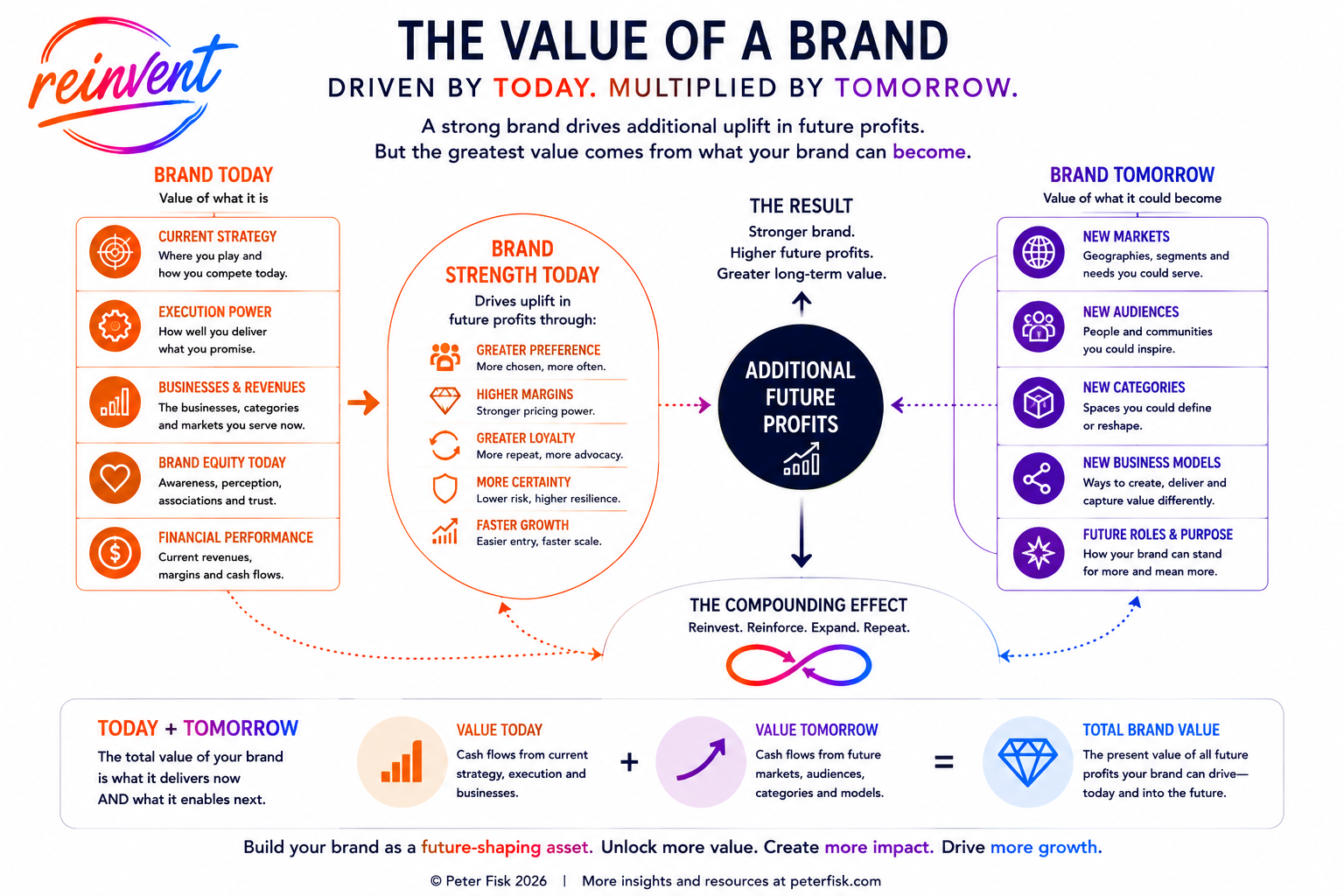
So what is really different?
Taken individually, many of these shifts might appear to be developments in marketing. Taken together, they represent something much bigger: a fundamental change in what a brand is for.
The old model was essentially linear: the company created the brand. Marketing communicated it. Consumers received it. Products delivered it. Consistency protected it.
The emerging model is dynamic: the brand is no longer simply transmitted from company to consumer. It is continuously created through interactions between the organisation, its customers, employees, creators, partners and communities. Meaning circulates. Communities amplify it. Culture reshapes it. Innovation renews it. And the resulting trust gives the organisation permission to keep evolving.
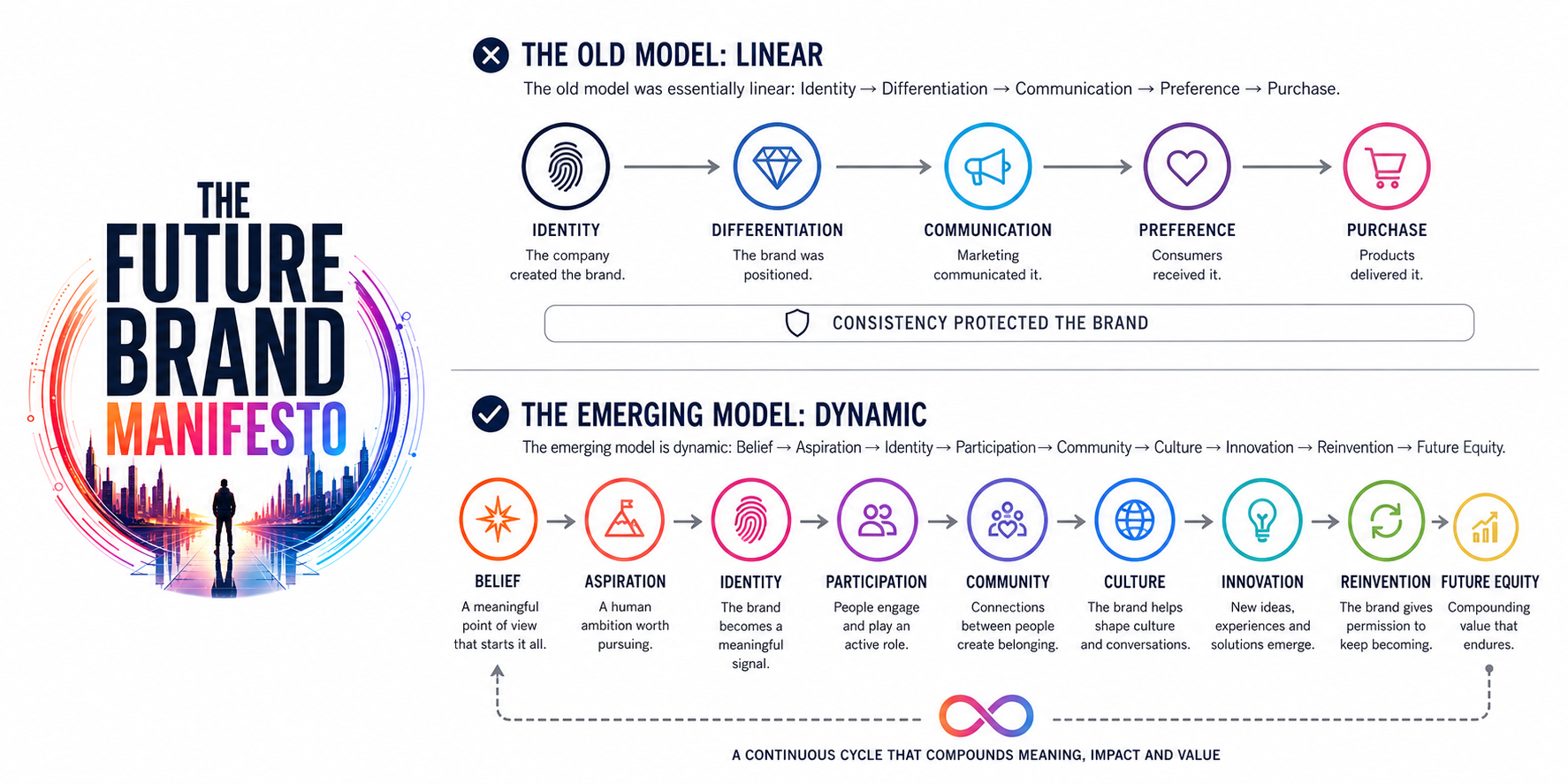
This is perhaps the biggest shift of all: brand moves from representing value to creating possibilities for value.
A strong traditional brand made today’s products easier to sell. A great future brand makes tomorrow’s products, services, markets and business models more credible before they even exist.
That changes the economics. Brand becomes a source not merely of differentiation but of optionality. It allows businesses to move faster because customers trust them, stretch further because their meaning transcends existing categories, and innovate more boldly because people are interested in where they are going rather than attached only to where they have been.
Brand therefore moves from marketing asset to strategic asset; from communications platform to innovation platform; from category position to cultural position; from customer preference to community participation; from brand equity accumulated from the past to Future Equity embedded in what the organisation could become.
What business leaders need to do now
The first implication is organisational. Brand is too important to leave to marketing. The CEO and leadership team need to own the central belief, aspiration and future role of the brand because these choices determine where the organisation can credibly go. Marketing remains critical, but brand increasingly connects strategy, innovation, customer experience, culture, talent, partnerships, sustainability and capital allocation.
Second, leaders should define brands around human aspirations rather than existing categories. Ask what people ultimately seek to achieve, express or become through you. That territory needs to be sufficiently distinctive to matter today but expansive enough to support tomorrow’s innovation.
Third, shift investment from campaigns towards brand systems. Products, experiences, stores, communities, content, collaborations, creators, employees and partners should all become interconnected expressions of the same underlying belief. Stop thinking episodically about communication and start creating continuous narrative momentum.
Fourth, give people a role. Ask not merely what customers can buy but what they can join, contribute, create, share and achieve. The strongest communities create value independently of the company and turn customers into participants in the brand’s evolution.
Fifth, use the brand deliberately as a reinvention platform. Every major innovation should ask two questions simultaneously: does this strengthen what our brand means, and does our brand give us permission to do it? Over time, this creates an expanding frontier of credible possibilities.
Finally, change how brand success is measured. Awareness, consideration and preference still matter, but leaders should also measure pricing power, customer lifetime value, advocacy, community participation, innovation adoption, cultural influence, category stretch and the ability of the brand to support future growth.
The ultimate question is no longer simply: How valuable is our brand today?
Instead it is: How much more valuable can our business become because of our brand tomorrow?
That is the real promise of the Future Brand.
In a world where products become obsolete, technologies converge, categories dissolve and organisations continuously reinvent, brand can become the enduring source of meaning that holds everything together whilst simultaneously pulling the organisation forwards.
Products create transactions. Experiences create memories. Communities create belonging. Beliefs create movements. Brands create possibilities. And possibilities create future value.
© Peter Fisk 2026
Read more from Peter Fisk … Market Makers: Reinventing Marketing
Over the last few years, almost every business leader I have worked with has come to recognise a profound reality: the things that created success in the past are unlikely to guarantee success in the future.
The strategies, capabilities, operating models and leadership approaches that helped organisations grow over previous decades were designed for a different era, one characterised by more predictable markets, slower technological cycles and clearer industry boundaries. Today, almost every assumption behind those models is being challenged simultaneously.
AI is reshaping the nature of work and knowledge creation. Geopolitical uncertainty is redefining globalisation. Demographic shifts are transforming societies, customers and workforces. Sustainability is changing the relationship between business, society and the planet. New competitors are emerging from unexpected places, often built on fundamentally different business models.
Microsoft’s latest Work Trend Index captures this moment well. Its research found that 82% of business leaders believe 2025 is a pivotal year to rethink key aspects of their strategy and operations because of AI. The same research points towards the emergence of what Microsoft calls the “Frontier Firm” by which they mean organisations built around human-agent collaboration, where AI does not simply automate tasks but fundamentally reshapes how work gets done.
Building the business of tomorrow
The question facing leaders is therefore no longer whether their organisations need to change. The question is whether they can change fast enough, and whether they can develop the capability to keep changing.
Recent CEO research reflects this growing urgency. PwC’s Global CEO Survey found that 45% of CEOs believe their companies will not be economically viable within ten years if they continue on their current path. The message is clear: reinvention is no longer a choice reserved for companies in crisis; it has become a fundamental leadership responsibility.
Yet there remains a significant gap between recognising the need for reinvention and actually building organisations capable of it.
Most businesses are still designed around the logic of the past. They are structured for efficiency, consistency and control. Their performance systems reward delivery against existing objectives rather than exploration of new opportunities. Their strategies often focus on improving today’s business rather than imagining tomorrow’s.
Even with the arrival of AI, many organisations initially approach it as an enhancement technology: a way to automate existing processes, improve productivity and make current operations more efficient. These benefits are important, but they represent only the first stage of transformation. The bigger opportunity is to rethink how organisations create value, how people work and how entirely new possibilities can be imagined.

Transformation as the new leadership superpower
This is why transformation has become the defining leadership capability of our era.
Not transformation as a one-off programme, but transformation as a continuous organisational capability. And that requires personal transformation from leaders themselves. The leaders who succeed will not simply manage change more effectively; they will become architects of change, creating organisations that are constantly learning, adapting and evolving.
This is the context in which I read the new book Leading for Tomorrow: Unlocking Human Potential in the Era of Continuous Change and Endless Possibility, a great collection of anecdotes and ideas from some of the world’s leading business thinkers, edited by cognitive scientist Scott Barry Kaufman and technology ecosystem catalyst Chris Shipley.
What makes this book particularly interesting is that it brings together voices from different disciplines – strategy, psychology, innovation, behavioural science and technology – to address one of the most important leadership questions of our time: how do we unlock human potential when change has become continuous?
Rather than presenting another formula for leadership success, the contributors collectively challenge many assumptions that have shaped business thinking for decades. Their message is that the organisations of the future will not win simply through technology, scale or efficiency. They will win by becoming more adaptive, more human and more capable of continuous reinvention.
Considering this together, what I see, is some fundamental shifts:
- From efficiency to adaptability … Human adaptability becomes a greater competitive advantage than operational optimisation.
- From control to agency … Empower people to act rather than simply comply.
- From prediction to experimentation … Leaders should run more experiments and make fewer long-term assumptions.
- From expertise to learning … Curiosity, humility and continuous learning matter more than always having the answers.
- From technology-first to human-first … AI amplifies the importance of uniquely human capabilities such as empathy, judgement, creativity and wisdom.
- From performance to flourishing … Organisations achieve better long-term performance when they create environments in which people can realise their potential.
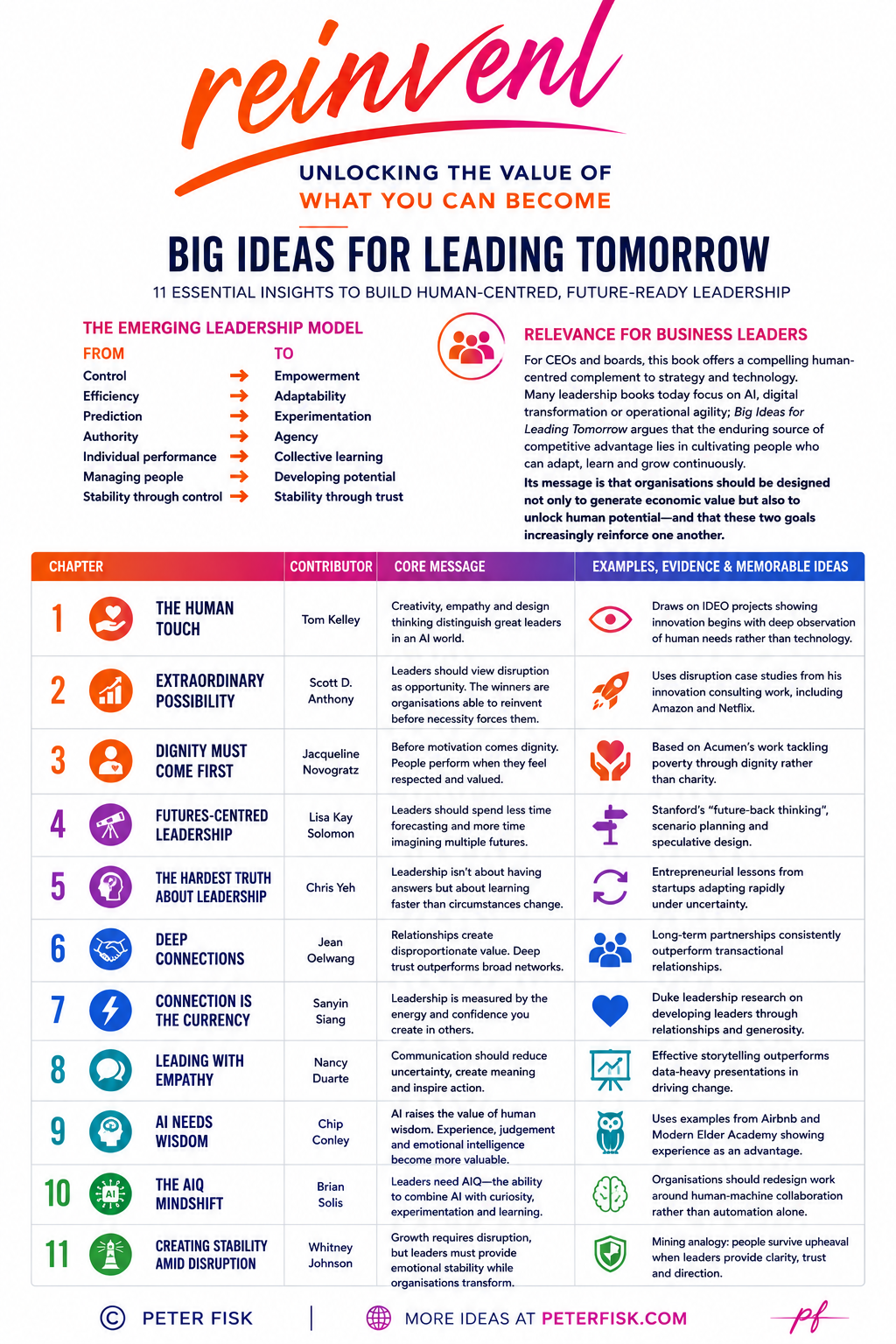
From sustainable advantage to continuous reinvention
One of the strongest themes throughout the book is the changing nature of competitive advantage.
For much of modern business history, leaders sought to build enduring advantages: powerful brands, dominant market positions, proprietary technologies and efficient operating systems that could protect their businesses for many years.
Today, those advantages are increasingly temporary.
Rita McGrath first described her thinking on “transient advantage” to me when I hosted the European Business Forum in Denmark. She describes how organisations can no longer assume yesterday’s success formula will remain effective indefinitely. The most successful companies are those that continually create new sources of value before existing ones decline.
This explains the behaviour of companies such as Amazon, which has repeatedly expanded beyond its original business model, moving from books into marketplace retail, cloud computing, artificial intelligence and multiple new industries. Netflix offers another example: it transformed itself from a DVD rental company into a global streaming and entertainment platform because leaders recognised that the future of the business would not be defined by protecting the past.
The implication for leaders is significant. Strategy can no longer simply be about choosing where to compete and how to win. It must also be about building the organisational capability to continually discover new opportunities.
This is the essence of what I describe as Dynamic Strategy: a future-shaping approach where strategy is continuously shaped by changing environments, emerging possibilities and organisational learning.
The great unfreezing
Scott Anthony develops this argument further by suggesting that we are living through what he describes as a “great unfreezing”, a period in which long-established assumptions about industries, organisations and leadership are rapidly dissolving. The challenge for leaders is not simply to respond to disruption, but to recognise the extraordinary possibilities that disruption creates.
I actually once hosted a boxing match with Scott (against Howard Yu from IMD, with 5 rounds each debating the future of strategy thinking – both guys boxed smart, as you’d expect for great thinkers, but Scott won!).
He argues that organisations rarely fail because they cannot see change coming; they fail because they remain too committed to the logic that made them successful in the first place. Great leaders therefore cultivate two complementary capabilities: the wisdom to see opportunities that others overlook, and the courage to let go of assumptions, products or business models that have outlived their usefulness.
Reinvention is as much about deciding what to stop doing as it is about imagining what comes next. It requires leaders to become comfortable with ambiguity, to experiment before certainty exists, and to create the future while today’s business is still performing well.
That idea aligns strongly with his long-standing work on disruptive innovation: transformation is most successful when it begins from a position of strength rather than as a last response to decline.
Human advantage in a world of AI
One of the most powerful insights in Leading for Tomorrow is that, despite its focus on technology and disruption, the book is fundamentally about people.
The book argues that the defining advantage of the future will not be technological capability alone, because technology will become increasingly accessible. Instead, advantage will come from how effectively organisations unlock uniquely human capabilities.
AI can process enormous quantities of information. It can recognise patterns, generate content and automate many forms of analysis. But human beings remain essential for imagination, judgement, empathy, ethical reasoning and the ability to create meaning.
The challenge for leaders is therefore not simply to deploy AI, but to redesign organisations around the combination of human and machine intelligence. This requires a different view of leadership. The traditional leadership question has often been: how do we get more performance from people? The emerging leadership question is: how do we create the conditions in which people can contribute more of their potential?
This is the idea of “agency” … People perform at their best when they feel ownership, purpose and the ability to influence outcomes. Organisations that create agency will be better positioned to adapt than those that simply demand compliance.
Innovation starts with people
I first met Tom Kelley in Istanbul when design thinking was a new idea, and IDEO was becoming its temple. His contribution reinforces an important lesson: innovation begins with empathy.
At a time when many organisations are fascinated by the possibilities of AI, there is a danger that technology becomes the starting point rather than the customer or human need.
IDEO’s approach has always been based on observing people closely, understanding their frustrations and discovering opportunities that others overlook. The redesign of healthcare experiences, consumer products and everyday services often begins not with advanced technology but with simple observation and curiosity.
The lesson for leaders is that innovation is not primarily a technology challenge. It is a human challenge. The organisations that understand people most deeply will be best positioned to create meaningful solutions.
Learning organisations are winning organisations
Perhaps the biggest shift in leadership thinking is moving from organisations that know to organisations that learn.
In a world of rapid change, expertise remains valuable, but it has a shorter lifespan. The capabilities that create success today may become obsolete tomorrow.
When I interviewed Amy Edmondson at the Thinkers50 Summit in London, she focused on her research into psychological safety which demonstrates that organisations learn fastest when people feel safe to question assumptions, challenge decisions and admit mistakes. Based on Google’s Project Aristotle, sheshowed that high-performing teams are not those that avoid failure; they are those that learn most effectively from experience.
John Hagel extends this thinking by arguing that the future belongs to organisations built around scalable learning rather than scalable efficiency. For much of the industrial era, companies competed by making processes more efficient. Increasingly, they will compete by improving their ability to learn.
This requires a fundamental cultural shift. Experimentation must become normal. Curiosity must be rewarded. Failure must become a source of insight rather than something to hide.
The more human organisation
Another powerful theme in the book is that investing in people is not simply a cultural choice. It is a strategic advantage.
Jacqueline Novogratz argues that dignity is central to human performance. People contribute most when they feel respected, trusted and valued.
Zeynep Ton‘s research challenges the belief that employee investment is merely a cost. Her studies of companies such as Costco, QuikTrip and Mercadona demonstrate that organisations which invest in frontline employees often achieve stronger financial results because engaged people create better customer experiences.
Jean Oelwang and Sanyin Siang similarly emphasise the importance of connection and relationships. In an increasingly digital world, trust becomes even more valuable. The quality of relationships inside organisations will increasingly determine their ability to collaborate, innovate and adapt.
The future organisation is therefore not less human because of technology. It needs to become more human because of technology.

5 leadership principles for an age of continuous reinvention
Drawing together the insights from Leading for Tomorrow with my own work on reinvention, future strategy and long-term value creation, I believe five principles will define successful leadership over the coming decade.
1. Lead from the future back
- Too many organisations are still designed around managing today’s performance. Future leaders must spend more time imagining tomorrow’s possibilities.
- This means developing a stronger future orientation: exploring emerging trends, challenging assumptions and creating strategies that are designed for multiple possible futures rather than a single predicted outcome.
- The best leaders do not simply respond to the future when it arrives. They actively participate in shaping it
2. Build living organisations
- The organisations of the future must behave more like living systems. They need the ability to sense change, learn continuously and adapt naturally.
- This means moving beyond rigid structures and annual planning cycles towards more dynamic approaches where strategy evolves, teams collaborate across boundaries and innovation becomes part of everyday work.
- Adaptability will become a more valuable capability than efficiency alone.
3. Unlock human potential
- The greatest opportunity from AI is not replacing people. It is enabling people to achieve more.
- Leaders must focus on developing curiosity, creativity, judgement and imagination—the capabilities that differentiate humans from machines.
- The organisations that unlock human potential will create stronger innovation, greater engagement and deeper customer value.
4. Learn faster then change
- The speed of external change will increasingly exceed the ability of traditional organisations to respond. The answer is not better prediction. It is faster learning.
- Leaders must create environments where experimentation is encouraged, diverse perspectives are welcomed and knowledge flows freely across the organisation.
- The ability to learn faster than competitors may become the ultimate source of competitive advantage.
5. Make reinvention a habit
- Transformation can no longer be treated as something that happens every few years when circumstances demand it.
- The most successful organisations will make reinvention part of their everyday operating rhythm. They will continually question their business models, rethink customer experiences, develop new capabilities and challenge their own assumptions.
- The question every leader should continually ask is not simply “How can we improve what we do today?” but “What should we reinvent before someone else does?”
The future is a leadership challenge
What makes Leading for Tomorrow such a valuable contribution is that it recognises a truth that is easy to overlook.
The future of business is not only a technology challenge. It is fundamentally a leadership challenge.
AI, digital platforms and new technologies will reshape industries, but their impact will ultimately depend on whether leaders create organisations capable of learning, adapting and imagining new possibilities.
The winners of the next decade will not necessarily be those with the most resources or the most advanced technologies. They will be those that combine intelligent technology with enlightened leadership, creating organisations that are both more adaptive and more human.
The future belongs to leaders who understand that reinvention is no longer something organisations do. It is something they become.
In 2023, as many established automotive companies were still debating the speed and scale of the EV transition, BYD emerged as one of the world’s most disruptive forces in mobility. Its rise was not simply because it produced competitive electric cars. It was much more about leadership. Wang Chuanfu, founder and chairman of BYD, had spent decades imagining a very different future for transportation.
Most automotive leaders looked at electrification as a technology transition: how to replace an internal combustion engine with an electric motor while preserving the existing industry model of manufacturing, dealerships and ownership. BYD saw something broader: it saw the convergence of batteries, energy systems, software, manufacturing and mobility. It invested in battery technology, supply chains and vertical integration long before the market had fully validated the opportunity.
It did not simply ask, “How do we make better electric vehicles?” It asked, “What would mobility look like if we rebuilt the entire system around electrification?” … which is the difference between information and intelligence, between analysis and leadership.
Thinking beyond AI: what leaders can do
Today, an AI system could analyse the automotive industry in seconds. It could map consumer trends, compare competitors, identify emerging technologies, assess regulatory shifts and recommend strategic options. It could probably produce a more comprehensive market assessment in minutes than a traditional consulting team could have produced after months of research.
But AI did not create BYD’s ambition. It did not decide that batteries would become the strategic foundation of mobility. It did not create the conviction to invest ahead of certainty. It did not make the difficult choices required to transform a company and an industry.
AI can analyse possibilities, but leadership creates possibilities.
This is the paradox of the AI era. Artificial intelligence is giving leaders access to an extraordinary abundance of knowledge. It can answer questions faster than ever before, synthesise vast amounts of information and generate strategic recommendations at unprecedented speed.
The more intelligence becomes available, the more valuable human leadership becomes.
Because the future will not be won by those who simply know more.
Almost every organisation will soon have access to powerful AI capabilities. The differentiator will be what leaders do with that intelligence. The advantage will move from knowledge acquisition to judgement, from analysis to choice, from prediction to imagination and from strategy creation to execution.
The critical leadership challenge is therefore not simply how to use AI. It is how to think beyond AI.
Thinking beyond AI means recognising that while machines can expand our intelligence, they cannot replace the uniquely human capabilities that create transformation: curiosity, imagination, courage, judgement and the ability to mobilise people around a different future.
The companies that thrive will be those that combine artificial intelligence with human ambition.
They will use AI not merely to optimise what they already do, but to imagine what they could become.
The new source of value: what a company can become
For much of business history, strategy was about improving the business a company already had. Leaders focused on efficiency, scale, market share and operational excellence. They looked at existing competitors and sought to outperform them.
But in a world of accelerating change, value increasingly comes from a different question: What could this company become?
The most valuable companies are often those that have convinced the world they can continually reinvent themselves. Their value is not only based on current performance but on confidence in their future potential.
This is the logic of what I call the “reinvention premium”.
A company earns a reinvention premium when investors, customers and employees believe it has the ability to continually create new sources of relevance, growth and value.
AI will amplify this dynamic because every organisation will have greater ability to explore opportunities, analyse markets and identify potential disruptions.
Reinvention is not a technology challenge. It is a leadership challenge.
AI can tell a company where opportunities may exist. It cannot decide which opportunities matter. It can generate hundreds of possible strategies. It cannot determine which future is worth pursuing.
That requires leaders who can think beyond the obvious.
How business leaders think beyond AI
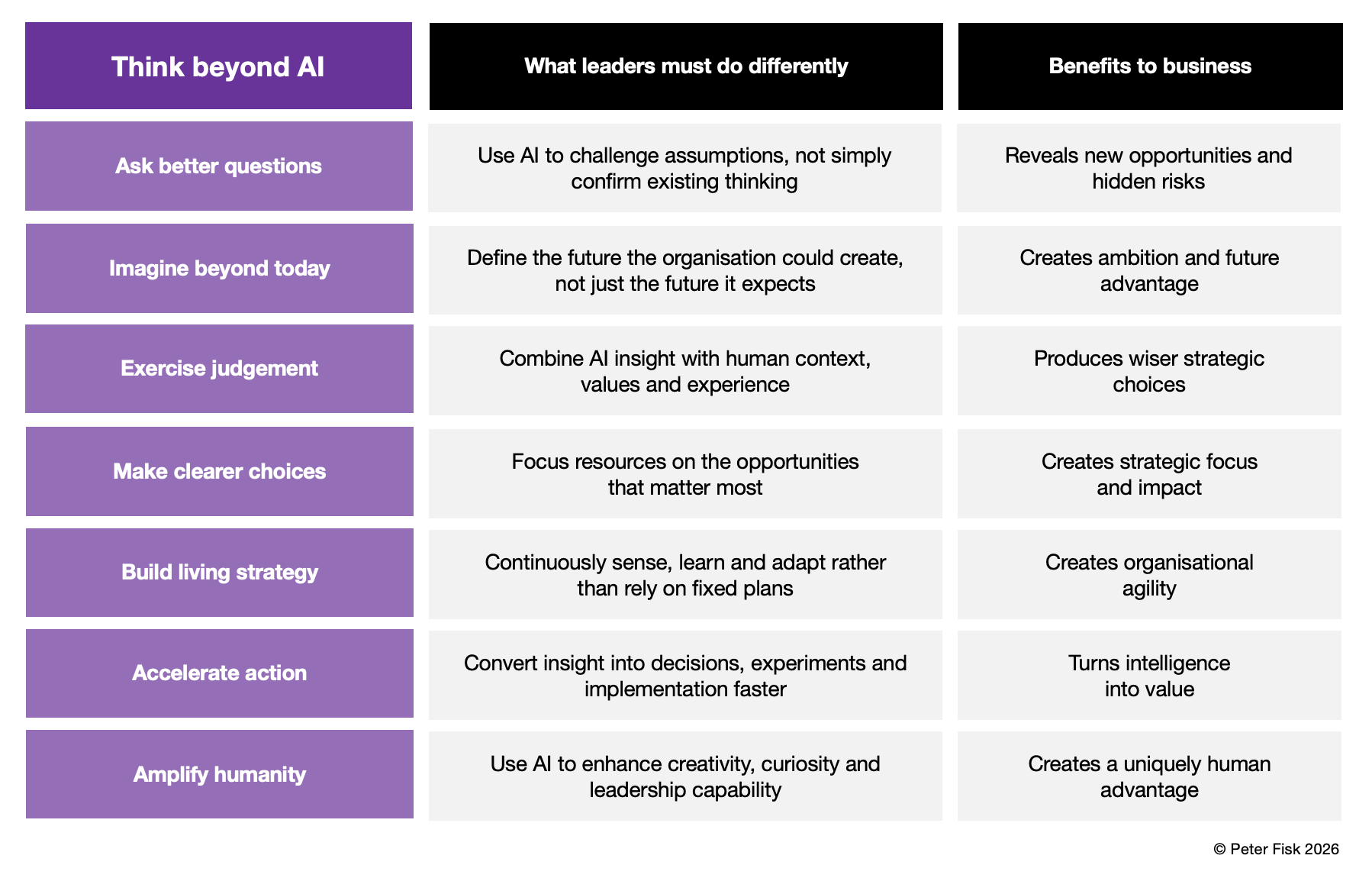
Beyond answers: asking better questions
The first capability of leaders in the AI era is not finding better answers. It is asking better questions.
Most organisations use AI in the same way they have traditionally used information: to solve existing problems faster. They ask how to increase efficiency, reduce costs, improve products or compete more effectively.
These are useful questions. But they are rarely transformational questions.
The greatest reinvention opportunities begin when leaders challenge the assumptions behind their business.
- Instead of asking, “How do we sell more products?” they ask, “What customer problem are we really solving?”
- Instead of asking, “How do we beat competitors?” they ask, “What if the boundaries of our industry disappeared?”
- Instead of asking, “How do we protect our current business?” they ask, “What could make our current business irrelevant?”
Melanie Perkins, co-founder and CEO of Canva, provides a powerful example of this kind of thinking. The conventional software industry assumed that professional design required professional expertise. Powerful creative tools were built for designers, agencies and specialists.
Perkins asked a different question: why should design capability belong only to experts?
Canva’s ambition was not simply to create another design application. It was to democratise creativity by making design accessible to everyone. The company reframed the market around a broader human need: helping people communicate ideas visually.
Now artificial intelligence is accelerating Canva’s mission, helping millions of users create content more easily. But the strategic insight came before the technology.
The lesson is simple: AI expands the range of answers available. Great leaders expand the range of questions being asked.
Beyond prediction: imagining futures that do not yet exist
AI is becoming increasingly powerful at identifying patterns and predicting likely outcomes. But many of the greatest business opportunities do not emerge from predicting the future. They emerge from creating it.
The challenge for leaders is moving from forecasting what is likely to happen towards imagining what could happen.
Peter Wennink, former CEO of ASML, understood this principle. ASML’s leadership in semiconductor manufacturing technology was not created through short-term market responses. It was built through decades of investment in extreme ultraviolet lithography, a technology so complex that success required collaboration across an entire ecosystem of suppliers, researchers and customers.
ASML’s leaders had to believe in a future computing landscape before that future was fully visible. The company’s advantage was not simply superior technology. It was long-term imagination translated into capability building.
The same principle explains BYD’s rise. It was not just following the electric vehicle market. It was building the capabilities required for a future mobility ecosystem.
AI can help leaders explore possible futures more extensively than ever before. But leaders must still decide which future deserves commitment. Prediction helps organisations prepare for change. Imagination helps them create it.
Beyond intelligence: exercising judgement
As AI becomes more sophisticated, leaders face a new challenge: too many plausible answers.
A leadership team can ask AI to analyse a market and receive multiple strategic options. It can model different scenarios and calculate potential outcomes.
But strategy has never been about finding the mathematically perfect answer. It is about making choices under uncertainty. This is where judgement becomes the defining leadership capability.
Bernard Arnault’s leadership of LVMH illustrates this clearly. Luxury is not an industry where success comes simply from analysing consumer behaviour. The value of luxury brands comes from culture, emotion, symbolism and human aspiration.
Arnault’s achievement was not simply acquiring famous brands. It was understanding how to preserve their heritage while continually renewing their relevance.
LVMH has maintained the exclusivity and craftsmanship that define luxury while embracing new generations, digital experiences, global markets and changing cultural expectations.
AI can identify consumer patterns. It cannot determine why a brand becomes meaningful. It cannot understand the emotional connection between history, identity and aspiration. That requires cultural judgement.
The future leader will not be the person who knows everything. It will be the person who knows what matters.
Beyond competition: creating ecosystems
Traditional strategy encourages companies to define themselves by their industry. Banks compete with banks. Retailers compete with retailers. Energy companies compete with energy companies. But many of the most valuable businesses today have escaped these boundaries by creating ecosystems.
Mukesh Ambani’s transformation of Reliance demonstrates this principle. Originally built around energy and petrochemicals, Reliance expanded into telecommunications, digital platforms, retail and consumer services.
The creation of Jio was not simply a telecommunications strategy. It was an ecosystem strategy. The ambition was to create the infrastructure for India’s digital economy, connecting consumers, businesses, entertainment, payments and services.
The strategic question changed from: “How can we compete better in our existing market?” to “What role can we play in shaping the future system around our customers?”
AI can reveal connections between industries and identify emerging opportunities. But leaders must have the ambition to move beyond the boundaries that defined their past success. The biggest opportunities are often found not inside industries, but between them.
Beyond possibilities: making difficult choices
One of the greatest challenges of the AI era will be abundance. Companies will have more ideas, more opportunities and more possible strategies than ever before.
The danger is that intelligence creates complexity rather than clarity. Leadership is ultimately about choice.
Jørgen Vig Knudstorp’s transformation of Lego illustrates this. When he became CEO, Lego was struggling because it had expanded into too many directions. The company had creativity, imagination and innovation, but it lacked strategic focus. The answer was not generating more ideas. It was deciding what mattered most.
Lego returned to the core power of the brick and the creativity it enables. From that stronger foundation, it expanded into successful new areas including digital experiences, entertainment partnerships and global communities.
Reinvention does not mean changing everything. It means choosing what must change and what must remain. AI will create unlimited possibilities. Great leaders will create clarity.
Beyond products: building platforms and solving bigger problems
Another defining characteristic of reinvention leaders is their ability to move beyond products towards platforms.
Marcos Galperin built Mercado Libre as an online marketplace, but the company’s ambition expanded far beyond e-commerce. It developed payments, logistics, credit and advertising capabilities because leaders recognised that customers did not simply need a place to buy and sell products. They needed the infrastructure to participate in a digital economy. The company became valuable because it solved a broader system problem.
This is the essence of platform thinking. AI can help companies identify customer needs more deeply and understand ecosystems more clearly. But leaders must still make the strategic leap from selling products to solving bigger problems.
Beyond technology: building organisations capable of renewal
The final challenge is turning intelligence into action.
Many companies will have access to similar AI tools. Their difference will come from their ability to adapt, decide and execute.
Jane Fraser’s leadership at Citi illustrates this challenge. Transforming a highly complex global financial institution requires more than technology investment. It requires simplifying structures, improving accountability and creating an organisation capable of responding faster.
The lesson applies across industries. The future advantage will not belong to organisations that simply know more. It will belong to organisations that learn faster.
Natarajan Chandrasekaran’s leadership of Tata reflects the same principle. The challenge for a company with more than a century of history is not simply growth. It is renewal: embracing digital technology, electric mobility, advanced manufacturing and new energy while preserving the purpose and values that created the institution. Long-term success requires the ability to reinvent without losing identity.
The ultimate advantage remains human
AI will transform every industry. It will change how companies analyse, innovate and compete. But the biggest mistake leaders can make is seeing AI only as a productivity tool. Its deeper significance is strategic.
AI gives leaders more intelligence than any previous generation has possessed. But intelligence alone does not create value. Value is created when leaders decide what matters, imagine what is possible and mobilise people to create something new.
The future will not belong to those who simply ask AI better questions. It will belong to those who use AI to become better thinkers. Because when machines can provide more answers than ever before, the defining human advantage will be knowing which questions are worth asking, which choices are worth making and which futures are worth creating.
That is what it means to think beyond AI.
Every great achievement begins with a moment when someone decides that what exists is no longer enough.
For Josh Kerr, that moment came not because he was failing, but because he had already succeeded. He had become one of the greatest middle-distance runners of his generation: a three-time world champion, an Olympic silver medallist and one of the defining athletes of modern athletics. Yet success created a new question. What would he do next that would truly define his career?
The answer was not another championship medal. It was something more enduring: a place in history.
In elite sport, championships and world records represent different forms of greatness. Championships reward consistency, tactical intelligence and the ability to deliver under pressure. World records demand something different. They require an athlete to move beyond competition and redefine the boundaries of human performance.
For much of his career, Kerr had been focused on championships. He thrived in races where strategy, positioning and instinct mattered as much as raw speed. But 2026 presented a unique opportunity. With no Olympic Games or World Championships, there was space to pursue something that had always carried a special significance for British athletics: the mile world record.
The mile is not simply a distance. It is a symbol. It carries the weight of history, national identity and sporting mythology. For British runners, no achievement has greater resonance than joining the exclusive group of athletes who have rewritten the mile record books.
Seventy years earlier, Roger Bannister had understood this perfectly. His attempt to break the four-minute mile was not a spontaneous act of athletic courage; it was a carefully planned project. Bannister analysed conditions, prepared meticulously and created the circumstances that would allow him to achieve what many believed impossible. When he crossed the line in Oxford in 1954 in 3:59.4, he did more than break a barrier. He changed human expectations.
Later generations of British milers, including Sebastian Coe and Steve Cram, continued that tradition, transforming the mile into one of the most celebrated events in athletics.
Kerr wanted to become part of that story.
But he also wanted to do it in a way that reflected his generation: transparent, ambitious and built around a complete performance ecosystem.
That became “Project 222“.
Naming the impossible
In January 2026, Kerr publicly announced something that few elite athletes would dare to do. He declared that he intended to run the mile in 222 seconds: three minutes and 42 seconds.
The challenge was enormous.
The world record of 3:43.13 had been held by Morocco’s Hicham El Guerrouj since 1999. For 27 years, some of the greatest runners in history had attempted to break it and failed. It represented one of the longest-standing barriers in modern athletics.
By announcing his target months in advance, Kerr created significant risk. A world record attempt depends on countless variables outside an athlete’s control. Weather conditions, injury, illness, competition and even the smallest disruption in preparation can determine success or failure.
Yet that was precisely the point.
Kerr was not simply setting a goal. He was creating a strategic commitment.
Every day, he wrote the target in his diary: 3:42.
The repetition was deliberate. The number became a constant reminder of the future he was working towards. The goal was not something that existed only on race day. It became embedded into his daily behaviour.
This is a principle understood by the world’s most successful organisations. Transformational companies often begin by articulating a future that does not yet exist, then building the capabilities required to make that future inevitable.
When Amazon invested in cloud computing through AWS, when Nvidia committed to accelerated computing long before artificial intelligence became the defining technology wave, when Tesla pursued mass-market electric vehicles before the infrastructure existed, these companies were not simply responding to existing markets. They were creating the conditions for new ones.
Kerr applied the same philosophy to human performance.
The record was not the outcome he hoped for.
It was the destination around which everything else was organised.
Individual talent and performance ecosystem
The greatest misconception about elite achievement is that it is created by exceptional individuals alone.
Talent matters. Determination matters. But at the highest levels, breakthroughs are rarely achieved by individuals acting alone. They emerge from ecosystems.
Eight years earlier, Kerr had joined the Brooks Beasts training group in the United States. Under coach Danny Mackay, he built a support system designed around continuous improvement. Physiotherapists, nutrition experts, sports scientists and technical specialists all contributed to the mission.
The objective was simple: remove every possible barrier between potential and performance.
Training sessions were planned with precision. Nutrition was designed around physiological requirements. Recovery became a science rather than an afterthought.
The team focused relentlessly on what Kerr described as finding the “one per cents” — the small improvements that collectively create extraordinary outcomes.
This mindset has become familiar in elite sport, but it has profound implications beyond athletics. The best organisations increasingly recognise that competitive advantage does not come from one breakthrough innovation alone. It comes from integrating many capabilities together: technology, talent, partnerships, culture and data.
The modern business equivalent of a champion athlete is not a lone genius. It is an orchestrated ecosystem.
Project 222 demonstrated this principle perfectly.
Kerr’s racing shoes were customised to maximise his biomechanics. His racing suit was specially designed to support performance. His recovery programme was engineered around his body’s needs. An altitude room was installed in his bedroom, allowing him to spend approximately 12 hours a day training his physiological response to lower oxygen conditions.
Even his recovery routines became part of the mission. After each hard session, he immersed himself in an ice bath for precisely 222 seconds, the same duration as the performance he was chasing.
The symbolism was powerful. Every day, his body experienced the number. Every day, his mind rehearsed the outcome.
The future was being built through repeated actions in the present.
Engineering the conditions for breakthrough
One of the most fascinating aspects of Project 222 is that Kerr did not treat the world record as a single event. He treated it as a system.
Modern organisations often make the mistake of focusing on outcomes while neglecting the operating model required to produce them. They announce transformation goals but fail to redesign the structures, capabilities and behaviours needed to achieve them.
Kerr approached transformation differently. He understood that the final race would last less than four minutes, but those four minutes were the product of thousands of decisions made over months and years.
The race was the visible moment. The real performance happened long before.
This is the essence of breakthrough performance: extraordinary outcomes are usually created through ordinary actions repeated with extraordinary discipline.
The same principle applies in business. Companies that successfully reinvent themselves rarely do so through one dramatic moment. Instead, they build the capability to continuously adapt. They develop the sensors to detect change, the imagination to see opportunities, the systems to experiment and the courage to commit.
Reinvention is not an event. It is a capability.
Kerr’s Project 222 was exactly that: a reinvention capability applied to an athlete, a team and a historic challenge.
London, 18 July 2026, 3.36pm
On 18 July 2026, Josh Kerr completed a journey that had begun months earlier with a simple but audacious declaration: he would run a mile in 222 seconds. The target seemed almost impossibly precise. The world record of 3:43.13 had belonged to Hicham El Guerrouj of Morocco since 1999, surviving for 27 years despite repeated attempts from some of the greatest runners in history.
When Kerr crossed the finish line in London in 3:42.66, the numbers told one story. He had broken one of athletics’ most prestigious records and placed himself among the greatest milers ever. But the deeper story was not the time itself. It was the process that created it.
World records often appear, in hindsight, like moments of individual brilliance. They are remembered through a single image: the athlete crossing the line, the clock stopping, the crowd celebrating. Yet behind every breakthrough lies a complex system of preparation, experimentation, collaboration and belief. The final performance is simply the visible expression of thousands of invisible decisions.
Project 222 demonstrated this reality. Kerr had not approached the mile record as a single race. He had approached it as a strategic transformation programme, with a clearly defined ambition, a carefully designed operating model and an ecosystem of people and technologies aligned around one outcome.
That distinction matters because it reflects a broader shift taking place across business and society. In an era of accelerating change, success increasingly belongs not to those who simply optimise what they already do well, but to those who can deliberately reinvent themselves.
Vision and execution
Kerr’s decision to announce Project 222 publicly was perhaps as significant as the physical preparation that followed. Most athletes would prefer to keep such an ambition private. The risks were obvious. Between January and July, countless things could have gone wrong. A minor injury, an illness, poor weather conditions or a loss of form could have turned a bold declaration into a very public failure.
Instead, Kerr chose commitment over caution.
By stating his ambition openly, he created a powerful psychological mechanism. The goal became more than a personal aspiration; it became an organising principle for every decision that followed. Each training session, recovery choice and lifestyle adjustment was measured against the question: does this move me closer to 222 seconds?
This is a pattern visible among many of the world’s most transformative leaders and organisations. They often create a future vision before they have all the answers required to achieve it. The ambition itself becomes the catalyst for building new capabilities.
When Roger Bannister set out to break the four-minute mile in 1954, he was not simply hoping that one exceptional race might happen. He engineered the conditions for success through preparation, pacing strategy and scientific understanding. His achievement changed the perception of human possibility because he demonstrated that a previously accepted limit could be redesigned.
The same principle has driven many of the world’s most valuable companies. Amazon did not become a technology leader by optimising its original online retail model; it created AWS because it imagined a different future for computing infrastructure. Nvidia did not become the defining company of the AI era by protecting its position in graphics processing; it reinvented itself around accelerated computing. BYD did not simply manufacture cars; it built an integrated ecosystem around batteries, software and electric mobility.
In each case, the breakthrough began with a decision to pursue a future that did not yet exist.
The rise of the performance ecosystem
Perhaps the greatest lesson from Project 222 is that exceptional performance is no longer created by exceptional individuals alone. The era of the lone genius is being replaced by the era of the connected ecosystem.
Kerr’s talent was undeniable, but talent was only the foundation. After joining the Brooks Beasts training group in the United States eight years earlier, he built a network of specialists around him, led by coach Danny Mackay, including physiotherapists, nutrition experts, sports scientists and technical specialists. Their role was not simply to support Kerr; it was to continuously expand the boundaries of what he could achieve.
Every element of his preparation was designed around marginal improvement. Training sessions were planned with precision. Nutrition was aligned with physiological requirements. Recovery was treated as seriously as exercise. Technology was used to measure, analyse and refine performance.
The team focused on what Kerr described as finding the “one per cents” — the small improvements that, when combined, create extraordinary outcomes.
This philosophy is increasingly important in business. Competitive advantage today rarely comes from one isolated capability. It emerges from the interaction between many capabilities: technology, talent, partnerships, culture, data and customer insight. The strongest organisations are not simply collections of resources; they are intelligent ecosystems that continuously learn and adapt.
Kerr’s preparation reflected this new reality. His racing shoes were customised to optimise his biomechanics. His racing suit was designed specifically for performance. An altitude environment was created in his bedroom, allowing him to spend approximately 12 hours each day training his physiological response. His recovery routines were precisely structured, including ice baths lasting exactly 222 seconds after hard sessions.
These details might appear obsessive, but at the highest level of performance the difference between success and failure is often measured in tiny margins. The ability to identify, integrate and improve those margins becomes the source of competitive advantage.
From optimisation to reinvention
The most important distinction between Project 222 and a conventional training programme is that Kerr was not simply trying to become a better version of the athlete he already was. He was attempting to become something different.
Before Project 222, Kerr was already a champion. He had proven his ability to win races and perform under pressure. But breaking the world record required a different identity. It required moving from competitor to record-breaker, from successful athlete to historical figure.
This transition mirrors the challenge facing many organisations today. Companies often spend enormous energy optimising their existing business models, improving efficiency and protecting current sources of revenue. Those activities are necessary, but they rarely create the breakthroughs that define industries.
The companies that shape the future are those capable of operating in two worlds simultaneously: exploiting today’s opportunities while exploring tomorrow’s possibilities.
They understand that reinvention is not a one-time transformation project. It is an ongoing capability.
Kerr’s preparation embodied this mindset. He did not wait until he was certain that he could break the record before changing his approach. He created the system that would make the attempt possible, then adapted continuously as new information emerged.
This is the essence of strategic reinvention: creating the future while still performing in the present.
Leaving your mark in time
For Josh Kerr, Project 222 was ultimately about more than a stopwatch. It was about legacy.
Championship medals are earned through victory over competitors. Records are earned through victory over history.
By choosing the mile record, Kerr chose to enter a conversation that began with Bannister more than seven decades earlier. He wanted his name connected not just with winning races, but with expanding what people believed was possible.
That desire for legacy is increasingly important in a world where attention is abundant but lasting impact is rare. The greatest leaders, athletes and entrepreneurs are not remembered simply because they achieved success. They are remembered because they changed expectations.
Roger Bannister changed what runners believed was possible. Steve Jobs changed what consumers expected from technology. Elon Musk changed expectations around electric vehicles and space exploration. Josh Kerr changed what the modern mile could be.
The record itself will eventually fall. Another athlete will run faster. Another generation will redefine the boundary. That is exactly how progress works. But the significance of Project 222 will endure because it represents something deeper: a demonstration that extraordinary outcomes can be deliberately created when ambition is matched with discipline, imagination and a system capable of delivering transformation.
The lesson extends far beyond athletics. In a world defined by constant disruption, the greatest competitive advantage is no longer simply being the best at what you do today. It is having the courage and capability to reinvent what you can become tomorrow.
Josh Kerr did not simply chase a record. He built the conditions for a breakthrough.