Welcome to your future … How business leaders can explore new possibilities, reimagine strategies and innovations, transform their businesses and themselves, and unlock the value of what they can become
November 26, 2026

In September 2016, Mukesh Ambani stood up at Reliance Industries’ annual meeting and invited India to try Jio for free.
For the introductory period, people could use its mobile data, calls and apps without charge. India already had mobile operators. Ambani was betting on what people might do if they could use mobile internet freely enough to make it part of everyday life. That meant building the network before knowing how customers would use it, then giving them a reason to find out.
Think about the decision from inside the company. You have to commit capital while important questions about demand are still open. You have to convince people who know how to run one kind of business that they can help build another. And when the new service goes live, your investment still depends on millions of individual choices. This is what makes creating the future such a demanding act of leadership. You have to give people a believable reason to step into it with you.
My new book The Reinvention Playbook starts with a question I believe every leader should ask of their business and themselves: What could we become, and what would that make possible for others?
Your answers will change as you learn. The courage is in giving an answer now, making a choice that counts, and being willing to grow into the person who can see it through.
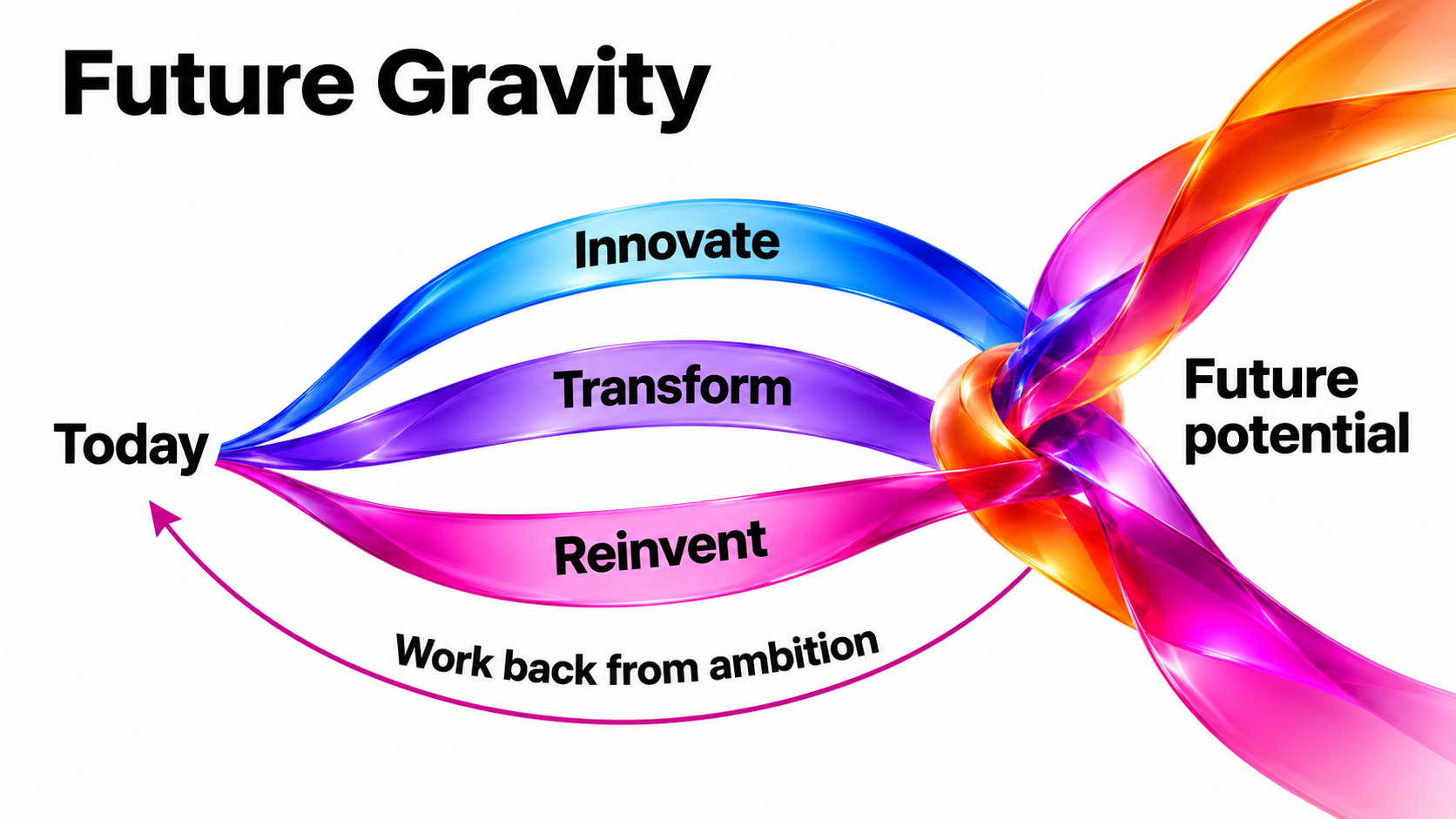
Define your Future Gravity
Future Gravity is the pull of a future worth creating.
Imagine your business ten years from now, playing a more valuable role in people’s lives. What can customers do because you exist? What problem have you made easier, cheaper or possible to solve at all? Which capabilities make you unusually well placed to get there? The answers give you something concrete to work back from. Your next investment, partnership or hire begins to look different when you can see what it might help you become.
Start with the megatrends. The convergence of AI and robotics changes what a small team can build and operate. Ageing populations change who needs care and how it might reach them. Climate pressure and electrification change where energy is generated, how it is stored and who can make use of it. The most interesting opportunities often involve several forces at once. Imagine an industrial company that can use AI to schedule production around electricity availability and price. Lower energy costs could make an existing factory more competitive, and the same capability might become a service it sells to other manufacturers.
Try writing your Future Gravity in a sentence a customer could recognise. A building materials company might aim to help developers deliver low-carbon buildings faster, with predictable cost and performance. That opens up decisions about design, prefabrication, logistics and what happens to materials at the end of a building’s life. A leader might aim to become the person who helps a regional business compete globally by developing local leadership in every market. That ambition immediately raises a practical question about which decisions will have to move out of the head office.
A compelling future gives people direction. Dynamic strategy keeps the route open as the evidence changes. Work backwards to identify what must become true, then work forwards through experiments and decisions. Give the team a way to tell you when the assumptions behind the original ambition have changed. A useful strategy conversation can end with a different plan and a stronger conviction about where you’re going.

Innovate at the nexus of markets and ideas
The Nexus Effect is what happens when capabilities from different worlds come together around a problem or possibility.
In 2022, Crazy Maple Studio founder Joey Jia saw how Chinese audiences were consuming vertical microdramas. With ReelShort he brought that format to English-language audiences, combining the cliffhangers of serial drama with episodes designed to be watched on a phone in a minute or two. A short gap in someone’s day could now be long enough for a story to get them hooked. The format shaped what writers, directors and actors had to do in the opening seconds of every episode. Read more in Joey Jia’s interview with TIME
Film studio A24 found a different opportunity in how audiences connect with stories. Everything Everywhere All at Onceuses a multiverse action story to explore the relationship between an immigrant mother and her daughter. Its very particular family story gives the spectacle emotional weight. For a leader in any creative business, the challenge is to identify an idea distinctive enough to attract an audience and give the people developing it room to keep the qualities that made it interesting in the first place.
At Insilico Medicine, the nexus is between machine learning, biology and drug development. Its researchers used generative AI to identify a target and design a candidate for idiopathic pulmonary fibrosis. The candidate then had to progress through experimental work and human trials, with Phase 2a results published in Nature Medicine. Each step asks for a different kind of evidence. If you’re bringing AI into an established business, start by asking where faster exploration would give experts better choices, and what evidence those experts would need before committing to one.
Take your team to the nexus by asking them to do three things.
- Follow the problem across the whole journey. Look for where customers lose time or take on risk. Ask who currently picks up the work between suppliers, systems and teams.
- Borrow a capability from somewhere unexpected. What could a construction company learn from the way a manufacturer configures complex products? What could an insurer learn from the way a fleet operator uses maintenance data to prevent breakdowns?
- Design the offer around the outcome. Decide what you could promise with the right partners, who would pay for it and where you would take responsibility. Then put the proposition in front of someone who could choose to buy it.
Anthropic’s open Model Context Protocol illustrates another kind of nexus. An AI assistant can become more useful when it can draw on the information and tools people already use. Publishing a common protocol gives outside developers a way to build those connections. That raises a question for any business looking to lead an ecosystem. Which capabilities should you develop yourself, and where would a shared standard make it easier for others to extend what you can offer?
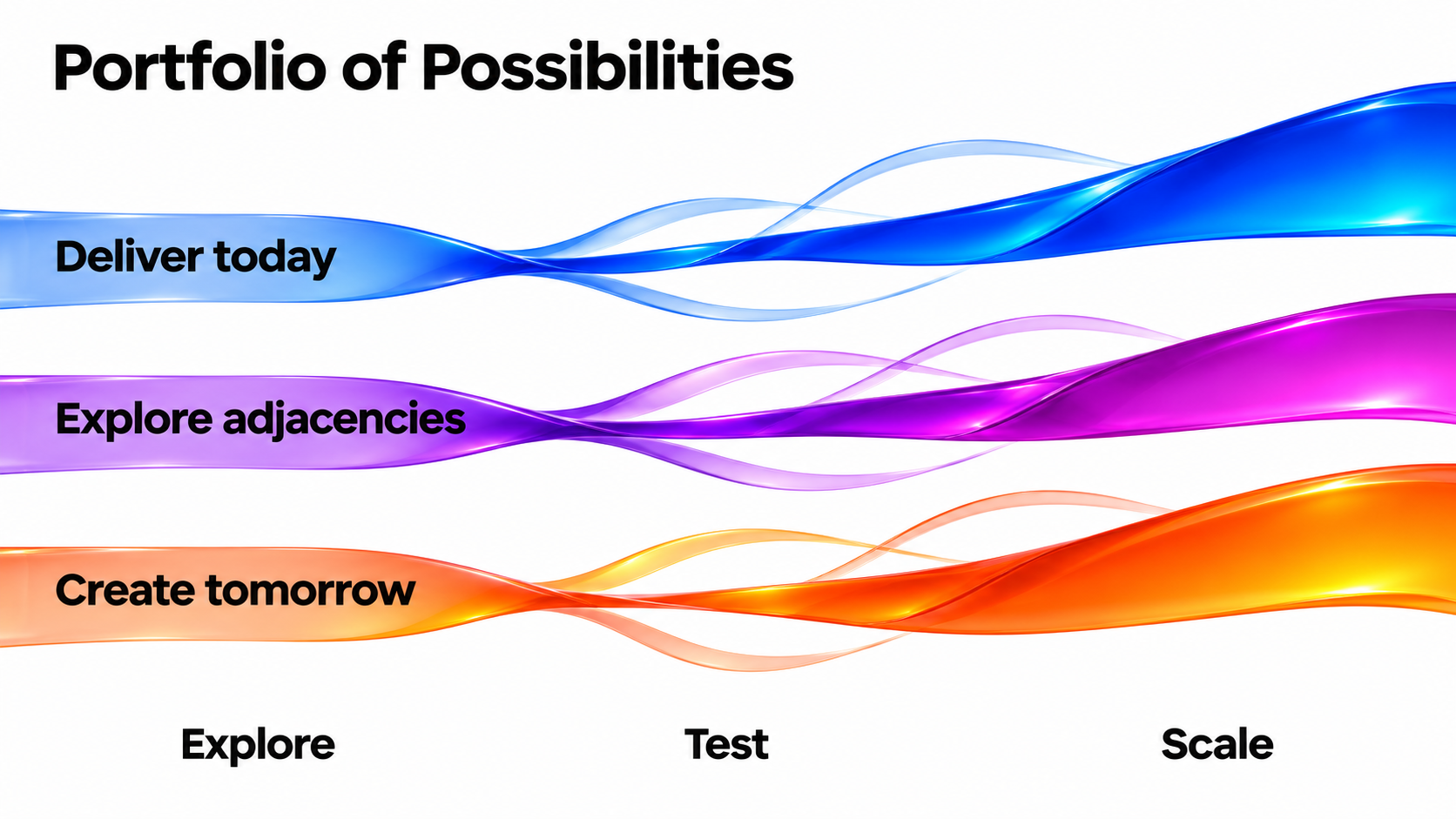
Build a portfolio of possibilities
Once you see a more valuable future, the temptation is to give it a name, launch a programme and decide too soon what form it will take. A Possibility Portfolio lets you explore several ways to realise the ambition. Some ideas can improve today’s business and pay their way quickly. Others might take you into adjacent markets. A few will change how the business earns its money or why customers come to it in the first place.
Two fintechs show how a specific opening can earn a company the right to pursue more possibilities.
In Brazil, David Vélez and the Nubank team began with a digital credit card with no annual fee. It gave them a focused way to earn trust and learn how customers used credit. They later introduced a digital account for deposits, transfers and payments.
Revolut’s Nik Storonsky and Vlad Yatsenko began with a different problem. Spending and transferring money abroad could be expensive and awkward. From that specific need, Revolut expanded into areas including business accounts, trading and merchant payments.
Each new possibility has to earn its place. A product your customers will happily try may require regulatory permissions, risk expertise or an operating model that you have yet to develop. Ask which advantage will carry over from your first business, which capabilities you can build with a partner, and how much you need to learn before you commit to the next market.
A practical portfolio makes room for three kinds of work.
- Build on today’s strengths. Improve a customer journey, increase reliability or free up cash. Give teams clear targets for outcomes they can measure now.
- Explore where you might grow next. Test an adjacent market with a paying customer, a partner or a trial in one geography. Ask which capabilities travel well and which need to be built.
- Test what could change the business. Give the most consequential possibilities a named leader, protected capacity and a clear next experiment. Agree what evidence will earn the next round of investment.
How you review the portfolio matters as much as what goes into it. A promising early idea might earn more investment because customers return and pay again. A mature offer might lose funding because its future economics have changed. A credible prototype can still be a poor business if every implementation requires its own team of specialists. Give the board a way to see both the opportunity and the next uncertainty it needs to resolve. Make it possible to move money and people as your understanding improves.
Be a performer transformer
Mercado Libre’s marketplace exposed two problems that could hold back the whole business. Could buyers and sellers transact with confidence? Could a small merchant reliably get a parcel to a customer?
Under founder Marcos Galperin, Mercado Pago and Mercado Envíos developed around these needs. Payments grew into a business serving transactions beyond the marketplace. Investment in fulfilment helped speed up delivery and made the marketplace more useful to merchants. Improving the core exposed opportunities to build businesses with a wider role across Latin America.
Performing and transforming are the two strands of the same job. A factory manager might improve yield this quarter while working with a customer on a new way to manufacture a component. An insurer might make claims handling quicker while testing a service that helps a fleet prevent losses. The work of today provides access, data and insight that help tomorrow’s business get started. The work of tomorrow can reveal a better way to perform today.
Give both strands a place in the leadership conversation. Ask operating leaders where they’re building capability as well as delivering results. Ask venture teams what they’ve learned that the wider business can use. When a new offer is ready to scale, decide who will train people, integrate systems, change incentives and take responsibility for a consistent customer experience. That is where promising innovation becomes transformational change.
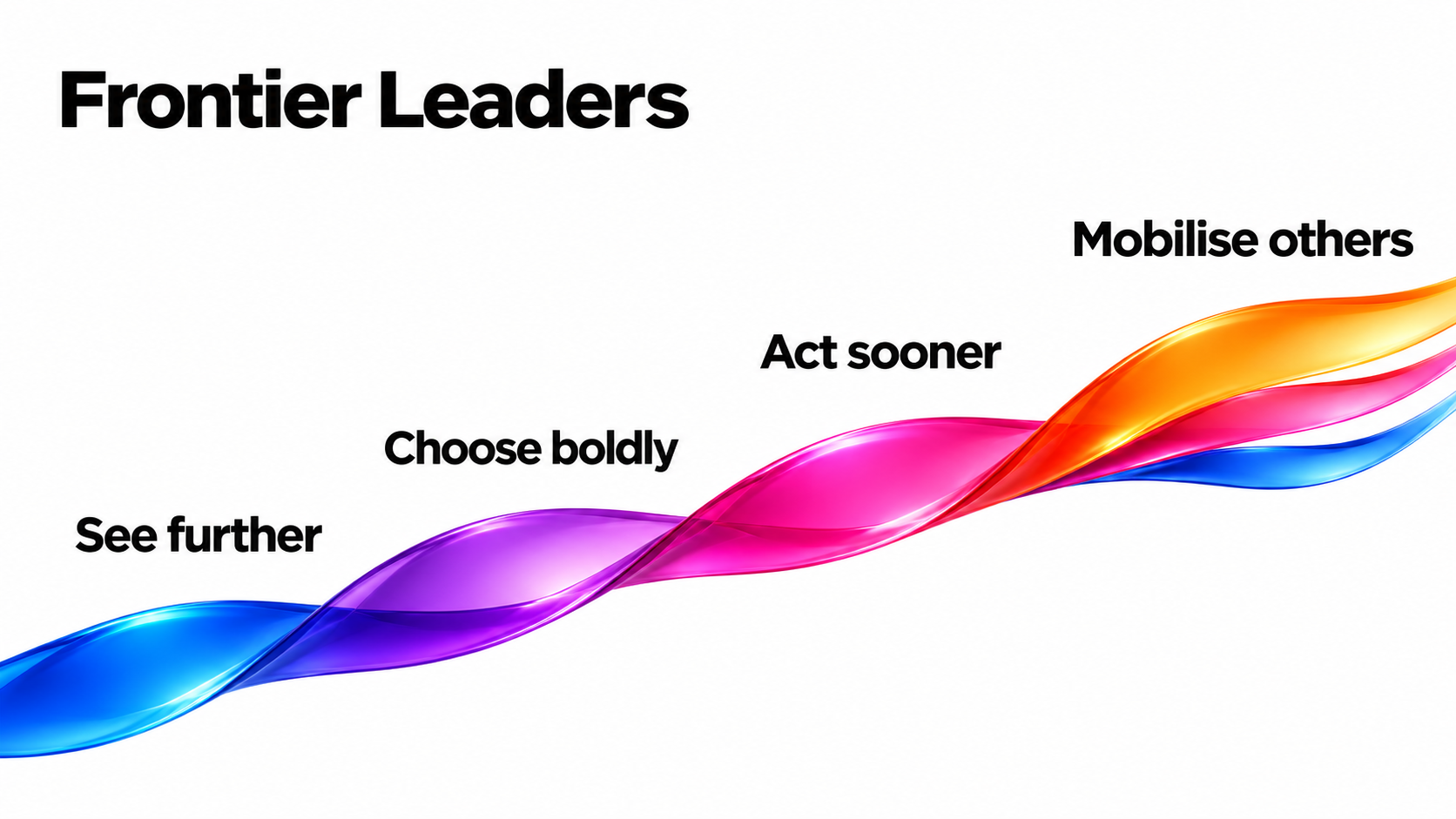
Practise frontiership
The next business will ask more of you than the one you already know how to run. You may have made your reputation as the fastest decision-maker in the room. Now your job might be to coach others to make decisions you would once have kept for yourself. You may have built a career on mastery of an industry. Now your advantage might come from being willing to learn its future from customers, engineers or entrepreneurs working beyond its edges.
I call this frontiership. Frontier leaders see further, choose boldly, act sooner and mobilise others. They go to the places where change is already happening and spend time with people living through it. They make strategic choices explicit enough for others to challenge. They create the conditions for people to take responsibility, especially when the work crosses functions or puts old incentives under strain.
Zipline’s Keller Rinaudo helped put that kind of leadership into practice in Rwanda.
The first use case was delivering blood to health facilities. Its value depended on the people who managed supplies, ordered deliveries and trusted a new service to work when a patient needed it. The team needed the judgement and participation of a public health system as much as it needed capable engineers. For a frontier leader, building a coalition starts with asking whose day-to-day work has to change for the idea to succeed.
Start with your own Future Gravity. In three years, what contribution do you want to be able to make that you cannot make today? Look beyond the role title. Perhaps you want to help a generation of plant managers lead through industrial AI, or become a better sponsor of people who can build businesses in unfamiliar markets. Then change something people can see this month. Give a successor a real decision. Join a customer visit in a market you rarely see. Sponsor an experiment whose outcome could overturn your own view. Ask your team what they would do differently if they were certain you would back them.
People take their cues from what you do when there’s something at stake. They notice who gets promoted, how you respond to an awkward result, and whether you honour a commitment to an experiment when the quarter gets difficult. Sustainable transformation depends on hundreds of people seeing that it is possible to act differently and still succeed here. Your behaviour can give them that evidence.
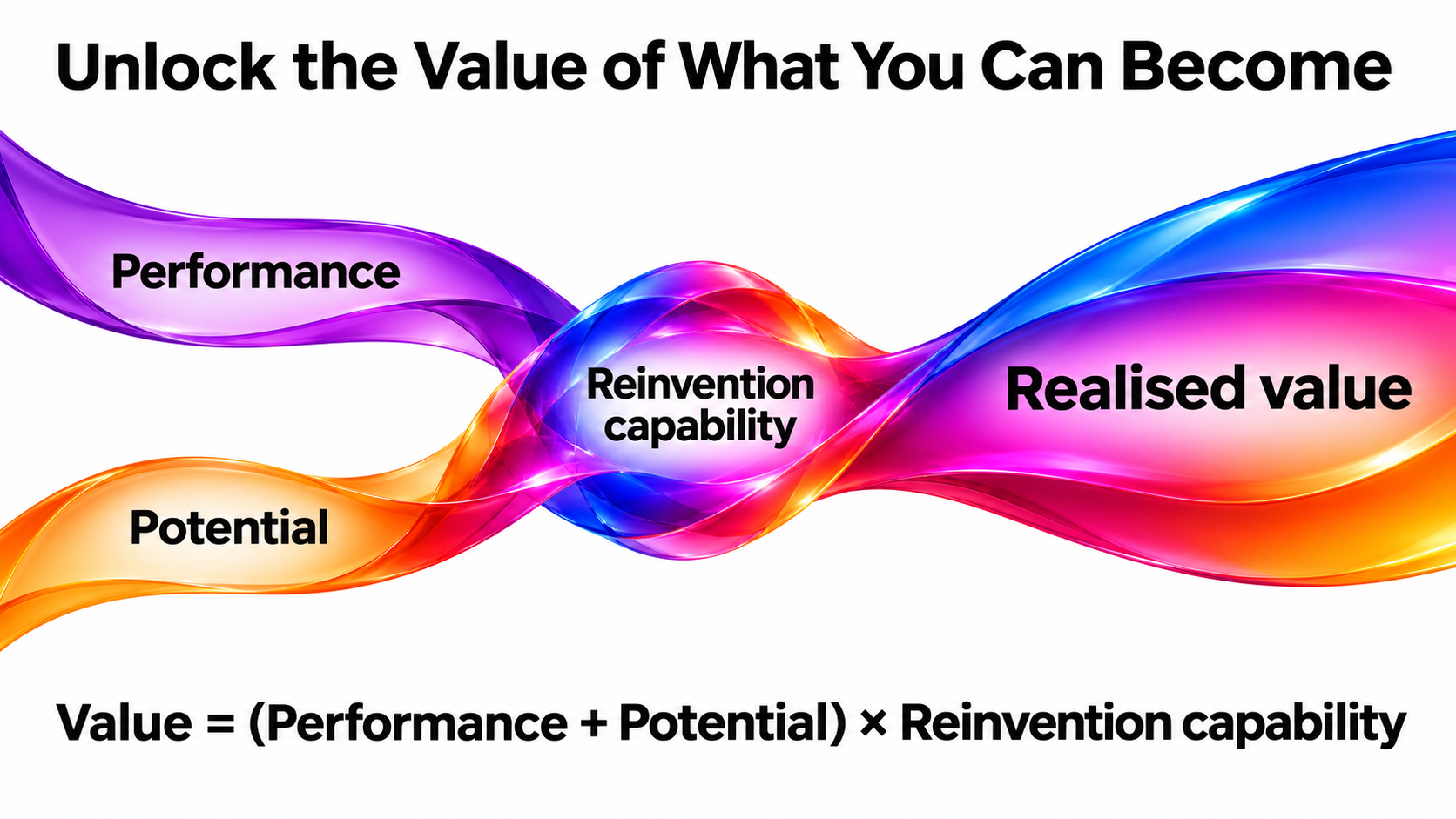
Unlock the value of what you can become
There’s a line in The Reinvention Playbook that captures the ambition.
Value = (performance + potential) × reinvention capability.
It’s a way to think about what makes potential credible. Performance gives you resources and trust. Potential gives you somewhere more valuable to go. Reinvention capability is your ability to mobilise people, ideas, capital and partners so that a promising possibility becomes part of the way the business works. The reinvention premium is the value that becomes visible as people gain confidence in that ability and in the future cash flows it could create.
You can start before the next strategy cycle. Put a few people around a table who see different parts of the business and the world outside it. Give them the space to get specific.
- Describe the future. Name the customer, what they will be able to do, and the role you will play.
- Find the nexus. Identify a capability from outside your sector that could materially change what you can deliver.
- Choose the first experiments. Back a small number of possibilities. Decide what you need to learn, how quickly you can learn it, and what would justify scaling.
- Change one leadership habit. Name the behaviour that will help your team move and give them permission to tell you when you revert to the old one.
Then make a commitment people can see. Give someone the time to test an idea with a paying customer. Move a decision closer to the people doing the work. Come back in a month to hear what they learned and decide what they can build next.
One day, someone in your business will be able to point to a decision you made and say, “That’s when we started becoming this.” They may be talking about the company. They may be talking about you.
Welcome to your future.
More from the blog