Future Gravity: Should Tesla and SpaceX become one? … they could unite converging industries into a platform for human progress … but should merge only if common ownership makes that future more achievable than collaboration alone
October 18, 2026

Imagine a world in which energy, transport, communications, intelligence and manufacturing become parts of one connected system.
Buildings generate and store electricity. Vehicles move people, carry goods and contribute to flexible energy networks. Robots construct and maintain infrastructure. Satellites connect remote operations. AI coordinates activity across these systems, helping people deploy resources more productively. Space becomes an extension of the infrastructure supporting life on Earth, and eventually a location for new economic activity.
In this world, the old sectors converge and become something more. A factory is also an energy asset and an intelligent network. A vehicle becomes a platform for services. A remote community can access productive capabilities previously concentrated in major cities. The business opportunity expands from selling individual technologies to enabling places, organisations and people to achieve more.
This is the most compelling way to consider a combination of Tesla and SpaceX.
Together, they could aspire to build the infrastructure of a more connected, productive and resilient civilisation. Their ultimate proposition could be to make human capability available in more places, at lower cost, with fewer physical constraints. That is a much stronger ambition than assembling cars, rockets, batteries and satellites under one corporate name.
The possibility is already being examined.
Tesla and SpaceX have disclosed special committees exploring a potential combination, without announcing an agreed transaction. SpaceX’s acquisition of xAI in February 2026 also means that a combination would encompass a broader constellation of capabilities than the familiar pairing of electric vehicles and rockets. The strategic question is whether bringing these capabilities under common ownership would improve their ability to create and capture value.
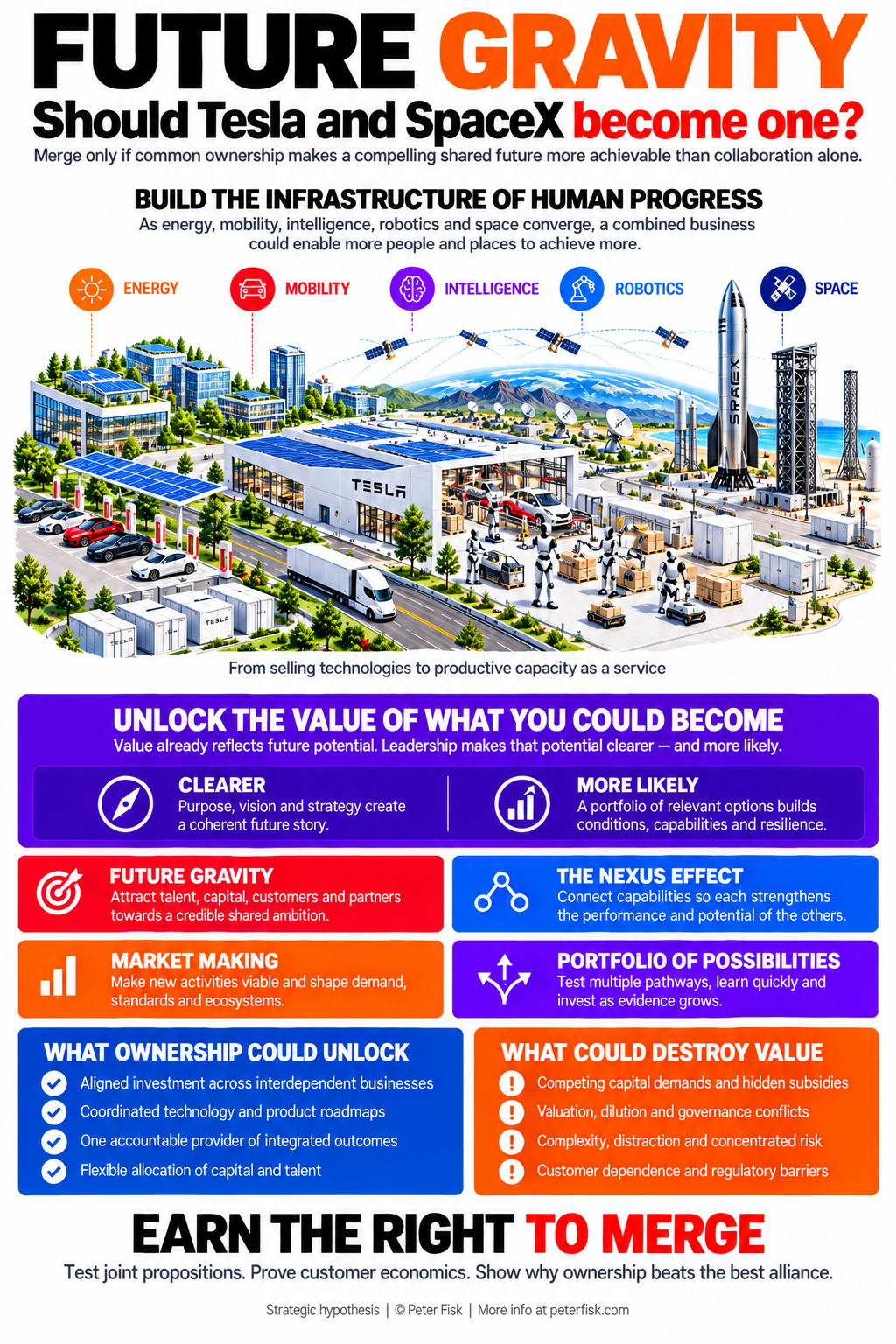
Start with the world they could enable
Traditional merger analysis starts with existing businesses: their revenues, assets, customers and opportunities to reduce costs. Those questions matter, but they can obscure the more consequential possibility. Future-back strategy begins by imagining a desirable, plausible future, identifying the conditions required to create it, and working backwards towards today’s choices.
For Tesla and SpaceX, that future could centre on overcoming constraints that limit economic participation: access to dependable energy, connectivity, mobility, intelligence and productive capacity. Many opportunities remain inaccessible because these capabilities are expensive, fragmented or unavailable in the places they are needed. Connecting them could change the economics of entire activities.
Consider a new industrial region in 2035. Rather than assembling separate contracts for power, communications, transport, automation and maintenance, its developers could commission an integrated operating platform. Local generation and storage would support electricity supply; satellite and terrestrial networks would connect operations; electric fleets would move goods; machines would perform selected tasks; and AI would help coordinate resources. Specialist partners would contribute capabilities the platform owner could not provide itself.
The customer could purchase outcomes such as available power, reliable connectivity, equipment uptime and productive hours. Revenue would flow through infrastructure services, software, maintenance and performance contracts. This hypothetical proposition, productive capacity as a service, would give convergence a commercial purpose. It could help make previously uneconomic projects viable while creating recurring relationships that extend beyond equipment sales.
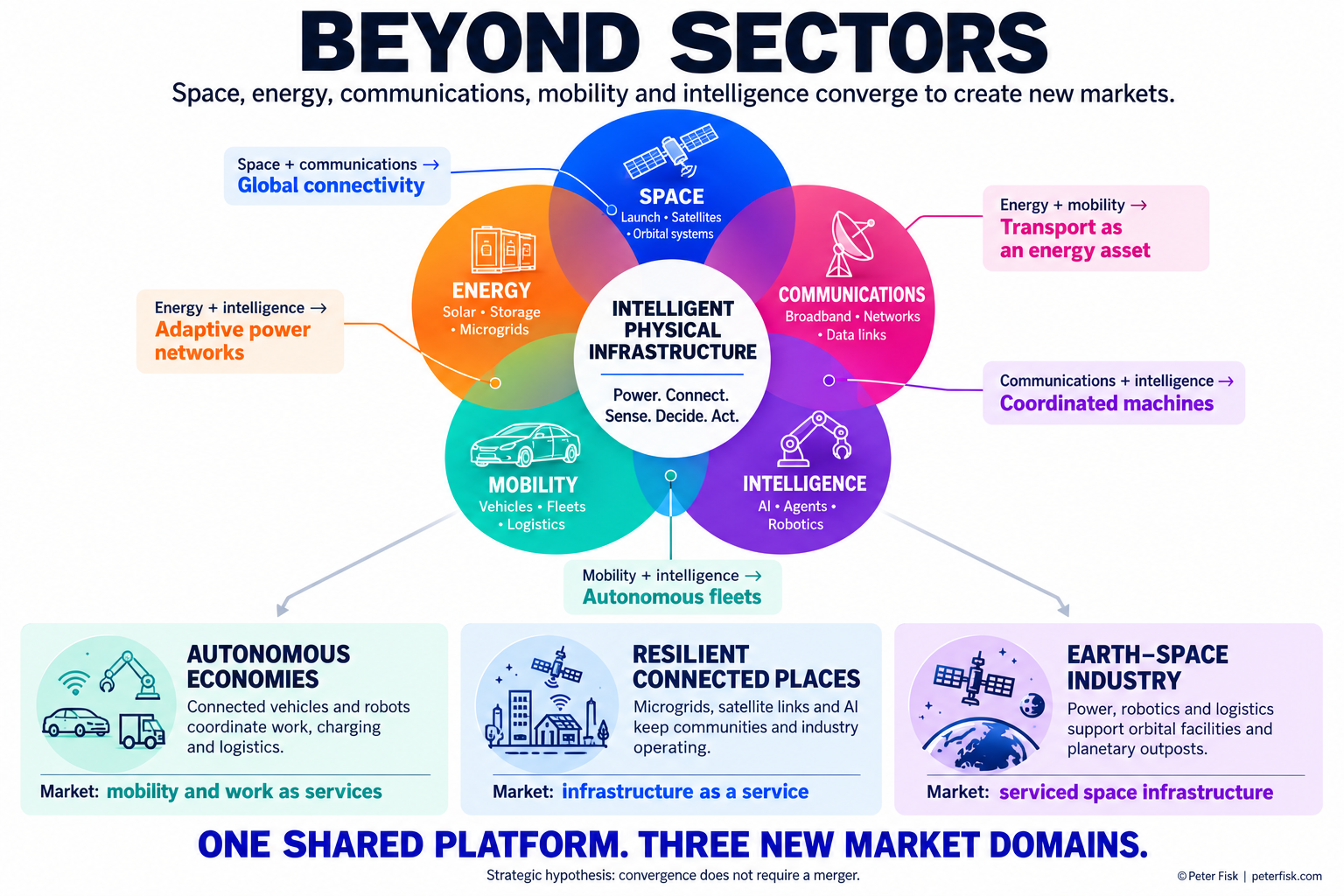
Make potential clearer, and more likely
The underlying valuation argument needs precision. Value already reflects expectations about future potential: the economic benefits a business can generate, their timing, and the risks involved. The leadership challenge is that companies often make their current performance far easier to understand than their capacity to become something more.
Accounts describe established activities. Organisational structures reinforce familiar categories. Targets favour what can already be measured. A company’s broader potential can therefore remain difficult to see, insufficiently credible, or both. Investors and partners reasonably concentrate on the evidence available to them, even when that evidence gives an incomplete picture of what the organisation could become.
Unlocking the value of future potential requires two complementary tasks. First, leaders must make that potential clearerthrough purpose, vision and strategy: a coherent future story explaining the progress the company enables, the markets it intends to shape, and how it expects to earn attractive returns. Second, they must make that potential more likely through capabilities, partnerships, investment and a portfolio of relevant options.
For a combined Tesla–SpaceX, “we operate across several exciting technologies” would be an inadequate story. A stronger proposition would explain how connecting those technologies reduces the cost and difficulty of productive activity. Its credibility would depend on showing which connections work, which customers benefit, what they will pay, and how the business can adapt when assumptions change.
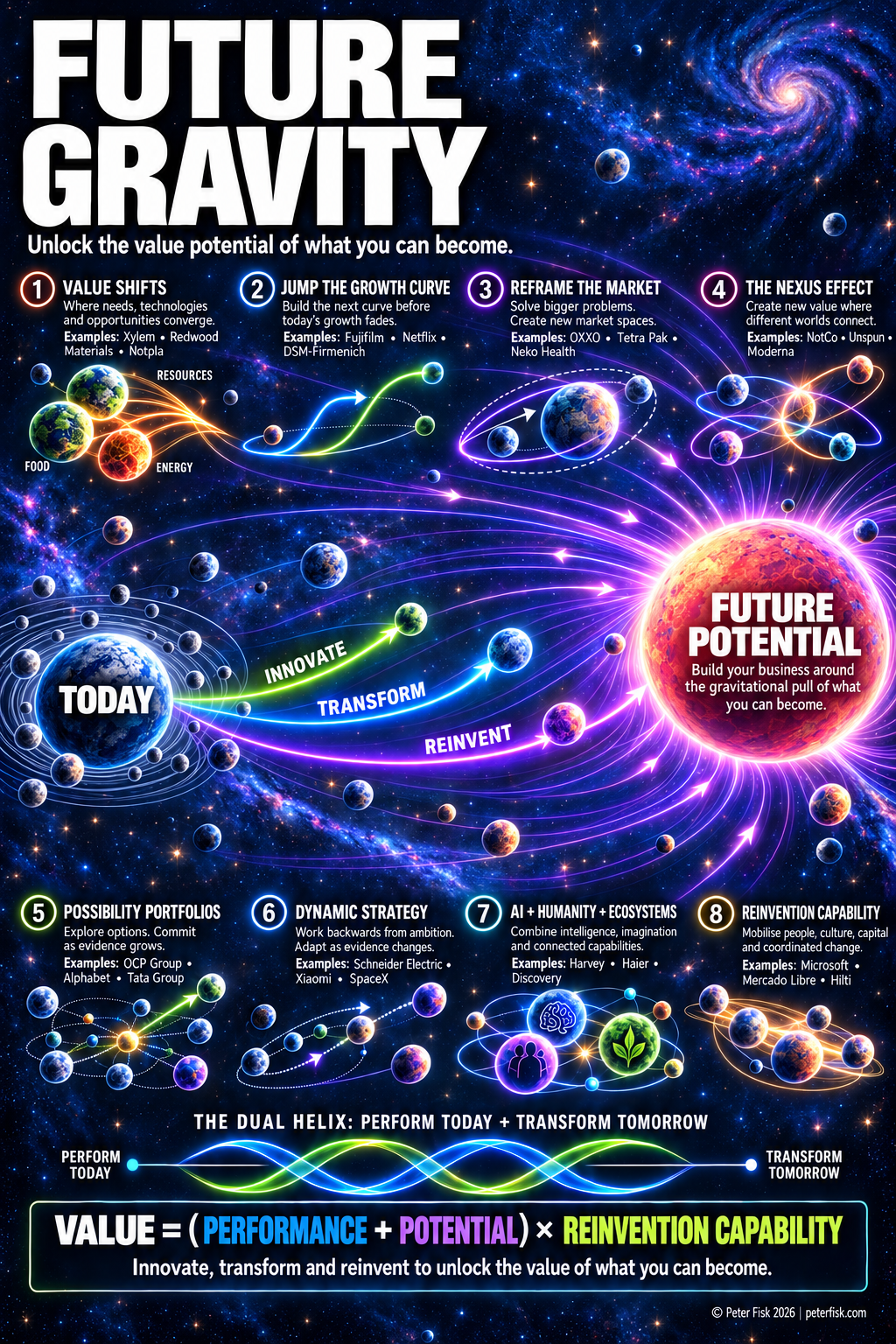
Create “Future Gravity”
Future Gravity is my concept that I use the articulate the power of a compelling, credible future to attract the resources needed to create it. Purpose gives people a reason to care; vision makes the destination imaginable; strategy explains the choices and pathways that connect ambition with action. Together, they influence where talent, capital, partners and customers commit themselves.
A combined business could generate considerable Future Gravity. Engineers might be attracted by the opportunity to connect physical intelligence with infrastructure. Developers could see a partner able to make complex projects deliverable. Governments might recognise possibilities for regional development and resilience. Suppliers and entrepreneurs could identify new markets around shared platforms.
This attraction can become economically productive. Better talent strengthens execution, capable partners widen the opportunity, and committed customers provide evidence and funding. However, the process can also work in reverse: ambitious promises followed by weak delivery can undermine confidence across the whole enterprise. Future Gravity depends on the relationship between imagination and evidence. The more expansive the vision, the more important it becomes to explain the sequence through which it will be realised.
Capture the Nexus Effect
Tesla’s disclosed activities and ambitions encompass vehicles, energy systems, autonomy and robotics. SpaceX contributes launch and connectivity capabilities, alongside the AI business brought into its corporate structure through xAI. The strategic potential lies in the Nexus Effect: additional value created through purposeful connections between capabilities.
Energy, for example, supports computing and automation. Connectivity enables remote supervision and maintenance. Better maintenance improves equipment availability. Manufacturing expertise can reduce the cost of deploying infrastructure. When these relationships reinforce one another, the commercial advantage may exceed what any individual product delivers.
The connections need careful engineering. Satellite communications cannot substitute for the onboard systems required to operate a vehicle safely when connectivity fails. General-purpose AI cannot simply become a safety-critical controller. Robots designed for terrestrial environments would need substantial adaptation for lunar conditions. Convergent innovation requires knowing both where capabilities transfer and where they do not.
Some of the strongest opportunities could therefore emerge in shared enabling capabilities: simulation, thermal management, power electronics, manufacturing automation and selected computing infrastructure. These would support more ambitious customer propositions while generating measurable improvements along the way. A credible strategy would connect the moonshot to such practical advances, rather than expecting the moonshot itself to justify every investment.
Make markets around new possibilities
The larger prize would be market making and shaping. A combined business could help create demand by changing what customers consider feasible. Remote industrial development, resilient island infrastructure, automated agricultural operations and rapidly deployable recovery systems could become more attractive if essential capabilities were easier to access and integrate.
This would require a different commercial mindset. Instead of asking how many vehicles, batteries or connections a customer might buy, the company would ask what new activity the customer could undertake. The resulting proposition could combine equipment, finance, software, insurance and operations around an outcome that matters to the buyer.
Market making would also demand institutional work. Standards, permissions, procurement practices, financing models and public confidence influence whether new systems can scale. A technically impressive platform may struggle if communities distrust it, insurers cannot assess it, or customers cannot finance it. The portfolio must therefore include options that help build these conditions.
The case for progress should remain explicit. Lower operating costs alone may be insufficient if customers also value local employment, control, resilience and freedom to choose suppliers. An ecosystem that enables partners to prosper could gain broader acceptance and access more opportunities than a tightly closed system seeking to own every activity.
Build a portfolio that improves the odds
An ambitious vision should create strategic direction while preserving multiple routes towards it. A portfolio of possibilities provides that combination. Its purpose is to improve the probability of progress by testing assumptions, building capabilities, developing demand and reducing dependence on any single technology or market.
Near-term options could strengthen existing operations through energy resilience, manufacturing improvements and selected joint customer offers. These would generate learning and potentially release resources for further development. Medium-term options could explore integrated industrial infrastructure, automated logistics and new service models. Longer-term possibilities might include lunar infrastructure and space-based computing, each subject to its own technical and economic tests.
The portfolio should also contain alternatives within each opportunity. A customer proposition might work through direct ownership, financing partners or licensing. A technology might be developed internally, sourced externally or replaced. Partnerships could open markets while limiting exposure. These options create room to respond when costs, regulation or customer needs evolve.
This is dynamic strategy supported by dynamic capital allocation. Small commitments buy knowledge; stronger evidence earns larger investment; weak assumptions trigger redesign or withdrawal. The portfolio makes the future story more credible because it demonstrates how the company can build necessary conditions and manage uncertainty. Performance funds potential, while reinvention turns new possibilities into sustained performance.
Establish what ownership adds
A persuasive vision of convergence establishes a reason to work together. It does not, by itself, establish a reason to merge. Tesla and SpaceX could pursue research agreements, joint ventures, licensing, shared infrastructure and integrated customer contracts while retaining separate ownership. Many of the proposed benefits could be tested through these arrangements.
Common ownership becomes more compelling when valuable opportunities depend on investments whose benefits fall unevenly across businesses. One division might need to commit resources before another can develop a market. Separate shareholders could reasonably resist bearing costs without a sufficient share of the returns. A common parent could assess the economics of the whole system and align incentives accordingly.
Ownership might also support coordinated product development over longer periods, faster movement of selected resources, and greater accountability for complex customer outcomes. Shared interfaces and investment priorities could reduce repeated negotiation. Yet these benefits would remain conditional on effective management and the legal, contractual and regulatory boundaries involved.
The relevant comparison is therefore between a combined company and the best realistic alliance. Merger advocates should identify specific opportunities that collaboration cannot adequately deliver, estimate the incremental benefits of ownership, and explain why less extensive structures would fall short. Without that work, the industrial vision could become a persuasive justification for an unnecessary transaction.
Recognise the costs of combination
Capital allocation would be an immediate challenge. Vehicles, energy infrastructure, AI, satellite networks, launch systems and robotics all require substantial resources. Combining them could improve flexibility, but it could also create competition for funding in which the most compelling narrative outranks the strongest economics. Cross-subsidies can support valuable experimentation or prolong disappointing projects.
Valuation introduces another difficulty. Shareholders would exchange distinct investments for a blended portfolio, potentially with different control arrangements and risk exposures. The exchange ratio would allocate ownership of uncertain opportunities as well as established businesses. Even an attractive strategy can destroy value if one group pays too much or accepts excessive dilution.
Governance would therefore be central. Musk’s involvement in both businesses makes independent judgement particularly important. Shareholders would need confidence in how alternatives were assessed, assumptions challenged and competing interests addressed. A combination should strengthen accountability through transparent reporting and investment discipline, allowing successful operations and speculative programmes to be evaluated separately.
Organisational complexity could also erode the anticipated benefits. Consumer manufacturing, space engineering, communications and AI involve different customers, development cycles and operating requirements. Selective integration might preserve the strengths of each business while connecting shared capabilities. An indiscriminate attempt to standardise everything could slow execution and weaken specialist expertise.
Avoid making the ecosystem too dependent
The breadth of the vision creates a further disadvantage: concentration. Some customers might welcome an integrated provider, while others would resist dependence on one group for communications, power systems, intelligence and operational automation. Partners could hesitate to contribute if they feared becoming subordinate to a future competitor.
The proposed business would need to earn trust through interoperability, transparent commercial arrangements and credible continuity of service. Depending on its structure and jurisdictions, it could also encounter scrutiny across competition, communications, data, national security and procurement. Combining ownership would not eliminate the separate obligations attached to those activities.
Nor would a broad portfolio necessarily diversify risk. Several ambitions might depend on the same computing supply chains, energy availability, regulatory confidence or leadership capacity. Reputational problems could spread between divisions, and setbacks could compete for management attention. Frontier leadership would require strong executives, independent challenge, succession planning and the authority to stop projects.
These issues influence the commercial opportunity itself. A company that offers extraordinary technical integration but insufficient customer autonomy may discover that its addressable market is smaller than its vision suggests. Openness and distributed participation could be essential conditions for capturing the benefits of convergence.
Earn the right to become one
Tesla and SpaceX should begin by making the common future concrete. A small number of joint programmes could test integrated infrastructure propositions, shared manufacturing improvements and coordinated energy and computing investments. Measures should include external demand, deployment time, reliability, margins and capital requirements. Internal transactions would provide limited evidence of a new market.
The next step would be to identify where separate ownership materially restricts progress. If strong opportunities repeatedly fail because investment cannot be aligned, essential coordination breaks down or customer accountability remains fragmented, deeper integration may be justified. Joint ventures, shared subsidiaries and a full merger should then be compared against those specific constraints.
The combined vision is powerful: a business helping connect energy, intelligence, mobility and physical systems so that more people and places can participate in productive activity. Its success would depend on making that potential visible through a coherent future story and increasingly likely through a disciplined portfolio of options.
Tesla and SpaceX should pursue that possibility together. They should merge when evidence shows that common ownership materially improves the likelihood, speed and economics of achieving it. That would turn Future Gravity into a practical strategic force: attracting resources towards a compelling future, then building the conditions that make it achievable.
More from the blog