Building the Future of Building Materials
October 26, 2026 at St Gallen Business School, Switzerland

The next phase of growth in building materials will come from helping construction achieve more with fewer resources. Customers need affordable homes, productive workplaces and resilient infrastructure. They also need projects delivered faster, buildings that cost less to operate, and credible reductions in environmental impact. Materials companies that solve these problems can expand their role, improve their margins and create new sources of demand.
This requires a broader view of the market. A cement producer sees demand for cement. A building materials company sees competing structural solutions. A construction partner sees opportunities to improve the economics of an entire project. Each perspective reveals different possibilities for growth. The challenge is to broaden the opportunity without losing the technical expertise and operational discipline that make the existing business competitive.
Affordability makes this transformation urgent. Buyers judge the cost of an occupied home or completed facility, while suppliers often optimise individual inputs. The gap creates room for innovation: a higher-performance material can reduce structural weight, shorten installation or avoid future repairs. Capturing that value requires evidence, a clear understanding of who benefits, and a commercial agreement that rewards the contribution. It also requires discipline. New technologies and business models should earn their place through measurable improvements in project economics, rather than novelty alone. For established producers, this is a practical route to differentiated growth.
Six shifts are particularly significant: changing patterns of development, the reinvention of existing buildings, decarbonisation, industrialised construction, digital intelligence, and the emergence of circular and service-based business models.
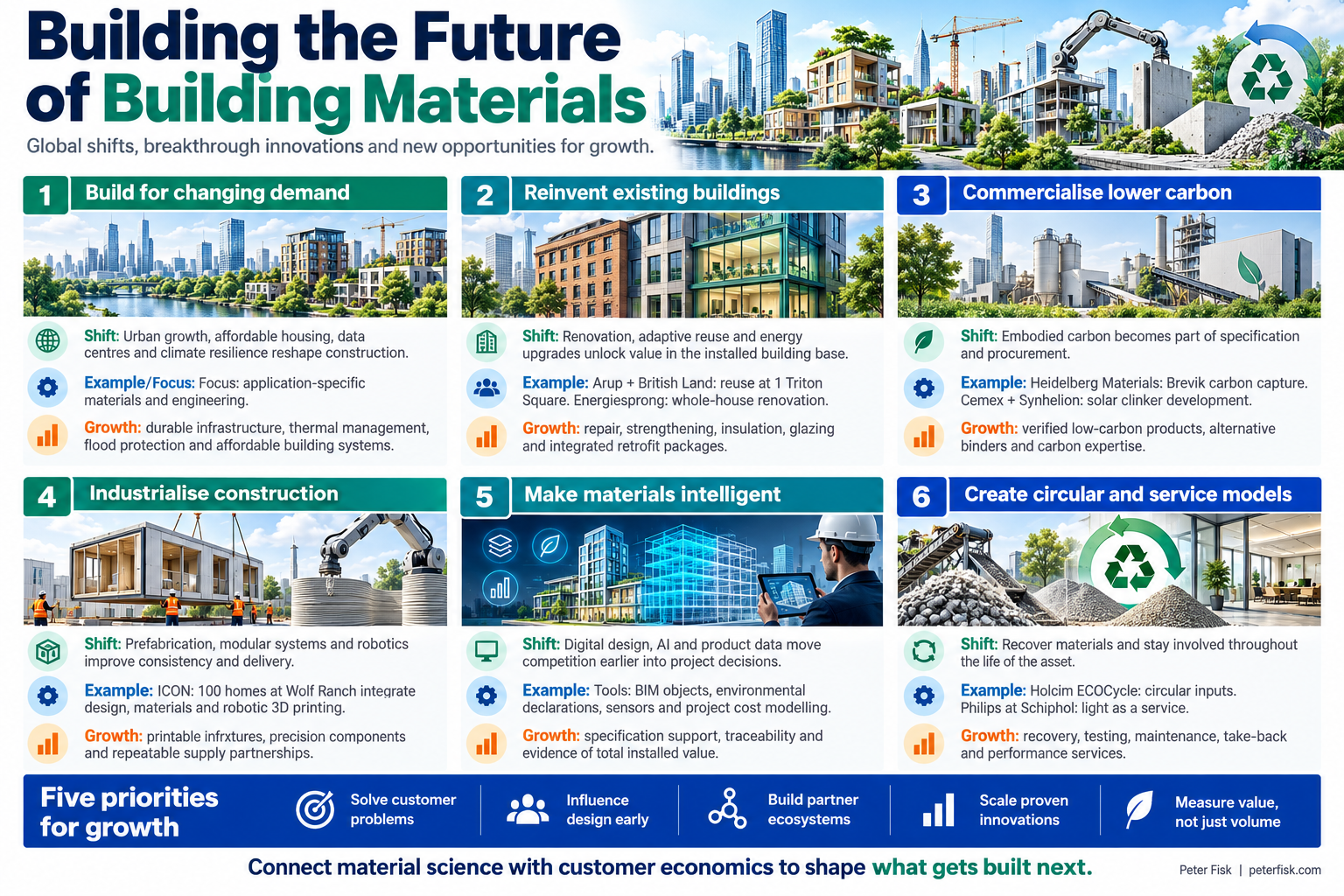
A changing geography of demand
Construction is a collection of local markets shaped by different needs. Expanding cities need housing, transport, water and social infrastructure. Mature cities need renewal, energy upgrades and adaptation. Growth strategies must reflect these differences rather than extrapolate a single global volume forecast.
UNEP’s 2025–2026 Global Status Report records global building floor area of 273 billion square metres in 2024, up 1.7% in a year. Residential buildings account for 77% of that area. Housing therefore sits at the centre of the sector’s economic and environmental challenge. The opportunity extends beyond prestigious developments to repeatable solutions that make ordinary homes more affordable, comfortable and efficient. [1]
Other growth markets have demanding specifications. Data centres require reliable structures, fire protection and thermal management. Healthcare buildings need hygiene, flexibility and acoustic control. Transport and water infrastructure require durability and dependable maintenance. Materials suppliers can build positions around these applications, combining specialist products with engineering support.
Climate adaptation adds another dimension. Heat, flooding, water stress and coastal exposure change the performance required from roofs, façades, drainage systems and structures. Opportunities include reflective surfaces, permeable paving, flood-resistant assemblies and repair systems. Commercial success depends on translating technical performance into a customer benefit: lower cooling costs, reduced disruption or longer asset life.
The existing city becomes a growth market
New construction is only part of the opportunity. Buildings already standing represent a vast installed base requiring improvement. Their structure may remain useful even when their layout, services or thermal performance have become obsolete.
London’s 1 Triton Square illustrates the potential. Arup and British Land retained and adapted substantial elements of an existing office building rather than replacing everything. Arup reports approximately 40,000 tonnes of carbon saved compared with a new-build workplace. The important lesson is that engineering knowledge can unlock value already embedded in an asset. [2]
For materials companies, this changes the product mix. Structural repair, strengthening, waterproofing, insulation, glazing, lightweight extensions and compatible façade systems become growth categories. Technical assessment and installer expertise become more valuable because existing buildings vary widely in condition and design.
The Dutch-origin Energiesprong approach takes renovation towards an industrial process. It combines prefabricated insulated façades with renewable energy and building services to pursue net-zero-energy homes. Instead of asking householders to coordinate numerous separate interventions, it organises a whole-house solution. [3]
This suggests an attractive business model: aggregate demand across a housing portfolio, standardise common elements and customise the interfaces. Materials suppliers can work with housing associations, contractors and finance providers to deliver renovation packages. Growth then depends on removing the customer’s coordination problem as much as improving any individual product.
Decarbonisation becomes a product proposition
The environmental challenge is also a market opportunity. Customers increasingly need to understand the emissions embodied in their buildings alongside the energy used during operation. Materials producers can respond through lower-clinker cement, alternative binders, recycled inputs, efficient production and carbon capture.
Heidelberg Materials’ Brevik facility in Norway is an important example. Inaugurated in June 2025, the industrial-scale carbon capture installation was designed to capture around 400,000 tonnes of CO₂ annually, approximately half the cement plant’s emissions. It supports the company’s evoZero offering and demonstrates how production technology can enable a differentiated commercial proposition. [4]
The wider lesson concerns the system around the product. Carbon capture requires transport, permanent storage, verification and customer acceptance. Producers need partnerships and reliable demand as well as engineering capability. Any net-zero claim must clearly explain its boundary, allocation method and remaining emissions.
Cemex and Synhelion offer a different route through their development work on solar heat for clinker production. Their demonstrated approach uses concentrated solar energy to provide the high temperatures required by the process. This addresses fuel-related emissions; emissions released by the underlying limestone chemistry still require separate solutions. Commercial scaling also remains distinct from technical demonstration. [5]
Materials businesses should therefore manage a portfolio of decarbonisation pathways. Some improvements can scale through existing assets; others require substantial capital and infrastructure. The commercial test is whether the offer helps customers meet a verified project requirement at an acceptable total cost.
Construction becomes more industrialised
Construction’s fragmented delivery model creates opportunities for companies that improve consistency. Prefabrication, modular assemblies, standardised interfaces and robotics can shift work into more controlled processes, reducing dependence on repeated improvisation at the building site.
ICON’s Wolf Ranch development in Georgetown, Texas, demonstrates one version of this change. Its project page records 100 homes, finished in 2025, using robotic 3D printing. The significance lies in the integration of design, machinery and printable materials. Printing remains one part of delivering a complete home, alongside foundations, roofing, services and other trades. [6]
For materials suppliers, industrialisation creates demand for tightly controlled performance. Printable mixtures need suitable flow, buildability and setting behaviour. Factory-produced elements need predictable tolerances, curing and connections. Lightweight assemblies must work as complete systems, including fire, acoustic and moisture performance.
It also changes the customer relationship. A manufacturer of building components may purchase through a long-term supply agreement and co-develop formulations. Winning that relationship can secure repeated demand across multiple projects.
However, factory capacity is valuable only when supported by sufficient orders. Materials companies should favour repeatable applications and credible project pipelines over speculative investment in facilities. Standardisation must accommodate local requirements while preserving enough repetition to generate an economic advantage.
Digital intelligence changes how materials are chosen
Digital construction moves competition upstream. When products are assessed within building information models, the supplier that makes specification straightforward can gain an advantage before procurement begins.
AI and digital modelling can help compare structural options, quantities, energy performance and embodied carbon. On-site sensors and production data can support quality control, curing decisions and delivery coordination. The practical value comes from improving a specific decision with reliable information.
This creates a new requirement for materials companies: products need usable digital information alongside physical performance. Designers need trustworthy environmental declarations, technical properties, compatible design objects and clear installation requirements. Contractors need availability, delivery visibility and traceability.
Consider a customer comparing two structural options. The cheaper material per tonne may require more material, more labour or a longer programme. A supplier able to demonstrate the total installed cost can change the purchasing conversation. Digital tools make that comparison easier, provided assumptions are transparent and technically valid.
There is a strategic risk as well. Design software, procurement platforms and integrated contractors may increasingly control access to customers. Materials businesses should develop relationships with these intermediaries while retaining the expertise and evidence needed to influence specification directly.
Circularity creates a second supply chain
Circular construction changes the meaning of raw materials. Existing buildings contain resources that can be recovered, assessed and returned to productive use. Demolition becomes a potential source of feedstock rather than simply a disposal activity.
Holcim’s ECOCycle platform illustrates this shift by incorporating construction and demolition materials into new building solutions. Its applications span several product categories, showing how recovery and processing can connect back into established manufacturing operations. [7]
The business opportunity extends beyond selling recycled products. Companies can develop services around collection, sorting, processing, quality assurance and logistics. In suitable markets, these activities may create both service revenue and a source of usable inputs.
Competitive advantage comes from managing variability. Recovered materials differ in composition, contamination and performance. Producers that can test, classify and process them consistently can turn an uncertain waste stream into a dependable resource.
The economics remain local. Transport distances, disposal charges, permitting and access to demolition projects determine viability. Selective dismantling and direct component reuse may sometimes preserve more value than crushing. A strong circular strategy chooses the highest-value practical route rather than assuming every recovered material should enter the same process.
From product sales to lifetime performance
New business models become possible when suppliers remain involved after installation. Inspection, maintenance, repair and refurbishment can generate recurring revenue while helping customers extend asset life.
An established example from an adjacent sector is Philips Lighting’s 2015 agreement at Schiphol Airport. Under the announced light-as-a-service model, the airport paid for light while Philips retained ownership of the fixtures and installations. The model linked the commercial relationship to an ongoing customer outcome. [8]
Building materials companies can adapt this principle selectively. Roof inspection and maintenance, façade refurbishment and surface renewal are more straightforward service opportunities than promising the performance of an entire structure. Performance contracts require clear responsibilities, reliable measurement and the capacity to manage long-term liabilities.
Integrated system offers provide another route. Saint-Gobain’s EnveoVent façade approach demonstrates the commercial logic of offering coordinated façade solutions adapted to local markets. The supplier can help customers resolve compatibility and installation questions across several components. [9]
The opportunity is to capture a greater share of customer value through expertise and coordination. Product ownership, leasing and take-back models may suit recoverable components. Permanent materials embedded in buildings require different economics and contractual arrangements. The right model follows the application.
Choosing where to grow
These shifts suggest five priorities for building materials leaders.
First, organise growth around customer problems. Affordable housing, energy renovation, climate resilience and critical infrastructure each provide a clearer basis for innovation than a generic ambition to sell more materials. Choose applications where existing assets and expertise create a credible advantage.
Second, move earlier into design and specification. Work with developers, engineers and public clients before material choices are fixed. Demonstrate whole-project economics, including quantities, installation, maintenance and verified environmental performance.
Third, build complete offers through partnerships. A renovation package or circular supply chain needs capabilities beyond those of a single producer. Partner with installers, technology businesses, demolition specialists and finance providers where this improves the proposition without unnecessary capital commitment.
Fourth, manage different investment horizons. Improve today’s plants and product mix while testing emerging technologies and services. Set milestones around customer adoption, repeat orders, margin and capital requirements. A technically successful pilot becomes strategically valuable when it can support a repeatable business.
Fifth, measure growth through value creation. Tonnes sold remain operationally important, but leaders also need to track contribution per project, specification wins, repeat customers and returns on invested capital. A solution that uses less material can still create a stronger business if the supplier captures part of the value delivered.
Building materials will remain a physical, local and capital-intensive industry. Its future opportunities increasingly depend on understanding the buildings, infrastructure and communities those materials enable. Companies that connect material science with customer economics can help construction become more affordable, adaptable and resource-efficient—and earn a larger role in shaping what gets built next.
Sources
[1] UNEP and GlobalABC, Global Status Report for Buildings and Construction 2025–2026, key messages: https://wedocs.unep.org/items/8fbf878c-7136-4864-8d88-ee929f591c76
[2] Arup, 1 Triton Square: https://www.arup.com/projects/1-triton-square/
[3] Energiesprong, About: https://www.energiesprong.org/what-is-energiesprong/
[4] Heidelberg Materials, Brevik inauguration, 18 June 2025: https://www.heidelbergmaterials.com/en/pr-2025-06-18
[5] Cemex, Solar-powered cement development: https://www.cemex.com/w/cemex-and-synhelion-make-further-progress-toward-the-world-s-first-fully-solar-powered-cement-plant
[6] ICON, Wolf Ranch: https://www.iconbuild.com/projects/wolf-ranch
[7] Holcim, ECOCycle: https://www.holcim.com/building-materials-solutions/ecocycle
[8] Signify, Schiphol light as a service, 16 April 2015: https://www.signify.com/global/our-company/news/press-release-archive/2015/20150416-philips-provides-light-as-a-service-to-schiphol-airport
[9] Saint-Gobain, Facades to suit every European market, 17 October 2025: https://www.saint-gobain.com/en/news/facades-suit-every-european-market