Future Makers with Osool Asset Management
November 8, 2026 at Osool Asset Management, Bahrain

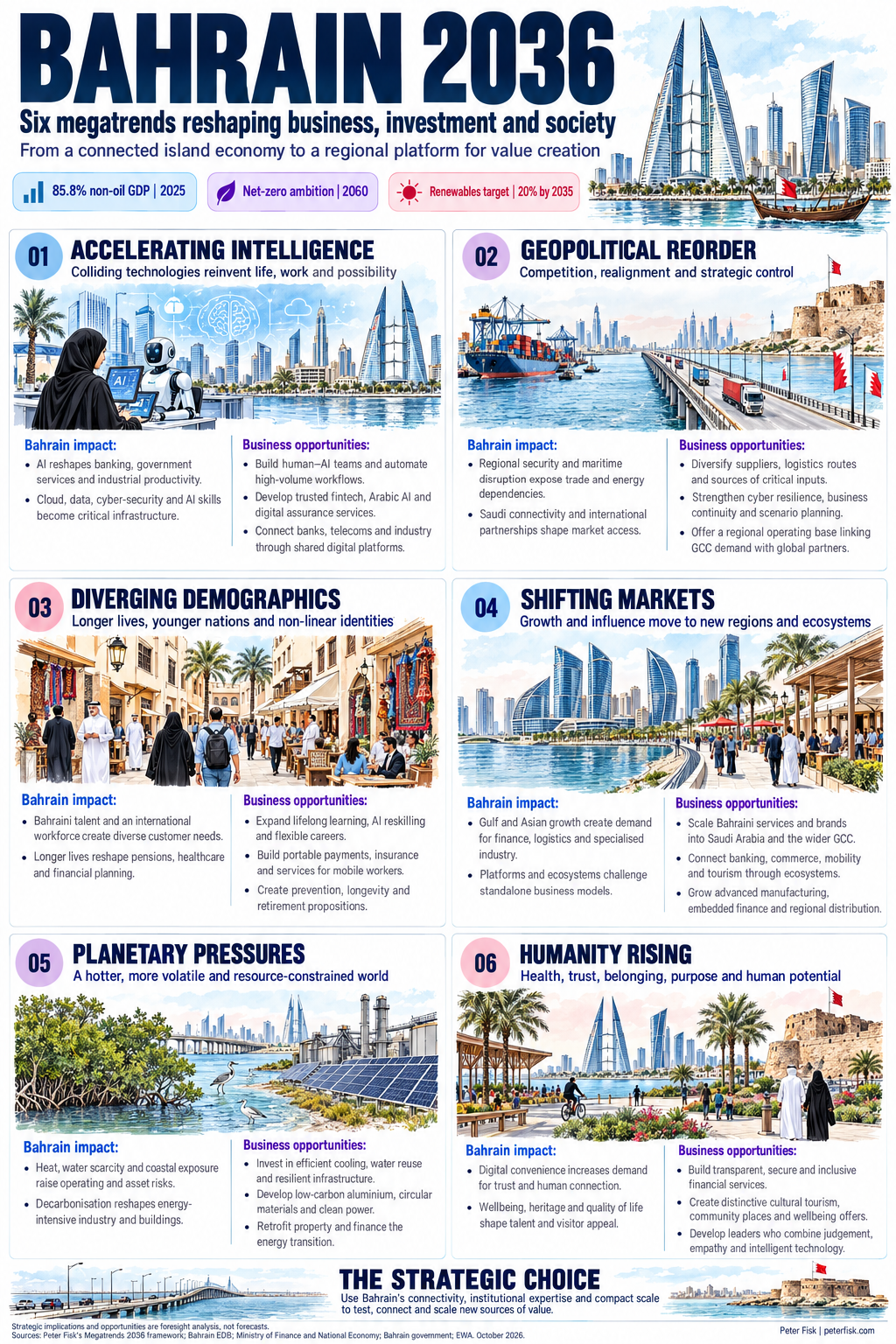
Bahrain – the relatively small, internationally connected Gulf economy – has strengths in financial services, manufacturing, and its access to Saudi Arabia. It has diversified substantially beyond oil, although government finances and export earnings remain sensitive to hydrocarbons.
Its population is approximately 1.6 million, with GDP of around US$49.3 billion in 2025, equivalent to approximately US$30,800 per person. Real economic growth reached 3.5% in 2025, following 2.9% in 2024. Non-oil activities account for more than 85% of GDP, demonstrating the progress of economic diversification. However, government debt was estimated at approximately 141% of GDP in 2025, leaving limited capacity to absorb external shocks.
The main economic sectors include:
- Financial services: Banking, Islamic finance, investment management, insurance and fintech form a central pillar. Financial services contributed 17.2% of GDP in 2024. Important organisations include Bank ABC, National Bank of Bahrain, Al Salam Bank, GFH, Investcorp and Osool Asset Management.
- Aluminium and manufacturing: Aluminium Bahrain, known as Alba, is a major industrial exporter, producing approximately 1.62 million tonnes of aluminium in 2025. It supports downstream manufacturing and an international customer base.
- Energy and refining: Bapco Energies and Bapco Refining underpin the hydrocarbons sector. Petroleum processing remains important to exports and public revenue despite the growth of other activities.
- Technology and digital infrastructure: Beyon, including Batelco, and international providers such as AWS support connectivity, cloud computing and digital services.
- Transport, tourism and property: Gulf Air, Bahrain Airport Company, Bahrain International Circuit and Edamah connect aviation, hospitality, events and property development.
Two investment institutions have distinct roles. Mumtalakat is Bahrain’s sovereign wealth fund, managing strategic commercial investments. Osool manages investment assets associated with the pension system, with a focus on long-term financial returns.
Bahrain’s principal trading relationships span the Gulf, Asia and the United States. Saudi Arabia is its leading export destination and an important neighbouring market. The UAE is a major commercial partner and a leading destination for re-exports. China is the largest source of imports in recent official quarterly figures; bilateral trade reached US$2.43 billion in 2025. US–Bahrain goods and services trade totalled approximately US$3.9 billion in 2025, supported by their free-trade agreement. Australia and Brazil are also significant suppliers, reflecting Bahrain’s industrial supply chains. Rankings differ depending on whether oil, non-oil goods, services or re-exports are included.
Future prospects centre on further diversification and greater resilience. My assessment is that the strongest opportunities include specialist financial services, fintech, cloud-enabled business services, higher-value manufacturing and businesses serving Saudi demand. Recent investments in sovereign cloud infrastructure, specialist healthcare and food production illustrate this direction.
The immediate outlook remains uncertain. The World Bank’s October 2026 assessment forecasts a 2.9% contraction in 2026, followed by 4.2% growth in 2027, citing regional conflict and disruption to industry, shipping and tourism. The IMF’s October forecast is substantially weaker, projecting an 11.3% contraction in 2026. These are forecasts rather than completed-year results, and their divergence highlights considerable uncertainty.
Osool Asset Management is Bahrain’s specialist institutional investment manager, established in 2011 to manage assets associated with the country’s pension system. Headquartered in Bahrain Bay, Manama, it manages approximately US$10 billion across global asset classes, according to its current website. Its underlying purpose is to grow and protect capital that supports the long-term financial security of pension beneficiaries.
Osool emerged from the investment activities of Bahrain’s Social Insurance Organisation (SIO) and Military Pension Fund. Previously called SIO Asset Management Company, it was developed as a separate investment organisation following a review involving pension-fund specialists, regulators and international advisers. The ambition was to strengthen investment capabilities, recruit specialist professionals and enable more commercially focused decision-making within disciplined risk limits.
Osool manages diversified portfolios across sectors and geographies. Its remit includes managing and dealing in financial instruments, providing investment management and advisory services, and directing collective investment undertakings. Its investment capabilities encompass private equity, real estate, infrastructure and private debt, alongside its wider multi-asset allocation responsibilities. It also works with international fund managers to access specialist expertise and investment opportunities.
The firm explicitly favours active management, combining fundamental analysis with thematic investing and ongoing assessment of economic conditions. It describes a core–satellite approach: a central portfolio provides the foundation, while more targeted investments pursue market dislocations and differentiated opportunities. Portfolios are tailored to client objectives, with risk management integrated into investment assessment and construction. This makes the central challenge balancing dependable long-term returns with selective exposure to emerging sources of growth.
Leadership and governance. The current executive team is led by Abdulla Ahmed Kamal, Chief Executive Officer, who joined Osool in 2014. Xavier Verdeyen is Chief Investment Officer, while Sara Khalil Nooruddin, Deputy Chief Investment Officer, leads investment and asset-allocation functions. Other senior executives include Ady Mohamed Al Shaikh, Chief Operating Officer, and Naser Khalid Alraee, Chief Risk Officer. The board is chaired by Shaikh Daij bin Salman bin Daij Al Khalifa.
Osool is licensed by the Central Bank of Bahrain as a Category 1 Investment Business Firm. Its governance structure includes dedicated board committees covering investment, risk, audit and compliance, and nominations, remuneration and corporate governance. Its real-estate interests also include Amlak, whose acquisition by Osool took effect in January 2020, according to SIO’s accounts.
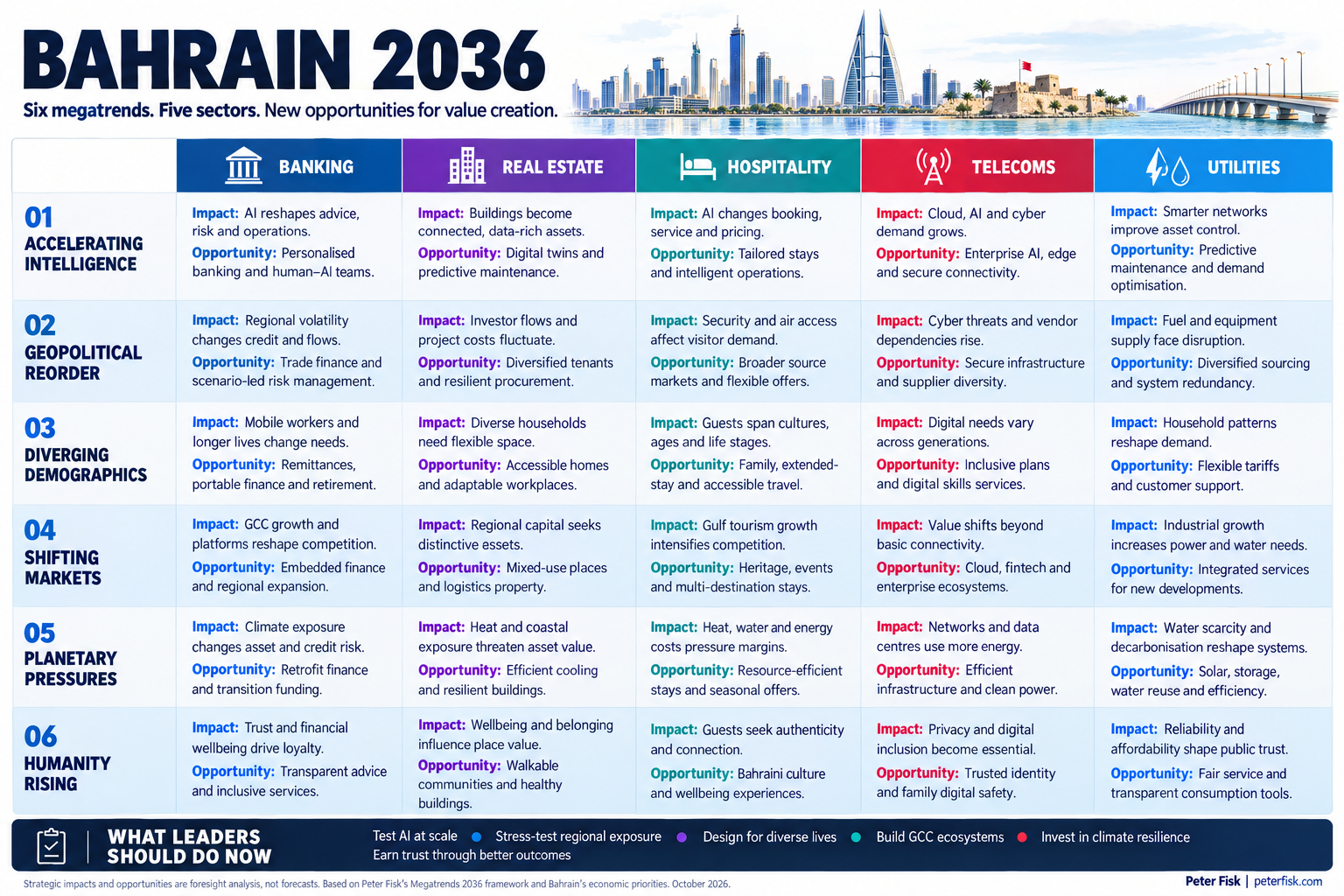
Purpose of this strategic workshop to engage board and executive level participants in exploring the key drivers in shaping business futures, inspired by some of the most interesting companies around the world, together with a portfolio of practical frameworks, tools and interactive experiences to bring to life and apply the insights.
1400 – 1500 : Changing Markets and Megatrends
- Change, disruption and opportunity. Riding the megatrends.
- Global and regional, by sector and segment, technology and beyond
- Value drivers, and the shifting nature of what drives business value
- S Curves of business, markets transform, and companies reinvent
- Examples: Anthropic, BYD, Dyson, PingAn, Schneider, SpaceX
1500 – 1600 : Alternative Scenarios and Strategies
- Scenario planning to explore alternative futures
- Groups develop scenarios within specific chosen sectors
- Groups discuss differences, evaluation and strategic choices
1600 – 1700 : Leadership and Value Creation
- Business reinvention, and the impact on value creation
- Dynamic strategies, agile innovation and portfolio management
- Changing nature of leadership, new executive and board agendas
- Growth mindset, critical thinking in an AI world, frontier leadership
- Examples: Amazon, DBS, Haier, Microsoft, OCP, PingAn