Factories of the Future … how manufacturers like Bosch and Corning, Foxconn and Nvidia, Tesla and Tetra Pak, are not just creating smarter factories, but reinventing what they do
October 21, 2026
Imagine two manufacturers, each investing heavily in automation, artificial intelligence and digital twins. Both improve productivity, reduce defects and accelerate delivery. 5 years later, one remains trapped in annual price negotiations. The other helps customers design new products, enter emerging markets and manage performance throughout the product lifecycle.
The difference is strategic. One has modernised its production system. The other has expanded its role in the customer’s business.
Much of the discussion about factories of the future centres on increasingly intelligent facilities: robots coordinating production, sensors anticipating failures and software continuously optimising operations. These capabilities matter.
But they leave a larger question unanswered: what should the manufacturer become as its customers, technologies and markets change?
A component supplier can become a systems partner. An equipment producer can help industrialise an emerging market. A materials specialist can enable an entirely new technology. A manufacturer can earn revenue from availability, engineering expertise or a shared production platform, alongside the products it makes.
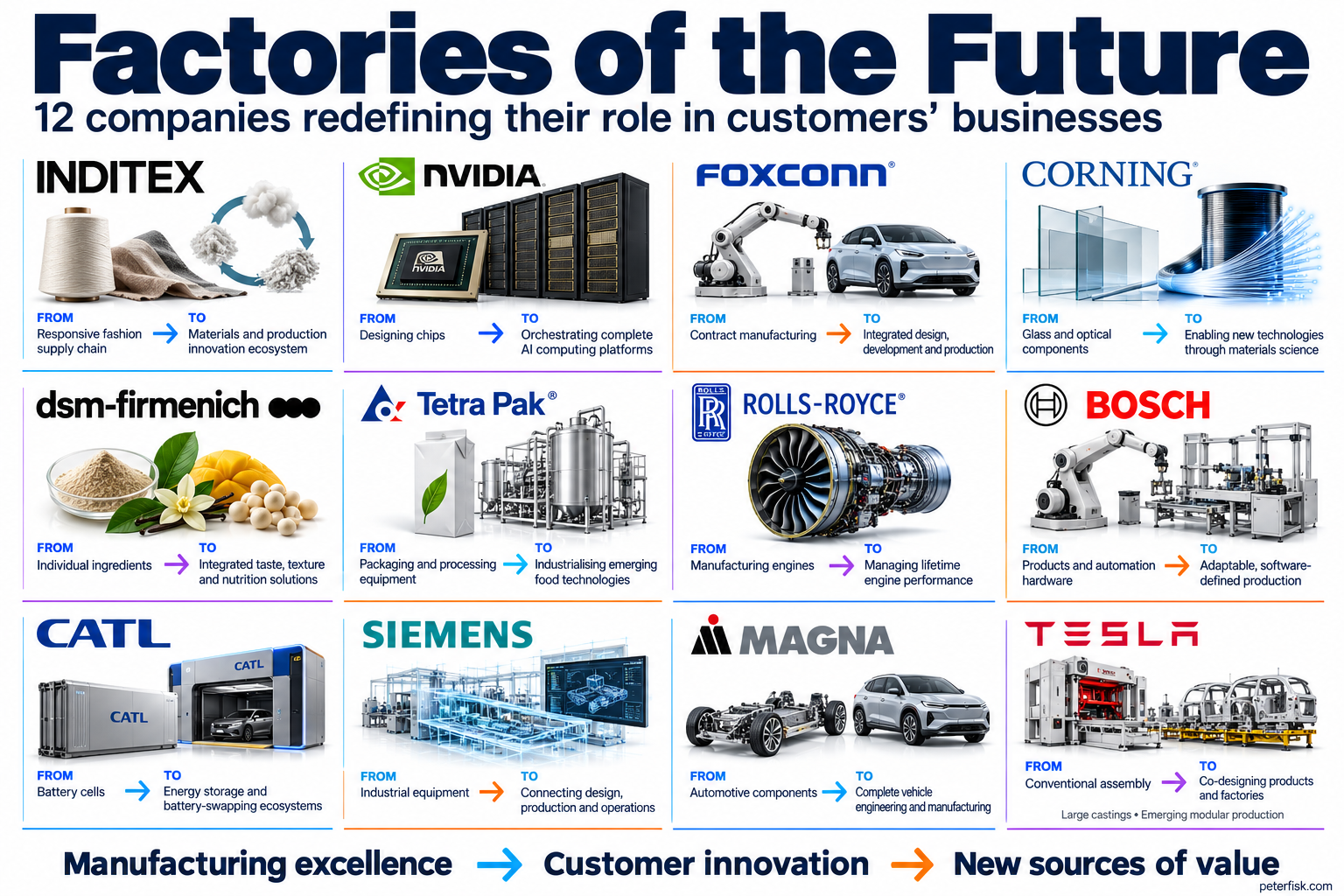
The opportunity is to connect manufacturing excellence with a deliberate expansion of customer value. 12 companies illustrate different routes.
- Inditex: From a responsive fashion supply chain to an innovation ecosystem developing new materials and more sustainable production.
- Nvidia: From designing chips to orchestrating complete AI computing platforms.
- Foxconn: From contract manufacturing to integrated product design, development and production.
- Corning: From supplying glass and optical components to enabling new technologies through materials science and infrastructure solutions.
- DSM-firmenich: From selling individual ingredients to co-creating integrated taste, texture and nutrition solutions.
- Tetra Pak: From supplying packaging and processing equipment to helping emerging food technologies reach commercial scale.
- Rolls-Royce: From manufacturing engines to managing their lifetime performance through services linked to flying hours.
- Bosch: From manufacturing products and automation hardware to enabling adaptable, software-defined production.
- CATL: From producing battery cells to building an ecosystem for energy storage, replenishment and battery swapping.
- Siemens: From supplying industrial equipment to connecting product design, production and operations through software, digital twins and AI.
- Magna: From supplying automotive components to providing complete vehicle engineering, industrialisation and manufacturing.
- Tesla: From improving conventional assembly to redesigning products and factories together through large castings and emerging modular production methods.
Beyond the smart factory
The World Economic Forum’s Global Lighthouse Network offers evidence of what advanced manufacturing can achieve. Its June 2026 announcement brought the network to 238 sites, recognising progress across productivity, supply-chain resilience, sustainability, customer centricity and talent. Its recent work emphasises intelligence across operations, human–machine collaboration and the scaling of proven innovations.
The addition of customer-centricity distinctions is particularly revealing. Factory performance increasingly includes speed to market, customisation and responsiveness. Manufacturing decisions influence which customer propositions are economically possible.
Consider Schneider Electric‘s El Paso operation. Facing growing data-centre demand, it connected engineering, logistics and production through data and advanced technologies. WEF reports that on-time delivery rose from 61% to 97%, while lead times fell by up to 35%. These are site-level results, rather than a forecast for the industry. They show how operating improvements can remove constraints on customer growth.
The following profiles extend that logic into business strategy. Some describe established models; others illustrate emerging propositions whose eventual economics remain uncertain.
1. Inditex: turning the supply chain into an innovation ecosystem
Inditex is a fashion retailer and supply-network orchestrator, making it a useful perspective on manufacturing’s future. Its competitiveness depends on what suppliers can develop, produce and adapt together.
Its Fibres Plan and Supply Chain Transformation Plan move requirements upstream into materials, environmental performance and production practices. The latter introduces requirements covering water, chemicals, wastewater, emissions and waste.
For suppliers, the strategic opportunity is to contribute before a finished specification arrives. Knowledge of fibre performance, processing and traceability can influence the product itself. A supplier that helps reconcile appearance, cost, durability and environmental requirements participates in innovation rather than simply fulfilling an order.
- Change driver: Fashion businesses face pressure to combine responsiveness with improved material and environmental performance.
- Strategic shift: Suppliers become development partners within a coordinated innovation network.
- Management lesson: Build the capabilities customers will need in their next product generation, and establish how joint development will be rewarded.
2. Nvidia: designing the system around the component
Nvidia demonstrates how a company can expand far beyond its original product category without owning the factories that fabricate its chips.
Its AI infrastructure combines processors, networking, systems and software. Blackwell Ultra offerings include rack-scale architectures, while its enterprise designs coordinate computing, storage, networking and software through partners.
The strategic implication for manufacturers is substantial. A technically superior component creates limited value if the surrounding system cannot support it. Performance depends on complementary technologies, installation and integration. Suppliers therefore need to understand architecture and interfaces, alongside their own engineering specialism.
- Change driver: AI workloads require coordinated advances across computing infrastructure.
- Strategic shift: A semiconductor designer becomes a platform architect supported by a manufacturing ecosystem.
- Management lesson: Identify the larger system in which your product creates value, then decide which interfaces and partnerships you need to influence.
3. Foxconn: extending production expertise into product development
Foxconn’s electric-vehicle ambitions illustrate an extension from electronics manufacturing into a broader development proposition. Its Contract Design and Manufacturing Service model combines vehicle design, components, manufacturing and supply-chain capabilities.
This changes the customer’s make-or-buy decision. Instead of outsourcing an isolated manufacturing task, a customer can seek external support for a much larger part of bringing a product to market.
The opportunity is attractive, but its success depends on commercial demand as well as technical competence. An extensive engineering platform does not automatically generate a profitable portfolio of vehicle programmes.
- Change driver: Vehicle entrants need industrial capabilities, while established businesses seek faster development and flexible partnerships.
- Strategic shift: Manufacturing expertise becomes an integrated development-and-production service.
- Management lesson: Expand around a customer’s costly coordination problems, while testing whether customers will pay for the additional responsibility.
4. Corning: applying enduring capabilities to emerging markets
Corning shows why a manufacturer should understand itself through capabilities as well as products. Its glass science and optical expertise can serve different generations of customer technology.
GlassWorks AI, launched in March 2025, combines cable and connectivity products with network planning, design and deployment support for AI data centres.[5] The offer addresses infrastructure complexity, extending beyond the sale of individual optical components.
The broader strategic inference is that a mature industrial capability can become newly valuable when another industry’s bottleneck changes. Recognising that opportunity requires contact with emerging customer problems, rather than relying solely on existing product categories.
- Change driver: AI infrastructure requires dense, demanding optical networks.
- Strategic shift: Materials and component expertise supports a wider infrastructure solution.
- Management lesson: Ask where your hardest-to-replicate capabilities could remove an emerging constraint on customer growth.
5. DSM-firmenich: organising around the customer’s formulation challenge
The DSM example is now best understood through dsm-firmenich’s Taste, Texture & Health business. Its capabilities span flavours, enzymes, cultures, texturising ingredients and nutrition.
For a food producer, these are interdependent choices. Reducing sugar can alter mouthfeel. Changing protein can affect taste. Improving nutritional content may create processing difficulties. Optimising each ingredient separately can undermine the finished product.
An integrated development approach brings these trade-offs together. The customer buys help creating a proposition that consumers will accept and factories can reproduce consistently. That creates a different relationship from purchasing ingredients against an established recipe.
- Change driver: Food brands must balance nutrition, sensory appeal, production requirements and cost.
- Strategic shift: Ingredient capabilities are combined around a complete formulation problem.
- Management lesson: Use customer outcomes to connect technical specialisms that your internal organisation currently separates.
6. Tetra Pak: helping an emerging industry reach commercial scale
Tetra Pak already combines processing, packaging and services. Its New Food Technology Development Centre in Karlshamn, Sweden, opened in June 2025, extends that role into industrialising fermentation-derived foods.
The centre helps producers develop processes, determine equipment requirements and move from prototypes towards commercial production. The intended benefit includes reducing investment uncertainty.
This is a significant role for an industrial supplier: helping customers establish a viable production process before a conventional equipment order exists. The commercial opportunity depends on which emerging food propositions ultimately achieve competitive costs and sustained demand.
- Change driver: New food technologies must cross the gap between laboratory success and industrial viability.
- Strategic shift: An equipment supplier becomes a scale-up and process-development partner.
- Management lesson: Help customers resolve the uncertainties that prevent them from investing, while preserving discipline about market potential.
7. Rolls-Royce: connecting manufacturing to lifetime performance
Rolls-Royce’s TotalCare model illustrates a longstanding transformation whose relevance grows as industrial data improves. Customers pay for engine maintenance through a charge linked to engine flying hours, with Rolls-Royce assuming specified maintenance responsibilities.[8]
This is more precise than describing the model simply as renting engines. Its importance lies in how the service agreement connects manufacturer economics to engine availability and maintenance requirements.
For industrial businesses, the implication reaches back into design and production. Reliability, maintainability and repair capability influence the economics of a long-term obligation. The sale becomes the beginning of an operating relationship.
- Change driver: Airlines need dependable availability and greater predictability of maintenance costs.
- Strategic shift: The manufacturer combines physical products with lifecycle risk management.
- Management lesson: Consider performance-based services where you can measure the outcome, influence it and price the associated risk.
8. Bosch: making manufacturing expertise transferable
Bosch participates in manufacturing both as an operator and as a supplier of industrial technology. Bosch Rexroth’s ctrlX AUTOMATION and Bosch’s software-defined manufacturing work illustrate how engineering knowledge can support more adaptable production.[9]
In the software-defined approach, production functions can become less tightly tied to particular hardware configurations. Bosch’s research demonstrations explore reconfigurable systems and virtualised control. These developments indicate a direction of travel, rather than universal deployment across factories.
For a manufacturer, accumulated production knowledge can therefore have a second use: improving other organisations’ operations through technology and services.
- Change driver: Product variety and shorter cycles increase the cost of rigid production systems.
- Strategic shift: Industrial expertise becomes reusable automation and software capability.
- Management lesson: Examine which internal capabilities could solve repeatable external problems, and which would require a different commercial organisation.
9. CATL: expanding from batteries into an energy ecosystem
CATL connects advanced production with a broader role in electric mobility. Its Ningde plant’s early Lighthouse recognition highlighted AI and analytics supporting quality, productivity and energy performance.[10]
Its battery-swapping activities extend the strategic ambition. CATL’s Choco-Swap ecosystem brings together vehicle manufacturers and infrastructure partners. In April 2026, the company reported more than 1,470 stations across 99 cities.[11]
The inference is that battery expertise can support a position in energy replenishment and standardisation, alongside cell supply. However, infrastructure utilisation, compatible vehicles and capital requirements determine whether the wider model creates attractive returns.
- Change driver: Electric mobility requires improvements in energy access as well as battery performance.
- Strategic shift: A battery producer participates in a coordinated service and infrastructure ecosystem.
- Management lesson: Explore adjacent value pools, then test the economics of the network needed to access them.
10. Siemens: connecting the product, its factory and its operating data
Siemens combines industrial automation, engineering software, simulation and digital twins. Its Industrial Copilot work adds AI assistance for activities including automation programming and operational troubleshooting.[12]
The strategic opportunity is to connect decisions that traditionally sit in different functions: what engineers design, what factories can produce and what operating experience reveals.
A digital twin becomes valuable when it changes a decision before expensive physical commitments occur. For manufacturers, that can mean earlier collaboration with customers and stronger evidence about manufacturability, performance and production alternatives.
- Change driver: Complex products and production systems make late engineering changes expensive.
- Strategic shift: Equipment and software support a connected development-and-operations proposition.
- Management lesson: Invest in the information connections that improve decisions across the lifecycle, alongside the models and interfaces themselves.
11. Magna: making industrial capability available as a service
Magna offers complete vehicle engineering, industrialisation and manufacturing. Its flexible manufacturing approach supports customers seeking production capability without building every element themselves.[13]
Compared with Foxconn’s expansion from electronics, Magna illustrates an established automotive route towards the broader industrial partner role. It can combine product knowledge with factory planning, production processes and execution.
The strategic benefit for customers is access to capabilities and manufacturing options. For the provider, profitability still depends on programme quality, capacity utilisation and customers’ commercial success. Sharing infrastructure does not eliminate demand risk.
- Change driver: Vehicle businesses need flexible routes to launch, localisation and production.
- Strategic shift: Manufacturing capacity is combined with engineering and industrialisation expertise.
- Management lesson: Sell a credible route to market, while explicitly allocating volume, investment and cancellation risks.
12. Tesla: redesigning the product and the factory together
Tesla’s Gigafactories invite manufacturers to reconsider production architecture itself. Large castings challenge the number of parts and joining steps required. Its proposed “unboxed” approach goes further, developing major sections in parallel before bringing them together.
Tesla’s October 2026 proxy materials still describe unboxed manufacturing as a process under development. Its anticipated reductions in time, footprint and cost should therefore be treated as ambitions, rather than independently established results.
The futuristic opportunity is broader: design products, material flows, automation and factory layouts together. Yet radical integration can also concentrate tooling risk and make changes expensive. Repairability and resilience belong in the assessment.
- Change driver: New vehicle economics challenge inherited production assumptions.
- Strategic shift: Product architecture and production architecture become a joint design problem.
- Management lesson: Question entire process steps before automating them, then validate the complete economics through production evidence.
The leadership challenge: choose the responsibility you want to own
These profiles suggest three connected routes to growth. Manufacturers can move upstream into design and development; outward into systems and ecosystems; or downstream into operation, service and renewal. None is an automatic progression. Each requires choices about capabilities, customers, capital and risk.
Start with the customer’s next business challenge. What prevents customers from launching faster, improving performance or entering a market? Which part of that constraint can your manufacturing knowledge resolve better than alternatives? The answer should define the technology programme.
Next, make the value exchange explicit. Co-development may justify engineering fees or intellectual-property agreements. Flexible capacity requires commitments that protect investment. Availability services need measurable obligations and risk pricing. Calling a relationship a partnership does not establish its economics.
Then change the organisation to deliver. Engineers need access to customer strategy; sales teams need to understand operations; service data must inform design. People who understand process variability and failure modes are essential to this work. Automation creates more value when their knowledge shapes its deployment.
Finally, measure both present performance and future potential. Track cost, quality and delivery alongside development revenue, time to customer launch, service contribution and returns on new capabilities. Apply investment gates to expansion: additional responsibility should earn adequate returns, rather than simply add complexity.
A practical starting point is one customer, one unresolved problem and one bounded commercial experiment. Bring customer development, factory operations and finance into the same team. Agree a baseline, define the additional responsibility and establish who pays if assumptions fail. Scale only when the experiment demonstrates both customer benefit and a repeatable economic model. This approach connects ambition with evidence. It also prevents the familiar mistake of building an impressive technical capability first and searching for a paying market afterwards. The objective is a stronger position in the customer’s business, supported by a manufacturing system capable of fulfilling the promise.
The factory of the future will be an increasingly intelligent production system. Its strategic significance will depend on the business built around it. Manufacturers that connect what they know with what customers are trying to become can shape products, enable markets and sustain performance long after production ends. That is where manufacturing excellence becomes a platform for reinvention.
More from the blog