Retail Revolution: from stores to systems that shape everyday life … how social discovery, lifestyle ecosystems, AI and relationships are reinventing retail into the most powerful platform of modern living
July 3, 2026

A teenager in São Paulo sees a skincare routine on Instagram. She taps through a creator’s “get ready with me” video, follows a link to a livestream on a marketplace, compares bundles in an app, pays instantly through ApplePay, and picks up the product an hour later at a nearby locker. No shopping list. No store visit as a starting point. No “trip” to retail at all.
This is not a future scenario, it is already how retail works for many, particularly in the vast emerging markets of Asia and beyond. Discovery begins in entertainment. Commerce is embedded in content. Payment is invisible. Fulfilment is local, instant and omnipresent.
Retail has quietly stopped being a place. It has become a system.
I’ve seen this shift up close through my work this year with the business leaders of OXXO, the extraordinary proximity retail network built by FEMSA in Mexico and now expanding rapidly across North and South America, and also to Europe. What makes OXXO remarkable is not simply its scale, but its evolution: from convenience stores to everyday infrastructure for life itself.
In many communities, OXXO is no longer just where you buy snacks or drinks. It is where you pay bills, access financial services, send parcels, top up mobile data, pick up online orders, and increasingly where new services emerge – from healthcare clinics and government services, branded eateries to fuel partnerships, local market traders and community hub. It sits at the intersection of retail, finance, logistics, mobility and community life.
5 forces reinventing retail
Retailers are no longer competing to sell more products. They are competing to become the operating system of daily life.
What used to be a relatively stable value chain — manufacturers create, retailers distribute, consumers choose — has fragmented into a real-time, AI-mediated, platform-orchestrated environment where demand is continuously shaped, redirected, and monetised across multiple competing systems simultaneously.
And that shift is being driven by 5 powerful forces: discovery commerce, lifestyle ecosystems, strategic brands, autonomous retail and relationship-based membership. Together, they are rewriting what retail means—and who wins in the future.
The retail industry is seeing faster and more dramatic change than almost any other sector. Social influence, enabled by Instagram and TikTok has transformed the context in which consumers shop, integrators like Grab and Jio have transformed the channels by which they interact, and Walgreens to Walmart have transformed what they offer, and ultimately their reason for being.
We see a dramatic restructuring of the industry, built on a convergence of many adjacent sectors, an acceleration of technologies, and a disruptive change in business models, demanding new capabilities and new leadership. This goes far beyond new store formats, omnichannel delivery, and personalised loyalty. This is rapid, radical reinvention.
The world’s most innovative retailers – Amazon to Alibaba, Carrefour to Coupang, Getir to Gojek, Shopee to Sonae – increasingly look less like merchants and more like media companies, platform businesses, technology firms and lifestyle partners.
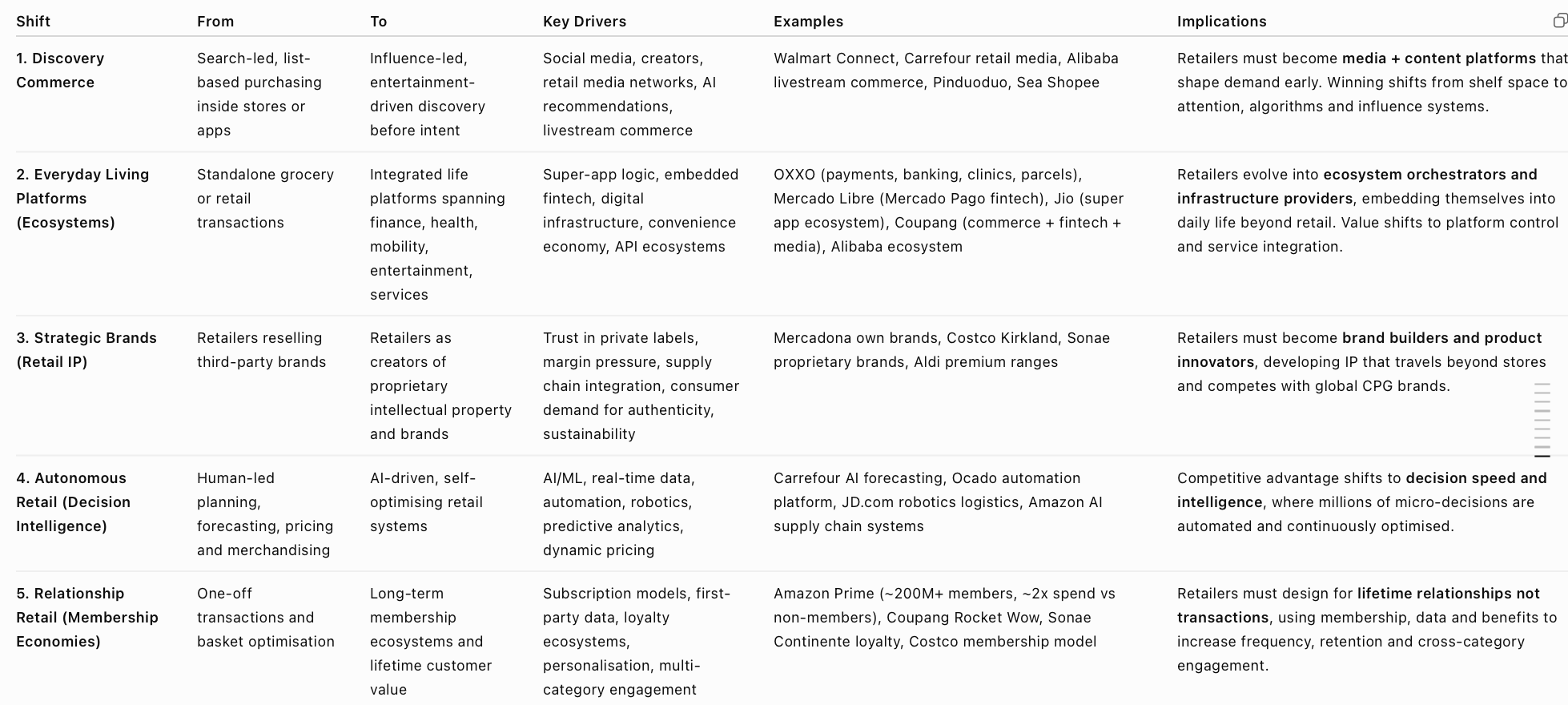
1. Discovery Commerce … from search to influence
Consumers increasingly buy what influences them, not what they search for. Shopping decisions are made long before a shopping list is written, shaped by creators, communities, AI recommendations, livestreaming and social media. The customer journey has shifted from “Search, Compare, Buy” to “Inspire, Discover, Validate, Purchase”.
The old journey was a functional journey, in the context of transactional retail. The new model typically starts elsewhere, on the sofa, in the gym, on vacation, with friends. On Instagram, or TikTok. Increasingly too, shopping is becoming entertainment. Consumers don’t simply discover products, they discover stories, experiences and communities.
Leading retailers are responding by becoming media businesses. Walmart Connect has become one of the world’s largest retail media platforms, enabling brands to influence shoppers long before they enter a store. Carrefour combines retail media with AI and loyalty data to personalise engagement, while Alibaba pioneered livestream commerce that blends entertainment and shopping. Pinduoduo transformed shopping into a social experience through group buying and gamification, while Sea’s Shopee combines gaming, creators and commerce to drive product discovery.
- More than 70% of purchase decisions are influenced before consumers enter a store, through digital content, recommendations and social engagement.
- Retail media is expected to exceed $175 billion globally by 2028, making it one of the fastest-growing advertising sectors.
- Livestream commerce already generates hundreds of billions of dollars annually in China, and is rapidly expanding globally.
What it demands: Retailers must stop thinking like merchants and start thinking like media companies. Systems thinking rather than funnel thinking. Winning is no longer about stocking products, it is about creating influence, shaping demand and building communities long before purchase.
2. Everyday Living … from food stores to lifestyle ecosystems
The world’s leading retailers are no longer building retail businesses—they are building platforms for everyday living. Grocery is becoming just one service within much broader ecosystems that include finance, healthcare, entertainment, logistics, telecoms, education and mobility.
The ambition is no longer to own a bigger share of a customer’s shopping basket, but a bigger share of their daily life.
OXXO has evolved into a neighbourhood services platform, offering banking, payments, parcel collection, telecom services and everyday financial transactions. Mercado Libre transformed an online marketplace into one of Latin America’s largest fintech businesses through Mercado Pago, alongside lending, insurance and logistics. Coupang combines retail with grocery, food delivery, streaming, fintech and its Rocket Wow membership, while Reliance Jio is creating India’s leading super app, integrating commerce, payments, pharmacy, entertainment, education and digital services. Alibaba has built an ecosystem spanning retail, payments, cloud computing, logistics, AI, entertainment and local services. Sea links gaming, digital finance and e-commerce into a single consumer platform.
Increasingly, retailers are becoming part of national and community infrastructure. They help people manage money, access healthcare, collect parcels, receive prescriptions, stream entertainment and navigate everyday life—not simply buy products.
- Mercado Pago now serves more than 60 million monthly active users, becoming one of Latin America’s largest digital financial platforms.
- Jio Platforms serves more than 490 million subscribers, creating one of the world’s largest integrated digital ecosystems.
- Ecosystem businesses consistently achieve significantly higher customer lifetime value because customers engage across multiple services rather than isolated transactions.
What it demands: Retailers must evolve from store owners into ecosystem orchestrators. Their role is to connect multiple services around the customer, creating indispensable platforms that customers use every day.
3. Strategic Brands … from private labels to IP advantage
Private labels are no longer cheaper alternatives, they are becoming strategic intellectual property. The strongest retailers are creating brands that stand for innovation, health, sustainability, premium quality and unique customer experiences. They have obvious advantages over conventional manufacturer brands, they can add services, become experiences, and be portfolios.
Increasingly too, these brands extend well beyond the retailer’s own shelves through licensing, partnerships, digital products and exclusive experiences.
Mercadona has built one of Europe’s most admired own-brand portfolios through relentless product innovation and deep supplier collaboration. Costco’s Kirkland Signature has become a global consumer brand in its own right, often outperforming traditional manufacturers. Sonae continues to develop proprietary brands that increasingly reach consumers beyond its own retail formats. It also means that sometimes more experiential stores can thrive like Eataly, where eating and cooking, come before buying.
- Private-label products account for more than 40% of grocery sales in several European markets.
- Premium private-label ranges continue to grow faster than value ranges as trust in retailer brands increases.
- Own brands typically deliver higher margins and stronger customer loyalty than equivalent national brands.
What it demands: The retailer is evolving from distributor to creator. Retailers must think like brand builders and product innovators, creating valuable intellectual property that customers actively seek rather than simply accept.
4. Autonomous Operations … from automation to decision intelligence
AI is becoming retail’s operating system. Rather than simply automating repetitive tasks, AI is increasingly making thousands of operational decisions every day—from demand forecasting and merchandising to dynamic pricing, inventory optimisation, personalised marketing and autonomous fulfilment.
Leading retailers are creating businesses that become progressively more self-managing. Carrefour uses AI to improve forecasting, optimise assortments and personalise promotions. Ocado has built one of the world’s most sophisticated AI-powered fulfilment platforms, combining robotics, automation and predictive analytics. JD.com deploys robot warehouses and autonomous delivery technologies, while Amazon continues to expand AI across merchandising, logistics and store operations.
- AI can reduce forecasting errors by 20–50%, significantly lowering waste and stock-outs.
- Leading retailers now deploy AI across merchandising, pricing, marketing, supply chains and customer service rather than isolated functions.
- Autonomous fulfilment can dramatically improve productivity while reducing operating costs and delivery times.
What it demands: Competitive advantage increasingly comes from decision intelligence—the ability to make millions of faster, smarter and more autonomous decisions than competitors.
5. Relational Experiences … from transactions to membership
The most valuable customers are not those with the biggest baskets, but those with the strongest relationships. The world’s leading retailers are shifting from transactions to memberships, creating recurring engagement, richer customer data and greater lifetime value.
Loyalty is evolving into subscription. Membership becomes the operating system that connects multiple services into one seamless customer relationship.
Amazon Prime has redefined retail membership by combining fast delivery, groceries, entertainment, healthcare and exclusive benefits into a single subscription. Coupang’s Rocket Wow performs a similar role by integrating grocery, commerce, food delivery, streaming and rapid fulfilment into one membership experience. Sonae’s Continente loyalty ecosystem connects supermarkets with health, fashion and partner services, creating a richer, more personalised customer relationship across multiple aspects of everyday life.
- Amazon Prime has more than 200 million members globally, with members spending approximately twice as much annually as non-members.
- Subscription and membership customers typically shop more frequently, remain customers for longer and demonstrate significantly higher lifetime value.
- The combination of membership, first-party data and AI is becoming one of retail’s most powerful competitive advantages.
What it demands: Retailers must optimise customer lifetime value rather than basket value—building relationships that become stronger with every interaction, across every format and service.
The Bigger Shift … retail beyond retail
Across all five shifts, one pattern repeats:
- From products, to platforms
- From stores, to systems
- From transactions, to relationships
- From operations, to intelligence
- From retail, to infrastructure to everyday life
Retail is no longer a sector defined by selling goods. It is becoming a set of overlapping influence systems, service ecosystems, brand factories, autonomous decision engines and relationship platforms.
The companies that win will not simply move along these axes individually—they will integrate all five simultaneously into a coherent operating model of modern life.
The future of retail is not a more efficient version of what exists today, it is a fundamentally different role in society.
Retail will increasingly disappear as a distinct “sector” at all. Instead, it will be woven into the fabric of everyday life: shaping what people want before they know it, orchestrating services across health, money, mobility and entertainment, and using AI to anticipate needs in real time. Stores will matter less as destinations and more as nodes in living networks. Brands will matter less as labels and more as trusted systems. And transactions will matter less than continuous relationships.
The most successful retailers will no longer ask how to sell more things. They will ask a deeper question: how do we become indispensable to how people live?
In that world, the boundary between retail, technology, media, healthcare, finance and infrastructure dissolves. What emerges instead are adaptive platforms that learn, evolve and respond—quietly shaping daily life in the background, while feeling effortless on the surface.
And perhaps the most profound shift of all: retail stops being something we go to.
It becomes something that is always with us.
More from the blog