Who owns ideas in the AI age? … Why AI could unlock a golden age for authors, readers and ideas … time for book publishers to embrace change, to embrace AI rather than protest about it, and drive reinvention
May 21, 2026
I have spent more than two decades writing books.
From Marketing Genius in 2004, to the award-winning Gamechangers, and most recently Business Recoded, translated into more than 35 languages, books have shaped my career, my thinking, and much of my life.
I know intimately the emotional and intellectual investment that goes into writing a serious book. A good business book is not simply assembled. It is researched obsessively, argued internally, tested through conversations, refined through experience, and then painstakingly written, rewritten, and rewritten again.
Typically, it takes me two years to complete a book (I’ve written 10 of them, so far!). Somewhere between 60,000 and 80,000 carefully chosen words emerge from that process. Every paragraph matters. Every idea is shaped over many hours of thinking. Every story has a purpose. Like many authors, I feel deeply protective of those words because they represent not just content, but years of accumulated experience, curiosity, failures, travels, conversations, inspiration and conviction.
And yet, despite all of that, I am also an enthusiastic advocate for AI.
Not reluctantly. Not cautiously. Enthusiastically.
That may surprise some people in publishing circles today, where the prevailing mood often swings between anxiety and outrage. Much of the debate about AI and publishing has quickly become polarized. On one side sit the technology evangelists proclaiming the end of traditional publishing and the limitless possibilities of generative AI. On the other sit authors, publishers, and creatives warning, often rightly, about copyright abuse, stolen intellectual property, collapsing business models, and the erosion of human creativity.
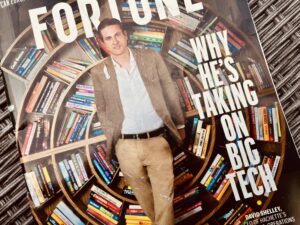
This month’s Fortune cover article about David Shelley, CEO of Hachette Book Group and Hachette UK, captures this tension powerfully. He argues passionately that publishers must defend authors against AI companies training models on copyrighted works without permission. He calls the current approach by some technology firms “parasitic” and warns that without sustainable economics for creators, society risks starving itself of future stories, ideas, and art.
He is right to raise the alarm. But I also believe there is another equally important conversation we need to have, one that moves beyond fear, beyond legal trench warfare, and beyond simply trying to preserve the publishing industry exactly as it is today.
Because while copyright matters enormously, readers matter too.
And readers are changing faster than publishing.
Publishing’s resistance to change
For decades, publishing has largely resisted radical reinvention. Yes, we have ebooks. Yes, we have audiobooks. But let us be honest: most digital publishing innovations have essentially reproduced the same linear content in slightly different formats. The core model remains remarkably unchanged. An author writes a long manuscript. A publisher packages it. A reader buys it. The reader consumes it sequentially from beginning to end.
That model worked brilliantly in a slower, less connected, less information-saturated world.
But today’s world is fundamentally different. Business leaders no longer consume knowledge in the same way. Nor do students. Nor do entrepreneurs. Nor do consumers generally. People increasingly seek modular knowledge, contextual insight, adaptive learning, real-time relevance, personalized recommendations, conversational exploration, multimedia engagement, and practical application.
In other words, people increasingly want knowledge to behave more like a living system than a static product.
The uncomfortable truth for publishing is that a 70,000-word book can often be an extraordinarily inefficient way to access a specific idea.
Imagine a CEO facing a strategic challenge in Indonesia next Tuesday morning. Does she really want to read an entire 300-page business book cover to cover to extract the three ideas most relevant to her immediate context? Or would she prefer a dynamic, adaptive knowledge experience that understands her market, her company, her industry pressures, and her preferred learning style?
That is not a threat to ideas. It is an evolution in how ideas travel.
This is why I believe AI, used wisely and ethically, could become one of the most important opportunities publishing has seen in generations. Not because AI should replace authors, but because AI could dramatically amplify the reach, usefulness, accessibility, and impact of human ideas.
The real question is not how to stop AI
As co-founder and host of the Future Book Forum held in Munich, where I engage every year with around 300 publishers from across the world, I see firsthand how deeply the industry cares about books. And rightly so. Books are beautiful objects. They carry emotional significance. They slow us down. They demand immersion. They reward contemplation. In a fragmented digital world, the physical book retains extraordinary cultural power.
But sentimentality alone is not a strategy.
Every industry today is being reshaped by changing technologies and changing human behaviour. Retail, banking, healthcare, automotive, media, education, hospitality — none can survive merely by protecting legacy formats. The winners are those who reimagine how they create value for people.
Publishing will be no different.
The key question is therefore not: “How do we stop AI?”
The key question is: “How do we reinvent knowledge?”
That distinction matters enormously. Because if we approach AI purely defensively, publishing risks becoming trapped in a nostalgic battle to preserve an increasingly outdated delivery model. But if we approach AI creatively, strategically, and humanistically, publishing could enter a remarkable new era.
From static books to living knowledge
Consider what becomes possible.
Imagine business books transformed into intelligent advisory systems that adapt insights dynamically for different industries, cultures, or business sizes. Imagine cookbooks that become interactive culinary companions, adapting recipes to dietary preferences, available ingredients, health goals, and skill levels. Imagine fitness books evolving into adaptive coaching systems that respond to age, injuries, schedules, biometric feedback, and motivation patterns.
The core intellectual property remains human. The ideas remain human. The expertise remains human.
But AI allows those ideas to become more useful.
This is not hypothetical. Consumers already expect personalization everywhere else. Netflix personalizes entertainment. Spotify personalizes music. TikTok personalizes discovery. Amazon personalizes commerce. Increasingly, people expect knowledge itself to become adaptive.
And frankly, they are right to expect it.
One of the great ironies of publishing is that we have often celebrated the democratization of knowledge while simultaneously clinging to highly inflexible formats for delivering it.
Books are magnificent containers for ideas. But they are still containers. AI potentially allows ideas to escape the container.
That should excite us.
Protecting authors while expanding impact
Of course, legitimate concerns remain.
Copyright absolutely matters. Consent matters. Attribution matters. Compensation matters. Transparency matters. If AI companies simply scrape authors’ work without permission or remuneration, then authors are right to object. Human creativity requires sustainable economics.
As David Shelley argues in the Fortune article, if creators cannot make a living, eventually the entire creative ecosystem weakens. But there is also a danger that the publishing world frames the debate too narrowly around ownership instead of usefulness.
The deeper opportunity is not simply to protect content. It is to expand impact.
As authors, surely our ultimate ambition is not merely to defend pages. It is to help people.
When I write about innovation, leadership, reinvention, strategy, or future business models, my real goal is not that somebody finishes Chapter 7. My goal is that they transform their business, challenge assumptions, create opportunities, inspire teams, and build a better future.
If AI helps those ideas reach more people more effectively, then I am interested.
Throughout history, publishing has always evolved through technological shifts. The printing press itself was once controversial. Paperbacks were dismissed as inferior. Radio threatened books. Television threatened reading. The internet threatened everything. Yet every technological wave ultimately expanded access to ideas.
AI will do the same — but only if the industry chooses reinvention over resistance.
Why human creativity matters more than ever
Importantly, embracing AI does not mean surrendering human creativity.
In fact, paradoxically, AI may increase the value of authentic human insight. As generative content floods the world, originality becomes more valuable, not less. Trust becomes more valuable. Experience becomes more valuable. Perspective becomes more valuable.
In a world of infinite synthetic content, people will increasingly seek what some are already calling the “human premium.”
That is actually good news for serious authors.
Because the best books are never simply information products. They are expressions of lived perspective. They connect ideas in unexpected ways. They challenge assumptions emotionally and intellectually. They capture nuance, contradiction, ambiguity, aspiration, and imagination.
AI can synthesize patterns. Humans create meaning.
The future therefore is unlikely to be humans versus AI. It is far more likely to be humans amplified by AI.
And publishers have an extraordinary opportunity to lead that future.
Reinventing the role of the publisher
Imagine publishers evolving from distributors of static products into orchestrators of dynamic knowledge ecosystems. Imagine subscription-based intelligence platforms built around authors. Imagine AI companions trained ethically and transparently on licensed author content. Imagine publishers monetizing not just book sales, but adaptive learning experiences, expert networks, real-time insights, simulations, coaching systems, and community engagement.
That is not the destruction of publishing.
That is the expansion of publishing.
Some publishers already understand this. The smartest conversations I hear at Future Book Forum are no longer about defending old formats. They are about reimagining the role of publishers in a world where knowledge flows differently.
Publishers still have enormous strengths — trust, curation, editorial quality, brand reputation, author relationships, discovery, distribution, communities, and intellectual rigor. But those strengths need to be applied to future models, not merely legacy ones.
Technology companies also need to engage differently. The current conflict between publishers and AI firms is understandable but unsustainable. Endless litigation may establish important legal precedents, but it will not create the future alone. Ultimately, publishers and technology companies will need each other.
The more enlightened path is partnership.
Transparent licensing models. Revenue-sharing systems. Author-controlled permissions. Attribution frameworks. Ethical training protocols. Consumer transparency. Shared innovation labs. New monetization architectures.
This is solvable.
And there are encouraging signs already emerging. Some AI companies are beginning to negotiate licensing agreements with publishers and media organizations. Others are exploring attribution systems. The legal framework will evolve. Business models will evolve. Consumer expectations will evolve.
They always do.
The bigger risk is irrelevance
The bigger risk facing publishing is not technological disruption itself. The bigger risk is intellectual stagnation.
If publishing becomes defined primarily by protecting yesterday’s formats instead of enabling tomorrow’s possibilities, it risks becoming culturally less relevant over time. Meanwhile, consumers will simply move elsewhere — and consumers always move faster than industries expect.
The most successful industries in periods of disruption are rarely those that defend products most aggressively. They are those that understand human needs most deeply.
People do not fundamentally want books. People want outcomes.
They want inspiration, insight, escapism, learning, transformation, possibility, connection, imagination, confidence, entertainment, and wisdom. Books have historically delivered those outcomes brilliantly. But they are not the only possible vehicle.
That may sound uncomfortable within publishing circles, but it is profoundly important to acknowledge. Because once we focus on human outcomes rather than legacy formats, innovation becomes much easier to embrace.
This is particularly true in business publishing. Executives today operate in conditions of extraordinary complexity. Markets shift rapidly. Technologies converge exponentially. Competitive advantage erodes faster. Geopolitics destabilize assumptions. Sustainability pressures intensify. Consumer behaviour changes continuously.
In that environment, static knowledge increasingly struggles to keep pace.
AI-enabled publishing models could potentially deliver living intelligence instead of frozen insight. Imagine a strategy book that updates dynamically as markets evolve. Imagine leadership frameworks contextualized by geography or industry. Imagine AI-curated learning journeys built around specific transformation challenges. Imagine conversational interfaces allowing leaders to interrogate ideas deeply and interactively.
That is incredibly exciting. Not because it replaces books, but because it extends them.
The next chapter for human ideas
Perhaps that is the most important mindset shift of all.
We should stop thinking about AI as the enemy of books. Instead, we should think about it as the next chapter in humanity’s long journey to spread ideas more effectively.
The publishing industry has always played a noble role in civilization. It preserves knowledge. Amplifies voices. Challenges power. Expands imagination. Fuels progress.
That mission matters more than ever. But missions endure precisely because institutions evolve.
The future of publishing will not belong solely to technology companies. Nor solely to traditional publishers. Nor solely to authors. It will belong to those who best combine human creativity, technological capability, ethical responsibility, and consumer relevance.
The winners will not ask, “How do we protect the book?” but “How do we maximize the value of human ideas?”
That is a far bigger ambition. And far more exciting too.
After all, as authors, what do we really want? Do we simply want people to buy our books? Or do we want our ideas to genuinely change lives, organizations, industries, and futures?
For me, the answer is easy. And that is exactly why I believe AI could become publishing’s greatest opportunity yet.
More from the blog