Small nations with big impact … How Estonia is rewriting the rules of global innovation, from Bolt’s mobility to Starship’s robots … inspired by small champions like Ireland and Iceland, Singapore to Switzerland
May 19, 2026
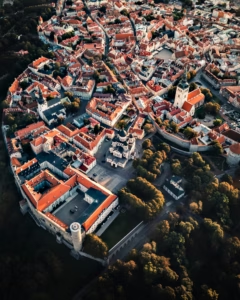
This week I’m working with a group of Estonian business leaders.
Estonia, and the Baltics more generally, are a great source of entrepreneurial spirit, with small companies thinking well beyond their physical size or geographical domains.
Some years ago I got together with my Estonian colleague Endrik Randoja in Tartu to launch a new type of business strategy – we called it the Pilot Fish Strategy – whereby small companies can partner with huge companies to reach distant shores. We had a great response, with many small local entrepreneurs and scale-up companies intrigued by the idea of ingredient branding, ecosystem models, and similar approaches – rather than the conventional lonely routes to growth.
More generally, as I think about Estonia this week, it feels like there is a quiet revolution underway in global innovation, and it is not being led by the usual giants.
Instead, it is being shaped by small countries that have discovered a powerful truth: when you cannot win through scale, you must win through systems. These nations do not compete by size, but by design. They build environments where entrepreneurship is not an exception but an expectation, where digital infrastructure replaces bureaucracy, and where global ambition is not aspirational, it is assumed.
At the centre of this shift is Estonia, which has turned constraint into competitive advantage more systematically than almost any other.
But Estonia is not alone. It belongs to a broader constellation of small, high-performance economies – from Ireland to Iceland, Singapore to Switzerland – each offering a different answer to the same question: how do small nations matter in a world dominated by scale?
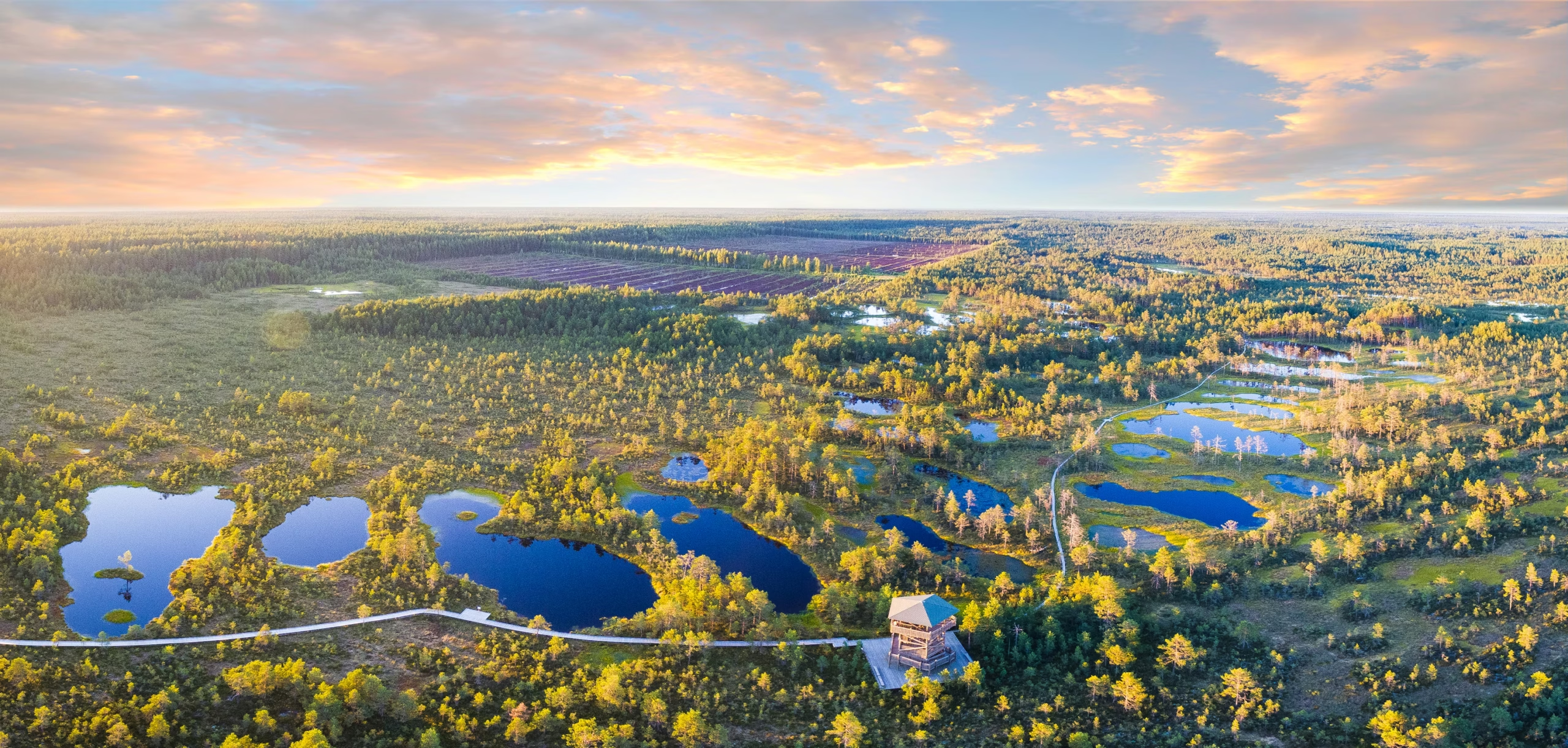
Estonia … from post-Soviet reset to digital launchpad
Estonia’s transformation is one of the most deliberate acts of national reinvention in modern economic history. After regaining independence, it faced a simple but brutal reality: it was too small to compete conventionally. So instead of trying to mimic large economies, it redefined what a country could be.
It built a fully digital state—secure identity, online governance, paperless administration, and near-instant company formation. But the deeper innovation was psychological: Estonia turned the state into an invisible infrastructure layer for entrepreneurship.
The result is not just efficiency. It is a startup operating system for a nation.
This system has produced a series of globally significant companies that reveal how Estonia actually competes: not by serving its domestic market, but by treating the world as its native environment.
Skype: The moment when big thinking became normal
The first defining moment in Estonia’s modern economic identity was Skype.
Skype was more than a breakthrough communication tool. It was a proof of concept that geography no longer determined destiny. Built by a distributed team with strong Estonian engineering roots, it showed that a small country could produce a product used by hundreds of millions of people worldwide.
But its most important impact was internal. Skype created a generation of engineers and founders who no longer saw Estonia as a limitation. It established a cultural baseline: global scale was not extraordinary—it was expected.
This matters because innovation ecosystems are ultimately belief systems. Skype rewired Estonia’s beliefs about what was possible.
Wise: Rebuilding the hidden architecture of global money
If Skype was Estonia’s myth of possibility, Wise is its demonstration of structural intelligence.
Wise did not compete by building a better fintech product in a crowded category. It attacked the underlying inefficiency of cross-border payments itself. Traditional banking moves money through a chain of intermediaries, each adding cost, delay, and opacity. Wise instead re-architected the system: matching flows locally and settling net positions globally.
The genius is not in fintech features—it is in systems thinking. Wise treats global finance as something that can be redesigned from first principles.
Even more important is how it scales trust. In a heavily regulated industry, Wise does not treat compliance as friction. It embeds it into its architecture. This is a distinctly Estonian trait: trust is not a marketing layer; it is infrastructure.
Bolt: Speed as a structural advantage
Where Wise rewrote financial systems, Bolt rewrote execution dynamics.
Bolt competes in one of the most aggressively contested global markets: mobility platforms. Yet its strategy is not to outspend incumbents, but to out-iterate them. Its advantage is velocity—entering new cities quickly, adapting locally, and refining operations in real time.
Unlike centralised platform models, Bolt operates more like a distributed network. Each city becomes a semi-autonomous unit of experimentation. This creates a compounding advantage: learning is decentralised, and adaptation is continuous.
The deeper lesson is strategic. In platform markets, dominance does not always go to the biggest player. It often goes to the fastest learner.
Bolt reflects a broader Estonian principle: speed is not just operational—it is structural. In small systems, delay is expensive. That constraint becomes capability.
Starship Technologies: Delivery robots
The most forward-looking expression of Estonia’s model is Starship Technologies.
Starship builds autonomous delivery robots designed to operate in real urban environments. While many companies chase full-scale autonomy in complex systems like highways, Starship focuses on constrained autonomy—sidewalks, campuses, controlled urban zones.
This is a subtle but powerful strategic choice. It reflects an understanding that technological revolutions rarely arrive fully formed. They emerge through progressive deployment in environments where reliability can be tested, refined, and scaled.
Estonia’s role in this is not accidental. Its compact geography, digital infrastructure, and regulatory openness make it an ideal “real-world laboratory” for iterative autonomy systems.
Starship is not just building robots. It is building the pathway by which autonomy becomes commercially viable.
Beyond Estonia
Estonia’s story becomes even more interesting when viewed alongside other small, high-performing countries that have taken different paths to global relevance.
Singapore: the precision engine of state-led global connectivity
Singapore represents a different philosophy entirely: not radical decentralisation, but highly orchestrated central design.
Where Estonia builds openness and entrepreneurial frictionlessness, Singapore builds precision and strategic coordination. It has positioned itself as a global node for finance, logistics, biotech, and increasingly AI infrastructure.
Its success rests on three pillars:
- Exceptional governance capacity
- Long-term strategic planning
- Deep integration into global trade and capital flows
Singapore shows that small nations can win not only by being fast, but by being exceptionally well orchestrated. It is less a startup ecosystem and more a global command hub.
Switzerland: high-trust precision at global scale
Switzerland offers another model: deep excellence in narrow domains.
Switzerland is not a startup-dense ecosystem like Estonia or Israel. Instead, it excels in highly specialised global industries—pharmaceuticals, precision engineering, advanced manufacturing, and financial services.
Its advantage is not speed, but trust and depth:
- Extremely high institutional stability
- Long-term R&D investment
- World-class technical education
Switzerland demonstrates that small countries can dominate global markets not through rapid iteration, but through sustained excellence in high-value niches.
Ireland: the scaling platform for global technology
Ireland represents a different kind of leverage: not invention, but amplification.
Ireland’s role in the global economy is as a launchpad for multinational technology companies. Its advantages include EU access, a highly educated workforce, English language fluency, and a business-friendly regulatory environment.
While Ireland has developed its own startup ecosystem, its greatest strength lies in becoming a global scaling infrastructure for companies entering Europe.
It shows that small countries can win not only by producing startups, but by becoming indispensable nodes in global corporate expansion.
Iceland: extreme smallness, maximum agility
Iceland represents the edge case of small-state innovation.
With a tiny population and extreme geographic isolation, Iceland has focused on leveraging its unique strengths: renewable energy abundance, digital connectivity, and institutional agility.
While it has not produced global tech giants at the scale of Estonia, it demonstrates a different form of relevance: the ability to act as a rapid test environment for energy systems, sustainability models, and digital experimentation.
Iceland shows that even extreme smallness does not prevent sophistication—it can enhance adaptability.
Small nations as innovation systems, not markets
What unites Estonia, Singapore, Switzerland, Ireland, and Iceland is not similarity—but logic.
Each has recognised a fundamental shift in the global economy: value is no longer determined primarily by domestic scale, but by the ability to plug into global systems.
Yet each responds differently:
- Estonia: builds digital entrepreneurial infrastructure
- Singapore: builds orchestrated global command systems
- Switzerland: builds deep, trust-based industrial excellence
- Ireland: builds scaling infrastructure for global firms
- Iceland: builds agile experimental environments
Together, they represent a new geography of innovation: not large markets competing for dominance, but small systems competing on leverage.
Design beats size
The Estonian story, and those of its peers, points to a deeper truth about the future of economic development. In a world defined by digital infrastructure, network effects, and global talent flows, size is no longer the primary determinant of success. Design is.
The most successful small countries are not trying to become large countries. They are becoming something else entirely: high-leverage systems for producing global impact.
Estonia did not ask how to compete with larger nations. It asked a more radical question: What would a country look like if it were designed to produce global companies as a default output?
The answer to that question is reshaping not just Estonia, but the future possibility space of nations everywhere.
More from the blog