The Brand Doctor … Could Mercedes Benz reinvent itself as a trillion-dollar business, combining the platform thinking of Apple, and rare luxury of Ferrari?
April 3, 2026
Each month The Brand Doctor, aka business expert Peter Fisk, takes a global brand that has perhaps lost its way, and considers how it could reinvent itself. If it’s your brand, do you have the courage to change? If not, what would you do, and how could you apply these ideas for reinvention to your own business?
Mercedes Benz.
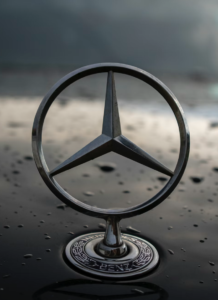
Few names carry such weight. A century of craftsmanship, engineering precision, and the quiet confidence of a brand that helped invent the automobile itself. The three-pointed star has long stood for certainty: if something bears it, it will be built properly, elegantly, enduringly.
And yet, in 2026, certainty feels like a fragile luxury. The ground beneath the industry is shifting—not gradually, but violently—towards electrification, software, artificial intelligence, and networks. The uncomfortable question now presents itself: what becomes of a company defined by engineering excellence in a world where engineering alone is no longer enough?
Mercedes-Benz has an answer, at least in principle. Its strategy is not a single pivot, but a multi-directional transformation … across product, technology, business model, geography, and culture. The ambition remains to build “the world’s most desirable cars”, but the meaning of desirability itself is evolving. The real question is whether Mercedes is evolving fast enough—and boldly enough—to redefine it.
- Mercedes Benz Annual Report 2025
- Mercedes Benz Capital Markets Day 2025
- Mercedes Benz Investor Presentation 2026
MB.OS … from automaker to software platform
At the heart of this transformation lies MB.OS, Mercedes’ attempt to build a unified operating system that powers everything from infotainment to autonomous driving. This is more than a technical upgrade; it is a philosophical shift. The car is no longer a finished product at the point of sale, but a living platform, capable of evolving through over-the-air updates, AI-driven features, and new digital services.
It is, in essence, an attempt to move closer to the logic of Apple—where hardware is merely the gateway to a broader ecosystem of experiences, services, and recurring revenue.
Apple now generates 25% of revenue from services (App Store, content), but 40–50% of profit due to high margins. A decade ago, this was under 10%. The shift to recurring, ecosystem-driven income has transformed its valuation—from hardware maker to platform company with scalable, predictable profitability.
But can Mercedes truly think like a software company? Can an organisation built on mechanical perfection embrace iteration, imperfection, and continuous release cycles? Or will MB.OS become yet another ambitious platform constrained by legacy systems and cultural inertia?
And more provocatively: if the car becomes a platform, does the brand’s value migrate from what you drive to what you experience?
Electrification … to compete with Tesla, Polestar
Mercedes’ approach to electrification is ambitious, yet cautious. It is building a new generation of electric vehicles while retaining hybrid and flexible powertrain strategies in markets where infrastructure lags.
This is pragmatic, perhaps even wise. But it also raises a tension. Competitors such as Tesla, Polestar, Nio and XPeng are pushing more aggressively towards fully electric futures, shaping consumer expectations in the process.
Can Mercedes afford to hedge its bets? Or does leadership in a new era require a more uncompromising stance? And perhaps more fundamentally: will customers in the future care less about what powers the car, and more about what powers the experience?
Global … made in Alabama, or Beijing
Beyond the vehicle itself, Mercedes is reshaping its global footprint—investing in regional manufacturing, engineering hubs, and localised supply chains. Factories in Alabama, expanded capabilities in Asia, and a broader geographic spread are all part of a strategy to navigate geopolitical volatility and shifting trade dynamics.
This is not merely operational efficiency; it is strategic resilience. Yet it introduces its own tensions. Can a brand synonymous with German precision maintain its identity when production is dispersed globally? Does localisation create agility—or dilute the very essence of what makes a Mercedes a Mercedes?
Culture … from an engineering legacy
Perhaps the most difficult transformation is internal. Mercedes is attempting to break down silos between engineering, manufacturing, sales, and customer experience—moving from a rigid industrial model to a more integrated, agile organisation.
This is easy to declare, notoriously difficult to achieve. Culture does not shift at the speed of strategy. Engineers trained to perfect hardware must now think in terms of software iterations. Sales teams accustomed to one-off transactions must consider subscriptions, services, and lifetime customer value.
Meanwhile, competitors—Rivian, Lucid Motors, VinFast, even design-led newcomers like Omoda and Jaecoo—are unburdened by legacy, able to design organisations around the future rather than retrofit the past.
Can Mercedes bend without breaking? Or is the weight of its own excellence the very thing that slows it down?
Tomorrow XX … good for the world
Sustainability has moved from obligation to opportunity. Initiatives such as “Ambition 2039” and “Tomorrow XX” aim to decarbonise not just vehicles, but the entire lifecycle—from materials to manufacturing to recycling.
This suggests a broader redefinition of luxury: not just what feels good, but what is good. Yet the question lingers. Does sustainability enhance desirability, or merely accompany it? Can Mercedes lead in circular materials and net-zero production without losing the immediacy, sensuality, and emotional pull that define its brand?
And will younger consumers—drawn to the narratives of companies like Polestar or Rivian—see Mercedes as a pioneer, or as a legacy player catching up?
Gamechanger … rising above the crowd
The competitive landscape is no longer orderly. It is a mosaic of ambition. Tesla continues to blur the lines between automotive and technology. Nio experiments with battery-swapping ecosystems. XPeng pushes autonomy and AI. Zeekrand Xiaomi hint at vertically integrated, tech-driven futures.
At the same time, Hyundai, Kia, Genesis, and Tata Motors are closing the gap from below, offering design, quality, and electrification at pace.
In such a world, Mercedes-Benz must ask itself a simple but profound question: is it still competing in the same game?
The reinvention imperative
The possible futures stretch in different directions. One path is incremental evolution—refining EVs, integrating MB.OS, improving sustainability, and relying on brand strength to sustain premium positioning.
Another is radical reinvention—becoming a mobility platform, offering autonomous services, subscription-based access, AI-driven experiences, and integration with energy and smart-city ecosystems.
Between these lies a hybrid possibility: Mercedes as both product and platform, delivering exceptional physical vehicles alongside a seamless digital ecosystem.
But even this raises deeper questions. Can luxury coexist with subscription models? Can exclusivity survive in a world of shared mobility? Can a brand built on ownership adapt to a future defined by access?
The trillion dollar question
And then there is the question that sits quietly beneath all others: what is Mercedes-Benz actually worth in this new world?
Today, Mercedes-Benz Group generates roughly $160–170 billion in revenue, yet is valued at less than $100 billion—a multiple of well under 1x revenue. Compare that with Ferrari, whose scarcity, margins, and brand power command 10x+ revenue multiples. Tesla, meanwhile, trades more like a technology platform, often at 5–8x revenue.
Step outside automotive, and the contrast sharpens further. Apple and Microsoft command 7–12x multiples, built on ecosystems, recurring revenues, and scalability. Even luxury houses like LVMH and Hermès sustain 4–10x multiples, driven by desirability and pricing power.
If Mercedes-Benz could achieve even a modest 3x revenue multiple, its valuation would approach $500 billion. At Tesla-like levels, it could edge towards $1 trillion.
But such multiples are not awarded for heritage—they are earned through transformation. Mercedes would need to become something fundamentally different:
- A platform, generating recurring software and service revenues
- A luxury brand of scarcity, with disciplined product and pricing strategy
- A mobility ecosystem, integrating vehicles, energy, data, and AI
- A high-margin business, less cyclical, more predictable
In short, it would need to combine the platform thinking of Apple, the margin discipline of Ferrari, and the desirability of Hermès.
And here lies the tension. Can Mercedes evolve into such a hybrid without losing its identity? Or does the pursuit of such valuation multiples risk distorting the very essence of the brand?
Luxury in a world of tech
Mercedes-Benz has survived disruption before. Wars, crises, competition—it has endured, adapted, and often led. But this moment feels different. The disruption is not just technological; it is conceptual.
The car is no longer the centre of gravity. The ecosystem is. The experience is. The network is.
So the question is no longer whether Mercedes-Benz can build the world’s most desirable cars. It is whether it can redefine what desire means in a world of software, autonomy, and sustainability.
- Can it become a platform without losing its soul?
- Can it scale without losing its exclusivity?
- Can it transform without becoming unrecognisable?
And perhaps most provocatively of all:
Can Mercedes-Benz reinvent itself not just as a great automaker—but as a trillion-dollar business that fuses technology, luxury, and mobility into something entirely new?
More on brands
Peter Fisk is a leading authority on business and brand strategy, creating more innovative strategies, business models and experiences for the world’s best brands. His 35 years of experience spans Adidas to Amazon, Bosch, Campari to Cartier to DSM, having started as a brand manager of supersonic travel, with Concorde, and today working around the world supporting business leaders.
- The Brand Doctor: Aperol Spritz
- The Brand Doctor: Ecco
- The Brand Doctor: Gucci
- The Brand Doctor: Philip Morris
- The Brand Doctor: Tetra Pak
and
- What’s new and next in branding?
- What’s new and next in marketing?
- What’s new and next in innovation?
and more
- Eyes on Tomorrow: What Leaders Must See before Everyone Else … exploring the most important megatrends that are transforming markets, and leadership mindsets, and how the best companies embrace them as opportunities … based on the new Megatrends 2035 report by Peter Fisk, and its implications for every business.
- The Reinvention Playbook: Thriving in a World of Relentless Change … the best organisations seek to continually reinvent themselves in a world of constant, uncertain and dynamic change. They rethink, refocus, and reinvent everything – embracing new agendas from AI to GenZ, climate change and social inequality.
- The Nexus Effect: Unlocking the Power of Connections … How can businesses and brands really unlock the power of data and networks, flywheels and AI, communities and ecosystems, to transform their futures?
- The New Growth Playbook: 9 New Ways to Accelerate Growth … many companies struggle to find new ways to grow their business … instead we look at how the best companies find radically new ways to grow.
- Super Innovators: Innovation Beyond the Normal … 10 radical ways to disrupt conventions, embrace deeper insights, unlock valuable assets, and stretch innovation for more dramatic impact.
- Consumer of the Future … “Aisha blinked twice, the smart lenses in her eyes had already scanned her biometric mood, cross-checked her carbon budget, and pulled up items her climate-positive friends were buying this week”
- Competing in the FLUX: How to develop a dynamic strategies in a world of relentless change … combining a strong, enduring direction with micro-moves that adapt quickly to emerging shifts:
- Business Transformation: The new superpower of business leaders … reimagining the future, redefining strategy, reinventing the organisation, rewiring performance … the journey to deliver step change in value creation.
- The Sustainable Consumer: Go on, do the Right Thing … how brands can accelerate the consumer shift to sustainable products and practices … from food and fashion, to energy and electric cars, making sustainability desirable and better.
- The “Performer Transformer” Leaders: How great leaders deliver today and create tomorrow … with dual thinking, to build dynamic ambidexterity, continually strategyzing, to perform and transform.
- The Hire-Wire Act of Leadership: Leading in a world of intense competition and relentless change … being visionary and innovative, learning to adapt and endure … inspired by Taylor Swift, Roger Federer, Beyoncé, and Lionel Messi
- Becoming a Future-Ready Business … in a world of relentless change, organisations need to anticipate change, embrace innovation, empower talent, and align deeply with the evolving needs of society and the planet
More from the blog