“None of us is as smart as all of us” … building effective leadership teams in a world of relentless change … from Amazon to the All Blacks, Space X and many others …
December 10, 2025

In the early days of SpaceX, rockets didn’t just fail, they exploded. Repeatedly.
Each launch represented years of engineering effort, millions of dollars, and the reputational stakes of a company trying to do what few believed possible: radically reduce the cost of space travel and make humanity multi-planetary. The margin for error was near zero, the uncertainty immense, and the pace unforgiving.
Yet within this high-stakes environment, SpaceX built something more valuable than rockets—it built leadership teams capable of operating at the edge of innovation.
These teams were not defined by hierarchy or tenure, but by ownership, accountability, and the ability to think independently while acting collectively. Engineers were expected to challenge assumptions, solve problems beyond their formal roles, and take responsibility for outcomes that directly impacted mission success. Leaders did not simply direct—they removed barriers, made rapid decisions with incomplete data, and created an environment where learning from failure was not optional but essential.
This is the reality of modern leadership. Increasingly, organizations operate in conditions that resemble SpaceX more than traditional corporate environments: fast-moving, ambiguous, interconnected, and unforgiving. In such contexts, leadership teams are no longer coordination bodies—they are performance engines. And whether they function effectively can determine not just success, but survival.
The challenge of leading in fast, uncertain, innovative environments
In stable environments, leadership teams can rely on structure, planning cycles, and clearly defined roles. Decision-making is often sequential, risks are manageable, and outcomes are predictable. But in fast, innovative companies, these assumptions break down.
Three challenges dominate:
- First, speed versus alignment.
Leaders must move quickly, often making decisions before all information is available. Yet misalignment at the top can cascade into confusion and inefficiency across the organization. - Second, autonomy versus control.
Innovation requires empowering individuals and teams to act independently. But without clarity and accountability, autonomy can become fragmentation. - Third, performance versus learning.
Organizations must deliver results while continuously experimenting, adapting, and learning from failure.
Leadership teams sit at the center of these tensions. Their ability to navigate them determines whether an organization accelerates—or stalls.
Interestingly, these dynamics are not unique to business. Elite sports teams have grappled with them for decades.
Lessons from the world’s most successful teams
Consider the All Blacks, widely regarded as one of the most successful teams in the history of sport. Their dominance is not simply a function of talent; it is the result of a deeply embedded team culture and leadership philosophy.
One of their defining principles is “shared leadership.” While there is a captain, leadership responsibility is distributed across the team. Players are expected to step up, hold each other accountable, and contribute beyond their positional roles. Senior players mentor juniors, and standards are reinforced peer-to-peer, not just top-down.
Another principle is “sweep the sheds”—a metaphor for humility and ownership. Even the most senior players take responsibility for the smallest tasks. This reinforces a culture where no one is above the team, and accountability is universal.
Finally, the All Blacks emphasize clarity of purpose. Every player understands not just what they are doing, but why it matters. This shared meaning creates cohesion under pressure and enables rapid decision-making in dynamic situations.
The parallels with high-performing leadership teams are striking. In both cases, success depends not just on individual excellence, but on how effectively individuals operate together under pressure.
What makes leadership teams truly effective?
Across industries and contexts, effective leadership teams share several characteristics:
- Clarity of purpose and goals
- Defined roles and decision rights
- High levels of trust and open communication
- Constructive conflict and debate
- Strong accountability for outcomes
- Ability to execute consistently while adapting quickly
These characteristics may sound straightforward, but achieving them is anything but simple. This is where frameworks become valuable—not as rigid models, but as tools to diagnose and improve team performance.
Frameworks to elevate team performance
Different frameworks serve different purposes. The key is knowing when and how to use them.
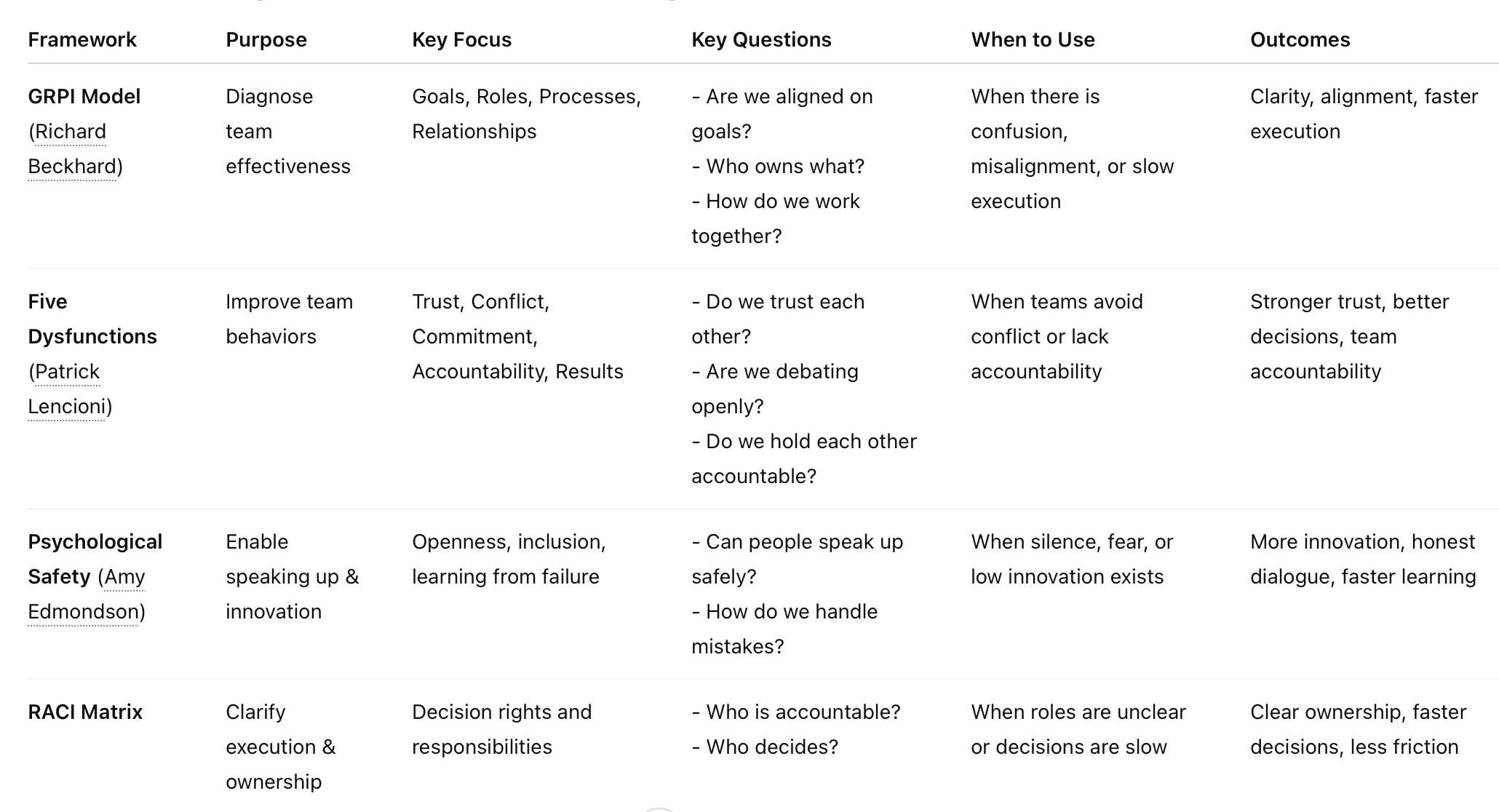
Diagnosing Structure and Alignment
One of the most practical starting points is the GRPI model—Goals, Roles, Processes, and Interpersonal Relationships. It provides a simple yet powerful way to diagnose where a team may be struggling.
If goals are unclear, teams lack direction. If roles are ambiguous, confusion and duplication arise. If processes are inefficient, execution suffers. And if relationships are weak, trust and collaboration break down.
GRPI is particularly useful early in team development or when performance issues emerge. It helps leaders quickly identify whether problems are structural or interpersonal.
Addressing Behavioral and Cultural Challenges
While structural clarity is necessary, it is not sufficient. Many teams fail not because they lack clarity, but because they struggle with behaviors.
This is where the concept of common team dysfunctions becomes relevant. Teams often avoid conflict, hesitate to hold each other accountable, or prioritize individual success over collective outcomes. These behaviors erode performance over time.
Addressing them requires intentional leadership: creating space for honest dialogue, encouraging constructive disagreement, and reinforcing shared accountability.
Building Psychological Safety
In innovative environments, psychological safety is critical. Team members must feel able to speak up, challenge ideas, admit mistakes, and propose new approaches without fear of negative consequences.
Without this, teams default to safe, incremental thinking. With it, they unlock creativity and innovation.
Leaders play a central role here. Their reactions to dissent, failure, and uncertainty set the tone for the entire team.
Clarifying Execution and Accountability
Even high-trust, aligned teams can struggle with execution if decision rights are unclear. Tools like responsibility matrices help clarify who is responsible, accountable, consulted, and informed for key decisions.
This is particularly important in complex organizations where multiple stakeholders are involved. Clarity reduces friction and accelerates progress.
Case studies in building high-performing teams
While frameworks provide structure, real-world examples bring them to life. Several organizations offer valuable lessons in how leadership teams can operate effectively.
Amazon: Scaling Alignment and Accountability
Amazon has built its leadership culture around principles that reinforce ownership, customer obsession, and high standards. Leadership teams are expected to think long-term while acting decisively in the present.
One of Amazon’s key practices is its approach to decision-making. Leaders are encouraged to distinguish between reversible and irreversible decisions, allowing for speed where appropriate and rigor where necessary. This prevents paralysis while maintaining accountability.
The company also emphasizes written communication. Leadership teams use structured narratives instead of presentations, ensuring clarity of thinking and alignment. This discipline forces leaders to articulate their ideas precisely and consider multiple perspectives.
The impact is a leadership culture that combines speed with rigor, autonomy with accountability. Teams are empowered to act, but within a framework that ensures alignment with broader goals.
Schneider Electric: Enabling Cross-Functional Innovation
Schneider Electric operates in a complex environment where innovation requires the integration of engineering, software, and customer insights. To address this, the company has built cross-functional teams focused on shared outcomes rather than functional silos.
Leadership teams play a critical role in enabling this collaboration. They establish clear goals, define roles across functions, and create environments where diverse perspectives are encouraged.
Psychological safety is particularly important in this context. Innovation depends on the ability to challenge assumptions and explore new ideas. Leaders must ensure that all voices are heard and that debate is constructive.
The result is faster innovation cycles and more integrated solutions. By breaking down silos and fostering collaboration, Schneider Electric has positioned itself at the forefront of digital transformation in energy management.
Holcim: Aligning Distributed Teams Around Purpose
Holcim operates across multiple regions, cultures, and regulatory environments. Coordinating efforts at this scale requires strong alignment and clear communication.
The company has addressed this by anchoring its teams around a shared purpose—advancing sustainable construction. This purpose provides a unifying direction that transcends geographic and functional boundaries.
Leadership teams reinforce this alignment through clear goals, transparent metrics, and regular communication. At the same time, local teams are given the flexibility to adapt their approach based on regional needs.
This balance between global alignment and local autonomy is critical. It enables consistency without stifling innovation.
The impact is a network of teams that can operate cohesively while remaining responsive to local conditions—an essential capability in today’s interconnected world.
Teams in action: what leaders must do
Understanding frameworks and case studies is valuable, but the real challenge lies in application. Building effective leadership teams requires consistent, intentional effort.
Leaders must:
- Clarify purpose and priorities
Ensure that the team has a shared understanding of what it is trying to achieve and why it matters. - Define roles and decision rights
Eliminate ambiguity about who is responsible for what. - Foster trust and open communication
Create an environment where team members feel safe to speak up and challenge ideas. - Encourage constructive conflict
Avoiding conflict may feel comfortable, but it leads to poor decisions. - Reinforce accountability
Hold each other to high standards and focus on collective outcomes. - Adapt continuously
Regularly assess team effectiveness and adjust as needed.
These actions may seem straightforward, but they require discipline and consistency. Leadership teams must model the behaviors they expect from the organization.
Why teams matter more than ever
In a world defined by rapid change, complexity, and uncertainty, no individual leader can have all the answers. Success depends on the collective intelligence, alignment, and execution of teams.
Organizations that build effective leadership teams gain several advantages:
- Faster decision-making
- Greater adaptability
- Stronger innovation
- Higher engagement
- More consistent execution
Conversely, organizations with dysfunctional leadership teams experience misalignment, slow progress, and missed opportunities.
Ultimately, teams are not just a component of organizational performance—they are its foundation.
Space X to All Blacks
The story of SpaceX illustrates what is possible when leadership teams operate at a high level. Facing immense uncertainty and pressure, they built a culture of accountability, autonomy, and continuous learning. This enabled them to achieve what many thought impossible.
The All Blacks demonstrate that even in highly competitive environments, sustained success depends on shared leadership, trust, and clarity of purpose.
Organizations like Amazon, Schneider Electric, and Holcim show that these principles can be applied across industries, scales, and contexts.
The common thread is clear: effective leadership teams are not accidental. They are built through intentional design, disciplined execution, and continuous development.
As the pace of change accelerates, this becomes even more critical. Strategies can be copied, technologies can be replicated, but high-performing teams are far harder to build—and far more valuable.
In the end, organizations do not rise or fall on strategy alone. They rise or fall on the ability of their teams to align, adapt, and execute together.
In a world of uncertainty, that is the ultimate competitive advantage.
More from the blog