Reinventing the Family Office … How the next generation leaders of family offices can embrace AI to transform their roles, organisations, investments and future potential
November 16, 2025

In a world of dramatic, accelerating change, family offices are undergoing a profound transformation. No longer confined to the administration of wealth, these private institutions have become strategic engines for investment, innovation, and enterprise growth.
At the heart of this evolution is AI, which is not merely a technological tool but a catalyst reshaping the way family offices operate, the decisions next leaders make, and the capabilities they must cultivate to steward and expand family wealth.
For the younger generation of leaders – those poised to inherit, manage, or modernise family offices – AI offers both opportunity and obligation. It challenges conventional practices while enabling entirely new approaches to strategy, leadership, and value creation.
However this is not simply about becoming adept at AI, but about how AI connects with where and how to invest and manage those investments – to reimagine the role of the family office, its vision and strategy, investments and activities – in a dynamic, intelligent world.
We explore how AI is transforming family offices, what this means for next generation leaders, and how they can harness these tools to create enduring impact for their families and enterprises.
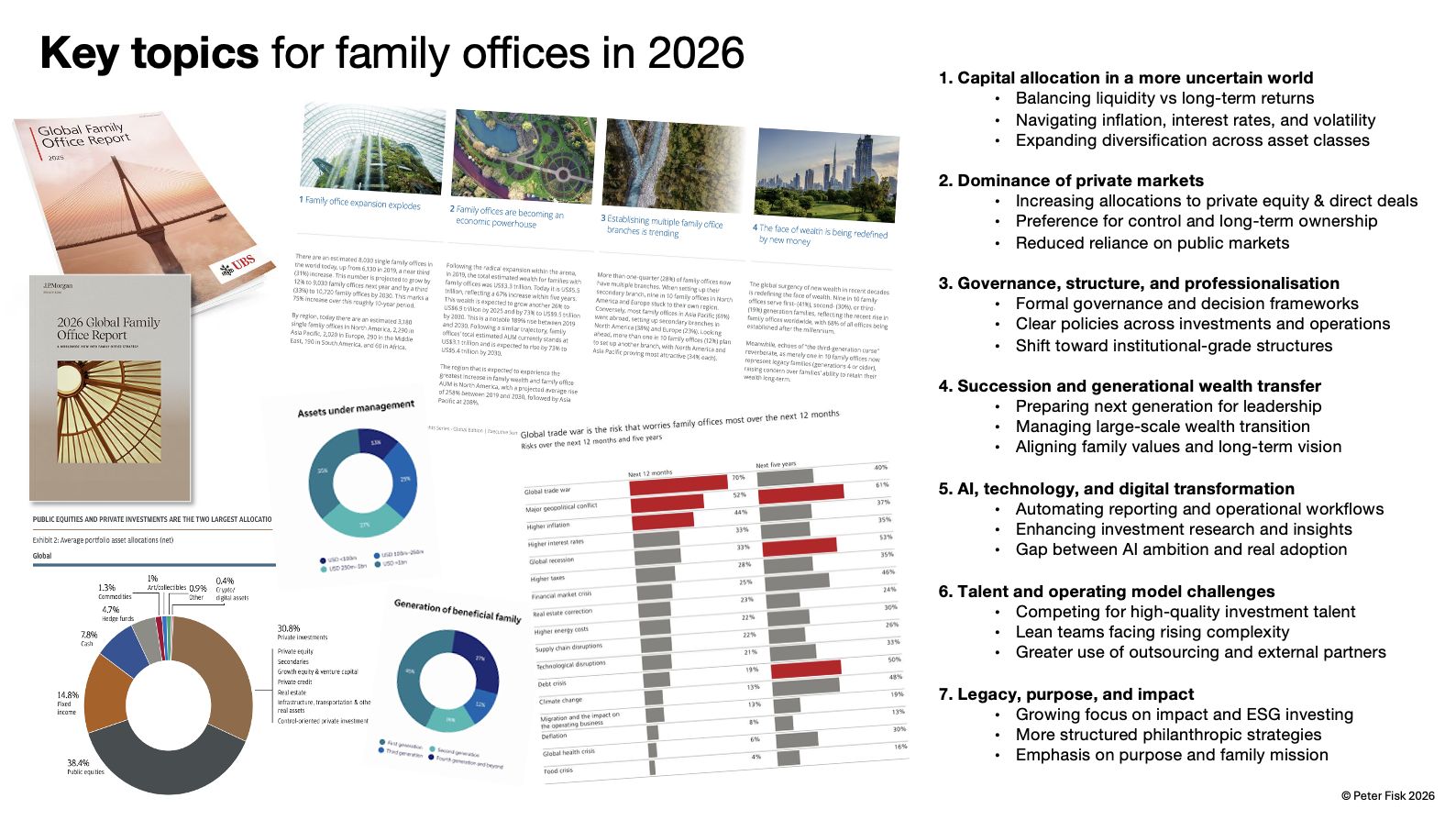
What is a family office?
First, a definition.
Family offices are private structures established by wealthy families to manage their financial affairs in a coordinated, institutional way. Globally, there are estimated to be around 8,000 such entities, with numbers continuing to grow as wealth increases and becomes more complex. While there is no single formal definition, a family office typically becomes viable once a family’s wealth reaches at least $100–250 million, with many overseeing several hundred million to multiple billions in assets.
In practice, a family office usually consists of a small, dedicated team—often around 10–25 professionals—responsible for investment management, governance, tax planning, and long-term wealth preservation. Operating costs vary with scale but generally represent a modest percentage of assets.
A key advantage of a family office is the separation it creates between family wealth and any underlying operating business. This enables more disciplined investment decisions, improved diversification, clearer succession planning, and stronger governance—supporting the preservation and growth of wealth across generations.
AI as a transformative force in family offices
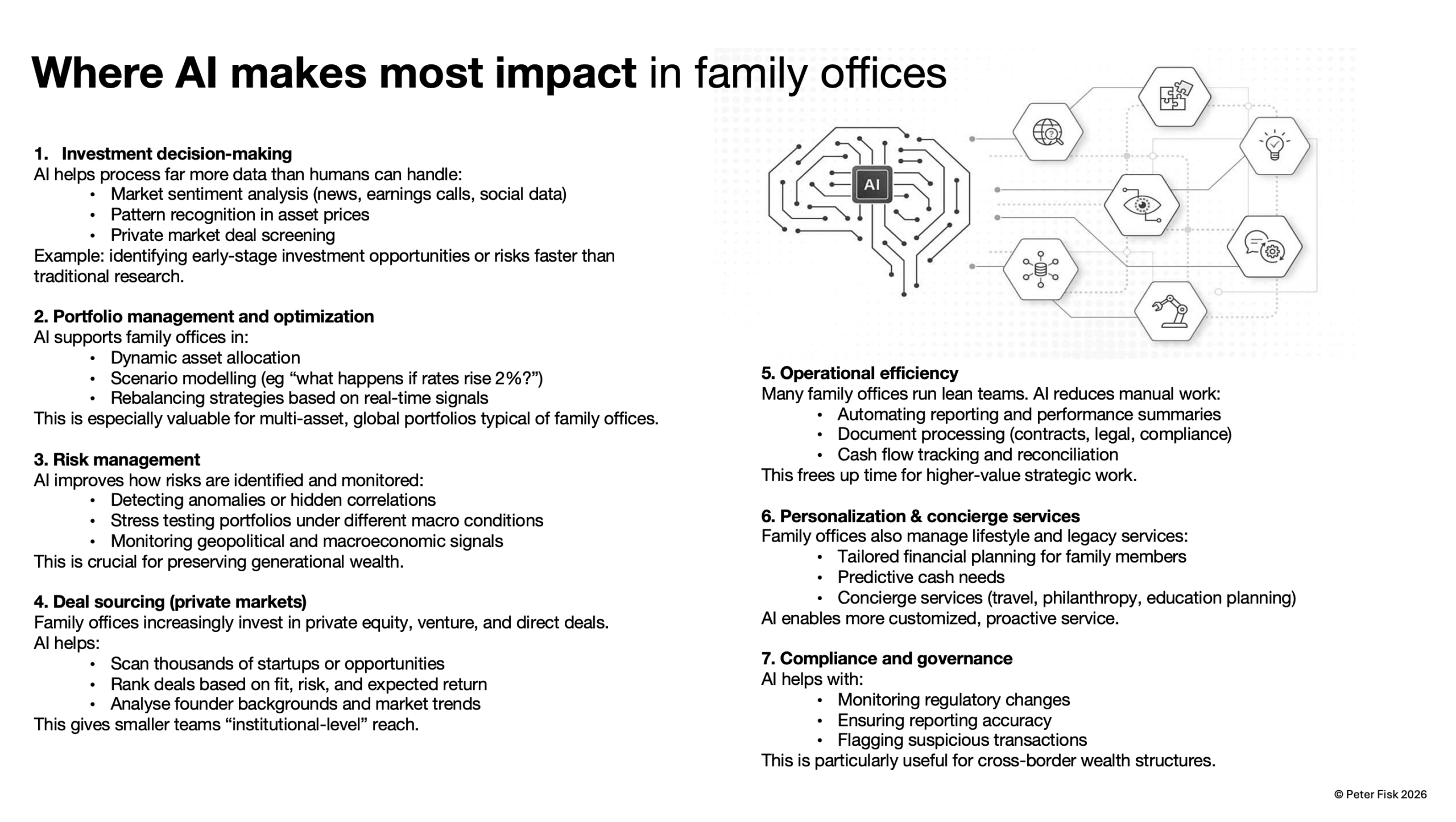
Family offices have historically focused on wealth preservation, tax optimisation, and investment management. Yet the contemporary landscape demands more than operational excellence; it requires foresight, agility, and the capacity to identify and capture opportunities in a rapidly shifting global environment. AI serves as a transformative force across three critical dimensions: decision intelligence, operational efficiency, and strategic foresight.
Decision intelligence
At its core, AI provides the family office with unprecedented decision intelligence. By leveraging vast datasets, machine learning algorithms, and predictive analytics, AI allows leaders to anticipate market movements, assess risk, and identify opportunity with far greater precision than traditional approaches.
Consider a multi-generational European family office with significant exposure to equities, private equity, and real estate. Historically, investment committees relied heavily on quarterly reporting, analyst briefings, and personal judgement honed over decades. Today, AI-driven platforms can continuously analyse global market trends, macroeconomic indicators, and asset performance, flagging risks or opportunities weeks or even months in advance. A sudden policy shift affecting renewable energy subsidies, for example, can trigger automated scenario analyses, guiding the family office in adjusting portfolios in real time.
For NextGen leaders, this is a paradigm shift. Rather than relying solely on the instincts and experience of previous generations, they can now make informed, high-impact decisions guided by AI insights, while still embedding family values and long-term vision. AI does not replace judgment; it amplifies it. Leaders move from reactive decision-making to strategic orchestration.
Operational efficiency
AI also streamlines operations, reducing the time and effort devoted to routine tasks, reporting, compliance, and risk management. Advanced dashboards integrate data across portfolios, jurisdictions, and asset classes, providing real-time visibility into cash flows, tax exposures, compliance obligations, and even philanthropic outcomes.
For instance, a Singapore-based family office with extensive global investments can use AI to monitor currency fluctuations, interest rates, and regulatory changes simultaneously. Where previously a team of analysts would spend weeks producing quarterly reports, AI generates actionable insights instantaneously, freeing leadership to focus on strategy, relationship-building, and long-term vision. This operational leverage is especially valuable for NextGen leaders, who must balance stewardship of the family legacy with the demands of innovation and enterprise growth.
Strategic foresight
Perhaps most profoundly, AI enables strategic foresight. Beyond analysing historical data, AI tools can scan thousands of startup deals, patents, scientific papers, and market signals to identify emerging trends, innovation gaps, and potential new markets. Natural language processing, for example, can identify shifts in consumer sentiment or early signals of disruptive technologies in sectors aligned with the family enterprise.
A case in point: a Middle Eastern family office historically invested in energy infrastructure. Using AI to monitor global patent filings, policy developments, and venture capital trends, the next gen leadership identifies an emergent opportunity in green hydrogen technologies. By investing early in a portfolio of startups aligned with the family’s existing industrial competencies, they not only preserve legacy but also create new avenues for growth.
Strategically, this positions NextGen leaders as proactive stewards, capable of spotting opportunities before competitors, navigating disruption, and aligning AI-driven insights with long-term family vision.
How AI will shape the role of next leaders
AI changes not just what family offices do, but who NextGen leaders need to be. Traditional next gen roles often emphasised learning the family business, executing operational responsibilities, and maintaining continuity. In an AI-enabled world, the expectations are fundamentally different. Leaders must evolve from executors to strategists, from operational managers to ecosystem builders, and from isolated decision-makers to orchestrators of collaborative intelligence.
From Executor to Strategist
The first transformation is conceptual: next gen leaders move from executing tasks to interpreting AI-driven insights and making scenario-based decisions.
Consider a London-based family office overseeing a diversified portfolio of real estate, venture capital, and public equities. Previously, a successor might spend months manually reviewing reports to understand portfolio exposure. With AI-enabled risk simulations, however, the leader can test multiple scenarios—such as interest rate changes or sector-specific disruptions—and rapidly decide whether to pivot a venture, increase exposure to high-growth areas, or divest underperforming assets.
The practical implication is profound: leaders now integrate AI insights into strategic planning and portfolio decisions, balancing analytical rigor with the family’s values and long-term goals.
From Operational Focus to Ecosystem Builder
AI also expands the scope of leadership from managing operations to curating an ecosystem of assets, ventures, and partnerships. By identifying connections between industries, markets, and networks, AI enables leaders to make more informed choices about where to invest, innovate, or collaborate.
A concrete example comes from a Hong Kong family office investing in luxury retail. AI analytics reveal emerging consumer behaviour trends in Asia, alongside potential synergy with tech-enabled supply chain solutions. Using these insights, the NextGen leader facilitates minority investments in high-growth e-commerce startups that complement the family’s traditional business, fostering innovation while preserving legacy.
This shift emphasises the orchestration of complex networks, where AI provides the intelligence, but the human leader curates, negotiates, and activates opportunities.
From Individual Insight to Collaborative Intelligence
Finally, AI encourages leaders to move from isolated insight to collaborative intelligence, integrating knowledge across teams, advisors, and enterprise units. Cohesion and alignment are vital: AI may generate insights, but translating them into actionable strategies requires leadership that bridges generational perspectives and aligns stakeholders around shared goals.
For instance, a next gen leader in a European family office might use AI to identify potential gaps in talent, innovation, or market coverage. They then coordinate across family executives, business units, and external advisors to implement initiatives, ensuring insights become real-world impact rather than abstract reports.
Practical shifts for next leaders
AI is not an abstract tool, it drives tangible shifts in how next leaders operate, with clear implications across investments, enterprise growth, governance, philanthropy, and leadership development.
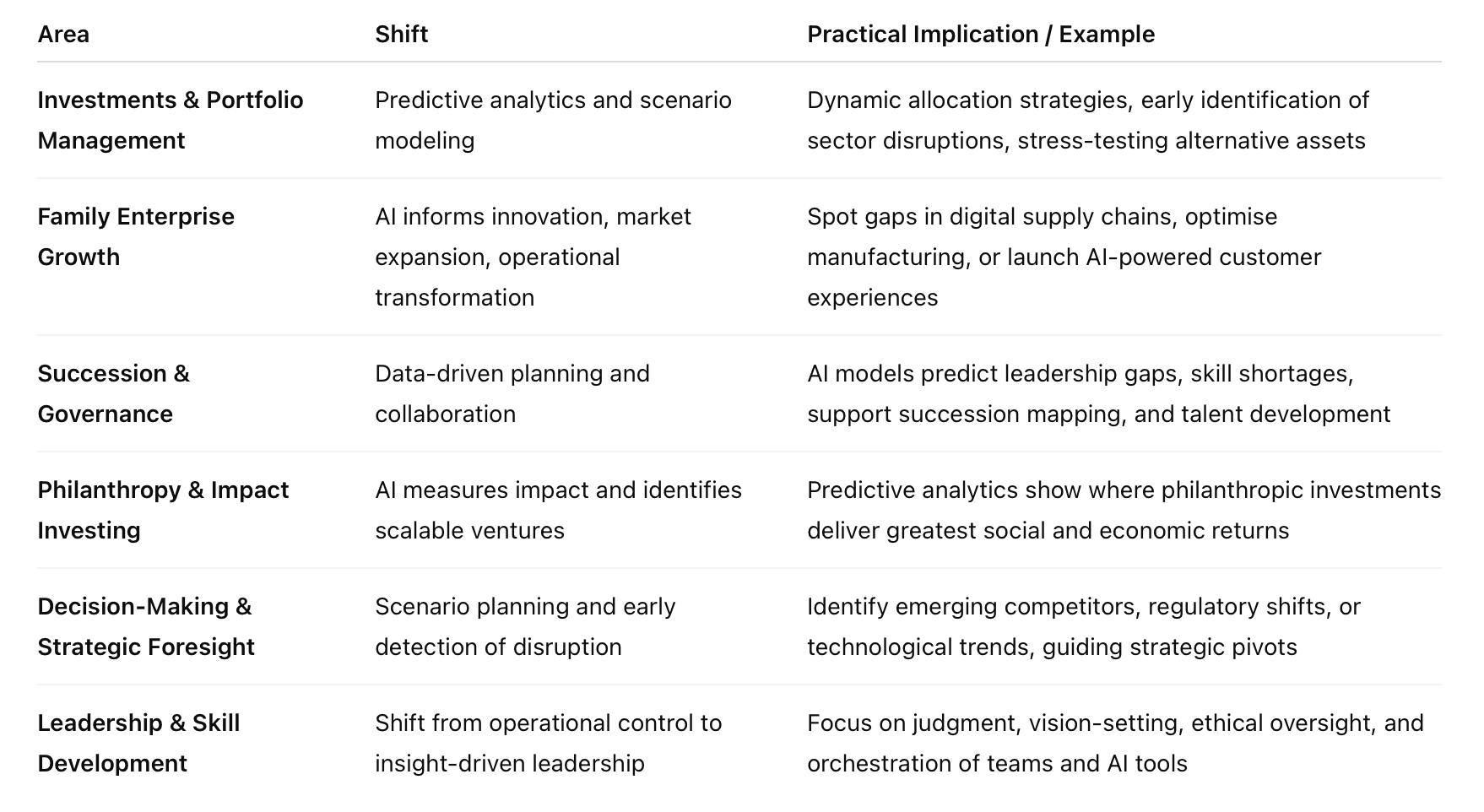
These shifts highlight that AI does not replace the leader but enhances their capacity to create value, innovate, and steward legacy.
Examples of AI in action for family offices
Financière Agache, the Arnault family office
Financière Agache, the family office of the Arnault family, stewards the wealth and strategic holdings behind LVMH, one of Europe’s most prominent luxury groups. Traditionally focused on preserving and growing legacy luxury assets, the office has evolved into a forward-looking investment vehicle, increasingly leveraging technology and data to drive value creation across sectors. Under the leadership of Frédéric Arnault, the next generation, the office has embraced AI and analytics as strategic enablers, using digital insights to assess investments, optimise risk, and evaluate complex global asset portfolios.
AI is not merely a tool but a lens for decision-making. Financière Agache integrates data-driven scenario modelling, predictive analytics, and operational dashboards to identify opportunities in luxury, digital platforms, and tech-enabled ventures. AI supports everything from personalised customer engagement strategies in portfolio companies to forecasting macro and sectoral trends, allowing leadership to act proactively rather than reactively.
NextGen leadership has also influenced the office’s strategic posture, advocating for technology-aligned, mission-driven investments that balance legacy preservation with growth and innovation. By embedding AI into both investment analysis and operational planning, Financière Agache exemplifies how a heritage European family office can combine tradition, foresight, and digital insight, empowering the next generation to steward wealth, drive innovation, and capture emerging opportunities in a rapidly changing world.
Kirkbi, the Kristiansen family office
Kirkbi A/S, the family office of the Kristiansen family, stewards the wealth and legacy of the Lego Group. While its foundation has always been on preserving the family’s long-term interests, the office has evolved into a strategic, globally aware investment vehicle, reflecting broader trends in European family offices. Kirkbi’s portfolio now spans renewable energy, climate infrastructure, private equity, and select technology ventures, signalling a shift from traditional asset preservation toward future-oriented, value-creation investing.
AI and digitalisation have become strategic enablers rather than isolated tools. Though Kirkbi does not publicly disclose internal systems, industry trends suggest that next generation leaders are driving adoption of data analytics, predictive modelling, and scenario-planning platforms to support portfolio decisions. These tools allow leadership to monitor global markets, assess risk dynamically, and optimise capital deployment efficiently.
Next generation influence is particularly notable: younger family principals advocate for mission-aligned investments, technology adoption, and sustainability-driven strategies, combining Lego’s heritage with emerging opportunities. Digital workflows enable faster decision-making, operational transparency, and integration of external advisors and ecosystem partners.
Kirkbi illustrates how a legacy-focused European family office can combine stewardship, innovation, and digital insight, enabling NextGen leaders to preserve the family’s values while actively shaping the long-term growth and relevance of the family’s capital.
D11Z, the Schwarz family office
D11Z is the single-family office of the Schwarz family, owners of the global retail conglomerate Lidl and Kaufland. Traditionally, family offices like D11Z focused on wealth preservation and operational oversight, but the office has transformed into a strategic, innovation-driven vehicle with global reach. Its investment philosophy emphasises early-stage ventures in AI-enabled B2B technologies, green tech, and advanced analytics, reflecting the family’s desire to actively create long-term value while anticipating structural market shifts.
The office leverages proprietary data and analytical tools to identify high-potential startups, track emerging industry trends, and simulate portfolio outcomes. AI and advanced analytics are integrated into deal sourcing, risk management, and scenario planning, enabling faster, more informed decision-making. This is not merely automation; it represents a shift toward data-driven strategic foresight, where human judgment is augmented by AI insights.
NextGen leaders play a central role in this transformation, advocating for technology adoption, hiring data-savvy teams, and engaging with founders and innovation ecosystems directly. Their influence has accelerated the adoption of AI-enabled workflows and investment models, embedding foresight and agility into the office’s operations.
D11Z exemplifies how a modern European single-family office can transition from passive wealth stewardship to active, tech-informed investment leadership, empowering the next generation to steward family capital with innovation, insight, and long-term strategic vision.
Here are some more examples of how AI is reshaping the family office:
-
AI-Enabled Investment Platforms
AI platforms can analyse thousands of private equity, venture capital, or real estate opportunities in real time, identifying niche, high-growth opportunities that align with family values or legacy industries. A family office in Zurich, for example, uses AI to identify early-stage clean-tech startups, enabling strategic minority stakes before competitors even become aware of them. -
AI for Family Enterprise Strategy
AI tools can scan global supply chains, consumer trends, and competitor actions, recommending new business models or product innovations. A Middle Eastern industrial family office predicted a shift toward sustainable energy demand and pivoted to complementary green technology investments, capturing growth without compromising legacy operations. -
Operational Transformation
Automation of treasury, reporting, compliance, and risk management accelerates decision-making. Using AI dashboards, a London-based NextGen leader can review cash flow scenarios, stress-test investments, and reallocate capital within hours rather than weeks, enabling more agile, informed governance. -
Scenario-Based Legacy Planning
AI models multiple succession and governance scenarios, allowing NextGen leaders to simulate consequences and optimise intergenerational planning. A family office in Singapore used AI to model potential leadership transitions across business units and philanthropic ventures, ensuring continuity while enabling growth initiatives.
The takeaways for next leaders
AI is an amplifier of impact, not a replacement for human judgment. It shifts the NextGen role from operational manager to strategic orchestrator, combining three core competencies:
-
Vision and stewardship – Aligning AI insights with family values, long-term vision, and multi-generational responsibility.
-
Innovation and growth – Using predictive and analytical tools to expand enterprises, invest strategically, and create new value.
-
Leadership and capability – Cultivating adaptive, collaborative teams capable of acting on AI-driven insights while maintaining ethical oversight.
Leaders who embrace AI as a transformation enabler are positioned to lead more effectively, protect family legacy, and generate new value in ways that previous generations could not. The next era of family enterprise leadership is not defined by wealth alone but by the ability to harness technology, navigate disruption, and orchestrate human and machine intelligence in pursuit of enduring impact.
Stepping up
The world of UHNW family offices is changing. Generational wealth is no longer managed solely through tradition and intuition; it is shaped by insights derived from vast data, predictive algorithms, and AI-driven foresight. For next gen leaders, the challenge is clear: they must learn to interpret, integrate, and act on these insights, bridging human judgment with technological intelligence.
In practice, this means redefining what it is to be a family office leader. Decisions are faster, more informed, and more precise; operations are streamlined, freeing capacity for strategy and growth; and foresight becomes predictive, enabling leaders to act before disruption arrives. AI is not a silver bullet, but for those who embrace it as a strategic enabler, it becomes a lever for stewardship, innovation, and enduring legacy.
The future of UHNW family offices, and the families they serve, will be shaped not by AI alone, but by next gen leaders who know how to wield it wisely. Those who do so will steward their legacies with insight, courage, and creativity, ensuring their family enterprises thrive across generations in a world defined by change.
- Top 10 Family Office Global Trends by Deloitte
- Asia Pacific’s Family Office Boom by McKinsey
- The Future of Family Wealth by The UHNW Institute
More from the blog