AI’s acceleration of change … the Madisson Project explains how we have emerged from 2000 years of stagnation to the possibility of 20x growth every century
December 27, 2025

How the long-run GDP research of Angus Maddison and the updated datasets from The Maddison Project at the University of Groningen frame the case that AI could accelerate healthcare, science, and innovation cycles enough to shift the global growth rate itself.
For most of human history, economic progress was so slow that it was almost invisible. A farmer in 1200 lived much like a farmer in 800. A merchant in 1500 was not dramatically richer than one in 1000. Growth existed, but it did not compound in a meaningful way.
That long stagnation—and the dramatic escape from it—is best understood through the work (between 1970 and 2010) of Angus Maddison. Over several decades, Maddison painstakingly reconstructed historical GDP and population data across countries going back nearly two millennia. His estimates, later refined and extended by The Maddison Project at the University of Groningen (2013-2020), gave economists something they had never truly possessed before: a quantitative map of civilization-scale growth.
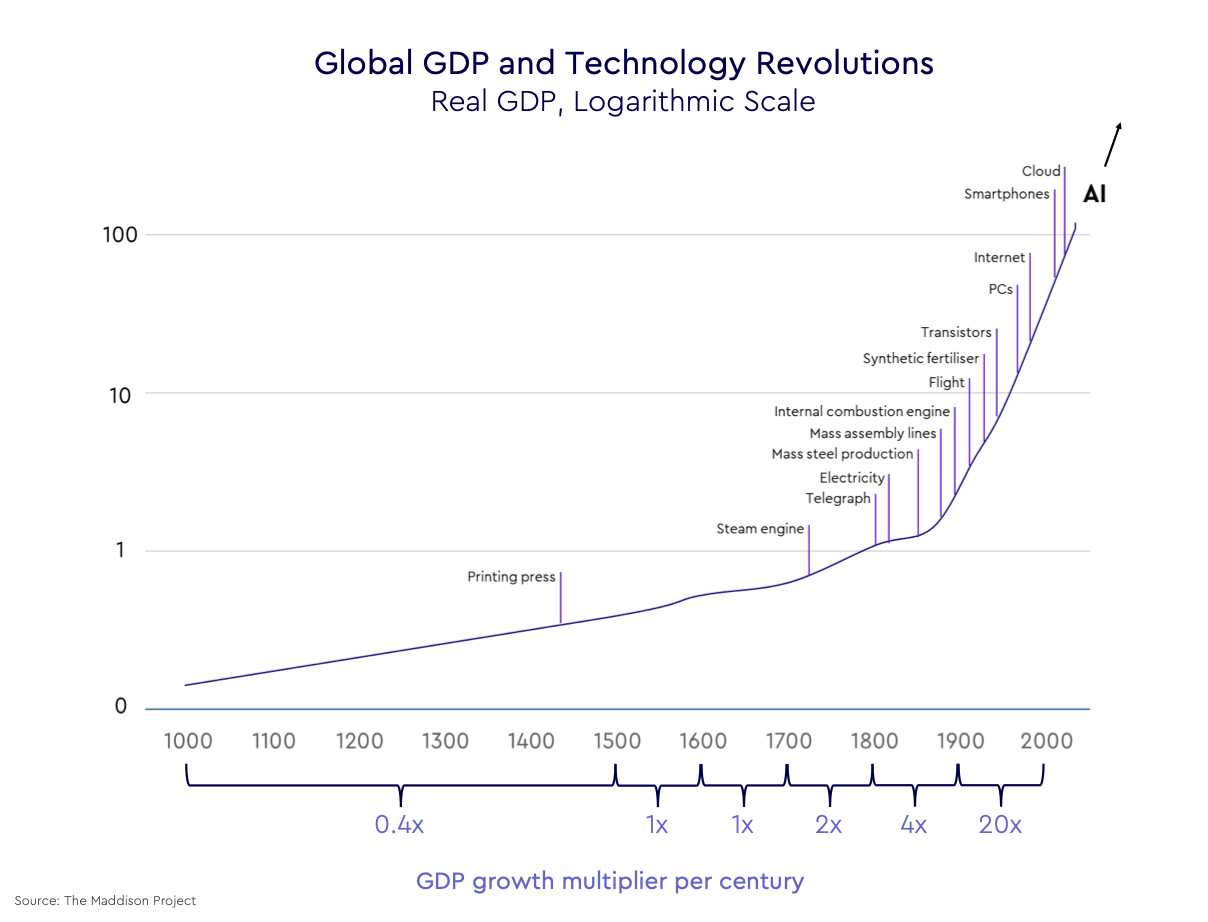
That map reveals a startling pattern. For roughly 1,800 years, global per capita income barely increased. Annual growth hovered near zero—around 0.05–0.1%. At that pace, it would take a millennium for incomes to meaningfully double. This was the Malthusian world: technological improvements mostly translated into larger populations, not higher living standards
The First Acceleration: Industrialization
Around 1800, the Industrial Revolution changed the trajectory of growth. Mechanization, steam power, and factory production pushed leading economies toward sustained 1–2% annual per capita growth.
That shift may sound incremental, but compounding magnifies it dramatically:
- 1% annual growth ≈ 2.7× expansion per century
- 2% annual growth ≈ 7× expansion per century
For the first time in recorded history, living standards multiplied within a few generations. The growth curve bent upward.
The Second Acceleration: The 20th Century
The 20th century brought electrification, internal combustion, telecommunications, aviation, pharmaceuticals, and computing. Some advanced economies sustained 2–3% annual per capita growth for decades.
At 3% growth, output rises nearly 20× over a century.
The Maddison data thus reveals a pattern: growth is not linear. It occurs in rare step changes. When the underlying growth rate shifts even slightly, the long-term consequences are transformative.
That historical pattern sets the stage for the AI question.
The AI Extrapolation: Where “20× per Century” Comes From
The Maddison dataset does not predict AI-driven growth. The “20× per century” thesis is a modern extrapolation grounded in the mathematics of compounding.
If AI helps sustain:
- ~3% long-run annual per capita growth → ~20× per century
- ~4% growth → ~50× per century
- ~5% growth → >100× per century
The claim is not that this will happen automatically. The claim is that AI, as a general-purpose technology, could plausibly raise the long-run growth rate in the way steam power or electricity once did.
The core distinction is this:
- Industrialization automated physical labor.
- AI has the potential to augment or automate cognitive labor.
If cognition itself becomes scalable, the growth implications are different in kind, not just degree.
Healthcare: Compressing the Timeline of Discovery
One practical area where this matters is healthcare.
Drug development today often takes more than a decade. AI systems capable of predicting protein structures, simulating molecular interactions, and optimizing trial design could shorten that cycle.
The economic effects would compound:
- Faster development of treatments
- Lower long-term healthcare costs
- Healthier, more productive populations
- Longer working lives
In the 20th century, public health improvements significantly contributed to growth. AI could accelerate that channel again—by compressing innovation timelines.
Science and Energy: Unlocking New Constraints
Economic history shows that energy abundance is tightly linked to growth accelerations. Steam power, fossil fuels, and electrification all lifted production ceilings.
AI-assisted research could accelerate breakthroughs in:
- Advanced materials
- Battery storage
- Nuclear fusion
- Carbon capture
If discovery cycles shorten and experimental iteration speeds up, scientific progress itself accelerates. The result is not just higher output—it is a faster pace of unlocking new production possibilities.
Innovation Cycles: Speed as a Growth Variable
Perhaps the most radical implication concerns innovation speed.
Past general-purpose technologies required decades of infrastructure buildout. Electrification required new grids and redesigned factories. The internet required global networks and new business models.
AI, by contrast, is software. It can scale globally in years.
If AI reduces the time required for:
- Software development
- Legal drafting
- Engineering design
- Supply chain optimization
then the gap between idea and implementation shrinks. Shorter cycles mean faster feedback. Faster feedback means more rapid productivity gains.
In that world, growth feeds on itself.
The 20x Century
The difference between 2% and 4% annual growth is not dramatic in a single year. Over a century, it is the difference between a world that is seven times richer and one that is fifty times richer. Compounding turns marginal percentage shifts into civilizational divergence.
None of this is guaranteed. The Maddison data also teaches caution. Sustained growth accelerations are rare. They require institutional stability, capital investment, diffusion of knowledge, and political accommodation. The Industrial Revolution produced upheaval before prosperity generalized. AI could generate its own social and labor disruptions that shape its long-run trajectory.
But the broader perspective remains powerful. When plotted over two thousand years, economic history looks like a staircase: a long flat stretch, a sharp upward step around 1800, another acceleration in the 20th century. Each step corresponded to a general-purpose technology that changed the constraints of production.
The work of Angus Maddison provided the long arc. The Maddison Project at Groningen refined it and extended it. The “20× per century” AI hypothesis is an attempt to apply that long-run lens forward.
The essential question is not whether AI improves productivity at the margin. It almost certainly will. The deeper question is whether it alters the slope of the growth curve itself.
If it does—if AI meaningfully augments cognition, accelerates science, and compresses innovation cycles—future historians may look back on the early 21st century as another clear discontinuity in the data. And what appears today as a small shift in annual growth rates may ultimately define the economic character of the century.
More from the blog