How space has become the new frontier for AI and computing, communications and advanced manufacturing, with limitless energy and zero emissions … and why the SpaceX and xAI/X merger is a symbol of exponential possibilities
February 3, 2026

AI is advancing at a breathtaking pace. Models are growing larger, systems more autonomous, and intelligence more deeply embedded into everything from healthcare and finance to logistics, defence and climate science.
Yet beneath the excitement lies a hard constraint that will shape the next era of innovation: processing power requires energy, and energy has limits on Earth.
AI systems depend on vast amounts of processing power. That power consumes electricity, generates heat, requires cooling, and increasingly competes with cities, industries and households for finite resources. As AI scales, so do carbon emissions, water usage and infrastructure strain. The uncomfortable truth is that today’s trajectory is environmentally, economically and politically unsustainable.
This is why a growing number of technologists, scientists and companies are looking upward. Not out of science fiction fantasy—but out of necessity. Space is emerging as the next logical home for energy-intensive intelligence and industry.
This week’s move by SpaceX to align satellite networks, AI and communications platforms are best understood in this context. Regardless of what you think of Musk, Grok or X, this is an early signal of a broader shift: the future of data processing, energy and advanced industry may be extra-terrestrial. Yes it will enhance the potential value of SpaceX’s IPO, but that’s because it symbolises a more fundamental shift in tech, and the exponential opportunities of space.
Or, to borrow from the movie … ET isn’t phoning home anymore. ET is building infrastructure.
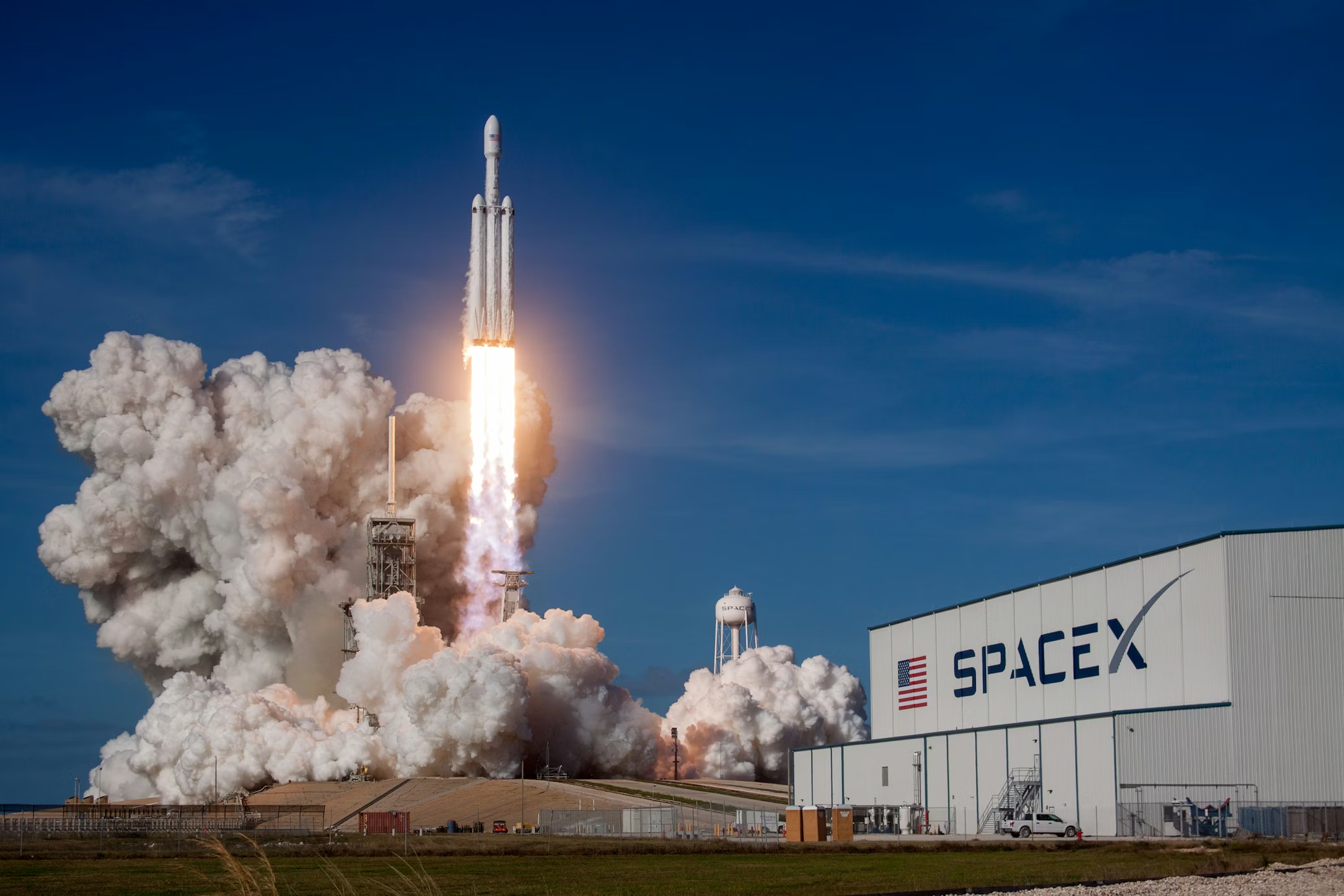
AI’s energy challenge
AI is no longer constrained by imagination. It is constrained by physics.
Training and operating advanced AI systems requires specialised chips running continuously at extraordinary intensity. At global scale, this translates into:
- Data centres consuming gigawatts of electricity
- Cooling systems drawing heavily on water resources
- Rising carbon emissions despite efficiency gains
- Local resistance to new infrastructure projects
In some regions, AI facilities are already being delayed or blocked because power grids simply cannot cope.
This creates a structural tension. AI is promoted as a tool to optimise energy use, reduce waste and fight climate change—yet its own growth threatens to overwhelm the very systems it aims to improve.
If intelligence is to keep scaling, it needs abundant, clean, reliable energy—at a scale Earth increasingly struggles to provide.
Space offers limitless energy
Space offers something Earth cannot: near-limitless solar energy without competition.
Above the atmosphere, solar power is constant, uninterrupted by night, weather or seasons. Cooling is dramatically easier. There is no land scarcity, no local opposition, and no water stress. From an engineering perspective, space is uniquely well suited to hosting energy-hungry systems.
That logic applies not just to AI, but to a growing range of industries already experimenting beyond Earth.
What we are witnessing is not a single breakthrough, but the early formation of a space-based industrial ecosystem.
AI and processing power in orbit
The SpaceX–Starlink–AI alignment is one of the clearest examples of this shift.
Starlink already operates a global satellite network powered by solar energy. Adding intelligence and processing power into that network transforms satellites from passive relays into active, intelligent nodes – capable of analysing data, optimising traffic, and delivering real-time services without routing everything back to Earth.
This model points toward a future where:
- Processing power moves closer to where data is generated
- Networks become intelligent systems, not just pipes
- Energy generation and data processing are tightly integrated
- Carbon intensity per unit of intelligence falls dramatically
Even if the specifics change, the strategic insight remains: Earth-bound data centres are not the end state for AI.
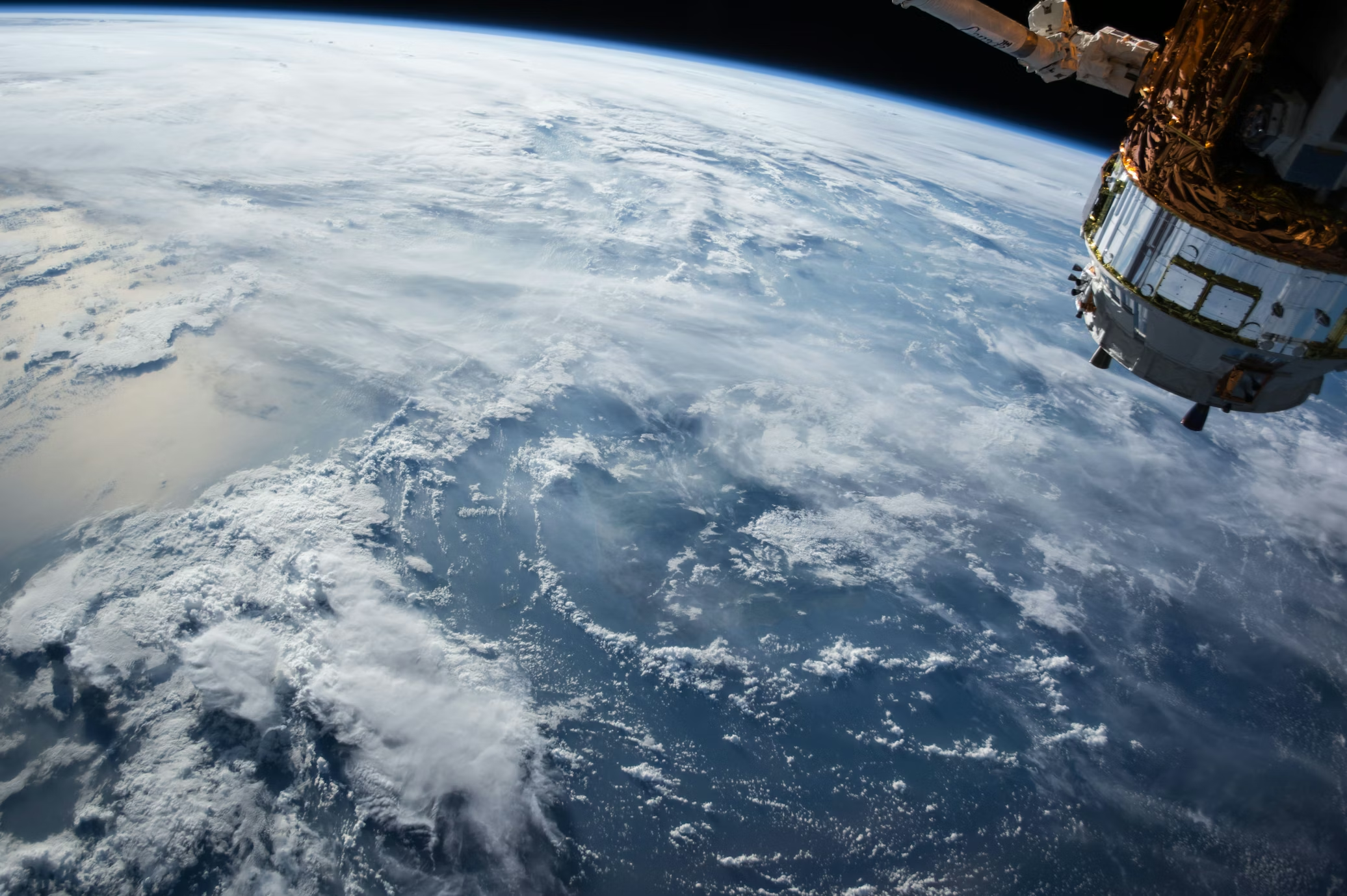
Asteroid Mining
AI and data processing are only part of the story.
Companies like Planetary Resources pioneered serious efforts to explore asteroid mining—not as science fiction, but as a response to resource scarcity on Earth.
Asteroids contain extraordinary concentrations of rare metals, including platinum-group elements essential for electronics, energy systems and advanced manufacturing. In the long run, extracting materials in space—rather than digging deeper holes on Earth—could reduce environmental damage while unlocking new economic models.
While early asteroid-mining ventures struggled financially, their core premise has not disappeared. It has simply matured. Today, governments and private companies increasingly view space resources as:
- Strategic assets
- Inputs into clean energy technologies
- Enablers of off-planet manufacturing
As processing power, robotics and AI improve, the feasibility of autonomous space mining rises sharply.
Life Sciences
Another surprising frontier is healthcare.
The International Space Station has already hosted experiments in:
- Protein crystallisation for drug development
- Tissue engineering and regenerative medicine
- Cancer research and cell behaviour
- Bone density and muscle degeneration
Microgravity environments allow biological processes that are impossible on Earth. Crystals grow more perfectly. Cells behave differently. Certain diseases can be studied in accelerated or clearer ways.
As AI-driven analysis and processing power expand, space-based biomedical research could become dramatically more valuable—especially for personalised medicine, advanced therapies and longevity science.
In this context, space is not an escape from Earth’s problems, but a laboratory for solving them.
Climate Intelligence
Ironically, space may become essential to saving Earth.
Satellites already play a critical role in monitoring climate systems, deforestation, ice melt, ocean health and atmospheric changes. Adding more intelligence and processing power in orbit allows data to be analysed in real time, enabling faster response and better forecasting.
This matters because climate systems generate enormous data volumes. Processing that data on Earth adds energy costs and delays. Processing it in space—powered by solar energy—reduces both.
Here again, intelligence moves closer to the source, improving efficiency while lowering emissions.
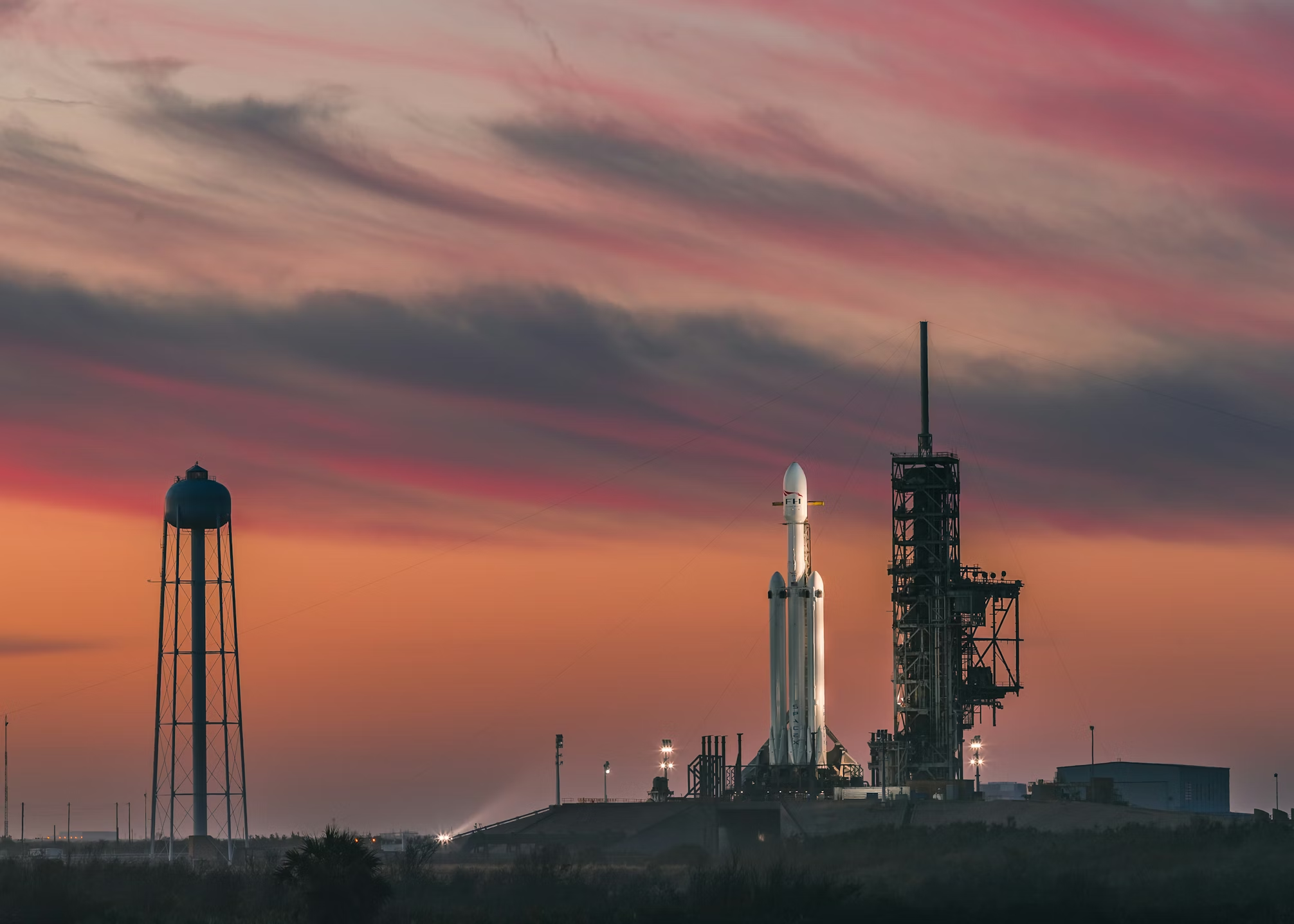
Space Ecosystems
Taken together, these developments point to a profound shift.
For decades, technological progress assumed Earth as the sole stage. Now, the planet’s limits—energy, carbon, land, water—are forcing a rethink.
The emerging model looks different:
- Energy generation in space
- Processing power in orbit
- Intelligence distributed across planetary systems
- Networks spanning Earth and beyond
This is not about abandoning Earth. It is about supporting Earth from above.
SpaceX, Starlink and X
SpaceX’s integration of launch capability, satellite networks and AI is not unique—but it is visible.
It shows what happens when declining launch costs meet rising energy demands and accelerating intelligence. Others will follow, in different forms, with different governance models and values.
Whether one admires or dislikes Musk is almost beside the point. History rarely waits for consensus or comfort. It moves when constraints collide with ambition.
This move is not a conclusion. It is an early example of what’s to come.
ET is extending possibilities
The future of intelligence will not be confined to Earth.
As AI, data processing and advanced industry continue to scale, space offers a release valve for energy constraints, environmental impact and economic growth. From processing power and communications to mining, medicine and climate intelligence, the next industrial frontier is forming above our heads.
ET isn’t phoning home anymore. ET is generating power. ET is processing data. ET is building networks. And increasingly, ET is helping us to embrace new industries in better ways, and explore new possibilities.
© Peter Fisk 2026

Here are my top 10 most interesting space businesses right now, from rocket and satellite companies, to those using space to develop new breakthroughs that enhance life on earth:
1. SpaceX
- Origins: Founded in 2002 by Elon Musk to reduce space costs and enable Mars colonisation; now includes Starlink broadband and AI/communications assets through acquisition of xAI/X.
- Purpose: Launch reusable rockets, deploy Starship for interplanetary travel, operate Starlink global broadband, and develop space-based AI and computing.
- Progress: Dominates commercial satellite launches and crewed missions to the ISS; Starlink has thousands of satellites and millions of users; pre-IPO valuation of $1.25 billion reflects its scale and ambitions.
2. RTX/Raytheon
- Origins: Created in 2020 from the merger of Raytheon Company and United Technologies aerospace divisions.
- Purpose: Aerospace and defense leader providing satellite communications, sensors, radar, tracking, and ground control systems for civilian and military space applications.
- Progress: Longstanding contractor for U.S. government space programs; a cornerstone in satellite infrastructure, defense tracking, and advanced space systems. Market cap of around $230 billion.
3. Rocket Lab
- Origins: Founded in 2006 by Peter Beck in New Zealand; now publicly traded in the U.S.
- Purpose: Small satellite launch provider via Electron rockets, spacecraft manufacturing via Photon, and medium-lift Neutron launch development.
- Progress: 75+ successful Electron launches; strong backlog of missions; establishing itself as a major player in small and medium satellite delivery. Market cap around $12 billion.
4. AST SpaceMobile
- Origins: Founded in 2017 by Abel Avellan; went public via SPAC.
- Purpose: Build the first space-based cellular broadband network connecting standard smartphones directly to LEO satellites.
- Progress: Launched BlueBird satellites; signed partnerships with Verizon, Vodafone, and other carriers; raising over $2 billion in funding. Market cap around $8 billion.
5. OneWeb
- Origins: Founded in 2012, emerged from bankruptcy with ownership by the UK government and Bharti Global, later merged with Eutelsat.
- Purpose: Deploy a LEO broadband satellite constellation to provide global internet connectivity for enterprise, government, and underserved regions.
- Progress: Hundreds of satellites launched; providing low-latency broadband primarily for governments and business partners rather than direct-to-consumer. Estimated value of $5 billion.
6. Intuitive Machines
- Origins: Founded in 2013 by Stephen Altemus, Kam Ghaffarian, and Tim Crain; went public via SPAC in 2023. Read their investor presentation.
- Purpose: Lunar delivery services, cislunar communications, and NASA’s Commercial Lunar Payload Services program.
- Progress: Successfully flown lunar landers, secured multiple NASA contracts; expanding lunar and orbital services. Estimated value of $3 billion.
7. Varda Space Industries
- Origins: Founded in 2021 by Will Bruey and Delian Asparouhov; backed by Founders Fund and Khosla Ventures.
- Purpose: Space-based manufacturing of pharmaceuticals and advanced materials in microgravity for products impossible to make on Earth.
- Progress: Completed multiple funding rounds; collaborative in-orbit manufacturing tests with Rocket Lab; positioning itself as a pioneer in space biotech and materials. Estimated value of $1.5 billion.
8. Relativity Space
- Origins: Founded in 2015 by Tim Ellis and Jordan Noone to leverage 3D printing for rocket construction.
- Purpose: Produce fully 3D-printed rockets (Terran series) to simplify manufacturing, enable rapid reconfiguration, and build reusable heavy-lift launchers.
- Progress: Raised $1.3 billion; first flights of Terran R planned by 2026; unique approach focused on automation and additive manufacturing. Estimated value of $5 billion.
9. Firefly Aerospace
- Origins: Re-formed in 2017 after EOS Launcher acquired Firefly Space Systems assets; backed by AE Industrial Partners.
- Purpose: Small/medium satellite launches (Alpha), lunar lander technology (Blue Ghost), and developing orbital tugs.
- Progress: Successful Alpha launches; NASA CLPS lunar contracts totalling ~$176 million; expanding lunar delivery capabilities. Estimated value of $1.5 billion.
10. Yuri
- Origins: Founded by former SpaceX and space biotech entrepreneurs; privately held.
- Purpose: Space-based biotech research platform for pharmaceuticals, advanced materials, and biological experiments in microgravity.
- Progress: Completed multiple ISS missions; partnerships with NASA and pharmaceutical firms including GSK; emerging as a key player in orbit-based biotech innovation.
More from the blog