Future Car: Reinventing the world’s most iconic industry … from flying Teslas and Chinese challengers to electric nostalgia, autonomous mobility and the end of car ownership as we know it
October 23, 2026
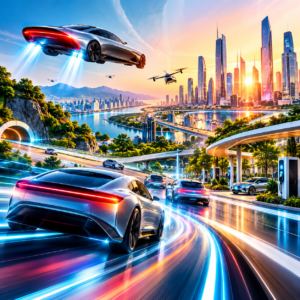
From flying Teslas and Chinese challengers to electric nostalgia, autonomous mobility and the reinvention of car ownership, the global automotive industry is entering its most profound transformation in a century. Yet the real revolution is not simply about replacing petrol engines with batteries. It is about redefining what a car is, who makes it, how we use it, and where value is created. Over the next one, three and ten years, the winners will be those who reinvent the wider mobility ecosystem, rather than simply build better vehicles.
The car that flew … and the industry that is changing direction
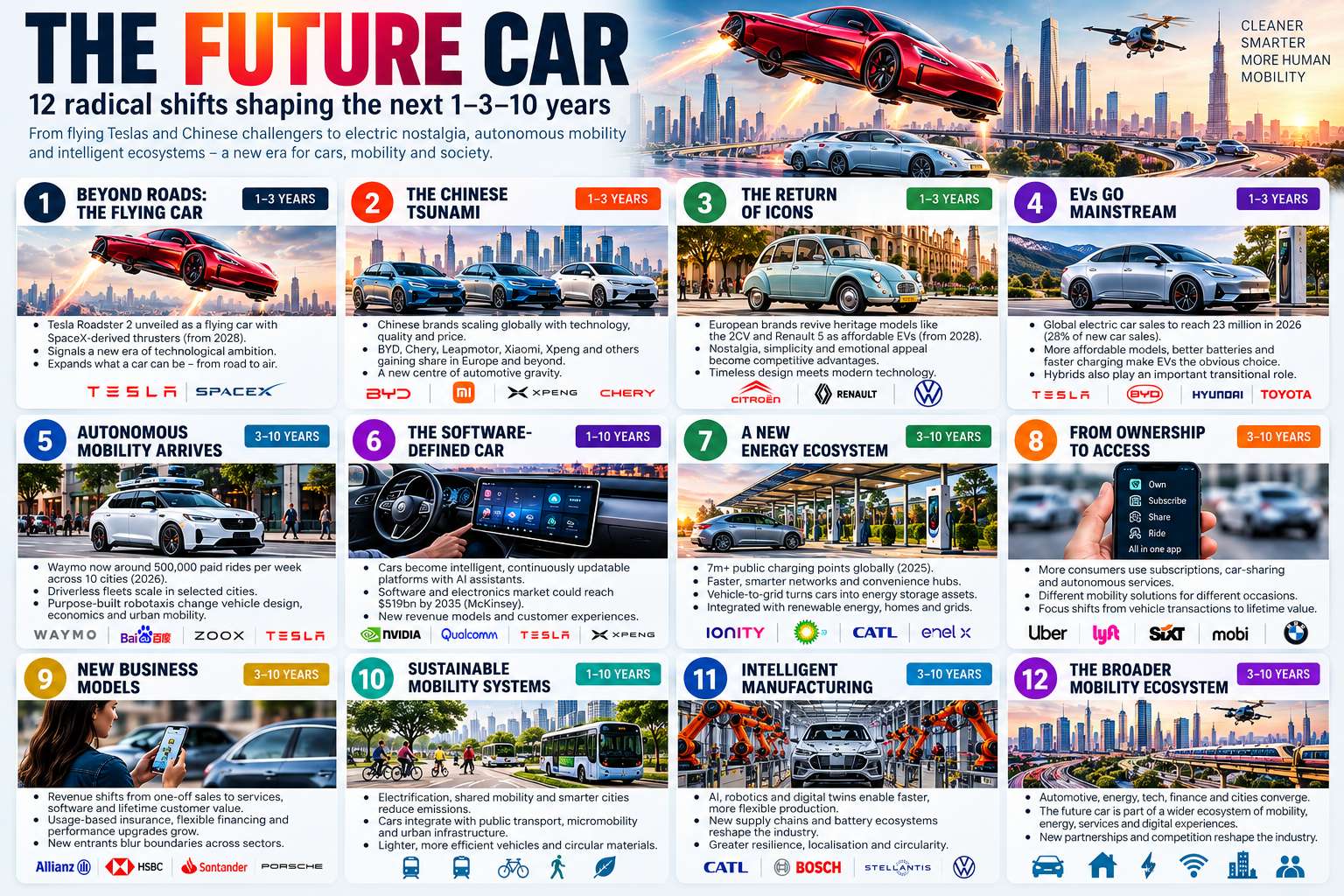
The long-awaited Tesla Roadster 2 has become a symbol of the extraordinary ambitions now reshaping the automotive industry. Elon Musk has repeatedly suggested that the next-generation Roadster could incorporate SpaceX-derived thrusters, potentially enabling capabilities far beyond those of conventional sports cars. The prospect of a rocket-assisted electric supercar captures the imagination, although claims of a recent flying-car demonstration and a confirmed 2028 production launch should be treated cautiously until independently verified.
Whether or not the Roadster ever flies, its significance extends beyond its technical specifications. Tesla is challenging the boundaries of what a car might become, combining automotive engineering, aerospace technology, artificial intelligence and theatrical brand storytelling. It is an expression of technological possibility rather than simply another vehicle launch.
Meanwhile, across the Atlantic, an apparently opposite revolution is taking shape. European manufacturers are rediscovering the appeal of small, affordable and emotionally distinctive cars. Renault has revived the iconic Renault 5 and Renault 4 as electric vehicles, while Citroën’s legendary 2CV continues to inspire speculation about a contemporary electric interpretation. Volkswagen, too, is drawing on familiar small-car identities as it develops its next generation of affordable electric models.
Between these two extremes, Chinese manufacturers are arriving in Western markets with unprecedented speed. BYD, Chery, Leapmotor, Xiaomi, Xpeng and others represent a fundamentally different competitive challenge: faster product development, sophisticated technology, aggressive pricing and a willingness to question almost every established assumption about automotive value.
These three developments represent very different visions of the future. Tesla is pushing the boundaries of technological ambition. Chinese manufacturers are reinventing how cars are designed, developed and produced. European manufacturers are rediscovering the emotional power of brands while struggling to adapt their industrial economics.
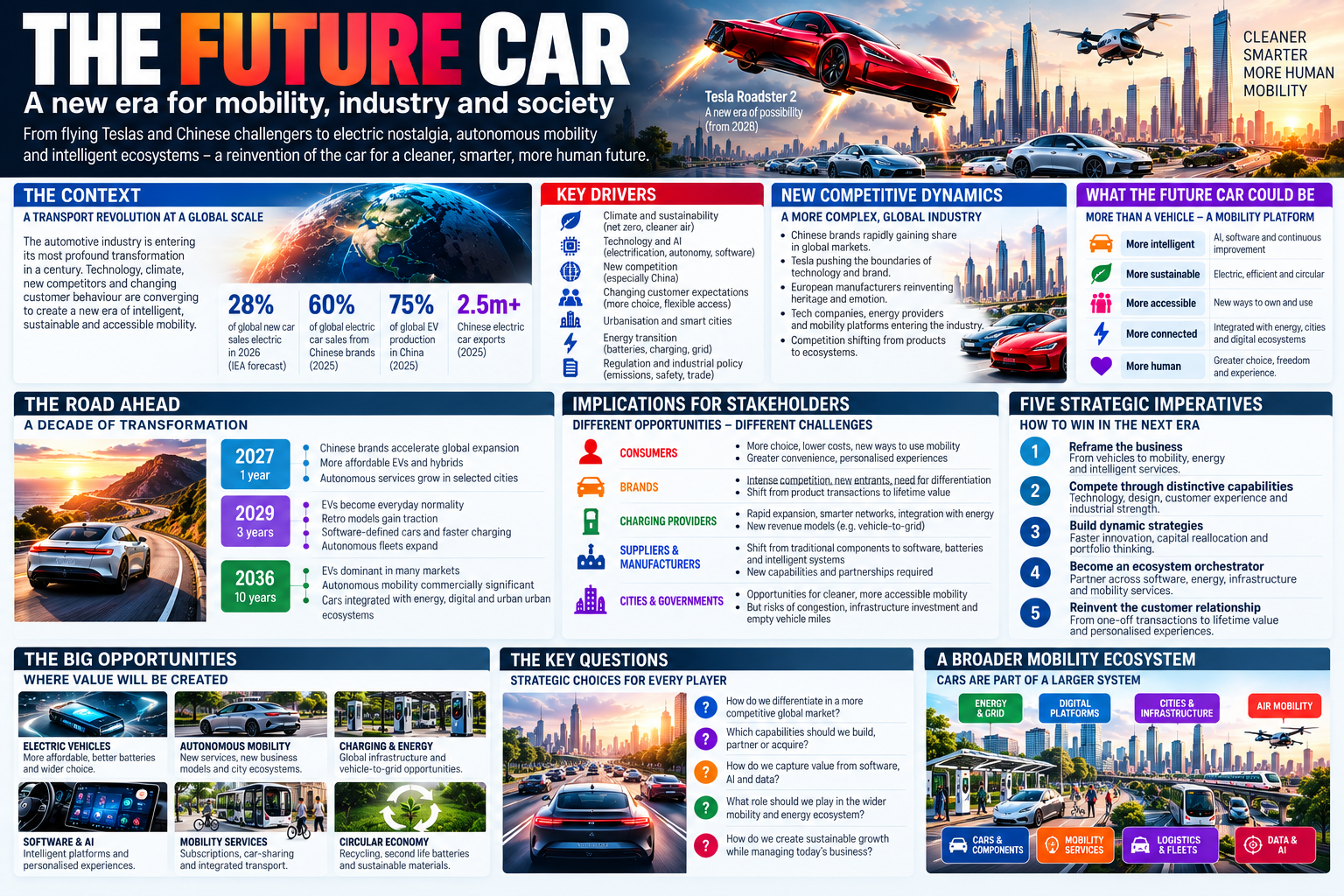
The future car will emerge from the collision of all three. More importantly, the automotive industry is moving from a relatively stable manufacturing model towards a much more dynamic competition between technologies, platforms, business models and ecosystems.
The Chinese tsunami … a new centre of automotive gravity
For more than a century, the automotive industry’s centre of gravity shifted between Detroit, Europe, Japan and South Korea. It is now shifting decisively towards China, and not simply because Chinese manufacturers can produce cheaper vehicles.
China has become the world’s largest electric vehicle market and its most important manufacturing centre. According to the International Energy Agency’s Global EV Outlook 2026, Chinese manufacturers accounted for approximately 60% of global electric car sales in 2025, while China produced around three-quarters of the world’s electric cars. Chinese electric car exports exceeded 2.5 million vehicles, demonstrating how quickly domestic industrial strength is becoming international competitive advantage.
These figures reveal a transformation of the industry’s innovation system. Chinese manufacturers have developed an ability to combine battery technology, software engineering, manufacturing integration and rapid product development in ways that challenge the traditional automotive model.
BYD illustrates the power of vertical integration. Its capabilities span battery chemistry, power electronics, manufacturing systems and finished vehicles, allowing it to control critical technologies and manage costs more effectively. Xiaomi approaches the automobile from a different direction, extending its consumer electronics and connected-device ecosystem into mobility. Its SU7 demonstrates how the car can become an intelligent extension of the customer’s digital life, rather than simply another mechanical product.
Xpeng is building differentiation around advanced driving assistance, artificial intelligence and software capabilities, while Leapmotor combines cost-focused electric architectures with international distribution and manufacturing partnerships through Stellantis. Chery, meanwhile, is expanding internationally through multiple brands, including Omoda and Jaecoo, targeting different customer segments and price points.
What makes these competitors formidable is the combination of speed, integration and ambition. Many Chinese manufacturers operate with shorter development cycles and closer relationships between technology development, suppliers and production. They are also increasingly moving beyond entry-level vehicles into premium segments traditionally dominated by European brands.
For BMW, Mercedes-Benz, Audi, Volkswagen and Stellantis, the strategic challenge is profound. They cannot rely indefinitely on engineering heritage, national loyalty or established distribution networks. Nor can they simply reproduce Chinese manufacturing economics without fundamentally restructuring their organisations.
The next automotive competition will not be Germany versus China, or Tesla versus BYD. It will be between competing business systems: vertically integrated manufacturers, software platforms, premium brand ecosystems and mobility service networks. Competitive advantage will depend increasingly on how effectively companies connect capabilities across these systems.
The return of the 2CV … nostalgia becomes a competitive advantage
There is something wonderfully paradoxical about Europe’s response to the technology-led expansion of Chinese automotive manufacturers. While Chinese brands are pursuing increasingly intelligent and sophisticated vehicles, European manufacturers are rediscovering simplicity, personality and emotional attachment.
The Renault 5 and Renault 4, the renewed interest in the Citroën 2CV, and Volkswagen’s revival of familiar small-car identities suggest that automotive innovation need not always mean greater complexity. Sometimes the most powerful innovation is to recover what made a product valuable in the first place.
The original Citroën 2CV was revolutionary because it democratised mobility. It was affordable, lightweight, practical and unmistakably distinctive. Its appeal came not from technological sophistication but from an unusually clear understanding of what customers needed. The same was true of the original Renault 5, Fiat 500 and Volkswagen Beetle. Each became culturally significant because it connected functional value with emotional identity.
Their modern electric successors offer an opportunity to reinterpret these principles for a different era. Consumers increasingly face rising vehicle prices, complex digital interfaces and cars that have become larger, heavier and more expensive. An affordable, distinctive electric vehicle with intuitive technology and genuine character could provide a compelling alternative.
Heritage also offers European manufacturers something that new entrants cannot easily replicate. Decades of cultural associations, design recognition and emotional attachment can create differentiation in a market where technical specifications are becoming increasingly similar.
The opportunity is not to recreate yesterday’s cars, but to reinterpret their original purpose. The strongest future automotive brands may combine advanced technology with timeless human appeal. In an increasingly digital industry, emotion may become more valuable, not less.
Electric vehicles … from technological revolution to everyday normality
For years, the automotive debate has been dominated by one question: how quickly will electric vehicles replace petrol and diesel? But that question is becoming less useful. The more important issue is how electrification changes vehicle economics, design, infrastructure and consumer behaviour.
The global transition is progressing, although at very different speeds across markets. The IEA estimates that worldwide electric car sales reached approximately 20.7 million in 2025 and forecasts around 23 million in 2026, representing approximately 28% of new car sales. China is substantially ahead of this global average, while Europe is progressing more unevenly and the United States has experienced a slower transition.
The distinction between new-car sales and the total installed fleet is particularly important. Even as electric vehicles gain share in showrooms, the vast majority of cars already on the road still use combustion engines. Vehicles remain in use for many years, meaning that the transformation of the global fleet will take considerably longer than the transformation of new-car sales.
Technology continues to advance rapidly. Lithium iron phosphate batteries are reducing costs, particularly for smaller and more affordable vehicles. Improvements in power electronics, battery management and vehicle efficiency are extending usable range, while higher-voltage electrical architectures enable faster charging. Solid-state batteries remain a promising development, although large-scale commercial deployment is still uncertain.
Manufacturers are also reconsidering the assumption that every electric car needs an enormous battery and maximum possible range. Smaller batteries, lighter vehicles and more efficient designs can provide a better combination of affordability, sustainability and convenience. In many markets, hybrids and range-extender vehicles will remain important transitional solutions, particularly where charging infrastructure is less developed.
The decisive breakthrough will come when consumers no longer buy an electric car because it is electric. They will buy it because it offers the best combination of price, convenience, performance, design and ownership experience.
Electrification will then cease to be a separate product category and become a normal characteristic of the automotive market.
Autonomous mobility … the revolution arrives one city at a time
If electrification changes how cars are powered, autonomy changes why we own them.
For decades, autonomous driving has been presented as an imminent technological revolution. In practice, progress has been slower, more expensive and more complicated than many anticipated. Yet a commercially meaningful market is now emerging, particularly in carefully defined urban environments.
Waymo has become one of the clearest demonstrations of this transition. By 2026, the company was reporting approximately 500,000 paid autonomous rides per week across ten American cities. Chinese operators, including Baidu’s Apollo Go, are developing parallel ecosystems, while Zoox is pursuing purpose-built autonomous vehicles designed around passengers rather than drivers.
The important distinction is between advanced driver assistance and genuine autonomy. Most vehicles marketed with sophisticated automated driving capabilities still require human supervision. Fully driverless commercial services operate within defined geographical areas and operating conditions, and their expansion depends on regulatory approval, safety performance and economics.
McKinsey’s modelling suggests that Level 4 and higher autonomous vehicles may account for only around 1% of new light-vehicle sales by 2035. This contrasts sharply with some of the industry’s more ambitious predictions. Nevertheless, autonomy could transform mobility long before it dominates vehicle sales, because a relatively small fleet of highly utilised autonomous vehicles can deliver millions of journeys.
The first major disruption may therefore come not from autonomous cars in private driveways, but from autonomous fleets in cities. Their economics depend on utilisation, routing efficiency, operating costs, maintenance and customer experience, rather than conventional vehicle sales margins.
Purpose-built autonomous vehicles also create opportunities to redesign the passenger experience. Interiors can prioritise comfort, accessibility, entertainment or productivity. The distinction between taxis, ride-hailing, car rental and public transport could gradually blur as different services become part of integrated mobility networks.
For cities, the implications are complex. Shared autonomous mobility could reduce parking requirements and improve access to transport, particularly for people unable to drive. Conversely, cheap and convenient driverless journeys could increase congestion and empty-vehicle mileage.
The fundamental question is therefore not simply whether cars can drive themselves. It is whether autonomy can create better mobility systems.
The software-defined car … from product to intelligent platform
The automobile is becoming a software-defined machine, and this may ultimately be as consequential as electrification.
Traditional vehicles were collections of mechanical systems controlled by numerous specialised electronic units. Increasingly, these functions are being consolidated into more centralised computing architectures, with capabilities continuously improved through software updates.
Tesla pioneered much of this approach, but the competitive field now includes Chinese manufacturers, established automotive groups and technology suppliers such as Nvidia and Qualcomm. The implications extend far beyond infotainment or digital dashboards.
A software-defined vehicle can improve after purchase. Its energy efficiency, driving characteristics, navigation, entertainment and assistance functions can evolve throughout its lifetime. AI-powered assistants may increasingly understand destinations, preferences, schedules and the driver’s wider digital environment, transforming the vehicle into a personalised digital platform.
McKinsey estimates that the global automotive software and electronics market could reach $519 billion by 2035, growing significantly faster than the overall vehicle market. This creates substantial opportunities, but also raises an uncomfortable strategic question for traditional manufacturers: who will own the customer relationship?
Will it be the automotive brand, the operating-system provider, the AI assistant or the mobility platform? If consumers increasingly interact with an intelligent assistant rather than the manufacturer’s interface, automotive brands risk losing control of their most valuable customer touchpoints.
Software also creates new commercial models, including personalised services, performance upgrades, predictive maintenance and subscription-based capabilities. However, consumers may resist paying repeatedly for features they believe should be included in the original purchase price.
The winners will not necessarily be those with the most software or subscriptions. They will be those who use intelligence to create meaningful, lasting customer value.
The charging revolution … from petrol stations to energy ecosystems
Charging is often presented as the greatest obstacle to electric vehicle adoption. Yet it may ultimately become one of the automotive industry’s most important new business opportunities.
According to the IEA, the world had more than seven million public charging points by the end of 2025, following growth of more than 33% during the year. But the next transformation involves much more than installing additional chargers. It requires rethinking the relationship between vehicles, electricity infrastructure, buildings and energy markets.
Three charging systems are emerging simultaneously. Everyday charging will increasingly take place where cars already spend time, including homes, workplaces, supermarkets and residential developments. Rapid charging will develop into a high-throughput service integrated with motorway infrastructure, retail and hospitality. Intelligent charging will connect vehicles with electricity markets, renewable generation, home batteries and smart grids.
As charging speeds improve, the practical distinction between refuelling and recharging will narrow. Some manufacturers are developing systems capable of adding substantial range in less than ten minutes, although actual performance depends on compatible vehicles, battery conditions and available charging power.
The more radical opportunity lies in bidirectional energy flows. Vehicle-to-home technology enables electric cars to supply electricity to a property, while vehicle-to-grid systems could eventually allow millions of parked vehicles to help balance electricity networks.
This changes the economic role of the car. Instead of being merely an energy consumer, it becomes a potential energy storage asset.
Imagine an automotive brand offering an integrated proposition combining the vehicle, home charger, solar panels, electricity tariff, battery optimisation and energy management. The customer relationship would extend far beyond driving, bringing automotive manufacturers into collaboration and competition with energy utilities, charging operators, technology companies and property developers.
The future charging network may resemble a distributed energy ecosystem more than a collection of petrol stations.
The end of ownership? From buying cars to accessing mobility
For more than a century, the automotive business model has remained remarkably consistent. Manufacturers design and build vehicles, dealers sell them, consumers own or finance them, and service networks maintain them.
That model is unlikely to disappear, but it will become one of several competing approaches.
Leasing, subscriptions, car-sharing, short-term rental and mobility memberships increasingly allow consumers to pay for vehicle use rather than long-term possession. Autonomous services could accelerate this shift by making convenient, on-demand transport available without the need to drive or own a car.
The economic logic is compelling in some circumstances. Privately owned cars spend much of their lives parked, while shared vehicles can potentially achieve much higher utilisation. For mobility providers, the critical measures become cost per kilometre, utilisation, customer lifetime value and service quality, rather than simply the number of vehicles sold.
However, predictions of the end of private car ownership overlook the emotional and practical importance of the automobile. In suburban and rural areas, private ownership often remains the most convenient option. Cars also represent freedom, privacy, enjoyment, identity and status.
Autonomous mobility could therefore produce an unexpected polarisation. At one end of the market, transport becomes an increasingly convenient and potentially inexpensive utility. At the other, privately owned vehicles become more emotional, distinctive and experiential products.
Driving enthusiasts may value a Porsche, Ferrari or classic roadster even more in a world where everyday journeys no longer require driving.
The future is less likely to involve the end of ownership than the end of one-size-fits-all ownership. Consumers will increasingly choose different mobility solutions for different circumstances, while automotive companies develop more flexible ways to serve them.
Beyond the car … reinventing the mobility ecosystem
The most profound transformation is taking place beyond the vehicle itself.
Automotive companies are becoming part of a much larger system encompassing energy, software, infrastructure, insurance, logistics, finance, urban development and digital services. The boundaries between these industries are becoming increasingly blurred, creating opportunities for companies that can connect previously separate capabilities.
Technology companies such as Nvidia and Qualcomm are becoming essential partners in vehicle intelligence. Energy companies are developing charging networks, battery storage and grid integration. Mobility platforms are orchestrating journeys, fleets and subscriptions, while financial services companies are exploring flexible financing, usage-based insurance and new forms of asset ownership.
Cities and property developers are also becoming more important participants. Electrification and autonomous mobility create opportunities to redesign parking, transport hubs, streets and energy infrastructure. Meanwhile, manufacturers must reconsider which parts of the vehicle and the wider system they should develop themselves, which they should source and which partnerships they need to build.
For automotive suppliers, this changes the strategic challenge. The opportunity is no longer simply to manufacture existing components more efficiently. It is to identify which capabilities become more valuable as vehicle architectures evolve. Some traditional components will face declining demand, while thermal management, advanced materials, power electronics, sensors and intelligent structural systems become increasingly important.
Manufacturing itself is also being reinvented. AI-assisted engineering, digital twins, robotics and more flexible production systems are changing how vehicles are designed and produced. Factories must accommodate faster development cycles, greater software integration and continuing uncertainty about future vehicle architectures.
The strategic challenge is to move beyond optimising a position in today’s automotive value chain and identify a distinctive role in tomorrow’s mobility ecosystem.
The critical question for every participant is no longer simply how to compete within the automotive industry, but which part of the future mobility system it should seek to lead.
The next one, three and ten years
The automotive revolution will not unfold as one simultaneous global transition. It will progress at different speeds across technologies, markets and customer segments. Looking towards 2027, 2029 and 2036 provides a useful way to distinguish immediate competitive pressures from longer-term structural change.
- 2027: The competitive shake-up. Over the next year, Chinese manufacturers will continue expanding internationally, intensifying pressure on established brands. More affordable electric vehicles and hybrids will broaden consumer choice, while AI interfaces and software capabilities become increasingly visible differentiators. Autonomous taxi operations will expand selectively, but remain geographically limited. The immediate competition will focus on market share, affordability, speed and consumer trust.
- 2029: The reinvention of the car. Within three years, the industry could look significantly different. More affordable electric vehicles, including revived European icons, should become established in mainstream markets. Faster charging and improving batteries will reduce practical barriers to adoption, while software-defined architectures become more widespread. Autonomous fleets may become commercially established in additional cities. Competition will increasingly shift from vehicle specifications towards platforms, customer relationships and new business models.
- 2036: The reinvention of mobility. Over the next decade, electrification is likely to dominate new-car sales across many major markets, although combustion vehicles will remain an important part of the global fleet. Autonomous mobility could become commercially significant in suitable locations, while vehicles increasingly connect with energy, digital and urban infrastructure. New ownership models and mobility services will diversify the ways consumers access transport.
By this stage, the most important competitive question may no longer be who sells the most cars, but who orchestrates the most valuable mobility ecosystem.
These scenarios are not predetermined. Technology, regulation, geopolitics, consumer behaviour and infrastructure investment will all influence the speed and direction of change. But the underlying trajectory is clear: the boundaries of the automotive industry are expanding.
Five strategic imperatives for automotive leaders
The greatest danger for established automotive companies is to interpret these developments as a series of separate technological transitions. Electrification, autonomy, artificial intelligence, Chinese competition and changing ownership models are interconnected forces reshaping the industry’s underlying economics.
Responding effectively requires five strategic shifts.
- Reframe the business. Automotive manufacturers must look beyond defining themselves as producers of vehicles or components. The opportunity is to explore how their capabilities could create value across mobility, intelligent systems, energy and connected experiences. This does not mean abandoning manufacturing, but recognising that the future business may extend far beyond the physical product.
- Compete through distinctive capabilities. European manufacturers cannot win through heritage alone, nor by attempting to imitate every Chinese cost advantage. They need sharper choices about where they can lead, whether through technology, design, customer experience, industrial capabilities or ecosystem relationships. Competitive advantage will increasingly come from distinctive combinations of capabilities rather than isolated technical superiority.
- Build dynamic strategies. Traditional automotive planning has been dominated by long investment cycles, fixed product programmes and incremental improvement. In a rapidly changing industry, companies need future-back thinking, portfolios of strategic options and faster capital reallocation. They must simultaneously improve today’s business while experimenting with new technologies, markets and business models that could become tomorrow’s growth engines.
- Become an ecosystem orchestrator. No manufacturer can independently master every technology and service required for future mobility. Successful companies will build partnerships across software, AI, energy, infrastructure and mobility services, while retaining control of the capabilities and customer relationships that matter most. Ecosystem leadership will become as important as operational excellence.
- Reinvent the customer relationship. The traditional automotive model concentrates much of its commercial activity around the moment of purchase. Future opportunities increasingly depend on the value created throughout the vehicle’s lifetime, including software, services, energy, maintenance, personalisation and flexible access. Companies must move from maximising transactions towards enabling customers to achieve more.
These imperatives require more than technological investment. They demand different leadership mindsets, operating models, organisational capabilities and performance measures. Above all, they require the courage to challenge assumptions that have defined the industry for generations.
The future car … is not really about cars
The Tesla Roadster 2, the electric revival of Europe’s automotive icons and the emergence of China’s global manufacturers appear to represent very different visions of the future. One pursues extraordinary technological performance, another rediscovers simplicity and emotional appeal, while the third is reinventing the speed and economics of industrial innovation.
Yet all three reveal a deeper transformation.
The automobile is evolving from a mechanical product into an intelligent, connected and increasingly electric platform, embedded within a wider ecosystem of mobility, energy and digital services. Its role is expanding beyond transportation into entertainment, productivity, personalisation and potentially energy storage.
Some future vehicles may incorporate aerospace technologies. Many will become more capable of driving themselves in defined environments. Most will become increasingly intelligent, while the ways people access, own and experience mobility will continue to diversify.
But technology alone will not determine the winners. The most successful companies will combine technological possibility with human relevance, commercial imagination and the ability to transform their business models.
Henry Ford transformed the automotive industry by making cars accessible to millions of people. The next generation of automotive leaders faces a more complex opportunity: to make mobility more intelligent, accessible, sustainable, enjoyable and valuable.
This requires moving beyond the conventional boundaries of the automotive business. It means looking beyond vehicle sales towards mobility outcomes, beyond mechanical engineering towards intelligent systems, beyond charging infrastructure towards energy ecosystems, and beyond individual companies towards networks of complementary capabilities.
The most exciting possibilities may come not from making today’s cars incrementally better, but from questioning the assumptions on which the entire industry was built.
The biggest strategic question is therefore no longer simply, What will the car of the future look like?
It is what could the automotive business become, and who will create the greatest value from that future?
More from the blog