Relentless reinvention: how Fujifilm keeps finding its next growth curve … from films to imaging, cosmetics to drugs … the Japanese innovation company never stops inventing, and reinventing itself
October 21, 2026

A photographic film company becomes a skincare brand, an antiviral developer, a manufacturer of biological medicines and a critical supplier to semiconductor producers. It sounds like a collection of improbable diversifications. Look beneath the products, however, and Fujifilm’s journey reveals a coherent discipline: understanding what the business can become, then moving its capabilities and capital towards that potential.
The familiar account ends with Fujifilm surviving the collapse of photographic film. The more useful story begins there. Survival became the foundation for repeated transformation: identifying new markets, acquiring missing capabilities, scaling promising businesses and withdrawing from activities that no longer justified ownership.
By the year ended March 2026, Fujifilm generated ¥3.357 trillion in revenue and ¥350.2 billion in operating income. Healthcare represented almost a third of sales, electronics around 14%, and imaging approximately 19%. The company had changed its economic centre of gravity without abandoning every connection to its origins.
Its story illustrates a demanding leadership challenge: how to keep reinventing after the immediate crisis has passed.
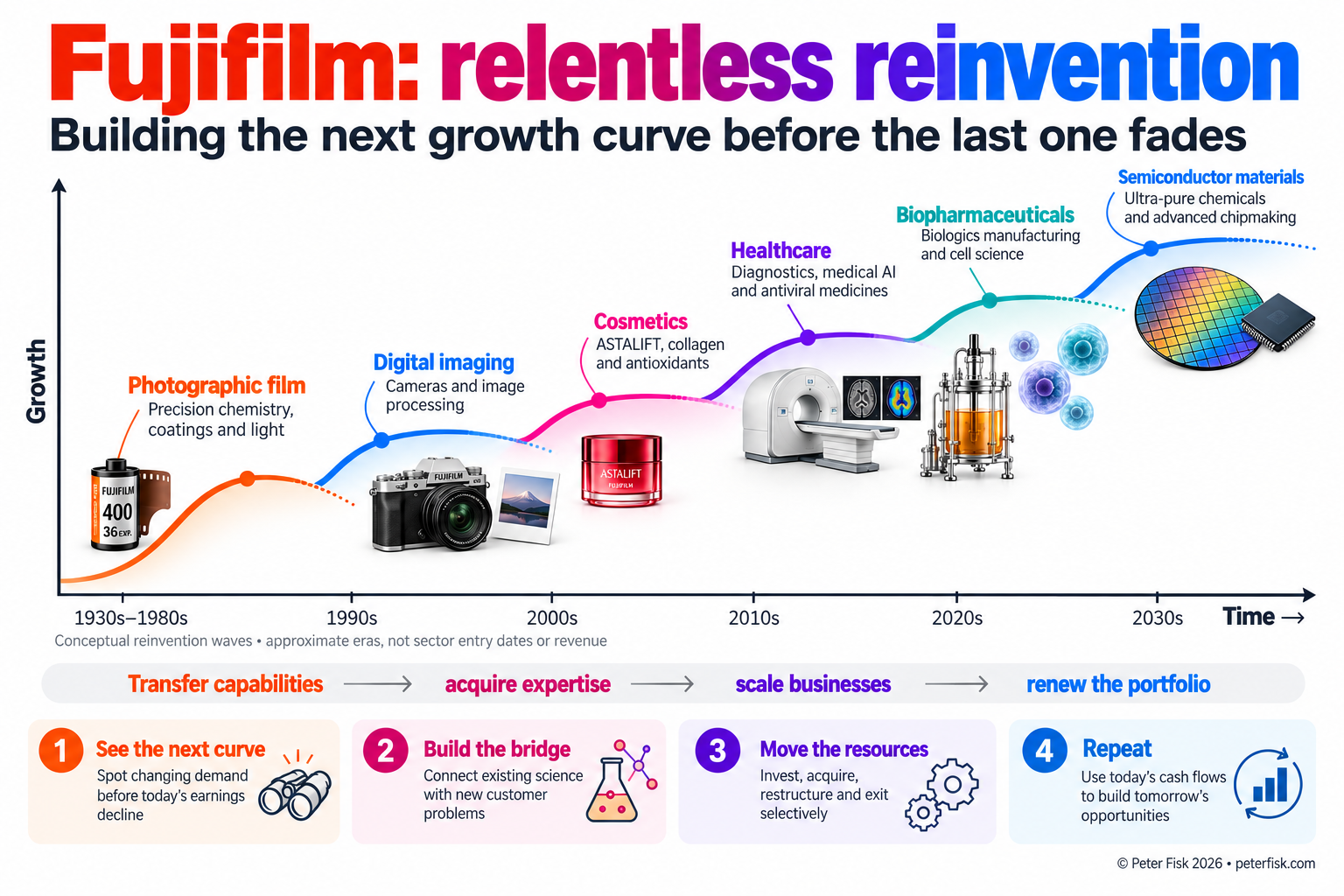
Recognising the end of a curve
An S-curve describes how a technology or business develops: uncertain beginnings, accelerating adoption, then slower growth as markets mature. Eventually, another solution can displace it. The danger is that financial performance and future potential diverge. A business can still generate attractive cash while the conditions supporting its next decade disappear.
Fujifilm confronted precisely that problem. Worldwide photographic film demand fell to approximately one-tenth of its former level between 2000 and 2010. This was a structural change in how people captured, stored and shared images. Becoming more efficient at producing film could soften the decline; it could not restore the market.
Former chief executive Shigetaka Komori understood the difference between adaptation and reconstruction. Recalling the response in a 2016 interview, he said: “Each decision had to be speedy, dynamic, and bold.”
The S-curve interpretation is useful, although it should not be mistaken for Fujifilm’s own terminology. Management had to operate on two clocks: extracting value from existing operations while constructing businesses whose economics were not yet proven.
Waiting for certainty would have made the transition harder. New capabilities, customer relationships and regulatory permissions take years to develop. The next curve needs investment before the previous one stops funding it.
Redefining the business beneath the product
The pivotal move was an inventory of technologies. Under the VISION75 strategy introduced in 2004, Fujifilm examined the knowledge accumulated in photosensitive materials and assessed where it might support new businesses. Advanced Research Laboratories followed in 2006, strengthening the infrastructure for connecting scientific disciplines.
The question changed from how to sell more photographic products to where the underlying science could solve valuable problems.
Photographic film is an intricate engineered material. Its production demands control over chemistry, particles, light, coatings and interactions between extremely thin layers. These capabilities have applications beyond photographs, provided they can be matched to a real customer need.
This distinction matters. A competence is not automatically a business opportunity. Technical relevance must meet market attractiveness, competitive advantage and a credible route to commercialisation.
Fujifilm’s reconstruction therefore involved both continuity and discontinuity. Scientific knowledge travelled between sectors. Customers, distribution channels, regulation and business models often had to change substantially. The company preserved useful knowledge while challenging the commercial structures through which that knowledge had previously earned money.
That is a stronger basis for reinvention than treating the existing product category as the boundary of the company’s imagination.
Creating bridges into unfamiliar markets
ASTALIFT, launched in 2007, is the most memorable bridge. Fujifilm applied knowledge of collagen, antioxidant chemistry, nanotechnology and light to skincare. Technologies developed to manage materials and preserve photographic images found another application in cosmetic formulations.
The brand is strategically revealing, but its scale is often exaggerated. Fujifilm does not separately disclose ASTALIFT revenue in the financial reporting examined here. Cosmetics sit within a wider life sciences business. The claim that skincare itself accounts for a third of Fujifilm confuses it with the entire healthcare segment.
Healthcare expansion also went well beyond transferring chemistry. Fujifilm acquired Toyama Chemical in 2008, bringing pharmaceutical expertise into the group. It entered biopharmaceutical contract development and manufacturing through the acquisition of two Merck businesses in 2011. These transactions added specialist people, facilities, contracts and industry knowledge.
The pattern was to build from existing strengths while buying capabilities that would take too long to create internally.
Acquisitions shortened the distance to a new market. Subsequent investment determined whether the acquired foothold became a competitive business. Reinvention required integration, manufacturing development and customer confidence after the transaction closed.
Moving from a drug to a healthcare platform
Avigan, the antiviral favipiravir developed by Toyama Chemical, illustrates the breadth of the pharmaceutical move. Japan approved it in 2014 for restricted use against new or re-emerging influenza, and added approval for severe fever with thrombocytopenia syndrome, a tick-borne infection, in June 2024. Its COVID-19 development programme was discontinued.
That qualification belongs in the story. Reinvention produces setbacks and abandoned possibilities alongside successes.
A more direct technological bridge is FF-10832, an investigational cancer treatment that encapsulates gemcitabine in liposomes. Fujifilm used nano-dispersion, analytical and process capabilities developed through photographic film to create the formulation. The company reported phase IIa studies in 2025; it should not be presented as an approved treatment.
Meanwhile, its medical AI technologies support image interpretation, including lung nodule analysis. Its iPS cell-derived research products help scientists model disease and evaluate potential medicines using human cells.
These activities occupy different positions in healthcare’s value chain. Some involve developing treatments; others support diagnosis or enable pharmaceutical companies to discover and produce medicines. The strategic opportunity lies in selecting positions where Fujifilm can build a defensible advantage.
Scaling a second curve
Biopharmaceutical manufacturing has become a major investment priority. The acquisition of Biogen’s Danish manufacturing operation in 2019 added a substantial production base. Fujifilm then committed capital to expansion rather than treating the acquisition as the finished transformation.
Its kojoX approach applies common designs, equipment and processes across facilities, including Denmark and North Carolina. Standardisation is intended to support technology transfer and dependable supply. In April 2025, the business secured a ten-year manufacturing agreement with Regeneron valued at more than $3 billion.
Lars Petersen, then president and chief executive of Fujifilm Diosynth Biotechnologies, described the ambition as making “transformative medicine accessible to patients”.
The important shift is from possessing a manufacturing asset to operating an interconnected production system.
This is how another S-curve forms inside the company. Entry establishes an option. Customer contracts validate demand. Process learning improves execution. Capacity investment creates room to scale. Repeat business can then justify further expansion.
Each stage requires different evidence. Early exploration needs technical and commercial learning; large-scale construction needs stronger conviction about customers, utilisation and returns.
Finding new growth inside the digital revolution
Electronics offers another route forward. Fujifilm supplies specialised materials used in semiconductor production, applying precision chemistry to the infrastructure behind digital technologies.
Its 2023 acquisition of Entegris’s electronic chemicals business added products, expertise and a wider manufacturing network. The deal brought twelve additional sites, including seven manufacturing locations across the United States, Europe and Singapore.
The strategic logic combines chemistry with proximity. Semiconductor manufacturers need reliable materials, consistent quality and responsive local supply. Meeting those requirements creates relationships that depend on much more than a product specification.
Fujifilm therefore participates in the growth of advanced computing without needing to design the processors itself. This is an instructive approach to emerging markets: identify an enabling capability that many participants require, then strengthen the position around it.
The relevant question for an established company is often where its expertise can become indispensable within a growing ecosystem. That can offer a more credible opportunity than competing at the most visible point in the market.
Renewing the original business
Fujifilm’s journey also challenges the assumption that reinvention always means leaving the past behind. Photography remains a valuable business, reshaped around different customer motivations.
Instax turns a photograph into a physical object to share, display or give away. Premium digital cameras offer another proposition: a distinctive photographic experience alongside digital convenience. These businesses create fresh demand within the company’s original field.
The commitment is tangible. In December 2025, Fujifilm announced a further ¥5 billion investment in instax film production facilities, with enhanced capacity scheduled to come fully online by autumn 2026.
An old technology can support a new growth curve when its meaning, users or economics change. Physical photographs acquire a different value in a world overflowing with digital images.
The implication is selective renewal. Leaders must distinguish activities whose underlying demand is disappearing from capabilities that can serve a newly attractive market. Age alone is an unreliable guide to future potential.
Making capital follow the strategy
How does Fujifilm prevent attractive ideas from remaining peripheral experiments?
Its published portfolio framework classifies businesses by market attractiveness and profitability into four groups: earnings base, growth driver, new/future potential and value reconstruction. Under VISION2030, launched in 2024, it planned ¥1.9 trillion of combined research expenditure and capital investment across fiscal 2024–2026.
The categories give businesses different responsibilities. Established operations generate earnings and cash; growth businesses receive investment to expand; emerging opportunities develop future potential; weaker activities face reconstruction.
The CFO’s 2025 message specified that ¥1.6 trillion of the planned investment would go to growth drivers and new/future potential businesses.
This is strategy expressed through resource movement. A future ambition becomes consequential when money, people and management attention move towards it.
The central discipline is to resist allocating next year’s resources mainly according to last year’s revenue. That approach gives the largest incumbent businesses an enduring advantage, even when their future opportunities are weaker. Portfolio management must allow a smaller business with stronger potential to compete for a larger share of investment.
The discipline of stopping
Reinvention also needs subtraction. Otherwise, each new initiative adds complexity while established activities retain their claims on resources.
Fujifilm’s CFO message is explicit: “If we determine that we are not the best owner of a business”, divestment or withdrawal can follow. It records disposals of regenerative medicine, radiopharmaceutical and medical information system activities between 2021 and 2023, followed by medical media in 2025.
Even healthcare’s strategic importance does not guarantee every healthcare business a permanent place.
That is a powerful form of internal disruption. A sector may be attractive while a particular ownership position is unconvincing. A useful capability may survive even when the business containing it changes hands.
The same logic remains visible in mature operations. In September 2026, Fujifilm announced planned transfers of its Chinese printing plate subsidiary and associated sales activities across many international markets. These were prospective transactions, not completed exits at the announcement date.
Stopping becomes easier when leaders evaluate future ownership value explicitly, rather than allowing historical importance to settle the question.
Connecting innovation to commercial reality
Capital allocation needs a supply of credible opportunities. Fujifilm’s Open Innovation Hubs create settings where customers and partners can explore how its technologies might address their problems. The original hub opened in 2014.
The purpose is to connect technical possibilities with external demand. Researchers can discover applications they would not identify from inside their existing product categories. Customers can encounter capabilities they would not otherwise know to request.
The resulting innovation process can be understood as a sequence of questions: what problem matters; which capabilities are relevant; what is missing; how can the proposition be tested; and what evidence warrants further commitment?
That sequence is an interpretation of the case, rather than a claim about an undisclosed internal approval process. Public reporting does not reveal every investment committee decision or project-level stopping rule.
What it does show is a deliberate connection between technological development and business building. VISION2030 calls for tighter selection of research themes and greater emphasis on commercialisation. Innovation has to create a route to economic value as well as scientific progress.
Sustaining momentum after the crisis
An existential threat can mobilise change once. Maintaining momentum requires a more durable source of direction.
Fujifilm combines long-term investment priorities with an expectation of competitive advantage. Chief executive Teiichi Goto describes his decision-making emphasis as “speed and dynamism”, while seeking businesses with “economic moats”.
The combination matters. Speed creates movement; a defensible position makes that movement economically worthwhile. Constant activity alone can consume capital without building advantage.
The company is also encouraging wider participation in change. Goto initiated an internal generative AI contest in March 2025, inviting ideas from employees across Japan and overseas. Its leadership development programmes seek people who can operate across business boundaries and connect technologies with other disciplines.
These practices suggest how momentum can outlast a single leader: make exploration accessible, develop people who can cross organisational boundaries, and retain senior responsibility for difficult resource choices.
Purpose provides continuity while the portfolio changes. But the practical test of that purpose remains what the company funds, scales, improves and stops.
There is also a financial tension at the heart of this approach. Judging every young business by the returns of an established operation would discourage investment too early. Excusing weak performance indefinitely would shelter poor decisions. Leaders need to distinguish the temporary cost of building a credible position from evidence that the investment thesis is failing. The S-curve helps frame that conversation, but cannot resolve it mechanically. Customer commitments, operational progress, competitive changes and cash requirements must continually inform the judgement. Dynamic strategy emerges from that combination of a persistent direction and a willingness to revise the commitments beneath it.
What comes next
The next challenge is converting investment into sustained returns. In the quarter ended June 2026, revenue rose 10.3%, but operating income fell 32%. Fujifilm cited higher costs, one-off expenses and other pressures; its outlook also identified delays in the ramp-up of biopharmaceutical facilities.
New curves carry execution risk. Capacity can arrive before revenue, regulatory requirements can interrupt operations, and attractive demand does not guarantee attractive returns.
The coming phase therefore requires disciplined delivery: filling facilities, transferring processes reliably, deepening semiconductor customer relationships and turning AI into useful products and better operations.
Further possibilities include iPS cell services and AI-enabled health screening. NURA, launched in 2021, extends Fujifilm’s diagnostic capabilities into health-check services with partners—another shift in how existing technology reaches customers.
VISION2030 targets ¥4 trillion revenue and an operating margin of approximately 15% or higher by fiscal 2030. These are ambitions, not achieved outcomes.
Fujifilm’s enduring lesson is the repeated renewal of the relationship between capabilities, opportunities and capital. Its history supplies knowledge, its customers supply problems, and its portfolio decisions determine which possibilities become substantial businesses.
Relentless reinvention depends on making those decisions repeatedly, including when today’s results make change feel optional. The next growth curve begins with a possibility. It becomes a strategy when the organisation commits resources—and releases them from somewhere else.
More from the blog