IDEAS100: the ideas business leaders need now … from agentic commerce to adaptive strategy, nexus business models and zero-based design … how to turn change into opportunity, and profitable progress
October 21, 2026

Why ideas matter
Ideas matter because they change what leaders can see, discuss and do. Before a business can adopt a new approach, somebody has to make it intelligible. Before people can work together differently, they need a shared understanding of what that difference means. Before an innovation can spread, its underlying logic must become transferable.
An idea gives a name to a possibility. A good idea also gives leaders a way to act on it.
Consider how concepts such as lean production, disruptive innovation and platform strategy have influenced management. Their contribution extends beyond individual techniques. They helped leaders recognise patterns, ask different questions and coordinate action across functions and organisations. Once a useful concept becomes shared language, people can build on one another’s thinking rather than repeatedly starting from scratch.
This is why ideas have three essential roles in business: they help us interpret new approaches, standardise concepts and accelerate progress. Interpretation makes unfamiliar developments understandable. Standardisation creates enough common meaning for people to collaborate and compare results. Acceleration comes when insights can travel, be tested and improve through application.
Yet the proliferation of management language creates its own problem. Leaders face a growing vocabulary of agentic enterprises, ecosystems, digital twins, dynamic strategies and regenerative business models. Some describe important changes. Some repackage established practice. Many combine both. The challenge is to identify which ideas explain a meaningful shift, which fit a particular business, and which can produce results.
My view is that the most valuable ideas today help leaders address a connected challenge: how to perform successfully in the present while building the capabilities, relationships and business models through which future growth will emerge.
How new ideas emerge
Management ideas develop through research, entrepreneurial experimentation and the adaptation of existing knowledge. Increasingly, their urgency comes from external change. Technologies create new possibilities. Customers make new demands. Geopolitics alters the conditions of competition. Climate and resource constraints change the economics of operations. Demographic shifts reshape work, consumption and expectations.
These changes expose a gap between the assumptions on which a business was built and the conditions in which it now operates. Ideas become useful when they help close that gap.
AI, for example, challenges assumptions about the cost and availability of expertise. Connected products challenge the separation between selling an asset and supporting its use. Energy volatility challenges the treatment of electricity as a predictable overhead. Longer lives challenge established boundaries between education, employment and retirement.
The most interesting responses often emerge where these forces intersect. AI combined with proprietary operational data can change an industrial service. A subscription combined with repair and recovery can change the economics of a physical product. Digital identity combined with autonomous purchasing could change how organisations establish trust with customers.
The new IDEAS100 framework, built on a global research project with leading companies and business schools, is perhaps the most comprehensive and practical ranking of business ideas. It groups these developments across five connected domains:
- intelligent enterprise … as intelligence becomes a business asset and organisational capability
- adaptive strategy … as strategy becomes a system of directions and choices that continually evolve
- innovation and markets … as advantage extends across convergent markets and ecosystems
- people and leadership … as teams matter more, and leadership increases collective intelligence
- finance, resilience and impact … as they become key design choices, to turn ideas into sustained, profitable action.
IDEAS100 becomes a map for exploration. Leaders need to select the ideas that address their most consequential choices, then connect them into a coherent approach.
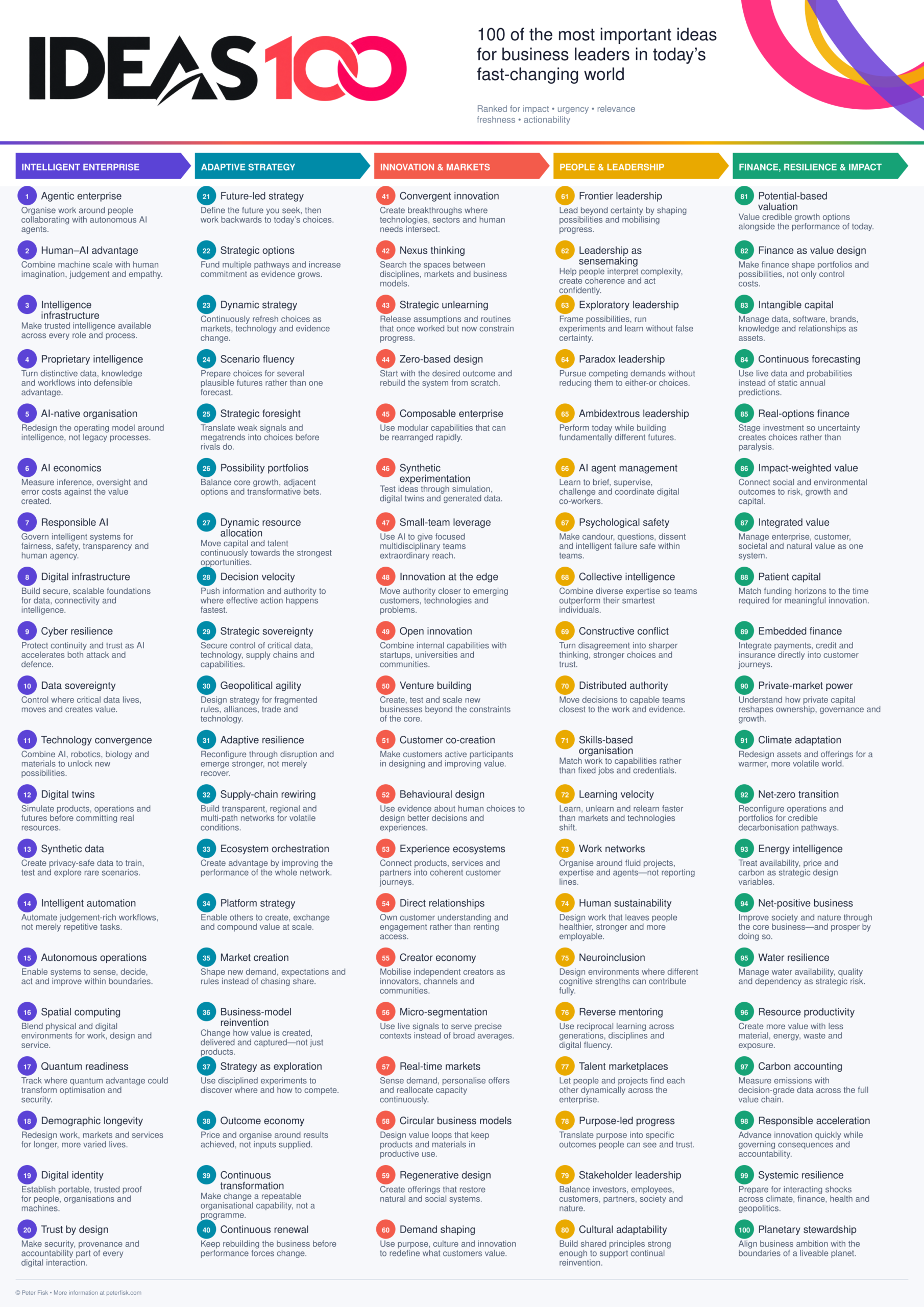
Grouping the 100 ideas together, shows how they connect and enhance each other:
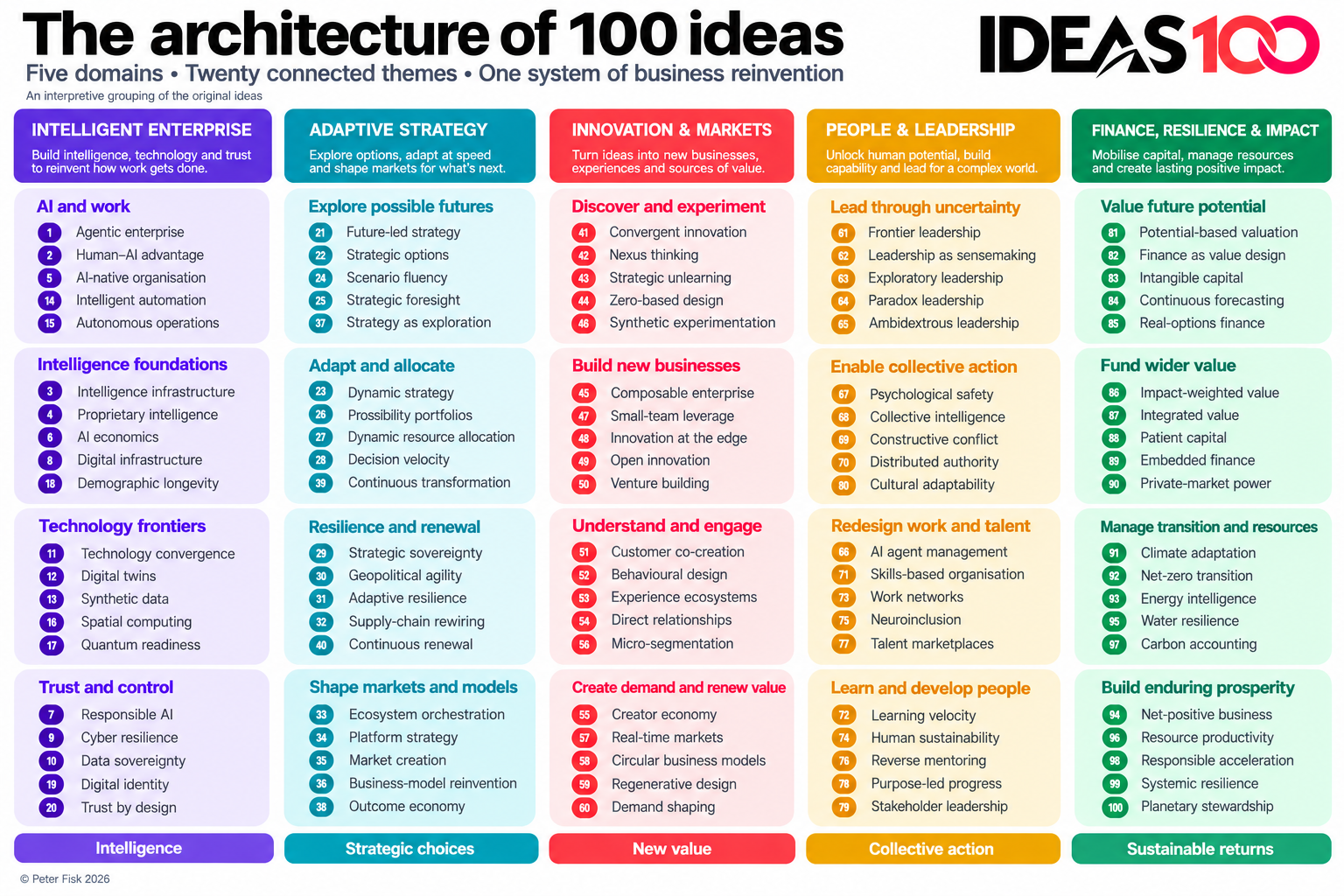
Seven themes demand significant focus for business leaders right now:
1. Intelligence becomes an organisational capability
The first is the combination of the agentic enterprise, human–AI advantage and proprietary intelligence. Together, these concepts move the discussion from adopting tools to redesigning how work gets done.
An AI assistant helps somebody complete a task. An agent can pursue a defined objective through several steps, using tools and information within specified boundaries. As these capabilities develop, leaders must decide which activities to automate, which decisions to augment, and where human judgement must remain decisive.
The strategic opportunity lies in organising the whole workflow. Faster analysis has limited value if approvals still take weeks. Automated recommendations create little advantage if the underlying data is unreliable. Giving every employee access to similar software rarely creates a durable distinction between competitors.
DBS, the Singapore-based bank, provides a useful example of intelligence applied at organisational scale. In its 2025 annual reporting, the bank described more than 2,000 models across over 430 use cases, generating approximately S$1 billion in economic value from data analytics and AI. That is a company-reported measure, rather than a standalone audited profit contribution, but it illustrates the importance of connecting deployment to economic outcomes.
For other leaders, the practical starting point is a valuable workflow: assessing a credit application, resolving a service problem, developing a product or maintaining an asset. Establish its current cost, speed and quality. Then redesign the division of work between people and machines, including exceptions and accountability.
AI economics matters as much as technical capability. Calculation must include integration, inference, supervision, correction and risk. Time saved becomes commercial value when the organisation converts it into lower cost, greater capacity, better decisions or additional revenue. The relevant question is what improves per completed outcome.
2. Strategy becomes a system of choices that can evolve
The second cluster combines future-led strategy, scenario fluency, possibility portfolios and dynamic resource allocation.
A future-led approach begins by exploring how customer needs and sources of value might change, then works back to the capabilities and choices required today. Scenarios test those choices against different plausible conditions. Possibility portfolios organise investments across the existing business, adjacent opportunities and more transformative options. Dynamic allocation moves resources as evidence develops.
These ideas give leaders a way to commit without pretending that uncertainty has disappeared.
Fujifilm illustrates the underlying logic. The contraction of photographic film required it to reconsider where its capabilities could create value. Expertise developed in materials, imaging, chemistry and manufacturing supported expansion into other fields. Today, its business spans healthcare, electronics, imaging and business innovation. The company explicitly connects photographic-film expertise in collagen, antioxidation and nanotechnology with applications in cosmetics and healthcare.
The transferable lesson concerns the distinction between a product and the capabilities behind it. A product category may decline while the knowledge used to create it becomes more valuable elsewhere. Leaders therefore need to examine their business at a deeper level than its current catalogue.
In practice, a possibility portfolio needs different investment criteria for different kinds of opportunity. An established operation should demonstrate performance. An early venture should demonstrate learning about demand, feasibility and economics. Funding can increase as uncertainty falls. Each option also needs a reason to stop.
Dynamic strategy becomes credible when leadership teams can point to resources they have actually moved: capital withdrawn, talent reassigned, projects accelerated and assumptions abandoned.
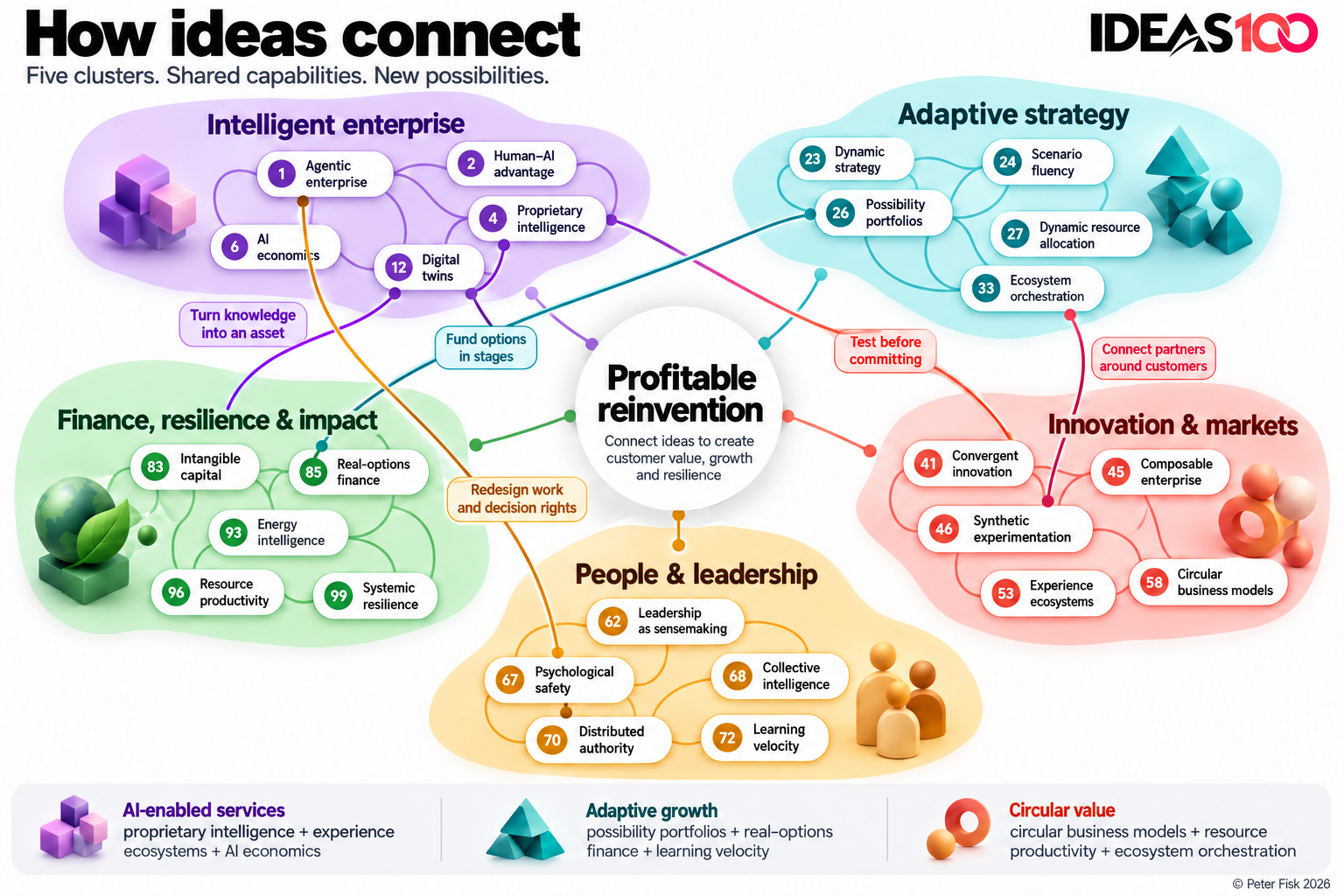
3. Advantage extends across an ecosystem
The third cluster brings together ecosystem orchestration, platform strategy and convergence innovation. Its central insight is that a company’s performance can depend on improving a wider system in which others also create value.
Nvidia is a powerful illustration. Its position encompasses processors, networking, software libraries, developer tools and relationships with manufacturers, cloud providers and application developers. Its fiscal 2026 results reported revenue of $215.9 billion, up 65% year on year, alongside continuing partnerships across industrial software and manufacturing.[3]
Those results reflect exceptional demand for AI infrastructure and many commercial factors. They cannot be attributed to ecosystem strategy alone. Nevertheless, the case shows why leaders need to examine complementary capabilities as carefully as their own products. A powerful component becomes more useful when others can develop applications, integrate systems and deploy it reliably.
For an industrial supplier, the opportunity might involve connecting equipment, software, finance and maintenance around a customer’s operating needs. For a bank, it might involve embedding financial services within commercial activity. For a healthcare company, it might involve coordinating diagnostics, treatment and continuing support.
The test is whether collaboration removes a meaningful obstacle to customer value. Leaders should identify who benefits, who invests, who controls access and how value is shared. Partnerships need working economics. An ecosystem that enriches its organiser while leaving participants with weak incentives will struggle to sustain innovation.
The strategic question becomes: which role can we play that makes the whole system more valuable, and gives us a defensible share of that value?
4. Business models move closer to customer outcomes
The fourth cluster combines business-model reinvention, the outcome economy, direct relationships and circular business models.
Customers buy products because they want something to happen. A contractor needs productive work on site. An airline needs reliable flying capacity. A building owner needs usable, efficient space. The opportunity is to organise more of the business around those continuing needs.
Rolls-Royce’s TotalCare demonstrates a long-established version of this logic. Its engine-flying-hour charging mechanism connects payment to use, while transferring specified maintenance-cost and time-on-wing risks to the manufacturer. This creates an economic incentive to improve reliability and manage engines throughout their operating lives.[4]
Hilti applies a related approach through Fleet Management. A fixed monthly fee covers tools, service and repairs. Customers gain more predictable expenditure and support for managing their equipment; Hilti gains an ongoing service relationship. The company also links tool-fleet management with repair, reuse and material recovery.[5]
These are mature ideas with renewed relevance. Better connectivity and analytics can make asset condition more visible, maintenance more anticipatory and service economics more manageable. They also raise the standard required of providers: promising an outcome means accepting responsibilities that a product sale may leave with the buyer.
Leaders should distinguish a subscription from a true outcome contract. Regular payment alone does not transfer performance risk or guarantee customer success. Before changing the model, determine what can be measured, what the provider can influence, how risk will be priced and how working capital will change.
Commercially, the attraction can include recurring revenue, stronger retention and greater lifetime value. Those benefits depend on service delivery, asset utilisation and disciplined pricing. A badly designed recurring contract can compound losses as effectively as a good one compounds value.
5. Experimentation moves ahead of physical commitment
The fifth cluster connects digital twins, synthetic experimentation and strategy as exploration. The common principle is to learn more before making expensive or difficult-to-reverse commitments.
A digital twin can help engineers explore a product or production system. Simulation can test alternative layouts, operating conditions and configurations. In strategy, an analogous discipline tests demand, partner behaviour and commercial assumptions through bounded experiments.
Siemens’ electronics factory in Erlangen provides a tangible industrial example. Siemens reports that its broader digital transformation increased labour productivity by 69%, reduced time to market by 40% and cut energy use by 42% between 2019 and 2023. Its account describes the combined application of technologies and operational changes, including digital twins and AI.
These are site-specific results, rather than a universal return on digital-twin investment. Their strategic significance is the connection between learning, operational redesign and measurable performance.
The same logic can guide a service business. Before launching a new offer nationally, test whether customers understand it, value it and will pay for it. Before redesigning an organisation, trial a different decision process within one business unit. Before building a platform, establish whether the proposed participants have a reason to return.
Each experiment should address an uncertainty that could change a decision. It needs an owner, a limit on expenditure and a threshold for proceeding, adapting or stopping. Simulation also requires scrutiny: a model can reproduce the assumptions embedded in it with impressive precision while missing the real constraint. Learning accelerates when virtual exploration and real-world evidence inform one another.
6. Leadership increases collective intelligence
The sixth cluster includes leadership as sensemaking, psychological safety, constructive conflict, distributed authority and learning velocity. These ideas address the human conditions through which the other changes become possible.
As information becomes more abundant, leadership must help people judge what matters. As expertise becomes more distributed, decisions must draw on knowledge across the organisation. As uncertainty increases, teams need to expose weak assumptions before those assumptions become expensive commitments.
Psychological safety supports this work by making it possible to raise concerns, admit uncertainty and challenge a proposal. Constructive conflict gives that openness a productive direction. Both require demanding standards: disagreement should improve the decision, and people remain responsible for the quality of their contribution.
Distributed authority adds a practical design question. Which decisions should move closer to customers, operations and evidence? Delegation works when teams have clear objectives, information and limits. Otherwise, responsibility can be distributed while real authority remains trapped at the centre.
Human–AI collaboration makes these choices more urgent. Teams need to know who verifies machine-generated work, when an agent must seek approval, and who owns the consequences. Managers will increasingly have to assess the quality of a combined human and digital workflow.
The commercial effects should be tested through decision time, avoidable rework, customer responsiveness and the speed with which learning spreads. A leadership programme earns its value when the organisation behaves differently in consequential situations.
7. Resilience and impact become strategic design choices
The seventh cluster connects energy intelligence, resource productivity, climate adaptation, strategic sovereignty and systemic resilience.
These ideas bring physical and political realities into strategic choice. Energy availability can affect where capacity is built. Water conditions can affect operational continuity. Data dependencies can affect freedom to operate. Supply-chain concentration can turn a local disruption into a business-wide constraint.
Schneider Electric illustrates the opportunity created when such pressures become customer priorities. Its combination of energy management, automation and software addresses the need to operate increasingly electrified and digital systems. In its 2025 results, it reported organic growth of 11% in Energy Management and 8% in Industrial Automation.[7]
For leaders, the implication extends beyond selling environmental solutions. Resource exposure belongs in decisions about products, locations, suppliers and investment. An efficient process can improve margins while reducing energy demand. A repairable product can support service revenue while reducing material requirements. These connections need to be demonstrated in the economics of the particular business.
Resilience also has a cost. Additional suppliers, spare capacity and alternative technology may reduce short-term efficiency. The task is to compare that cost with the value of maintaining operations and preserving choices under disruption. Finance can help make those trade-offs explicit, using scenarios and staged commitments rather than relying on a single forecast.
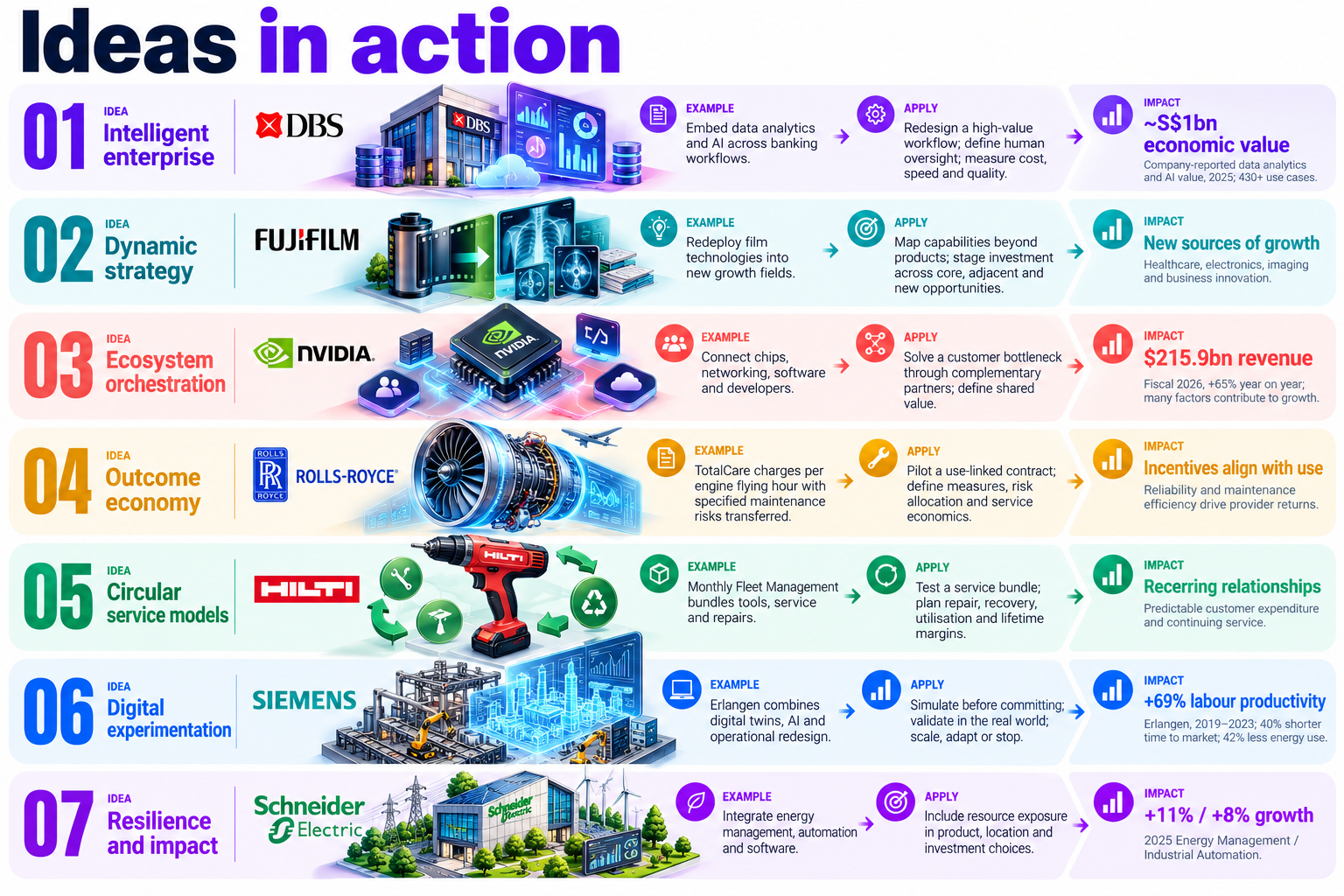
Turning useful ideas into profitable practice
My work with leaders around the world is about making these connections useful in their own context. Across board discussions, executive programmes and practical workshops, I bring together external perspectives, company cases and strategic questions. The aim is to help leaders see further, make sharper choices and act faster.
An example from another sector can be especially valuable because it loosens familiar assumptions. A manufacturer may learn from a bank about using intelligence across a customer journey. A bank may learn from an industrial service provider about pricing for continuing value. The task is to identify the mechanism that transfers, then understand what must change locally.
I organise this work around four moves: interpret, connect, choose and apply.
Interpret the change before selecting the concept. What is happening outside the business, and which assumption does it challenge? Connect a small number of relevant ideas. An outcome model may require proprietary intelligence, ecosystem partners and a different funding approach. Choose where the business has a credible advantage and what it will stop doing. Apply the choices through projects with owners, resources, measures and decision dates.
This process needs a commercial thread throughout. How does the idea improve customer value? Why should that value generate revenue, margin or cash? What capabilities and investment are required? What evidence would show that the opportunity is weaker than expected?
The first practical output should be a decision or an experiment. For an AI initiative, that could be a redesigned workflow with a baseline and a test of completed outcomes. For a new service model, it could be a pilot contract with explicit risk allocation. For a possibility portfolio, it could be a first reallocation of capital towards an option with clear learning milestones.
Ideas become strategically valuable through this conversion from insight to commitment, and from commitment to evidence.
What comes next
I expect the next wave of business ideas to emerge around three connected developments: increasingly autonomous economic activity, more adaptable organisations and closer integration between digital ambition and physical constraints.
Here is my first look at the emerging ideas that will matter next:
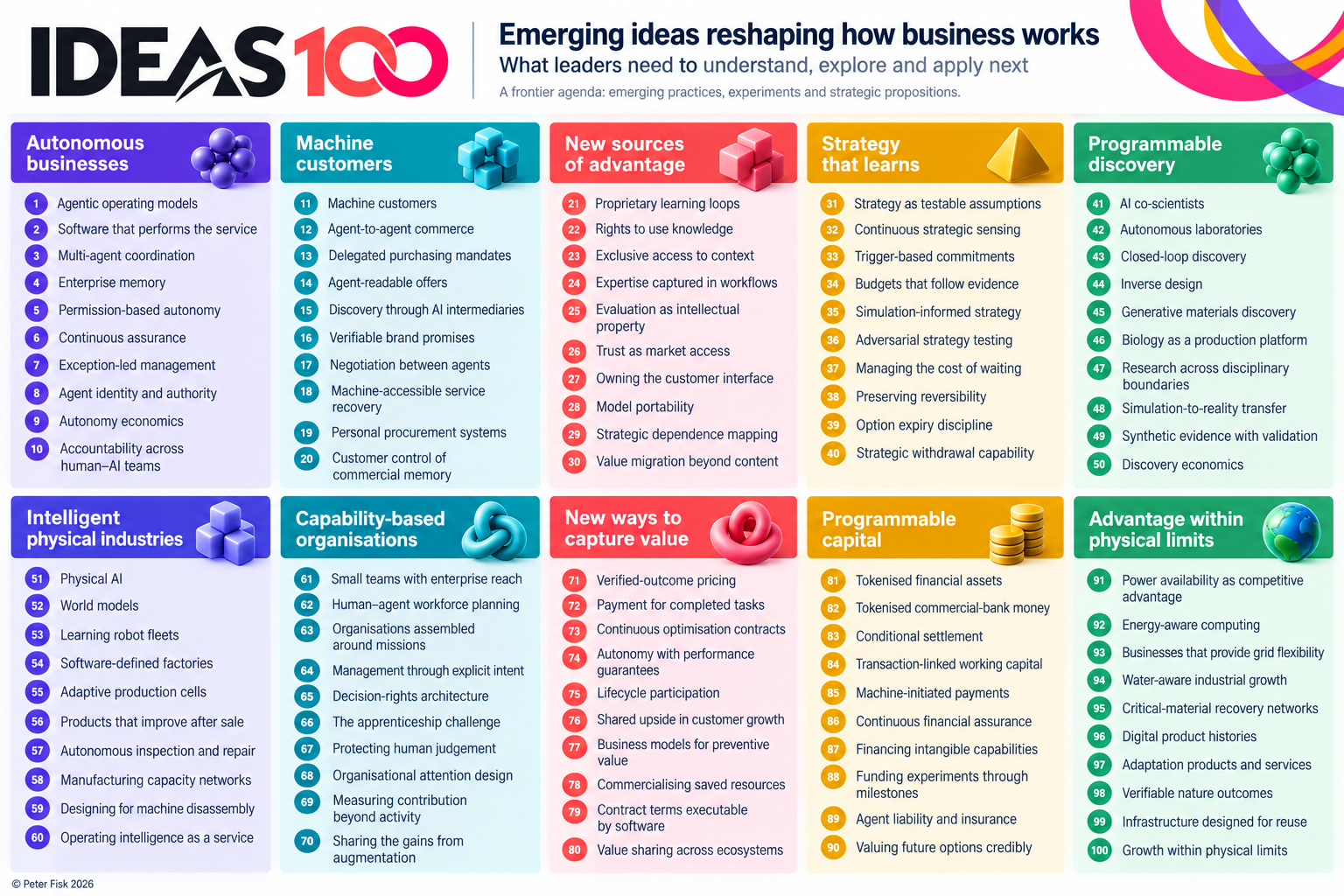
As AI agents take on more activity, companies will need ways to establish authority, verify identity, control spending and resolve mistakes. Machine customers and agent-to-agent commerce may create new markets, but their scale and timing remain uncertain. Leaders can prepare by making offers, permissions and service standards clearer and more machine-readable.
Organisations will also need to reconfigure expertise, technology and partnerships more readily. This could make the ability to assemble the right capabilities around an opportunity a stronger source of advantage. Alongside financial performance, leaders will need to examine whether they are becoming better at creating and testing future options.
Finally, the expansion of intelligence will keep encountering energy, materials, infrastructure and human limits. The most consequential innovations may come from addressing those constraints together: designing systems that are more capable, productive and sustainable because their economics and physical requirements have been considered as one.
The best ideas will continue to make an unfamiliar world more intelligible. Their value will depend on the quality of the choices they enable. For business leaders, the enduring task is to recognise possibility, connect it to distinctive capabilities, and build the evidence and commitment that turn it into profitable progress.
© Peter Fisk 2026
Appendix: IDEAS100 in detail, in theory and action
This guide follows the original poster’s five domains, names and numbering. Each entry explains the idea, identifies particularly useful thinkers and frameworks, and gives a company application and its practical or commercial significance.
The choice of thinkers and examples is editorial, rather than an objective ranking. A company can illustrate a principle without explicitly adopting the named academic framework. Where a label combines several traditions, the closest intellectual foundations are identified. Company-reported outcomes, historical examples, projections and intended benefits are distinguished; an example’s overall financial performance cannot establish the isolated return from a management idea. Sources are linked throughout. Research checked on 21 October 2026.
Intelligent enterprise … Ideas 1–20
1. Agentic enterprise
An organisation in which people work with AI systems that can plan, use tools and execute multiple steps towards an objective. The management challenge is allocating autonomy, escalation and accountability across complete workflows.
Theory: Who are the best thought leaders on this? Andrew Ng’s work on agentic workflows highlights reflection, tool use, planning and collaboration. Marco Iansiti and Karim Lakhani’s Competing in the Age of AI explains how data-driven operating systems change scale and learning. Anthropic’s distinction between predefined workflows and model-directed agents is a useful implementation framework. Sources · AI operating models.
Action: What are the best examples of companies using this? Intercom’s Fin handles customer-service conversations and routes work according to configured boundaries. Its reporting distinguishes resolution from overall automation: leaders can measure completed service rather than messages generated. The commercial mechanism is increased service capacity and lower handling effort; results depend on the customer, knowledge quality and escalation design. Company evidence.
2. Human–AI advantage
Combine machine speed and pattern recognition with human contextual understanding, imagination and responsibility. The strongest design considers the joint performance of the system, including when people should override or question AI.
Theory: Who are the best thought leaders on this? Ethan Mollick’s Co-Intelligence offers principles for working with AI. Erik Brynjolfsson’s research distinguishes replacing labour from augmenting human capability. The useful framework is task-level allocation: identify where AI improves performance, where judgement remains necessary, and how the two interact.
Action: What are the best examples of companies using this? DBS combines data analytics and AI with banking expertise across hundreds of applications. The bank reported approximately S$1 billion in economic value from these activities in 2025. This is a company-defined aggregate measure, not a separately audited profit line or proof of any single intervention. Company evidence.
3. Intelligence infrastructure
Provide reusable foundations for intelligence: dependable data, access controls, models, integration, monitoring and evaluation. This enables multiple teams to improve processes without rebuilding everything independently.
Theory: Who are the best thought leaders on this? Iansiti and Lakhani’s AI factory links data pipelines, algorithms, experimentation and infrastructure. Jeanne Ross, Cynthia Beath and Martin Mocker’s Designed for Digital explains the importance of shared operational and digital foundations. Both shift attention from isolated pilots towards organisational architecture.
Action: What are the best examples of companies using this? Microsoft’s Azure AI services provide shared capabilities for building and governing intelligent applications. Its responsible-AI arrangements add organisational controls to the technical stack. The practical effect is reuse and more consistent deployment; adopting a platform does not itself demonstrate business returns. Company approach.
4. Proprietary intelligence
Turn a company’s distinctive data, operating knowledge and customer context into decisions competitors cannot easily reproduce. Owning information matters less than reliably converting it into useful action.
Theory: Who are the best thought leaders on this? Jay Barney’s resource-based view asks whether resources are valuable, rare and difficult to imitate. David Teece explains how complementary assets and capabilities determine who captures innovation’s value. Applied here, advantage comes from exclusive context and learning routines, not merely access to a model.
Action: What are the best examples of companies using this? Netflix uses viewing behaviour and experimentation to improve its product. Its experimentation infrastructure helps evaluate proposed changes against actual member response. The commercial purpose is stronger engagement and retention; Netflix does not disclose an isolated profit contribution for proprietary intelligence. Engineering evidence.
5. AI-native organisation
Design operations around what intelligent systems make possible, rather than attaching AI to inherited processes. This may change workflow boundaries, job responsibilities and the economics of serving additional customers.
Theory: Who are the best thought leaders on this? Iansiti and Lakhani describe algorithmic operating models. Thomas Davenport and Nitin Mittal’s All-in on AI examines organisations that integrate AI into strategy and operations. This is a design direction rather than a universally agreed organisational category.
Action: What are the best examples of companies using this? Nubank is a useful digital-native analogue, rather than evidence of a fully autonomous bank. Its digital model, analytics and technology architecture support service at scale. At the end of 2024 it reported 114 million customers and cost to serve below US$1 per active customer per month. Those economics reflect its wider model. Company reporting.
6. AI economics
Assess AI through the net value of completed work. Include integration, inference, supervision, error correction, security and change costs, alongside benefits such as better conversion, lower losses or additional capacity.
Theory: Who are the best thought leaders on this? Ajay Agrawal, Joshua Gans and Avi Goldfarb’s Prediction Machines and Power and Prediction explain how cheaper prediction changes decisions and systems. Brynjolfsson adds the role of complementary organisational investment. The framework is a full decision-system business case, rather than a model-price comparison.
Action: What are the best examples of companies using this? Intercom connects Fin’s service proposition to outcomes and distinguishes different performance measures. This makes the economics of resolution more visible. Buyers still need to test whether automated resolutions are satisfactory and whether saved staff time becomes actual capacity or financial benefit. Company explanation.
7. Responsible AI
Build intelligent systems with proportionate safeguards for safety, fairness, privacy, transparency and human agency. Responsibility requires decision rights, evaluation and intervention mechanisms as well as principles.
Theory: Who are the best thought leaders on this? Stuart Russell’s Human Compatible examines alignment with human preferences. Virginia Dignum’s work on responsible AI emphasises governance and social context. NIST’s AI Risk Management Framework translates governance into the functions Govern, Map, Measure and Manage. Framework.
Action: What are the best examples of companies using this? Microsoft applies a Responsible AI Standard, impact assessments and sensitive-use reviews. These provide a documented way to question or restrict deployments before and during use. The practical impact is stronger control over exposure and deployment decisions; a public standard is not proof that every application is safe. Company evidence.
8. Digital infrastructure
Build the secure, scalable foundations for a connected enterprise: cloud, networks, operational systems, data and interoperable interfaces. Infrastructure creates value by making services reliable and change easier.
Theory: Who are the best thought leaders on this? Jeanne Ross and Peter Weill’s enterprise-architecture research distinguishes shared foundations from local applications. Carliss Baldwin’s work on modularity explains how clear interfaces allow components to evolve independently.
Action: What are the best examples of companies using this? Shopify supplies merchants with commerce infrastructure, including storefront, checkout, payments and partner integrations. In 2024 its platform facilitated US$292.3 billion in gross merchandise volume. GMV represents merchant transactions, not Shopify revenue, but demonstrates the scale supported by the infrastructure. Company filing.
9. Cyber resilience
Maintain and restore essential business functions under cyberattack. This combines prevention with detection, recovery, supplier resilience and rehearsed decisions about continuity.
Theory: Who are the best thought leaders on this? Ross Anderson’s Security Engineering explains security as a system problem. Nancy Leveson’s systems-safety work provides a useful complementary lens for control failures. NIST’s Cybersecurity Framework adds a practical structure covering governance through recovery.
Action: What are the best examples of companies using this? Apple’s Secure Enclave separates sensitive security operations from general processing and supports encryption and authentication. It illustrates containment through architecture. This reduces particular attack opportunities, while broader resilience still requires backups, response processes and operational recovery. Technical evidence.
10. Data sovereignty
Retain meaningful control over where data is stored, who can access it and which legal and technical dependencies apply. Physical location alone does not establish sovereignty.
Theory: Who are the best thought leaders on this? Anu Bradford’s Digital Empires explains competing regulatory systems. Shoshana Zuboff examines how control over data produces economic power. The practical framework maps jurisdiction, ownership, access, encryption and exit options separately.
Action: What are the best examples of companies using this? Microsoft’s sovereign-cloud approaches illustrate how providers adapt access, operational controls and deployment arrangements to customer requirements. The benefit is the ability to serve sensitive sectors under tighter conditions. Assessment must examine the specific service and jurisdiction rather than accept a sovereignty label at face value. Company design guidance.
11. Technology convergence
Create opportunities where technologies combine: AI with robotics, biology with computation, or materials with sensing. Value often arises from solving the integration problem rather than inventing every component.
Theory: Who are the best thought leaders on this? W. Brian Arthur’s The Nature of Technology explains technologies as combinations of existing capabilities. Frans Johansson’s The Medici Effect explores innovation across disciplinary boundaries. These help identify intersections where previously separate capabilities become commercially useful.
Action: What are the best examples of companies using this? Nvidia’s Cosmos connects world models, synthetic data and physical-AI development. The aim is to help developers prepare robots and autonomous systems for varied environments. This demonstrates a convergence platform; it does not establish an industry-wide commercial return. Company evidence.
12. Digital twins
Use a digital representation linked to a physical product, asset or process to test decisions and improve operations. The value depends on appropriate fidelity, current data and a real decision to improve.
Theory: Who are the best thought leaders on this? Michael Grieves is foundational to digital-twin thinking; John Vickers helped develop its aerospace application. David Gelernter’s Mirror Worlds provides an earlier conceptual foundation for digital representations of real systems.
Action: What are the best examples of companies using this? BMW uses virtual factory planning with Nvidia to test layouts and detect collisions before installation. BMW projected up to a 30% reduction in production-planning costs as its Virtual Factory scaled. This is a projected benefit, not a universal achieved saving. Company evidence.
13. Synthetic data
Generate data to train or test systems where real examples are scarce, sensitive or expensive. Synthetic data must be validated for realism, bias and the behaviour that matters.
Theory: Who are the best thought leaders on this? Donald Rubin’s statistical work established important foundations for synthetic datasets. Cynthia Dwork’s differential-privacy framework addresses disclosure risk, although privacy protection and synthetic generation are distinct. Fei-Fei Li’s work highlights the importance of representative visual data.
Action: What are the best examples of companies using this? Nvidia’s Cosmos platform supports generation of physics-aware visual scenarios for physical AI. Developers can explore situations difficult to capture repeatedly in the real world. The practical benefit is broader training and testing coverage; simulated success still requires physical validation. Company evidence.
14. Intelligent automation
Automate activities requiring interpretation and decisions, combining AI with rules and workflow systems. Clear exception handling distinguishes a dependable process from an impressive demonstration.
Theory: Who are the best thought leaders on this? Thomas Davenport’s process-innovation research links technology to workflow redesign. Leslie Willcocks and Mary Lacity examine automation’s operational and organisational conditions. Their useful lesson is to redesign the process and governance alongside the software.
Action: What are the best examples of companies using this? Amazon combines robotics, machine learning and logistics systems in fulfilment. It announced deployment of its millionth robot in 2025. This is an adoption measure, not a quantified return, but shows the scale at which physical movement and operational decisions can be automated. Company evidence.
15. Autonomous operations
Enable bounded operational systems to sense conditions, decide and act with limited intervention. Autonomy is specific to an operating environment and safety envelope, not an all-or-nothing company characteristic.
Theory: Who are the best thought leaders on this? Rodney Brooks’ robotics work emphasises embodied intelligence; Russell and Peter Norvig provide foundations for intelligent agents. Nancy Leveson’s STAMP framework is valuable for analysing the safety constraints surrounding autonomous activity.
Action: What are the best examples of companies using this? Rio Tinto’s AutoHaul operates heavy-haul trains between Pilbara mines and ports. Autonomous driving removes particular manual tasks and supports more consistent train operation. It remains part of a managed mining and rail system with maintenance and oversight. Company evidence.
16. Spatial computing
Combine digital information with physical space through augmented, mixed or virtual environments. Applications should improve a real task, such as picking, training, maintenance or design review.
Theory: Who are the best thought leaders on this? Ivan Sutherland’s early work on immersive displays is foundational. Paul Milgram and Fumio Kishino’s reality–virtuality continuum helps distinguish modes of interaction. Mel Slater’s research explains presence and why immersive environments affect behaviour.
Action: What are the best examples of companies using this? DHL’s historical vision-picking pilot used smart glasses to guide warehouse workers. DHL reported a 25% improvement in picking efficiency in that pilot. The result is task- and site-specific; comfort, integration and error rates also matter. Company evidence.
17. Quantum readiness
Prepare selectively for quantum computing and quantum-related security changes. Separate research into potential computing advantage from the practical need to manage cryptographic migration.
Theory: Who are the best thought leaders on this? John Preskill’s NISQ framing explains the limits of noisy intermediate-scale hardware. Peter Shor’s algorithms explain important implications for cryptography. Scott Aaronson’s work helps leaders distinguish computational claims from evidence.
Action: What are the best examples of companies using this? IBM’s Quantum Network brings companies, universities and laboratories together to investigate applications and build expertise. The immediate impact is learning and readiness. Participation or an experimental demonstration should not be described as proven enterprise-wide quantum advantage. Company evidence.
18. Demographic longevity
Redesign employment, products and services for longer lives and changing age structures. This includes multistage careers, healthy ageing and markets that do not treat older people as one segment.
Theory: Who are the best thought leaders on this? Lynda Gratton and Andrew Scott’s The 100-Year Life replaces the traditional education–work–retirement sequence with more varied life stages. Laura Carstensen’s longevity research explains how time horizons affect motivation. Academic context.
Action: What are the best examples of companies using this? BMW redesigned a historical assembly-line pilot for an older workforce, including ergonomic and work-process changes. The published case reported a 7% productivity improvement in one year. This illustrates work redesign rather than evidence that age has no operational implications. Original case.
19. Digital identity
Establish trustworthy digital representations of people, organisations and machines, with appropriate authentication and permissions. Identity should enable transactions while limiting unnecessary disclosure.
Theory: Who are the best thought leaders on this? Kim Cameron’s Laws of Identity stresses user control and minimal disclosure. Christopher Allen’s work on self-sovereign identity explores portable credentials. These approaches help separate identity proofing, authentication and authorisation.
Action: What are the best examples of companies using this? Mastercard’s identity services use digital signals to support fraud prevention and transaction confidence. Visa’s Trusted Agent Protocol addresses the related question of whether a purchasing agent is legitimate. The commercial purpose is safer acceptance with less friction, not the elimination of fraud. Mastercard · Visa.
20. Trust by design
Make security, privacy, provenance and accountability properties of the product and process. Trust is stronger when users can inspect relevant evidence and exercise meaningful control.
Theory: Who are the best thought leaders on this? Ann Cavoukian’s Privacy by Design makes protection proactive and embedded. Helen Nissenbaum’s contextual integrity examines whether information flows fit their social setting. Bruce Schneier explains the interaction between technical safeguards, incentives and institutions.
Action: What are the best examples of companies using this? Adobe’s Content Credentials attach provenance information using C2PA-compatible methods. This helps people inspect an asset’s origin and editing history. It supplies evidence about provenance, not a guarantee that the content’s claims are true. Company evidence.
Adaptive strategy … Ideas 21–40
21. Future-led strategy
Explore a future in which the business can create distinctive value, then work backwards to today’s choices. Future ambition must be tested against alternative developments and translated into capabilities and commitments.
Theory: Who are the best thought leaders on this? Gary Hamel and C.K. Prahalad’s Competing for the Futureintroduces strategic intent and capability building ahead of demand. Mark Johnson and Josh Suskewicz’s Lead from the Future develops future-back thinking. Peter Fisk’s Future Gravity adds a useful emphasis on the pull of future potential.
Action: What are the best examples of companies using this? Fujifilm redeployed technologies and expertise from photographic film into other fields, including healthcare and advanced materials. It illustrates defining the business through capabilities rather than an endangered product category. The impact is a diversified portfolio; each new activity has its own economics and competitive risks. Company account.
22. Strategic options
Make limited commitments that preserve access to future opportunities. An option has a learning objective, a further investment decision and conditions under which it should expire.
Theory: Who are the best thought leaders on this? Rita McGrath and Ian MacMillan’s discovery-driven planning converts assumptions into milestones. Avinash Dixit and Robert Pindyck’s real-options economics explains the value of waiting and flexibility under uncertainty. The management application is staged commitment rather than indiscriminate small investments.
Action: What are the best examples of companies using this? Alphabet’s X develops projects before some graduate into separate businesses; Waymo emerged from its self-driving-car project. This creates opportunities beyond the core while allowing different development paths. Commercial success varies: a portfolio also contains costly experiments and discontinued projects. Company account.
23. Dynamic strategy
Refresh strategic choices as markets, technology and evidence change. Preserve coherence of ambition while adapting assumptions, resource allocations and routes to value.
Theory: Who are the best thought leaders on this? David Teece’s dynamic-capabilities framework connects sensing, seizing and transforming. Rita McGrath’s transient advantage explains why businesses must repeatedly build and release positions. Henry Mintzberg’s emergent strategy adds learning from actual action. Foundational research.
Action: What are the best examples of companies using this? DSM’s history includes successive moves away from mining and materials towards life sciences, nutrition and related fields, followed by the DSM–Firmenich combination. Acquisitions, disposals and investment changed its capabilities and portfolio. This is strategic adaptation through capital decisions, rather than simply updating a plan. Company history.
24. Scenario fluency
Use several plausible futures to reveal assumptions, vulnerabilities and opportunities. Fluency means repeatedly applying scenarios to decisions rather than producing a one-off report.
Theory: Who are the best thought leaders on this? Pierre Wack and Peter Schwartz developed influential approaches to scenario thinking. Kees van der Heijden’s Scenarios connects scenarios with strategic conversation. Their value lies in challenging mental models, not predicting a single outcome.
Action: What are the best examples of companies using this? Shell has used scenarios for more than 50 years to broaden its understanding of possible energy and societal developments. Shell explicitly distinguishes them from predictions and its business strategy. Their practical contribution is testing thinking and choices; their isolated financial return is not measurable from public reporting. Company evidence.
25. Strategic foresight
Identify signals and structural forces early enough to influence choices. Translate observations about technology, society and markets into strategic implications and experiments.
Theory: Who are the best thought leaders on this? Amy Webb’s futures research connects weak signals with structured scenarios. Sohail Inayatullah’s causal layered analysis examines events, systems, worldviews and underlying narratives. Richard Slaughter’s work emphasises integrating foresight into organisational judgement.
Action: What are the best examples of companies using this? Alphabet’s X explores significant problems and emerging technologies before their commercial form is settled. Its project portfolio illustrates turning future possibilities into experiments, including autonomous mobility and energy-related systems. The impact is access to new opportunities; technical promise does not guarantee an investable business. Company portfolio.
26. Possibility portfolios
Manage a connected set of core improvements, adjacent opportunities and transformative bets. Assess each according to maturity while considering the combined future potential of the portfolio.
Theory: Who are the best thought leaders on this? Peter Fisk uses possibility portfolios to connect present performance with future potential. Baghai, Coley and White’s Three Horizons distinguishes different growth horizons. McGrath’s options thinking adds learning milestones. These are related foundations, not identical frameworks.
Action: What are the best examples of companies using this? Fujifilm’s businesses span healthcare, electronics, imaging and business innovation. This is an illustrative portfolio of capabilities and growth positions, rather than proof that it uses the label “possibility portfolios”. Its diversification reduces dependence on photographic film while introducing new capital and execution demands. Company account.
27. Dynamic resource allocation
Move capital, people and management attention towards the most promising uses as evidence develops. Allocating resources is the point at which a strategic intention becomes operationally credible.
Theory: Who are the best thought leaders on this? Joseph Bower’s resource-allocation research explains how investments emerge through organisational processes. Donald Sull and Stephen Bungay connect strategic priorities to execution. McGrath adds the need to disengage from fading advantages to fund new ones.
Action: What are the best examples of companies using this? Berkshire Hathaway centrally allocates capital across a decentralised collection of businesses and securities. Its shareholder letters explain the importance of assessing alternative uses of funds. The practical impact is flexibility across businesses; Berkshire’s results reflect investment judgement, structure and market conditions together. Primary account.
28. Decision velocity
Increase the speed of sound decisions by clarifying authority, information requirements and reversibility. Measure elapsed time to effective action, not simply how quickly a meeting ends.
Theory: Who are the best thought leaders on this? John Boyd’s OODA loop links observation, orientation, decision and action. Jeff Bezos distinguishes reversible from difficult-to-reverse decisions. Kathleen Eisenhardt’s research explains how rapid strategic decisions can still involve substantial information and debate.
Action: What are the best examples of companies using this? Amazon’s 2016 shareholder letter describes high-velocity decisions, reversible choices and avoiding consensus as a default. These mechanisms aim to prevent a large company becoming slow. The letter offers a management system, not a separately measured contribution to Amazon’s revenue. Primary account.
29. Strategic sovereignty
Preserve the ability to act despite dependence on external technology, suppliers, capital or infrastructure. Sovereignty is a set of selective controls and alternatives, not complete self-sufficiency.
Theory: Who are the best thought leaders on this? Jeffrey Pfeffer and Gerald Salancik’s resource-dependence theory explains how external control constrains organisations. Henry Farrell and Abraham Newman’s work on weaponised interdependence shows how networks can become instruments of geopolitical power.
Action: What are the best examples of companies using this? TSMC’s international manufacturing footprint gives customers additional geographic production options. Its Arizona first fab began high-volume production in the fourth quarter of 2024. The benefit is more choice and proximity; advanced technology and supply-chain dependencies remain distributed rather than disappearing. Company evidence.
30. Geopolitical agility
Adjust strategy for divergent rules, trade conditions, security priorities and political relationships. Build options that can be activated when the operating environment changes.
Theory: Who are the best thought leaders on this? Pankaj Ghemawat’s CAGE framework examines cultural, administrative, geographic and economic distance. Anu Bradford’s The Brussels Effect and Digital Empires explain how regulation shapes international markets. Ian Bremmer adds a political-risk perspective.
Action: What are the best examples of companies using this? TSMC’s Arizona expansion illustrates how manufacturing strategy responds to customer requirements and public-policy priorities. It creates regional access to advanced production but requires substantial investment and execution. Geopolitical diversification is a trade-off involving resilience, cost and operating complexity. Company evidence.
31. Adaptive resilience
Change capabilities and business arrangements in response to disruption, rather than solely restoring the previous state. Resilience includes the ability to learn and reconfigure.
Theory: Who are the best thought leaders on this? C.S. Holling distinguished ecological resilience from narrow stability. Yossi Sheffi applies resilience to enterprises and supply networks. David Teece adds the capability to transform resources when circumstances change.
Action: What are the best examples of companies using this? Inditex’s integrated retail and logistics model connects customer demand, inventory and distribution across channels. Its ability to coordinate these elements supports adaptation as demand changes. This is a system-level capability; strong gross margins cannot be attributed to resilience alone. Company results.
32. Supply-chain rewiring
Reconfigure sourcing, production and distribution around changing risk, technology and customer needs. Use visibility and alternative pathways to manage dependencies instead of optimising unit cost in isolation.
Theory: Who are the best thought leaders on this? Hau Lee’s Triple-A supply chain combines agility, adaptability and alignment. Yossi Sheffi examines disruption and recovery; Willy Shih explains the strategic consequences of manufacturing geography and capability concentration.
Action: What are the best examples of companies using this? TSMC’s production investments outside Taiwan show physical rewiring of a critical supply network. Arizona adds manufacturing capability closer to major customers. The intended impact is regional availability and diversification, with capital intensity and supplier coordination as important costs. Company evidence.
33. Ecosystem orchestration
Coordinate independent participants whose combined capabilities deliver a customer outcome. Establish roles, interfaces and incentives so the wider system can develop profitably.
Theory: Who are the best thought leaders on this? Ron Adner’s The Wide Lens and Winning the Right Game examine interdependence and ecosystem alignment. Michael Jacobides explains ecosystem architecture and value capture. James Moore’s business-ecosystem work provides an earlier foundation.
Action: What are the best examples of companies using this? Nvidia connects processors, software, developers and industry partners. This makes its technology useful within broader solutions. Fiscal 2026 revenue of US$215.9 billion indicates the scale of the business, but reflects exceptional AI demand and many factors beyond orchestration. Company reporting.
34. Platform strategy
Enable others to interact, create or transact through shared infrastructure and rules. A platform’s economics depend on participation, governance and how value is distributed between sides.
Theory: Who are the best thought leaders on this? Geoffrey Parker, Marshall Van Alstyne and Sangeet Paul Choudary’s Platform Revolution explains network effects and platform design. Michael Cusumano, Annabelle Gawer and David Yoffie’s The Business of Platforms distinguishes transaction and innovation platforms.
Action: What are the best examples of companies using this? Shopify enables merchants, app developers, payment providers and other partners to build commerce services. Its 2024 filing describes both subscription and merchant-solutions revenues. The platform expands what merchants can do while giving Shopify several ways to participate in their growth. Company filing.
35. Market creation
Create demand by addressing noncustomers, reframing a problem or changing the price–value equation. A new market needs a workable adoption path, not merely an unfamiliar product.
Theory: Who are the best thought leaders on this? W. Chan Kim and Renée Mauborgne’s Blue Ocean Strategy uses the strategy canvas and eliminate–reduce–raise–create framework. Clayton Christensen’s work on nonconsumption explains how simpler, more accessible solutions can open markets. Academic source.
Action: What are the best examples of companies using this? Shopify reduced the capabilities a business needed to begin selling online by providing shared commerce tools. The result is access to commercial infrastructure for a broad merchant base. It illustrates market-enabling innovation, without implying Shopify alone created ecommerce or that every merchant succeeds. Company filing.
36. Business-model reinvention
Change how value is created, delivered and captured. This may alter customers, activities, partners, revenues or risk allocation even where the underlying product remains recognisable.
Theory: Who are the best thought leaders on this? Alexander Osterwalder and Yves Pigneur’s Business Model Canvas makes the components explicit. David Teece connects business models to innovation capture. Mark Johnson’s four-box model links customer value, profit formula, resources and processes.
Action: What are the best examples of companies using this? Hilti’s Fleet Management shifts the relationship from occasional tool purchases towards a continuing bundle of equipment, service and repairs for a monthly fee. Customers gain predictability; Hilti manages a longer-lived relationship and service obligations. Contract profitability depends on repair, utilisation and lifecycle economics. Company evidence.
37. Strategy as exploration
Use disciplined experiments to discover where and how to compete. Treat assumptions as uncertainties to resolve before making large commitments.
Theory: Who are the best thought leaders on this? James March’s exploration–exploitation distinction explains the tension between learning and efficiency. Rita McGrath’s discovery-driven planning and Eric Ries’ build–measure–learn loop translate uncertainty into experiments and decision points. Research application.
Action: What are the best examples of companies using this? X pursues ambitious technological opportunities through development projects, with some graduating into independent businesses. The mechanism is to learn before committing to a conventional operating business. The portfolio’s value includes options created and mistakes stopped; neither is captured by counting launches alone. Company portfolio.
38. Outcome economy
Organise and price around the result a customer values, with clear measurement and risk allocation. Outcome contracts differ from subscriptions because the provider accepts specified performance responsibilities.
Theory: Who are the best thought leaders on this? Theodore Levitt’s customer-needs thinking and Christensen’s jobs-to-be-done theory focus on the purpose behind a purchase. Tim Baines’ servitisation research explains manufacturers’ move towards services and performance-based business models.
Action: What are the best examples of companies using this? Rolls-Royce TotalCare charges per engine flying hour and transfers specified maintenance-cost and time-on-wing risks. This connects provider incentives with reliable engine use and gives airlines greater cost predictability. It also exposes the manufacturer to service-performance risk. Company evidence.
39. Continuous transformation
Make organisational change a repeatable capability rather than a succession of exceptional programmes. Develop routines for diagnosis, experimentation, capability building and benefits realisation.
Theory: Who are the best thought leaders on this? John Kotter’s dual operating system connects a formal hierarchy with a network for change. W. Edwards Deming’s improvement cycle supports repeated learning. Teece’s transforming capability addresses strategic reconfiguration rather than only local improvement.
Action: What are the best examples of companies using this? Toyota’s production system builds improvement and problem detection into daily operations. It illustrates the operational foundations of continuous change, although strategic transformation also requires market and portfolio choices. The practical benefit is repeated learning and waste reduction rather than dependence on a central transformation campaign. Company explanation.
40. Continuous renewal
Rebuild growth opportunities and capabilities before declining performance makes change unavoidable. Renewal includes releasing resources from activities that remain profitable but have weakening prospects.
Theory: Who are the best thought leaders on this? Charles Handy’s The Second Curve argues for beginning the next curve before the first expires. Rita McGrath explains transient advantage. Charles O’Reilly and Michael Tushman’s ambidexterity connects renewal with simultaneous exploitation and exploration.
Action: What are the best examples of companies using this? DSM’s successive portfolio transformations demonstrate repeated moves into new capability and market positions. Its history includes disposals of materials businesses alongside a greater focus on nutrition, health and beauty. Renewal changes the sources of earnings; it does not remove integration or market risk. Company history.
Innovation and markets … Ideas 41–60
41. Convergent innovation
Develop new solutions by combining capabilities from different technologies, industries or disciplines. Convergence becomes innovation when the combination solves a valuable problem and can be delivered economically.
Theory: Who are the best thought leaders on this? Frans Johansson’s The Medici Effect explores intersectional innovation. W. Brian Arthur explains technological recombination. Roberto Verganti’s design-driven innovation adds the possibility that combining capabilities changes what a product means to customers.
Action: What are the best examples of companies using this? Fujifilm applies knowledge from photographic-film development, including materials and formulation expertise, to healthcare and cosmetics. The result is new commercial applications for capabilities whose original market contracted. It is a capability-transfer story, rather than evidence that every adjacent category is attractive. Company evidence.
42. Nexus thinking
Search the connections between customer needs, disciplines and business models for opportunities that a single-sector view misses. The nexus is a place to investigate, not a guarantee of synergy.
Theory: Who are the best thought leaders on this? Peter Fisk’s Nexus Effect provides a strategic framing for connecting different worlds. Johansson’s intersectional innovation and Roger Martin’s integrative thinking offer related foundations: combine perspectives to create a better choice than the obvious alternatives.
Action: What are the best examples of companies using this? Nvidia links computing hardware, software and industrial partners so customers can develop applications beyond the chip itself. The practical benefit comes from making complementary technologies work together. This is an illustrative interpretation of its approach; Nvidia does not need to use the label “nexus thinking”. Company reporting.
43. Strategic unlearning
Identify assumptions and routines that once supported success but now obstruct it. Unlearning requires changing incentives and decisions, rather than merely acknowledging that the world has changed.
Theory: Who are the best thought leaders on this? Chris Argyris and Donald Schön’s double-loop learning questions the assumptions governing action. Vijay Govindarajan’s Three Box Solution distinguishes managing the present, selectively forgetting the past and creating the future. These frameworks make abandonment an explicit management responsibility.
Action: What are the best examples of companies using this? Fujifilm’s diversification required managers to release the assumption that photographic film defined the business. Existing capabilities were reassessed for other applications. The practical outcome was a broader set of markets and investments, accompanied by the need to learn unfamiliar commercial disciplines. Company account.
44. Zero-based design
Start with the required customer outcome and redesign the system from first principles. Distinguish this from zero-based budgeting, which primarily re-examines expenditure.
Theory: Who are the best thought leaders on this? Russell Ackoff’s idealised design asks what system one would create if starting again. Michael Hammer and James Champy’s reengineering challenges inherited processes. Herbert Simon’s design research provides a foundation for moving from an existing to a preferred situation.
Action: What are the best examples of companies using this? Nubank’s digital model avoids parts of the traditional branch-centred banking structure and builds service around digital channels. Its scale and low reported servicing costs illustrate the economic possibilities of a different starting design. They also reflect market conditions, product choices and execution. Company reporting.
45. Composable enterprise
Organise capabilities as modules that can be reused and recombined. Modularity must include clear interfaces, ownership and commercial rules, not simply a collection of software components.
Theory: Who are the best thought leaders on this? Carliss Baldwin and Kim Clark’s Design Rules explains modularity and options. Herbert Simon’s near-decomposable systems show why loosely coupled subsystems can adapt. Gartner helped popularise the specific composable-business terminology.
Action: What are the best examples of companies using this? Amazon Web Services offers separately usable computing services that customers combine into applications. The practical effect is faster assembly and independent scaling of components. The trade-off is integration complexity, governance and potential dependence on the provider; modularity is not free flexibility. Company architecture account.
46. Synthetic experimentation
Use simulations, generated data and virtual environments to explore alternatives before costly real-world commitments. Synthetic results should identify better experiments, not replace external validation without evidence.
Theory: Who are the best thought leaders on this? Stefan Thomke’s Experimentation Works explains disciplined testing. Michael Grieves’ digital-twin thinking supports virtual exploration. Judea Pearl’s causal-inference work helps distinguish simulated associations from defensible conclusions about interventions.
Action: What are the best examples of companies using this? BMW’s virtual factories let teams test layouts and interactions before construction or physical changes. The value is earlier detection of errors and reduced planning effort. BMW’s published cost-saving ambition is a projection, so leaders should measure realised benefits within their own implementation. Company evidence.
47. Small-team leverage
Give focused teams access to tools, knowledge and infrastructure that expand their reach. Small size is useful when it reduces coordination costs without starving the team of necessary expertise.
Theory: Who are the best thought leaders on this? J. Richard Hackman’s team-effectiveness research explains enabling conditions. Jeff Bezos’ two-pizza-team approach highlights ownership and manageable coordination. Amy Edmondson’s teaming explains how people can collaborate across changing boundaries.
Action: What are the best examples of companies using this? Atlassian’s ShipIt events allow teams to form around ideas and build quickly, drawing on colleagues beyond their normal roles. The practical result is prototypes, learning and cross-team relationships. Participation and launch counts should not be mistaken for verified commercial returns. Company account.
48. Innovation at the edge
Move experimentation towards people encountering new customers, technologies or operational problems. The centre supplies support and routes to scale rather than requiring every insight to originate centrally.
Theory: Who are the best thought leaders on this? Eric von Hippel’s user-innovation research explains why valuable knowledge often sits outside central R&D. Govindarajan and Chris Trimble’s reverse innovation shows how new solutions can originate outside established headquarters markets.
Action: What are the best examples of companies using this? 3M’s 15% Culture permits employees to pursue chosen projects aligned with business objectives. It creates space for initiative beyond assigned programmes. Its value is access to distributed ideas; product success also depends on selection, development and commercialisation. Company evidence.
49. Open innovation
Use knowledge, technology and commercial pathways beyond the firm’s boundaries. Manage intellectual property, incentives and integration deliberately so external ideas become usable innovations.
Theory: Who are the best thought leaders on this? Henry Chesbrough established the open-innovation framework, including inbound and outbound flows of knowledge. Eric von Hippel adds user communities, while Karim Lakhani examines crowdsourcing and distributed problem-solving. Academic source.
Action: What are the best examples of companies using this? P&G’s Connect + Develop invites external technologies and inventions to address needs across products, supply chain and commerce. The mechanism broadens access to solutions without requiring P&G to invent everything itself. Its impact depends on fit, intellectual-property arrangements and the ability to scale selected ideas. Company platform.
50. Venture building
Create new businesses with their own proposition, economics and development path. A venture needs access to entrepreneurial freedom and suitable assets without inheriting every constraint of the parent.
Theory: Who are the best thought leaders on this? Steve Blank’s customer development tests the business model before scaling. Eric Ries adds validated learning; McGrath and MacMillan provide discovery-driven planning. Govindarajan and Trimble examine the difficult relationship between new ventures and established operations.
Action: What are the best examples of companies using this? Waymo graduated from the Google self-driving-car project developed within X. This illustrates turning an exploratory technology programme into a separately managed commercial venture. The practical impact is a new business opportunity; graduation does not itself demonstrate durable profitability. Company history.
51. Customer co-creation
Make customers active participants in identifying needs, designing solutions or improving products. Co-creation works when contributions influence decisions and participants understand the terms.
Theory: Who are the best thought leaders on this? C.K. Prahalad and Venkat Ramaswamy’s The Future of Competitionplaces co-created value at the centre of customer relationships. Eric von Hippel’s lead-user method identifies people whose advanced needs reveal wider opportunities.
Action: What are the best examples of companies using this? LEGO Ideas lets fans submit designs and build community support. Reaching 10,000 supporters qualifies a proposal for review rather than guaranteeing launch. The mechanism creates a commercially relevant idea pipeline with evidence of interest before development decisions. Company evidence.
52. Behavioural design
Use evidence about human attention, motivation and decision-making to improve choices and experiences. Evaluate whether an intervention benefits users as well as the business.
Theory: Who are the best thought leaders on this? Daniel Kahneman and Amos Tversky explain systematic judgement patterns. Richard Thaler and Cass Sunstein’s choice architecture examines how presentation changes decisions. B.J. Fogg’s behaviour model connects motivation, ability and prompts.
Action: What are the best examples of companies using this? Booking.com uses controlled experiments to test changes to its customer experience. Its researchers describe infrastructure that allows decentralised evidence-based decisions. The practical benefit is learning which changes help users and the business; conversion should be assessed alongside transparency and customer welfare. Research by company authors.
53. Experience ecosystems
Connect products, services and partners into a coherent customer journey. The unit of design becomes the customer’s broader purpose, rather than an isolated transaction.
Theory: Who are the best thought leaders on this? B. Joseph Pine and James Gilmore’s experience economy explains experiences as a source of value. Prahalad and Ramaswamy add co-creation; Ron Adner helps analyse the complementary partners needed to deliver the experience.
Action: What are the best examples of companies using this? Nike connects product access, membership and digital experiences through its Nike and SNKRS applications. These give customers continuing reasons to engage beyond a single purchase. The commercial aim is a stronger relationship and better access to demand; direct channels also require investment and retail-partner management. Company explanation.
54. Direct relationships
Maintain permission-based access to customers, their needs and continuing experience. Direct contact creates value when it improves service and relevance, rather than simply bypassing intermediaries.
Theory: Who are the best thought leaders on this? Don Peppers and Martha Rogers’ one-to-one marketing focuses on individual customer relationships. V. Kumar’s customer-lifetime-value research connects relationship decisions to economic value. Seth Godin’s permission marketing emphasises earning the right to communicate.
Action: What are the best examples of companies using this? Nike’s member applications create direct product and engagement channels. The practical benefit is first-party interaction and more control over experience. Owning a channel does not guarantee profitable acquisition or loyalty; the relationship must justify the costs of content, fulfilment and service. Company evidence.
55. Creator economy
Enable individuals and small teams to create content, products or experiences and earn from them. Successful systems align creator incentives with customer quality and platform sustainability.
Theory: Who are the best thought leaders on this? Yochai Benkler’s networked production explains distributed creation. Henry Jenkins’ participatory culture examines active audiences. Li Jin’s work highlights creator ownership, dependence and the distribution of economic rewards.
Action: What are the best examples of companies using this? Roblox provides creation tools and monetisation mechanisms for independent developers. It reported US$803 million distributed to creators in the 12 months to June 2024. This demonstrates real economic participation, although earnings are uneven and participation does not guarantee a viable income. Company evidence.
56. Micro-segmentation
Use fine-grained signals to distinguish customer needs and contexts. The purpose is more useful decisions, not simply producing ever-smaller demographic groups.
Theory: Who are the best thought leaders on this? Wedel and Kamakura’s market-segmentation research develops analytical foundations. Peppers and Rogers move towards individual relationships. Peter Fader’s customer-centricity focuses on meaningful differences in customer value rather than treating everyone identically.
Action: What are the best examples of companies using this? Netflix uses behavioural evidence and experiments to tailor and improve its service. The practical impact is greater relevance than a single undifferentiated presentation. Leaders should evaluate retention and satisfaction while watching privacy, repetition and over-personalisation. Engineering account.
57. Real-time markets
Match demand, supply, price and capacity continuously as conditions change. Real-time coordination creates value when the rules remain understandable, fair and operationally effective.
Theory: Who are the best thought leaders on this? Alvin Roth’s market-design work explains matching and incentives. Paul Milgrom’s auction research shows how rules influence allocation. Hal Varian examines information economics and digital markets.
Action: What are the best examples of companies using this? Uber’s surge pricing responds to local supply–demand conditions. The intended mechanism encourages availability and moderates excess demand. Prices alone do not guarantee service quality, and commercial gains must be weighed against rider trust and driver experience. Company explanation.
58. Circular business models
Keep products, components and materials in productive use through durability, repair, reuse, remanufacture and recovery. Commercial design determines whether returning assets retain sufficient value.
Theory: Who are the best thought leaders on this? Walter Stahel’s performance economy connects service models with resource retention. Ellen MacArthur’s foundation provides circular-economy principles and the butterfly diagram. Michael Braungart and William McDonough’s Cradle to Cradle emphasises design for material cycles. Framework.
Action: What are the best examples of companies using this? IKEA’s Buyback & Resell gives eligible furniture another use cycle, with products checked before acceptance. Customers receive value for unwanted items and IKEA gains a resale relationship. Reverse logistics, condition and local demand determine the economics. Company evidence.
59. Regenerative design
Design products and systems to help restore the ecological or social conditions on which they depend. Regeneration requires evidence of improved conditions, not simply a lower negative footprint.
Theory: Who are the best thought leaders on this? John Tillman Lyle’s Regenerative Design for Sustainable Development is foundational. Bill Reed and the Regenesis tradition develop place-based systems thinking. Janine Benyus’ biomimicry contributes learning from living systems, although biomimicry and regeneration are distinct.
Action: What are the best examples of companies using this? Cargill’s RegenConnect supports and rewards farmers for adopting specified agricultural practices. The intended impact is healthier soils and more resilient agricultural supply. Outcomes depend on place, practice and measurement; enrolment itself is not proof of ecological regeneration. Company evidence.
60. Demand shaping
Influence what customers value by changing expectations, habits and the context of use. It combines proposition, product performance, culture and distribution rather than relying only on persuasion.
Theory: Who are the best thought leaders on this? Philip Kotler’s marketing research explains demand creation and management. Douglas Holt’s cultural branding connects brands to social meaning. Kim and Mauborgne’s value innovation shows how changing the offering can attract previously unserved demand.
Action: What are the best examples of companies using this? Oatly’s barista products make oat drinks relevant to a familiar coffee occasion. Designing for that use case helps change what customers consider a normal choice. The practical commercial effect is access to consumption occasions; product adoption should not be confused with sustained company profitability. Company product evidence.
People and leadership … Ideas 61–80
61. Frontier leadership
Lead where a credible direction is needed but established answers are incomplete. Combine exploration with responsibility for mobilisation, delivery and the consequences of change.
Theory: Who are the best thought leaders on this? This is a broad editorial label rather than one settled academic theory. Peter Fisk’s Future Makers and frontiership framing emphasises shaping possibility. Ronald Heifetz’s adaptive leadership distinguishes technical fixes from challenges requiring collective learning; Linda Hill’s Collective Geniusexplains leadership that enables innovation.
Action: What are the best examples of companies using this? Microsoft’s cultural emphasis on learning and its continuing reinvention around cloud and AI illustrate leadership through changing technological conditions. Satya Nadella’s employee communication connects ambition with culture. The impact is organisational direction and adaptation; overall business growth cannot be credited to leadership style alone. Primary account.
62. Leadership as sensemaking
Help people interpret complexity and understand what it means for coordinated action. Sensemaking involves revising explanations as evidence develops, not confidently simplifying away uncertainty.
Theory: Who are the best thought leaders on this? Karl Weick’s Sensemaking in Organizations explains how people construct meaning through action and interpretation. Dave Snowden’s Cynefin framework distinguishes decision contexts, including complex situations requiring probing and learning. Deborah Ancona connects sensemaking to leadership practice.
Action: What are the best examples of companies using this? Shell’s scenario process gives leaders contrasting accounts of how the environment might evolve. This supports discussion of assumptions across functions. Its contribution is a shared language for uncertainty; scenarios remain inputs to decisions rather than authoritative descriptions of what will happen. Company evidence.
63. Exploratory leadership
Frame useful questions, authorise bounded experiments and learn without demanding premature certainty. Leaders protect exploration while ensuring it eventually faces commercial and operational tests.
Theory: Who are the best thought leaders on this? Linda Hill’s collective genius identifies creative abrasion, agility and resolution as innovation capabilities. Amy Edmondson’s intelligent failure distinguishes useful experiments from preventable mistakes. James March explains why exploration needs protection from the immediate attractions of exploitation.
Action: What are the best examples of companies using this? X’s project portfolio gives ambitious ideas a route into experimentation and, sometimes, a separate company. It illustrates exploration as a managed activity. The useful leadership test is whether experiments resolve consequential uncertainties, not whether every idea is kept alive. Company portfolio.
64. Paradox leadership
Work with competing demands that persist: efficiency and innovation, autonomy and control, global consistency and local relevance. Seek productive arrangements rather than assuming every tension can be permanently resolved.
Theory: Who are the best thought leaders on this? Wendy Smith and Marianne Lewis’ Both/And Thinking develops paradox theory for leadership. Roger Martin’s integrative thinking explains how leaders construct better models from opposing alternatives. These ideas differ from simply compromising between two goals.
Action: What are the best examples of companies using this? Amazon’s two-pizza-team model combines autonomy with ownership and accountability. Teams gain freedom within technical and organisational boundaries. The intended impact is speed without losing responsibility; the balance requires deliberate interfaces and controls rather than delegation alone. Company explanation.
65. Ambidextrous leadership
Exploit today’s business while exploring substantially different opportunities. The two activities may need different measures, structures and rhythms, integrated through leadership and resource allocation.
Theory: Who are the best thought leaders on this? Charles O’Reilly and Michael Tushman’s Lead and Disruptdevelops organisational ambidexterity. James March supplies the underlying exploration–exploitation distinction. Structural separation can help, but senior leaders still need to resolve trade-offs and share relevant assets. Academic source.
Action: What are the best examples of companies using this? Microsoft’s established enterprise products and newer cloud and AI activities illustrate simultaneous current delivery and future capability building. Different offerings have different maturity and investment needs. The example demonstrates the managerial tension rather than proving formal adoption of a specific ambidexterity design. Primary account.
66. AI agent management
Learn to brief, supervise, evaluate and coordinate software agents. Managers must define goals, authority, escalation rules and acceptable evidence of completion.
Theory: Who are the best thought leaders on this? Andrew Ng’s agentic-workflow thinking explains task organisation. Ethan Mollick’s co-intelligence provides a managerial collaboration lens. Russell and Norvig’s agent framework clarifies the relationship between goals, environments and actions; it does not remove the need for human accountability.
Action: What are the best examples of companies using this? Intercom’s Fin reporting distinguishes involvement, resolution and overall automation. Service leaders can use those measures to adjust knowledge, scope and human handoffs. The practical impact is a more inspectable division of work; apparent automation needs checking against service quality and customer outcomes. Company evidence.
67. Psychological safety
Create conditions in which people can raise concerns, ask questions and acknowledge mistakes without interpersonal punishment. This supports demanding performance when paired with accountability and clear standards.
Theory: Who are the best thought leaders on this? Amy Edmondson’s The Fearless Organization and research on team learning are foundational. Edgar Schein’s humble inquiry explains how leaders make genuine questions possible. Psychological safety concerns speaking up, not an absence of discomfort or disagreement. Academic source.
Action: What are the best examples of companies using this? Google’s Project Aristotle identified psychological safety among the important dynamics of effective teams. Google translated its findings into team guidance. This is internal research with useful organisational implications, not a universal causal estimate of the profit gained from psychological safety. Company research.
68. Collective intelligence
Combine diverse knowledge so a group makes better decisions than its members could separately. Coordination, participation and information quality matter as much as individual expertise.
Theory: Who are the best thought leaders on this? Thomas Malone’s Superminds explores combinations of people and computers. Anita Woolley’s research examines group intelligence and social sensitivity. Scott Page’s diversity research explains when different perspectives improve problem-solving. Research evidence.
Action: What are the best examples of companies using this? LEGO Ideas combines fan proposals, community support and company evaluation. It gives the firm access to distributed creativity and demand signals. Community popularity is an input rather than a substitute for feasibility, product quality and commercial judgement. Company evidence.
69. Constructive conflict
Use disagreement to improve ideas and decisions while protecting working relationships. Separate criticism of an argument from personal status and give challenge a clear decision process.
Theory: Who are the best thought leaders on this? Karen Jehn distinguishes task and relationship conflict. Linda Hill’s creative abrasion explains the productive collision of ideas. Charlan Nemeth’s dissent research shows why authentic disagreement can improve thinking beyond artificial devil’s advocacy.
Action: What are the best examples of companies using this? Pixar’s Braintrust brings experienced colleagues together to critique work in progress. Ed Catmull describes candid advice without transferring creative authority away from the director. The practical impact is identifying weaknesses while revision is possible; the mechanism does not guarantee a successful film. Primary account by Catmull.
70. Distributed authority
Move decisions to people closest to relevant evidence, within explicit limits. Distributing responsibility without information, resources or real authority creates frustration rather than agility.
Theory: Who are the best thought leaders on this? Gary Hamel and Michele Zanini’s Humanocracy challenges bureaucracy. Frédéric Laloux explores self-management; David Marquet’s intent-based leadership clarifies how to move control while building competence and shared understanding.
Action: What are the best examples of companies using this? Haier’s RenDanHeYi model organises entrepreneurial microenterprises around user value. Haier describes decision and resource rights closer to these units. The intended impact is market responsiveness and ownership; its results depend on incentives and context, and should not be generalised into a guarantee of decentralisation. Company account.
71. Skills-based organisation
Allocate work and development according to capabilities rather than relying solely on job titles or qualifications. Skills data must stay current and managers must permit movement across boundaries.
Theory: Who are the best thought leaders on this? Ravin Jesuthasan and John Boudreau’s Work Without Jobsdisaggregates work into tasks and capabilities. Josh Bersin’s skills research connects this with learning and talent systems. The practical framework links task demand, capability evidence and development opportunities.
Action: What are the best examples of companies using this? Unilever’s FLEX Experiences uses an internal marketplace to connect people with development work. It gives employees opportunities beyond their current position and makes latent capability more visible. Its value depends on released capacity and actual matching, not the platform’s existence alone. Company evidence.
72. Learning velocity
Increase the speed at which useful learning changes decisions and behaviour. Measure validated improvement, not simply training hours, experiments run or content consumed.
Theory: Who are the best thought leaders on this? Peter Senge’s learning organisation connects individual and collective learning. Carol Dweck’s growth mindset concerns beliefs about development. John Seely Brown’s work emphasises learning through practice and participation rather than knowledge transfer alone.
Action: What are the best examples of companies using this? Microsoft explicitly adopted growth mindset as a cultural principle and built learning resources around it. The practical aim is greater curiosity, development and adaptability. The evidence establishes a learning approach, not a quantified causal link between mindset and financial performance. Company account.
73. Work networks
Organise collaboration around projects, expertise and relationships that cross formal reporting lines. A network still needs accountability, shared priorities and mechanisms to resolve conflicts over time.
Theory: Who are the best thought leaders on this? Rob Cross’ organisational-network analysis reveals how work actually flows. Amy Edmondson’s teaming explains temporary collaboration. Lynda Gratton’s research examines work redesign across location, time and life stages.
Action: What are the best examples of companies using this? Atlassian’s Team Anywhere arrangements and cross-team ShipIt activity demonstrate work coordinated beyond a single office or fixed team. The benefit is access to distributed capability. Effective collaboration still depends on time-zone compatibility, intentional practices and suitable work design. Company approach.
74. Human sustainability
Design work so people can maintain health, capability and employability over time. Examine the effects of workload and management systems, rather than treating wellbeing solely as an individual responsibility.
Theory: Who are the best thought leaders on this? Jeffrey Pfeffer’s Dying for a Paycheck examines work-related harm. Christina Maslach’s burnout research identifies organisational conditions, while Gratton and Scott connect wellbeing and learning with longer working lives.
Action: What are the best examples of companies using this? Novartis links its culture with employee energy and wellbeing, including its Energised for Life approach. This illustrates investment in people’s capacity to contribute. The appropriate impact measures include wellbeing, absence, retention and sustainable performance; the public description does not isolate a profit effect. Company account.
75. Neuroinclusion
Create recruitment and working conditions in which different cognitive styles can contribute. Avoid assuming a diagnosis determines an individual’s skills or support needs.
Theory: Who are the best thought leaders on this? Judy Singer’s neurodiversity concept is foundational. Robert Austin’s research explores neurodiversity in employment and organisational advantage. Nancy Doyle’s occupational research examines workplace adjustment and the interaction between people and environments.
Action: What are the best examples of companies using this? SAP’s Autism at Work and broader neuroinclusion initiatives adapt employment practices and support colleagues. The practical effect is access to people and perspectives that conventional processes can exclude. Talent outcomes matter; a universal productivity premium should not be assumed. Company evidence.
76. Reverse mentoring
Create reciprocal learning in which junior or differently experienced colleagues help senior leaders understand unfamiliar technologies, communities or working practices. Learning should flow in both directions.
Theory: Who are the best thought leaders on this? Jack Welch helped popularise reverse mentoring in business. David Clutterbuck’s mentoring research and Kathy Kram’s developmental relationships provide stronger theoretical foundations. The useful mechanism is reciprocal development with enough trust to challenge status differences.
Action: What are the best examples of companies using this? P&G describes reverse-mentoring initiatives helping executives develop digital skills and understand different perspectives. The intended effect is greater leadership fluency and inclusion. Evidence of participating executives is a starting point; changes in decisions and working relationships are better impact tests. Company evidence.
77. Talent marketplaces
Match employees with projects, mentors and roles using visible opportunities and capability information. A marketplace changes how talent moves only if managers release people and recognise shared contributions.
Theory: Who are the best thought leaders on this? Jesuthasan and Boudreau explain the movement from fixed jobs to more fluid work. Alvin Roth’s matching research helps examine allocation rules. Josh Bersin connects internal mobility with learning and retention.
Action: What are the best examples of companies using this? Schneider Electric’s Open Talent Market connects employees with mentoring, roles and part-time projects. Its practical purpose is to make opportunities and available capabilities visible across organisational boundaries. Participation should be assessed alongside mobility, capacity released and development achieved. Company report.
78. Purpose-led progress
Translate purpose into specific choices, customer outcomes and operating measures. Purpose becomes useful when it affects investment, behaviour and what the company declines to do.
Theory: Who are the best thought leaders on this? Colin Mayer’s Prosperity connects corporate purpose with solving problems profitably. Rebecca Henderson’s Reimagining Capitalism examines how firms can contribute to systemic change. Simon Sinek’s Golden Circle is a communication tool, but purpose also requires governance and economics.
Action: What are the best examples of companies using this? Patagonia’s ownership transfer to the Patagonia Purpose Trust and Holdfast Collective embedded environmental purpose in governance. It changes who controls the company and how economic value supports its mission. This is stronger evidence of commitment than advertising, without establishing that every activity has a positive net impact. Company report.
79. Stakeholder leadership
Consider the people and systems that enable the business to prosper: investors, employees, customers, partners and communities. Make conflicts explicit rather than assuming all stakeholder interests automatically align.
Theory: Who are the best thought leaders on this? R. Edward Freeman’s stakeholder theory identifies relevant relationships and obligations. Henderson examines institutional and business conditions for broader value creation. Mayer adds the role of purpose and governance.
Action: What are the best examples of companies using this? Novo Nordisk’s Triple Bottom Line is a stated decision lens covering financial, social and environmental concerns. It illustrates formal recognition of wider value. Evaluating performance still requires examining access, affordability, environmental effects and investor returns separately. Company governance.
80. Cultural adaptability
Maintain useful shared principles while changing behaviour as circumstances evolve. Adaptability requires mechanisms for surfacing problems and revising practice, not simply celebrating change.
Theory: Who are the best thought leaders on this? Edgar Schein explains culture through assumptions, values and visible practices. Charles O’Reilly’s research examines culture and adaptability. Carol Dweck’s growth mindset contributes a development orientation, but cannot replace structural incentives.
Action: What are the best examples of companies using this? Netflix’s culture memo describes informed decision ownership, dissent and reflection after outcomes become clear. These are explicit behaviours intended to support adaptation. The approach has context and trade-offs; its existence is not proof that all employees experience equal freedom or safety. Company account.
Finance, resilience and impact … Ideas 81–100
81. Potential-based valuation
Assess credible future cash-generating possibilities alongside current performance. Distinguish a persuasive narrative from opportunities supported by capabilities, customer evidence and realistic investment requirements.
Theory: Who are the best thought leaders on this? This label combines several traditions. Aswath Damodaran connects valuation narratives with explicit assumptions; Alfred Rappaport focuses on shareholder-value drivers. Stewart Myers’ growth-options thinking and Peter Fisk’s emphasis on future potential help frame possibilities beyond today’s earnings. Valuation resources.
Action: What are the best examples of companies using this? Alphabet’s development of Waymo illustrates investing in an opportunity whose potential cannot be assessed from an early-stage earnings multiple. The practical valuation task is to examine adoption, unit economics, required capital and uncertainty. This is an analytical application, not a claim that Alphabet uses this label or that a particular valuation is justified. Company history.
82. Finance as value design
Use finance to shape propositions, investments and business models, alongside controlling expenditure. Financial analysis helps determine where value can be created and how the business can capture it sustainably.
Theory: Who are the best thought leaders on this? Rappaport’s value-driver approach and Tim Koller, Marc Goedhart and David Wessels’ Valuation connect growth, returns and capital requirements. Joseph Bower explains how allocation processes affect strategy. The phrase is a management framing, not one proprietary methodology.
Action: What are the best examples of companies using this? Berkshire Hathaway’s central capital allocation assesses opportunities across businesses rather than treating each historical budget as an entitlement. The mechanism directs funds towards better prospective uses. Its shareholder letters also acknowledge allocation mistakes, a useful reminder that disciplined finance improves judgement without eliminating uncertainty. Primary account.
83. Intangible capital
Manage software, data, brands, relationships and organisational knowledge as productive assets. Much of their economic value depends on complementary capabilities and is not visible as a recognised balance-sheet asset.
Theory: Who are the best thought leaders on this? Jonathan Haskel and Stian Westlake’s Capitalism Without Capitalexplains characteristics of intangible investment, including spillovers and complementarities. Baruch Lev’s research examines the reporting and valuation problems. David Teece helps explain how firms capture value from knowledge.
Action: What are the best examples of companies using this? Adobe’s creative tools and Content Credentials infrastructure illustrate investment in software, standards and trust relationships. These capabilities can support continued product usefulness and ecosystem participation. Their strategic importance is broader than accounting treatment; a distinct financial value for each capability is not publicly isolated. Company evidence.
84. Continuous forecasting
Refresh expectations as evidence changes, separating an honest forecast from a performance target or permission to spend. Forecasting should improve decisions rather than encourage managers to defend outdated numbers.
Theory: Who are the best thought leaders on this? Jeremy Hope and Robin Fraser’s Beyond Budgeting challenges fixed annual control systems. Bjarte Bogsnes’ Implementing Beyond Budgeting describes separating targets, forecasts and resource allocation. Philip Tetlock’s forecasting research adds calibration and updating in response to evidence.
Action: What are the best examples of companies using this? Bogsnes’ documented Statoil/Equinor work on Ambition to Action is a historical example of replacing a single budgeting exercise with differentiated management processes. The intended impact is more realistic forecasts and more responsive allocation. It should be read as an implementation case, not an assertion that every current Equinor process is unchanged. Bogsnes presentation.
85. Real-options finance
Value the ability to expand, defer, alter or abandon an investment as uncertainty resolves. An option is valuable when the business can actually exercise the choice and learn before committing further.
Theory: Who are the best thought leaders on this? Avinash Dixit and Robert Pindyck’s Investment Under Uncertaintyis foundational. Lenos Trigeorgis develops applications to capital investment. McGrath and MacMillan translate option logic into discovery milestones. Applied valuation resources.
Action: What are the best examples of companies using this? Pharmaceutical development at Novartis proceeds through stages that generate evidence before later commitments. Clinical phases are not identical to a financial real-options model, but illustrate its logic: learn, reassess and decide whether to invest further. The effect is disciplined exposure, with expensive failures still possible. Company explanation.
86. Impact-weighted value
Express significant social and environmental effects in ways that can inform business decisions, including monetary estimates where appropriate. Keep assumptions visible and avoid treating modelled impact as cash profit.
Theory: Who are the best thought leaders on this? George Serafeim and Ethan Rouen led Harvard’s Impact-Weighted Accounts project; Ronald Cohen advocates integrating impact into investment decisions. Their work explores how conventional accounts can be complemented by estimates of external effects. Academic context.
Action: What are the best examples of companies using this? Natura’s integrated profit-and-loss approach assesses environmental, social and human effects alongside financial performance. It makes wider impacts visible to management. The estimates depend on methodology and valuation assumptions and should not be presented as audited distributable earnings. Company evidence.
87. Integrated value
Examine how enterprise, customer, social and natural value interact within one business system. Identify trade-offs and dependencies rather than assuming that every stakeholder benefit immediately improves financial returns.
Theory: Who are the best thought leaders on this? John Elkington’s triple bottom line broadened performance assessment. Mervyn King advanced integrated thinking and reporting. Freeman’s stakeholder theory and Serafeim’s research connect wider effects with governance and long-term business relevance.
Action: What are the best examples of companies using this? Novo Nordisk states that its Triple Bottom Line guides decisions across financial, environmental and social considerations. The practical contribution is a broader decision lens. Whether value is genuinely integrated must be tested through actual choices and outcomes, not the framework’s adoption alone. Company governance.
88. Patient capital
Match funding and governance horizons to the time required to build useful capabilities and businesses. Patience needs milestones and accountability; it is not a reason to sustain a weak investment indefinitely.
Theory: Who are the best thought leaders on this? Warren Buffett’s owner-oriented investment philosophy emphasises long-term business economics. Colin Mayer links ownership to purpose and commitment. Mariana Mazzucato examines the role of patient public investment in uncertain innovation.
Action: What are the best examples of companies using this? Berkshire Hathaway describes investment horizons that can extend over decades and ownership of operating businesses beyond an exit timetable. This can allow managers to make long-duration decisions. The benefit depends on capital discipline and business quality; patient ownership also carries opportunity costs. Primary account.
89. Embedded finance
Integrate payments, credit, accounts or insurance into a nonfinancial customer journey. Financial services become available at the point of need, with appropriate responsibility for risk, regulation and customer understanding.
Theory: Who are the best thought leaders on this? Douglas Arner’s fintech research provides an academic foundation. Chris Skinner and Brett King examine financial services delivered through digital platforms. Platform economics explains why a provider with transaction context can distribute financial products effectively.
Action: What are the best examples of companies using this? Adyen for Platforms offers payments and related financial products that platforms can present to their users. The commercial mechanism is deeper integration into merchant activity and additional services. Distribution advantages do not eliminate credit, compliance or conduct obligations. Company evidence.
90. Private-market power
Understand how private ownership and alternative capital affect strategy, governance and investment horizons. Assess operational contribution, financing costs, leverage and exit incentives separately.
Theory: Who are the best thought leaders on this? Steven Kaplan and Per Strömberg examine private-equity structures and value creation. Josh Lerner studies private capital and entrepreneurship. Ludovic Phalippou challenges simplified performance claims and highlights fees and measurement problems.
Action: What are the best examples of companies using this? Blackstone’s Operating Team works with portfolio companies on data, insight and value-creation plans. This illustrates active ownership extending beyond financing. Its presence is not evidence that every investment creates value; leverage, purchase price, fees and exit conditions remain material. Company evidence.
91. Climate adaptation
Prepare assets, supply chains and offerings for physical climate conditions and associated disruptions. Adaptation addresses exposure and vulnerability; it does not substitute for reducing emissions.
Theory: Who are the best thought leaders on this? W. Neil Adger’s research examines vulnerability and adaptive capacity. C.S. Holling’s resilience thinking explains systems under disturbance. The IPCC’s risk framing connects hazard, exposure and vulnerability and is more useful than treating climate risk as one aggregate score.
Action: What are the best examples of companies using this? Munich Re’s Location Risk Intelligence helps organisations assess natural-hazard and climate exposure at specific sites. It supports decisions about location, protection and risk transfer. Modelling helps prioritise action, but remains subject to uncertainty and does not itself reduce physical exposure. Company evidence.
92. Net-zero transition
Reconfigure operations and portfolios towards deep emissions reductions, with credible treatment of residual emissions. Distinguish company targets, operational progress and value-chain outcomes.
Theory: Who are the best thought leaders on this? Nicholas Stern’s climate economics addresses investment and the cost of delay. Johan Rockström’s Earth-system research explains physical constraints. The Science Based Targets initiative and GHG Protocol provide practical reference points for targets and measurement, rather than one universal transition strategy.
Action: What are the best examples of companies using this? Ørsted’s history shows a substantial shift from fossil-energy activities towards renewables, including offshore wind. It demonstrates portfolio transformation and operational emissions reduction. It is also a reminder that decarbonisation does not remove project, financing or commercial risks. Company history.
93. Energy intelligence
Treat energy availability, cost, reliability and carbon as variables in strategic and operational design. Connect measurement with decisions about equipment, scheduling, locations and investment.
Theory: Who are the best thought leaders on this? Amory Lovins’ integrative design examines whole-system efficiency. Vaclav Smil explains physical energy systems and transitions. Michael Liebreich’s work helps evaluate competing energy pathways and their economics.
Action: What are the best examples of companies using this? Schneider Electric combines energy management, automation and software to help customers operate connected systems. Its 2025 results reported 11% organic growth in Energy Management. This is segment growth, not a direct measure of customer savings or the isolated return from energy intelligence. Company results.
94. Net-positive business
Aim to improve social and environmental conditions through the core business, beyond reducing harm. Define the boundary, time horizon and evidence before claiming the business is positive overall.
Theory: Who are the best thought leaders on this? Paul Polman and Andrew Winston’s Net Positive develops the business-leadership argument. John Elkington examines regenerative capitalism; Kate Raworth’s Doughnut places social foundations within ecological limits. Product-level gains and company-wide net-positive claims are different propositions.
Action: What are the best examples of companies using this? Interface developed carpet tiles described as carbon negative under specified product-accounting boundaries. This illustrates using design and materials to pursue a positive contribution. It must not be expanded into an unqualified claim that every product or the whole company removes more carbon than it emits. Company evidence.
95. Water resilience
Manage water availability, quality and local ecosystem dependence as strategic issues. A business’s risk depends on its basin and timing of demand, not simply global consumption totals.
Theory: Who are the best thought leaders on this? Peter Gleick’s water research connects security, demand and management. Arjen Hoekstra’s water-footprint framework distinguishes types and locations of water use. Johan Rockström links freshwater with wider Earth-system stability.
Action: What are the best examples of companies using this? TSMC invests in water recovery and reclaimed-water supply for semiconductor production. Its 2024 sustainability report records substantial recycled water volumes. The practical purpose is to reduce dependence on fresh supply and support continuity; internal recycling totals should not be confused with equal reductions in basin withdrawal. Company report.
96. Resource productivity
Create more useful output from energy, materials, space and equipment. Measure absolute resource use as well as efficiency so increased volume does not conceal a growing total footprint.
Theory: Who are the best thought leaders on this? Amory Lovins and Ernst von Weizsäcker’s resource-productivity work explores large improvements in efficiency. Walter Stahel adds longer asset lives and performance models. Deming’s systems thinking connects waste reduction with process quality.
Action: What are the best examples of companies using this? Siemens’ Erlangen electronics factory reported a 69% increase in labour productivity and a 42% reduction in energy use between 2019 and 2023, alongside wider digital and operational changes. These are site-specific results from a combined programme, not a universal return from one technology. Company evidence.
97. Carbon accounting
Measure greenhouse-gas emissions across operations and value chains using clear boundaries and methods. Use the information to inform investment and procurement, rather than treating disclosure as the final objective.
Theory: Who are the best thought leaders on this? Robert Kaplan and Karthik Ramanna’s E-liability proposal seeks more traceable product-level emissions information. Pankaj Bhatia’s work at the GHG Protocol is an important practical foundation. Different accounting approaches should be compared, not blended without explanation.
Action: What are the best examples of companies using this? Microsoft’s 2025 environmental report disclosed total emissions 23.4% above its 2020 baseline despite reduction efforts, with growth in AI and cloud among the pressures. This illustrates why accounting matters: it reveals the gap between ambition, efficiency and absolute outcomes. Company evidence.
98. Responsible acceleration
Advance innovation quickly while increasing safeguards and evidence in proportion to capability and exposure. The aim is faster useful deployment with explicit accountability for consequential risks.
Theory: Who are the best thought leaders on this? Jack Stilgoe, Richard Owen and Phil Macnaghten’s responsible-innovation framework emphasises anticipation, reflexivity, inclusion and responsiveness. Stuart Russell contributes alignment thinking. Edmondson’s intelligent failure helps distinguish contained learning from avoidable harm.
Action: What are the best examples of companies using this? Anthropic’s Responsible Scaling Policy describes a governance approach for risks associated with increasingly capable AI. It illustrates explicit commitments and evaluation mechanisms. Its existence is evidence of a policy, not independent proof that all risks are controlled or that every deployment decision is optimal. Company policy.
99. Systemic resilience
Prepare for interacting shocks across suppliers, infrastructure, finance, climate and geopolitics. Map dependencies and propagation paths rather than assessing risks as unrelated entries on a register.
Theory: Who are the best thought leaders on this? Donella Meadows’ systems thinking examines feedback and leverage points. Yossi Sheffi connects networks with enterprise resilience. Nassim Nicholas Taleb’s work challenges overconfidence in forecasts and highlights fragility under extreme events.
Action: What are the best examples of companies using this? Maersk’s response to Red Sea disruption included rerouting vessels around the Cape of Good Hope and adjusting its network. Its first-quarter 2024 report recorded increased fuel consumption and costs. The case shows resilience as maintaining service through difficult trade-offs, rather than disruption without pain. Company reporting.
100. Planetary stewardship
Align business decisions with the long-term viability of the ecological systems that support society and commerce. Translate broad responsibility into measurable choices about products, investment, sourcing and governance.
Theory: Who are the best thought leaders on this? Johan Rockström and colleagues’ planetary-boundaries framework identifies Earth-system processes and limits. Kate Raworth’s Doughnut connects these with social foundations. Elinor Ostrom’s work on governing shared resources explains why institutions and cooperation matter. Scientific framework.
Action: What are the best examples of companies using this? Patagonia’s ownership and purpose arrangements are a tangible attempt to embed environmental responsibility in a company’s governance and use of value. They illustrate stewardship as an organisational commitment. No clothing business should be assumed to operate entirely within planetary limits simply because it has a strong environmental mission. Company account.
How to use this guide
For each idea, ask four questions: Which business problem does it help us understand? What does the theory change in our judgement? Which mechanism from the company example transfers to our situation? What practical test would establish whether the idea creates value for us?
The strongest applications usually combine ideas. For example, an outcome-based service may need proprietary intelligence, ecosystem partners, real-options funding and different leadership behaviours.
The purpose of IDEAS100 is to improve interpretation, connection and action, and to help business leaders navigate an ever more complex, uncertain, and yet exciting, world ahead.
© Peter Fisk 2026
More from the blog