Boards of the Future … from guardians of yesterday’s success to architects of tomorrow’s value … too many non-executive directors are focused on sustaining the current business, rather than creating the future
October 23, 2026

Are you managing your business to perform better within its current model, or creating the conditions for it to become a fundamentally different, more valuable business?
It is perhaps the most important question that boards of directors should be asking today. Yet it is one that many boards are poorly equipped to answer.
To be brutal, too many corporate boards are past their sell-by date. Not because their members lack intelligence, integrity or experience, but because the qualities that earned them their positions are not necessarily the qualities needed to guide a business through the next decade. They were appointed for what they have achieved, the companies they have led, the financial expertise they possess or the shareholders they represent. All are valuable. None guarantees an ability to imagine what comes next.
Boards have always played an essential role in corporate governance. They provide oversight, challenge executive management, protect shareholder interests, oversee risk and capital allocation, and hold CEOs accountable for performance. These responsibilities remain fundamental. But the world in which they must be exercised has changed dramatically.
For much of the twentieth century, effective governance was largely associated with stability, financial discipline, operational efficiency and predictable performance. The board’s job was to ensure that management delivered against an established business model, controlled risks and allocated resources responsibly. Strategy was typically reviewed periodically, while financial performance was scrutinised quarterly.
Today, the greatest risk may not be that a company executes its strategy badly. It may be that it executes an increasingly irrelevant strategy extremely well.
Artificial intelligence is redefining the economics of knowledge and work. Robotics is transforming physical operations. Technologies are converging, industry boundaries are dissolving, and intelligent agents are beginning to reshape customer relationships and transactions. Geopolitical fragmentation is changing supply chains and investment decisions, while demographic, environmental and social shifts are creating entirely new patterns of demand.
These forces do not simply require companies to become more efficient. They challenge what businesses do, whom they serve, how they create value and which capabilities will matter in the future.
The board of the future must move beyond governing the business that exists to governing the possibilities of what it could become.
That is not a rejection of governance. It is a reinvention of governance for an age in which the creation of future value depends increasingly on the ability to anticipate change, challenge assumptions, make courageous choices and continuously reinvent.
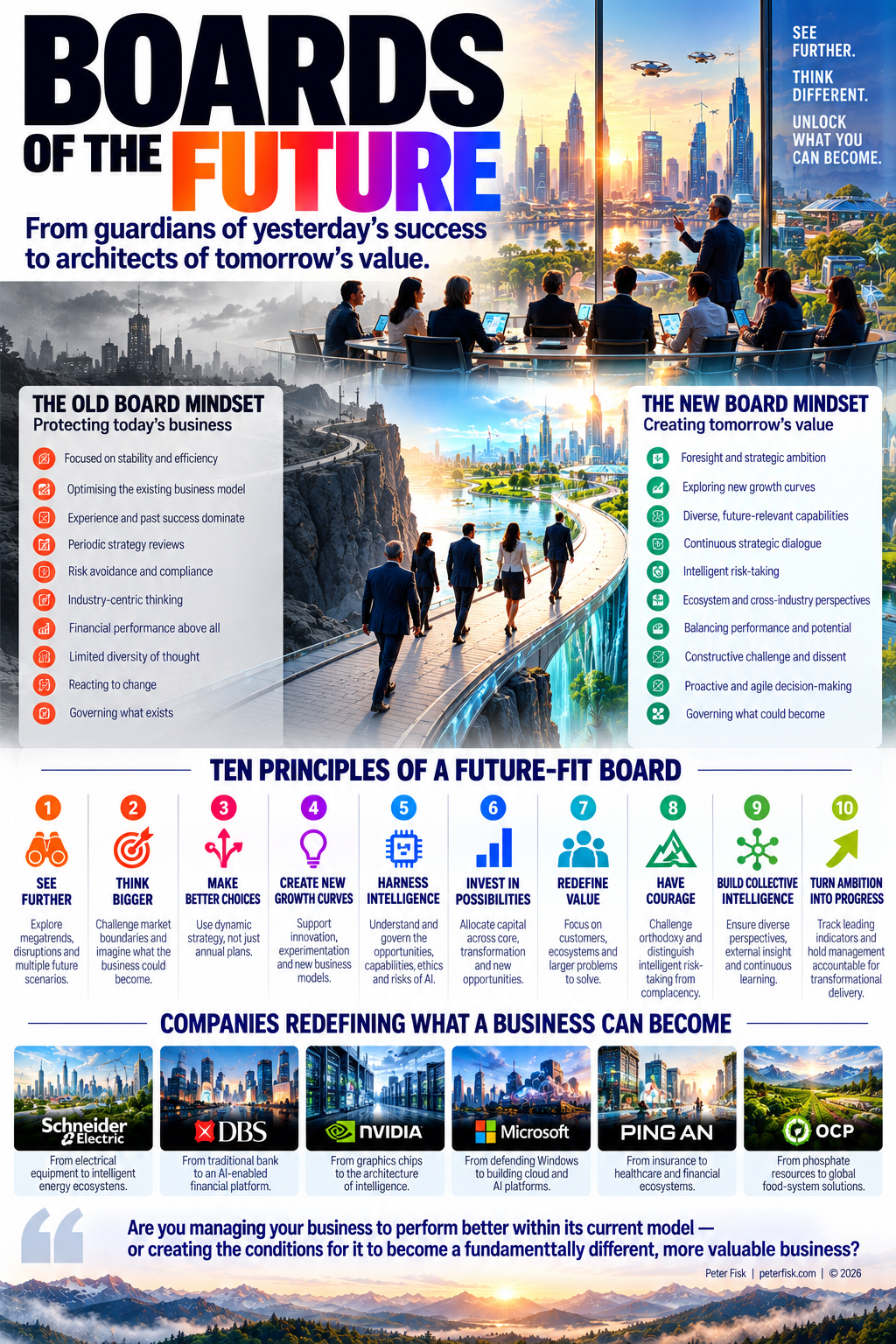
The boardroom has a future-readiness problem
The evidence suggests that many directors recognise the problem themselves. PwC’s September 2026 Annual Corporate Directors Survey found that
- 55% of directors believe at least one colleague should be replaced
- 71% identify AI as a capability their board needs to strengthen
- 81% believe their boards could challenge management more effectively on strategy
- 81% place high importance on cultural fit when recruiting directors
- 27% say the same about specialised expertise.
These are extraordinary findings. At precisely the moment when businesses need to challenge conventional thinking, boards continue to prioritise familiarity and compatibility. Experience matters, but experience can also reinforce yesterday’s assumptions. A distinguished career in an industry can make someone an invaluable adviser on how that industry works, while making it harder to imagine how the industry might cease to work in the same way.
The problem is compounded by how boards spend their time. Financial reporting, audit, remuneration, regulatory compliance, cybersecurity and succession planning can consume the agenda. These responsibilities are necessary, but the danger is that the urgent repeatedly displaces the important. A board can spend hours discussing a 2% deviation from its annual budget while devoting minutes to a technological disruption that could destroy half its market within five years.
The question is not whether boards need more information. They need different information, better questions and more courage to challenge the assumptions behind existing strategies.
BDO’s October 2026 board survey reinforces the challenge: 51% of directors identify keeping pace with AI and emerging technologies as a leading challenge, while 35% cite capital allocation amid resource constraints.
The implications go beyond recruiting a younger director or adding an AI expert. Boards need to change their collective mindset, operating rhythm and definition of good governance.
A board that only understands the business as it exists today cannot adequately govern the business it needs to become tomorrow.
From protecting value to creating future value
The economic logic is straightforward. The value of a business is fundamentally connected to the future cash flows it is expected to generate, adjusted for their risk and the cost of capital. Its current assets, products and profits matter because they help investors assess that future. But the future is not simply an extension of the past.
A business might deliver excellent current returns while its long-term growth prospects deteriorate. Another might invest heavily in new capabilities, depressing near-term earnings while creating the foundations for a much more valuable future.
The board’s responsibility is to understand both.
Consider the difference between Kodak and Fujifilm. Both confronted the collapse of photographic film as digital imaging transformed consumer behaviour. Kodak famously developed important digital technologies but struggled to escape the economics and assumptions of its traditional business. Fujifilm used capabilities in chemistry, imaging and precision materials to build businesses in healthcare and advanced materials.
The lesson is not that one company had intelligent people and the other did not. It is that recognising disruption is different from mobilising an organisation to reinvent itself. That requires leaders to question the future relevance of existing assets, redirect capital, develop new capabilities and accept that tomorrow’s business may look fundamentally different from today’s.
The same challenge now faces companies across financial services, automotive manufacturing, healthcare, construction, retail and professional services.
For boards, the strategic question must shift from How do we protect the value of what we have? to How do we unlock the value of what we could become?
This is what I call the reinvention premium: the additional value that can arise when investors recognise credible opportunities for future growth beyond the company’s existing business model. It is not a guaranteed valuation uplift. It depends on whether the organisation can translate future possibilities into sustainable economic performance.
The companies redefining what a business can become
The most interesting examples of business reinvention are not necessarily companies adopting the latest technology. They are organisations using new capabilities to redefine their purpose, competitive boundaries and sources of value.
- Schneider Electric: From electrical equipment to intelligent energy ecosystems. Schneider Electric has expanded its strategic relevance from supplying electrical and automation products towards enabling energy management, industrial intelligence and sustainability. Electrification, data centres, connected infrastructure and software are creating growth opportunities that extend beyond its historical product categories. The board-level lesson is that redefining the customer problem can dramatically expand the possibilities for growth.
- DBS: From traditional banking to an AI-enabled financial platform. Singapore’s DBS has combined digital transformation, data, AI and a customer-centred culture to rethink how banking works. Its 2025 annual report describes more than 2,000 AI models and over 430 use cases delivering approximately S$1 billion in economic value. Its ambition to become an AI-enabled bank with a heart captures an important principle: technology should enhance both economic performance and customer outcomes.
- Nvidia: From graphics chips to the architecture of intelligence. Nvidia demonstrates how an organisation can repeatedly redefine the market in which it competes. What began as leadership in graphics processing has expanded into accelerated computing, AI infrastructure, networking, software and increasingly comprehensive technology ecosystems. The lesson for boards is to look beyond today’s products towards the capabilities that could underpin entirely new markets.
- Microsoft: From defending Windows to building cloud and AI platforms. Microsoft’s reinvention under Satya Nadella illustrates the power of shifting from protecting a dominant product franchise towards enabling customers and developers through cloud services, subscriptions, ecosystems and AI. Such a transformation requires changes in culture, investment priorities, partnerships and measures of success.
- Ping An: From insurance to healthcare and financial ecosystems. China’s Ping An has developed an interconnected portfolio spanning insurance, banking, healthcare and technology-enabled services. Its broader approach challenges the assumption that an insurance company should compete only within insurance. The opportunity is to address larger customer needs, such as health, security and financial wellbeing.
- OCP Group: From phosphate resources to global food-system solutions. Morocco’s OCP illustrates how a resource-based business can develop a broader strategic ambition around soil health, sustainable fertilisation, agricultural productivity and food security. The potential is to move from supplying inputs towards creating value across a much larger ecosystem.
These examples are different in their industries, ownership structures and outcomes. None offers a simple formula for success. But they share an important characteristic: leadership has looked beyond the current definition of the business to explore what its capabilities, relationships and assets could enable next.
Boards should be challenging executives to make such possibilities visible, assess their economic potential and translate the most promising into disciplined strategic choices.
Seven shifts that define the board of the future
The reinvention of boards requires more than a change in agenda. It requires a different approach to governance, leadership, strategy and value creation. Seven shifts are particularly important.
1. From hindsight to foresight
Traditional boards spend much of their time reviewing what has happened. Future boards must devote significantly more attention to what could happen. That means exploring megatrends, technological discontinuities, geopolitical scenarios, changing customer aspirations and the emergence of new competitors.
Foresight is not about predicting one future. It is about understanding multiple plausible futures and ensuring the organisation has the strategic flexibility to respond.
The new question: Which future scenarios could make our current strategy irrelevant, and which could create extraordinary new opportunities?
2. From protecting the core to exploring new growth curves
Boards have traditionally concentrated on protecting the profitability and resilience of the core business. Future boards must also ensure that the organisation is developing its next growth curves before existing ones mature or decline.
This requires an ambidextrous mindset: improving today’s performance while investing in tomorrow’s possibilities. It means assessing a portfolio of opportunities at different stages of maturity, rather than expecting every investment to meet the same short-term financial criteria.
The new question: Where will our next significant sources of growth come from, and are we investing early enough to create them?
3. From annual strategy to dynamic strategy
The conventional strategic planning process often produces a detailed plan that is approved annually and monitored quarterly. In fast-changing markets, this can create an illusion of certainty while limiting responsiveness.
Future boards need to govern a more dynamic approach: clear strategic ambition, explicit choices, portfolios of options, continuous learning and disciplined resource reallocation. Strategy becomes an evolving system of decisions rather than a document.
The new question: What evidence would cause us to accelerate, change direction or abandon a strategic commitment?
4. From financial allocation to possibility portfolios
Capital allocation is one of the board’s most powerful responsibilities. Yet it is often dominated by established businesses that can demonstrate predictable returns, while emerging opportunities struggle to compete for resources.
Future boards should distinguish between investments that improve current performance, those that transform existing capabilities and those that explore entirely new markets. Each requires different measures of risk, progress and return.
The challenge is not simply to spend more on innovation, but to develop a disciplined portfolio of strategic possibilities.
The new question: Are we allocating capital according to yesterday’s revenues or tomorrow’s opportunities?
5. From risk avoidance to intelligent risk-taking
Effective governance is not the elimination of risk. Indeed, refusing to innovate can be one of the greatest risks a company takes.
Boards must distinguish between unacceptable risks, such as failures of safety, integrity or regulatory compliance, and strategic uncertainties that can be managed through experimentation, partnerships and staged investment. The objective is to reduce the cost of learning while increasing the organisation’s capacity to pursue valuable opportunities.
The new question: Which risks are we taking by doing nothing, and which experiments could help us explore the future responsibly?
6. From conventional expertise to collective intelligence
Future boards need a broader mix of capabilities: strategic foresight, AI and technology fluency, customer insight, innovation, business models, sustainability, capital markets and transformational leadership. But diversity of expertise is only valuable when it creates genuine diversity of thinking.
That requires psychological safety, constructive dissent and a chair who encourages challenge rather than consensus for its own sake. Boards should draw on external specialists, customers, entrepreneurs and emerging leaders, while using AI to enrich analysis and explore alternative perspectives.
The new question: Who is missing from our conversations, and which assumptions are we failing to challenge?
7. From CEO oversight to transformational partnership
The relationship between boards and CEOs must also evolve. The board should neither retreat into passive oversight nor become an alternative executive team. Its role is to create the conditions in which leaders can pursue ambitious transformation with appropriate accountability.
That means helping CEOs frame bigger possibilities, supporting difficult strategic choices, challenging the persistence of outdated business models and maintaining confidence through periods when transformation requires investment before results become visible.
The new question: Are we giving our CEO the confidence, challenge and strategic support needed to reinvent the business?
AI could reinvent the boardroom itself
Artificial intelligence is not simply another issue for boards to oversee. It could fundamentally improve how boards fulfil their responsibilities.
Imagine a board supported by intelligent systems that continuously scan emerging technologies, competitors, geopolitical developments, customer behaviour and capital markets. Instead of relying primarily on management presentations, directors could interrogate different scenarios, compare strategic options, model investment choices and identify contradictions between assumptions and evidence.
AI could provide a more dynamic picture of business performance and future potential, making board discussions more informed and forward-looking. It could also help directors identify weak signals that might otherwise remain buried within extensive board papers.
The opportunity is significant, but so are the limitations. AI can generate convincing errors, reproduce biases, expose confidential information and create false confidence in uncertain predictions. Directors must remain accountable for their judgement, ensure appropriate controls and resist the temptation to outsource difficult decisions.
The evidence suggests there is considerable room for improvement. PwC’s 2026 survey found that 82% of directors rated the information linking AI outcomes, risks and business performance as fair, poor or unavailable.
The future boardroom should combine the analytical capabilities of AI with the distinctive strengths of humanity: imagination, ethical judgement, experience, empathy, courage and the ability to understand the consequences of decisions for people and society.
AI can help boards see further and explore more possibilities. Human judgement must determine which futures are worth pursuing.
A practical reinvention agenda for boards
How might a board begin to change? The answer is not another committee or a larger volume of reporting. It is to redesign how the board thinks, what it discusses and how it evaluates progress.
I would suggest six practical actions:
- Conduct a future-readiness audit. Assess the board’s capabilities, diversity of thinking, technological fluency and capacity to challenge existing assumptions. Evaluate whether its composition reflects the future challenges of the business, rather than merely its historical success.
- Create a future-focused agenda. Dedicate substantial time to strategic foresight, emerging opportunities, new business models and potential disruptions. Use external perspectives and company examples from other industries to challenge conventional thinking.
- Define the future ambition. Work with management to articulate what the business could become over five to ten years, including the customer problems it might solve, markets it could create and capabilities it must develop.
- Build a portfolio of strategic options. Review investments across current performance, transformation and new growth opportunities. Establish explicit criteria for experimentation, scaling, stopping and reallocating capital.
- Measure performance and potential. Continue monitoring financial results, risk and operational delivery, but introduce forward-looking indicators such as innovation progress, emerging revenue streams, new capabilities, customer value and the maturity of strategic options.
- Reinvent the board’s operating model. Introduce regular scenario discussions, deeper strategic workshops, external learning experiences and more candid board evaluations. Encourage constructive disagreement and reward the willingness to challenge established assumptions.
These changes should be adapted to the organisation’s circumstances and the board’s legal responsibilities. They are not a justification for directors to interfere in daily management. The purpose is to improve the quality of strategic oversight and create stronger conditions for long-term value creation.
The ultimate responsibility: Unlocking the value of becoming
There is a fundamental paradox at the heart of modern corporate governance. Boards are entrusted with protecting the long-term interests of shareholders, yet many of their established processes encourage attention to short-term performance, existing assets and familiar business models.
But shareholders ultimately invest in the future. The market value of a business reflects expectations about the cash flows it can generate over time. And in an age of accelerating disruption, those future cash flows increasingly depend on capabilities, markets and business models that may not exist within the company today.
This changes the meaning of responsible governance.
A board that protects today’s business while allowing tomorrow’s opportunities to disappear is not necessarily fulfilling its responsibility to shareholders. Equally, a board that pursues ambitious reinvention without financial discipline, credible evidence or appropriate controls is failing in a different way.
The task is to balance performance and potential: ensuring the business delivers today while developing the possibilities that will create tomorrow’s value.
That requires directors who are curious about the world beyond their own experience, courageous enough to challenge successful formulas, and commercially disciplined enough to distinguish genuine opportunities from fashionable distractions. It requires chairs who cultivate debate, CEOs who welcome challenge and investors who understand that long-term value creation sometimes demands uncomfortable choices.
Above all, it requires a different conception of the board’s purpose.
The board of yesterday was primarily a guardian of established value. The board of the future must also become a catalyst for creating new value.
It must help the organisation see further, think differently and act faster. It must ensure that strategy is not constrained by the past, that innovation is connected to meaningful opportunities, and that capital is allocated to the future rather than simply inherited by the present.
The most dangerous board is not necessarily one that makes bad decisions. It is one that makes perfectly reasonable decisions based on assumptions that are no longer true.
The defining question for every board is therefore not simply whether the company is performing well. It is whether the company is becoming more capable of creating value in a fundamentally different future.
Are you governing the business you have, or unlocking the value of what it can become?
© Peter Fisk 2026 | Email peterfisk@peterfisk.com
Appendix 1: The Future Board Workshop
A two-day immersive workshop for boards and senior leaders to see further, think differently, and unlock the value of what their business can become.
Are you managing your business to perform better within its current model — or creating the conditions for it to become a fundamentally different, more valuable business?
Boards have traditionally been appointed to provide governance, oversight and accountability, drawing on experience to protect shareholder interests and guide executive leadership. These responsibilities remain essential. But in a world of accelerating technological disruption, AI, geopolitical uncertainty, changing customer expectations and converging industries, good governance is no longer enough. The greatest risk may not be failing to execute today’s strategy, but executing a strategy that is becoming increasingly irrelevant.
I work specifically with boards, and sometimes combined with their senior executives, to both explore the key challenges and opportunities of a changing business world, and reflecting on what this means for the business, and the board itself.
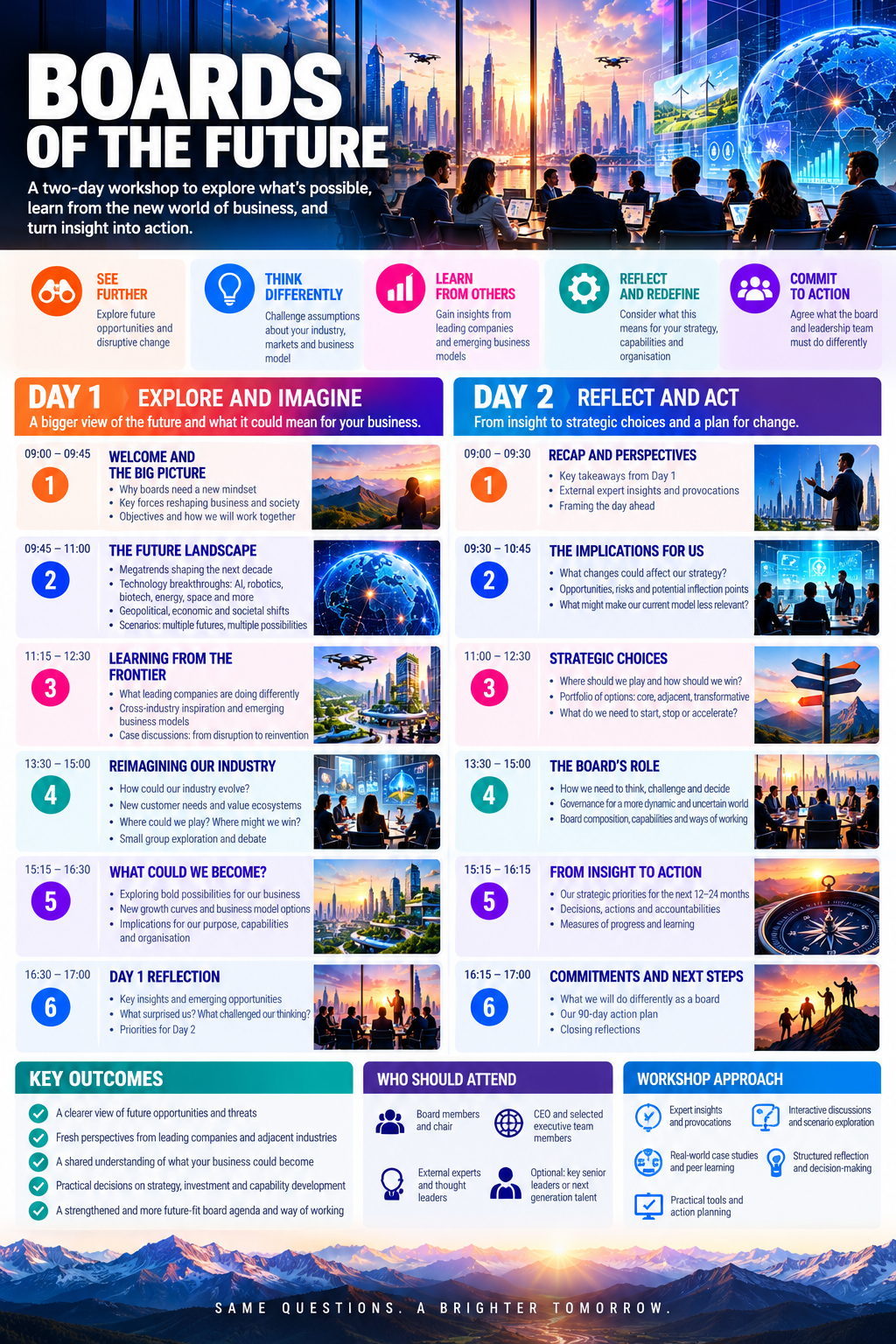
The board of the future must combine responsibility for today’s performance with the imagination and courage to create tomorrow’s value.
This two-day workshop takes board members beyond conventional governance discussions to explore the new world of business, challenge established assumptions and discover what their organisation could become. Drawing on global megatrends, emerging technologies, future scenarios and inspiring examples of companies reinventing industries, participants will explore new growth curves, innovative business models and opportunities beyond their traditional market boundaries.
The experience then turns from external inspiration to internal transformation. What do these possibilities mean for our strategic ambition, choices and investments? How should we balance performance and potential, manage uncertainty and allocate capital to emerging opportunities? And, critically, how must the board itself evolve — in its composition, capabilities, mindset, conversations and relationship with executive leadership?
Combining provocative insights, global case studies, interactive exploration and practical boardroom reflection, the workshop moves from seeing the future to shaping it. It concludes with a shared view of future opportunities, clear strategic priorities and practical commitments to what the board will do differently.
The ambition is not simply to create a better board. It is to create a future-fit board that enables a more ambitious, innovative and valuable business.
Appendix 2: The Future Board Diagnostic
Is your board governing today’s performance, or unlocking tomorrow’s potential?
This is a practical diagnostic which I use with boards, chairs and CEOs to evaluate how effectively they are preparing their organisation for a rapidly changing world.
The assessment examines 10 dimensions of future-fit governance, balancing traditional responsibilities for performance, risk and accountability with the foresight, courage, strategic agility and reinvention capabilities needed to create future value.
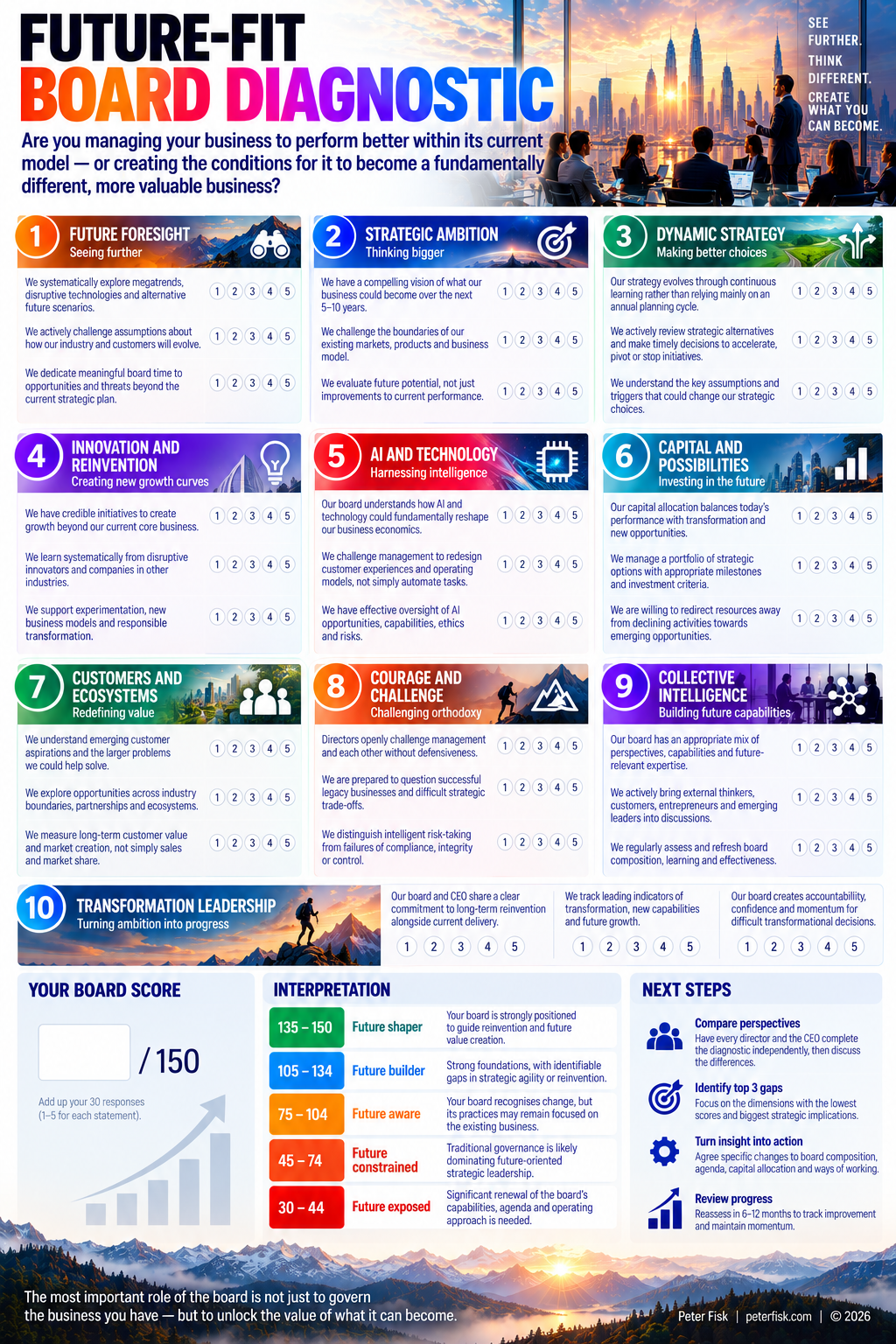
I would use this assessment in three stages. First, have every director and the CEO complete it independently. Second, compare the scores, paying particular attention to differences between the chair, independent directors and executives. Third, hold a facilitated discussion to identify the three biggest gaps and translate them into changes in board composition, agenda, capital allocation and leadership practices.
The most revealing measure may not be the average score. It may be the difference in perceptions between directors, particularly where some believe the board is future-focused while others believe it remains dominated by conventional oversight.
Four questions should conclude the discussion: What are we failing to see? Which assumptions must we challenge? Where should we redirect our attention and capital? And what must we do differently as a board in the next 90 days?
The ultimate test of a future-fit board is not how well it governs the business it inherited, but how effectively it enables the business to become more valuable.
© Peter Fisk 2026 | Email peterfisk@peterfisk.com
More from the blog